
Globalisation is basically the world becoming more connected through trade,...
 Geography223 views·Updated Jun 27, 2026·3 pages
Understanding Globalisation: Causes and Recent Acceleration

Maisie Wood@alevel.revisionnotes


1 / 3
1
of 3
Understanding Globalisation and Trade Blocs
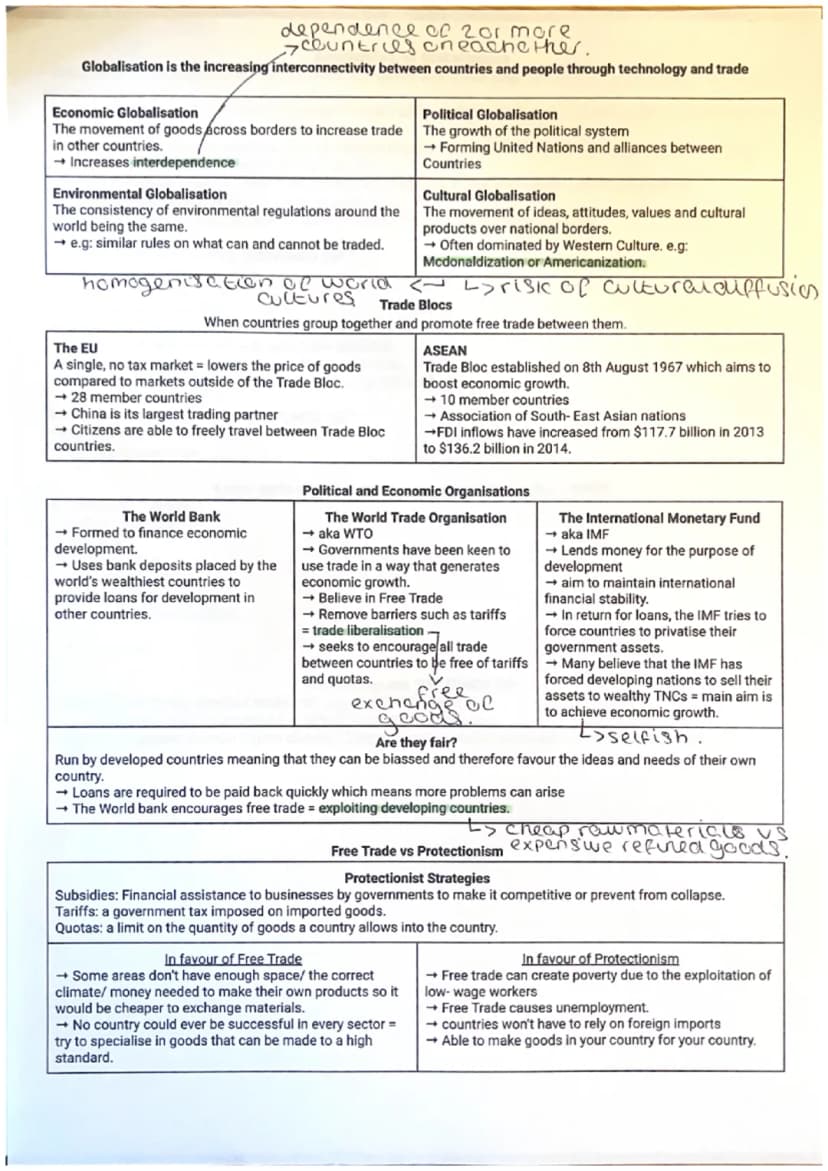
Think of globalisation as the world's biggest networking event that never ends. Globalisation means countries depend on each other more than ever before through four main types: economic (trading goods), political (forming alliances like the UN), environmental (sharing similar rules), and cultural (spreading ideas and values).
Trade blocs are like exclusive clubs where countries team up to trade without taxes between members. The EU has 28 countries where you can travel freely and buy cheaper goods, whilst ASEAN (10 Southeast Asian countries) has boosted foreign investment from $117.7 billion to $136.2 billion in just one year.
Three major organisations control global economics: the World Trade Organisation (WTO) removes trade barriers, the International Monetary Fund (IMF) lends money but forces countries to privatise assets, and the World Bank finances development using deposits from wealthy nations.
Quick Tip: Remember that these organisations are run by developed countries, so they often favour their own interests over developing nations.
The free trade vs protectionism debate is crucial for your exams. Free trade supporters argue it's cheaper and lets countries specialise, whilst protectionists use tariffs (import taxes), quotas (import limits), and subsidies (government financial help) to protect local jobs and prevent exploitation.
2
of 3
Acceleration and Global Connections
Transnational Corporations (TNCs) are the real architects of globalisation - they're companies operating in multiple countries to maximise profits. They've revolutionised how we connect through cheaper transport (containerisation), faster communication (satellites and fibre optics), and global investment opportunities.
Some countries are completely "switched on" to globalisation because they offer fast internet, international trade hubs, low taxes, excellent transport infrastructure, and cheap labour. Think of China's Special Economic Zones or Las Vegas as a tourist magnet.
Meanwhile, other nations remain "switched off" due to poor geographical location (being landlocked like Zimbabwe), political instability, high crime rates, corruption, and weak infrastructure. North Korea is the ultimate example - they follow a self-sufficiency policy, ban foreign tourism, and restrict internet access.
Remember: Large parts of Africa are bypassed by globalisation despite having valuable resources like diamonds, mainly due to political and infrastructure problems.
The key factors accelerating globalisation include economic liberalisation (relaxing laws for foreign companies), financial deregulation (fewer controls on currencies), improved transport technology, and international organisations promoting free trade.
3
of 3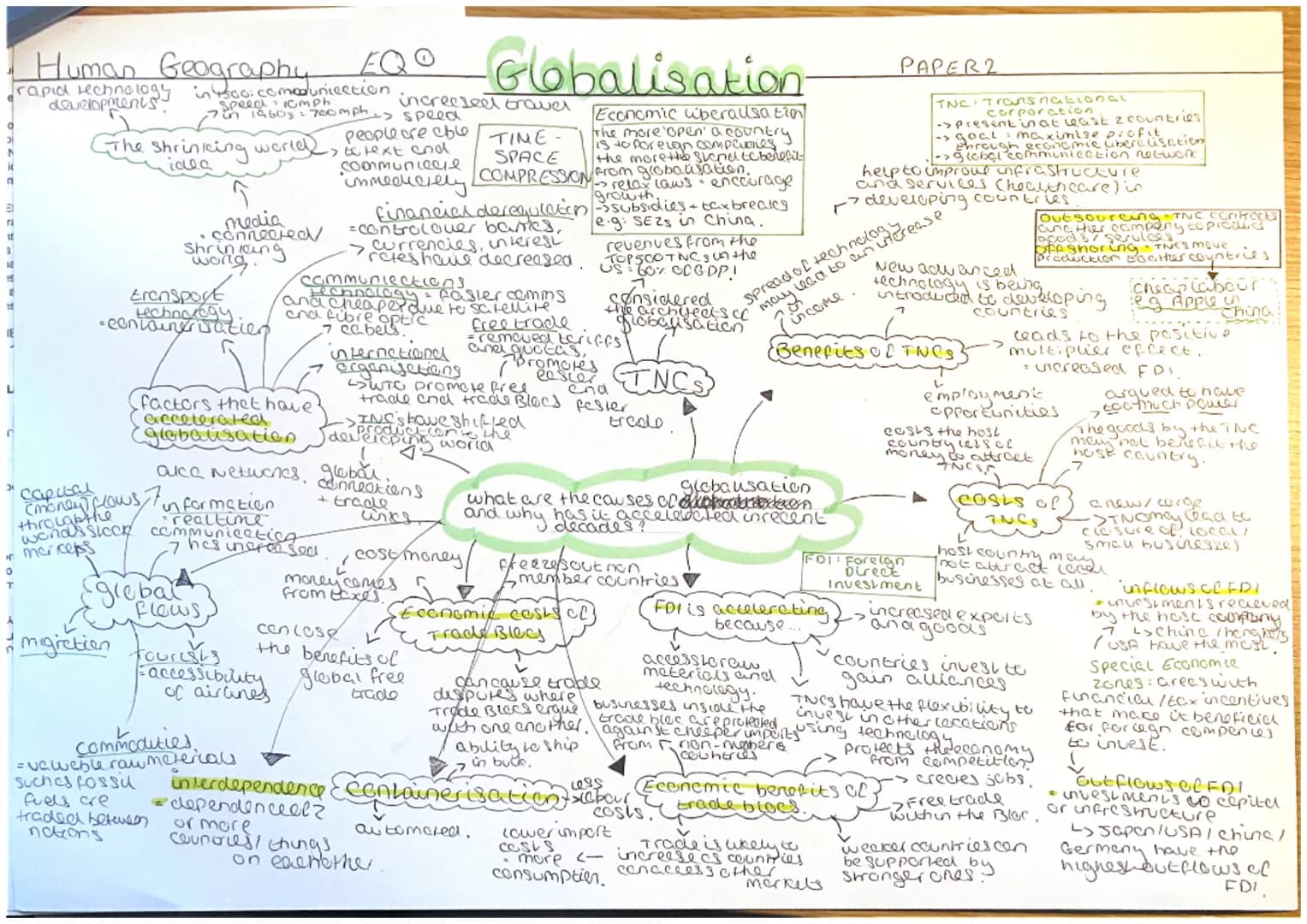
Economic Flows and Global Networks
The modern world runs on global flows - the movement of people, money, goods, and ideas across borders. Foreign Direct Investment (FDI) is massive money flowing between countries, with the USA receiving the most inflows whilst Japan, USA, China, and Germany have the highest outflows.
TNCs drive globalisation through outsourcing (hiring other companies for services) and offshoring (moving production to cheaper countries). Apple manufacturing in China is a perfect example - it creates jobs and introduces new technology but can destroy local businesses.
The benefits of TNCs include employment opportunities, increased exports, technology transfer, and the positive multiplier effect that boosts entire economies. However, they also cause local business closures and can make countries too dependent on foreign investment.
Trade blocs create economic benefits like free internal trade, lower import costs, and support for weaker member countries. But they freeze out non-members and protect businesses from potentially cheaper competition outside the bloc.
Exam Focus: You'll need to evaluate both costs and benefits of globalisation - it's rarely completely positive or negative.
The "shrinking world" concept explains how technology has made distances meaningless. Communication speeds boomed in the 1960s, containerisation revolutionised shipping, and Special Economic Zones offer tax incentives that attract massive investment.
We thought you’d never ask...
What is the Knowunity AI companion?
Our AI companion is specifically built for the needs of students. Based on the millions of content pieces we have on the platform we can provide truly meaningful and relevant answers to students. But its not only about answers, the companion is even more about guiding students through their daily learning challenges, with personalised study plans, quizzes or content pieces in the chat and 100% personalisation based on the students skills and developments.
Where can I download the Knowunity app?
You can download the app in the Google Play Store and in the Apple App Store.
Is Knowunity really free of charge?
That's right! Enjoy free access to study content, connect with fellow students, and get instant help – all at your fingertips.
Similar Content
 Wirtschaft und Recht
Most popular content: Globalization
7GeographyGlobalization & Development Dynamics
Explore the intricate relationship between globalization and economic development through key concepts such as the core-periphery model, dependency theory, and the impact of transnational corporations (TNCs). This summary provides insights into how globalization influences inequality and development strategies in emerging nations. Ideal for students preparing for Edexcel Geography Paper 1.
112973
GeographyGlobal Systems & Governance Overview
Explore the complexities of global systems and governance in this comprehensive revision guide. Covering key concepts such as international trade, globalisation, and the roles of multinational corporations, this resource provides insights into economic inequalities, environmental impacts, and the significance of global governance institutions like the UN and WTO. Ideal for A Level Geography students seeking to deepen their understanding of global geographical issues and sustainable development.
121,81480
GeographyGlobalisation Insights
Explore the dynamics of globalisation, focusing on transnational corporations (TNCs), international trade, and the impact of tectonic processes. This comprehensive overview is tailored for Edexcel A Level Geography students, highlighting key concepts such as business globalisation, migration patterns, and the benefits and challenges of globalisation. Ideal for exam preparation and understanding the interconnectedness of the global economy.
121,07539
GeographyGlobalisation Insights
Explore key concepts of globalisation, including foreign direct investment (FDI), international trade dynamics, and the benefits of a global economy. This summary provides a comprehensive overview tailored for Edexcel's enquiry question on globalisation, highlighting essential themes and their implications for economic growth and development.
1249720
GeographyGlobal Systems & Governance Insights
Explore comprehensive A Level Geography notes on Global Systems and Governance, covering key concepts such as globalisation, inequality, the Gini coefficient, and the role of international organizations like the WTO and UN. This resource provides an in-depth understanding of geopolitical issues, environmental impacts, and the dynamics of global trade and migration.
1290519
GeographyGlobalisation Metrics Explained
Explore the KOF Index and AT Kearney Index in this A-Level Geography summary. Understand how globalisation is measured through social, economic, and political dimensions, and discover the advantages and disadvantages of these metrics. Key concepts include the core-periphery model, offshoring, and the impact of globalization on the global economy and development.
121775
GeographyUnderstanding Globalisation
Explore the concept of globalisation, its historical context, and its impact on international trade, culture, and politics. This summary covers key aspects such as economic interdependence, the role of multinational corporations, and the effects of technological advancements. Ideal for A-Level students studying the Edexcel specification.
122999
Most popular content in Geography
9U
GeographyUrbanisation - AQA GCSE Geography
Some questions on key knowledge from the Urbanisation topic in GCSE Geography
98070
T
Geographytopic one- hazards flashcards set 1
Explore the fascinating world of geography with these flashcards covering diverse topics like continents, landmarks, and natural wonders. Enhance your knowledge and ace your exams!
114760
GeographyAQA GCSE Geography Paper 1 revision notes (excl. case studies)
Revision notes for the AQA GCSE Geography specification. Does not include case studies as they are selected by the school.
93,77086
E
GeographyExploring Natural Hazards: Causes and Effects
Discover the primary causes and common effects of natural hazards such as tsunamis, volcanic eruptions, hurricanes, wildfires, droughts, landslides, and more!
113230
I
GeographyIntroduction to Natural Hazard Types
Identify the differences between geological and meteorological hazards and understand the factors affecting hazard risk.
S32880
GeographyGeography Hazards & Landscapes
Explore key concepts in AQA Geography, covering rivers, coasts, natural hazards, and ecosystems. This summary highlights essential topics such as river processes, coastal management, desertification, and case studies on earthquakes and tropical storms. Ideal for exam preparation and understanding geographical systems.
103,064117
P
GeographyPaper 1? Down what else
Explore the fascinating world of geography with these flashcards covering diverse topics like continents, landmarks, and natural wonders. Enhance your knowledge and ace your exams!
114782
I
GeographyIntroduction to Global Urbanisation Concepts
Define urbanisation, explore rural-to-urban migration, and identify the push and pull factors driving global city growth.
112210
GeographyRio de Janeiro case study
AQA geography gcse
1095526
Most popular content
9 Sociology
Sociology of Education Overview
Explore comprehensive A-Level Sociology notes on the education system, covering key theories, policies, and sociological perspectives. This resource includes insights on marketisation, gender roles, cultural deprivation, and educational inequalities, providing a thorough understanding of how education shapes social stratification and individual achievement. Ideal for exam preparation and in-depth study.
12102,8693,040
SociologySociology of Families: Comprehensive Revision
Dive into an extensive overview of family dynamics, perspectives, and patterns in sociology. This resource covers key concepts such as family diversity, gender roles, marriage, and the impact of social policies on family structures. Perfect for A-Level Sociology students preparing for Paper 2.
1273,6662,307
CriminologyCriminology: Crime & Punishment Overview
Comprehensive mindmaps covering key concepts in the Crime and Punishment topic for WJEC Criminology Unit 4. This resource includes detailed insights into the Criminal Justice System, crime prevention strategies, sentencing models, and the roles of various agencies. Ideal for A-Level revision, ensuring you grasp essential theories and legislative processes to excel in your exams.
1254,8721,059
SociologyComprehensive Crime & Deviance Overview
Explore an extensive revision of crime and deviance topics, including theories, types of crime, and the impact of media. This resource covers key concepts such as Marxism, functionalism, gender and crime, and the influence of globalization on criminal behavior. Ideal for students seeking a thorough understanding of criminology and its various theories. Type: Full Topic Revision.
1251,6541,399
C
 Biology
Cell Biology and Cell structure
cell structures
93,2490
 English Literature
An Inspector Calls: Character Insights
Explore in-depth analysis and key quotes for characters in J.B. Priestley's 'An Inspector Calls'. This resource covers Gerald Croft, Inspector Goole, Sheila Birling, Mrs. Birling, Eric Birling, and Eva Smith, focusing on themes of class, gender roles, and social responsibility. Ideal for students aiming for Grade 8 and above.
1025,429907
CriminologyWJEC Unit 4 Criminology
Criminology unit 4 detailed revision note
127,151125
CriminologyCriminology Theories Overview
Explore key criminology theories and their implications on crime and deviance. This comprehensive summary covers biological, psychological, and sociological perspectives, including labelling theory, right realism, and the impact of social campaigns on policy development. Ideal for A-Level criminology students seeking to understand the complexities of criminal behaviour and the factors influencing crime prevention strategies.
129,760210
English LiteratureRomeo and Juliet: Key themes
Key Romeo and Juliet themes and analysed quotes
106,708198
Can't find what you're looking for? Explore other subjects.
Students love us — and so will you.
4.6/5App Store
4.7/5Google Play
The app is very easy to use and well designed. I have found everything I was looking for so far and have been able to learn a lot from the presentations! I will definitely use the app for a class assignment! And of course it also helps a lot as an inspiration.
Stefan SiOS user
This app is really great. There are so many study notes and help [...]. My problem subject is French, for example, and the app has so many options for help. Thanks to this app, I have improved my French. I would recommend it to anyone.
Samantha KlichAndroid user
Wow, I am really amazed. I just tried the app because I've seen it advertised many times and was absolutely stunned. This app is THE HELP you want for school and above all, it offers so many things, such as workouts and fact sheets, which have been VERY helpful to me personally.
AnnaiOS user
Geography223 views·Updated Jun 27, 2026·3 pagesUnderstanding Globalisation: Causes and Recent Acceleration
Maisie Wood@alevel.revisionnotes
Globalisation is basically the world becoming more connected through trade, technology, and culture. It's why you can buy a phone made in China, eat McDonald's in Tokyo, and chat with friends across the globe instantly.
1
of 3
Sign up to see the content. It's free!
- Access to all documents
- Improve your grades
- Join milions of students
Understanding Globalisation and Trade Blocs
Think of globalisation as the world's biggest networking event that never ends. Globalisation means countries depend on each other more than ever before through four main types: economic (trading goods), political (forming alliances like the UN), environmental (sharing similar rules), and cultural (spreading ideas and values).
Trade blocs are like exclusive clubs where countries team up to trade without taxes between members. The EU has 28 countries where you can travel freely and buy cheaper goods, whilst ASEAN (10 Southeast Asian countries) has boosted foreign investment from $117.7 billion to $136.2 billion in just one year.
Three major organisations control global economics: the World Trade Organisation (WTO) removes trade barriers, the International Monetary Fund (IMF) lends money but forces countries to privatise assets, and the World Bank finances development using deposits from wealthy nations.
Quick Tip: Remember that these organisations are run by developed countries, so they often favour their own interests over developing nations.
The free trade vs protectionism debate is crucial for your exams. Free trade supporters argue it's cheaper and lets countries specialise, whilst protectionists use tariffs (import taxes), quotas (import limits), and subsidies (government financial help) to protect local jobs and prevent exploitation.
2
of 3Sign up to see the content. It's free!
- Access to all documents
- Improve your grades
- Join milions of students
Acceleration and Global Connections
Transnational Corporations (TNCs) are the real architects of globalisation - they're companies operating in multiple countries to maximise profits. They've revolutionised how we connect through cheaper transport (containerisation), faster communication (satellites and fibre optics), and global investment opportunities.
Some countries are completely "switched on" to globalisation because they offer fast internet, international trade hubs, low taxes, excellent transport infrastructure, and cheap labour. Think of China's Special Economic Zones or Las Vegas as a tourist magnet.
Meanwhile, other nations remain "switched off" due to poor geographical location (being landlocked like Zimbabwe), political instability, high crime rates, corruption, and weak infrastructure. North Korea is the ultimate example - they follow a self-sufficiency policy, ban foreign tourism, and restrict internet access.
Remember: Large parts of Africa are bypassed by globalisation despite having valuable resources like diamonds, mainly due to political and infrastructure problems.
The key factors accelerating globalisation include economic liberalisation (relaxing laws for foreign companies), financial deregulation (fewer controls on currencies), improved transport technology, and international organisations promoting free trade.
3
of 3Sign up to see the content. It's free!
- Access to all documents
- Improve your grades
- Join milions of students
Economic Flows and Global Networks
The modern world runs on global flows - the movement of people, money, goods, and ideas across borders. Foreign Direct Investment (FDI) is massive money flowing between countries, with the USA receiving the most inflows whilst Japan, USA, China, and Germany have the highest outflows.
TNCs drive globalisation through outsourcing (hiring other companies for services) and offshoring (moving production to cheaper countries). Apple manufacturing in China is a perfect example - it creates jobs and introduces new technology but can destroy local businesses.
The benefits of TNCs include employment opportunities, increased exports, technology transfer, and the positive multiplier effect that boosts entire economies. However, they also cause local business closures and can make countries too dependent on foreign investment.
Trade blocs create economic benefits like free internal trade, lower import costs, and support for weaker member countries. But they freeze out non-members and protect businesses from potentially cheaper competition outside the bloc.
Exam Focus: You'll need to evaluate both costs and benefits of globalisation - it's rarely completely positive or negative.
The "shrinking world" concept explains how technology has made distances meaningless. Communication speeds boomed in the 1960s, containerisation revolutionised shipping, and Special Economic Zones offer tax incentives that attract massive investment.
We thought you’d never ask...
What is the Knowunity AI companion?
Our AI companion is specifically built for the needs of students. Based on the millions of content pieces we have on the platform we can provide truly meaningful and relevant answers to students. But its not only about answers, the companion is even more about guiding students through their daily learning challenges, with personalised study plans, quizzes or content pieces in the chat and 100% personalisation based on the students skills and developments.
Where can I download the Knowunity app?
You can download the app in the Google Play Store and in the Apple App Store.
Is Knowunity really free of charge?
That's right! Enjoy free access to study content, connect with fellow students, and get instant help – all at your fingertips.
Similar Content
Most popular content: Globalization
7GeographyGlobalization & Development Dynamics
Explore the intricate relationship between globalization and economic development through key concepts such as the core-periphery model, dependency theory, and the impact of transnational corporations (TNCs). This summary provides insights into how globalization influences inequality and development strategies in emerging nations. Ideal for students preparing for Edexcel Geography Paper 1.
112973
GeographyGlobal Systems & Governance Overview
Explore the complexities of global systems and governance in this comprehensive revision guide. Covering key concepts such as international trade, globalisation, and the roles of multinational corporations, this resource provides insights into economic inequalities, environmental impacts, and the significance of global governance institutions like the UN and WTO. Ideal for A Level Geography students seeking to deepen their understanding of global geographical issues and sustainable development.
121,81480
GeographyGlobalisation Insights
Explore the dynamics of globalisation, focusing on transnational corporations (TNCs), international trade, and the impact of tectonic processes. This comprehensive overview is tailored for Edexcel A Level Geography students, highlighting key concepts such as business globalisation, migration patterns, and the benefits and challenges of globalisation. Ideal for exam preparation and understanding the interconnectedness of the global economy.
121,07539
GeographyGlobalisation Insights
Explore key concepts of globalisation, including foreign direct investment (FDI), international trade dynamics, and the benefits of a global economy. This summary provides a comprehensive overview tailored for Edexcel's enquiry question on globalisation, highlighting essential themes and their implications for economic growth and development.
1249720
GeographyGlobal Systems & Governance Insights
Explore comprehensive A Level Geography notes on Global Systems and Governance, covering key concepts such as globalisation, inequality, the Gini coefficient, and the role of international organizations like the WTO and UN. This resource provides an in-depth understanding of geopolitical issues, environmental impacts, and the dynamics of global trade and migration.
1290519
GeographyGlobalisation Metrics Explained
Explore the KOF Index and AT Kearney Index in this A-Level Geography summary. Understand how globalisation is measured through social, economic, and political dimensions, and discover the advantages and disadvantages of these metrics. Key concepts include the core-periphery model, offshoring, and the impact of globalization on the global economy and development.
121775
GeographyUnderstanding Globalisation
Explore the concept of globalisation, its historical context, and its impact on international trade, culture, and politics. This summary covers key aspects such as economic interdependence, the role of multinational corporations, and the effects of technological advancements. Ideal for A-Level students studying the Edexcel specification.
122999
Most popular content in Geography
9U
GeographyUrbanisation - AQA GCSE Geography
Some questions on key knowledge from the Urbanisation topic in GCSE Geography
98070
T
Geographytopic one- hazards flashcards set 1
Explore the fascinating world of geography with these flashcards covering diverse topics like continents, landmarks, and natural wonders. Enhance your knowledge and ace your exams!
114760
GeographyAQA GCSE Geography Paper 1 revision notes (excl. case studies)
Revision notes for the AQA GCSE Geography specification. Does not include case studies as they are selected by the school.
93,77086
E
GeographyExploring Natural Hazards: Causes and Effects
Discover the primary causes and common effects of natural hazards such as tsunamis, volcanic eruptions, hurricanes, wildfires, droughts, landslides, and more!
113230
I
GeographyIntroduction to Natural Hazard Types
Identify the differences between geological and meteorological hazards and understand the factors affecting hazard risk.
S32880
GeographyGeography Hazards & Landscapes
Explore key concepts in AQA Geography, covering rivers, coasts, natural hazards, and ecosystems. This summary highlights essential topics such as river processes, coastal management, desertification, and case studies on earthquakes and tropical storms. Ideal for exam preparation and understanding geographical systems.
103,064117
P
GeographyPaper 1? Down what else
Explore the fascinating world of geography with these flashcards covering diverse topics like continents, landmarks, and natural wonders. Enhance your knowledge and ace your exams!
114782
I
GeographyIntroduction to Global Urbanisation Concepts
Define urbanisation, explore rural-to-urban migration, and identify the push and pull factors driving global city growth.
112210
GeographyRio de Janeiro case study
AQA geography gcse
1095526
Most popular content
9SociologySociology of Education Overview
Explore comprehensive A-Level Sociology notes on the education system, covering key theories, policies, and sociological perspectives. This resource includes insights on marketisation, gender roles, cultural deprivation, and educational inequalities, providing a thorough understanding of how education shapes social stratification and individual achievement. Ideal for exam preparation and in-depth study.
12102,8693,040
SociologySociology of Families: Comprehensive Revision
Dive into an extensive overview of family dynamics, perspectives, and patterns in sociology. This resource covers key concepts such as family diversity, gender roles, marriage, and the impact of social policies on family structures. Perfect for A-Level Sociology students preparing for Paper 2.
1273,6662,307
CriminologyCriminology: Crime & Punishment Overview
Comprehensive mindmaps covering key concepts in the Crime and Punishment topic for WJEC Criminology Unit 4. This resource includes detailed insights into the Criminal Justice System, crime prevention strategies, sentencing models, and the roles of various agencies. Ideal for A-Level revision, ensuring you grasp essential theories and legislative processes to excel in your exams.
1254,8721,059
SociologyComprehensive Crime & Deviance Overview
Explore an extensive revision of crime and deviance topics, including theories, types of crime, and the impact of media. This resource covers key concepts such as Marxism, functionalism, gender and crime, and the influence of globalization on criminal behavior. Ideal for students seeking a thorough understanding of criminology and its various theories. Type: Full Topic Revision.
1251,6541,399
C
BiologyCell Biology and Cell structure
cell structures
93,2490
English LiteratureAn Inspector Calls: Character Insights
Explore in-depth analysis and key quotes for characters in J.B. Priestley's 'An Inspector Calls'. This resource covers Gerald Croft, Inspector Goole, Sheila Birling, Mrs. Birling, Eric Birling, and Eva Smith, focusing on themes of class, gender roles, and social responsibility. Ideal for students aiming for Grade 8 and above.
1025,429907
CriminologyWJEC Unit 4 Criminology
Criminology unit 4 detailed revision note
127,151125
CriminologyCriminology Theories Overview
Explore key criminology theories and their implications on crime and deviance. This comprehensive summary covers biological, psychological, and sociological perspectives, including labelling theory, right realism, and the impact of social campaigns on policy development. Ideal for A-Level criminology students seeking to understand the complexities of criminal behaviour and the factors influencing crime prevention strategies.
129,760210
English LiteratureRomeo and Juliet: Key themes
Key Romeo and Juliet themes and analysed quotes
106,708198
Can't find what you're looking for? Explore other subjects.
Students love us — and so will you.
4.6/5App Store
4.7/5Google Play
The app is very easy to use and well designed. I have found everything I was looking for so far and have been able to learn a lot from the presentations! I will definitely use the app for a class assignment! And of course it also helps a lot as an inspiration.
Stefan SiOS user
This app is really great. There are so many study notes and help [...]. My problem subject is French, for example, and the app has so many options for help. Thanks to this app, I have improved my French. I would recommend it to anyone.
Samantha KlichAndroid user
Wow, I am really amazed. I just tried the app because I've seen it advertised many times and was absolutely stunned. This app is THE HELP you want for school and above all, it offers so many things, such as workouts and fact sheets, which have been VERY helpful to me personally.
AnnaiOS user