
This GCSE Geography guide covers the essential topics you need...
 Geography979 views·Updated Jun 17, 2026·17 pages
Comprehensive Geography Knowledge Organisers for OCR B
B
Benz in nenz@nenzinabenz




1 / 10
1
of 10
GCSE Geography Overview
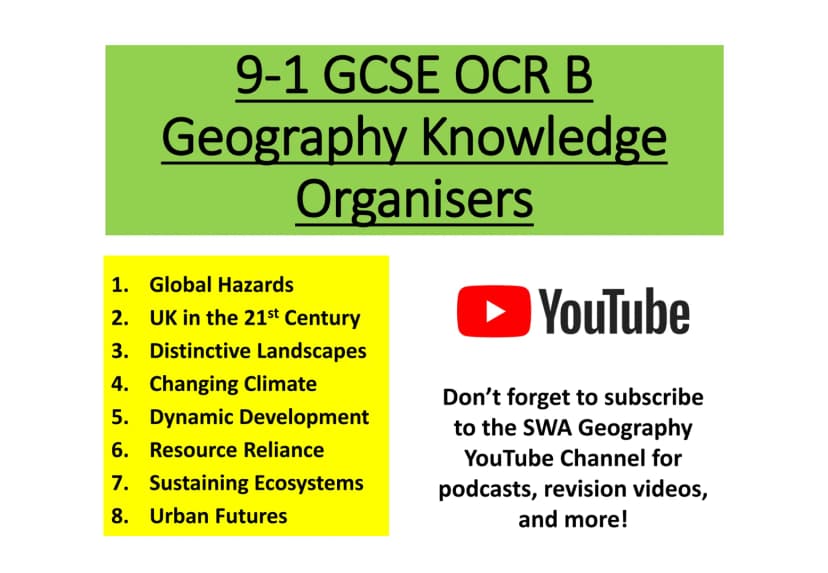
You've got eight major topics to tackle in your GCSE Geography course, and each one connects to real-world issues happening right now. Global Hazards explores natural disasters like earthquakes and hurricanes, while UK in the 21st Century examines how our country is evolving. Distinctive Landscapes looks at the physical features that make places unique.
The course also covers Changing Climate - one of the biggest challenges facing our planet today. Dynamic Development helps you understand why some countries are wealthy whilst others struggle with poverty. Resource Reliance examines how we depend on natural resources, and Sustaining Ecosystems focuses on protecting our environment.
Finally, Urban Futures explores how cities are growing and changing. These topics aren't just academic - they're about understanding the world you're living in and the challenges you'll face as adults.
Quick Tip: Don't forget to check out SWA Geography's YouTube channel for extra revision support and podcasts that make these topics come alive!
2
of 10
Global Air Circulation and Climate Patterns
The global circulation system is basically Earth's way of moving heat around the planet - think of it as a massive air conditioning system. Three main circulation cells do most of the work: Hadley cells , Ferrel cells , and Polar cells (the smallest, covering the poles).
This system creates distinct climate zones that you can see on any world map. Tropical climates around the equator get heavy rainfall and thunderstorms (like Brazil), whilst desert climates at 30° north and south stay hot and dry (think Libya). Temperate climates like the UK sit between 50-60° and get frequent rainfall, whilst polar climates stay cold and windy.
High and low pressure systems drive our daily weather. When cold air sinks, it creates high pressure and clear, calm weather. When hot air rises, you get low pressure, which brings stormy, cloudy conditions. Understanding this helps explain why some places are naturally wetter or drier than others.
Remember: Air always moves from high pressure to low pressure areas - this creates wind, which can range from gentle trade winds to powerful jet streams travelling at 225km/h!
3
of 10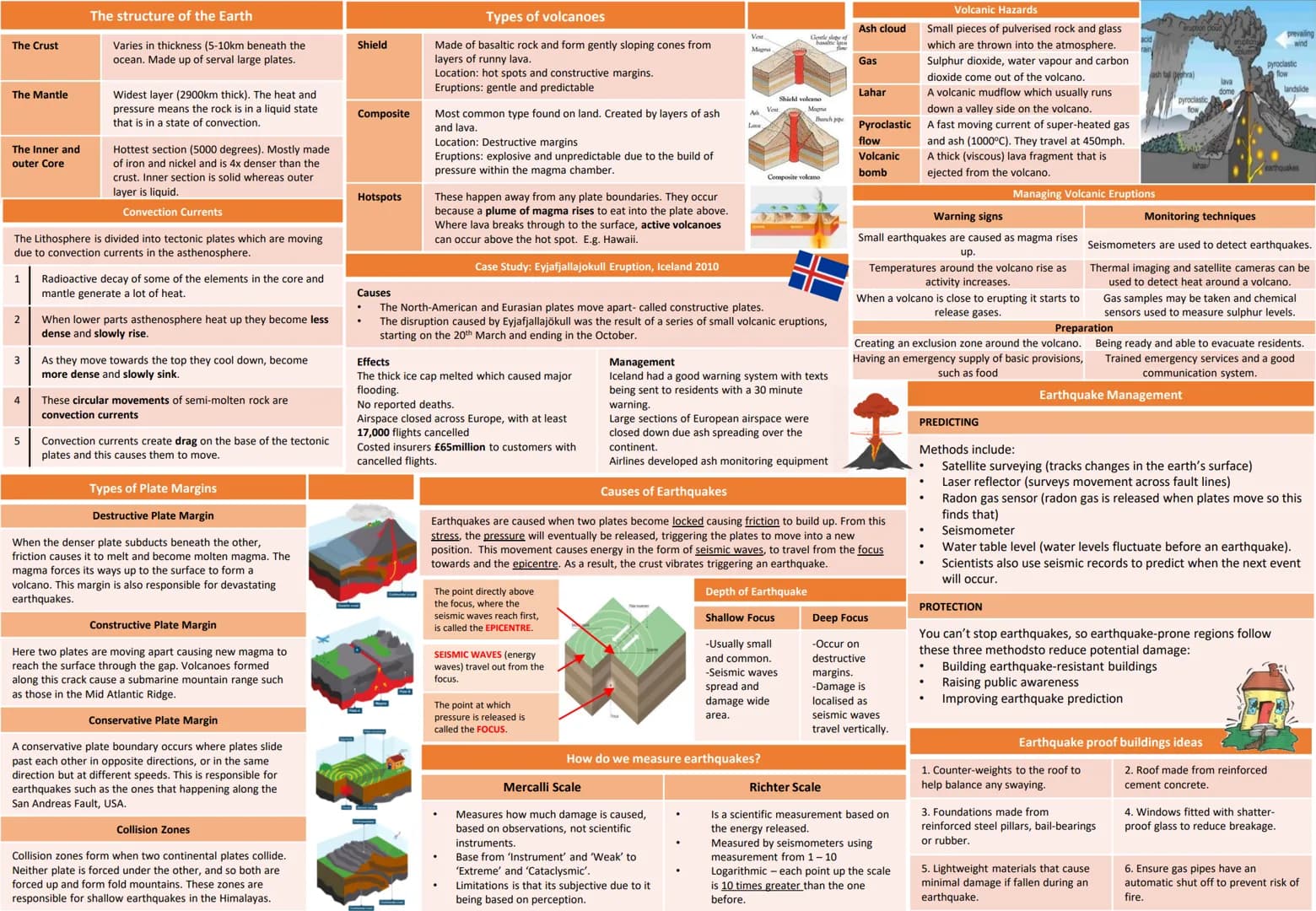
Earth's Structure and Tectonic Activity
Imagine Earth as a giant onion with different layers. The crust sits on top of the mantle , which surrounds the core (the hottest bit at 5,000°C, made of iron and nickel). Convection currents in the mantle work like a lava lamp - hot rock rises, cools, then sinks, creating a circular movement that drags tectonic plates around.
Plate boundaries come in different types, each creating specific hazards. Destructive margins occur when one plate slides under another, creating volcanoes and earthquakes. Constructive margins happen where plates pull apart, forming new ocean floor and gentle volcanic activity. Conservative margins see plates sliding past each other, causing earthquakes but no volcanoes.
Volcanoes vary depending on where they form. Shield volcanoes create gentle slopes with predictable, less dangerous eruptions. Composite volcanoes are the dangerous ones - they're explosive and unpredictable because pressure builds up in the magma chamber. Some volcanoes form at hotspots away from plate boundaries, like the Hawaiian islands.
Case Study Alert: Iceland's Eyjafjallajökull eruption in 2010 shows how even small volcanic events can have massive global impacts - it cancelled 17,000 flights across Europe!
4
of 10
UK Physical Geography and Population
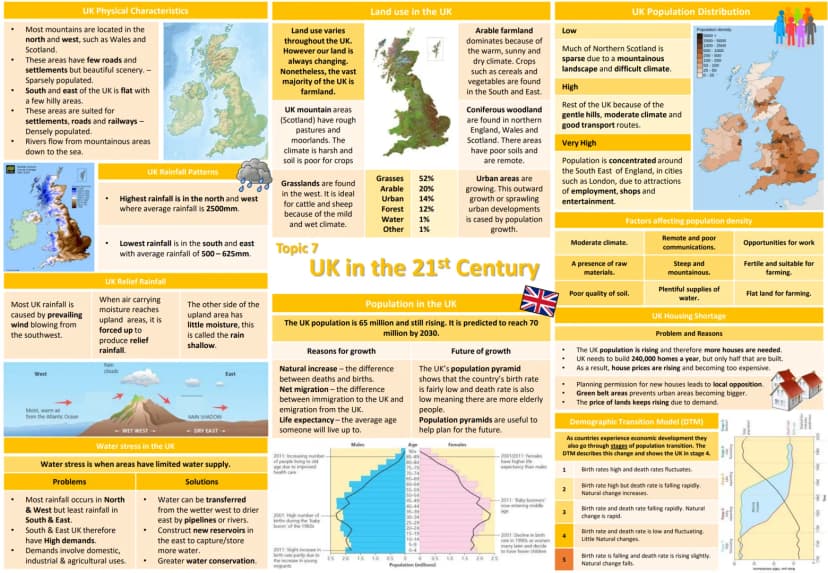
The UK's landscape tells a story shaped by geology, climate, and human activity. Mountains dominate the north and west (Scotland, Wales) where it's wetter and sparsely populated, whilst the south and east are flatter, drier, and packed with people. This pattern exists because prevailing winds from the southwest bring moisture that gets dumped on upland areas through relief rainfall, leaving the east in a rain shadow.
Water stress affects the southeast because that's where most people live but least rain falls. The UK tackles this through water transfer schemes - moving water from wet areas to dry ones via pipelines. The country also builds reservoirs and promotes water conservation to meet growing demands.
Population distribution isn't random - it follows clear patterns. Very high density around London and the southeast reflects job opportunities and good transport links. Much of northern Scotland stays sparse due to mountains and harsh climate. The UK's growing population (heading towards 70 million by 2030) creates a housing shortage because we're only building half the 240,000 homes needed annually.
The Demographic Transition Model shows the UK in stage 4, with low birth and death rates creating slow population growth. However, an ageing population means more people over 65, especially in coastal areas, creating challenges for healthcare and pensions.
Key Insight: The UK's physical geography directly influences where people live, work, and face challenges - understanding this connection is crucial for your exam!
5
of 10
UK's Changing Society and Economy
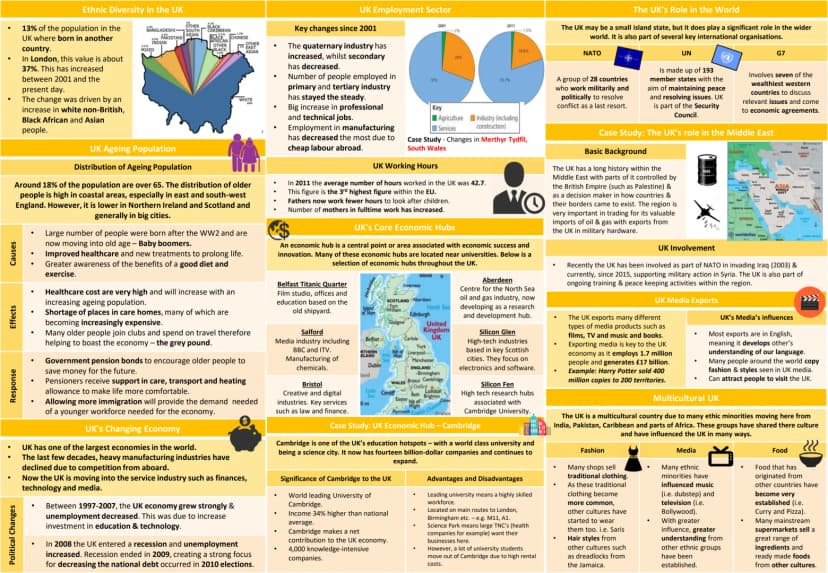
Modern Britain is incredibly diverse - 13% of the population was born abroad, rising to 37% in London. This ethnic diversity has transformed British culture, influencing everything from food (curry is now a national dish) to music and fashion. The UK has genuinely become a multicultural society where different traditions blend together.
The UK's economy has shifted dramatically from heavy manufacturing to service industries like finance, technology, and media. This change accelerated after the 2008 recession, with quaternary industries growing whilst manufacturing declined due to cheaper labour abroad. Most economic growth now happens in economic hubs like Cambridge, which combines world-class universities with high-tech companies.
Regional differences are stark across the UK. Scotland's Silicon Glen focuses on electronics, whilst Belfast's Titanic Quarter has become a media hub. Cambridge stands out as a science city with over 4,000 knowledge-intensive companies and incomes 34% higher than the national average. However, high costs push many graduates away.
Britain's global influence extends far beyond its size. The UK plays key roles in NATO, the UN Security Council, and G7, whilst British media exports like Harry Potter reach 200 territories. The country's multicultural identity and English language help spread British culture worldwide, attracting tourists and maintaining international connections.
Think About It: How has the shift from manufacturing to services affected your local area? Look for evidence of old industrial sites being converted to new uses!
6
of 10
Distinctive UK Landscapes
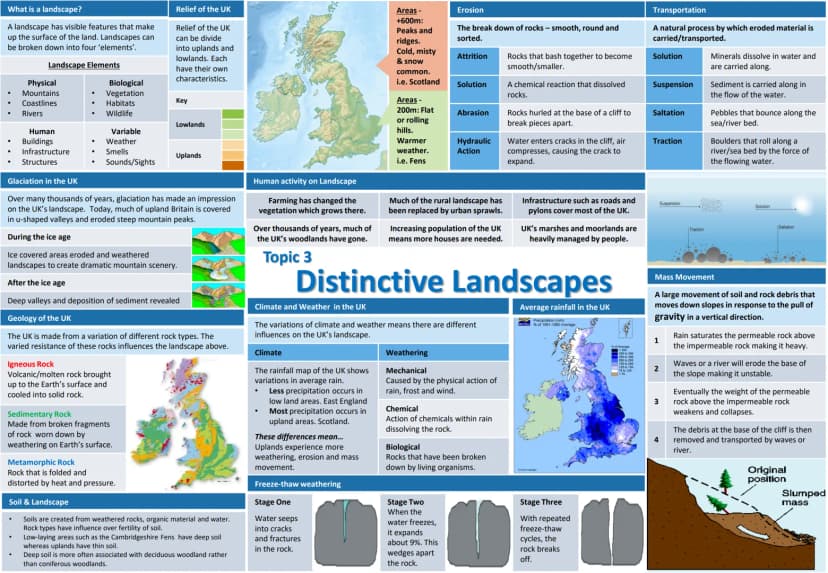
British landscapes are like a geographical story book - each region tells you about the rocks, climate, and human activity that shaped it. The UK's varied geology includes hard igneous rocks (formed from cooled lava), layered sedimentary rocks (made from weathered fragments), and twisted metamorphic rocks (changed by heat and pressure). These different rock types create everything from Scotland's dramatic mountains to East Anglia's flat farmland.
Glaciation left a massive mark during ice ages, carving U-shaped valleys and creating the steep mountain peaks you see in upland areas today. When the ice melted, it revealed deep valleys and deposited sediment that now forms fertile lowlands. Climate continues shaping landscapes through freeze-thaw weathering in upland areas, where water freezes in rock cracks and splits them apart.
Human impact has been enormous over thousands of years. Most of Britain's original woodland disappeared long ago, replaced by farmland, cities, and infrastructure. Mass movement occurs where slopes become unstable - heavy rain saturates permeable rock above impermeable rock, creating landslides when the weight becomes too much.
The contrast between upland and lowland Britain couldn't be clearer. Uplands experience harsh weather, thin soils, and coniferous forests, whilst lowlands enjoy milder conditions, deep fertile soils, and deciduous woodland. This explains why most people live in lowland areas.
Field Tip: Next time you're outdoors, try to identify whether you're looking at weathering, erosion, or deposition - these processes are happening everywhere around you!
7
of 10
Coastal and River Processes
Coastal landscapes constantly change through erosion, transportation, and deposition. Hydraulic action occurs when waves crash into cliffs, compressing air in cracks and gradually widening them. Abrasion happens when waves hurl rocks at cliff bases, whilst attrition rounds and smooths rocks as they bash together. These processes create spectacular features like the coastal stacks at Old Harry Rocks in Dorset.
Longshore drift moves material along beaches in a zigzag pattern. Swash carries material up the beach at the angle of prevailing winds, whilst backwash pulls it straight down due to gravity. This process creates spits - curved beaches that extend into the sea until they reach river estuaries, often developing salt marshes in their sheltered areas.
River landscapes change from source to mouth. In the upper course, steep gradients give rivers energy to erode vertically, creating V-shaped valleys and waterfalls. The middle course sees gentler gradients and lateral erosion, forming meanders. The lower course features deposition, creating floodplains and oxbow lakes when meanders get cut off.
Management strategies vary between hard and soft engineering. Hard defences like sea walls and groynes provide immediate protection but can be expensive and cause problems elsewhere. Soft approaches like beach nourishment and managed retreat work with natural processes but require ongoing maintenance.
Case Study Connection: Walton-on-the-Naze demonstrates how coastal management requires multiple strategies working together - no single solution fits every situation!
8
of 10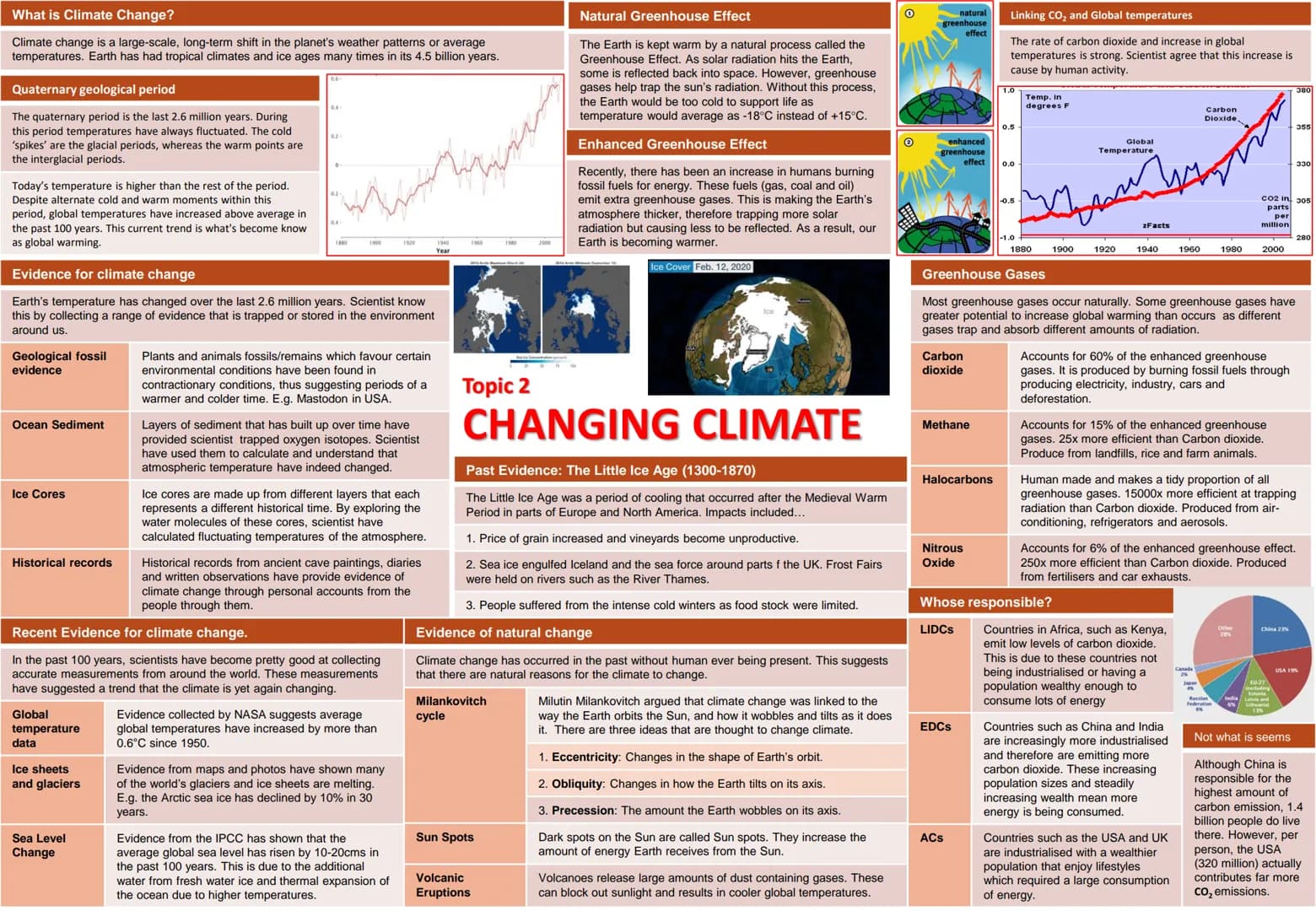
Climate Change Evidence and Causes
Climate change isn't new - Earth's temperature has fluctuated for millions of years. During the Quaternary period (last 2.6 million years), we've seen ice ages followed by warmer interglacial periods. Scientists know this from ice cores (which trap ancient atmospheres), ocean sediments (showing changing conditions), and fossil evidence (revealing past environments).
However, recent change is different. Global temperature data shows average temperatures have risen 0.6°C since 1950, whilst ice sheets and glaciers are melting rapidly - Arctic sea ice has declined 10% in 30 years. Sea levels have risen 10-20cm in the past century due to thermal expansion of warming oceans and melting ice.
The enhanced greenhouse effect explains what's happening. Naturally, greenhouse gases keep Earth 33°C warmer than it would be otherwise - without them, average temperature would be -18°C instead of +15°C. But burning fossil fuels adds extra carbon dioxide, methane, nitrous oxide, and halocarbons to the atmosphere, trapping more heat.
Responsibility varies globally. LIDCs like Kenya emit very little because they're not industrialised. EDCs like China and India are rapidly increasing emissions as they develop. ACs like the USA and UK have high per-capita emissions due to energy-intensive lifestyles, though some are now reducing total emissions.
Key Point: The link between rising CO₂ levels and global temperatures is undeniable - this correlation provides the strongest evidence for human-caused climate change!
9
of 10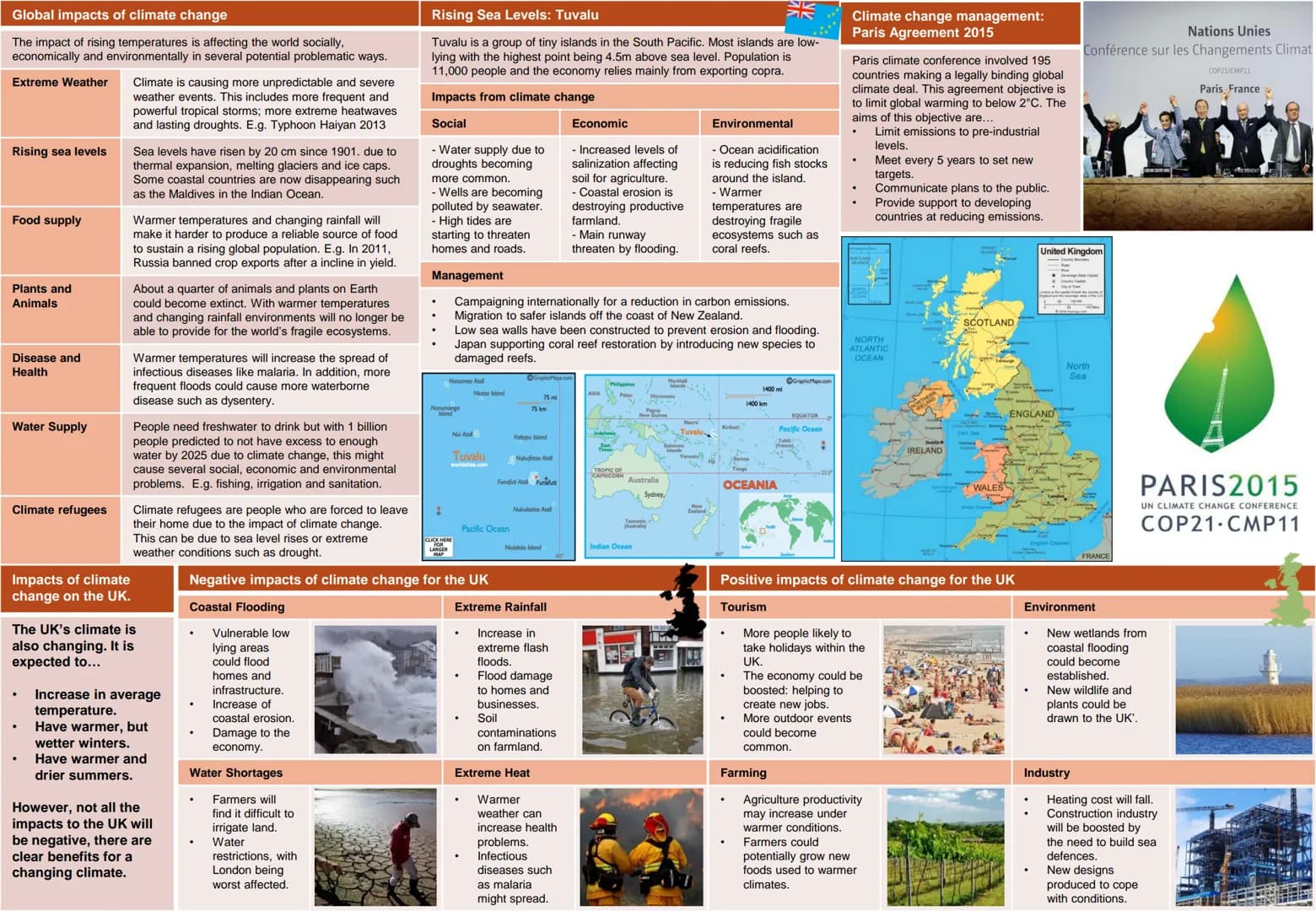
Climate Change Impacts and Responses
Global impacts of climate change are already visible and accelerating. Extreme weather events like Hurricane Haiyan (2013) are becoming more frequent and powerful. Rising sea levels threaten island nations - the Maldives could disappear entirely. Food security faces challenges as changing rainfall patterns disrupt agriculture, forcing countries like Russia to ban crop exports during droughts.
Climate refugees represent a growing humanitarian crisis as people flee sea level rise, droughts, and extreme weather. Disease patterns are shifting too - warmer temperatures allow malaria mosquitoes to spread to new areas, whilst floods increase waterborne diseases like dysentery.
The UK faces mixed impacts. Negative effects include increased coastal flooding, water shortages (especially affecting London), extreme rainfall causing flash floods, and heat-related health problems. However, there are positive aspects - tourism might increase, farmers could grow new crops, and heating costs will fall.
Tuvalu provides a stark example of climate change reality. This Pacific island nation faces saltwater contamination of freshwater supplies, coastal erosion destroying farmland, and coral reef destruction reducing fish stocks. The government is exploring migration agreements with New Zealand whilst building sea walls and campaigning for global emissions reductions.
International cooperation is essential. The Paris Agreement (2015) saw 195 countries commit to limiting warming below 2°C, though achieving this requires massive changes in how we produce and use energy.
Think Global, Act Local: Climate change impacts vary by location, but the solutions require both international cooperation and individual action!
10
of 10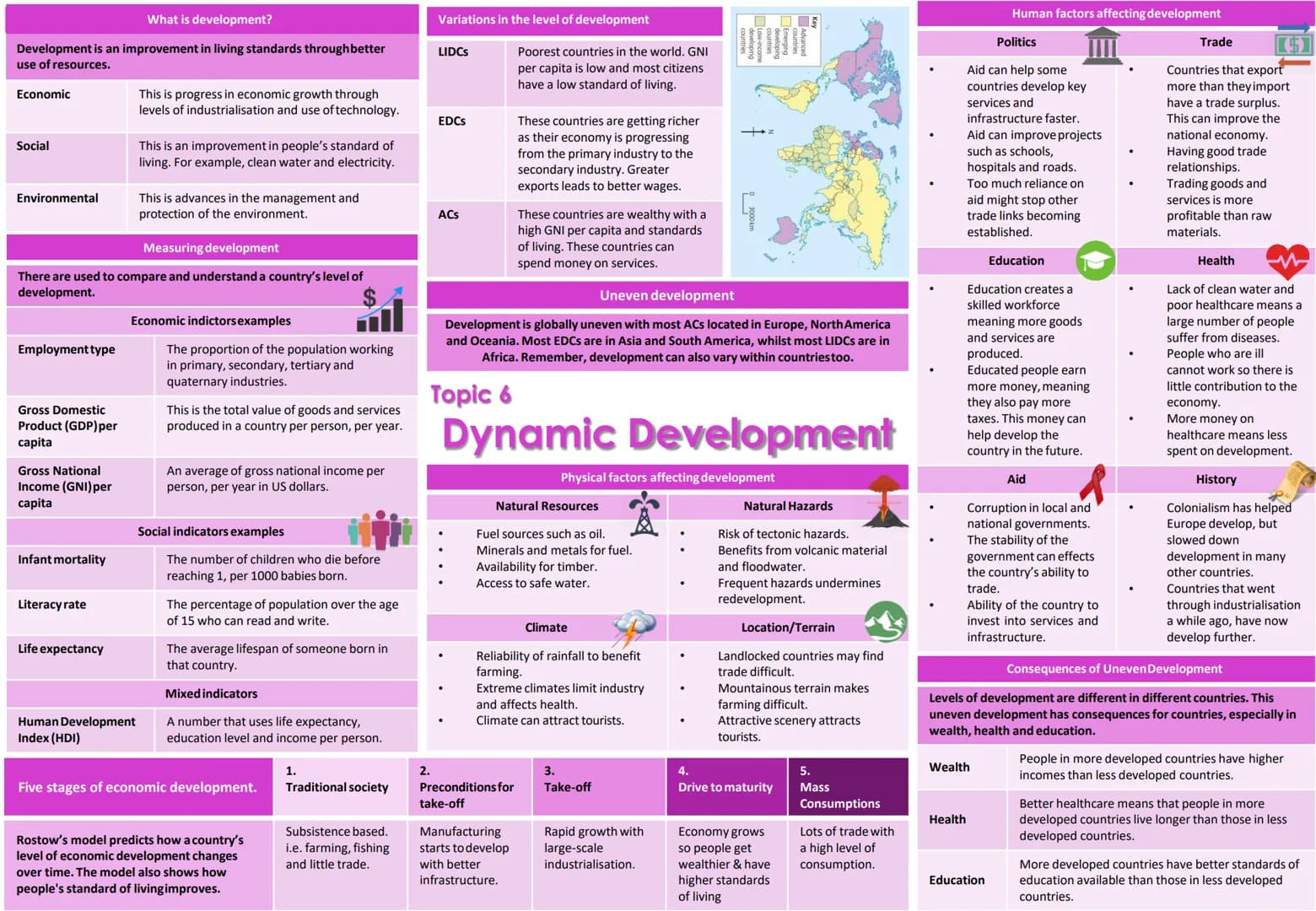
Development and Global Inequalities
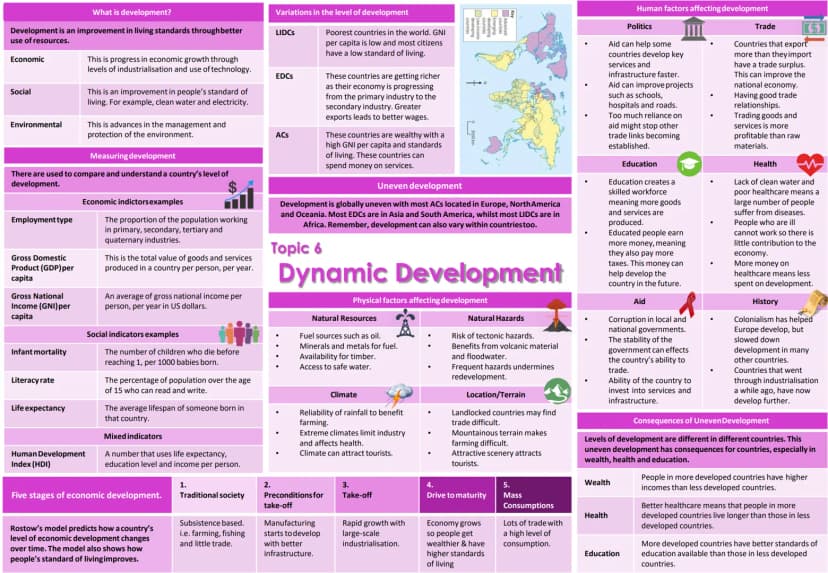
Development means improving living standards through better use of resources. It's not just about money - economic development involves industrialisation and technology, social development includes clean water and education, whilst environmental development focuses on protecting natural resources for future generations.
Measuring development requires different indicators. GDP per capita shows economic wealth, but life expectancy, literacy rates, and infant mortality reveal social conditions. The Human Development Index (HDI) combines these into a single number, giving a more complete picture than economic measures alone.
Global development is highly uneven. LIDCs (Least Developed Countries) struggle with poverty, disease, and limited infrastructure. EDCs (Emerging and Developing Countries) are experiencing rapid economic growth but face challenges like pollution and inequality. ACs (Advanced Countries) enjoy high living standards but consume disproportionate resources.
Physical factors affecting development include natural resources (oil, minerals, water), climate (reliable rainfall for farming), natural hazards (earthquakes, droughts), and location (landlocked countries struggle with trade). Human factors include education (creating skilled workforces), healthcare (keeping people productive), politics (stable governments attract investment), and trade relationships.
Understanding these patterns helps explain why wealth, health, and education vary so dramatically between countries, and why international cooperation is essential for addressing global challenges.
Development Insight: No country develops in isolation - global connections through trade, aid, and migration create opportunities but also dependencies!
We thought you’d never ask...
What is the Knowunity AI companion?
Our AI companion is specifically built for the needs of students. Based on the millions of content pieces we have on the platform we can provide truly meaningful and relevant answers to students. But its not only about answers, the companion is even more about guiding students through their daily learning challenges, with personalised study plans, quizzes or content pieces in the chat and 100% personalisation based on the students skills and developments.
Where can I download the Knowunity app?
You can download the app in the Google Play Store and in the Apple App Store.
Is Knowunity really free of charge?
That's right! Enjoy free access to study content, connect with fellow students, and get instant help – all at your fingertips.
Similar Content
 Ens. Scient.
 Historia
Most popular content: Climate Change
6GeographyUnderstanding Climate Change
Explore the causes, impacts, and responses to climate change in this comprehensive overview. This study note covers key concepts such as the greenhouse effect, mitigation and adaptation strategies, and the UK's climate action plan. Ideal for GCSE Geography students seeking to grasp the complexities of climate change and its global implications.
115617
GeographyClimate Change Mitigation
Explore effective strategies for mitigating climate change, including afforestation, international agreements like the Kyoto Protocol and Paris Agreement, and alternative energy solutions. This summary covers the greenhouse effect, human and natural factors contributing to global warming, and adaptation strategies to combat climate impacts. Ideal for Geography GCSE (AQA) students.
111,31523
GeographyWeather and Climate Dynamics
Explore the intricate dynamics of weather and climate in this comprehensive study note. Covering key concepts such as global atmospheric circulation, the greenhouse effect, ocean currents, and the impact of climate change, this resource is essential for mastering the Geography GCSE syllabus. Ideal for revision for Paper 1 in Physical Geography.
101,73340
GeographyClimate Change Impacts on Tundra
Explore the effects of climate change on Arctic tundra ecosystems, focusing on rising temperatures, increased wildfires, and permafrost thawing. This summary evaluates both actual and potential impacts, including changes in wildlife habitats, water availability, and infrastructure costs. Ideal for students studying geography and environmental science.
131142
GeographyClimate Change Dynamics
Explore the intricate dynamics of climate change, including global atmospheric circulation, the greenhouse effect, and human impacts on the environment. This summary covers key concepts such as global winds, the Hadley cell, and evidence for climate change, providing a clear understanding of how these factors contribute to global warming and its effects on weather patterns and biodiversity.
973013
GeographyUK Weather Extremes: Beast from the East
Explore the impact of the Beast from the East, a significant weather event in the UK that occurred from February 24 to March 4, 2018. This case study covers the social, environmental, and economic effects of extreme weather, including heavy snowfall, school closures, and emergency responses. Understand the broader context of climate change and its implications for future weather patterns in the UK.
112862
Most popular content in Geography
9U
GeographyUrbanisation - AQA GCSE Geography
Some questions on key knowledge from the Urbanisation topic in GCSE Geography
98070
T
Geographytopic one- hazards flashcards set 1
Explore the fascinating world of geography with these flashcards covering diverse topics like continents, landmarks, and natural wonders. Enhance your knowledge and ace your exams!
114760
GeographyAQA GCSE Geography Paper 1 revision notes (excl. case studies)
Revision notes for the AQA GCSE Geography specification. Does not include case studies as they are selected by the school.
93,77086
E
GeographyExploring Natural Hazards: Causes and Effects
Discover the primary causes and common effects of natural hazards such as tsunamis, volcanic eruptions, hurricanes, wildfires, droughts, landslides, and more!
113230
I
GeographyIntroduction to Natural Hazard Types
Identify the differences between geological and meteorological hazards and understand the factors affecting hazard risk.
S32880
GeographyGeography Hazards & Landscapes
Explore key concepts in AQA Geography, covering rivers, coasts, natural hazards, and ecosystems. This summary highlights essential topics such as river processes, coastal management, desertification, and case studies on earthquakes and tropical storms. Ideal for exam preparation and understanding geographical systems.
103,064117
P
GeographyPaper 1? Down what else
Explore the fascinating world of geography with these flashcards covering diverse topics like continents, landmarks, and natural wonders. Enhance your knowledge and ace your exams!
114782
I
GeographyIntroduction to Global Urbanisation Concepts
Define urbanisation, explore rural-to-urban migration, and identify the push and pull factors driving global city growth.
112210
GeographyRio de Janeiro case study
AQA geography gcse
1095526
Most popular content
9 Sociology
Sociology of Education Overview
Explore comprehensive A-Level Sociology notes on the education system, covering key theories, policies, and sociological perspectives. This resource includes insights on marketisation, gender roles, cultural deprivation, and educational inequalities, providing a thorough understanding of how education shapes social stratification and individual achievement. Ideal for exam preparation and in-depth study.
12102,8693,040
SociologySociology of Families: Comprehensive Revision
Dive into an extensive overview of family dynamics, perspectives, and patterns in sociology. This resource covers key concepts such as family diversity, gender roles, marriage, and the impact of social policies on family structures. Perfect for A-Level Sociology students preparing for Paper 2.
1273,6612,307
CriminologyCriminology: Crime & Punishment Overview
Comprehensive mindmaps covering key concepts in the Crime and Punishment topic for WJEC Criminology Unit 4. This resource includes detailed insights into the Criminal Justice System, crime prevention strategies, sentencing models, and the roles of various agencies. Ideal for A-Level revision, ensuring you grasp essential theories and legislative processes to excel in your exams.
1254,8691,059
SociologyComprehensive Crime & Deviance Overview
Explore an extensive revision of crime and deviance topics, including theories, types of crime, and the impact of media. This resource covers key concepts such as Marxism, functionalism, gender and crime, and the influence of globalization on criminal behavior. Ideal for students seeking a thorough understanding of criminology and its various theories. Type: Full Topic Revision.
1251,6541,399
C
 Biology
Cell Biology and Cell structure
cell structures
93,2490
 English Literature
An Inspector Calls: Character Insights
Explore in-depth analysis and key quotes for characters in J.B. Priestley's 'An Inspector Calls'. This resource covers Gerald Croft, Inspector Goole, Sheila Birling, Mrs. Birling, Eric Birling, and Eva Smith, focusing on themes of class, gender roles, and social responsibility. Ideal for students aiming for Grade 8 and above.
1025,429907
CriminologyWJEC Unit 4 Criminology
Criminology unit 4 detailed revision note
127,151125
CriminologyCriminology Theories Overview
Explore key criminology theories and their implications on crime and deviance. This comprehensive summary covers biological, psychological, and sociological perspectives, including labelling theory, right realism, and the impact of social campaigns on policy development. Ideal for A-Level criminology students seeking to understand the complexities of criminal behaviour and the factors influencing crime prevention strategies.
129,760210
English LiteratureRomeo and Juliet: Key themes
Key Romeo and Juliet themes and analysed quotes
106,708198
Can't find what you're looking for? Explore other subjects.
Students love us — and so will you.
4.6/5App Store
4.7/5Google Play
The app is very easy to use and well designed. I have found everything I was looking for so far and have been able to learn a lot from the presentations! I will definitely use the app for a class assignment! And of course it also helps a lot as an inspiration.
Stefan SiOS user
This app is really great. There are so many study notes and help [...]. My problem subject is French, for example, and the app has so many options for help. Thanks to this app, I have improved my French. I would recommend it to anyone.
Samantha KlichAndroid user
Wow, I am really amazed. I just tried the app because I've seen it advertised many times and was absolutely stunned. This app is THE HELP you want for school and above all, it offers so many things, such as workouts and fact sheets, which have been VERY helpful to me personally.
AnnaiOS user
Geography979 views·Updated Jun 17, 2026·17 pagesComprehensive Geography Knowledge Organisers for OCR B
B
Benz in nenz@nenzinabenz
This GCSE Geography guide covers the essential topics you need to master for your OCR B exam. From understanding global hazards and the UK's changing landscape to tackling climate change and development patterns, these concepts will help you make sense...
1
of 10
Sign up to see the content. It's free!
- Access to all documents
- Improve your grades
- Join milions of students
GCSE Geography Overview
You've got eight major topics to tackle in your GCSE Geography course, and each one connects to real-world issues happening right now. Global Hazards explores natural disasters like earthquakes and hurricanes, while UK in the 21st Century examines how our country is evolving. Distinctive Landscapes looks at the physical features that make places unique.
The course also covers Changing Climate - one of the biggest challenges facing our planet today. Dynamic Development helps you understand why some countries are wealthy whilst others struggle with poverty. Resource Reliance examines how we depend on natural resources, and Sustaining Ecosystems focuses on protecting our environment.
Finally, Urban Futures explores how cities are growing and changing. These topics aren't just academic - they're about understanding the world you're living in and the challenges you'll face as adults.
Quick Tip: Don't forget to check out SWA Geography's YouTube channel for extra revision support and podcasts that make these topics come alive!
2
of 10Sign up to see the content. It's free!
- Access to all documents
- Improve your grades
- Join milions of students
Global Air Circulation and Climate Patterns
The global circulation system is basically Earth's way of moving heat around the planet - think of it as a massive air conditioning system. Three main circulation cells do most of the work: Hadley cells , Ferrel cells , and Polar cells (the smallest, covering the poles).
This system creates distinct climate zones that you can see on any world map. Tropical climates around the equator get heavy rainfall and thunderstorms (like Brazil), whilst desert climates at 30° north and south stay hot and dry (think Libya). Temperate climates like the UK sit between 50-60° and get frequent rainfall, whilst polar climates stay cold and windy.
High and low pressure systems drive our daily weather. When cold air sinks, it creates high pressure and clear, calm weather. When hot air rises, you get low pressure, which brings stormy, cloudy conditions. Understanding this helps explain why some places are naturally wetter or drier than others.
Remember: Air always moves from high pressure to low pressure areas - this creates wind, which can range from gentle trade winds to powerful jet streams travelling at 225km/h!
3
of 10Sign up to see the content. It's free!
- Access to all documents
- Improve your grades
- Join milions of students
Earth's Structure and Tectonic Activity
Imagine Earth as a giant onion with different layers. The crust sits on top of the mantle , which surrounds the core (the hottest bit at 5,000°C, made of iron and nickel). Convection currents in the mantle work like a lava lamp - hot rock rises, cools, then sinks, creating a circular movement that drags tectonic plates around.
Plate boundaries come in different types, each creating specific hazards. Destructive margins occur when one plate slides under another, creating volcanoes and earthquakes. Constructive margins happen where plates pull apart, forming new ocean floor and gentle volcanic activity. Conservative margins see plates sliding past each other, causing earthquakes but no volcanoes.
Volcanoes vary depending on where they form. Shield volcanoes create gentle slopes with predictable, less dangerous eruptions. Composite volcanoes are the dangerous ones - they're explosive and unpredictable because pressure builds up in the magma chamber. Some volcanoes form at hotspots away from plate boundaries, like the Hawaiian islands.
Case Study Alert: Iceland's Eyjafjallajökull eruption in 2010 shows how even small volcanic events can have massive global impacts - it cancelled 17,000 flights across Europe!
4
of 10Sign up to see the content. It's free!
- Access to all documents
- Improve your grades
- Join milions of students
UK Physical Geography and Population
The UK's landscape tells a story shaped by geology, climate, and human activity. Mountains dominate the north and west (Scotland, Wales) where it's wetter and sparsely populated, whilst the south and east are flatter, drier, and packed with people. This pattern exists because prevailing winds from the southwest bring moisture that gets dumped on upland areas through relief rainfall, leaving the east in a rain shadow.
Water stress affects the southeast because that's where most people live but least rain falls. The UK tackles this through water transfer schemes - moving water from wet areas to dry ones via pipelines. The country also builds reservoirs and promotes water conservation to meet growing demands.
Population distribution isn't random - it follows clear patterns. Very high density around London and the southeast reflects job opportunities and good transport links. Much of northern Scotland stays sparse due to mountains and harsh climate. The UK's growing population (heading towards 70 million by 2030) creates a housing shortage because we're only building half the 240,000 homes needed annually.
The Demographic Transition Model shows the UK in stage 4, with low birth and death rates creating slow population growth. However, an ageing population means more people over 65, especially in coastal areas, creating challenges for healthcare and pensions.
Key Insight: The UK's physical geography directly influences where people live, work, and face challenges - understanding this connection is crucial for your exam!
5
of 10Sign up to see the content. It's free!
- Access to all documents
- Improve your grades
- Join milions of students
UK's Changing Society and Economy
Modern Britain is incredibly diverse - 13% of the population was born abroad, rising to 37% in London. This ethnic diversity has transformed British culture, influencing everything from food (curry is now a national dish) to music and fashion. The UK has genuinely become a multicultural society where different traditions blend together.
The UK's economy has shifted dramatically from heavy manufacturing to service industries like finance, technology, and media. This change accelerated after the 2008 recession, with quaternary industries growing whilst manufacturing declined due to cheaper labour abroad. Most economic growth now happens in economic hubs like Cambridge, which combines world-class universities with high-tech companies.
Regional differences are stark across the UK. Scotland's Silicon Glen focuses on electronics, whilst Belfast's Titanic Quarter has become a media hub. Cambridge stands out as a science city with over 4,000 knowledge-intensive companies and incomes 34% higher than the national average. However, high costs push many graduates away.
Britain's global influence extends far beyond its size. The UK plays key roles in NATO, the UN Security Council, and G7, whilst British media exports like Harry Potter reach 200 territories. The country's multicultural identity and English language help spread British culture worldwide, attracting tourists and maintaining international connections.
Think About It: How has the shift from manufacturing to services affected your local area? Look for evidence of old industrial sites being converted to new uses!
6
of 10Sign up to see the content. It's free!
- Access to all documents
- Improve your grades
- Join milions of students
Distinctive UK Landscapes
British landscapes are like a geographical story book - each region tells you about the rocks, climate, and human activity that shaped it. The UK's varied geology includes hard igneous rocks (formed from cooled lava), layered sedimentary rocks (made from weathered fragments), and twisted metamorphic rocks (changed by heat and pressure). These different rock types create everything from Scotland's dramatic mountains to East Anglia's flat farmland.
Glaciation left a massive mark during ice ages, carving U-shaped valleys and creating the steep mountain peaks you see in upland areas today. When the ice melted, it revealed deep valleys and deposited sediment that now forms fertile lowlands. Climate continues shaping landscapes through freeze-thaw weathering in upland areas, where water freezes in rock cracks and splits them apart.
Human impact has been enormous over thousands of years. Most of Britain's original woodland disappeared long ago, replaced by farmland, cities, and infrastructure. Mass movement occurs where slopes become unstable - heavy rain saturates permeable rock above impermeable rock, creating landslides when the weight becomes too much.
The contrast between upland and lowland Britain couldn't be clearer. Uplands experience harsh weather, thin soils, and coniferous forests, whilst lowlands enjoy milder conditions, deep fertile soils, and deciduous woodland. This explains why most people live in lowland areas.
Field Tip: Next time you're outdoors, try to identify whether you're looking at weathering, erosion, or deposition - these processes are happening everywhere around you!
7
of 10Sign up to see the content. It's free!
- Access to all documents
- Improve your grades
- Join milions of students
Coastal and River Processes
Coastal landscapes constantly change through erosion, transportation, and deposition. Hydraulic action occurs when waves crash into cliffs, compressing air in cracks and gradually widening them. Abrasion happens when waves hurl rocks at cliff bases, whilst attrition rounds and smooths rocks as they bash together. These processes create spectacular features like the coastal stacks at Old Harry Rocks in Dorset.
Longshore drift moves material along beaches in a zigzag pattern. Swash carries material up the beach at the angle of prevailing winds, whilst backwash pulls it straight down due to gravity. This process creates spits - curved beaches that extend into the sea until they reach river estuaries, often developing salt marshes in their sheltered areas.
River landscapes change from source to mouth. In the upper course, steep gradients give rivers energy to erode vertically, creating V-shaped valleys and waterfalls. The middle course sees gentler gradients and lateral erosion, forming meanders. The lower course features deposition, creating floodplains and oxbow lakes when meanders get cut off.
Management strategies vary between hard and soft engineering. Hard defences like sea walls and groynes provide immediate protection but can be expensive and cause problems elsewhere. Soft approaches like beach nourishment and managed retreat work with natural processes but require ongoing maintenance.
Case Study Connection: Walton-on-the-Naze demonstrates how coastal management requires multiple strategies working together - no single solution fits every situation!
8
of 10Sign up to see the content. It's free!
- Access to all documents
- Improve your grades
- Join milions of students
Climate Change Evidence and Causes
Climate change isn't new - Earth's temperature has fluctuated for millions of years. During the Quaternary period (last 2.6 million years), we've seen ice ages followed by warmer interglacial periods. Scientists know this from ice cores (which trap ancient atmospheres), ocean sediments (showing changing conditions), and fossil evidence (revealing past environments).
However, recent change is different. Global temperature data shows average temperatures have risen 0.6°C since 1950, whilst ice sheets and glaciers are melting rapidly - Arctic sea ice has declined 10% in 30 years. Sea levels have risen 10-20cm in the past century due to thermal expansion of warming oceans and melting ice.
The enhanced greenhouse effect explains what's happening. Naturally, greenhouse gases keep Earth 33°C warmer than it would be otherwise - without them, average temperature would be -18°C instead of +15°C. But burning fossil fuels adds extra carbon dioxide, methane, nitrous oxide, and halocarbons to the atmosphere, trapping more heat.
Responsibility varies globally. LIDCs like Kenya emit very little because they're not industrialised. EDCs like China and India are rapidly increasing emissions as they develop. ACs like the USA and UK have high per-capita emissions due to energy-intensive lifestyles, though some are now reducing total emissions.
Key Point: The link between rising CO₂ levels and global temperatures is undeniable - this correlation provides the strongest evidence for human-caused climate change!
9
of 10Sign up to see the content. It's free!
- Access to all documents
- Improve your grades
- Join milions of students
Climate Change Impacts and Responses
Global impacts of climate change are already visible and accelerating. Extreme weather events like Hurricane Haiyan (2013) are becoming more frequent and powerful. Rising sea levels threaten island nations - the Maldives could disappear entirely. Food security faces challenges as changing rainfall patterns disrupt agriculture, forcing countries like Russia to ban crop exports during droughts.
Climate refugees represent a growing humanitarian crisis as people flee sea level rise, droughts, and extreme weather. Disease patterns are shifting too - warmer temperatures allow malaria mosquitoes to spread to new areas, whilst floods increase waterborne diseases like dysentery.
The UK faces mixed impacts. Negative effects include increased coastal flooding, water shortages (especially affecting London), extreme rainfall causing flash floods, and heat-related health problems. However, there are positive aspects - tourism might increase, farmers could grow new crops, and heating costs will fall.
Tuvalu provides a stark example of climate change reality. This Pacific island nation faces saltwater contamination of freshwater supplies, coastal erosion destroying farmland, and coral reef destruction reducing fish stocks. The government is exploring migration agreements with New Zealand whilst building sea walls and campaigning for global emissions reductions.
International cooperation is essential. The Paris Agreement (2015) saw 195 countries commit to limiting warming below 2°C, though achieving this requires massive changes in how we produce and use energy.
Think Global, Act Local: Climate change impacts vary by location, but the solutions require both international cooperation and individual action!
10
of 10Sign up to see the content. It's free!
- Access to all documents
- Improve your grades
- Join milions of students
Development and Global Inequalities
Development means improving living standards through better use of resources. It's not just about money - economic development involves industrialisation and technology, social development includes clean water and education, whilst environmental development focuses on protecting natural resources for future generations.
Measuring development requires different indicators. GDP per capita shows economic wealth, but life expectancy, literacy rates, and infant mortality reveal social conditions. The Human Development Index (HDI) combines these into a single number, giving a more complete picture than economic measures alone.
Global development is highly uneven. LIDCs (Least Developed Countries) struggle with poverty, disease, and limited infrastructure. EDCs (Emerging and Developing Countries) are experiencing rapid economic growth but face challenges like pollution and inequality. ACs (Advanced Countries) enjoy high living standards but consume disproportionate resources.
Physical factors affecting development include natural resources (oil, minerals, water), climate (reliable rainfall for farming), natural hazards (earthquakes, droughts), and location (landlocked countries struggle with trade). Human factors include education (creating skilled workforces), healthcare (keeping people productive), politics (stable governments attract investment), and trade relationships.
Understanding these patterns helps explain why wealth, health, and education vary so dramatically between countries, and why international cooperation is essential for addressing global challenges.
Development Insight: No country develops in isolation - global connections through trade, aid, and migration create opportunities but also dependencies!
We thought you’d never ask...
What is the Knowunity AI companion?
Our AI companion is specifically built for the needs of students. Based on the millions of content pieces we have on the platform we can provide truly meaningful and relevant answers to students. But its not only about answers, the companion is even more about guiding students through their daily learning challenges, with personalised study plans, quizzes or content pieces in the chat and 100% personalisation based on the students skills and developments.
Where can I download the Knowunity app?
You can download the app in the Google Play Store and in the Apple App Store.
Is Knowunity really free of charge?
That's right! Enjoy free access to study content, connect with fellow students, and get instant help – all at your fingertips.
Similar Content
Most popular content: Climate Change
6GeographyUnderstanding Climate Change
Explore the causes, impacts, and responses to climate change in this comprehensive overview. This study note covers key concepts such as the greenhouse effect, mitigation and adaptation strategies, and the UK's climate action plan. Ideal for GCSE Geography students seeking to grasp the complexities of climate change and its global implications.
115617
GeographyClimate Change Mitigation
Explore effective strategies for mitigating climate change, including afforestation, international agreements like the Kyoto Protocol and Paris Agreement, and alternative energy solutions. This summary covers the greenhouse effect, human and natural factors contributing to global warming, and adaptation strategies to combat climate impacts. Ideal for Geography GCSE (AQA) students.
111,31523
GeographyWeather and Climate Dynamics
Explore the intricate dynamics of weather and climate in this comprehensive study note. Covering key concepts such as global atmospheric circulation, the greenhouse effect, ocean currents, and the impact of climate change, this resource is essential for mastering the Geography GCSE syllabus. Ideal for revision for Paper 1 in Physical Geography.
101,73340
GeographyClimate Change Impacts on Tundra
Explore the effects of climate change on Arctic tundra ecosystems, focusing on rising temperatures, increased wildfires, and permafrost thawing. This summary evaluates both actual and potential impacts, including changes in wildlife habitats, water availability, and infrastructure costs. Ideal for students studying geography and environmental science.
131142
GeographyClimate Change Dynamics
Explore the intricate dynamics of climate change, including global atmospheric circulation, the greenhouse effect, and human impacts on the environment. This summary covers key concepts such as global winds, the Hadley cell, and evidence for climate change, providing a clear understanding of how these factors contribute to global warming and its effects on weather patterns and biodiversity.
973013
GeographyUK Weather Extremes: Beast from the East
Explore the impact of the Beast from the East, a significant weather event in the UK that occurred from February 24 to March 4, 2018. This case study covers the social, environmental, and economic effects of extreme weather, including heavy snowfall, school closures, and emergency responses. Understand the broader context of climate change and its implications for future weather patterns in the UK.
112862
Most popular content in Geography
9U
GeographyUrbanisation - AQA GCSE Geography
Some questions on key knowledge from the Urbanisation topic in GCSE Geography
98070
T
Geographytopic one- hazards flashcards set 1
Explore the fascinating world of geography with these flashcards covering diverse topics like continents, landmarks, and natural wonders. Enhance your knowledge and ace your exams!
114760
GeographyAQA GCSE Geography Paper 1 revision notes (excl. case studies)
Revision notes for the AQA GCSE Geography specification. Does not include case studies as they are selected by the school.
93,77086
E
GeographyExploring Natural Hazards: Causes and Effects
Discover the primary causes and common effects of natural hazards such as tsunamis, volcanic eruptions, hurricanes, wildfires, droughts, landslides, and more!
113230
I
GeographyIntroduction to Natural Hazard Types
Identify the differences between geological and meteorological hazards and understand the factors affecting hazard risk.
S32880
GeographyGeography Hazards & Landscapes
Explore key concepts in AQA Geography, covering rivers, coasts, natural hazards, and ecosystems. This summary highlights essential topics such as river processes, coastal management, desertification, and case studies on earthquakes and tropical storms. Ideal for exam preparation and understanding geographical systems.
103,064117
P
GeographyPaper 1? Down what else
Explore the fascinating world of geography with these flashcards covering diverse topics like continents, landmarks, and natural wonders. Enhance your knowledge and ace your exams!
114782
I
GeographyIntroduction to Global Urbanisation Concepts
Define urbanisation, explore rural-to-urban migration, and identify the push and pull factors driving global city growth.
112210
GeographyRio de Janeiro case study
AQA geography gcse
1095526
Most popular content
9SociologySociology of Education Overview
Explore comprehensive A-Level Sociology notes on the education system, covering key theories, policies, and sociological perspectives. This resource includes insights on marketisation, gender roles, cultural deprivation, and educational inequalities, providing a thorough understanding of how education shapes social stratification and individual achievement. Ideal for exam preparation and in-depth study.
12102,8693,040
SociologySociology of Families: Comprehensive Revision
Dive into an extensive overview of family dynamics, perspectives, and patterns in sociology. This resource covers key concepts such as family diversity, gender roles, marriage, and the impact of social policies on family structures. Perfect for A-Level Sociology students preparing for Paper 2.
1273,6612,307
CriminologyCriminology: Crime & Punishment Overview
Comprehensive mindmaps covering key concepts in the Crime and Punishment topic for WJEC Criminology Unit 4. This resource includes detailed insights into the Criminal Justice System, crime prevention strategies, sentencing models, and the roles of various agencies. Ideal for A-Level revision, ensuring you grasp essential theories and legislative processes to excel in your exams.
1254,8691,059
SociologyComprehensive Crime & Deviance Overview
Explore an extensive revision of crime and deviance topics, including theories, types of crime, and the impact of media. This resource covers key concepts such as Marxism, functionalism, gender and crime, and the influence of globalization on criminal behavior. Ideal for students seeking a thorough understanding of criminology and its various theories. Type: Full Topic Revision.
1251,6541,399
C
BiologyCell Biology and Cell structure
cell structures
93,2490
English LiteratureAn Inspector Calls: Character Insights
Explore in-depth analysis and key quotes for characters in J.B. Priestley's 'An Inspector Calls'. This resource covers Gerald Croft, Inspector Goole, Sheila Birling, Mrs. Birling, Eric Birling, and Eva Smith, focusing on themes of class, gender roles, and social responsibility. Ideal for students aiming for Grade 8 and above.
1025,429907
CriminologyWJEC Unit 4 Criminology
Criminology unit 4 detailed revision note
127,151125
CriminologyCriminology Theories Overview
Explore key criminology theories and their implications on crime and deviance. This comprehensive summary covers biological, psychological, and sociological perspectives, including labelling theory, right realism, and the impact of social campaigns on policy development. Ideal for A-Level criminology students seeking to understand the complexities of criminal behaviour and the factors influencing crime prevention strategies.
129,760210
English LiteratureRomeo and Juliet: Key themes
Key Romeo and Juliet themes and analysed quotes
106,708198
Can't find what you're looking for? Explore other subjects.
Students love us — and so will you.
4.6/5App Store
4.7/5Google Play
The app is very easy to use and well designed. I have found everything I was looking for so far and have been able to learn a lot from the presentations! I will definitely use the app for a class assignment! And of course it also helps a lot as an inspiration.
Stefan SiOS user
This app is really great. There are so many study notes and help [...]. My problem subject is French, for example, and the app has so many options for help. Thanks to this app, I have improved my French. I would recommend it to anyone.
Samantha KlichAndroid user
Wow, I am really amazed. I just tried the app because I've seen it advertised many times and was absolutely stunned. This app is THE HELP you want for school and above all, it offers so many things, such as workouts and fact sheets, which have been VERY helpful to me personally.
AnnaiOS user