
¿Te has preguntado alguna vez dónde se encuentra exactamente nuestro...
 Geografía e Historia640 views·Updated Jun 25, 2026·40 pages
El planeta Tierra y su relación con el universo
M
Morena Morena@orenaorena_romoxpjrr





1 / 10
1
of 10
El planeta Tierra en el universo
Nuestro planeta no está solo en el espacio. La Tierra forma parte de un sistema increíblemente organizado que va desde lo más grande hasta lo más pequeño.
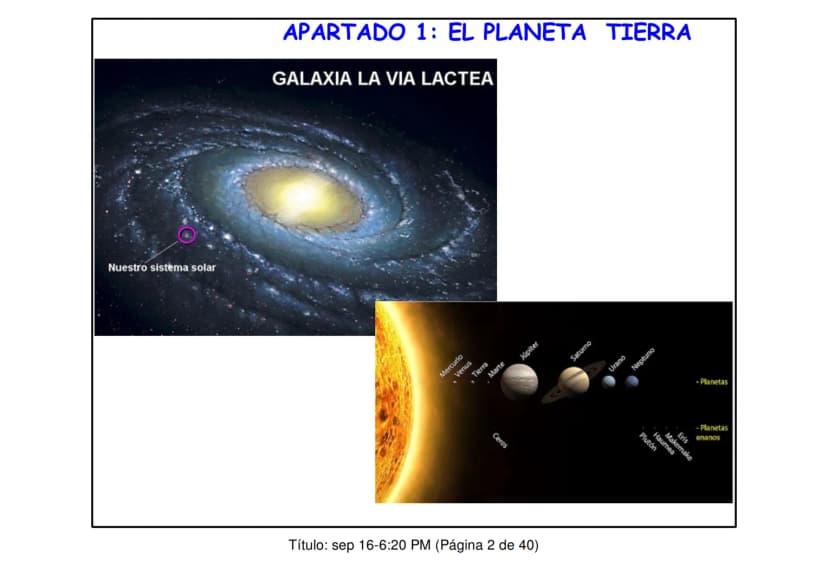
Todo comienza con el universo, que está formado por millones de galaxias. Nuestra galaxia se llama la Vía Láctea y es donde encontramos nuestro sistema solar. Este sistema incluye una estrella (el Sol), ocho planetas principales, planetas enanos como Plutón y Ceres, satélites como la Luna, y otros cuerpos como cometas y asteroides.
Los planetas se dividen en dos grupos: planetas interiores (Mercurio, Venus, Tierra y Marte) que están más cerca del Sol, y planetas exteriores (Júpiter, Saturno, Urano y Neptuno) que están más lejos.
¡Dato curioso! Aunque Plutón era considerado el noveno planeta, ahora se clasifica como planeta enano junto con otros como Eris, Haumea y Makemake.
2
of 10
La forma de nuestro planeta
La Tierra tiene una forma muy especial llamada geoide. Aunque parece una esfera perfecta desde el espacio, en realidad está ligeramente achatada por los polos, como si fuera una pelota a la que alguien hubiera presionado por arriba y por abajo.
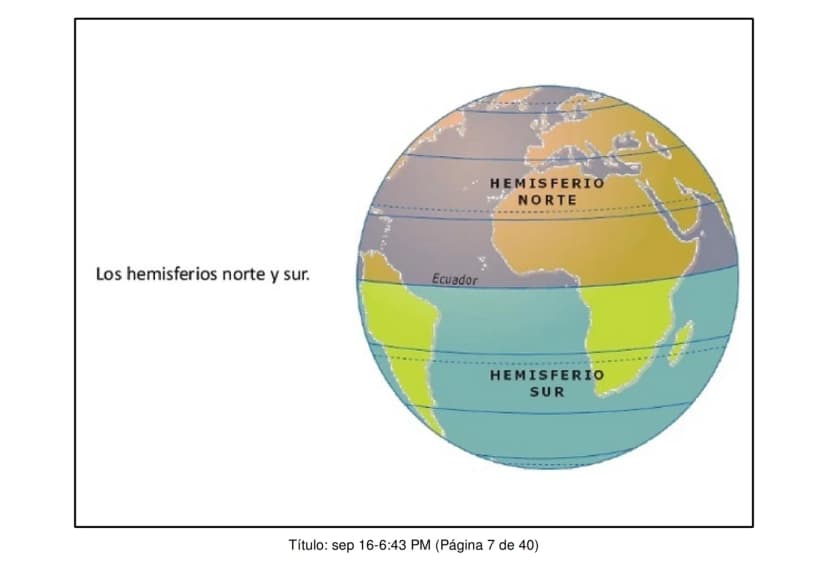
Para estudiarla mejor, los científicos usan dos líneas imaginarias muy importantes. El eje va del Polo Norte al Polo Sur, como si fuera un palillo atravesando una manzana. El ecuador es un círculo que rodea la Tierra por la mitad y la divide en dos partes iguales: el hemisferio norte y el hemisferio sur.
Las medidas de la Tierra son impresionantes: tiene un diámetro de 12.756 km por el ecuador y 12.713 km por los polos. Su superficie total es de 510 millones de kilómetros cuadrados. En el hemisferio norte se encuentra la mayor parte de los continentes, mientras que en el sur hay más océanos.
Para recordar: El ecuador es como el cinturón de la Tierra que la divide perfectamente por la mitad.
3
of 10
Orientándose en la Tierra
Para no perdernos en nuestro planeta, necesitamos conocer las direcciones básicas. La brújula es el instrumento que nos ayuda a orientarnos mostrando los cuatro puntos cardinales principales.
Los puntos cardinales son Norte (N), Sur (S), Este (E) y Oeste (W). El Norte apunta hacia el Polo Norte, el Sur hacia el Polo Sur, el Este es donde sale el Sol cada mañana, y el Oeste es donde se pone por la tarde.
Entre estos puntos principales encontramos direcciones intermedias: Noreste (NE), Sureste (SE), Suroeste (SW) y Noroeste (NW). Estas direcciones nos permiten ser mucho más precisos cuando queremos indicar una ubicación o seguir un camino.
Truco útil: Recuerda que el Sol siempre sale por el Este y se pone por el Oeste, ¡así nunca te perderás!
4
of 10
El movimiento de rotación
La Tierra nunca para de moverse, y uno de sus movimientos más importantes es la rotación. Este es el giro que hace nuestro planeta sobre sí mismo, como una peonza, alrededor de su eje imaginario.
La rotación tarda exactamente 24 horas en completarse, que es lo que llamamos un día. La Tierra gira en dirección oeste-este a una velocidad increíble de 1.670 km por hora. ¡Eso significa que te mueves súper rápido aunque estés sentado leyendo esto!
Este movimiento tiene consecuencias muy importantes para nuestra vida diaria. Causa la sucesión del día y la noche, hace que el Sol parezca moverse por el cielo (aunque en realidad somos nosotros los que nos movemos), y determina las horas y los husos horarios del planeta.
¿Sabías que...? El Sol no se mueve realmente por el cielo: ¡somos nosotros los que giramos! Por eso vemos amanecer por el Este y atardecer por el Oeste.
5
of 10
6
of 10
7
of 10
8
of 10
9
of 10
10
of 10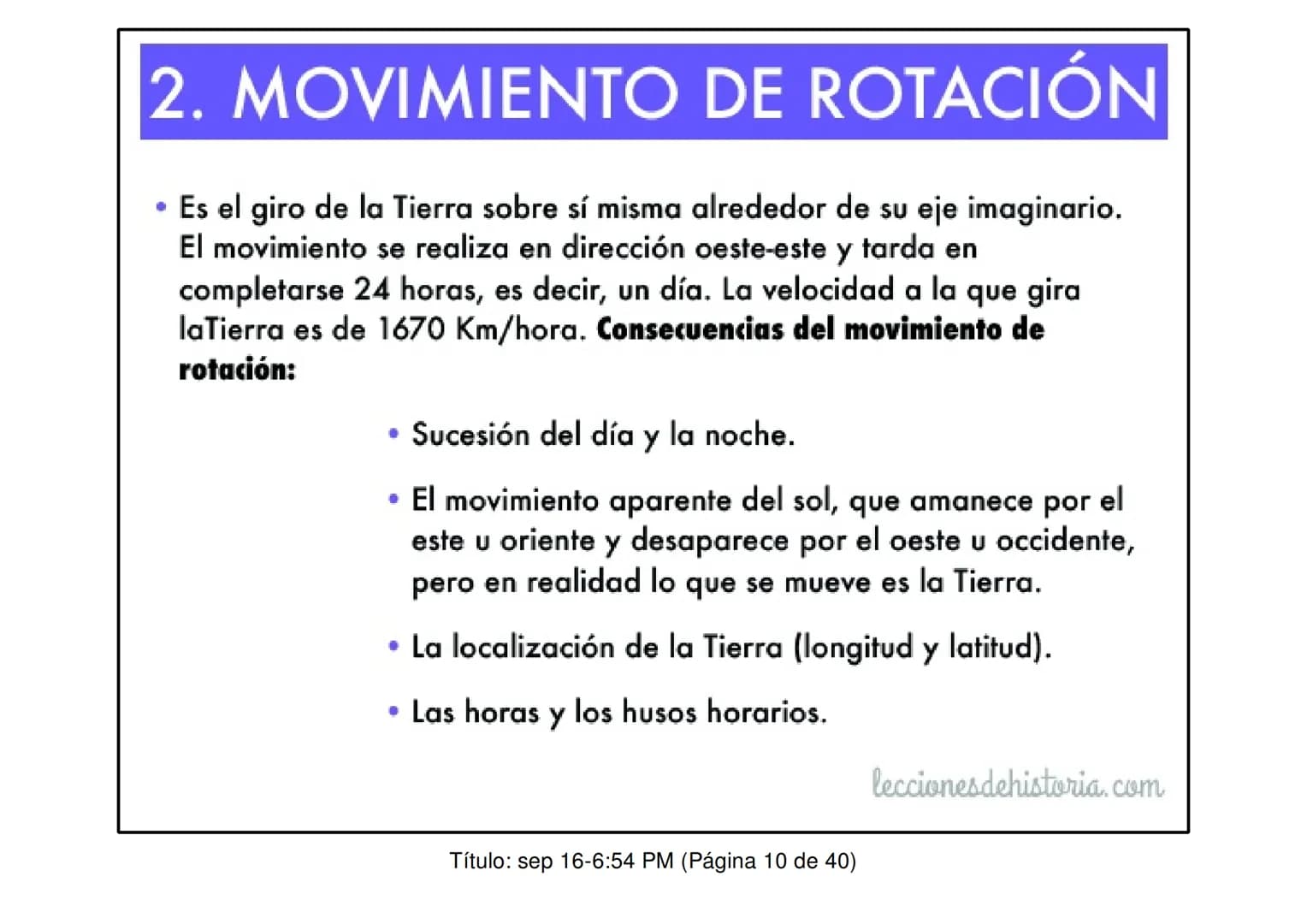
We thought you’d never ask...
What is the Knowunity AI companion?
Our AI companion is specifically built for the needs of students. Based on the millions of content pieces we have on the platform we can provide truly meaningful and relevant answers to students. But its not only about answers, the companion is even more about guiding students through their daily learning challenges, with personalised study plans, quizzes or content pieces in the chat and 100% personalisation based on the students skills and developments.
Where can I download the Knowunity app?
You can download the app in the Google Play Store and in the Apple App Store.
Is Knowunity really free of charge?
That's right! Enjoy free access to study content, connect with fellow students, and get instant help – all at your fingertips.
Similar Content
 Sociales/Historia
Most popular content: Cartografía
9Geografía e HistoriaMapa político de España
Ficha con capitales, Comunidades autónomas y provincias
1° ESO4726
Geografía e HistoriaCORDENADAS GEOGRÁFICAS!!
¿Que es la longitud y latitud? Aquí la respuesta
1° ESO4749
Geografía e HistoriaMapa España Física
Aprende sobre tu país.
3° ESO41614
Geografía e HistoriaMapa político España
Mapa político de España . De color verde las provincias y de color rojo las capitales .
1° ESO2760
Geografía e HistoriaMapa mundi físico
Un poco sobre la geografía del mundo.
3° ESO3304
Geografía e HistoriaCOORDENADAS GEOGRÁFICAS+ESCALAS
Explicación de estos dos aspectos
1° ESO65224
Geografía e HistoriaEl planeta tierra 🌎🌍
La planeta
1° ESO4584
 Historia
Comentar un mapa historico
Pautas para comentar un mapa historia historia de españa 2 de bachillerato
PAU (2° Bach)2973
Geografía e HistoriaGeografía España y Europa.
Mapas físicos y políticos de España y Europa.
3° ESO4813
Most popular content in Geografía e Historia
9R
Geografía e Historiaroma
a estudiar Roma!!
1° ESO2,3122
G
Geografía e HistoriaGrecia: Inicio de la democracia
Más o menos las preguntas que me pusieron a mí en el examen
1° ESO2,3622
M
Geografía e HistoriaMesopotamia y Egipto
Contenidos sobre la civilización mesopotámica y egipcia
1° ESO3,9381
L
Geografía e HistoriaLa República Romana y su Sociedad
Aprende sobre el Senado, las magistraturas y el conflicto social entre patricios y plebeyos durante la etapa republicana.
1° ESO1,3420
A
Geografía e HistoriaAtenas, Esparta y las Guerras Médicas
Comparativa entre la democracia de Atenas y la oligarquía de Esparta junto a los grandes conflictos bélicos.
1° ESO1,0480
E
Geografía e Historiaegipto
🧡
1° ESO9732
A
Geografía e HistoriaArte y Arquitectura de Mesopotamia y Egipto
Compara las grandes construcciones como zigurats y pirámides, analizando su función religiosa, política y funeraria.
1° ESO1,1720
V
Geografía e HistoriaVocabulario II Guerra Mundial
Términos clave y eventos de la Segunda Guerra Mundial, incluyendo Lebensraum, Juicios de Núremberg y Holocausto.
1° Bach9320
C
Geografía e Historiacambios políticos y sociales
Explora el surgimiento del capitalismo, familias poderosas y herramientas del rey en cambios políticos y sociales.
2° ESO1,0780
Most popular content
9I
 Inglés
irregular verbs quiz
Domina el idioma inglés de manera sencilla y divertida con estos flashcards diseñados especialmente para estudiantes de sexto grado.
6º primaria2,8981
R
Geografía e Historiaroma
a estudiar Roma!!
1° ESO2,3122
G
Geografía e HistoriaGrecia: Inicio de la democracia
Más o menos las preguntas que me pusieron a mí en el examen
1° ESO2,3622
D
InglésDominando la gramática inglesa: Flashcards desafiantes
Mejora tus habilidades gramaticales en inglés con estos flashcards desafiantes diseñados para estudiantes de grado 11. ¡Prepárate para dominar la gramática inglesa de manera divertida y efectiva!
3° ESO2,2450
M
Geografía e HistoriaMesopotamia y Egipto
Contenidos sobre la civilización mesopotámica y egipcia
1° ESO3,9381
O
 Lengua Castellana y Literatura
OBRAS Y AUTORES II
Quiz donde tendrás que relacionar las siguientes obras con sus respectivos autores: edición Romanticismo.
4° ESO3,3610
I
InglésIngles para repasar
quiz de ingles para entrar a clase preparados
2° ESO2,6290
F
 Filosofía
filosofía
repaso filosofía "el arje , la metafísica y la crítica de Nietszche a platon"
1° Bach2,8421
I
InglésIrregular verbs
Aprende nuevas palabras y expande tu vocabulario en inglés con esta colección de tarjetas de estudio interactivas.
3° ESO1,7442
Can't find what you're looking for? Explore other subjects.
Students love us — and so will you.
4.6/5App Store
4.7/5Google Play
The app is very easy to use and well designed. I have found everything I was looking for so far and have been able to learn a lot from the presentations! I will definitely use the app for a class assignment! And of course it also helps a lot as an inspiration.
Stefan SiOS user
This app is really great. There are so many study notes and help [...]. My problem subject is French, for example, and the app has so many options for help. Thanks to this app, I have improved my French. I would recommend it to anyone.
Samantha KlichAndroid user
Wow, I am really amazed. I just tried the app because I've seen it advertised many times and was absolutely stunned. This app is THE HELP you want for school and above all, it offers so many things, such as workouts and fact sheets, which have been VERY helpful to me personally.
AnnaiOS user
Geografía e Historia640 views·Updated Jun 25, 2026·40 pagesEl planeta Tierra y su relación con el universo
M
Morena Morena@orenaorena_romoxpjrr
¿Te has preguntado alguna vez dónde se encuentra exactamente nuestro planeta en el universo? La Tierra es mucho más que el lugar donde vivimos: forma parte de un sistema complejo y fascinante que incluye desde nuestra galaxia hasta los movimientos...
1
of 10
Sign up to see the content. It's free!
- Access to all documents
- Improve your grades
- Join milions of students
El planeta Tierra en el universo
Nuestro planeta no está solo en el espacio. La Tierra forma parte de un sistema increíblemente organizado que va desde lo más grande hasta lo más pequeño.
Todo comienza con el universo, que está formado por millones de galaxias. Nuestra galaxia se llama la Vía Láctea y es donde encontramos nuestro sistema solar. Este sistema incluye una estrella (el Sol), ocho planetas principales, planetas enanos como Plutón y Ceres, satélites como la Luna, y otros cuerpos como cometas y asteroides.
Los planetas se dividen en dos grupos: planetas interiores (Mercurio, Venus, Tierra y Marte) que están más cerca del Sol, y planetas exteriores (Júpiter, Saturno, Urano y Neptuno) que están más lejos.
¡Dato curioso! Aunque Plutón era considerado el noveno planeta, ahora se clasifica como planeta enano junto con otros como Eris, Haumea y Makemake.
2
of 10Sign up to see the content. It's free!
- Access to all documents
- Improve your grades
- Join milions of students
La forma de nuestro planeta
La Tierra tiene una forma muy especial llamada geoide. Aunque parece una esfera perfecta desde el espacio, en realidad está ligeramente achatada por los polos, como si fuera una pelota a la que alguien hubiera presionado por arriba y por abajo.
Para estudiarla mejor, los científicos usan dos líneas imaginarias muy importantes. El eje va del Polo Norte al Polo Sur, como si fuera un palillo atravesando una manzana. El ecuador es un círculo que rodea la Tierra por la mitad y la divide en dos partes iguales: el hemisferio norte y el hemisferio sur.
Las medidas de la Tierra son impresionantes: tiene un diámetro de 12.756 km por el ecuador y 12.713 km por los polos. Su superficie total es de 510 millones de kilómetros cuadrados. En el hemisferio norte se encuentra la mayor parte de los continentes, mientras que en el sur hay más océanos.
Para recordar: El ecuador es como el cinturón de la Tierra que la divide perfectamente por la mitad.
3
of 10Sign up to see the content. It's free!
- Access to all documents
- Improve your grades
- Join milions of students
Orientándose en la Tierra
Para no perdernos en nuestro planeta, necesitamos conocer las direcciones básicas. La brújula es el instrumento que nos ayuda a orientarnos mostrando los cuatro puntos cardinales principales.
Los puntos cardinales son Norte (N), Sur (S), Este (E) y Oeste (W). El Norte apunta hacia el Polo Norte, el Sur hacia el Polo Sur, el Este es donde sale el Sol cada mañana, y el Oeste es donde se pone por la tarde.
Entre estos puntos principales encontramos direcciones intermedias: Noreste (NE), Sureste (SE), Suroeste (SW) y Noroeste (NW). Estas direcciones nos permiten ser mucho más precisos cuando queremos indicar una ubicación o seguir un camino.
Truco útil: Recuerda que el Sol siempre sale por el Este y se pone por el Oeste, ¡así nunca te perderás!
4
of 10Sign up to see the content. It's free!
- Access to all documents
- Improve your grades
- Join milions of students
El movimiento de rotación
La Tierra nunca para de moverse, y uno de sus movimientos más importantes es la rotación. Este es el giro que hace nuestro planeta sobre sí mismo, como una peonza, alrededor de su eje imaginario.
La rotación tarda exactamente 24 horas en completarse, que es lo que llamamos un día. La Tierra gira en dirección oeste-este a una velocidad increíble de 1.670 km por hora. ¡Eso significa que te mueves súper rápido aunque estés sentado leyendo esto!
Este movimiento tiene consecuencias muy importantes para nuestra vida diaria. Causa la sucesión del día y la noche, hace que el Sol parezca moverse por el cielo (aunque en realidad somos nosotros los que nos movemos), y determina las horas y los husos horarios del planeta.
¿Sabías que...? El Sol no se mueve realmente por el cielo: ¡somos nosotros los que giramos! Por eso vemos amanecer por el Este y atardecer por el Oeste.
5
of 10Sign up to see the content. It's free!
- Access to all documents
- Improve your grades
- Join milions of students
6
of 10Sign up to see the content. It's free!
- Access to all documents
- Improve your grades
- Join milions of students
7
of 10Sign up to see the content. It's free!
- Access to all documents
- Improve your grades
- Join milions of students
8
of 10Sign up to see the content. It's free!
- Access to all documents
- Improve your grades
- Join milions of students
9
of 10Sign up to see the content. It's free!
- Access to all documents
- Improve your grades
- Join milions of students
10
of 10Sign up to see the content. It's free!
- Access to all documents
- Improve your grades
- Join milions of students
We thought you’d never ask...
What is the Knowunity AI companion?
Our AI companion is specifically built for the needs of students. Based on the millions of content pieces we have on the platform we can provide truly meaningful and relevant answers to students. But its not only about answers, the companion is even more about guiding students through their daily learning challenges, with personalised study plans, quizzes or content pieces in the chat and 100% personalisation based on the students skills and developments.
Where can I download the Knowunity app?
You can download the app in the Google Play Store and in the Apple App Store.
Is Knowunity really free of charge?
That's right! Enjoy free access to study content, connect with fellow students, and get instant help – all at your fingertips.
Similar Content
Most popular content: Cartografía
9Geografía e HistoriaMapa político de España
Ficha con capitales, Comunidades autónomas y provincias
1° ESO4726
Geografía e HistoriaCORDENADAS GEOGRÁFICAS!!
¿Que es la longitud y latitud? Aquí la respuesta
1° ESO4749
Geografía e HistoriaMapa España Física
Aprende sobre tu país.
3° ESO41614
Geografía e HistoriaMapa político España
Mapa político de España . De color verde las provincias y de color rojo las capitales .
1° ESO2760
Geografía e HistoriaMapa mundi físico
Un poco sobre la geografía del mundo.
3° ESO3304
Geografía e HistoriaCOORDENADAS GEOGRÁFICAS+ESCALAS
Explicación de estos dos aspectos
1° ESO65224
Geografía e HistoriaEl planeta tierra 🌎🌍
La planeta
1° ESO4584
HistoriaComentar un mapa historico
Pautas para comentar un mapa historia historia de españa 2 de bachillerato
PAU (2° Bach)2973
Geografía e HistoriaGeografía España y Europa.
Mapas físicos y políticos de España y Europa.
3° ESO4813
Most popular content in Geografía e Historia
9R
Geografía e Historiaroma
a estudiar Roma!!
1° ESO2,3122
G
Geografía e HistoriaGrecia: Inicio de la democracia
Más o menos las preguntas que me pusieron a mí en el examen
1° ESO2,3622
M
Geografía e HistoriaMesopotamia y Egipto
Contenidos sobre la civilización mesopotámica y egipcia
1° ESO3,9381
L
Geografía e HistoriaLa República Romana y su Sociedad
Aprende sobre el Senado, las magistraturas y el conflicto social entre patricios y plebeyos durante la etapa republicana.
1° ESO1,3420
A
Geografía e HistoriaAtenas, Esparta y las Guerras Médicas
Comparativa entre la democracia de Atenas y la oligarquía de Esparta junto a los grandes conflictos bélicos.
1° ESO1,0480
E
Geografía e Historiaegipto
🧡
1° ESO9732
A
Geografía e HistoriaArte y Arquitectura de Mesopotamia y Egipto
Compara las grandes construcciones como zigurats y pirámides, analizando su función religiosa, política y funeraria.
1° ESO1,1720
V
Geografía e HistoriaVocabulario II Guerra Mundial
Términos clave y eventos de la Segunda Guerra Mundial, incluyendo Lebensraum, Juicios de Núremberg y Holocausto.
1° Bach9320
C
Geografía e Historiacambios políticos y sociales
Explora el surgimiento del capitalismo, familias poderosas y herramientas del rey en cambios políticos y sociales.
2° ESO1,0780
Most popular content
9I
Inglésirregular verbs quiz
Domina el idioma inglés de manera sencilla y divertida con estos flashcards diseñados especialmente para estudiantes de sexto grado.
6º primaria2,8981
R
Geografía e Historiaroma
a estudiar Roma!!
1° ESO2,3122
G
Geografía e HistoriaGrecia: Inicio de la democracia
Más o menos las preguntas que me pusieron a mí en el examen
1° ESO2,3622
D
InglésDominando la gramática inglesa: Flashcards desafiantes
Mejora tus habilidades gramaticales en inglés con estos flashcards desafiantes diseñados para estudiantes de grado 11. ¡Prepárate para dominar la gramática inglesa de manera divertida y efectiva!
3° ESO2,2450
M
Geografía e HistoriaMesopotamia y Egipto
Contenidos sobre la civilización mesopotámica y egipcia
1° ESO3,9381
O
Lengua Castellana y LiteraturaOBRAS Y AUTORES II
Quiz donde tendrás que relacionar las siguientes obras con sus respectivos autores: edición Romanticismo.
4° ESO3,3610
I
InglésIngles para repasar
quiz de ingles para entrar a clase preparados
2° ESO2,6290
F
Filosofíafilosofía
repaso filosofía "el arje , la metafísica y la crítica de Nietszche a platon"
1° Bach2,8421
I
InglésIrregular verbs
Aprende nuevas palabras y expande tu vocabulario en inglés con esta colección de tarjetas de estudio interactivas.
3° ESO1,7442
Can't find what you're looking for? Explore other subjects.
Students love us — and so will you.
4.6/5App Store
4.7/5Google Play
The app is very easy to use and well designed. I have found everything I was looking for so far and have been able to learn a lot from the presentations! I will definitely use the app for a class assignment! And of course it also helps a lot as an inspiration.
Stefan SiOS user
This app is really great. There are so many study notes and help [...]. My problem subject is French, for example, and the app has so many options for help. Thanks to this app, I have improved my French. I would recommend it to anyone.
Samantha KlichAndroid user
Wow, I am really amazed. I just tried the app because I've seen it advertised many times and was absolutely stunned. This app is THE HELP you want for school and above all, it offers so many things, such as workouts and fact sheets, which have been VERY helpful to me personally.
AnnaiOS user