
Ever wonder what makes up everything around you - your...
 GenChem871 views·Updated Jun 21, 2026·42 pages
Understanding Atomic Theory and Structure for Grade 11 Chemistry
N
Nicole Nezren Suliva German@nicolenezrensul



1 / 10
1
of 10
Atomic Theory & Atomic Structure
Think of atoms as the LEGO blocks of the universe - everything you see is built from these incredibly tiny pieces. Atomic theory explains what atoms are and how they work, while atomic structure describes what's inside these microscopic building blocks.
Scientists have been obsessed with understanding atoms because once you know how they work, you can explain pretty much everything in chemistry and physics. It's like having the ultimate cheat code for understanding matter!
💡 Quick Fact: Atoms are so small that millions could fit on the period at the end of this sentence!
2
of 10
Early Atomic Theories
Long before we had fancy microscopes and lab equipment, ancient philosophers were already asking the big question: "What is everything made of?" These early thinkers used pure logic and imagination to come up with some pretty amazing ideas.
The journey to understanding atoms started with some brilliant Greeks who basically guessed their way to one of science's most important discoveries. Their ideas were so ahead of their time that it took over 2,000 years for technology to catch up and prove them right!
💡 Think About It: Imagine trying to figure out what matter is made of without any modern tools - just your brain and imagination!
3
of 10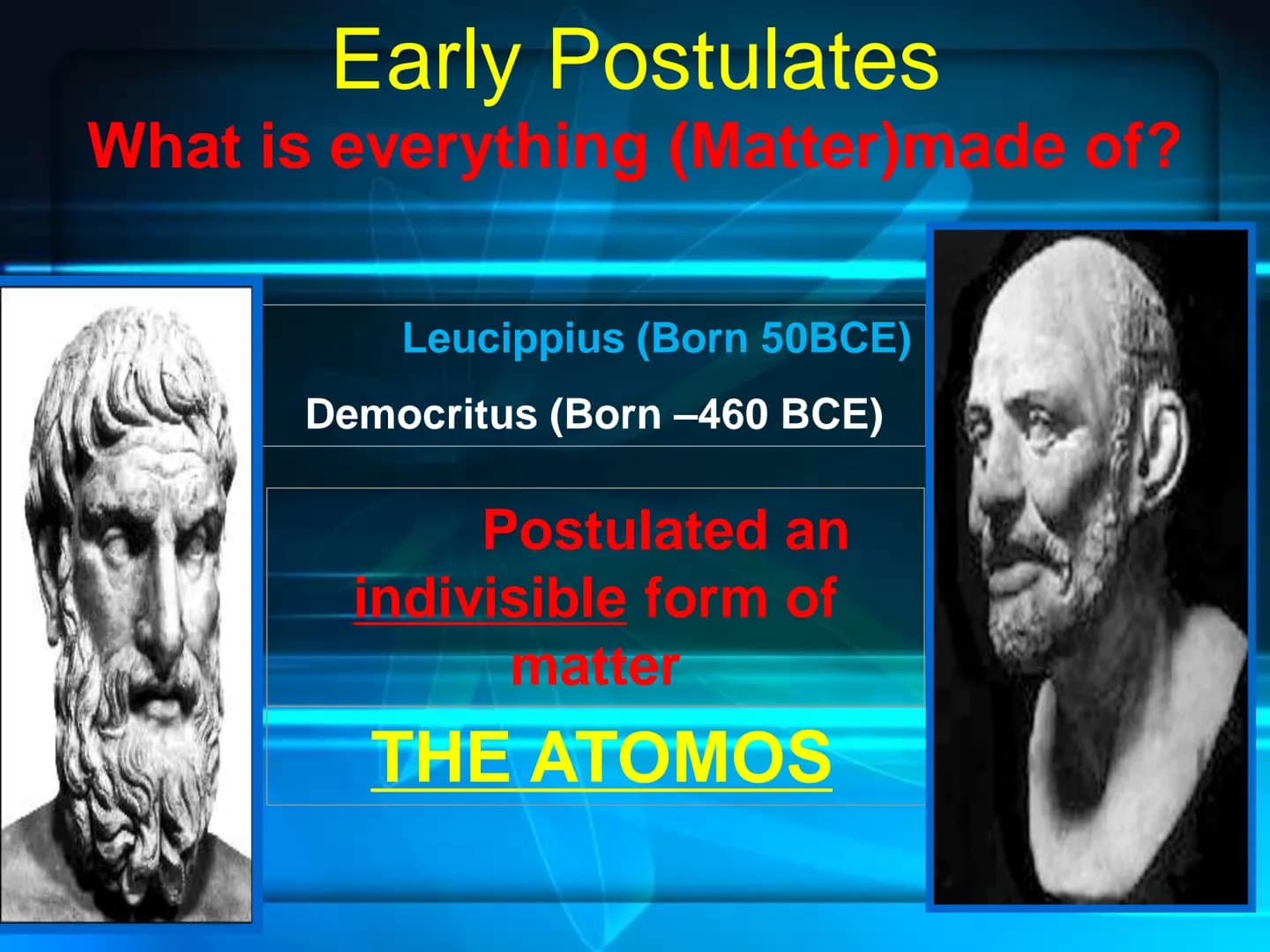
The Birth of the Atom Concept
Around 500 BCE, two Greek philosophers named Leucippus and Democritus had a revolutionary idea. They wondered: if you kept cutting something in half over and over, would you eventually reach a piece so small it couldn't be divided anymore?
They called this theoretical smallest piece "atomos" - which literally means "cannot be cut" in Greek. This was the birth of atomic theory, even though they had zero experimental proof to back up their claims.
These guys were basically the first people to say "Hey, maybe everything is made of tiny, invisible building blocks!" It sounds obvious now, but back then it was mind-blowing.
💡 Cool Connection: The word "atom" we use today comes directly from Democritus's ancient Greek term "atomos"!
4
of 10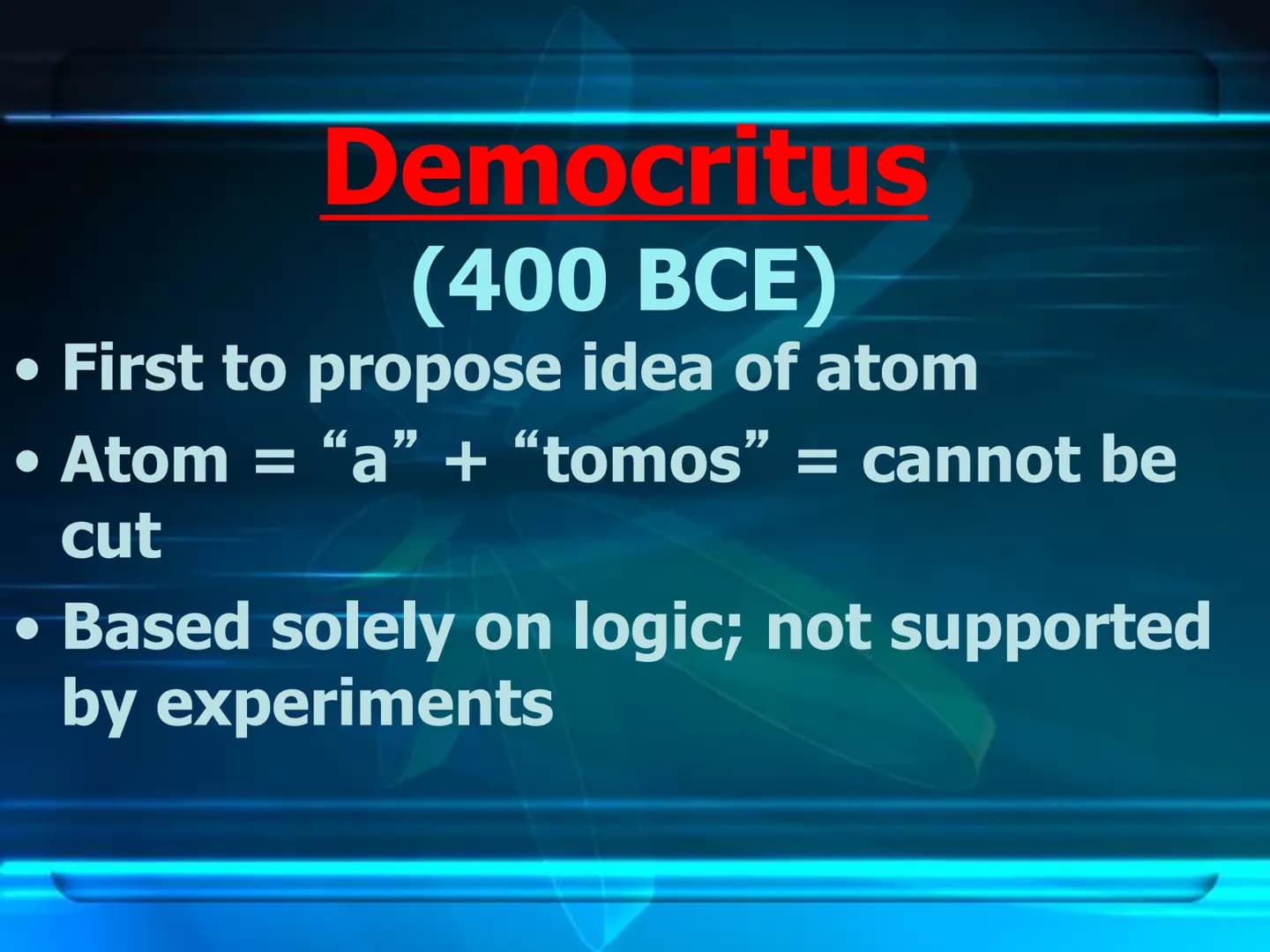
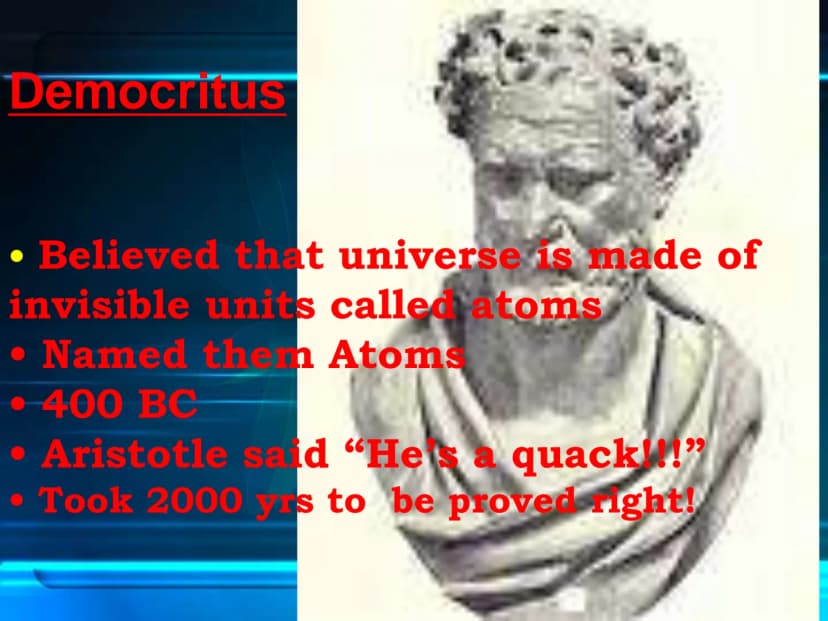
Democritus: The Original Atom Guy
Democritus (460 BCE) deserves major props for being the first person to seriously propose that atoms exist. He broke down the word: "a" (meaning "not") plus "tomos" (meaning "to cut") equals something that can't be divided.
Here's the crazy part - his entire theory was based purely on logical thinking, not experiments. He just used his brain to reason that matter must be made of tiny, indivisible particles.
Unfortunately for Democritus, he lived in a time when most people preferred philosophical debates over scientific testing. His ideas were revolutionary, but he couldn't prove them with the tools available back then.
💡 Reality Check: Democritus was doing ancient "thought experiments" - using logic to explore ideas that couldn't be tested yet!
5
of 10
Democritus vs. The World
Democritus believed the entire universe consisted of invisible units called atoms moving around in empty space. This was absolutely radical thinking for 400 BCE! But then Aristotle - one of the most influential philosophers ever - basically called him crazy.
Aristotle's rejection of atomic theory set science back by about 2,000 years. Since Aristotle was so respected, most people just accepted his word and ignored Democritus's brilliant insights.
Talk about being ahead of your time! Poor Democritus had to wait until the 1800s for scientists to finally prove he was right all along.
💡 Lesson Learned: Sometimes the best ideas take centuries to be accepted - don't give up on good thinking just because others don't get it yet!
6
of 10
Greek Mythology Meets Science
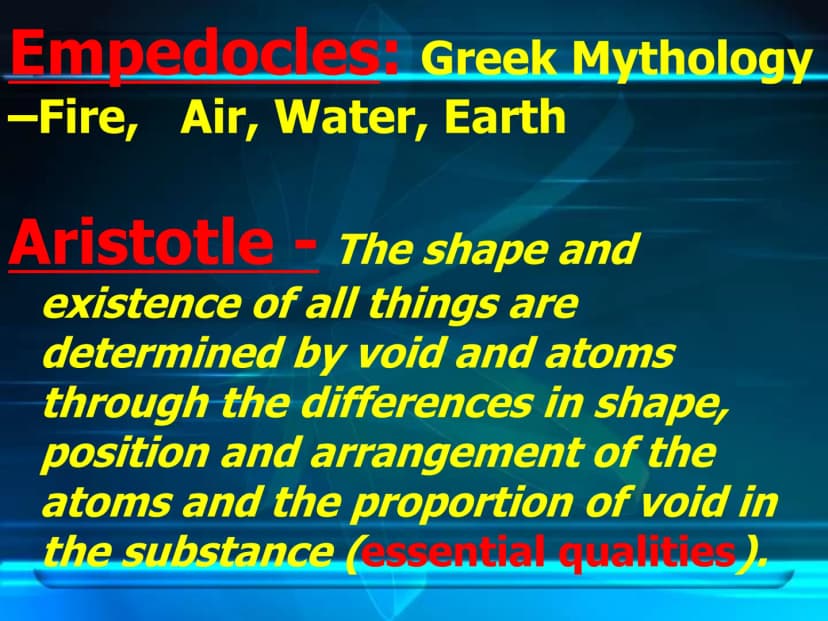
While Democritus was thinking about atoms, other Greeks like Empedocles believed everything was made of just four elements: fire, air, water, and earth. This became super popular and influenced thinking for centuries.
Aristotle expanded on these ideas, believing that the shape and properties of all things came from how atoms were arranged and how much empty space (void) existed between them. Ironically, this part of Aristotle's thinking was actually pretty close to modern atomic theory!
The Greeks were mixing mythology, philosophy, and early scientific thinking into one big intellectual soup. Some ideas were brilliant, others were completely wrong, but they all contributed to our eventual understanding of matter.
💡 Fun Fact: Those four ancient elements (fire, air, water, earth) show up everywhere in modern fantasy games and movies!
7
of 10
The Ancient "Periodic Table"
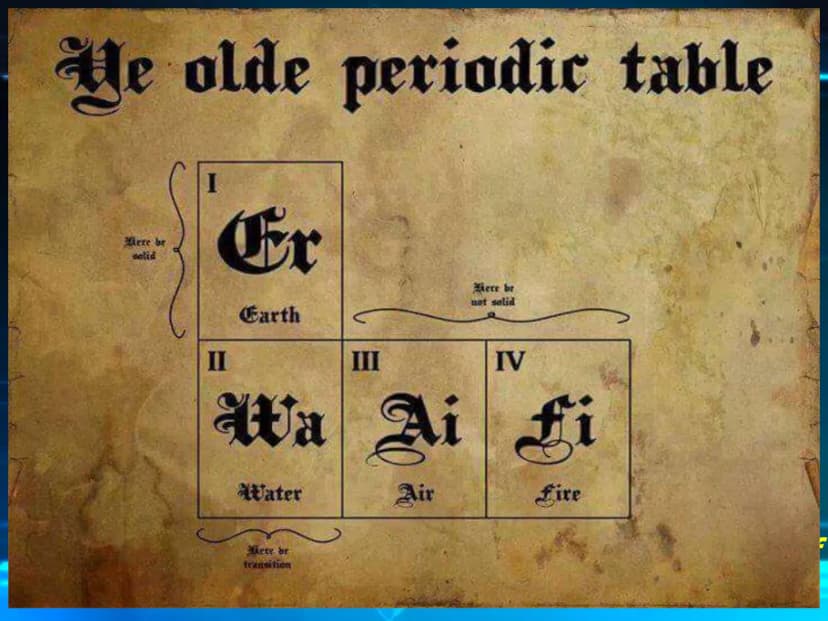
Before we had the modern periodic table, ancient scholars tried to organize matter using their four-element system. They created simple charts showing earth (solid things), water (liquids), air (gases), and fire .
This "ye olde periodic table" was incredibly basic compared to what we know now, but it represented humanity's first attempt to categorize and organize different types of matter. They even tried to explain transitions between states!
While their system was completely wrong by today's standards, you have to admire their effort to make sense of the natural world. They were laying the groundwork for real chemistry to develop centuries later.
💡 Evolution of Ideas: Today's periodic table with 118+ elements evolved from these ancient four-element charts!
8
of 10
Enter John Dalton: The Game Changer
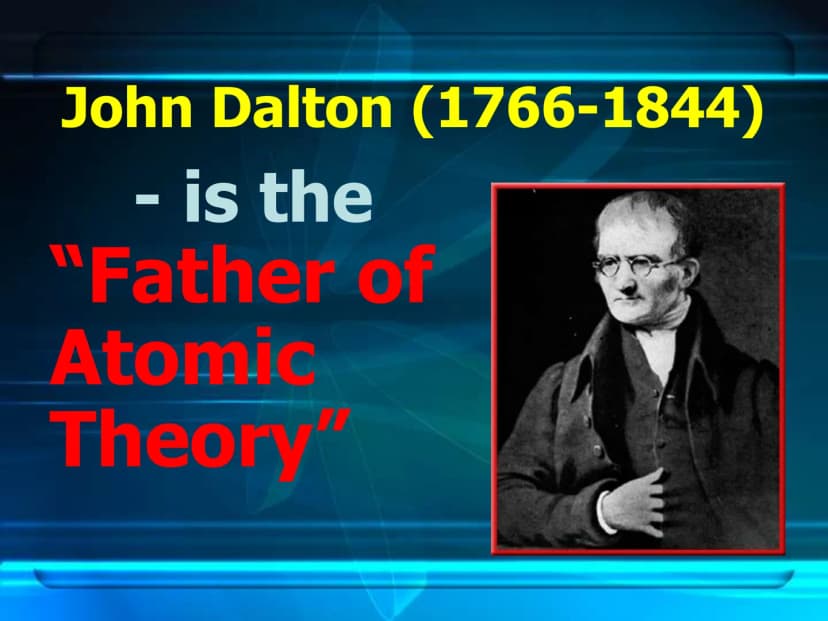
Fast forward to the late 1700s and early 1800s, when John Dalton (1766-1844) earned the title "Father of Atomic Theory" by finally putting real science behind the ancient Greek ideas about atoms.
Dalton was the first person to back up atomic theory with actual experimental evidence and mathematical calculations. He took Democritus's brilliant guesses and turned them into legitimate science.
This guy basically bridged the gap between ancient philosophy and modern chemistry. Without Dalton's work, we might still be arguing about whether atoms actually exist!
💡 Why It Matters: Dalton proved that good ideas from the past can become great science when combined with proper experimental methods.
9
of 10
Dalton's Atomic Model: The Billiard Ball
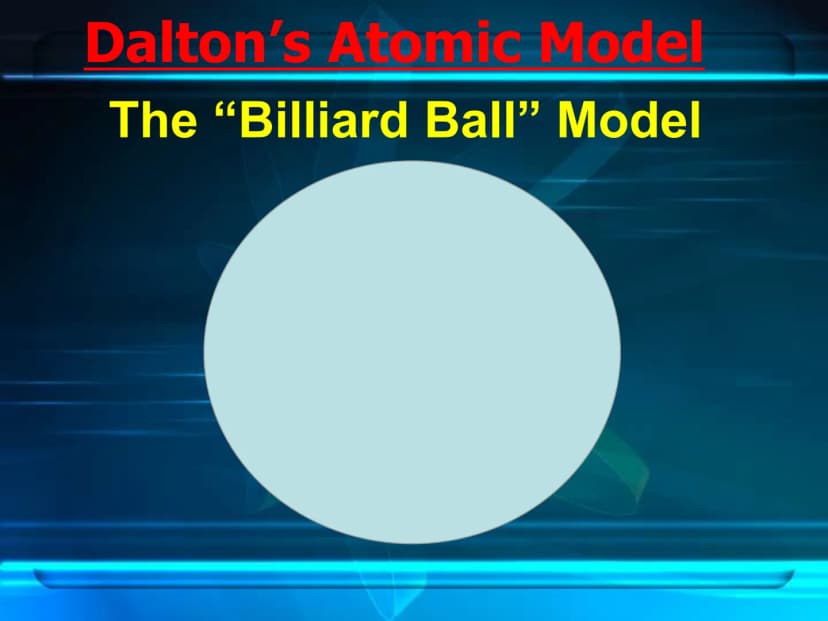
Dalton imagined atoms as tiny, solid spheres - kind of like microscopic billiard balls. In his model, each element had its own type of atom with a specific size and mass, and these atoms combined in simple ratios to form compounds.
This "Billiard Ball" model was revolutionary because it explained so many chemical reactions and properties that scientists had observed but couldn't understand. Finally, chemistry started making sense!
While we now know atoms aren't solid balls (they're mostly empty space!), Dalton's model was a crucial stepping stone toward our modern understanding of atomic structure.
💡 Scientific Progress: Even "wrong" models can be incredibly useful if they help explain observations and lead to better theories!
10
of 10
Modern Atomic Theories
Dalton's billiard ball model was just the beginning. Scientists eventually discovered that atoms aren't solid at all - they contain even smaller particles like protons, neutrons, and electrons arranged in complex ways.
Modern atomic theory incorporates quantum mechanics, electron orbitals, and nuclear physics to explain how atoms really work. It's way more complicated than ancient Greeks imagined, but also way more amazing!
Today's understanding of atoms allows us to create everything from computer chips to life-saving medicines. Those ancient philosophical questions about "what is matter made of?" have led to technologies that would seem like magic to Democritus and Dalton.
💡 Mind Blown: The journey from ancient Greek philosophy to modern atomic theory shows how human curiosity and persistence can unlock the universe's deepest secrets!
We thought you’d never ask...
What is the Knowunity AI companion?
Our AI companion is specifically built for the needs of students. Based on the millions of content pieces we have on the platform we can provide truly meaningful and relevant answers to students. But its not only about answers, the companion is even more about guiding students through their daily learning challenges, with personalised study plans, quizzes or content pieces in the chat and 100% personalisation based on the students skills and developments.
Where can I download the Knowunity app?
You can download the app in the Google Play Store and in the Apple App Store.
Is Knowunity really free of charge?
That's right! Enjoy free access to study content, connect with fellow students, and get instant help – all at your fingertips.
Similar Content
 Otros
Otros Altres
 Diğer
Diğer Science (ACT®)
Most popular content: Key Concepts
6 UCSP
UCSPUnderstanding Culture, Society, and Politics
Complete notes for #UCSP
G121,85526
 Math
MathGRADE 9
This is all for Grade 9 students!
G92,16672
 Econ
EconApplied Economics - 1st Sem
This provides ABM Students complete notes for 1st Semester on Applied Economics.
G111,61828
 EAPP
EAPPEAPP Lesson 1
Notes for SHS students (any strand)
G1178316
 GenBio
CELLULAR RESPIRATION - DEEP DIVE
Descriptive and annotated notes about the types of cellular respiration— aerobic, anaerobic, & ETC! Best for Grade 12 Students!
G125078
GenBioGeneral Biology 1
First Semester Notes
G1297321
Most popular content in GenChem
9GenChemGeneral Chemistry
Covers atomic theory, periodic table, chemical bonding, stoichiometry, acids/bases, and thermodynamics.
G115,766137
GenChemgeneral chemistry
general reviwer for chemistry
G123,30074
GenChemGeneral Chemistry 2
everything about gen chem 2
G123,06644
GenChemElectron configuration
This notes will help you to understand how electron is being distributed.
G92,29944
GenChemTheoretical Foundation of Nursing
Compact guide that breaks down major nursing theorist. CTTO.
G112,01244
GenChemGENERAL CHEMISTRY 2
Gen Chem 2 Reviewer
G111,42035
GenChemGeneral Chemistry - Reviewer for Midterm Exam
Inclusions: Kinetic Molecular Theory, Intermolecular Forces of Attraction, Intermolecular Forces in the Properties of Liquid, Phase Change, Types of Solutions, and etc.
G129438
GenChemINTERMOLECULAR FORCES OF LIQUIDS AND SOLIDS
Intermolecular forces are the attractive forces between molecules that determine the physical properties of liquids and solids, such as boiling point, melting point, viscosity, and solubility.
G126354
GenChemGeneral Chemistry 2 (Midterms)
Reviewer for General Chemistry 2
G121,60531
Most popular content
9MathMathematics Grade 10 Quarter 1
Grade 10 Math topics
G1010,223250
 Iba pa
El Filibusterismo (FILIPINO 10)
Kilalanin ang mga karakter at alamin ang mga pangyayari mula Kabanata 1 hanggang 39.
G1011,183240
ScienceScience 9 Quarter 1 Lesson 1
Topics: The Respiratory System and The Circulatory System
G911,075383
 Gen Physics
General Physics 1, First Sem
Units of Measurement, Vectors, and Kinematics. All with formulas
G116,255168
 Filipino
Filipino 8 Reviewer
Filipino Reviewer for 4th Quarter for Grade 8 students
G88,088127
ScienceSCIENCE Grade 9 Quarter 3 Reviewer
All about the lessons in Grade 9 Quarter 3 SCIENCE, all complete, highlighted, printable, and has extra informations.
G914,629303
 Pre-Cal
UPCAT Reviewer: Mathematics
general coverage of the mathematics section for UPCAT
G127,085397
OtherIntroduction to Philosophy - 1st Semester, Grade 12
A summarized notes for Grade 12 students. Easier learning for the 1st semester’s Philosophy subject.
G123,96856
ScienceThe Human Digestive System
Science Grade 8 1st Quarter Lesson
G84,78386
Can't find what you're looking for? Explore other subjects.
Students love us — and so will you.
4.6/5App Store
4.7/5Google Play
The app is very easy to use and well designed. I have found everything I was looking for so far and have been able to learn a lot from the presentations! I will definitely use the app for a class assignment! And of course it also helps a lot as an inspiration.
Stefan SiOS user
This app is really great. There are so many study notes and help [...]. My problem subject is French, for example, and the app has so many options for help. Thanks to this app, I have improved my French. I would recommend it to anyone.
Samantha KlichAndroid user
Wow, I am really amazed. I just tried the app because I've seen it advertised many times and was absolutely stunned. This app is THE HELP you want for school and above all, it offers so many things, such as workouts and fact sheets, which have been VERY helpful to me personally.
AnnaiOS user
GenChem871 views·Updated Jun 21, 2026·42 pagesUnderstanding Atomic Theory and Structure for Grade 11 Chemistry
N
Nicole Nezren Suliva German@nicolenezrensul
Ever wonder what makes up everything around you - your phone, the air you breathe, even yourself? It all comes down to tiny building blocks called atoms, and scientists have been trying to figure out their secrets for over 2,000...
1
of 10
Sign up to see the content. It's free!
- Access to all documents
- Improve your grades
- Join milions of students
Atomic Theory & Atomic Structure
Think of atoms as the LEGO blocks of the universe - everything you see is built from these incredibly tiny pieces. Atomic theory explains what atoms are and how they work, while atomic structure describes what's inside these microscopic building blocks.
Scientists have been obsessed with understanding atoms because once you know how they work, you can explain pretty much everything in chemistry and physics. It's like having the ultimate cheat code for understanding matter!
💡 Quick Fact: Atoms are so small that millions could fit on the period at the end of this sentence!
2
of 10Sign up to see the content. It's free!
- Access to all documents
- Improve your grades
- Join milions of students
Early Atomic Theories
Long before we had fancy microscopes and lab equipment, ancient philosophers were already asking the big question: "What is everything made of?" These early thinkers used pure logic and imagination to come up with some pretty amazing ideas.
The journey to understanding atoms started with some brilliant Greeks who basically guessed their way to one of science's most important discoveries. Their ideas were so ahead of their time that it took over 2,000 years for technology to catch up and prove them right!
💡 Think About It: Imagine trying to figure out what matter is made of without any modern tools - just your brain and imagination!
3
of 10Sign up to see the content. It's free!
- Access to all documents
- Improve your grades
- Join milions of students
The Birth of the Atom Concept
Around 500 BCE, two Greek philosophers named Leucippus and Democritus had a revolutionary idea. They wondered: if you kept cutting something in half over and over, would you eventually reach a piece so small it couldn't be divided anymore?
They called this theoretical smallest piece "atomos" - which literally means "cannot be cut" in Greek. This was the birth of atomic theory, even though they had zero experimental proof to back up their claims.
These guys were basically the first people to say "Hey, maybe everything is made of tiny, invisible building blocks!" It sounds obvious now, but back then it was mind-blowing.
💡 Cool Connection: The word "atom" we use today comes directly from Democritus's ancient Greek term "atomos"!
4
of 10Sign up to see the content. It's free!
- Access to all documents
- Improve your grades
- Join milions of students
Democritus: The Original Atom Guy
Democritus (460 BCE) deserves major props for being the first person to seriously propose that atoms exist. He broke down the word: "a" (meaning "not") plus "tomos" (meaning "to cut") equals something that can't be divided.
Here's the crazy part - his entire theory was based purely on logical thinking, not experiments. He just used his brain to reason that matter must be made of tiny, indivisible particles.
Unfortunately for Democritus, he lived in a time when most people preferred philosophical debates over scientific testing. His ideas were revolutionary, but he couldn't prove them with the tools available back then.
💡 Reality Check: Democritus was doing ancient "thought experiments" - using logic to explore ideas that couldn't be tested yet!
5
of 10Sign up to see the content. It's free!
- Access to all documents
- Improve your grades
- Join milions of students
Democritus vs. The World
Democritus believed the entire universe consisted of invisible units called atoms moving around in empty space. This was absolutely radical thinking for 400 BCE! But then Aristotle - one of the most influential philosophers ever - basically called him crazy.
Aristotle's rejection of atomic theory set science back by about 2,000 years. Since Aristotle was so respected, most people just accepted his word and ignored Democritus's brilliant insights.
Talk about being ahead of your time! Poor Democritus had to wait until the 1800s for scientists to finally prove he was right all along.
💡 Lesson Learned: Sometimes the best ideas take centuries to be accepted - don't give up on good thinking just because others don't get it yet!
6
of 10Sign up to see the content. It's free!
- Access to all documents
- Improve your grades
- Join milions of students
Greek Mythology Meets Science
While Democritus was thinking about atoms, other Greeks like Empedocles believed everything was made of just four elements: fire, air, water, and earth. This became super popular and influenced thinking for centuries.
Aristotle expanded on these ideas, believing that the shape and properties of all things came from how atoms were arranged and how much empty space (void) existed between them. Ironically, this part of Aristotle's thinking was actually pretty close to modern atomic theory!
The Greeks were mixing mythology, philosophy, and early scientific thinking into one big intellectual soup. Some ideas were brilliant, others were completely wrong, but they all contributed to our eventual understanding of matter.
💡 Fun Fact: Those four ancient elements (fire, air, water, earth) show up everywhere in modern fantasy games and movies!
7
of 10Sign up to see the content. It's free!
- Access to all documents
- Improve your grades
- Join milions of students
The Ancient "Periodic Table"
Before we had the modern periodic table, ancient scholars tried to organize matter using their four-element system. They created simple charts showing earth (solid things), water (liquids), air (gases), and fire .
This "ye olde periodic table" was incredibly basic compared to what we know now, but it represented humanity's first attempt to categorize and organize different types of matter. They even tried to explain transitions between states!
While their system was completely wrong by today's standards, you have to admire their effort to make sense of the natural world. They were laying the groundwork for real chemistry to develop centuries later.
💡 Evolution of Ideas: Today's periodic table with 118+ elements evolved from these ancient four-element charts!
8
of 10Sign up to see the content. It's free!
- Access to all documents
- Improve your grades
- Join milions of students
Enter John Dalton: The Game Changer
Fast forward to the late 1700s and early 1800s, when John Dalton (1766-1844) earned the title "Father of Atomic Theory" by finally putting real science behind the ancient Greek ideas about atoms.
Dalton was the first person to back up atomic theory with actual experimental evidence and mathematical calculations. He took Democritus's brilliant guesses and turned them into legitimate science.
This guy basically bridged the gap between ancient philosophy and modern chemistry. Without Dalton's work, we might still be arguing about whether atoms actually exist!
💡 Why It Matters: Dalton proved that good ideas from the past can become great science when combined with proper experimental methods.
9
of 10Sign up to see the content. It's free!
- Access to all documents
- Improve your grades
- Join milions of students
Dalton's Atomic Model: The Billiard Ball
Dalton imagined atoms as tiny, solid spheres - kind of like microscopic billiard balls. In his model, each element had its own type of atom with a specific size and mass, and these atoms combined in simple ratios to form compounds.
This "Billiard Ball" model was revolutionary because it explained so many chemical reactions and properties that scientists had observed but couldn't understand. Finally, chemistry started making sense!
While we now know atoms aren't solid balls (they're mostly empty space!), Dalton's model was a crucial stepping stone toward our modern understanding of atomic structure.
💡 Scientific Progress: Even "wrong" models can be incredibly useful if they help explain observations and lead to better theories!
10
of 10Sign up to see the content. It's free!
- Access to all documents
- Improve your grades
- Join milions of students
Modern Atomic Theories
Dalton's billiard ball model was just the beginning. Scientists eventually discovered that atoms aren't solid at all - they contain even smaller particles like protons, neutrons, and electrons arranged in complex ways.
Modern atomic theory incorporates quantum mechanics, electron orbitals, and nuclear physics to explain how atoms really work. It's way more complicated than ancient Greeks imagined, but also way more amazing!
Today's understanding of atoms allows us to create everything from computer chips to life-saving medicines. Those ancient philosophical questions about "what is matter made of?" have led to technologies that would seem like magic to Democritus and Dalton.
💡 Mind Blown: The journey from ancient Greek philosophy to modern atomic theory shows how human curiosity and persistence can unlock the universe's deepest secrets!
We thought you’d never ask...
What is the Knowunity AI companion?
Our AI companion is specifically built for the needs of students. Based on the millions of content pieces we have on the platform we can provide truly meaningful and relevant answers to students. But its not only about answers, the companion is even more about guiding students through their daily learning challenges, with personalised study plans, quizzes or content pieces in the chat and 100% personalisation based on the students skills and developments.
Where can I download the Knowunity app?
You can download the app in the Google Play Store and in the Apple App Store.
Is Knowunity really free of charge?
That's right! Enjoy free access to study content, connect with fellow students, and get instant help – all at your fingertips.
Similar Content
Most popular content: Key Concepts
6UCSPUnderstanding Culture, Society, and Politics
Complete notes for #UCSP
G121,85526
MathGRADE 9
This is all for Grade 9 students!
G92,16672
EconApplied Economics - 1st Sem
This provides ABM Students complete notes for 1st Semester on Applied Economics.
G111,61828
EAPPEAPP Lesson 1
Notes for SHS students (any strand)
G1178316
GenBioCELLULAR RESPIRATION - DEEP DIVE
Descriptive and annotated notes about the types of cellular respiration— aerobic, anaerobic, & ETC! Best for Grade 12 Students!
G125078
GenBioGeneral Biology 1
First Semester Notes
G1297321
Most popular content in GenChem
9GenChemGeneral Chemistry
Covers atomic theory, periodic table, chemical bonding, stoichiometry, acids/bases, and thermodynamics.
G115,766137
GenChemgeneral chemistry
general reviwer for chemistry
G123,30074
GenChemGeneral Chemistry 2
everything about gen chem 2
G123,06644
GenChemElectron configuration
This notes will help you to understand how electron is being distributed.
G92,29944
GenChemTheoretical Foundation of Nursing
Compact guide that breaks down major nursing theorist. CTTO.
G112,01244
GenChemGENERAL CHEMISTRY 2
Gen Chem 2 Reviewer
G111,42035
GenChemGeneral Chemistry - Reviewer for Midterm Exam
Inclusions: Kinetic Molecular Theory, Intermolecular Forces of Attraction, Intermolecular Forces in the Properties of Liquid, Phase Change, Types of Solutions, and etc.
G129438
GenChemINTERMOLECULAR FORCES OF LIQUIDS AND SOLIDS
Intermolecular forces are the attractive forces between molecules that determine the physical properties of liquids and solids, such as boiling point, melting point, viscosity, and solubility.
G126354
GenChemGeneral Chemistry 2 (Midterms)
Reviewer for General Chemistry 2
G121,60531
Most popular content
9MathMathematics Grade 10 Quarter 1
Grade 10 Math topics
G1010,223250
Iba paEl Filibusterismo (FILIPINO 10)
Kilalanin ang mga karakter at alamin ang mga pangyayari mula Kabanata 1 hanggang 39.
G1011,183240
ScienceScience 9 Quarter 1 Lesson 1
Topics: The Respiratory System and The Circulatory System
G911,075383
Gen PhysicsGeneral Physics 1, First Sem
Units of Measurement, Vectors, and Kinematics. All with formulas
G116,255168
FilipinoFilipino 8 Reviewer
Filipino Reviewer for 4th Quarter for Grade 8 students
G88,088127
ScienceSCIENCE Grade 9 Quarter 3 Reviewer
All about the lessons in Grade 9 Quarter 3 SCIENCE, all complete, highlighted, printable, and has extra informations.
G914,629303
Pre-CalUPCAT Reviewer: Mathematics
general coverage of the mathematics section for UPCAT
G127,085397
OtherIntroduction to Philosophy - 1st Semester, Grade 12
A summarized notes for Grade 12 students. Easier learning for the 1st semester’s Philosophy subject.
G123,96856
ScienceThe Human Digestive System
Science Grade 8 1st Quarter Lesson
G84,78386
Can't find what you're looking for? Explore other subjects.
Students love us — and so will you.
4.6/5App Store
4.7/5Google Play
The app is very easy to use and well designed. I have found everything I was looking for so far and have been able to learn a lot from the presentations! I will definitely use the app for a class assignment! And of course it also helps a lot as an inspiration.
Stefan SiOS user
This app is really great. There are so many study notes and help [...]. My problem subject is French, for example, and the app has so many options for help. Thanks to this app, I have improved my French. I would recommend it to anyone.
Samantha KlichAndroid user
Wow, I am really amazed. I just tried the app because I've seen it advertised many times and was absolutely stunned. This app is THE HELP you want for school and above all, it offers so many things, such as workouts and fact sheets, which have been VERY helpful to me personally.
AnnaiOS user