
Ever wonder how your muscles work or how your brain...
 GenBio929 views·Updated Jun 23, 2026·3 pages
Introduction to Muscle Tissue and Nervous System
S
secret@secretaccountto
1 / 3
1
of 3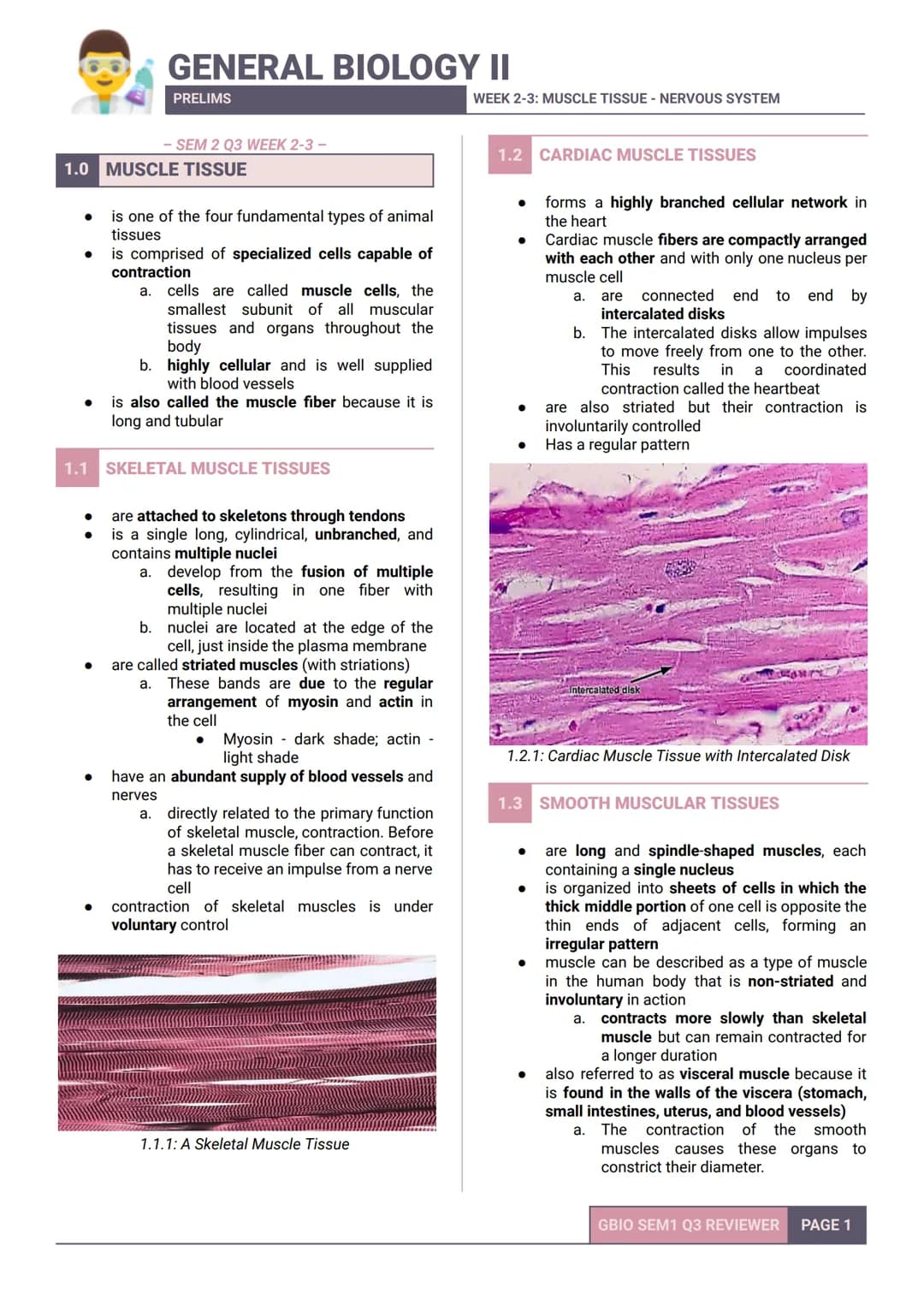
Muscle Tissue Basics
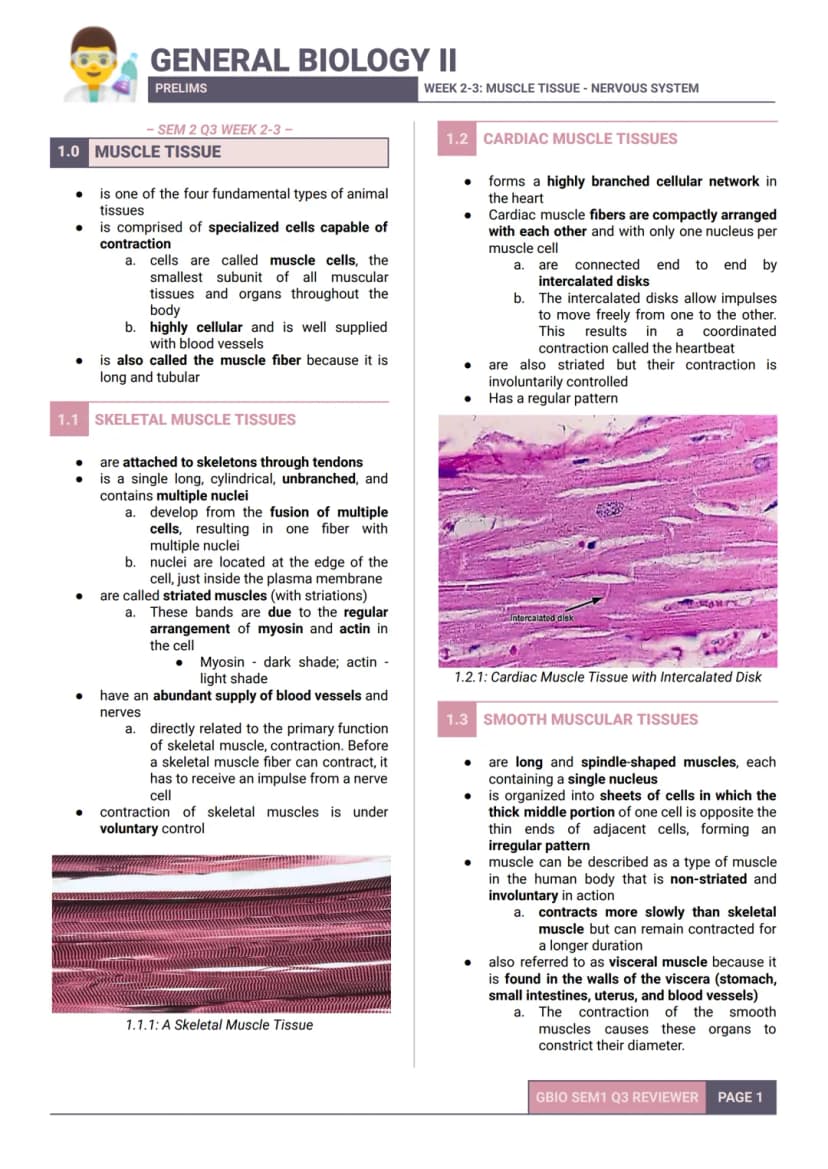
Your body has muscle tissue as one of its four main tissue types, and it's pretty amazing when you think about it. These tissues are made up of specialized cells called muscle fibers that can contract and relax to make movement happen. What makes them special is that they're long, tube-shaped, and packed with blood vessels to keep them well-supplied with nutrients.
There are three types of muscle tissue you need to know. Skeletal muscles attach to your bones through tendons and are the ones you control voluntarily - like when you flex your bicep or walk. These fibers are long, have multiple nuclei, and show striped patterns called striations because of how their proteins (myosin and actin) are arranged.
Cardiac muscle forms the walls of your heart and works involuntarily - thank goodness you don't have to remember to make your heart beat! These cells connect through special junctions called intercalated disks that help coordinate the heartbeat. Smooth muscle is found in your internal organs like your stomach and blood vessels, and it's non-striated and also involuntary.
Quick Tip: Remember SMC - Skeletal , Cardiac , Smooth
2
of 3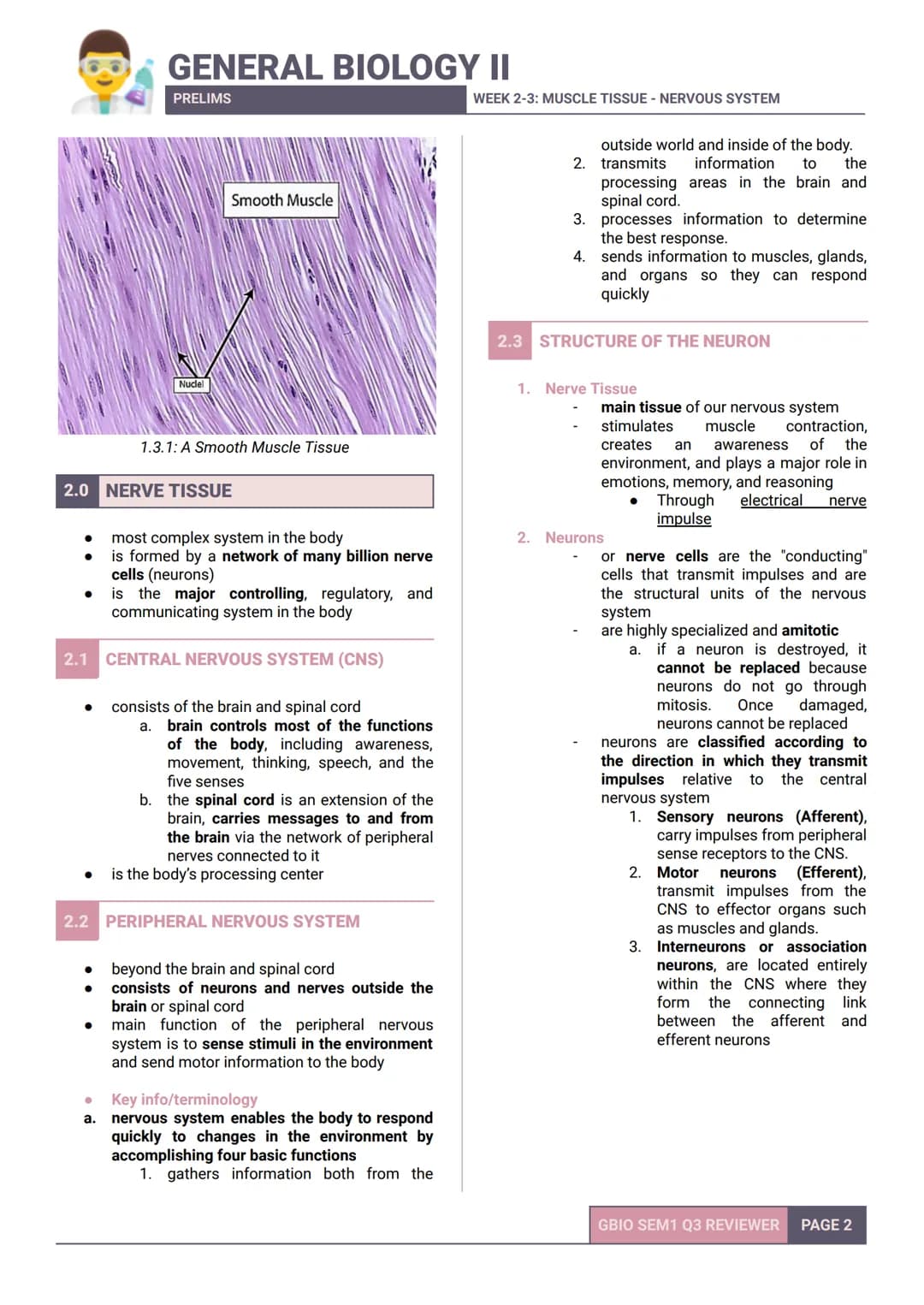
Nervous System Overview
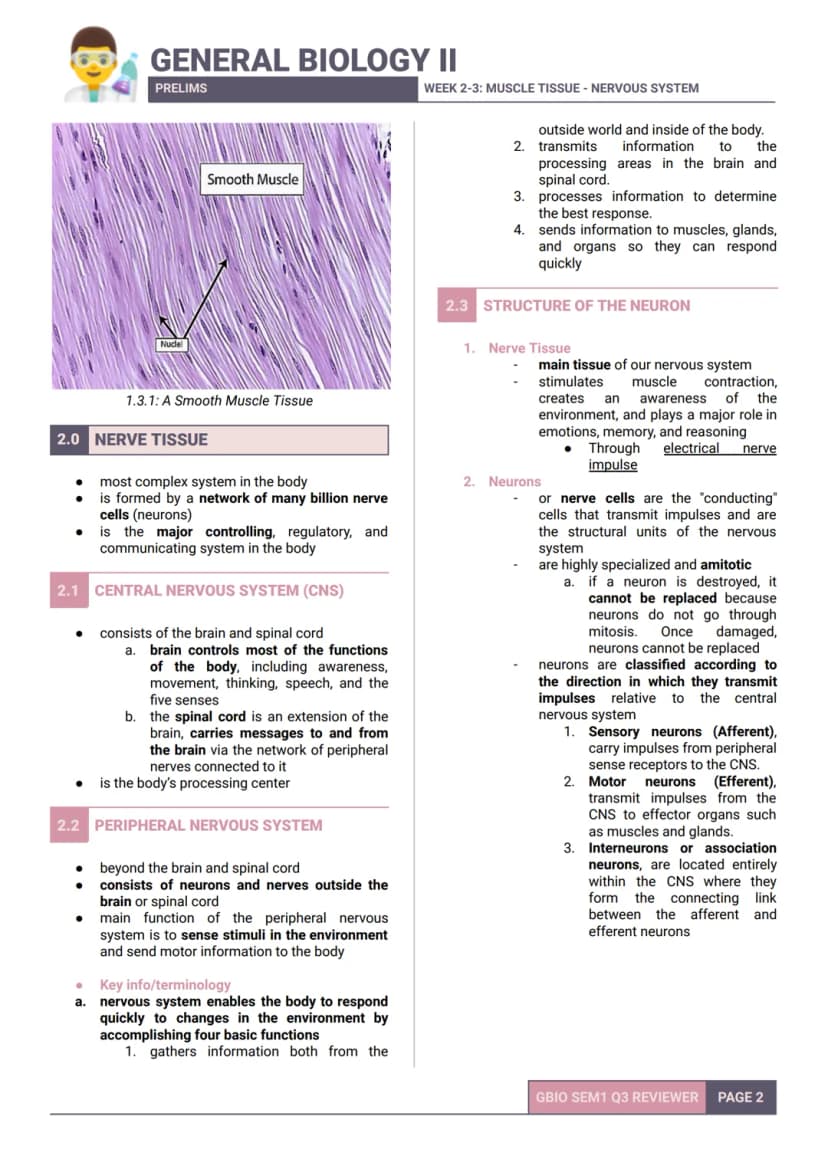
Your nervous system is like the body's internet - it's a complex network of billions of neurons that control and communicate everything happening in your body. This system handles awareness, movement, thinking, speech, and all five senses, making it the ultimate control center.
The system splits into two main parts. The Central Nervous System (CNS) includes your brain and spinal cord - think of it as the main processing center. Your brain controls most body functions while your spinal cord acts like a major highway carrying messages between your brain and the rest of your body.
The Peripheral Nervous System consists of all the nerves outside your brain and spinal cord. Its main job is sensing what's happening in your environment and sending motor commands to your muscles and organs. Together, these systems gather information, transmit it for processing, decide on responses, and send out commands - all happening faster than you can blink!
Remember This: Your nervous system does four things: gather info, transmit it, process it, and respond to it.
3
of 3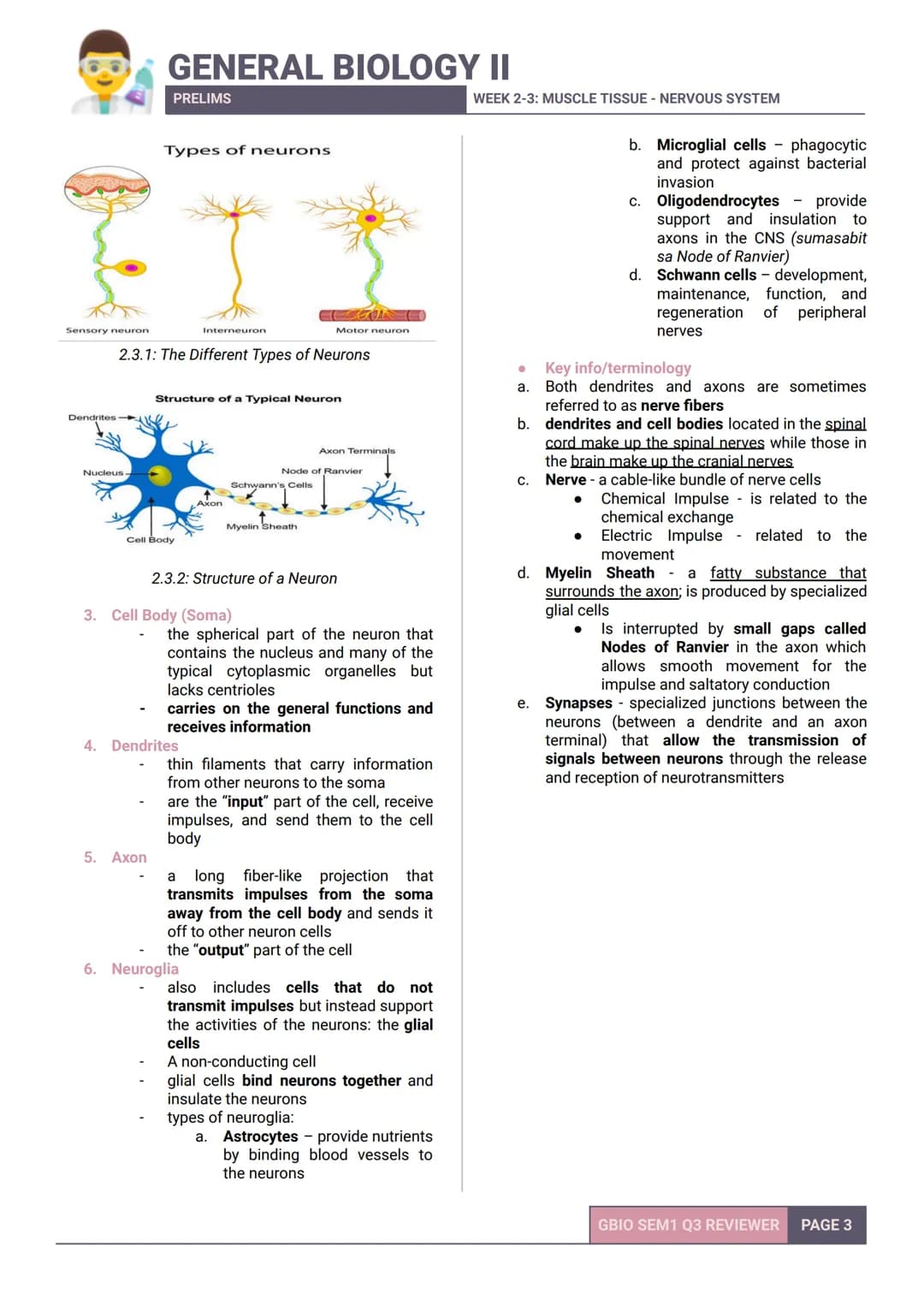
Neuron Structure and Function
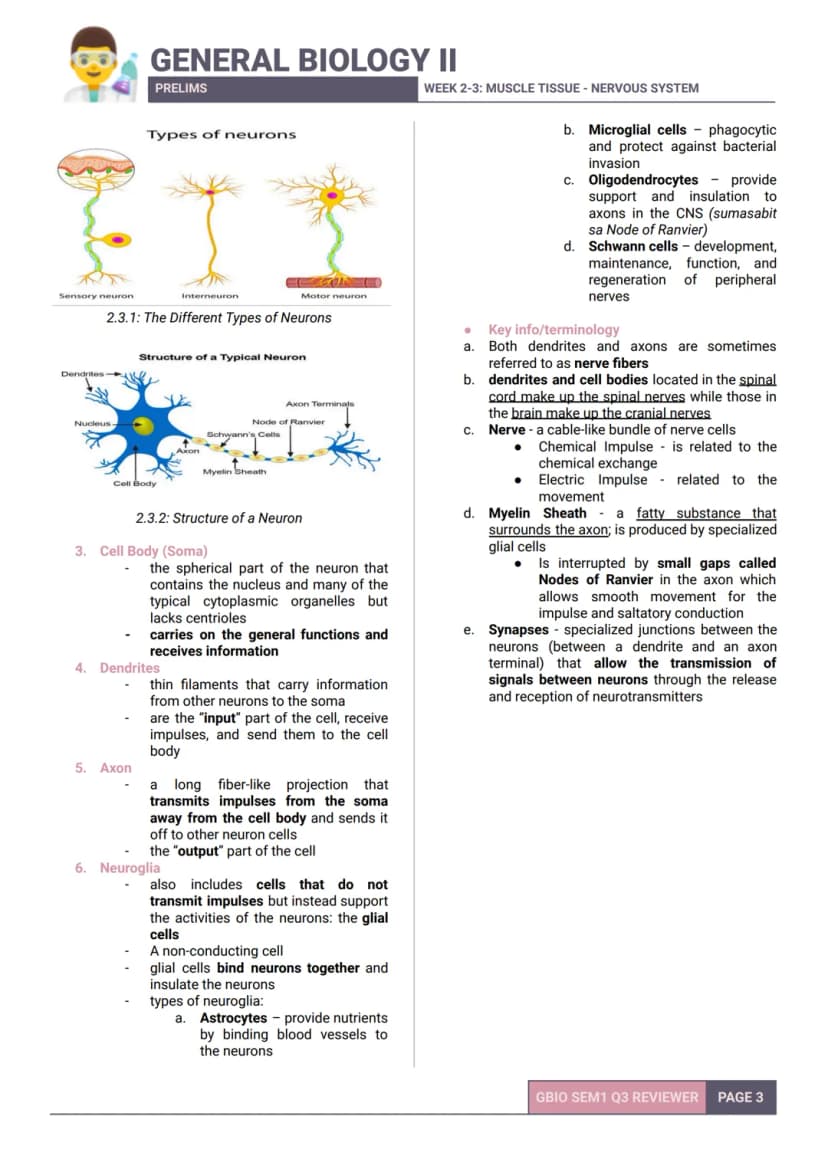
Neurons (nerve cells) are the superstars of your nervous system - they're the "conducting" cells that transmit electrical impulses throughout your body. What's fascinating is that once these cells are damaged, they can't be replaced because neurons don't undergo cell division like other cells do.
There are three types of neurons based on their job. Sensory neurons carry information from your sense organs to your CNS (like when you touch something hot). Motor neurons send commands from your CNS to muscles and glands (telling your hand to pull away from that hot object). Interneurons work entirely within your CNS, connecting sensory and motor neurons.
Every neuron has key parts you should know. The cell body (soma) contains the nucleus and handles general cell functions. Dendrites are like branches that receive incoming signals and send them toward the cell body. The axon is the long projection that carries signals away from the cell body to other neurons.
Neuroglia are the support cells that don't transmit impulses but keep neurons healthy and functioning. The myelin sheath wraps around axons like insulation on electrical wires, helping impulses travel faster. Synapses are the specialized junctions where neurons communicate using chemical messengers called neurotransmitters.
Memory Trick: Think of dendrites as "receivers" and axons as "senders" - just like how you receive texts and send replies!
We thought you’d never ask...
What is the Knowunity AI companion?
Our AI companion is specifically built for the needs of students. Based on the millions of content pieces we have on the platform we can provide truly meaningful and relevant answers to students. But its not only about answers, the companion is even more about guiding students through their daily learning challenges, with personalised study plans, quizzes or content pieces in the chat and 100% personalisation based on the students skills and developments.
Where can I download the Knowunity app?
You can download the app in the Google Play Store and in the Apple App Store.
Is Knowunity really free of charge?
That's right! Enjoy free access to study content, connect with fellow students, and get instant help – all at your fingertips.
Most popular content in GenBio
9GenBioGeneral Biology 1, 1st Sem
Topics: Cells, Organelles, Prokaryotes & Eukaryotes, Specialized Cells, Cell Modification, Cell Cycle, Mitosis, Meiosis, Chromosomal Abnormalities, Cell Membrane, Transport Mechanism
G119,063281
GenBioBiology
General Knowledge
G113,17387
GenBioUNDERSTANDING THE SELF LESSON 1
understanding the self lesson one
College3,28180
GenBioReview on Anatomy and Physiology
These notes contain a collated review on anatomy and physiology, which covers the different parts of the body and their basic descriptions.
G114,188137
GenBioBiology review 1
Preparation for college entrance exams
College79917
 GenChem
Theoretical Foundation of Nursing
Compact guide that breaks down major nursing theorist. CTTO.
G112,01244
GenBioPhotosynthesis Reviewer
Contains a complete review of photosynthesis, with detailed explanations of the light-dependent reactions and the light-independent (Calvin cycle) reactions.
G112,35643
GenBioBiology 2 - Genetic Engineering Lesson
Biology 2 -Genetic Engineering lesson for Grade 12 STEM 2nd Semester
G1294714
Earth ScienceCell Division - Difference of Mitosis and Meiosis
General Biology
G111,96843
Most popular content
9 Math
MathMathematics Grade 10 Quarter 1
Grade 10 Math topics
G1010,223250
 Iba pa
El Filibusterismo (FILIPINO 10)
Kilalanin ang mga karakter at alamin ang mga pangyayari mula Kabanata 1 hanggang 39.
G1011,183240
ScienceScience 9 Quarter 1 Lesson 1
Topics: The Respiratory System and The Circulatory System
G911,075383
 Gen Physics
General Physics 1, First Sem
Units of Measurement, Vectors, and Kinematics. All with formulas
G116,247168
 Filipino
Filipino 8 Reviewer
Filipino Reviewer for 4th Quarter for Grade 8 students
G88,088127
ScienceSCIENCE Grade 9 Quarter 3 Reviewer
All about the lessons in Grade 9 Quarter 3 SCIENCE, all complete, highlighted, printable, and has extra informations.
G914,629303
 Pre-Cal
UPCAT Reviewer: Mathematics
general coverage of the mathematics section for UPCAT
G127,085397
OtherIntroduction to Philosophy - 1st Semester, Grade 12
A summarized notes for Grade 12 students. Easier learning for the 1st semester’s Philosophy subject.
G123,96856
ScienceThe Human Digestive System
Science Grade 8 1st Quarter Lesson
G84,78386
Can't find what you're looking for? Explore other subjects.
Students love us — and so will you.
4.6/5App Store
4.7/5Google Play
The app is very easy to use and well designed. I have found everything I was looking for so far and have been able to learn a lot from the presentations! I will definitely use the app for a class assignment! And of course it also helps a lot as an inspiration.
Stefan SiOS user
This app is really great. There are so many study notes and help [...]. My problem subject is French, for example, and the app has so many options for help. Thanks to this app, I have improved my French. I would recommend it to anyone.
Samantha KlichAndroid user
Wow, I am really amazed. I just tried the app because I've seen it advertised many times and was absolutely stunned. This app is THE HELP you want for school and above all, it offers so many things, such as workouts and fact sheets, which have been VERY helpful to me personally.
AnnaiOS user
GenBio929 views·Updated Jun 23, 2026·3 pagesIntroduction to Muscle Tissue and Nervous System
S
secret@secretaccountto
Ever wonder how your muscles work or how your brain sends messages to your body? Understanding muscle and nerve tissues is key to knowing how your body moves and responds to the world around you.
1
of 3
Sign up to see the content. It's free!
- Access to all documents
- Improve your grades
- Join milions of students
Muscle Tissue Basics
Your body has muscle tissue as one of its four main tissue types, and it's pretty amazing when you think about it. These tissues are made up of specialized cells called muscle fibers that can contract and relax to make movement happen. What makes them special is that they're long, tube-shaped, and packed with blood vessels to keep them well-supplied with nutrients.
There are three types of muscle tissue you need to know. Skeletal muscles attach to your bones through tendons and are the ones you control voluntarily - like when you flex your bicep or walk. These fibers are long, have multiple nuclei, and show striped patterns called striations because of how their proteins (myosin and actin) are arranged.
Cardiac muscle forms the walls of your heart and works involuntarily - thank goodness you don't have to remember to make your heart beat! These cells connect through special junctions called intercalated disks that help coordinate the heartbeat. Smooth muscle is found in your internal organs like your stomach and blood vessels, and it's non-striated and also involuntary.
Quick Tip: Remember SMC - Skeletal , Cardiac , Smooth
2
of 3Sign up to see the content. It's free!
- Access to all documents
- Improve your grades
- Join milions of students
Nervous System Overview
Your nervous system is like the body's internet - it's a complex network of billions of neurons that control and communicate everything happening in your body. This system handles awareness, movement, thinking, speech, and all five senses, making it the ultimate control center.
The system splits into two main parts. The Central Nervous System (CNS) includes your brain and spinal cord - think of it as the main processing center. Your brain controls most body functions while your spinal cord acts like a major highway carrying messages between your brain and the rest of your body.
The Peripheral Nervous System consists of all the nerves outside your brain and spinal cord. Its main job is sensing what's happening in your environment and sending motor commands to your muscles and organs. Together, these systems gather information, transmit it for processing, decide on responses, and send out commands - all happening faster than you can blink!
Remember This: Your nervous system does four things: gather info, transmit it, process it, and respond to it.
3
of 3Sign up to see the content. It's free!
- Access to all documents
- Improve your grades
- Join milions of students
Neuron Structure and Function
Neurons (nerve cells) are the superstars of your nervous system - they're the "conducting" cells that transmit electrical impulses throughout your body. What's fascinating is that once these cells are damaged, they can't be replaced because neurons don't undergo cell division like other cells do.
There are three types of neurons based on their job. Sensory neurons carry information from your sense organs to your CNS (like when you touch something hot). Motor neurons send commands from your CNS to muscles and glands (telling your hand to pull away from that hot object). Interneurons work entirely within your CNS, connecting sensory and motor neurons.
Every neuron has key parts you should know. The cell body (soma) contains the nucleus and handles general cell functions. Dendrites are like branches that receive incoming signals and send them toward the cell body. The axon is the long projection that carries signals away from the cell body to other neurons.
Neuroglia are the support cells that don't transmit impulses but keep neurons healthy and functioning. The myelin sheath wraps around axons like insulation on electrical wires, helping impulses travel faster. Synapses are the specialized junctions where neurons communicate using chemical messengers called neurotransmitters.
Memory Trick: Think of dendrites as "receivers" and axons as "senders" - just like how you receive texts and send replies!
We thought you’d never ask...
What is the Knowunity AI companion?
Our AI companion is specifically built for the needs of students. Based on the millions of content pieces we have on the platform we can provide truly meaningful and relevant answers to students. But its not only about answers, the companion is even more about guiding students through their daily learning challenges, with personalised study plans, quizzes or content pieces in the chat and 100% personalisation based on the students skills and developments.
Where can I download the Knowunity app?
You can download the app in the Google Play Store and in the Apple App Store.
Is Knowunity really free of charge?
That's right! Enjoy free access to study content, connect with fellow students, and get instant help – all at your fingertips.
Most popular content in GenBio
9GenBioGeneral Biology 1, 1st Sem
Topics: Cells, Organelles, Prokaryotes & Eukaryotes, Specialized Cells, Cell Modification, Cell Cycle, Mitosis, Meiosis, Chromosomal Abnormalities, Cell Membrane, Transport Mechanism
G119,063281
GenBioBiology
General Knowledge
G113,17387
GenBioUNDERSTANDING THE SELF LESSON 1
understanding the self lesson one
College3,28180
GenBioReview on Anatomy and Physiology
These notes contain a collated review on anatomy and physiology, which covers the different parts of the body and their basic descriptions.
G114,188137
GenBioBiology review 1
Preparation for college entrance exams
College79917
GenChemTheoretical Foundation of Nursing
Compact guide that breaks down major nursing theorist. CTTO.
G112,01244
GenBioPhotosynthesis Reviewer
Contains a complete review of photosynthesis, with detailed explanations of the light-dependent reactions and the light-independent (Calvin cycle) reactions.
G112,35643
GenBioBiology 2 - Genetic Engineering Lesson
Biology 2 -Genetic Engineering lesson for Grade 12 STEM 2nd Semester
G1294714
Earth ScienceCell Division - Difference of Mitosis and Meiosis
General Biology
G111,96843
Most popular content
9MathMathematics Grade 10 Quarter 1
Grade 10 Math topics
G1010,223250
Iba paEl Filibusterismo (FILIPINO 10)
Kilalanin ang mga karakter at alamin ang mga pangyayari mula Kabanata 1 hanggang 39.
G1011,183240
ScienceScience 9 Quarter 1 Lesson 1
Topics: The Respiratory System and The Circulatory System
G911,075383
Gen PhysicsGeneral Physics 1, First Sem
Units of Measurement, Vectors, and Kinematics. All with formulas
G116,247168
FilipinoFilipino 8 Reviewer
Filipino Reviewer for 4th Quarter for Grade 8 students
G88,088127
ScienceSCIENCE Grade 9 Quarter 3 Reviewer
All about the lessons in Grade 9 Quarter 3 SCIENCE, all complete, highlighted, printable, and has extra informations.
G914,629303
Pre-CalUPCAT Reviewer: Mathematics
general coverage of the mathematics section for UPCAT
G127,085397
OtherIntroduction to Philosophy - 1st Semester, Grade 12
A summarized notes for Grade 12 students. Easier learning for the 1st semester’s Philosophy subject.
G123,96856
ScienceThe Human Digestive System
Science Grade 8 1st Quarter Lesson
G84,78386
Can't find what you're looking for? Explore other subjects.
Students love us — and so will you.
4.6/5App Store
4.7/5Google Play
The app is very easy to use and well designed. I have found everything I was looking for so far and have been able to learn a lot from the presentations! I will definitely use the app for a class assignment! And of course it also helps a lot as an inspiration.
Stefan SiOS user
This app is really great. There are so many study notes and help [...]. My problem subject is French, for example, and the app has so many options for help. Thanks to this app, I have improved my French. I would recommend it to anyone.
Samantha KlichAndroid user
Wow, I am really amazed. I just tried the app because I've seen it advertised many times and was absolutely stunned. This app is THE HELP you want for school and above all, it offers so many things, such as workouts and fact sheets, which have been VERY helpful to me personally.
AnnaiOS user