
Ever wonder what makes up every living thing on Earth?...
 GenBio9,063 views·Updated Jun 26, 2026·14 pages
General Biology: Exploring Life Processes
S
Sophia@sophialuvr
1 / 10
1
of 10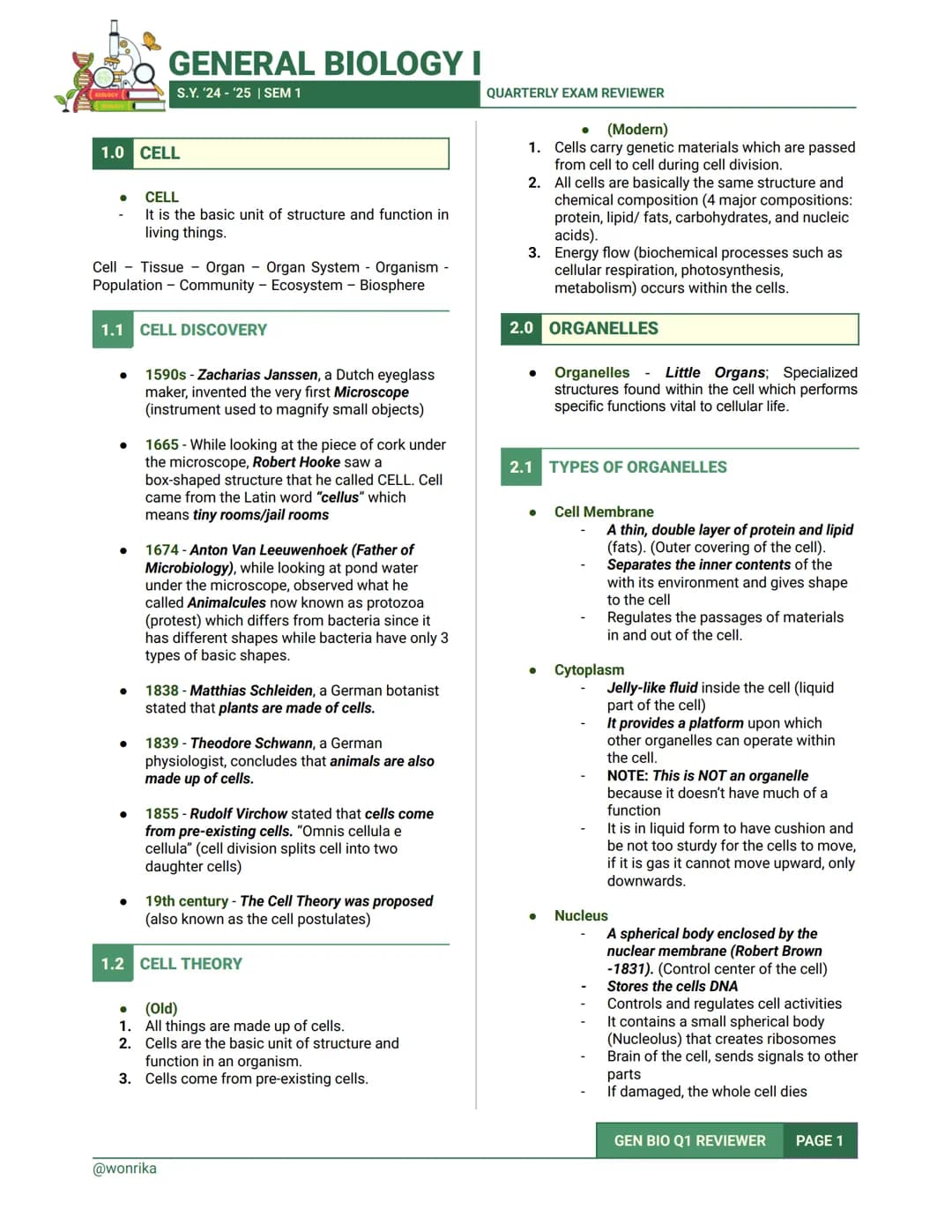
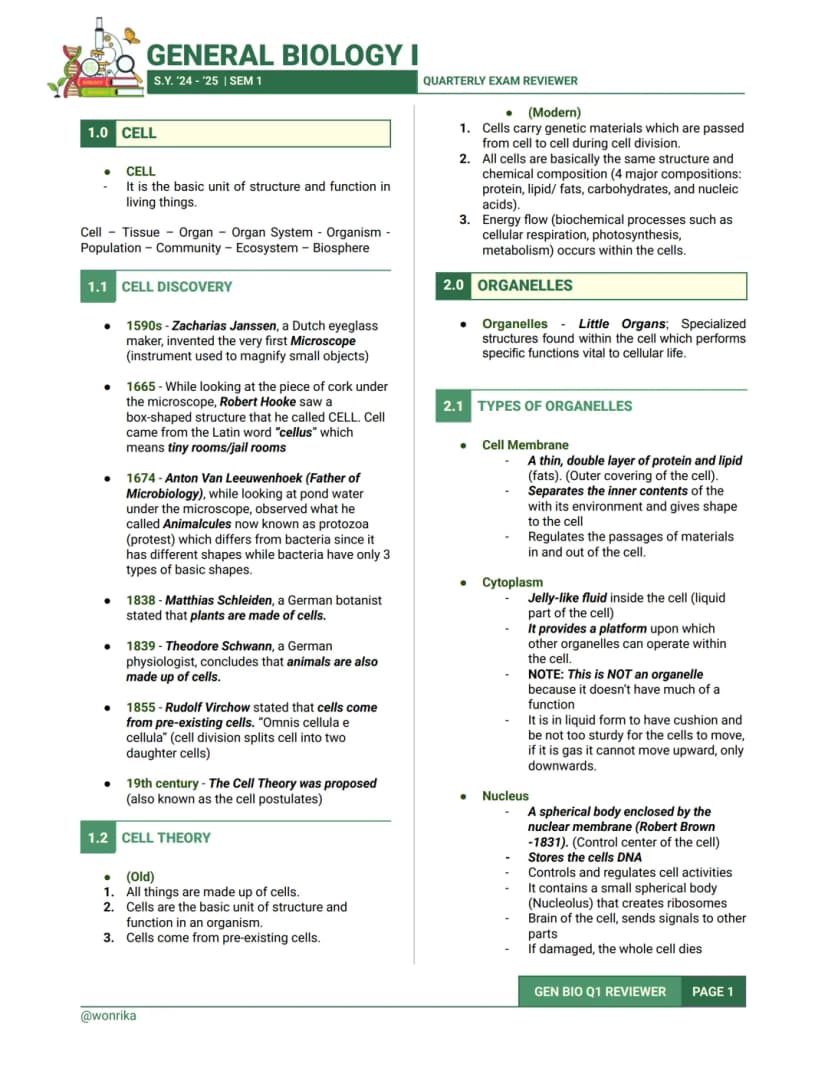
Cell Basics and Discovery
Think of cells as the LEGO blocks of life - everything living is made from these tiny units! The cell is the basic unit of structure and function in all living things, and it took centuries of brilliant scientists to figure this out.
Back in the 1590s, Zacharias Janssen invented the first microscope, which was like giving humanity superpowers to see the invisible. Then Robert Hooke in 1665 looked at cork and saw box-shaped structures he called "cells" . Anton van Leeuwenhoek, known as the Father of Microbiology, discovered tiny moving creatures called animalcules (now called protozoa) in pond water.
The real breakthrough came with the Cell Theory in the 19th century. The old version had three simple rules: all living things are made of cells, cells are the basic units of life, and cells come from other cells. The modern version adds that cells carry genetic material, have similar chemical makeup (proteins, fats, carbs, and DNA), and handle energy processes like cellular respiration.
Quick Tip: Remember "Structure, Function, Origin" - that's the core of cell theory and will help you ace any exam question about it!
2
of 10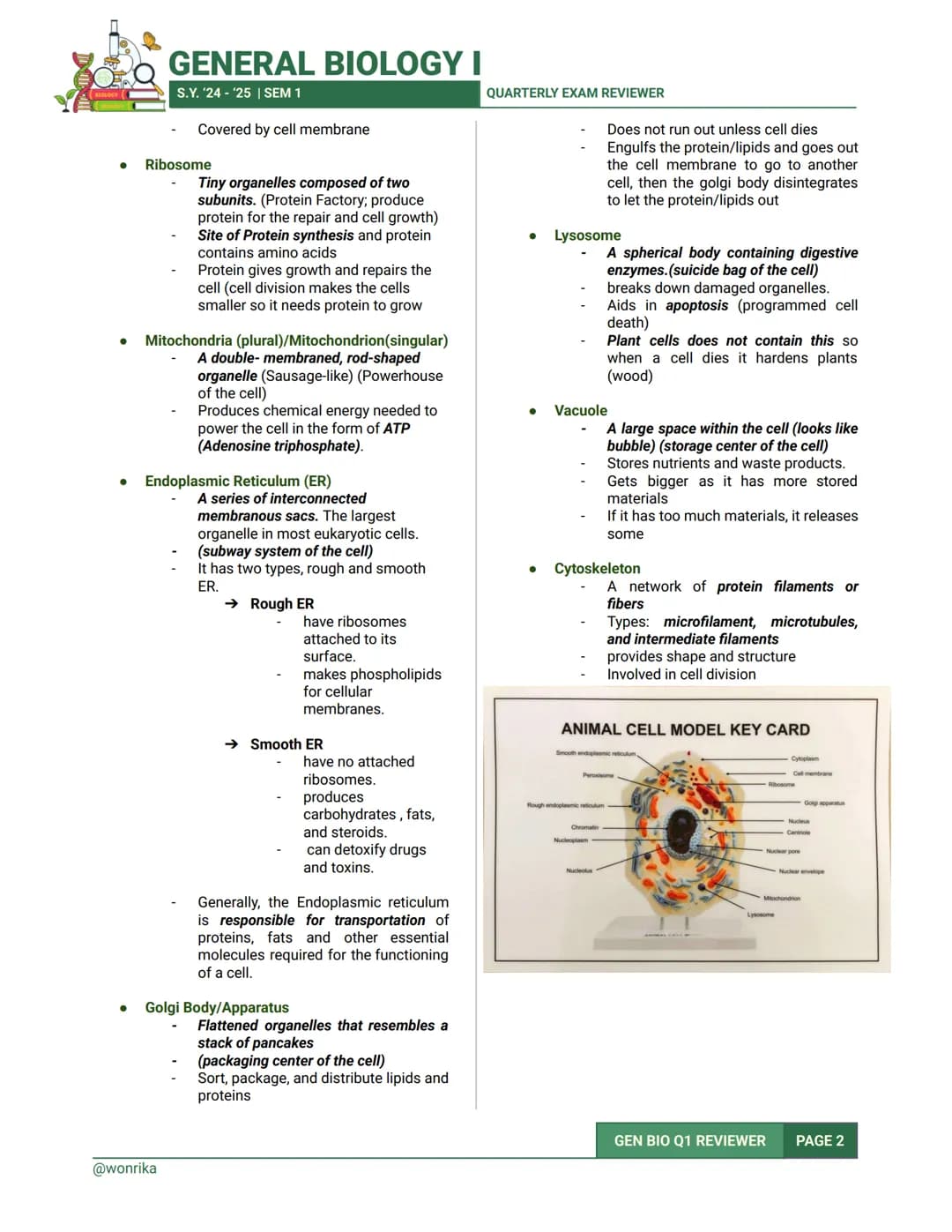
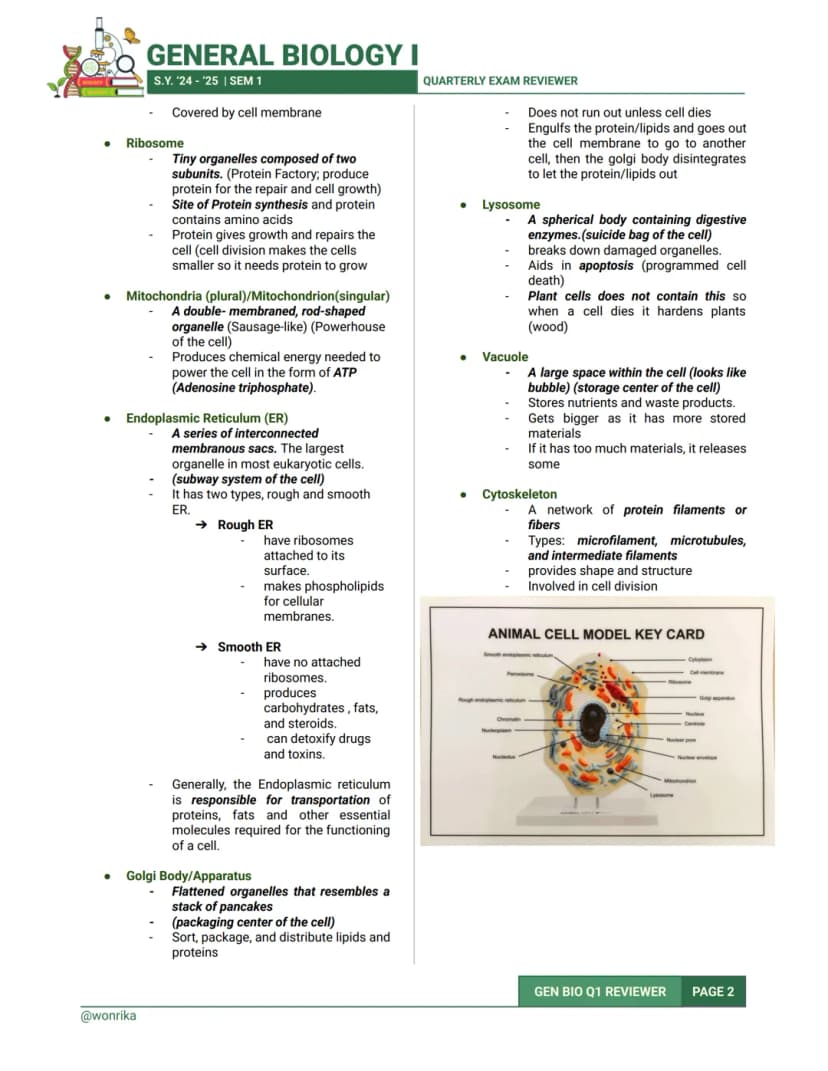
Cell Parts and Their Jobs
Your cell is like a bustling city with different districts handling specific jobs. The cell membrane is your city walls - it's a double layer of proteins and fats that controls what goes in and out. Inside, you've got cytoplasm, which is basically the jelly-like fluid where everything floats around (think of it as the city's atmosphere).
The nucleus is definitely the mayor's office - it's the control center storing your DNA and running the whole show. If it gets damaged, game over for the cell. Ribosomes are your protein factories, cranked out by the nucleolus inside the nucleus. They're constantly building proteins for growth and repair.
Mitochondria are the powerhouses generating ATP (cellular energy currency) - you literally can't live without them. The endoplasmic reticulum is like the city's subway system, with rough ER (has ribosomes) making membrane parts and smooth ER (no ribosomes) producing fats and detoxing harmful stuff.
Golgi bodies are the packaging centers that wrap up proteins and lipids for delivery, while lysosomes are the cleanup crew with digestive enzymes (they're called "suicide bags" because they can destroy the cell). Vacuoles store stuff like a warehouse, and the cytoskeleton gives your cell its shape and helps during division.
Study Hack: Draw your own cell and label everything - visual learning sticks way better than just memorizing lists!
3
of 10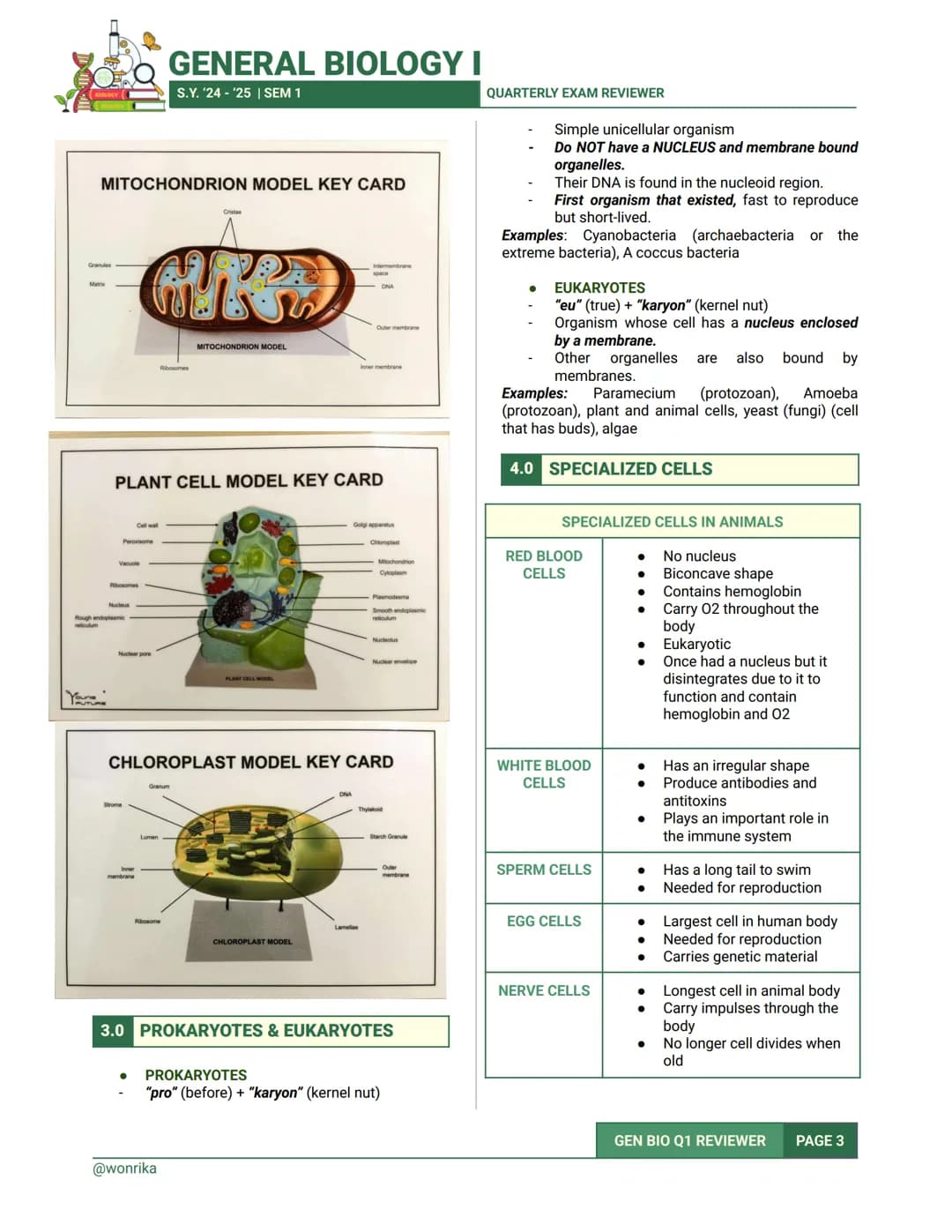
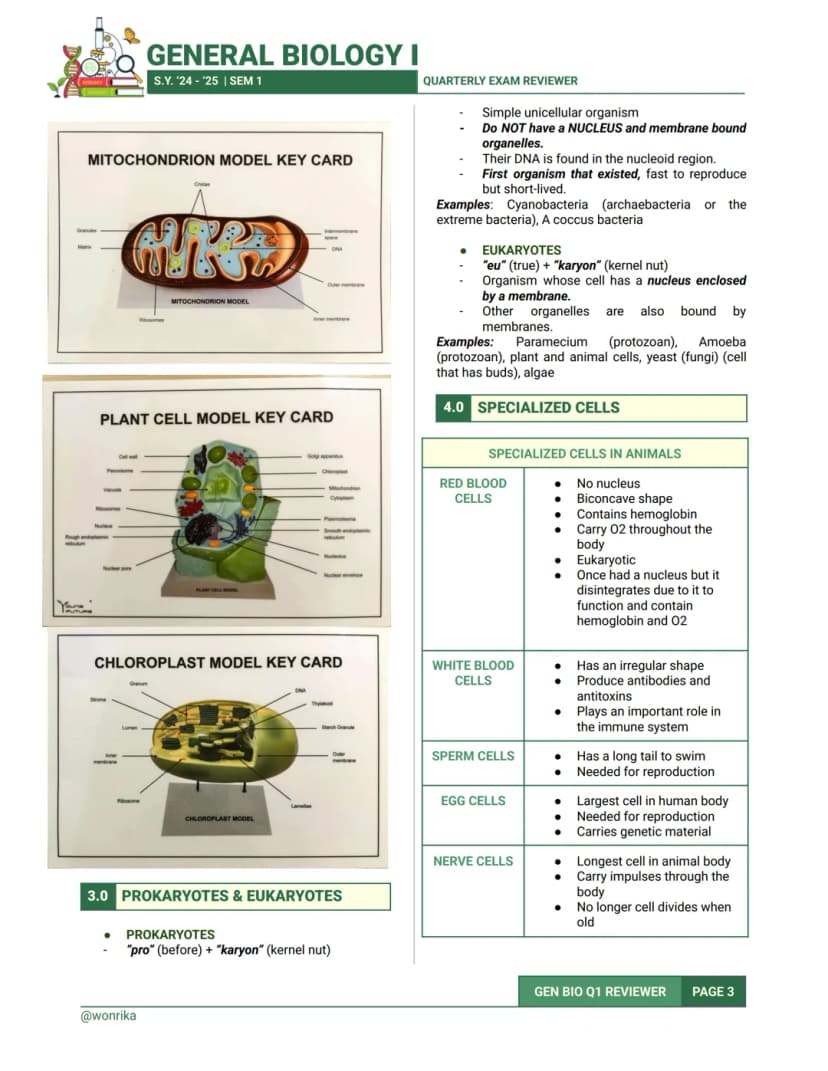
Prokaryotes vs Eukaryotes and Specialized Cells
Here's where cells get interesting - they come in two major types that are totally different! Prokaryotes (like bacteria) are the rebels without a nucleus - their DNA just floats around freely in a region called the nucleoid. They're simple, fast-reproducing, but short-lived. Think of them as the first life forms that figured out how to exist.
Eukaryotes are the sophisticated ones with a proper nucleus wrapped in a membrane, plus all those organelles we talked about. This includes everything from single-celled amoebas to complex organisms like plants, animals, and even yeast.
Now for the cool part - specialized cells! Your body has cells that are like specialized workers. Red blood cells are biconcave discs packed with hemoglobin to carry oxygen (they even lose their nucleus to make more room!). White blood cells are your immune system warriors with irregular shapes to fight infections.
Sperm cells have long tails for swimming to reach eggs, while egg cells are the largest cells in your body, packed with nutrients. Nerve cells are the longest cells, carrying electrical signals throughout your body. Plants have their own specialists too - guard cells control gas exchange, photosynthetic cells make food with chloroplasts, and xylem and phloem cells transport water and nutrients like a plant's circulatory system.
Memory Trick: Remember "Form follows function" - each cell's shape and parts perfectly match its job!
4
of 10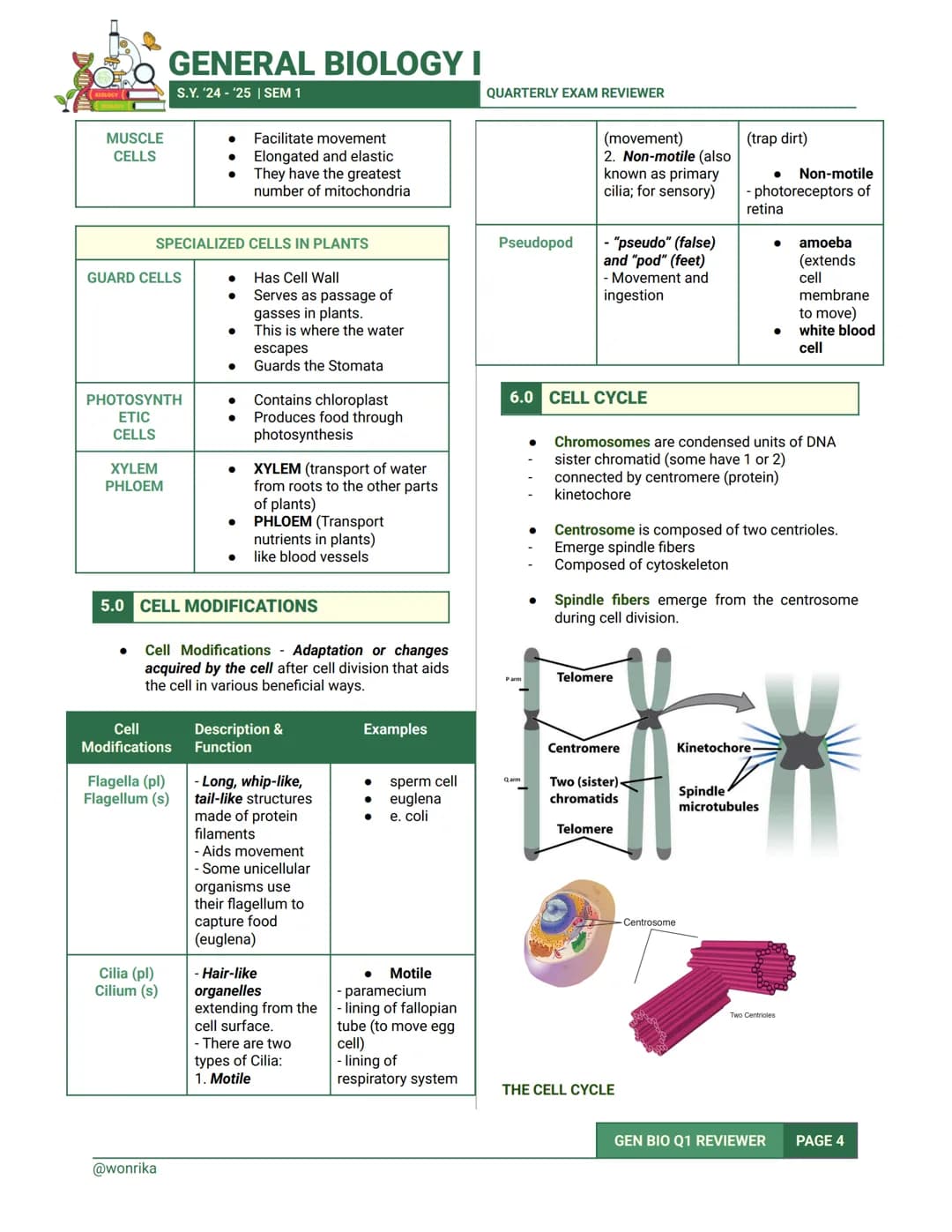
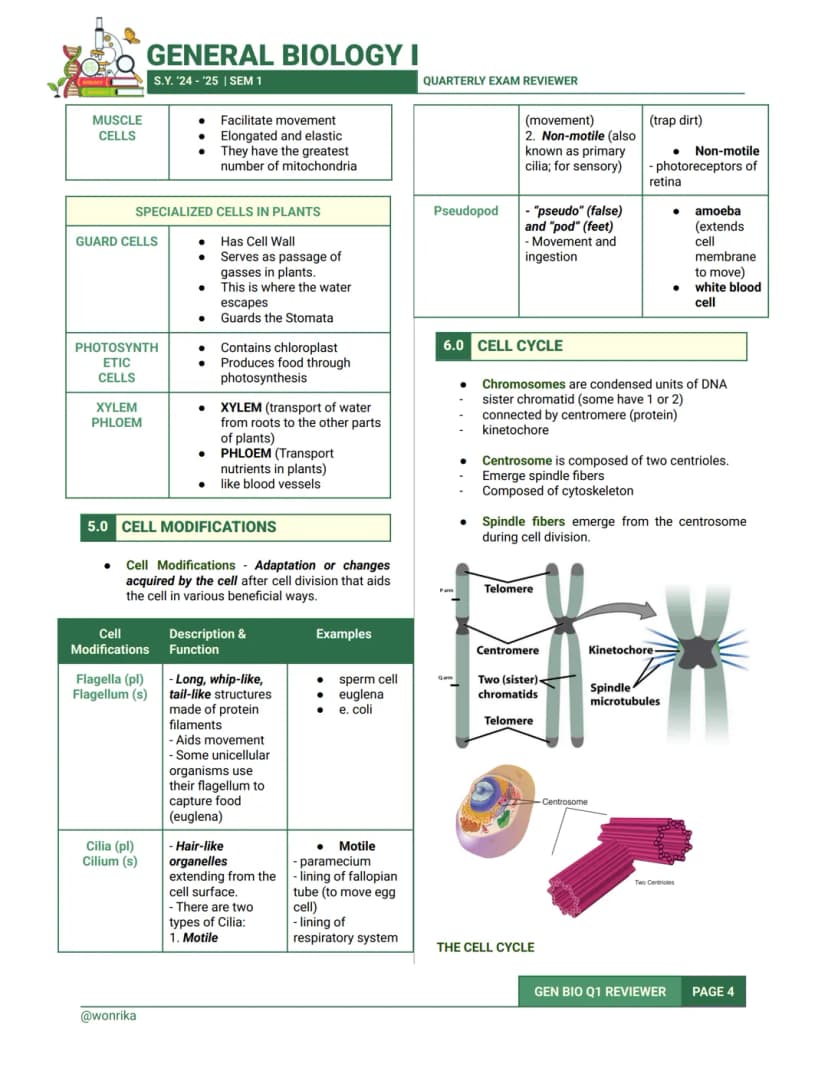
Cell Modifications and the Cell Cycle
Cells are like smartphones - they come with awesome upgrades! Cell modifications are special features cells develop after division to do their jobs better. Flagella are long whip-like tails that help cells swim (like sperm cells or E. coli bacteria). Cilia are shorter hair-like structures - some help with movement (like in paramecium) while others are sensory (like in your eye's photoreceptors).
Pseudopodia are fake feet that amoebas use to move and eat - they literally extend their cell membrane like stretching silly putty. White blood cells use this trick too when chasing down germs!
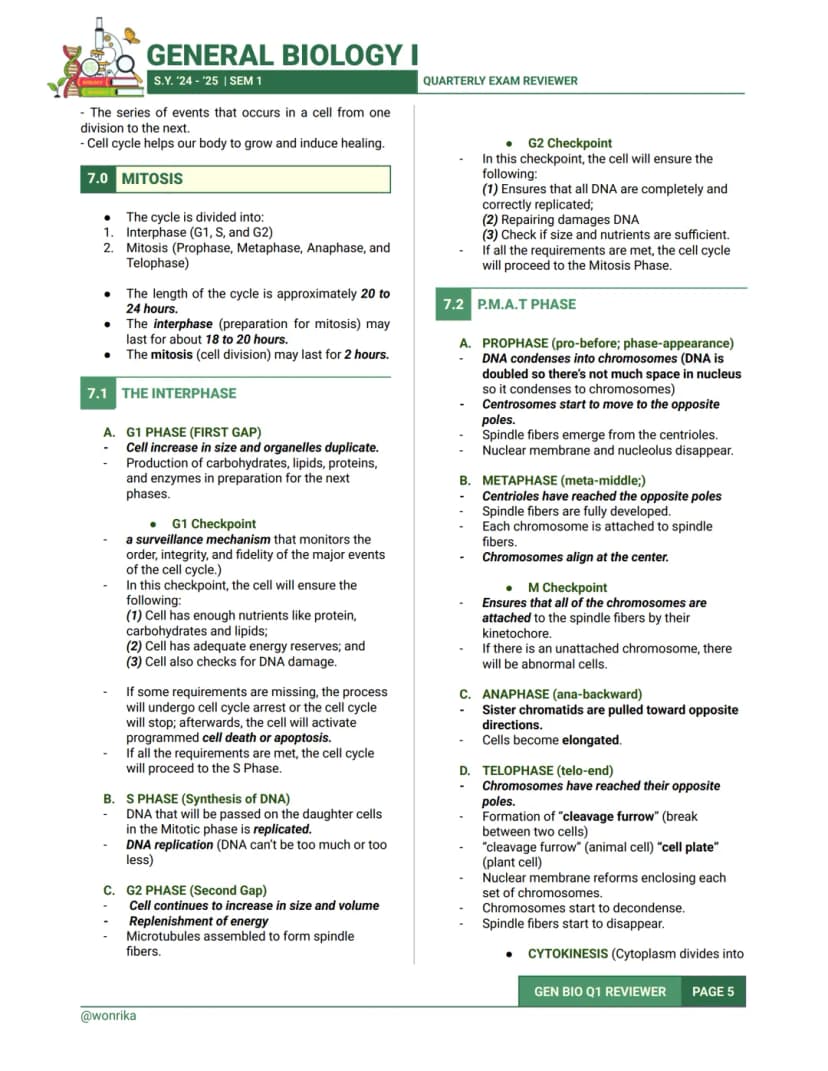
The cell cycle is basically your cell's life schedule - it takes about 20-24 hours total. Most of this time is spent in interphase, which is like preparation mode with three phases: G1 (growing and making organelles), S (copying DNA), and G2 (final prep and energy storage).
There are checkpoints at G1 and G2 where cells basically ask: "Do I have enough nutrients and energy? Is my DNA okay?" If something's wrong, the cell either fixes itself or triggers apoptosis (programmed cell death) - it's like a quality control system preventing defective cells from dividing.
Fun Fact: Your cells are constantly checking themselves for problems - it's like having an internal security system preventing cancer and other issues!
5
of 10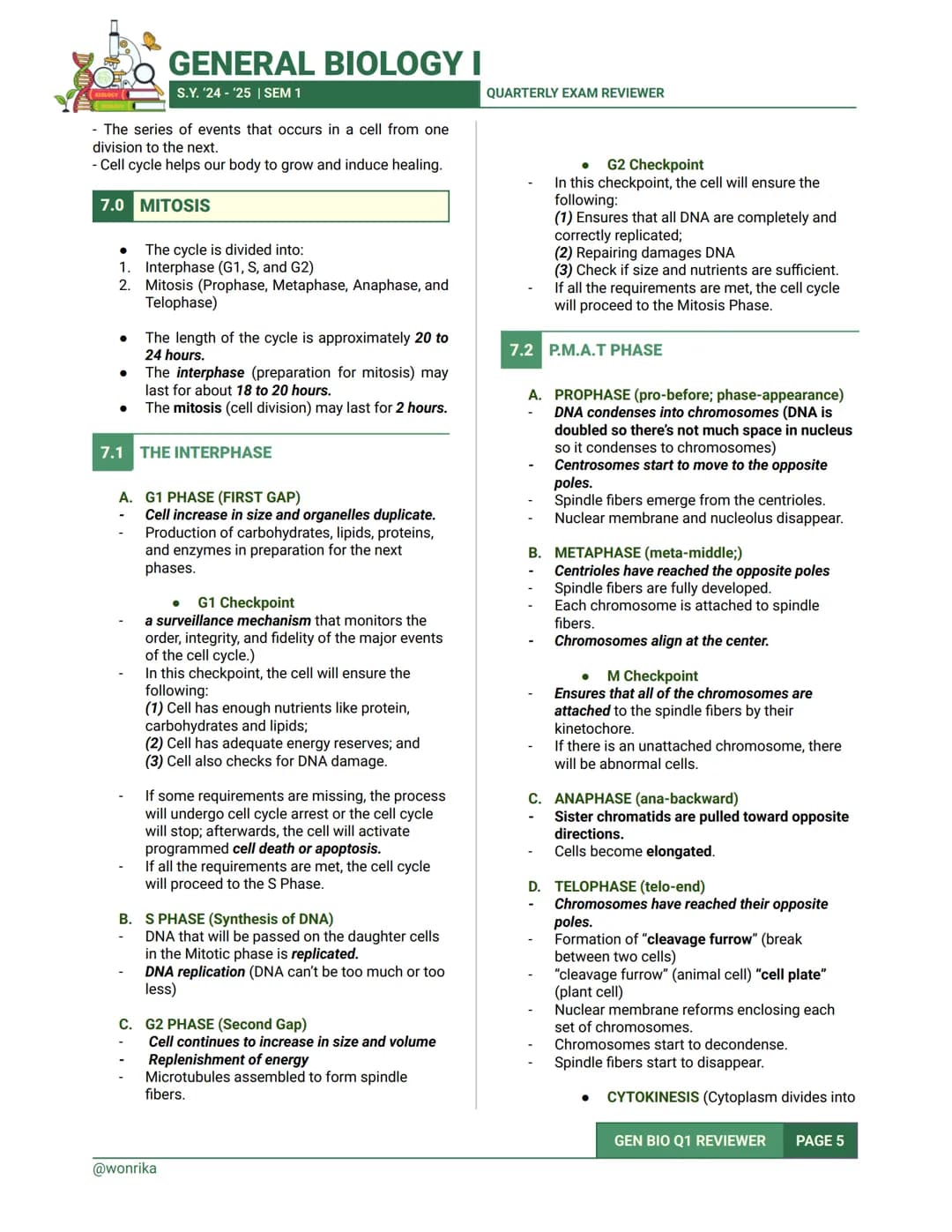
Mitosis - Cell Division for Growth
Mitosis is where the real action happens - it's how your body grows and heals by creating two identical daughter cells. After interphase prep work, cells enter the PMAT phases: Prophase, Metaphase, Anaphase, and Telophase (remember "Please Make A Taco"!).
In Prophase, DNA condenses into visible chromosomes, the nuclear membrane disappears, and spindle fibers start forming. Metaphase is the alignment phase where chromosomes line up perfectly at the cell's center - there's even an M checkpoint ensuring everything's attached properly to spindle fibers.
Anaphase is the separation phase where sister chromatids get pulled to opposite sides of the cell. Finally, Telophase sees new nuclear membranes forming around each set of chromosomes, and a cleavage furrow (or cell plate in plants) starts splitting the cell in two.
Cytokinesis is the final split where cytoplasm divides, creating two identical diploid cells with the complete set of 46 chromosomes each. The whole mitosis process takes only about 2 hours - pretty impressive for creating an entirely new cell!
After division, cells enter G0 phase (resting stage) before potentially starting another cycle. This is how you grow, heal cuts, and replace old cells throughout your life.
Study Tip: Act out mitosis with your hands - physical movement helps your brain remember the sequence better than just reading about it!
6
of 10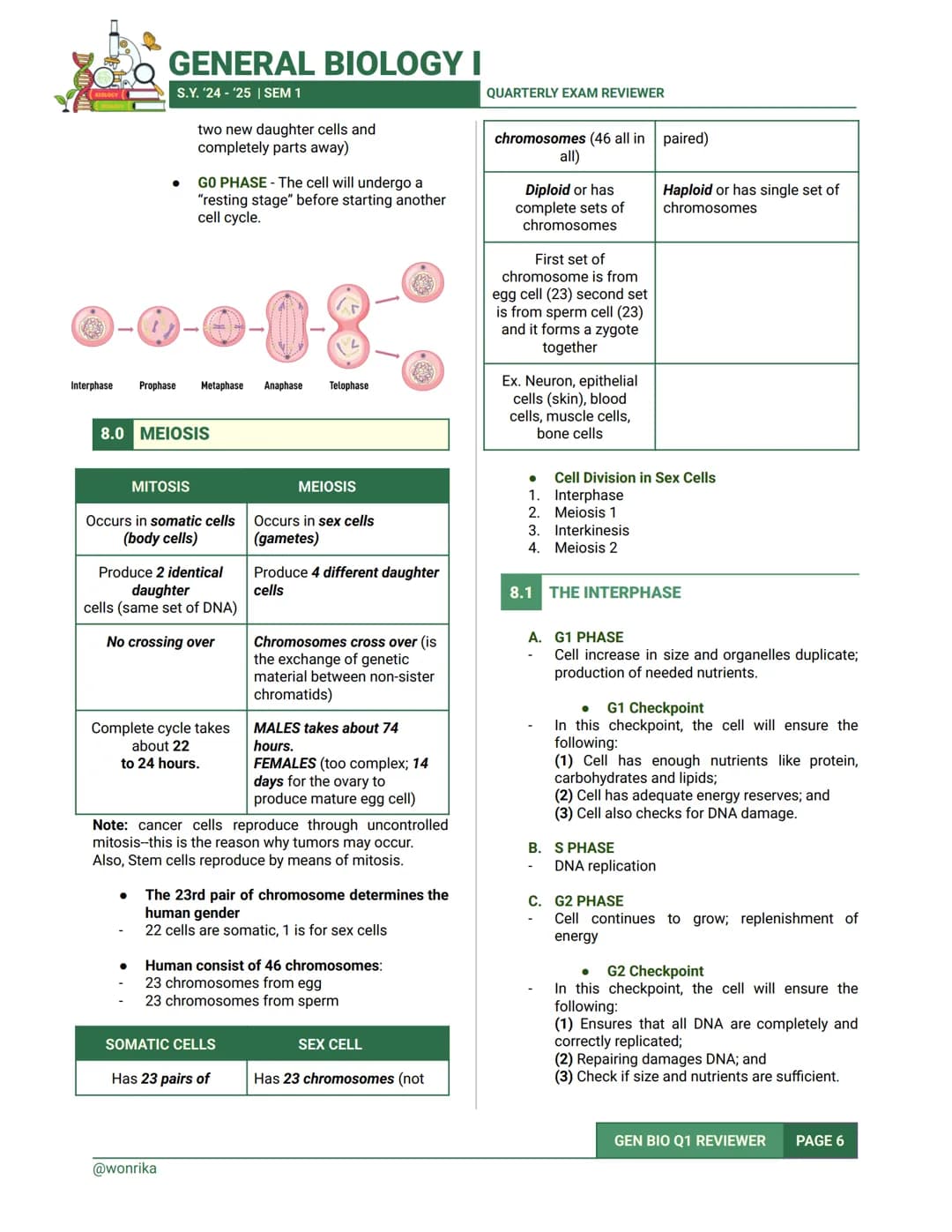
Meiosis - Creating Sex Cells
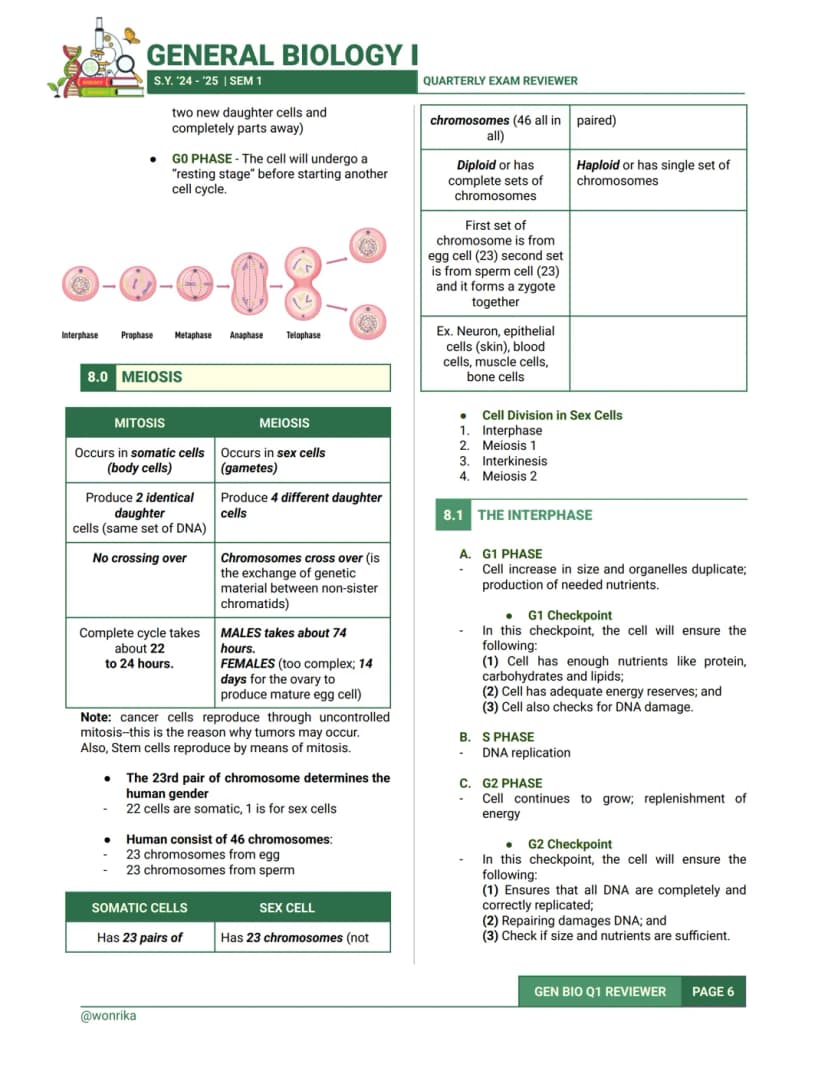
Meiosis is mitosis's more complex cousin that creates sex cells (gametes) for reproduction. Unlike mitosis making 2 identical cells, meiosis produces 4 genetically different cells, each with only 23 chromosomes (haploid) instead of the usual 46 (diploid).
The magic happens through crossing over during Prophase I, where chromosomes literally swap pieces of DNA with their partners. This creates genetic variety - it's why you're unique and not identical to your siblings! The process involves synapsis where sister chromatids group into tetrads (groups of four).
Meiosis I separates homologous chromosome pairs, while Meiosis II separates sister chromatids. Between these two divisions is interkinesis - a rest period with no DNA replication (unlike regular interphase).
Here's the key difference: somatic cells (body cells) have 23 pairs of chromosomes and reproduce through mitosis for growth and repair. Sex cells have 23 individual chromosomes and are created through meiosis. When a sperm (23 chromosomes) meets an egg (23 chromosomes), they form a zygote with the complete 46 chromosomes.
The timing is different too - mitosis takes about 22-24 hours, while meiosis takes 74 hours in males and about 14 days in females (because egg maturation is more complex).
Key Point: Meiosis = variety and reproduction; Mitosis = identical copies for growth. Remember this distinction and you'll nail any comparison question!
7
of 10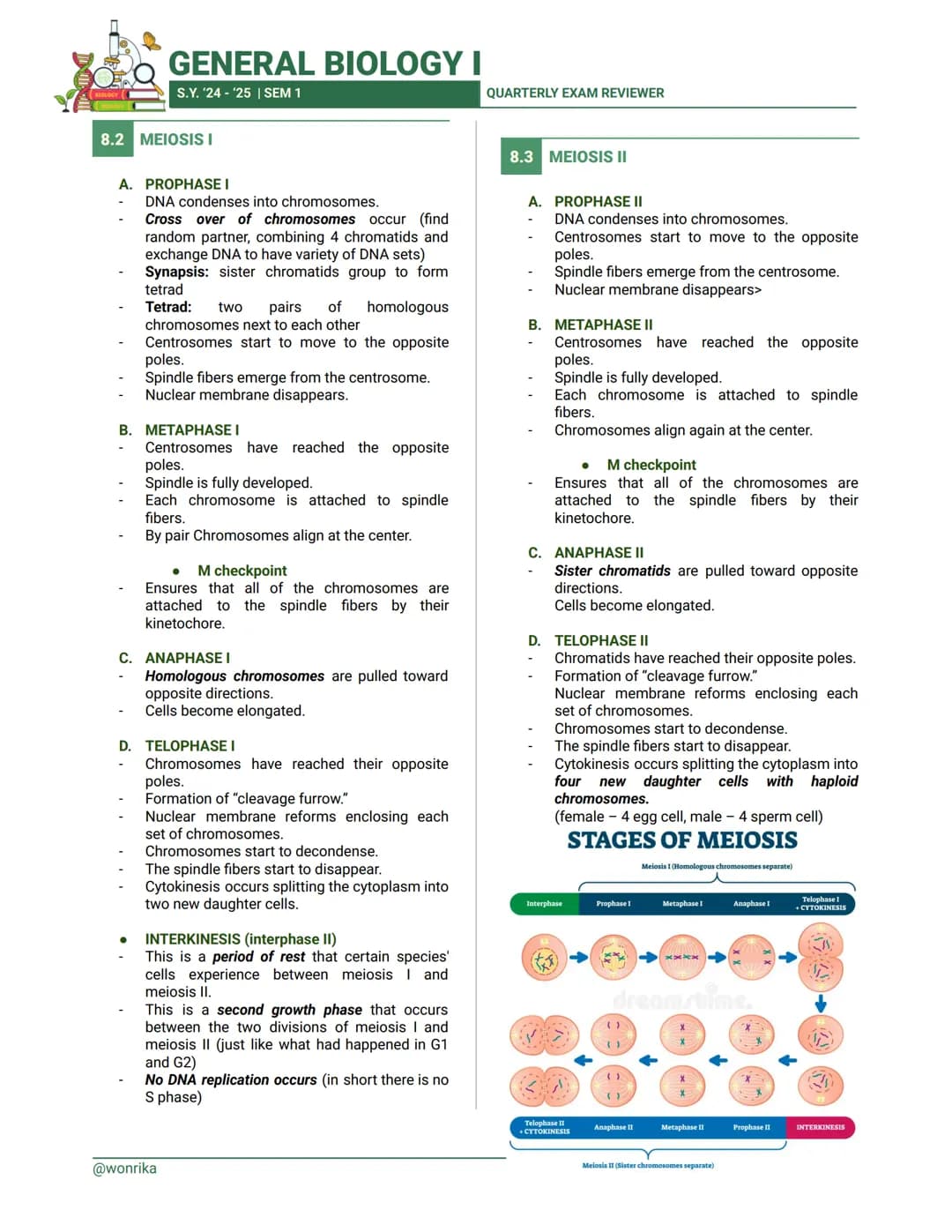
Meiosis Details and Process
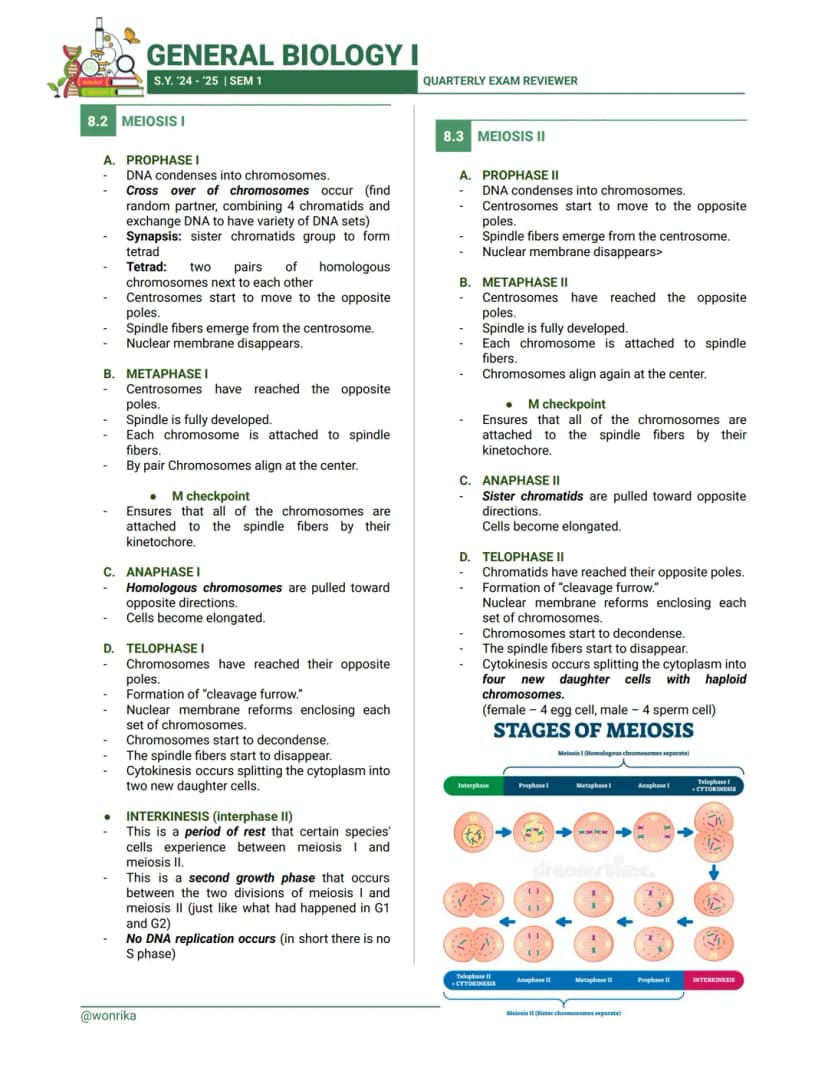
Let's dive deeper into meiosis since it's more complex than mitosis. The process starts with the same interphase (G1, S, G2) as mitosis, but then splits into two separate divisions.
Meiosis I is where the real genetic shuffling happens. In Prophase I, chromosomes pair up and perform crossing over - they literally trade DNA segments to create new combinations. This synapsis creates tetrads (four chromatids grouped together). Metaphase I aligns these paired chromosomes at the center, then Anaphase I separates the homologous pairs (not sister chromatids yet). Telophase I completes the first division with cytokinesis.
Interkinesis is like a coffee break between divisions - cells rest and grow but don't replicate DNA again. Then comes Meiosis II, which looks just like mitosis: Prophase II (chromosomes condense again), Metaphase II (chromosomes align), Anaphase II (sister chromatids finally separate), and Telophase II (four haploid cells form).
The result? In males, you get 4 functional sperm cells. In females, you typically get 1 large egg cell and 3 smaller polar bodies that usually degenerate. This unequal division ensures the egg gets most of the cytoplasm and nutrients needed for early development.
Crossing over is crucial for genetic diversity - without it, you'd be much more similar to your siblings. It's nature's way of ensuring survival through variation.
Visual Learning: Draw the chromosomes actually crossing over and swapping pieces - this physical representation helps you understand why siblings look different!
8
of 10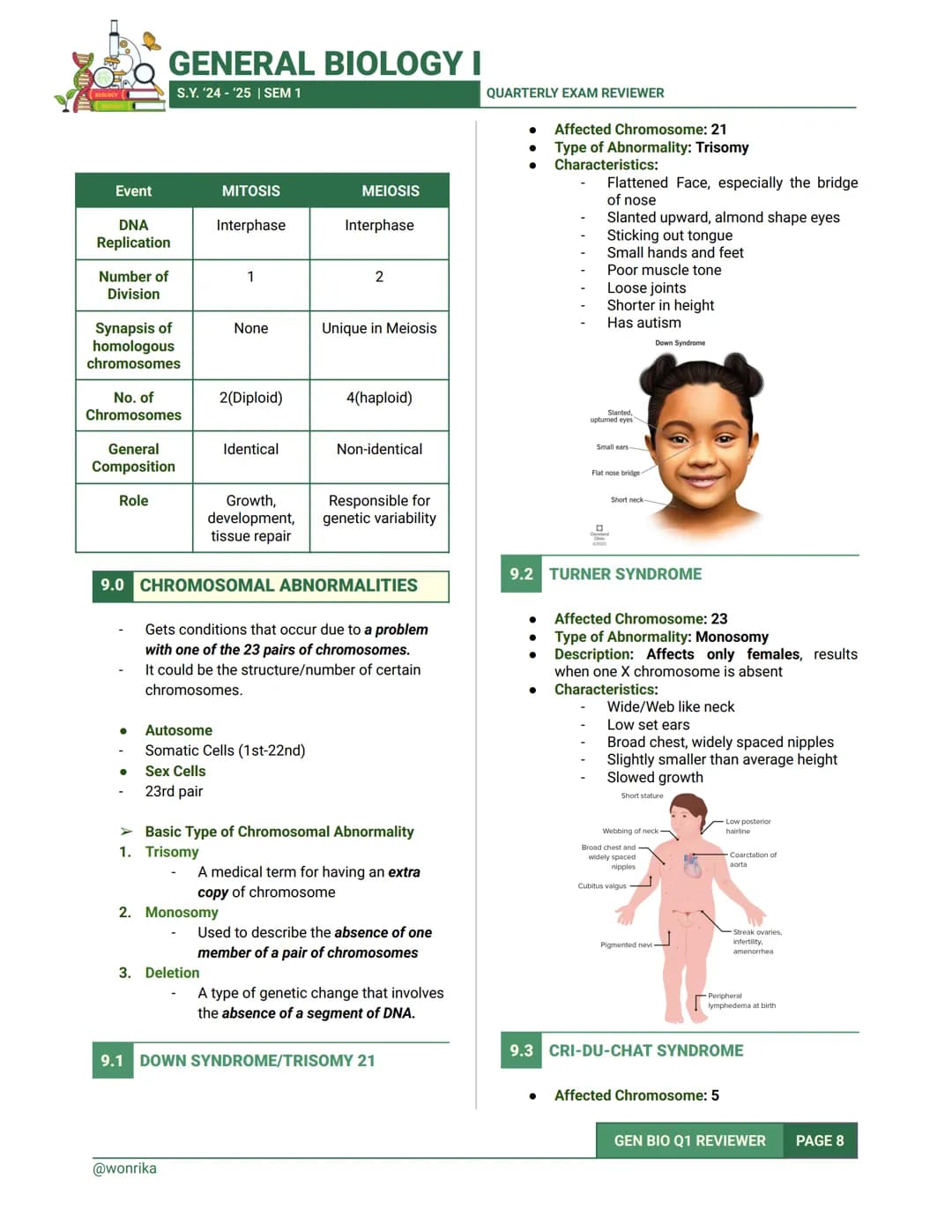
Chromosomal Abnormalities - When Things Go Wrong
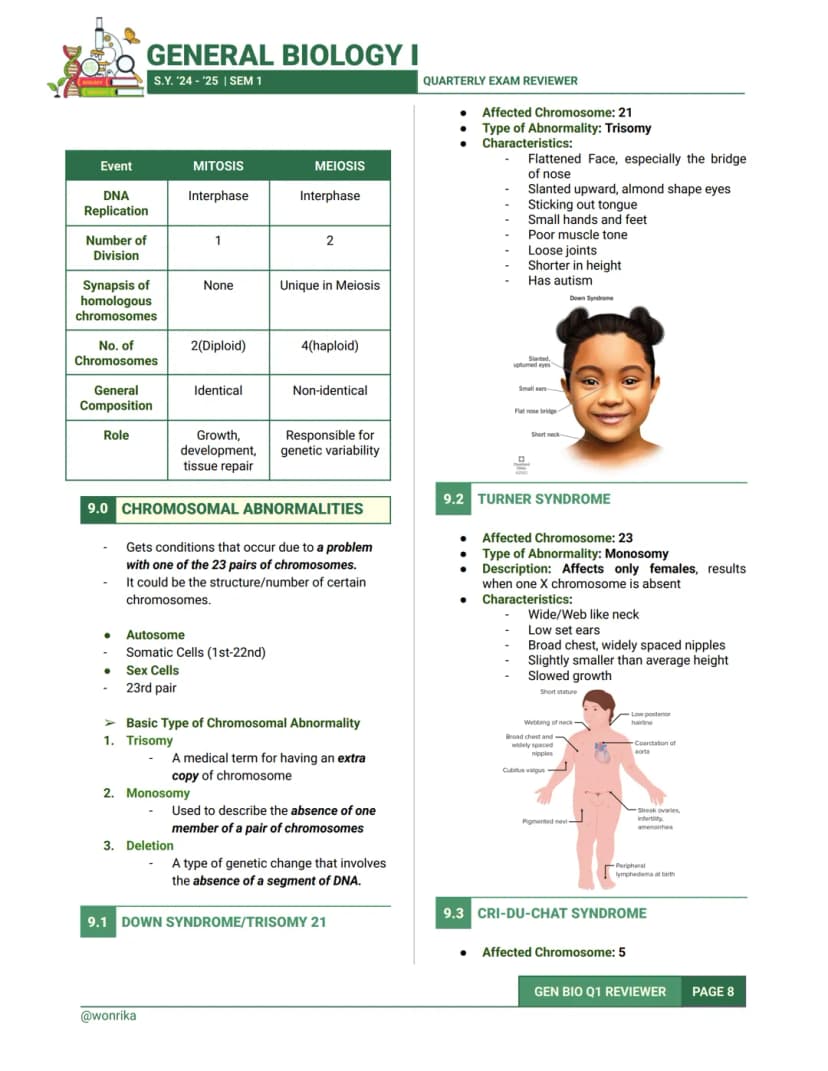
Sometimes chromosome division doesn't go perfectly, leading to chromosomal abnormalities. These happen when there are problems with chromosome number or structure. Understanding these helps explain various genetic conditions you might encounter.
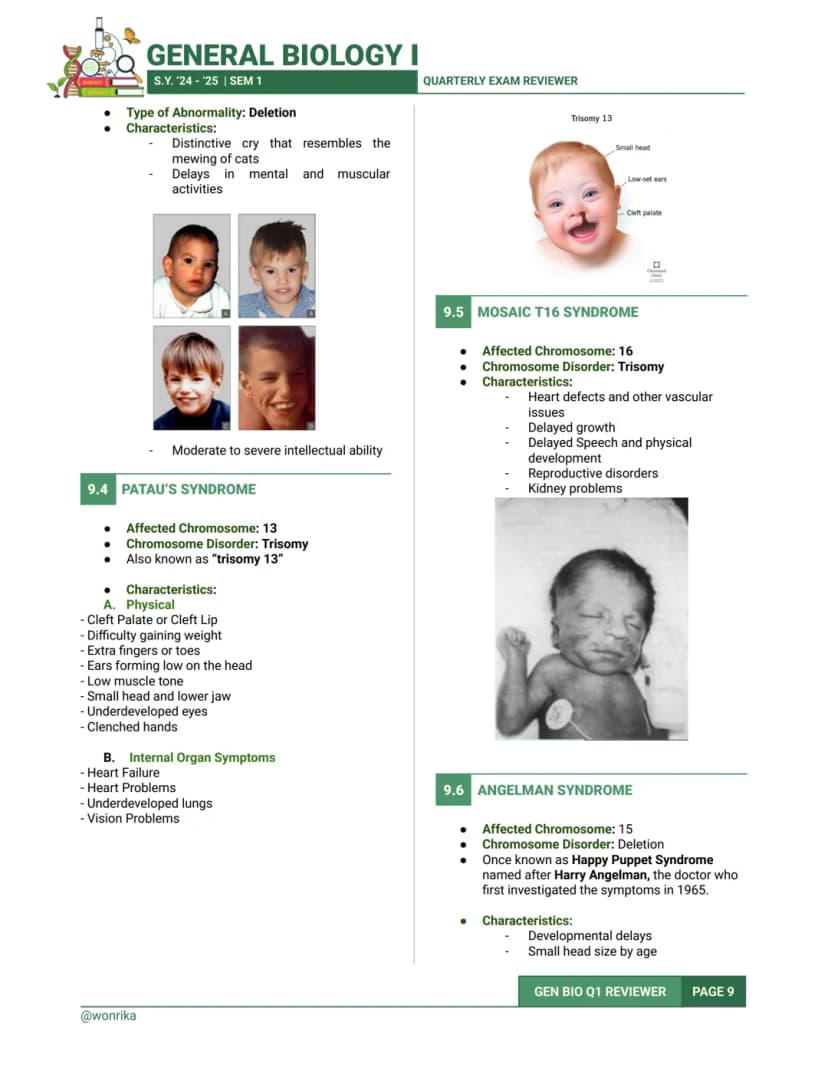
Trisomy means having an extra chromosome (three instead of two), while monosomy means missing one chromosome. Deletion involves losing a piece of a chromosome. These usually occur during meiosis when chromosomes don't separate properly.
Down syndrome (Trisomy 21) is the most common trisomy, where people have three copies of chromosome 21. This causes characteristic facial features like flattened faces, almond-shaped eyes, and developmental delays. People with Down syndrome can live fulfilling lives with proper support.
Turner syndrome affects only females who are missing one X chromosome (monosomy). This causes short stature, webbed neck, and reproductive issues. Cri-du-chat syndrome involves deletion of part of chromosome 5, causing a distinctive cat-like cry in infants.
Patau syndrome (Trisomy 13) is more severe, often causing cleft palate, extra fingers/toes, and serious internal organ problems. Most of these conditions result from errors during meiosis, especially in older parents where chromosome separation becomes less reliable.
Compassion Note: Remember that people with chromosomal differences are individuals first - these conditions don't define their worth or potential contributions to society.
9
of 10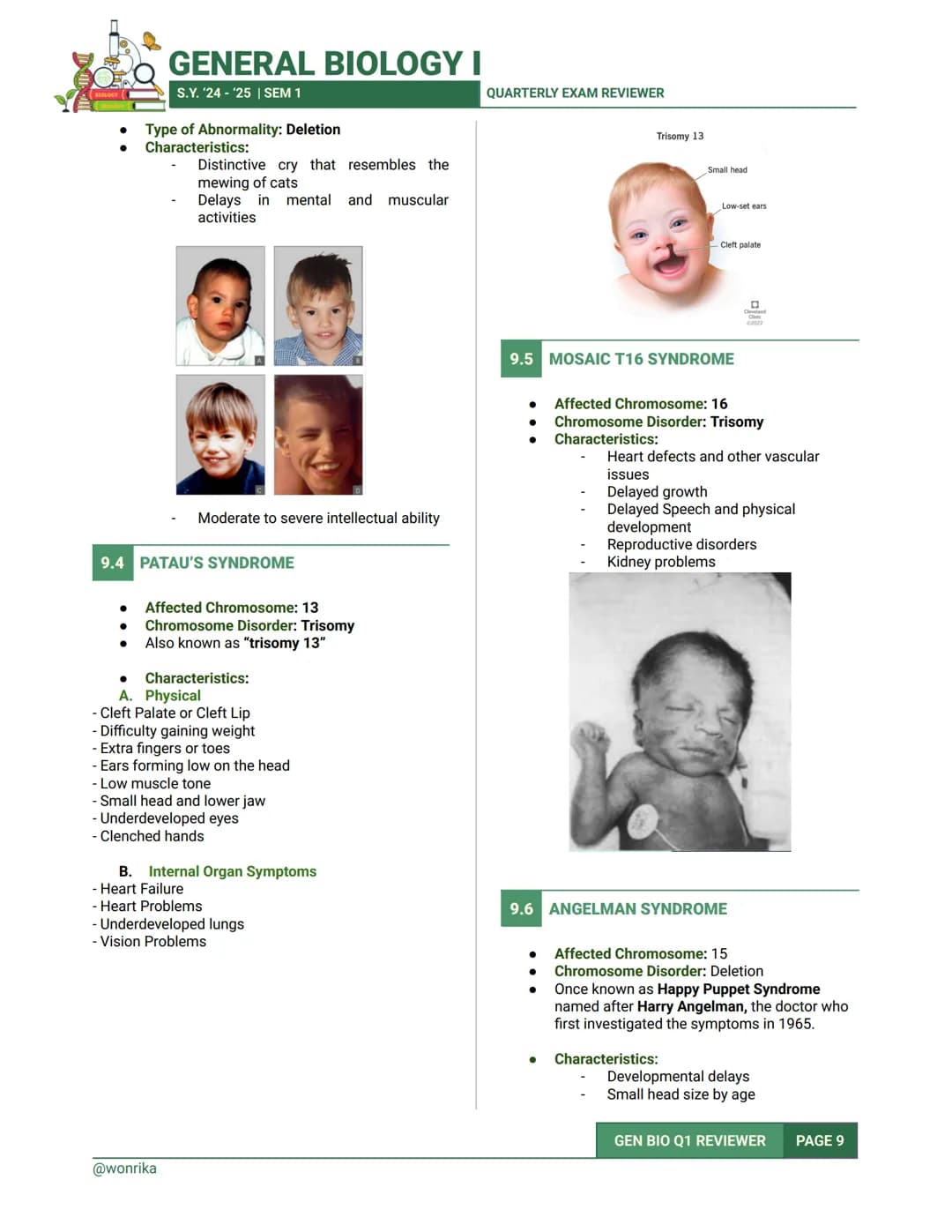
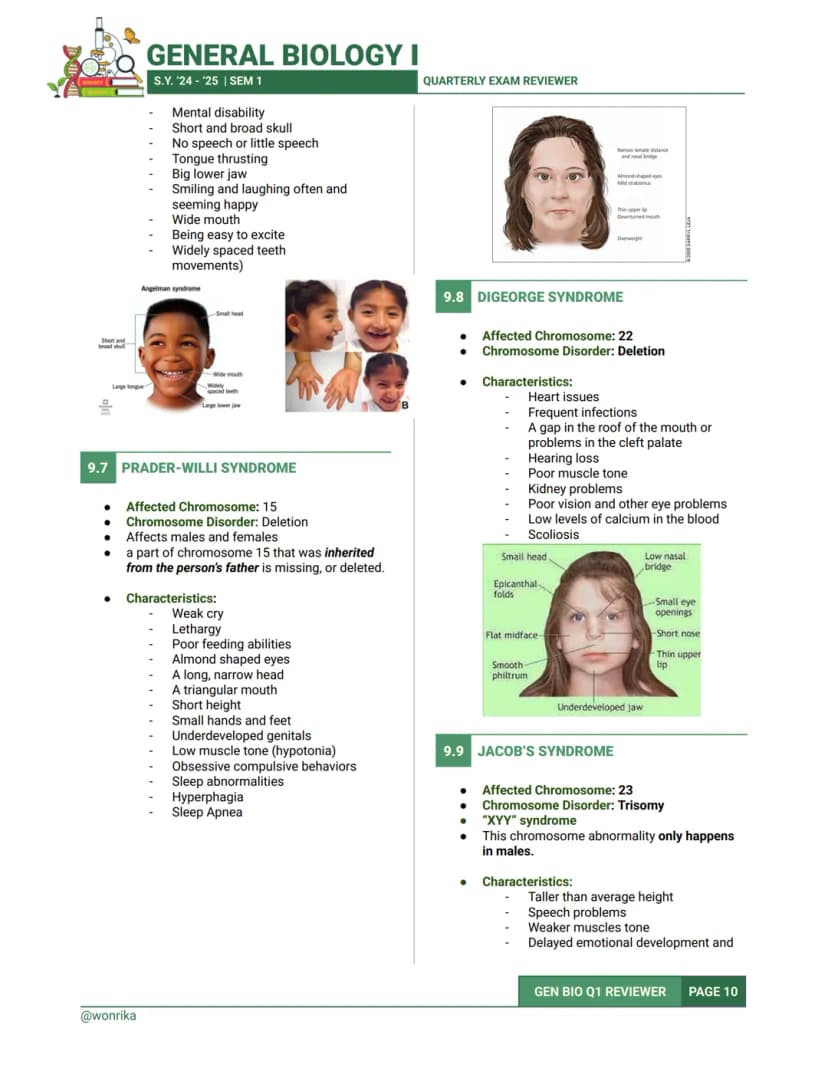
More Chromosomal Conditions
Several other chromosomal abnormalities affect different aspects of development and health. Mosaic T16 syndrome involves trisomy of chromosome 16, causing heart defects, delayed growth and speech development, plus reproductive and kidney problems.
Angelman syndrome results from deletion of part of chromosome 15 (specifically the maternal copy). Originally called "Happy Puppet Syndrome," it causes developmental delays, little to no speech, frequent laughing and smiling, and a characteristic happy demeanor. People affected often have small heads, big lower jaws, and widely spaced teeth.
Prader-Willi syndrome also involves chromosome 15, but affects the paternal copy through deletion. It causes weak muscle tone in infancy, feeding difficulties, and later develops into obsessive eating behaviors (hyperphagia), short stature, and behavioral challenges like OCD tendencies.
DiGeorge syndrome involves deletion of part of chromosome 22, affecting multiple body systems. It commonly causes heart problems, frequent infections due to immune deficiencies, cleft palate, hearing and vision issues, and distinctive facial features.
These conditions show how critical proper chromosome function is for normal development. Each chromosome contains hundreds of genes, so even small deletions can have significant effects on multiple body systems.
Study Strategy: Group these syndromes by chromosome number and type of abnormality - it's easier to remember patterns than isolated facts!
10
of 10
Jacob's Syndrome and Wrapping Up
Jacob's syndrome is unique because it only affects males and involves an extra Y chromosome (XYY instead of the normal XY). This trisomy of the sex chromosomes typically causes taller than average height, speech problems, weaker muscle tone, and sometimes delayed emotional development.
Unlike some other chromosomal conditions, Jacob's syndrome often goes undiagnosed because symptoms can be mild. Many males with XYY live normal lives and may never know they have this condition unless genetic testing is done for other reasons.
Understanding chromosomal abnormalities helps us appreciate how precise cell division usually is. Consider that every time your cells divide, 46 chromosomes must be perfectly copied and separated - and this happens millions of times throughout your life! The fact that errors are relatively rare shows how well-designed these cellular processes are.
These conditions also highlight the importance of genetic counseling for families and the incredible advances in medical care that help people with chromosomal differences live full, productive lives. Many individuals with these conditions contribute significantly to their communities and families.
Modern genetic testing can detect many of these conditions early, allowing families to prepare and access appropriate medical care and support services. The key is understanding that chromosomal differences are natural variations in human genetics, not failures or defects.
Final Thought: Cell biology shows us that life is incredibly complex yet remarkably organized - from tiny organelles to chromosome behavior, everything works together in amazing harmony!
We thought you’d never ask...
What is the Knowunity AI companion?
Our AI companion is specifically built for the needs of students. Based on the millions of content pieces we have on the platform we can provide truly meaningful and relevant answers to students. But its not only about answers, the companion is even more about guiding students through their daily learning challenges, with personalised study plans, quizzes or content pieces in the chat and 100% personalisation based on the students skills and developments.
Where can I download the Knowunity app?
You can download the app in the Google Play Store and in the Apple App Store.
Is Knowunity really free of charge?
That's right! Enjoy free access to study content, connect with fellow students, and get instant help – all at your fingertips.
Similar Content
 Biología
Most popular content in GenBio
9GenBioBiology
General Knowledge
G113,17387
GenBioUNDERSTANDING THE SELF LESSON 1
understanding the self lesson one
College3,28180
GenBioReview on Anatomy and Physiology
These notes contain a collated review on anatomy and physiology, which covers the different parts of the body and their basic descriptions.
G114,188137
GenBioBiology review 1
Preparation for college entrance exams
College79917
 GenChem
Theoretical Foundation of Nursing
Compact guide that breaks down major nursing theorist. CTTO.
G112,01244
GenBioGeneral Biology 2
MUSCLE TISSUE - NERVOUS SYSTEM
G1092910
GenBioPhotosynthesis Reviewer
Contains a complete review of photosynthesis, with detailed explanations of the light-dependent reactions and the light-independent (Calvin cycle) reactions.
G112,35643
GenBioBiology 2 - Genetic Engineering Lesson
Biology 2 -Genetic Engineering lesson for Grade 12 STEM 2nd Semester
G1294714
Earth ScienceCell Division - Difference of Mitosis and Meiosis
General Biology
G111,96843
Most popular content
9 Math
MathMathematics Grade 10 Quarter 1
Grade 10 Math topics
G1010,223250
 Iba pa
El Filibusterismo (FILIPINO 10)
Kilalanin ang mga karakter at alamin ang mga pangyayari mula Kabanata 1 hanggang 39.
G1011,183240
ScienceScience 9 Quarter 1 Lesson 1
Topics: The Respiratory System and The Circulatory System
G911,075383
 Gen Physics
General Physics 1, First Sem
Units of Measurement, Vectors, and Kinematics. All with formulas
G116,247168
 Filipino
Filipino 8 Reviewer
Filipino Reviewer for 4th Quarter for Grade 8 students
G88,088127
ScienceSCIENCE Grade 9 Quarter 3 Reviewer
All about the lessons in Grade 9 Quarter 3 SCIENCE, all complete, highlighted, printable, and has extra informations.
G914,629303
 Pre-Cal
UPCAT Reviewer: Mathematics
general coverage of the mathematics section for UPCAT
G127,085397
OtherIntroduction to Philosophy - 1st Semester, Grade 12
A summarized notes for Grade 12 students. Easier learning for the 1st semester’s Philosophy subject.
G123,96856
ScienceThe Human Digestive System
Science Grade 8 1st Quarter Lesson
G84,78386
Can't find what you're looking for? Explore other subjects.
Students love us — and so will you.
4.6/5App Store
4.7/5Google Play
The app is very easy to use and well designed. I have found everything I was looking for so far and have been able to learn a lot from the presentations! I will definitely use the app for a class assignment! And of course it also helps a lot as an inspiration.
Stefan SiOS user
This app is really great. There are so many study notes and help [...]. My problem subject is French, for example, and the app has so many options for help. Thanks to this app, I have improved my French. I would recommend it to anyone.
Samantha KlichAndroid user
Wow, I am really amazed. I just tried the app because I've seen it advertised many times and was absolutely stunned. This app is THE HELP you want for school and above all, it offers so many things, such as workouts and fact sheets, which have been VERY helpful to me personally.
AnnaiOS user
GenBio9,063 views·Updated Jun 26, 2026·14 pagesGeneral Biology: Exploring Life Processes
S
Sophia@sophialuvr
Ever wonder what makes up every living thing on Earth? Cells are literally the building blocks of all life - from your skin and muscles to the trees outside your window. Understanding cells and how they work is like getting...
1
of 10
Sign up to see the content. It's free!
- Access to all documents
- Improve your grades
- Join milions of students
Cell Basics and Discovery
Think of cells as the LEGO blocks of life - everything living is made from these tiny units! The cell is the basic unit of structure and function in all living things, and it took centuries of brilliant scientists to figure this out.
Back in the 1590s, Zacharias Janssen invented the first microscope, which was like giving humanity superpowers to see the invisible. Then Robert Hooke in 1665 looked at cork and saw box-shaped structures he called "cells" . Anton van Leeuwenhoek, known as the Father of Microbiology, discovered tiny moving creatures called animalcules (now called protozoa) in pond water.
The real breakthrough came with the Cell Theory in the 19th century. The old version had three simple rules: all living things are made of cells, cells are the basic units of life, and cells come from other cells. The modern version adds that cells carry genetic material, have similar chemical makeup (proteins, fats, carbs, and DNA), and handle energy processes like cellular respiration.
Quick Tip: Remember "Structure, Function, Origin" - that's the core of cell theory and will help you ace any exam question about it!
2
of 10Sign up to see the content. It's free!
- Access to all documents
- Improve your grades
- Join milions of students
Cell Parts and Their Jobs
Your cell is like a bustling city with different districts handling specific jobs. The cell membrane is your city walls - it's a double layer of proteins and fats that controls what goes in and out. Inside, you've got cytoplasm, which is basically the jelly-like fluid where everything floats around (think of it as the city's atmosphere).
The nucleus is definitely the mayor's office - it's the control center storing your DNA and running the whole show. If it gets damaged, game over for the cell. Ribosomes are your protein factories, cranked out by the nucleolus inside the nucleus. They're constantly building proteins for growth and repair.
Mitochondria are the powerhouses generating ATP (cellular energy currency) - you literally can't live without them. The endoplasmic reticulum is like the city's subway system, with rough ER (has ribosomes) making membrane parts and smooth ER (no ribosomes) producing fats and detoxing harmful stuff.
Golgi bodies are the packaging centers that wrap up proteins and lipids for delivery, while lysosomes are the cleanup crew with digestive enzymes (they're called "suicide bags" because they can destroy the cell). Vacuoles store stuff like a warehouse, and the cytoskeleton gives your cell its shape and helps during division.
Study Hack: Draw your own cell and label everything - visual learning sticks way better than just memorizing lists!
3
of 10Sign up to see the content. It's free!
- Access to all documents
- Improve your grades
- Join milions of students
Prokaryotes vs Eukaryotes and Specialized Cells
Here's where cells get interesting - they come in two major types that are totally different! Prokaryotes (like bacteria) are the rebels without a nucleus - their DNA just floats around freely in a region called the nucleoid. They're simple, fast-reproducing, but short-lived. Think of them as the first life forms that figured out how to exist.
Eukaryotes are the sophisticated ones with a proper nucleus wrapped in a membrane, plus all those organelles we talked about. This includes everything from single-celled amoebas to complex organisms like plants, animals, and even yeast.
Now for the cool part - specialized cells! Your body has cells that are like specialized workers. Red blood cells are biconcave discs packed with hemoglobin to carry oxygen (they even lose their nucleus to make more room!). White blood cells are your immune system warriors with irregular shapes to fight infections.
Sperm cells have long tails for swimming to reach eggs, while egg cells are the largest cells in your body, packed with nutrients. Nerve cells are the longest cells, carrying electrical signals throughout your body. Plants have their own specialists too - guard cells control gas exchange, photosynthetic cells make food with chloroplasts, and xylem and phloem cells transport water and nutrients like a plant's circulatory system.
Memory Trick: Remember "Form follows function" - each cell's shape and parts perfectly match its job!
4
of 10Sign up to see the content. It's free!
- Access to all documents
- Improve your grades
- Join milions of students
Cell Modifications and the Cell Cycle
Cells are like smartphones - they come with awesome upgrades! Cell modifications are special features cells develop after division to do their jobs better. Flagella are long whip-like tails that help cells swim (like sperm cells or E. coli bacteria). Cilia are shorter hair-like structures - some help with movement (like in paramecium) while others are sensory (like in your eye's photoreceptors).
Pseudopodia are fake feet that amoebas use to move and eat - they literally extend their cell membrane like stretching silly putty. White blood cells use this trick too when chasing down germs!
The cell cycle is basically your cell's life schedule - it takes about 20-24 hours total. Most of this time is spent in interphase, which is like preparation mode with three phases: G1 (growing and making organelles), S (copying DNA), and G2 (final prep and energy storage).
There are checkpoints at G1 and G2 where cells basically ask: "Do I have enough nutrients and energy? Is my DNA okay?" If something's wrong, the cell either fixes itself or triggers apoptosis (programmed cell death) - it's like a quality control system preventing defective cells from dividing.
Fun Fact: Your cells are constantly checking themselves for problems - it's like having an internal security system preventing cancer and other issues!
5
of 10Sign up to see the content. It's free!
- Access to all documents
- Improve your grades
- Join milions of students
Mitosis - Cell Division for Growth
Mitosis is where the real action happens - it's how your body grows and heals by creating two identical daughter cells. After interphase prep work, cells enter the PMAT phases: Prophase, Metaphase, Anaphase, and Telophase (remember "Please Make A Taco"!).
In Prophase, DNA condenses into visible chromosomes, the nuclear membrane disappears, and spindle fibers start forming. Metaphase is the alignment phase where chromosomes line up perfectly at the cell's center - there's even an M checkpoint ensuring everything's attached properly to spindle fibers.
Anaphase is the separation phase where sister chromatids get pulled to opposite sides of the cell. Finally, Telophase sees new nuclear membranes forming around each set of chromosomes, and a cleavage furrow (or cell plate in plants) starts splitting the cell in two.
Cytokinesis is the final split where cytoplasm divides, creating two identical diploid cells with the complete set of 46 chromosomes each. The whole mitosis process takes only about 2 hours - pretty impressive for creating an entirely new cell!
After division, cells enter G0 phase (resting stage) before potentially starting another cycle. This is how you grow, heal cuts, and replace old cells throughout your life.
Study Tip: Act out mitosis with your hands - physical movement helps your brain remember the sequence better than just reading about it!
6
of 10Sign up to see the content. It's free!
- Access to all documents
- Improve your grades
- Join milions of students
Meiosis - Creating Sex Cells
Meiosis is mitosis's more complex cousin that creates sex cells (gametes) for reproduction. Unlike mitosis making 2 identical cells, meiosis produces 4 genetically different cells, each with only 23 chromosomes (haploid) instead of the usual 46 (diploid).
The magic happens through crossing over during Prophase I, where chromosomes literally swap pieces of DNA with their partners. This creates genetic variety - it's why you're unique and not identical to your siblings! The process involves synapsis where sister chromatids group into tetrads (groups of four).
Meiosis I separates homologous chromosome pairs, while Meiosis II separates sister chromatids. Between these two divisions is interkinesis - a rest period with no DNA replication (unlike regular interphase).
Here's the key difference: somatic cells (body cells) have 23 pairs of chromosomes and reproduce through mitosis for growth and repair. Sex cells have 23 individual chromosomes and are created through meiosis. When a sperm (23 chromosomes) meets an egg (23 chromosomes), they form a zygote with the complete 46 chromosomes.
The timing is different too - mitosis takes about 22-24 hours, while meiosis takes 74 hours in males and about 14 days in females (because egg maturation is more complex).
Key Point: Meiosis = variety and reproduction; Mitosis = identical copies for growth. Remember this distinction and you'll nail any comparison question!
7
of 10Sign up to see the content. It's free!
- Access to all documents
- Improve your grades
- Join milions of students
Meiosis Details and Process
Let's dive deeper into meiosis since it's more complex than mitosis. The process starts with the same interphase (G1, S, G2) as mitosis, but then splits into two separate divisions.
Meiosis I is where the real genetic shuffling happens. In Prophase I, chromosomes pair up and perform crossing over - they literally trade DNA segments to create new combinations. This synapsis creates tetrads (four chromatids grouped together). Metaphase I aligns these paired chromosomes at the center, then Anaphase I separates the homologous pairs (not sister chromatids yet). Telophase I completes the first division with cytokinesis.
Interkinesis is like a coffee break between divisions - cells rest and grow but don't replicate DNA again. Then comes Meiosis II, which looks just like mitosis: Prophase II (chromosomes condense again), Metaphase II (chromosomes align), Anaphase II (sister chromatids finally separate), and Telophase II (four haploid cells form).
The result? In males, you get 4 functional sperm cells. In females, you typically get 1 large egg cell and 3 smaller polar bodies that usually degenerate. This unequal division ensures the egg gets most of the cytoplasm and nutrients needed for early development.
Crossing over is crucial for genetic diversity - without it, you'd be much more similar to your siblings. It's nature's way of ensuring survival through variation.
Visual Learning: Draw the chromosomes actually crossing over and swapping pieces - this physical representation helps you understand why siblings look different!
8
of 10Sign up to see the content. It's free!
- Access to all documents
- Improve your grades
- Join milions of students
Chromosomal Abnormalities - When Things Go Wrong
Sometimes chromosome division doesn't go perfectly, leading to chromosomal abnormalities. These happen when there are problems with chromosome number or structure. Understanding these helps explain various genetic conditions you might encounter.
Trisomy means having an extra chromosome (three instead of two), while monosomy means missing one chromosome. Deletion involves losing a piece of a chromosome. These usually occur during meiosis when chromosomes don't separate properly.
Down syndrome (Trisomy 21) is the most common trisomy, where people have three copies of chromosome 21. This causes characteristic facial features like flattened faces, almond-shaped eyes, and developmental delays. People with Down syndrome can live fulfilling lives with proper support.
Turner syndrome affects only females who are missing one X chromosome (monosomy). This causes short stature, webbed neck, and reproductive issues. Cri-du-chat syndrome involves deletion of part of chromosome 5, causing a distinctive cat-like cry in infants.
Patau syndrome (Trisomy 13) is more severe, often causing cleft palate, extra fingers/toes, and serious internal organ problems. Most of these conditions result from errors during meiosis, especially in older parents where chromosome separation becomes less reliable.
Compassion Note: Remember that people with chromosomal differences are individuals first - these conditions don't define their worth or potential contributions to society.
9
of 10Sign up to see the content. It's free!
- Access to all documents
- Improve your grades
- Join milions of students
More Chromosomal Conditions
Several other chromosomal abnormalities affect different aspects of development and health. Mosaic T16 syndrome involves trisomy of chromosome 16, causing heart defects, delayed growth and speech development, plus reproductive and kidney problems.
Angelman syndrome results from deletion of part of chromosome 15 (specifically the maternal copy). Originally called "Happy Puppet Syndrome," it causes developmental delays, little to no speech, frequent laughing and smiling, and a characteristic happy demeanor. People affected often have small heads, big lower jaws, and widely spaced teeth.
Prader-Willi syndrome also involves chromosome 15, but affects the paternal copy through deletion. It causes weak muscle tone in infancy, feeding difficulties, and later develops into obsessive eating behaviors (hyperphagia), short stature, and behavioral challenges like OCD tendencies.
DiGeorge syndrome involves deletion of part of chromosome 22, affecting multiple body systems. It commonly causes heart problems, frequent infections due to immune deficiencies, cleft palate, hearing and vision issues, and distinctive facial features.
These conditions show how critical proper chromosome function is for normal development. Each chromosome contains hundreds of genes, so even small deletions can have significant effects on multiple body systems.
Study Strategy: Group these syndromes by chromosome number and type of abnormality - it's easier to remember patterns than isolated facts!
10
of 10Sign up to see the content. It's free!
- Access to all documents
- Improve your grades
- Join milions of students
Jacob's Syndrome and Wrapping Up
Jacob's syndrome is unique because it only affects males and involves an extra Y chromosome (XYY instead of the normal XY). This trisomy of the sex chromosomes typically causes taller than average height, speech problems, weaker muscle tone, and sometimes delayed emotional development.
Unlike some other chromosomal conditions, Jacob's syndrome often goes undiagnosed because symptoms can be mild. Many males with XYY live normal lives and may never know they have this condition unless genetic testing is done for other reasons.
Understanding chromosomal abnormalities helps us appreciate how precise cell division usually is. Consider that every time your cells divide, 46 chromosomes must be perfectly copied and separated - and this happens millions of times throughout your life! The fact that errors are relatively rare shows how well-designed these cellular processes are.
These conditions also highlight the importance of genetic counseling for families and the incredible advances in medical care that help people with chromosomal differences live full, productive lives. Many individuals with these conditions contribute significantly to their communities and families.
Modern genetic testing can detect many of these conditions early, allowing families to prepare and access appropriate medical care and support services. The key is understanding that chromosomal differences are natural variations in human genetics, not failures or defects.
Final Thought: Cell biology shows us that life is incredibly complex yet remarkably organized - from tiny organelles to chromosome behavior, everything works together in amazing harmony!
We thought you’d never ask...
What is the Knowunity AI companion?
Our AI companion is specifically built for the needs of students. Based on the millions of content pieces we have on the platform we can provide truly meaningful and relevant answers to students. But its not only about answers, the companion is even more about guiding students through their daily learning challenges, with personalised study plans, quizzes or content pieces in the chat and 100% personalisation based on the students skills and developments.
Where can I download the Knowunity app?
You can download the app in the Google Play Store and in the Apple App Store.
Is Knowunity really free of charge?
That's right! Enjoy free access to study content, connect with fellow students, and get instant help – all at your fingertips.
Similar Content
Most popular content in GenBio
9GenBioBiology
General Knowledge
G113,17387
GenBioUNDERSTANDING THE SELF LESSON 1
understanding the self lesson one
College3,28180
GenBioReview on Anatomy and Physiology
These notes contain a collated review on anatomy and physiology, which covers the different parts of the body and their basic descriptions.
G114,188137
GenBioBiology review 1
Preparation for college entrance exams
College79917
GenChemTheoretical Foundation of Nursing
Compact guide that breaks down major nursing theorist. CTTO.
G112,01244
GenBioGeneral Biology 2
MUSCLE TISSUE - NERVOUS SYSTEM
G1092910
GenBioPhotosynthesis Reviewer
Contains a complete review of photosynthesis, with detailed explanations of the light-dependent reactions and the light-independent (Calvin cycle) reactions.
G112,35643
GenBioBiology 2 - Genetic Engineering Lesson
Biology 2 -Genetic Engineering lesson for Grade 12 STEM 2nd Semester
G1294714
Earth ScienceCell Division - Difference of Mitosis and Meiosis
General Biology
G111,96843
Most popular content
9MathMathematics Grade 10 Quarter 1
Grade 10 Math topics
G1010,223250
Iba paEl Filibusterismo (FILIPINO 10)
Kilalanin ang mga karakter at alamin ang mga pangyayari mula Kabanata 1 hanggang 39.
G1011,183240
ScienceScience 9 Quarter 1 Lesson 1
Topics: The Respiratory System and The Circulatory System
G911,075383
Gen PhysicsGeneral Physics 1, First Sem
Units of Measurement, Vectors, and Kinematics. All with formulas
G116,247168
FilipinoFilipino 8 Reviewer
Filipino Reviewer for 4th Quarter for Grade 8 students
G88,088127
ScienceSCIENCE Grade 9 Quarter 3 Reviewer
All about the lessons in Grade 9 Quarter 3 SCIENCE, all complete, highlighted, printable, and has extra informations.
G914,629303
Pre-CalUPCAT Reviewer: Mathematics
general coverage of the mathematics section for UPCAT
G127,085397
OtherIntroduction to Philosophy - 1st Semester, Grade 12
A summarized notes for Grade 12 students. Easier learning for the 1st semester’s Philosophy subject.
G123,96856
ScienceThe Human Digestive System
Science Grade 8 1st Quarter Lesson
G84,78386
Can't find what you're looking for? Explore other subjects.
Students love us — and so will you.
4.6/5App Store
4.7/5Google Play
The app is very easy to use and well designed. I have found everything I was looking for so far and have been able to learn a lot from the presentations! I will definitely use the app for a class assignment! And of course it also helps a lot as an inspiration.
Stefan SiOS user
This app is really great. There are so many study notes and help [...]. My problem subject is French, for example, and the app has so many options for help. Thanks to this app, I have improved my French. I would recommend it to anyone.
Samantha KlichAndroid user
Wow, I am really amazed. I just tried the app because I've seen it advertised many times and was absolutely stunned. This app is THE HELP you want for school and above all, it offers so many things, such as workouts and fact sheets, which have been VERY helpful to me personally.
AnnaiOS user