
A comprehensive guide to homicide investigationprocedures and crime scene...
 Fun Stuff75 views·Updated Jun 18, 2026·5 pages
Homicide Investigation Kids Guide: Crime Scene Steps and Examples
B
Brooke Shivers@brookeshivers_ulwy

1 / 5
1
of 5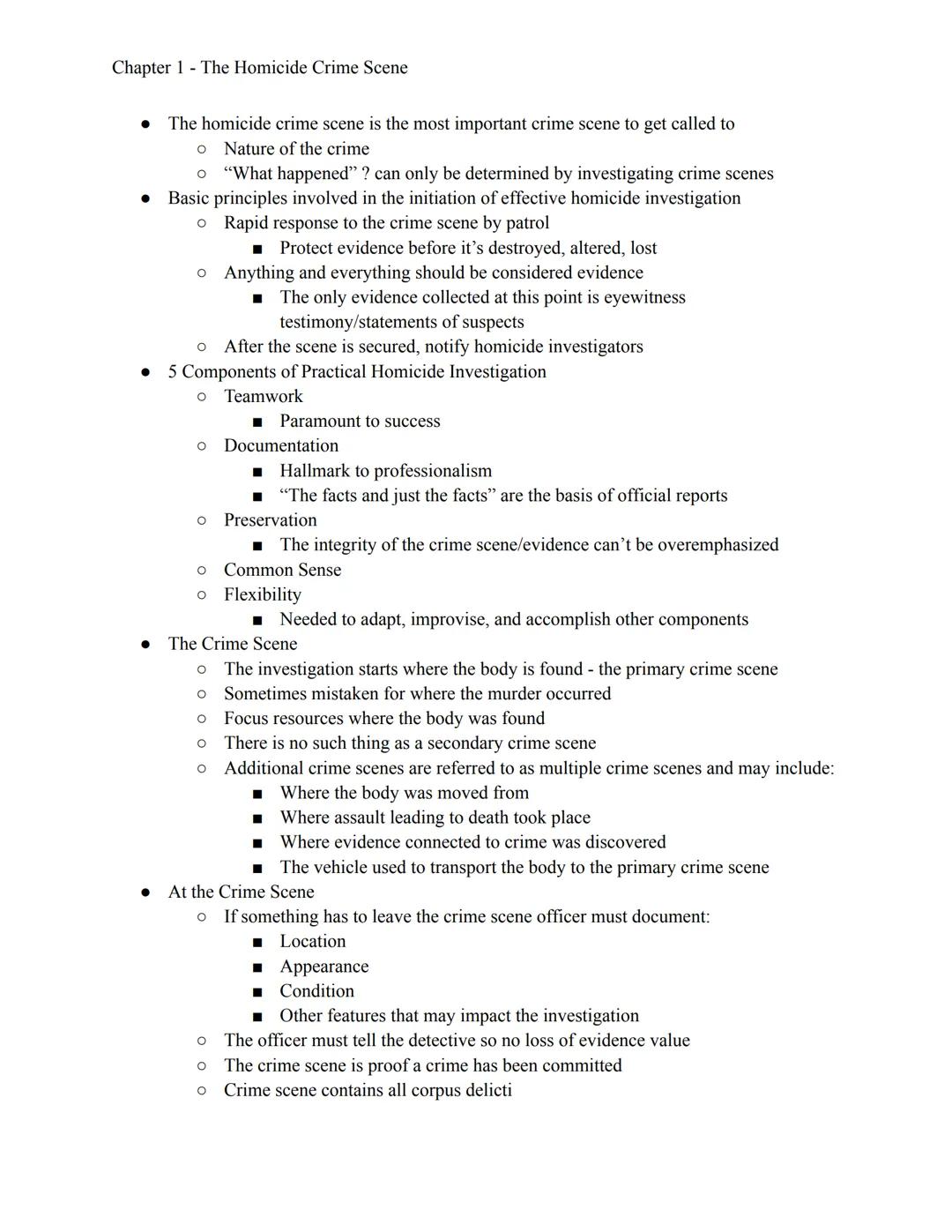
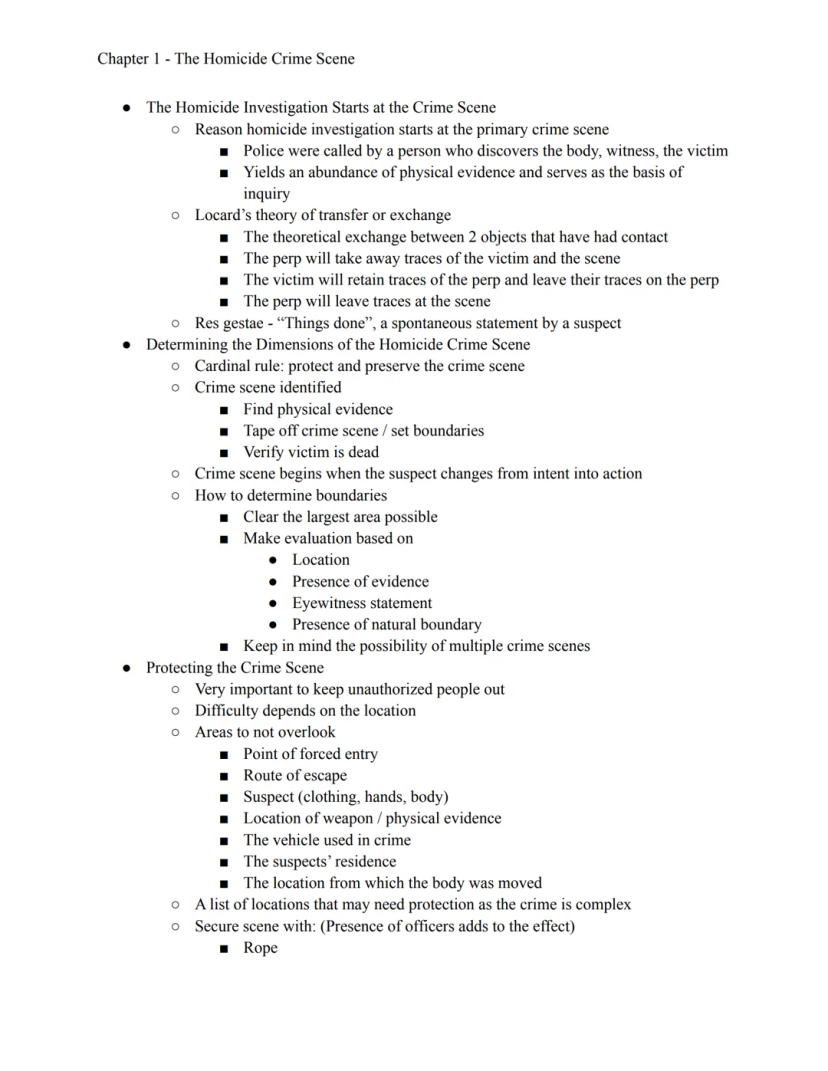
Determining the Dimensions of the Homicide Crime Scene
This section focuses on the crucial steps in identifying and securing the crime scene perimeter. The cardinal rule emphasized is to protect and preserve the crime scene. The process involves verifying the victim's death, finding physical evidence, and taping off the crime scene boundaries.
The text provides guidance on how to determine the boundaries of a crime scene, emphasizing the importance of clearing the largest area possible and considering factors such as location, presence of evidence, eyewitness statements, and natural boundaries.
Highlight: When possible, maintain an outer perimeter around a crime scene of at least the largest area that can be reasonably secured.
The chapter also addresses the importance of protecting the crime scene from unauthorized access and lists potential areas that should not be overlooked, such as points of forced entry, routes of escape, and the suspect's clothing and body.
Example: Areas to protect in a complex crime may include the suspect's residence, the location from which the body was moved, and the vehicle used in the crime.
2
of 5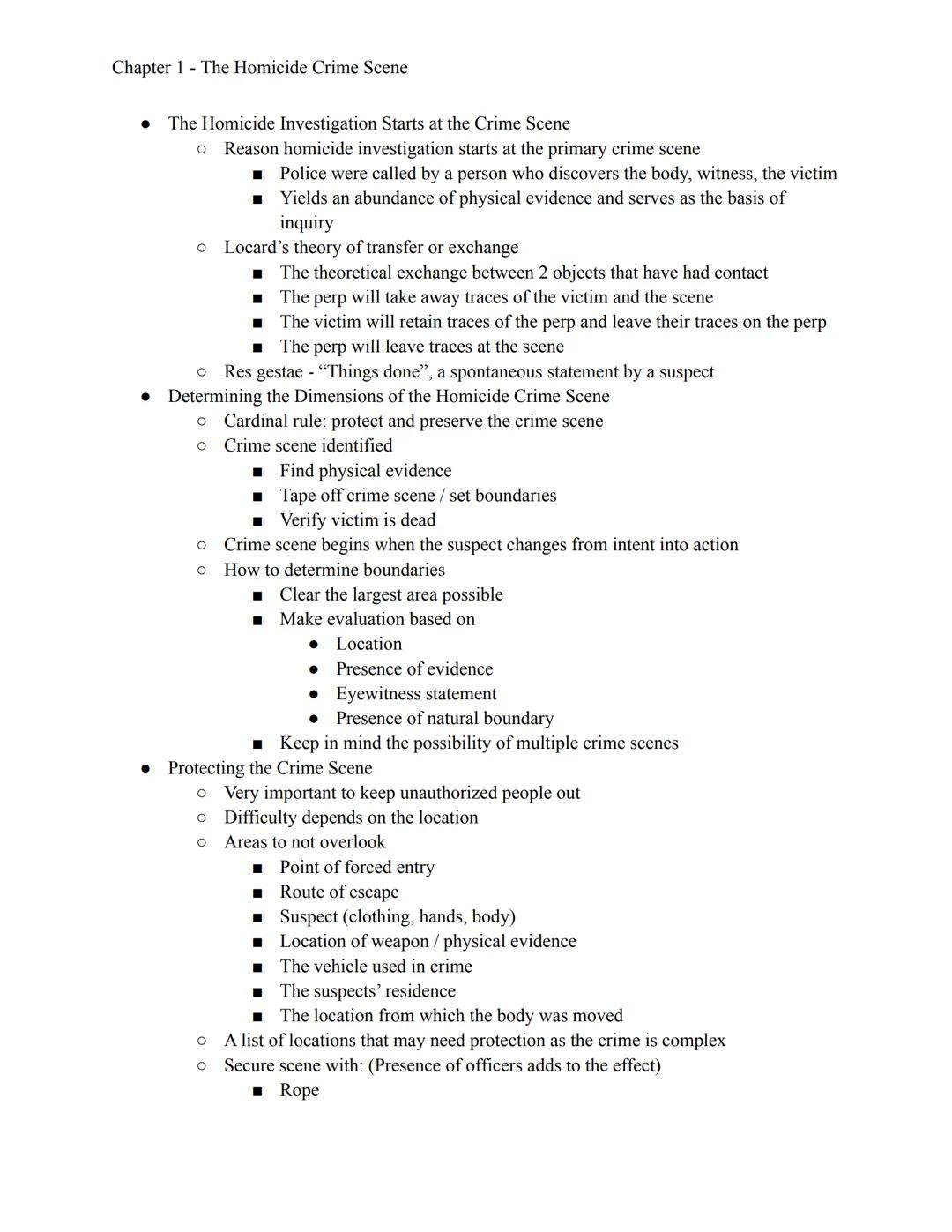
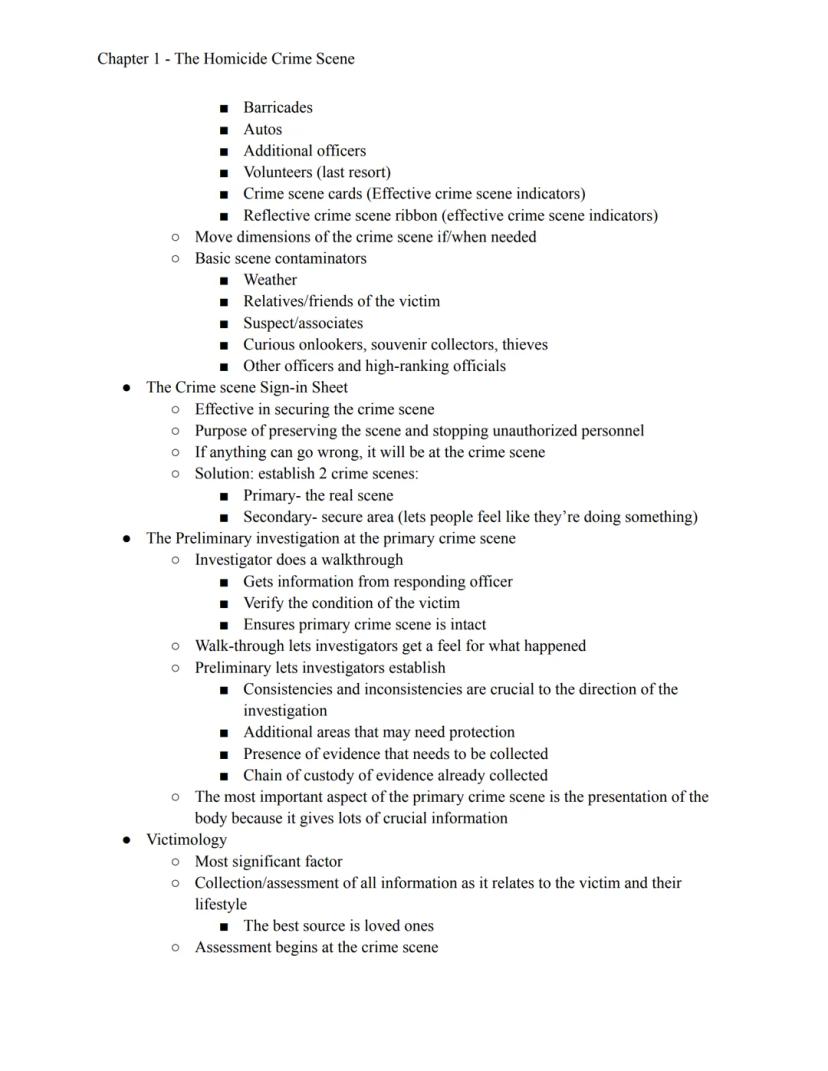
Protecting the Crime Scene
This section delves into the critical aspects of crime scene security and preservation. It emphasizes the importance of keeping unauthorized people out of the crime scene, acknowledging that the difficulty of this task can vary depending on the location.
The text provides a comprehensive list of methods to secure a crime scene, including:
- Rope
- Barricades
- Police vehicles
- Additional officers
- Volunteers (as a last resort)
- Crime scene cards
- Reflective crime scene ribbon
Highlight: The presence of officers adds to the effectiveness of crime scene security measures.
The chapter also identifies basic scene contaminators, such as weather, relatives or friends of the victim, suspects and their associates, curious onlookers, and even other officers or high-ranking officials.
Vocabulary: Scene contaminators are factors or individuals that can compromise the integrity of a crime scene.
3
of 5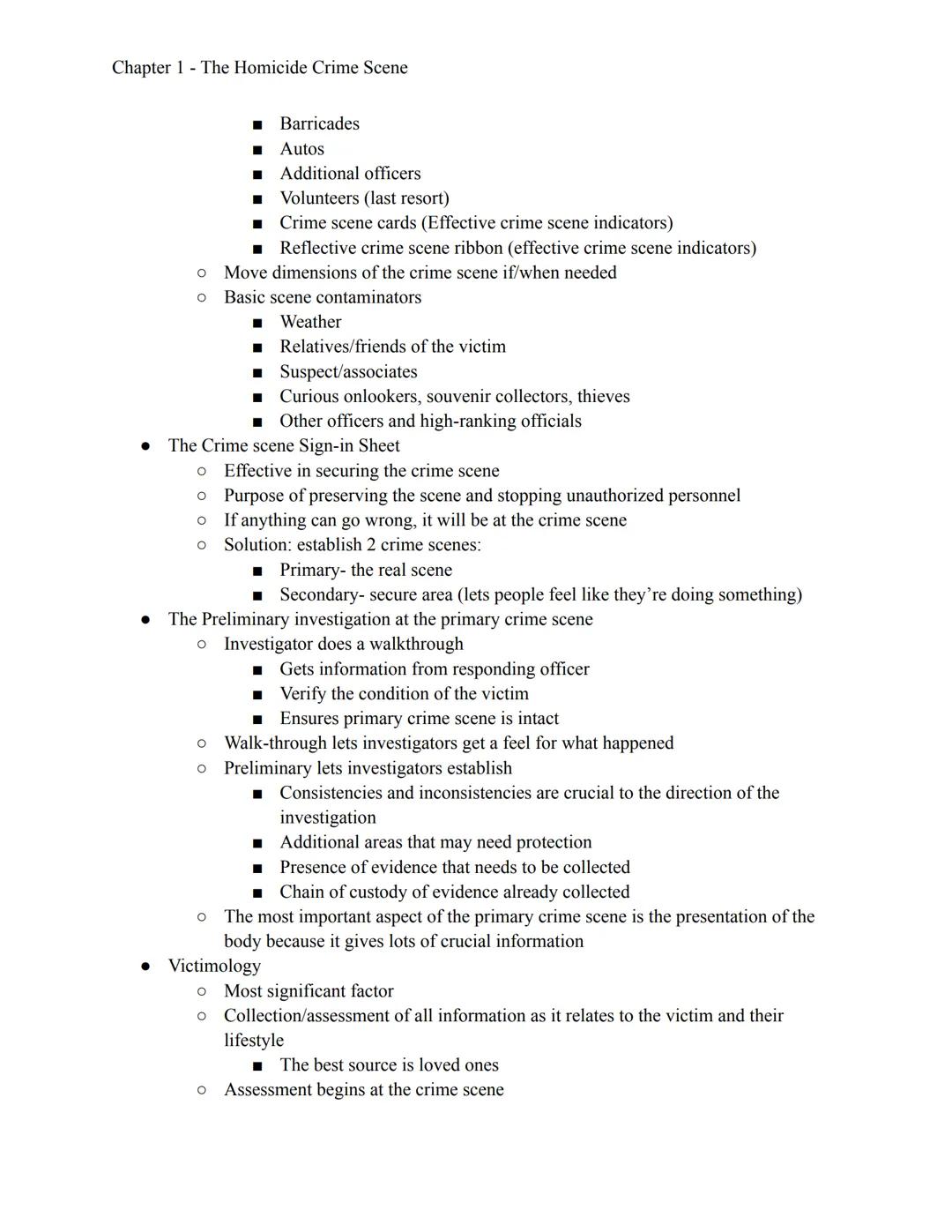
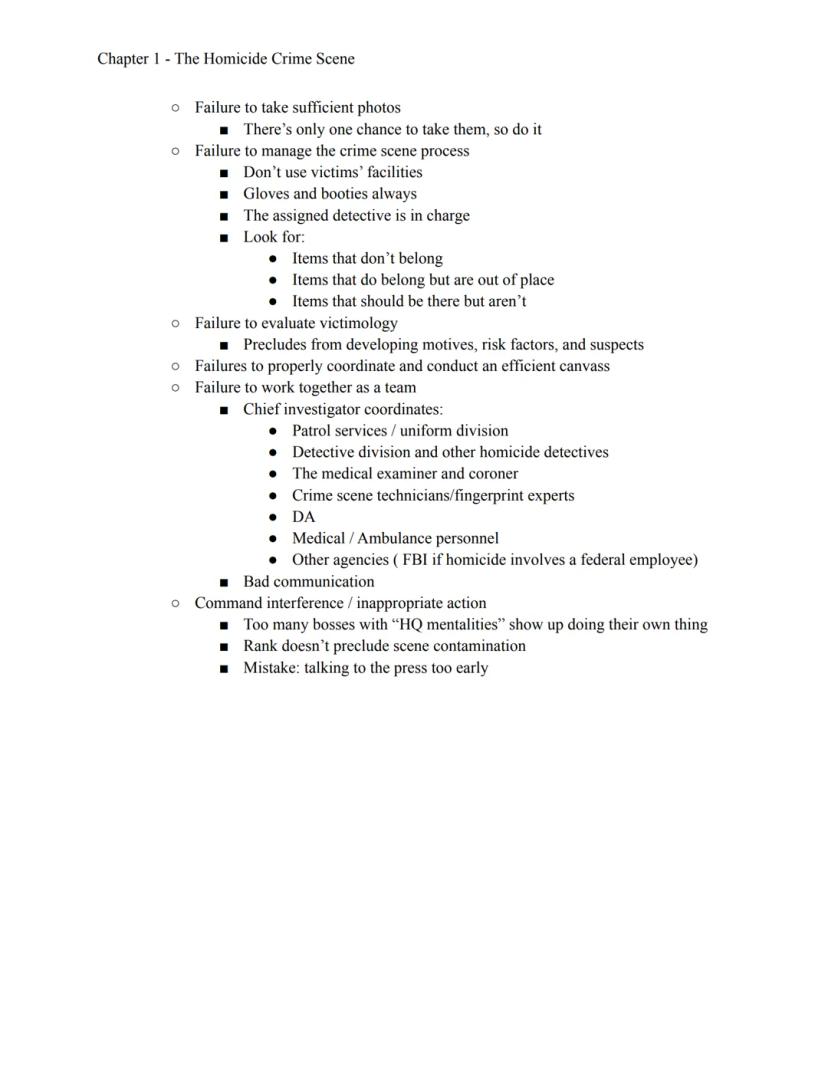
The Crime Scene Sign-in Sheet and Preliminary Investigation
This section introduces the concept of a crime scene sign-in sheet as an effective tool for securing the crime scene and preserving evidence. It explains that the purpose of this measure is to stop unauthorized personnel from entering the scene.
The text suggests establishing two crime scenes as a solution to potential issues:
- Primary - the real scene
- Secondary - a secure area to allow people to feel involved without compromising the actual crime scene
The chapter then outlines the steps of the preliminary investigation at the primary crime scene, which includes:
- Investigator walkthrough
- Gathering information from responding officers
- Verifying the condition of the victim
- Ensuring the primary crime scene is intact
Highlight: The walk-through allows investigators to get a feel for what happened and establish crucial consistencies and inconsistencies that will guide the direction of the investigation.
Example: During the preliminary investigation, investigators may identify additional areas that need protection or evidence that needs to be collected.
The text concludes by emphasizing that the most important aspect of the primary crime scene is the presentation of the body, as it provides crucial information for the investigation.
Quote: "If anything can go wrong, it will be at the crime scene."
4
of 5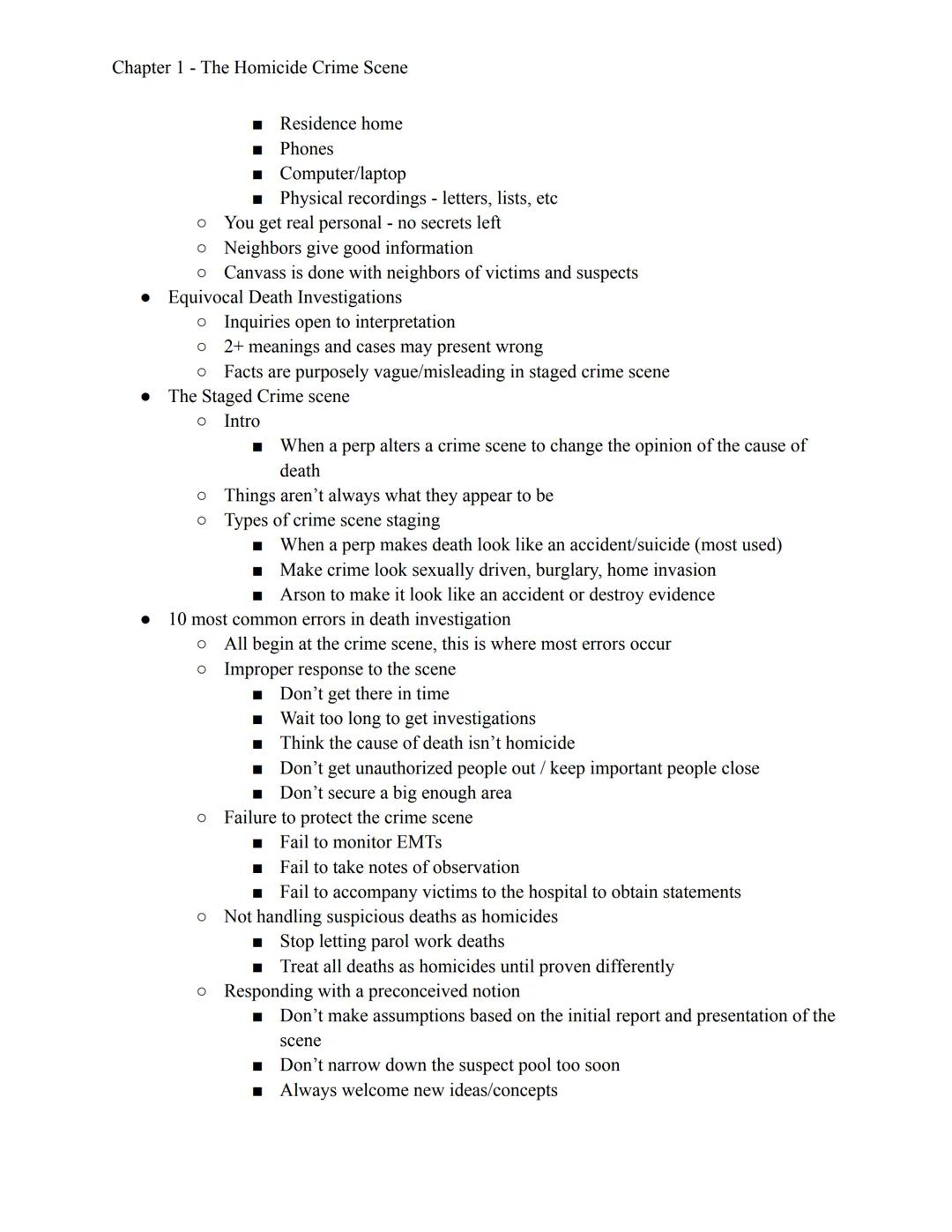
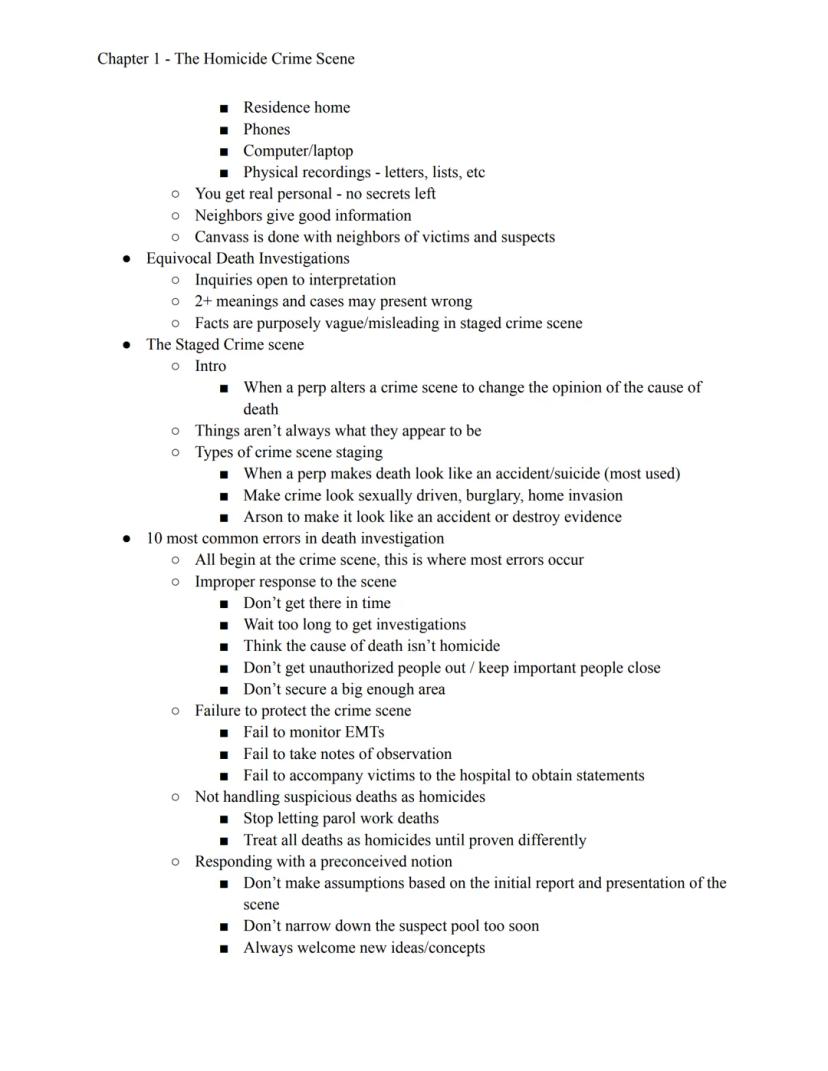
Specialized Investigation Scenarios
This portion addresses complex investigation scenarios and common pitfalls in homicide investigation.
Definition: Equivocal death investigations involve cases where facts may be purposely vague or misleading.
The chapter details important aspects of thorough investigation:
- Examination of victim's personal effects
- Analysis of electronic devices
- Review of physical recordings
- Neighborhood canvassing
Highlight: Staged crime scenes require particular attention to detail and skepticism from investigators.
5
of 5
Chapter 1: The Homicide Crime Scene
The chapter begins by emphasizing the critical nature of homicide crime scenes and the basic principles involved in initiating an effective homicide investigation. It outlines the five components of Practical Homicide Investigation: teamwork, documentation, preservation, common sense, and flexibility.
The text explains that the primary crime scene is where the body is found, which may differ from where the murder occurred. It stresses the importance of focusing resources on this location and clarifies that there are no secondary crime scenes, only multiple crime scenes.
Definition: Corpus delicti refers to the body of evidence that proves a crime has been committed.
Highlight: The crime scene is proof that a crime has been committed and contains all corpus delicti.
Example: Multiple crime scenes may include where the body was moved from, where the assault leading to death took place, or where evidence connected to the crime was discovered.
The chapter also introduces Locard's theory of transfer, which explains the exchange of trace evidence between the perpetrator, victim, and crime scene.
Vocabulary: Res gestae refers to "things done," including spontaneous statements made by a suspect.
We thought you’d never ask...
What is the Knowunity AI companion?
Our AI companion is specifically built for the needs of students. Based on the millions of content pieces we have on the platform we can provide truly meaningful and relevant answers to students. But its not only about answers, the companion is even more about guiding students through their daily learning challenges, with personalised study plans, quizzes or content pieces in the chat and 100% personalisation based on the students skills and developments.
Where can I download the Knowunity app?
You can download the app in the Google Play Store and in the Apple App Store.
Is Knowunity really free of charge?
That's right! Enjoy free access to study content, connect with fellow students, and get instant help – all at your fingertips.
Similar Content
Most popular content in Fun Stuff
9S
Fun StuffSuper Easy Quiz (+)
Are you smarter than a 3rd grader in math? Let’s see.
6th2120
Fun StuffAnatomy and Physiology Chapter 1
Chpater 1 : The orientation of the body / College Level Anatomy and Physiology
84538
Fun Stuff🌈 LGBTQ+ Pride Flags: Context & Symbolism
Use this Know as a quick reference to identify all of the different Pride flags and learn about their context & symbolism
9th36517
Fun StuffALL ABOUT PHILOSOPHY
This document tackles my impression towards "pilosopo" people, what does it mean to love wisdom, implication of face value, and the significance of impartiality.
582
Fun StuffSchool Law
Notes on school law chapter 8 intro to education
10th511
Fun StuffUnit 2 Lesson 2: Alphabet of Lines
An overview of the different types of lines used in drafting
422
Fun StuffPhilosophy of Education
Notes on chapter 6- philosophy of education for intro to EDUC
10th752
Fun StuffDMV Practice Test 1
First set of Questions from DMV Handbook
1,023128
Fun StuffIntro to Python Pt 1
This is a summary of the basics of python such as variables, print, and if statements.
10th2715
Most popular content
9O
 AP US History
Origins and Dynamics of the Columbian Exchange
Analyze the ecological and economic motivations behind the initial transfer of goods, people, and diseases between the Old and New Worlds.
9th3,1280
I
AP US HistoryIntroduction to Early Cultural Interactions
Analyze the initial social and religious encounters between Europeans, Africans, and Indigenous peoples in the colonial Americas.
9th2,7730
O
 AP World History
Origins of Ancient River Civilizations
Analyze the environmental factors and technological innovations that led to the rise of early states in Mesopotamia, Egypt, and the Indus Valley.
9th3,1870
M
AP US HistoryMotivations for European Exploration
Analyze the economic, religious, and political factors that drove European powers to the Americas during the 15th and 16th centuries.
9th1,7780
F
 AP Psychology
Foundations of Ethical Guidelines in Research
Practice the core principles of the APA ethical code including informed consent, debriefing, and the role of Institutional Review Boards.
9th1,3360
I
AP US HistoryIntroduction to Native American Societies
Examine the diverse social, political, and economic structures of North American indigenous groups prior to European contact.
9th1,1100
I
 AP Biology
Introduction to Biological Elements of Life
Practice identifying the essential elements including carbon, nitrogen, phosphorus, and sulfur that compose biological macromolecules.
9th1,7390
I
AP US HistoryIntroduction to the Spanish Encomienda System
Explore the fundamental economic and social structures of the Spanish colonial system, focusing on the encomienda and the casta social hierarchy.
9th8890
O
AP World HistoryOrigins and Continuity of the Byzantine Empire
Analyze the political and cultural transitions from the Roman Empire to the Byzantine Empire, focusing on the reign of Justinian I and his code.
9th1,6320
Can't find what you're looking for? Explore other subjects.
Students love us — and so will you.
4.6/5App Store
4.7/5Google Play
The app is very easy to use and well designed. I have found everything I was looking for so far and have been able to learn a lot from the presentations! I will definitely use the app for a class assignment! And of course it also helps a lot as an inspiration.
Stefan SiOS user
This app is really great. There are so many study notes and help [...]. My problem subject is French, for example, and the app has so many options for help. Thanks to this app, I have improved my French. I would recommend it to anyone.
Samantha KlichAndroid user
Wow, I am really amazed. I just tried the app because I've seen it advertised many times and was absolutely stunned. This app is THE HELP you want for school and above all, it offers so many things, such as workouts and fact sheets, which have been VERY helpful to me personally.
AnnaiOS user
Fun Stuff75 views·Updated Jun 18, 2026·5 pagesHomicide Investigation Kids Guide: Crime Scene Steps and Examples
B
Brooke Shivers@brookeshivers_ulwy
A comprehensive guide to homicide investigation procedures and crime scene management, focusing on essential protocols, common challenges, and best practices for law enforcement professionals.
- The guide emphasizes the critical importance of proper crime scene management in homicide investigations, highlighting...
1
of 5
Sign up to see the content. It's free!
- Access to all documents
- Improve your grades
- Join milions of students
Determining the Dimensions of the Homicide Crime Scene
This section focuses on the crucial steps in identifying and securing the crime scene perimeter. The cardinal rule emphasized is to protect and preserve the crime scene. The process involves verifying the victim's death, finding physical evidence, and taping off the crime scene boundaries.
The text provides guidance on how to determine the boundaries of a crime scene, emphasizing the importance of clearing the largest area possible and considering factors such as location, presence of evidence, eyewitness statements, and natural boundaries.
Highlight: When possible, maintain an outer perimeter around a crime scene of at least the largest area that can be reasonably secured.
The chapter also addresses the importance of protecting the crime scene from unauthorized access and lists potential areas that should not be overlooked, such as points of forced entry, routes of escape, and the suspect's clothing and body.
Example: Areas to protect in a complex crime may include the suspect's residence, the location from which the body was moved, and the vehicle used in the crime.
2
of 5Sign up to see the content. It's free!
- Access to all documents
- Improve your grades
- Join milions of students
Protecting the Crime Scene
This section delves into the critical aspects of crime scene security and preservation. It emphasizes the importance of keeping unauthorized people out of the crime scene, acknowledging that the difficulty of this task can vary depending on the location.
The text provides a comprehensive list of methods to secure a crime scene, including:
- Rope
- Barricades
- Police vehicles
- Additional officers
- Volunteers (as a last resort)
- Crime scene cards
- Reflective crime scene ribbon
Highlight: The presence of officers adds to the effectiveness of crime scene security measures.
The chapter also identifies basic scene contaminators, such as weather, relatives or friends of the victim, suspects and their associates, curious onlookers, and even other officers or high-ranking officials.
Vocabulary: Scene contaminators are factors or individuals that can compromise the integrity of a crime scene.
3
of 5Sign up to see the content. It's free!
- Access to all documents
- Improve your grades
- Join milions of students
The Crime Scene Sign-in Sheet and Preliminary Investigation
This section introduces the concept of a crime scene sign-in sheet as an effective tool for securing the crime scene and preserving evidence. It explains that the purpose of this measure is to stop unauthorized personnel from entering the scene.
The text suggests establishing two crime scenes as a solution to potential issues:
- Primary - the real scene
- Secondary - a secure area to allow people to feel involved without compromising the actual crime scene
The chapter then outlines the steps of the preliminary investigation at the primary crime scene, which includes:
- Investigator walkthrough
- Gathering information from responding officers
- Verifying the condition of the victim
- Ensuring the primary crime scene is intact
Highlight: The walk-through allows investigators to get a feel for what happened and establish crucial consistencies and inconsistencies that will guide the direction of the investigation.
Example: During the preliminary investigation, investigators may identify additional areas that need protection or evidence that needs to be collected.
The text concludes by emphasizing that the most important aspect of the primary crime scene is the presentation of the body, as it provides crucial information for the investigation.
Quote: "If anything can go wrong, it will be at the crime scene."
4
of 5Sign up to see the content. It's free!
- Access to all documents
- Improve your grades
- Join milions of students
Specialized Investigation Scenarios
This portion addresses complex investigation scenarios and common pitfalls in homicide investigation.
Definition: Equivocal death investigations involve cases where facts may be purposely vague or misleading.
The chapter details important aspects of thorough investigation:
- Examination of victim's personal effects
- Analysis of electronic devices
- Review of physical recordings
- Neighborhood canvassing
Highlight: Staged crime scenes require particular attention to detail and skepticism from investigators.
5
of 5Sign up to see the content. It's free!
- Access to all documents
- Improve your grades
- Join milions of students
Chapter 1: The Homicide Crime Scene
The chapter begins by emphasizing the critical nature of homicide crime scenes and the basic principles involved in initiating an effective homicide investigation. It outlines the five components of Practical Homicide Investigation: teamwork, documentation, preservation, common sense, and flexibility.
The text explains that the primary crime scene is where the body is found, which may differ from where the murder occurred. It stresses the importance of focusing resources on this location and clarifies that there are no secondary crime scenes, only multiple crime scenes.
Definition: Corpus delicti refers to the body of evidence that proves a crime has been committed.
Highlight: The crime scene is proof that a crime has been committed and contains all corpus delicti.
Example: Multiple crime scenes may include where the body was moved from, where the assault leading to death took place, or where evidence connected to the crime was discovered.
The chapter also introduces Locard's theory of transfer, which explains the exchange of trace evidence between the perpetrator, victim, and crime scene.
Vocabulary: Res gestae refers to "things done," including spontaneous statements made by a suspect.
We thought you’d never ask...
What is the Knowunity AI companion?
Our AI companion is specifically built for the needs of students. Based on the millions of content pieces we have on the platform we can provide truly meaningful and relevant answers to students. But its not only about answers, the companion is even more about guiding students through their daily learning challenges, with personalised study plans, quizzes or content pieces in the chat and 100% personalisation based on the students skills and developments.
Where can I download the Knowunity app?
You can download the app in the Google Play Store and in the Apple App Store.
Is Knowunity really free of charge?
That's right! Enjoy free access to study content, connect with fellow students, and get instant help – all at your fingertips.
Similar Content
Most popular content in Fun Stuff
9S
Fun StuffSuper Easy Quiz (+)
Are you smarter than a 3rd grader in math? Let’s see.
6th2120
Fun StuffAnatomy and Physiology Chapter 1
Chpater 1 : The orientation of the body / College Level Anatomy and Physiology
84538
Fun Stuff🌈 LGBTQ+ Pride Flags: Context & Symbolism
Use this Know as a quick reference to identify all of the different Pride flags and learn about their context & symbolism
9th36517
Fun StuffALL ABOUT PHILOSOPHY
This document tackles my impression towards "pilosopo" people, what does it mean to love wisdom, implication of face value, and the significance of impartiality.
582
Fun StuffSchool Law
Notes on school law chapter 8 intro to education
10th511
Fun StuffUnit 2 Lesson 2: Alphabet of Lines
An overview of the different types of lines used in drafting
422
Fun StuffPhilosophy of Education
Notes on chapter 6- philosophy of education for intro to EDUC
10th752
Fun StuffDMV Practice Test 1
First set of Questions from DMV Handbook
1,023128
Fun StuffIntro to Python Pt 1
This is a summary of the basics of python such as variables, print, and if statements.
10th2715
Most popular content
9O
AP US HistoryOrigins and Dynamics of the Columbian Exchange
Analyze the ecological and economic motivations behind the initial transfer of goods, people, and diseases between the Old and New Worlds.
9th3,1280
I
AP US HistoryIntroduction to Early Cultural Interactions
Analyze the initial social and religious encounters between Europeans, Africans, and Indigenous peoples in the colonial Americas.
9th2,7730
O
AP World HistoryOrigins of Ancient River Civilizations
Analyze the environmental factors and technological innovations that led to the rise of early states in Mesopotamia, Egypt, and the Indus Valley.
9th3,1870
M
AP US HistoryMotivations for European Exploration
Analyze the economic, religious, and political factors that drove European powers to the Americas during the 15th and 16th centuries.
9th1,7780
F
AP PsychologyFoundations of Ethical Guidelines in Research
Practice the core principles of the APA ethical code including informed consent, debriefing, and the role of Institutional Review Boards.
9th1,3360
I
AP US HistoryIntroduction to Native American Societies
Examine the diverse social, political, and economic structures of North American indigenous groups prior to European contact.
9th1,1100
I
AP BiologyIntroduction to Biological Elements of Life
Practice identifying the essential elements including carbon, nitrogen, phosphorus, and sulfur that compose biological macromolecules.
9th1,7390
I
AP US HistoryIntroduction to the Spanish Encomienda System
Explore the fundamental economic and social structures of the Spanish colonial system, focusing on the encomienda and the casta social hierarchy.
9th8890
O
AP World HistoryOrigins and Continuity of the Byzantine Empire
Analyze the political and cultural transitions from the Roman Empire to the Byzantine Empire, focusing on the reign of Justinian I and his code.
9th1,6320
Can't find what you're looking for? Explore other subjects.
Students love us — and so will you.
4.6/5App Store
4.7/5Google Play
The app is very easy to use and well designed. I have found everything I was looking for so far and have been able to learn a lot from the presentations! I will definitely use the app for a class assignment! And of course it also helps a lot as an inspiration.
Stefan SiOS user
This app is really great. There are so many study notes and help [...]. My problem subject is French, for example, and the app has so many options for help. Thanks to this app, I have improved my French. I would recommend it to anyone.
Samantha KlichAndroid user
Wow, I am really amazed. I just tried the app because I've seen it advertised many times and was absolutely stunned. This app is THE HELP you want for school and above all, it offers so many things, such as workouts and fact sheets, which have been VERY helpful to me personally.
AnnaiOS user