
The First SWAT teamemerged from the Los Angeles Police...
 Fun Stuff240 views·Updated Jun 16, 2026·6 pages
All About SWAT Teams and U.S. Border Security

Danner Halsey@dannerhalsey_loqm

1 / 6
1
of 6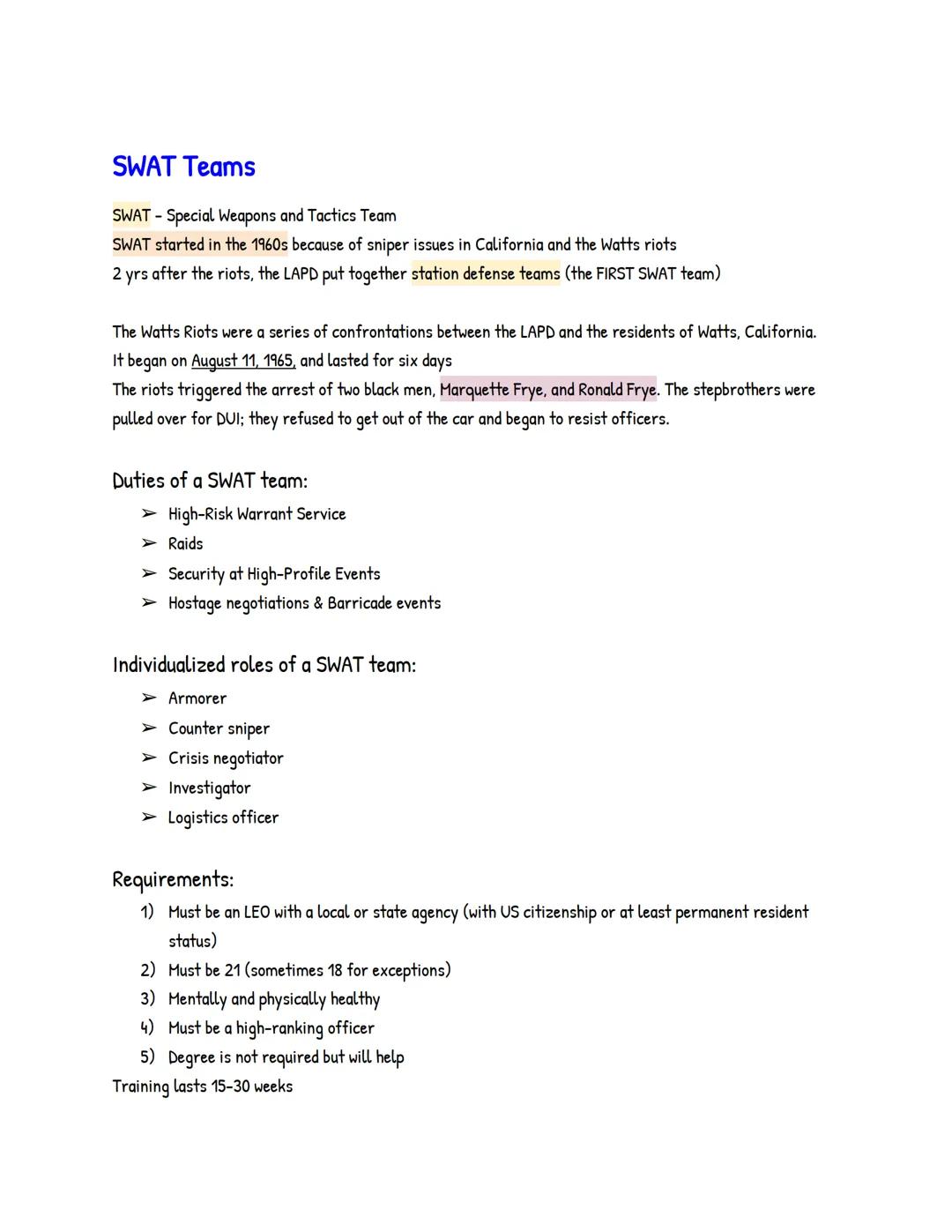
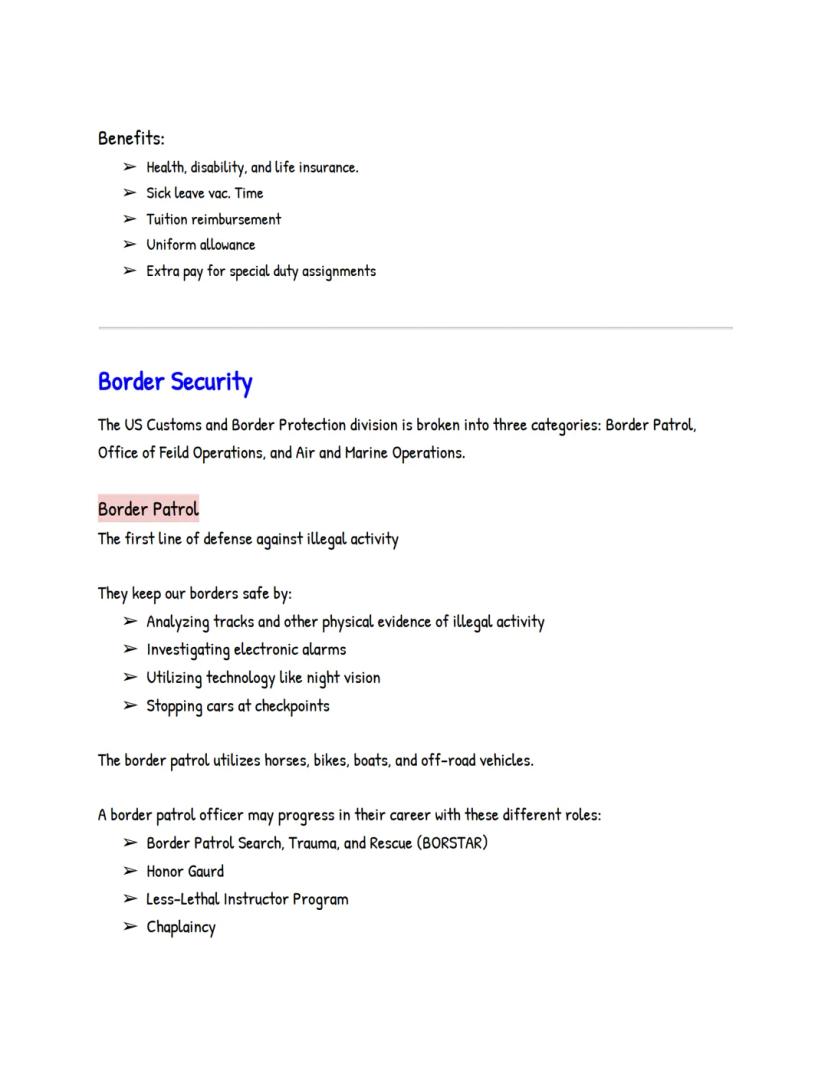
Border Security: Protecting America's Frontiers
The U.S. Customs and Border Protection (CBP) is the primary agency responsible for border security. It is divided into three main categories:
- Border Patrol
- Office of Field Operations
- Air and Marine Operations
Border Patrol: The First Line of Defense
The Border Patrol serves as the initial barrier against illegal activities at U.S. borders. Their methods include:
- Analyzing tracks and physical evidence of illegal activity
- Investigating electronic alarms
- Using advanced technology like night vision
- Conducting vehicle checkpoints
Example: Border Patrol agents may use horses, bikes, boats, and off-road vehicles to patrol diverse terrains along the border.
Career progression in Border Patrol includes specialized roles such as:
- Border Patrol Search, Trauma, and Rescue (BORSTAR)
- Honor Guard
- Less-Lethal Instructor Program
- Chaplaincy
Highlight: The diverse roles within Border Patrol allow agents to specialize in areas that match their skills and interests.
2
of 6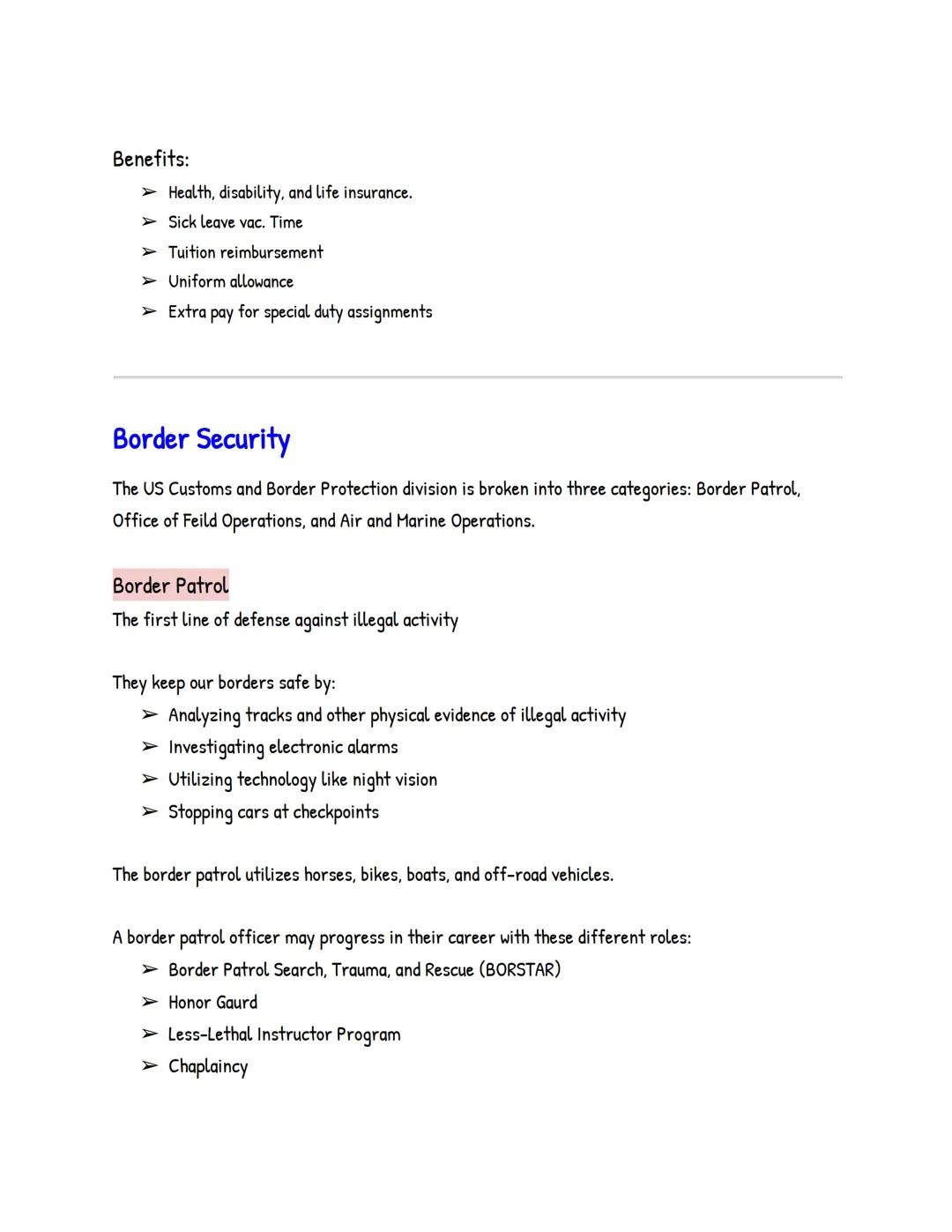
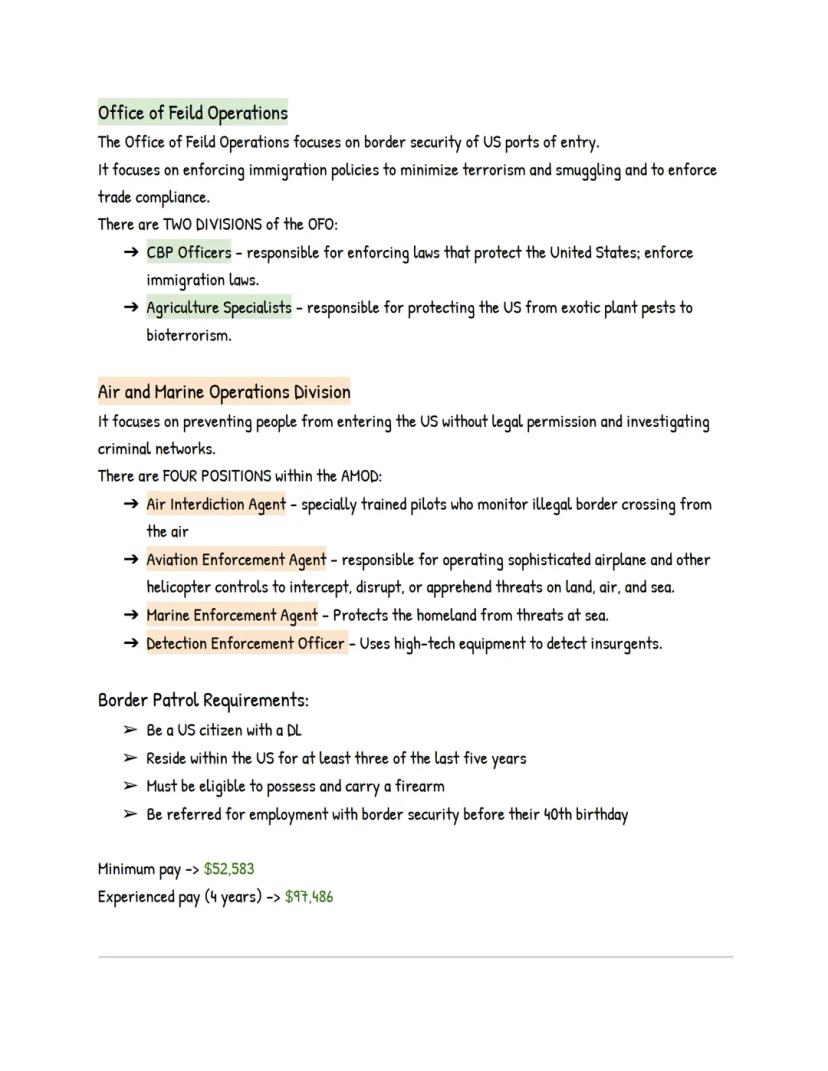
Office of Field Operations and Air and Marine Operations
Office of Field Operations (OFO)
The OFO focuses on border security at U.S. ports of entry. Its primary objectives are:
- Enforcing immigration policies
- Minimizing terrorism and smuggling
- Ensuring trade compliance
The OFO is divided into two main branches:
- CBP Officers: Responsible for enforcing laws that protect the United States and implementing immigration laws.
- Agriculture Specialists: Tasked with protecting the U.S. from exotic plant pests and potential bioterrorism threats.
Definition: Trade compliance refers to adhering to laws and regulations governing the import and export of goods across international borders.
Air and Marine Operations Division (AMOD)
The AMOD is dedicated to preventing unauthorized entry into the U.S. and investigating criminal networks. It comprises four key positions:
- Air Interdiction Agent: Specially trained pilots who monitor illegal border crossings from the air.
- Aviation Enforcement Agent: Operates sophisticated aircraft to intercept, disrupt, or apprehend threats on land, air, and sea.
- Marine Enforcement Agent: Protects the homeland from threats at sea.
- Detection Enforcement Officer: Utilizes high-tech equipment to detect insurgents.
Highlight: The AMOD's diverse roles demonstrate the multifaceted approach to border security, covering air, sea, and land operations.
Border Patrol Requirements and Compensation
To join the Border Patrol, candidates must meet the following criteria:
- U.S. citizenship and possession of a driver's license
- Residency in the U.S. for at least three of the last five years
- Eligibility to possess and carry a firearm
- Referral for employment before their 40th birthday
Example: The age requirement ensures that Border Patrol agents have the physical capability to perform their duties effectively throughout their careers.
Compensation for Border Patrol agents is competitive:
- Minimum starting pay: $52,583
- Experienced pay (4 years): $97,486
Highlight: The significant increase in pay over four years reflects the value placed on experience and skill development within the Border Patrol.
3
of 6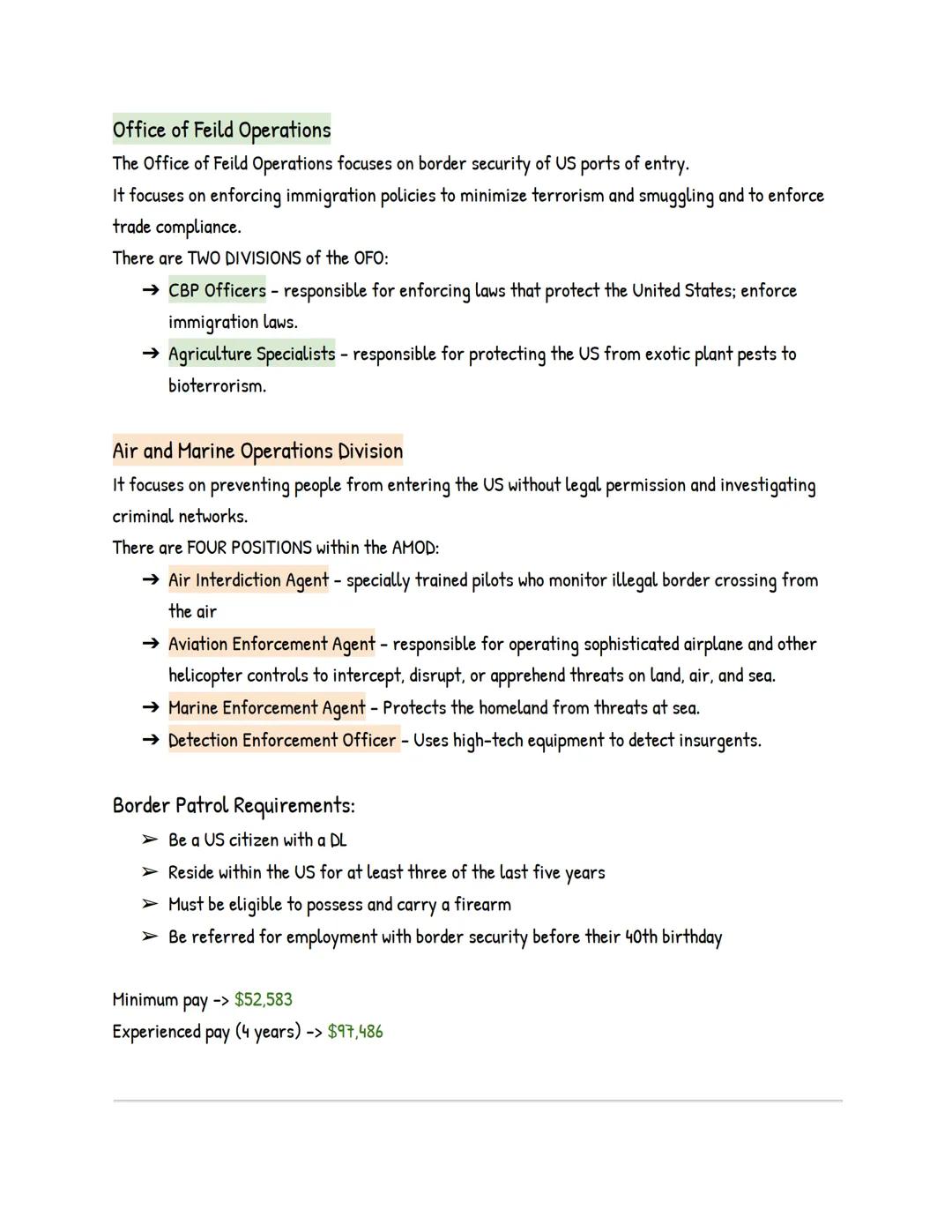
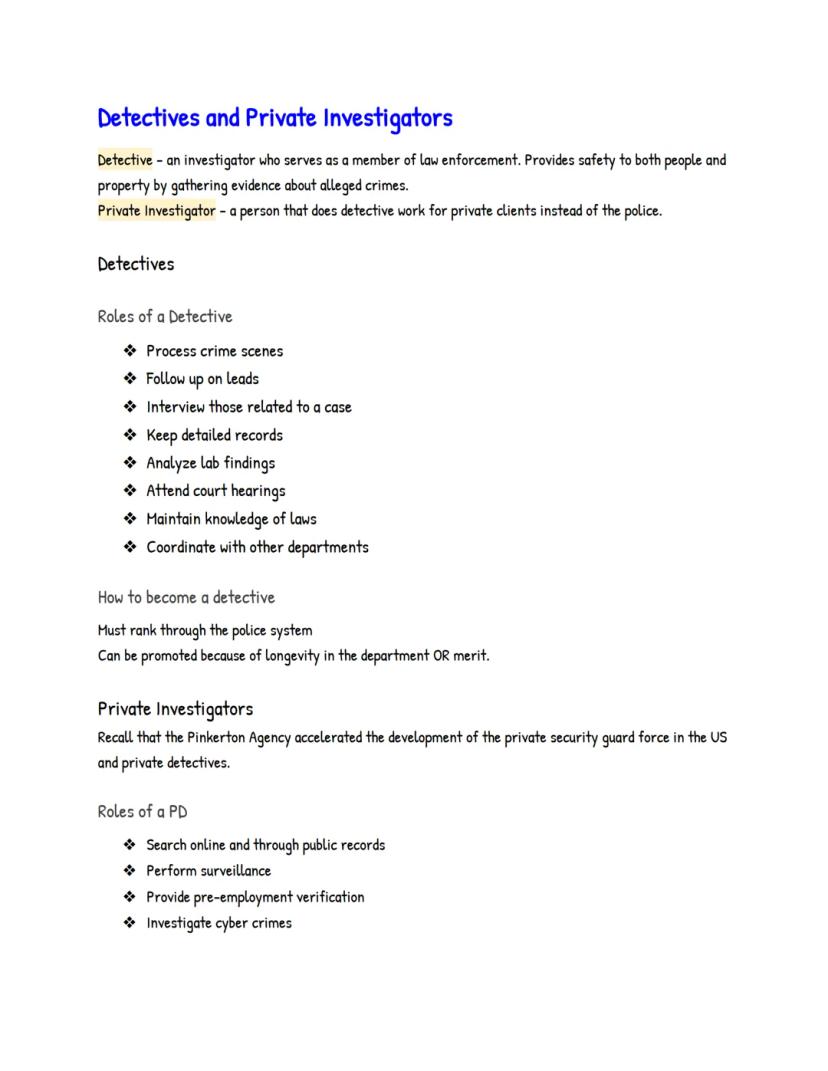
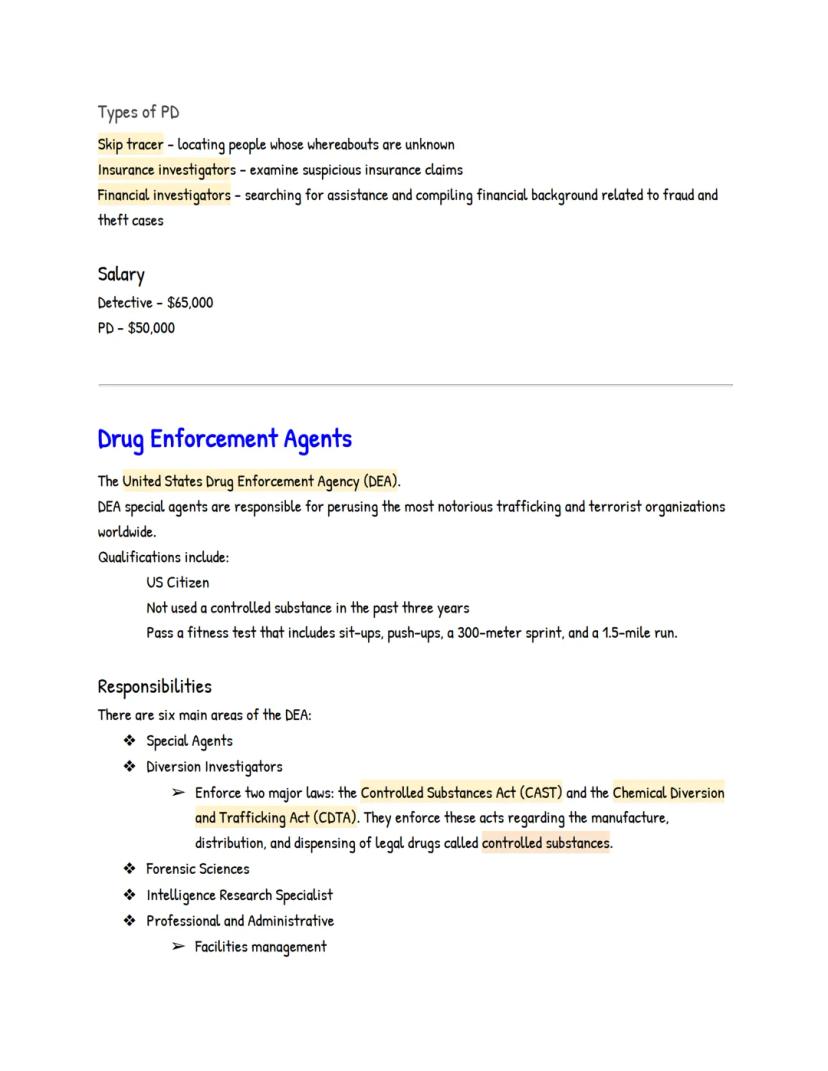
Detectives and Private Investigators: Uncovering the Truth
Detectives: Law Enforcement Investigators
Detectives are integral members of law enforcement agencies, responsible for investigating crimes and gathering evidence to ensure public safety.
Key roles of a detective include:
- Processing crime scenes
- Following up on leads
- Interviewing individuals related to a case
- Maintaining detailed records
- Analyzing laboratory findings
- Attending court hearings
- Staying updated on relevant laws
- Coordinating with other departments
Highlight: Detectives play a crucial role in bridging the gap between initial crime reports and successful prosecutions by meticulously gathering and analyzing evidence.
To become a detective, one must typically progress through the ranks of the police system. Promotions can be based on longevity in the department or merit.
Private Investigators: Independent Sleuths
Private Investigators (PIs) conduct detective work for private clients rather than law enforcement agencies. The development of private security and detective work in the U.S. was significantly influenced by the Pinkerton Agency.
Roles of a Private Investigator include:
- Searching online and through public records
- Performing surveillance
- Providing pre-employment verification
- Investigating cybercrimes
Example: A private investigator might be hired to conduct background checks on potential employees or to gather evidence in civil cases such as insurance fraud.
Types of Private Investigators:
- Skip Tracer: Specializes in locating people whose whereabouts are unknown.
- Insurance Investigator: Examines suspicious insurance claims.
- Financial Investigator: Searches for assets and compiles financial backgrounds related to fraud and theft cases.
Vocabulary: A Skip Tracer is a professional who specializes in locating individuals who have "skipped" or left town, often to avoid legal or financial obligations.
Salary Comparison:
- Detective: Approximately $65,000 per year
- Private Investigator: Approximately $50,000 per year
4
of 6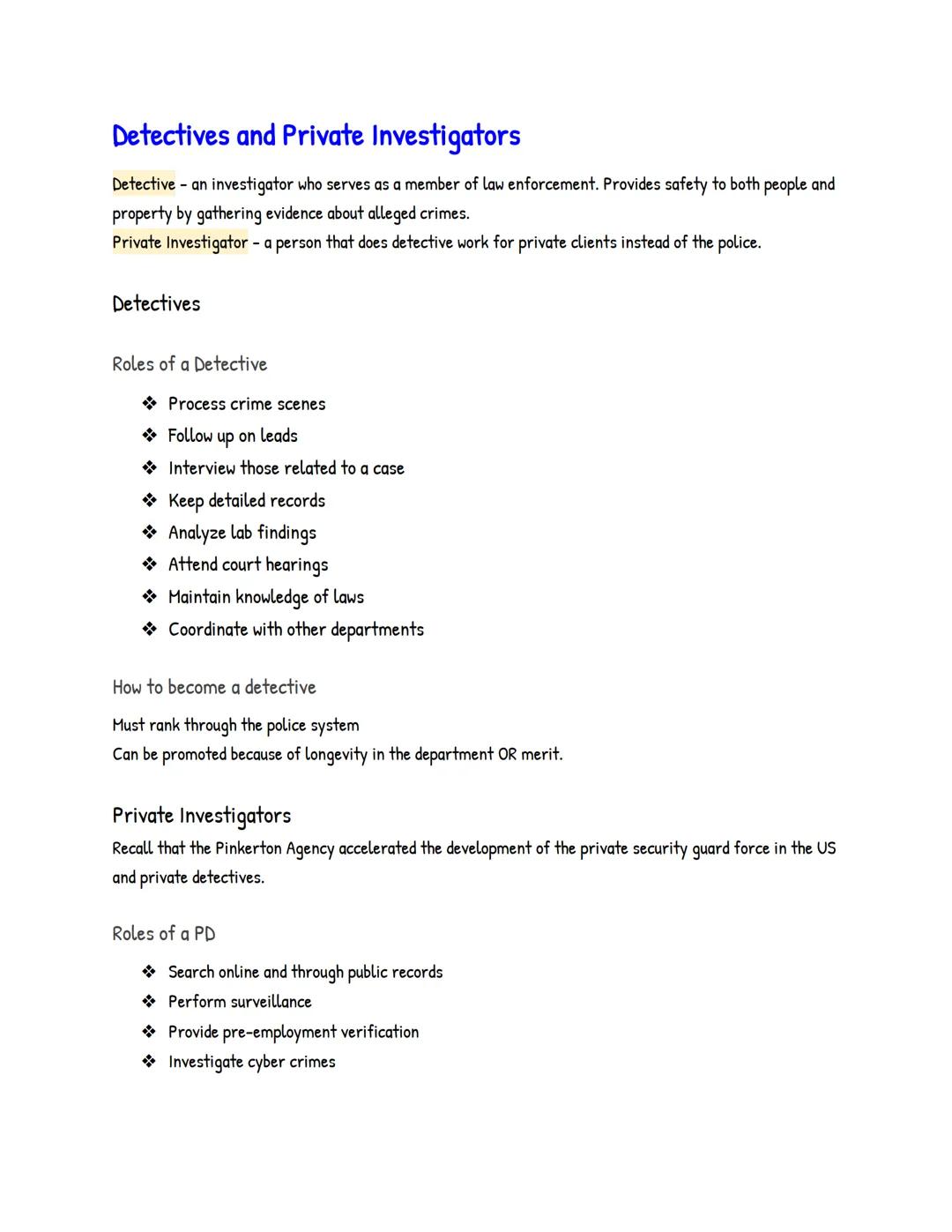
Drug Enforcement Agents: Combating Narcotics Trafficking
The United States Drug Enforcement Agency (DEA) is at the forefront of the fight against drug trafficking and related crimes. DEA special agents are tasked with pursuing the most notorious trafficking and terrorist organizations worldwide.
Highlight: DEA agents play a crucial role in national security by targeting the intersection of drug trafficking and terrorism.
Qualifications for becoming a DEA agent include:
- U.S. citizenship
- No use of controlled substances in the past three years
- Passing a rigorous fitness test that includes:
- Sit-ups
- Push-ups
- 300-meter sprint
- 1.5-mile run
Example: The fitness test ensures that DEA agents are physically capable of handling the demanding nature of their work, which may involve surveillance, raids, and pursuit of suspects.
Highlight: The requirement of no controlled substance use in the past three years underscores the importance of personal integrity and commitment to the agency's mission.
DEA agents undergo extensive training to prepare them for the complex and often dangerous work of combating drug trafficking organizations. This training covers various aspects of law enforcement, including investigative techniques, legal procedures, and tactical operations.
5
of 6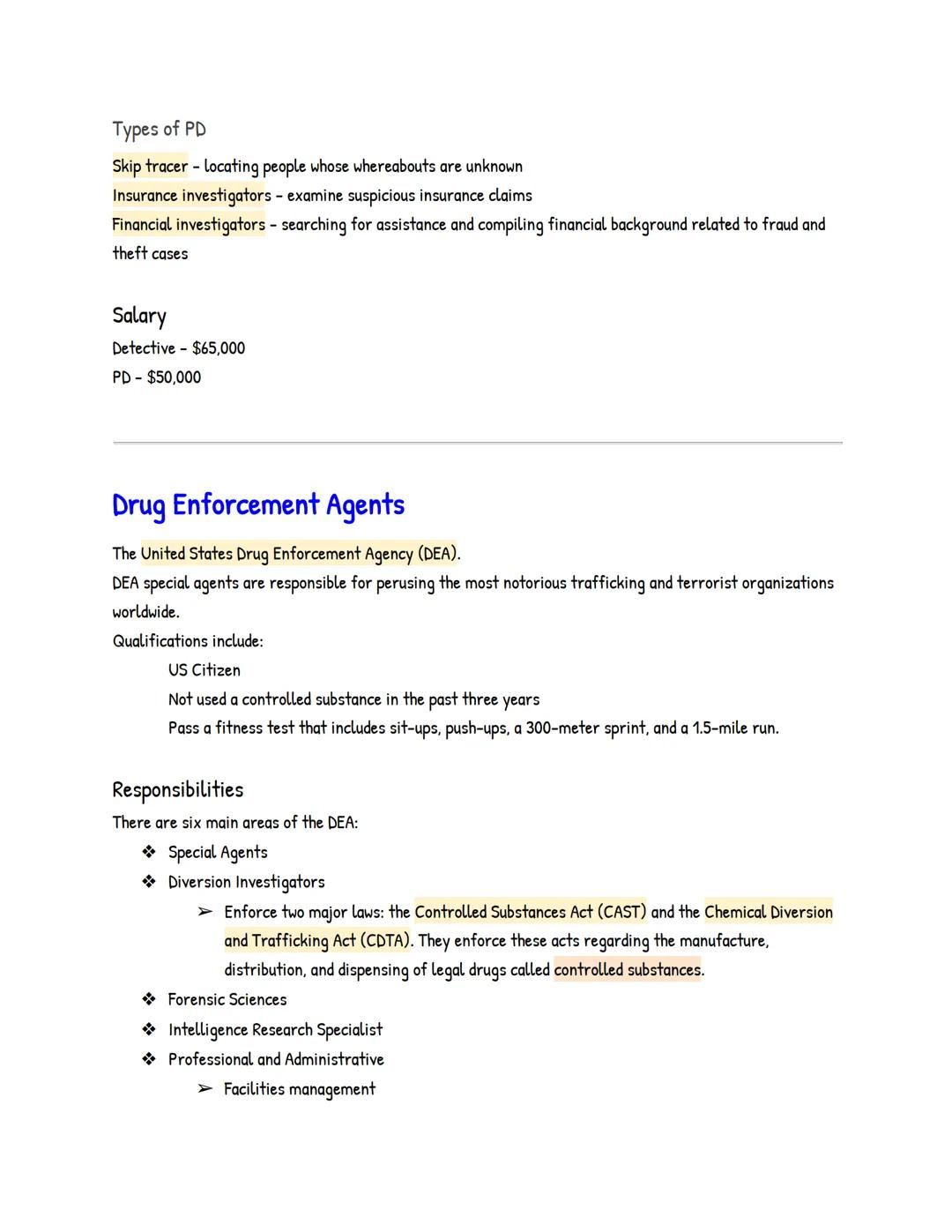
Drug Enforcement Operations
The Drug Enforcement Administration (DEA) focuses on combating international drug trafficking and terrorist organizations.
Definition: DEA special agents are federal law enforcement officers targeting major drug trafficking operations globally.
Qualification requirements include:
- U.S. citizenship
- Clean drug history for past three years
- Physical fitness test completion including:
- Sit-ups
- Push-ups
- 300-meter sprint
- 1.5-mile run
6
of 6
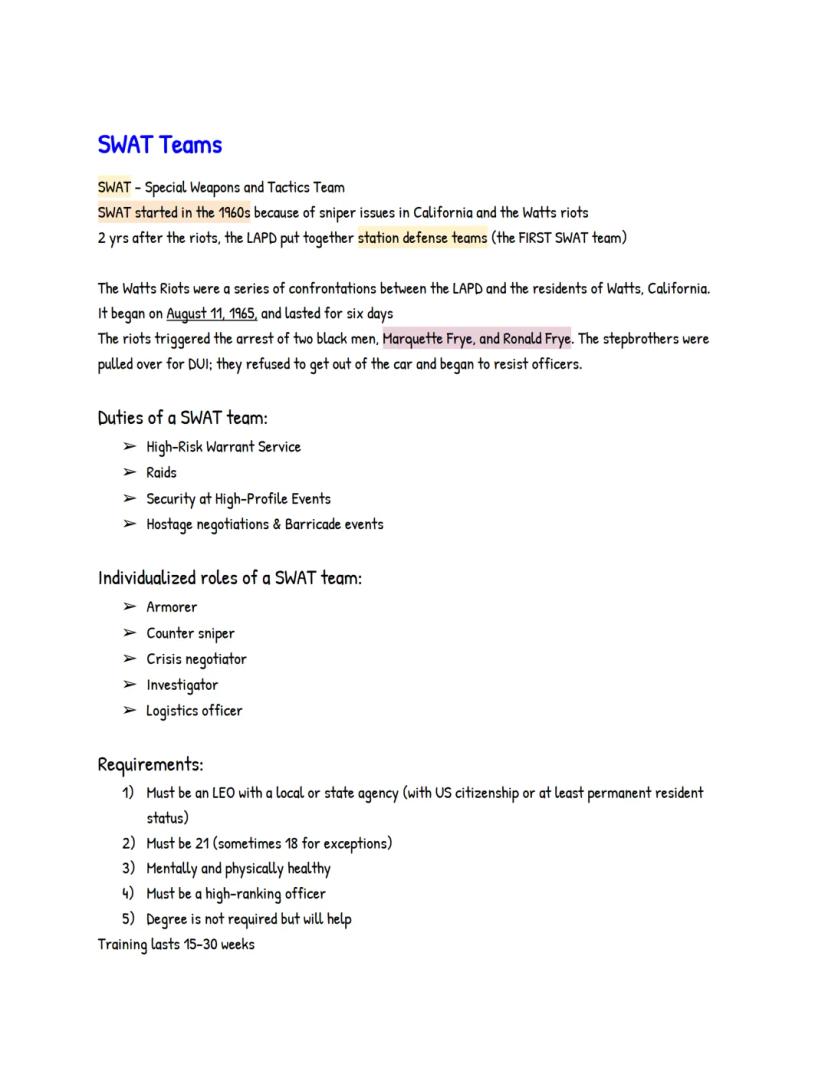
SWAT Teams: Origins and Responsibilities
The first SWAT team was established in response to significant law enforcement challenges in the 1960s. SWAT, which stands for Special Weapons and Tactics, was created to address sniper issues in California and the aftermath of the Watts riots.
Highlight: The LAPD SWAT, formed two years after the Watts riots, was the pioneering SWAT unit in the United States.
The Watts Riots, a pivotal event in SWAT history, occurred in August 1965 and lasted for six days. These riots were sparked by the arrest of two black men, Marquette and Ronald Frye, during a traffic stop for suspected DUI.
SWAT team roles and responsibilities include:
- High-Risk Warrant Service
- Raids
- Security at High-Profile Events
- Hostage negotiations
- Barricade events
Example: A SWAT team may be called to a house for situations like hostage scenarios or when serving high-risk warrants.
The SWAT team composition and roles include specialized positions such as:
- Armorer
- Counter sniper
- Crisis negotiator
- Investigator
- Logistics officer
Vocabulary: An Armorer is responsible for maintaining and repairing the team's weapons and equipment.
SWAT team requirements are stringent:
- Must be a law enforcement officer with a local or state agency (U.S. citizenship or permanent resident status required)
- Typically 21 years old
- Mentally and physically fit
- Usually a high-ranking officer
- While a degree is not mandatory, it can be beneficial
SWAT training is intensive, lasting between 15 to 30 weeks.
We thought you’d never ask...
What is the Knowunity AI companion?
Our AI companion is specifically built for the needs of students. Based on the millions of content pieces we have on the platform we can provide truly meaningful and relevant answers to students. But its not only about answers, the companion is even more about guiding students through their daily learning challenges, with personalised study plans, quizzes or content pieces in the chat and 100% personalisation based on the students skills and developments.
Where can I download the Knowunity app?
You can download the app in the Google Play Store and in the Apple App Store.
Is Knowunity really free of charge?
That's right! Enjoy free access to study content, connect with fellow students, and get instant help – all at your fingertips.
Similar Content
Most popular content in Fun Stuff
9S
Fun StuffSuper Easy Quiz (+)
Are you smarter than a 3rd grader in math? Let’s see.
6th2120
Fun StuffAnatomy and Physiology Chapter 1
Chpater 1 : The orientation of the body / College Level Anatomy and Physiology
84538
Fun Stuff🌈 LGBTQ+ Pride Flags: Context & Symbolism
Use this Know as a quick reference to identify all of the different Pride flags and learn about their context & symbolism
9th36517
Fun StuffALL ABOUT PHILOSOPHY
This document tackles my impression towards "pilosopo" people, what does it mean to love wisdom, implication of face value, and the significance of impartiality.
582
Fun StuffSchool Law
Notes on school law chapter 8 intro to education
10th511
Fun StuffUnit 2 Lesson 2: Alphabet of Lines
An overview of the different types of lines used in drafting
422
Fun StuffPhilosophy of Education
Notes on chapter 6- philosophy of education for intro to EDUC
10th752
Fun StuffDMV Practice Test 1
First set of Questions from DMV Handbook
1,023128
Fun StuffIntro to Python Pt 1
This is a summary of the basics of python such as variables, print, and if statements.
10th2715
Most popular content
9O
 AP US History
Origins and Dynamics of the Columbian Exchange
Analyze the ecological and economic motivations behind the initial transfer of goods, people, and diseases between the Old and New Worlds.
9th3,1280
I
AP US HistoryIntroduction to Early Cultural Interactions
Analyze the initial social and religious encounters between Europeans, Africans, and Indigenous peoples in the colonial Americas.
9th2,7730
O
 AP World History
Origins of Ancient River Civilizations
Analyze the environmental factors and technological innovations that led to the rise of early states in Mesopotamia, Egypt, and the Indus Valley.
9th3,1870
M
AP US HistoryMotivations for European Exploration
Analyze the economic, religious, and political factors that drove European powers to the Americas during the 15th and 16th centuries.
9th1,7780
F
 AP Psychology
Foundations of Ethical Guidelines in Research
Practice the core principles of the APA ethical code including informed consent, debriefing, and the role of Institutional Review Boards.
9th1,3360
I
AP US HistoryIntroduction to Native American Societies
Examine the diverse social, political, and economic structures of North American indigenous groups prior to European contact.
9th1,1100
I
 AP Biology
Introduction to Biological Elements of Life
Practice identifying the essential elements including carbon, nitrogen, phosphorus, and sulfur that compose biological macromolecules.
9th1,7390
I
AP US HistoryIntroduction to the Spanish Encomienda System
Explore the fundamental economic and social structures of the Spanish colonial system, focusing on the encomienda and the casta social hierarchy.
9th8890
O
AP World HistoryOrigins and Continuity of the Byzantine Empire
Analyze the political and cultural transitions from the Roman Empire to the Byzantine Empire, focusing on the reign of Justinian I and his code.
9th1,6320
Can't find what you're looking for? Explore other subjects.
Students love us — and so will you.
4.6/5App Store
4.7/5Google Play
The app is very easy to use and well designed. I have found everything I was looking for so far and have been able to learn a lot from the presentations! I will definitely use the app for a class assignment! And of course it also helps a lot as an inspiration.
Stefan SiOS user
This app is really great. There are so many study notes and help [...]. My problem subject is French, for example, and the app has so many options for help. Thanks to this app, I have improved my French. I would recommend it to anyone.
Samantha KlichAndroid user
Wow, I am really amazed. I just tried the app because I've seen it advertised many times and was absolutely stunned. This app is THE HELP you want for school and above all, it offers so many things, such as workouts and fact sheets, which have been VERY helpful to me personally.
AnnaiOS user
Fun Stuff240 views·Updated Jun 16, 2026·6 pagesAll About SWAT Teams and U.S. Border Security
Danner Halsey@dannerhalsey_loqm
The First SWAT teamemerged from the Los Angeles Police Department in response to the 1965 Watts riots, establishing specialized law enforcement units that continue to serve crucial roles in modern policing. This comprehensive overview explores SWAT operations, border security...
1
of 6
Sign up to see the content. It's free!
- Access to all documents
- Improve your grades
- Join milions of students
Border Security: Protecting America's Frontiers
The U.S. Customs and Border Protection (CBP) is the primary agency responsible for border security. It is divided into three main categories:
- Border Patrol
- Office of Field Operations
- Air and Marine Operations
Border Patrol: The First Line of Defense
The Border Patrol serves as the initial barrier against illegal activities at U.S. borders. Their methods include:
- Analyzing tracks and physical evidence of illegal activity
- Investigating electronic alarms
- Using advanced technology like night vision
- Conducting vehicle checkpoints
Example: Border Patrol agents may use horses, bikes, boats, and off-road vehicles to patrol diverse terrains along the border.
Career progression in Border Patrol includes specialized roles such as:
- Border Patrol Search, Trauma, and Rescue (BORSTAR)
- Honor Guard
- Less-Lethal Instructor Program
- Chaplaincy
Highlight: The diverse roles within Border Patrol allow agents to specialize in areas that match their skills and interests.
2
of 6Sign up to see the content. It's free!
- Access to all documents
- Improve your grades
- Join milions of students
Office of Field Operations and Air and Marine Operations
Office of Field Operations (OFO)
The OFO focuses on border security at U.S. ports of entry. Its primary objectives are:
- Enforcing immigration policies
- Minimizing terrorism and smuggling
- Ensuring trade compliance
The OFO is divided into two main branches:
- CBP Officers: Responsible for enforcing laws that protect the United States and implementing immigration laws.
- Agriculture Specialists: Tasked with protecting the U.S. from exotic plant pests and potential bioterrorism threats.
Definition: Trade compliance refers to adhering to laws and regulations governing the import and export of goods across international borders.
Air and Marine Operations Division (AMOD)
The AMOD is dedicated to preventing unauthorized entry into the U.S. and investigating criminal networks. It comprises four key positions:
- Air Interdiction Agent: Specially trained pilots who monitor illegal border crossings from the air.
- Aviation Enforcement Agent: Operates sophisticated aircraft to intercept, disrupt, or apprehend threats on land, air, and sea.
- Marine Enforcement Agent: Protects the homeland from threats at sea.
- Detection Enforcement Officer: Utilizes high-tech equipment to detect insurgents.
Highlight: The AMOD's diverse roles demonstrate the multifaceted approach to border security, covering air, sea, and land operations.
Border Patrol Requirements and Compensation
To join the Border Patrol, candidates must meet the following criteria:
- U.S. citizenship and possession of a driver's license
- Residency in the U.S. for at least three of the last five years
- Eligibility to possess and carry a firearm
- Referral for employment before their 40th birthday
Example: The age requirement ensures that Border Patrol agents have the physical capability to perform their duties effectively throughout their careers.
Compensation for Border Patrol agents is competitive:
- Minimum starting pay: $52,583
- Experienced pay (4 years): $97,486
Highlight: The significant increase in pay over four years reflects the value placed on experience and skill development within the Border Patrol.
3
of 6Sign up to see the content. It's free!
- Access to all documents
- Improve your grades
- Join milions of students
Detectives and Private Investigators: Uncovering the Truth
Detectives: Law Enforcement Investigators
Detectives are integral members of law enforcement agencies, responsible for investigating crimes and gathering evidence to ensure public safety.
Key roles of a detective include:
- Processing crime scenes
- Following up on leads
- Interviewing individuals related to a case
- Maintaining detailed records
- Analyzing laboratory findings
- Attending court hearings
- Staying updated on relevant laws
- Coordinating with other departments
Highlight: Detectives play a crucial role in bridging the gap between initial crime reports and successful prosecutions by meticulously gathering and analyzing evidence.
To become a detective, one must typically progress through the ranks of the police system. Promotions can be based on longevity in the department or merit.
Private Investigators: Independent Sleuths
Private Investigators (PIs) conduct detective work for private clients rather than law enforcement agencies. The development of private security and detective work in the U.S. was significantly influenced by the Pinkerton Agency.
Roles of a Private Investigator include:
- Searching online and through public records
- Performing surveillance
- Providing pre-employment verification
- Investigating cybercrimes
Example: A private investigator might be hired to conduct background checks on potential employees or to gather evidence in civil cases such as insurance fraud.
Types of Private Investigators:
- Skip Tracer: Specializes in locating people whose whereabouts are unknown.
- Insurance Investigator: Examines suspicious insurance claims.
- Financial Investigator: Searches for assets and compiles financial backgrounds related to fraud and theft cases.
Vocabulary: A Skip Tracer is a professional who specializes in locating individuals who have "skipped" or left town, often to avoid legal or financial obligations.
Salary Comparison:
- Detective: Approximately $65,000 per year
- Private Investigator: Approximately $50,000 per year
4
of 6Sign up to see the content. It's free!
- Access to all documents
- Improve your grades
- Join milions of students
Drug Enforcement Agents: Combating Narcotics Trafficking
The United States Drug Enforcement Agency (DEA) is at the forefront of the fight against drug trafficking and related crimes. DEA special agents are tasked with pursuing the most notorious trafficking and terrorist organizations worldwide.
Highlight: DEA agents play a crucial role in national security by targeting the intersection of drug trafficking and terrorism.
Qualifications for becoming a DEA agent include:
- U.S. citizenship
- No use of controlled substances in the past three years
- Passing a rigorous fitness test that includes:
- Sit-ups
- Push-ups
- 300-meter sprint
- 1.5-mile run
Example: The fitness test ensures that DEA agents are physically capable of handling the demanding nature of their work, which may involve surveillance, raids, and pursuit of suspects.
Highlight: The requirement of no controlled substance use in the past three years underscores the importance of personal integrity and commitment to the agency's mission.
DEA agents undergo extensive training to prepare them for the complex and often dangerous work of combating drug trafficking organizations. This training covers various aspects of law enforcement, including investigative techniques, legal procedures, and tactical operations.
5
of 6Sign up to see the content. It's free!
- Access to all documents
- Improve your grades
- Join milions of students
Drug Enforcement Operations
The Drug Enforcement Administration (DEA) focuses on combating international drug trafficking and terrorist organizations.
Definition: DEA special agents are federal law enforcement officers targeting major drug trafficking operations globally.
Qualification requirements include:
- U.S. citizenship
- Clean drug history for past three years
- Physical fitness test completion including:
- Sit-ups
- Push-ups
- 300-meter sprint
- 1.5-mile run
6
of 6Sign up to see the content. It's free!
- Access to all documents
- Improve your grades
- Join milions of students
SWAT Teams: Origins and Responsibilities
The first SWAT team was established in response to significant law enforcement challenges in the 1960s. SWAT, which stands for Special Weapons and Tactics, was created to address sniper issues in California and the aftermath of the Watts riots.
Highlight: The LAPD SWAT, formed two years after the Watts riots, was the pioneering SWAT unit in the United States.
The Watts Riots, a pivotal event in SWAT history, occurred in August 1965 and lasted for six days. These riots were sparked by the arrest of two black men, Marquette and Ronald Frye, during a traffic stop for suspected DUI.
SWAT team roles and responsibilities include:
- High-Risk Warrant Service
- Raids
- Security at High-Profile Events
- Hostage negotiations
- Barricade events
Example: A SWAT team may be called to a house for situations like hostage scenarios or when serving high-risk warrants.
The SWAT team composition and roles include specialized positions such as:
- Armorer
- Counter sniper
- Crisis negotiator
- Investigator
- Logistics officer
Vocabulary: An Armorer is responsible for maintaining and repairing the team's weapons and equipment.
SWAT team requirements are stringent:
- Must be a law enforcement officer with a local or state agency (U.S. citizenship or permanent resident status required)
- Typically 21 years old
- Mentally and physically fit
- Usually a high-ranking officer
- While a degree is not mandatory, it can be beneficial
SWAT training is intensive, lasting between 15 to 30 weeks.
We thought you’d never ask...
What is the Knowunity AI companion?
Our AI companion is specifically built for the needs of students. Based on the millions of content pieces we have on the platform we can provide truly meaningful and relevant answers to students. But its not only about answers, the companion is even more about guiding students through their daily learning challenges, with personalised study plans, quizzes or content pieces in the chat and 100% personalisation based on the students skills and developments.
Where can I download the Knowunity app?
You can download the app in the Google Play Store and in the Apple App Store.
Is Knowunity really free of charge?
That's right! Enjoy free access to study content, connect with fellow students, and get instant help – all at your fingertips.
Similar Content
Most popular content in Fun Stuff
9S
Fun StuffSuper Easy Quiz (+)
Are you smarter than a 3rd grader in math? Let’s see.
6th2120
Fun StuffAnatomy and Physiology Chapter 1
Chpater 1 : The orientation of the body / College Level Anatomy and Physiology
84538
Fun Stuff🌈 LGBTQ+ Pride Flags: Context & Symbolism
Use this Know as a quick reference to identify all of the different Pride flags and learn about their context & symbolism
9th36517
Fun StuffALL ABOUT PHILOSOPHY
This document tackles my impression towards "pilosopo" people, what does it mean to love wisdom, implication of face value, and the significance of impartiality.
582
Fun StuffSchool Law
Notes on school law chapter 8 intro to education
10th511
Fun StuffUnit 2 Lesson 2: Alphabet of Lines
An overview of the different types of lines used in drafting
422
Fun StuffPhilosophy of Education
Notes on chapter 6- philosophy of education for intro to EDUC
10th752
Fun StuffDMV Practice Test 1
First set of Questions from DMV Handbook
1,023128
Fun StuffIntro to Python Pt 1
This is a summary of the basics of python such as variables, print, and if statements.
10th2715
Most popular content
9O
AP US HistoryOrigins and Dynamics of the Columbian Exchange
Analyze the ecological and economic motivations behind the initial transfer of goods, people, and diseases between the Old and New Worlds.
9th3,1280
I
AP US HistoryIntroduction to Early Cultural Interactions
Analyze the initial social and religious encounters between Europeans, Africans, and Indigenous peoples in the colonial Americas.
9th2,7730
O
AP World HistoryOrigins of Ancient River Civilizations
Analyze the environmental factors and technological innovations that led to the rise of early states in Mesopotamia, Egypt, and the Indus Valley.
9th3,1870
M
AP US HistoryMotivations for European Exploration
Analyze the economic, religious, and political factors that drove European powers to the Americas during the 15th and 16th centuries.
9th1,7780
F
AP PsychologyFoundations of Ethical Guidelines in Research
Practice the core principles of the APA ethical code including informed consent, debriefing, and the role of Institutional Review Boards.
9th1,3360
I
AP US HistoryIntroduction to Native American Societies
Examine the diverse social, political, and economic structures of North American indigenous groups prior to European contact.
9th1,1100
I
AP BiologyIntroduction to Biological Elements of Life
Practice identifying the essential elements including carbon, nitrogen, phosphorus, and sulfur that compose biological macromolecules.
9th1,7390
I
AP US HistoryIntroduction to the Spanish Encomienda System
Explore the fundamental economic and social structures of the Spanish colonial system, focusing on the encomienda and the casta social hierarchy.
9th8890
O
AP World HistoryOrigins and Continuity of the Byzantine Empire
Analyze the political and cultural transitions from the Roman Empire to the Byzantine Empire, focusing on the reign of Justinian I and his code.
9th1,6320
Can't find what you're looking for? Explore other subjects.
Students love us — and so will you.
4.6/5App Store
4.7/5Google Play
The app is very easy to use and well designed. I have found everything I was looking for so far and have been able to learn a lot from the presentations! I will definitely use the app for a class assignment! And of course it also helps a lot as an inspiration.
Stefan SiOS user
This app is really great. There are so many study notes and help [...]. My problem subject is French, for example, and the app has so many options for help. Thanks to this app, I have improved my French. I would recommend it to anyone.
Samantha KlichAndroid user
Wow, I am really amazed. I just tried the app because I've seen it advertised many times and was absolutely stunned. This app is THE HELP you want for school and above all, it offers so many things, such as workouts and fact sheets, which have been VERY helpful to me personally.
AnnaiOS user