
The nervous system is a complex network that controls everything...
 Fun Stuff83 views·Updated Jun 18, 2026·3 pages
Understanding Neuroanatomy in Human Communication
1 / 3
1
of 3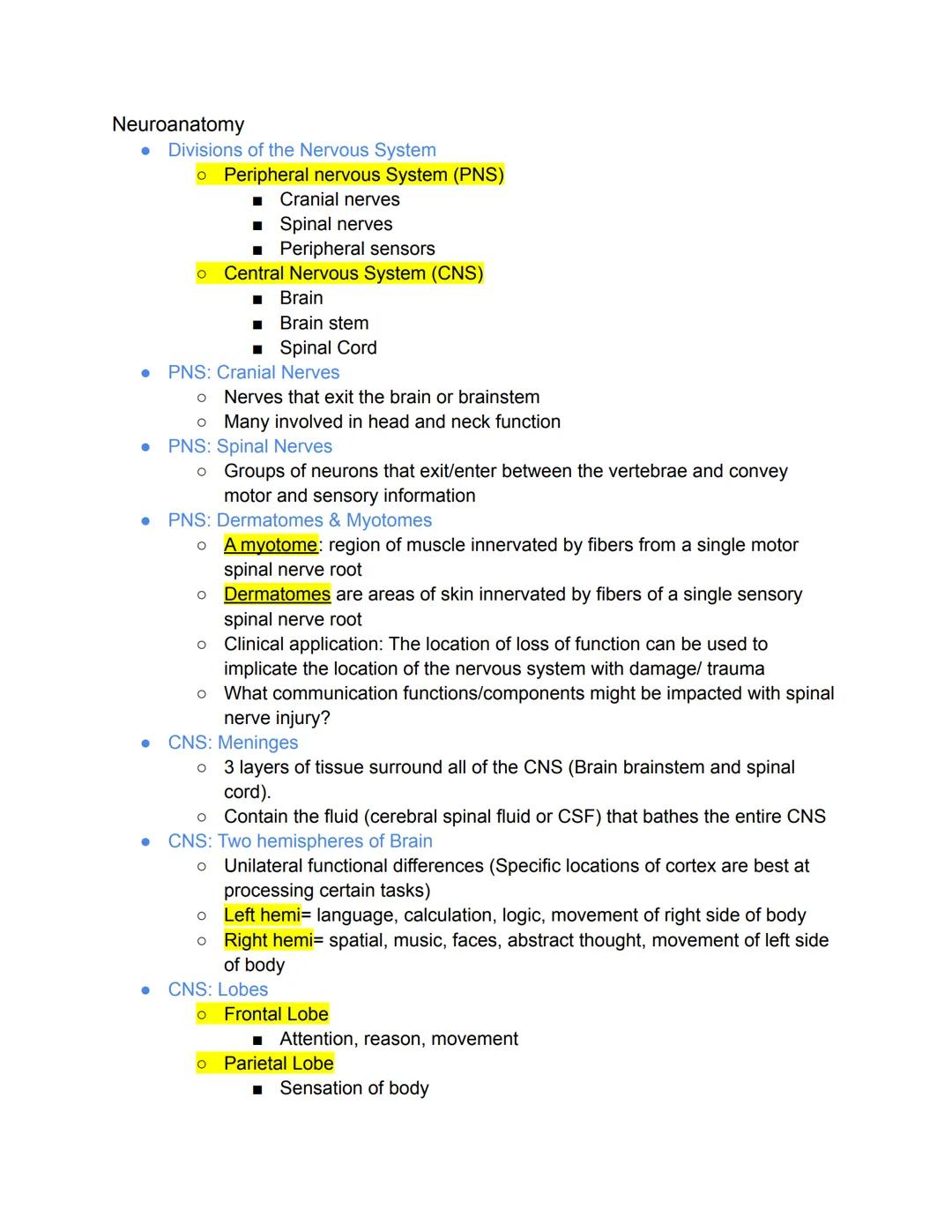
Nervous System Divisions and Structure
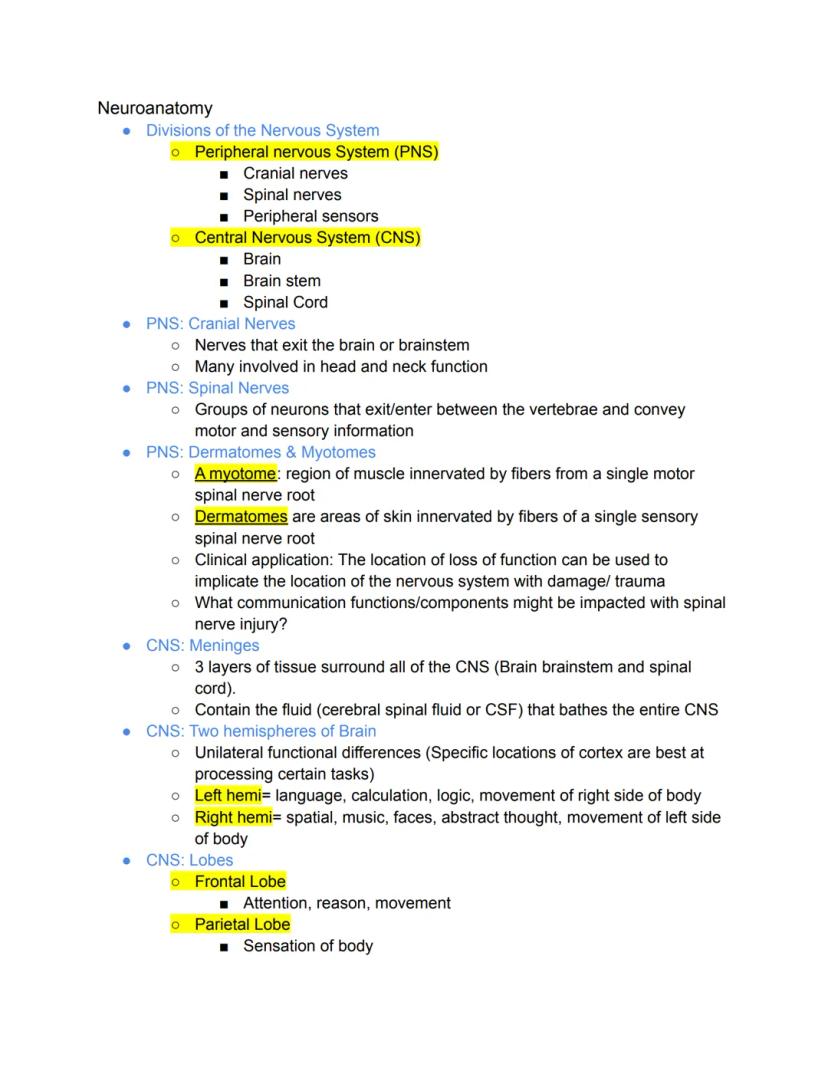
Your nervous system has two main parts that work together like a complex computer network. The Peripheral Nervous System (PNS) includes all nerves outside your brain and spinal cord—cranial nerves, spinal nerves, and peripheral sensors that collect information from your environment.
The Central Nervous System (CNS) is your body's command center, consisting of your brain, brain stem, and spinal cord. These structures process information and send out instructions to your body.
The PNS connects to specific body regions in organized patterns. Myotomes are muscle regions controlled by a single motor nerve root, while dermatomes are skin areas served by a single sensory nerve root. This organization helps doctors pinpoint injury locations when you lose sensation or movement in specific areas.
Did You Know? Your brain is protected by three layers of tissue called meninges that contain cerebrospinal fluid (CSF). This fluid acts like a cushion, protecting your brain from bumping against your skull when you move.
Your brain has two hemispheres with different specialties. The left side handles language, math, and logic, while the right side processes spatial relationships, music, and faces. Your brain is also divided into lobes: frontal (attention and movement), parietal (body sensations), occipital (vision), temporal (hearing), and limbic (emotions and impulse control).
2
of 3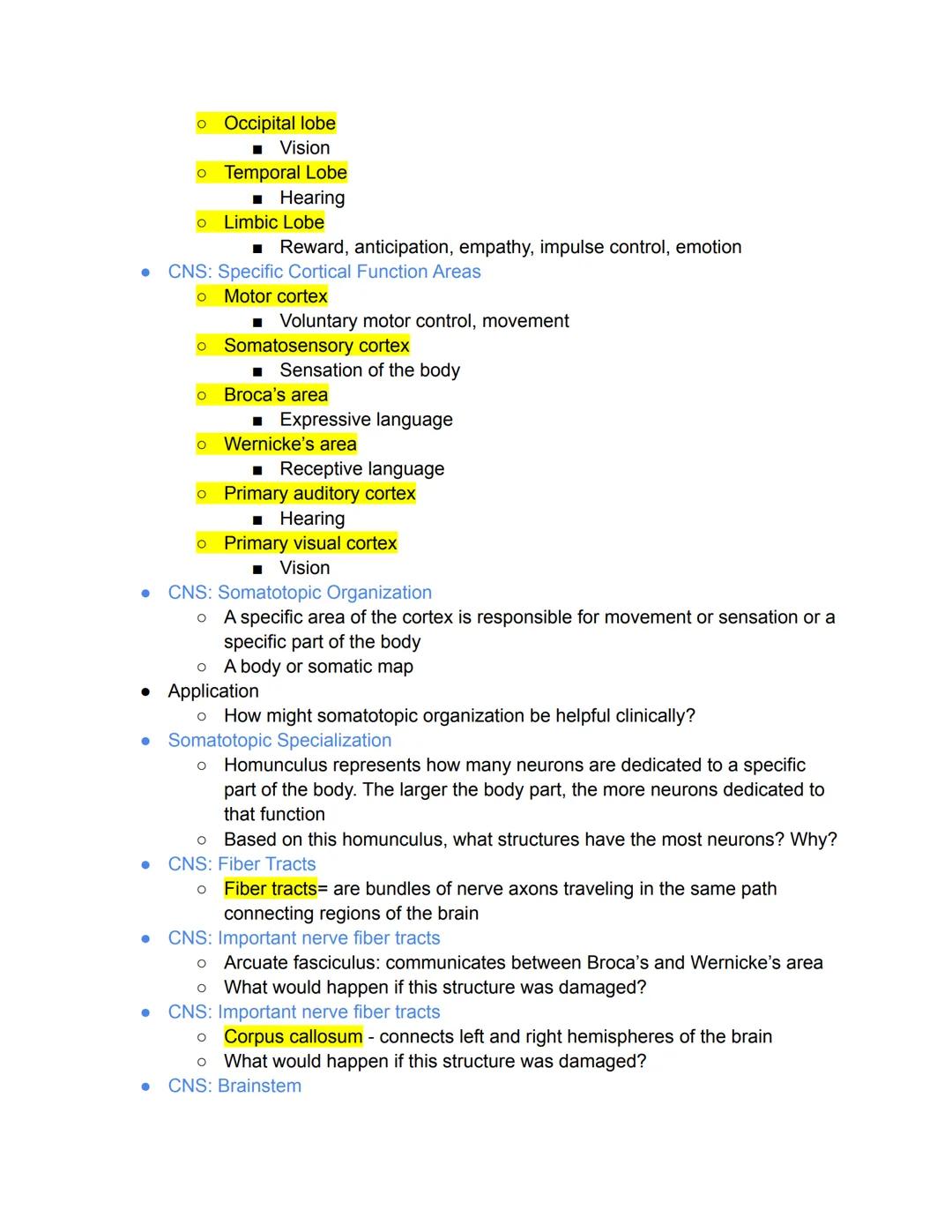
Brain Functions and Organization
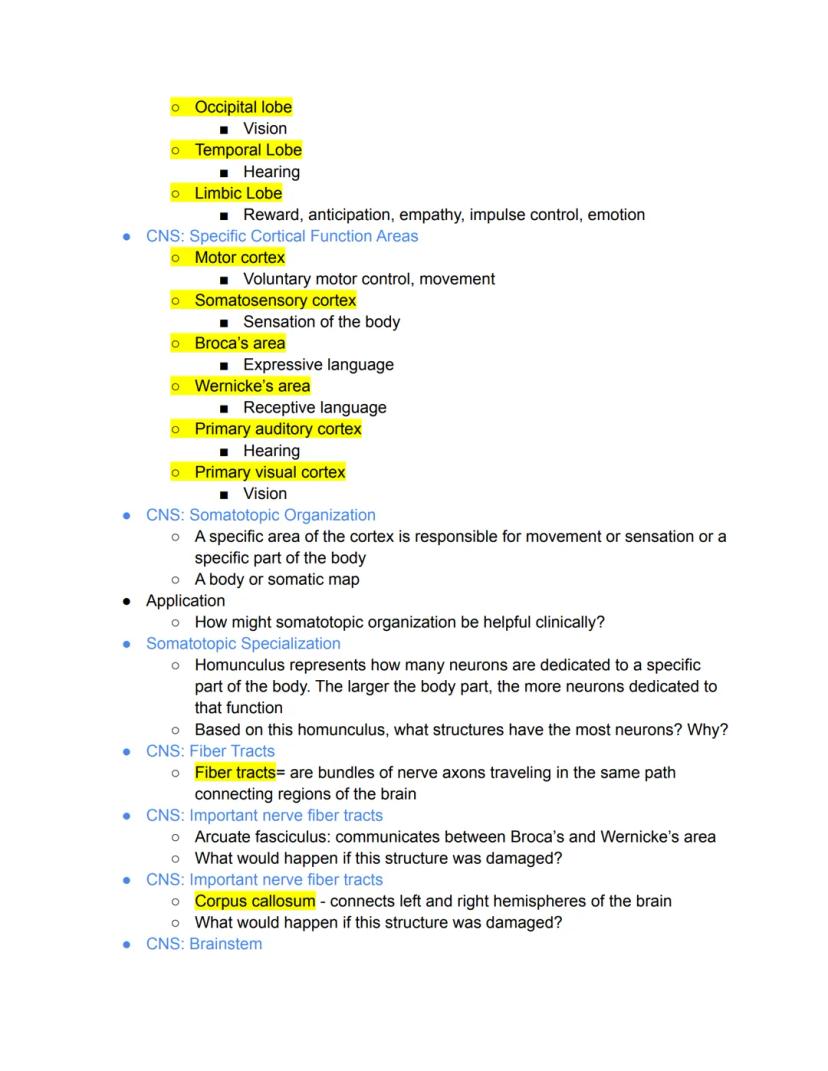
Your brain contains specialized regions for different functions, much like departments in a school. The motor cortex controls your voluntary movements, while the somatosensory cortex processes body sensations. Language is handled by Broca's area (speaking) and Wernicke's area (understanding).
The brain organizes body connections in a fascinating way called somatotopic organization. This means specific brain areas control specific body parts, creating a complete body map in your brain. Some parts get more brain real estate than others—your hands and face have huge representation compared to your back or legs!
This organization is depicted as a homunculus, a distorted human figure showing which body parts get the most brain attention. Your fingers, lips, and tongue have enormous representation because they need precise control and sensation for tasks like texting, eating, and speaking.
Think About It: If you had to design a robot with human-like abilities, which body parts would you give the most sensors and controllers to?
Important fiber tracts connect different brain regions. The arcuate fasciculus links language areas, while the massive corpus callosum connects your left and right hemispheres. Damage to these connections can seriously disrupt communication between brain regions without damaging the regions themselves.
3
of 3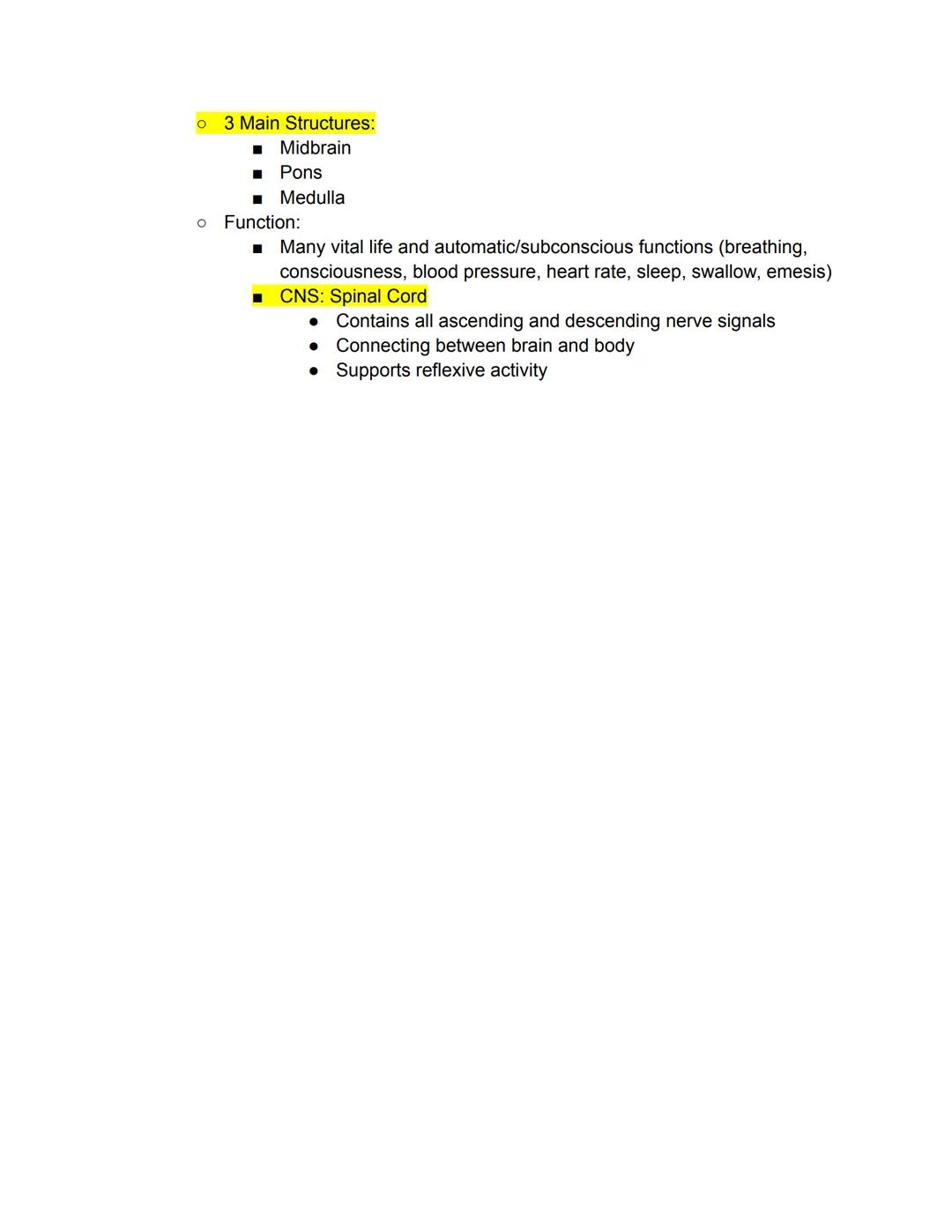
Brainstem and Spinal Cord
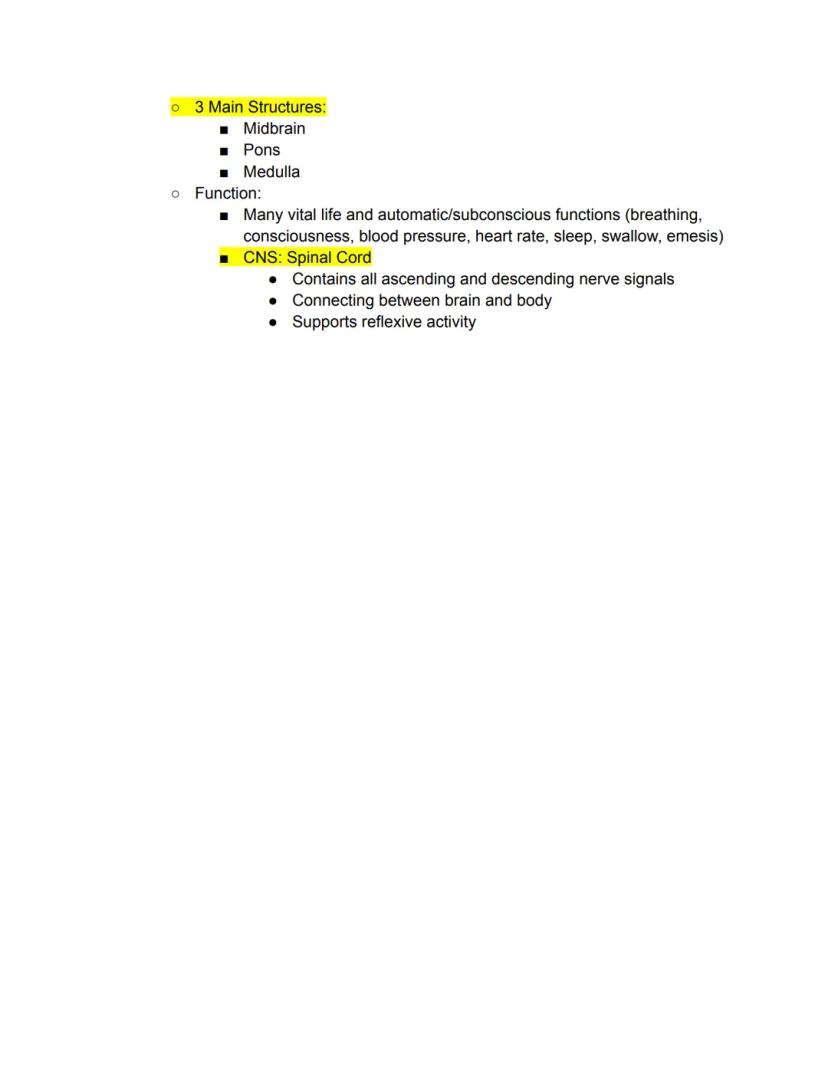
The brainstem consists of three main parts: midbrain, pons, and medulla. Think of it as your body's automatic pilot system. While you're busy thinking about your homework or friends, your brainstem quietly handles critical functions like breathing, heart rate, blood pressure, and sleep cycles.
These processes happen without conscious effort, which is good because you'd be exhausted if you had to remember to breathe or keep your heart beating! The brainstem also controls other automatic functions like swallowing and vomiting to protect your body.
The spinal cord is your body's information superhighway. All signals traveling between your brain and body must pass through this vital structure. It carries ascending signals (information going up to the brain) and descending signals (commands going down to the body).
Cool Connection: Your spinal cord can handle some simple responses on its own through reflexes. When you touch something hot, your hand pulls away before your brain even processes what happened!
We thought you’d never ask...
What is the Knowunity AI companion?
Our AI companion is specifically built for the needs of students. Based on the millions of content pieces we have on the platform we can provide truly meaningful and relevant answers to students. But its not only about answers, the companion is even more about guiding students through their daily learning challenges, with personalised study plans, quizzes or content pieces in the chat and 100% personalisation based on the students skills and developments.
Where can I download the Knowunity app?
You can download the app in the Google Play Store and in the Apple App Store.
Is Knowunity really free of charge?
That's right! Enjoy free access to study content, connect with fellow students, and get instant help – all at your fingertips.
Similar Content
 Health & Medicine
 Health & Social Care
Most popular content in Fun Stuff
9S
Fun StuffSuper Easy Quiz (+)
Are you smarter than a 3rd grader in math? Let’s see.
6th2120
Fun StuffAnatomy and Physiology Chapter 1
Chpater 1 : The orientation of the body / College Level Anatomy and Physiology
84538
Fun Stuff🌈 LGBTQ+ Pride Flags: Context & Symbolism
Use this Know as a quick reference to identify all of the different Pride flags and learn about their context & symbolism
9th36517
Fun StuffALL ABOUT PHILOSOPHY
This document tackles my impression towards "pilosopo" people, what does it mean to love wisdom, implication of face value, and the significance of impartiality.
582
Fun StuffSchool Law
Notes on school law chapter 8 intro to education
10th511
Fun StuffUnit 2 Lesson 2: Alphabet of Lines
An overview of the different types of lines used in drafting
422
Fun StuffPhilosophy of Education
Notes on chapter 6- philosophy of education for intro to EDUC
10th752
Fun StuffDMV Practice Test 1
First set of Questions from DMV Handbook
1,023128
Fun StuffIntro to Python Pt 1
This is a summary of the basics of python such as variables, print, and if statements.
10th2715
Most popular content
9O
 AP US History
Origins and Dynamics of the Columbian Exchange
Analyze the ecological and economic motivations behind the initial transfer of goods, people, and diseases between the Old and New Worlds.
9th3,1280
I
AP US HistoryIntroduction to Early Cultural Interactions
Analyze the initial social and religious encounters between Europeans, Africans, and Indigenous peoples in the colonial Americas.
9th2,7730
O
 AP World History
Origins of Ancient River Civilizations
Analyze the environmental factors and technological innovations that led to the rise of early states in Mesopotamia, Egypt, and the Indus Valley.
9th3,1870
M
AP US HistoryMotivations for European Exploration
Analyze the economic, religious, and political factors that drove European powers to the Americas during the 15th and 16th centuries.
9th1,7780
F
 AP Psychology
Foundations of Ethical Guidelines in Research
Practice the core principles of the APA ethical code including informed consent, debriefing, and the role of Institutional Review Boards.
9th1,3360
I
AP US HistoryIntroduction to Native American Societies
Examine the diverse social, political, and economic structures of North American indigenous groups prior to European contact.
9th1,1100
I
 AP Biology
Introduction to Biological Elements of Life
Practice identifying the essential elements including carbon, nitrogen, phosphorus, and sulfur that compose biological macromolecules.
9th1,7390
I
AP US HistoryIntroduction to the Spanish Encomienda System
Explore the fundamental economic and social structures of the Spanish colonial system, focusing on the encomienda and the casta social hierarchy.
9th8890
O
AP World HistoryOrigins and Continuity of the Byzantine Empire
Analyze the political and cultural transitions from the Roman Empire to the Byzantine Empire, focusing on the reign of Justinian I and his code.
9th1,6320
Can't find what you're looking for? Explore other subjects.
Students love us — and so will you.
4.6/5App Store
4.7/5Google Play
The app is very easy to use and well designed. I have found everything I was looking for so far and have been able to learn a lot from the presentations! I will definitely use the app for a class assignment! And of course it also helps a lot as an inspiration.
Stefan SiOS user
This app is really great. There are so many study notes and help [...]. My problem subject is French, for example, and the app has so many options for help. Thanks to this app, I have improved my French. I would recommend it to anyone.
Samantha KlichAndroid user
Wow, I am really amazed. I just tried the app because I've seen it advertised many times and was absolutely stunned. This app is THE HELP you want for school and above all, it offers so many things, such as workouts and fact sheets, which have been VERY helpful to me personally.
AnnaiOS user
Fun Stuff83 views·Updated Jun 18, 2026·3 pagesUnderstanding Neuroanatomy in Human Communication
The nervous system is a complex network that controls everything we do, from breathing to thinking. It's divided into two main parts: the Central Nervous System (CNS) and the Peripheral Nervous System (PNS). Understanding how these parts work together helps...
1
of 3
Sign up to see the content. It's free!
- Access to all documents
- Improve your grades
- Join milions of students
Nervous System Divisions and Structure
Your nervous system has two main parts that work together like a complex computer network. The Peripheral Nervous System (PNS) includes all nerves outside your brain and spinal cord—cranial nerves, spinal nerves, and peripheral sensors that collect information from your environment.
The Central Nervous System (CNS) is your body's command center, consisting of your brain, brain stem, and spinal cord. These structures process information and send out instructions to your body.
The PNS connects to specific body regions in organized patterns. Myotomes are muscle regions controlled by a single motor nerve root, while dermatomes are skin areas served by a single sensory nerve root. This organization helps doctors pinpoint injury locations when you lose sensation or movement in specific areas.
Did You Know? Your brain is protected by three layers of tissue called meninges that contain cerebrospinal fluid (CSF). This fluid acts like a cushion, protecting your brain from bumping against your skull when you move.
Your brain has two hemispheres with different specialties. The left side handles language, math, and logic, while the right side processes spatial relationships, music, and faces. Your brain is also divided into lobes: frontal (attention and movement), parietal (body sensations), occipital (vision), temporal (hearing), and limbic (emotions and impulse control).
2
of 3Sign up to see the content. It's free!
- Access to all documents
- Improve your grades
- Join milions of students
Brain Functions and Organization
Your brain contains specialized regions for different functions, much like departments in a school. The motor cortex controls your voluntary movements, while the somatosensory cortex processes body sensations. Language is handled by Broca's area (speaking) and Wernicke's area (understanding).
The brain organizes body connections in a fascinating way called somatotopic organization. This means specific brain areas control specific body parts, creating a complete body map in your brain. Some parts get more brain real estate than others—your hands and face have huge representation compared to your back or legs!
This organization is depicted as a homunculus, a distorted human figure showing which body parts get the most brain attention. Your fingers, lips, and tongue have enormous representation because they need precise control and sensation for tasks like texting, eating, and speaking.
Think About It: If you had to design a robot with human-like abilities, which body parts would you give the most sensors and controllers to?
Important fiber tracts connect different brain regions. The arcuate fasciculus links language areas, while the massive corpus callosum connects your left and right hemispheres. Damage to these connections can seriously disrupt communication between brain regions without damaging the regions themselves.
3
of 3Sign up to see the content. It's free!
- Access to all documents
- Improve your grades
- Join milions of students
Brainstem and Spinal Cord
The brainstem consists of three main parts: midbrain, pons, and medulla. Think of it as your body's automatic pilot system. While you're busy thinking about your homework or friends, your brainstem quietly handles critical functions like breathing, heart rate, blood pressure, and sleep cycles.
These processes happen without conscious effort, which is good because you'd be exhausted if you had to remember to breathe or keep your heart beating! The brainstem also controls other automatic functions like swallowing and vomiting to protect your body.
The spinal cord is your body's information superhighway. All signals traveling between your brain and body must pass through this vital structure. It carries ascending signals (information going up to the brain) and descending signals (commands going down to the body).
Cool Connection: Your spinal cord can handle some simple responses on its own through reflexes. When you touch something hot, your hand pulls away before your brain even processes what happened!
We thought you’d never ask...
What is the Knowunity AI companion?
Our AI companion is specifically built for the needs of students. Based on the millions of content pieces we have on the platform we can provide truly meaningful and relevant answers to students. But its not only about answers, the companion is even more about guiding students through their daily learning challenges, with personalised study plans, quizzes or content pieces in the chat and 100% personalisation based on the students skills and developments.
Where can I download the Knowunity app?
You can download the app in the Google Play Store and in the Apple App Store.
Is Knowunity really free of charge?
That's right! Enjoy free access to study content, connect with fellow students, and get instant help – all at your fingertips.
Similar Content
Most popular content in Fun Stuff
9S
Fun StuffSuper Easy Quiz (+)
Are you smarter than a 3rd grader in math? Let’s see.
6th2120
Fun StuffAnatomy and Physiology Chapter 1
Chpater 1 : The orientation of the body / College Level Anatomy and Physiology
84538
Fun Stuff🌈 LGBTQ+ Pride Flags: Context & Symbolism
Use this Know as a quick reference to identify all of the different Pride flags and learn about their context & symbolism
9th36517
Fun StuffALL ABOUT PHILOSOPHY
This document tackles my impression towards "pilosopo" people, what does it mean to love wisdom, implication of face value, and the significance of impartiality.
582
Fun StuffSchool Law
Notes on school law chapter 8 intro to education
10th511
Fun StuffUnit 2 Lesson 2: Alphabet of Lines
An overview of the different types of lines used in drafting
422
Fun StuffPhilosophy of Education
Notes on chapter 6- philosophy of education for intro to EDUC
10th752
Fun StuffDMV Practice Test 1
First set of Questions from DMV Handbook
1,023128
Fun StuffIntro to Python Pt 1
This is a summary of the basics of python such as variables, print, and if statements.
10th2715
Most popular content
9O
AP US HistoryOrigins and Dynamics of the Columbian Exchange
Analyze the ecological and economic motivations behind the initial transfer of goods, people, and diseases between the Old and New Worlds.
9th3,1280
I
AP US HistoryIntroduction to Early Cultural Interactions
Analyze the initial social and religious encounters between Europeans, Africans, and Indigenous peoples in the colonial Americas.
9th2,7730
O
AP World HistoryOrigins of Ancient River Civilizations
Analyze the environmental factors and technological innovations that led to the rise of early states in Mesopotamia, Egypt, and the Indus Valley.
9th3,1870
M
AP US HistoryMotivations for European Exploration
Analyze the economic, religious, and political factors that drove European powers to the Americas during the 15th and 16th centuries.
9th1,7780
F
AP PsychologyFoundations of Ethical Guidelines in Research
Practice the core principles of the APA ethical code including informed consent, debriefing, and the role of Institutional Review Boards.
9th1,3360
I
AP US HistoryIntroduction to Native American Societies
Examine the diverse social, political, and economic structures of North American indigenous groups prior to European contact.
9th1,1100
I
AP BiologyIntroduction to Biological Elements of Life
Practice identifying the essential elements including carbon, nitrogen, phosphorus, and sulfur that compose biological macromolecules.
9th1,7390
I
AP US HistoryIntroduction to the Spanish Encomienda System
Explore the fundamental economic and social structures of the Spanish colonial system, focusing on the encomienda and the casta social hierarchy.
9th8890
O
AP World HistoryOrigins and Continuity of the Byzantine Empire
Analyze the political and cultural transitions from the Roman Empire to the Byzantine Empire, focusing on the reign of Justinian I and his code.
9th1,6320
Can't find what you're looking for? Explore other subjects.
Students love us — and so will you.
4.6/5App Store
4.7/5Google Play
The app is very easy to use and well designed. I have found everything I was looking for so far and have been able to learn a lot from the presentations! I will definitely use the app for a class assignment! And of course it also helps a lot as an inspiration.
Stefan SiOS user
This app is really great. There are so many study notes and help [...]. My problem subject is French, for example, and the app has so many options for help. Thanks to this app, I have improved my French. I would recommend it to anyone.
Samantha KlichAndroid user
Wow, I am really amazed. I just tried the app because I've seen it advertised many times and was absolutely stunned. This app is THE HELP you want for school and above all, it offers so many things, such as workouts and fact sheets, which have been VERY helpful to me personally.
AnnaiOS user