
¿Alguna vez te has preguntado cómo se organizan los electrones...
 Física i Química316 views·Updated Jun 18, 2026·2 pages
Guía Completa para la Configuración Electrónica

Inés Para estudiar@inesquiereaprobar._.
1
of 2
Configuración Electrónica y el Diagrama de Möeller
El diagrama de Möeller es tu mejor aliado para escribir configuraciones electrónicas sin complicarte la vida. Funciona como una escalera diagonal que sigues desde arriba hacia abajo: 1s² → 2s² → 2p⁶ → 3s² → 3p⁶ → 4s² → 3d¹⁰...
Para cualquier elemento, solo necesitas su número atómico (Z) y seguir las diagonales sumando los exponentes hasta llegar a ese número. Por ejemplo, el carbono : 1s² 2s² 2p². ¡Súper fácil!
La tabla periódica cobra sentido cuando entiendes que tiene 7 periodos (filas) y 18 grupos (columnas). El grupo de un elemento lo determina su terminación electrónica: s¹ son alcalinos, p⁶ son gases nobles, d son metales de transición.
💡 Truco clave: El periodo siempre es el número más alto que aparece en la configuración electrónica. Para el ejemplo Z=36, como aparece el 4, está en el periodo 4.
2
of 2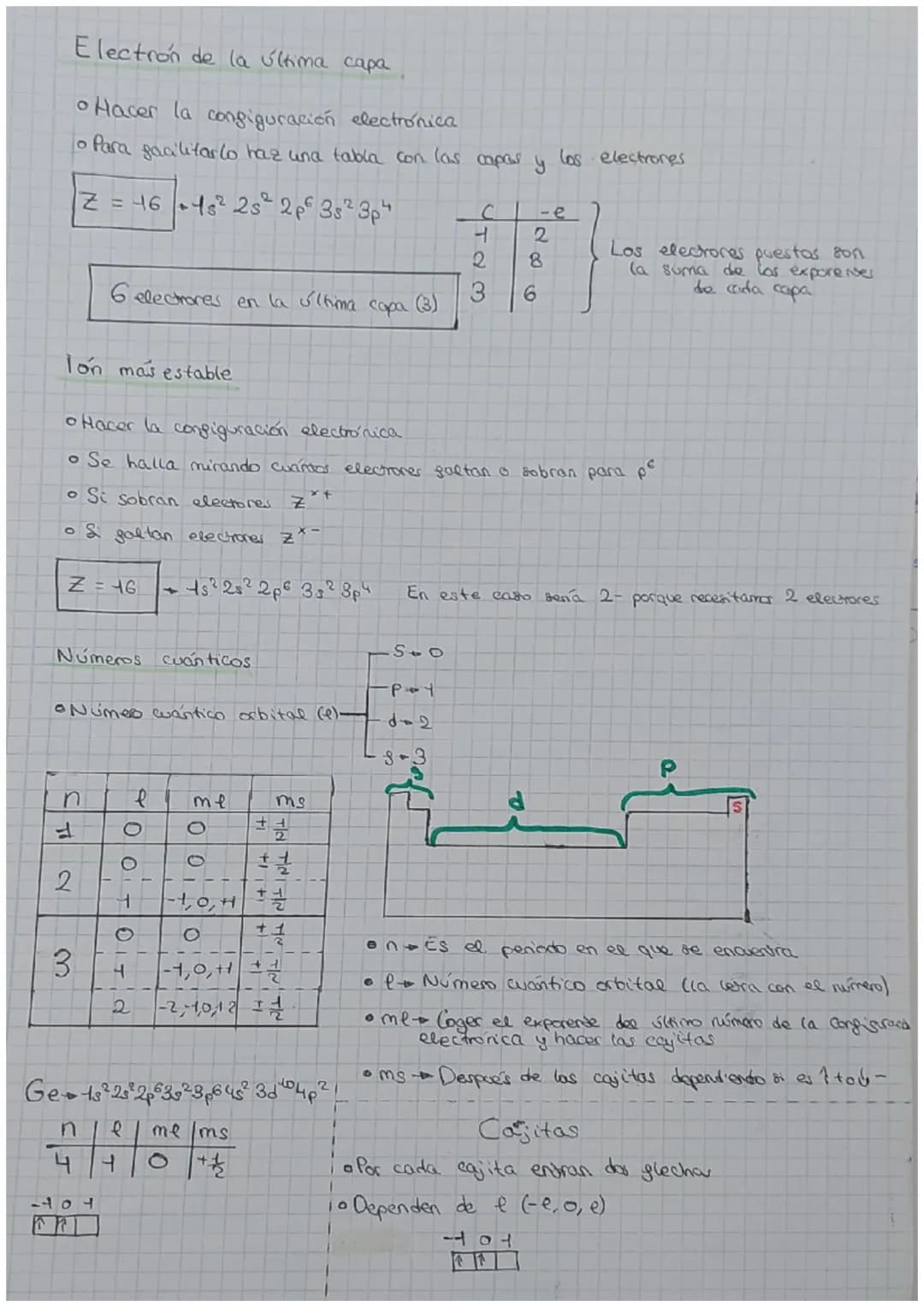
Electrones de Valencia, Iones y Números Cuánticos
Los electrones de la última capa (valencia) determinan cómo se comporta un elemento químicamente. Haz una tabla con las capas 1, 2, 3... y cuenta cuántos electrones hay en la más externa. Es así de simple.
Para encontrar el ion más estable, mira cuántos electrones faltan o sobran para completar la capa. Si faltan electrones, el ion será negativo (anión). Si sobran, será positivo (catión). El azufre necesita 2 electrones más, así que forma S²⁻.
Los números cuánticos describen cada electrón individualmente usando cuatro valores: n (periodo), ℓ , mℓ (orientación) y ms . Para el último electrón, usa "cajitas" donde cada una puede tener máximo 2 electrones con spins opuestos.
🎯 Dato útil: Los orbitales p tienen 3 cajitas, los d tienen 5 cajitas, y los f tienen 7 cajitas. Siempre llena primero con un electrón por cajita antes de emparejar.
We thought you’d never ask...
What is the Knowunity AI companion?
Our AI companion is specifically built for the needs of students. Based on the millions of content pieces we have on the platform we can provide truly meaningful and relevant answers to students. But its not only about answers, the companion is even more about guiding students through their daily learning challenges, with personalised study plans, quizzes or content pieces in the chat and 100% personalisation based on the students skills and developments.
Where can I download the Knowunity app?
You can download the app in the Google Play Store and in the Apple App Store.
Is Knowunity really free of charge?
That's right! Enjoy free access to study content, connect with fellow students, and get instant help – all at your fingertips.
Similar Content
 Química
Most popular content: niveles de energía
9Física y QuímicaResumen números cuánticos
Números cuánticos
1° Bach1,17024
Física y QuímicaFormulación
Formulación química
3° ESO5595
Física y QuímicaCONFIGURACIÓN ELECTRÓNICA
Apuntes de la configuración electrónica de física y química.
4° ESO1,05026
Física y QuímicaQuímica inorgánica
Estudia todos los tipos de compuestos dentro de la química inorgánica, cómo se nombran, las valencias, etc.
1° Bach4274
Física y QuímicaLa estructura del átomo
Esquema del tema estructura del átomo para selectividad (temario 1º Bachillerato)
1° Bach66624
Física i QuímicaSÍMBOLOS Y VALENCIAS
Valencias
3° ESO79917
Física i QuímicaRADIO ATÓMICO, EI, AE, ELECTRONEGATIVIDAD…
Radio atómico, ionico, especies isoelectronicas…
4° ESO56214
Física i QuímicaNÚMEROS CUÁNTICOS
Teoría y ejercicio
1° Bach1,01615
Física y QuímicaEstructura atómica y tabla periódica
Resúmenes
1° Bach3306
Most popular content in Física i Química
9Física i QuímicaFormulario Dinámica y Cinemática
Aquí un esquema de todas las formulas, válido sobre todo para bachillerato y 4ESO. También incluyo un ejercicio de dinámica resuelto bastante completo
1° Bach5,256129
Física i QuímicaResumen Dinamica fisica 1 bach
Resumen Dinamica fisica 1 bachillerato
1° Bach8,365304
Física i QuímicaDINÁMICA
teoría + ejercicios resueltos
1° Bach1,26422
T
Física i QuímicaTabla periódica
Aprende sobre la tabla periódica.
2° ESO7001
Física i QuímicaCinemática y dinámica
- Magnitudes del movimiento, MRU, MRUA, Caída libre/tiro vertical
4° ESO4,521170
Física i QuímicaMcu y mcua
Movimiento circular uniforme y movimiento circular uniforme acelerado
4° ESO1,17725
Física i Químicafuerzas
apuntes sobre fuerzas
4° ESO3,884127
Física i QuímicaMRU Y MRUA
movimiento rectilíneo uniforme y movimiento rectilíneo uniformemente acelerado
4° ESO1,38226
F
Física i QuímicaFuerzas
física y química
2° ESO6290
Most popular content
9I
 Inglés
irregular verbs quiz
Domina el idioma inglés de manera sencilla y divertida con estos flashcards diseñados especialmente para estudiantes de sexto grado.
6º primaria2,8981
R
 Geografía e Historia
roma
a estudiar Roma!!
1° ESO2,3122
G
Geografía e HistoriaGrecia: Inicio de la democracia
Más o menos las preguntas que me pusieron a mí en el examen
1° ESO2,3622
D
InglésDominando la gramática inglesa: Flashcards desafiantes
Mejora tus habilidades gramaticales en inglés con estos flashcards desafiantes diseñados para estudiantes de grado 11. ¡Prepárate para dominar la gramática inglesa de manera divertida y efectiva!
3° ESO2,2480
M
Geografía e HistoriaMesopotamia y Egipto
Contenidos sobre la civilización mesopotámica y egipcia
1° ESO3,9381
O
 Lengua Castellana y Literatura
OBRAS Y AUTORES II
Quiz donde tendrás que relacionar las siguientes obras con sus respectivos autores: edición Romanticismo.
4° ESO3,3610
I
InglésIngles para repasar
quiz de ingles para entrar a clase preparados
2° ESO2,6290
F
 Filosofía
filosofía
repaso filosofía "el arje , la metafísica y la crítica de Nietszche a platon"
1° Bach2,8421
I
InglésIrregular verbs
Aprende nuevas palabras y expande tu vocabulario en inglés con esta colección de tarjetas de estudio interactivas.
3° ESO1,7442
Can't find what you're looking for? Explore other subjects.
Students love us — and so will you.
4.6/5App Store
4.7/5Google Play
The app is very easy to use and well designed. I have found everything I was looking for so far and have been able to learn a lot from the presentations! I will definitely use the app for a class assignment! And of course it also helps a lot as an inspiration.
Stefan SiOS user
This app is really great. There are so many study notes and help [...]. My problem subject is French, for example, and the app has so many options for help. Thanks to this app, I have improved my French. I would recommend it to anyone.
Samantha KlichAndroid user
Wow, I am really amazed. I just tried the app because I've seen it advertised many times and was absolutely stunned. This app is THE HELP you want for school and above all, it offers so many things, such as workouts and fact sheets, which have been VERY helpful to me personally.
AnnaiOS user
Física i Química316 views·Updated Jun 18, 2026·2 pagesGuía Completa para la Configuración Electrónica
Inés Para estudiar@inesquiereaprobar._.
¿Alguna vez te has preguntado cómo se organizan los electrones en los átomos? La configuración electrónica es como el "mapa del tesoro" que nos dice exactamente dónde están todos los electrones de cualquier elemento. Con el diagrama de Möeller y...
1
of 2
Sign up to see the content. It's free!
- Access to all documents
- Improve your grades
- Join milions of students
Configuración Electrónica y el Diagrama de Möeller
El diagrama de Möeller es tu mejor aliado para escribir configuraciones electrónicas sin complicarte la vida. Funciona como una escalera diagonal que sigues desde arriba hacia abajo: 1s² → 2s² → 2p⁶ → 3s² → 3p⁶ → 4s² → 3d¹⁰...
Para cualquier elemento, solo necesitas su número atómico (Z) y seguir las diagonales sumando los exponentes hasta llegar a ese número. Por ejemplo, el carbono : 1s² 2s² 2p². ¡Súper fácil!
La tabla periódica cobra sentido cuando entiendes que tiene 7 periodos (filas) y 18 grupos (columnas). El grupo de un elemento lo determina su terminación electrónica: s¹ son alcalinos, p⁶ son gases nobles, d son metales de transición.
💡 Truco clave: El periodo siempre es el número más alto que aparece en la configuración electrónica. Para el ejemplo Z=36, como aparece el 4, está en el periodo 4.
2
of 2Sign up to see the content. It's free!
- Access to all documents
- Improve your grades
- Join milions of students
Electrones de Valencia, Iones y Números Cuánticos
Los electrones de la última capa (valencia) determinan cómo se comporta un elemento químicamente. Haz una tabla con las capas 1, 2, 3... y cuenta cuántos electrones hay en la más externa. Es así de simple.
Para encontrar el ion más estable, mira cuántos electrones faltan o sobran para completar la capa. Si faltan electrones, el ion será negativo (anión). Si sobran, será positivo (catión). El azufre necesita 2 electrones más, así que forma S²⁻.
Los números cuánticos describen cada electrón individualmente usando cuatro valores: n (periodo), ℓ , mℓ (orientación) y ms . Para el último electrón, usa "cajitas" donde cada una puede tener máximo 2 electrones con spins opuestos.
🎯 Dato útil: Los orbitales p tienen 3 cajitas, los d tienen 5 cajitas, y los f tienen 7 cajitas. Siempre llena primero con un electrón por cajita antes de emparejar.
We thought you’d never ask...
What is the Knowunity AI companion?
Our AI companion is specifically built for the needs of students. Based on the millions of content pieces we have on the platform we can provide truly meaningful and relevant answers to students. But its not only about answers, the companion is even more about guiding students through their daily learning challenges, with personalised study plans, quizzes or content pieces in the chat and 100% personalisation based on the students skills and developments.
Where can I download the Knowunity app?
You can download the app in the Google Play Store and in the Apple App Store.
Is Knowunity really free of charge?
That's right! Enjoy free access to study content, connect with fellow students, and get instant help – all at your fingertips.
Similar Content
Most popular content: niveles de energía
9Física y QuímicaResumen números cuánticos
Números cuánticos
1° Bach1,17024
Física y QuímicaFormulación
Formulación química
3° ESO5595
Física y QuímicaCONFIGURACIÓN ELECTRÓNICA
Apuntes de la configuración electrónica de física y química.
4° ESO1,05026
Física y QuímicaQuímica inorgánica
Estudia todos los tipos de compuestos dentro de la química inorgánica, cómo se nombran, las valencias, etc.
1° Bach4274
Física y QuímicaLa estructura del átomo
Esquema del tema estructura del átomo para selectividad (temario 1º Bachillerato)
1° Bach66624
Física i QuímicaSÍMBOLOS Y VALENCIAS
Valencias
3° ESO79917
Física i QuímicaRADIO ATÓMICO, EI, AE, ELECTRONEGATIVIDAD…
Radio atómico, ionico, especies isoelectronicas…
4° ESO56214
Física i QuímicaNÚMEROS CUÁNTICOS
Teoría y ejercicio
1° Bach1,01615
Física y QuímicaEstructura atómica y tabla periódica
Resúmenes
1° Bach3306
Most popular content in Física i Química
9Física i QuímicaFormulario Dinámica y Cinemática
Aquí un esquema de todas las formulas, válido sobre todo para bachillerato y 4ESO. También incluyo un ejercicio de dinámica resuelto bastante completo
1° Bach5,256129
Física i QuímicaResumen Dinamica fisica 1 bach
Resumen Dinamica fisica 1 bachillerato
1° Bach8,365304
Física i QuímicaDINÁMICA
teoría + ejercicios resueltos
1° Bach1,26422
T
Física i QuímicaTabla periódica
Aprende sobre la tabla periódica.
2° ESO7001
Física i QuímicaCinemática y dinámica
- Magnitudes del movimiento, MRU, MRUA, Caída libre/tiro vertical
4° ESO4,521170
Física i QuímicaMcu y mcua
Movimiento circular uniforme y movimiento circular uniforme acelerado
4° ESO1,17725
Física i Químicafuerzas
apuntes sobre fuerzas
4° ESO3,884127
Física i QuímicaMRU Y MRUA
movimiento rectilíneo uniforme y movimiento rectilíneo uniformemente acelerado
4° ESO1,38226
F
Física i QuímicaFuerzas
física y química
2° ESO6290
Most popular content
9I
Inglésirregular verbs quiz
Domina el idioma inglés de manera sencilla y divertida con estos flashcards diseñados especialmente para estudiantes de sexto grado.
6º primaria2,8981
R
Geografía e Historiaroma
a estudiar Roma!!
1° ESO2,3122
G
Geografía e HistoriaGrecia: Inicio de la democracia
Más o menos las preguntas que me pusieron a mí en el examen
1° ESO2,3622
D
InglésDominando la gramática inglesa: Flashcards desafiantes
Mejora tus habilidades gramaticales en inglés con estos flashcards desafiantes diseñados para estudiantes de grado 11. ¡Prepárate para dominar la gramática inglesa de manera divertida y efectiva!
3° ESO2,2480
M
Geografía e HistoriaMesopotamia y Egipto
Contenidos sobre la civilización mesopotámica y egipcia
1° ESO3,9381
O
Lengua Castellana y LiteraturaOBRAS Y AUTORES II
Quiz donde tendrás que relacionar las siguientes obras con sus respectivos autores: edición Romanticismo.
4° ESO3,3610
I
InglésIngles para repasar
quiz de ingles para entrar a clase preparados
2° ESO2,6290
F
Filosofíafilosofía
repaso filosofía "el arje , la metafísica y la crítica de Nietszche a platon"
1° Bach2,8421
I
InglésIrregular verbs
Aprende nuevas palabras y expande tu vocabulario en inglés con esta colección de tarjetas de estudio interactivas.
3° ESO1,7442
Can't find what you're looking for? Explore other subjects.
Students love us — and so will you.
4.6/5App Store
4.7/5Google Play
The app is very easy to use and well designed. I have found everything I was looking for so far and have been able to learn a lot from the presentations! I will definitely use the app for a class assignment! And of course it also helps a lot as an inspiration.
Stefan SiOS user
This app is really great. There are so many study notes and help [...]. My problem subject is French, for example, and the app has so many options for help. Thanks to this app, I have improved my French. I would recommend it to anyone.
Samantha KlichAndroid user
Wow, I am really amazed. I just tried the app because I've seen it advertised many times and was absolutely stunned. This app is THE HELP you want for school and above all, it offers so many things, such as workouts and fact sheets, which have been VERY helpful to me personally.
AnnaiOS user