
¿Te has preguntado cómo funciona realmente la electricidad en tu...
 Física246 views·Updated Jun 20, 2026·3 pages
Entendiendo la Ley de Ohm y Circuitos Eléctricos
N
Niko Velandia@nikovel17

1 / 3
1
of 3
Ley de Ohm y Circuitos en Serie
La Ley de Ohm es tu mejor amiga en física: V = IR. Esto significa que el voltaje es igual a la corriente multiplicada por la resistencia. Es como una receta que siempre funciona.
En los circuitos en serie, imagínate una fila de personas tomadas de la mano. La corriente es igual en todo el circuito (como si fuera la misma energía pasando por cada persona), pero el voltaje se reparte entre las resistencias.
Para encontrar la resistencia equivalente en serie, solo sumas todas las resistencias: Re = R₁ + R₂ + R₃. En el ejemplo con resistencias de 2Ω, 4Ω y 6Ω, obtienes 12Ω total.
💡 Tip clave: En serie, la corriente es constante pero el voltaje se divide. ¡Piensa en una cadena donde la fuerza es la misma en cada eslabón!
Con 24V y resistencia total de 12Ω, la corriente será I = 24V ÷ 12Ω = 2 Amp en todo el circuito.
2
of 3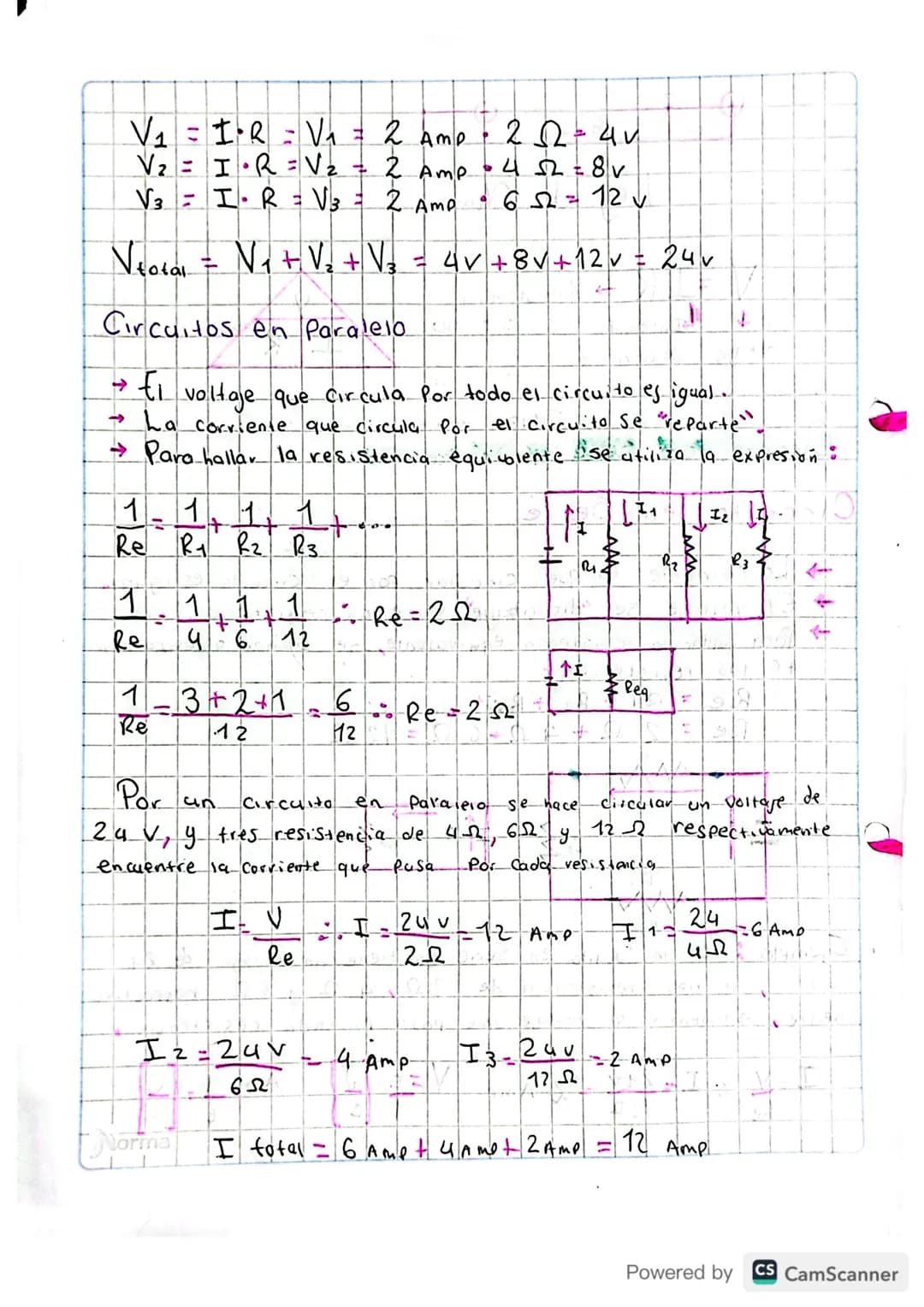
Cálculos en Serie y Circuitos en Paralelo
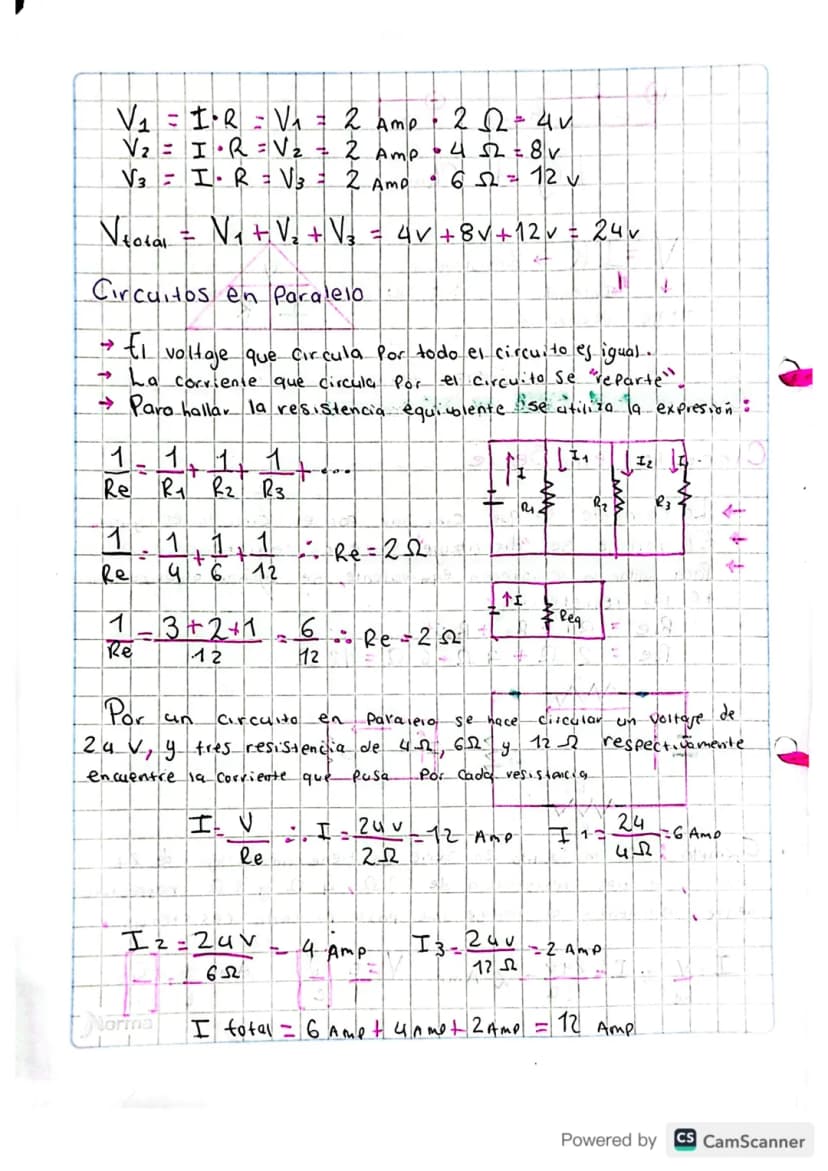
Para calcular el voltaje en cada resistencia del ejemplo anterior, multiplicas la corriente por cada resistencia: V₁ = 2A × 2Ω = 4V, V₂ = 8V, V₃ = 12V. La suma siempre debe dar el voltaje total (24V).
Los circuitos en paralelo son completamente diferentes. Aquí el voltaje es igual en todas las ramas (como varios caminos que salen del mismo punto), pero la corriente se reparte.
La fórmula para resistencia equivalente en paralelo es: 1/Re = 1/R₁ + 1/R₂ + 1/R₃. Con resistencias de 4Ω, 6Ω y 12Ω, obtienes Re = 2Ω.
💡 Recuerda: En paralelo, el voltaje es constante pero la corriente se divide entre las ramas. ¡Como un río que se separa en varios arroyos!
En el ejemplo con 24V, cada resistencia recibe los mismos 24V, pero las corrientes son diferentes: I₁ = 6A, I₂ = 4A, I₃ = 2A, sumando 12A total.
3
of 3
Ejercicios Prácticos Resueltos
Estos ejercicios de aplicación te muestran exactamente cómo usar las fórmulas en situaciones reales. ¡Dominarlos es clave para tus exámenes!
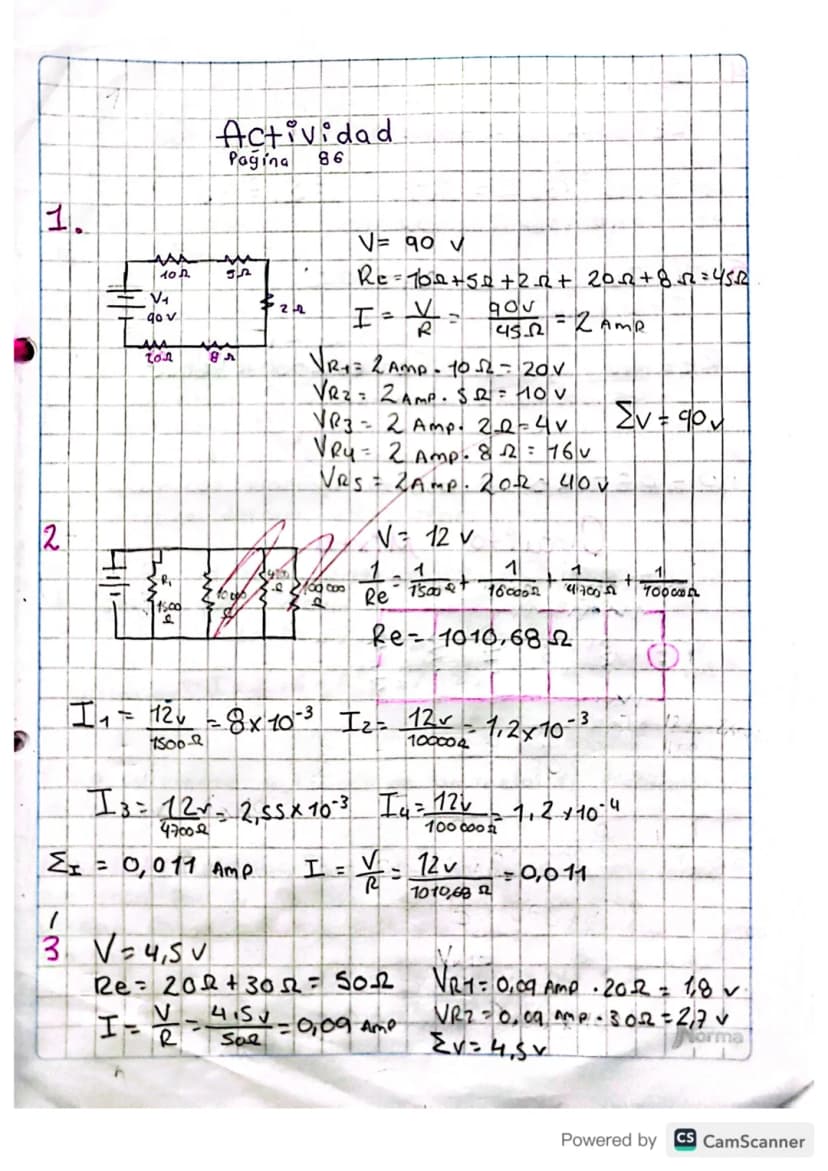
Ejercicio 1 (serie): Con 90V y resistencias que suman 45Ω, la corriente es 2A. Cada resistencia recibe diferente voltaje según su valor: 20V, 10V, 4V, 16V y 40V respectivamente.
Ejercicio 2 (paralelo): Con 12V y cuatro resistencias en paralelo, cada una recibe los mismos 12V pero conduce diferente corriente. Las corrientes individuales se calculan dividiendo 12V entre cada resistencia.
💡 Estrategia ganadora: Siempre verifica tus respuestas sumando los voltajes (en serie) o las corrientes (en paralelo). ¡Deben dar el valor total!
Ejercicio 3 (serie simple): Con 4.5V y dos resistencias (20Ω + 30Ω = 50Ω), la corriente es 0.09A. Los voltajes son 1.8V y 2.7V respectivamente.
We thought you’d never ask...
What is the Knowunity AI companion?
Our AI companion is specifically built for the needs of students. Based on the millions of content pieces we have on the platform we can provide truly meaningful and relevant answers to students. But its not only about answers, the companion is even more about guiding students through their daily learning challenges, with personalised study plans, quizzes or content pieces in the chat and 100% personalisation based on the students skills and developments.
Where can I download the Knowunity app?
You can download the app in the Google Play Store and in the Apple App Store.
Is Knowunity really free of charge?
That's right! Enjoy free access to study content, connect with fellow students, and get instant help – all at your fingertips.
Similar Content
Most popular content: Ohm's Law
1Most popular content in Física
9FísicaConversión de unidades
Conversión de unidades
91,16614
C
FísicaClasificación de Magnitudes Físicas
Conceptos clave sobre magnitudes escalares y vectoriales con ejemplos.
101030
F
FísicaFundamentos de las Ondas: Partes Clave
Conceptos esenciales sobre las partes de una onda, incluyendo amplitud, frecuencia, longitud y periodo.
10510
L
FísicaLeyes de Newton
Primera, segunda y tercera ley de Newton
92011
FísicaOndas
Concepto de ondas Clasificación de ondas Partes de la onda Propiedades de las ondas
113065
C
FísicaConceptos Fundamentales de Ondas
Explora las definiciones clave de periodo, frecuencia, longitud de onda, amplitud y rapidez de una onda.
10270
 Química
Ley de Coulomb
Que es la ley de Coulomb, para que sirve, valor, función, formula, ejemplos gráficos
92755
FísicaAceleración
Concepto, características, ecuación
2°M1783
FísicaConversión de unidades
Conversión de unidades
96066
Most popular content
9 ICFES: Matemáticas
Simulacro ICFES primera sesión calendario B filtrado 2025
Este simulacro te ayudará a sacar un buen puntaje en las pruebas ICFES este 2025. Vamos por ese 500/500. Y poder ser admitido en la universidad que quieras, estudiar la carrera que quieres y no la que te toque. Vamos con toda para sacar un buen puntaje.
1016,900174
 ICFES: Lectura Crítica
Simulacro icfes
Simulacro
111,82946
 ICFES: Inglés
Cuadernillo Preguntaa Saber 11 Inglés.
Aprovecha los cuadernillos de Inglés para practicar y mejorar tus habilidades en el ítem de Inglés de la Prueba Saber 11. 🫡
Universidad82512
ICFES: MatemáticasMaterial de estudio ICFES
Material de estudio, preguntas icfes de matemáticas resueltas
116,996109
QuímicaTrucos para ganar icfes
Lo mejor
111,03212
S
 Otros
Otrossimulacro icfes
Este simulacro evalúa tus conocimientos en las áreas clave del examen ICFES, preparándote para obtener un excelente puntaje.
114540
 ICFES: Sociales y Ciudadanas
SIMULACRO ICFES
Simulacro icfes
111,06015
ICFES: Lectura CríticaICFES segunda sesión calendario B 2025
Segunda sesión simulacro ICFES 2025 calendario B filtrado, aprovecha y se el mejor ICFES de tu colegio y poder ingresar a universidad, y estudiar aquella carrera con la que tanto sueñas.
119,795123
ICFES: Lectura CríticaPrueba icfes 2024
Prueba icfes para practicar todas las asignaturas
118227
Can't find what you're looking for? Explore other subjects.
Students love us — and so will you.
4.6/5App Store
4.7/5Google Play
The app is very easy to use and well designed. I have found everything I was looking for so far and have been able to learn a lot from the presentations! I will definitely use the app for a class assignment! And of course it also helps a lot as an inspiration.
Stefan SiOS user
This app is really great. There are so many study notes and help [...]. My problem subject is French, for example, and the app has so many options for help. Thanks to this app, I have improved my French. I would recommend it to anyone.
Samantha KlichAndroid user
Wow, I am really amazed. I just tried the app because I've seen it advertised many times and was absolutely stunned. This app is THE HELP you want for school and above all, it offers so many things, such as workouts and fact sheets, which have been VERY helpful to me personally.
AnnaiOS user
Física246 views·Updated Jun 20, 2026·3 pagesEntendiendo la Ley de Ohm y Circuitos Eléctricos
N
Niko Velandia@nikovel17
¿Te has preguntado cómo funciona realmente la electricidad en tu casa o en tu celular? Todo se basa en la Ley de Ohmy en cómo se conectan los circuitos eléctricos. Vamos a descubrir de manera súper práctica cómo calcular...
1
of 3
Sign up to see the content. It's free!
- Access to all documents
- Improve your grades
- Join milions of students
Ley de Ohm y Circuitos en Serie
La Ley de Ohm es tu mejor amiga en física: V = IR. Esto significa que el voltaje es igual a la corriente multiplicada por la resistencia. Es como una receta que siempre funciona.
En los circuitos en serie, imagínate una fila de personas tomadas de la mano. La corriente es igual en todo el circuito (como si fuera la misma energía pasando por cada persona), pero el voltaje se reparte entre las resistencias.
Para encontrar la resistencia equivalente en serie, solo sumas todas las resistencias: Re = R₁ + R₂ + R₃. En el ejemplo con resistencias de 2Ω, 4Ω y 6Ω, obtienes 12Ω total.
💡 Tip clave: En serie, la corriente es constante pero el voltaje se divide. ¡Piensa en una cadena donde la fuerza es la misma en cada eslabón!
Con 24V y resistencia total de 12Ω, la corriente será I = 24V ÷ 12Ω = 2 Amp en todo el circuito.
2
of 3Sign up to see the content. It's free!
- Access to all documents
- Improve your grades
- Join milions of students
Cálculos en Serie y Circuitos en Paralelo
Para calcular el voltaje en cada resistencia del ejemplo anterior, multiplicas la corriente por cada resistencia: V₁ = 2A × 2Ω = 4V, V₂ = 8V, V₃ = 12V. La suma siempre debe dar el voltaje total (24V).
Los circuitos en paralelo son completamente diferentes. Aquí el voltaje es igual en todas las ramas (como varios caminos que salen del mismo punto), pero la corriente se reparte.
La fórmula para resistencia equivalente en paralelo es: 1/Re = 1/R₁ + 1/R₂ + 1/R₃. Con resistencias de 4Ω, 6Ω y 12Ω, obtienes Re = 2Ω.
💡 Recuerda: En paralelo, el voltaje es constante pero la corriente se divide entre las ramas. ¡Como un río que se separa en varios arroyos!
En el ejemplo con 24V, cada resistencia recibe los mismos 24V, pero las corrientes son diferentes: I₁ = 6A, I₂ = 4A, I₃ = 2A, sumando 12A total.
3
of 3Sign up to see the content. It's free!
- Access to all documents
- Improve your grades
- Join milions of students
Ejercicios Prácticos Resueltos
Estos ejercicios de aplicación te muestran exactamente cómo usar las fórmulas en situaciones reales. ¡Dominarlos es clave para tus exámenes!
Ejercicio 1 (serie): Con 90V y resistencias que suman 45Ω, la corriente es 2A. Cada resistencia recibe diferente voltaje según su valor: 20V, 10V, 4V, 16V y 40V respectivamente.
Ejercicio 2 (paralelo): Con 12V y cuatro resistencias en paralelo, cada una recibe los mismos 12V pero conduce diferente corriente. Las corrientes individuales se calculan dividiendo 12V entre cada resistencia.
💡 Estrategia ganadora: Siempre verifica tus respuestas sumando los voltajes (en serie) o las corrientes (en paralelo). ¡Deben dar el valor total!
Ejercicio 3 (serie simple): Con 4.5V y dos resistencias (20Ω + 30Ω = 50Ω), la corriente es 0.09A. Los voltajes son 1.8V y 2.7V respectivamente.
We thought you’d never ask...
What is the Knowunity AI companion?
Our AI companion is specifically built for the needs of students. Based on the millions of content pieces we have on the platform we can provide truly meaningful and relevant answers to students. But its not only about answers, the companion is even more about guiding students through their daily learning challenges, with personalised study plans, quizzes or content pieces in the chat and 100% personalisation based on the students skills and developments.
Where can I download the Knowunity app?
You can download the app in the Google Play Store and in the Apple App Store.
Is Knowunity really free of charge?
That's right! Enjoy free access to study content, connect with fellow students, and get instant help – all at your fingertips.
Similar Content
Most popular content: Ohm's Law
1Most popular content in Física
9FísicaConversión de unidades
Conversión de unidades
91,16614
C
FísicaClasificación de Magnitudes Físicas
Conceptos clave sobre magnitudes escalares y vectoriales con ejemplos.
101030
F
FísicaFundamentos de las Ondas: Partes Clave
Conceptos esenciales sobre las partes de una onda, incluyendo amplitud, frecuencia, longitud y periodo.
10510
L
FísicaLeyes de Newton
Primera, segunda y tercera ley de Newton
92011
FísicaOndas
Concepto de ondas Clasificación de ondas Partes de la onda Propiedades de las ondas
113065
C
FísicaConceptos Fundamentales de Ondas
Explora las definiciones clave de periodo, frecuencia, longitud de onda, amplitud y rapidez de una onda.
10270
QuímicaLey de Coulomb
Que es la ley de Coulomb, para que sirve, valor, función, formula, ejemplos gráficos
92755
FísicaAceleración
Concepto, características, ecuación
2°M1783
FísicaConversión de unidades
Conversión de unidades
96066
Most popular content
9ICFES: MatemáticasSimulacro ICFES primera sesión calendario B filtrado 2025
Este simulacro te ayudará a sacar un buen puntaje en las pruebas ICFES este 2025. Vamos por ese 500/500. Y poder ser admitido en la universidad que quieras, estudiar la carrera que quieres y no la que te toque. Vamos con toda para sacar un buen puntaje.
1016,900174
ICFES: Lectura CríticaSimulacro icfes
Simulacro
111,82946
ICFES: InglésCuadernillo Preguntaa Saber 11 Inglés.
Aprovecha los cuadernillos de Inglés para practicar y mejorar tus habilidades en el ítem de Inglés de la Prueba Saber 11. 🫡
Universidad82512
ICFES: MatemáticasMaterial de estudio ICFES
Material de estudio, preguntas icfes de matemáticas resueltas
116,996109
QuímicaTrucos para ganar icfes
Lo mejor
111,03212
S
Otrossimulacro icfes
Este simulacro evalúa tus conocimientos en las áreas clave del examen ICFES, preparándote para obtener un excelente puntaje.
114540
ICFES: Sociales y CiudadanasSIMULACRO ICFES
Simulacro icfes
111,06015
ICFES: Lectura CríticaICFES segunda sesión calendario B 2025
Segunda sesión simulacro ICFES 2025 calendario B filtrado, aprovecha y se el mejor ICFES de tu colegio y poder ingresar a universidad, y estudiar aquella carrera con la que tanto sueñas.
119,795123
ICFES: Lectura CríticaPrueba icfes 2024
Prueba icfes para practicar todas las asignaturas
118227
Can't find what you're looking for? Explore other subjects.
Students love us — and so will you.
4.6/5App Store
4.7/5Google Play
The app is very easy to use and well designed. I have found everything I was looking for so far and have been able to learn a lot from the presentations! I will definitely use the app for a class assignment! And of course it also helps a lot as an inspiration.
Stefan SiOS user
This app is really great. There are so many study notes and help [...]. My problem subject is French, for example, and the app has so many options for help. Thanks to this app, I have improved my French. I would recommend it to anyone.
Samantha KlichAndroid user
Wow, I am really amazed. I just tried the app because I've seen it advertised many times and was absolutely stunned. This app is THE HELP you want for school and above all, it offers so many things, such as workouts and fact sheets, which have been VERY helpful to me personally.
AnnaiOS user