
El análisis dimensionales una herramienta súper útil en física...
 Física270 views·Updated Jun 25, 2026·4 pages
Guía Completa de Análisis Dimensional
M
Maribel Martinez@maribelma_oyp03

1 / 4
1
of 4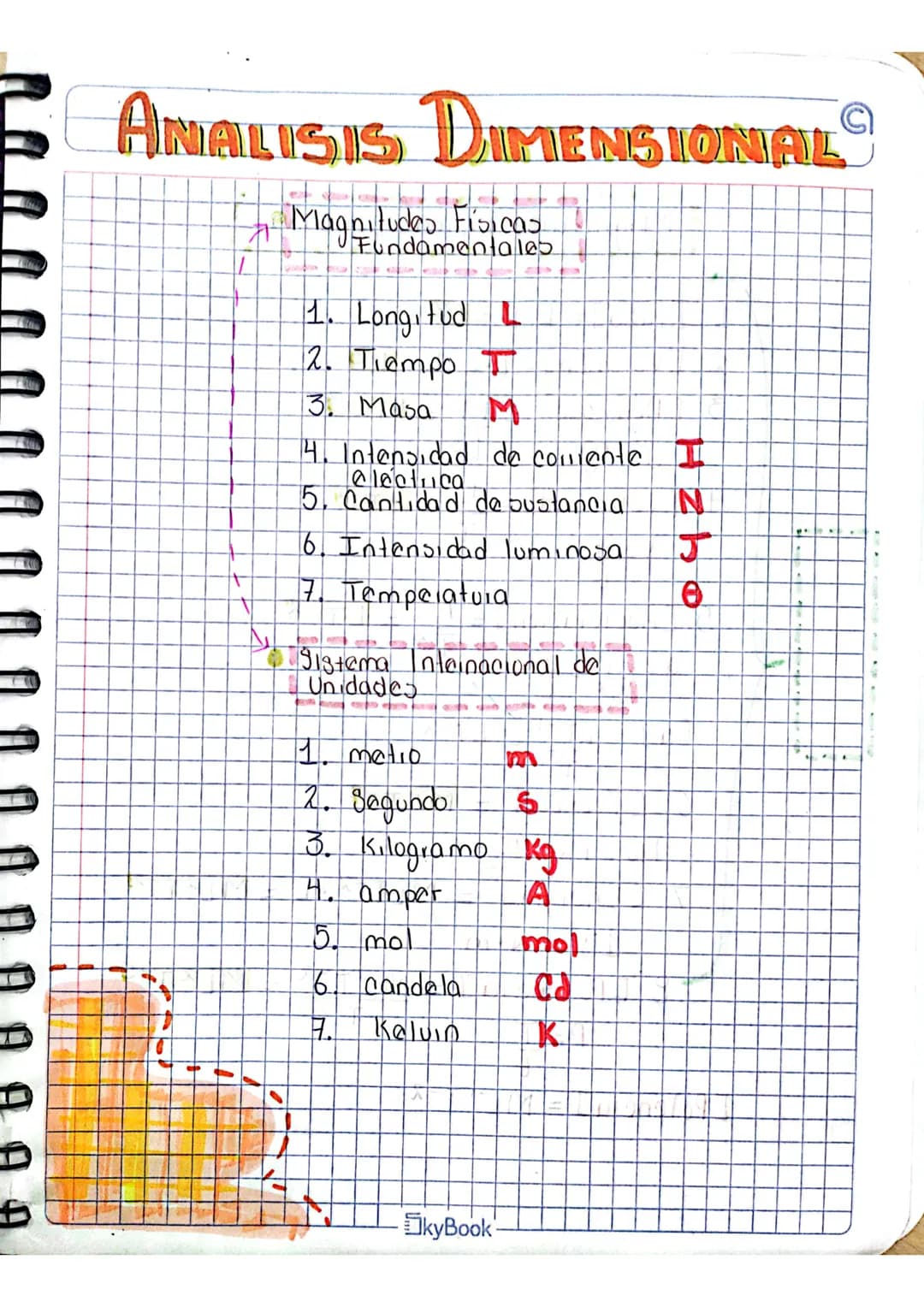
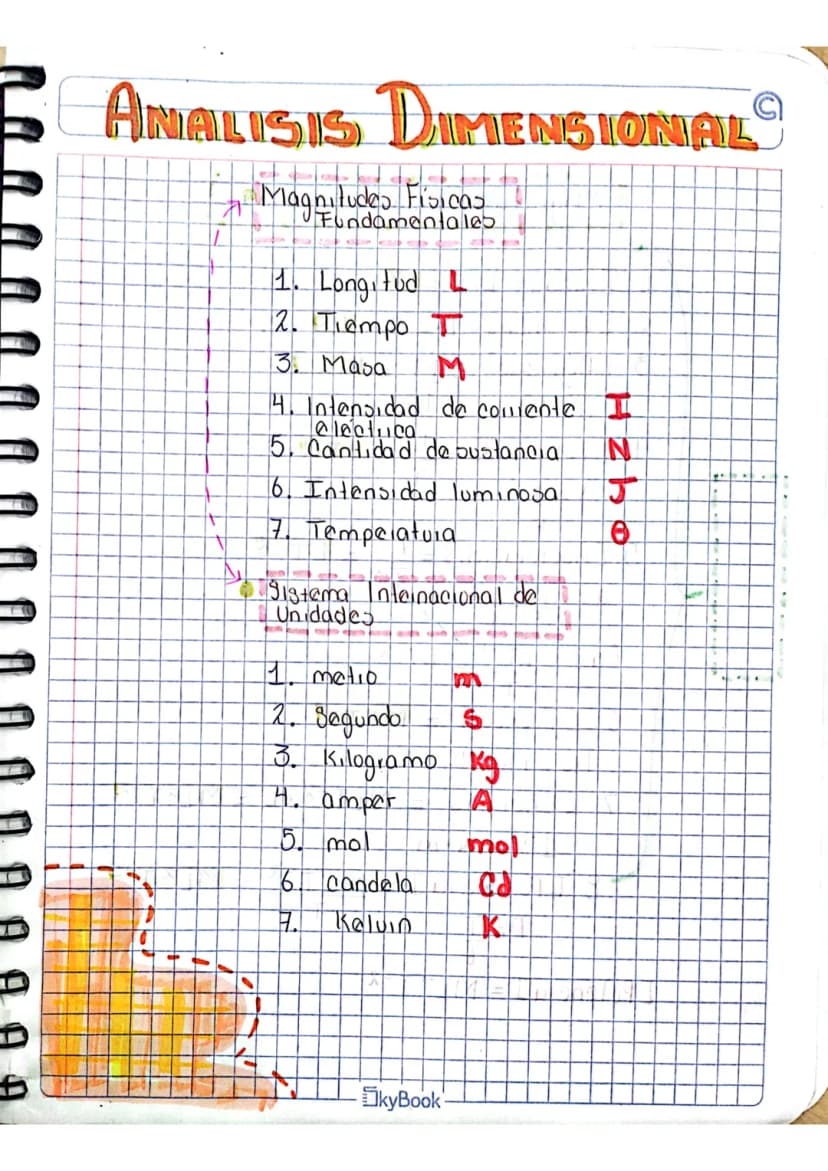
Magnitudes Fundamentales y Sistema Internacional
¿Te has preguntado por qué medimos todo en metros, segundos y kilogramos? Resulta que toda la física se construye sobre 7 magnitudes físicas fundamentales que son como los "bloques de construcción" de todas las medidas.
Las tres más importantes que usarás constantemente son: longitud (L) medida en metros, tiempo (T) en segundos, y masa (M) en kilogramos. Las otras cuatro son intensidad de corriente eléctrica (I) en amperes, cantidad de sustancia (N) en moles, intensidad luminosa (J) en candelas, y temperatura (Θ) en Kelvin.
💡 Tip clave: Memoriza L, T y M primero - son las que más vas a usar en mecánica y te van a salvar en los exámenes.
El Sistema Internacional de Unidades estandariza estas medidas globalmente, así que un metro en México es exactamente igual a un metro en cualquier parte del mundo.
2
of 4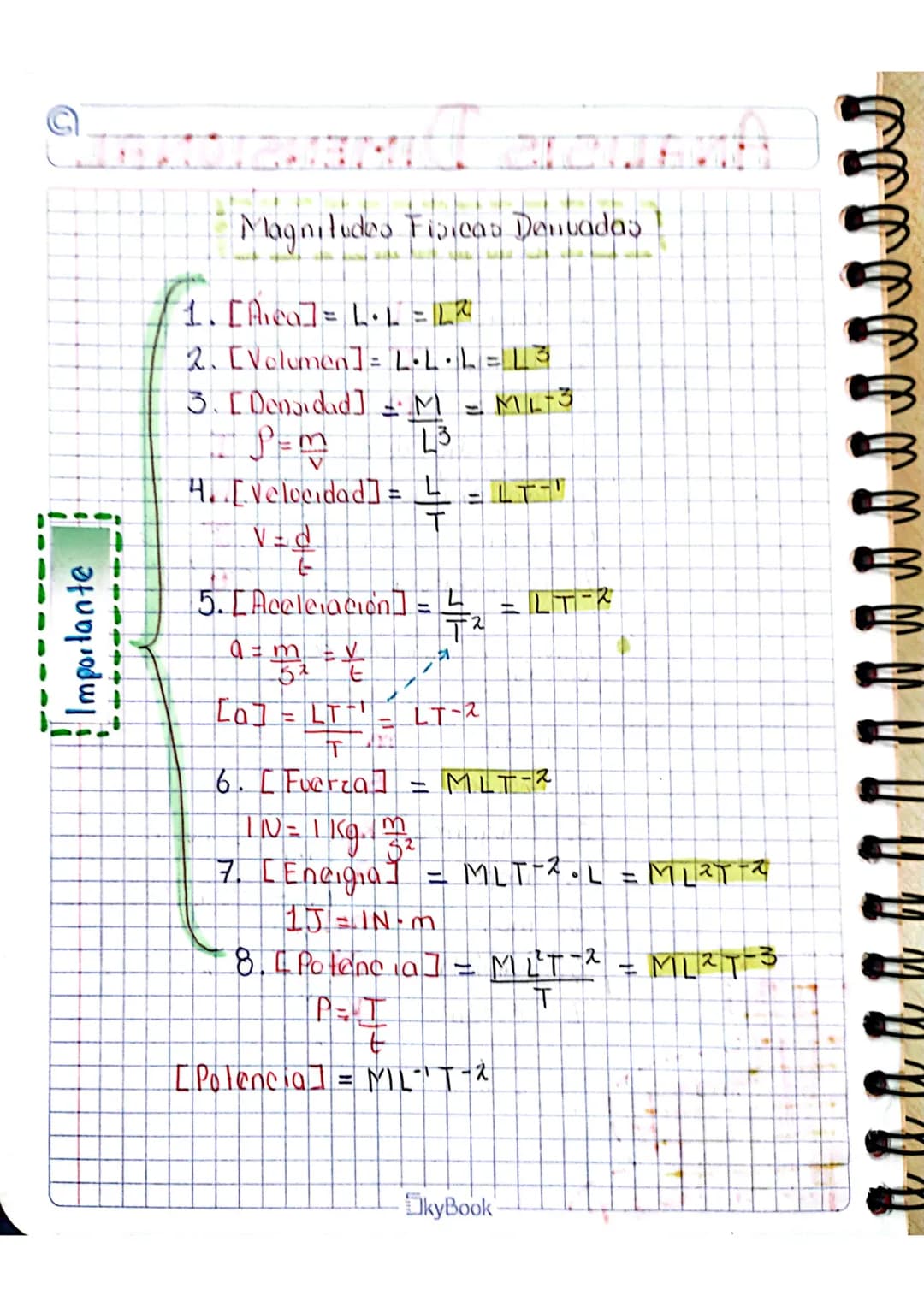
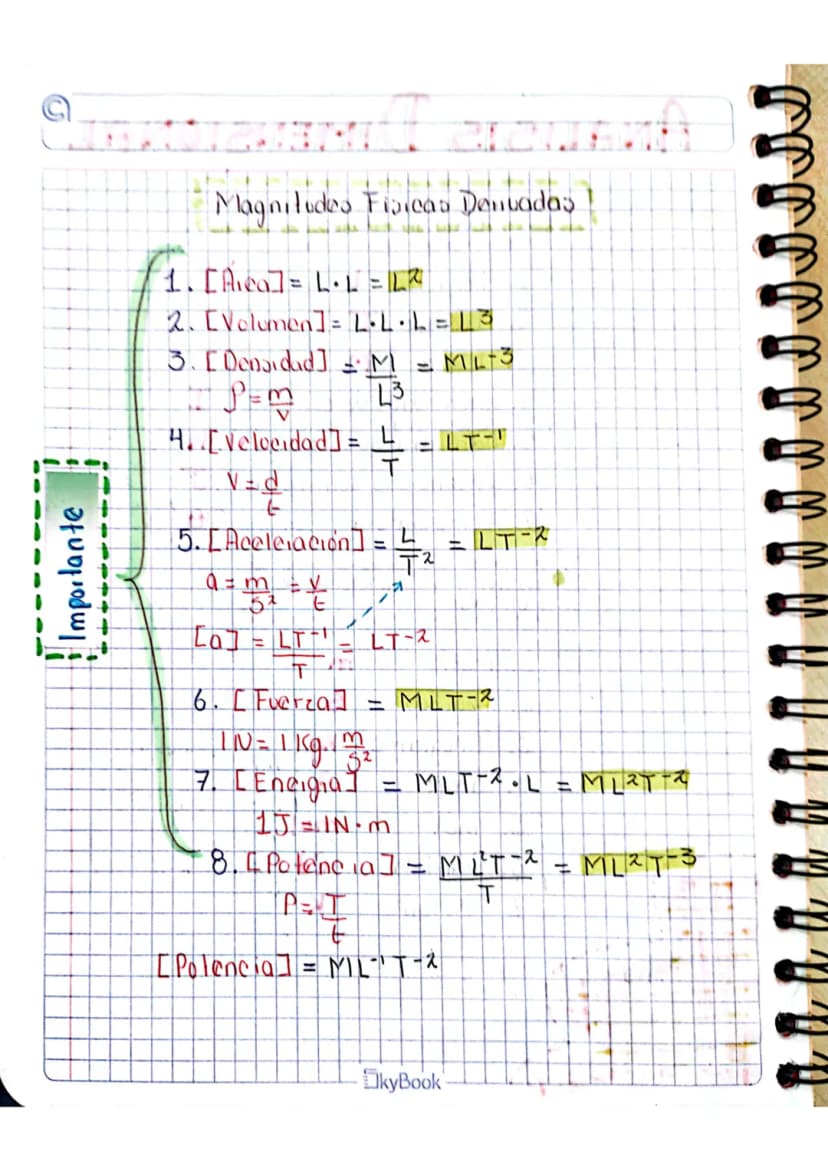
Magnitudes Derivadas: Construyendo la Física
Aquí es donde se pone interesante: todas las demás cantidades físicas se forman combinando las fundamentales. Es como armar con Legos, pero con dimensiones.
Área = L², volumen = L³, y densidad = M/L³ = ML⁻³. La velocidad se expresa como L/T = LT⁻¹, mientras que la aceleración es L/T² = LT⁻².
Para las magnitudes más complejas: fuerza = MLT⁻², energía = ML²T⁻², y potencia = ML²T⁻³. Cada una tiene un significado físico específico y se construye lógicamente a partir de las fundamentales.
💡 Recuerda: Los exponentes negativos no dan miedo - solo significan "por cada unidad de tiempo" o "por cada unidad de longitud".
3
of 4
Resolviendo Problemas de Homogeneidad Dimensional
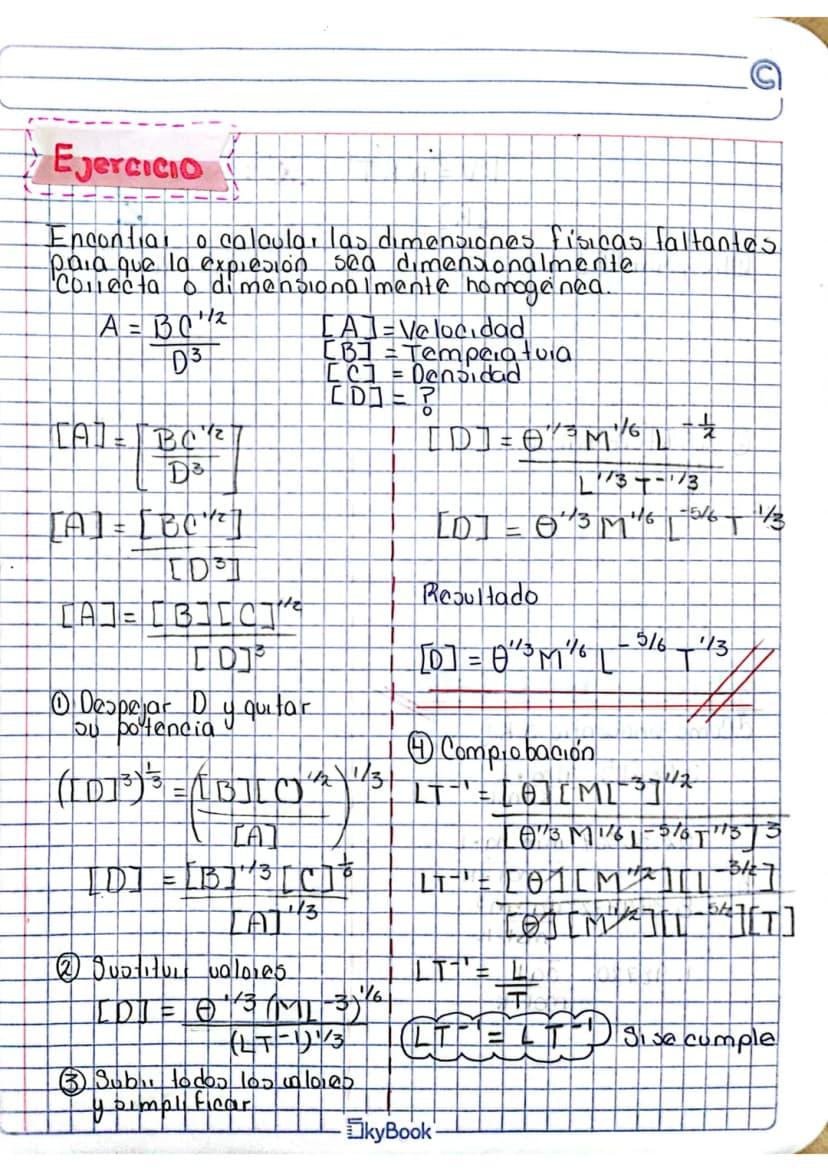
Este tipo de ejercicios te pide encontrar las dimensiones desconocidas para que una ecuación sea dimensionalmente correcta. Es como resolver un rompecabezas donde ambos lados de la ecuación deben tener las mismas dimensiones.
El truco está en despejar la incógnita y sustituir las dimensiones conocidas. En el ejemplo: si A = BC^(1/2)/D³, y conoces las dimensiones de A, B y C, puedes encontrar D.
Pasos clave: 1) Despeja la variable desconocida, 2) Sustituye las dimensiones conocidas, 3) Simplifica algebraicamente, 4) Siempre verifica tu resultado sustituyendo de vuelta.
💡 Pro tip: La comprobación es crucial - si al final no obtienes la misma dimensión en ambos lados, algo está mal.
4
of 4
Aplicación Práctica: La Constante Universal R
La famosa ecuación PV = nRT de los gases ideales es perfecta para practicar análisis dimensional. Aquí calculas las dimensiones de la constante universal de los gases R.
Despejando R obtienes: [R] = [P][V]/[n][T]. Sustituyendo: presión (ML⁻¹T⁻²), volumen (L³), cantidad de sustancia (N) y temperatura (Θ), resulta en ML²T⁻²N⁻¹Θ⁻¹.
Lo genial es que esta misma constante tiene diferentes valores numéricos dependiendo de las unidades que uses: 0.08205 atm·L/(K·mol) o 8.314 Pa·m³/(mol·K), pero sus dimensiones siempre son las mismas.
💡 Dato interesante: R conecta el mundo microscópico con el macroscópico - es por eso que aparece en tantas ecuaciones importantes.
We thought you’d never ask...
What is the Knowunity AI companion?
Our AI companion is specifically built for the needs of students. Based on the millions of content pieces we have on the platform we can provide truly meaningful and relevant answers to students. But its not only about answers, the companion is even more about guiding students through their daily learning challenges, with personalised study plans, quizzes or content pieces in the chat and 100% personalisation based on the students skills and developments.
Where can I download the Knowunity app?
You can download the app in the Google Play Store and in the Apple App Store.
Is Knowunity really free of charge?
That's right! Enjoy free access to study content, connect with fellow students, and get instant help – all at your fingertips.
Similar Content
Most popular content: Density
2Most popular content in Matemáticas
9 Matemáticas
Calculo integral - investigación
Investigación sobre el cálculo integral, definición, suma de riemann, integrales definidas, teorema fundamental del cálculo, antiderivadas, integrales indefinidas y ejemplos.
3º Bach5048
FísicaMRU , MRUA , caída libre y conceptos basicos
En este archivo se ve MRU ,MRUA , caída libre y algunos conceptos básicos como la física , magnitud , fenómenos físico , etc...
3º Sec2,47530
FísicaEl Átomo
Habla sobre qué contiene un átomo y sus características
2º Sec2153
MatemáticasNotación Cientifica
Todo lo básico que debes saber sobre la notación científica.
1º Sec1334
FísicaLas células y sus funciones
Las células y sus funciones
3º Sec30110
FísicaEcuaciones cuadraticas
Definicion,partes y ejercicio
1º Bach69711
FísicaEnergía CINETiCA
Energía CINETiCA
1º Sec2975
FísicaGUÍA DE ESTUDIO PARA FÍSICA (nivel prepa)
Guía de estudio para exámenes de física nivel preparatoria, incluye: cargas eléctricas, ley de coulomb, campo eléctrico, ley de ohm, potencia eléctrica, entre otros.
1º Bach56113
FísicaLa ley de conservación de masa
La ley de la conservación de la masa
3º Sec88823
Most popular content
9MatemáticasJerarquía de operaciones
Te enseña la jerarquía de operaciones y también te ecplica que son y como las puedes hacer
1º Sec1,13017
 Historia
Historia ECOEMS (Comipems)
Breve resumen de los temas de historia universal del examen del examen de media superior ECOEMS del valle de México
3º Sec1,23039
 Biología
Mapa metabólico
Mapa metabólico, glucólisis, gluconeogénesis, lípidos, vía de las pentosas, ciclo de krebs
Universidad1,10121
 Química
química
química
3º Sec4210
BiologíaSistema óseo
Función, tipos, etcétera
Universidad66418
MatemáticasTeorema de tales
Explicación fácil de entender, sobre el teorema de lates
1º Bach89716
 Español
Examen ecoems unam
Estudiar para el examen de ecoems 2026 unam
1º Sec36316
QuímicaQuimica ECOEMS(Comipems)
resumen de los temas de quimica que se presentarán en el próximo examen de nivel media superior en la zona metropolitana de el valle de México
3º Sec1,04143
MatemáticasAritmética básica
Operaciones aritméticas suma, resta, multiplicación y ley de signos, para bachillerato o para el examen de admisión a la universidad
1º Bach6607
Can't find what you're looking for? Explore other subjects.
Students love us — and so will you.
4.6/5App Store
4.7/5Google Play
The app is very easy to use and well designed. I have found everything I was looking for so far and have been able to learn a lot from the presentations! I will definitely use the app for a class assignment! And of course it also helps a lot as an inspiration.
Stefan SiOS user
This app is really great. There are so many study notes and help [...]. My problem subject is French, for example, and the app has so many options for help. Thanks to this app, I have improved my French. I would recommend it to anyone.
Samantha KlichAndroid user
Wow, I am really amazed. I just tried the app because I've seen it advertised many times and was absolutely stunned. This app is THE HELP you want for school and above all, it offers so many things, such as workouts and fact sheets, which have been VERY helpful to me personally.
AnnaiOS user
Física270 views·Updated Jun 25, 2026·4 pagesGuía Completa de Análisis Dimensional
M
Maribel Martinez@maribelma_oyp03
El análisis dimensionales una herramienta súper útil en física que te permite verificar si tus fórmulas están correctas y resolver problemas complejos. Básicamente, es como un "detector de errores" que usa las dimensiones fundamentales (longitud, tiempo, masa, etc.) para...
1
of 4
Sign up to see the content. It's free!
- Access to all documents
- Improve your grades
- Join milions of students
Magnitudes Fundamentales y Sistema Internacional
¿Te has preguntado por qué medimos todo en metros, segundos y kilogramos? Resulta que toda la física se construye sobre 7 magnitudes físicas fundamentales que son como los "bloques de construcción" de todas las medidas.
Las tres más importantes que usarás constantemente son: longitud (L) medida en metros, tiempo (T) en segundos, y masa (M) en kilogramos. Las otras cuatro son intensidad de corriente eléctrica (I) en amperes, cantidad de sustancia (N) en moles, intensidad luminosa (J) en candelas, y temperatura (Θ) en Kelvin.
💡 Tip clave: Memoriza L, T y M primero - son las que más vas a usar en mecánica y te van a salvar en los exámenes.
El Sistema Internacional de Unidades estandariza estas medidas globalmente, así que un metro en México es exactamente igual a un metro en cualquier parte del mundo.
2
of 4Sign up to see the content. It's free!
- Access to all documents
- Improve your grades
- Join milions of students
Magnitudes Derivadas: Construyendo la Física
Aquí es donde se pone interesante: todas las demás cantidades físicas se forman combinando las fundamentales. Es como armar con Legos, pero con dimensiones.
Área = L², volumen = L³, y densidad = M/L³ = ML⁻³. La velocidad se expresa como L/T = LT⁻¹, mientras que la aceleración es L/T² = LT⁻².
Para las magnitudes más complejas: fuerza = MLT⁻², energía = ML²T⁻², y potencia = ML²T⁻³. Cada una tiene un significado físico específico y se construye lógicamente a partir de las fundamentales.
💡 Recuerda: Los exponentes negativos no dan miedo - solo significan "por cada unidad de tiempo" o "por cada unidad de longitud".
3
of 4Sign up to see the content. It's free!
- Access to all documents
- Improve your grades
- Join milions of students
Resolviendo Problemas de Homogeneidad Dimensional
Este tipo de ejercicios te pide encontrar las dimensiones desconocidas para que una ecuación sea dimensionalmente correcta. Es como resolver un rompecabezas donde ambos lados de la ecuación deben tener las mismas dimensiones.
El truco está en despejar la incógnita y sustituir las dimensiones conocidas. En el ejemplo: si A = BC^(1/2)/D³, y conoces las dimensiones de A, B y C, puedes encontrar D.
Pasos clave: 1) Despeja la variable desconocida, 2) Sustituye las dimensiones conocidas, 3) Simplifica algebraicamente, 4) Siempre verifica tu resultado sustituyendo de vuelta.
💡 Pro tip: La comprobación es crucial - si al final no obtienes la misma dimensión en ambos lados, algo está mal.
4
of 4Sign up to see the content. It's free!
- Access to all documents
- Improve your grades
- Join milions of students
Aplicación Práctica: La Constante Universal R
La famosa ecuación PV = nRT de los gases ideales es perfecta para practicar análisis dimensional. Aquí calculas las dimensiones de la constante universal de los gases R.
Despejando R obtienes: [R] = [P][V]/[n][T]. Sustituyendo: presión (ML⁻¹T⁻²), volumen (L³), cantidad de sustancia (N) y temperatura (Θ), resulta en ML²T⁻²N⁻¹Θ⁻¹.
Lo genial es que esta misma constante tiene diferentes valores numéricos dependiendo de las unidades que uses: 0.08205 atm·L/(K·mol) o 8.314 Pa·m³/(mol·K), pero sus dimensiones siempre son las mismas.
💡 Dato interesante: R conecta el mundo microscópico con el macroscópico - es por eso que aparece en tantas ecuaciones importantes.
We thought you’d never ask...
What is the Knowunity AI companion?
Our AI companion is specifically built for the needs of students. Based on the millions of content pieces we have on the platform we can provide truly meaningful and relevant answers to students. But its not only about answers, the companion is even more about guiding students through their daily learning challenges, with personalised study plans, quizzes or content pieces in the chat and 100% personalisation based on the students skills and developments.
Where can I download the Knowunity app?
You can download the app in the Google Play Store and in the Apple App Store.
Is Knowunity really free of charge?
That's right! Enjoy free access to study content, connect with fellow students, and get instant help – all at your fingertips.
Similar Content
Most popular content: Density
2Most popular content in Matemáticas
9MatemáticasCalculo integral - investigación
Investigación sobre el cálculo integral, definición, suma de riemann, integrales definidas, teorema fundamental del cálculo, antiderivadas, integrales indefinidas y ejemplos.
3º Bach5048
FísicaMRU , MRUA , caída libre y conceptos basicos
En este archivo se ve MRU ,MRUA , caída libre y algunos conceptos básicos como la física , magnitud , fenómenos físico , etc...
3º Sec2,47530
FísicaEl Átomo
Habla sobre qué contiene un átomo y sus características
2º Sec2153
MatemáticasNotación Cientifica
Todo lo básico que debes saber sobre la notación científica.
1º Sec1334
FísicaLas células y sus funciones
Las células y sus funciones
3º Sec30110
FísicaEcuaciones cuadraticas
Definicion,partes y ejercicio
1º Bach69711
FísicaEnergía CINETiCA
Energía CINETiCA
1º Sec2975
FísicaGUÍA DE ESTUDIO PARA FÍSICA (nivel prepa)
Guía de estudio para exámenes de física nivel preparatoria, incluye: cargas eléctricas, ley de coulomb, campo eléctrico, ley de ohm, potencia eléctrica, entre otros.
1º Bach56113
FísicaLa ley de conservación de masa
La ley de la conservación de la masa
3º Sec88823
Most popular content
9MatemáticasJerarquía de operaciones
Te enseña la jerarquía de operaciones y también te ecplica que son y como las puedes hacer
1º Sec1,13017
HistoriaHistoria ECOEMS (Comipems)
Breve resumen de los temas de historia universal del examen del examen de media superior ECOEMS del valle de México
3º Sec1,23039
BiologíaMapa metabólico
Mapa metabólico, glucólisis, gluconeogénesis, lípidos, vía de las pentosas, ciclo de krebs
Universidad1,10121
Químicaquímica
química
3º Sec4210
BiologíaSistema óseo
Función, tipos, etcétera
Universidad66418
MatemáticasTeorema de tales
Explicación fácil de entender, sobre el teorema de lates
1º Bach89716
EspañolExamen ecoems unam
Estudiar para el examen de ecoems 2026 unam
1º Sec36316
QuímicaQuimica ECOEMS(Comipems)
resumen de los temas de quimica que se presentarán en el próximo examen de nivel media superior en la zona metropolitana de el valle de México
3º Sec1,04143
MatemáticasAritmética básica
Operaciones aritméticas suma, resta, multiplicación y ley de signos, para bachillerato o para el examen de admisión a la universidad
1º Bach6607
Can't find what you're looking for? Explore other subjects.
Students love us — and so will you.
4.6/5App Store
4.7/5Google Play
The app is very easy to use and well designed. I have found everything I was looking for so far and have been able to learn a lot from the presentations! I will definitely use the app for a class assignment! And of course it also helps a lot as an inspiration.
Stefan SiOS user
This app is really great. There are so many study notes and help [...]. My problem subject is French, for example, and the app has so many options for help. Thanks to this app, I have improved my French. I would recommend it to anyone.
Samantha KlichAndroid user
Wow, I am really amazed. I just tried the app because I've seen it advertised many times and was absolutely stunned. This app is THE HELP you want for school and above all, it offers so many things, such as workouts and fact sheets, which have been VERY helpful to me personally.
AnnaiOS user