
Kaldırma Kuvveti: A comprehensive guide to buoyancy force in...
 Fizik151 views·Updated Jun 15, 2026·5 pages
10. Sınıf Fizik: Kaldırma Kuvveti Ders Notları ve Özet PDF
N
nazcansamet@nazcansamet


1 / 5
1
of 5
Buoyancy in Different Scenarios and Fluid Properties
This page delves deeper into sıvıların kaldırma kuvveti (buoyancy force in liquids) by examining various scenarios and fluid properties. It is particularly useful for students working on sıvıların kaldırma kuvveti Proje ödevi (buoyancy force in liquids project assignments).
The page discusses how buoyancy force changes in different situations, such as when objects are partially or fully submerged, and when fluids of different densities are involved. It also explores the concept of neutral buoyancy and its applications.
Vocabulary: Neutral buoyancy occurs when an object's density is equal to the fluid's density, causing it to neither sink nor float but remain suspended at any depth.
The document provides examples of how to analyze systems with multiple objects or fluids, including cases where objects are attached or separated. It emphasizes the importance of understanding density relationships in determining an object's behavior in a fluid.
Example: When two objects of different densities are attached and placed in a fluid, their combined behavior depends on their average density compared to the fluid's density.
The page also touches on the concept of apparent weight in fluids and how it relates to buoyancy force. This information is crucial for understanding batan cisimlerde kaldırma kuvveti (buoyancy force in submerged objects) and yüzen cisimlerde kaldırma kuvveti (buoyancy force in floating objects).
2
of 5
Advanced Concepts in Buoyancy and Fluid Dynamics
This section of the document explores more advanced topics related to kaldırma kuvveti (buoyancy force) and fluid dynamics. It is particularly relevant for students studying 10.sınıf fizik sıvıların kaldırma kuvveti ders notları .
The page discusses the relationship between pressure, volume, and temperature in fluids, introducing the ideal gas law . This concept is crucial for understanding how buoyancy can change with temperature or pressure variations.
Formula: PV = nRT, where P is pressure, V is volume, T is temperature, n is the number of moles of gas, and R is the gas constant.
The document also explores the concept of fluid displacement and its relationship to buoyancy force. It emphasizes that the volume of fluid displaced by an object is equal to the volume of the submerged portion of the object, which is key to understanding kaldırma kuvveti hacim ilişkisi (relationship between buoyancy force and volume).
Highlight: The amount of fluid displaced by an object is always equal to the volume of the submerged portion of the object, regardless of the object's shape or density.
The page provides examples of how changes in fluid properties or object characteristics can affect buoyancy. This includes scenarios where fluid density changes or when an object's volume changes due to external factors.
Example: If a balloon is submerged in water and then rises to a lower pressure environment, its volume will increase, affecting the buoyancy force acting on it.
3
of 5
Practical Applications and Problem-Solving Techniques
This page focuses on practical applications of kaldırma kuvveti (buoyancy force) and provides problem-solving techniques for students. It is especially useful for those working on 10.sınıf fizik kaldırma kuvveti soruları ve çözümleri .
The document presents various real-world scenarios where buoyancy plays a crucial role, such as in ship design, hot air balloons, and submarine operations. It explains how understanding buoyancy is essential in these applications and how engineers use this knowledge to design efficient systems.
Example: In submarine design, engineers must carefully balance the submarine's weight and buoyancy to allow for controlled submersion and surfacing.
The page provides step-by-step problem-solving strategies for buoyancy-related questions. It emphasizes the importance of identifying given information, selecting appropriate formulas, and systematically working through calculations.
Highlight: When solving buoyancy problems, always start by determining the densities of the object and the fluid, as well as the volume of the displaced fluid.
The document also discusses common misconceptions about buoyancy and clarifies these points to help students avoid errors in their understanding and calculations.
Definition: Archimedes' Principle states that the upward buoyant force exerted on a body immersed in a fluid is equal to the weight of the fluid displaced by the body.
This section is particularly valuable for students preparing for exams or working on sıvıların kaldırma kuvveti 10. sınıf performans ödevi .
4
of 5
Special Cases and Advanced Applications of Buoyancy
This final page of the document explores special cases and advanced applications of kaldırma kuvveti (buoyancy force). It provides valuable insights for students interested in deeper understanding and real-world applications of the concept.
The page discusses the buoyancy force in gases, particularly focusing on how it affects objects in air. This concept is crucial for understanding phenomena like hot air balloons and the behavior of weather balloons in the atmosphere.
Example: A hot air balloon rises because the heated air inside the balloon is less dense than the surrounding cooler air, creating an upward buoyant force.
The document also explores how buoyancy principles apply in stratified fluids, where density varies with depth. This concept is important in oceanography and atmospheric sciences.
Vocabulary: Stratification refers to the layering of fluids with different densities, which can significantly affect buoyancy and fluid dynamics.
The page touches on advanced topics such as the center of buoyancy and its importance in naval architecture and the stability of floating objects. It explains how the position of the center of buoyancy relative to the center of gravity affects an object's stability in a fluid.
Highlight: Understanding the relationship between the center of buoyancy and the center of gravity is crucial for designing stable ships and other floating structures.
Finally, the document provides information on how buoyancy principles are applied in various scientific and engineering fields, demonstrating the broad relevance of this concept beyond basic physics.
This section is particularly valuable for students looking to expand their knowledge beyond the standard 10.sınıf fizik kaldırma kuvveti özet and gain a more comprehensive understanding of the topic.
5
of 5
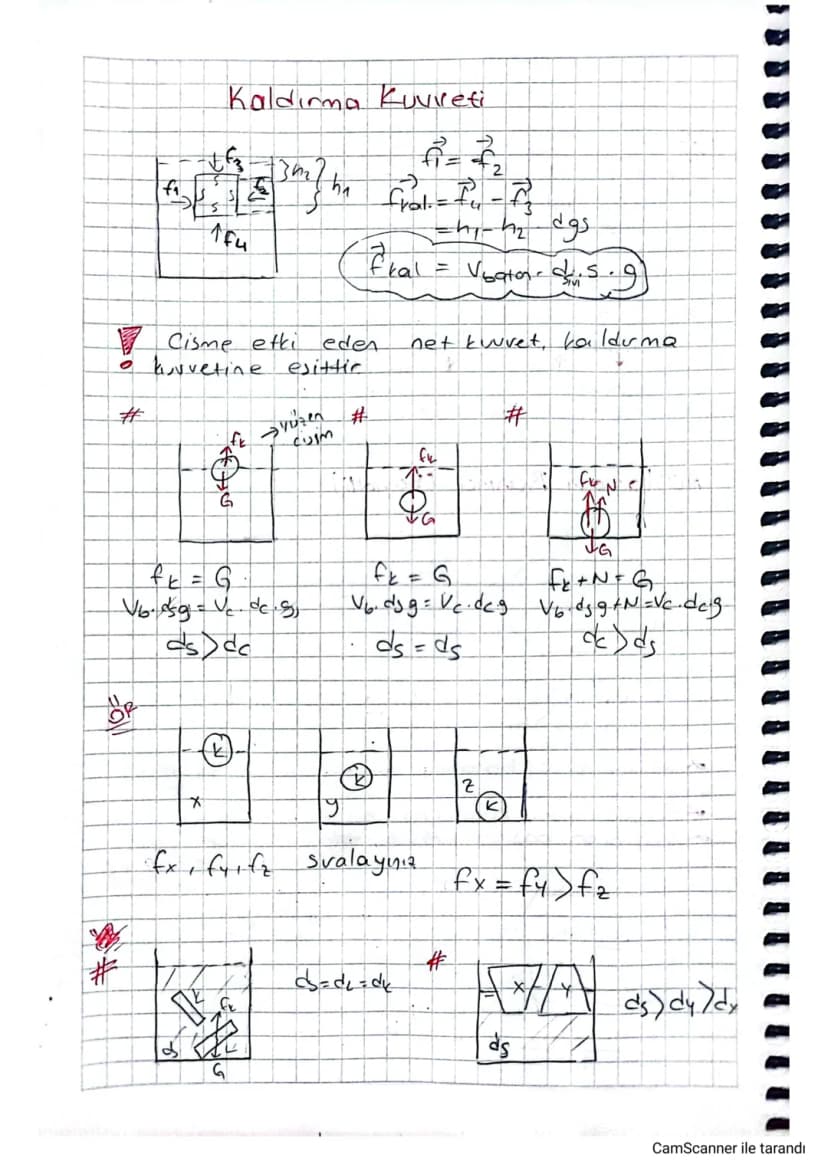
Kaldırma Kuvveti: Fundamental Concepts and Calculations
This page introduces the basic principles of kaldırma kuvveti (buoyancy force) and provides essential formulas for calculations. The content is crucial for understanding 10. sınıf fizik kaldırma kuvveti konu anlatımı .
The buoyancy force is explained as the upward force exerted by a fluid on an immersed object. The page presents the key formula for calculating buoyancy force: F_k = ρ_fluid * g * V_displaced, where ρ_fluid is the density of the fluid, g is the acceleration due to gravity, and V_displaced is the volume of fluid displaced by the object.
Definition: Kaldırma kuvveti (Buoyancy force) is the upward force exerted by a fluid on an immersed object, equal to the weight of the fluid displaced by the object.
Highlight: The buoyancy force is always equal to the weight of the fluid displaced by the object, regardless of the object's density or whether it floats or sinks.
The page also discusses the relationship between buoyancy force and the object's weight, introducing concepts of floating, sinking, and neutral buoyancy. It emphasizes that the net force on an object in a fluid is the difference between its weight and the buoyancy force.
Example: For a floating object, the buoyancy force is equal to the object's weight . For a sinking object, the buoyancy force is less than the object's weight .
The document provides visual representations of force diagrams, helping students understand the interplay between gravity, buoyancy, and normal forces acting on objects in fluids.
We thought you’d never ask...
What is the Knowunity AI companion?
Our AI companion is specifically built for the needs of students. Based on the millions of content pieces we have on the platform we can provide truly meaningful and relevant answers to students. But its not only about answers, the companion is even more about guiding students through their daily learning challenges, with personalised study plans, quizzes or content pieces in the chat and 100% personalisation based on the students skills and developments.
Where can I download the Knowunity app?
You can download the app in the Google Play Store and in the Apple App Store.
Is Knowunity really free of charge?
That's right! Enjoy free access to study content, connect with fellow students, and get instant help – all at your fingertips.
Similar Content
Most popular content: Buoyancy
9FizikTYT Fizik
18 sayfada fizik
1218,147728
FizikBasınç ve kaldırma kuvveti
Basınç ve kaldırma kuvveti ders notu
91,05918
FizikSıvıların kaldırma kuvveti
Sıvıların kaldırma kuvveti konu anlatımı ve örnek
103588
FizikFizik kaldırma kuvveti
Iyi çalışmalar
96454
FizikKaldırma kuvveti
Yüzme, askıda kalma, batma durumu
93653
FizikTYT FİZİK KALDIRMA KUVVETİ
KALDIRMA KUVVETİ
92425
FizikTYT FİZİK FULL TEKRAR -1-
Fizik konu anlatım özeti bölüm 1
61,88131
FizikFizik basınç
Kaldırma kuvveti
121,08214
FizikTYT fizik suyun kaldırma kuvveti ve taşırma kapları
Taşırma kapları örnekleri içeren kaldırma kuvveti ders notu
101362
Most popular content in Fizik
9FizikDalgalar
Fizik Notları
99,605142
FizikTYT Fizik
18 sayfada fizik
1218,147728
FizikFizik 9.sınıf
Çok iyi bir kitap
91,92740
FizikBasınç ve kaldırma kuvveti
Basınç ve kaldırma kuvveti ders notu
91,05918
FizikTYT Fizik
Tyt fizik
107,043208
FizikElektrik devreleri ve lambalar
Elektrik devreleri konusunu anlatır
101,21314
Fizik11. sınıf fizik
fizik
111,53730
FizikIsı ve Sıcaklık
9.sınıf fizik ısı ve sıcaklık
96569
FizikIsı ve sıcaklık
Isı ve sıcaklık ders notları
969217
Most popular content
9 Tarih
Tarih9. Sınıf Tarih Konu Anlatımı
9. sınıf tarih tüm ünite konu anlatımı
94,16066
 Matematik
8.sınıf matematik
Tüm üniteleri içermektedir!
85,207185
 Biyoloji
Tyt biyoloji
Bio
95,112132
Tarih9.sınıf tarih ders notları
Yeni maarif modele uygundur
92,20748
Biyoloji11. sınıf biyoloji dolaşım sistemi ders notları
11. sınıf biyoloji dolaşım sistemi ders notları
114,34185
TarihTYT AYT TARİH
Tarih
92,58762
T.C. İnkılâp Tarihi ve Atatürkçülükİnkılap tarihi
Beğenin
82,76154
Fen Bilimleri7. Sınıf Fen Bilimleri
Tüm üniteler
79,269188
 Felsefe
11.Sınıf Felsefe 2.Dönem 2.Yazılı sınavı ders notları
20.yüzyıl felsefesini hazırlayan düşünce ortamı, 20.yüzyıl felsefesi temel problemleri ve akımları konularını içermektedir
113,596113
Can't find what you're looking for? Explore other subjects.
Students love us — and so will you.
4.6/5App Store
4.7/5Google Play
The app is very easy to use and well designed. I have found everything I was looking for so far and have been able to learn a lot from the presentations! I will definitely use the app for a class assignment! And of course it also helps a lot as an inspiration.
Stefan SiOS user
This app is really great. There are so many study notes and help [...]. My problem subject is French, for example, and the app has so many options for help. Thanks to this app, I have improved my French. I would recommend it to anyone.
Samantha KlichAndroid user
Wow, I am really amazed. I just tried the app because I've seen it advertised many times and was absolutely stunned. This app is THE HELP you want for school and above all, it offers so many things, such as workouts and fact sheets, which have been VERY helpful to me personally.
AnnaiOS user
Fizik151 views·Updated Jun 15, 2026·5 pages10. Sınıf Fizik: Kaldırma Kuvveti Ders Notları ve Özet PDF
N
nazcansamet@nazcansamet
Kaldırma Kuvveti: A comprehensive guide to buoyancy force in fluids for 10th-grade physics students.
This document provides an in-depth exploration of kaldırma kuvveti(buoyancy force) in fluids, covering key concepts, formulas, and practical applications. It is an essential resource...
1
of 5
Sign up to see the content. It's free!
- Access to all documents
- Improve your grades
- Join milions of students
Buoyancy in Different Scenarios and Fluid Properties
This page delves deeper into sıvıların kaldırma kuvveti (buoyancy force in liquids) by examining various scenarios and fluid properties. It is particularly useful for students working on sıvıların kaldırma kuvveti Proje ödevi (buoyancy force in liquids project assignments).
The page discusses how buoyancy force changes in different situations, such as when objects are partially or fully submerged, and when fluids of different densities are involved. It also explores the concept of neutral buoyancy and its applications.
Vocabulary: Neutral buoyancy occurs when an object's density is equal to the fluid's density, causing it to neither sink nor float but remain suspended at any depth.
The document provides examples of how to analyze systems with multiple objects or fluids, including cases where objects are attached or separated. It emphasizes the importance of understanding density relationships in determining an object's behavior in a fluid.
Example: When two objects of different densities are attached and placed in a fluid, their combined behavior depends on their average density compared to the fluid's density.
The page also touches on the concept of apparent weight in fluids and how it relates to buoyancy force. This information is crucial for understanding batan cisimlerde kaldırma kuvveti (buoyancy force in submerged objects) and yüzen cisimlerde kaldırma kuvveti (buoyancy force in floating objects).
2
of 5Sign up to see the content. It's free!
- Access to all documents
- Improve your grades
- Join milions of students
Advanced Concepts in Buoyancy and Fluid Dynamics
This section of the document explores more advanced topics related to kaldırma kuvveti (buoyancy force) and fluid dynamics. It is particularly relevant for students studying 10.sınıf fizik sıvıların kaldırma kuvveti ders notları .
The page discusses the relationship between pressure, volume, and temperature in fluids, introducing the ideal gas law . This concept is crucial for understanding how buoyancy can change with temperature or pressure variations.
Formula: PV = nRT, where P is pressure, V is volume, T is temperature, n is the number of moles of gas, and R is the gas constant.
The document also explores the concept of fluid displacement and its relationship to buoyancy force. It emphasizes that the volume of fluid displaced by an object is equal to the volume of the submerged portion of the object, which is key to understanding kaldırma kuvveti hacim ilişkisi (relationship between buoyancy force and volume).
Highlight: The amount of fluid displaced by an object is always equal to the volume of the submerged portion of the object, regardless of the object's shape or density.
The page provides examples of how changes in fluid properties or object characteristics can affect buoyancy. This includes scenarios where fluid density changes or when an object's volume changes due to external factors.
Example: If a balloon is submerged in water and then rises to a lower pressure environment, its volume will increase, affecting the buoyancy force acting on it.
3
of 5Sign up to see the content. It's free!
- Access to all documents
- Improve your grades
- Join milions of students
Practical Applications and Problem-Solving Techniques
This page focuses on practical applications of kaldırma kuvveti (buoyancy force) and provides problem-solving techniques for students. It is especially useful for those working on 10.sınıf fizik kaldırma kuvveti soruları ve çözümleri .
The document presents various real-world scenarios where buoyancy plays a crucial role, such as in ship design, hot air balloons, and submarine operations. It explains how understanding buoyancy is essential in these applications and how engineers use this knowledge to design efficient systems.
Example: In submarine design, engineers must carefully balance the submarine's weight and buoyancy to allow for controlled submersion and surfacing.
The page provides step-by-step problem-solving strategies for buoyancy-related questions. It emphasizes the importance of identifying given information, selecting appropriate formulas, and systematically working through calculations.
Highlight: When solving buoyancy problems, always start by determining the densities of the object and the fluid, as well as the volume of the displaced fluid.
The document also discusses common misconceptions about buoyancy and clarifies these points to help students avoid errors in their understanding and calculations.
Definition: Archimedes' Principle states that the upward buoyant force exerted on a body immersed in a fluid is equal to the weight of the fluid displaced by the body.
This section is particularly valuable for students preparing for exams or working on sıvıların kaldırma kuvveti 10. sınıf performans ödevi .
4
of 5Sign up to see the content. It's free!
- Access to all documents
- Improve your grades
- Join milions of students
Special Cases and Advanced Applications of Buoyancy
This final page of the document explores special cases and advanced applications of kaldırma kuvveti (buoyancy force). It provides valuable insights for students interested in deeper understanding and real-world applications of the concept.
The page discusses the buoyancy force in gases, particularly focusing on how it affects objects in air. This concept is crucial for understanding phenomena like hot air balloons and the behavior of weather balloons in the atmosphere.
Example: A hot air balloon rises because the heated air inside the balloon is less dense than the surrounding cooler air, creating an upward buoyant force.
The document also explores how buoyancy principles apply in stratified fluids, where density varies with depth. This concept is important in oceanography and atmospheric sciences.
Vocabulary: Stratification refers to the layering of fluids with different densities, which can significantly affect buoyancy and fluid dynamics.
The page touches on advanced topics such as the center of buoyancy and its importance in naval architecture and the stability of floating objects. It explains how the position of the center of buoyancy relative to the center of gravity affects an object's stability in a fluid.
Highlight: Understanding the relationship between the center of buoyancy and the center of gravity is crucial for designing stable ships and other floating structures.
Finally, the document provides information on how buoyancy principles are applied in various scientific and engineering fields, demonstrating the broad relevance of this concept beyond basic physics.
This section is particularly valuable for students looking to expand their knowledge beyond the standard 10.sınıf fizik kaldırma kuvveti özet and gain a more comprehensive understanding of the topic.
5
of 5Sign up to see the content. It's free!
- Access to all documents
- Improve your grades
- Join milions of students
Kaldırma Kuvveti: Fundamental Concepts and Calculations
This page introduces the basic principles of kaldırma kuvveti (buoyancy force) and provides essential formulas for calculations. The content is crucial for understanding 10. sınıf fizik kaldırma kuvveti konu anlatımı .
The buoyancy force is explained as the upward force exerted by a fluid on an immersed object. The page presents the key formula for calculating buoyancy force: F_k = ρ_fluid * g * V_displaced, where ρ_fluid is the density of the fluid, g is the acceleration due to gravity, and V_displaced is the volume of fluid displaced by the object.
Definition: Kaldırma kuvveti (Buoyancy force) is the upward force exerted by a fluid on an immersed object, equal to the weight of the fluid displaced by the object.
Highlight: The buoyancy force is always equal to the weight of the fluid displaced by the object, regardless of the object's density or whether it floats or sinks.
The page also discusses the relationship between buoyancy force and the object's weight, introducing concepts of floating, sinking, and neutral buoyancy. It emphasizes that the net force on an object in a fluid is the difference between its weight and the buoyancy force.
Example: For a floating object, the buoyancy force is equal to the object's weight . For a sinking object, the buoyancy force is less than the object's weight .
The document provides visual representations of force diagrams, helping students understand the interplay between gravity, buoyancy, and normal forces acting on objects in fluids.
We thought you’d never ask...
What is the Knowunity AI companion?
Our AI companion is specifically built for the needs of students. Based on the millions of content pieces we have on the platform we can provide truly meaningful and relevant answers to students. But its not only about answers, the companion is even more about guiding students through their daily learning challenges, with personalised study plans, quizzes or content pieces in the chat and 100% personalisation based on the students skills and developments.
Where can I download the Knowunity app?
You can download the app in the Google Play Store and in the Apple App Store.
Is Knowunity really free of charge?
That's right! Enjoy free access to study content, connect with fellow students, and get instant help – all at your fingertips.
Similar Content
Most popular content: Buoyancy
9FizikTYT Fizik
18 sayfada fizik
1218,147728
FizikBasınç ve kaldırma kuvveti
Basınç ve kaldırma kuvveti ders notu
91,05918
FizikSıvıların kaldırma kuvveti
Sıvıların kaldırma kuvveti konu anlatımı ve örnek
103588
FizikFizik kaldırma kuvveti
Iyi çalışmalar
96454
FizikKaldırma kuvveti
Yüzme, askıda kalma, batma durumu
93653
FizikTYT FİZİK KALDIRMA KUVVETİ
KALDIRMA KUVVETİ
92425
FizikTYT FİZİK FULL TEKRAR -1-
Fizik konu anlatım özeti bölüm 1
61,88131
FizikFizik basınç
Kaldırma kuvveti
121,08214
FizikTYT fizik suyun kaldırma kuvveti ve taşırma kapları
Taşırma kapları örnekleri içeren kaldırma kuvveti ders notu
101362
Most popular content in Fizik
9FizikDalgalar
Fizik Notları
99,605142
FizikTYT Fizik
18 sayfada fizik
1218,147728
FizikFizik 9.sınıf
Çok iyi bir kitap
91,92740
FizikBasınç ve kaldırma kuvveti
Basınç ve kaldırma kuvveti ders notu
91,05918
FizikTYT Fizik
Tyt fizik
107,043208
FizikElektrik devreleri ve lambalar
Elektrik devreleri konusunu anlatır
101,21314
Fizik11. sınıf fizik
fizik
111,53730
FizikIsı ve Sıcaklık
9.sınıf fizik ısı ve sıcaklık
96569
FizikIsı ve sıcaklık
Isı ve sıcaklık ders notları
969217
Most popular content
9Tarih9. Sınıf Tarih Konu Anlatımı
9. sınıf tarih tüm ünite konu anlatımı
94,16066
Matematik8.sınıf matematik
Tüm üniteleri içermektedir!
85,207185
BiyolojiTyt biyoloji
Bio
95,112132
Tarih9.sınıf tarih ders notları
Yeni maarif modele uygundur
92,20748
Biyoloji11. sınıf biyoloji dolaşım sistemi ders notları
11. sınıf biyoloji dolaşım sistemi ders notları
114,34185
TarihTYT AYT TARİH
Tarih
92,58762
T.C. İnkılâp Tarihi ve Atatürkçülükİnkılap tarihi
Beğenin
82,76154
Fen Bilimleri7. Sınıf Fen Bilimleri
Tüm üniteler
79,269188
Felsefe11.Sınıf Felsefe 2.Dönem 2.Yazılı sınavı ders notları
20.yüzyıl felsefesini hazırlayan düşünce ortamı, 20.yüzyıl felsefesi temel problemleri ve akımları konularını içermektedir
113,596113
Can't find what you're looking for? Explore other subjects.
Students love us — and so will you.
4.6/5App Store
4.7/5Google Play
The app is very easy to use and well designed. I have found everything I was looking for so far and have been able to learn a lot from the presentations! I will definitely use the app for a class assignment! And of course it also helps a lot as an inspiration.
Stefan SiOS user
This app is really great. There are so many study notes and help [...]. My problem subject is French, for example, and the app has so many options for help. Thanks to this app, I have improved my French. I would recommend it to anyone.
Samantha KlichAndroid user
Wow, I am really amazed. I just tried the app because I've seen it advertised many times and was absolutely stunned. This app is THE HELP you want for school and above all, it offers so many things, such as workouts and fact sheets, which have been VERY helpful to me personally.
AnnaiOS user