
I quantificatoriin inglese ti aiutano a esprimere quantità indefinite...
 Fisica1,283 views·Updated Jun 22, 2026·2 pages
Understanding Quantifiers in English

Helly@elisavalentini_bnho
1
of 2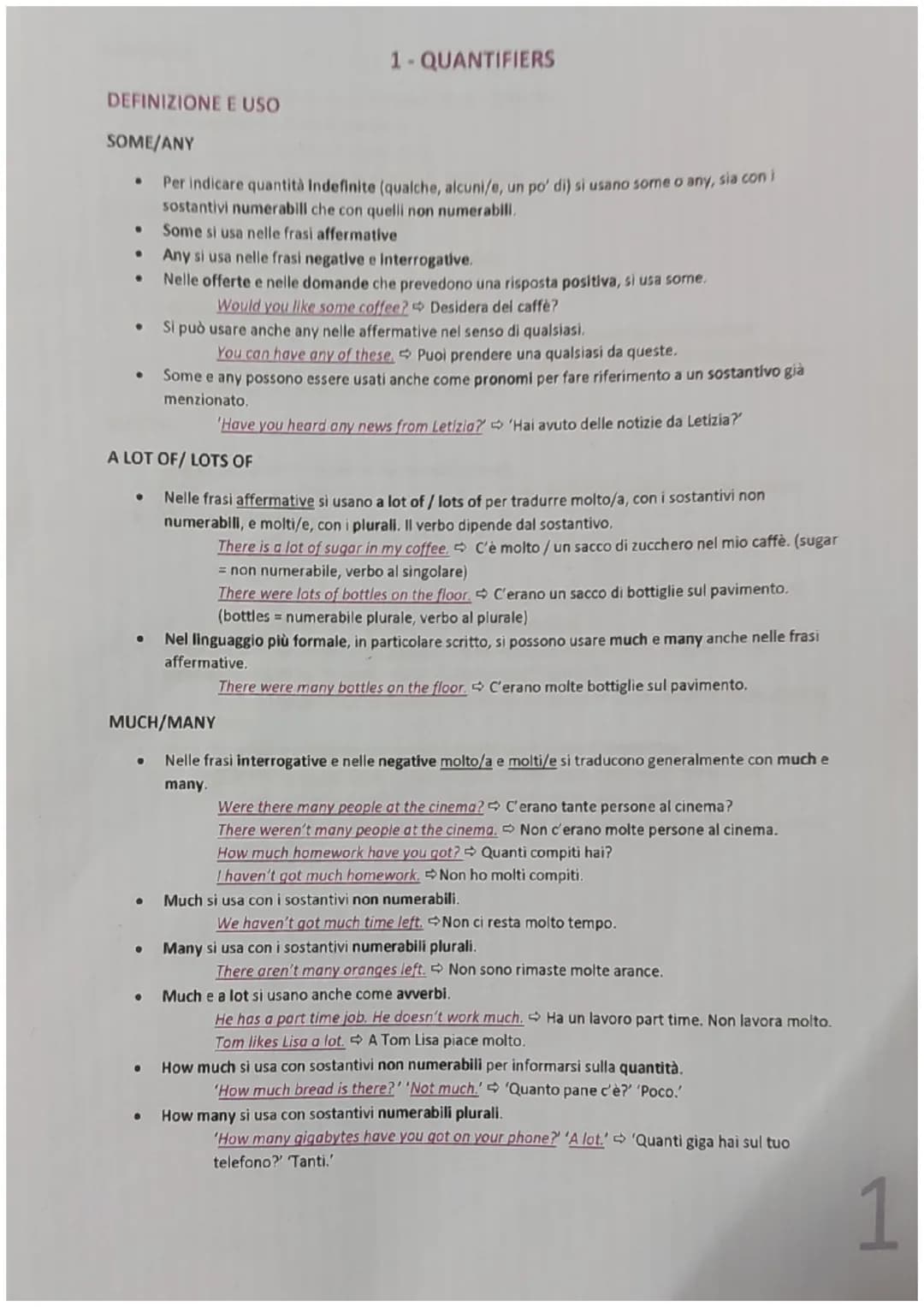
Some, Any e i Quantificatori Principali
Hai mai avuto dubbi su quando dire "some" o "any"? È più semplice di quanto pensi! Some si usa nelle frasi affermative per dire "alcuni" o "un po' di", mentre any va nelle domande e nelle frasi negative.
C'è un'eccezione importante: nelle offerte o domande dove ti aspetti un "sì", usa sempre some. Per esempio: "Would you like some coffee?" suona molto più naturale di "any coffee".
Per le quantità grandi nelle frasi positive, a lot of e lots of sono i tuoi migliori amici. Funzionano sia con sostantivi numerabili che non numerabili. "There are lots of students" oppure "There is a lot of homework" - il verbo cambia in base al sostantivo che segue!
💡 Trucco veloce: Some = frasi positive, Any = domande e negative. A lot of = sempre sicuro per "molto/molti"!
2
of 2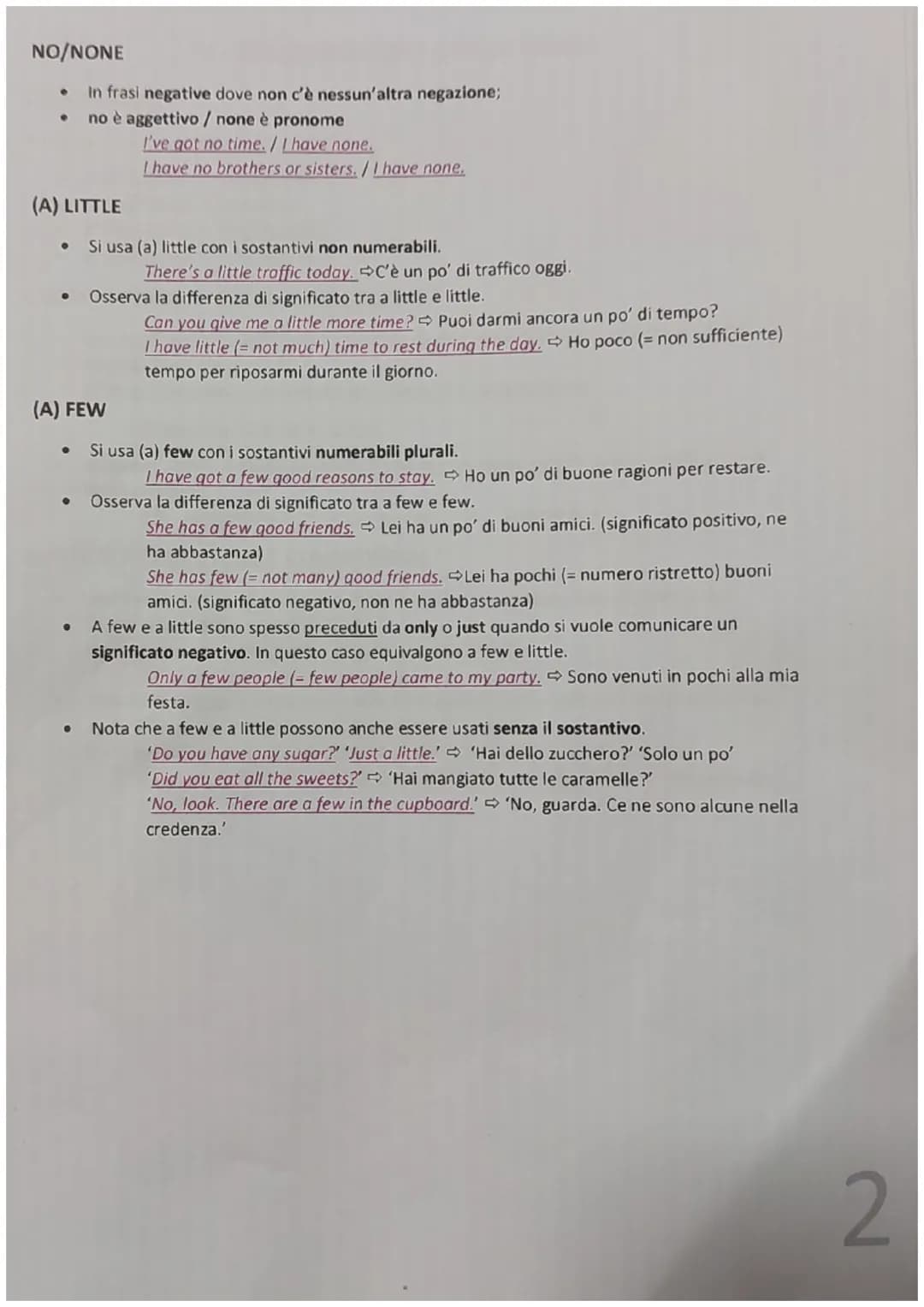
Much, Many e le Quantità Precise
Nelle domande e frasi negative, much e many sono più comuni di "a lot of". Much va con sostantivi non numerabili (much time, much water), mentre many con i plurali (many books, many friends).
Little e few sono un po' tricky! Con l'articolo "a" hanno significato positivo: "a little time" = un po' di tempo (abbastanza). Senza articolo diventano negativi: "little time" = poco tempo (insufficiente).
La stessa regola vale per a few (alcuni, abbastanza) contro few (pochi, non abbastanza). È una differenza sottile ma importante per suonare naturali.
No e none servono per le negazioni complete. No è aggettivo ("I have no money"), none è pronome ("I have none"). Ricorda: una sola negazione per frase in inglese!
💡 Ricorda: A little/A few = positivo, Little/Few = negativo. Questa distinzione ti farà sembrare un vero madrelingua!
We thought you’d never ask...
What is the Knowunity AI companion?
Our AI companion is specifically built for the needs of students. Based on the millions of content pieces we have on the platform we can provide truly meaningful and relevant answers to students. But its not only about answers, the companion is even more about guiding students through their daily learning challenges, with personalised study plans, quizzes or content pieces in the chat and 100% personalisation based on the students skills and developments.
Where can I download the Knowunity app?
You can download the app in the Google Play Store and in the Apple App Store.
Is Knowunity really free of charge?
That's right! Enjoy free access to study content, connect with fellow students, and get instant help – all at your fingertips.
Similar Content
 Anglais
Most popular content: quantifiers
9 Inglese
Quantifiers
è presente la spiegazione di: countable\uncountable nouns, differenza tra: some, any, many, much, a little, a few, a lot(s) of, how much e how many
1ªl3,78680
IngleseI quantificatori in inglese
Some,any,much e many(how,too),a lot of,a little,a few
1ªl2,97660
IngleseMuch, many, a lot of, a few and a little
Appunti sull'uso di much many a lot of a few e a little in inglese
2ªm3,909123
IngleseA/AnSome and anyCountable/uncountable Much/manyA lot of/ lots ofA few/a littleHow much/how manytoo much/too manyPresent continuons
A/AnSome and anyCountable/uncountable Much/manyA lot of/ lots ofA few/a littleHow much/how manytoo much/too manyPresent continuons
1ªl3,382115
IngleseQuantifiers
Uncountable and countable nouns, some, any, much, many, a little, a few, a lot(s) of, how much and how many
1ªm4,80459
Ingleseschema grammatica inglese
• The passive • Quantifiers and indefinite pronouns • Past Simple • Past Continuous • Past Perfect • Verb + infinitive • Verb + object + to infinitive • Verb + ing. • Modal verbs + infinitive without to • Verb + object + infinitive without to
1ªl11,666191
IngleseMUCH / MANY, ANY / SOME, A / AN
.
1ªl1,23713
IngleseQuantifiers
Ripasso dei Quantifiers in inglese
2ªm1,92267
IngleseCountable and Uncountable nouns
Countable and Uncountable nouns, regole ecc..
1ªl1,42213
Most popular content in Fisica
9FisicaI vettori e le forze
Teoria su: i vettori; componenti cartesiane dei vettori; operazione tra vettori; le forze (forza peso; forza elastica; forze di attrito)
1ªl31,3801,589
L
FisicaLe forze - fisica
Sei pront* per l’interrogazione o per la verifica? Verificalo con questo test!
1ªl1,5546
P
FisicaPressione e principio di Stevino/Archimede
quiz
1ªl7230
 Matematica
Preparazione Tolc I
Il contenuto è un ripasso completo di tutti gli argomenti matematici e fisici su cui le domande del TOLC I si basano.
5ªl4,108133
FisicaCampo elettrico, il flusso, teorema di Gauss , il potenziale elettrico, la differenza di potenziale, il condensatore piano
Campo elettrico, il flusso, teorema di Gauss , il potenziale elettrico, la differenza di potenziale, il condensatore piano
5ªl31,9881,158
MatematicaLIMITI - APPUNTI COMPLETI CON TEOREMI
Limiti notevoli, goniometri, teoremi di fondamenta…
4ªl5,98391
F
FisicaFisica: Energie
Energia meccanica, cinetica e potenziale.
3ªl9422
F
FisicaFormule e teoria MRU MRUA
Quiz su formule e teoria di fisica che riguardano MRU e MRUA
1ªl1,3086
FisicaCarica Elettrica - Legge di Coulomb - Polarizzazione - Campo Elettrico - Teorema di Gauss
Appunti sulla carica elettrica, legge di Coulomb, polarizzazione degli isolanti, costante dielettrica relativa e assoluta, il campo elettrico, flusso del campo elettrico, teorema di Gauss.
4ªl8,728200
Most popular content
9 Italiano
Riassunto patente B
Riassunto patente B - appunti presi a lezione
5ªl29,228943
 Altro
AltroTeoria patente b
Tutti gli argomenti per la patente
1ªl21,114685
 Ed. civ.
Teoria patente di guida B: Segnali stradali
Segnali stradali di pericolo, luminosi, di prescrizione, di indicazione, temporanei, complementari, pannelli integrativi, segnaletica orizzontale, segnalazioni agenti del traffico, distanza di visibilità per l‘arresto, minima di sicurezza.
5ªl40,0241,644
 Filosofia
Aristotele
Aristotele: vita, metafisica, fisica, etica e politica, retorica e poetica
3ªl7,623216
ItalianoI promessi sposi
Riassunti completi di tutti i 38 capitoli dei Promessi sposi.
2ªl14,090314
AltroPATENTE
schemi per esame teorico della patente
Università22,050755
S
ItalianoSintesi finale di Analisi logica
Esercitazione completa di analisi logica su frasi articolate per consolidare la conoscenza di tutti i complementi.
3ªm5,5290
P
InglesePresent Simple vs Present Continuous
Develop the ability to choose correctly between the Present Simple for habits and the Present Continuous for ongoing actions.
3ªm4,2110
G
ItalianoGabriele D'Annunzio e l'Estetismo
Domande sull'ideale del superuomo, il panismo e la concezione dell'arte come valore assoluto in D'Annunzio.
4ªl2,6740
Can't find what you're looking for? Explore other subjects.
Students love us — and so will you.
4.6/5App Store
4.7/5Google Play
The app is very easy to use and well designed. I have found everything I was looking for so far and have been able to learn a lot from the presentations! I will definitely use the app for a class assignment! And of course it also helps a lot as an inspiration.
Stefan SiOS user
This app is really great. There are so many study notes and help [...]. My problem subject is French, for example, and the app has so many options for help. Thanks to this app, I have improved my French. I would recommend it to anyone.
Samantha KlichAndroid user
Wow, I am really amazed. I just tried the app because I've seen it advertised many times and was absolutely stunned. This app is THE HELP you want for school and above all, it offers so many things, such as workouts and fact sheets, which have been VERY helpful to me personally.
AnnaiOS user
Fisica1,283 views·Updated Jun 22, 2026·2 pagesUnderstanding Quantifiers in English
Helly@elisavalentini_bnho
I quantificatori in inglese ti aiutano a esprimere quantità indefinite come "alcuni", "molti" o "poco". Sapere quando usare some, any, much, many e gli altri è fondamentale per parlare e scrivere correttamente in inglese.
1
of 2
Sign up to see the content. It's free!
- Access to all documents
- Improve your grades
- Join milions of students
Some, Any e i Quantificatori Principali
Hai mai avuto dubbi su quando dire "some" o "any"? È più semplice di quanto pensi! Some si usa nelle frasi affermative per dire "alcuni" o "un po' di", mentre any va nelle domande e nelle frasi negative.
C'è un'eccezione importante: nelle offerte o domande dove ti aspetti un "sì", usa sempre some. Per esempio: "Would you like some coffee?" suona molto più naturale di "any coffee".
Per le quantità grandi nelle frasi positive, a lot of e lots of sono i tuoi migliori amici. Funzionano sia con sostantivi numerabili che non numerabili. "There are lots of students" oppure "There is a lot of homework" - il verbo cambia in base al sostantivo che segue!
💡 Trucco veloce: Some = frasi positive, Any = domande e negative. A lot of = sempre sicuro per "molto/molti"!
2
of 2Sign up to see the content. It's free!
- Access to all documents
- Improve your grades
- Join milions of students
Much, Many e le Quantità Precise
Nelle domande e frasi negative, much e many sono più comuni di "a lot of". Much va con sostantivi non numerabili (much time, much water), mentre many con i plurali (many books, many friends).
Little e few sono un po' tricky! Con l'articolo "a" hanno significato positivo: "a little time" = un po' di tempo (abbastanza). Senza articolo diventano negativi: "little time" = poco tempo (insufficiente).
La stessa regola vale per a few (alcuni, abbastanza) contro few (pochi, non abbastanza). È una differenza sottile ma importante per suonare naturali.
No e none servono per le negazioni complete. No è aggettivo ("I have no money"), none è pronome ("I have none"). Ricorda: una sola negazione per frase in inglese!
💡 Ricorda: A little/A few = positivo, Little/Few = negativo. Questa distinzione ti farà sembrare un vero madrelingua!
We thought you’d never ask...
What is the Knowunity AI companion?
Our AI companion is specifically built for the needs of students. Based on the millions of content pieces we have on the platform we can provide truly meaningful and relevant answers to students. But its not only about answers, the companion is even more about guiding students through their daily learning challenges, with personalised study plans, quizzes or content pieces in the chat and 100% personalisation based on the students skills and developments.
Where can I download the Knowunity app?
You can download the app in the Google Play Store and in the Apple App Store.
Is Knowunity really free of charge?
That's right! Enjoy free access to study content, connect with fellow students, and get instant help – all at your fingertips.
Similar Content
Most popular content: quantifiers
9IngleseQuantifiers
è presente la spiegazione di: countable\uncountable nouns, differenza tra: some, any, many, much, a little, a few, a lot(s) of, how much e how many
1ªl3,78680
IngleseI quantificatori in inglese
Some,any,much e many(how,too),a lot of,a little,a few
1ªl2,97660
IngleseMuch, many, a lot of, a few and a little
Appunti sull'uso di much many a lot of a few e a little in inglese
2ªm3,909123
IngleseA/AnSome and anyCountable/uncountable Much/manyA lot of/ lots ofA few/a littleHow much/how manytoo much/too manyPresent continuons
A/AnSome and anyCountable/uncountable Much/manyA lot of/ lots ofA few/a littleHow much/how manytoo much/too manyPresent continuons
1ªl3,382115
IngleseQuantifiers
Uncountable and countable nouns, some, any, much, many, a little, a few, a lot(s) of, how much and how many
1ªm4,80459
Ingleseschema grammatica inglese
• The passive • Quantifiers and indefinite pronouns • Past Simple • Past Continuous • Past Perfect • Verb + infinitive • Verb + object + to infinitive • Verb + ing. • Modal verbs + infinitive without to • Verb + object + infinitive without to
1ªl11,666191
IngleseMUCH / MANY, ANY / SOME, A / AN
.
1ªl1,23713
IngleseQuantifiers
Ripasso dei Quantifiers in inglese
2ªm1,92267
IngleseCountable and Uncountable nouns
Countable and Uncountable nouns, regole ecc..
1ªl1,42213
Most popular content in Fisica
9FisicaI vettori e le forze
Teoria su: i vettori; componenti cartesiane dei vettori; operazione tra vettori; le forze (forza peso; forza elastica; forze di attrito)
1ªl31,3801,589
L
FisicaLe forze - fisica
Sei pront* per l’interrogazione o per la verifica? Verificalo con questo test!
1ªl1,5546
P
FisicaPressione e principio di Stevino/Archimede
quiz
1ªl7230
MatematicaPreparazione Tolc I
Il contenuto è un ripasso completo di tutti gli argomenti matematici e fisici su cui le domande del TOLC I si basano.
5ªl4,108133
FisicaCampo elettrico, il flusso, teorema di Gauss , il potenziale elettrico, la differenza di potenziale, il condensatore piano
Campo elettrico, il flusso, teorema di Gauss , il potenziale elettrico, la differenza di potenziale, il condensatore piano
5ªl31,9881,158
MatematicaLIMITI - APPUNTI COMPLETI CON TEOREMI
Limiti notevoli, goniometri, teoremi di fondamenta…
4ªl5,98391
F
FisicaFisica: Energie
Energia meccanica, cinetica e potenziale.
3ªl9422
F
FisicaFormule e teoria MRU MRUA
Quiz su formule e teoria di fisica che riguardano MRU e MRUA
1ªl1,3086
FisicaCarica Elettrica - Legge di Coulomb - Polarizzazione - Campo Elettrico - Teorema di Gauss
Appunti sulla carica elettrica, legge di Coulomb, polarizzazione degli isolanti, costante dielettrica relativa e assoluta, il campo elettrico, flusso del campo elettrico, teorema di Gauss.
4ªl8,728200
Most popular content
9ItalianoRiassunto patente B
Riassunto patente B - appunti presi a lezione
5ªl29,228943
AltroTeoria patente b
Tutti gli argomenti per la patente
1ªl21,114685
Ed. civ.Teoria patente di guida B: Segnali stradali
Segnali stradali di pericolo, luminosi, di prescrizione, di indicazione, temporanei, complementari, pannelli integrativi, segnaletica orizzontale, segnalazioni agenti del traffico, distanza di visibilità per l‘arresto, minima di sicurezza.
5ªl40,0241,644
FilosofiaAristotele
Aristotele: vita, metafisica, fisica, etica e politica, retorica e poetica
3ªl7,623216
ItalianoI promessi sposi
Riassunti completi di tutti i 38 capitoli dei Promessi sposi.
2ªl14,090314
AltroPATENTE
schemi per esame teorico della patente
Università22,050755
S
ItalianoSintesi finale di Analisi logica
Esercitazione completa di analisi logica su frasi articolate per consolidare la conoscenza di tutti i complementi.
3ªm5,5290
P
InglesePresent Simple vs Present Continuous
Develop the ability to choose correctly between the Present Simple for habits and the Present Continuous for ongoing actions.
3ªm4,2110
G
ItalianoGabriele D'Annunzio e l'Estetismo
Domande sull'ideale del superuomo, il panismo e la concezione dell'arte come valore assoluto in D'Annunzio.
4ªl2,6740
Can't find what you're looking for? Explore other subjects.
Students love us — and so will you.
4.6/5App Store
4.7/5Google Play
The app is very easy to use and well designed. I have found everything I was looking for so far and have been able to learn a lot from the presentations! I will definitely use the app for a class assignment! And of course it also helps a lot as an inspiration.
Stefan SiOS user
This app is really great. There are so many study notes and help [...]. My problem subject is French, for example, and the app has so many options for help. Thanks to this app, I have improved my French. I would recommend it to anyone.
Samantha KlichAndroid user
Wow, I am really amazed. I just tried the app because I've seen it advertised many times and was absolutely stunned. This app is THE HELP you want for school and above all, it offers so many things, such as workouts and fact sheets, which have been VERY helpful to me personally.
AnnaiOS user