
¿Te lías con las conjugaciones del euskera? Los sistemas verbales...
 Euskera604 views·Updated Jun 25, 2026·5 pages
Aditzak en Euskera para Primero de Bachillerato

Nahikari@nahikariiiii
1 / 5
1
of 5
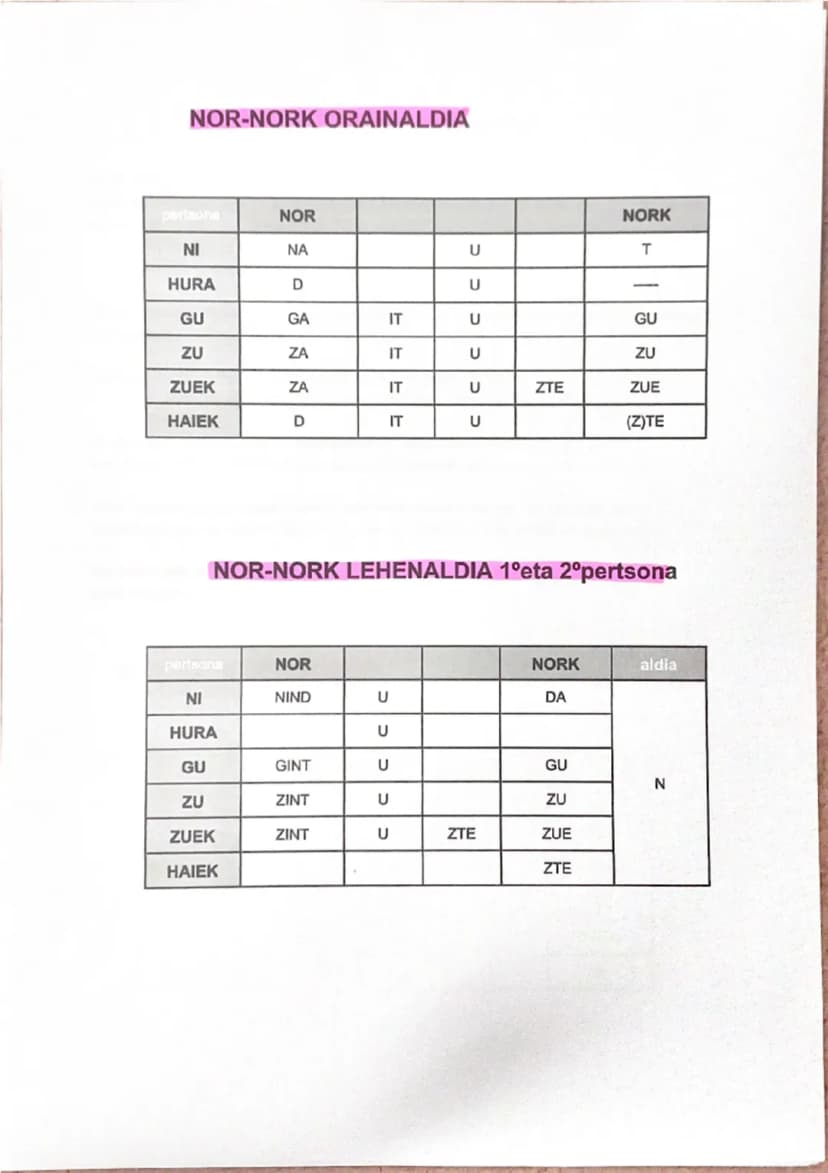
Sistema NOR-NORK: Presente y Pasado
El sistema NOR-NORK se usa cuando hay una acción que recae directamente sobre un objeto. Es como el equivalente a los verbos transitivos en castellano.
En el presente (orainaldia), las formas van desde las más simples como "dut" (lo tengo) hasta "dituzte" (ellos los tienen). Las conjugaciones cambian según quién hace la acción (NORK) y quién o qué la recibe (NOR).
El pasado (lehenaldia) para primera y segunda persona usa formas como "ninduen" o "zintuzte". Aquí lo importante es fijarse en las terminaciones que nos indican quién realiza la acción.
Truco: Si en castellano puedes añadir un objeto directo a la frase, probablemente necesites NOR-NORK en euskera.
2
of 5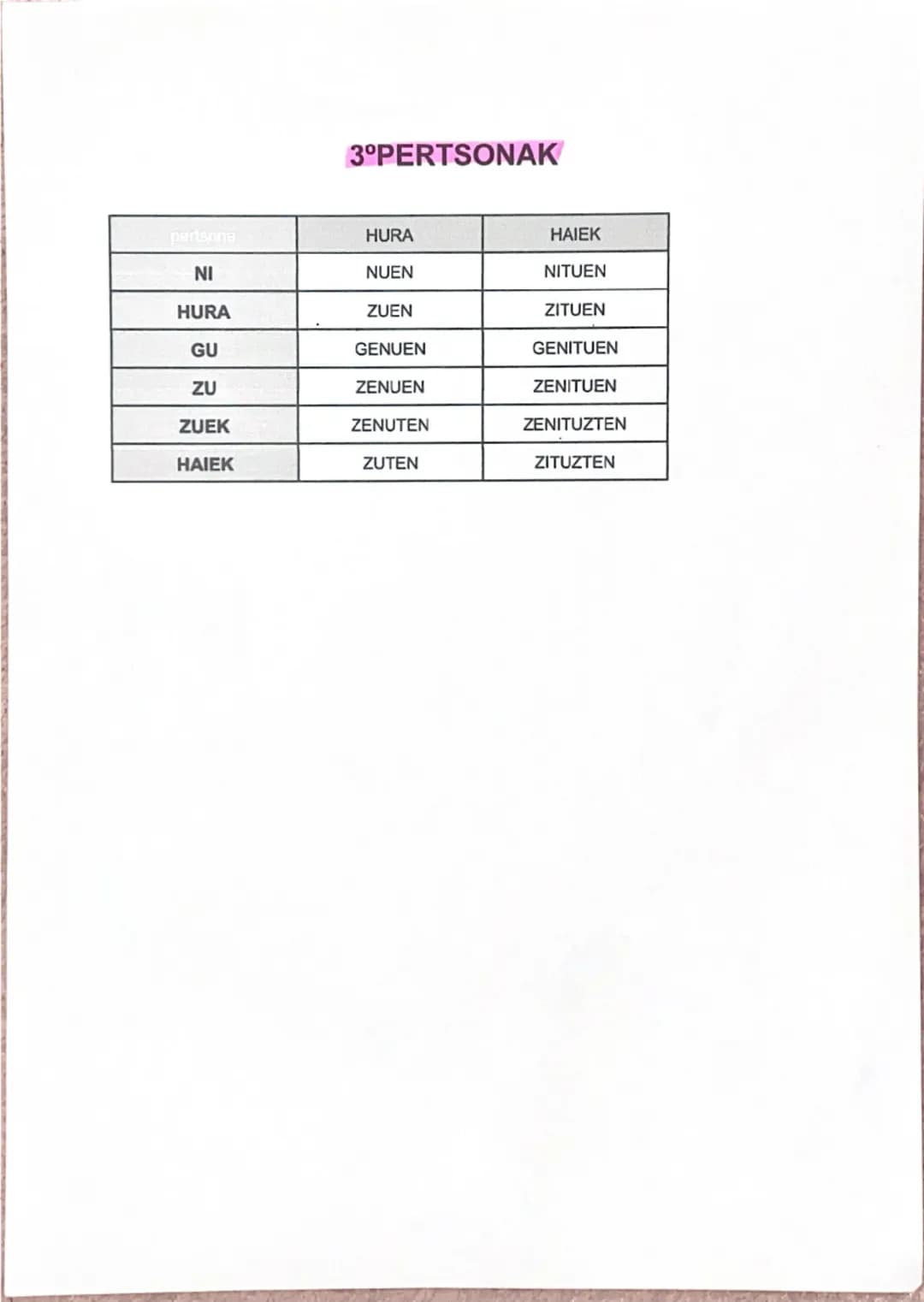
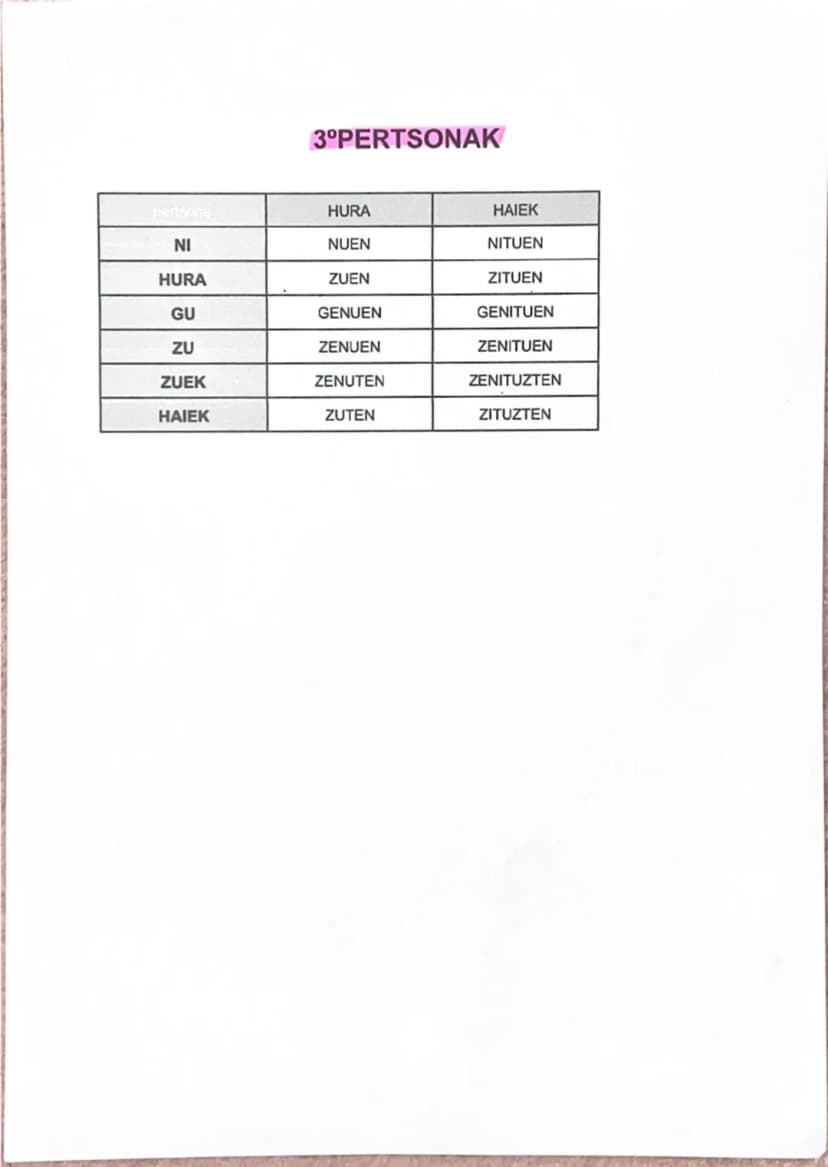
NOR-NORK: Terceras Personas en Pasado
Las terceras personas en pasado tienen sus propias formas especiales. Cuando "hura" o "haiek" son quienes realizan la acción, las conjugaciones cambian completamente.
Por ejemplo, "nuen" significa "yo lo tenía", mientras que "zuen" es "él lo tenía". Para los plurales, "nituen" sería "yo los tenía" y "zituen" es "él los tenía".
Las formas con "haiek" siempre terminan en -n: "zuten", "zituzten". Es un patrón que te ayudará a recordarlas mejor.
Dato clave: Las terceras personas siempre tienen formas únicas que es mejor memorizar como bloques.
3
of 5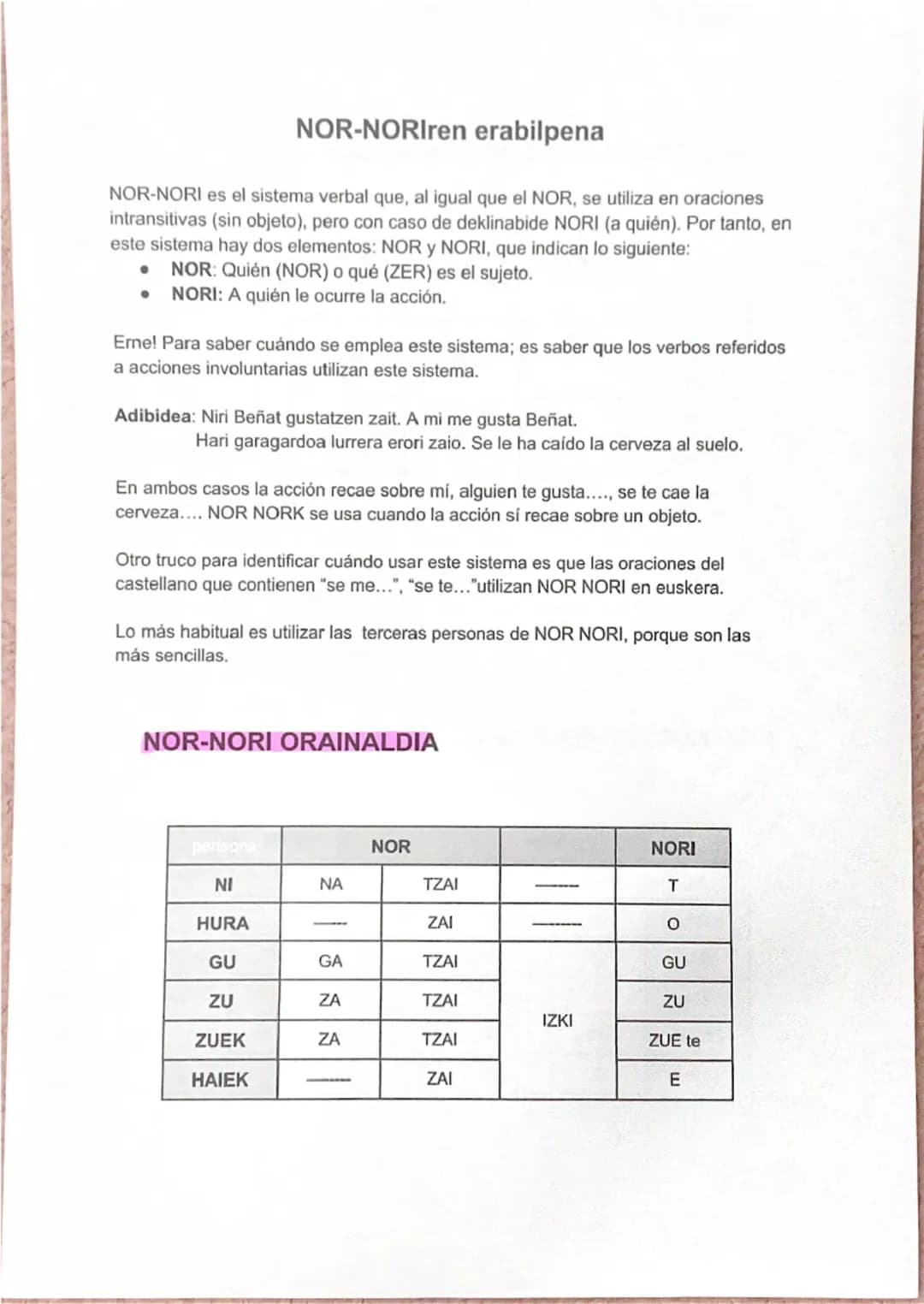
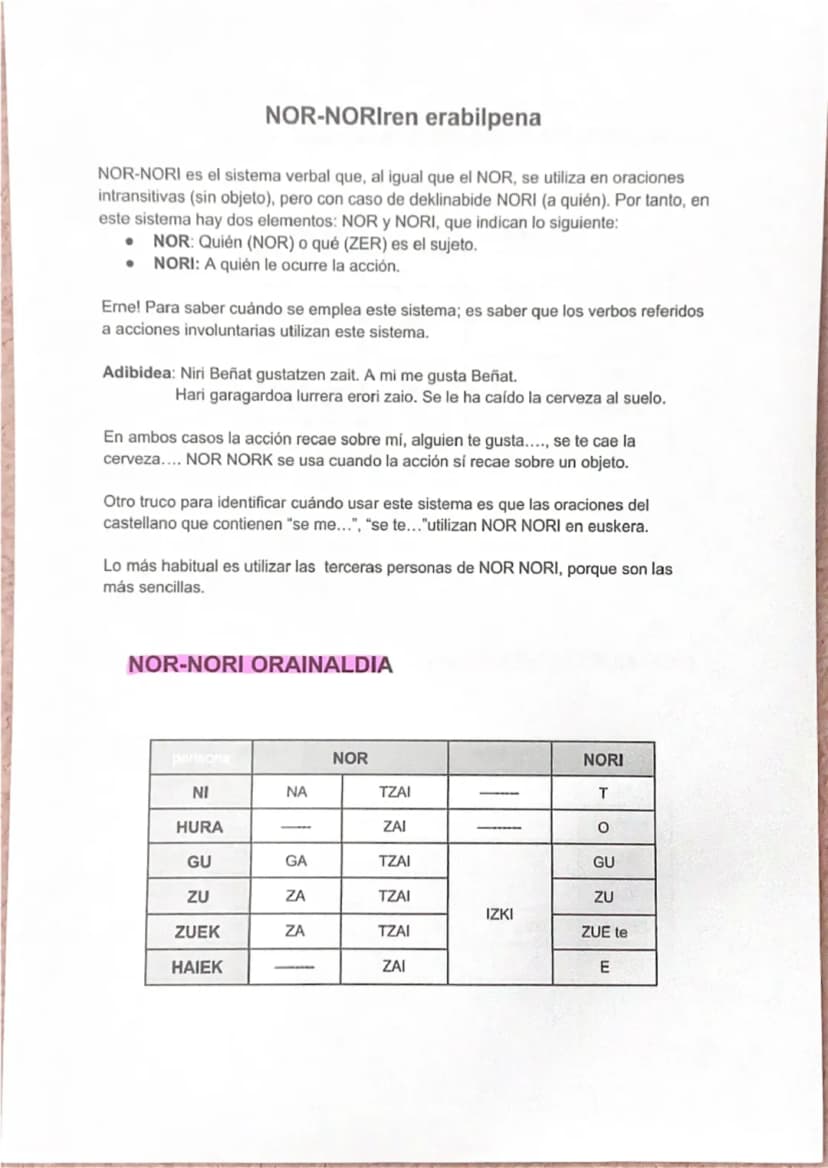
Sistema NOR-NORI: Acciones Involuntarias
¿Alguna vez has dicho "se me ha caído" o "me gusta"? El sistema NOR-NORI es perfecto para estas situaciones donde la acción no es completamente voluntaria.
Este sistema tiene dos elementos clave: NOR (quién o qué es el sujeto) y NORI (a quién le pasa la acción). Un ejemplo claro es "Niri Benat gustatzen zait" (A mí me gusta Benat).
Las terceras personas son las más comunes y sencillas de usar. Formas como "zait" (me ocurre a mí) o "zaio" aparecen constantemente en conversaciones cotidianas.
Regla de oro: Si en castellano usas "se me...", "se te...", en euskera necesitarás NOR-NORI.
4
of 5
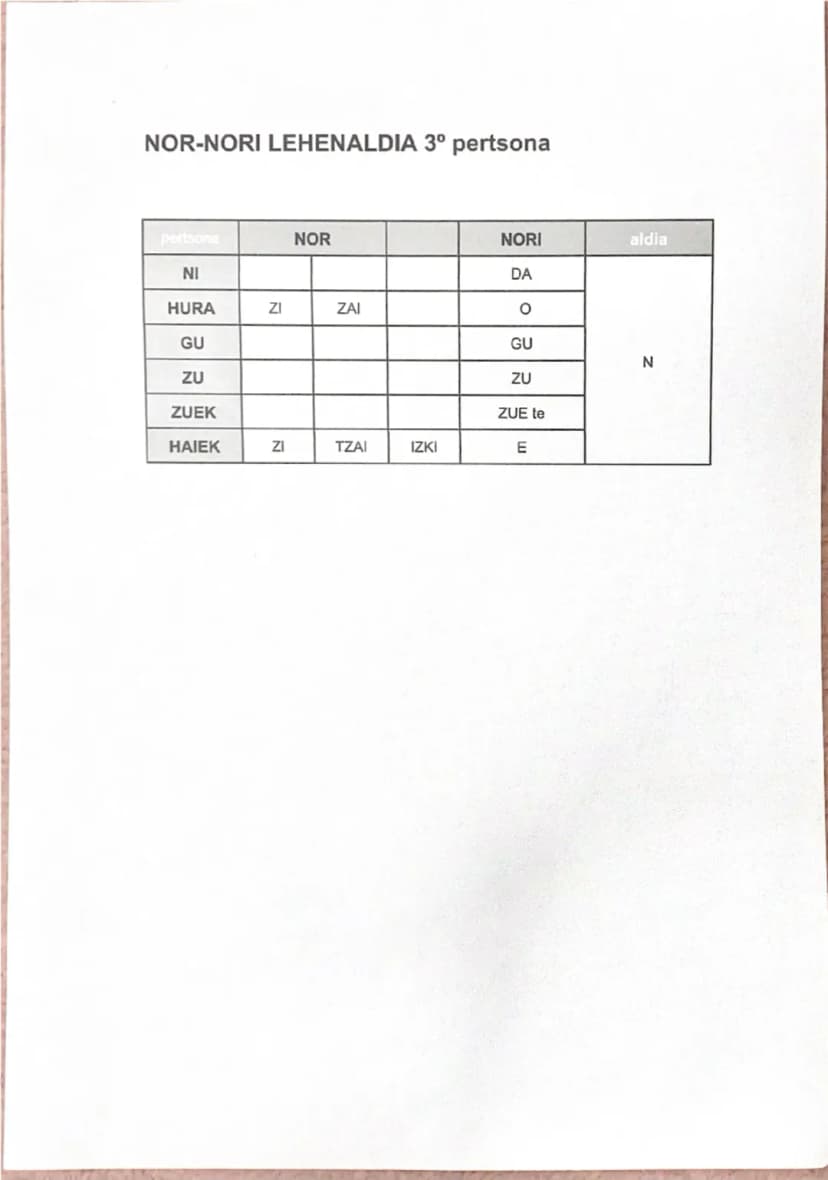
NOR-NORI en Pasado
El pasado del sistema NOR-NORI sigue patrones similares al presente, pero con sus propias terminaciones. Las formas más habituales incluyen "zitzaidan" (me ocurrió a mí) o "zitzaion" .
Para las terceras personas, que son las más frecuentes, las conjugaciones mantienen la base "zitzai-" pero cambian según a quién le ocurre la acción. Es más fácil de lo que parece una vez que practicas.
La clave está en reconocer el patrón: primero identifies quién recibe la acción (NORI) y después adaptas la terminación según corresponda.
Consejo práctico: Empieza dominando las terceras personas antes de complicarte con el resto.
5
of 5
Sistema NOR-NORI-NORK: El Más Complejo
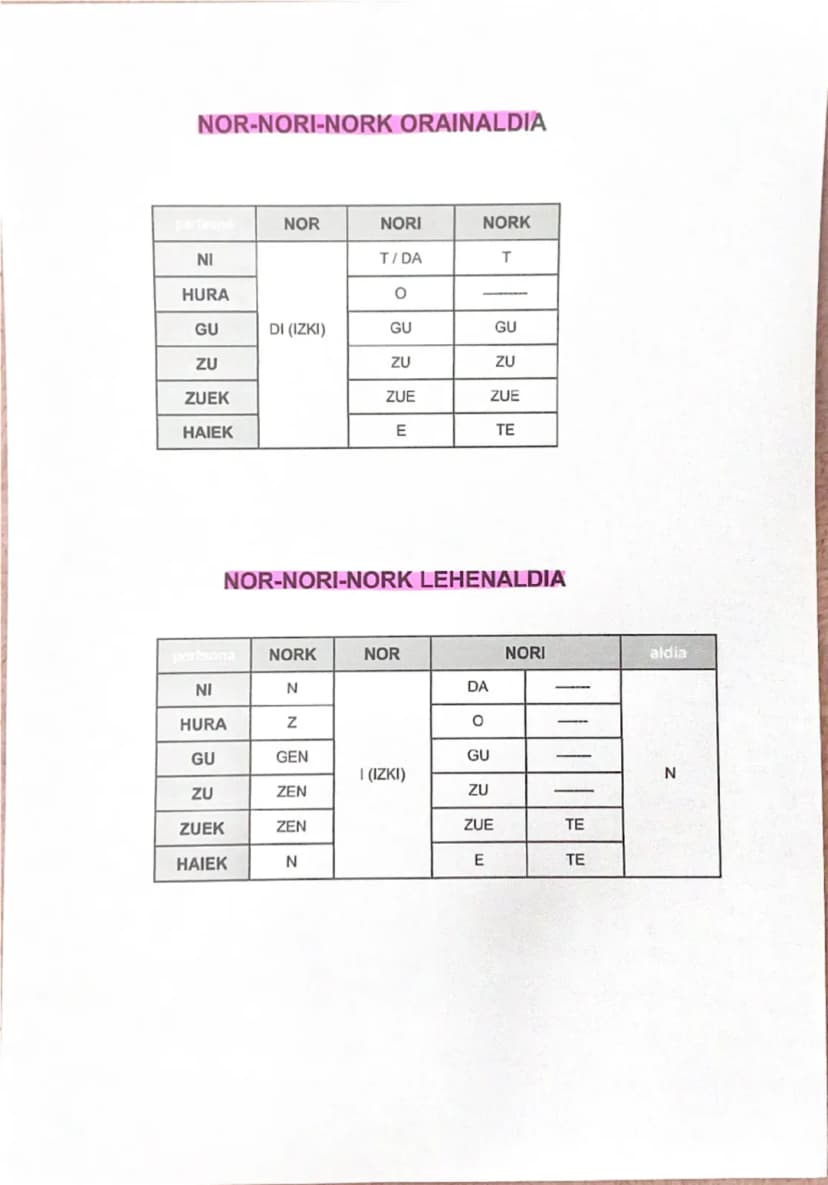
El sistema NOR-NORI-NORK es como el "jefe final" de los verbos euskera. Combina tres elementos: quién hace la acción (NORK), qué recibe la acción (NOR) y a quién se le hace (NORI).
En el presente, formas como "dizut" (te lo doy) o "dizkigu" (nos los dan) son habituales. Puede parecer complicado, pero cada parte tiene su función específica.
El pasado sigue la misma lógica pero con terminaciones diferentes. "Zenidan" (me lo diste) o "genion" (se lo dimos) son ejemplos típicos que encontrarás en textos y conversaciones.
No te agobies: Este sistema se domina con práctica constante. Empieza con las formas más básicas y ve añadiendo complejidad poco a poco.
We thought you’d never ask...
What is the Knowunity AI companion?
Our AI companion is specifically built for the needs of students. Based on the millions of content pieces we have on the platform we can provide truly meaningful and relevant answers to students. But its not only about answers, the companion is even more about guiding students through their daily learning challenges, with personalised study plans, quizzes or content pieces in the chat and 100% personalisation based on the students skills and developments.
Where can I download the Knowunity app?
You can download the app in the Google Play Store and in the Apple App Store.
Is Knowunity really free of charge?
That's right! Enjoy free access to study content, connect with fellow students, and get instant help – all at your fingertips.
Similar Content
Most popular content: verbos vascos
9EuskeraAhalera eta subjuntiboa aditzak euskera
Ahalera(errealean,iraganean eta hipotetikoan) eta subjuntiboa(orainaldian eta iraganean)
4° ESO49515
EuskeraEuskara: indikatiboa, baldintza, ahalera, berridazketak eta esamoldeak.
1° Bach87022
EuskeraPlantilla para idazlana de euskera EBAU
Plantilla de: Gutun informal, Gutun formal kexa/ eskaera eta iritzi artikulua.
PAU (2° Bach)7209
EuskeraMenpeko perpausak
Kausazko perpausak, helburuzko perpausak…
4° ESO71312
EuskeraBaldintzak
Euskaera
3° ESO1,92328
EuskeraNor nori nork
Nor nori nork
3° ESO5516
EuskeraBALDINTZAK TAULAK
Baldintako taulak
PAU (2° Bach)2926
EuskeraTestu Antolatzaileak
Conectores en euskera, vienen MUY BIEN para los idazlanas.
3° ESO84018
EuskeraPerpausak
Los perpausak: teoría y ejemplos
3° ESO1,18825
Most popular content in Euskera
9EuskeraEuskara: indikatiboa, baldintza, ahalera, berridazketak eta esamoldeak.
1° Bach87022
EuskeraAhalera eta subjuntiboa aditzak euskera
Ahalera(errealean,iraganean eta hipotetikoan) eta subjuntiboa(orainaldian eta iraganean)
4° ESO49515
EuskeraPlantilla para idazlana de euskera EBAU
Plantilla de: Gutun informal, Gutun formal kexa/ eskaera eta iritzi artikulua.
PAU (2° Bach)7209
EuskeraMenpeko perpausak
Kausazko perpausak, helburuzko perpausak…
4° ESO71312
EuskeraBaldintzak
Euskaera
3° ESO1,92328
EuskeraNor nori nork
Nor nori nork
3° ESO5516
EuskeraBALDINTZAK TAULAK
Baldintako taulak
PAU (2° Bach)2926
EuskeraTestu Antolatzaileak
Conectores en euskera, vienen MUY BIEN para los idazlanas.
3° ESO84018
EuskeraPerpausak
Los perpausak: teoría y ejemplos
3° ESO1,18825
Most popular content
9I
 Inglés
irregular verbs quiz
Domina el idioma inglés de manera sencilla y divertida con estos flashcards diseñados especialmente para estudiantes de sexto grado.
6º primaria2,8981
R
 Geografía e Historia
roma
a estudiar Roma!!
1° ESO2,3122
G
Geografía e HistoriaGrecia: Inicio de la democracia
Más o menos las preguntas que me pusieron a mí en el examen
1° ESO2,3622
D
InglésDominando la gramática inglesa: Flashcards desafiantes
Mejora tus habilidades gramaticales en inglés con estos flashcards desafiantes diseñados para estudiantes de grado 11. ¡Prepárate para dominar la gramática inglesa de manera divertida y efectiva!
3° ESO2,2480
M
Geografía e HistoriaMesopotamia y Egipto
Contenidos sobre la civilización mesopotámica y egipcia
1° ESO3,9381
O
 Lengua Castellana y Literatura
OBRAS Y AUTORES II
Quiz donde tendrás que relacionar las siguientes obras con sus respectivos autores: edición Romanticismo.
4° ESO3,3610
I
InglésIngles para repasar
quiz de ingles para entrar a clase preparados
2° ESO2,6290
F
 Filosofía
filosofía
repaso filosofía "el arje , la metafísica y la crítica de Nietszche a platon"
1° Bach2,8421
I
InglésIrregular verbs
Aprende nuevas palabras y expande tu vocabulario en inglés con esta colección de tarjetas de estudio interactivas.
3° ESO1,7442
Can't find what you're looking for? Explore other subjects.
Students love us — and so will you.
4.6/5App Store
4.7/5Google Play
The app is very easy to use and well designed. I have found everything I was looking for so far and have been able to learn a lot from the presentations! I will definitely use the app for a class assignment! And of course it also helps a lot as an inspiration.
Stefan SiOS user
This app is really great. There are so many study notes and help [...]. My problem subject is French, for example, and the app has so many options for help. Thanks to this app, I have improved my French. I would recommend it to anyone.
Samantha KlichAndroid user
Wow, I am really amazed. I just tried the app because I've seen it advertised many times and was absolutely stunned. This app is THE HELP you want for school and above all, it offers so many things, such as workouts and fact sheets, which have been VERY helpful to me personally.
AnnaiOS user
Euskera604 views·Updated Jun 25, 2026·5 pagesAditzak en Euskera para Primero de Bachillerato
Nahikari@nahikariiiii
¿Te lías con las conjugaciones del euskera? Los sistemas verbales NOR-NORK, NOR-NORI y NOR-NORI-NORK son la base para formar correctamente los verbos en euskera. Una vez que pilles el truco, verás que todo tiene su lógica.
1
of 5
Sign up to see the content. It's free!
- Access to all documents
- Improve your grades
- Join milions of students
Sistema NOR-NORK: Presente y Pasado
El sistema NOR-NORK se usa cuando hay una acción que recae directamente sobre un objeto. Es como el equivalente a los verbos transitivos en castellano.
En el presente (orainaldia), las formas van desde las más simples como "dut" (lo tengo) hasta "dituzte" (ellos los tienen). Las conjugaciones cambian según quién hace la acción (NORK) y quién o qué la recibe (NOR).
El pasado (lehenaldia) para primera y segunda persona usa formas como "ninduen" o "zintuzte". Aquí lo importante es fijarse en las terminaciones que nos indican quién realiza la acción.
Truco: Si en castellano puedes añadir un objeto directo a la frase, probablemente necesites NOR-NORK en euskera.
2
of 5Sign up to see the content. It's free!
- Access to all documents
- Improve your grades
- Join milions of students
NOR-NORK: Terceras Personas en Pasado
Las terceras personas en pasado tienen sus propias formas especiales. Cuando "hura" o "haiek" son quienes realizan la acción, las conjugaciones cambian completamente.
Por ejemplo, "nuen" significa "yo lo tenía", mientras que "zuen" es "él lo tenía". Para los plurales, "nituen" sería "yo los tenía" y "zituen" es "él los tenía".
Las formas con "haiek" siempre terminan en -n: "zuten", "zituzten". Es un patrón que te ayudará a recordarlas mejor.
Dato clave: Las terceras personas siempre tienen formas únicas que es mejor memorizar como bloques.
3
of 5Sign up to see the content. It's free!
- Access to all documents
- Improve your grades
- Join milions of students
Sistema NOR-NORI: Acciones Involuntarias
¿Alguna vez has dicho "se me ha caído" o "me gusta"? El sistema NOR-NORI es perfecto para estas situaciones donde la acción no es completamente voluntaria.
Este sistema tiene dos elementos clave: NOR (quién o qué es el sujeto) y NORI (a quién le pasa la acción). Un ejemplo claro es "Niri Benat gustatzen zait" (A mí me gusta Benat).
Las terceras personas son las más comunes y sencillas de usar. Formas como "zait" (me ocurre a mí) o "zaio" aparecen constantemente en conversaciones cotidianas.
Regla de oro: Si en castellano usas "se me...", "se te...", en euskera necesitarás NOR-NORI.
4
of 5Sign up to see the content. It's free!
- Access to all documents
- Improve your grades
- Join milions of students
NOR-NORI en Pasado
El pasado del sistema NOR-NORI sigue patrones similares al presente, pero con sus propias terminaciones. Las formas más habituales incluyen "zitzaidan" (me ocurrió a mí) o "zitzaion" .
Para las terceras personas, que son las más frecuentes, las conjugaciones mantienen la base "zitzai-" pero cambian según a quién le ocurre la acción. Es más fácil de lo que parece una vez que practicas.
La clave está en reconocer el patrón: primero identifies quién recibe la acción (NORI) y después adaptas la terminación según corresponda.
Consejo práctico: Empieza dominando las terceras personas antes de complicarte con el resto.
5
of 5Sign up to see the content. It's free!
- Access to all documents
- Improve your grades
- Join milions of students
Sistema NOR-NORI-NORK: El Más Complejo
El sistema NOR-NORI-NORK es como el "jefe final" de los verbos euskera. Combina tres elementos: quién hace la acción (NORK), qué recibe la acción (NOR) y a quién se le hace (NORI).
En el presente, formas como "dizut" (te lo doy) o "dizkigu" (nos los dan) son habituales. Puede parecer complicado, pero cada parte tiene su función específica.
El pasado sigue la misma lógica pero con terminaciones diferentes. "Zenidan" (me lo diste) o "genion" (se lo dimos) son ejemplos típicos que encontrarás en textos y conversaciones.
No te agobies: Este sistema se domina con práctica constante. Empieza con las formas más básicas y ve añadiendo complejidad poco a poco.
We thought you’d never ask...
What is the Knowunity AI companion?
Our AI companion is specifically built for the needs of students. Based on the millions of content pieces we have on the platform we can provide truly meaningful and relevant answers to students. But its not only about answers, the companion is even more about guiding students through their daily learning challenges, with personalised study plans, quizzes or content pieces in the chat and 100% personalisation based on the students skills and developments.
Where can I download the Knowunity app?
You can download the app in the Google Play Store and in the Apple App Store.
Is Knowunity really free of charge?
That's right! Enjoy free access to study content, connect with fellow students, and get instant help – all at your fingertips.
Similar Content
Most popular content: verbos vascos
9EuskeraAhalera eta subjuntiboa aditzak euskera
Ahalera(errealean,iraganean eta hipotetikoan) eta subjuntiboa(orainaldian eta iraganean)
4° ESO49515
EuskeraEuskara: indikatiboa, baldintza, ahalera, berridazketak eta esamoldeak.
1° Bach87022
EuskeraPlantilla para idazlana de euskera EBAU
Plantilla de: Gutun informal, Gutun formal kexa/ eskaera eta iritzi artikulua.
PAU (2° Bach)7209
EuskeraMenpeko perpausak
Kausazko perpausak, helburuzko perpausak…
4° ESO71312
EuskeraBaldintzak
Euskaera
3° ESO1,92328
EuskeraNor nori nork
Nor nori nork
3° ESO5516
EuskeraBALDINTZAK TAULAK
Baldintako taulak
PAU (2° Bach)2926
EuskeraTestu Antolatzaileak
Conectores en euskera, vienen MUY BIEN para los idazlanas.
3° ESO84018
EuskeraPerpausak
Los perpausak: teoría y ejemplos
3° ESO1,18825
Most popular content in Euskera
9EuskeraEuskara: indikatiboa, baldintza, ahalera, berridazketak eta esamoldeak.
1° Bach87022
EuskeraAhalera eta subjuntiboa aditzak euskera
Ahalera(errealean,iraganean eta hipotetikoan) eta subjuntiboa(orainaldian eta iraganean)
4° ESO49515
EuskeraPlantilla para idazlana de euskera EBAU
Plantilla de: Gutun informal, Gutun formal kexa/ eskaera eta iritzi artikulua.
PAU (2° Bach)7209
EuskeraMenpeko perpausak
Kausazko perpausak, helburuzko perpausak…
4° ESO71312
EuskeraBaldintzak
Euskaera
3° ESO1,92328
EuskeraNor nori nork
Nor nori nork
3° ESO5516
EuskeraBALDINTZAK TAULAK
Baldintako taulak
PAU (2° Bach)2926
EuskeraTestu Antolatzaileak
Conectores en euskera, vienen MUY BIEN para los idazlanas.
3° ESO84018
EuskeraPerpausak
Los perpausak: teoría y ejemplos
3° ESO1,18825
Most popular content
9I
Inglésirregular verbs quiz
Domina el idioma inglés de manera sencilla y divertida con estos flashcards diseñados especialmente para estudiantes de sexto grado.
6º primaria2,8981
R
Geografía e Historiaroma
a estudiar Roma!!
1° ESO2,3122
G
Geografía e HistoriaGrecia: Inicio de la democracia
Más o menos las preguntas que me pusieron a mí en el examen
1° ESO2,3622
D
InglésDominando la gramática inglesa: Flashcards desafiantes
Mejora tus habilidades gramaticales en inglés con estos flashcards desafiantes diseñados para estudiantes de grado 11. ¡Prepárate para dominar la gramática inglesa de manera divertida y efectiva!
3° ESO2,2480
M
Geografía e HistoriaMesopotamia y Egipto
Contenidos sobre la civilización mesopotámica y egipcia
1° ESO3,9381
O
Lengua Castellana y LiteraturaOBRAS Y AUTORES II
Quiz donde tendrás que relacionar las siguientes obras con sus respectivos autores: edición Romanticismo.
4° ESO3,3610
I
InglésIngles para repasar
quiz de ingles para entrar a clase preparados
2° ESO2,6290
F
Filosofíafilosofía
repaso filosofía "el arje , la metafísica y la crítica de Nietszche a platon"
1° Bach2,8421
I
InglésIrregular verbs
Aprende nuevas palabras y expande tu vocabulario en inglés con esta colección de tarjetas de estudio interactivas.
3° ESO1,7442
Can't find what you're looking for? Explore other subjects.
Students love us — and so will you.
4.6/5App Store
4.7/5Google Play
The app is very easy to use and well designed. I have found everything I was looking for so far and have been able to learn a lot from the presentations! I will definitely use the app for a class assignment! And of course it also helps a lot as an inspiration.
Stefan SiOS user
This app is really great. There are so many study notes and help [...]. My problem subject is French, for example, and the app has so many options for help. Thanks to this app, I have improved my French. I would recommend it to anyone.
Samantha KlichAndroid user
Wow, I am really amazed. I just tried the app because I've seen it advertised many times and was absolutely stunned. This app is THE HELP you want for school and above all, it offers so many things, such as workouts and fact sheets, which have been VERY helpful to me personally.
AnnaiOS user