
The English Civil War was a crucial conflict in 17th...
 European History57 views·Updated Jun 12, 2026·3 pages
The English Civil War: A Study of Absolutism and Constitutionalism

Islombek@islombek_zqdd

1 / 3
1
of 3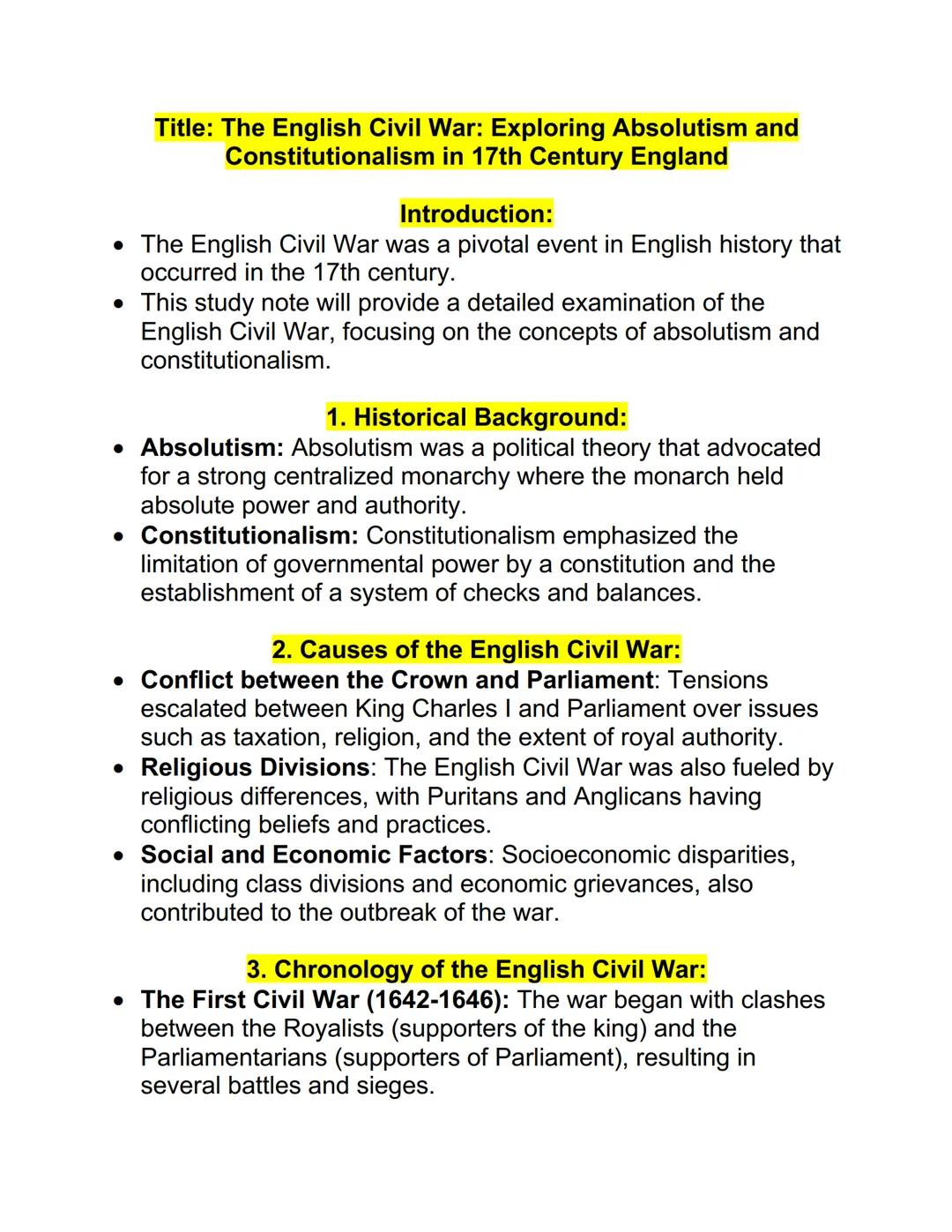
Origins and Causes of the English Civil War
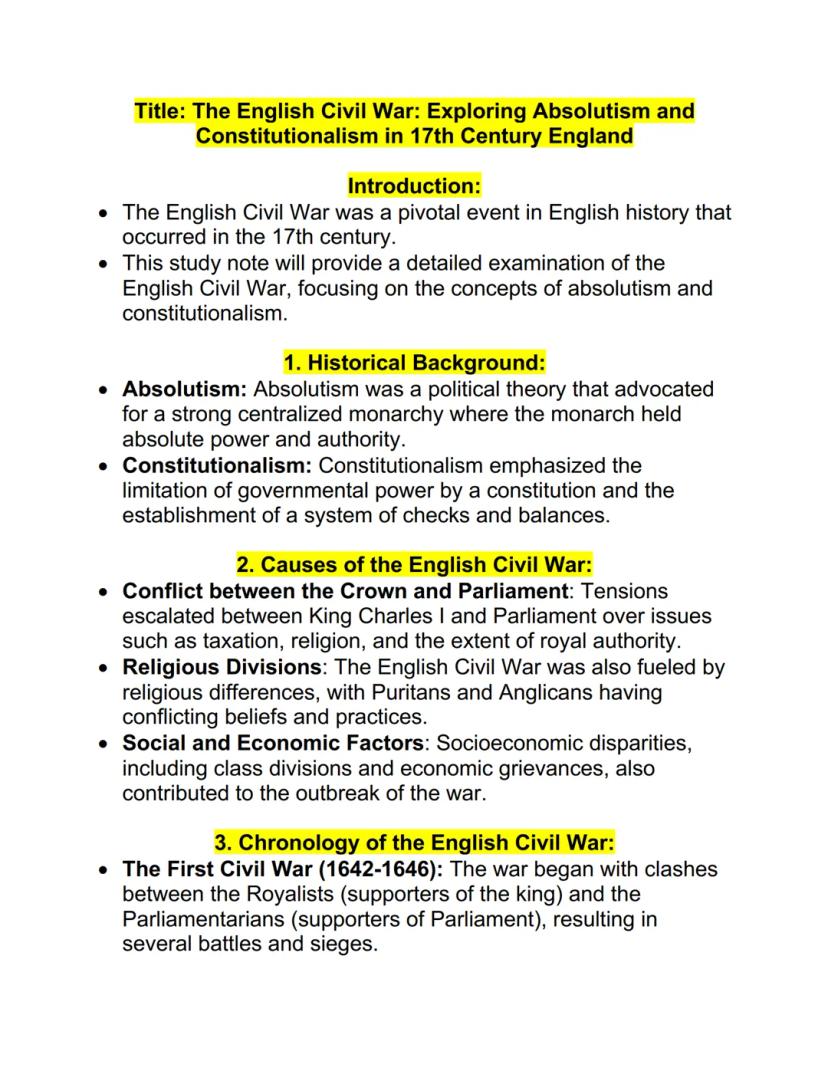
Ever wondered how a country could end up fighting against itself? The English Civil War erupted from a fundamental clash between two political philosophies: absolutism and constitutionalism. Absolutism promoted the idea that monarchs should hold unlimited power, while constitutionalism argued for limiting governmental authority through laws and checks on power.
The war didn't happen overnight. Tensions between King Charles I and Parliament had been building for years over three main issues. First, disagreements about taxation and who controlled the nation's purse strings created political friction. Second, religious divisions between Puritans and Anglicans fueled mutual distrust and hostility. Third, social and economic inequalities added fuel to an already volatile situation.
By 1642, these tensions erupted into open warfare between the Royalists (supporters of the king) and Parliamentarians. The First Civil War (1642-1646) saw a series of bloody battles across England as both sides fought to determine the future of governance in the nation.
Did you know? The English Civil War was the first major European conflict where ordinary citizens actively debated and fought over abstract political principles rather than just territorial claims or religious differences.
2
of 3
Key Events and Figures of the English Civil War
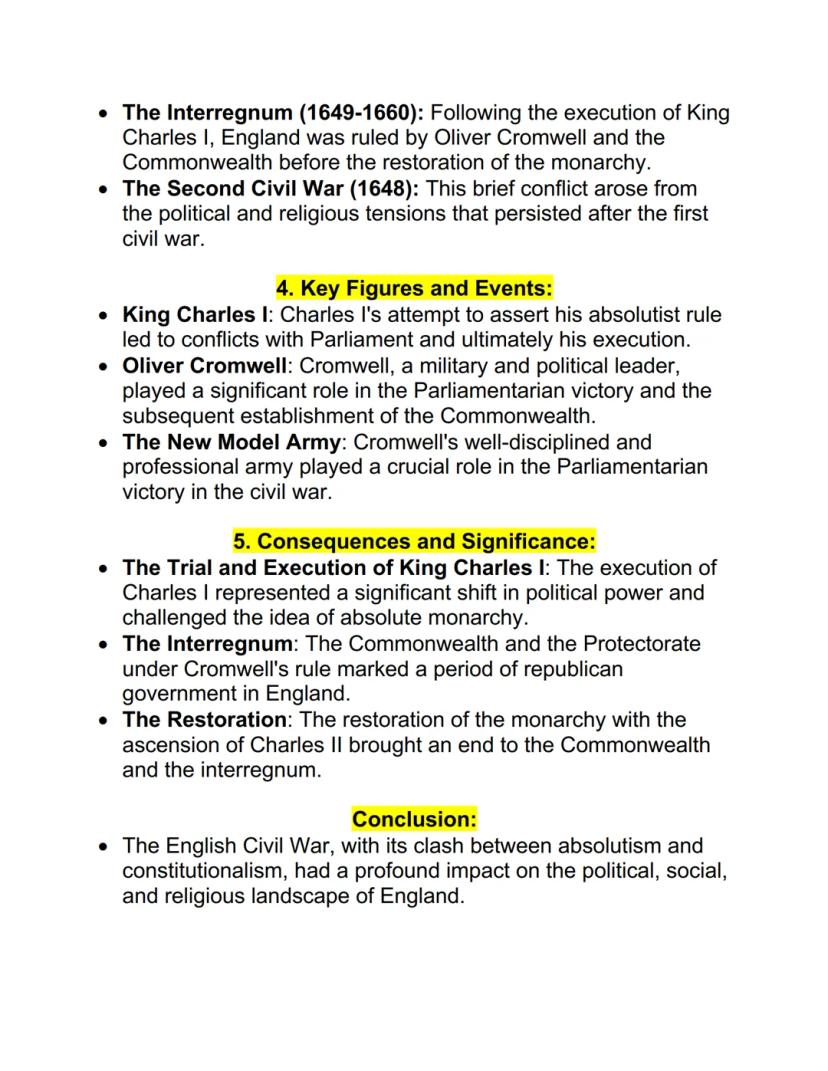
The conflict had several distinct phases that changed England forever. The First Civil War ended with Parliament's victory, but tensions continued to simmer. A Second Civil War broke out briefly in 1648, followed by a shocking development - the trial and execution of King Charles I in 1649, an unprecedented act that stunned Europe.
After the king's execution came the Interregnum (1649-1660), when England became a republic called the Commonwealth. Oliver Cromwell emerged as the dominant figure during this period. As commander of the professional New Model Army, Cromwell proved to be a brilliant military strategist who secured victory for Parliament before becoming Lord Protector of England.
Cromwell's death in 1658 created a power vacuum that eventually led to the Restoration of the monarchy. Charles II returned to the throne in 1660, but the balance of power had permanently shifted. Never again would an English monarch claim absolute authority without parliamentary consent.
Think about it: The execution of King Charles I in 1649 was revolutionary - it established the principle that rulers could be held accountable for their actions, even to the point of facing trial and punishment.
3
of 3
Legacy and Significance
The English Civil War profoundly transformed England's political landscape. By challenging the divine right of kings, the conflict established important precedents about governmental authority and accountability that continue to influence democracies today.
The war's outcomes didn't just change politics - they affected everyday life. Religious tolerance gradually increased, and the idea that citizens had certain rights that even kings couldn't violate began to take hold. These concepts would later influence revolutionary movements in America and France.
Understanding this pivotal conflict helps us see how modern democratic principles evolved. The tension between central authority and representative government that sparked the English Civil War continues to shape political debates around the world today. You're experiencing the legacy of these struggles every time you hear about checks and balances in government.
Connect the dots: Many fundamental principles we take for granted in modern democracies - like limits on government power, the importance of representative assemblies, and the accountability of leaders - were strengthened through the bloody conflicts of the English Civil War.
We thought you’d never ask...
What is the Knowunity AI companion?
Our AI companion is specifically built for the needs of students. Based on the millions of content pieces we have on the platform we can provide truly meaningful and relevant answers to students. But its not only about answers, the companion is even more about guiding students through their daily learning challenges, with personalised study plans, quizzes or content pieces in the chat and 100% personalisation based on the students skills and developments.
Where can I download the Knowunity app?
You can download the app in the Google Play Store and in the Apple App Store.
Is Knowunity really free of charge?
That's right! Enjoy free access to study content, connect with fellow students, and get instant help – all at your fingertips.
Most popular content in European History
2Most popular content
9O
 AP US History
Origins and Dynamics of the Columbian Exchange
Analyze the ecological and economic motivations behind the initial transfer of goods, people, and diseases between the Old and New Worlds.
9th3,1280
I
AP US HistoryIntroduction to Early Cultural Interactions
Analyze the initial social and religious encounters between Europeans, Africans, and Indigenous peoples in the colonial Americas.
9th2,7730
O
 AP World History
Origins of Ancient River Civilizations
Analyze the environmental factors and technological innovations that led to the rise of early states in Mesopotamia, Egypt, and the Indus Valley.
9th3,1870
M
AP US HistoryMotivations for European Exploration
Analyze the economic, religious, and political factors that drove European powers to the Americas during the 15th and 16th centuries.
9th1,7780
F
 AP Psychology
Foundations of Ethical Guidelines in Research
Practice the core principles of the APA ethical code including informed consent, debriefing, and the role of Institutional Review Boards.
9th1,3360
I
AP US HistoryIntroduction to Native American Societies
Examine the diverse social, political, and economic structures of North American indigenous groups prior to European contact.
9th1,1100
I
 AP Biology
Introduction to Biological Elements of Life
Practice identifying the essential elements including carbon, nitrogen, phosphorus, and sulfur that compose biological macromolecules.
9th1,7390
I
AP US HistoryIntroduction to the Spanish Encomienda System
Explore the fundamental economic and social structures of the Spanish colonial system, focusing on the encomienda and the casta social hierarchy.
9th8890
O
AP World HistoryOrigins and Continuity of the Byzantine Empire
Analyze the political and cultural transitions from the Roman Empire to the Byzantine Empire, focusing on the reign of Justinian I and his code.
9th1,6320
Can't find what you're looking for? Explore other subjects.
Students love us — and so will you.
4.6/5App Store
4.7/5Google Play
The app is very easy to use and well designed. I have found everything I was looking for so far and have been able to learn a lot from the presentations! I will definitely use the app for a class assignment! And of course it also helps a lot as an inspiration.
Stefan SiOS user
This app is really great. There are so many study notes and help [...]. My problem subject is French, for example, and the app has so many options for help. Thanks to this app, I have improved my French. I would recommend it to anyone.
Samantha KlichAndroid user
Wow, I am really amazed. I just tried the app because I've seen it advertised many times and was absolutely stunned. This app is THE HELP you want for school and above all, it offers so many things, such as workouts and fact sheets, which have been VERY helpful to me personally.
AnnaiOS user
European History57 views·Updated Jun 12, 2026·3 pagesThe English Civil War: A Study of Absolutism and Constitutionalism
Islombek@islombek_zqdd
The English Civil War was a crucial conflict in 17th century England that pitted supporters of absolute monarchy against those who wanted constitutional limits on royal power. This struggle between King Charles I and Parliament would reshape England's political landscape...
1
of 3
Sign up to see the content. It's free!
- Access to all documents
- Improve your grades
- Join milions of students
Origins and Causes of the English Civil War
Ever wondered how a country could end up fighting against itself? The English Civil War erupted from a fundamental clash between two political philosophies: absolutism and constitutionalism. Absolutism promoted the idea that monarchs should hold unlimited power, while constitutionalism argued for limiting governmental authority through laws and checks on power.
The war didn't happen overnight. Tensions between King Charles I and Parliament had been building for years over three main issues. First, disagreements about taxation and who controlled the nation's purse strings created political friction. Second, religious divisions between Puritans and Anglicans fueled mutual distrust and hostility. Third, social and economic inequalities added fuel to an already volatile situation.
By 1642, these tensions erupted into open warfare between the Royalists (supporters of the king) and Parliamentarians. The First Civil War (1642-1646) saw a series of bloody battles across England as both sides fought to determine the future of governance in the nation.
Did you know? The English Civil War was the first major European conflict where ordinary citizens actively debated and fought over abstract political principles rather than just territorial claims or religious differences.
2
of 3Sign up to see the content. It's free!
- Access to all documents
- Improve your grades
- Join milions of students
Key Events and Figures of the English Civil War
The conflict had several distinct phases that changed England forever. The First Civil War ended with Parliament's victory, but tensions continued to simmer. A Second Civil War broke out briefly in 1648, followed by a shocking development - the trial and execution of King Charles I in 1649, an unprecedented act that stunned Europe.
After the king's execution came the Interregnum (1649-1660), when England became a republic called the Commonwealth. Oliver Cromwell emerged as the dominant figure during this period. As commander of the professional New Model Army, Cromwell proved to be a brilliant military strategist who secured victory for Parliament before becoming Lord Protector of England.
Cromwell's death in 1658 created a power vacuum that eventually led to the Restoration of the monarchy. Charles II returned to the throne in 1660, but the balance of power had permanently shifted. Never again would an English monarch claim absolute authority without parliamentary consent.
Think about it: The execution of King Charles I in 1649 was revolutionary - it established the principle that rulers could be held accountable for their actions, even to the point of facing trial and punishment.
3
of 3Sign up to see the content. It's free!
- Access to all documents
- Improve your grades
- Join milions of students
Legacy and Significance
The English Civil War profoundly transformed England's political landscape. By challenging the divine right of kings, the conflict established important precedents about governmental authority and accountability that continue to influence democracies today.
The war's outcomes didn't just change politics - they affected everyday life. Religious tolerance gradually increased, and the idea that citizens had certain rights that even kings couldn't violate began to take hold. These concepts would later influence revolutionary movements in America and France.
Understanding this pivotal conflict helps us see how modern democratic principles evolved. The tension between central authority and representative government that sparked the English Civil War continues to shape political debates around the world today. You're experiencing the legacy of these struggles every time you hear about checks and balances in government.
Connect the dots: Many fundamental principles we take for granted in modern democracies - like limits on government power, the importance of representative assemblies, and the accountability of leaders - were strengthened through the bloody conflicts of the English Civil War.
We thought you’d never ask...
What is the Knowunity AI companion?
Our AI companion is specifically built for the needs of students. Based on the millions of content pieces we have on the platform we can provide truly meaningful and relevant answers to students. But its not only about answers, the companion is even more about guiding students through their daily learning challenges, with personalised study plans, quizzes or content pieces in the chat and 100% personalisation based on the students skills and developments.
Where can I download the Knowunity app?
You can download the app in the Google Play Store and in the Apple App Store.
Is Knowunity really free of charge?
That's right! Enjoy free access to study content, connect with fellow students, and get instant help – all at your fingertips.
Most popular content in European History
2Most popular content
9O
AP US HistoryOrigins and Dynamics of the Columbian Exchange
Analyze the ecological and economic motivations behind the initial transfer of goods, people, and diseases between the Old and New Worlds.
9th3,1280
I
AP US HistoryIntroduction to Early Cultural Interactions
Analyze the initial social and religious encounters between Europeans, Africans, and Indigenous peoples in the colonial Americas.
9th2,7730
O
AP World HistoryOrigins of Ancient River Civilizations
Analyze the environmental factors and technological innovations that led to the rise of early states in Mesopotamia, Egypt, and the Indus Valley.
9th3,1870
M
AP US HistoryMotivations for European Exploration
Analyze the economic, religious, and political factors that drove European powers to the Americas during the 15th and 16th centuries.
9th1,7780
F
AP PsychologyFoundations of Ethical Guidelines in Research
Practice the core principles of the APA ethical code including informed consent, debriefing, and the role of Institutional Review Boards.
9th1,3360
I
AP US HistoryIntroduction to Native American Societies
Examine the diverse social, political, and economic structures of North American indigenous groups prior to European contact.
9th1,1100
I
AP BiologyIntroduction to Biological Elements of Life
Practice identifying the essential elements including carbon, nitrogen, phosphorus, and sulfur that compose biological macromolecules.
9th1,7390
I
AP US HistoryIntroduction to the Spanish Encomienda System
Explore the fundamental economic and social structures of the Spanish colonial system, focusing on the encomienda and the casta social hierarchy.
9th8890
O
AP World HistoryOrigins and Continuity of the Byzantine Empire
Analyze the political and cultural transitions from the Roman Empire to the Byzantine Empire, focusing on the reign of Justinian I and his code.
9th1,6320
Can't find what you're looking for? Explore other subjects.
Students love us — and so will you.
4.6/5App Store
4.7/5Google Play
The app is very easy to use and well designed. I have found everything I was looking for so far and have been able to learn a lot from the presentations! I will definitely use the app for a class assignment! And of course it also helps a lot as an inspiration.
Stefan SiOS user
This app is really great. There are so many study notes and help [...]. My problem subject is French, for example, and the app has so many options for help. Thanks to this app, I have improved my French. I would recommend it to anyone.
Samantha KlichAndroid user
Wow, I am really amazed. I just tried the app because I've seen it advertised many times and was absolutely stunned. This app is THE HELP you want for school and above all, it offers so many things, such as workouts and fact sheets, which have been VERY helpful to me personally.
AnnaiOS user