
O imperativo em espanhol é fundamental para dar instruções, ordens...
 Espanhol63 views·Updated Jun 22, 2026·3 pages
El Imperativo Negativo en los Verbos
B
Beatriz Pedro@beatrizpedro

1 / 3
1
of 3
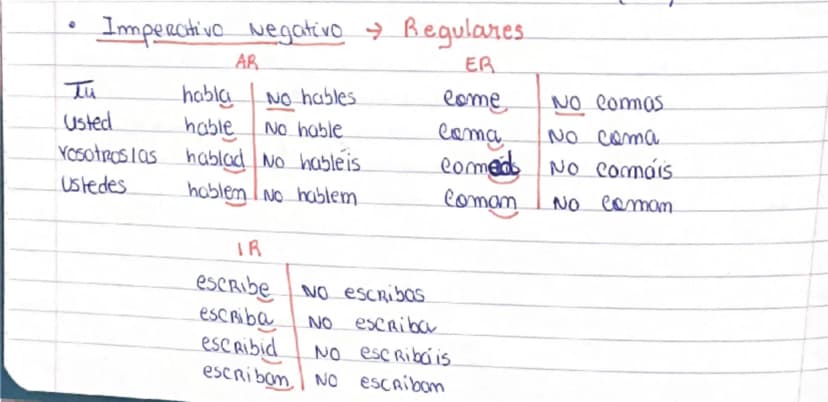
Imperativo Negativo - Verbos Regulares
Quando precisas dar uma ordem negativa em espanhol (dizer a alguém para NÃO fazer algo), usas o imperativo negativo. Para verbos regulares, a formação segue padrões claros.
Para os verbos terminados em -AR como "hablar", colocas "No" antes do verbo e usas terminações específicas: No hables (tu), No hable (usted), No habléis e No hablen (ustedes).
Os verbos terminados em -ER como "comer" seguem um padrão semelhante: No comas (tu), No coma (usted), No comáis e No coman (ustedes). O mesmo acontece com os verbos em -IR como "escribir": No escribas, No escriba, No escribáis e No escriban.
💡 Dica: Observa que o imperativo negativo tem formas diferentes do afirmativo! Não é só adicionar "No" à forma afirmativa.
2
of 3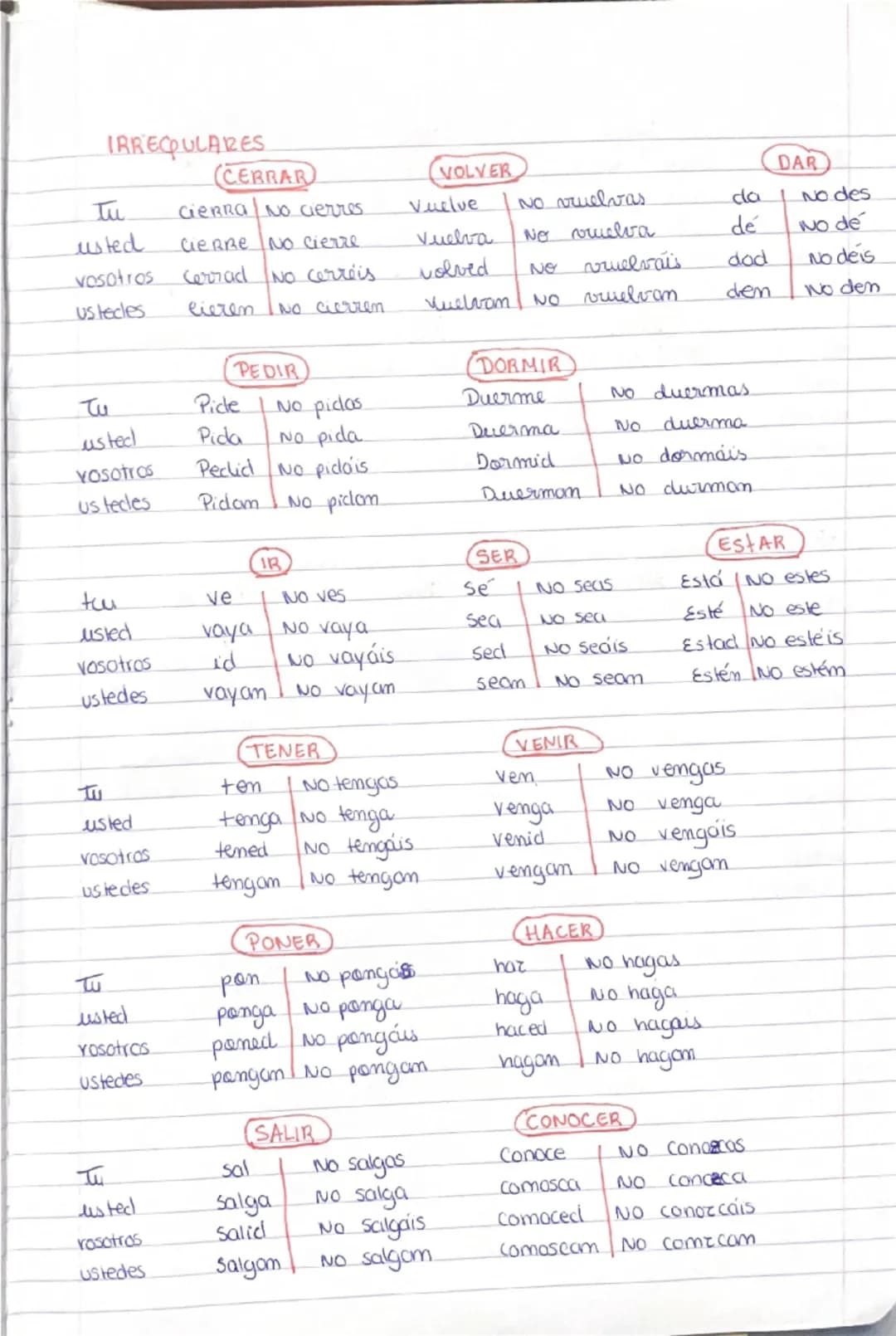
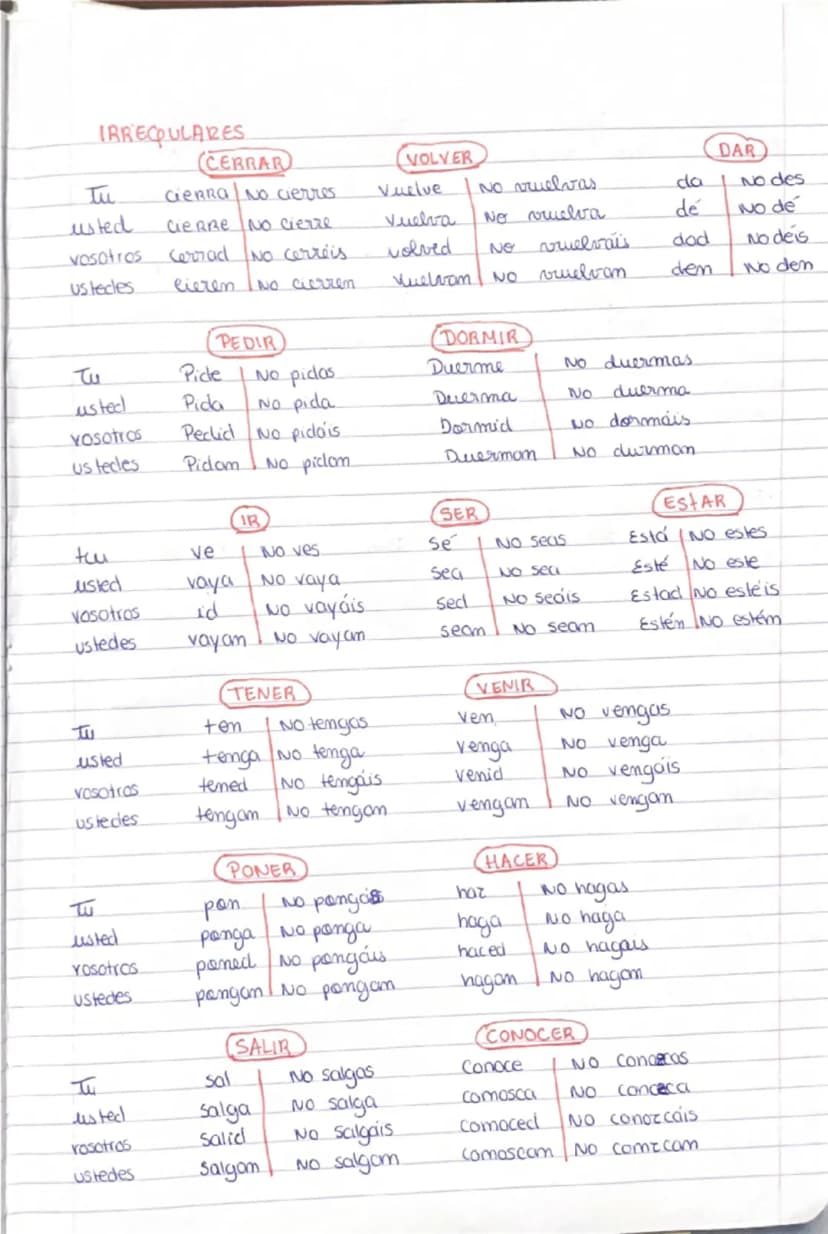
Imperativo Negativo - Verbos Irregulares
Os verbos irregulares no imperativo negativo seguem regras especiais que tens de memorizar. Verbos como cerrar, volver e dar modificam as suas raízes em algumas pessoas.
Com os verbos de alteração vocálica como pedir (No pidas) e dormir (No duermas), as mudanças na vogal da raiz mantêm-se no imperativo negativo. Já verbos muito irregulares como ir (No vayas), ser (No seas) e estar (No estés) têm formas completamente únicas.
Outros verbos irregulares comuns que deves dominar incluem tener (No tengas), venir (No vengas), poner (No pongas) e hacer (No hagas). Também salir (No salgas) e conocer (No conozcas) seguem padrões específicos.
🔑 Lembra-te: A maioria dos verbos que são irregulares no presente do subjuntivo mantêm essas mesmas irregularidades no imperativo negativo!
3
of 3
Verbos Irregulares no Presente do Indicativo
Alguns verbos espanhóis têm conjugações únicas no presente do indicativo que deves conhecer. O verbo oír tem uma forma especial na primeira pessoa: yo oigo, enquanto as restantes seguem um padrão mais previsível.
Ver e pensar apresentam características distintas: yo veo e yo pienso. O verbo pensar é um exemplo de verbo com alteração vocálica, onde o "e" muda para "ie" em certas pessoas.
Os verbos decir (yo digo), saber (yo sé) e traer (yo traigo) têm primeiras pessoas muito irregulares que terás de memorizar. Estas irregularidades são cruciais para falar espanhol corretamente.
💫 Curiosidade: A maioria das irregularidades ocorre na primeira pessoa do singular (yo), o que torna mais fácil lembrar os padrões para as outras formas!
We thought you’d never ask...
What is the Knowunity AI companion?
Our AI companion is specifically built for the needs of students. Based on the millions of content pieces we have on the platform we can provide truly meaningful and relevant answers to students. But its not only about answers, the companion is even more about guiding students through their daily learning challenges, with personalised study plans, quizzes or content pieces in the chat and 100% personalisation based on the students skills and developments.
Where can I download the Knowunity app?
You can download the app in the Google Play Store and in the Apple App Store.
Is Knowunity really free of charge?
That's right! Enjoy free access to study content, connect with fellow students, and get instant help – all at your fingertips.
Similar Content
 Espagnol
Most popular content in Espanhol
4EspanholPreparação para exame - Espanhol 10º e 11º ano
Toda a matéria necessária para estudar para o exame de espanhol, gramática, vocabulário, ...
11º1,90739
EspanholEspanhol de iniciação 1
Meses do ano, números cardinais, dados pessoais, verbo ser/ter/chamar-se, sinais de pontuação, falsos amigos, cultura espanhola, cumprimentar, despedir e nacionalidades
10º4005
EspanholVerbos Regulares e Irregulares em Espanhol
Espanhol- Gramática
10º4433
Espanholresumos que fiz para um teste
quatro resumos feitos em um dia , para que eu possa melhorar a minha nota a espanhol , e enquanto estava no tiktok encontrei esta app maravilhosa que posso até ganhar dinheiro com os meus estudos e que possa ter mais motivação pra estudar para testes
7º2291
Most popular content
9 Português
Resumos Exame Português
Completos
10º16,518322
 Biologia
Biologia 10°ano
Resumo completo de biologia de 10°ano
10º7,250148
 Filosofia
Resumos Filosofia 10º ano & 11º ano
Resumos muito completos e explicativos de praticamente toda a matéria da disciplina de Filosofia no ensino secundário em Portugal @mariiarafael
10º8,249201
PortuguêsLusíadas de Luís Vaz Camões
Resumo dos Lusíadas
9º3,46169
Filosofiaresumos filosofia 10 e 11 ano
resumos completos de toda a matéria de filosofia de 10 e 11 ano. preparação para exame de filosofia
10º6,343127
PortuguêsOs Maias
tudo o que necessitas de saber para o teste
11º2,48258
PortuguêsObra: Memorial do Convento de José Saramago
Obra: Memorial do Convento de José Saramago
12º2,93671
BiologiaResumos biologia 10 ano
Resumo completo biologia 10 ano
10º5,540144
Portuguêsmateria de português de 10, 11 e 12 ano
Síntese da matéria de português de 10, 11 e 12 anos
12º3,70398
Can't find what you're looking for? Explore other subjects.
Students love us — and so will you.
4.6/5App Store
4.7/5Google Play
The app is very easy to use and well designed. I have found everything I was looking for so far and have been able to learn a lot from the presentations! I will definitely use the app for a class assignment! And of course it also helps a lot as an inspiration.
Stefan SiOS user
This app is really great. There are so many study notes and help [...]. My problem subject is French, for example, and the app has so many options for help. Thanks to this app, I have improved my French. I would recommend it to anyone.
Samantha KlichAndroid user
Wow, I am really amazed. I just tried the app because I've seen it advertised many times and was absolutely stunned. This app is THE HELP you want for school and above all, it offers so many things, such as workouts and fact sheets, which have been VERY helpful to me personally.
AnnaiOS user
Espanhol63 views·Updated Jun 22, 2026·3 pagesEl Imperativo Negativo en los Verbos
B
Beatriz Pedro@beatrizpedro
O imperativo em espanhol é fundamental para dar instruções, ordens ou conselhos. Esta forma verbal tem formas afirmativas e negativas, cada uma com suas próprias regras e conjugações específicas para os diferentes pronomes pessoais.
1
of 3
Sign up to see the content. It's free!
- Access to all documents
- Improve your grades
- Join milions of students
Imperativo Negativo - Verbos Regulares
Quando precisas dar uma ordem negativa em espanhol (dizer a alguém para NÃO fazer algo), usas o imperativo negativo. Para verbos regulares, a formação segue padrões claros.
Para os verbos terminados em -AR como "hablar", colocas "No" antes do verbo e usas terminações específicas: No hables (tu), No hable (usted), No habléis e No hablen (ustedes).
Os verbos terminados em -ER como "comer" seguem um padrão semelhante: No comas (tu), No coma (usted), No comáis e No coman (ustedes). O mesmo acontece com os verbos em -IR como "escribir": No escribas, No escriba, No escribáis e No escriban.
💡 Dica: Observa que o imperativo negativo tem formas diferentes do afirmativo! Não é só adicionar "No" à forma afirmativa.
2
of 3Sign up to see the content. It's free!
- Access to all documents
- Improve your grades
- Join milions of students
Imperativo Negativo - Verbos Irregulares
Os verbos irregulares no imperativo negativo seguem regras especiais que tens de memorizar. Verbos como cerrar, volver e dar modificam as suas raízes em algumas pessoas.
Com os verbos de alteração vocálica como pedir (No pidas) e dormir (No duermas), as mudanças na vogal da raiz mantêm-se no imperativo negativo. Já verbos muito irregulares como ir (No vayas), ser (No seas) e estar (No estés) têm formas completamente únicas.
Outros verbos irregulares comuns que deves dominar incluem tener (No tengas), venir (No vengas), poner (No pongas) e hacer (No hagas). Também salir (No salgas) e conocer (No conozcas) seguem padrões específicos.
🔑 Lembra-te: A maioria dos verbos que são irregulares no presente do subjuntivo mantêm essas mesmas irregularidades no imperativo negativo!
3
of 3Sign up to see the content. It's free!
- Access to all documents
- Improve your grades
- Join milions of students
Verbos Irregulares no Presente do Indicativo
Alguns verbos espanhóis têm conjugações únicas no presente do indicativo que deves conhecer. O verbo oír tem uma forma especial na primeira pessoa: yo oigo, enquanto as restantes seguem um padrão mais previsível.
Ver e pensar apresentam características distintas: yo veo e yo pienso. O verbo pensar é um exemplo de verbo com alteração vocálica, onde o "e" muda para "ie" em certas pessoas.
Os verbos decir (yo digo), saber (yo sé) e traer (yo traigo) têm primeiras pessoas muito irregulares que terás de memorizar. Estas irregularidades são cruciais para falar espanhol corretamente.
💫 Curiosidade: A maioria das irregularidades ocorre na primeira pessoa do singular (yo), o que torna mais fácil lembrar os padrões para as outras formas!
We thought you’d never ask...
What is the Knowunity AI companion?
Our AI companion is specifically built for the needs of students. Based on the millions of content pieces we have on the platform we can provide truly meaningful and relevant answers to students. But its not only about answers, the companion is even more about guiding students through their daily learning challenges, with personalised study plans, quizzes or content pieces in the chat and 100% personalisation based on the students skills and developments.
Where can I download the Knowunity app?
You can download the app in the Google Play Store and in the Apple App Store.
Is Knowunity really free of charge?
That's right! Enjoy free access to study content, connect with fellow students, and get instant help – all at your fingertips.
Similar Content
Most popular content in Espanhol
4EspanholPreparação para exame - Espanhol 10º e 11º ano
Toda a matéria necessária para estudar para o exame de espanhol, gramática, vocabulário, ...
11º1,90739
EspanholEspanhol de iniciação 1
Meses do ano, números cardinais, dados pessoais, verbo ser/ter/chamar-se, sinais de pontuação, falsos amigos, cultura espanhola, cumprimentar, despedir e nacionalidades
10º4005
EspanholVerbos Regulares e Irregulares em Espanhol
Espanhol- Gramática
10º4433
Espanholresumos que fiz para um teste
quatro resumos feitos em um dia , para que eu possa melhorar a minha nota a espanhol , e enquanto estava no tiktok encontrei esta app maravilhosa que posso até ganhar dinheiro com os meus estudos e que possa ter mais motivação pra estudar para testes
7º2291
Most popular content
9PortuguêsResumos Exame Português
Completos
10º16,518322
BiologiaBiologia 10°ano
Resumo completo de biologia de 10°ano
10º7,250148
FilosofiaResumos Filosofia 10º ano & 11º ano
Resumos muito completos e explicativos de praticamente toda a matéria da disciplina de Filosofia no ensino secundário em Portugal @mariiarafael
10º8,249201
PortuguêsLusíadas de Luís Vaz Camões
Resumo dos Lusíadas
9º3,46169
Filosofiaresumos filosofia 10 e 11 ano
resumos completos de toda a matéria de filosofia de 10 e 11 ano. preparação para exame de filosofia
10º6,343127
PortuguêsOs Maias
tudo o que necessitas de saber para o teste
11º2,48258
PortuguêsObra: Memorial do Convento de José Saramago
Obra: Memorial do Convento de José Saramago
12º2,93671
BiologiaResumos biologia 10 ano
Resumo completo biologia 10 ano
10º5,540144
Portuguêsmateria de português de 10, 11 e 12 ano
Síntese da matéria de português de 10, 11 e 12 anos
12º3,70398
Can't find what you're looking for? Explore other subjects.
Students love us — and so will you.
4.6/5App Store
4.7/5Google Play
The app is very easy to use and well designed. I have found everything I was looking for so far and have been able to learn a lot from the presentations! I will definitely use the app for a class assignment! And of course it also helps a lot as an inspiration.
Stefan SiOS user
This app is really great. There are so many study notes and help [...]. My problem subject is French, for example, and the app has so many options for help. Thanks to this app, I have improved my French. I would recommend it to anyone.
Samantha KlichAndroid user
Wow, I am really amazed. I just tried the app because I've seen it advertised many times and was absolutely stunned. This app is THE HELP you want for school and above all, it offers so many things, such as workouts and fact sheets, which have been VERY helpful to me personally.
AnnaiOS user