
Waves are all around us, from ripples in water to...
 Environmental Science21 views·Updated Jun 19, 2026·8 pages
Understanding Waves: A Simple Guide

Mark Torosyan@dilanyanvardanyan_gckv
1 / 8
1
of 8
What is a Wave?
A wave is a disturbance that travels through space. This might sound complicated, but it's something you experience every day!
Think about what happens when someone bumps a table with your drink on it. The bump creates a disturbance that travels through the table, through your cup, and into your drink, making the liquid move back and forth. That movement is a wave in action!
Try This! Place a pencil on water in a bowl and make small waves with your finger. Watch how the pencil moves up and down but doesn't travel across the bowl—the wave energy moves, but the water mostly stays in place!
2
of 8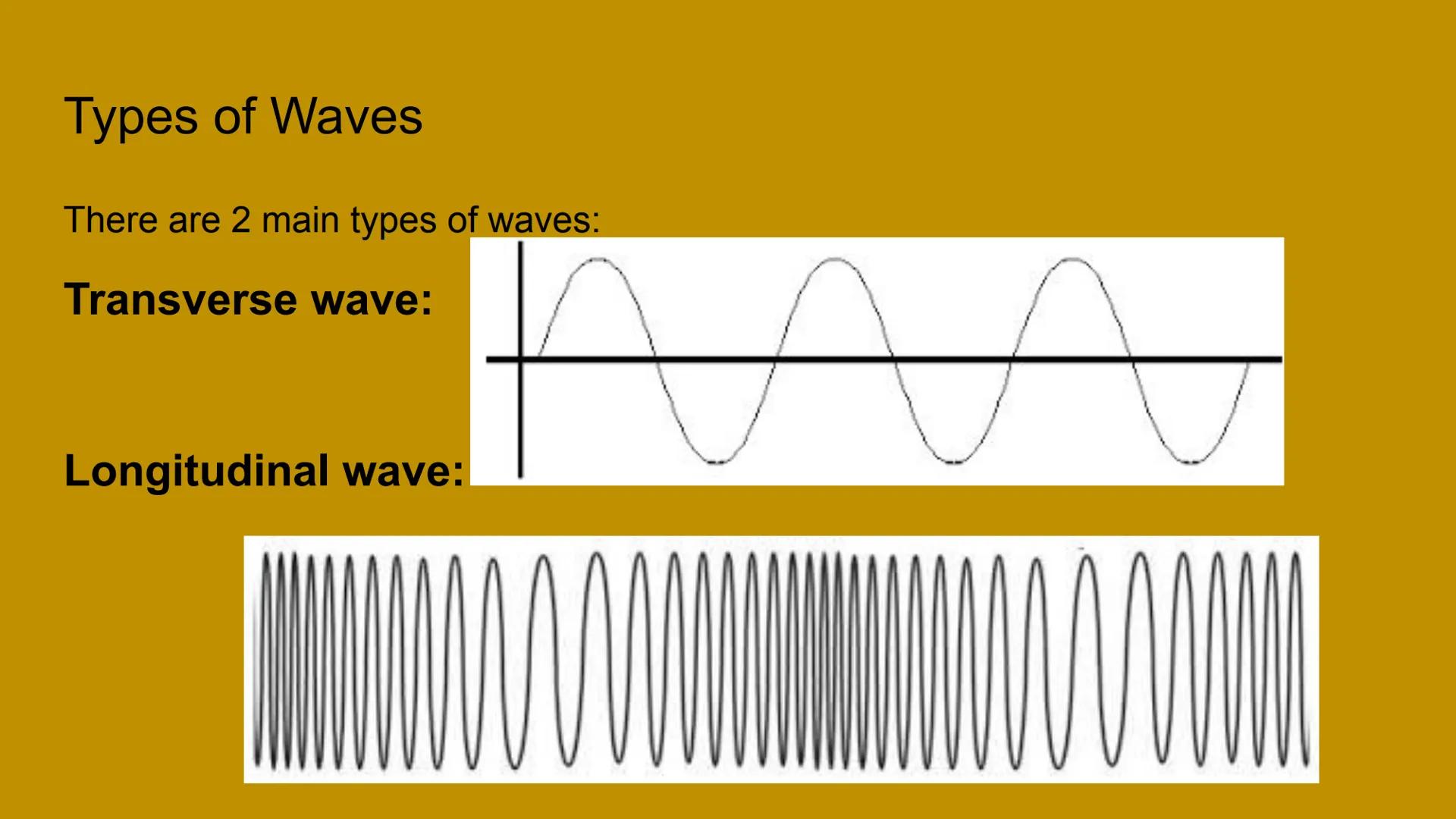
Types of Waves
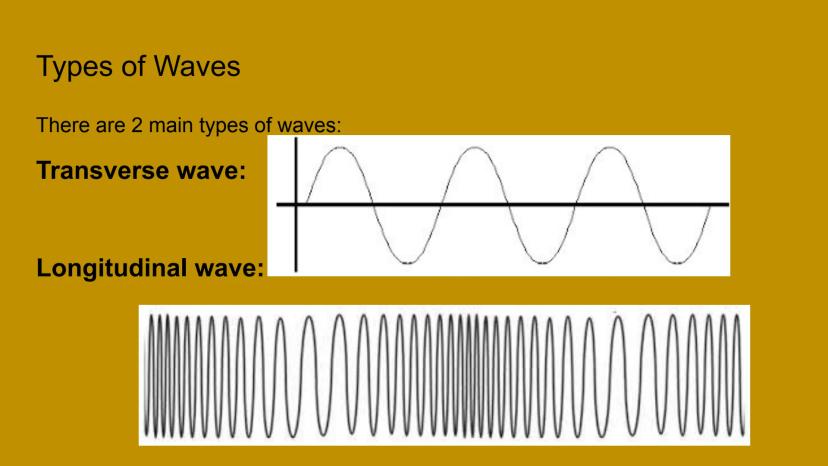
There are two main types of waves you'll encounter in science: transverse waves and longitudinal waves.
In a transverse wave, the particles move perpendicular (at right angles) to the direction the wave travels. Ocean waves are a good example—the water moves up and down while the wave itself moves horizontally.
In a longitudinal wave, particles move parallel to the direction the wave travels. Sound waves work this way—air molecules move back and forth in the same direction the sound is traveling.
Remember: The key difference is in how the particles move relative to the wave's direction!
3
of 8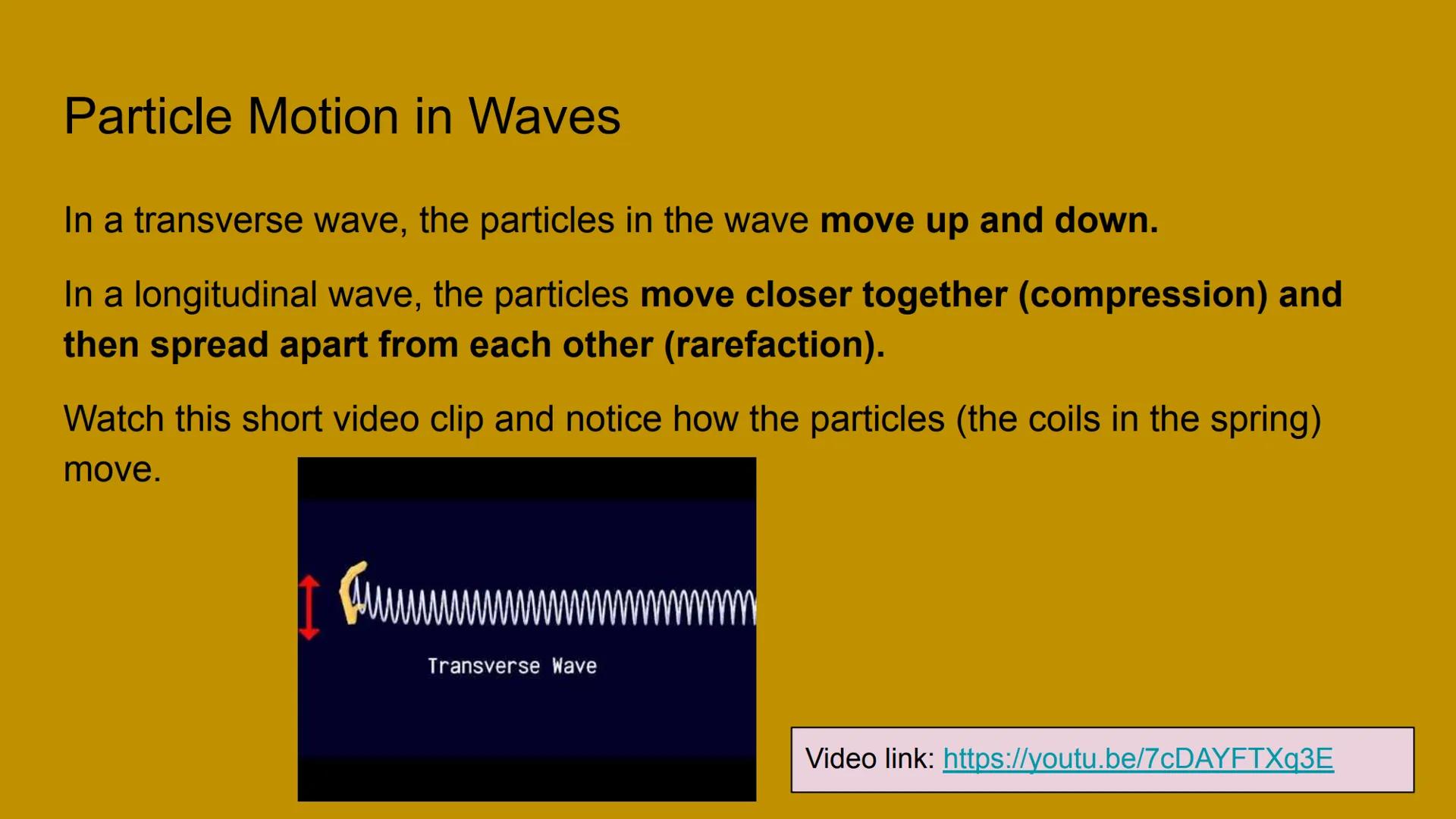
Particle Motion in Waves
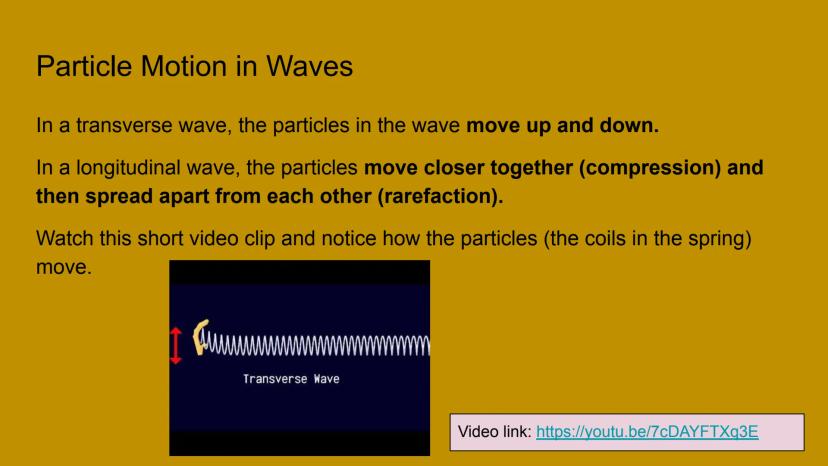
In transverse waves, particles move up and down (or side to side) while the wave itself moves forward. Imagine doing "the wave" at a sports game—you stand up and sit down, but you don't leave your seat!
Longitudinal waves work differently. Particles bunch together in compressions and spread apart in rarefactions . Think of a spring toy that gets squeezed in some parts and stretched in others.
Visualization Tip: Picture a spring toy—in a transverse wave, the coils move up and down; in a longitudinal wave, they bunch together and spread apart like an accordion.
4
of 8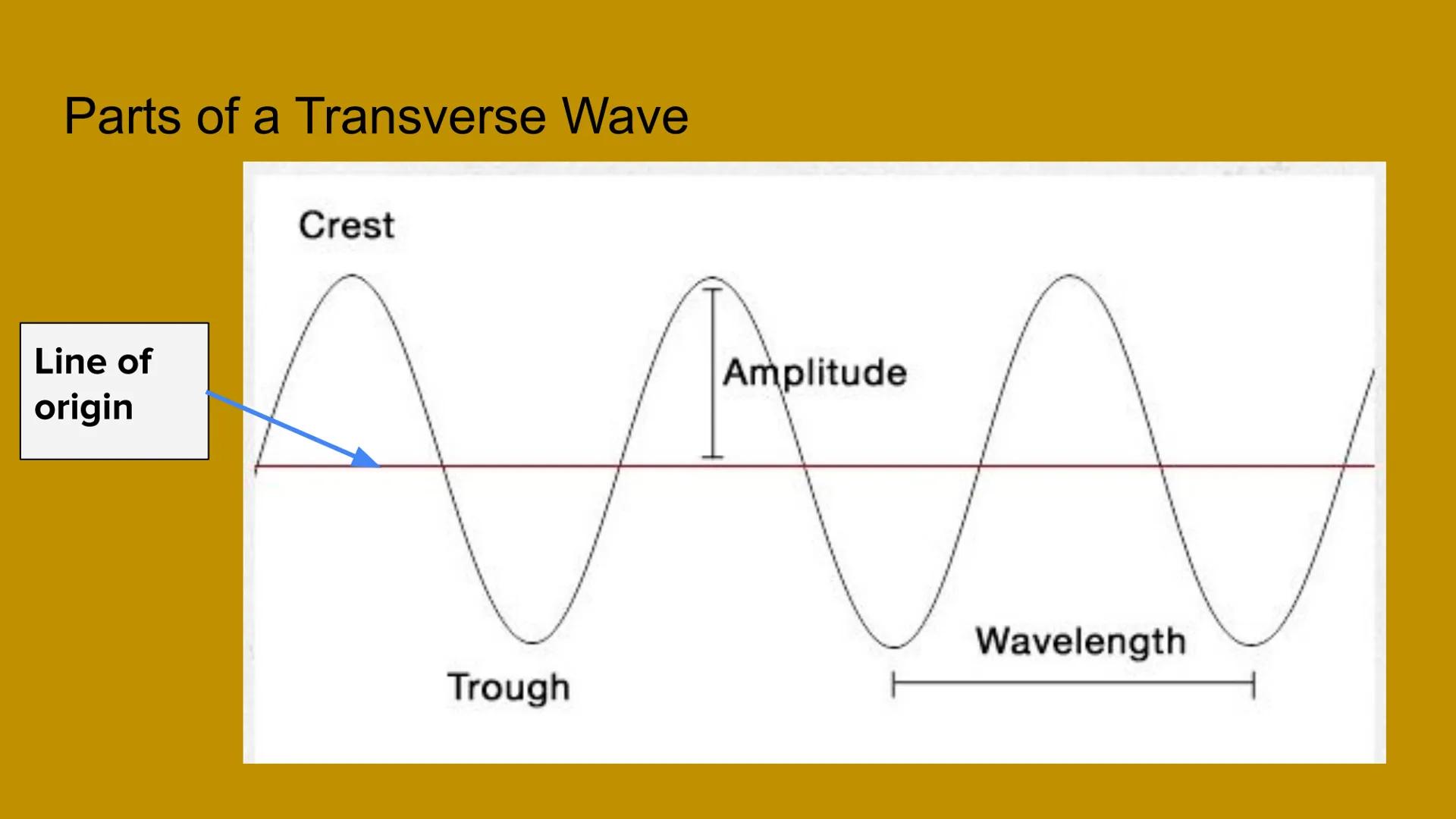
Parts of a Transverse Wave
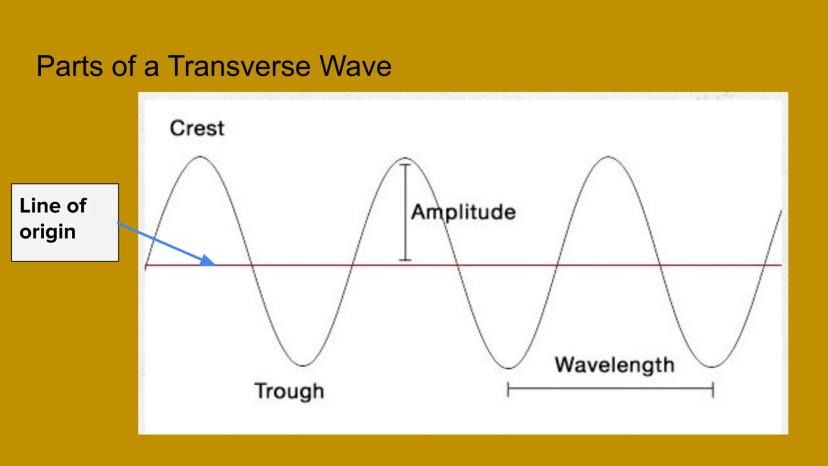
Transverse waves have several important parts that help us measure and describe them. The main components include the crest, trough, line of origin, amplitude, and wavelength.
The shape of a transverse wave resembles a series of hills and valleys. Each hill represents energy moving through the medium, and the complete pattern repeats itself over and over.
Understanding these parts helps scientists measure waves and predict how they'll behave in different situations.
Real-World Connection: The parts of waves explain everything from how sunlight travels to Earth to how your favorite songs travel to your ears!
5
of 8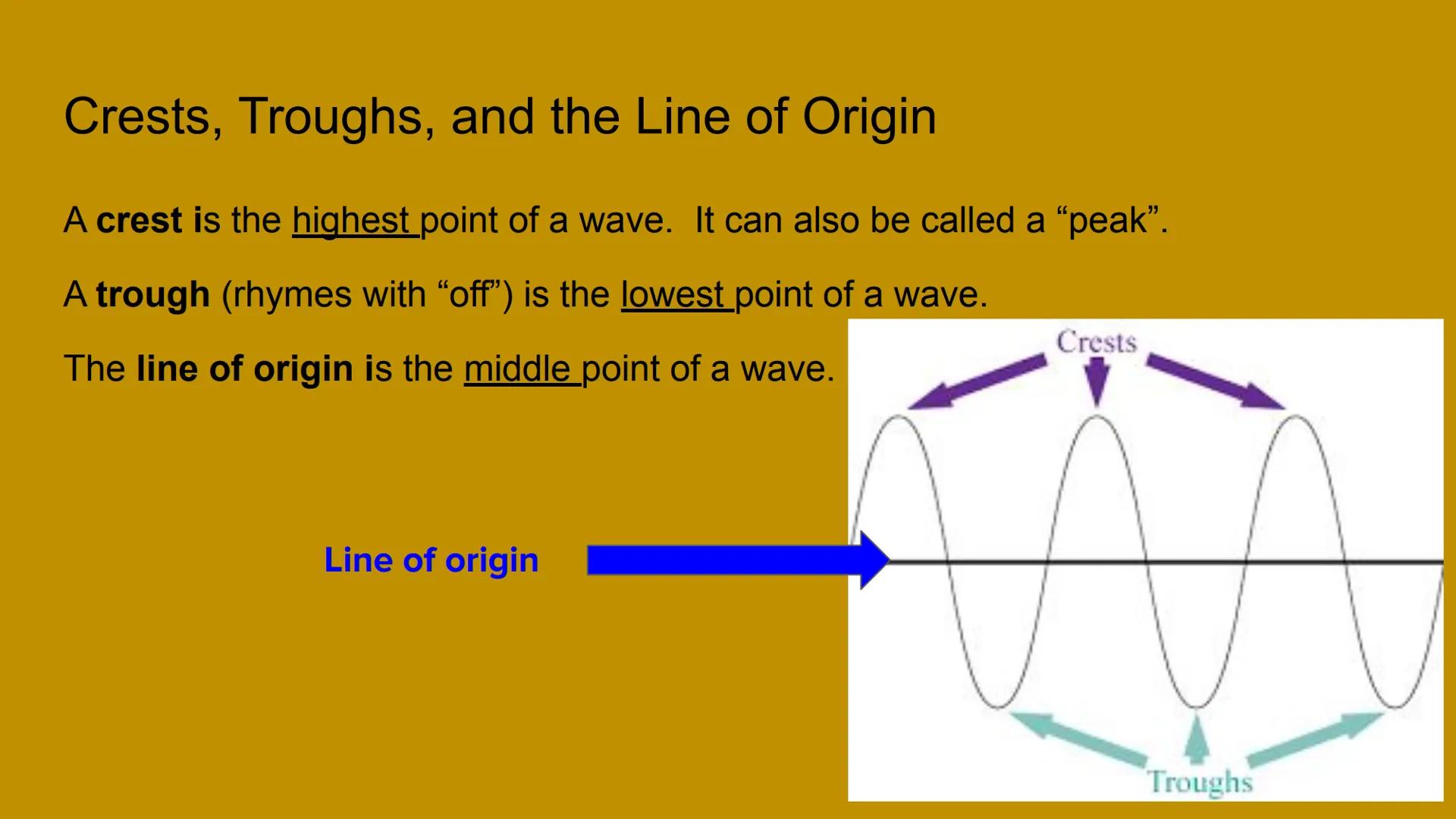
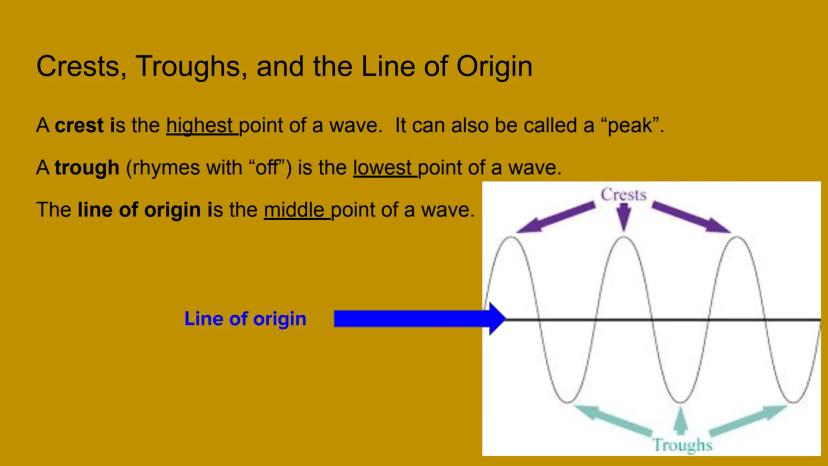
Crests, Troughs, and the Line of Origin
The crest is the highest point of a wave—think of it as the "peak" or top of the hill. When you see ocean waves, the crests are the parts that can crash over you!
The trough (rhymes with "off") is the lowest point of a wave—the bottom of the valley. In water waves, troughs are the low points between the wave peaks.
The line of origin is the middle reference point of a wave. It represents the position of particles when they're at rest, not being disturbed by the wave.
Quick Check: When drawing a wave, always start with the line of origin (like the "equator" of your wave), then add crests above and troughs below it.
6
of 8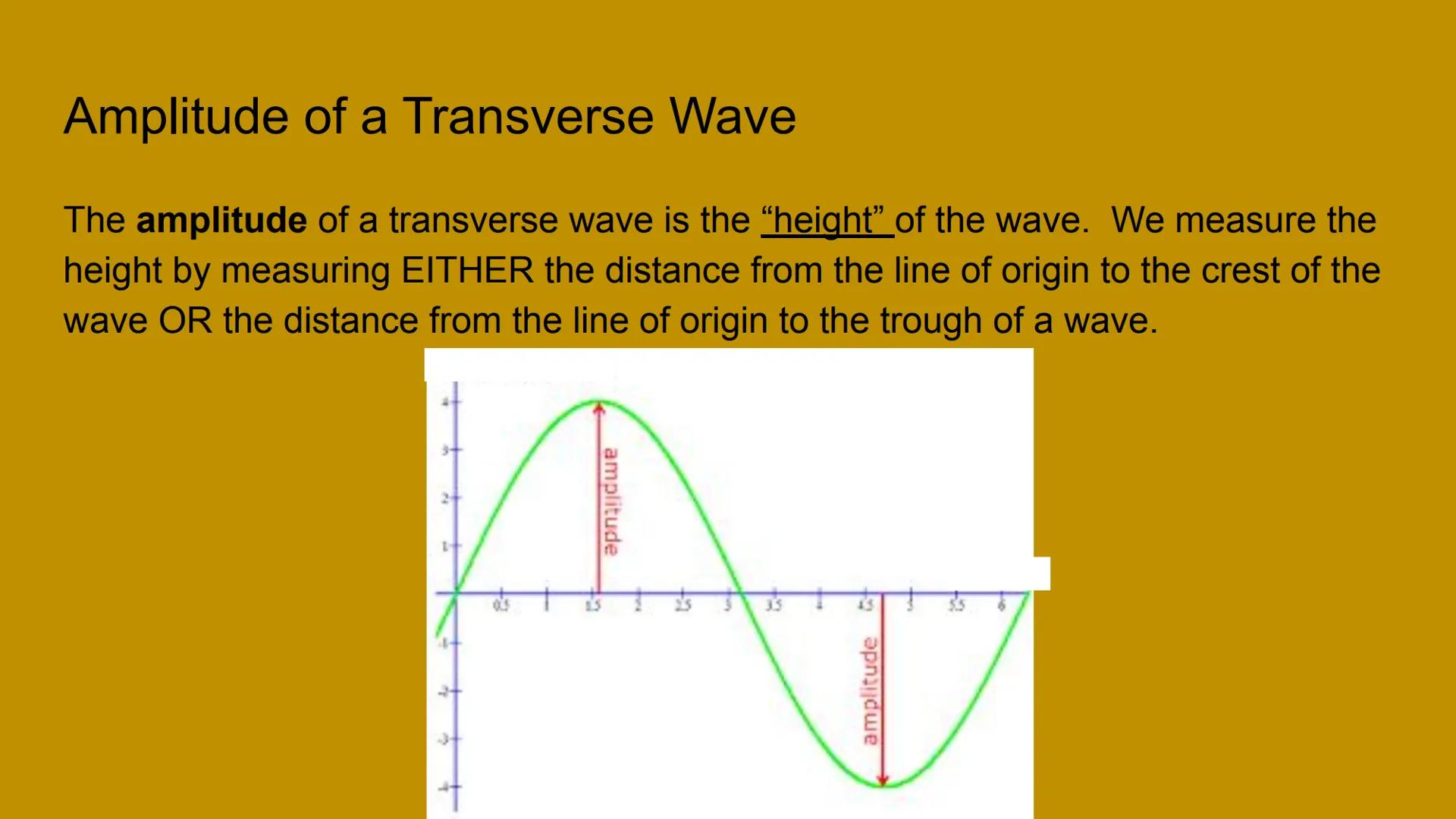
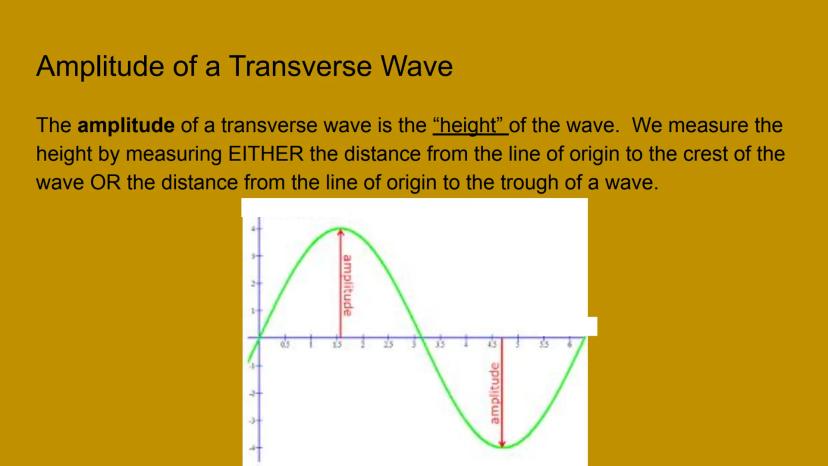
Amplitude of a Transverse Wave
The amplitude of a transverse wave measures how "tall" the wave is. It's the distance from the line of origin to either a crest or a trough.
Amplitude is directly related to the energy of a wave. Waves with larger amplitudes carry more energy than waves with smaller amplitudes.
You can measure amplitude by finding the distance from the middle (line of origin) to the highest point (crest) OR from the middle to the lowest point (trough).
Energy Connection: Amplitude determines how much energy a wave carries. A high-amplitude sound wave is louder, and a high-amplitude light wave appears brighter!
7
of 8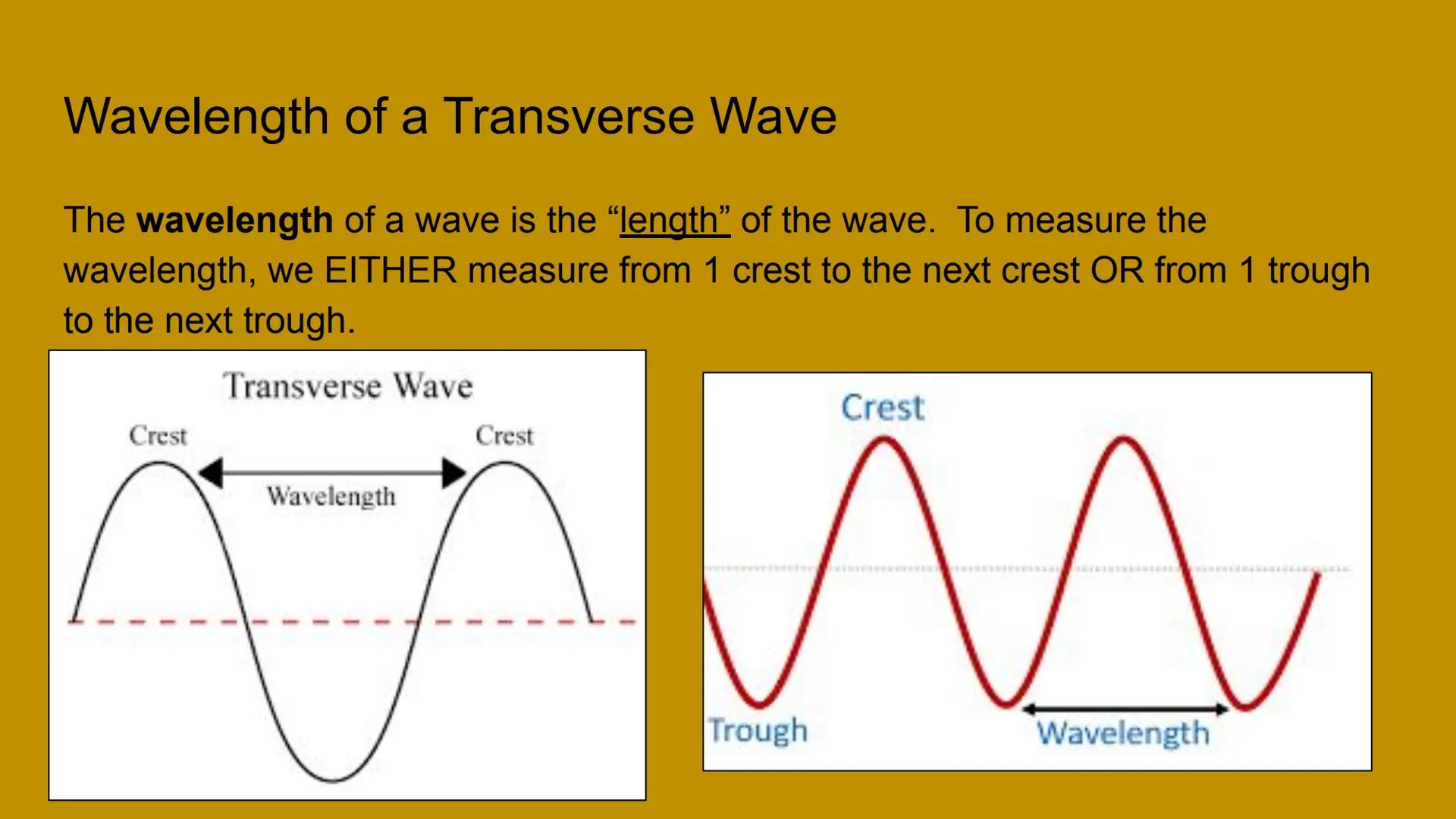
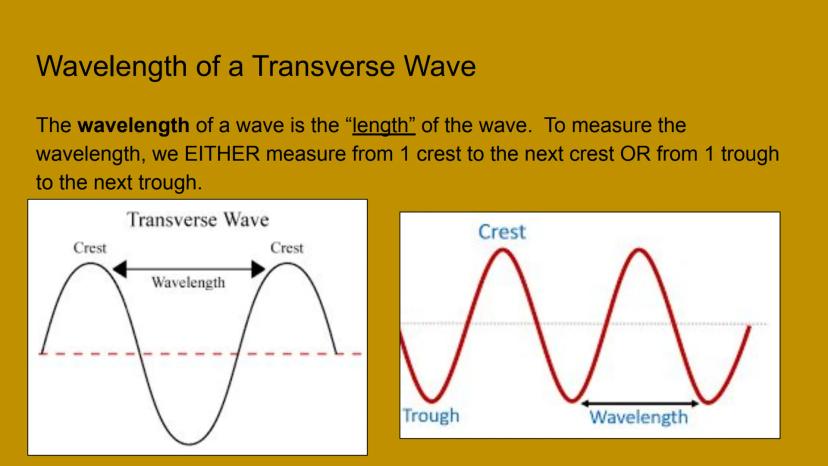
Wavelength of a Transverse Wave
The wavelength measures the "length" of one complete wave cycle. It tells us how long a wave is from one point to the same point on the next wave.
You can measure wavelength by finding the distance from one crest to the next crest OR from one trough to the next trough. Both measurements will give you the same result.
Wavelength is related to the frequency of a wave—shorter wavelengths typically have higher frequencies, while longer wavelengths have lower frequencies.
Visualization Tip: If you drew a wave on paper, the wavelength would be the distance it takes for the pattern to repeat itself exactly.
8
of 8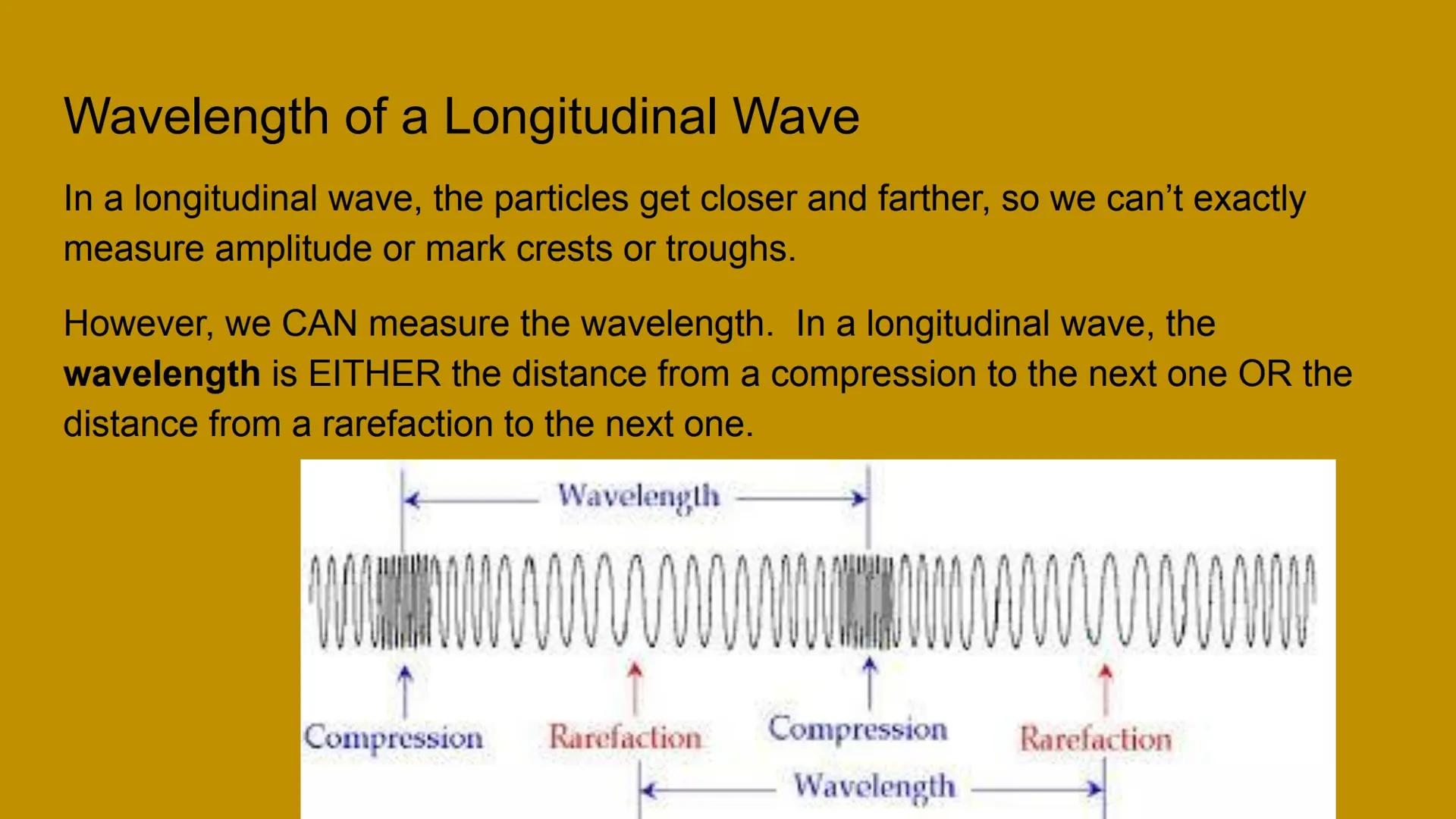
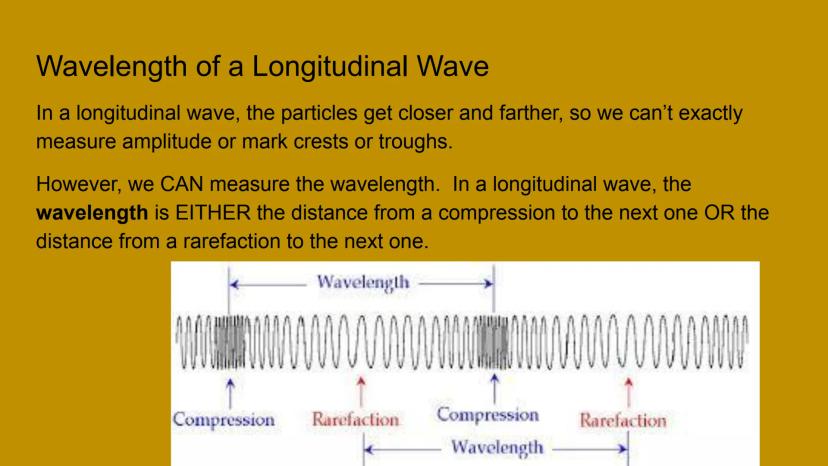
Wavelength of a Longitudinal Wave
Longitudinal waves don't have visible crests and troughs like transverse waves do, making them look different but they still have wavelengths!
In a longitudinal wave, the wavelength is measured as either the distance from one compression to the next compression OR from one rarefaction to the next rarefaction.
Compressions are areas where particles are bunched together, while rarefactions are areas where particles are spread apart. These patterns repeat at regular intervals as the wave travels.
Sound Connection: Sound waves are longitudinal—when you speak, your vocal cords create compressions and rarefactions in air that travel to listeners' ears!
We thought you’d never ask...
What is the Knowunity AI companion?
Our AI companion is specifically built for the needs of students. Based on the millions of content pieces we have on the platform we can provide truly meaningful and relevant answers to students. But its not only about answers, the companion is even more about guiding students through their daily learning challenges, with personalised study plans, quizzes or content pieces in the chat and 100% personalisation based on the students skills and developments.
Where can I download the Knowunity app?
You can download the app in the Google Play Store and in the Apple App Store.
Is Knowunity really free of charge?
That's right! Enjoy free access to study content, connect with fellow students, and get instant help – all at your fingertips.
Similar Content
 Physics
Most popular content in Environmental Science
9C
Environmental ScienceCells
Basics
9th800
Environmental ScienceStudent Exploration: GMOs and the Environment Answer Key.pdf
GMOs and the Environment
4267
Environmental ScienceEarth and Space: Ch. 2- Minerals
Slideshow about Ch. 2 of Earth and Space Science
11th742
 Chemistry
Photosynthesis: The Calvin Cycle
Understanding the Calvin Cycle as well as impact of light intensity, carbon dioxide levels, and temperature on the rate of photosynthesis. CHECK MY NOTES ON THE LIGHT REACTIONS FOR THE FIRST PART OF PHOTOSYNTHESIS
9th993
 Earth and Space Science
Human Impact on the Earth: Effects of Environmental Change on Biodiversity
Very interesting and full of info presentation about human impact on our planet and the biodiversity among the animal species
390
Environmental ScienceEcology
Gives an overview of Ecological levels of Organization .
1141
Environmental ScienceSymbiotic Relationships
Covers: community interactions, mutualism, commensalism, parasitism, habitats, microhabitats, tolerance, ecological niche, keystone species
9th911
Environmental ScienceThe Moon
In depth notes on the moon and its phases.
9th611
Environmental ScienceAsexual vs Sexual Reproduction
Comparison of advantages and disadvantages of asexual and sexual reproduction, including mitosis and meiosis processes.
9th1547
Most popular content
9O
 AP US History
Origins and Dynamics of the Columbian Exchange
Analyze the ecological and economic motivations behind the initial transfer of goods, people, and diseases between the Old and New Worlds.
9th3,1280
I
AP US HistoryIntroduction to Early Cultural Interactions
Analyze the initial social and religious encounters between Europeans, Africans, and Indigenous peoples in the colonial Americas.
9th2,7730
O
AP World HistoryOrigins of Ancient River Civilizations
Analyze the environmental factors and technological innovations that led to the rise of early states in Mesopotamia, Egypt, and the Indus Valley.
9th3,1870
M
AP US HistoryMotivations for European Exploration
Analyze the economic, religious, and political factors that drove European powers to the Americas during the 15th and 16th centuries.
9th1,7780
F
 AP Psychology
Foundations of Ethical Guidelines in Research
Practice the core principles of the APA ethical code including informed consent, debriefing, and the role of Institutional Review Boards.
9th1,3360
I
AP US HistoryIntroduction to Native American Societies
Examine the diverse social, political, and economic structures of North American indigenous groups prior to European contact.
9th1,1100
I
 AP Biology
Introduction to Biological Elements of Life
Practice identifying the essential elements including carbon, nitrogen, phosphorus, and sulfur that compose biological macromolecules.
9th1,7390
I
AP US HistoryIntroduction to the Spanish Encomienda System
Explore the fundamental economic and social structures of the Spanish colonial system, focusing on the encomienda and the casta social hierarchy.
9th8890
O
AP World HistoryOrigins and Continuity of the Byzantine Empire
Analyze the political and cultural transitions from the Roman Empire to the Byzantine Empire, focusing on the reign of Justinian I and his code.
9th1,6320
Can't find what you're looking for? Explore other subjects.
Students love us — and so will you.
4.6/5App Store
4.7/5Google Play
The app is very easy to use and well designed. I have found everything I was looking for so far and have been able to learn a lot from the presentations! I will definitely use the app for a class assignment! And of course it also helps a lot as an inspiration.
Stefan SiOS user
This app is really great. There are so many study notes and help [...]. My problem subject is French, for example, and the app has so many options for help. Thanks to this app, I have improved my French. I would recommend it to anyone.
Samantha KlichAndroid user
Wow, I am really amazed. I just tried the app because I've seen it advertised many times and was absolutely stunned. This app is THE HELP you want for school and above all, it offers so many things, such as workouts and fact sheets, which have been VERY helpful to me personally.
AnnaiOS user
Environmental Science21 views·Updated Jun 19, 2026·8 pagesUnderstanding Waves: A Simple Guide
Mark Torosyan@dilanyanvardanyan_gckv
Waves are all around us, from ripples in water to sound waves in the air. They're simply disturbances that travel through space, transferring energy without transferring matter. Understanding waves helps explain how we hear, see, and even communicate wirelessly!
1
of 8
Sign up to see the content. It's free!
- Access to all documents
- Improve your grades
- Join milions of students
What is a Wave?
A wave is a disturbance that travels through space. This might sound complicated, but it's something you experience every day!
Think about what happens when someone bumps a table with your drink on it. The bump creates a disturbance that travels through the table, through your cup, and into your drink, making the liquid move back and forth. That movement is a wave in action!
Try This! Place a pencil on water in a bowl and make small waves with your finger. Watch how the pencil moves up and down but doesn't travel across the bowl—the wave energy moves, but the water mostly stays in place!
2
of 8Sign up to see the content. It's free!
- Access to all documents
- Improve your grades
- Join milions of students
Types of Waves
There are two main types of waves you'll encounter in science: transverse waves and longitudinal waves.
In a transverse wave, the particles move perpendicular (at right angles) to the direction the wave travels. Ocean waves are a good example—the water moves up and down while the wave itself moves horizontally.
In a longitudinal wave, particles move parallel to the direction the wave travels. Sound waves work this way—air molecules move back and forth in the same direction the sound is traveling.
Remember: The key difference is in how the particles move relative to the wave's direction!
3
of 8Sign up to see the content. It's free!
- Access to all documents
- Improve your grades
- Join milions of students
Particle Motion in Waves
In transverse waves, particles move up and down (or side to side) while the wave itself moves forward. Imagine doing "the wave" at a sports game—you stand up and sit down, but you don't leave your seat!
Longitudinal waves work differently. Particles bunch together in compressions and spread apart in rarefactions . Think of a spring toy that gets squeezed in some parts and stretched in others.
Visualization Tip: Picture a spring toy—in a transverse wave, the coils move up and down; in a longitudinal wave, they bunch together and spread apart like an accordion.
4
of 8Sign up to see the content. It's free!
- Access to all documents
- Improve your grades
- Join milions of students
Parts of a Transverse Wave
Transverse waves have several important parts that help us measure and describe them. The main components include the crest, trough, line of origin, amplitude, and wavelength.
The shape of a transverse wave resembles a series of hills and valleys. Each hill represents energy moving through the medium, and the complete pattern repeats itself over and over.
Understanding these parts helps scientists measure waves and predict how they'll behave in different situations.
Real-World Connection: The parts of waves explain everything from how sunlight travels to Earth to how your favorite songs travel to your ears!
5
of 8Sign up to see the content. It's free!
- Access to all documents
- Improve your grades
- Join milions of students
Crests, Troughs, and the Line of Origin
The crest is the highest point of a wave—think of it as the "peak" or top of the hill. When you see ocean waves, the crests are the parts that can crash over you!
The trough (rhymes with "off") is the lowest point of a wave—the bottom of the valley. In water waves, troughs are the low points between the wave peaks.
The line of origin is the middle reference point of a wave. It represents the position of particles when they're at rest, not being disturbed by the wave.
Quick Check: When drawing a wave, always start with the line of origin (like the "equator" of your wave), then add crests above and troughs below it.
6
of 8Sign up to see the content. It's free!
- Access to all documents
- Improve your grades
- Join milions of students
Amplitude of a Transverse Wave
The amplitude of a transverse wave measures how "tall" the wave is. It's the distance from the line of origin to either a crest or a trough.
Amplitude is directly related to the energy of a wave. Waves with larger amplitudes carry more energy than waves with smaller amplitudes.
You can measure amplitude by finding the distance from the middle (line of origin) to the highest point (crest) OR from the middle to the lowest point (trough).
Energy Connection: Amplitude determines how much energy a wave carries. A high-amplitude sound wave is louder, and a high-amplitude light wave appears brighter!
7
of 8Sign up to see the content. It's free!
- Access to all documents
- Improve your grades
- Join milions of students
Wavelength of a Transverse Wave
The wavelength measures the "length" of one complete wave cycle. It tells us how long a wave is from one point to the same point on the next wave.
You can measure wavelength by finding the distance from one crest to the next crest OR from one trough to the next trough. Both measurements will give you the same result.
Wavelength is related to the frequency of a wave—shorter wavelengths typically have higher frequencies, while longer wavelengths have lower frequencies.
Visualization Tip: If you drew a wave on paper, the wavelength would be the distance it takes for the pattern to repeat itself exactly.
8
of 8Sign up to see the content. It's free!
- Access to all documents
- Improve your grades
- Join milions of students
Wavelength of a Longitudinal Wave
Longitudinal waves don't have visible crests and troughs like transverse waves do, making them look different but they still have wavelengths!
In a longitudinal wave, the wavelength is measured as either the distance from one compression to the next compression OR from one rarefaction to the next rarefaction.
Compressions are areas where particles are bunched together, while rarefactions are areas where particles are spread apart. These patterns repeat at regular intervals as the wave travels.
Sound Connection: Sound waves are longitudinal—when you speak, your vocal cords create compressions and rarefactions in air that travel to listeners' ears!
We thought you’d never ask...
What is the Knowunity AI companion?
Our AI companion is specifically built for the needs of students. Based on the millions of content pieces we have on the platform we can provide truly meaningful and relevant answers to students. But its not only about answers, the companion is even more about guiding students through their daily learning challenges, with personalised study plans, quizzes or content pieces in the chat and 100% personalisation based on the students skills and developments.
Where can I download the Knowunity app?
You can download the app in the Google Play Store and in the Apple App Store.
Is Knowunity really free of charge?
That's right! Enjoy free access to study content, connect with fellow students, and get instant help – all at your fingertips.
Similar Content
Most popular content in Environmental Science
9C
Environmental ScienceCells
Basics
9th800
Environmental ScienceStudent Exploration: GMOs and the Environment Answer Key.pdf
GMOs and the Environment
4267
Environmental ScienceEarth and Space: Ch. 2- Minerals
Slideshow about Ch. 2 of Earth and Space Science
11th742
ChemistryPhotosynthesis: The Calvin Cycle
Understanding the Calvin Cycle as well as impact of light intensity, carbon dioxide levels, and temperature on the rate of photosynthesis. CHECK MY NOTES ON THE LIGHT REACTIONS FOR THE FIRST PART OF PHOTOSYNTHESIS
9th993
Earth and Space ScienceHuman Impact on the Earth: Effects of Environmental Change on Biodiversity
Very interesting and full of info presentation about human impact on our planet and the biodiversity among the animal species
390
Environmental ScienceEcology
Gives an overview of Ecological levels of Organization .
1141
Environmental ScienceSymbiotic Relationships
Covers: community interactions, mutualism, commensalism, parasitism, habitats, microhabitats, tolerance, ecological niche, keystone species
9th911
Environmental ScienceThe Moon
In depth notes on the moon and its phases.
9th611
Environmental ScienceAsexual vs Sexual Reproduction
Comparison of advantages and disadvantages of asexual and sexual reproduction, including mitosis and meiosis processes.
9th1547
Most popular content
9O
AP US HistoryOrigins and Dynamics of the Columbian Exchange
Analyze the ecological and economic motivations behind the initial transfer of goods, people, and diseases between the Old and New Worlds.
9th3,1280
I
AP US HistoryIntroduction to Early Cultural Interactions
Analyze the initial social and religious encounters between Europeans, Africans, and Indigenous peoples in the colonial Americas.
9th2,7730
O
AP World HistoryOrigins of Ancient River Civilizations
Analyze the environmental factors and technological innovations that led to the rise of early states in Mesopotamia, Egypt, and the Indus Valley.
9th3,1870
M
AP US HistoryMotivations for European Exploration
Analyze the economic, religious, and political factors that drove European powers to the Americas during the 15th and 16th centuries.
9th1,7780
F
AP PsychologyFoundations of Ethical Guidelines in Research
Practice the core principles of the APA ethical code including informed consent, debriefing, and the role of Institutional Review Boards.
9th1,3360
I
AP US HistoryIntroduction to Native American Societies
Examine the diverse social, political, and economic structures of North American indigenous groups prior to European contact.
9th1,1100
I
AP BiologyIntroduction to Biological Elements of Life
Practice identifying the essential elements including carbon, nitrogen, phosphorus, and sulfur that compose biological macromolecules.
9th1,7390
I
AP US HistoryIntroduction to the Spanish Encomienda System
Explore the fundamental economic and social structures of the Spanish colonial system, focusing on the encomienda and the casta social hierarchy.
9th8890
O
AP World HistoryOrigins and Continuity of the Byzantine Empire
Analyze the political and cultural transitions from the Roman Empire to the Byzantine Empire, focusing on the reign of Justinian I and his code.
9th1,6320
Can't find what you're looking for? Explore other subjects.
Students love us — and so will you.
4.6/5App Store
4.7/5Google Play
The app is very easy to use and well designed. I have found everything I was looking for so far and have been able to learn a lot from the presentations! I will definitely use the app for a class assignment! And of course it also helps a lot as an inspiration.
Stefan SiOS user
This app is really great. There are so many study notes and help [...]. My problem subject is French, for example, and the app has so many options for help. Thanks to this app, I have improved my French. I would recommend it to anyone.
Samantha KlichAndroid user
Wow, I am really amazed. I just tried the app because I've seen it advertised many times and was absolutely stunned. This app is THE HELP you want for school and above all, it offers so many things, such as workouts and fact sheets, which have been VERY helpful to me personally.
AnnaiOS user