

The story begins in the sleepy town of Maycomb, Alabama,...
 English1,071 views·Updated Jun 12, 2026·21 pages
To Kill a Mockingbird: Chapter 1 Characters and Summary - Easy Notes and Fun Quizzes


1 / 10
1
of 10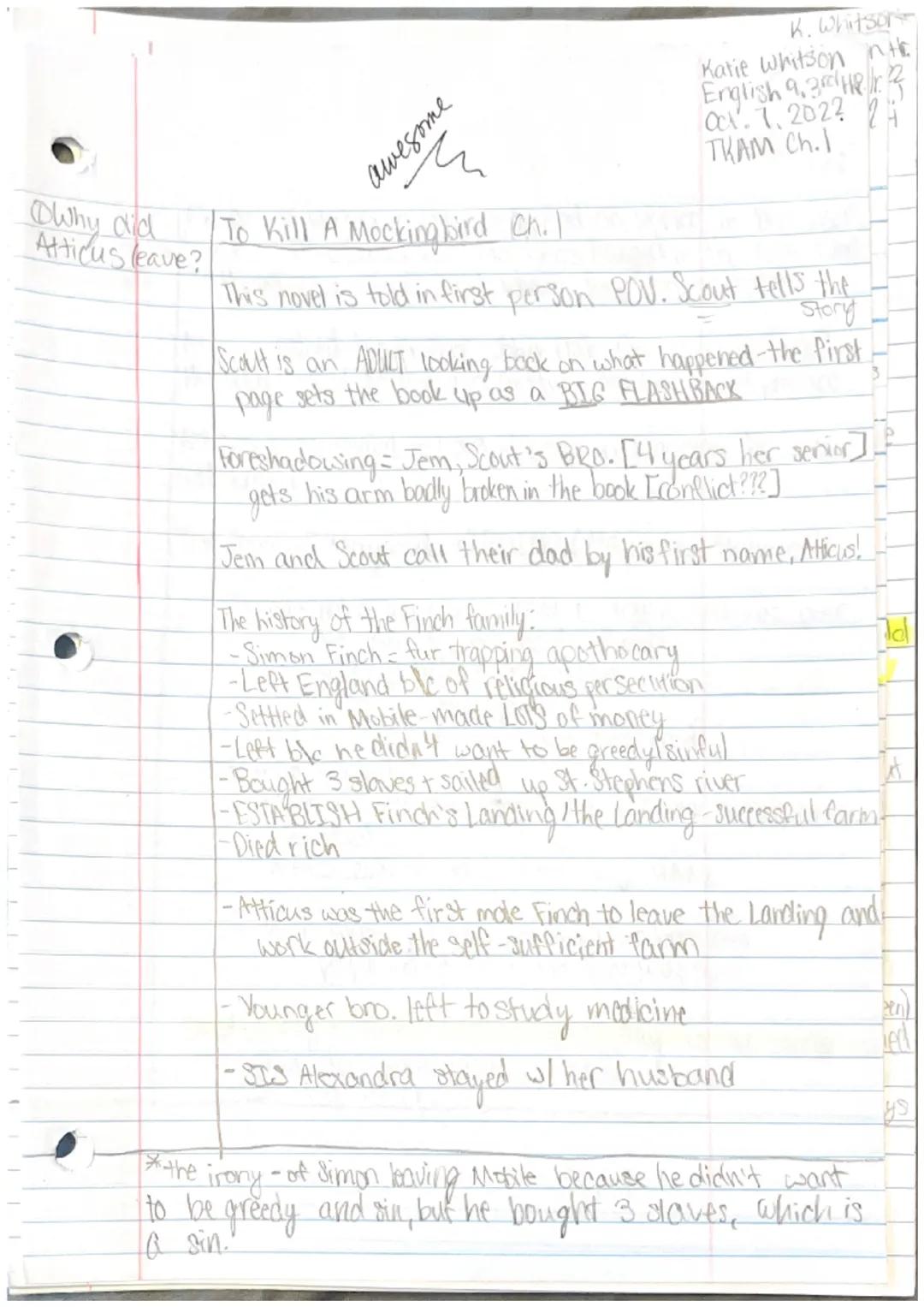
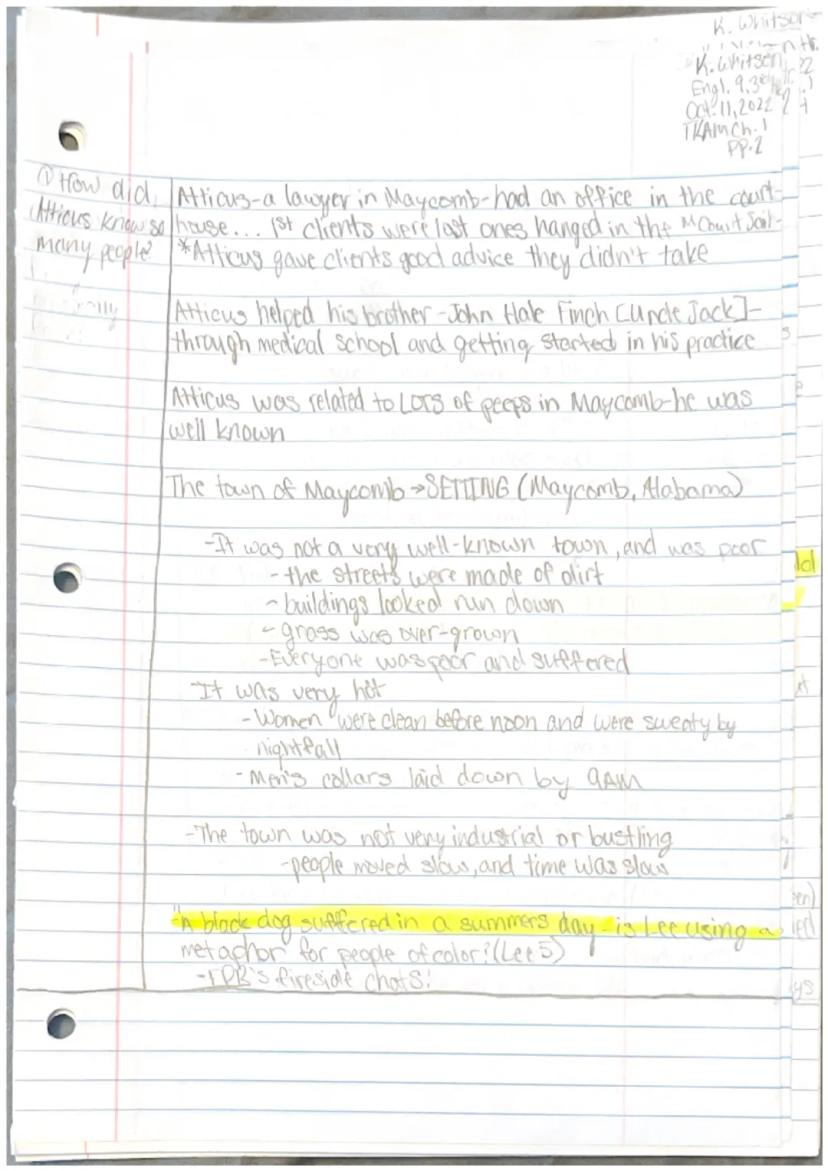
Understanding To Kill a Mockingbird Chapter 1: Characters, Setting, and Family History
To Kill a Mockingbird Chapter 1 introduces us to the Finch family through Scout's adult perspective, setting up the entire novel as one extended flashback. The narrative immediately establishes key To Kill a Mockingbird Chapter 1 characters including Scout, Jem, Atticus, and Calpurnia.
Definition: The novel employs first-person point of view through Scout's narration, with her adult self reflecting on childhood events, creating layers of meaning through this dual perspective.
The Finch family history reveals deep roots in Alabama. Simon Finch, their ancestor, established Finch's Landing after leaving England due to religious persecution. The Finch family history in To Kill a Mockingbird shows how Atticus broke tradition by becoming the first to leave the family farm to pursue law, while his brother studied medicine and sister Alexandra remained at the Landing.
The setting of Maycomb, Alabama, is vividly portrayed as a sleepy, poor Southern town during the Great Depression. Lee's description creates a powerful backdrop for the story's events, with dirt roads, run-down buildings, and a slow-paced lifestyle that reflects the era's challenges.
2
of 10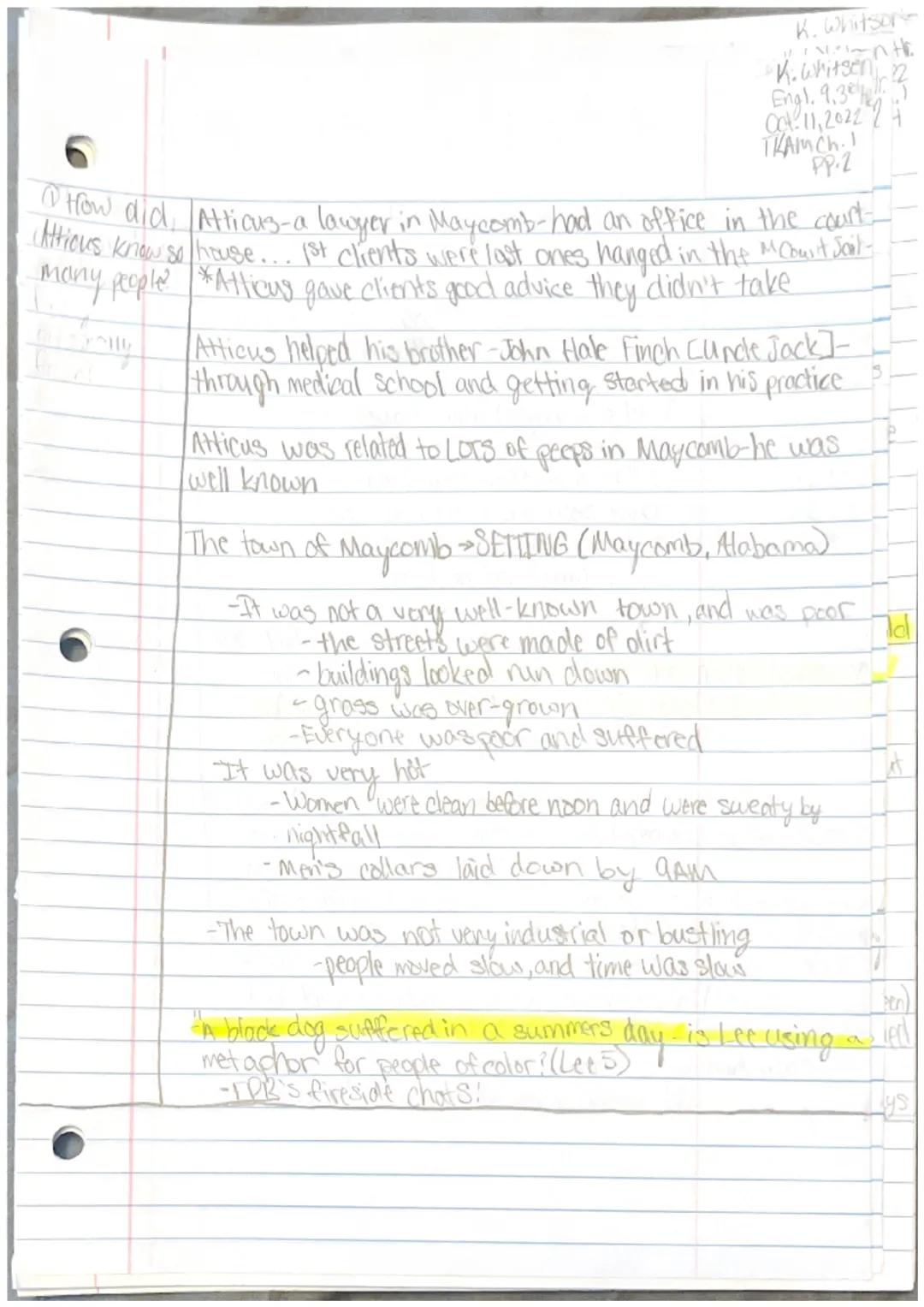
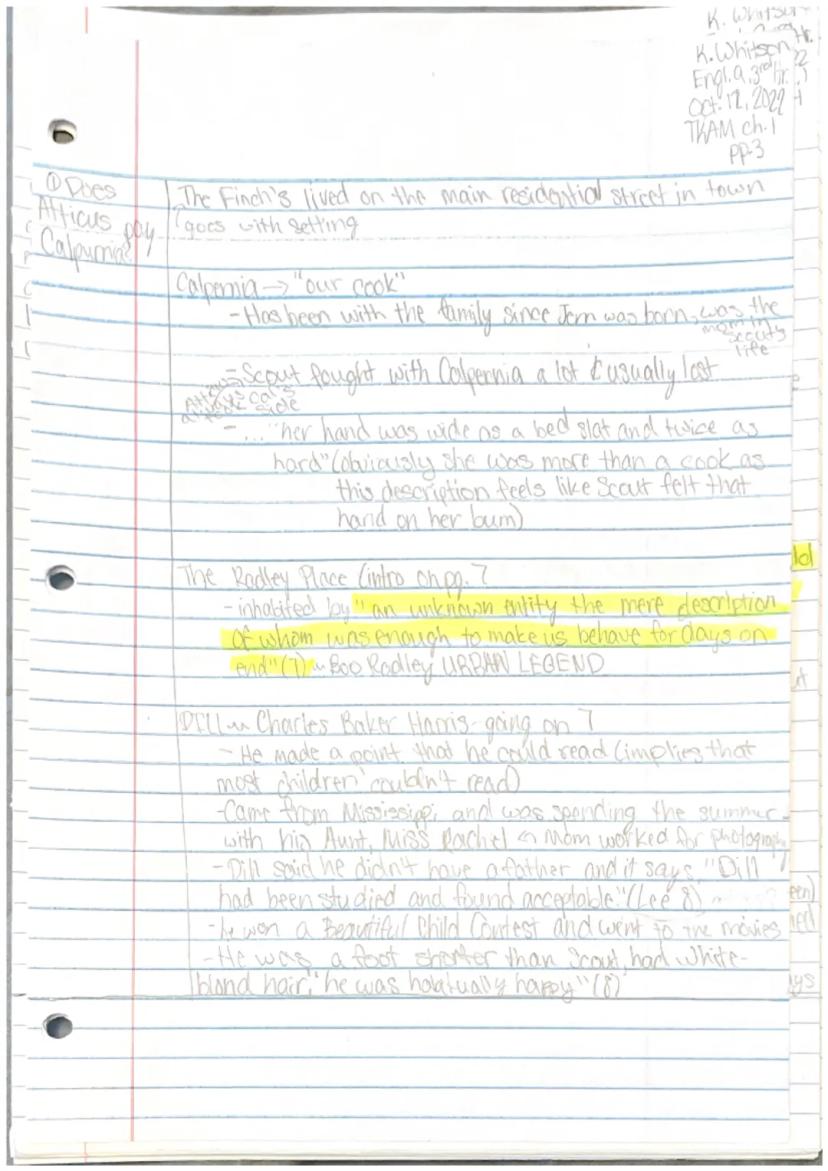
Scout's Perspective and the Introduction of Key Characters
Scout's flashbacks in To Kill a Mockingbird serve multiple narrative purposes, providing both childhood innocence and adult wisdom. The story begins with a significant piece of foreshadowing in To Kill a Mockingbird - the mention of Jem's broken arm, which creates immediate intrigue.
Highlight: The relationship between Scout and Calpurnia, the family's cook, is complex and meaningful, with Scout noting that their conflicts usually ended in Calpurnia's victory.
The introduction of Dill Harris brings new energy to the narrative. His arrival during summer vacation adds a catalyst for many upcoming adventures. Dill's character, described as a peculiarly happy child who can read, represents both innocence and worldliness.
3
of 10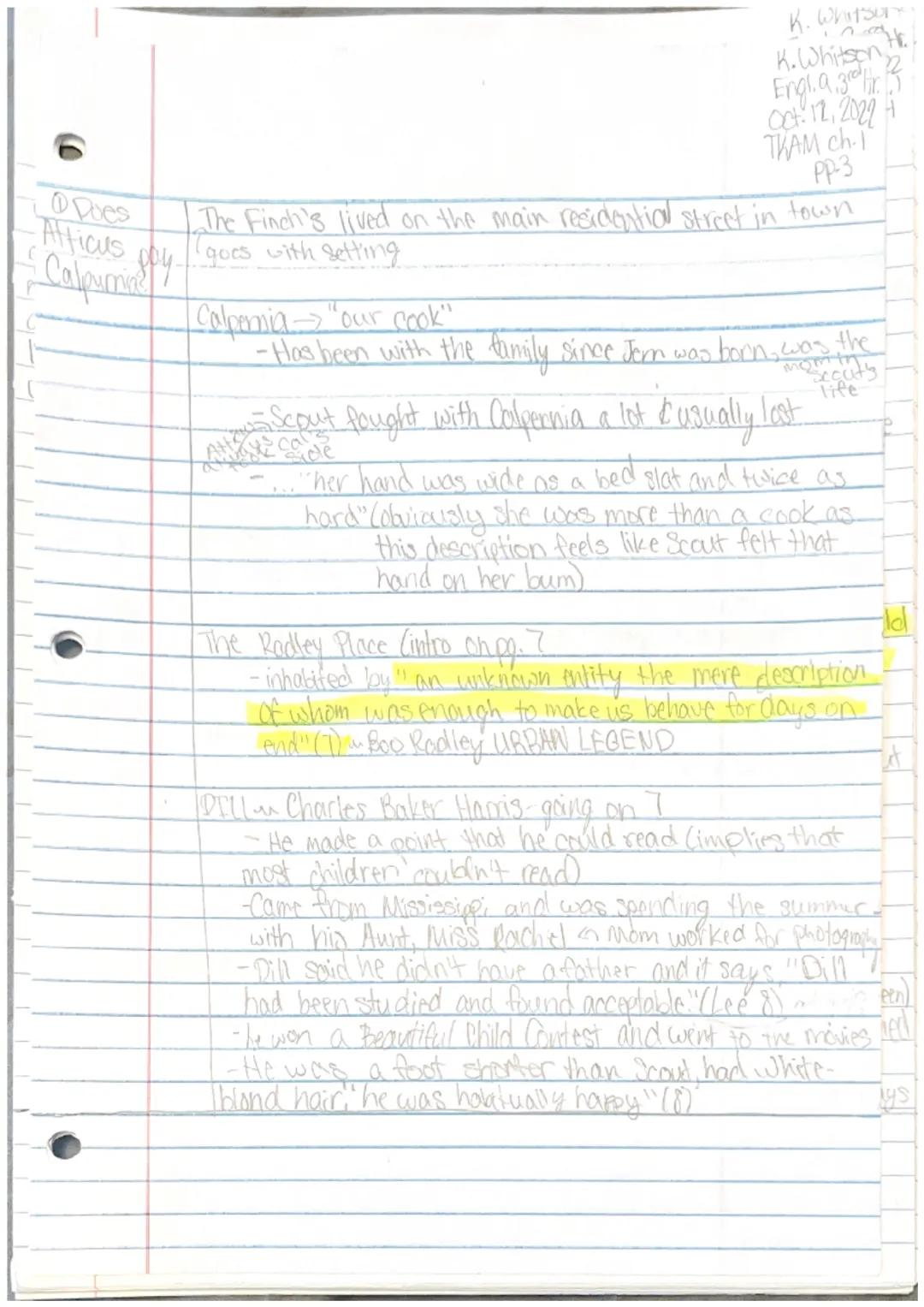
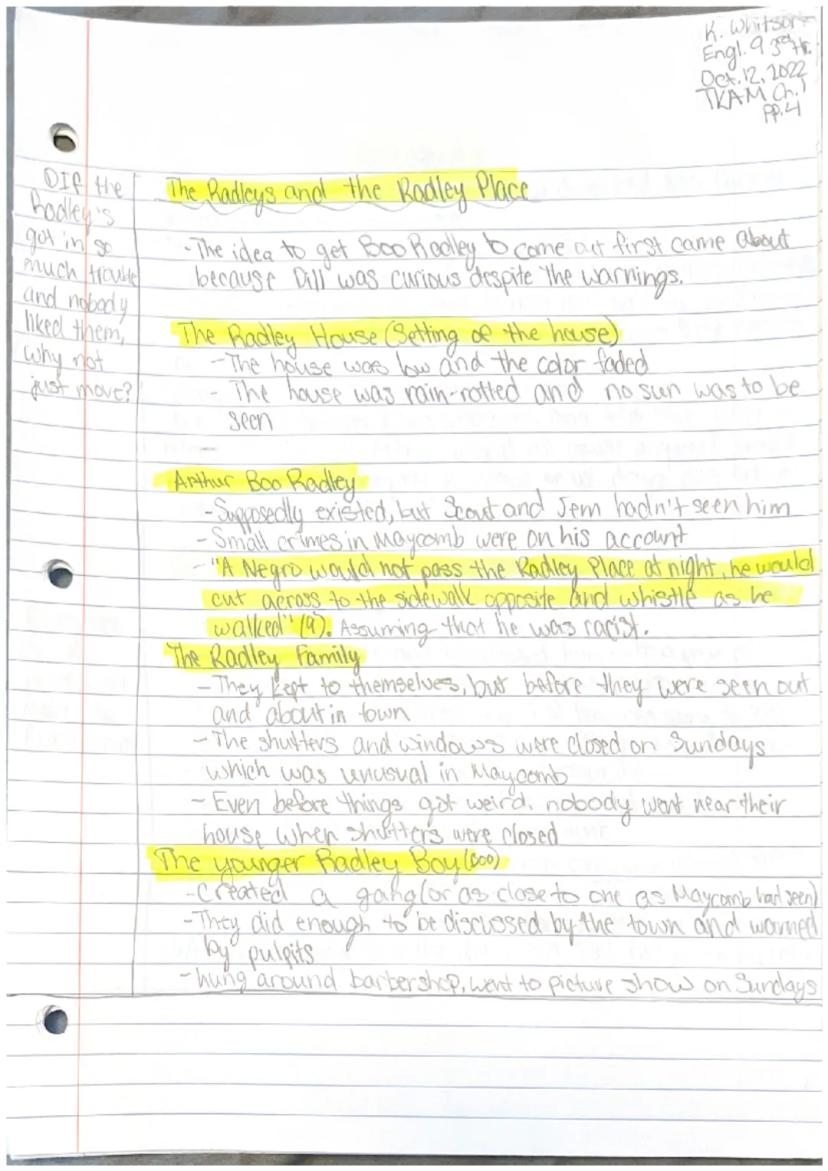
The Mystery of the Radley Place
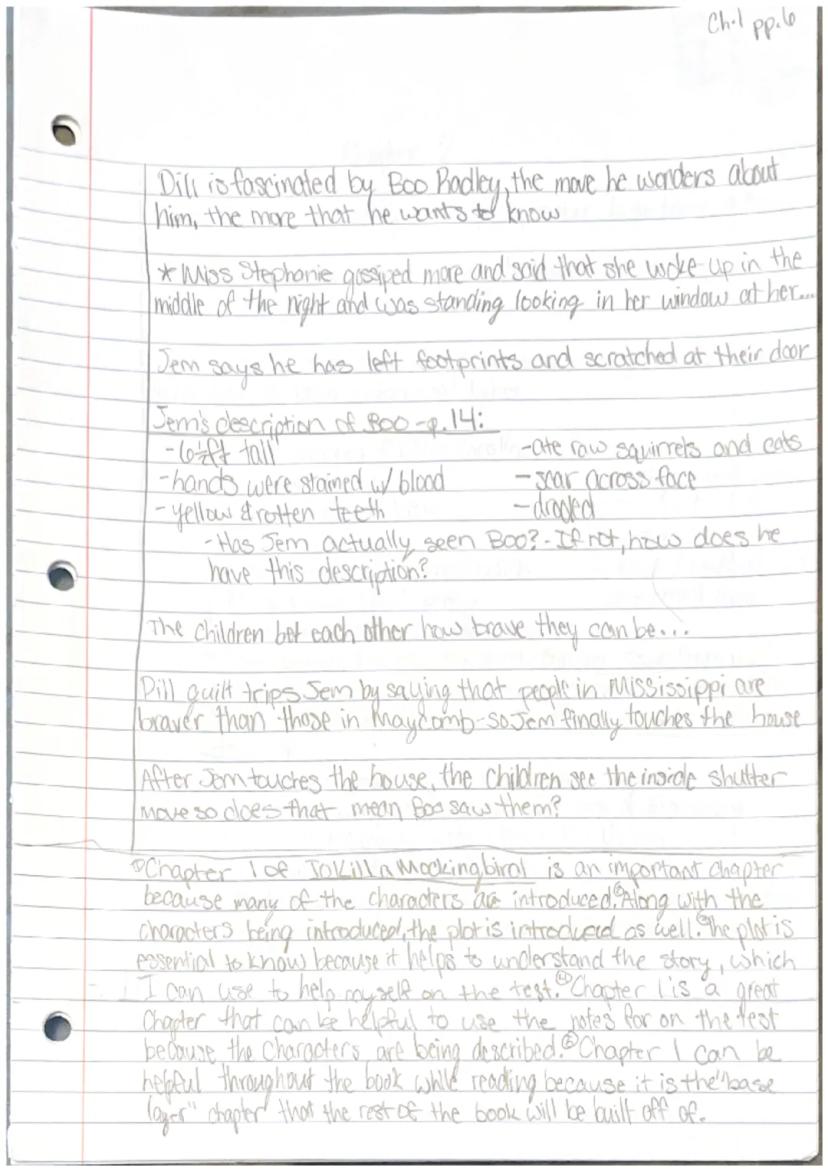
The Radley Place emerges as a crucial setting element in To Kill a Mockingbird Chapter 1-5. This mysterious house and its inhabitants, particularly Boo Radley, become central to the children's imagination and the story's development.
Example: The description of the Radley house as "rain-rotted" and sunless creates a Gothic atmosphere that contrasts with the rest of Maycomb's landscape.
The Radley family's isolation from Maycomb society represents the town's treatment of those who don't conform to its social norms. The younger Radley's involvement in a "gang" and subsequent confinement demonstrates the strict social codes governing the community.
4
of 10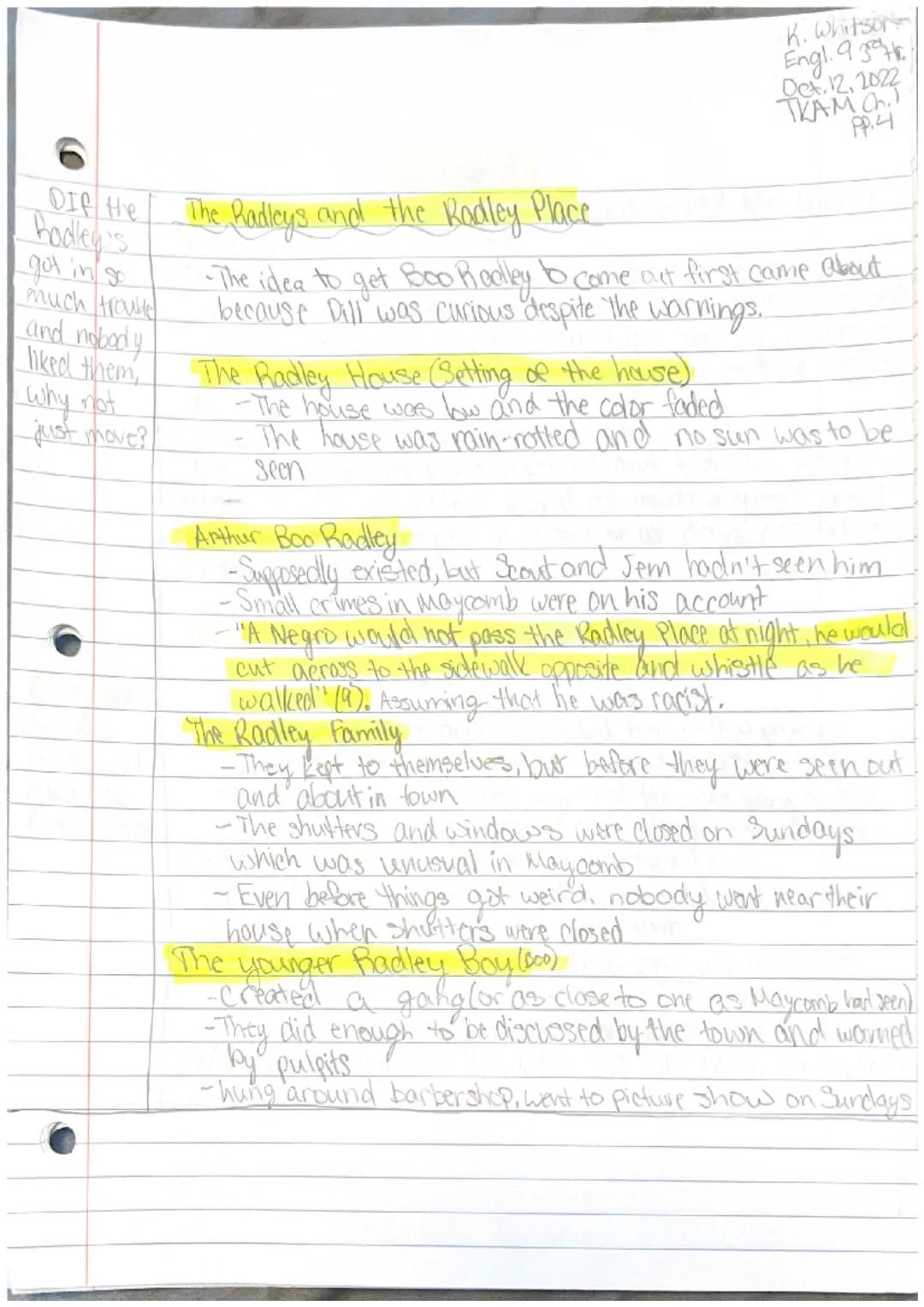
Social Dynamics and Community Relations
The novel's early chapters establish important social dynamics that will influence later events. The To Kill a Mockingbird Chapter 1-5 notes reveal how the town's social hierarchy and prejudices operate through various interactions and observations.
Quote: "A Negro would not pass the Radley Place at night" - this detail subtly introduces the racial tensions that will become central to the novel's main conflict.
The community's reaction to the Radley family's reclusiveness demonstrates how Maycomb treats those who deviate from its social norms. This theme of social isolation and judgment becomes increasingly significant as the story progresses through To Kill a Mockingbird Chapter 1-5 summary.
5
of 10
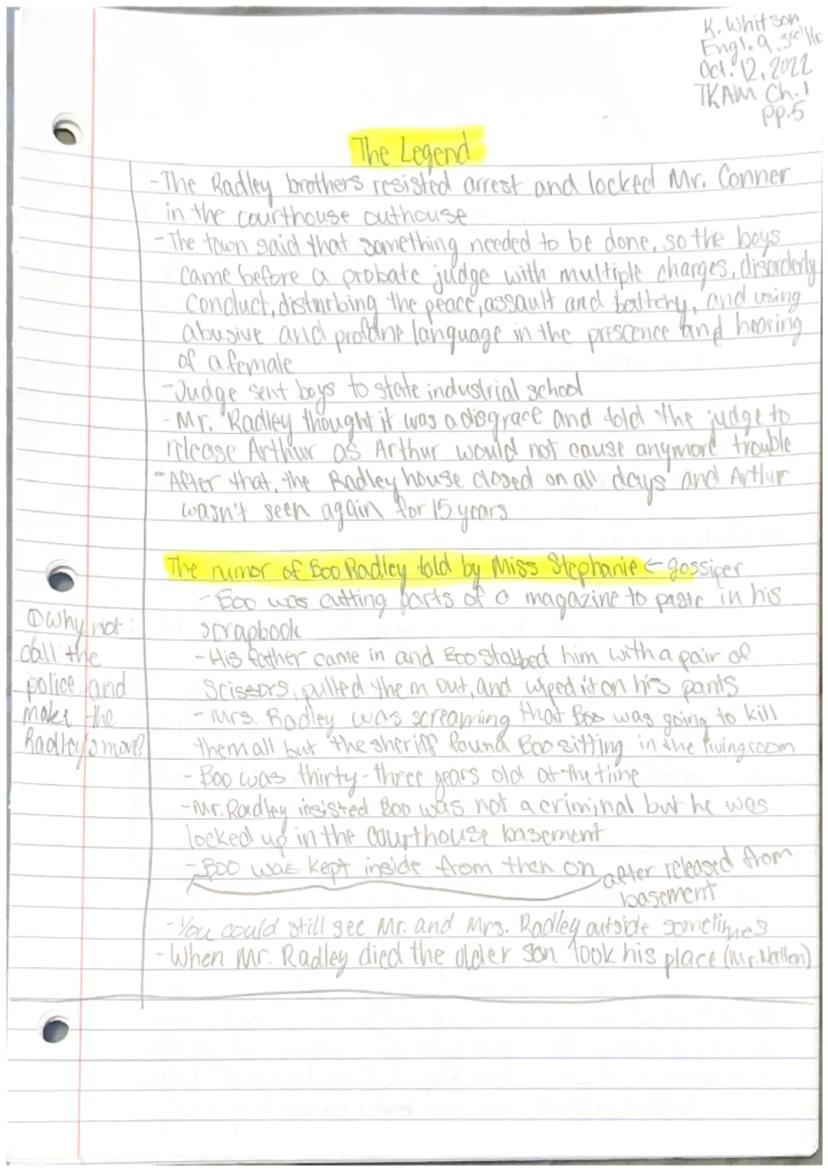
Understanding To Kill a Mockingbird Chapter 1: The Radley Legend
The opening chapter of To Kill a Mockingbird introduces readers to the mysterious Radley family through Scout's childhood memories. The Radley brothers' infamous confrontation with Mr. Conner at the courthouse outhouse marks the beginning of Maycomb's fascination with the family. When brought before a probate judge on charges including disorderly conduct and assault, the boys faced a turning point that would shape the town's perception of them for years to come.
Definition: The Radley Legend refers to the series of events and rumors surrounding the Radley family, particularly Arthur "Boo" Radley, that became part of Maycomb's folklore.
Arthur "Boo" Radley's story takes a dark turn with Miss Stephanie's account of the scissors incident. At thirty-three years old, Boo allegedly stabbed his father while scrapbooking, leading to his confinement in the courthouse basement. This event solidified the town's fear and fascination with the Radley house, which became increasingly isolated after Mr. Radley's death when Nathan Radley took his father's place.
The children's perception of Boo Radley, particularly through Jem's vivid descriptions, reveals the power of small-town gossip and childhood imagination. Jem's detailed account of Boo - complete with blood-stained hands and raw squirrel-eating habits - demonstrates how local legends grow and transform through storytelling.
6
of 10
Scout's First School Experience in Chapter 2
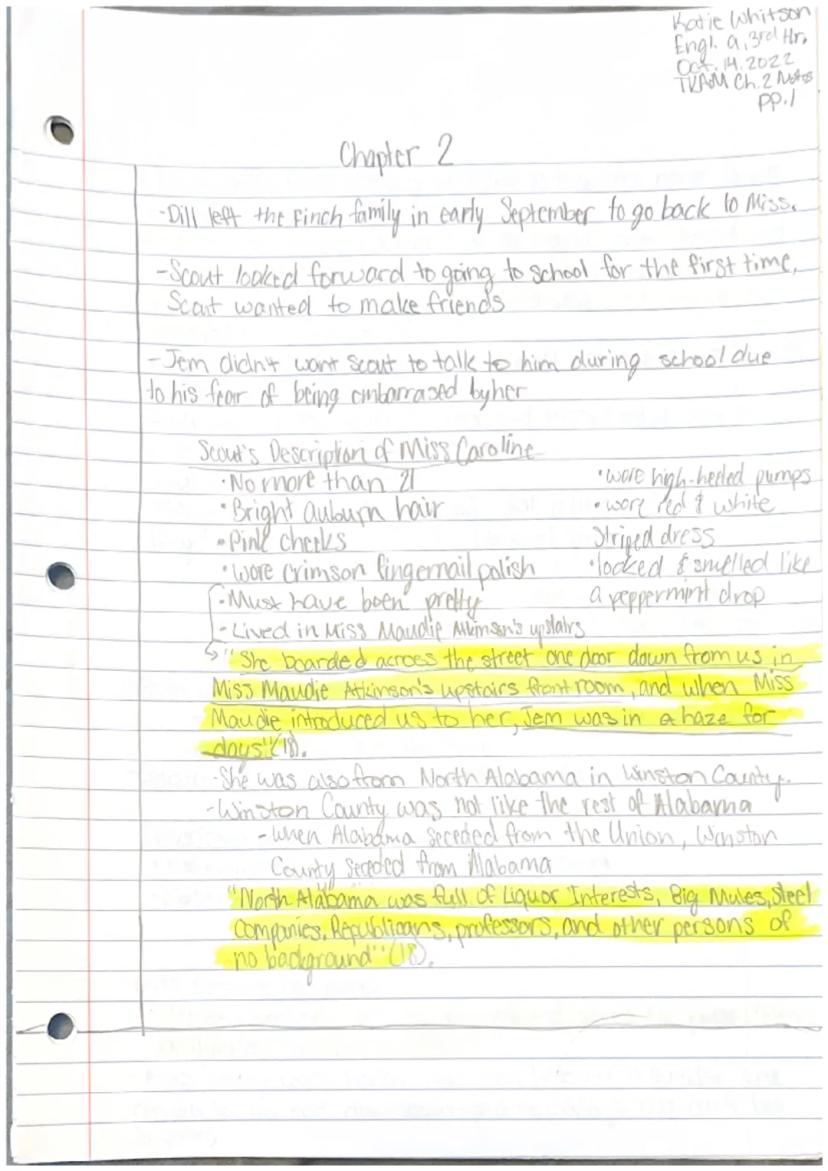
Scout's eagerly anticipated first day of school introduces Miss Caroline Fisher, a young teacher whose Northern Alabama background creates a cultural disconnect with Maycomb's rural community. The chapter expertly contrasts educational expectations with rural realities, highlighting the complex social dynamics of 1930s Alabama.
Highlight: Miss Caroline's character represents the clash between progressive educational methods and traditional Southern teaching approaches.
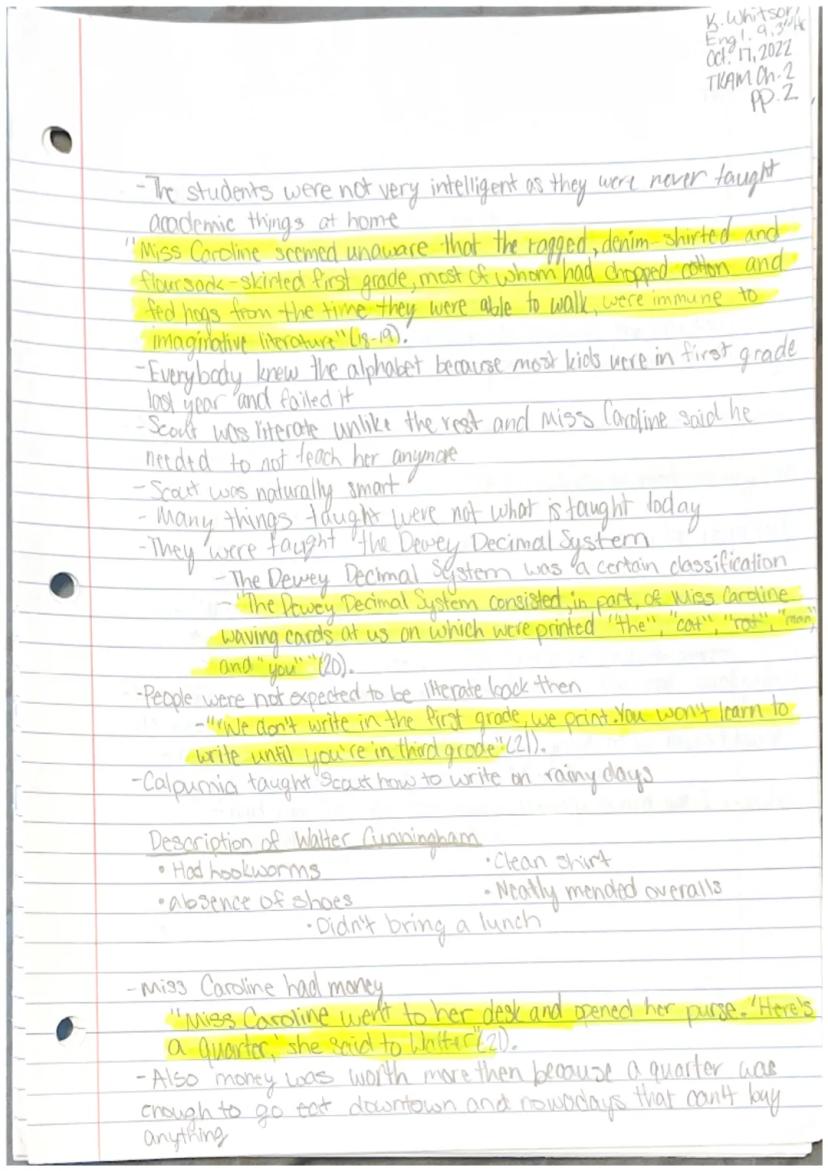
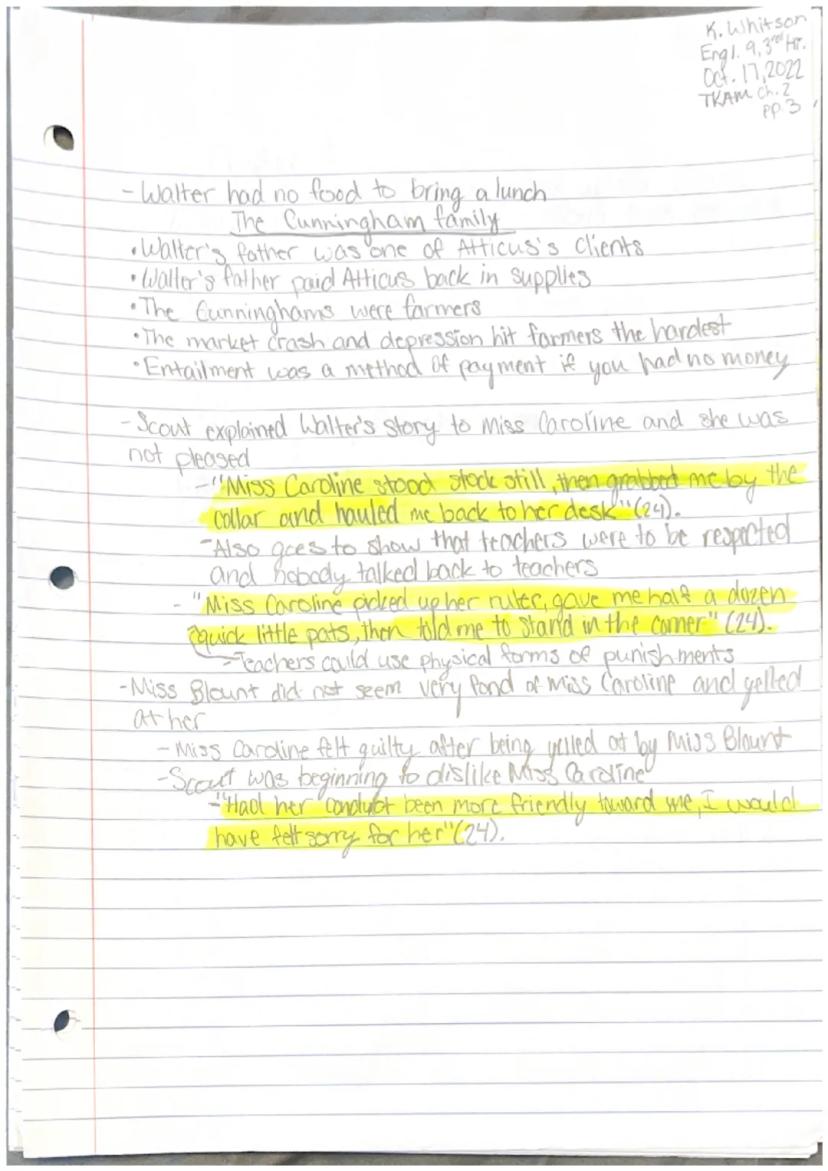
The chapter delves into the economic hardships faced by farming families like the Cunninghams, who resort to paying for services through entailment rather than cash. Scout's attempt to explain Walter Cunningham's situation to Miss Caroline reveals the deep-rooted social customs and pride that govern Maycomb's community relationships.
The educational system's rigid structure becomes apparent through Miss Caroline's insistence on following the Dewey Decimal System and her disapproval of Scout's advanced literacy. This conflict illustrates the broader themes of tradition versus progress that run throughout the novel.
7
of 10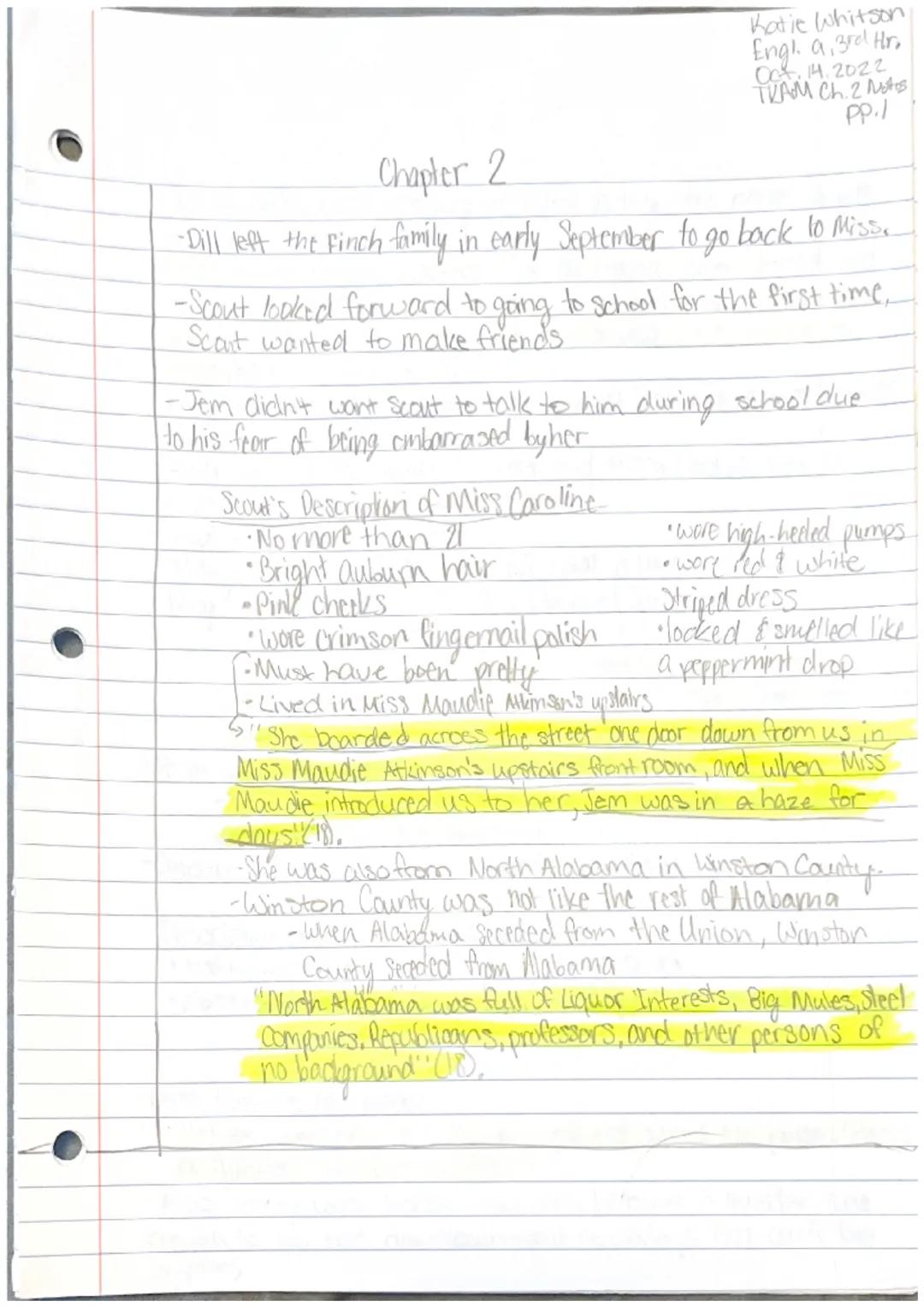
The Finch Family and Social Structure
The Finch family history in To Kill a Mockingbird provides crucial context for understanding Maycomb's social hierarchy. Atticus Finch's position as a respected lawyer and his relationship with clients like the Cunninghams demonstrates the complex web of social obligations and professional responsibilities in Southern society.
Example: The Cunningham family's payment method of using farm goods instead of money illustrates the Depression-era economic challenges faced by rural communities.
Scout's natural intelligence and early literacy, taught by Calpurnia, sets her apart from her classmates and creates tension with traditional educational methods. This distinction highlights the varying levels of educational opportunity available to different social classes in Maycomb.
8
of 10
Themes and Character Development in Early Chapters
The initial chapters of To Kill a Mockingbird establish fundamental themes that resonate throughout the novel. The contrast between childhood innocence and adult prejudices becomes evident through Scout's observations of Maycomb's social dynamics and the town's treatment of the Radley family.
Quote: "After that, the Radley house closed on all days and Arthur wasn't seen again for 15 years" - This line encapsulates the isolation and mystery surrounding the Radley family.
The development of key characters, particularly Scout's growing awareness of social complexities and Jem's evolution from childhood fears to adolescent bravado, sets the stage for their later moral development. The children's fascination with Boo Radley represents their broader journey toward understanding human nature and challenging societal prejudices.
9
of 10
Understanding To Kill a Mockingbird Chapter 3: Key Events and Character Development
To Kill a Mockingbird Chapter 1-5 notes reveal important character developments and social dynamics in Maycomb County. The chapter opens with a significant confrontation between Scout Finch and Walter Cunningham in the schoolyard, highlighting the complex social hierarchy that exists even among children.
Definition: The Cunninghams represent Maycomb's poor but proud farming families who never take charity and always pay their debts in whatever way they can.
The physical description of Walter Cunningham provides crucial insight into the poverty conditions of 1930s Alabama. His appearance - with red-rimmed eyes and worn overalls - symbolizes the harsh realities faced by many families during the Great Depression. This scene connects directly to the broader themes of social class and economic hardship that run throughout the novel.
Scout's interaction with Walter at the Finch home reveals her character's early prejudices and need for growth. When Walter covers his food in molasses, Scout's criticism prompts Calpurnia to teach her about respect and hospitality. This moment serves as a pivotal learning experience in Scout's moral development, demonstrating how the Finch family in To Kill a Mockingbird influences her understanding of social equality.
10
of 10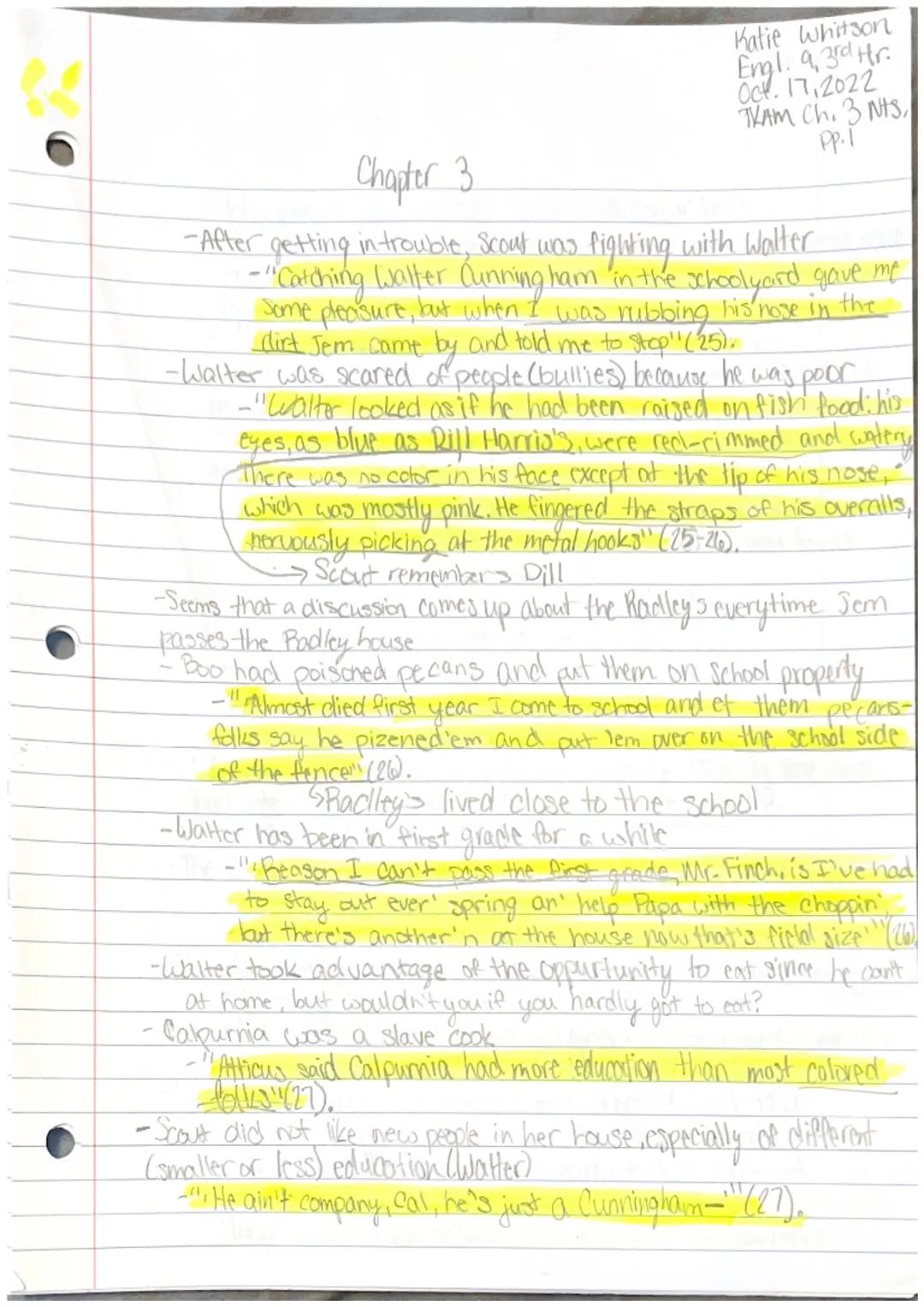
Social Class and Education in To Kill a Mockingbird Chapter 3
The chapter deeply explores the relationship between social class and education in Maycomb. Walter's explanation about missing school to help with farming illustrates how poverty directly impacts educational opportunities. This connects to the larger To Kill a Mockingbird Chapter 1-5 summary themes about social justice and inequality.
Highlight: The education system's failure to accommodate the needs of poor farming families reveals deeper systemic issues in Maycomb's society.
The character of Calpurnia emerges as a significant influence in this chapter. Her role as both servant and teacher to the Finch children demonstrates the complex racial dynamics of the time. The narrative notes that "Calpurnia had more education than most colored folks," highlighting both her exceptional status and the limited opportunities available to Black Americans during this period.
Scout's flashbacks in To Kill a Mockingbird serve to connect various elements of the story, particularly when she recalls conversations about Boo Radley. The mysterious stories about poisoned pecans and the Radley house continue to build suspense while revealing how local legends and prejudices are passed down through generations in Maycomb.
Example: The story of Boo Radley's poisoned pecans represents how fear and gossip can shape a community's perception of outsiders.
We thought you’d never ask...
What is the Knowunity AI companion?
Our AI companion is specifically built for the needs of students. Based on the millions of content pieces we have on the platform we can provide truly meaningful and relevant answers to students. But its not only about answers, the companion is even more about guiding students through their daily learning challenges, with personalised study plans, quizzes or content pieces in the chat and 100% personalisation based on the students skills and developments.
Where can I download the Knowunity app?
You can download the app in the Google Play Store and in the Apple App Store.
Is Knowunity really free of charge?
That's right! Enjoy free access to study content, connect with fellow students, and get instant help – all at your fingertips.
Similar Content
Most popular content: To Kill a Mockingbird
7EnglishTo Kill A Mockingbird Notes
Chapters 22-26
18213
EnglishEnglish 6 | Nelson Mandela Biography Essay
Essay on a biography of Nelson Mandela
6th523
EnglishTo Kill a Mockingbird by Harper Lee
To Kill a Mockingbird by Harper Lee: summary, book analysis, character development, plot structure, theme, setting, historical and cultural context
6th881
EnglishTo Kill a Mockingbird Notes Chpater 14-17
Notes for chapters 14-17 of To Kill a Mockingbird including quotes.
1,53878
EnglishTo Kill A Mockingbird Notes
Chapters 6-10
36838
EnglishTo Kill a Mockingbird Essay
Research paper on appearances and truth in TKAM
35136
EnglishTo Kill a Mockingbird Notes Chapters 28-31
Notes for chapters 28-31 of To Kill a Mockingbird including quotes.
23928
Most popular content in English
9G
Englishgrade 6 english
learning the basics
6th7870
M
EnglishMastering English Grammar: Challenging Concepts for Grade 9
Boost your English skills with this comprehensive flashcard set covering advanced grammar topics for grade 9 students. Dive into challenging concepts and ace your exams!
10th3771
E
EnglishEnglish 10 grammar quiz
verbs
10th3090
EnglishIntroduction to linguistics
Introduction to linguistics exam revision notes. Structure of language, typologies of language, parts of speech, language families, Chomsky, Hockett, semantic triangle, Prague Linguistic Circle, writing systems, acquisition and learning
1,21250
M
Englishmatter
8th grade science
8th1731
AP English LanguageAP Lang Unit 1.1 Notes (The Rhetorical Situation)
Notes on AP lang unit 1.1, the rhetorical situation
10th28013
G
Englishgrade 10 English vocabulary
this content is about vocabulary
10th4866
EnglishThe great Gatsbey notes. please note that these are things I found interesting/ important. if you have any questions please feel free to ask
grammar and the great gatsby notes.
11th94469
EnglishComplete Hamlet Breakdown
What you need to know in Hamlet
10th30817
Most popular content
9O
 AP US History
Origins and Dynamics of the Columbian Exchange
Analyze the ecological and economic motivations behind the initial transfer of goods, people, and diseases between the Old and New Worlds.
9th3,1280
I
AP US HistoryIntroduction to Early Cultural Interactions
Analyze the initial social and religious encounters between Europeans, Africans, and Indigenous peoples in the colonial Americas.
9th2,7730
O
 AP World History
Origins of Ancient River Civilizations
Analyze the environmental factors and technological innovations that led to the rise of early states in Mesopotamia, Egypt, and the Indus Valley.
9th3,1870
M
AP US HistoryMotivations for European Exploration
Analyze the economic, religious, and political factors that drove European powers to the Americas during the 15th and 16th centuries.
9th1,7780
F
 AP Psychology
Foundations of Ethical Guidelines in Research
Practice the core principles of the APA ethical code including informed consent, debriefing, and the role of Institutional Review Boards.
9th1,3360
I
AP US HistoryIntroduction to Native American Societies
Examine the diverse social, political, and economic structures of North American indigenous groups prior to European contact.
9th1,1100
I
 AP Biology
Introduction to Biological Elements of Life
Practice identifying the essential elements including carbon, nitrogen, phosphorus, and sulfur that compose biological macromolecules.
9th1,7390
I
AP US HistoryIntroduction to the Spanish Encomienda System
Explore the fundamental economic and social structures of the Spanish colonial system, focusing on the encomienda and the casta social hierarchy.
9th8890
O
AP World HistoryOrigins and Continuity of the Byzantine Empire
Analyze the political and cultural transitions from the Roman Empire to the Byzantine Empire, focusing on the reign of Justinian I and his code.
9th1,6320
Can't find what you're looking for? Explore other subjects.
Students love us — and so will you.
4.6/5App Store
4.7/5Google Play
The app is very easy to use and well designed. I have found everything I was looking for so far and have been able to learn a lot from the presentations! I will definitely use the app for a class assignment! And of course it also helps a lot as an inspiration.
Stefan SiOS user
This app is really great. There are so many study notes and help [...]. My problem subject is French, for example, and the app has so many options for help. Thanks to this app, I have improved my French. I would recommend it to anyone.
Samantha KlichAndroid user
Wow, I am really amazed. I just tried the app because I've seen it advertised many times and was absolutely stunned. This app is THE HELP you want for school and above all, it offers so many things, such as workouts and fact sheets, which have been VERY helpful to me personally.
AnnaiOS user
English1,071 views·Updated Jun 12, 2026·21 pagesTo Kill a Mockingbird: Chapter 1 Characters and Summary - Easy Notes and Fun Quizzes
The story begins in the sleepy town of Maycomb, Alabama, where young Scout Finch, the main character of To Kill a Mockingbird, recounts her childhood memories through a series of flashbacks. The narrative opens with Scout introducing...
1
of 10
Sign up to see the content. It's free!
- Access to all documents
- Improve your grades
- Join milions of students
Understanding To Kill a Mockingbird Chapter 1: Characters, Setting, and Family History
To Kill a Mockingbird Chapter 1 introduces us to the Finch family through Scout's adult perspective, setting up the entire novel as one extended flashback. The narrative immediately establishes key To Kill a Mockingbird Chapter 1 characters including Scout, Jem, Atticus, and Calpurnia.
Definition: The novel employs first-person point of view through Scout's narration, with her adult self reflecting on childhood events, creating layers of meaning through this dual perspective.
The Finch family history reveals deep roots in Alabama. Simon Finch, their ancestor, established Finch's Landing after leaving England due to religious persecution. The Finch family history in To Kill a Mockingbird shows how Atticus broke tradition by becoming the first to leave the family farm to pursue law, while his brother studied medicine and sister Alexandra remained at the Landing.
The setting of Maycomb, Alabama, is vividly portrayed as a sleepy, poor Southern town during the Great Depression. Lee's description creates a powerful backdrop for the story's events, with dirt roads, run-down buildings, and a slow-paced lifestyle that reflects the era's challenges.
2
of 10Sign up to see the content. It's free!
- Access to all documents
- Improve your grades
- Join milions of students
Scout's Perspective and the Introduction of Key Characters
Scout's flashbacks in To Kill a Mockingbird serve multiple narrative purposes, providing both childhood innocence and adult wisdom. The story begins with a significant piece of foreshadowing in To Kill a Mockingbird - the mention of Jem's broken arm, which creates immediate intrigue.
Highlight: The relationship between Scout and Calpurnia, the family's cook, is complex and meaningful, with Scout noting that their conflicts usually ended in Calpurnia's victory.
The introduction of Dill Harris brings new energy to the narrative. His arrival during summer vacation adds a catalyst for many upcoming adventures. Dill's character, described as a peculiarly happy child who can read, represents both innocence and worldliness.
3
of 10Sign up to see the content. It's free!
- Access to all documents
- Improve your grades
- Join milions of students
The Mystery of the Radley Place
The Radley Place emerges as a crucial setting element in To Kill a Mockingbird Chapter 1-5. This mysterious house and its inhabitants, particularly Boo Radley, become central to the children's imagination and the story's development.
Example: The description of the Radley house as "rain-rotted" and sunless creates a Gothic atmosphere that contrasts with the rest of Maycomb's landscape.
The Radley family's isolation from Maycomb society represents the town's treatment of those who don't conform to its social norms. The younger Radley's involvement in a "gang" and subsequent confinement demonstrates the strict social codes governing the community.
4
of 10Sign up to see the content. It's free!
- Access to all documents
- Improve your grades
- Join milions of students
Social Dynamics and Community Relations
The novel's early chapters establish important social dynamics that will influence later events. The To Kill a Mockingbird Chapter 1-5 notes reveal how the town's social hierarchy and prejudices operate through various interactions and observations.
Quote: "A Negro would not pass the Radley Place at night" - this detail subtly introduces the racial tensions that will become central to the novel's main conflict.
The community's reaction to the Radley family's reclusiveness demonstrates how Maycomb treats those who deviate from its social norms. This theme of social isolation and judgment becomes increasingly significant as the story progresses through To Kill a Mockingbird Chapter 1-5 summary.
5
of 10Sign up to see the content. It's free!
- Access to all documents
- Improve your grades
- Join milions of students
Understanding To Kill a Mockingbird Chapter 1: The Radley Legend
The opening chapter of To Kill a Mockingbird introduces readers to the mysterious Radley family through Scout's childhood memories. The Radley brothers' infamous confrontation with Mr. Conner at the courthouse outhouse marks the beginning of Maycomb's fascination with the family. When brought before a probate judge on charges including disorderly conduct and assault, the boys faced a turning point that would shape the town's perception of them for years to come.
Definition: The Radley Legend refers to the series of events and rumors surrounding the Radley family, particularly Arthur "Boo" Radley, that became part of Maycomb's folklore.
Arthur "Boo" Radley's story takes a dark turn with Miss Stephanie's account of the scissors incident. At thirty-three years old, Boo allegedly stabbed his father while scrapbooking, leading to his confinement in the courthouse basement. This event solidified the town's fear and fascination with the Radley house, which became increasingly isolated after Mr. Radley's death when Nathan Radley took his father's place.
The children's perception of Boo Radley, particularly through Jem's vivid descriptions, reveals the power of small-town gossip and childhood imagination. Jem's detailed account of Boo - complete with blood-stained hands and raw squirrel-eating habits - demonstrates how local legends grow and transform through storytelling.
6
of 10Sign up to see the content. It's free!
- Access to all documents
- Improve your grades
- Join milions of students
Scout's First School Experience in Chapter 2
Scout's eagerly anticipated first day of school introduces Miss Caroline Fisher, a young teacher whose Northern Alabama background creates a cultural disconnect with Maycomb's rural community. The chapter expertly contrasts educational expectations with rural realities, highlighting the complex social dynamics of 1930s Alabama.
Highlight: Miss Caroline's character represents the clash between progressive educational methods and traditional Southern teaching approaches.
The chapter delves into the economic hardships faced by farming families like the Cunninghams, who resort to paying for services through entailment rather than cash. Scout's attempt to explain Walter Cunningham's situation to Miss Caroline reveals the deep-rooted social customs and pride that govern Maycomb's community relationships.
The educational system's rigid structure becomes apparent through Miss Caroline's insistence on following the Dewey Decimal System and her disapproval of Scout's advanced literacy. This conflict illustrates the broader themes of tradition versus progress that run throughout the novel.
7
of 10Sign up to see the content. It's free!
- Access to all documents
- Improve your grades
- Join milions of students
The Finch Family and Social Structure
The Finch family history in To Kill a Mockingbird provides crucial context for understanding Maycomb's social hierarchy. Atticus Finch's position as a respected lawyer and his relationship with clients like the Cunninghams demonstrates the complex web of social obligations and professional responsibilities in Southern society.
Example: The Cunningham family's payment method of using farm goods instead of money illustrates the Depression-era economic challenges faced by rural communities.
Scout's natural intelligence and early literacy, taught by Calpurnia, sets her apart from her classmates and creates tension with traditional educational methods. This distinction highlights the varying levels of educational opportunity available to different social classes in Maycomb.
8
of 10Sign up to see the content. It's free!
- Access to all documents
- Improve your grades
- Join milions of students
Themes and Character Development in Early Chapters
The initial chapters of To Kill a Mockingbird establish fundamental themes that resonate throughout the novel. The contrast between childhood innocence and adult prejudices becomes evident through Scout's observations of Maycomb's social dynamics and the town's treatment of the Radley family.
Quote: "After that, the Radley house closed on all days and Arthur wasn't seen again for 15 years" - This line encapsulates the isolation and mystery surrounding the Radley family.
The development of key characters, particularly Scout's growing awareness of social complexities and Jem's evolution from childhood fears to adolescent bravado, sets the stage for their later moral development. The children's fascination with Boo Radley represents their broader journey toward understanding human nature and challenging societal prejudices.
9
of 10Sign up to see the content. It's free!
- Access to all documents
- Improve your grades
- Join milions of students
Understanding To Kill a Mockingbird Chapter 3: Key Events and Character Development
To Kill a Mockingbird Chapter 1-5 notes reveal important character developments and social dynamics in Maycomb County. The chapter opens with a significant confrontation between Scout Finch and Walter Cunningham in the schoolyard, highlighting the complex social hierarchy that exists even among children.
Definition: The Cunninghams represent Maycomb's poor but proud farming families who never take charity and always pay their debts in whatever way they can.
The physical description of Walter Cunningham provides crucial insight into the poverty conditions of 1930s Alabama. His appearance - with red-rimmed eyes and worn overalls - symbolizes the harsh realities faced by many families during the Great Depression. This scene connects directly to the broader themes of social class and economic hardship that run throughout the novel.
Scout's interaction with Walter at the Finch home reveals her character's early prejudices and need for growth. When Walter covers his food in molasses, Scout's criticism prompts Calpurnia to teach her about respect and hospitality. This moment serves as a pivotal learning experience in Scout's moral development, demonstrating how the Finch family in To Kill a Mockingbird influences her understanding of social equality.
10
of 10Sign up to see the content. It's free!
- Access to all documents
- Improve your grades
- Join milions of students
Social Class and Education in To Kill a Mockingbird Chapter 3
The chapter deeply explores the relationship between social class and education in Maycomb. Walter's explanation about missing school to help with farming illustrates how poverty directly impacts educational opportunities. This connects to the larger To Kill a Mockingbird Chapter 1-5 summary themes about social justice and inequality.
Highlight: The education system's failure to accommodate the needs of poor farming families reveals deeper systemic issues in Maycomb's society.
The character of Calpurnia emerges as a significant influence in this chapter. Her role as both servant and teacher to the Finch children demonstrates the complex racial dynamics of the time. The narrative notes that "Calpurnia had more education than most colored folks," highlighting both her exceptional status and the limited opportunities available to Black Americans during this period.
Scout's flashbacks in To Kill a Mockingbird serve to connect various elements of the story, particularly when she recalls conversations about Boo Radley. The mysterious stories about poisoned pecans and the Radley house continue to build suspense while revealing how local legends and prejudices are passed down through generations in Maycomb.
Example: The story of Boo Radley's poisoned pecans represents how fear and gossip can shape a community's perception of outsiders.
We thought you’d never ask...
What is the Knowunity AI companion?
Our AI companion is specifically built for the needs of students. Based on the millions of content pieces we have on the platform we can provide truly meaningful and relevant answers to students. But its not only about answers, the companion is even more about guiding students through their daily learning challenges, with personalised study plans, quizzes or content pieces in the chat and 100% personalisation based on the students skills and developments.
Where can I download the Knowunity app?
You can download the app in the Google Play Store and in the Apple App Store.
Is Knowunity really free of charge?
That's right! Enjoy free access to study content, connect with fellow students, and get instant help – all at your fingertips.
Similar Content
Most popular content: To Kill a Mockingbird
7EnglishTo Kill A Mockingbird Notes
Chapters 22-26
18213
EnglishEnglish 6 | Nelson Mandela Biography Essay
Essay on a biography of Nelson Mandela
6th523
EnglishTo Kill a Mockingbird by Harper Lee
To Kill a Mockingbird by Harper Lee: summary, book analysis, character development, plot structure, theme, setting, historical and cultural context
6th881
EnglishTo Kill a Mockingbird Notes Chpater 14-17
Notes for chapters 14-17 of To Kill a Mockingbird including quotes.
1,53878
EnglishTo Kill A Mockingbird Notes
Chapters 6-10
36838
EnglishTo Kill a Mockingbird Essay
Research paper on appearances and truth in TKAM
35136
EnglishTo Kill a Mockingbird Notes Chapters 28-31
Notes for chapters 28-31 of To Kill a Mockingbird including quotes.
23928
Most popular content in English
9G
Englishgrade 6 english
learning the basics
6th7870
M
EnglishMastering English Grammar: Challenging Concepts for Grade 9
Boost your English skills with this comprehensive flashcard set covering advanced grammar topics for grade 9 students. Dive into challenging concepts and ace your exams!
10th3771
E
EnglishEnglish 10 grammar quiz
verbs
10th3090
EnglishIntroduction to linguistics
Introduction to linguistics exam revision notes. Structure of language, typologies of language, parts of speech, language families, Chomsky, Hockett, semantic triangle, Prague Linguistic Circle, writing systems, acquisition and learning
1,21250
M
Englishmatter
8th grade science
8th1731
AP English LanguageAP Lang Unit 1.1 Notes (The Rhetorical Situation)
Notes on AP lang unit 1.1, the rhetorical situation
10th28013
G
Englishgrade 10 English vocabulary
this content is about vocabulary
10th4866
EnglishThe great Gatsbey notes. please note that these are things I found interesting/ important. if you have any questions please feel free to ask
grammar and the great gatsby notes.
11th94469
EnglishComplete Hamlet Breakdown
What you need to know in Hamlet
10th30817
Most popular content
9O
AP US HistoryOrigins and Dynamics of the Columbian Exchange
Analyze the ecological and economic motivations behind the initial transfer of goods, people, and diseases between the Old and New Worlds.
9th3,1280
I
AP US HistoryIntroduction to Early Cultural Interactions
Analyze the initial social and religious encounters between Europeans, Africans, and Indigenous peoples in the colonial Americas.
9th2,7730
O
AP World HistoryOrigins of Ancient River Civilizations
Analyze the environmental factors and technological innovations that led to the rise of early states in Mesopotamia, Egypt, and the Indus Valley.
9th3,1870
M
AP US HistoryMotivations for European Exploration
Analyze the economic, religious, and political factors that drove European powers to the Americas during the 15th and 16th centuries.
9th1,7780
F
AP PsychologyFoundations of Ethical Guidelines in Research
Practice the core principles of the APA ethical code including informed consent, debriefing, and the role of Institutional Review Boards.
9th1,3360
I
AP US HistoryIntroduction to Native American Societies
Examine the diverse social, political, and economic structures of North American indigenous groups prior to European contact.
9th1,1100
I
AP BiologyIntroduction to Biological Elements of Life
Practice identifying the essential elements including carbon, nitrogen, phosphorus, and sulfur that compose biological macromolecules.
9th1,7390
I
AP US HistoryIntroduction to the Spanish Encomienda System
Explore the fundamental economic and social structures of the Spanish colonial system, focusing on the encomienda and the casta social hierarchy.
9th8890
O
AP World HistoryOrigins and Continuity of the Byzantine Empire
Analyze the political and cultural transitions from the Roman Empire to the Byzantine Empire, focusing on the reign of Justinian I and his code.
9th1,6320
Can't find what you're looking for? Explore other subjects.
Students love us — and so will you.
4.6/5App Store
4.7/5Google Play
The app is very easy to use and well designed. I have found everything I was looking for so far and have been able to learn a lot from the presentations! I will definitely use the app for a class assignment! And of course it also helps a lot as an inspiration.
Stefan SiOS user
This app is really great. There are so many study notes and help [...]. My problem subject is French, for example, and the app has so many options for help. Thanks to this app, I have improved my French. I would recommend it to anyone.
Samantha KlichAndroid user
Wow, I am really amazed. I just tried the app because I've seen it advertised many times and was absolutely stunned. This app is THE HELP you want for school and above all, it offers so many things, such as workouts and fact sheets, which have been VERY helpful to me personally.
AnnaiOS user