
Sentence structure is the backbone of effective writing. Understanding different...
 English83 views·Updated Jun 11, 2026·3 pages
Mastering Sentence Structure: Tips and Examples

Mariah@mariah_stangl

1 / 3
1
of 3
Sentence Structure Basics
Effective writing mirrors how we naturally speak. Using only one type of sentence structure creates dull, monotonous writing. Instead, aim for dynamic and engaging sentences that keep your reader interested.
A complete sentence requires two essential components: a subject (noun) and a predicate (verb plus any information about the subject). For example: "The lazy dog ran wildly into the ocean." Simple sentences can include multiple nouns and verbs, like "My siblings and I ran and jumped swiftly after the enormous ball."
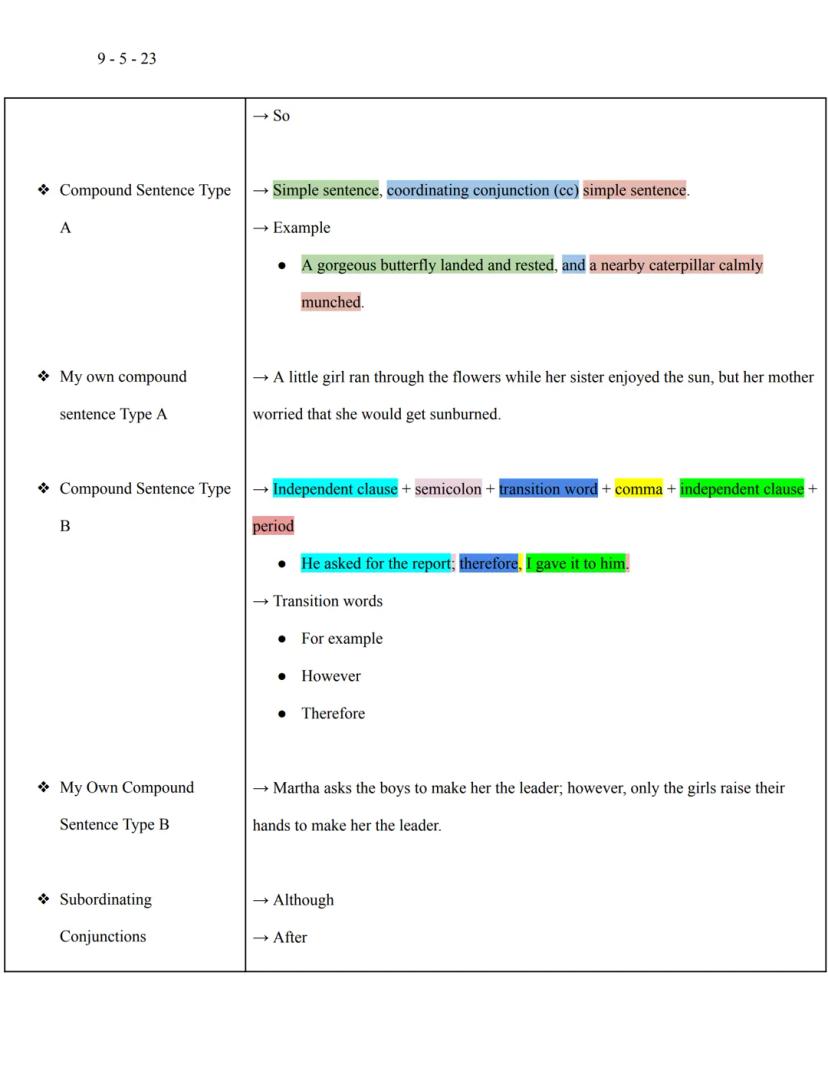
Coordinating conjunctions connect parts of sentences and include: FOR , AND (additional information), NOR , BUT (contrast), OR (alternatives), YET (despite), and SO (result). Remember them using the acronym FANBOYS.
Pro Tip: When you're revising your writing, read it aloud to hear if it sounds natural. If your sentences all follow the same pattern, mix them up using different structures!
2
of 3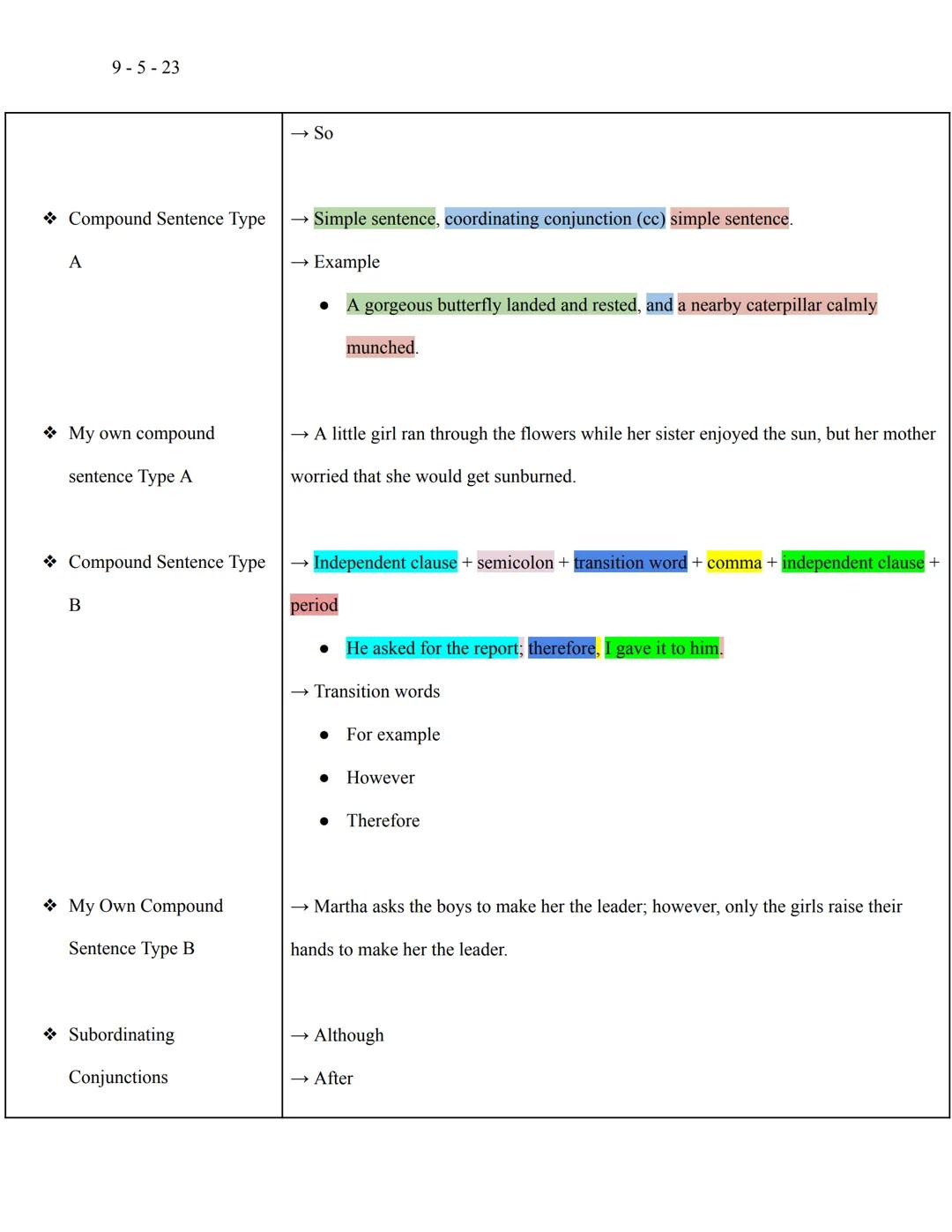
Compound Sentences
Compound sentences join two complete thoughts (independent clauses) together. Type A compound sentences use a coordinating conjunction with a comma: "A gorgeous butterfly landed and rested, and a nearby caterpillar calmly munched." Notice how this connects two complete thoughts.
Type B compound sentences use a semicolon and transition word: "He asked for the report; therefore, I gave it to him." Common transition words include "for example," "however," and "therefore." This structure creates a clear relationship between ideas.
Creating your own compound sentences is easy once you recognize the patterns. Try writing sentences like: "Martha asks the boys to make her the leader; however, only the girls raise their hands to make her the leader."
Remember: Compound sentences give your writing rhythm and show relationships between ideas. They're perfect for connecting related thoughts that could each stand alone.
3
of 3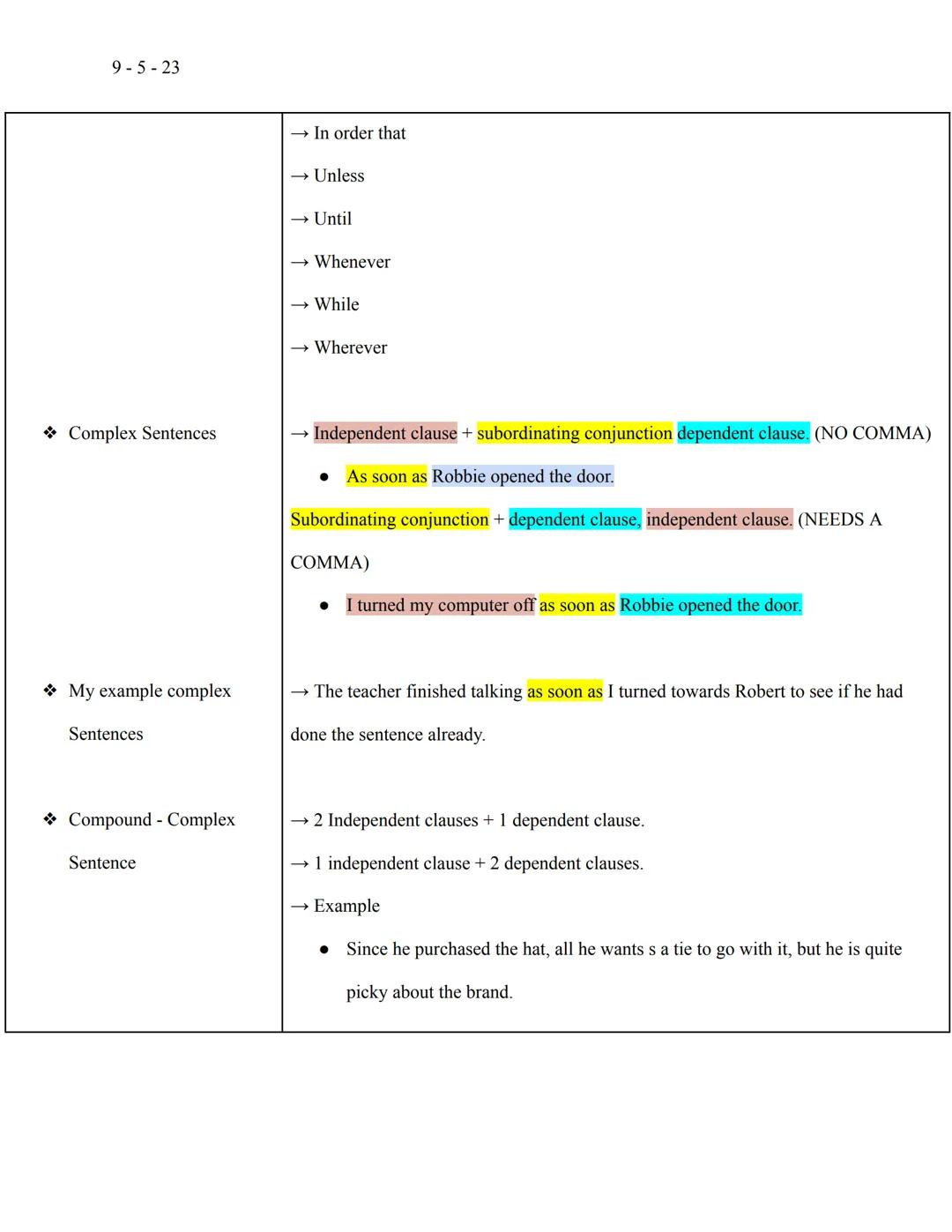
Complex and Compound-Complex Sentences
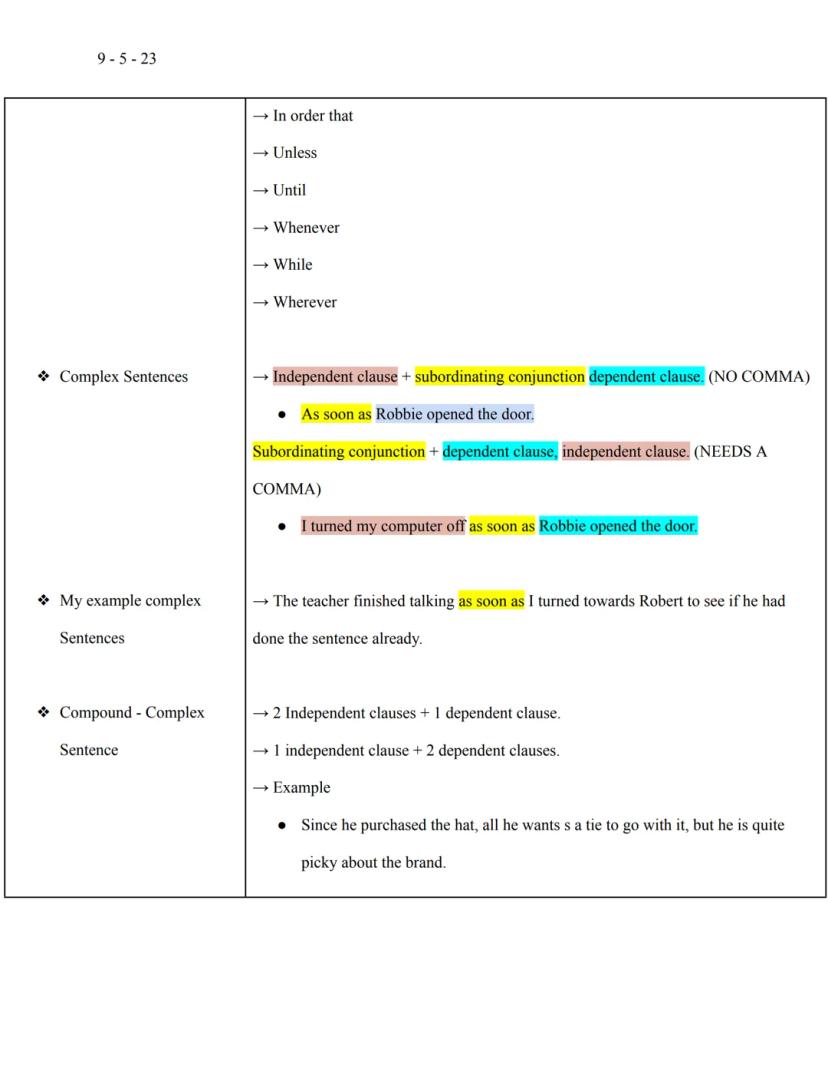
Complex sentences combine an independent clause with at least one dependent clause using subordinating conjunctions like although, after, unless, until, whenever, while, and wherever. The placement of these conjunctions affects comma usage.
When the subordinating conjunction comes in the middle , no comma is needed: "I turned my computer off as soon as Robbie opened the door." When it starts the sentence , use a comma: "As soon as Robbie opened the door, I turned my computer off."
Compound-complex sentences are the most sophisticated structure, containing either two independent clauses plus one dependent clause, or one independent clause plus two dependent clauses. For example: "Since he purchased the hat, all he wants is a tie to go with it, but he is quite picky about the brand."
Challenge yourself: Try writing a paragraph using at least one of each sentence type. This variety will make your writing flow naturally and keep readers engaged!
We thought you’d never ask...
What is the Knowunity AI companion?
Our AI companion is specifically built for the needs of students. Based on the millions of content pieces we have on the platform we can provide truly meaningful and relevant answers to students. But its not only about answers, the companion is even more about guiding students through their daily learning challenges, with personalised study plans, quizzes or content pieces in the chat and 100% personalisation based on the students skills and developments.
Where can I download the Knowunity app?
You can download the app in the Google Play Store and in the Apple App Store.
Is Knowunity really free of charge?
That's right! Enjoy free access to study content, connect with fellow students, and get instant help – all at your fingertips.
Similar Content
Most popular content in English
9G
Englishgrade 6 english
learning the basics
6th7870
M
EnglishMastering English Grammar: Challenging Concepts for Grade 9
Boost your English skills with this comprehensive flashcard set covering advanced grammar topics for grade 9 students. Dive into challenging concepts and ace your exams!
10th3771
E
EnglishEnglish 10 grammar quiz
verbs
10th3090
EnglishIntroduction to linguistics
Introduction to linguistics exam revision notes. Structure of language, typologies of language, parts of speech, language families, Chomsky, Hockett, semantic triangle, Prague Linguistic Circle, writing systems, acquisition and learning
1,21250
M
Englishmatter
8th grade science
8th1731
AP English LanguageAP Lang Unit 1.1 Notes (The Rhetorical Situation)
Notes on AP lang unit 1.1, the rhetorical situation
10th28013
G
Englishgrade 10 English vocabulary
this content is about vocabulary
10th4866
EnglishThe great Gatsbey notes. please note that these are things I found interesting/ important. if you have any questions please feel free to ask
grammar and the great gatsby notes.
11th94469
EnglishComplete Hamlet Breakdown
What you need to know in Hamlet
10th30817
Most popular content
9O
 AP US History
Origins and Dynamics of the Columbian Exchange
Analyze the ecological and economic motivations behind the initial transfer of goods, people, and diseases between the Old and New Worlds.
9th3,1280
I
AP US HistoryIntroduction to Early Cultural Interactions
Analyze the initial social and religious encounters between Europeans, Africans, and Indigenous peoples in the colonial Americas.
9th2,7730
O
 AP World History
Origins of Ancient River Civilizations
Analyze the environmental factors and technological innovations that led to the rise of early states in Mesopotamia, Egypt, and the Indus Valley.
9th3,1870
M
AP US HistoryMotivations for European Exploration
Analyze the economic, religious, and political factors that drove European powers to the Americas during the 15th and 16th centuries.
9th1,7780
F
 AP Psychology
Foundations of Ethical Guidelines in Research
Practice the core principles of the APA ethical code including informed consent, debriefing, and the role of Institutional Review Boards.
9th1,3360
I
AP US HistoryIntroduction to Native American Societies
Examine the diverse social, political, and economic structures of North American indigenous groups prior to European contact.
9th1,1100
I
 AP Biology
Introduction to Biological Elements of Life
Practice identifying the essential elements including carbon, nitrogen, phosphorus, and sulfur that compose biological macromolecules.
9th1,7390
I
AP US HistoryIntroduction to the Spanish Encomienda System
Explore the fundamental economic and social structures of the Spanish colonial system, focusing on the encomienda and the casta social hierarchy.
9th8890
O
AP World HistoryOrigins and Continuity of the Byzantine Empire
Analyze the political and cultural transitions from the Roman Empire to the Byzantine Empire, focusing on the reign of Justinian I and his code.
9th1,6320
Can't find what you're looking for? Explore other subjects.
Students love us — and so will you.
4.6/5App Store
4.7/5Google Play
The app is very easy to use and well designed. I have found everything I was looking for so far and have been able to learn a lot from the presentations! I will definitely use the app for a class assignment! And of course it also helps a lot as an inspiration.
Stefan SiOS user
This app is really great. There are so many study notes and help [...]. My problem subject is French, for example, and the app has so many options for help. Thanks to this app, I have improved my French. I would recommend it to anyone.
Samantha KlichAndroid user
Wow, I am really amazed. I just tried the app because I've seen it advertised many times and was absolutely stunned. This app is THE HELP you want for school and above all, it offers so many things, such as workouts and fact sheets, which have been VERY helpful to me personally.
AnnaiOS user
English83 views·Updated Jun 11, 2026·3 pagesMastering Sentence Structure: Tips and Examples
Mariah@mariah_stangl
Sentence structure is the backbone of effective writing. Understanding different sentence types helps you create engaging writing that sounds natural. In this summary, we'll explore simple, compound, complex, and compound-complex sentences to help you vary your writing style.
1
of 3
Sign up to see the content. It's free!
- Access to all documents
- Improve your grades
- Join milions of students
Sentence Structure Basics
Effective writing mirrors how we naturally speak. Using only one type of sentence structure creates dull, monotonous writing. Instead, aim for dynamic and engaging sentences that keep your reader interested.
A complete sentence requires two essential components: a subject (noun) and a predicate (verb plus any information about the subject). For example: "The lazy dog ran wildly into the ocean." Simple sentences can include multiple nouns and verbs, like "My siblings and I ran and jumped swiftly after the enormous ball."
Coordinating conjunctions connect parts of sentences and include: FOR , AND (additional information), NOR , BUT (contrast), OR (alternatives), YET (despite), and SO (result). Remember them using the acronym FANBOYS.
Pro Tip: When you're revising your writing, read it aloud to hear if it sounds natural. If your sentences all follow the same pattern, mix them up using different structures!
2
of 3Sign up to see the content. It's free!
- Access to all documents
- Improve your grades
- Join milions of students
Compound Sentences
Compound sentences join two complete thoughts (independent clauses) together. Type A compound sentences use a coordinating conjunction with a comma: "A gorgeous butterfly landed and rested, and a nearby caterpillar calmly munched." Notice how this connects two complete thoughts.
Type B compound sentences use a semicolon and transition word: "He asked for the report; therefore, I gave it to him." Common transition words include "for example," "however," and "therefore." This structure creates a clear relationship between ideas.
Creating your own compound sentences is easy once you recognize the patterns. Try writing sentences like: "Martha asks the boys to make her the leader; however, only the girls raise their hands to make her the leader."
Remember: Compound sentences give your writing rhythm and show relationships between ideas. They're perfect for connecting related thoughts that could each stand alone.
3
of 3Sign up to see the content. It's free!
- Access to all documents
- Improve your grades
- Join milions of students
Complex and Compound-Complex Sentences
Complex sentences combine an independent clause with at least one dependent clause using subordinating conjunctions like although, after, unless, until, whenever, while, and wherever. The placement of these conjunctions affects comma usage.
When the subordinating conjunction comes in the middle , no comma is needed: "I turned my computer off as soon as Robbie opened the door." When it starts the sentence , use a comma: "As soon as Robbie opened the door, I turned my computer off."
Compound-complex sentences are the most sophisticated structure, containing either two independent clauses plus one dependent clause, or one independent clause plus two dependent clauses. For example: "Since he purchased the hat, all he wants is a tie to go with it, but he is quite picky about the brand."
Challenge yourself: Try writing a paragraph using at least one of each sentence type. This variety will make your writing flow naturally and keep readers engaged!
We thought you’d never ask...
What is the Knowunity AI companion?
Our AI companion is specifically built for the needs of students. Based on the millions of content pieces we have on the platform we can provide truly meaningful and relevant answers to students. But its not only about answers, the companion is even more about guiding students through their daily learning challenges, with personalised study plans, quizzes or content pieces in the chat and 100% personalisation based on the students skills and developments.
Where can I download the Knowunity app?
You can download the app in the Google Play Store and in the Apple App Store.
Is Knowunity really free of charge?
That's right! Enjoy free access to study content, connect with fellow students, and get instant help – all at your fingertips.
Similar Content
Most popular content in English
9G
Englishgrade 6 english
learning the basics
6th7870
M
EnglishMastering English Grammar: Challenging Concepts for Grade 9
Boost your English skills with this comprehensive flashcard set covering advanced grammar topics for grade 9 students. Dive into challenging concepts and ace your exams!
10th3771
E
EnglishEnglish 10 grammar quiz
verbs
10th3090
EnglishIntroduction to linguistics
Introduction to linguistics exam revision notes. Structure of language, typologies of language, parts of speech, language families, Chomsky, Hockett, semantic triangle, Prague Linguistic Circle, writing systems, acquisition and learning
1,21250
M
Englishmatter
8th grade science
8th1731
AP English LanguageAP Lang Unit 1.1 Notes (The Rhetorical Situation)
Notes on AP lang unit 1.1, the rhetorical situation
10th28013
G
Englishgrade 10 English vocabulary
this content is about vocabulary
10th4866
EnglishThe great Gatsbey notes. please note that these are things I found interesting/ important. if you have any questions please feel free to ask
grammar and the great gatsby notes.
11th94469
EnglishComplete Hamlet Breakdown
What you need to know in Hamlet
10th30817
Most popular content
9O
AP US HistoryOrigins and Dynamics of the Columbian Exchange
Analyze the ecological and economic motivations behind the initial transfer of goods, people, and diseases between the Old and New Worlds.
9th3,1280
I
AP US HistoryIntroduction to Early Cultural Interactions
Analyze the initial social and religious encounters between Europeans, Africans, and Indigenous peoples in the colonial Americas.
9th2,7730
O
AP World HistoryOrigins of Ancient River Civilizations
Analyze the environmental factors and technological innovations that led to the rise of early states in Mesopotamia, Egypt, and the Indus Valley.
9th3,1870
M
AP US HistoryMotivations for European Exploration
Analyze the economic, religious, and political factors that drove European powers to the Americas during the 15th and 16th centuries.
9th1,7780
F
AP PsychologyFoundations of Ethical Guidelines in Research
Practice the core principles of the APA ethical code including informed consent, debriefing, and the role of Institutional Review Boards.
9th1,3360
I
AP US HistoryIntroduction to Native American Societies
Examine the diverse social, political, and economic structures of North American indigenous groups prior to European contact.
9th1,1100
I
AP BiologyIntroduction to Biological Elements of Life
Practice identifying the essential elements including carbon, nitrogen, phosphorus, and sulfur that compose biological macromolecules.
9th1,7390
I
AP US HistoryIntroduction to the Spanish Encomienda System
Explore the fundamental economic and social structures of the Spanish colonial system, focusing on the encomienda and the casta social hierarchy.
9th8890
O
AP World HistoryOrigins and Continuity of the Byzantine Empire
Analyze the political and cultural transitions from the Roman Empire to the Byzantine Empire, focusing on the reign of Justinian I and his code.
9th1,6320
Can't find what you're looking for? Explore other subjects.
Students love us — and so will you.
4.6/5App Store
4.7/5Google Play
The app is very easy to use and well designed. I have found everything I was looking for so far and have been able to learn a lot from the presentations! I will definitely use the app for a class assignment! And of course it also helps a lot as an inspiration.
Stefan SiOS user
This app is really great. There are so many study notes and help [...]. My problem subject is French, for example, and the app has so many options for help. Thanks to this app, I have improved my French. I would recommend it to anyone.
Samantha KlichAndroid user
Wow, I am really amazed. I just tried the app because I've seen it advertised many times and was absolutely stunned. This app is THE HELP you want for school and above all, it offers so many things, such as workouts and fact sheets, which have been VERY helpful to me personally.
AnnaiOS user