
Let's dive into the world of sentences and how they're...
 English97 views·Updated Jun 11, 2026·5 pages
Understanding Sentence Basics: Key Grammar Notes

Daniela Gonzalez@danielagonza20_02

1 / 5
1
of 5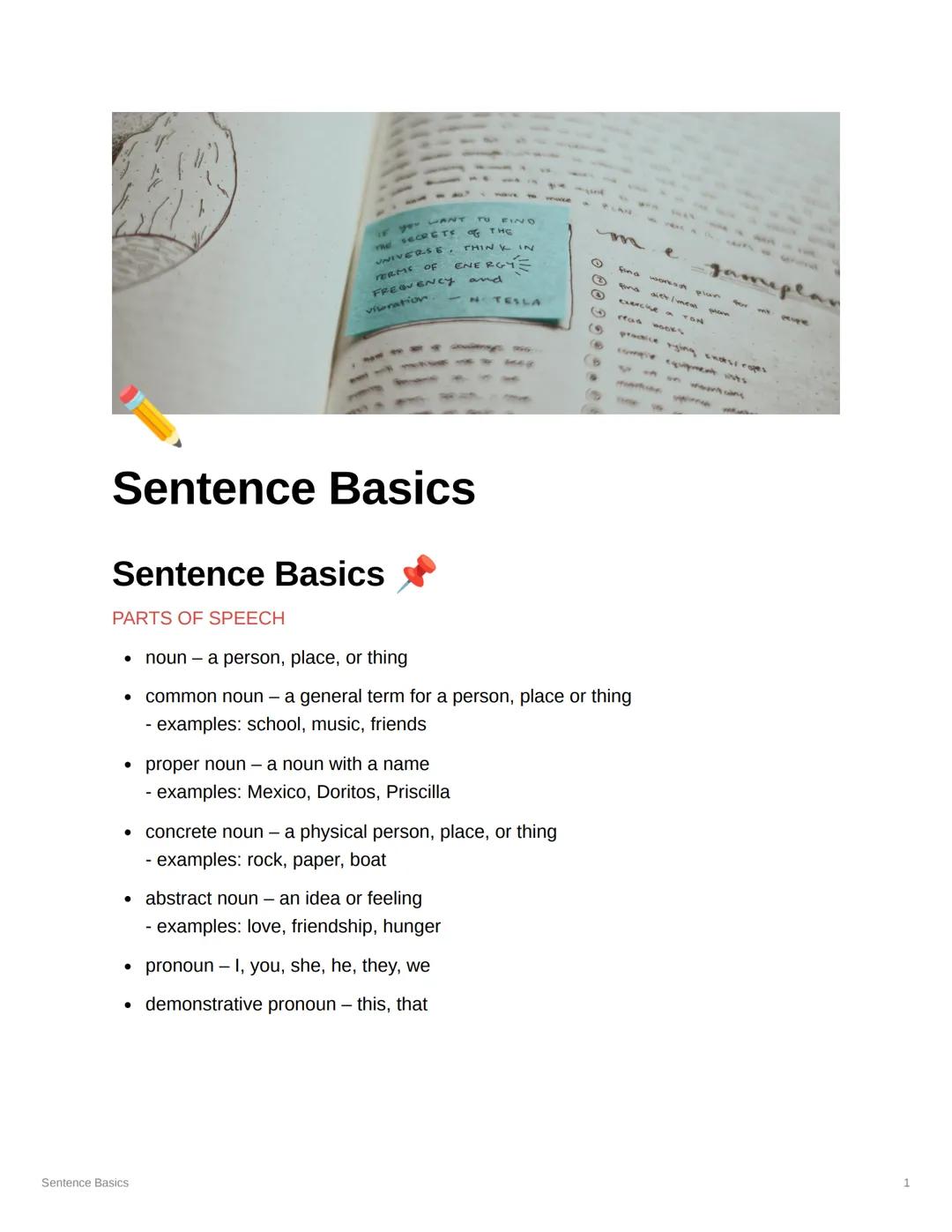
Parts of Speech Essentials
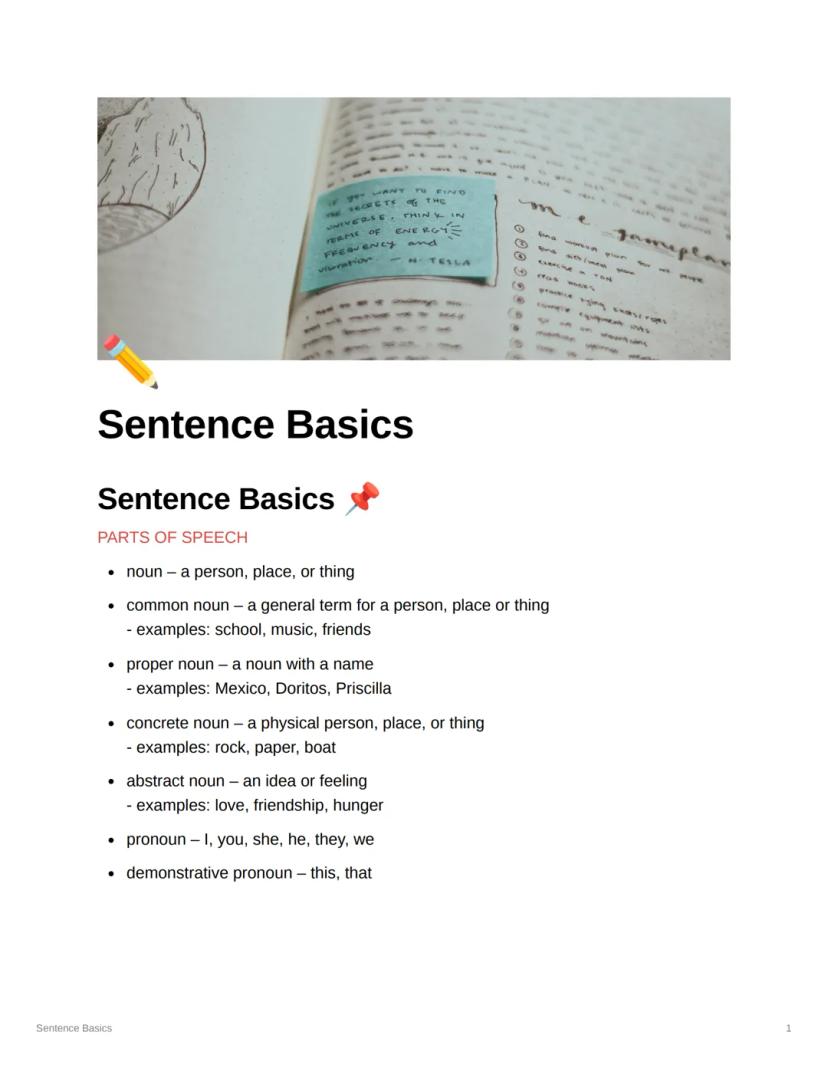
Every sentence starts with basic building blocks called parts of speech. Nouns name the people, places, and things in our world. They come in different varieties: common nouns (school, music) are general terms, while proper nouns (Mexico, Doritos) are specific named things.
Some nouns you can touch or see (concrete nouns) like rock or boat, while others represent ideas or feelings (abstract nouns) like love or friendship. When we don't want to repeat nouns, we use pronouns like I, you, she, or they to replace them.
Demonstrative pronouns like this and that help us point to specific things in our communication. These basic parts create the foundation for everything we write.
Remember this! Every sentence needs at least one noun (or pronoun) to name what the sentence is about. Without this, you don't have a complete thought!
2
of 5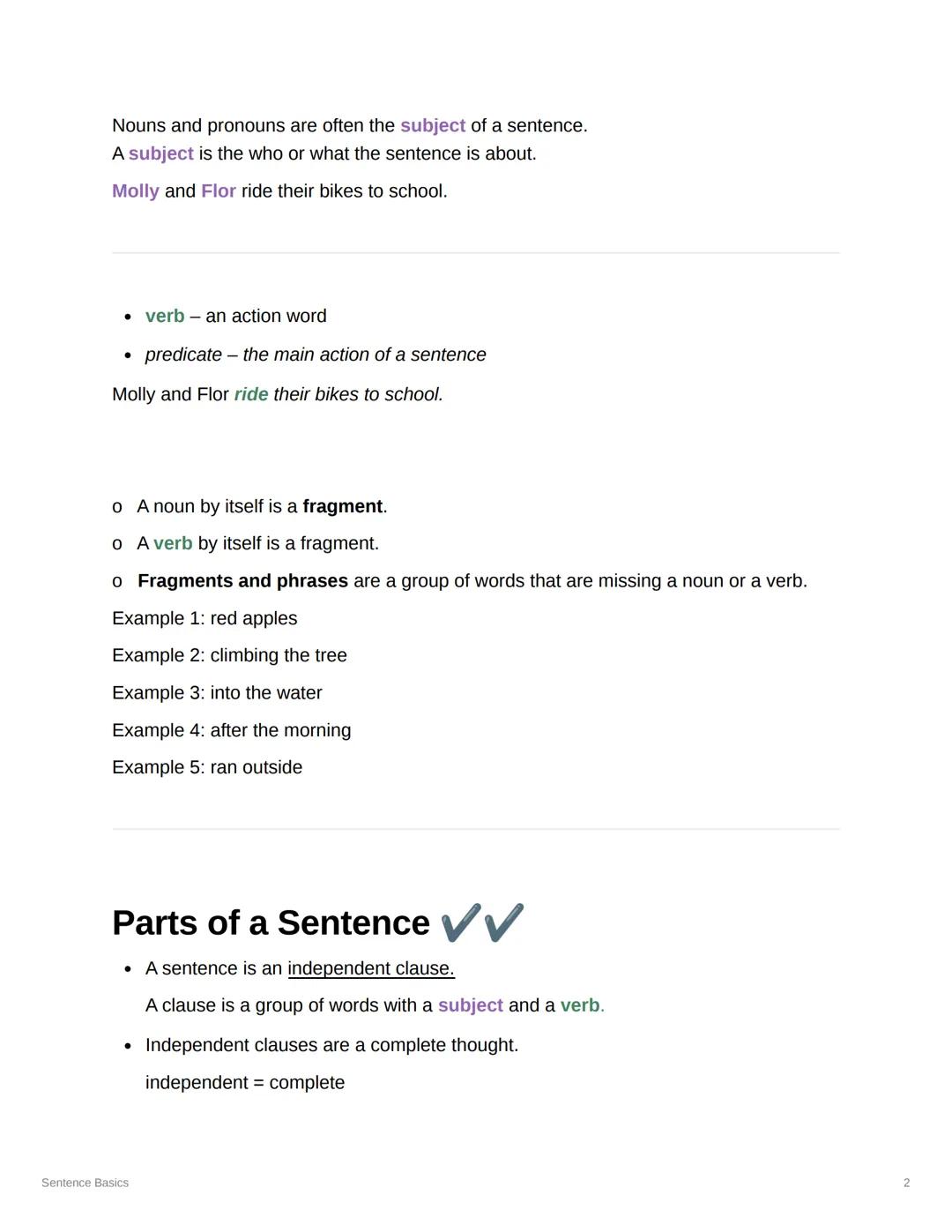
Sentence Structure Fundamentals
Nouns and pronouns typically serve as the subject of a sentence—the who or what the sentence talks about. For example, in "Molly and Flor ride their bikes to school," Molly and Flor are the subjects. The predicate (ride their bikes to school) tells what the subjects are doing.
A sentence must have both a subject and a verb to be complete. Without both, you have a fragment, which is an incomplete thought. Examples of fragments include "red apples," "climbing the tree," or "into the water"—these aren't complete sentences!
An actual sentence is an independent clause—a group of words with a subject and verb that expresses a complete thought. This completeness is what separates real sentences from mere fragments.
Quick Tip: Test if you have a complete sentence by asking: "Who or what is doing something?" (subject) and "What are they doing?" (verb). If both questions can be answered, you probably have a complete sentence!
3
of 5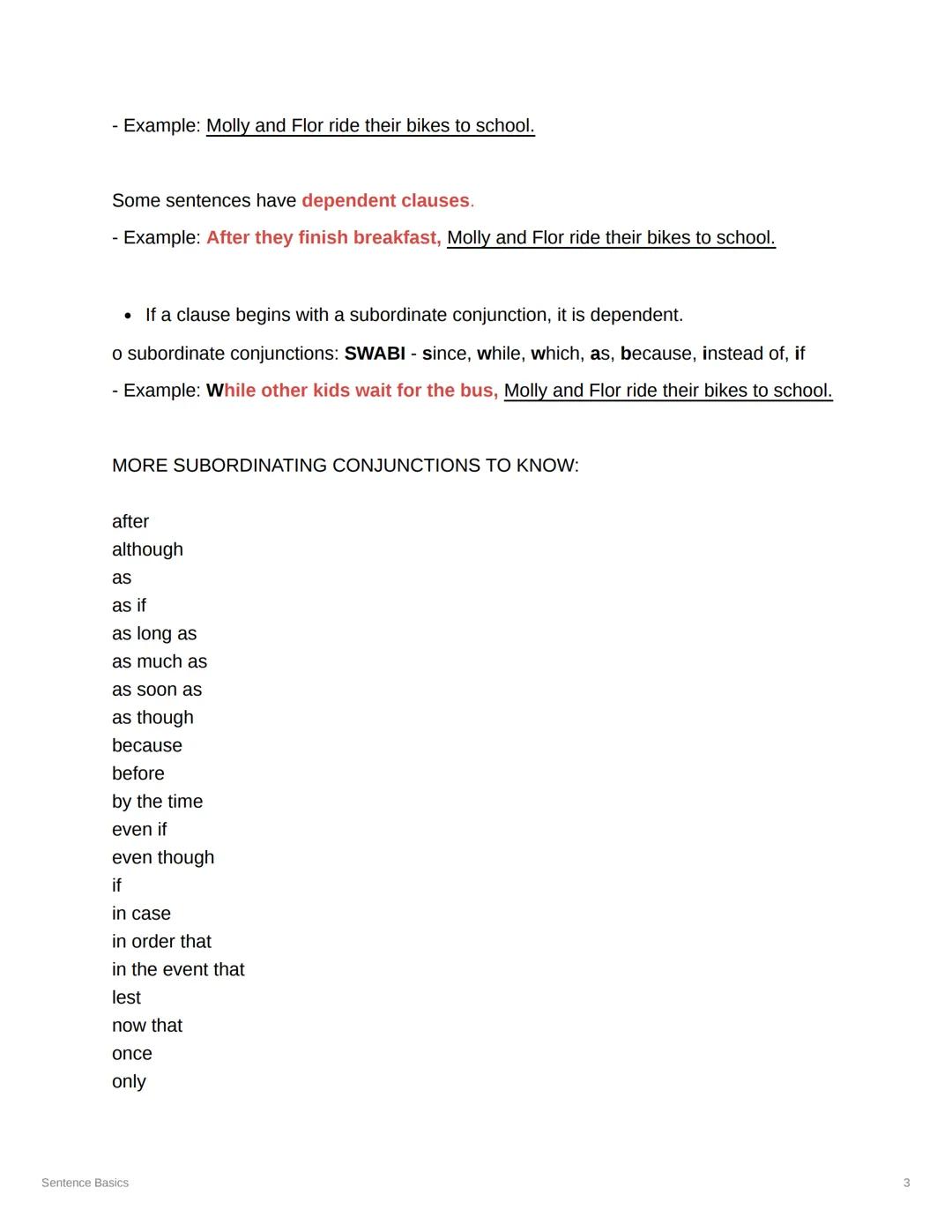
Understanding Clauses
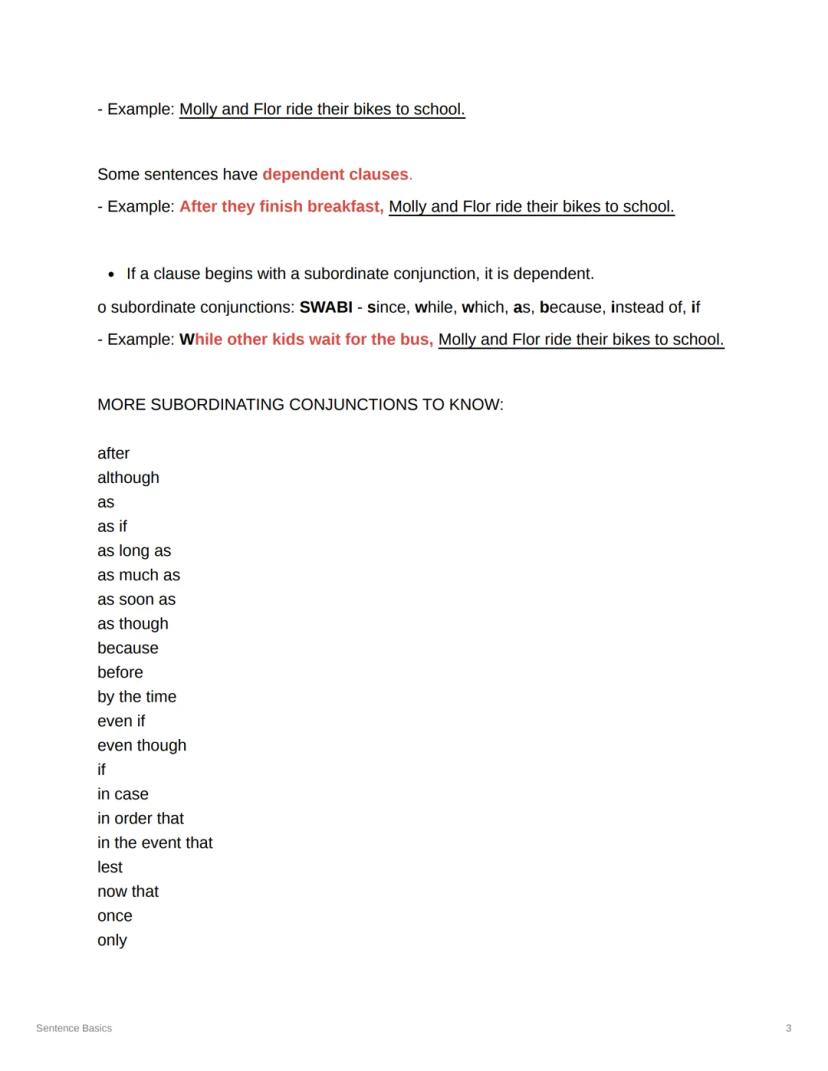
Basic sentences are independent clauses that stand alone, like "Molly and Flor ride their bikes to school." However, many sentences include dependent clauses that add information but can't stand alone as complete thoughts.
Dependent clauses often begin with subordinate conjunctions like since, while, as, because, or if. For example: "While other kids wait for the bus, Molly and Flor ride their bikes to school." The first part can't stand alone—it depends on the rest of the sentence.
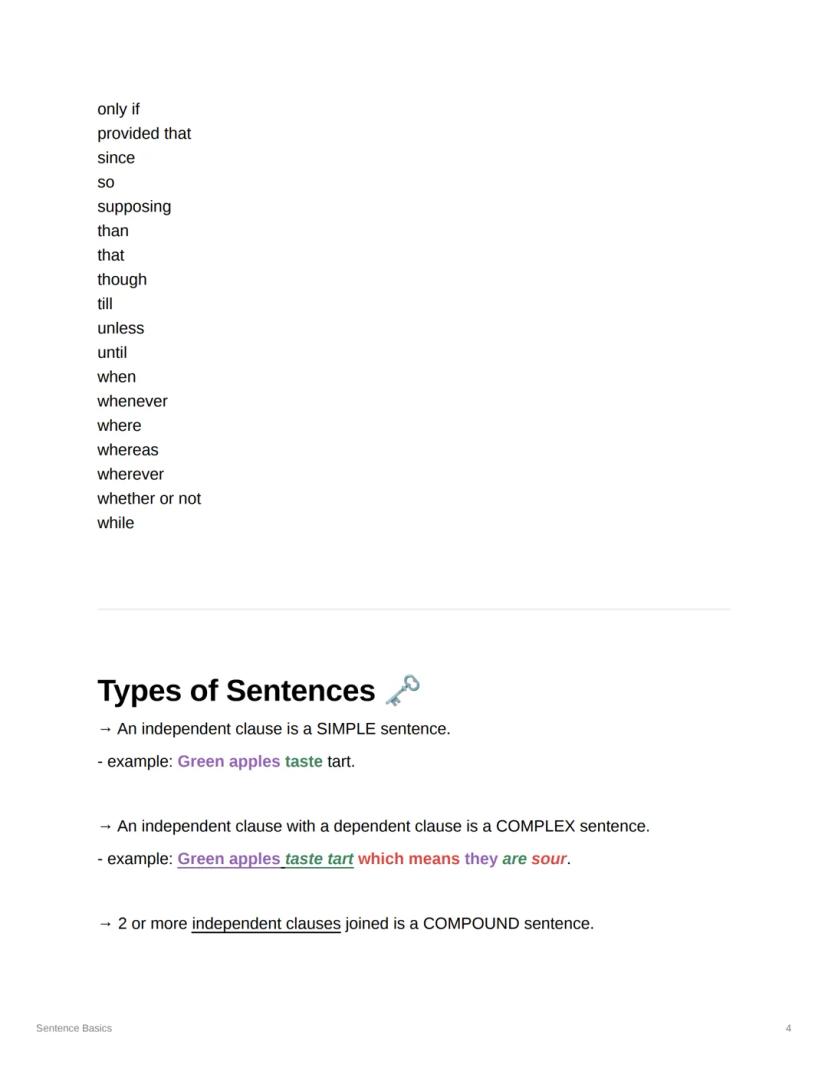
There are many subordinating conjunctions to know, including after, although, because, before, even though, unless, until, when, and whenever. These words signal that the clause needs more information to make complete sense.
Pro Writing Move: Using dependent clauses adds sophistication to your writing by showing relationships between ideas. Try starting some sentences with "because," "although," or "when" to vary your style!
4
of 5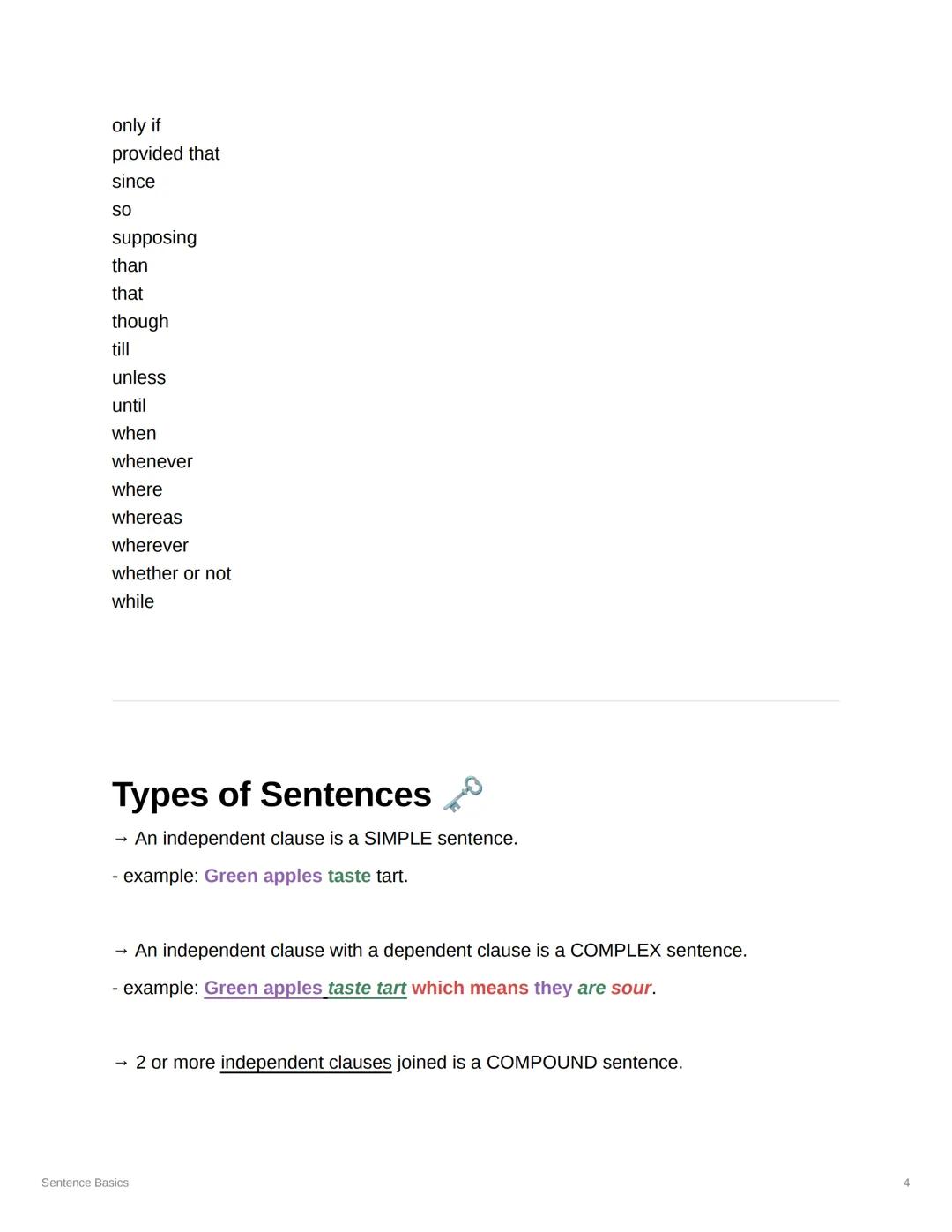
Types of Sentences
Sentences come in different patterns that help add variety to your writing. A simple sentence contains just one independent clause, like "Green apples taste tart." It communicates one complete thought.
When you combine an independent clause with a dependent clause, you create a complex sentence: "Green apples taste tart which means they are sour." The dependent clause adds extra information but couldn't stand alone.
A compound sentence joins two or more independent clauses that could each be their own sentence. This creates longer, more sophisticated expressions that connect related ideas.
Sentence Power-Up: Varying your sentence types keeps your writing interesting! If you notice you're using too many simple sentences in a row, try combining some into compound or complex sentences for better flow.
5
of 5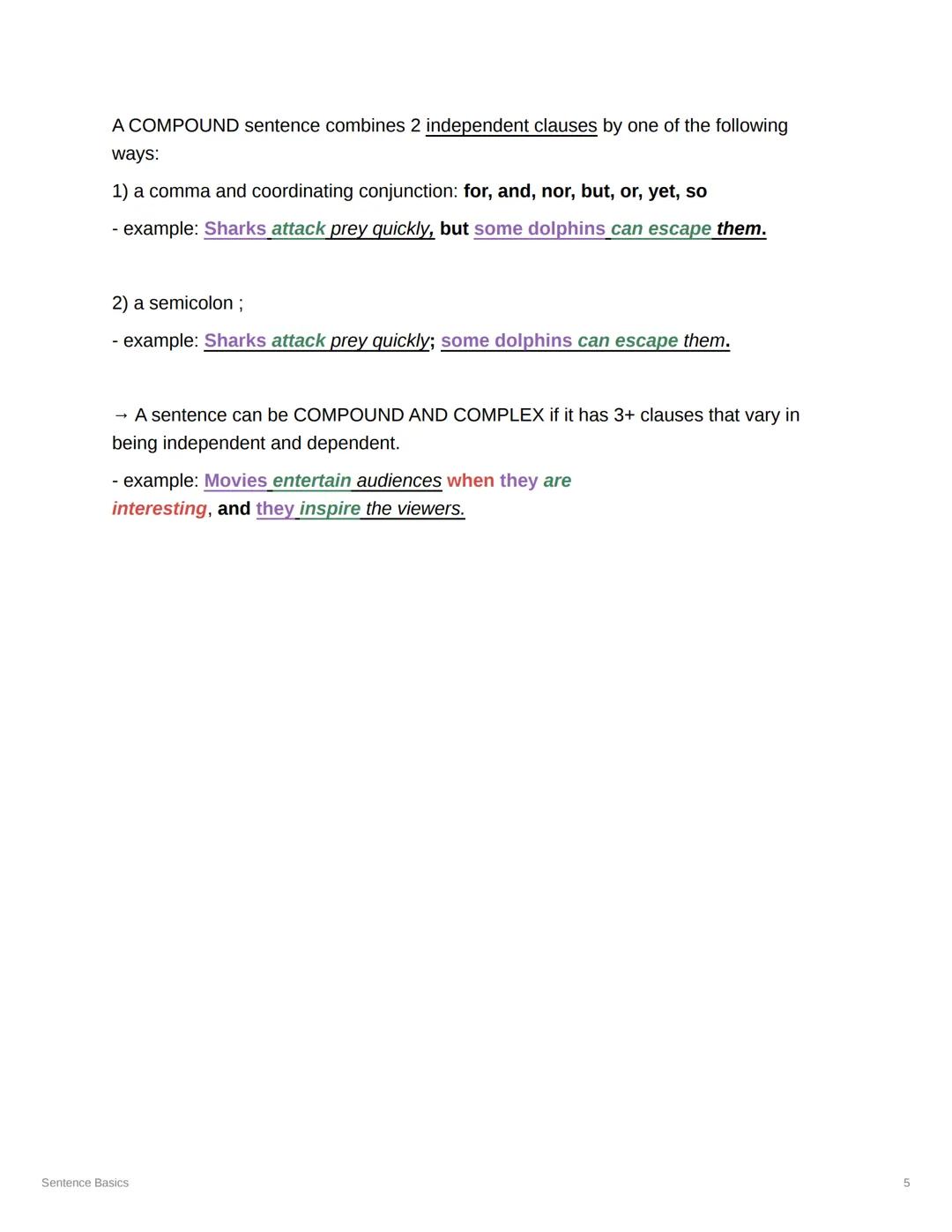
Creating Compound Sentences
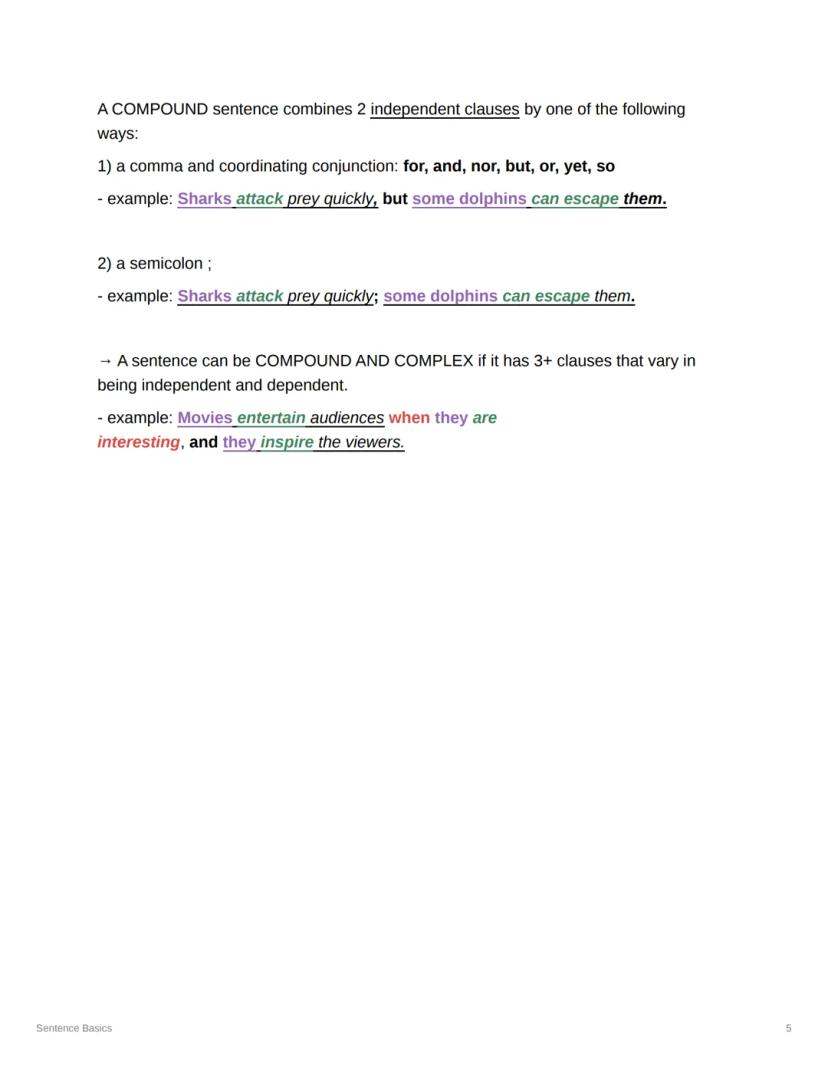
You can create compound sentences in two main ways. First, you can use a comma plus a coordinating conjunction (for, and, nor, but, or, yet, so). For example: "Sharks attack prey quickly, but some dolphins can escape them."
The second method uses a semicolon between independent clauses: "Sharks attack prey quickly; some dolphins can escape them." Both methods connect complete thoughts that are related to each other.
For even more sophisticated writing, you can create compound-complex sentences that contain multiple clauses of different types. For example: "Movies entertain audiences when they are interesting, and they inspire the viewers." These sentences show advanced relationships between multiple ideas.
Writing Challenge: Try identifying different sentence types in your favorite book or article. Then practice writing one example of each type using topics from your own life!
We thought you’d never ask...
What is the Knowunity AI companion?
Our AI companion is specifically built for the needs of students. Based on the millions of content pieces we have on the platform we can provide truly meaningful and relevant answers to students. But its not only about answers, the companion is even more about guiding students through their daily learning challenges, with personalised study plans, quizzes or content pieces in the chat and 100% personalisation based on the students skills and developments.
Where can I download the Knowunity app?
You can download the app in the Google Play Store and in the Apple App Store.
Is Knowunity really free of charge?
That's right! Enjoy free access to study content, connect with fellow students, and get instant help – all at your fingertips.
Similar Content
Most popular content in English
9G
Englishgrade 6 english
learning the basics
6th7870
M
EnglishMastering English Grammar: Challenging Concepts for Grade 9
Boost your English skills with this comprehensive flashcard set covering advanced grammar topics for grade 9 students. Dive into challenging concepts and ace your exams!
10th3771
E
EnglishEnglish 10 grammar quiz
verbs
10th3090
EnglishIntroduction to linguistics
Introduction to linguistics exam revision notes. Structure of language, typologies of language, parts of speech, language families, Chomsky, Hockett, semantic triangle, Prague Linguistic Circle, writing systems, acquisition and learning
1,21250
M
Englishmatter
8th grade science
8th1731
AP English LanguageAP Lang Unit 1.1 Notes (The Rhetorical Situation)
Notes on AP lang unit 1.1, the rhetorical situation
10th28013
G
Englishgrade 10 English vocabulary
this content is about vocabulary
10th4866
EnglishThe great Gatsbey notes. please note that these are things I found interesting/ important. if you have any questions please feel free to ask
grammar and the great gatsby notes.
11th94469
EnglishComplete Hamlet Breakdown
What you need to know in Hamlet
10th30817
Most popular content
9O
 AP US History
Origins and Dynamics of the Columbian Exchange
Analyze the ecological and economic motivations behind the initial transfer of goods, people, and diseases between the Old and New Worlds.
9th3,1280
I
AP US HistoryIntroduction to Early Cultural Interactions
Analyze the initial social and religious encounters between Europeans, Africans, and Indigenous peoples in the colonial Americas.
9th2,7730
O
 AP World History
Origins of Ancient River Civilizations
Analyze the environmental factors and technological innovations that led to the rise of early states in Mesopotamia, Egypt, and the Indus Valley.
9th3,1870
M
AP US HistoryMotivations for European Exploration
Analyze the economic, religious, and political factors that drove European powers to the Americas during the 15th and 16th centuries.
9th1,7780
F
 AP Psychology
Foundations of Ethical Guidelines in Research
Practice the core principles of the APA ethical code including informed consent, debriefing, and the role of Institutional Review Boards.
9th1,3360
I
AP US HistoryIntroduction to Native American Societies
Examine the diverse social, political, and economic structures of North American indigenous groups prior to European contact.
9th1,1100
I
 AP Biology
Introduction to Biological Elements of Life
Practice identifying the essential elements including carbon, nitrogen, phosphorus, and sulfur that compose biological macromolecules.
9th1,7390
I
AP US HistoryIntroduction to the Spanish Encomienda System
Explore the fundamental economic and social structures of the Spanish colonial system, focusing on the encomienda and the casta social hierarchy.
9th8890
O
AP World HistoryOrigins and Continuity of the Byzantine Empire
Analyze the political and cultural transitions from the Roman Empire to the Byzantine Empire, focusing on the reign of Justinian I and his code.
9th1,6320
Can't find what you're looking for? Explore other subjects.
Students love us — and so will you.
4.6/5App Store
4.7/5Google Play
The app is very easy to use and well designed. I have found everything I was looking for so far and have been able to learn a lot from the presentations! I will definitely use the app for a class assignment! And of course it also helps a lot as an inspiration.
Stefan SiOS user
This app is really great. There are so many study notes and help [...]. My problem subject is French, for example, and the app has so many options for help. Thanks to this app, I have improved my French. I would recommend it to anyone.
Samantha KlichAndroid user
Wow, I am really amazed. I just tried the app because I've seen it advertised many times and was absolutely stunned. This app is THE HELP you want for school and above all, it offers so many things, such as workouts and fact sheets, which have been VERY helpful to me personally.
AnnaiOS user
English97 views·Updated Jun 11, 2026·5 pagesUnderstanding Sentence Basics: Key Grammar Notes
Daniela Gonzalez@danielagonza20_02
Let's dive into the world of sentences and how they're built. Understanding the basics of sentence structure helps you communicate more clearly in your writing and recognize good writing when you see it.
1
of 5
Sign up to see the content. It's free!
- Access to all documents
- Improve your grades
- Join milions of students
Parts of Speech Essentials
Every sentence starts with basic building blocks called parts of speech. Nouns name the people, places, and things in our world. They come in different varieties: common nouns (school, music) are general terms, while proper nouns (Mexico, Doritos) are specific named things.
Some nouns you can touch or see (concrete nouns) like rock or boat, while others represent ideas or feelings (abstract nouns) like love or friendship. When we don't want to repeat nouns, we use pronouns like I, you, she, or they to replace them.
Demonstrative pronouns like this and that help us point to specific things in our communication. These basic parts create the foundation for everything we write.
Remember this! Every sentence needs at least one noun (or pronoun) to name what the sentence is about. Without this, you don't have a complete thought!
2
of 5Sign up to see the content. It's free!
- Access to all documents
- Improve your grades
- Join milions of students
Sentence Structure Fundamentals
Nouns and pronouns typically serve as the subject of a sentence—the who or what the sentence talks about. For example, in "Molly and Flor ride their bikes to school," Molly and Flor are the subjects. The predicate (ride their bikes to school) tells what the subjects are doing.
A sentence must have both a subject and a verb to be complete. Without both, you have a fragment, which is an incomplete thought. Examples of fragments include "red apples," "climbing the tree," or "into the water"—these aren't complete sentences!
An actual sentence is an independent clause—a group of words with a subject and verb that expresses a complete thought. This completeness is what separates real sentences from mere fragments.
Quick Tip: Test if you have a complete sentence by asking: "Who or what is doing something?" (subject) and "What are they doing?" (verb). If both questions can be answered, you probably have a complete sentence!
3
of 5Sign up to see the content. It's free!
- Access to all documents
- Improve your grades
- Join milions of students
Understanding Clauses
Basic sentences are independent clauses that stand alone, like "Molly and Flor ride their bikes to school." However, many sentences include dependent clauses that add information but can't stand alone as complete thoughts.
Dependent clauses often begin with subordinate conjunctions like since, while, as, because, or if. For example: "While other kids wait for the bus, Molly and Flor ride their bikes to school." The first part can't stand alone—it depends on the rest of the sentence.
There are many subordinating conjunctions to know, including after, although, because, before, even though, unless, until, when, and whenever. These words signal that the clause needs more information to make complete sense.
Pro Writing Move: Using dependent clauses adds sophistication to your writing by showing relationships between ideas. Try starting some sentences with "because," "although," or "when" to vary your style!
4
of 5Sign up to see the content. It's free!
- Access to all documents
- Improve your grades
- Join milions of students
Types of Sentences
Sentences come in different patterns that help add variety to your writing. A simple sentence contains just one independent clause, like "Green apples taste tart." It communicates one complete thought.
When you combine an independent clause with a dependent clause, you create a complex sentence: "Green apples taste tart which means they are sour." The dependent clause adds extra information but couldn't stand alone.
A compound sentence joins two or more independent clauses that could each be their own sentence. This creates longer, more sophisticated expressions that connect related ideas.
Sentence Power-Up: Varying your sentence types keeps your writing interesting! If you notice you're using too many simple sentences in a row, try combining some into compound or complex sentences for better flow.
5
of 5Sign up to see the content. It's free!
- Access to all documents
- Improve your grades
- Join milions of students
Creating Compound Sentences
You can create compound sentences in two main ways. First, you can use a comma plus a coordinating conjunction (for, and, nor, but, or, yet, so). For example: "Sharks attack prey quickly, but some dolphins can escape them."
The second method uses a semicolon between independent clauses: "Sharks attack prey quickly; some dolphins can escape them." Both methods connect complete thoughts that are related to each other.
For even more sophisticated writing, you can create compound-complex sentences that contain multiple clauses of different types. For example: "Movies entertain audiences when they are interesting, and they inspire the viewers." These sentences show advanced relationships between multiple ideas.
Writing Challenge: Try identifying different sentence types in your favorite book or article. Then practice writing one example of each type using topics from your own life!
We thought you’d never ask...
What is the Knowunity AI companion?
Our AI companion is specifically built for the needs of students. Based on the millions of content pieces we have on the platform we can provide truly meaningful and relevant answers to students. But its not only about answers, the companion is even more about guiding students through their daily learning challenges, with personalised study plans, quizzes or content pieces in the chat and 100% personalisation based on the students skills and developments.
Where can I download the Knowunity app?
You can download the app in the Google Play Store and in the Apple App Store.
Is Knowunity really free of charge?
That's right! Enjoy free access to study content, connect with fellow students, and get instant help – all at your fingertips.
Similar Content
Most popular content in English
9G
Englishgrade 6 english
learning the basics
6th7870
M
EnglishMastering English Grammar: Challenging Concepts for Grade 9
Boost your English skills with this comprehensive flashcard set covering advanced grammar topics for grade 9 students. Dive into challenging concepts and ace your exams!
10th3771
E
EnglishEnglish 10 grammar quiz
verbs
10th3090
EnglishIntroduction to linguistics
Introduction to linguistics exam revision notes. Structure of language, typologies of language, parts of speech, language families, Chomsky, Hockett, semantic triangle, Prague Linguistic Circle, writing systems, acquisition and learning
1,21250
M
Englishmatter
8th grade science
8th1731
AP English LanguageAP Lang Unit 1.1 Notes (The Rhetorical Situation)
Notes on AP lang unit 1.1, the rhetorical situation
10th28013
G
Englishgrade 10 English vocabulary
this content is about vocabulary
10th4866
EnglishThe great Gatsbey notes. please note that these are things I found interesting/ important. if you have any questions please feel free to ask
grammar and the great gatsby notes.
11th94469
EnglishComplete Hamlet Breakdown
What you need to know in Hamlet
10th30817
Most popular content
9O
AP US HistoryOrigins and Dynamics of the Columbian Exchange
Analyze the ecological and economic motivations behind the initial transfer of goods, people, and diseases between the Old and New Worlds.
9th3,1280
I
AP US HistoryIntroduction to Early Cultural Interactions
Analyze the initial social and religious encounters between Europeans, Africans, and Indigenous peoples in the colonial Americas.
9th2,7730
O
AP World HistoryOrigins of Ancient River Civilizations
Analyze the environmental factors and technological innovations that led to the rise of early states in Mesopotamia, Egypt, and the Indus Valley.
9th3,1870
M
AP US HistoryMotivations for European Exploration
Analyze the economic, religious, and political factors that drove European powers to the Americas during the 15th and 16th centuries.
9th1,7780
F
AP PsychologyFoundations of Ethical Guidelines in Research
Practice the core principles of the APA ethical code including informed consent, debriefing, and the role of Institutional Review Boards.
9th1,3360
I
AP US HistoryIntroduction to Native American Societies
Examine the diverse social, political, and economic structures of North American indigenous groups prior to European contact.
9th1,1100
I
AP BiologyIntroduction to Biological Elements of Life
Practice identifying the essential elements including carbon, nitrogen, phosphorus, and sulfur that compose biological macromolecules.
9th1,7390
I
AP US HistoryIntroduction to the Spanish Encomienda System
Explore the fundamental economic and social structures of the Spanish colonial system, focusing on the encomienda and the casta social hierarchy.
9th8890
O
AP World HistoryOrigins and Continuity of the Byzantine Empire
Analyze the political and cultural transitions from the Roman Empire to the Byzantine Empire, focusing on the reign of Justinian I and his code.
9th1,6320
Can't find what you're looking for? Explore other subjects.
Students love us — and so will you.
4.6/5App Store
4.7/5Google Play
The app is very easy to use and well designed. I have found everything I was looking for so far and have been able to learn a lot from the presentations! I will definitely use the app for a class assignment! And of course it also helps a lot as an inspiration.
Stefan SiOS user
This app is really great. There are so many study notes and help [...]. My problem subject is French, for example, and the app has so many options for help. Thanks to this app, I have improved my French. I would recommend it to anyone.
Samantha KlichAndroid user
Wow, I am really amazed. I just tried the app because I've seen it advertised many times and was absolutely stunned. This app is THE HELP you want for school and above all, it offers so many things, such as workouts and fact sheets, which have been VERY helpful to me personally.
AnnaiOS user