
Tennessee Williams' "A Streetcar Named Desire" is one of the...
 English Literature522 views·Updated Jun 14, 2026·25 pages
A Streetcar Named Desire Litcharts Guide
P
Poppy Ramsay@poppyramsay



1 / 10
1
of 10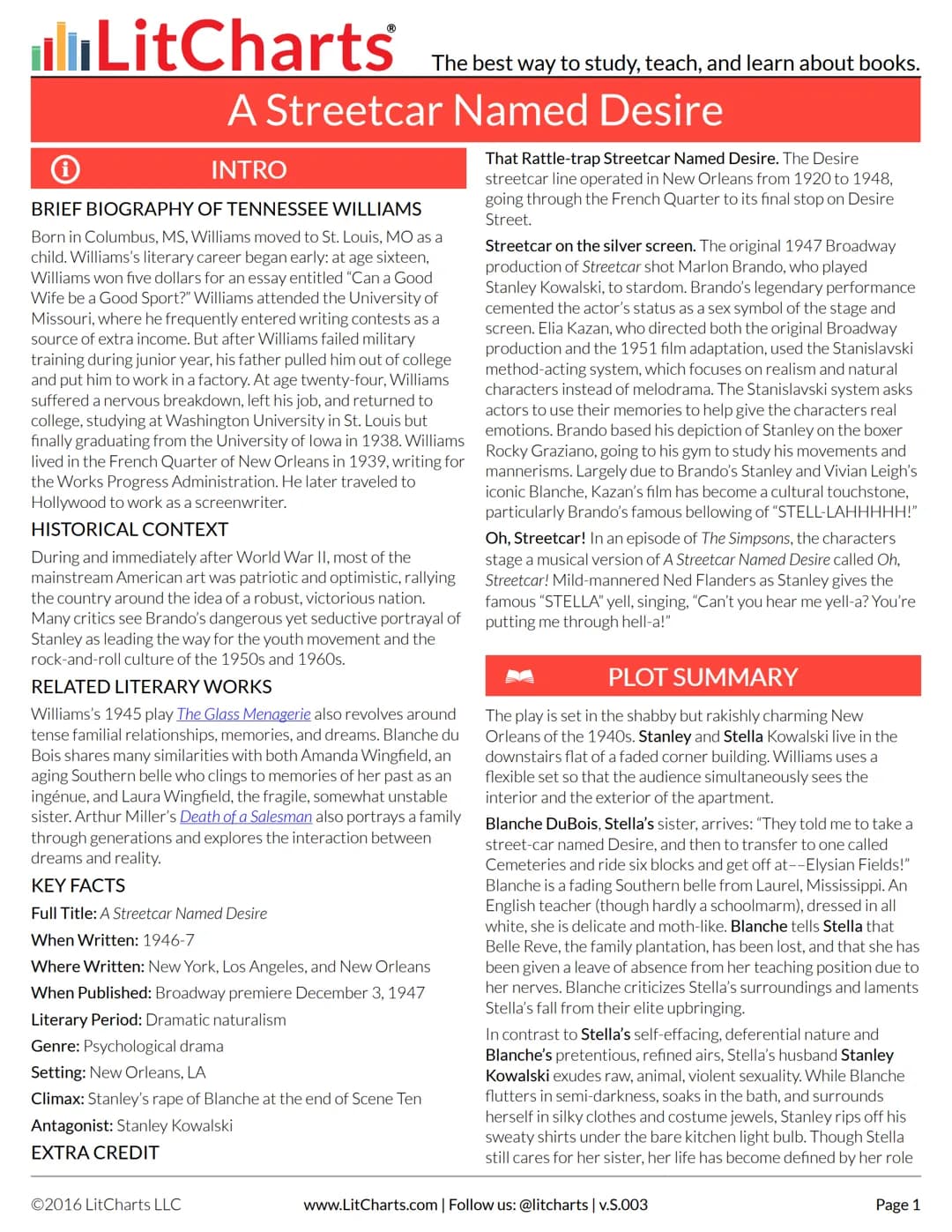
Introduction and Context
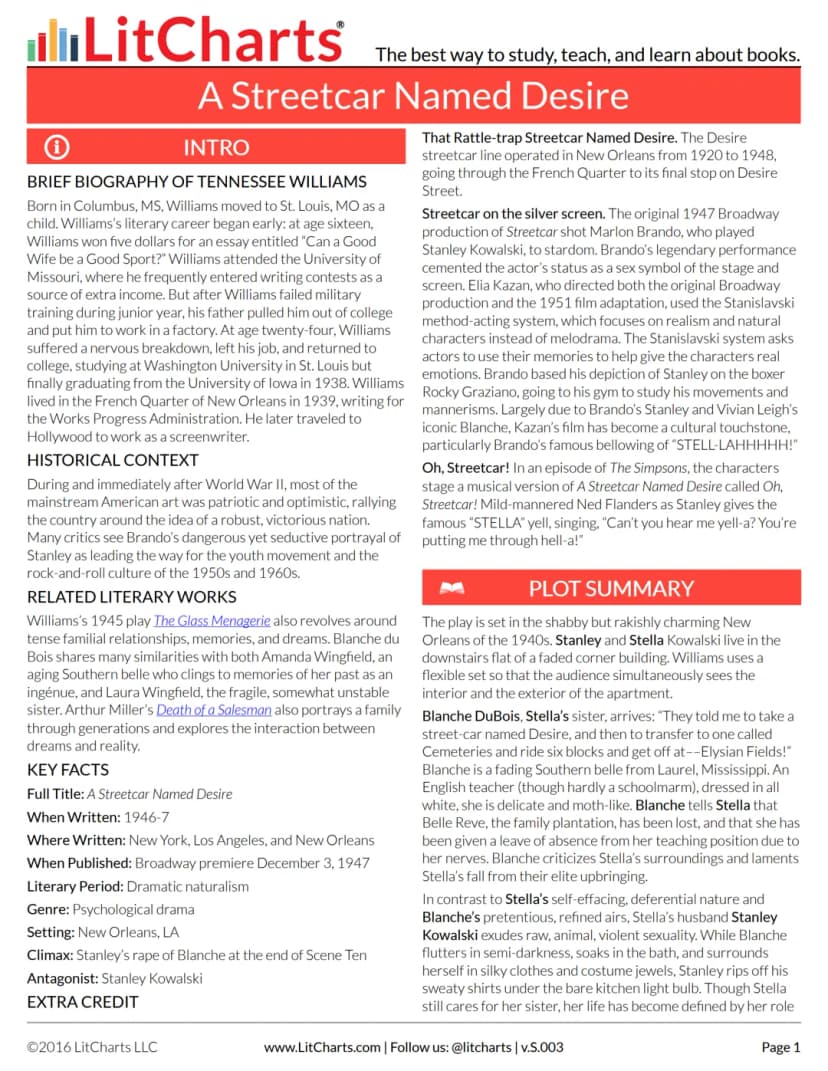
You're about to dive into a play that completely changed American theatre when it premiered in 1947. Tennessee Williams wrote this masterpiece after his own struggles with mental health and his experiences living in New Orleans' French Quarter.
The timing matters hugely - this was written just after World War II, when America was celebrating victory and optimism. Williams dared to show the darker, grittier side of American life instead. Marlon Brando's explosive performance as Stanley launched him to stardom and helped create the rebellious youth culture of the 1950s.
Think of this as a psychological drama that uses realistic settings and natural dialogue to explore what happens when people can't face the truth about themselves. The French Quarter setting isn't just backdrop - it's a melting pot where different classes and desires collide violently.
Quick Context: The actual Desire streetcar line ran through New Orleans until 1948, making Blanche's journey both real and symbolic.
2
of 10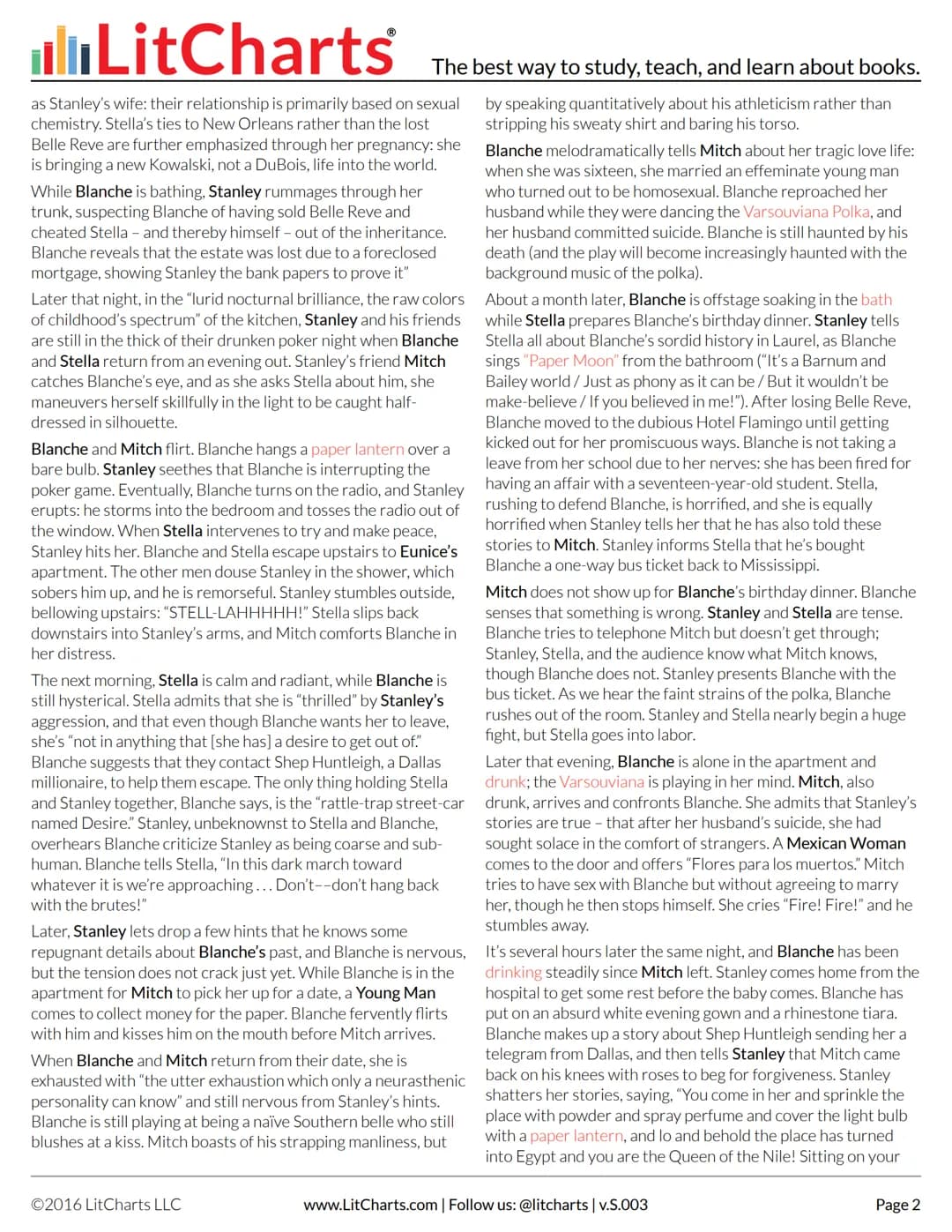
Plot Summary - Part 1
Blanche DuBois arrives at her sister Stella's cramped New Orleans flat after losing the family plantation, Belle Reve. She's a fading Southern belle who desperately clings to her refined past, while Stella has embraced a passionate but brutal relationship with her husband Stanley Kowalski.
The clash is immediate and explosive. Stanley represents raw, animal sexuality and working-class power, whilst Blanche tries to maintain her delicate, aristocratic facade. When Stanley suspects Blanche of cheating Stella out of inheritance money, he aggressively searches through her belongings.
The famous poker night scene sets up the central conflict. Blanche flirts with Stanley's friend Mitch while trying to soften the harsh apartment lighting with a paper lantern. Stanley's rage erupts when she interrupts his game - he smashes the radio and hits Stella. Yet after the men sober him up, Stella returns to his arms when he bellows "STELLA!" from the courtyard.
Key Moment: Stella's return to Stanley after he hits her shows how sexual desire overpowers everything else in this play.
3
of 10
Plot Summary - Part 2
Blanche's facade begins cracking as Stanley discovers her sordid past in Mississippi. She was fired from her teaching job for having an affair with a seventeen-year-old student and lived promiscuously at the Hotel Flamingo. Stanley shares this information with Mitch, destroying Blanche's hopes for marriage and respectability.
The tragic backstory emerges - Blanche's young husband was homosexual, and after she cruelly confronted him, he committed suicide. The Varsouviana Polka they were dancing haunts her throughout the play, representing her guilt and mental deterioration.
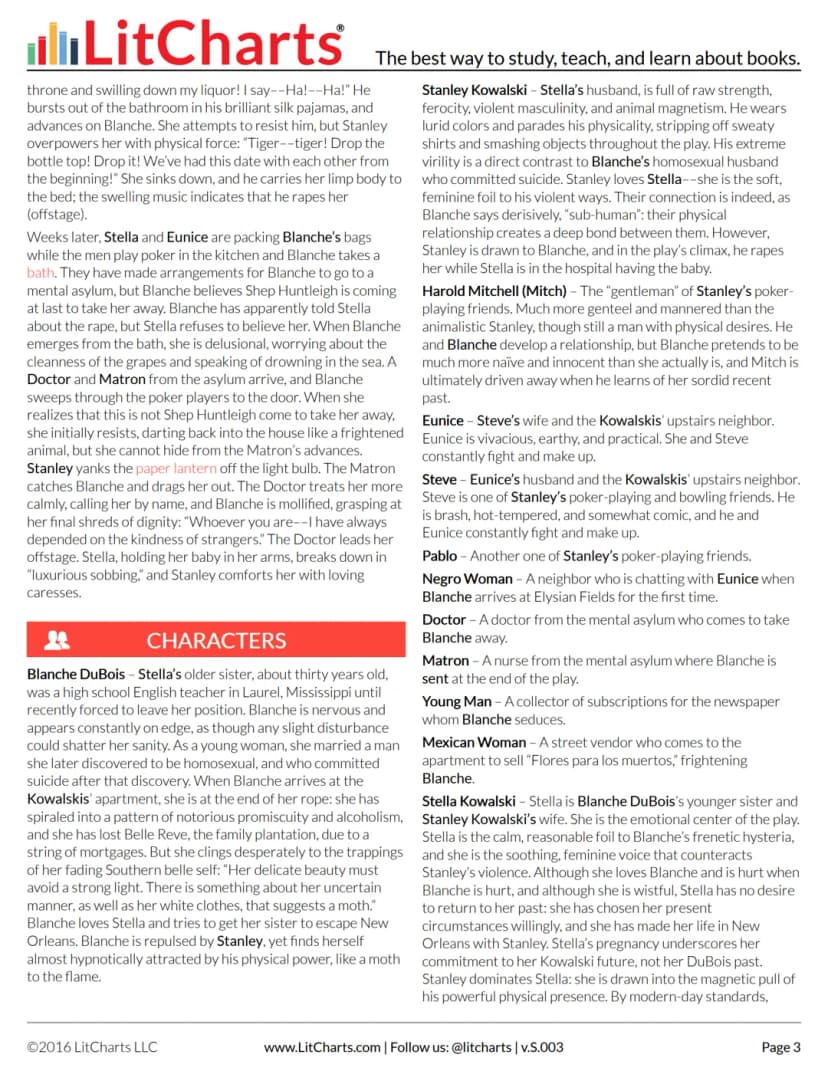
As Stella goes into labour, Stanley finds Blanche alone, drunk, and dressed in a ridiculous evening gown and tiara. She's retreated completely into fantasy, claiming a millionaire is rescuing her. Stanley brutally shatters her illusions before raping her - the play's devastating climax.
In the final scene, Blanche is taken to a mental asylum. Stella, who cannot believe the rape story and continue living with Stanley, chooses to protect her new life over her sister.
Tragic Irony: Blanche's famous final line, "I have always depended on the kindness of strangers," shows how completely she's lost touch with reality.
4
of 10
Major Themes
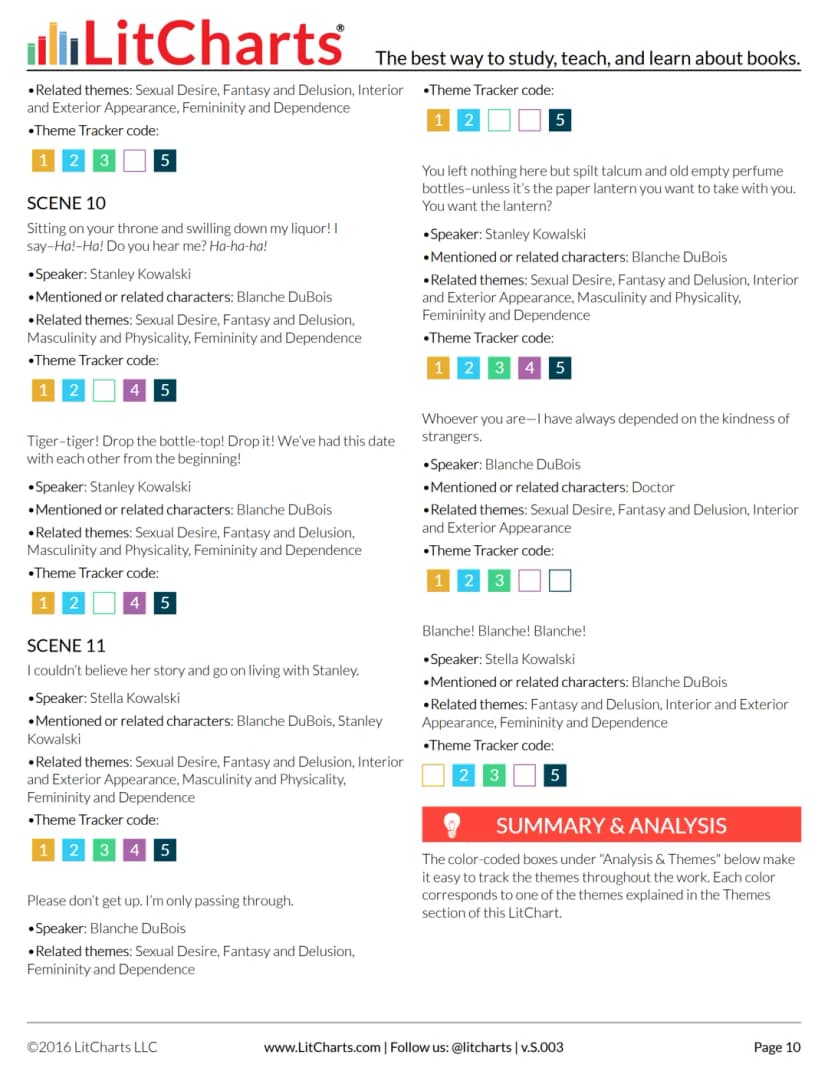
Sexual desire drives every character like an unstoppable streetcar. Blanche uses sexuality to define her worth, desperately flirting to feel alive. Stanley and Stella's relationship is built on raw physical attraction that keeps them together despite his violence. Yet Williams shows how desire leads to destruction - it costs Blanche her job, reputation, and sanity.
The battle between fantasy and reality forms the play's core conflict. Blanche creates elaborate illusions about her past and future because reality is too painful to bear. She literally avoids bright lights and harsh truths, preferring the magic of dim lighting and make-believe. But reality always wins - Stanley's brutal honesty destroys her fantasy world completely.
Masculinity in this play means physical dominance and aggression. Stanley asserts his power through violence, loud behaviour, and sexual conquest. He's described as animalistic - a "richly feathered male bird among hens." Even gentler Mitch defines himself through physical measurements and strength.
The women demonstrate different types of femininity and dependence. Blanche performs delicate Southern belle behaviour, believing this attracts men who can save her. Stella chooses practical dependence on Stanley's physical love over Blanche's romantic schemes.
Essential Understanding: Every theme connects to the central idea that people cannot escape their true nature, no matter how elaborate their disguises.
5
of 10
Key Symbols You Must Know
The streetcar itself represents how desire controls human behaviour. Just as Blanche rides the streetcar named Desire through Cemeteries to Elysian Fields, characters are carried by their desires to inevitable destinations - often destructive ones.
The paper lantern over the light bulb symbolises Blanche's attempts to hide reality behind pretty illusions. When Mitch angrily tears it off, demanding to see her true age, she cries "I don't want realism - I want magic!" The lantern's fragility shows how easily such illusions can be destroyed.
Bathing becomes Blanche's escape mechanism - she constantly soaks in hot baths to "calm her nerves." Like Lady Macbeth washing imaginary bloodstains, Blanche tries to cleanse herself of guilt and reality. But you cannot wash away the past.
The Varsouviana Polka plays in Blanche's mind whenever she remembers her husband's suicide. Only gunshots or real-world distractions can stop the music, showing how trauma shapes her mental state.
Light and shadows represent the conflict between truth and illusion. Blanche avoids bright lights that reveal her age and faded beauty, preferring shadows that hide reality.
Exam Tip: These symbols work together - notice how Williams often combines them (like Blanche bathing while the polka plays in her mind).
6
of 10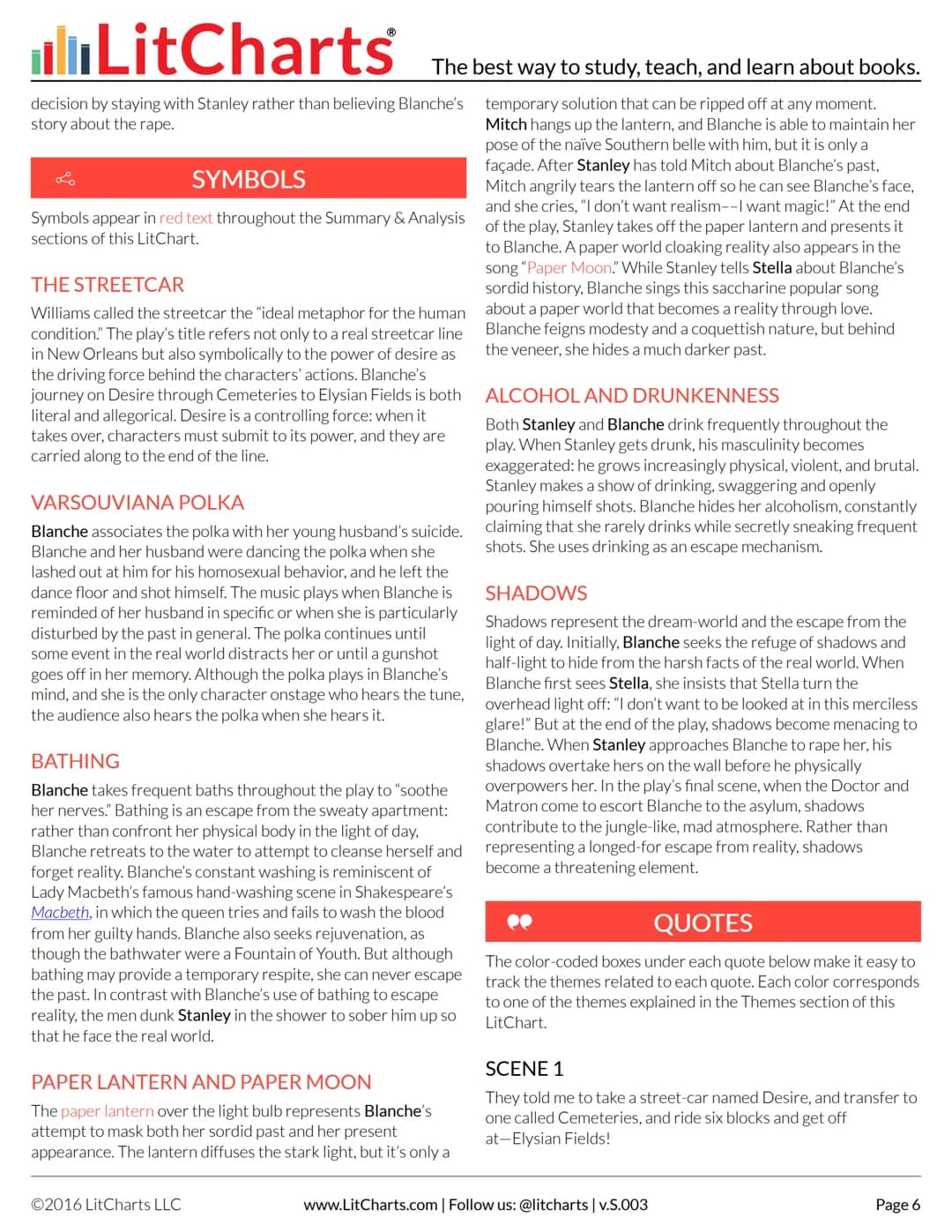
Essential Quotes and Analysis
"They told me to take a street-car named Desire, and then transfer to one called Cemeteries and ride six blocks and get off at—Elysian Fields!" This opening quote works on multiple levels - literal directions that also map Blanche's psychological journey from desire through death to her final resting place.
"What you are talking about is brutal desire—just—Desire!—the name of that rattle-trap street-car that bangs through the Quarter." Blanche recognises desire as a destructive force, yet she cannot escape its power over her own life.
"I don't want realism. I want magic!" Blanche's desperate cry encapsulates the play's central conflict. She knows reality will destroy her, so she clings to illusions until the very end.
"STELLA!" Stanley's famous bellow represents raw masculine power calling to feminine submission. The fact that Stella responds shows how sexual attraction overpowers rationality and self-preservation.
"I have always depended on the kindness of strangers." Blanche's final line is deeply ironic - she's speaking to the doctor who will commit her, yet she still sees him as another potential rescuer.
Analysis Key: Notice how Williams uses these quotes to reveal character psychology rather than just advance plot.
7
of 10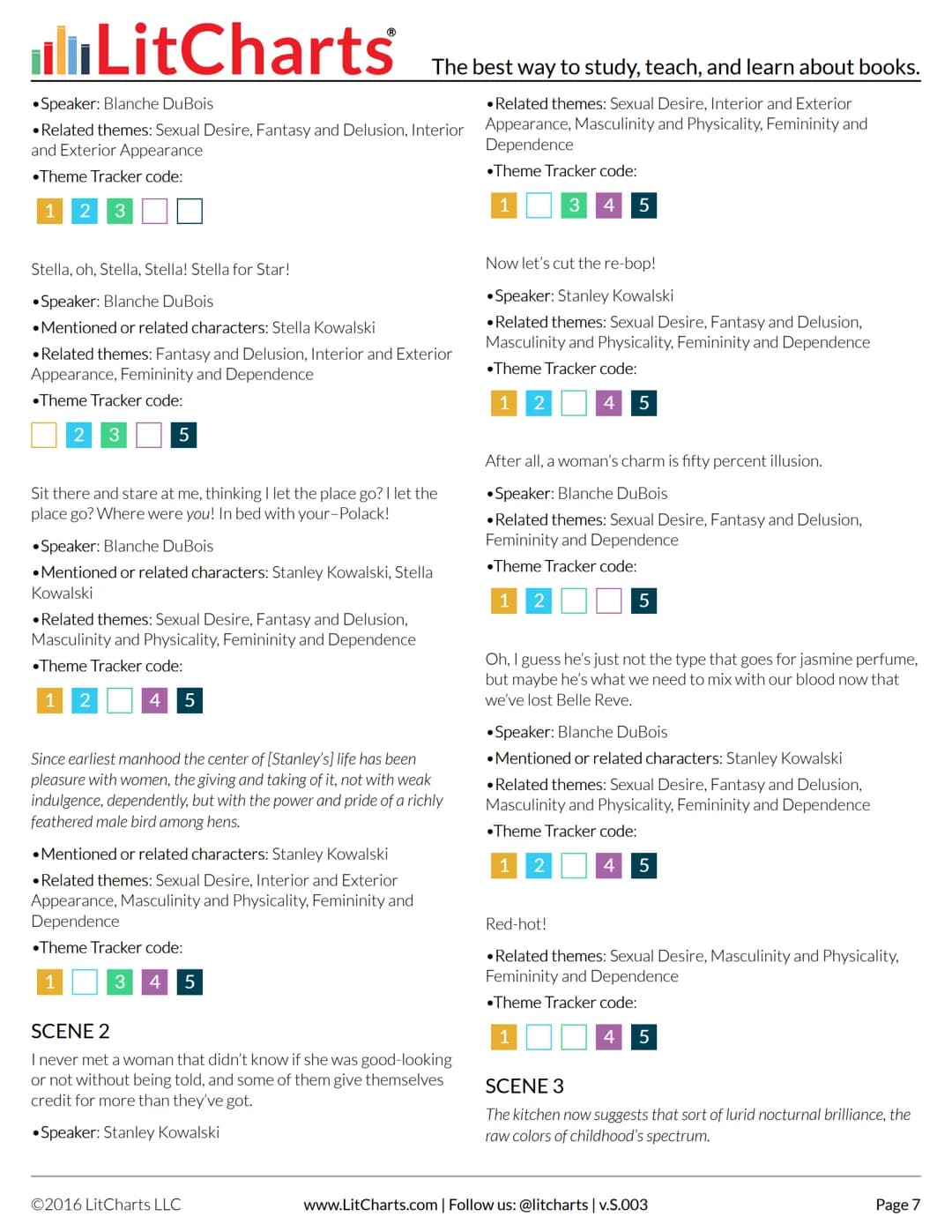
8
of 10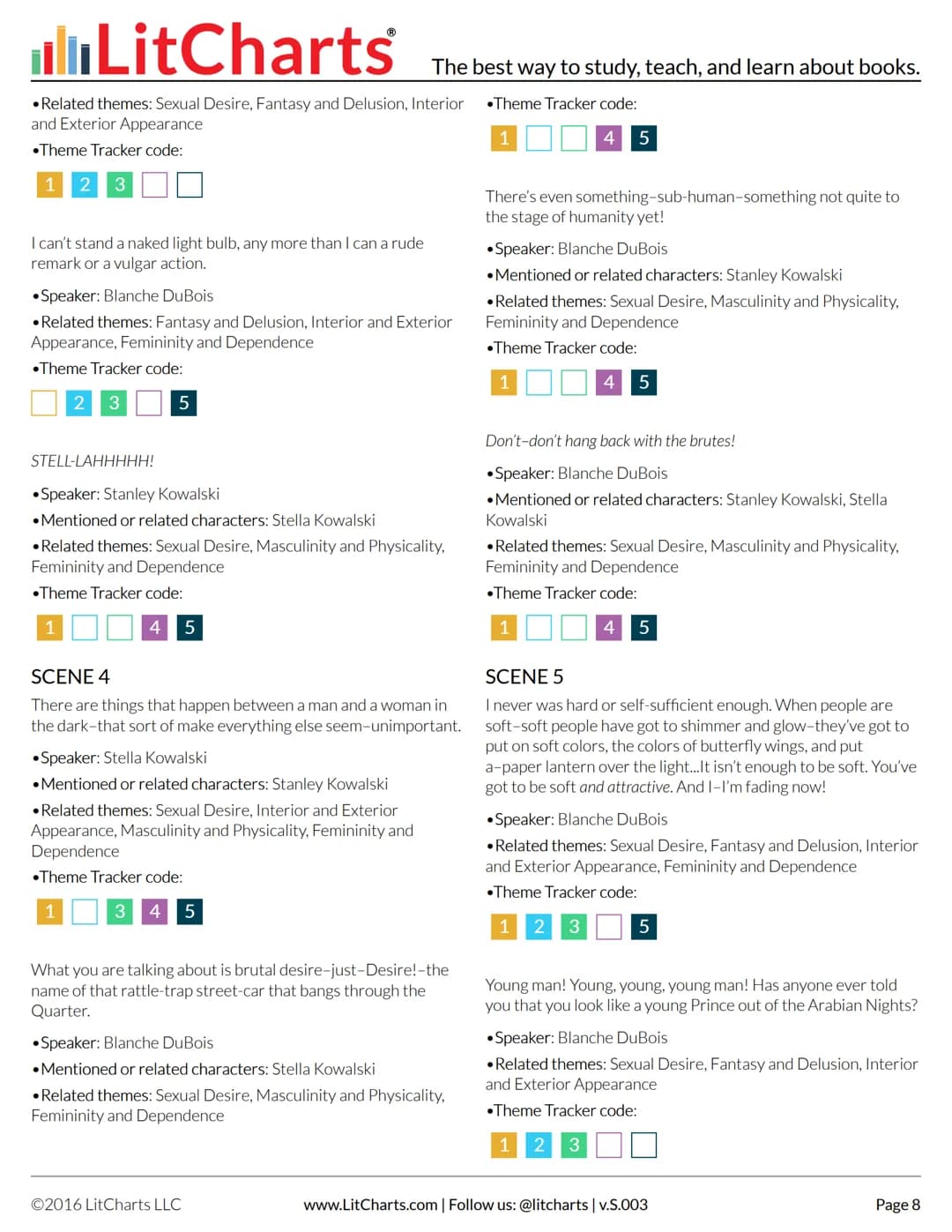
9
of 10
10
of 10
We thought you’d never ask...
What is the Knowunity AI companion?
Our AI companion is specifically built for the needs of students. Based on the millions of content pieces we have on the platform we can provide truly meaningful and relevant answers to students. But its not only about answers, the companion is even more about guiding students through their daily learning challenges, with personalised study plans, quizzes or content pieces in the chat and 100% personalisation based on the students skills and developments.
Where can I download the Knowunity app?
You can download the app in the Google Play Store and in the Apple App Store.
Is Knowunity really free of charge?
That's right! Enjoy free access to study content, connect with fellow students, and get instant help – all at your fingertips.
Similar Content
Most popular content: Foreshadowing
3English LiteratureRomeo and Juliet: Key themes
Key Romeo and Juliet themes and analysed quotes
106,708198
English LanguageEssential Literary Techniques
Explore key literary devices essential for English GCSE, including symbolism, hyperbole, personification, and more. This comprehensive guide covers various techniques used in poetry and prose, enhancing your understanding and analysis skills. Perfect for exam preparation and improving your literary analysis.
992618
English Literaturemacbeth supernatural
macbeth supernatural essay on the witches
113638
Most popular content in English Literature
9English LiteratureAn Inspector Calls: Character Insights
Explore in-depth analysis and key quotes for characters in J.B. Priestley's 'An Inspector Calls'. This resource covers Gerald Croft, Inspector Goole, Sheila Birling, Mrs. Birling, Eric Birling, and Eva Smith, focusing on themes of class, gender roles, and social responsibility. Ideal for students aiming for Grade 8 and above.
1025,429907
English LiteratureRomeo and Juliet: Key themes
Key Romeo and Juliet themes and analysed quotes
106,708198
English LiteratureMacbeth: Guilt and Ambition
Explore the complex themes of guilt and ambition in Shakespeare's 'Macbeth'. This analysis covers key characters, including Macbeth and Lady Macbeth, their moral dilemmas, and the tragic consequences of their ambition. Ideal for students studying character motivations, thematic elements, and the psychological impact of power. Includes insights on the natural order, manipulation, and the descent into madness.
919,093397
I
English LiteratureInspector Calls Quiz (YR 10 MOCKS)
for YR 10 GCSE mock on Inspector Calls
102,1451
E
English LiteratureExplore the World of English Literature
Master the key concepts and works of English literature with this comprehensive flashcard set designed for grade 10 students.
112,0941
English LiteratureExploring Macbeth's Themes
Dive into the intricate themes of Shakespeare's Macbeth, including the supernatural, ambition, guilt, and kingship. This analysis features key quotes and insights that reveal how these themes intertwine to shape the characters and the narrative. Ideal for students seeking a deeper understanding of the play's moral complexities and psychological depth.
1015,849524
E
English LiteratureExploring English Literature: A Journey through Medium
Discover the captivating world of English Literature with this comprehensive medium-level flashcard set. Dive into the works of renowned authors and explore the themes, characters, and literary techniques that make their writing truly remarkable.
111,0580
E
English LiteratureExploring 'A Christmas Carol': Themes, Characters, and Lessons
Delve into the main themes, key characters, and valuable lessons in Charles Dickens' 'A Christmas Carol'. Discover the impact of Scrooge's transformation and the significance of love, redemption, and the true meaning of Christmas.
101,2480
English LiteratureMacbeth Key Themes Essay Plans
Essay plans for key themes in macbeth - guilt, supernatural & ambition
115,186146
Most popular content
9 Sociology
Sociology of Education Overview
Explore comprehensive A-Level Sociology notes on the education system, covering key theories, policies, and sociological perspectives. This resource includes insights on marketisation, gender roles, cultural deprivation, and educational inequalities, providing a thorough understanding of how education shapes social stratification and individual achievement. Ideal for exam preparation and in-depth study.
12102,8523,040
SociologySociology of Families: Comprehensive Revision
Dive into an extensive overview of family dynamics, perspectives, and patterns in sociology. This resource covers key concepts such as family diversity, gender roles, marriage, and the impact of social policies on family structures. Perfect for A-Level Sociology students preparing for Paper 2.
1273,6612,307
CriminologyCriminology: Crime & Punishment Overview
Comprehensive mindmaps covering key concepts in the Crime and Punishment topic for WJEC Criminology Unit 4. This resource includes detailed insights into the Criminal Justice System, crime prevention strategies, sentencing models, and the roles of various agencies. Ideal for A-Level revision, ensuring you grasp essential theories and legislative processes to excel in your exams.
1254,8691,059
SociologyComprehensive Crime & Deviance Overview
Explore an extensive revision of crime and deviance topics, including theories, types of crime, and the impact of media. This resource covers key concepts such as Marxism, functionalism, gender and crime, and the influence of globalization on criminal behavior. Ideal for students seeking a thorough understanding of criminology and its various theories. Type: Full Topic Revision.
1251,6541,399
C
 Biology
Cell Biology and Cell structure
cell structures
93,2470
English LiteratureAn Inspector Calls: Character Insights
Explore in-depth analysis and key quotes for characters in J.B. Priestley's 'An Inspector Calls'. This resource covers Gerald Croft, Inspector Goole, Sheila Birling, Mrs. Birling, Eric Birling, and Eva Smith, focusing on themes of class, gender roles, and social responsibility. Ideal for students aiming for Grade 8 and above.
1025,429907
CriminologyWJEC Unit 4 Criminology
Criminology unit 4 detailed revision note
127,151125
CriminologyCriminology Theories Overview
Explore key criminology theories and their implications on crime and deviance. This comprehensive summary covers biological, psychological, and sociological perspectives, including labelling theory, right realism, and the impact of social campaigns on policy development. Ideal for A-Level criminology students seeking to understand the complexities of criminal behaviour and the factors influencing crime prevention strategies.
129,760210
English LiteratureRomeo and Juliet: Key themes
Key Romeo and Juliet themes and analysed quotes
106,708198
Can't find what you're looking for? Explore other subjects.
Students love us — and so will you.
4.6/5App Store
4.7/5Google Play
The app is very easy to use and well designed. I have found everything I was looking for so far and have been able to learn a lot from the presentations! I will definitely use the app for a class assignment! And of course it also helps a lot as an inspiration.
Stefan SiOS user
This app is really great. There are so many study notes and help [...]. My problem subject is French, for example, and the app has so many options for help. Thanks to this app, I have improved my French. I would recommend it to anyone.
Samantha KlichAndroid user
Wow, I am really amazed. I just tried the app because I've seen it advertised many times and was absolutely stunned. This app is THE HELP you want for school and above all, it offers so many things, such as workouts and fact sheets, which have been VERY helpful to me personally.
AnnaiOS user
English Literature522 views·Updated Jun 14, 2026·25 pagesA Streetcar Named Desire Litcharts Guide
P
Poppy Ramsay@poppyramsay
Tennessee Williams' "A Streetcar Named Desire" is one of the most powerful psychological dramas in American theatre, exploring the collision between fantasy and reality through the tragic story of Blanche DuBois. This study guide breaks down the key themes, characters,...
1
of 10
Sign up to see the content. It's free!
- Access to all documents
- Improve your grades
- Join milions of students
Introduction and Context
You're about to dive into a play that completely changed American theatre when it premiered in 1947. Tennessee Williams wrote this masterpiece after his own struggles with mental health and his experiences living in New Orleans' French Quarter.
The timing matters hugely - this was written just after World War II, when America was celebrating victory and optimism. Williams dared to show the darker, grittier side of American life instead. Marlon Brando's explosive performance as Stanley launched him to stardom and helped create the rebellious youth culture of the 1950s.
Think of this as a psychological drama that uses realistic settings and natural dialogue to explore what happens when people can't face the truth about themselves. The French Quarter setting isn't just backdrop - it's a melting pot where different classes and desires collide violently.
Quick Context: The actual Desire streetcar line ran through New Orleans until 1948, making Blanche's journey both real and symbolic.
2
of 10Sign up to see the content. It's free!
- Access to all documents
- Improve your grades
- Join milions of students
Plot Summary - Part 1
Blanche DuBois arrives at her sister Stella's cramped New Orleans flat after losing the family plantation, Belle Reve. She's a fading Southern belle who desperately clings to her refined past, while Stella has embraced a passionate but brutal relationship with her husband Stanley Kowalski.
The clash is immediate and explosive. Stanley represents raw, animal sexuality and working-class power, whilst Blanche tries to maintain her delicate, aristocratic facade. When Stanley suspects Blanche of cheating Stella out of inheritance money, he aggressively searches through her belongings.
The famous poker night scene sets up the central conflict. Blanche flirts with Stanley's friend Mitch while trying to soften the harsh apartment lighting with a paper lantern. Stanley's rage erupts when she interrupts his game - he smashes the radio and hits Stella. Yet after the men sober him up, Stella returns to his arms when he bellows "STELLA!" from the courtyard.
Key Moment: Stella's return to Stanley after he hits her shows how sexual desire overpowers everything else in this play.
3
of 10Sign up to see the content. It's free!
- Access to all documents
- Improve your grades
- Join milions of students
Plot Summary - Part 2
Blanche's facade begins cracking as Stanley discovers her sordid past in Mississippi. She was fired from her teaching job for having an affair with a seventeen-year-old student and lived promiscuously at the Hotel Flamingo. Stanley shares this information with Mitch, destroying Blanche's hopes for marriage and respectability.
The tragic backstory emerges - Blanche's young husband was homosexual, and after she cruelly confronted him, he committed suicide. The Varsouviana Polka they were dancing haunts her throughout the play, representing her guilt and mental deterioration.
As Stella goes into labour, Stanley finds Blanche alone, drunk, and dressed in a ridiculous evening gown and tiara. She's retreated completely into fantasy, claiming a millionaire is rescuing her. Stanley brutally shatters her illusions before raping her - the play's devastating climax.
In the final scene, Blanche is taken to a mental asylum. Stella, who cannot believe the rape story and continue living with Stanley, chooses to protect her new life over her sister.
Tragic Irony: Blanche's famous final line, "I have always depended on the kindness of strangers," shows how completely she's lost touch with reality.
4
of 10Sign up to see the content. It's free!
- Access to all documents
- Improve your grades
- Join milions of students
Major Themes
Sexual desire drives every character like an unstoppable streetcar. Blanche uses sexuality to define her worth, desperately flirting to feel alive. Stanley and Stella's relationship is built on raw physical attraction that keeps them together despite his violence. Yet Williams shows how desire leads to destruction - it costs Blanche her job, reputation, and sanity.
The battle between fantasy and reality forms the play's core conflict. Blanche creates elaborate illusions about her past and future because reality is too painful to bear. She literally avoids bright lights and harsh truths, preferring the magic of dim lighting and make-believe. But reality always wins - Stanley's brutal honesty destroys her fantasy world completely.
Masculinity in this play means physical dominance and aggression. Stanley asserts his power through violence, loud behaviour, and sexual conquest. He's described as animalistic - a "richly feathered male bird among hens." Even gentler Mitch defines himself through physical measurements and strength.
The women demonstrate different types of femininity and dependence. Blanche performs delicate Southern belle behaviour, believing this attracts men who can save her. Stella chooses practical dependence on Stanley's physical love over Blanche's romantic schemes.
Essential Understanding: Every theme connects to the central idea that people cannot escape their true nature, no matter how elaborate their disguises.
5
of 10Sign up to see the content. It's free!
- Access to all documents
- Improve your grades
- Join milions of students
Key Symbols You Must Know
The streetcar itself represents how desire controls human behaviour. Just as Blanche rides the streetcar named Desire through Cemeteries to Elysian Fields, characters are carried by their desires to inevitable destinations - often destructive ones.
The paper lantern over the light bulb symbolises Blanche's attempts to hide reality behind pretty illusions. When Mitch angrily tears it off, demanding to see her true age, she cries "I don't want realism - I want magic!" The lantern's fragility shows how easily such illusions can be destroyed.
Bathing becomes Blanche's escape mechanism - she constantly soaks in hot baths to "calm her nerves." Like Lady Macbeth washing imaginary bloodstains, Blanche tries to cleanse herself of guilt and reality. But you cannot wash away the past.
The Varsouviana Polka plays in Blanche's mind whenever she remembers her husband's suicide. Only gunshots or real-world distractions can stop the music, showing how trauma shapes her mental state.
Light and shadows represent the conflict between truth and illusion. Blanche avoids bright lights that reveal her age and faded beauty, preferring shadows that hide reality.
Exam Tip: These symbols work together - notice how Williams often combines them (like Blanche bathing while the polka plays in her mind).
6
of 10Sign up to see the content. It's free!
- Access to all documents
- Improve your grades
- Join milions of students
Essential Quotes and Analysis
"They told me to take a street-car named Desire, and then transfer to one called Cemeteries and ride six blocks and get off at—Elysian Fields!" This opening quote works on multiple levels - literal directions that also map Blanche's psychological journey from desire through death to her final resting place.
"What you are talking about is brutal desire—just—Desire!—the name of that rattle-trap street-car that bangs through the Quarter." Blanche recognises desire as a destructive force, yet she cannot escape its power over her own life.
"I don't want realism. I want magic!" Blanche's desperate cry encapsulates the play's central conflict. She knows reality will destroy her, so she clings to illusions until the very end.
"STELLA!" Stanley's famous bellow represents raw masculine power calling to feminine submission. The fact that Stella responds shows how sexual attraction overpowers rationality and self-preservation.
"I have always depended on the kindness of strangers." Blanche's final line is deeply ironic - she's speaking to the doctor who will commit her, yet she still sees him as another potential rescuer.
Analysis Key: Notice how Williams uses these quotes to reveal character psychology rather than just advance plot.
7
of 10Sign up to see the content. It's free!
- Access to all documents
- Improve your grades
- Join milions of students
8
of 10Sign up to see the content. It's free!
- Access to all documents
- Improve your grades
- Join milions of students
9
of 10Sign up to see the content. It's free!
- Access to all documents
- Improve your grades
- Join milions of students
10
of 10Sign up to see the content. It's free!
- Access to all documents
- Improve your grades
- Join milions of students
We thought you’d never ask...
What is the Knowunity AI companion?
Our AI companion is specifically built for the needs of students. Based on the millions of content pieces we have on the platform we can provide truly meaningful and relevant answers to students. But its not only about answers, the companion is even more about guiding students through their daily learning challenges, with personalised study plans, quizzes or content pieces in the chat and 100% personalisation based on the students skills and developments.
Where can I download the Knowunity app?
You can download the app in the Google Play Store and in the Apple App Store.
Is Knowunity really free of charge?
That's right! Enjoy free access to study content, connect with fellow students, and get instant help – all at your fingertips.
Similar Content
Most popular content: Foreshadowing
3English LiteratureRomeo and Juliet: Key themes
Key Romeo and Juliet themes and analysed quotes
106,708198
English LanguageEssential Literary Techniques
Explore key literary devices essential for English GCSE, including symbolism, hyperbole, personification, and more. This comprehensive guide covers various techniques used in poetry and prose, enhancing your understanding and analysis skills. Perfect for exam preparation and improving your literary analysis.
992618
English Literaturemacbeth supernatural
macbeth supernatural essay on the witches
113638
Most popular content in English Literature
9English LiteratureAn Inspector Calls: Character Insights
Explore in-depth analysis and key quotes for characters in J.B. Priestley's 'An Inspector Calls'. This resource covers Gerald Croft, Inspector Goole, Sheila Birling, Mrs. Birling, Eric Birling, and Eva Smith, focusing on themes of class, gender roles, and social responsibility. Ideal for students aiming for Grade 8 and above.
1025,429907
English LiteratureRomeo and Juliet: Key themes
Key Romeo and Juliet themes and analysed quotes
106,708198
English LiteratureMacbeth: Guilt and Ambition
Explore the complex themes of guilt and ambition in Shakespeare's 'Macbeth'. This analysis covers key characters, including Macbeth and Lady Macbeth, their moral dilemmas, and the tragic consequences of their ambition. Ideal for students studying character motivations, thematic elements, and the psychological impact of power. Includes insights on the natural order, manipulation, and the descent into madness.
919,093397
I
English LiteratureInspector Calls Quiz (YR 10 MOCKS)
for YR 10 GCSE mock on Inspector Calls
102,1451
E
English LiteratureExplore the World of English Literature
Master the key concepts and works of English literature with this comprehensive flashcard set designed for grade 10 students.
112,0941
English LiteratureExploring Macbeth's Themes
Dive into the intricate themes of Shakespeare's Macbeth, including the supernatural, ambition, guilt, and kingship. This analysis features key quotes and insights that reveal how these themes intertwine to shape the characters and the narrative. Ideal for students seeking a deeper understanding of the play's moral complexities and psychological depth.
1015,849524
E
English LiteratureExploring English Literature: A Journey through Medium
Discover the captivating world of English Literature with this comprehensive medium-level flashcard set. Dive into the works of renowned authors and explore the themes, characters, and literary techniques that make their writing truly remarkable.
111,0580
E
English LiteratureExploring 'A Christmas Carol': Themes, Characters, and Lessons
Delve into the main themes, key characters, and valuable lessons in Charles Dickens' 'A Christmas Carol'. Discover the impact of Scrooge's transformation and the significance of love, redemption, and the true meaning of Christmas.
101,2480
English LiteratureMacbeth Key Themes Essay Plans
Essay plans for key themes in macbeth - guilt, supernatural & ambition
115,186146
Most popular content
9SociologySociology of Education Overview
Explore comprehensive A-Level Sociology notes on the education system, covering key theories, policies, and sociological perspectives. This resource includes insights on marketisation, gender roles, cultural deprivation, and educational inequalities, providing a thorough understanding of how education shapes social stratification and individual achievement. Ideal for exam preparation and in-depth study.
12102,8523,040
SociologySociology of Families: Comprehensive Revision
Dive into an extensive overview of family dynamics, perspectives, and patterns in sociology. This resource covers key concepts such as family diversity, gender roles, marriage, and the impact of social policies on family structures. Perfect for A-Level Sociology students preparing for Paper 2.
1273,6612,307
CriminologyCriminology: Crime & Punishment Overview
Comprehensive mindmaps covering key concepts in the Crime and Punishment topic for WJEC Criminology Unit 4. This resource includes detailed insights into the Criminal Justice System, crime prevention strategies, sentencing models, and the roles of various agencies. Ideal for A-Level revision, ensuring you grasp essential theories and legislative processes to excel in your exams.
1254,8691,059
SociologyComprehensive Crime & Deviance Overview
Explore an extensive revision of crime and deviance topics, including theories, types of crime, and the impact of media. This resource covers key concepts such as Marxism, functionalism, gender and crime, and the influence of globalization on criminal behavior. Ideal for students seeking a thorough understanding of criminology and its various theories. Type: Full Topic Revision.
1251,6541,399
C
BiologyCell Biology and Cell structure
cell structures
93,2470
English LiteratureAn Inspector Calls: Character Insights
Explore in-depth analysis and key quotes for characters in J.B. Priestley's 'An Inspector Calls'. This resource covers Gerald Croft, Inspector Goole, Sheila Birling, Mrs. Birling, Eric Birling, and Eva Smith, focusing on themes of class, gender roles, and social responsibility. Ideal for students aiming for Grade 8 and above.
1025,429907
CriminologyWJEC Unit 4 Criminology
Criminology unit 4 detailed revision note
127,151125
CriminologyCriminology Theories Overview
Explore key criminology theories and their implications on crime and deviance. This comprehensive summary covers biological, psychological, and sociological perspectives, including labelling theory, right realism, and the impact of social campaigns on policy development. Ideal for A-Level criminology students seeking to understand the complexities of criminal behaviour and the factors influencing crime prevention strategies.
129,760210
English LiteratureRomeo and Juliet: Key themes
Key Romeo and Juliet themes and analysed quotes
106,708198
Can't find what you're looking for? Explore other subjects.
Students love us — and so will you.
4.6/5App Store
4.7/5Google Play
The app is very easy to use and well designed. I have found everything I was looking for so far and have been able to learn a lot from the presentations! I will definitely use the app for a class assignment! And of course it also helps a lot as an inspiration.
Stefan SiOS user
This app is really great. There are so many study notes and help [...]. My problem subject is French, for example, and the app has so many options for help. Thanks to this app, I have improved my French. I would recommend it to anyone.
Samantha KlichAndroid user
Wow, I am really amazed. I just tried the app because I've seen it advertised many times and was absolutely stunned. This app is THE HELP you want for school and above all, it offers so many things, such as workouts and fact sheets, which have been VERY helpful to me personally.
AnnaiOS user