
Welcome to your guide on "Romeo and Juliet" character analysis...
 English Literature315 views·Updated Jun 18, 2026·6 pages
Romeo and Juliet: Themes and Character Analysis Mind Maps
L
Lexi Pope@lexipope


1 / 6
1
of 6
Tybalt: The Fiery Antagonist
Tybalt embodies the feud's destructive power through his aggressive personality and violent tendencies. Shakespeare uses religious imagery to show how Tybalt's anger pushes moral boundaries beyond ethical reasoning, setting the tone for potential violence throughout the play.
His character creates a deliberate contrast with Romeo - where Romeo is poetic and romantic, Tybalt is portrayed as a skilled fighter who finds pleasure in violence. His approach to fighting showcases his hot-tempered nature, with Shakespeare using metaphors of fire to illustrate his quick anger and emotional volatility.
The audience experiences mixed reactions to Tybalt - his skilled rhetoric might draw admiration, but his aggressive nature and "bloodthirsty" personality represent the deeply-rooted hatred driving the family feud. This makes him a compelling antagonist who symbolises the destructive power of unchecked aggression.
Think about it: Notice how Shakespeare uses Tybalt as a 'human embodiment' of anger. How does this character trait drive the plot forward and contribute to the play's tragic ending?
2
of 6
Fate and Destiny
Ever felt like some things are just meant to happen? In Romeo and Juliet, fate looms large from the very beginning. The play opens with a "pair of star-crossed lovers" - a powerful oxymoron showing that while their connection is beautiful, the stars themselves work against them, creating a sense of inevitable tragedy.
Shakespeare uses foreshadowing throughout to hint at the tragic conclusion. When Juliet says, "Methinks I see thee, as one dead in the bottom of a tomb," she unknowingly predicts exactly what will happen. This creates dramatic tension as we watch events unfold toward their predetermined end.
The language around fate is rich with metaphors and imagery of death. When Juliet claims "My grave is like to be my wedding bed," Shakespeare juxtaposes symbols of union (wedding) with finality (grave). This technique emphasises how love and death are intertwined in their story.
Interesting fact: Elizabethans were fascinated by astrology and predestination! They believed the position of stars at birth influenced one's destiny - making the "star-crossed" reference particularly meaningful to Shakespeare's original audience.
3
of 6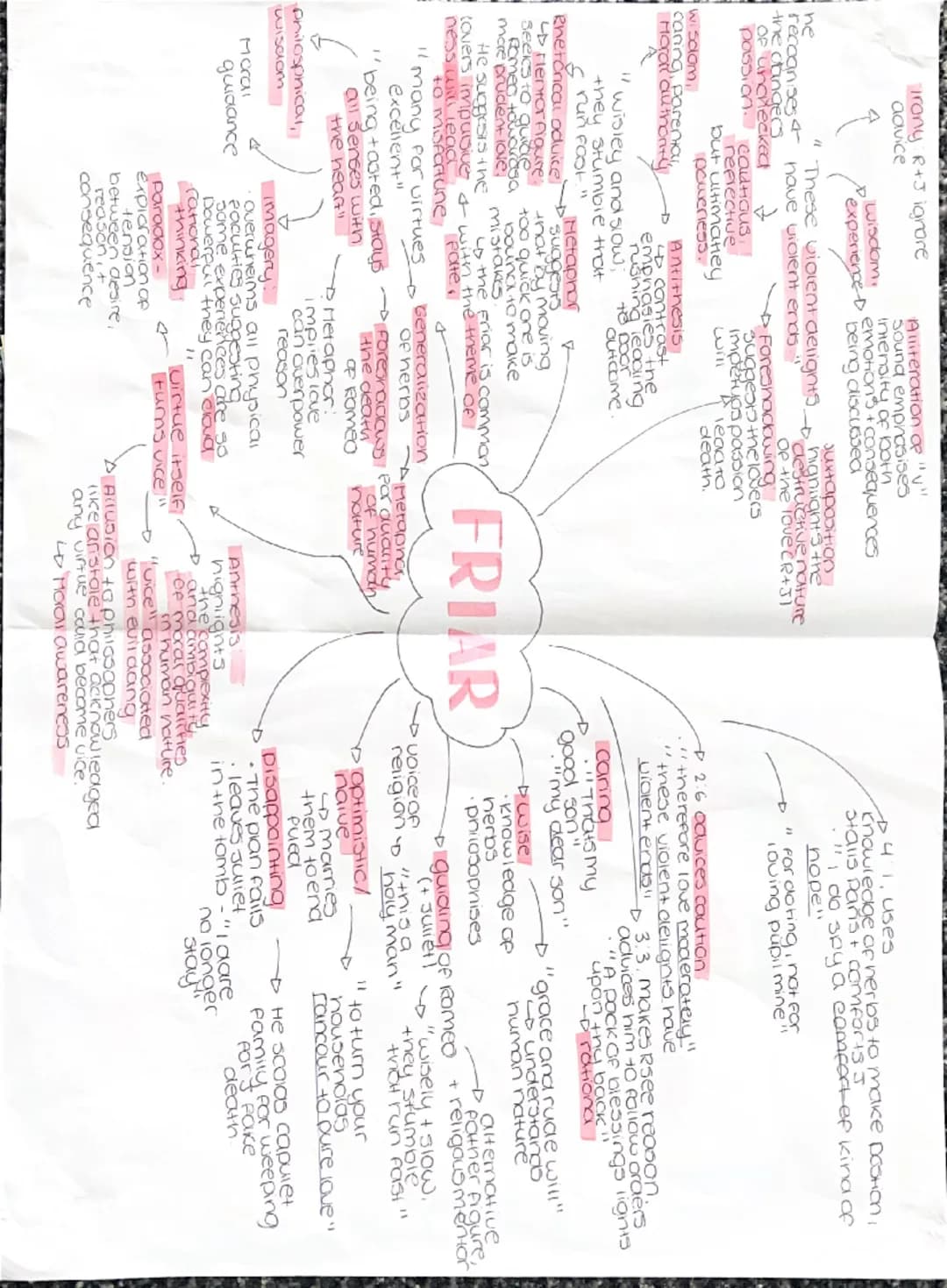
The Friar: Voice of Wisdom and Caution
The Friar serves as a moral compass throughout the play, offering advice and caution to the young lovers. His famous line "these violent delights have violent ends" demonstrates his understanding that unchecked passion often leads to disaster. Through carefully constructed language, Shakespeare establishes him as a voice of reason.
Shakespeare uses religious language and imagery to present the Friar as a guiding figure. Terms like "holy man," "sweet," and "wise" create an impression of someone who combines religious authority with practical wisdom. His optimistic nature drives him to help Romeo and Juliet, hoping their union might end the family feud.
The Friar's speech is filled with antithesis - contrasting pairs like "virtue/vice" and "night/day" - reflecting his nuanced understanding of human nature. This rhetorical device shows his intellectual approach to problems, believing in moderation rather than extremes. His character highlights the tension between impetuosity and thoughtful action.
Pay attention: Notice how the Friar uses the word "moderate" frequently. His belief in moderation directly contrasts with the passionate, all-consuming love of Romeo and Juliet. What might Shakespeare be suggesting about different approaches to life?
4
of 6
Mercutio and Benvolio: Contrasting Friends
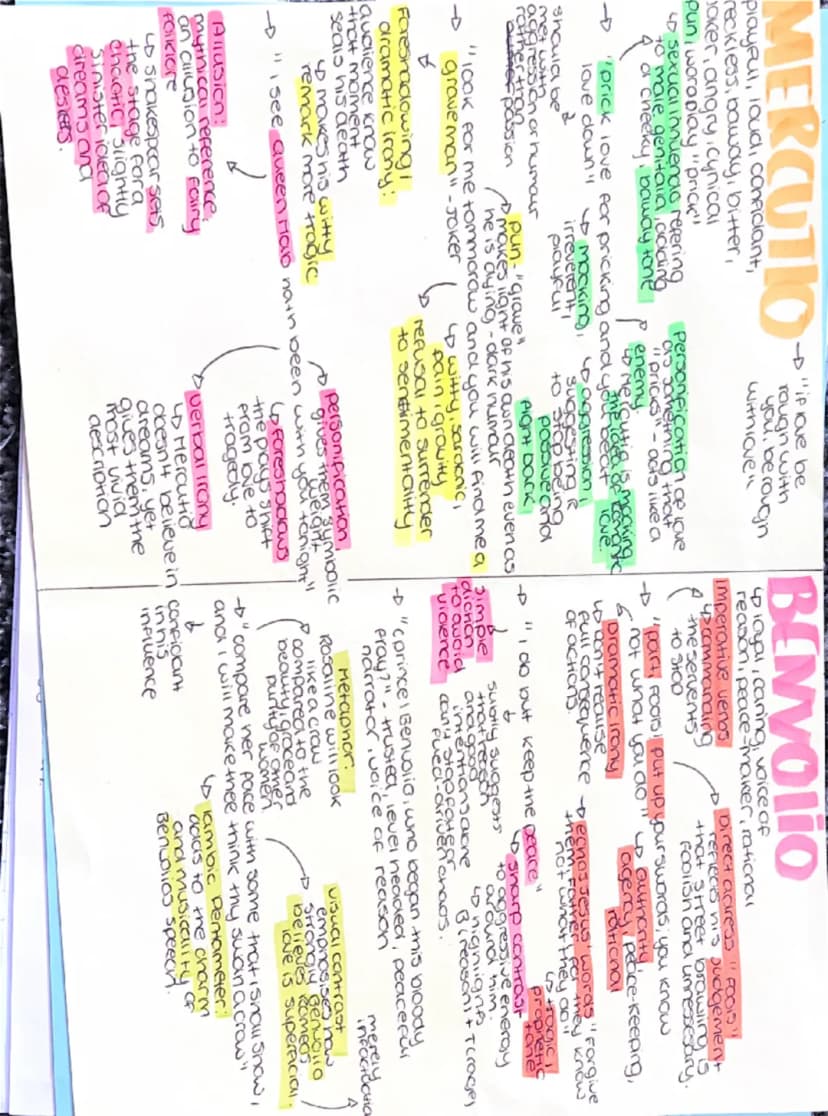
Mercutio bursts with life through his playful, witty language. His famous line "prick love for pricking" showcases his love of wordplay and sexual innuendo, adding bawdy humour to the play. Even as he dies, his dark joke "look for me tomorrow and you will find me a grave man" demonstrates his refusal to surrender to sentimentality, making his death all the more tragic.
In stark contrast, Benvolio appears as the voice of reason. His language includes imperative verbs like "part, fools" when commanding servants to stop fighting, highlighting his peacekeeping nature. Prince Escalus trusts him to provide a truthful account of events, showing his reputation for honesty and level-headedness.
Shakespeare uses different speech patterns to distinguish these characters. Mercutio's elaborate speeches about Queen Mab reveal his imaginative, slightly sinister worldview, while Benvolio speaks in more measured, practical terms. His promise that Romeo will "think thy swan a crow" when comparing Rosaline to other beauties shows his pragmatic approach to his friend's lovesickness.
Writing technique: Notice how Shakespeare uses iambic pentameter in Benvolio's speech to add musicality and charm, contrasting with Mercutio's more unpredictable language patterns. This subtly reinforces their different personalities!
5
of 6
Conflict: The Driving Force
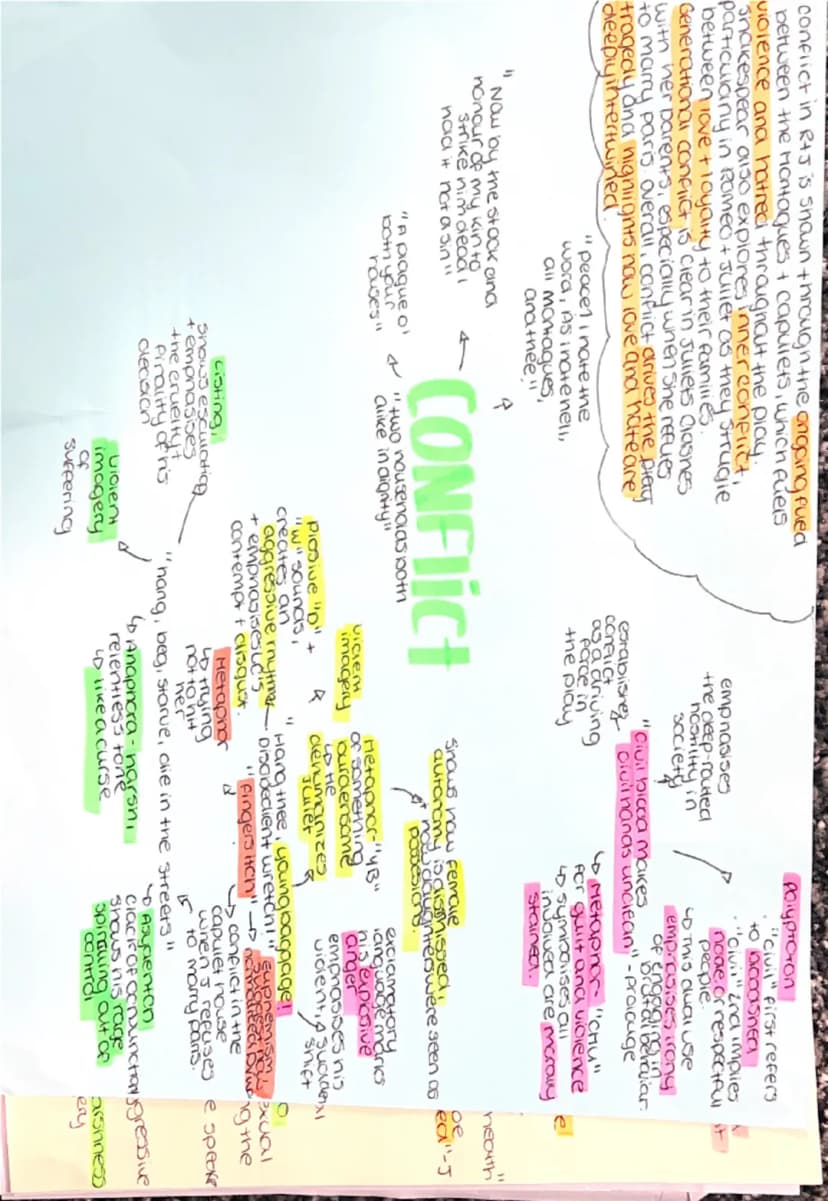
Conflict pulses through every scene in Romeo and Juliet, appearing in multiple forms. The family feud between Montagues and Capulets creates the backdrop for violence, captured perfectly in the prologue's description of "civil blood makes civil hands unclean" – a clever play on words showing how supposedly civilised people become stained by their actions.
Individual characters express conflict through powerful language. Tybalt's explosive "Now by the stock and honour of my kin, to strike him dead I hold it not a sin" reveals how deeply the hatred runs, with harsh consonant sounds creating an aggressive rhythm. This external conflict drives much of the physical violence in the play.
Perhaps most heart-wrenching is the generational conflict between Juliet and her parents. When Lord Capulet erupts with "Hang thee, young baggage! Disobedient wretch!", the dehumanising language and violent imagery show the terrifying power parents held over their children. His threat "hang, beg, starve, die in the streets" uses anaphora to emphasise the harshness of his ultimatum.
Consider this: The word "peace" appears frequently throughout the play, but is always followed by more conflict. What might Shakespeare be suggesting about human nature and our ability to resolve differences?
6
of 6
Love: Beautiful but Dangerous
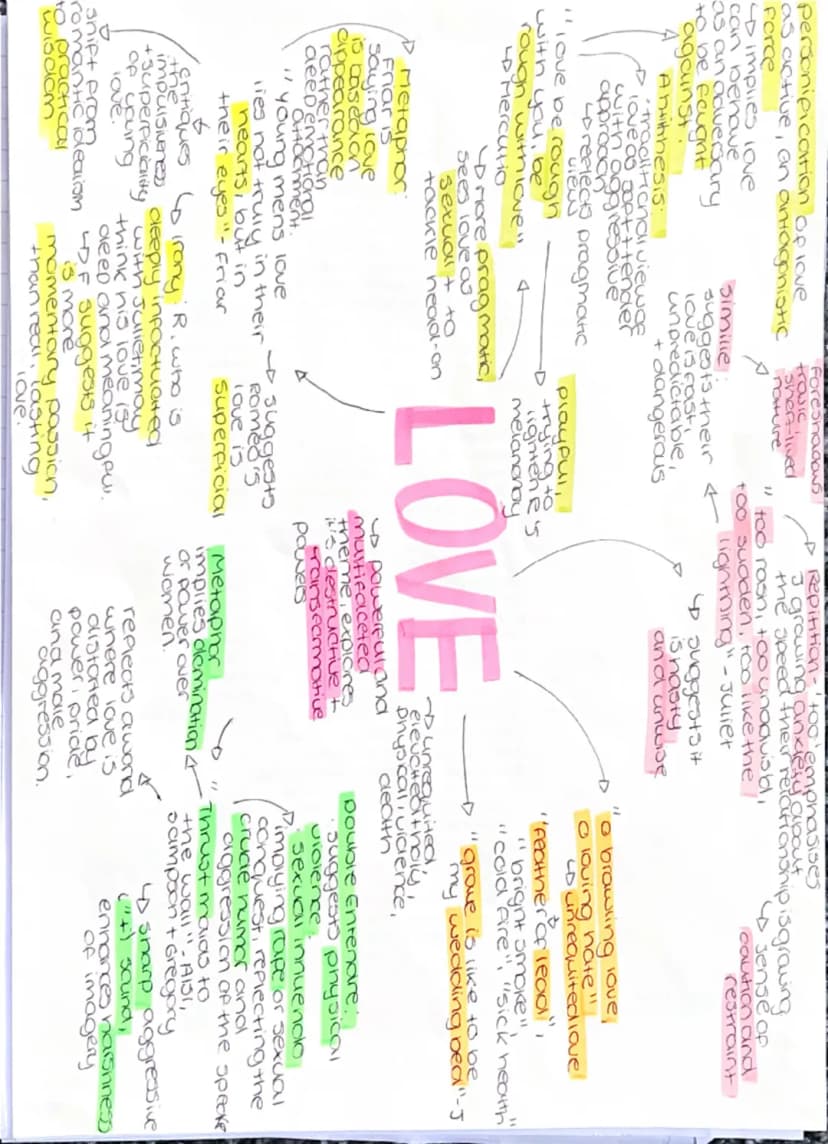
Love in Romeo and Juliet is portrayed as a powerful but potentially destructive force. Juliet describes their love as "too like the lightning" – a simile suggesting it's brilliant but dangerous, unpredictable and possibly destructive. This foreshadows how their intense passion might lead to tragedy.
Shakespeare contrasts different perspectives on love throughout the play. Mercutio takes a pragmatic view with his advice "if love be rough with you, be rough with love", suggesting love should be approached with aggression rather than sentimentality. Meanwhile, the Friar cautions that young men's love "lies not truly in their hearts, but in their eyes" – implying Romeo's feelings might be superficial physical attraction.
Romeo himself describes love through paradoxical language – "a brawling love, a loving hate" and lists contradictions like "feather of lead" and "cold fire." These oxymorons reveal love's complex, contradictory nature. Shakespeare also includes darker references to love, with some characters using violent sexual imagery that reflects a world where love is distorted by power dynamics.
Language focus: Notice how Shakespeare uses antithesis (opposing ideas) when describing love. These contradictions help convey how love can simultaneously bring extreme joy and devastating pain – a key theme throughout the play.
We thought you’d never ask...
What is the Knowunity AI companion?
Our AI companion is specifically built for the needs of students. Based on the millions of content pieces we have on the platform we can provide truly meaningful and relevant answers to students. But its not only about answers, the companion is even more about guiding students through their daily learning challenges, with personalised study plans, quizzes or content pieces in the chat and 100% personalisation based on the students skills and developments.
Where can I download the Knowunity app?
You can download the app in the Google Play Store and in the Apple App Store.
Is Knowunity really free of charge?
That's right! Enjoy free access to study content, connect with fellow students, and get instant help – all at your fingertips.
Similar Content
 Taller de lectura y redacción
Most popular content: Theme
9English LiteratureJekyll and Hyde essay plans for themes and characters
Themes such as secrecy, silence, repression, religion, morality. Characters including utterson, Enfield, Jekyll, Hyde, lanyon etc.
101,17134
English LiteratureThemes in A Christmas Carol
Explore the key themes of 'A Christmas Carol' through detailed mind maps. This study resource covers Scrooge's redemption, the impact of poverty, the significance of family, and the role of the ghosts in shaping the narrative. Ideal for students seeking to understand Dickens' moral lessons and social commentary.
113,538106
English LiteratureKey Themes in A Christmas Carol
Explore the pivotal themes of Charles Dickens' 'A Christmas Carol' through detailed mind maps. This study note covers family dynamics, poverty, redemption, and the Christmas spirit, highlighting how these elements shape the narrative and character development. Ideal for students seeking to understand the deeper meanings behind the text.
113,472162
English Literaturemacbeth character mind maps
macbeth character mind maps with quotes and linked themes
1147112
English LiteratureBefore You Were Mine annotations
GCSE AQA Literature; love and relationship poetry; Before You Were Mine by Carol Ann Duffy
1074119
English LiteratureOthello: Key Quotes & Themes
Explore pivotal quotes from Shakespeare's 'Othello' that illustrate themes of deception, jealousy, race, and tragedy. This summary highlights key moments and literary devices, providing insights into character motivations and the play's central conflicts. Ideal for students studying Shakespearean literature.
1243811
English LiteraturePride and Prejudice mind maps
Pride and prejudice mind maps on love and marriage and social class and gender roles, Elizabeth bennet and mr Darcy
113565
English LiteratureFate & Family in Romeo and Juliet
Explore key quotes from 'Romeo and Juliet' that illustrate the themes of fate and family honour. This analysis delves into how Shakespeare portrays the inescapable nature of fate and the destructive power of family feuds, highlighting pivotal moments that shape the tragic narrative. Ideal for students studying Shakespeare's themes and character motivations.
114,47784
English LiteratureMacbeth theme essay plans
Macbeth essay plans for ambition, kingship, gender and natural vs unnatural
115298
Most popular content in English Literature
9English LiteratureAn Inspector Calls: Character Insights
Explore in-depth analysis and key quotes for characters in J.B. Priestley's 'An Inspector Calls'. This resource covers Gerald Croft, Inspector Goole, Sheila Birling, Mrs. Birling, Eric Birling, and Eva Smith, focusing on themes of class, gender roles, and social responsibility. Ideal for students aiming for Grade 8 and above.
1025,429907
English LiteratureRomeo and Juliet: Key themes
Key Romeo and Juliet themes and analysed quotes
106,708198
English LiteratureMacbeth: Guilt and Ambition
Explore the complex themes of guilt and ambition in Shakespeare's 'Macbeth'. This analysis covers key characters, including Macbeth and Lady Macbeth, their moral dilemmas, and the tragic consequences of their ambition. Ideal for students studying character motivations, thematic elements, and the psychological impact of power. Includes insights on the natural order, manipulation, and the descent into madness.
919,093397
I
English LiteratureInspector Calls Quiz (YR 10 MOCKS)
for YR 10 GCSE mock on Inspector Calls
102,1451
E
English LiteratureExplore the World of English Literature
Master the key concepts and works of English literature with this comprehensive flashcard set designed for grade 10 students.
112,0941
English LiteratureExploring Macbeth's Themes
Dive into the intricate themes of Shakespeare's Macbeth, including the supernatural, ambition, guilt, and kingship. This analysis features key quotes and insights that reveal how these themes intertwine to shape the characters and the narrative. Ideal for students seeking a deeper understanding of the play's moral complexities and psychological depth.
1015,849524
E
English LiteratureExploring English Literature: A Journey through Medium
Discover the captivating world of English Literature with this comprehensive medium-level flashcard set. Dive into the works of renowned authors and explore the themes, characters, and literary techniques that make their writing truly remarkable.
111,0580
E
English LiteratureExploring 'A Christmas Carol': Themes, Characters, and Lessons
Delve into the main themes, key characters, and valuable lessons in Charles Dickens' 'A Christmas Carol'. Discover the impact of Scrooge's transformation and the significance of love, redemption, and the true meaning of Christmas.
101,2480
English LiteratureMacbeth Key Themes Essay Plans
Essay plans for key themes in macbeth - guilt, supernatural & ambition
115,186146
Most popular content
9 Sociology
Sociology of Education Overview
Explore comprehensive A-Level Sociology notes on the education system, covering key theories, policies, and sociological perspectives. This resource includes insights on marketisation, gender roles, cultural deprivation, and educational inequalities, providing a thorough understanding of how education shapes social stratification and individual achievement. Ideal for exam preparation and in-depth study.
12102,8693,040
SociologySociology of Families: Comprehensive Revision
Dive into an extensive overview of family dynamics, perspectives, and patterns in sociology. This resource covers key concepts such as family diversity, gender roles, marriage, and the impact of social policies on family structures. Perfect for A-Level Sociology students preparing for Paper 2.
1273,6612,307
CriminologyCriminology: Crime & Punishment Overview
Comprehensive mindmaps covering key concepts in the Crime and Punishment topic for WJEC Criminology Unit 4. This resource includes detailed insights into the Criminal Justice System, crime prevention strategies, sentencing models, and the roles of various agencies. Ideal for A-Level revision, ensuring you grasp essential theories and legislative processes to excel in your exams.
1254,8691,059
SociologyComprehensive Crime & Deviance Overview
Explore an extensive revision of crime and deviance topics, including theories, types of crime, and the impact of media. This resource covers key concepts such as Marxism, functionalism, gender and crime, and the influence of globalization on criminal behavior. Ideal for students seeking a thorough understanding of criminology and its various theories. Type: Full Topic Revision.
1251,6541,399
C
 Biology
Cell Biology and Cell structure
cell structures
93,2470
English LiteratureAn Inspector Calls: Character Insights
Explore in-depth analysis and key quotes for characters in J.B. Priestley's 'An Inspector Calls'. This resource covers Gerald Croft, Inspector Goole, Sheila Birling, Mrs. Birling, Eric Birling, and Eva Smith, focusing on themes of class, gender roles, and social responsibility. Ideal for students aiming for Grade 8 and above.
1025,429907
CriminologyWJEC Unit 4 Criminology
Criminology unit 4 detailed revision note
127,151125
CriminologyCriminology Theories Overview
Explore key criminology theories and their implications on crime and deviance. This comprehensive summary covers biological, psychological, and sociological perspectives, including labelling theory, right realism, and the impact of social campaigns on policy development. Ideal for A-Level criminology students seeking to understand the complexities of criminal behaviour and the factors influencing crime prevention strategies.
129,760210
English LiteratureRomeo and Juliet: Key themes
Key Romeo and Juliet themes and analysed quotes
106,708198
Can't find what you're looking for? Explore other subjects.
Students love us — and so will you.
4.6/5App Store
4.7/5Google Play
The app is very easy to use and well designed. I have found everything I was looking for so far and have been able to learn a lot from the presentations! I will definitely use the app for a class assignment! And of course it also helps a lot as an inspiration.
Stefan SiOS user
This app is really great. There are so many study notes and help [...]. My problem subject is French, for example, and the app has so many options for help. Thanks to this app, I have improved my French. I would recommend it to anyone.
Samantha KlichAndroid user
Wow, I am really amazed. I just tried the app because I've seen it advertised many times and was absolutely stunned. This app is THE HELP you want for school and above all, it offers so many things, such as workouts and fact sheets, which have been VERY helpful to me personally.
AnnaiOS user
English Literature315 views·Updated Jun 18, 2026·6 pagesRomeo and Juliet: Themes and Character Analysis Mind Maps
L
Lexi Pope@lexipope
Welcome to your guide on "Romeo and Juliet" character analysis and key themes! Shakespeare's tragic love story showcases complex characters and powerful themes that still resonate today. Let's explore how Shakespeare builds character through language and examines conflict, love, and...
1
of 6
Sign up to see the content. It's free!
- Access to all documents
- Improve your grades
- Join milions of students
Tybalt: The Fiery Antagonist
Tybalt embodies the feud's destructive power through his aggressive personality and violent tendencies. Shakespeare uses religious imagery to show how Tybalt's anger pushes moral boundaries beyond ethical reasoning, setting the tone for potential violence throughout the play.
His character creates a deliberate contrast with Romeo - where Romeo is poetic and romantic, Tybalt is portrayed as a skilled fighter who finds pleasure in violence. His approach to fighting showcases his hot-tempered nature, with Shakespeare using metaphors of fire to illustrate his quick anger and emotional volatility.
The audience experiences mixed reactions to Tybalt - his skilled rhetoric might draw admiration, but his aggressive nature and "bloodthirsty" personality represent the deeply-rooted hatred driving the family feud. This makes him a compelling antagonist who symbolises the destructive power of unchecked aggression.
Think about it: Notice how Shakespeare uses Tybalt as a 'human embodiment' of anger. How does this character trait drive the plot forward and contribute to the play's tragic ending?
2
of 6Sign up to see the content. It's free!
- Access to all documents
- Improve your grades
- Join milions of students
Fate and Destiny
Ever felt like some things are just meant to happen? In Romeo and Juliet, fate looms large from the very beginning. The play opens with a "pair of star-crossed lovers" - a powerful oxymoron showing that while their connection is beautiful, the stars themselves work against them, creating a sense of inevitable tragedy.
Shakespeare uses foreshadowing throughout to hint at the tragic conclusion. When Juliet says, "Methinks I see thee, as one dead in the bottom of a tomb," she unknowingly predicts exactly what will happen. This creates dramatic tension as we watch events unfold toward their predetermined end.
The language around fate is rich with metaphors and imagery of death. When Juliet claims "My grave is like to be my wedding bed," Shakespeare juxtaposes symbols of union (wedding) with finality (grave). This technique emphasises how love and death are intertwined in their story.
Interesting fact: Elizabethans were fascinated by astrology and predestination! They believed the position of stars at birth influenced one's destiny - making the "star-crossed" reference particularly meaningful to Shakespeare's original audience.
3
of 6Sign up to see the content. It's free!
- Access to all documents
- Improve your grades
- Join milions of students
The Friar: Voice of Wisdom and Caution
The Friar serves as a moral compass throughout the play, offering advice and caution to the young lovers. His famous line "these violent delights have violent ends" demonstrates his understanding that unchecked passion often leads to disaster. Through carefully constructed language, Shakespeare establishes him as a voice of reason.
Shakespeare uses religious language and imagery to present the Friar as a guiding figure. Terms like "holy man," "sweet," and "wise" create an impression of someone who combines religious authority with practical wisdom. His optimistic nature drives him to help Romeo and Juliet, hoping their union might end the family feud.
The Friar's speech is filled with antithesis - contrasting pairs like "virtue/vice" and "night/day" - reflecting his nuanced understanding of human nature. This rhetorical device shows his intellectual approach to problems, believing in moderation rather than extremes. His character highlights the tension between impetuosity and thoughtful action.
Pay attention: Notice how the Friar uses the word "moderate" frequently. His belief in moderation directly contrasts with the passionate, all-consuming love of Romeo and Juliet. What might Shakespeare be suggesting about different approaches to life?
4
of 6Sign up to see the content. It's free!
- Access to all documents
- Improve your grades
- Join milions of students
Mercutio and Benvolio: Contrasting Friends
Mercutio bursts with life through his playful, witty language. His famous line "prick love for pricking" showcases his love of wordplay and sexual innuendo, adding bawdy humour to the play. Even as he dies, his dark joke "look for me tomorrow and you will find me a grave man" demonstrates his refusal to surrender to sentimentality, making his death all the more tragic.
In stark contrast, Benvolio appears as the voice of reason. His language includes imperative verbs like "part, fools" when commanding servants to stop fighting, highlighting his peacekeeping nature. Prince Escalus trusts him to provide a truthful account of events, showing his reputation for honesty and level-headedness.
Shakespeare uses different speech patterns to distinguish these characters. Mercutio's elaborate speeches about Queen Mab reveal his imaginative, slightly sinister worldview, while Benvolio speaks in more measured, practical terms. His promise that Romeo will "think thy swan a crow" when comparing Rosaline to other beauties shows his pragmatic approach to his friend's lovesickness.
Writing technique: Notice how Shakespeare uses iambic pentameter in Benvolio's speech to add musicality and charm, contrasting with Mercutio's more unpredictable language patterns. This subtly reinforces their different personalities!
5
of 6Sign up to see the content. It's free!
- Access to all documents
- Improve your grades
- Join milions of students
Conflict: The Driving Force
Conflict pulses through every scene in Romeo and Juliet, appearing in multiple forms. The family feud between Montagues and Capulets creates the backdrop for violence, captured perfectly in the prologue's description of "civil blood makes civil hands unclean" – a clever play on words showing how supposedly civilised people become stained by their actions.
Individual characters express conflict through powerful language. Tybalt's explosive "Now by the stock and honour of my kin, to strike him dead I hold it not a sin" reveals how deeply the hatred runs, with harsh consonant sounds creating an aggressive rhythm. This external conflict drives much of the physical violence in the play.
Perhaps most heart-wrenching is the generational conflict between Juliet and her parents. When Lord Capulet erupts with "Hang thee, young baggage! Disobedient wretch!", the dehumanising language and violent imagery show the terrifying power parents held over their children. His threat "hang, beg, starve, die in the streets" uses anaphora to emphasise the harshness of his ultimatum.
Consider this: The word "peace" appears frequently throughout the play, but is always followed by more conflict. What might Shakespeare be suggesting about human nature and our ability to resolve differences?
6
of 6Sign up to see the content. It's free!
- Access to all documents
- Improve your grades
- Join milions of students
Love: Beautiful but Dangerous
Love in Romeo and Juliet is portrayed as a powerful but potentially destructive force. Juliet describes their love as "too like the lightning" – a simile suggesting it's brilliant but dangerous, unpredictable and possibly destructive. This foreshadows how their intense passion might lead to tragedy.
Shakespeare contrasts different perspectives on love throughout the play. Mercutio takes a pragmatic view with his advice "if love be rough with you, be rough with love", suggesting love should be approached with aggression rather than sentimentality. Meanwhile, the Friar cautions that young men's love "lies not truly in their hearts, but in their eyes" – implying Romeo's feelings might be superficial physical attraction.
Romeo himself describes love through paradoxical language – "a brawling love, a loving hate" and lists contradictions like "feather of lead" and "cold fire." These oxymorons reveal love's complex, contradictory nature. Shakespeare also includes darker references to love, with some characters using violent sexual imagery that reflects a world where love is distorted by power dynamics.
Language focus: Notice how Shakespeare uses antithesis (opposing ideas) when describing love. These contradictions help convey how love can simultaneously bring extreme joy and devastating pain – a key theme throughout the play.
We thought you’d never ask...
What is the Knowunity AI companion?
Our AI companion is specifically built for the needs of students. Based on the millions of content pieces we have on the platform we can provide truly meaningful and relevant answers to students. But its not only about answers, the companion is even more about guiding students through their daily learning challenges, with personalised study plans, quizzes or content pieces in the chat and 100% personalisation based on the students skills and developments.
Where can I download the Knowunity app?
You can download the app in the Google Play Store and in the Apple App Store.
Is Knowunity really free of charge?
That's right! Enjoy free access to study content, connect with fellow students, and get instant help – all at your fingertips.
Similar Content
Most popular content: Theme
9English LiteratureJekyll and Hyde essay plans for themes and characters
Themes such as secrecy, silence, repression, religion, morality. Characters including utterson, Enfield, Jekyll, Hyde, lanyon etc.
101,17134
English LiteratureThemes in A Christmas Carol
Explore the key themes of 'A Christmas Carol' through detailed mind maps. This study resource covers Scrooge's redemption, the impact of poverty, the significance of family, and the role of the ghosts in shaping the narrative. Ideal for students seeking to understand Dickens' moral lessons and social commentary.
113,538106
English LiteratureKey Themes in A Christmas Carol
Explore the pivotal themes of Charles Dickens' 'A Christmas Carol' through detailed mind maps. This study note covers family dynamics, poverty, redemption, and the Christmas spirit, highlighting how these elements shape the narrative and character development. Ideal for students seeking to understand the deeper meanings behind the text.
113,472162
English Literaturemacbeth character mind maps
macbeth character mind maps with quotes and linked themes
1147112
English LiteratureBefore You Were Mine annotations
GCSE AQA Literature; love and relationship poetry; Before You Were Mine by Carol Ann Duffy
1074119
English LiteratureOthello: Key Quotes & Themes
Explore pivotal quotes from Shakespeare's 'Othello' that illustrate themes of deception, jealousy, race, and tragedy. This summary highlights key moments and literary devices, providing insights into character motivations and the play's central conflicts. Ideal for students studying Shakespearean literature.
1243811
English LiteraturePride and Prejudice mind maps
Pride and prejudice mind maps on love and marriage and social class and gender roles, Elizabeth bennet and mr Darcy
113565
English LiteratureFate & Family in Romeo and Juliet
Explore key quotes from 'Romeo and Juliet' that illustrate the themes of fate and family honour. This analysis delves into how Shakespeare portrays the inescapable nature of fate and the destructive power of family feuds, highlighting pivotal moments that shape the tragic narrative. Ideal for students studying Shakespeare's themes and character motivations.
114,47784
English LiteratureMacbeth theme essay plans
Macbeth essay plans for ambition, kingship, gender and natural vs unnatural
115298
Most popular content in English Literature
9English LiteratureAn Inspector Calls: Character Insights
Explore in-depth analysis and key quotes for characters in J.B. Priestley's 'An Inspector Calls'. This resource covers Gerald Croft, Inspector Goole, Sheila Birling, Mrs. Birling, Eric Birling, and Eva Smith, focusing on themes of class, gender roles, and social responsibility. Ideal for students aiming for Grade 8 and above.
1025,429907
English LiteratureRomeo and Juliet: Key themes
Key Romeo and Juliet themes and analysed quotes
106,708198
English LiteratureMacbeth: Guilt and Ambition
Explore the complex themes of guilt and ambition in Shakespeare's 'Macbeth'. This analysis covers key characters, including Macbeth and Lady Macbeth, their moral dilemmas, and the tragic consequences of their ambition. Ideal for students studying character motivations, thematic elements, and the psychological impact of power. Includes insights on the natural order, manipulation, and the descent into madness.
919,093397
I
English LiteratureInspector Calls Quiz (YR 10 MOCKS)
for YR 10 GCSE mock on Inspector Calls
102,1451
E
English LiteratureExplore the World of English Literature
Master the key concepts and works of English literature with this comprehensive flashcard set designed for grade 10 students.
112,0941
English LiteratureExploring Macbeth's Themes
Dive into the intricate themes of Shakespeare's Macbeth, including the supernatural, ambition, guilt, and kingship. This analysis features key quotes and insights that reveal how these themes intertwine to shape the characters and the narrative. Ideal for students seeking a deeper understanding of the play's moral complexities and psychological depth.
1015,849524
E
English LiteratureExploring English Literature: A Journey through Medium
Discover the captivating world of English Literature with this comprehensive medium-level flashcard set. Dive into the works of renowned authors and explore the themes, characters, and literary techniques that make their writing truly remarkable.
111,0580
E
English LiteratureExploring 'A Christmas Carol': Themes, Characters, and Lessons
Delve into the main themes, key characters, and valuable lessons in Charles Dickens' 'A Christmas Carol'. Discover the impact of Scrooge's transformation and the significance of love, redemption, and the true meaning of Christmas.
101,2480
English LiteratureMacbeth Key Themes Essay Plans
Essay plans for key themes in macbeth - guilt, supernatural & ambition
115,186146
Most popular content
9SociologySociology of Education Overview
Explore comprehensive A-Level Sociology notes on the education system, covering key theories, policies, and sociological perspectives. This resource includes insights on marketisation, gender roles, cultural deprivation, and educational inequalities, providing a thorough understanding of how education shapes social stratification and individual achievement. Ideal for exam preparation and in-depth study.
12102,8693,040
SociologySociology of Families: Comprehensive Revision
Dive into an extensive overview of family dynamics, perspectives, and patterns in sociology. This resource covers key concepts such as family diversity, gender roles, marriage, and the impact of social policies on family structures. Perfect for A-Level Sociology students preparing for Paper 2.
1273,6612,307
CriminologyCriminology: Crime & Punishment Overview
Comprehensive mindmaps covering key concepts in the Crime and Punishment topic for WJEC Criminology Unit 4. This resource includes detailed insights into the Criminal Justice System, crime prevention strategies, sentencing models, and the roles of various agencies. Ideal for A-Level revision, ensuring you grasp essential theories and legislative processes to excel in your exams.
1254,8691,059
SociologyComprehensive Crime & Deviance Overview
Explore an extensive revision of crime and deviance topics, including theories, types of crime, and the impact of media. This resource covers key concepts such as Marxism, functionalism, gender and crime, and the influence of globalization on criminal behavior. Ideal for students seeking a thorough understanding of criminology and its various theories. Type: Full Topic Revision.
1251,6541,399
C
BiologyCell Biology and Cell structure
cell structures
93,2470
English LiteratureAn Inspector Calls: Character Insights
Explore in-depth analysis and key quotes for characters in J.B. Priestley's 'An Inspector Calls'. This resource covers Gerald Croft, Inspector Goole, Sheila Birling, Mrs. Birling, Eric Birling, and Eva Smith, focusing on themes of class, gender roles, and social responsibility. Ideal for students aiming for Grade 8 and above.
1025,429907
CriminologyWJEC Unit 4 Criminology
Criminology unit 4 detailed revision note
127,151125
CriminologyCriminology Theories Overview
Explore key criminology theories and their implications on crime and deviance. This comprehensive summary covers biological, psychological, and sociological perspectives, including labelling theory, right realism, and the impact of social campaigns on policy development. Ideal for A-Level criminology students seeking to understand the complexities of criminal behaviour and the factors influencing crime prevention strategies.
129,760210
English LiteratureRomeo and Juliet: Key themes
Key Romeo and Juliet themes and analysed quotes
106,708198
Can't find what you're looking for? Explore other subjects.
Students love us — and so will you.
4.6/5App Store
4.7/5Google Play
The app is very easy to use and well designed. I have found everything I was looking for so far and have been able to learn a lot from the presentations! I will definitely use the app for a class assignment! And of course it also helps a lot as an inspiration.
Stefan SiOS user
This app is really great. There are so many study notes and help [...]. My problem subject is French, for example, and the app has so many options for help. Thanks to this app, I have improved my French. I would recommend it to anyone.
Samantha KlichAndroid user
Wow, I am really amazed. I just tried the app because I've seen it advertised many times and was absolutely stunned. This app is THE HELP you want for school and above all, it offers so many things, such as workouts and fact sheets, which have been VERY helpful to me personally.
AnnaiOS user