
"My Last Duchess" is Robert Browning's chilling dramatic monologue where...
 English Literature162 views·Updated Jun 20, 2026·5 pages
Analyzing Power and Conflict in 'My Last Duchess'
S
Simran Singh@simransin_2f93r


1 / 5
1
of 5
The Duke's Calculated Performance
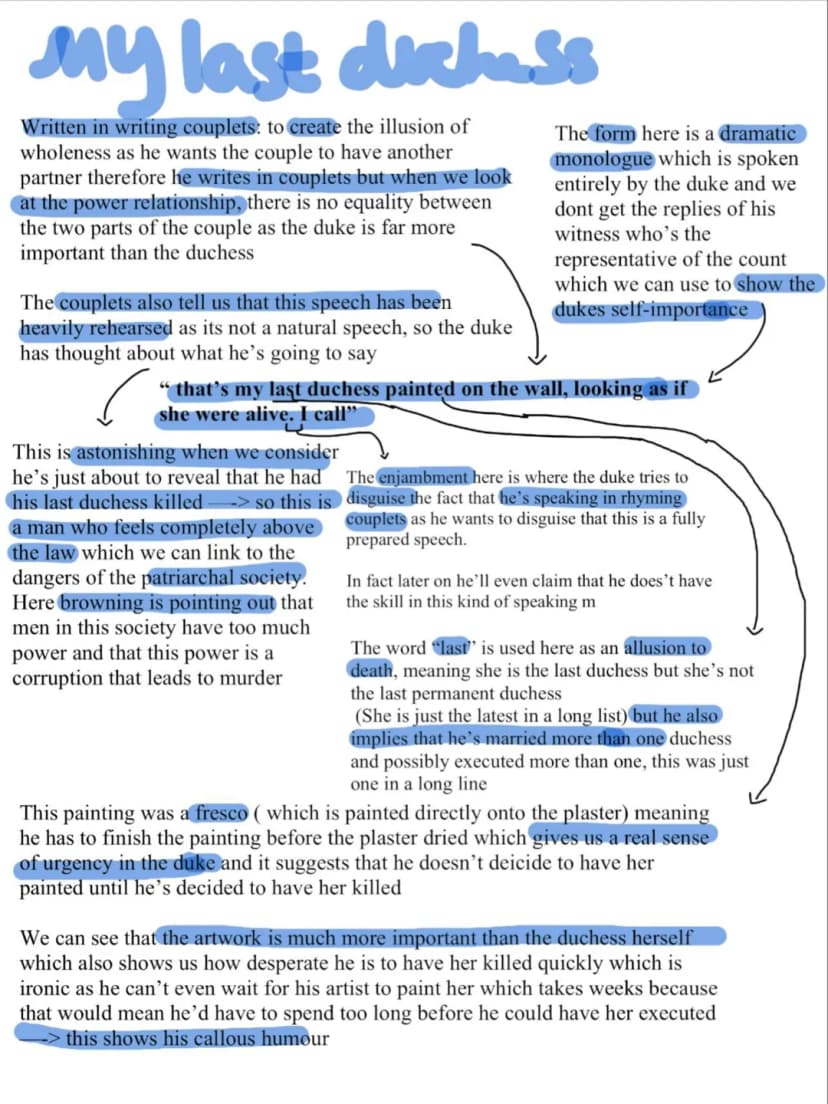
You're about to meet one of literature's most disturbing characters - a Duke who speaks entirely in rhyming couplets to create an illusion of completeness and control. These couplets aren't natural speech though; they reveal this is a heavily rehearsed performance where every word has been carefully planned.
The opening line "that's my last duchess painted on the wall, looking as if she were alive" is absolutely chilling when you realise he's just casually revealed he had her killed. This man genuinely believes he's above the law, which Browning uses to criticise how patriarchal society gives men dangerous levels of power.
The poem uses dramatic monologue form - we only hear the Duke's voice, never the replies from his listener (a Count's representative). This shows his complete self-importance and need to dominate every conversation. The Duke uses enjambment to disguise his rhyming couplets, pretending this is spontaneous chat rather than a prepared speech.
Key insight: The word "last" suggests she's just the latest in a long line of murdered wives - not his final duchess, but his most recent victim.
2
of 5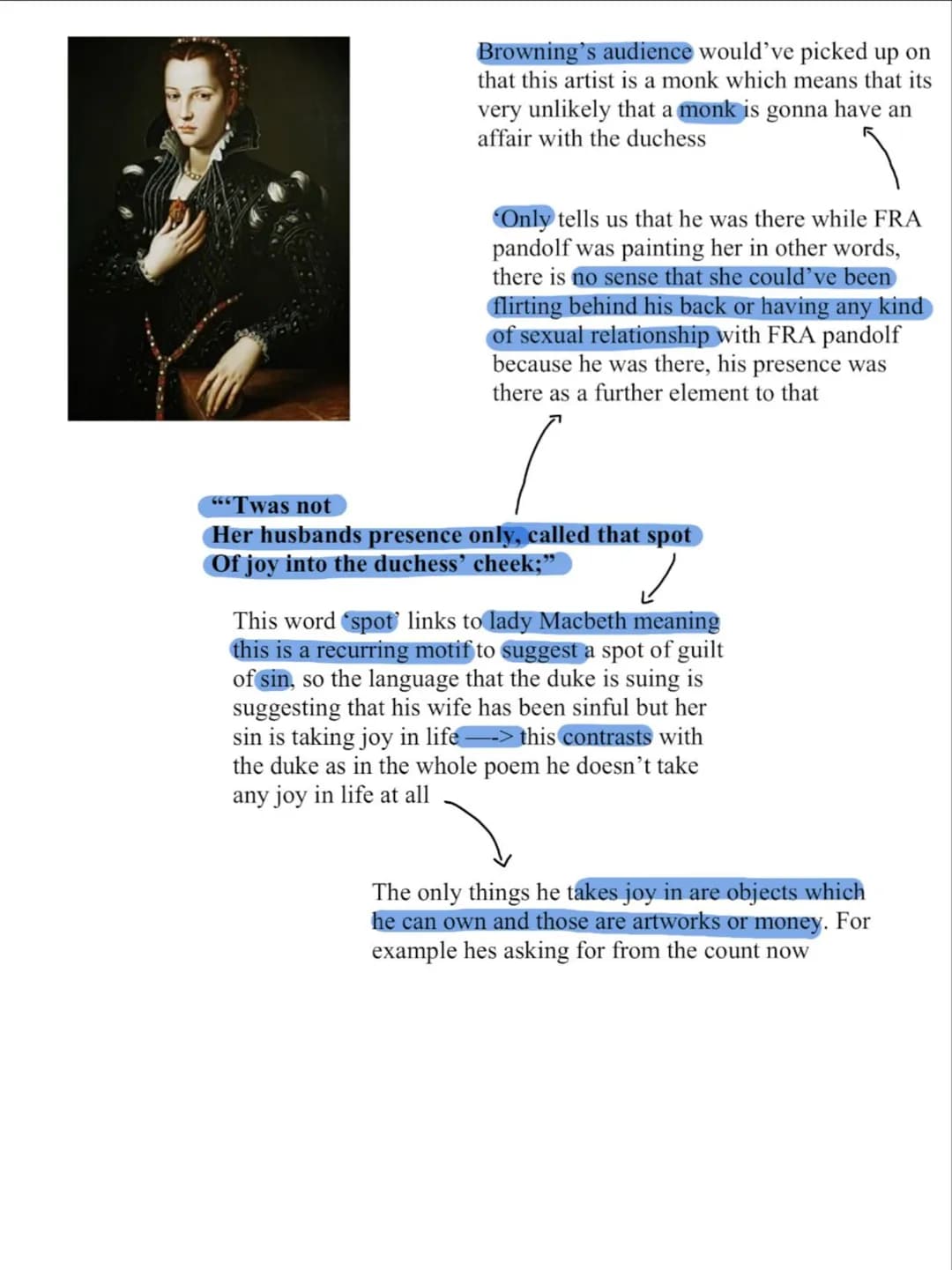
The Fresco and False Accusations
The painting technique becomes crucial evidence of the Duke's calculated cruelty. He chose a fresco (painted directly onto wet plaster), which must be completed before the plaster dries, creating artificial urgency.
This reveals something horrifying - he didn't decide to commission her portrait until after he'd decided to kill her. The artwork matters more to him than his wife's life, showing his callous priorities and how quickly he wanted her executed.
Browning's audience would recognise that Fra Pandolf is a monk, making the Duke's jealousy accusations even more ridiculous. He admits he was present during the painting sessions, so there's no possibility of an affair - yet he still finds reasons to be suspicious.
The phrase "spot of joy" deliberately echoes Lady Macbeth's guilt, suggesting the Duchess's only "sin" was finding happiness in life - something the Duke himself never experiences.
Remember: The Duke only takes pleasure in objects he can own (art, money) - never in human relationships or simple joys.
3
of 5
Loss of Control and Social Status
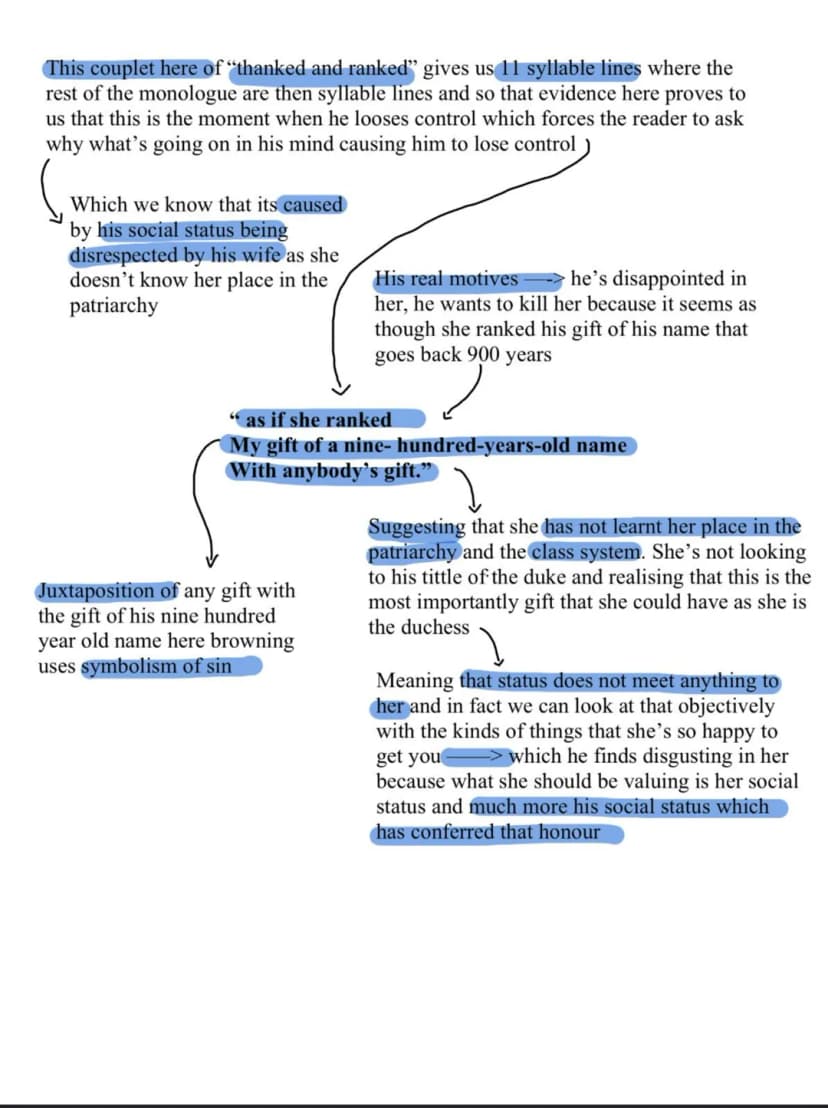
Watch how the Duke's composure cracks during this section - the couplet "thanked and ranked" breaks the poem's ten-syllable pattern with eleven syllables instead. This is the exact moment he loses emotional control, forcing you to ask what's really driving his rage.
His true motive emerges: the Duchess didn't properly respect his social status. She treated his "gift of a nine-hundred-years-old name" like any ordinary present, failing to recognise the honour of becoming a Duchess.
Browning uses juxtaposition between "anybody's gift" and his ancient family name to highlight the Duke's obsession with hierarchy. The Duchess's crime was treating all people with equal kindness rather than showing him special deference as her social superior.
This reveals she genuinely didn't value status or class distinctions - she found joy in simple things like sunsets and cherries, which disgusted him because she should have been focused entirely on their social position.
Critical point: Her "sin" was not learning her place in the patriarchy - she treated everyone with equal respect, including her husband.
4
of 5
The Casual Confession of Murder
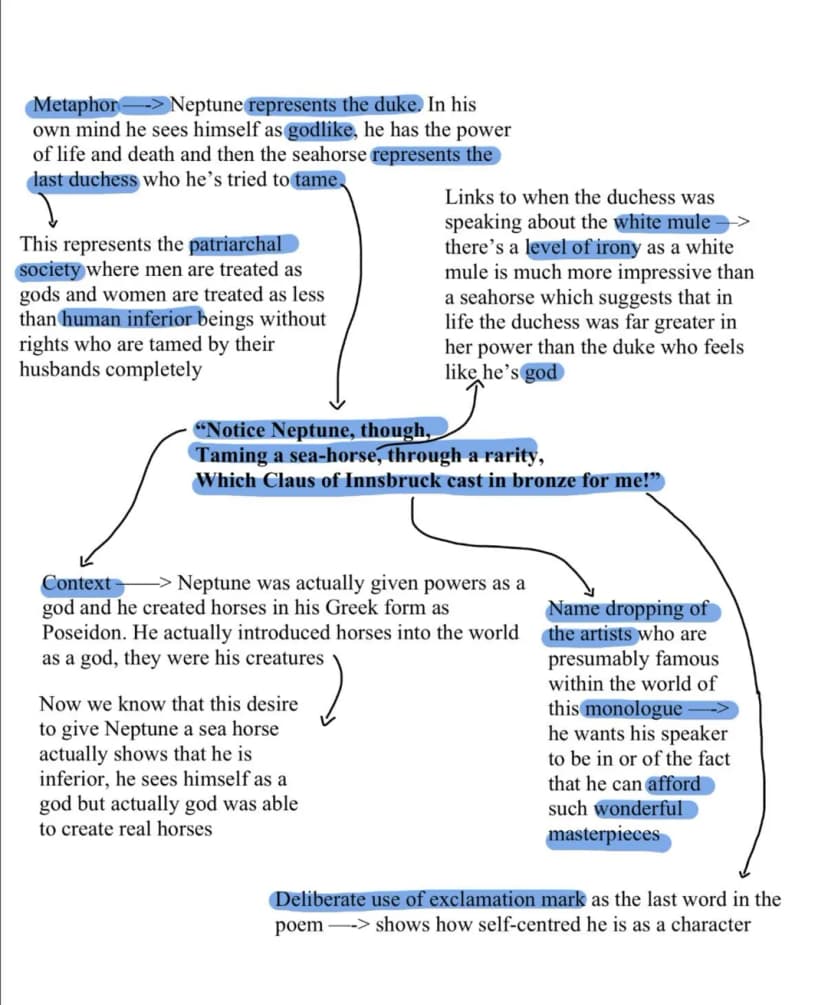
The Duke's confession comes through a chilling euphemism: "I gave commands; Then all smiles stopped together." This deliberately vague language shows how casually he ordered her death while trying to maintain plausible deniability.
The phrase "passed without much the same smile" has a cruel double meaning - "passed" suggests both walking by and passing away (dying). He's possibly imagining her smiling at the very moment she was killed, suggesting she never saw it coming.
The plural "smiles" could mean he killed others alongside her, or simply that he eliminated all her expressions of joy. What truly enraged him was that she smiled at him the same way she smiled at everyone else - she didn't give him the special reverence he demanded as her husband.
The sudden phrase "all smiles stopped together" emphasises how unexpected her death was and reminds us that he completely controls who lives and dies in his world.
Dark reality: He murdered her not for adultery, but for treating him like an equal human being rather than a superior lord.
5
of 5
We thought you’d never ask...
What is the Knowunity AI companion?
Our AI companion is specifically built for the needs of students. Based on the millions of content pieces we have on the platform we can provide truly meaningful and relevant answers to students. But its not only about answers, the companion is even more about guiding students through their daily learning challenges, with personalised study plans, quizzes or content pieces in the chat and 100% personalisation based on the students skills and developments.
Where can I download the Knowunity app?
You can download the app in the Google Play Store and in the Apple App Store.
Is Knowunity really free of charge?
That's right! Enjoy free access to study content, connect with fellow students, and get instant help – all at your fingertips.
Similar Content
 LLCE Ang
 Taller de lectura y redacción
Most popular content: Integration of Knowledge and Ideas
9English LiteratureGCSE English - Romeo and Juliet
R&J Essay Plans
1177012
English LiteratureA Streetcar Named Desire - Context
This should hopefully cover all of the relevant info you’ll need for Streetcar
123798
English LiteraturePower and conflict: checking out me own history
AQA checking out me own history quote analysis
112013
English LiteratureKing Lear grade A/A* essay. A level English Literature
King Lear essay on “uncertainty”
122455
English LiteratureMiscellaneous AQA English Literature Essay Plans/Questions - Streetcar, Color Purple, Feminine Gospels
2 essay plans on 'A Streetcar Named Desire' by Tennessee Williams and 2 comparing 'The Colour Purple' by Alice Walker with 'Feminine Gospels' by Carol Ann Duffy. All based on AQA Paper 2 option B. As well as lists of past exam questions.
122555
English LiteraturePower and conflict: London
AQA power and conflict London quote analysis
112058
English LiteratureOthello - Context
This should cover all areas of Othello’s context
121835
English LiteraturePower and conflict: tissue
AQA power and conflict tissue quote analysis
111033
English LiteratureGCSE English Literature Paper 1
AQA, ACC and Macbeth
112086
Most popular content in English Literature
9English LiteratureAn Inspector Calls: Character Insights
Explore in-depth analysis and key quotes for characters in J.B. Priestley's 'An Inspector Calls'. This resource covers Gerald Croft, Inspector Goole, Sheila Birling, Mrs. Birling, Eric Birling, and Eva Smith, focusing on themes of class, gender roles, and social responsibility. Ideal for students aiming for Grade 8 and above.
1025,429907
English LiteratureRomeo and Juliet: Key themes
Key Romeo and Juliet themes and analysed quotes
106,708198
English LiteratureMacbeth: Guilt and Ambition
Explore the complex themes of guilt and ambition in Shakespeare's 'Macbeth'. This analysis covers key characters, including Macbeth and Lady Macbeth, their moral dilemmas, and the tragic consequences of their ambition. Ideal for students studying character motivations, thematic elements, and the psychological impact of power. Includes insights on the natural order, manipulation, and the descent into madness.
919,093397
I
English LiteratureInspector Calls Quiz (YR 10 MOCKS)
for YR 10 GCSE mock on Inspector Calls
102,1451
E
English LiteratureExplore the World of English Literature
Master the key concepts and works of English literature with this comprehensive flashcard set designed for grade 10 students.
112,0941
English LiteratureExploring Macbeth's Themes
Dive into the intricate themes of Shakespeare's Macbeth, including the supernatural, ambition, guilt, and kingship. This analysis features key quotes and insights that reveal how these themes intertwine to shape the characters and the narrative. Ideal for students seeking a deeper understanding of the play's moral complexities and psychological depth.
1015,849524
E
English LiteratureExploring English Literature: A Journey through Medium
Discover the captivating world of English Literature with this comprehensive medium-level flashcard set. Dive into the works of renowned authors and explore the themes, characters, and literary techniques that make their writing truly remarkable.
111,0580
E
English LiteratureExploring 'A Christmas Carol': Themes, Characters, and Lessons
Delve into the main themes, key characters, and valuable lessons in Charles Dickens' 'A Christmas Carol'. Discover the impact of Scrooge's transformation and the significance of love, redemption, and the true meaning of Christmas.
101,2480
English LiteratureMacbeth Key Themes Essay Plans
Essay plans for key themes in macbeth - guilt, supernatural & ambition
115,186146
Most popular content
9 Sociology
Sociology of Education Overview
Explore comprehensive A-Level Sociology notes on the education system, covering key theories, policies, and sociological perspectives. This resource includes insights on marketisation, gender roles, cultural deprivation, and educational inequalities, providing a thorough understanding of how education shapes social stratification and individual achievement. Ideal for exam preparation and in-depth study.
12102,8693,040
SociologySociology of Families: Comprehensive Revision
Dive into an extensive overview of family dynamics, perspectives, and patterns in sociology. This resource covers key concepts such as family diversity, gender roles, marriage, and the impact of social policies on family structures. Perfect for A-Level Sociology students preparing for Paper 2.
1273,6612,307
CriminologyCriminology: Crime & Punishment Overview
Comprehensive mindmaps covering key concepts in the Crime and Punishment topic for WJEC Criminology Unit 4. This resource includes detailed insights into the Criminal Justice System, crime prevention strategies, sentencing models, and the roles of various agencies. Ideal for A-Level revision, ensuring you grasp essential theories and legislative processes to excel in your exams.
1254,8691,059
SociologyComprehensive Crime & Deviance Overview
Explore an extensive revision of crime and deviance topics, including theories, types of crime, and the impact of media. This resource covers key concepts such as Marxism, functionalism, gender and crime, and the influence of globalization on criminal behavior. Ideal for students seeking a thorough understanding of criminology and its various theories. Type: Full Topic Revision.
1251,6541,399
C
 Biology
Cell Biology and Cell structure
cell structures
93,2470
English LiteratureAn Inspector Calls: Character Insights
Explore in-depth analysis and key quotes for characters in J.B. Priestley's 'An Inspector Calls'. This resource covers Gerald Croft, Inspector Goole, Sheila Birling, Mrs. Birling, Eric Birling, and Eva Smith, focusing on themes of class, gender roles, and social responsibility. Ideal for students aiming for Grade 8 and above.
1025,429907
CriminologyWJEC Unit 4 Criminology
Criminology unit 4 detailed revision note
127,151125
CriminologyCriminology Theories Overview
Explore key criminology theories and their implications on crime and deviance. This comprehensive summary covers biological, psychological, and sociological perspectives, including labelling theory, right realism, and the impact of social campaigns on policy development. Ideal for A-Level criminology students seeking to understand the complexities of criminal behaviour and the factors influencing crime prevention strategies.
129,760210
English LiteratureRomeo and Juliet: Key themes
Key Romeo and Juliet themes and analysed quotes
106,708198
Can't find what you're looking for? Explore other subjects.
Students love us — and so will you.
4.6/5App Store
4.7/5Google Play
The app is very easy to use and well designed. I have found everything I was looking for so far and have been able to learn a lot from the presentations! I will definitely use the app for a class assignment! And of course it also helps a lot as an inspiration.
Stefan SiOS user
This app is really great. There are so many study notes and help [...]. My problem subject is French, for example, and the app has so many options for help. Thanks to this app, I have improved my French. I would recommend it to anyone.
Samantha KlichAndroid user
Wow, I am really amazed. I just tried the app because I've seen it advertised many times and was absolutely stunned. This app is THE HELP you want for school and above all, it offers so many things, such as workouts and fact sheets, which have been VERY helpful to me personally.
AnnaiOS user
English Literature162 views·Updated Jun 20, 2026·5 pagesAnalyzing Power and Conflict in 'My Last Duchess'
S
Simran Singh@simransin_2f93r
"My Last Duchess" is Robert Browning's chilling dramatic monologue where a Duke casually reveals he murdered his wife whilst negotiating his next marriage. The poem exposes the dangerous power of men in patriarchal society and how unchecked authority can lead...
1
of 5
Sign up to see the content. It's free!
- Access to all documents
- Improve your grades
- Join milions of students
The Duke's Calculated Performance
You're about to meet one of literature's most disturbing characters - a Duke who speaks entirely in rhyming couplets to create an illusion of completeness and control. These couplets aren't natural speech though; they reveal this is a heavily rehearsed performance where every word has been carefully planned.
The opening line "that's my last duchess painted on the wall, looking as if she were alive" is absolutely chilling when you realise he's just casually revealed he had her killed. This man genuinely believes he's above the law, which Browning uses to criticise how patriarchal society gives men dangerous levels of power.
The poem uses dramatic monologue form - we only hear the Duke's voice, never the replies from his listener (a Count's representative). This shows his complete self-importance and need to dominate every conversation. The Duke uses enjambment to disguise his rhyming couplets, pretending this is spontaneous chat rather than a prepared speech.
Key insight: The word "last" suggests she's just the latest in a long line of murdered wives - not his final duchess, but his most recent victim.
2
of 5Sign up to see the content. It's free!
- Access to all documents
- Improve your grades
- Join milions of students
The Fresco and False Accusations
The painting technique becomes crucial evidence of the Duke's calculated cruelty. He chose a fresco (painted directly onto wet plaster), which must be completed before the plaster dries, creating artificial urgency.
This reveals something horrifying - he didn't decide to commission her portrait until after he'd decided to kill her. The artwork matters more to him than his wife's life, showing his callous priorities and how quickly he wanted her executed.
Browning's audience would recognise that Fra Pandolf is a monk, making the Duke's jealousy accusations even more ridiculous. He admits he was present during the painting sessions, so there's no possibility of an affair - yet he still finds reasons to be suspicious.
The phrase "spot of joy" deliberately echoes Lady Macbeth's guilt, suggesting the Duchess's only "sin" was finding happiness in life - something the Duke himself never experiences.
Remember: The Duke only takes pleasure in objects he can own (art, money) - never in human relationships or simple joys.
3
of 5Sign up to see the content. It's free!
- Access to all documents
- Improve your grades
- Join milions of students
Loss of Control and Social Status
Watch how the Duke's composure cracks during this section - the couplet "thanked and ranked" breaks the poem's ten-syllable pattern with eleven syllables instead. This is the exact moment he loses emotional control, forcing you to ask what's really driving his rage.
His true motive emerges: the Duchess didn't properly respect his social status. She treated his "gift of a nine-hundred-years-old name" like any ordinary present, failing to recognise the honour of becoming a Duchess.
Browning uses juxtaposition between "anybody's gift" and his ancient family name to highlight the Duke's obsession with hierarchy. The Duchess's crime was treating all people with equal kindness rather than showing him special deference as her social superior.
This reveals she genuinely didn't value status or class distinctions - she found joy in simple things like sunsets and cherries, which disgusted him because she should have been focused entirely on their social position.
Critical point: Her "sin" was not learning her place in the patriarchy - she treated everyone with equal respect, including her husband.
4
of 5Sign up to see the content. It's free!
- Access to all documents
- Improve your grades
- Join milions of students
The Casual Confession of Murder
The Duke's confession comes through a chilling euphemism: "I gave commands; Then all smiles stopped together." This deliberately vague language shows how casually he ordered her death while trying to maintain plausible deniability.
The phrase "passed without much the same smile" has a cruel double meaning - "passed" suggests both walking by and passing away (dying). He's possibly imagining her smiling at the very moment she was killed, suggesting she never saw it coming.
The plural "smiles" could mean he killed others alongside her, or simply that he eliminated all her expressions of joy. What truly enraged him was that she smiled at him the same way she smiled at everyone else - she didn't give him the special reverence he demanded as her husband.
The sudden phrase "all smiles stopped together" emphasises how unexpected her death was and reminds us that he completely controls who lives and dies in his world.
Dark reality: He murdered her not for adultery, but for treating him like an equal human being rather than a superior lord.
5
of 5Sign up to see the content. It's free!
- Access to all documents
- Improve your grades
- Join milions of students
We thought you’d never ask...
What is the Knowunity AI companion?
Our AI companion is specifically built for the needs of students. Based on the millions of content pieces we have on the platform we can provide truly meaningful and relevant answers to students. But its not only about answers, the companion is even more about guiding students through their daily learning challenges, with personalised study plans, quizzes or content pieces in the chat and 100% personalisation based on the students skills and developments.
Where can I download the Knowunity app?
You can download the app in the Google Play Store and in the Apple App Store.
Is Knowunity really free of charge?
That's right! Enjoy free access to study content, connect with fellow students, and get instant help – all at your fingertips.
Similar Content
Most popular content: Integration of Knowledge and Ideas
9English LiteratureGCSE English - Romeo and Juliet
R&J Essay Plans
1177012
English LiteratureA Streetcar Named Desire - Context
This should hopefully cover all of the relevant info you’ll need for Streetcar
123798
English LiteraturePower and conflict: checking out me own history
AQA checking out me own history quote analysis
112013
English LiteratureKing Lear grade A/A* essay. A level English Literature
King Lear essay on “uncertainty”
122455
English LiteratureMiscellaneous AQA English Literature Essay Plans/Questions - Streetcar, Color Purple, Feminine Gospels
2 essay plans on 'A Streetcar Named Desire' by Tennessee Williams and 2 comparing 'The Colour Purple' by Alice Walker with 'Feminine Gospels' by Carol Ann Duffy. All based on AQA Paper 2 option B. As well as lists of past exam questions.
122555
English LiteraturePower and conflict: London
AQA power and conflict London quote analysis
112058
English LiteratureOthello - Context
This should cover all areas of Othello’s context
121835
English LiteraturePower and conflict: tissue
AQA power and conflict tissue quote analysis
111033
English LiteratureGCSE English Literature Paper 1
AQA, ACC and Macbeth
112086
Most popular content in English Literature
9English LiteratureAn Inspector Calls: Character Insights
Explore in-depth analysis and key quotes for characters in J.B. Priestley's 'An Inspector Calls'. This resource covers Gerald Croft, Inspector Goole, Sheila Birling, Mrs. Birling, Eric Birling, and Eva Smith, focusing on themes of class, gender roles, and social responsibility. Ideal for students aiming for Grade 8 and above.
1025,429907
English LiteratureRomeo and Juliet: Key themes
Key Romeo and Juliet themes and analysed quotes
106,708198
English LiteratureMacbeth: Guilt and Ambition
Explore the complex themes of guilt and ambition in Shakespeare's 'Macbeth'. This analysis covers key characters, including Macbeth and Lady Macbeth, their moral dilemmas, and the tragic consequences of their ambition. Ideal for students studying character motivations, thematic elements, and the psychological impact of power. Includes insights on the natural order, manipulation, and the descent into madness.
919,093397
I
English LiteratureInspector Calls Quiz (YR 10 MOCKS)
for YR 10 GCSE mock on Inspector Calls
102,1451
E
English LiteratureExplore the World of English Literature
Master the key concepts and works of English literature with this comprehensive flashcard set designed for grade 10 students.
112,0941
English LiteratureExploring Macbeth's Themes
Dive into the intricate themes of Shakespeare's Macbeth, including the supernatural, ambition, guilt, and kingship. This analysis features key quotes and insights that reveal how these themes intertwine to shape the characters and the narrative. Ideal for students seeking a deeper understanding of the play's moral complexities and psychological depth.
1015,849524
E
English LiteratureExploring English Literature: A Journey through Medium
Discover the captivating world of English Literature with this comprehensive medium-level flashcard set. Dive into the works of renowned authors and explore the themes, characters, and literary techniques that make their writing truly remarkable.
111,0580
E
English LiteratureExploring 'A Christmas Carol': Themes, Characters, and Lessons
Delve into the main themes, key characters, and valuable lessons in Charles Dickens' 'A Christmas Carol'. Discover the impact of Scrooge's transformation and the significance of love, redemption, and the true meaning of Christmas.
101,2480
English LiteratureMacbeth Key Themes Essay Plans
Essay plans for key themes in macbeth - guilt, supernatural & ambition
115,186146
Most popular content
9SociologySociology of Education Overview
Explore comprehensive A-Level Sociology notes on the education system, covering key theories, policies, and sociological perspectives. This resource includes insights on marketisation, gender roles, cultural deprivation, and educational inequalities, providing a thorough understanding of how education shapes social stratification and individual achievement. Ideal for exam preparation and in-depth study.
12102,8693,040
SociologySociology of Families: Comprehensive Revision
Dive into an extensive overview of family dynamics, perspectives, and patterns in sociology. This resource covers key concepts such as family diversity, gender roles, marriage, and the impact of social policies on family structures. Perfect for A-Level Sociology students preparing for Paper 2.
1273,6612,307
CriminologyCriminology: Crime & Punishment Overview
Comprehensive mindmaps covering key concepts in the Crime and Punishment topic for WJEC Criminology Unit 4. This resource includes detailed insights into the Criminal Justice System, crime prevention strategies, sentencing models, and the roles of various agencies. Ideal for A-Level revision, ensuring you grasp essential theories and legislative processes to excel in your exams.
1254,8691,059
SociologyComprehensive Crime & Deviance Overview
Explore an extensive revision of crime and deviance topics, including theories, types of crime, and the impact of media. This resource covers key concepts such as Marxism, functionalism, gender and crime, and the influence of globalization on criminal behavior. Ideal for students seeking a thorough understanding of criminology and its various theories. Type: Full Topic Revision.
1251,6541,399
C
BiologyCell Biology and Cell structure
cell structures
93,2470
English LiteratureAn Inspector Calls: Character Insights
Explore in-depth analysis and key quotes for characters in J.B. Priestley's 'An Inspector Calls'. This resource covers Gerald Croft, Inspector Goole, Sheila Birling, Mrs. Birling, Eric Birling, and Eva Smith, focusing on themes of class, gender roles, and social responsibility. Ideal for students aiming for Grade 8 and above.
1025,429907
CriminologyWJEC Unit 4 Criminology
Criminology unit 4 detailed revision note
127,151125
CriminologyCriminology Theories Overview
Explore key criminology theories and their implications on crime and deviance. This comprehensive summary covers biological, psychological, and sociological perspectives, including labelling theory, right realism, and the impact of social campaigns on policy development. Ideal for A-Level criminology students seeking to understand the complexities of criminal behaviour and the factors influencing crime prevention strategies.
129,760210
English LiteratureRomeo and Juliet: Key themes
Key Romeo and Juliet themes and analysed quotes
106,708198
Can't find what you're looking for? Explore other subjects.
Students love us — and so will you.
4.6/5App Store
4.7/5Google Play
The app is very easy to use and well designed. I have found everything I was looking for so far and have been able to learn a lot from the presentations! I will definitely use the app for a class assignment! And of course it also helps a lot as an inspiration.
Stefan SiOS user
This app is really great. There are so many study notes and help [...]. My problem subject is French, for example, and the app has so many options for help. Thanks to this app, I have improved my French. I would recommend it to anyone.
Samantha KlichAndroid user
Wow, I am really amazed. I just tried the app because I've seen it advertised many times and was absolutely stunned. This app is THE HELP you want for school and above all, it offers so many things, such as workouts and fact sheets, which have been VERY helpful to me personally.
AnnaiOS user