
These poems explore how language, identity, and place shape who...
 English Literature734 views·Updated Jun 23, 2026·19 pages
Exploring Worlds and Lives in Poetry: Part 2

robyn🎀🤗@rqbny




1 / 10
1
of 10
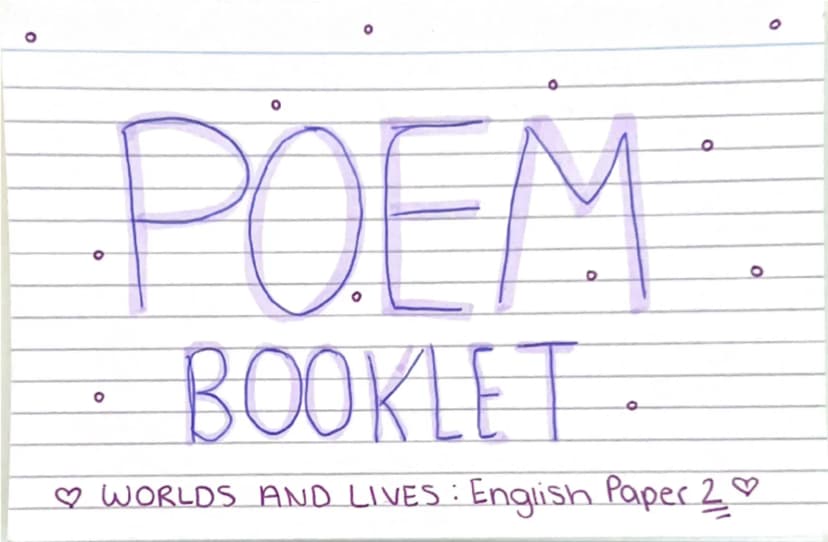
Poem Booklet Introduction
You're diving into English Paper 2 with a focus on "Worlds and Lives" - poems that explore identity, belonging, and the spaces we call home. These aren't just words on a page; they're snapshots of real experiences that'll probably feel surprisingly familiar.
The poems you'll study dig deep into how language shapes identity and how growing up means navigating between different worlds. Think about how you might speak differently at home versus at school - these poets get it.
Quick Tip: These poems work brilliantly together because they both explore the journey of finding your authentic voice in a world that sometimes wants you to change it.
2
of 10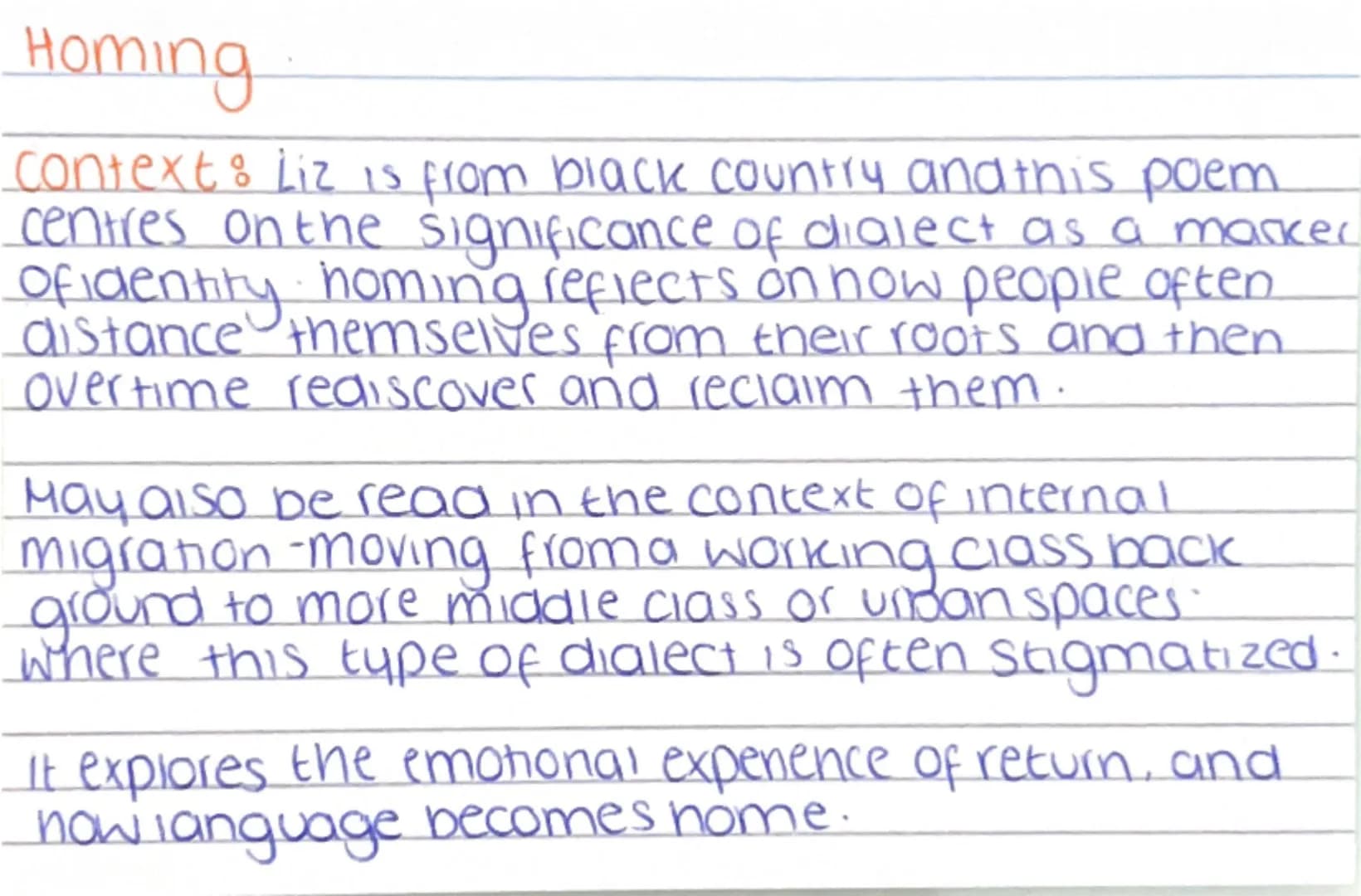
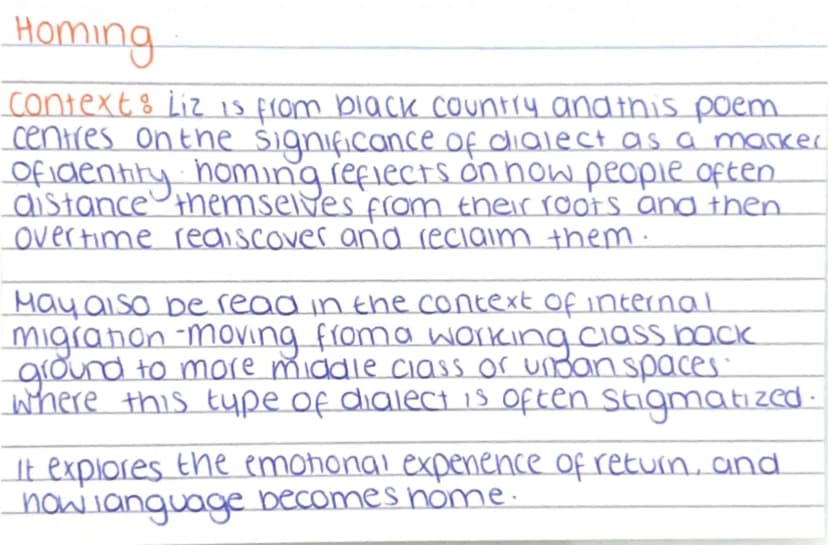
Homing - Context and Background
Liz Berry's "Homing" centres on how dialect acts as a marker of identity, especially for people from the Black Country. The poem reflects on how we often distance ourselves from our roots, then later rediscover and reclaim them - sound familiar?
This isn't just about accents; it's about internal migration - moving from working-class backgrounds into middle-class or urban spaces where your natural way of speaking gets stigmatised. Berry explores that emotional experience of return, showing how language becomes home.
The poem's deeply personal, examining how we sometimes hide parts of ourselves to fit in, then later realise what we've lost. It's about the journey back to authenticity.
Remember: This poem celebrates regional identity as something powerful and beautiful, not something to be ashamed of.
3
of 10
Homing - Structure and Form
Berry writes in free verse, which perfectly captures the natural rhythms of Black Country speech. The short, irregular stanzas mirror how we actually talk - no fancy constraints, just authentic flow.
The movement between stanzas mimics shifts in memory and emotion, just like how your mind jumps around when you're remembering something important. Enjambment gives the poem a flowing, musical quality that feels like listening to someone's actual voice.
Caesura (those strategic pauses) adds contemplative moments, giving space for emotions to settle. It's a lyric poem - highly personal, emotional, and reflective, using Black Country dialect as both political statement and emotional reclamation.
Exam Focus: Notice how the structure supports the content - the natural speech patterns reinforce the poem's message about authentic voice.
4
of 10
Homing - Key Analysis: "Send your words, like pigeons, fluttering for home"
This closing line brings everything full circle with a powerful simile comparing words to homing pigeons. No matter where pigeons are released, they find their way back - just like how your authentic voice carries the memory of home.
The verb "fluttering" suggests both vulnerability and determination. It's an emotional moment, but one filled with purpose and hope. Berry encourages speaking proudly in your own voice, regardless of where life takes you.
This isn't just about language - it's about belonging, place, and returning to your true self. The poem becomes an act of reclaiming dialect as identity, something to fly proudly rather than hide away.
Key Theme: Your authentic voice is something to celebrate, not suppress - it carries your history and shapes your future.
5
of 10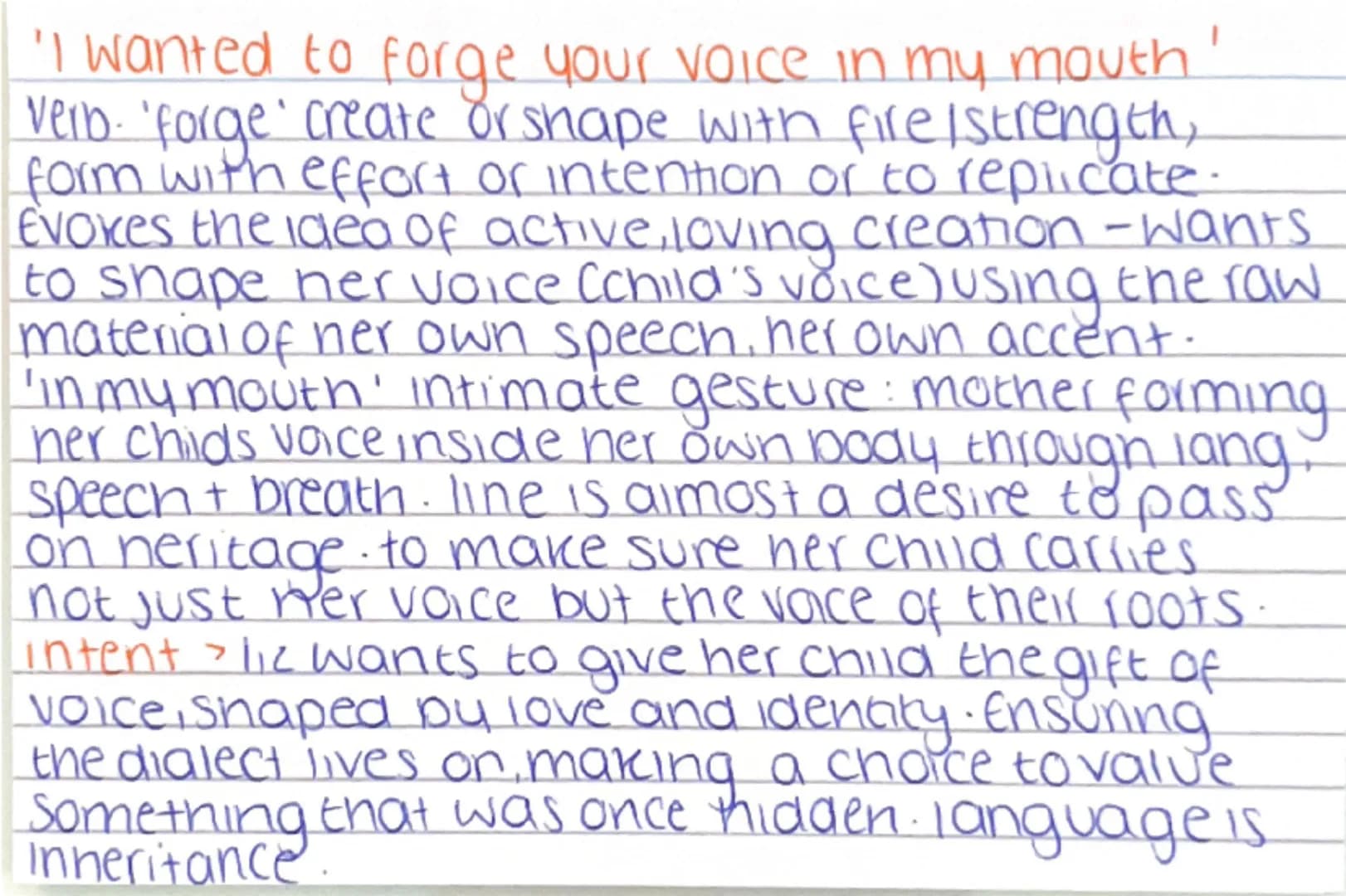
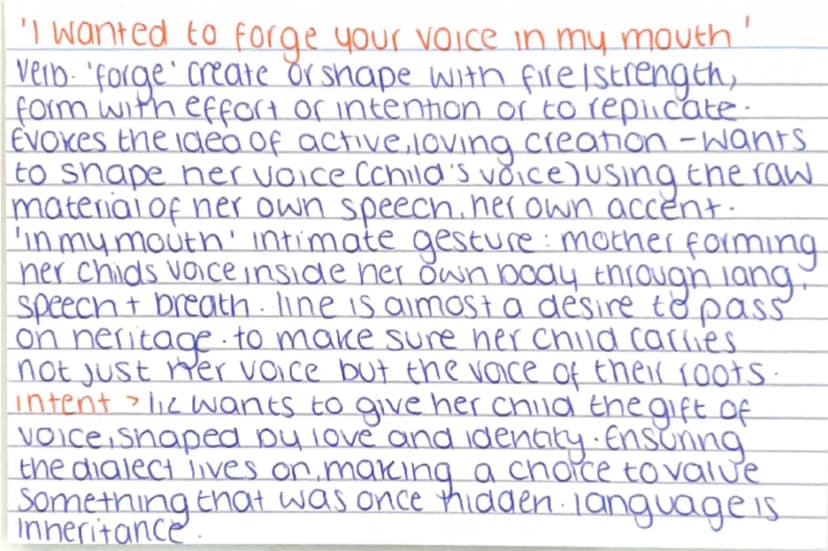
Homing - Key Analysis: "I wanted to forge your voice in my mouth"
The verb "forge" is massive here - it means to create with fire and strength, suggesting active, loving creation. The mother wants to shape her child's voice using her own speech and accent as raw material.
"In my mouth" creates incredible intimacy - it's about forming the child's voice inside her own body through language, speech, and breath. This represents the desire to pass on heritage, ensuring the child carries not just her voice but their collective roots.
Berry shows language as inheritance - something precious passed down through generations. The mother's making a conscious choice to value something that was once hidden or stigmatised.
Deeper Meaning: This line transforms dialect from something shameful into a gift of love and identity.
6
of 10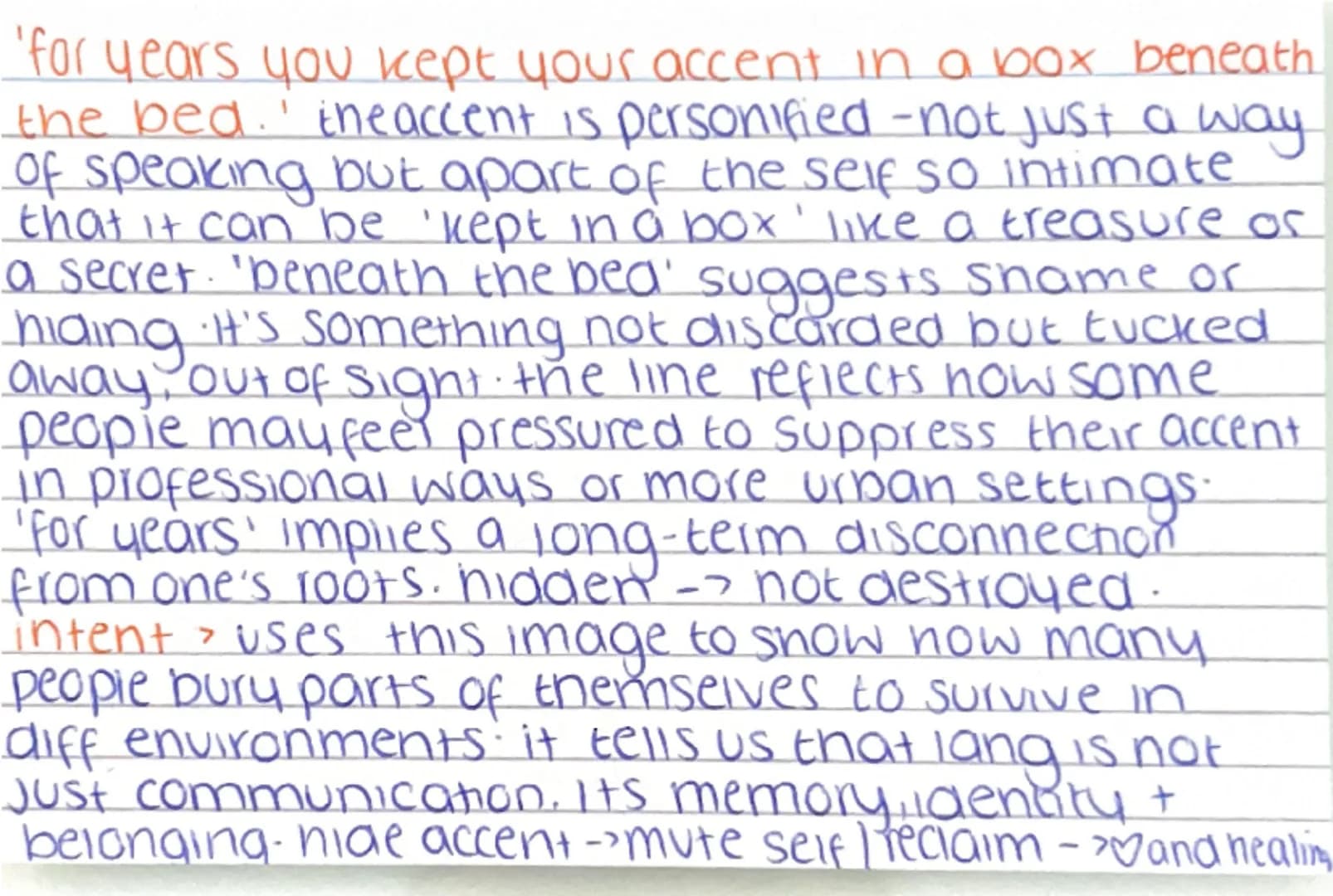
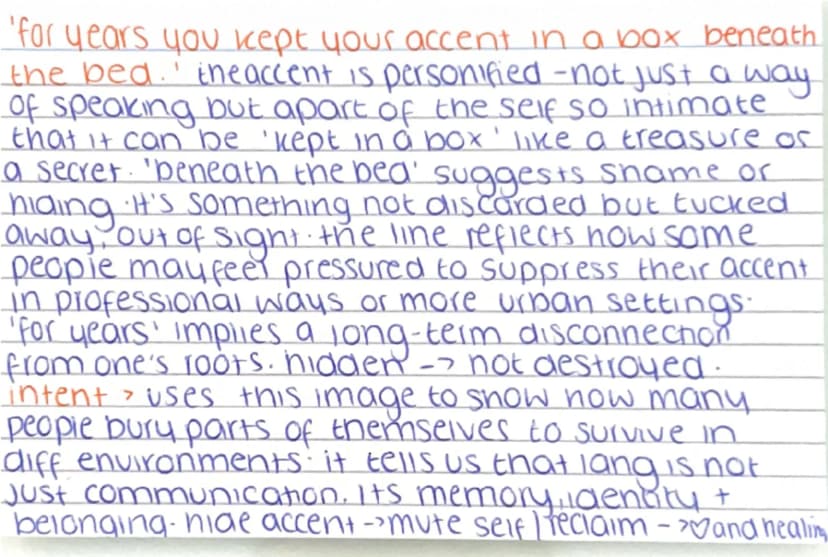
Homing - Key Analysis: "for years you kept your accent in a box beneath the bed"
This personification treats the accent as part of the self - so intimate it can be kept "like a treasure or secret." The phrase "beneath the bed" suggests shame and hiding, but crucially, not destruction.
"For years" implies long-term disconnection from roots, reflecting how people feel pressured to suppress their accents in professional or urban settings. The image shows how we bury parts of ourselves to survive in different environments.
Berry uses this powerful metaphor to demonstrate that language isn't just communication - it's memory, identity, and belonging. Hiding your accent means muting yourself; reclaiming it offers healing.
Critical Point: The accent isn't discarded but preserved, suggesting hope for eventual reconnection with authentic identity.
7
of 10
Homing - Key Analysis: "vowels as ferrous as nails"
Vowels are the core of spoken language and clearest markers of regional speech. Here, Berry celebrates the Black Country dialect with pride and defiance.
The simile "ferrous as nails" suggests strength and industrial heritage - these vowels are powerful, forged from industry and rooted in place. This contrasts sharply with ideas of "soft, refined speech," celebrating the rough, metallic beauty of regional language.
Berry reclaims regional dialect as something strong, valuable, and beautiful. The line connects voice to ancestry, place, and labour, showing that accent carries not just sound but entire histories.
Power Move: This transforms perceived "rough" speech into something precious and powerful - industrial strength becomes linguistic pride.
8
of 10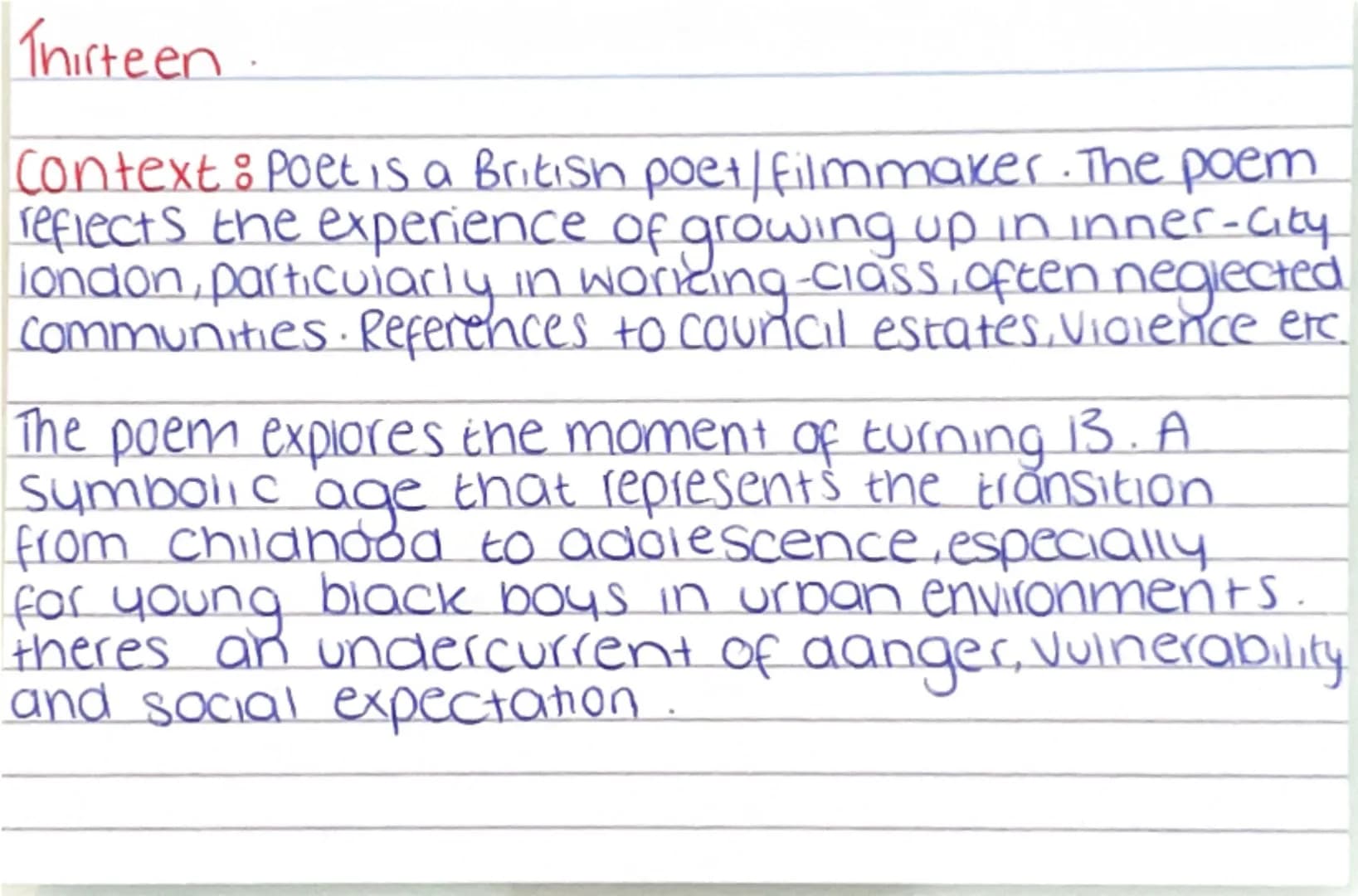
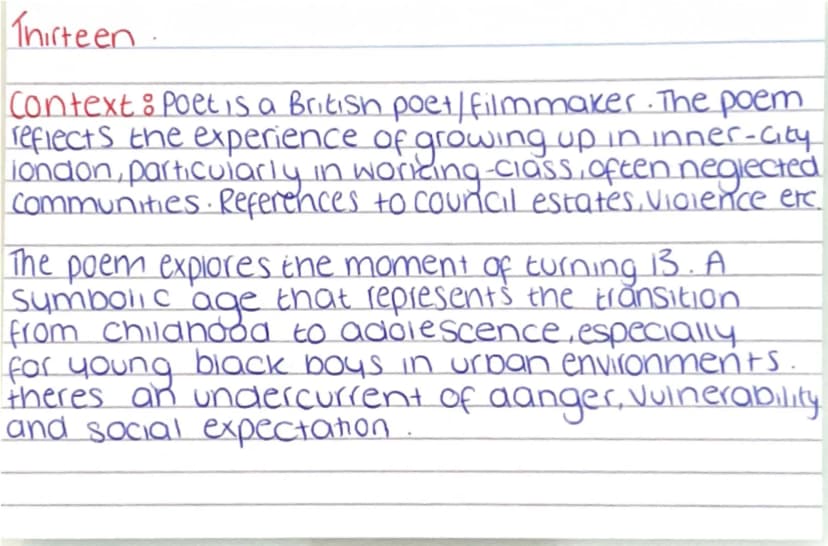
Thirteen - Context and Background
Caleb Femi's "Thirteen" reflects growing up in inner-city London, particularly in working-class, often neglected communities. References to council estates and violence create a vivid urban landscape.
The poem explores turning thirteen - that crucial transition from childhood to adolescence, especially challenging for young black boys in urban environments. There's an undercurrent of anger, vulnerability, and crushing social expectation.
Femi captures a specific moment in time but makes it universal - that age when innocence meets harsh reality. The poem examines how society views and treats young black men, often failing them before they've had a chance to succeed.
Context Key: This isn't just about one boy's experience - it's a critique of systemic issues affecting entire communities.
9
of 10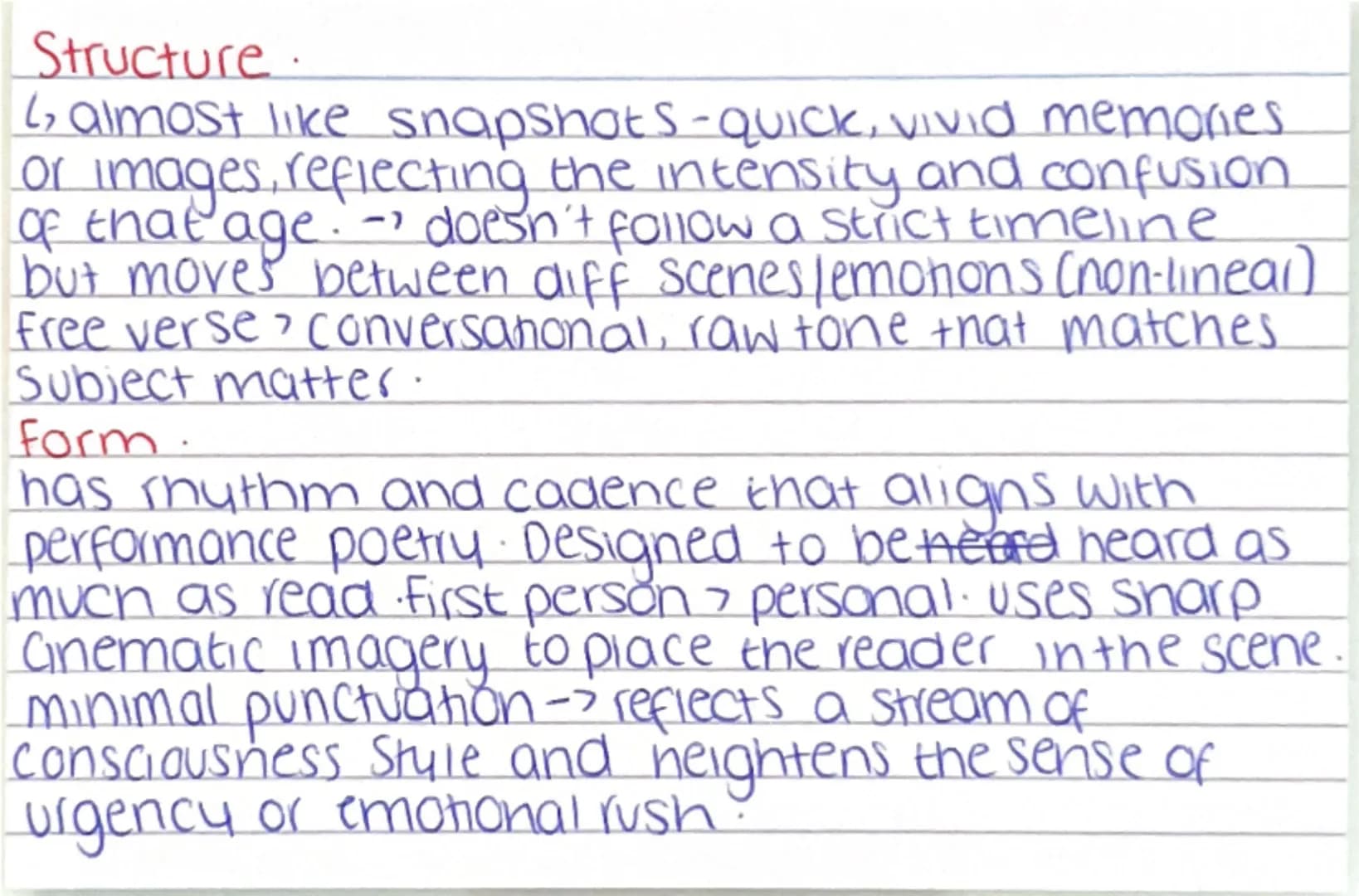
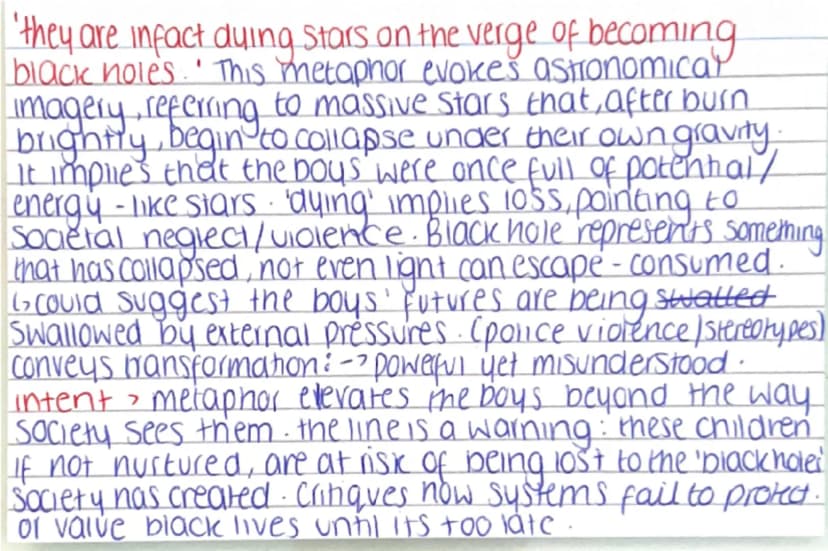
Thirteen - Structure and Form
The structure works like snapshots - quick, vivid memories reflecting the intensity and confusion of that age. Rather than following strict timeline, it moves between different scenes and emotions in a non-linear way.
Free verse creates a conversational, raw tone matching the subject matter. The rhythm and cadence align with performance poetry - designed to be heard as much as read.
First-person perspective makes it deeply personal, using sharp, cinematic imagery to place you right in the scene. Minimal punctuation reflects stream-of-consciousness style, heightening urgency and emotional rush.
Technique Tip: Notice how the fragmented structure mirrors the fragmented experience of growing up in challenging circumstances.
10
of 10
We thought you’d never ask...
What is the Knowunity AI companion?
Our AI companion is specifically built for the needs of students. Based on the millions of content pieces we have on the platform we can provide truly meaningful and relevant answers to students. But its not only about answers, the companion is even more about guiding students through their daily learning challenges, with personalised study plans, quizzes or content pieces in the chat and 100% personalisation based on the students skills and developments.
Where can I download the Knowunity app?
You can download the app in the Google Play Store and in the Apple App Store.
Is Knowunity really free of charge?
That's right! Enjoy free access to study content, connect with fellow students, and get instant help – all at your fingertips.
Similar Content
Most popular content: Analysis
9English LiteratureAn Inspector Calls Lightup Hub Notes
English Literature An Inspector Calls
104,082105
English LiteratureGCSE English - Romeo and Juliet
R&J Theme Pages
1198714
English LanguageIGCSE EDEXCEL ENGLISH LANGUAGE REVISION GUIDE
IGCSE EDEXCEL ENGLISH LANGUAGE REVISION GUIDE - for all texts
111,02333
English LanguageChild Language Acquisition - Speech
Key Theorists for Child Language Acquisition Speech
123155
English LiteratureA Dolls House revision guide
In this presentation there is all the key bits that you will need for the comparative essay
122166
English LiteratureOthello Act Summaries and Critics
Othello a level English literature edexcel, act summaries 1-5 and critic quotes, quick fire then in depth quotes
1246712
English LiteratureStreetcar named desire scene analysis
Scene analysis of the 11 scenes from streetcar by Tennessee’s williams
132114
English LiteratureRevenge in hamlet
OCR A-Level English Literature, hamlet, revenge mindmap
121831
English LiteratureRomeo & Juliet key quotes
AQA GCSE English Literature Romeo & Juliet key quotations!
113051
Most popular content in English Literature
9English LiteratureAn Inspector Calls: Character Insights
Explore in-depth analysis and key quotes for characters in J.B. Priestley's 'An Inspector Calls'. This resource covers Gerald Croft, Inspector Goole, Sheila Birling, Mrs. Birling, Eric Birling, and Eva Smith, focusing on themes of class, gender roles, and social responsibility. Ideal for students aiming for Grade 8 and above.
1025,429907
English LiteratureRomeo and Juliet: Key themes
Key Romeo and Juliet themes and analysed quotes
106,708198
English LiteratureMacbeth: Guilt and Ambition
Explore the complex themes of guilt and ambition in Shakespeare's 'Macbeth'. This analysis covers key characters, including Macbeth and Lady Macbeth, their moral dilemmas, and the tragic consequences of their ambition. Ideal for students studying character motivations, thematic elements, and the psychological impact of power. Includes insights on the natural order, manipulation, and the descent into madness.
919,093397
I
English LiteratureInspector Calls Quiz (YR 10 MOCKS)
for YR 10 GCSE mock on Inspector Calls
102,1451
E
English LiteratureExplore the World of English Literature
Master the key concepts and works of English literature with this comprehensive flashcard set designed for grade 10 students.
112,0941
English LiteratureExploring Macbeth's Themes
Dive into the intricate themes of Shakespeare's Macbeth, including the supernatural, ambition, guilt, and kingship. This analysis features key quotes and insights that reveal how these themes intertwine to shape the characters and the narrative. Ideal for students seeking a deeper understanding of the play's moral complexities and psychological depth.
1015,849524
E
English LiteratureExploring English Literature: A Journey through Medium
Discover the captivating world of English Literature with this comprehensive medium-level flashcard set. Dive into the works of renowned authors and explore the themes, characters, and literary techniques that make their writing truly remarkable.
111,0580
E
English LiteratureExploring 'A Christmas Carol': Themes, Characters, and Lessons
Delve into the main themes, key characters, and valuable lessons in Charles Dickens' 'A Christmas Carol'. Discover the impact of Scrooge's transformation and the significance of love, redemption, and the true meaning of Christmas.
101,2480
English LiteratureMacbeth Key Themes Essay Plans
Essay plans for key themes in macbeth - guilt, supernatural & ambition
115,186146
Most popular content
9 Sociology
Sociology of Education Overview
Explore comprehensive A-Level Sociology notes on the education system, covering key theories, policies, and sociological perspectives. This resource includes insights on marketisation, gender roles, cultural deprivation, and educational inequalities, providing a thorough understanding of how education shapes social stratification and individual achievement. Ideal for exam preparation and in-depth study.
12102,8693,040
SociologySociology of Families: Comprehensive Revision
Dive into an extensive overview of family dynamics, perspectives, and patterns in sociology. This resource covers key concepts such as family diversity, gender roles, marriage, and the impact of social policies on family structures. Perfect for A-Level Sociology students preparing for Paper 2.
1273,6612,307
CriminologyCriminology: Crime & Punishment Overview
Comprehensive mindmaps covering key concepts in the Crime and Punishment topic for WJEC Criminology Unit 4. This resource includes detailed insights into the Criminal Justice System, crime prevention strategies, sentencing models, and the roles of various agencies. Ideal for A-Level revision, ensuring you grasp essential theories and legislative processes to excel in your exams.
1254,8691,059
SociologyComprehensive Crime & Deviance Overview
Explore an extensive revision of crime and deviance topics, including theories, types of crime, and the impact of media. This resource covers key concepts such as Marxism, functionalism, gender and crime, and the influence of globalization on criminal behavior. Ideal for students seeking a thorough understanding of criminology and its various theories. Type: Full Topic Revision.
1251,6541,399
C
 Biology
Cell Biology and Cell structure
cell structures
93,2470
English LiteratureAn Inspector Calls: Character Insights
Explore in-depth analysis and key quotes for characters in J.B. Priestley's 'An Inspector Calls'. This resource covers Gerald Croft, Inspector Goole, Sheila Birling, Mrs. Birling, Eric Birling, and Eva Smith, focusing on themes of class, gender roles, and social responsibility. Ideal for students aiming for Grade 8 and above.
1025,429907
CriminologyWJEC Unit 4 Criminology
Criminology unit 4 detailed revision note
127,151125
CriminologyCriminology Theories Overview
Explore key criminology theories and their implications on crime and deviance. This comprehensive summary covers biological, psychological, and sociological perspectives, including labelling theory, right realism, and the impact of social campaigns on policy development. Ideal for A-Level criminology students seeking to understand the complexities of criminal behaviour and the factors influencing crime prevention strategies.
129,760210
English LiteratureRomeo and Juliet: Key themes
Key Romeo and Juliet themes and analysed quotes
106,708198
Can't find what you're looking for? Explore other subjects.
Students love us — and so will you.
4.6/5App Store
4.7/5Google Play
The app is very easy to use and well designed. I have found everything I was looking for so far and have been able to learn a lot from the presentations! I will definitely use the app for a class assignment! And of course it also helps a lot as an inspiration.
Stefan SiOS user
This app is really great. There are so many study notes and help [...]. My problem subject is French, for example, and the app has so many options for help. Thanks to this app, I have improved my French. I would recommend it to anyone.
Samantha KlichAndroid user
Wow, I am really amazed. I just tried the app because I've seen it advertised many times and was absolutely stunned. This app is THE HELP you want for school and above all, it offers so many things, such as workouts and fact sheets, which have been VERY helpful to me personally.
AnnaiOS user
English Literature734 views·Updated Jun 23, 2026·19 pagesExploring Worlds and Lives in Poetry: Part 2
robyn🎀🤗@rqbny
These poems explore how language, identity, and place shape who we are during crucial moments of self-discovery. Both "Homing" and "Thirteen" examine the tension between fitting in and staying true to your roots, showing how our voices carry the power...
1
of 10
Sign up to see the content. It's free!
- Access to all documents
- Improve your grades
- Join milions of students
Poem Booklet Introduction
You're diving into English Paper 2 with a focus on "Worlds and Lives" - poems that explore identity, belonging, and the spaces we call home. These aren't just words on a page; they're snapshots of real experiences that'll probably feel surprisingly familiar.
The poems you'll study dig deep into how language shapes identity and how growing up means navigating between different worlds. Think about how you might speak differently at home versus at school - these poets get it.
Quick Tip: These poems work brilliantly together because they both explore the journey of finding your authentic voice in a world that sometimes wants you to change it.
2
of 10Sign up to see the content. It's free!
- Access to all documents
- Improve your grades
- Join milions of students
Homing - Context and Background
Liz Berry's "Homing" centres on how dialect acts as a marker of identity, especially for people from the Black Country. The poem reflects on how we often distance ourselves from our roots, then later rediscover and reclaim them - sound familiar?
This isn't just about accents; it's about internal migration - moving from working-class backgrounds into middle-class or urban spaces where your natural way of speaking gets stigmatised. Berry explores that emotional experience of return, showing how language becomes home.
The poem's deeply personal, examining how we sometimes hide parts of ourselves to fit in, then later realise what we've lost. It's about the journey back to authenticity.
Remember: This poem celebrates regional identity as something powerful and beautiful, not something to be ashamed of.
3
of 10Sign up to see the content. It's free!
- Access to all documents
- Improve your grades
- Join milions of students
Homing - Structure and Form
Berry writes in free verse, which perfectly captures the natural rhythms of Black Country speech. The short, irregular stanzas mirror how we actually talk - no fancy constraints, just authentic flow.
The movement between stanzas mimics shifts in memory and emotion, just like how your mind jumps around when you're remembering something important. Enjambment gives the poem a flowing, musical quality that feels like listening to someone's actual voice.
Caesura (those strategic pauses) adds contemplative moments, giving space for emotions to settle. It's a lyric poem - highly personal, emotional, and reflective, using Black Country dialect as both political statement and emotional reclamation.
Exam Focus: Notice how the structure supports the content - the natural speech patterns reinforce the poem's message about authentic voice.
4
of 10Sign up to see the content. It's free!
- Access to all documents
- Improve your grades
- Join milions of students
Homing - Key Analysis: "Send your words, like pigeons, fluttering for home"
This closing line brings everything full circle with a powerful simile comparing words to homing pigeons. No matter where pigeons are released, they find their way back - just like how your authentic voice carries the memory of home.
The verb "fluttering" suggests both vulnerability and determination. It's an emotional moment, but one filled with purpose and hope. Berry encourages speaking proudly in your own voice, regardless of where life takes you.
This isn't just about language - it's about belonging, place, and returning to your true self. The poem becomes an act of reclaiming dialect as identity, something to fly proudly rather than hide away.
Key Theme: Your authentic voice is something to celebrate, not suppress - it carries your history and shapes your future.
5
of 10Sign up to see the content. It's free!
- Access to all documents
- Improve your grades
- Join milions of students
Homing - Key Analysis: "I wanted to forge your voice in my mouth"
The verb "forge" is massive here - it means to create with fire and strength, suggesting active, loving creation. The mother wants to shape her child's voice using her own speech and accent as raw material.
"In my mouth" creates incredible intimacy - it's about forming the child's voice inside her own body through language, speech, and breath. This represents the desire to pass on heritage, ensuring the child carries not just her voice but their collective roots.
Berry shows language as inheritance - something precious passed down through generations. The mother's making a conscious choice to value something that was once hidden or stigmatised.
Deeper Meaning: This line transforms dialect from something shameful into a gift of love and identity.
6
of 10Sign up to see the content. It's free!
- Access to all documents
- Improve your grades
- Join milions of students
Homing - Key Analysis: "for years you kept your accent in a box beneath the bed"
This personification treats the accent as part of the self - so intimate it can be kept "like a treasure or secret." The phrase "beneath the bed" suggests shame and hiding, but crucially, not destruction.
"For years" implies long-term disconnection from roots, reflecting how people feel pressured to suppress their accents in professional or urban settings. The image shows how we bury parts of ourselves to survive in different environments.
Berry uses this powerful metaphor to demonstrate that language isn't just communication - it's memory, identity, and belonging. Hiding your accent means muting yourself; reclaiming it offers healing.
Critical Point: The accent isn't discarded but preserved, suggesting hope for eventual reconnection with authentic identity.
7
of 10Sign up to see the content. It's free!
- Access to all documents
- Improve your grades
- Join milions of students
Homing - Key Analysis: "vowels as ferrous as nails"
Vowels are the core of spoken language and clearest markers of regional speech. Here, Berry celebrates the Black Country dialect with pride and defiance.
The simile "ferrous as nails" suggests strength and industrial heritage - these vowels are powerful, forged from industry and rooted in place. This contrasts sharply with ideas of "soft, refined speech," celebrating the rough, metallic beauty of regional language.
Berry reclaims regional dialect as something strong, valuable, and beautiful. The line connects voice to ancestry, place, and labour, showing that accent carries not just sound but entire histories.
Power Move: This transforms perceived "rough" speech into something precious and powerful - industrial strength becomes linguistic pride.
8
of 10Sign up to see the content. It's free!
- Access to all documents
- Improve your grades
- Join milions of students
Thirteen - Context and Background
Caleb Femi's "Thirteen" reflects growing up in inner-city London, particularly in working-class, often neglected communities. References to council estates and violence create a vivid urban landscape.
The poem explores turning thirteen - that crucial transition from childhood to adolescence, especially challenging for young black boys in urban environments. There's an undercurrent of anger, vulnerability, and crushing social expectation.
Femi captures a specific moment in time but makes it universal - that age when innocence meets harsh reality. The poem examines how society views and treats young black men, often failing them before they've had a chance to succeed.
Context Key: This isn't just about one boy's experience - it's a critique of systemic issues affecting entire communities.
9
of 10Sign up to see the content. It's free!
- Access to all documents
- Improve your grades
- Join milions of students
Thirteen - Structure and Form
The structure works like snapshots - quick, vivid memories reflecting the intensity and confusion of that age. Rather than following strict timeline, it moves between different scenes and emotions in a non-linear way.
Free verse creates a conversational, raw tone matching the subject matter. The rhythm and cadence align with performance poetry - designed to be heard as much as read.
First-person perspective makes it deeply personal, using sharp, cinematic imagery to place you right in the scene. Minimal punctuation reflects stream-of-consciousness style, heightening urgency and emotional rush.
Technique Tip: Notice how the fragmented structure mirrors the fragmented experience of growing up in challenging circumstances.
10
of 10Sign up to see the content. It's free!
- Access to all documents
- Improve your grades
- Join milions of students
We thought you’d never ask...
What is the Knowunity AI companion?
Our AI companion is specifically built for the needs of students. Based on the millions of content pieces we have on the platform we can provide truly meaningful and relevant answers to students. But its not only about answers, the companion is even more about guiding students through their daily learning challenges, with personalised study plans, quizzes or content pieces in the chat and 100% personalisation based on the students skills and developments.
Where can I download the Knowunity app?
You can download the app in the Google Play Store and in the Apple App Store.
Is Knowunity really free of charge?
That's right! Enjoy free access to study content, connect with fellow students, and get instant help – all at your fingertips.
Similar Content
Most popular content: Analysis
9English LiteratureAn Inspector Calls Lightup Hub Notes
English Literature An Inspector Calls
104,082105
English LiteratureGCSE English - Romeo and Juliet
R&J Theme Pages
1198714
English LanguageIGCSE EDEXCEL ENGLISH LANGUAGE REVISION GUIDE
IGCSE EDEXCEL ENGLISH LANGUAGE REVISION GUIDE - for all texts
111,02333
English LanguageChild Language Acquisition - Speech
Key Theorists for Child Language Acquisition Speech
123155
English LiteratureA Dolls House revision guide
In this presentation there is all the key bits that you will need for the comparative essay
122166
English LiteratureOthello Act Summaries and Critics
Othello a level English literature edexcel, act summaries 1-5 and critic quotes, quick fire then in depth quotes
1246712
English LiteratureStreetcar named desire scene analysis
Scene analysis of the 11 scenes from streetcar by Tennessee’s williams
132114
English LiteratureRevenge in hamlet
OCR A-Level English Literature, hamlet, revenge mindmap
121831
English LiteratureRomeo & Juliet key quotes
AQA GCSE English Literature Romeo & Juliet key quotations!
113051
Most popular content in English Literature
9English LiteratureAn Inspector Calls: Character Insights
Explore in-depth analysis and key quotes for characters in J.B. Priestley's 'An Inspector Calls'. This resource covers Gerald Croft, Inspector Goole, Sheila Birling, Mrs. Birling, Eric Birling, and Eva Smith, focusing on themes of class, gender roles, and social responsibility. Ideal for students aiming for Grade 8 and above.
1025,429907
English LiteratureRomeo and Juliet: Key themes
Key Romeo and Juliet themes and analysed quotes
106,708198
English LiteratureMacbeth: Guilt and Ambition
Explore the complex themes of guilt and ambition in Shakespeare's 'Macbeth'. This analysis covers key characters, including Macbeth and Lady Macbeth, their moral dilemmas, and the tragic consequences of their ambition. Ideal for students studying character motivations, thematic elements, and the psychological impact of power. Includes insights on the natural order, manipulation, and the descent into madness.
919,093397
I
English LiteratureInspector Calls Quiz (YR 10 MOCKS)
for YR 10 GCSE mock on Inspector Calls
102,1451
E
English LiteratureExplore the World of English Literature
Master the key concepts and works of English literature with this comprehensive flashcard set designed for grade 10 students.
112,0941
English LiteratureExploring Macbeth's Themes
Dive into the intricate themes of Shakespeare's Macbeth, including the supernatural, ambition, guilt, and kingship. This analysis features key quotes and insights that reveal how these themes intertwine to shape the characters and the narrative. Ideal for students seeking a deeper understanding of the play's moral complexities and psychological depth.
1015,849524
E
English LiteratureExploring English Literature: A Journey through Medium
Discover the captivating world of English Literature with this comprehensive medium-level flashcard set. Dive into the works of renowned authors and explore the themes, characters, and literary techniques that make their writing truly remarkable.
111,0580
E
English LiteratureExploring 'A Christmas Carol': Themes, Characters, and Lessons
Delve into the main themes, key characters, and valuable lessons in Charles Dickens' 'A Christmas Carol'. Discover the impact of Scrooge's transformation and the significance of love, redemption, and the true meaning of Christmas.
101,2480
English LiteratureMacbeth Key Themes Essay Plans
Essay plans for key themes in macbeth - guilt, supernatural & ambition
115,186146
Most popular content
9SociologySociology of Education Overview
Explore comprehensive A-Level Sociology notes on the education system, covering key theories, policies, and sociological perspectives. This resource includes insights on marketisation, gender roles, cultural deprivation, and educational inequalities, providing a thorough understanding of how education shapes social stratification and individual achievement. Ideal for exam preparation and in-depth study.
12102,8693,040
SociologySociology of Families: Comprehensive Revision
Dive into an extensive overview of family dynamics, perspectives, and patterns in sociology. This resource covers key concepts such as family diversity, gender roles, marriage, and the impact of social policies on family structures. Perfect for A-Level Sociology students preparing for Paper 2.
1273,6612,307
CriminologyCriminology: Crime & Punishment Overview
Comprehensive mindmaps covering key concepts in the Crime and Punishment topic for WJEC Criminology Unit 4. This resource includes detailed insights into the Criminal Justice System, crime prevention strategies, sentencing models, and the roles of various agencies. Ideal for A-Level revision, ensuring you grasp essential theories and legislative processes to excel in your exams.
1254,8691,059
SociologyComprehensive Crime & Deviance Overview
Explore an extensive revision of crime and deviance topics, including theories, types of crime, and the impact of media. This resource covers key concepts such as Marxism, functionalism, gender and crime, and the influence of globalization on criminal behavior. Ideal for students seeking a thorough understanding of criminology and its various theories. Type: Full Topic Revision.
1251,6541,399
C
BiologyCell Biology and Cell structure
cell structures
93,2470
English LiteratureAn Inspector Calls: Character Insights
Explore in-depth analysis and key quotes for characters in J.B. Priestley's 'An Inspector Calls'. This resource covers Gerald Croft, Inspector Goole, Sheila Birling, Mrs. Birling, Eric Birling, and Eva Smith, focusing on themes of class, gender roles, and social responsibility. Ideal for students aiming for Grade 8 and above.
1025,429907
CriminologyWJEC Unit 4 Criminology
Criminology unit 4 detailed revision note
127,151125
CriminologyCriminology Theories Overview
Explore key criminology theories and their implications on crime and deviance. This comprehensive summary covers biological, psychological, and sociological perspectives, including labelling theory, right realism, and the impact of social campaigns on policy development. Ideal for A-Level criminology students seeking to understand the complexities of criminal behaviour and the factors influencing crime prevention strategies.
129,760210
English LiteratureRomeo and Juliet: Key themes
Key Romeo and Juliet themes and analysed quotes
106,708198
Can't find what you're looking for? Explore other subjects.
Students love us — and so will you.
4.6/5App Store
4.7/5Google Play
The app is very easy to use and well designed. I have found everything I was looking for so far and have been able to learn a lot from the presentations! I will definitely use the app for a class assignment! And of course it also helps a lot as an inspiration.
Stefan SiOS user
This app is really great. There are so many study notes and help [...]. My problem subject is French, for example, and the app has so many options for help. Thanks to this app, I have improved my French. I would recommend it to anyone.
Samantha KlichAndroid user
Wow, I am really amazed. I just tried the app because I've seen it advertised many times and was absolutely stunned. This app is THE HELP you want for school and above all, it offers so many things, such as workouts and fact sheets, which have been VERY helpful to me personally.
AnnaiOS user