
Understanding Shakespeare's Othellobecomes much clearer when you grasp the...
 English Literature183 views·Updated Jun 16, 2026·4 pages
Othello: Understanding the Context

John Joyce@johnjoyce4535


1 / 4
1
of 4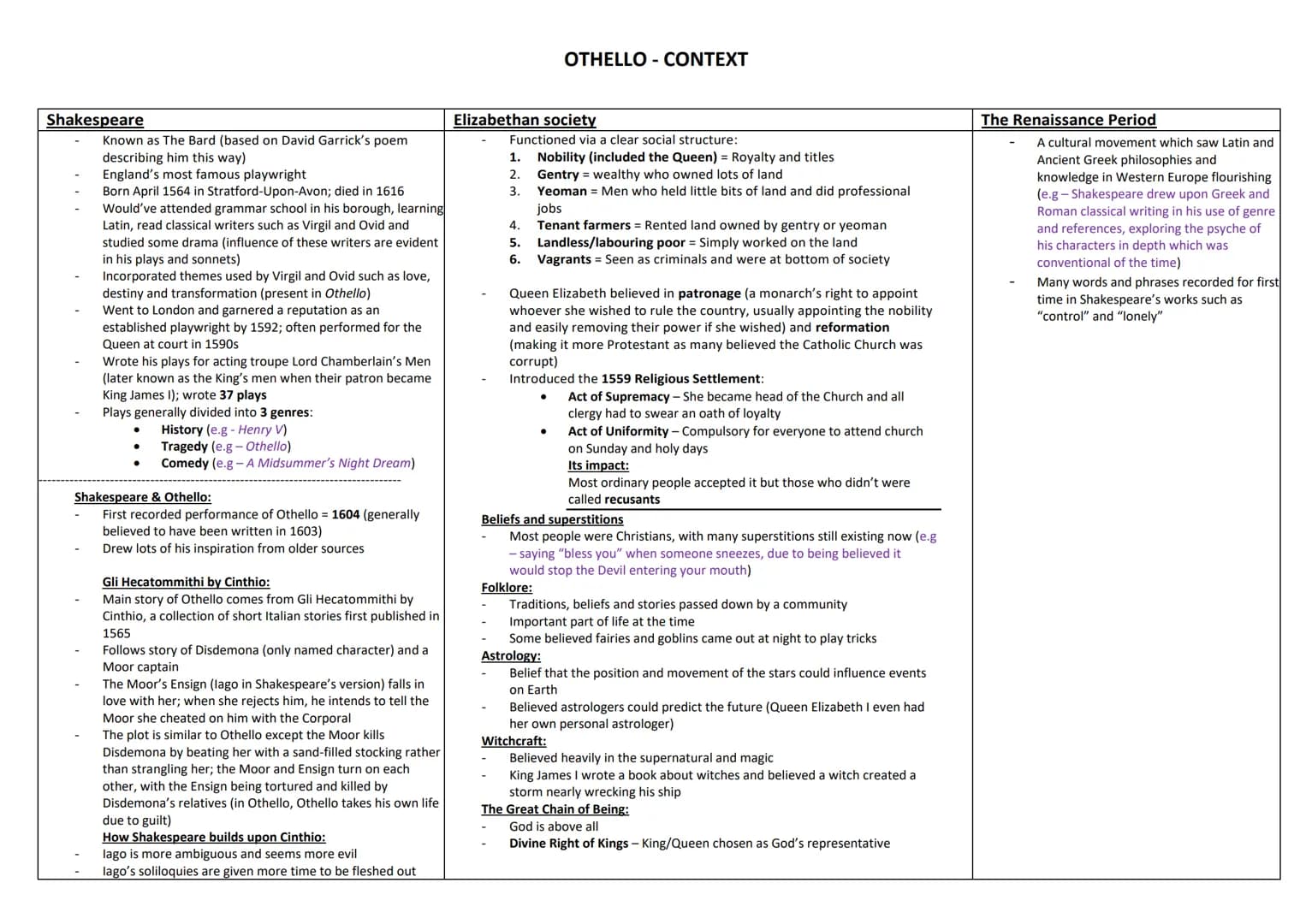
Shakespeare and His Sources
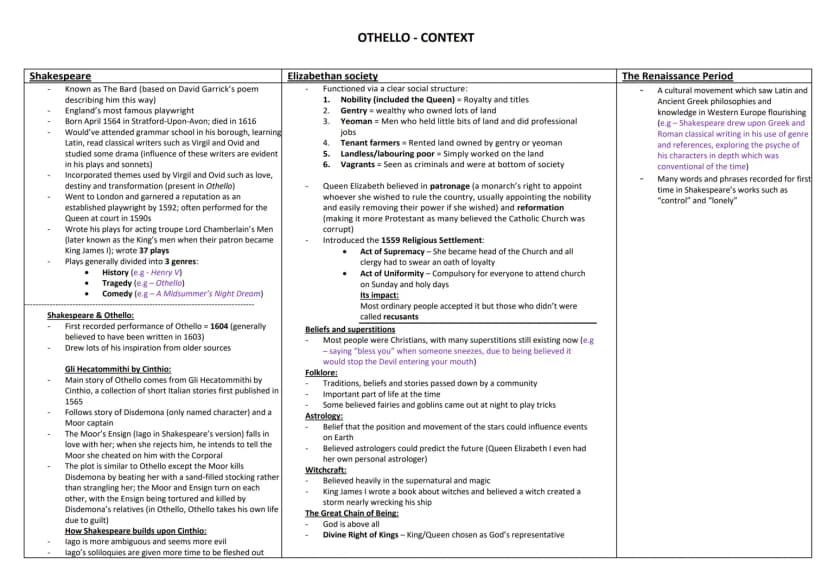
Ever wondered how The Bard became England's most celebrated playwright? Born in Stratford-Upon-Avon in 1564, Shakespeare's grammar school education exposed him to classical writers like Virgil and Ovid, whose themes of love, destiny and transformation pulse through his 37 plays.
Othello first performed in 1604, wasn't entirely Shakespeare's original creation. He cleverly adapted an Italian story from Gli Hecatommithi by Cinthio, where a Moorish captain's wife Disdemona faces betrayal from a jealous ensign. However, Shakespeare's genius lies in the improvements - his Iago becomes far more psychologically complex and terrifyingly ambiguous.
The Elizabethan society Shakespeare wrote for operated through rigid social hierarchies, from nobility at the top to vagrants at the bottom. Queen Elizabeth's Religious Settlement of 1559 made Protestant church attendance compulsory, whilst beliefs in astrology, witchcraft and folklore dominated daily life.
Key Point: The Renaissance period encouraged exploring human psychology in depth - exactly what Shakespeare does with Othello's jealousy and Iago's manipulation.
2
of 4
Race and Social Attitudes
Here's where Othello gets really interesting for modern audiences - it directly confronts Elizabethan racial prejudices. The term "Moor" served as an umbrella term for any African or ethnic minority, and whilst some people of colour lived in England, they remained a tiny, often stereotyped minority.
Shakespeare's audience expected Moors on stage to be villains threatening social order - think Aaron from Titus Andronicus. Othello brilliantly subverts this expectation initially, presenting a heroic, dignified military leader who reflects Venice's multicultural society.
The four humours theory shaped how Elizabethans understood personality. Othello's choleric nature and Iago's melancholic disposition would have been immediately recognisable character types to Shakespeare's audience.
Theatre faced constant suspicion from authorities who feared large crowds might spread disease or incite rebellion. The 1572 law requiring performance licences shows how drama was seen as potentially dangerous social commentary.
Key Point: Iago's racist language reflects genuine Elizabethan prejudices, making Othello's tragic fall even more complex for contemporary audiences.
3
of 4
Gender, Power and Colonial Attitudes
Women in Shakespeare's England had virtually no power - they couldn't vote, attend university, or even act on stage. Considered property of fathers then husbands, they were trapped in domestic roles and expected to remain silent and obedient to patriarchal authority.
The slave trade, initiated by John Hawkins in 1562, was gaining momentum during Shakespeare's lifetime. English attitudes toward colonial expansion involved "educating" supposedly uncivilised peoples, reflecting the Eurocentric superiority complex that makes Othello's position in Venice so precarious.
Biblical influences remained powerful - many believed women carried the taint of Eve's original sin, requiring strict control of their sexuality. This context makes Desdemona's bold decision to marry without her father's permission genuinely shocking for the time.
Queen Elizabeth's unmarried status challenged traditional gender roles, though she faced constant questions about female leadership capability. Her famous declaration about having "the heart and stomach of a king" shows how she navigated patriarchal expectations.
Key Point: The rise of the "shrew" stereotype (1595-1620) - assertive women who spoke their minds - directly relates to how Desdemona and Emilia challenge male authority in the play.
4
of 4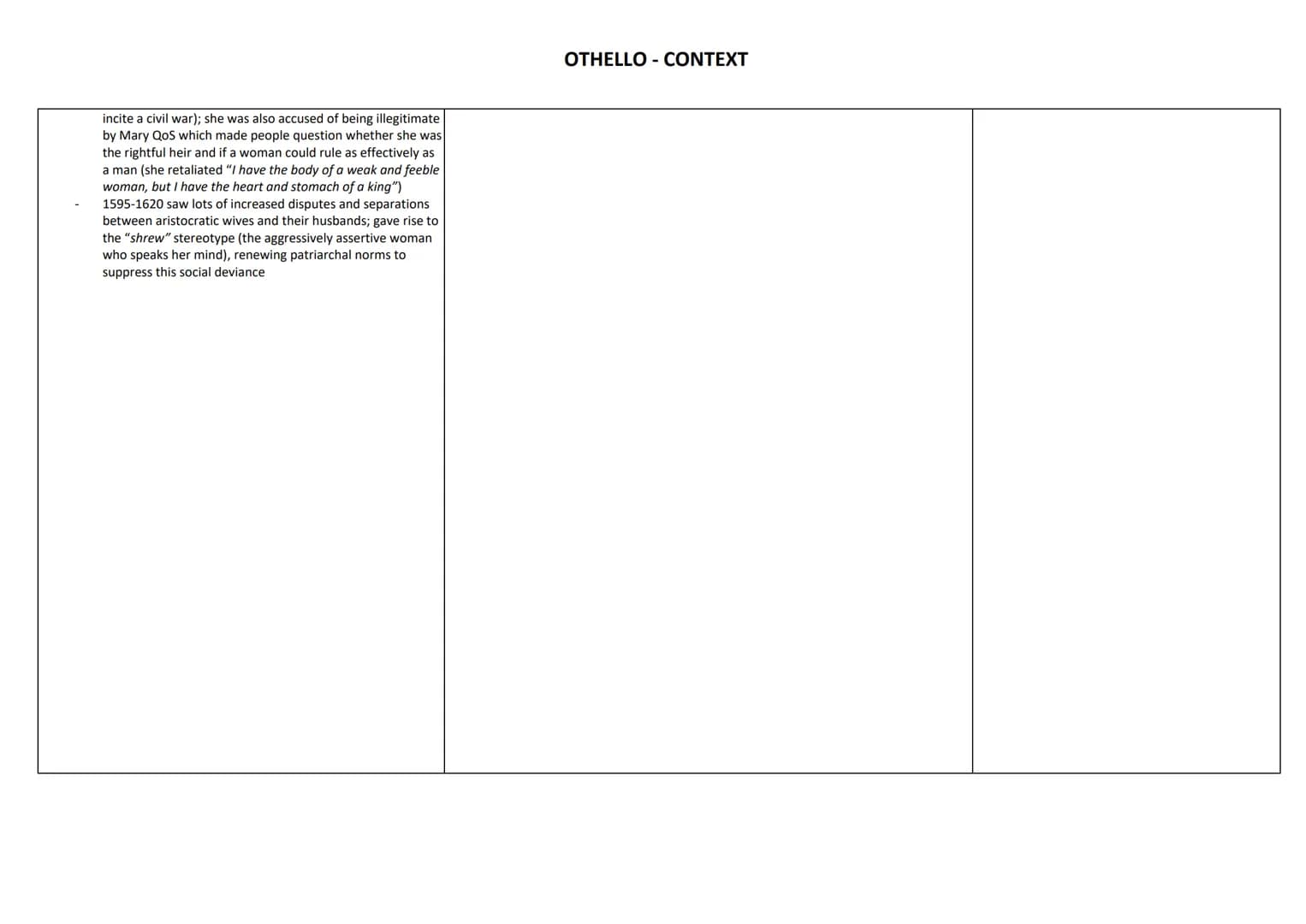
Social Context and Theatrical Conventions
Poverty plagued Elizabethan England, with households spending 80% of wages on food and widespread vagabondage creating social anxiety. The poor were categorised as impotent (unable to work), able-bodied (seeking work), or idle (unwilling to work) - distinctions that shaped how audiences viewed characters' social standing.
This economic instability fed into theatrical themes. Crime was common, and audiences would recognise the social tensions reflected in plays about jealousy, betrayal, and social climbing that drive Othello's plot forward.
The context of colonial attitudes and racial stereotypes makes Othello's military success both remarkable and fragile - he's achieved high rank in a society that fundamentally questions his humanity.
Key Point: Understanding these social hierarchies and cultural tensions helps explain why Iago's manipulation proves so devastatingly effective against Othello's insecurities about race and belonging.
We thought you’d never ask...
What is the Knowunity AI companion?
Our AI companion is specifically built for the needs of students. Based on the millions of content pieces we have on the platform we can provide truly meaningful and relevant answers to students. But its not only about answers, the companion is even more about guiding students through their daily learning challenges, with personalised study plans, quizzes or content pieces in the chat and 100% personalisation based on the students skills and developments.
Where can I download the Knowunity app?
You can download the app in the Google Play Store and in the Apple App Store.
Is Knowunity really free of charge?
That's right! Enjoy free access to study content, connect with fellow students, and get instant help – all at your fingertips.
Similar Content
 LLCE Ang
 Taller de lectura y redacción
Most popular content: Integration of Knowledge and Ideas
9English LiteratureGCSE English - Romeo and Juliet
R&J Essay Plans
1177012
English LiteratureA Streetcar Named Desire - Context
This should hopefully cover all of the relevant info you’ll need for Streetcar
123798
English LiteraturePower and conflict: checking out me own history
AQA checking out me own history quote analysis
112013
English LiteratureKing Lear grade A/A* essay. A level English Literature
King Lear essay on “uncertainty”
122455
English LiteratureMiscellaneous AQA English Literature Essay Plans/Questions - Streetcar, Color Purple, Feminine Gospels
2 essay plans on 'A Streetcar Named Desire' by Tennessee Williams and 2 comparing 'The Colour Purple' by Alice Walker with 'Feminine Gospels' by Carol Ann Duffy. All based on AQA Paper 2 option B. As well as lists of past exam questions.
122555
English LiteraturePower and conflict: London
AQA power and conflict London quote analysis
112058
English LiteraturePower and conflict: tissue
AQA power and conflict tissue quote analysis
111033
English LiteraturePower and conflict: my last duchess
AQA power and conflict my last duchess quote analysis
111624
English LiteratureGCSE English Literature Paper 1
AQA, ACC and Macbeth
112086
Most popular content in English Literature
9English LiteratureAn Inspector Calls: Character Insights
Explore in-depth analysis and key quotes for characters in J.B. Priestley's 'An Inspector Calls'. This resource covers Gerald Croft, Inspector Goole, Sheila Birling, Mrs. Birling, Eric Birling, and Eva Smith, focusing on themes of class, gender roles, and social responsibility. Ideal for students aiming for Grade 8 and above.
1025,429907
English LiteratureRomeo and Juliet: Key themes
Key Romeo and Juliet themes and analysed quotes
106,708198
English LiteratureMacbeth: Guilt and Ambition
Explore the complex themes of guilt and ambition in Shakespeare's 'Macbeth'. This analysis covers key characters, including Macbeth and Lady Macbeth, their moral dilemmas, and the tragic consequences of their ambition. Ideal for students studying character motivations, thematic elements, and the psychological impact of power. Includes insights on the natural order, manipulation, and the descent into madness.
919,093397
I
English LiteratureInspector Calls Quiz (YR 10 MOCKS)
for YR 10 GCSE mock on Inspector Calls
102,1451
E
English LiteratureExplore the World of English Literature
Master the key concepts and works of English literature with this comprehensive flashcard set designed for grade 10 students.
112,0941
English LiteratureExploring Macbeth's Themes
Dive into the intricate themes of Shakespeare's Macbeth, including the supernatural, ambition, guilt, and kingship. This analysis features key quotes and insights that reveal how these themes intertwine to shape the characters and the narrative. Ideal for students seeking a deeper understanding of the play's moral complexities and psychological depth.
1015,849524
E
English LiteratureExploring English Literature: A Journey through Medium
Discover the captivating world of English Literature with this comprehensive medium-level flashcard set. Dive into the works of renowned authors and explore the themes, characters, and literary techniques that make their writing truly remarkable.
111,0580
E
English LiteratureExploring 'A Christmas Carol': Themes, Characters, and Lessons
Delve into the main themes, key characters, and valuable lessons in Charles Dickens' 'A Christmas Carol'. Discover the impact of Scrooge's transformation and the significance of love, redemption, and the true meaning of Christmas.
101,2480
English LiteratureMacbeth Key Themes Essay Plans
Essay plans for key themes in macbeth - guilt, supernatural & ambition
115,186146
Most popular content
9 Sociology
Sociology of Education Overview
Explore comprehensive A-Level Sociology notes on the education system, covering key theories, policies, and sociological perspectives. This resource includes insights on marketisation, gender roles, cultural deprivation, and educational inequalities, providing a thorough understanding of how education shapes social stratification and individual achievement. Ideal for exam preparation and in-depth study.
12102,8693,040
SociologySociology of Families: Comprehensive Revision
Dive into an extensive overview of family dynamics, perspectives, and patterns in sociology. This resource covers key concepts such as family diversity, gender roles, marriage, and the impact of social policies on family structures. Perfect for A-Level Sociology students preparing for Paper 2.
1273,6612,307
CriminologyCriminology: Crime & Punishment Overview
Comprehensive mindmaps covering key concepts in the Crime and Punishment topic for WJEC Criminology Unit 4. This resource includes detailed insights into the Criminal Justice System, crime prevention strategies, sentencing models, and the roles of various agencies. Ideal for A-Level revision, ensuring you grasp essential theories and legislative processes to excel in your exams.
1254,8691,059
SociologyComprehensive Crime & Deviance Overview
Explore an extensive revision of crime and deviance topics, including theories, types of crime, and the impact of media. This resource covers key concepts such as Marxism, functionalism, gender and crime, and the influence of globalization on criminal behavior. Ideal for students seeking a thorough understanding of criminology and its various theories. Type: Full Topic Revision.
1251,6541,399
C
 Biology
Cell Biology and Cell structure
cell structures
93,2470
English LiteratureAn Inspector Calls: Character Insights
Explore in-depth analysis and key quotes for characters in J.B. Priestley's 'An Inspector Calls'. This resource covers Gerald Croft, Inspector Goole, Sheila Birling, Mrs. Birling, Eric Birling, and Eva Smith, focusing on themes of class, gender roles, and social responsibility. Ideal for students aiming for Grade 8 and above.
1025,429907
CriminologyWJEC Unit 4 Criminology
Criminology unit 4 detailed revision note
127,151125
CriminologyCriminology Theories Overview
Explore key criminology theories and their implications on crime and deviance. This comprehensive summary covers biological, psychological, and sociological perspectives, including labelling theory, right realism, and the impact of social campaigns on policy development. Ideal for A-Level criminology students seeking to understand the complexities of criminal behaviour and the factors influencing crime prevention strategies.
129,760210
English LiteratureRomeo and Juliet: Key themes
Key Romeo and Juliet themes and analysed quotes
106,708198
Can't find what you're looking for? Explore other subjects.
Students love us — and so will you.
4.6/5App Store
4.7/5Google Play
The app is very easy to use and well designed. I have found everything I was looking for so far and have been able to learn a lot from the presentations! I will definitely use the app for a class assignment! And of course it also helps a lot as an inspiration.
Stefan SiOS user
This app is really great. There are so many study notes and help [...]. My problem subject is French, for example, and the app has so many options for help. Thanks to this app, I have improved my French. I would recommend it to anyone.
Samantha KlichAndroid user
Wow, I am really amazed. I just tried the app because I've seen it advertised many times and was absolutely stunned. This app is THE HELP you want for school and above all, it offers so many things, such as workouts and fact sheets, which have been VERY helpful to me personally.
AnnaiOS user
English Literature183 views·Updated Jun 16, 2026·4 pagesOthello: Understanding the Context
John Joyce@johnjoyce4535
Understanding Shakespeare's Othello becomes much clearer when you grasp the world it emerged from. Written in 1603 for Elizabethan audiences, this tragic masterpiece reflects the complex social attitudes, religious beliefs, and cultural tensions of early 17th-century England.
1
of 4
Sign up to see the content. It's free!
- Access to all documents
- Improve your grades
- Join milions of students
Shakespeare and His Sources
Ever wondered how The Bard became England's most celebrated playwright? Born in Stratford-Upon-Avon in 1564, Shakespeare's grammar school education exposed him to classical writers like Virgil and Ovid, whose themes of love, destiny and transformation pulse through his 37 plays.
Othello first performed in 1604, wasn't entirely Shakespeare's original creation. He cleverly adapted an Italian story from Gli Hecatommithi by Cinthio, where a Moorish captain's wife Disdemona faces betrayal from a jealous ensign. However, Shakespeare's genius lies in the improvements - his Iago becomes far more psychologically complex and terrifyingly ambiguous.
The Elizabethan society Shakespeare wrote for operated through rigid social hierarchies, from nobility at the top to vagrants at the bottom. Queen Elizabeth's Religious Settlement of 1559 made Protestant church attendance compulsory, whilst beliefs in astrology, witchcraft and folklore dominated daily life.
Key Point: The Renaissance period encouraged exploring human psychology in depth - exactly what Shakespeare does with Othello's jealousy and Iago's manipulation.
2
of 4Sign up to see the content. It's free!
- Access to all documents
- Improve your grades
- Join milions of students
Race and Social Attitudes
Here's where Othello gets really interesting for modern audiences - it directly confronts Elizabethan racial prejudices. The term "Moor" served as an umbrella term for any African or ethnic minority, and whilst some people of colour lived in England, they remained a tiny, often stereotyped minority.
Shakespeare's audience expected Moors on stage to be villains threatening social order - think Aaron from Titus Andronicus. Othello brilliantly subverts this expectation initially, presenting a heroic, dignified military leader who reflects Venice's multicultural society.
The four humours theory shaped how Elizabethans understood personality. Othello's choleric nature and Iago's melancholic disposition would have been immediately recognisable character types to Shakespeare's audience.
Theatre faced constant suspicion from authorities who feared large crowds might spread disease or incite rebellion. The 1572 law requiring performance licences shows how drama was seen as potentially dangerous social commentary.
Key Point: Iago's racist language reflects genuine Elizabethan prejudices, making Othello's tragic fall even more complex for contemporary audiences.
3
of 4Sign up to see the content. It's free!
- Access to all documents
- Improve your grades
- Join milions of students
Gender, Power and Colonial Attitudes
Women in Shakespeare's England had virtually no power - they couldn't vote, attend university, or even act on stage. Considered property of fathers then husbands, they were trapped in domestic roles and expected to remain silent and obedient to patriarchal authority.
The slave trade, initiated by John Hawkins in 1562, was gaining momentum during Shakespeare's lifetime. English attitudes toward colonial expansion involved "educating" supposedly uncivilised peoples, reflecting the Eurocentric superiority complex that makes Othello's position in Venice so precarious.
Biblical influences remained powerful - many believed women carried the taint of Eve's original sin, requiring strict control of their sexuality. This context makes Desdemona's bold decision to marry without her father's permission genuinely shocking for the time.
Queen Elizabeth's unmarried status challenged traditional gender roles, though she faced constant questions about female leadership capability. Her famous declaration about having "the heart and stomach of a king" shows how she navigated patriarchal expectations.
Key Point: The rise of the "shrew" stereotype (1595-1620) - assertive women who spoke their minds - directly relates to how Desdemona and Emilia challenge male authority in the play.
4
of 4Sign up to see the content. It's free!
- Access to all documents
- Improve your grades
- Join milions of students
Social Context and Theatrical Conventions
Poverty plagued Elizabethan England, with households spending 80% of wages on food and widespread vagabondage creating social anxiety. The poor were categorised as impotent (unable to work), able-bodied (seeking work), or idle (unwilling to work) - distinctions that shaped how audiences viewed characters' social standing.
This economic instability fed into theatrical themes. Crime was common, and audiences would recognise the social tensions reflected in plays about jealousy, betrayal, and social climbing that drive Othello's plot forward.
The context of colonial attitudes and racial stereotypes makes Othello's military success both remarkable and fragile - he's achieved high rank in a society that fundamentally questions his humanity.
Key Point: Understanding these social hierarchies and cultural tensions helps explain why Iago's manipulation proves so devastatingly effective against Othello's insecurities about race and belonging.
We thought you’d never ask...
What is the Knowunity AI companion?
Our AI companion is specifically built for the needs of students. Based on the millions of content pieces we have on the platform we can provide truly meaningful and relevant answers to students. But its not only about answers, the companion is even more about guiding students through their daily learning challenges, with personalised study plans, quizzes or content pieces in the chat and 100% personalisation based on the students skills and developments.
Where can I download the Knowunity app?
You can download the app in the Google Play Store and in the Apple App Store.
Is Knowunity really free of charge?
That's right! Enjoy free access to study content, connect with fellow students, and get instant help – all at your fingertips.
Similar Content
Most popular content: Integration of Knowledge and Ideas
9English LiteratureGCSE English - Romeo and Juliet
R&J Essay Plans
1177012
English LiteratureA Streetcar Named Desire - Context
This should hopefully cover all of the relevant info you’ll need for Streetcar
123798
English LiteraturePower and conflict: checking out me own history
AQA checking out me own history quote analysis
112013
English LiteratureKing Lear grade A/A* essay. A level English Literature
King Lear essay on “uncertainty”
122455
English LiteratureMiscellaneous AQA English Literature Essay Plans/Questions - Streetcar, Color Purple, Feminine Gospels
2 essay plans on 'A Streetcar Named Desire' by Tennessee Williams and 2 comparing 'The Colour Purple' by Alice Walker with 'Feminine Gospels' by Carol Ann Duffy. All based on AQA Paper 2 option B. As well as lists of past exam questions.
122555
English LiteraturePower and conflict: London
AQA power and conflict London quote analysis
112058
English LiteraturePower and conflict: tissue
AQA power and conflict tissue quote analysis
111033
English LiteraturePower and conflict: my last duchess
AQA power and conflict my last duchess quote analysis
111624
English LiteratureGCSE English Literature Paper 1
AQA, ACC and Macbeth
112086
Most popular content in English Literature
9English LiteratureAn Inspector Calls: Character Insights
Explore in-depth analysis and key quotes for characters in J.B. Priestley's 'An Inspector Calls'. This resource covers Gerald Croft, Inspector Goole, Sheila Birling, Mrs. Birling, Eric Birling, and Eva Smith, focusing on themes of class, gender roles, and social responsibility. Ideal for students aiming for Grade 8 and above.
1025,429907
English LiteratureRomeo and Juliet: Key themes
Key Romeo and Juliet themes and analysed quotes
106,708198
English LiteratureMacbeth: Guilt and Ambition
Explore the complex themes of guilt and ambition in Shakespeare's 'Macbeth'. This analysis covers key characters, including Macbeth and Lady Macbeth, their moral dilemmas, and the tragic consequences of their ambition. Ideal for students studying character motivations, thematic elements, and the psychological impact of power. Includes insights on the natural order, manipulation, and the descent into madness.
919,093397
I
English LiteratureInspector Calls Quiz (YR 10 MOCKS)
for YR 10 GCSE mock on Inspector Calls
102,1451
E
English LiteratureExplore the World of English Literature
Master the key concepts and works of English literature with this comprehensive flashcard set designed for grade 10 students.
112,0941
English LiteratureExploring Macbeth's Themes
Dive into the intricate themes of Shakespeare's Macbeth, including the supernatural, ambition, guilt, and kingship. This analysis features key quotes and insights that reveal how these themes intertwine to shape the characters and the narrative. Ideal for students seeking a deeper understanding of the play's moral complexities and psychological depth.
1015,849524
E
English LiteratureExploring English Literature: A Journey through Medium
Discover the captivating world of English Literature with this comprehensive medium-level flashcard set. Dive into the works of renowned authors and explore the themes, characters, and literary techniques that make their writing truly remarkable.
111,0580
E
English LiteratureExploring 'A Christmas Carol': Themes, Characters, and Lessons
Delve into the main themes, key characters, and valuable lessons in Charles Dickens' 'A Christmas Carol'. Discover the impact of Scrooge's transformation and the significance of love, redemption, and the true meaning of Christmas.
101,2480
English LiteratureMacbeth Key Themes Essay Plans
Essay plans for key themes in macbeth - guilt, supernatural & ambition
115,186146
Most popular content
9SociologySociology of Education Overview
Explore comprehensive A-Level Sociology notes on the education system, covering key theories, policies, and sociological perspectives. This resource includes insights on marketisation, gender roles, cultural deprivation, and educational inequalities, providing a thorough understanding of how education shapes social stratification and individual achievement. Ideal for exam preparation and in-depth study.
12102,8693,040
SociologySociology of Families: Comprehensive Revision
Dive into an extensive overview of family dynamics, perspectives, and patterns in sociology. This resource covers key concepts such as family diversity, gender roles, marriage, and the impact of social policies on family structures. Perfect for A-Level Sociology students preparing for Paper 2.
1273,6612,307
CriminologyCriminology: Crime & Punishment Overview
Comprehensive mindmaps covering key concepts in the Crime and Punishment topic for WJEC Criminology Unit 4. This resource includes detailed insights into the Criminal Justice System, crime prevention strategies, sentencing models, and the roles of various agencies. Ideal for A-Level revision, ensuring you grasp essential theories and legislative processes to excel in your exams.
1254,8691,059
SociologyComprehensive Crime & Deviance Overview
Explore an extensive revision of crime and deviance topics, including theories, types of crime, and the impact of media. This resource covers key concepts such as Marxism, functionalism, gender and crime, and the influence of globalization on criminal behavior. Ideal for students seeking a thorough understanding of criminology and its various theories. Type: Full Topic Revision.
1251,6541,399
C
BiologyCell Biology and Cell structure
cell structures
93,2470
English LiteratureAn Inspector Calls: Character Insights
Explore in-depth analysis and key quotes for characters in J.B. Priestley's 'An Inspector Calls'. This resource covers Gerald Croft, Inspector Goole, Sheila Birling, Mrs. Birling, Eric Birling, and Eva Smith, focusing on themes of class, gender roles, and social responsibility. Ideal for students aiming for Grade 8 and above.
1025,429907
CriminologyWJEC Unit 4 Criminology
Criminology unit 4 detailed revision note
127,151125
CriminologyCriminology Theories Overview
Explore key criminology theories and their implications on crime and deviance. This comprehensive summary covers biological, psychological, and sociological perspectives, including labelling theory, right realism, and the impact of social campaigns on policy development. Ideal for A-Level criminology students seeking to understand the complexities of criminal behaviour and the factors influencing crime prevention strategies.
129,760210
English LiteratureRomeo and Juliet: Key themes
Key Romeo and Juliet themes and analysed quotes
106,708198
Can't find what you're looking for? Explore other subjects.
Students love us — and so will you.
4.6/5App Store
4.7/5Google Play
The app is very easy to use and well designed. I have found everything I was looking for so far and have been able to learn a lot from the presentations! I will definitely use the app for a class assignment! And of course it also helps a lot as an inspiration.
Stefan SiOS user
This app is really great. There are so many study notes and help [...]. My problem subject is French, for example, and the app has so many options for help. Thanks to this app, I have improved my French. I would recommend it to anyone.
Samantha KlichAndroid user
Wow, I am really amazed. I just tried the app because I've seen it advertised many times and was absolutely stunned. This app is THE HELP you want for school and above all, it offers so many things, such as workouts and fact sheets, which have been VERY helpful to me personally.
AnnaiOS user