
Love poetry has evolved dramatically over the centuries, reflecting changing...
 English Literature601 views·Updated Jun 20, 2026·6 pages
Timeless Love Poems: Exploring Emotions Through Different Eras
I
Ilham❤️@iduqow8
1 / 6
1
of 6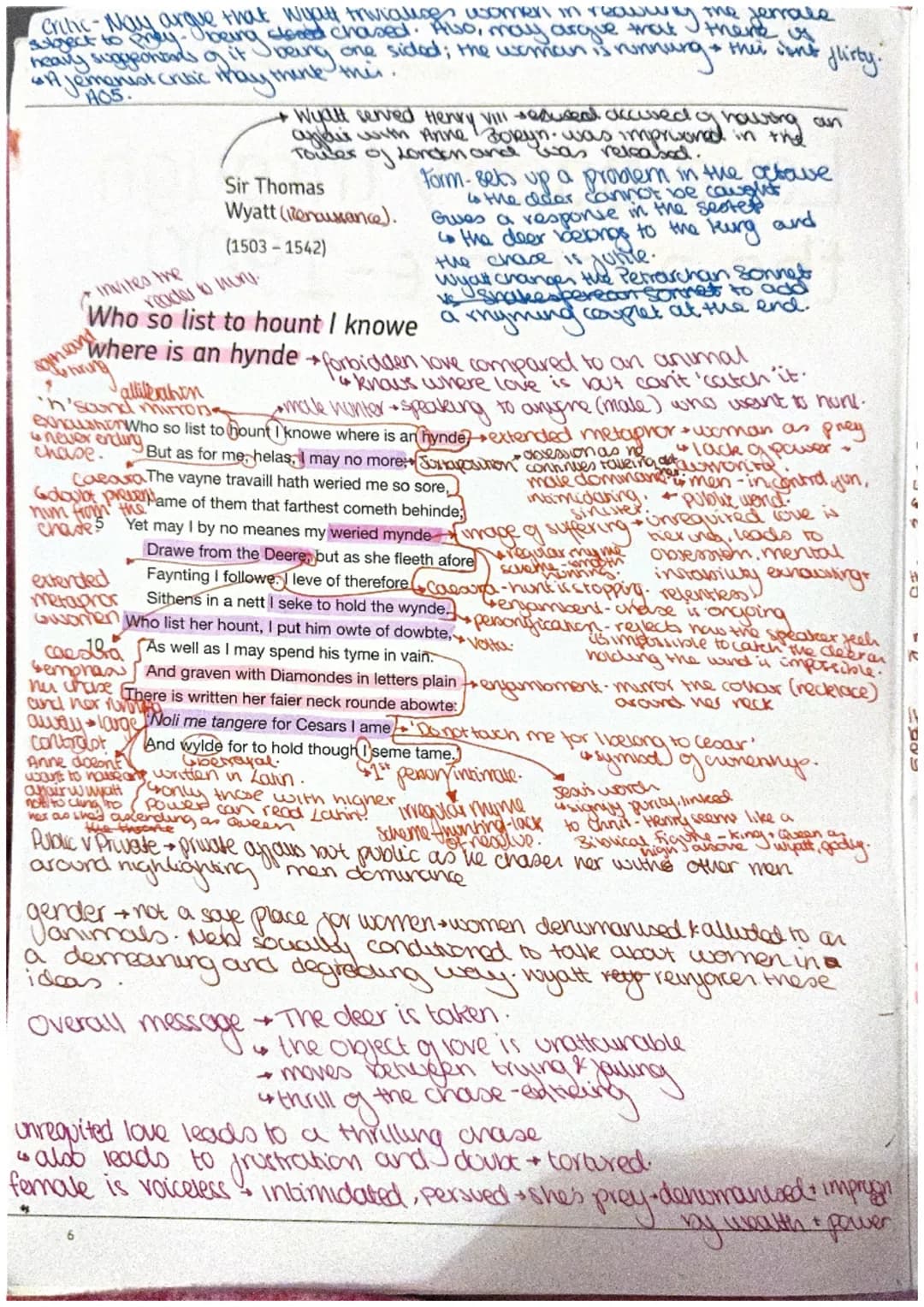
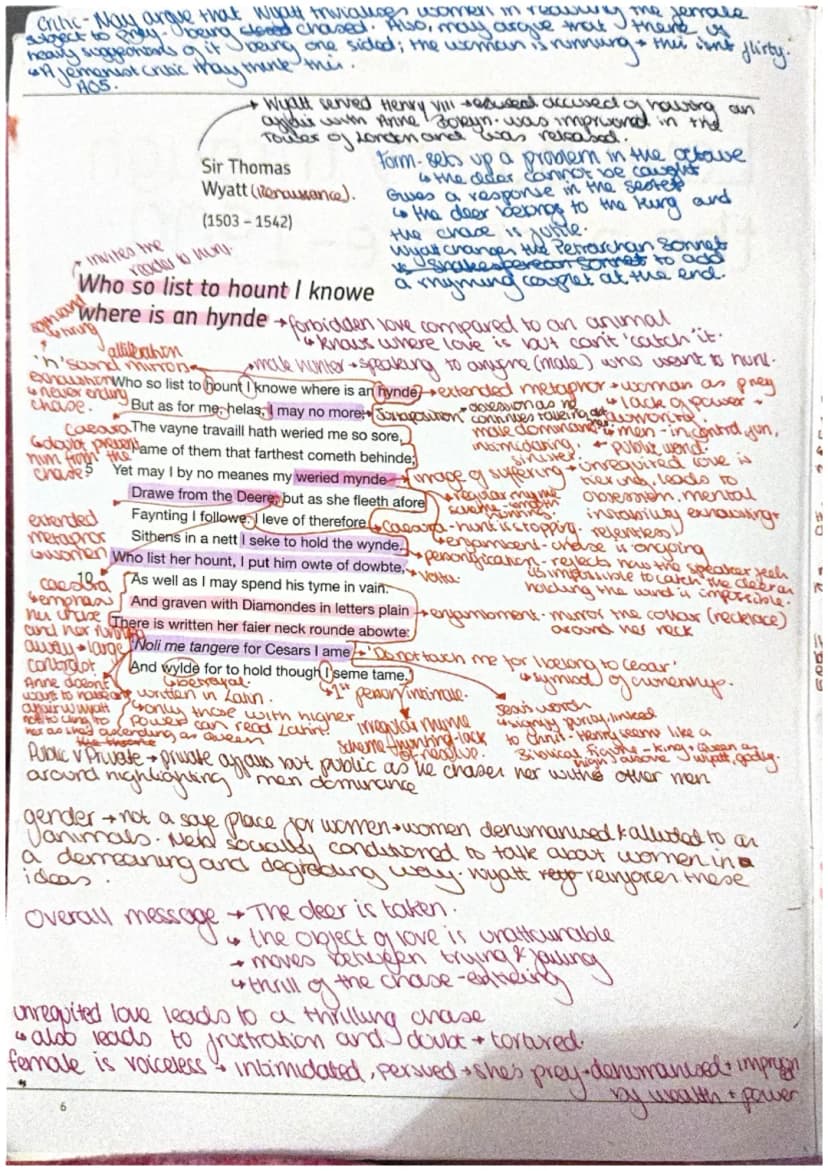
Sir Thomas Wyatt - "Who so list to hount"
Ever wondered what it feels like to want something you absolutely cannot have? Wyatt's sonnet captures that torment perfectly through his extended metaphor comparing a woman to a hunted deer. The speaker warns other men that chasing this particular woman is pointless - she's already claimed by someone far more powerful.
The poem's famous Latin phrase "Noli me tangere for Cesars I ame" (Don't touch me, for I belong to Caesar) reveals the truth: this deer wears a diamond collar marking her as the king's property. Wyatt transforms the traditional Petrarchan sonnet form by adding a final rhyming couplet that delivers this devastating revelation.
💡 Key insight: The caesura in "Faynting I followe. I leve of therefore" shows the exact moment the speaker gives up the chase - notice how the punctuation mirrors his exhaustion.
Written during Wyatt's imprisonment in the Tower of London, this poem likely references his alleged affair with Anne Boleyn. The hunter-prey dynamic raises uncomfortable questions about how women were viewed as objects to be pursued rather than individuals with agency.
2
of 6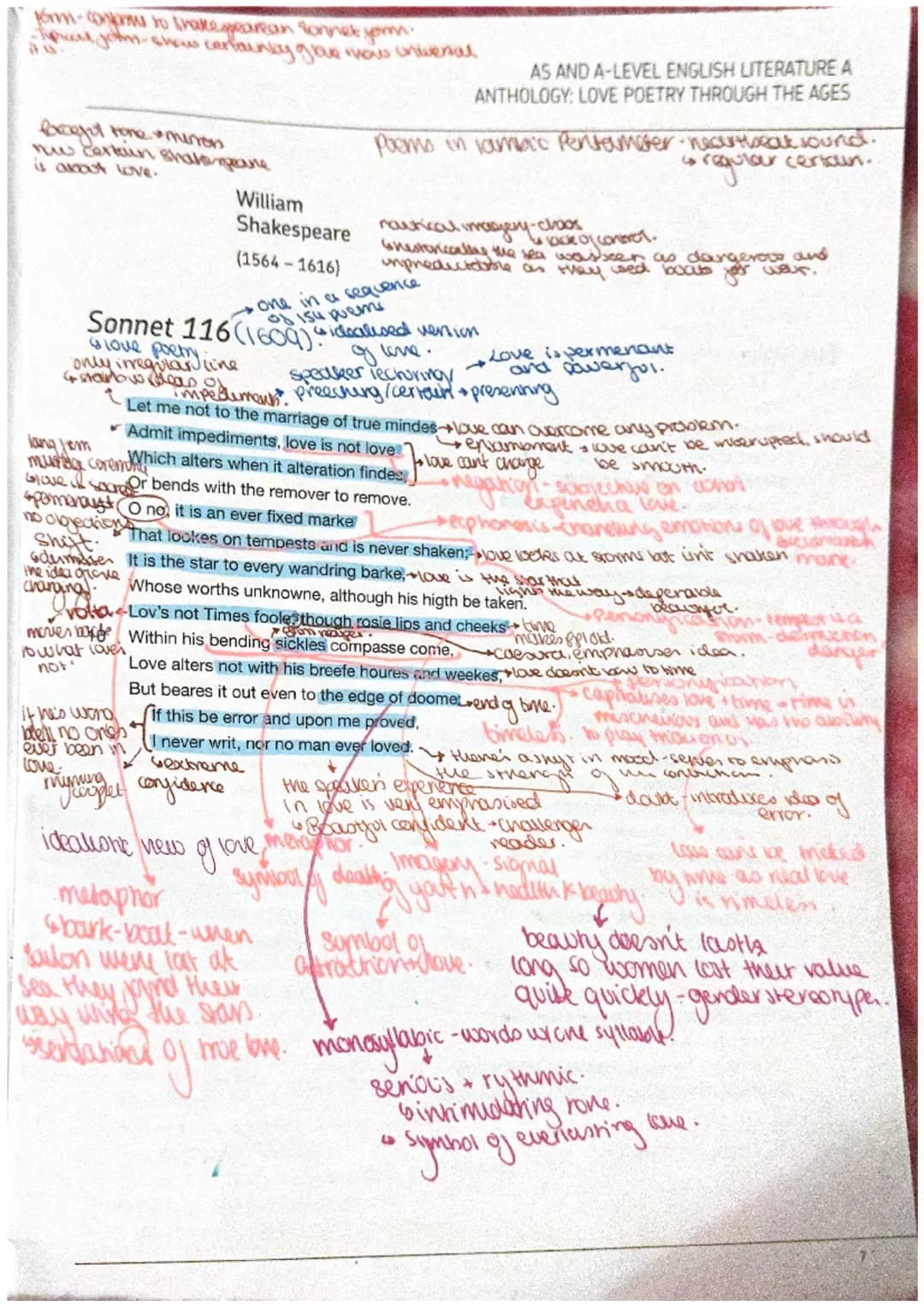
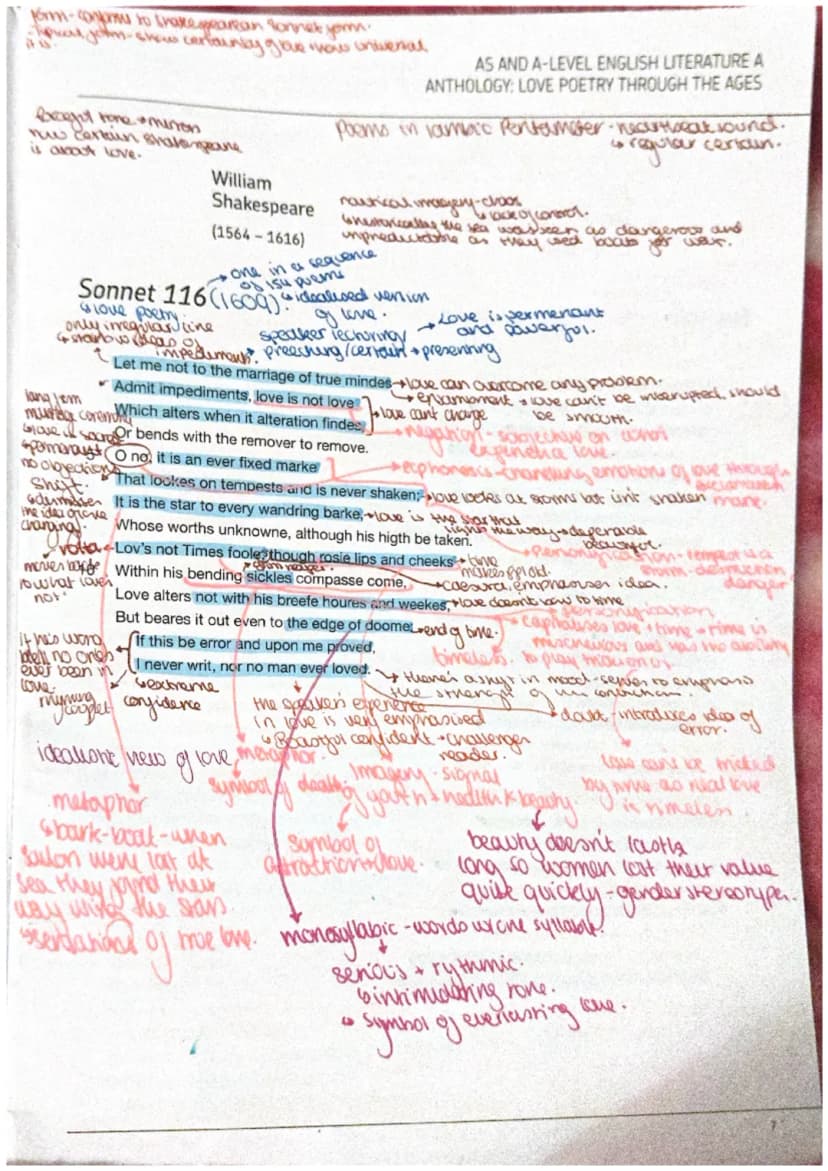
William Shakespeare - Sonnet 116
Think love is just about butterflies and romance? Shakespeare argues it's actually the most powerful force in the universe. Sonnet 116 presents love as an "ever fixed marke" - something absolutely constant that never changes, no matter what life throws at it.
The poem's nautical imagery comparing love to a guiding star makes perfect sense for Shakespeare's audience, who relied on stars for navigation. Love doesn't just help you find your way - it's literally what keeps you from being shipwrecked by life's storms.
💡 Key insight: The monosyllabic final couplet creates an intimidating, almost threatening tone as Shakespeare basically dares anyone to prove him wrong.
Shakespeare's confidence is breathtaking here. He's so certain about love's permanence that he stakes his entire reputation on it: if he's wrong about love, then he never wrote anything and no one has ever truly loved. That's quite a bold claim from history's most famous poet.
3
of 6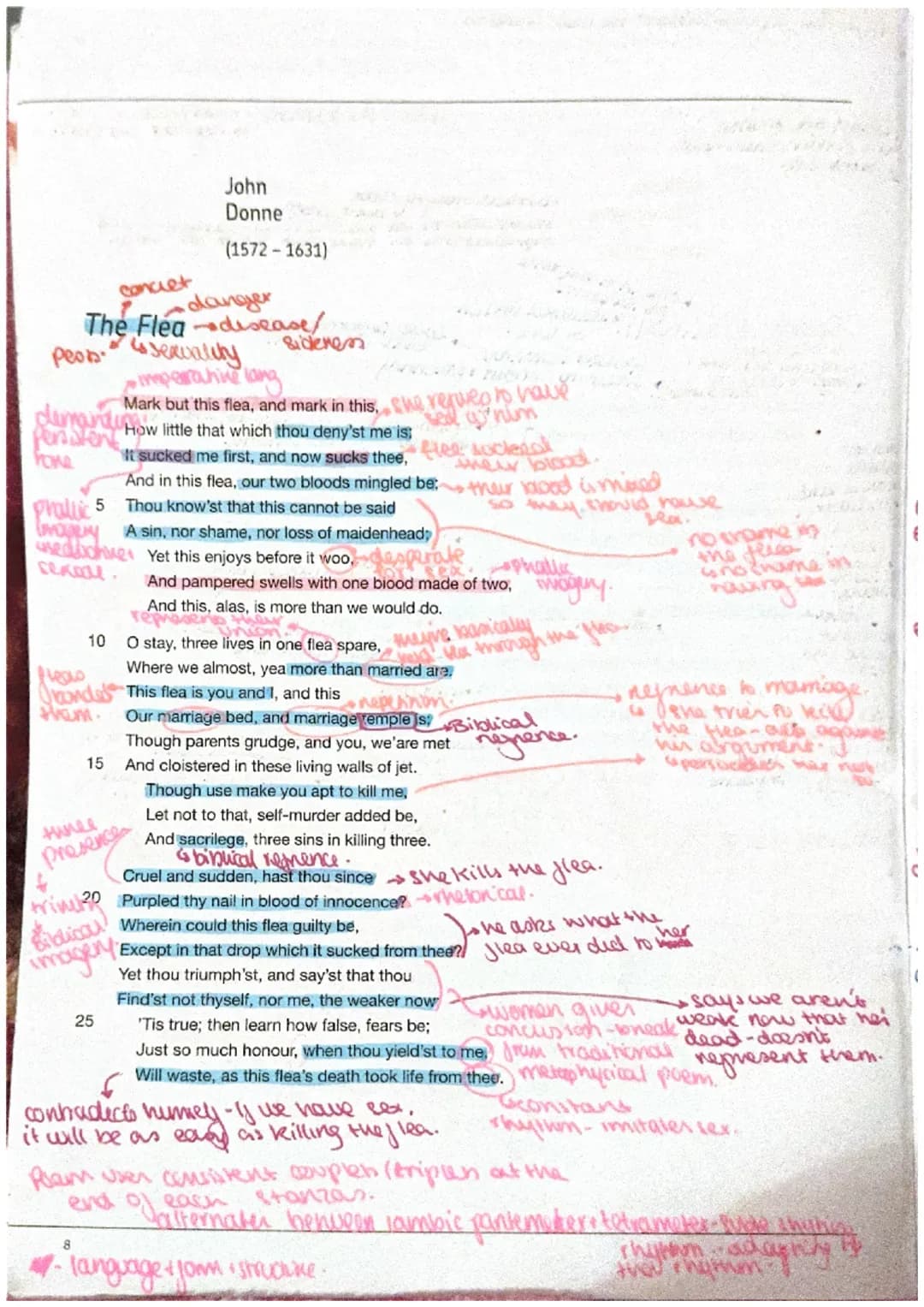
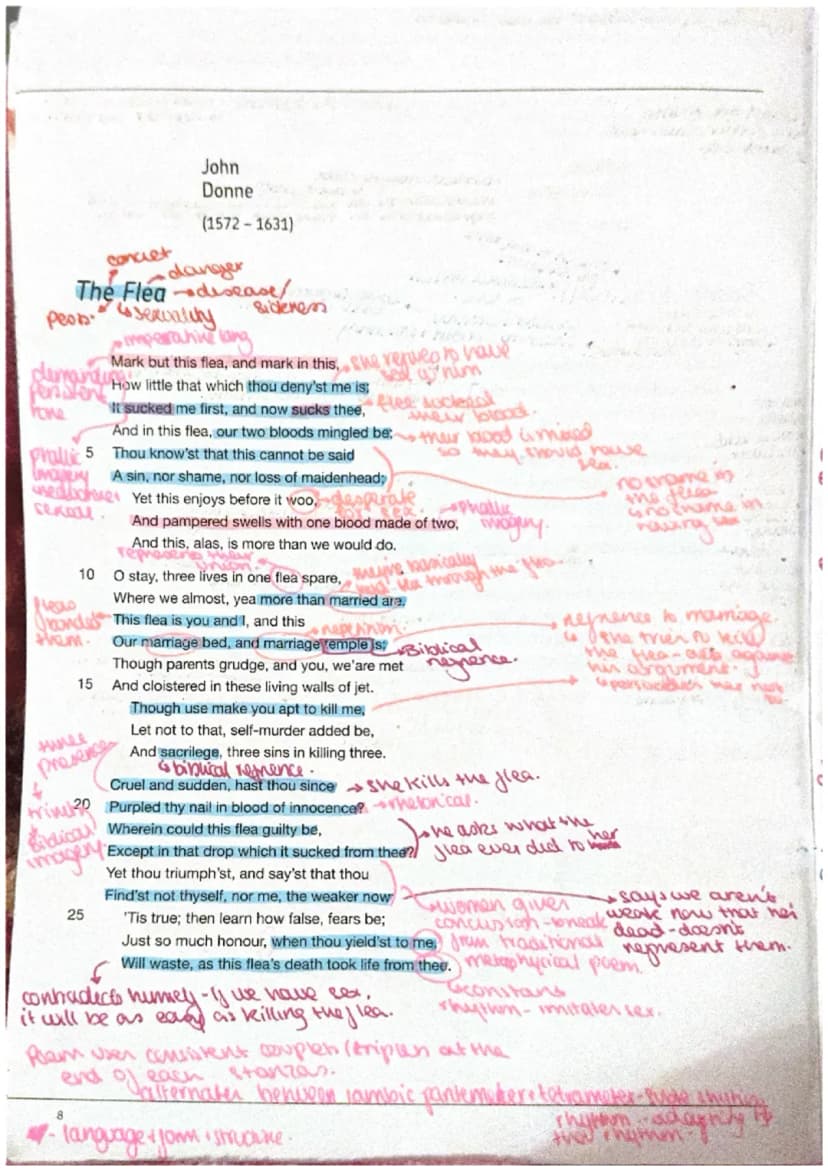
John Donne - "The Flea"
Imagine trying to convince someone to sleep with you using a flea bite as your main argument. Donne's metaphysical conceit is brilliantly ridiculous: since a flea has already mixed their blood by biting them both, they're practically married already, so why not go all the way?
The poem's three stanzas follow the flea's life and death. First, Donne argues the flea represents their union. Then he begs his lover not to kill it (calling it murder, suicide, and sacrilege). Finally, when she crushes it anyway, he flips the logic: see how little you lost? That's exactly how little honour you'd lose by sleeping with me.
💡 Key insight: The phallic imagery throughout isn't subtle - Donne's comparing the flea's swelling after sucking blood to sexual arousal.
The consistent rhyme scheme creates a heartbeat-like rhythm that mirrors both sexual urgency and the relentless nature of his argument. Donne's cleverness lies in turning the woman's resistance into proof of his point - whatever she does, he wins the debate.
4
of 6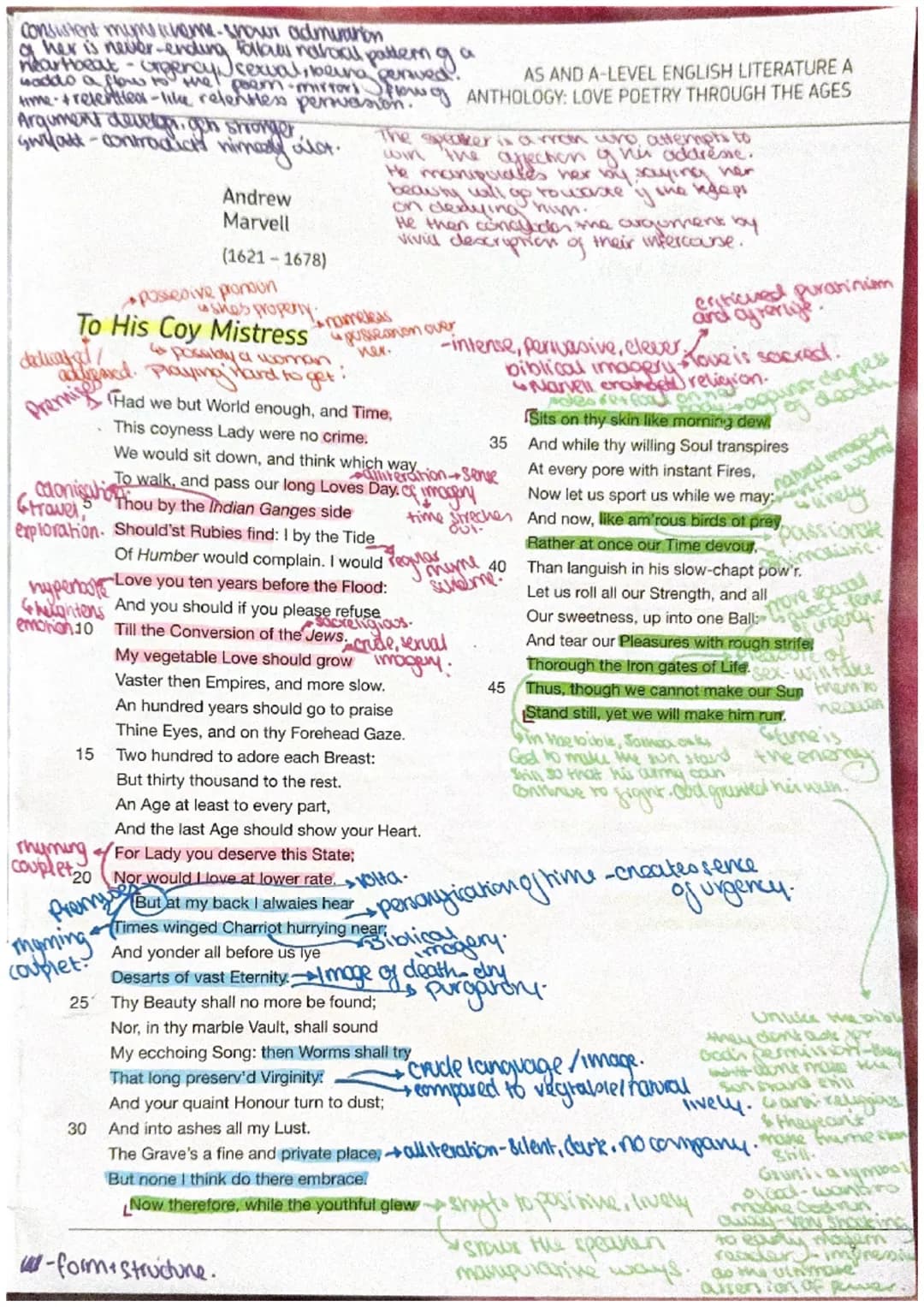
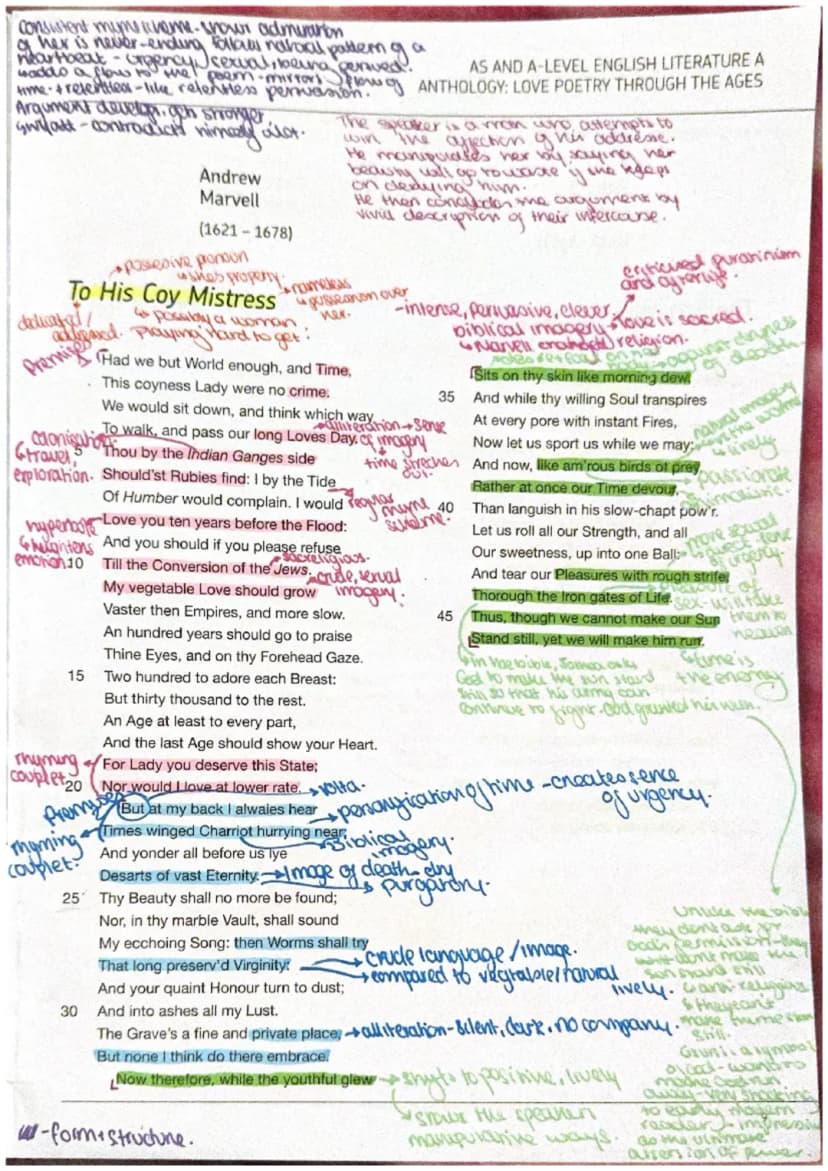
Andrew Marvell - "To His Coy Mistress"
Picture the smoothest pickup line in literary history, wrapped in existential dread. Marvell's speaker uses a three-part argument: if we had forever, your shyness would be charming; but time is running out; so let's have sex now before we're both dead and buried.
The poem's structure mirrors this logical progression. The first section piles on hyperbolic compliments (he'd spend 30,000 years just admiring her body), the second delivers shocking memento mori imagery (worms will get her virginity if he doesn't), and the third urges immediate action.
💡 Key insight: The volta at "But at my back I alwaies hear" completely shifts the tone from playful to genuinely unsettling.
Marvell's biblical imagery adds weight to his argument - he references Noah's flood and the conversion of the Jews to suggest their love should last until the end of time. Yet the crude sexual imagery in the final section reveals his true intentions, making this both romantic poetry and sophisticated manipulation.
5
of 6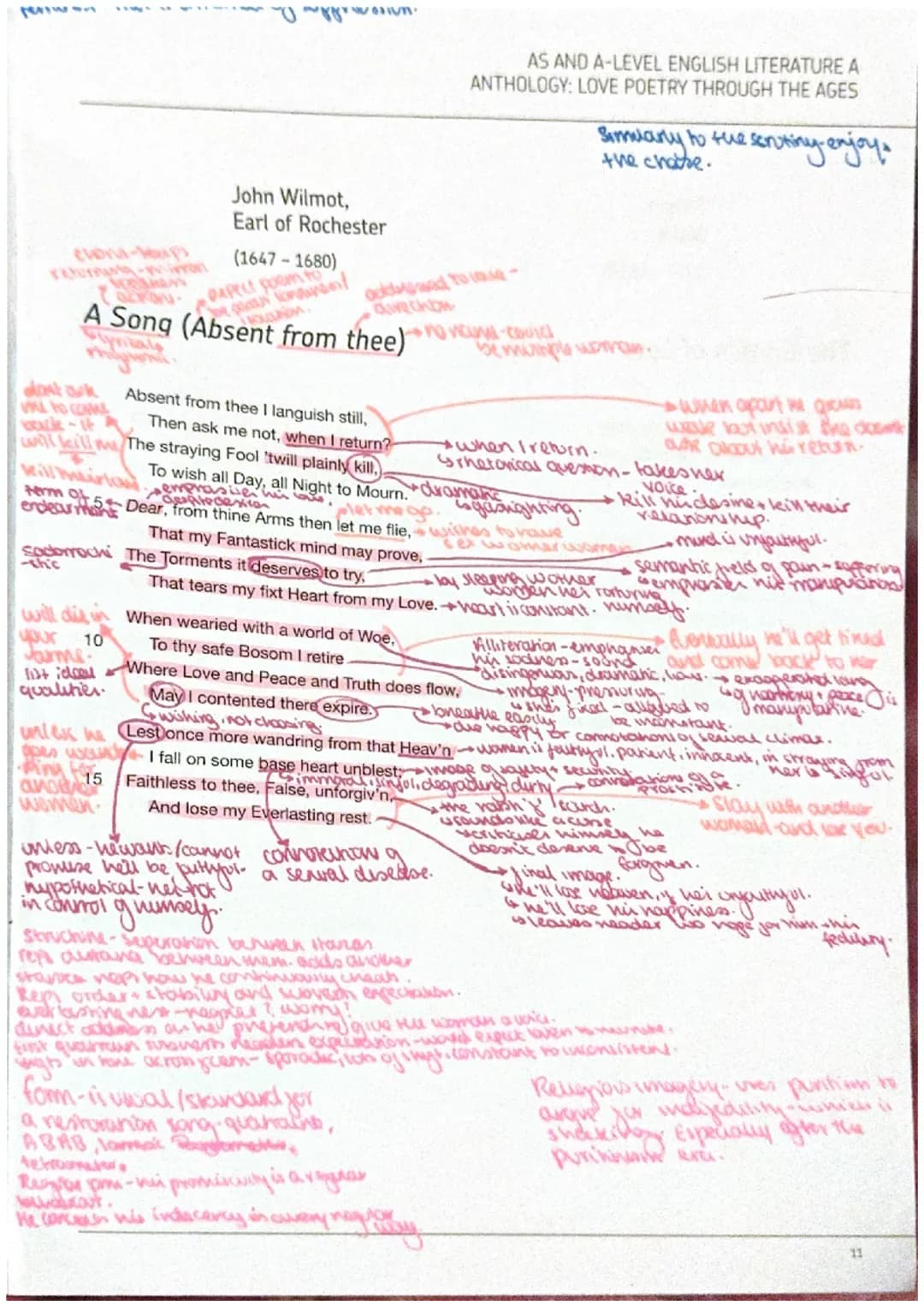
John Wilmot, Earl of Rochester - "A Song (Absent from thee)"
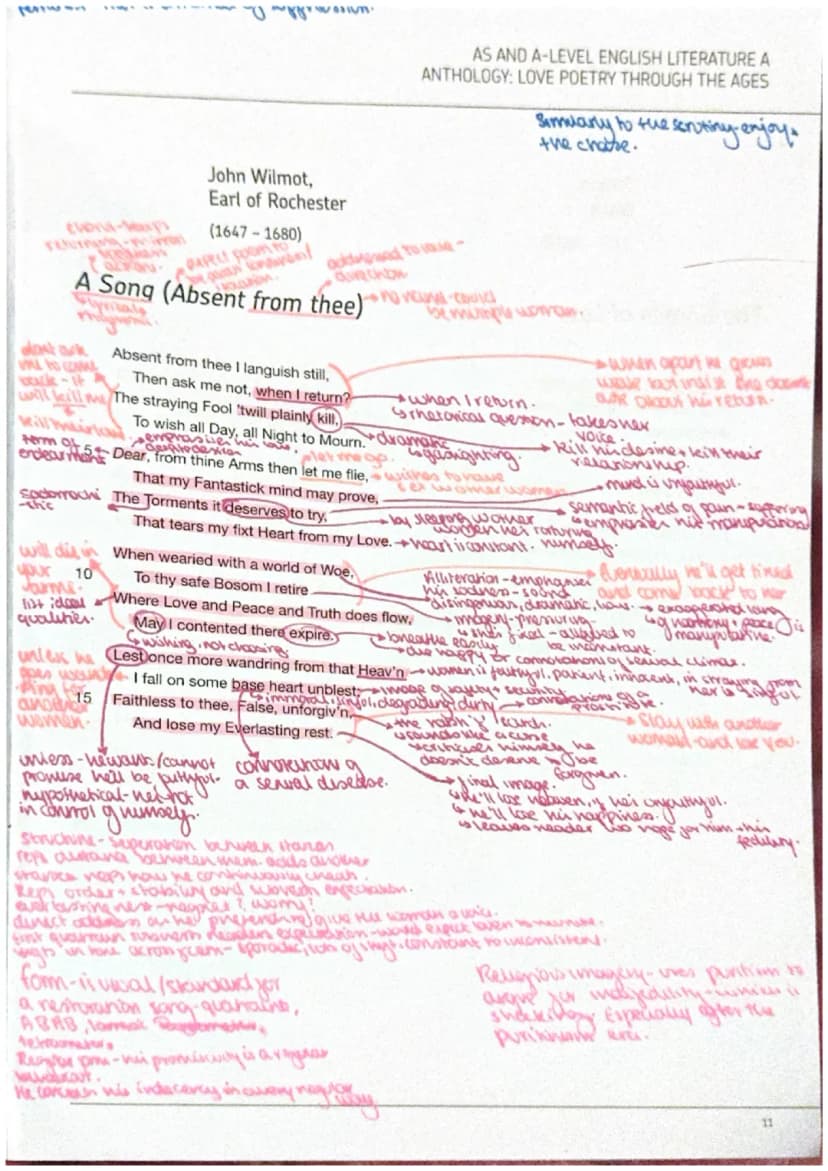
Welcome to the 17th century's most honest portrayal of a toxic relationship. Rochester's speaker admits he's a "straying Fool" who can't stay faithful, yet somehow makes this sound like a romantic confession rather than a warning.
The poem's semantic field of pain ("languish," "torments," "woe") creates a world where suffering equals love. The speaker claims his "Fantastick mind" forces him to wander, but promises he'll always return to his patient lover's "safe Bosom" when he gets tired of his affairs.
💡 Key insight: The religious imagery ("Heav'n," "Everlasting rest") makes his promiscuity sound like a spiritual journey rather than simple infidelity.
Rochester's manipulation is masterful - he presents his inability to commit as evidence of how special their relationship is. The hypothetical language ("Lest," "May I") means he's not actually promising anything, just painting pretty pictures of what might happen.
6
of 6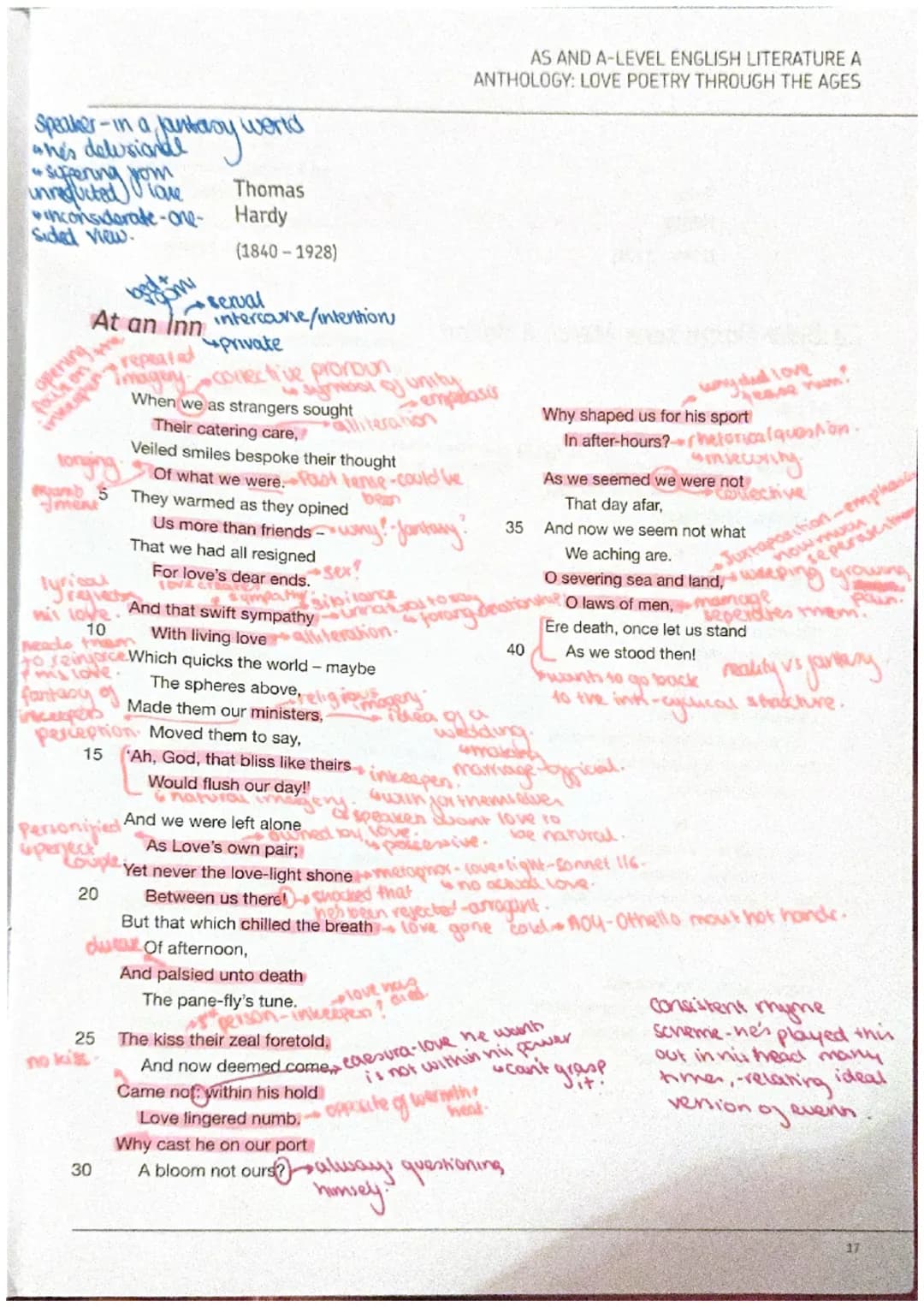
Thomas Hardy - "At an Inn"
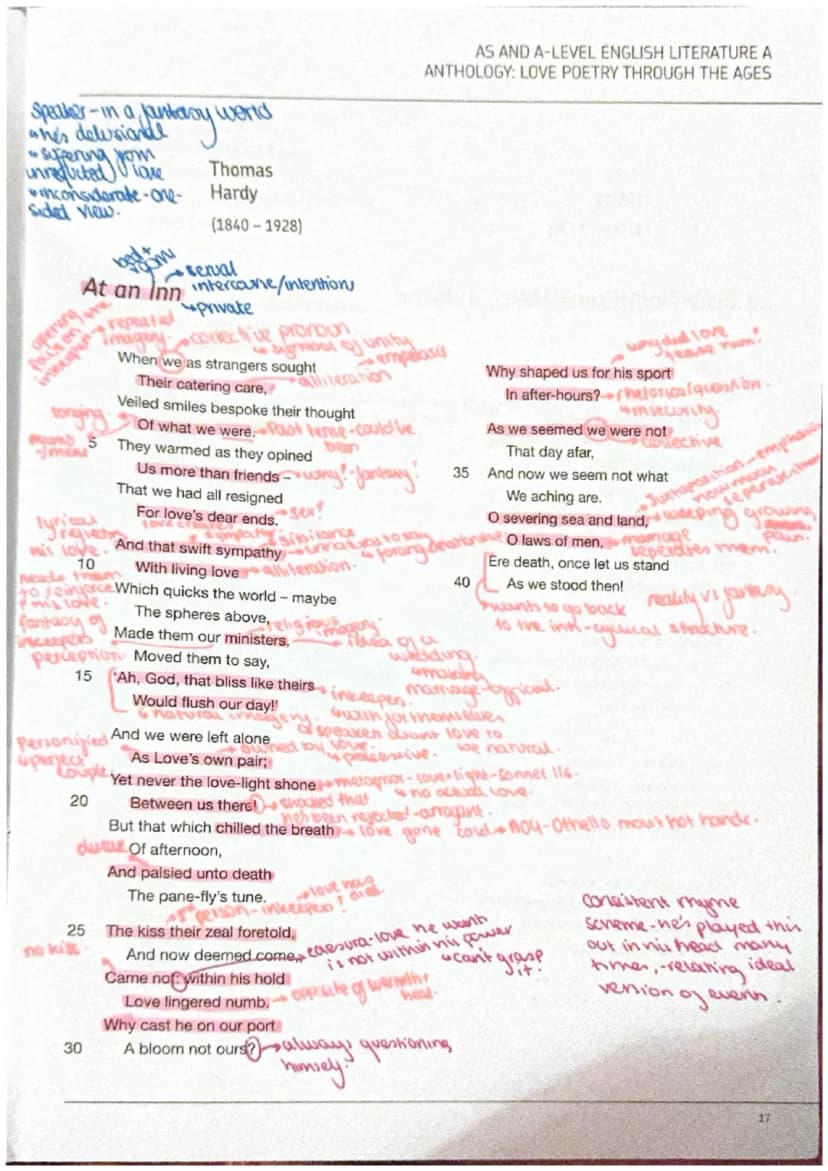
Ever built up a romantic scenario in your head, only to have reality crush your dreams? Hardy's speaker recalls a perfect day when strangers assumed he and his companion were lovers, and he's been fantasising about that moment ever since.
The past tense throughout reveals this is all memory and wishful thinking. The innkeepers' "veiled smiles" and assumptions created a brief fantasy world where the couple seemed destined for love, but the reality is painfully different.
💡 Key insight: The juxtaposition "As we seemed we were not / That day afar, / And now we seem not what / We aching are" captures how love can exist in perception rather than reality.
The poem's cyclical structure returns to the inn, emphasising how the speaker remains trapped in this one moment of possibility. The pathetic fallacy of the chilled afternoon and dying fly's tune reflects the death of his romantic hopes, while his final plea reveals the depth of his unrequited love.
We thought you’d never ask...
What is the Knowunity AI companion?
Our AI companion is specifically built for the needs of students. Based on the millions of content pieces we have on the platform we can provide truly meaningful and relevant answers to students. But its not only about answers, the companion is even more about guiding students through their daily learning challenges, with personalised study plans, quizzes or content pieces in the chat and 100% personalisation based on the students skills and developments.
Where can I download the Knowunity app?
You can download the app in the Google Play Store and in the Apple App Store.
Is Knowunity really free of charge?
That's right! Enjoy free access to study content, connect with fellow students, and get instant help – all at your fingertips.
Similar Content
Most popular content: Love Poetry
9English LiteratureExploring Love in Poetry
Dive into the themes of love and relationships through key poems from the AQA anthology. This resource covers context, language features, and essential quotations for poems like 'When We Two Parted', 'Porphyria's Lover', and 'Winter Swans'. Perfect for exam preparation and deepening your understanding of romantic poetry.
113879
English LiteratureLove Dynamics in Much Ado
This analytical essay delves into the contrasting representations of love in Shakespeare's 'Much Ado About Nothing'. It examines the relationships of Beatrice and Benedick versus Hero and Claudio, highlighting themes of manipulation, societal norms, and the interplay of love and honour. Ideal for students seeking a deeper understanding of Shakespearean themes and character dynamics.
111,00222
English LiteratureLetters from Yorkshire detailed annotations
GCSE AQA Literature; love and relationship poetry, Letters from Yorkshire by Maura Dooley
111916
EnglishMen Should Weep Love theme
Quotes and analysis for Love theme in Men Should Weep by Ena Lamont Stewart.
S51941
English LiteratureLove & Relationships Anthology
Explore the AQA Love and Relationships Poetry Anthology with detailed analyses of key poems, including 'When We Two Parted' by Lord Byron, 'Eden Rock' by Charles Causley, and 'Porphyria's Lover' by Robert Browning. This summary sheet covers themes, language techniques, and contextual insights to enhance your understanding and comparison of love and relationships in poetry.
111,72857
English LiteratureOthello: Love and Hatred
Explore the complex themes of love and hatred in Shakespeare's Othello. This analysis delves into the romantic idealization and misogyny present in the characters' relationships, particularly between Othello and Desdemona. Discover how jealousy, societal expectations, and patriarchal influences shape their tragic love story. Ideal for students studying literary criticism and character dynamics in Othello.
111,02734
English LiteratureExploring Love in Othello
This analytical essay delves into the multifaceted nature of love in Shakespeare's 'Othello', examining its romantic, familial, and platonic dimensions. It highlights how love evolves from lust to compassion, and ultimately reveals its destructive potential through the relationships of Othello and Desdemona, and Iago and Emilia. Ideal for AS/A-Level students, this essay provides critical insights into the themes of love and jealousy, supported by textual evidence and literary analysis.
1293731
English LiteratureCavalier Poets' Love Themes
Dive into the intricate themes of love and relationships in Richard Lovelace's 'The Scrutiny' and other Cavalier poetry. This analysis highlights the contrasting attitudes towards love, fidelity, and gender dynamics in 17th-century literature, providing insights into the poetic techniques and societal reflections of the time.
122281
English LiteratureMetaphysical Love in Marvell
Dive into Andrew Marvell's 'To His Coy Mistress' with this detailed analysis of its metaphysical themes, including the interplay of love, time, and seduction. This summary highlights key poetic devices, imagery, and the poem's carpe diem philosophy, making it essential for A-Level English Literature students studying love poetry.
124959
Most popular content in English Literature
9English LiteratureAn Inspector Calls: Character Insights
Explore in-depth analysis and key quotes for characters in J.B. Priestley's 'An Inspector Calls'. This resource covers Gerald Croft, Inspector Goole, Sheila Birling, Mrs. Birling, Eric Birling, and Eva Smith, focusing on themes of class, gender roles, and social responsibility. Ideal for students aiming for Grade 8 and above.
1025,429907
English LiteratureRomeo and Juliet: Key themes
Key Romeo and Juliet themes and analysed quotes
106,708198
English LiteratureMacbeth: Guilt and Ambition
Explore the complex themes of guilt and ambition in Shakespeare's 'Macbeth'. This analysis covers key characters, including Macbeth and Lady Macbeth, their moral dilemmas, and the tragic consequences of their ambition. Ideal for students studying character motivations, thematic elements, and the psychological impact of power. Includes insights on the natural order, manipulation, and the descent into madness.
919,094397
I
English LiteratureInspector Calls Quiz (YR 10 MOCKS)
for YR 10 GCSE mock on Inspector Calls
102,1461
E
English LiteratureExplore the World of English Literature
Master the key concepts and works of English literature with this comprehensive flashcard set designed for grade 10 students.
112,0941
English LiteratureExploring Macbeth's Themes
Dive into the intricate themes of Shakespeare's Macbeth, including the supernatural, ambition, guilt, and kingship. This analysis features key quotes and insights that reveal how these themes intertwine to shape the characters and the narrative. Ideal for students seeking a deeper understanding of the play's moral complexities and psychological depth.
1015,849524
E
English LiteratureExploring English Literature: A Journey through Medium
Discover the captivating world of English Literature with this comprehensive medium-level flashcard set. Dive into the works of renowned authors and explore the themes, characters, and literary techniques that make their writing truly remarkable.
111,0580
E
English LiteratureExploring 'A Christmas Carol': Themes, Characters, and Lessons
Delve into the main themes, key characters, and valuable lessons in Charles Dickens' 'A Christmas Carol'. Discover the impact of Scrooge's transformation and the significance of love, redemption, and the true meaning of Christmas.
101,2480
English LiteratureMacbeth Key Themes Essay Plans
Essay plans for key themes in macbeth - guilt, supernatural & ambition
115,186146
Most popular content
9 Sociology
Sociology of Education Overview
Explore comprehensive A-Level Sociology notes on the education system, covering key theories, policies, and sociological perspectives. This resource includes insights on marketisation, gender roles, cultural deprivation, and educational inequalities, providing a thorough understanding of how education shapes social stratification and individual achievement. Ideal for exam preparation and in-depth study.
12102,8703,040
SociologySociology of Families: Comprehensive Revision
Dive into an extensive overview of family dynamics, perspectives, and patterns in sociology. This resource covers key concepts such as family diversity, gender roles, marriage, and the impact of social policies on family structures. Perfect for A-Level Sociology students preparing for Paper 2.
1273,6662,307
CriminologyCriminology: Crime & Punishment Overview
Comprehensive mindmaps covering key concepts in the Crime and Punishment topic for WJEC Criminology Unit 4. This resource includes detailed insights into the Criminal Justice System, crime prevention strategies, sentencing models, and the roles of various agencies. Ideal for A-Level revision, ensuring you grasp essential theories and legislative processes to excel in your exams.
1254,8721,059
SociologyComprehensive Crime & Deviance Overview
Explore an extensive revision of crime and deviance topics, including theories, types of crime, and the impact of media. This resource covers key concepts such as Marxism, functionalism, gender and crime, and the influence of globalization on criminal behavior. Ideal for students seeking a thorough understanding of criminology and its various theories. Type: Full Topic Revision.
1251,6541,399
C
 Biology
Cell Biology and Cell structure
cell structures
93,2490
English LiteratureAn Inspector Calls: Character Insights
Explore in-depth analysis and key quotes for characters in J.B. Priestley's 'An Inspector Calls'. This resource covers Gerald Croft, Inspector Goole, Sheila Birling, Mrs. Birling, Eric Birling, and Eva Smith, focusing on themes of class, gender roles, and social responsibility. Ideal for students aiming for Grade 8 and above.
1025,429907
CriminologyWJEC Unit 4 Criminology
Criminology unit 4 detailed revision note
127,154125
CriminologyCriminology Theories Overview
Explore key criminology theories and their implications on crime and deviance. This comprehensive summary covers biological, psychological, and sociological perspectives, including labelling theory, right realism, and the impact of social campaigns on policy development. Ideal for A-Level criminology students seeking to understand the complexities of criminal behaviour and the factors influencing crime prevention strategies.
129,760210
English LiteratureRomeo and Juliet: Key themes
Key Romeo and Juliet themes and analysed quotes
106,708198
Can't find what you're looking for? Explore other subjects.
Students love us — and so will you.
4.6/5App Store
4.7/5Google Play
The app is very easy to use and well designed. I have found everything I was looking for so far and have been able to learn a lot from the presentations! I will definitely use the app for a class assignment! And of course it also helps a lot as an inspiration.
Stefan SiOS user
This app is really great. There are so many study notes and help [...]. My problem subject is French, for example, and the app has so many options for help. Thanks to this app, I have improved my French. I would recommend it to anyone.
Samantha KlichAndroid user
Wow, I am really amazed. I just tried the app because I've seen it advertised many times and was absolutely stunned. This app is THE HELP you want for school and above all, it offers so many things, such as workouts and fact sheets, which have been VERY helpful to me personally.
AnnaiOS user
English Literature601 views·Updated Jun 20, 2026·6 pagesTimeless Love Poems: Exploring Emotions Through Different Eras
I
Ilham❤️@iduqow8
Love poetry has evolved dramatically over the centuries, reflecting changing attitudes towards romance, desire, and relationships. From the Tudor court's forbidden passions to Victorian fantasies of unrequited love, these poems reveal how poets have captured the complexities of human attraction...
1
of 6
Sign up to see the content. It's free!
- Access to all documents
- Improve your grades
- Join milions of students
Sir Thomas Wyatt - "Who so list to hount"
Ever wondered what it feels like to want something you absolutely cannot have? Wyatt's sonnet captures that torment perfectly through his extended metaphor comparing a woman to a hunted deer. The speaker warns other men that chasing this particular woman is pointless - she's already claimed by someone far more powerful.
The poem's famous Latin phrase "Noli me tangere for Cesars I ame" (Don't touch me, for I belong to Caesar) reveals the truth: this deer wears a diamond collar marking her as the king's property. Wyatt transforms the traditional Petrarchan sonnet form by adding a final rhyming couplet that delivers this devastating revelation.
💡 Key insight: The caesura in "Faynting I followe. I leve of therefore" shows the exact moment the speaker gives up the chase - notice how the punctuation mirrors his exhaustion.
Written during Wyatt's imprisonment in the Tower of London, this poem likely references his alleged affair with Anne Boleyn. The hunter-prey dynamic raises uncomfortable questions about how women were viewed as objects to be pursued rather than individuals with agency.
2
of 6Sign up to see the content. It's free!
- Access to all documents
- Improve your grades
- Join milions of students
William Shakespeare - Sonnet 116
Think love is just about butterflies and romance? Shakespeare argues it's actually the most powerful force in the universe. Sonnet 116 presents love as an "ever fixed marke" - something absolutely constant that never changes, no matter what life throws at it.
The poem's nautical imagery comparing love to a guiding star makes perfect sense for Shakespeare's audience, who relied on stars for navigation. Love doesn't just help you find your way - it's literally what keeps you from being shipwrecked by life's storms.
💡 Key insight: The monosyllabic final couplet creates an intimidating, almost threatening tone as Shakespeare basically dares anyone to prove him wrong.
Shakespeare's confidence is breathtaking here. He's so certain about love's permanence that he stakes his entire reputation on it: if he's wrong about love, then he never wrote anything and no one has ever truly loved. That's quite a bold claim from history's most famous poet.
3
of 6Sign up to see the content. It's free!
- Access to all documents
- Improve your grades
- Join milions of students
John Donne - "The Flea"
Imagine trying to convince someone to sleep with you using a flea bite as your main argument. Donne's metaphysical conceit is brilliantly ridiculous: since a flea has already mixed their blood by biting them both, they're practically married already, so why not go all the way?
The poem's three stanzas follow the flea's life and death. First, Donne argues the flea represents their union. Then he begs his lover not to kill it (calling it murder, suicide, and sacrilege). Finally, when she crushes it anyway, he flips the logic: see how little you lost? That's exactly how little honour you'd lose by sleeping with me.
💡 Key insight: The phallic imagery throughout isn't subtle - Donne's comparing the flea's swelling after sucking blood to sexual arousal.
The consistent rhyme scheme creates a heartbeat-like rhythm that mirrors both sexual urgency and the relentless nature of his argument. Donne's cleverness lies in turning the woman's resistance into proof of his point - whatever she does, he wins the debate.
4
of 6Sign up to see the content. It's free!
- Access to all documents
- Improve your grades
- Join milions of students
Andrew Marvell - "To His Coy Mistress"
Picture the smoothest pickup line in literary history, wrapped in existential dread. Marvell's speaker uses a three-part argument: if we had forever, your shyness would be charming; but time is running out; so let's have sex now before we're both dead and buried.
The poem's structure mirrors this logical progression. The first section piles on hyperbolic compliments (he'd spend 30,000 years just admiring her body), the second delivers shocking memento mori imagery (worms will get her virginity if he doesn't), and the third urges immediate action.
💡 Key insight: The volta at "But at my back I alwaies hear" completely shifts the tone from playful to genuinely unsettling.
Marvell's biblical imagery adds weight to his argument - he references Noah's flood and the conversion of the Jews to suggest their love should last until the end of time. Yet the crude sexual imagery in the final section reveals his true intentions, making this both romantic poetry and sophisticated manipulation.
5
of 6Sign up to see the content. It's free!
- Access to all documents
- Improve your grades
- Join milions of students
John Wilmot, Earl of Rochester - "A Song (Absent from thee)"
Welcome to the 17th century's most honest portrayal of a toxic relationship. Rochester's speaker admits he's a "straying Fool" who can't stay faithful, yet somehow makes this sound like a romantic confession rather than a warning.
The poem's semantic field of pain ("languish," "torments," "woe") creates a world where suffering equals love. The speaker claims his "Fantastick mind" forces him to wander, but promises he'll always return to his patient lover's "safe Bosom" when he gets tired of his affairs.
💡 Key insight: The religious imagery ("Heav'n," "Everlasting rest") makes his promiscuity sound like a spiritual journey rather than simple infidelity.
Rochester's manipulation is masterful - he presents his inability to commit as evidence of how special their relationship is. The hypothetical language ("Lest," "May I") means he's not actually promising anything, just painting pretty pictures of what might happen.
6
of 6Sign up to see the content. It's free!
- Access to all documents
- Improve your grades
- Join milions of students
Thomas Hardy - "At an Inn"
Ever built up a romantic scenario in your head, only to have reality crush your dreams? Hardy's speaker recalls a perfect day when strangers assumed he and his companion were lovers, and he's been fantasising about that moment ever since.
The past tense throughout reveals this is all memory and wishful thinking. The innkeepers' "veiled smiles" and assumptions created a brief fantasy world where the couple seemed destined for love, but the reality is painfully different.
💡 Key insight: The juxtaposition "As we seemed we were not / That day afar, / And now we seem not what / We aching are" captures how love can exist in perception rather than reality.
The poem's cyclical structure returns to the inn, emphasising how the speaker remains trapped in this one moment of possibility. The pathetic fallacy of the chilled afternoon and dying fly's tune reflects the death of his romantic hopes, while his final plea reveals the depth of his unrequited love.
We thought you’d never ask...
What is the Knowunity AI companion?
Our AI companion is specifically built for the needs of students. Based on the millions of content pieces we have on the platform we can provide truly meaningful and relevant answers to students. But its not only about answers, the companion is even more about guiding students through their daily learning challenges, with personalised study plans, quizzes or content pieces in the chat and 100% personalisation based on the students skills and developments.
Where can I download the Knowunity app?
You can download the app in the Google Play Store and in the Apple App Store.
Is Knowunity really free of charge?
That's right! Enjoy free access to study content, connect with fellow students, and get instant help – all at your fingertips.
Similar Content
Most popular content: Love Poetry
9English LiteratureExploring Love in Poetry
Dive into the themes of love and relationships through key poems from the AQA anthology. This resource covers context, language features, and essential quotations for poems like 'When We Two Parted', 'Porphyria's Lover', and 'Winter Swans'. Perfect for exam preparation and deepening your understanding of romantic poetry.
113879
English LiteratureLove Dynamics in Much Ado
This analytical essay delves into the contrasting representations of love in Shakespeare's 'Much Ado About Nothing'. It examines the relationships of Beatrice and Benedick versus Hero and Claudio, highlighting themes of manipulation, societal norms, and the interplay of love and honour. Ideal for students seeking a deeper understanding of Shakespearean themes and character dynamics.
111,00222
English LiteratureLetters from Yorkshire detailed annotations
GCSE AQA Literature; love and relationship poetry, Letters from Yorkshire by Maura Dooley
111916
EnglishMen Should Weep Love theme
Quotes and analysis for Love theme in Men Should Weep by Ena Lamont Stewart.
S51941
English LiteratureLove & Relationships Anthology
Explore the AQA Love and Relationships Poetry Anthology with detailed analyses of key poems, including 'When We Two Parted' by Lord Byron, 'Eden Rock' by Charles Causley, and 'Porphyria's Lover' by Robert Browning. This summary sheet covers themes, language techniques, and contextual insights to enhance your understanding and comparison of love and relationships in poetry.
111,72857
English LiteratureOthello: Love and Hatred
Explore the complex themes of love and hatred in Shakespeare's Othello. This analysis delves into the romantic idealization and misogyny present in the characters' relationships, particularly between Othello and Desdemona. Discover how jealousy, societal expectations, and patriarchal influences shape their tragic love story. Ideal for students studying literary criticism and character dynamics in Othello.
111,02734
English LiteratureExploring Love in Othello
This analytical essay delves into the multifaceted nature of love in Shakespeare's 'Othello', examining its romantic, familial, and platonic dimensions. It highlights how love evolves from lust to compassion, and ultimately reveals its destructive potential through the relationships of Othello and Desdemona, and Iago and Emilia. Ideal for AS/A-Level students, this essay provides critical insights into the themes of love and jealousy, supported by textual evidence and literary analysis.
1293731
English LiteratureCavalier Poets' Love Themes
Dive into the intricate themes of love and relationships in Richard Lovelace's 'The Scrutiny' and other Cavalier poetry. This analysis highlights the contrasting attitudes towards love, fidelity, and gender dynamics in 17th-century literature, providing insights into the poetic techniques and societal reflections of the time.
122281
English LiteratureMetaphysical Love in Marvell
Dive into Andrew Marvell's 'To His Coy Mistress' with this detailed analysis of its metaphysical themes, including the interplay of love, time, and seduction. This summary highlights key poetic devices, imagery, and the poem's carpe diem philosophy, making it essential for A-Level English Literature students studying love poetry.
124959
Most popular content in English Literature
9English LiteratureAn Inspector Calls: Character Insights
Explore in-depth analysis and key quotes for characters in J.B. Priestley's 'An Inspector Calls'. This resource covers Gerald Croft, Inspector Goole, Sheila Birling, Mrs. Birling, Eric Birling, and Eva Smith, focusing on themes of class, gender roles, and social responsibility. Ideal for students aiming for Grade 8 and above.
1025,429907
English LiteratureRomeo and Juliet: Key themes
Key Romeo and Juliet themes and analysed quotes
106,708198
English LiteratureMacbeth: Guilt and Ambition
Explore the complex themes of guilt and ambition in Shakespeare's 'Macbeth'. This analysis covers key characters, including Macbeth and Lady Macbeth, their moral dilemmas, and the tragic consequences of their ambition. Ideal for students studying character motivations, thematic elements, and the psychological impact of power. Includes insights on the natural order, manipulation, and the descent into madness.
919,094397
I
English LiteratureInspector Calls Quiz (YR 10 MOCKS)
for YR 10 GCSE mock on Inspector Calls
102,1461
E
English LiteratureExplore the World of English Literature
Master the key concepts and works of English literature with this comprehensive flashcard set designed for grade 10 students.
112,0941
English LiteratureExploring Macbeth's Themes
Dive into the intricate themes of Shakespeare's Macbeth, including the supernatural, ambition, guilt, and kingship. This analysis features key quotes and insights that reveal how these themes intertwine to shape the characters and the narrative. Ideal for students seeking a deeper understanding of the play's moral complexities and psychological depth.
1015,849524
E
English LiteratureExploring English Literature: A Journey through Medium
Discover the captivating world of English Literature with this comprehensive medium-level flashcard set. Dive into the works of renowned authors and explore the themes, characters, and literary techniques that make their writing truly remarkable.
111,0580
E
English LiteratureExploring 'A Christmas Carol': Themes, Characters, and Lessons
Delve into the main themes, key characters, and valuable lessons in Charles Dickens' 'A Christmas Carol'. Discover the impact of Scrooge's transformation and the significance of love, redemption, and the true meaning of Christmas.
101,2480
English LiteratureMacbeth Key Themes Essay Plans
Essay plans for key themes in macbeth - guilt, supernatural & ambition
115,186146
Most popular content
9SociologySociology of Education Overview
Explore comprehensive A-Level Sociology notes on the education system, covering key theories, policies, and sociological perspectives. This resource includes insights on marketisation, gender roles, cultural deprivation, and educational inequalities, providing a thorough understanding of how education shapes social stratification and individual achievement. Ideal for exam preparation and in-depth study.
12102,8703,040
SociologySociology of Families: Comprehensive Revision
Dive into an extensive overview of family dynamics, perspectives, and patterns in sociology. This resource covers key concepts such as family diversity, gender roles, marriage, and the impact of social policies on family structures. Perfect for A-Level Sociology students preparing for Paper 2.
1273,6662,307
CriminologyCriminology: Crime & Punishment Overview
Comprehensive mindmaps covering key concepts in the Crime and Punishment topic for WJEC Criminology Unit 4. This resource includes detailed insights into the Criminal Justice System, crime prevention strategies, sentencing models, and the roles of various agencies. Ideal for A-Level revision, ensuring you grasp essential theories and legislative processes to excel in your exams.
1254,8721,059
SociologyComprehensive Crime & Deviance Overview
Explore an extensive revision of crime and deviance topics, including theories, types of crime, and the impact of media. This resource covers key concepts such as Marxism, functionalism, gender and crime, and the influence of globalization on criminal behavior. Ideal for students seeking a thorough understanding of criminology and its various theories. Type: Full Topic Revision.
1251,6541,399
C
BiologyCell Biology and Cell structure
cell structures
93,2490
English LiteratureAn Inspector Calls: Character Insights
Explore in-depth analysis and key quotes for characters in J.B. Priestley's 'An Inspector Calls'. This resource covers Gerald Croft, Inspector Goole, Sheila Birling, Mrs. Birling, Eric Birling, and Eva Smith, focusing on themes of class, gender roles, and social responsibility. Ideal for students aiming for Grade 8 and above.
1025,429907
CriminologyWJEC Unit 4 Criminology
Criminology unit 4 detailed revision note
127,154125
CriminologyCriminology Theories Overview
Explore key criminology theories and their implications on crime and deviance. This comprehensive summary covers biological, psychological, and sociological perspectives, including labelling theory, right realism, and the impact of social campaigns on policy development. Ideal for A-Level criminology students seeking to understand the complexities of criminal behaviour and the factors influencing crime prevention strategies.
129,760210
English LiteratureRomeo and Juliet: Key themes
Key Romeo and Juliet themes and analysed quotes
106,708198
Can't find what you're looking for? Explore other subjects.
Students love us — and so will you.
4.6/5App Store
4.7/5Google Play
The app is very easy to use and well designed. I have found everything I was looking for so far and have been able to learn a lot from the presentations! I will definitely use the app for a class assignment! And of course it also helps a lot as an inspiration.
Stefan SiOS user
This app is really great. There are so many study notes and help [...]. My problem subject is French, for example, and the app has so many options for help. Thanks to this app, I have improved my French. I would recommend it to anyone.
Samantha KlichAndroid user
Wow, I am really amazed. I just tried the app because I've seen it advertised many times and was absolutely stunned. This app is THE HELP you want for school and above all, it offers so many things, such as workouts and fact sheets, which have been VERY helpful to me personally.
AnnaiOS user