
London by William Blakestands as a powerful critique of...
 English Literature2,704 views·Updated Jun 19, 2026·9 pages
Explore The London Poem: Fun Gcse Summary & Analysis for Kids!

Gabriela@gabriela.my.school.journey16



1 / 9
1
of 9
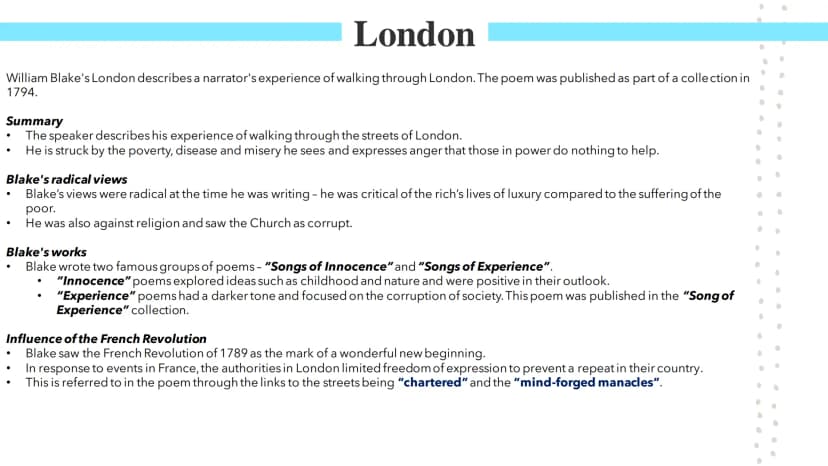
London by William Blake - Introduction
This page introduces William Blake's poem "London" and provides key contextual information for understanding the London poem analysis.
Key points:
- "London" was published in 1794 as part of Blake's "Songs of Experience" collection
- The poem describes a narrator walking through London, observing widespread poverty and misery
- It expresses anger at those in power for failing to alleviate suffering
Context: Blake held radical views for his time, criticizing the luxurious lives of the rich compared to the poor's suffering. He was also against organized religion, viewing the Church as corrupt.
Blake's poetic works:
- Wrote two famous collections: "Songs of Innocence" and "Songs of Experience"
- "Innocence" poems explored positive themes like childhood and nature
- "Experience" poems had a darker tone, focusing on society's corruption
Highlight: The poem's context is heavily influenced by the French Revolution of 1789, which Blake initially saw as a positive new beginning. However, the subsequent crackdown on free expression in London is reflected in the poem's references to "chartered" streets and "mind-forged manacles".
This introduction sets the stage for a deeper London poem analysis, highlighting Blake's critical perspective on late 18th century English society.
2
of 9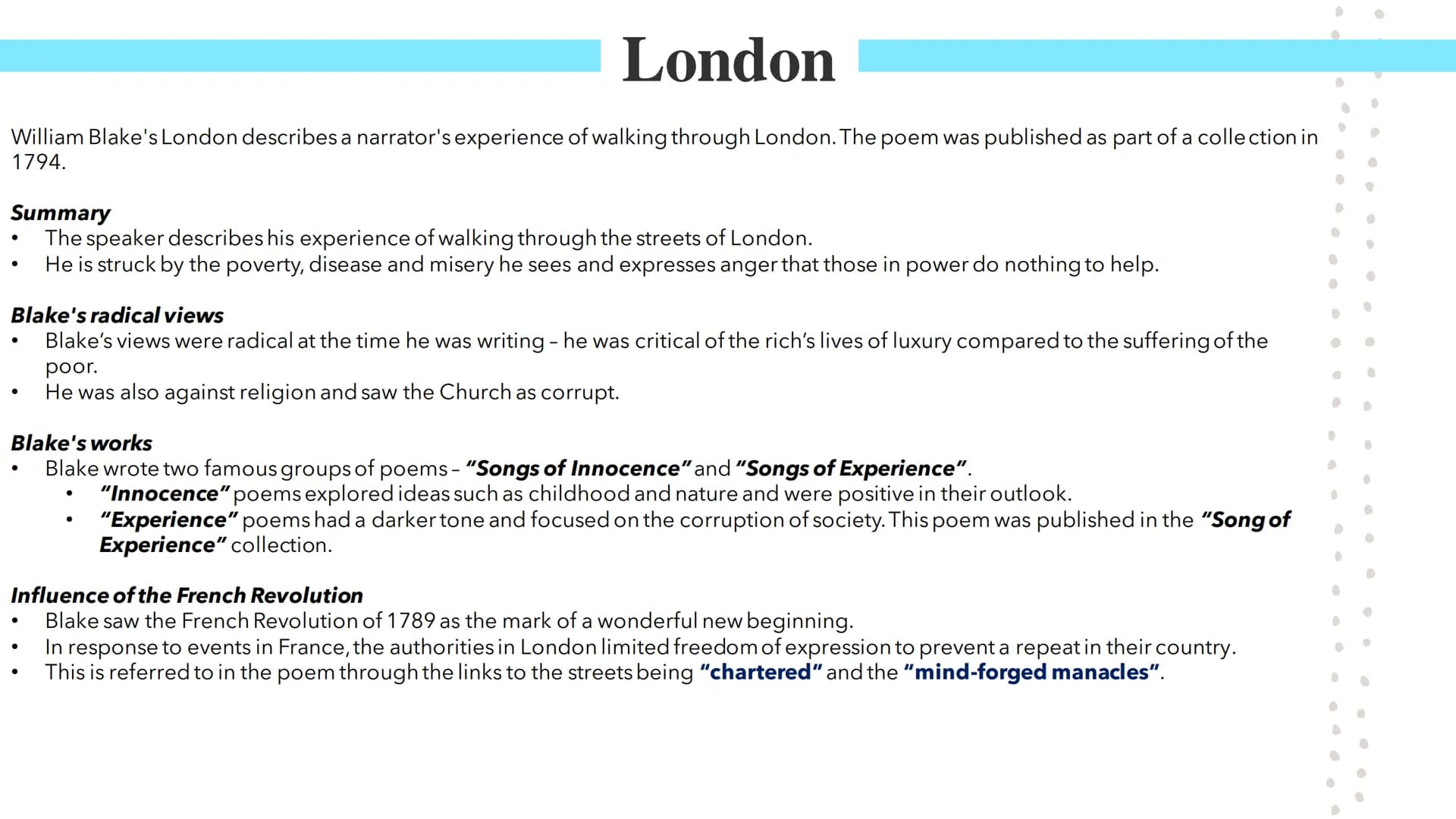
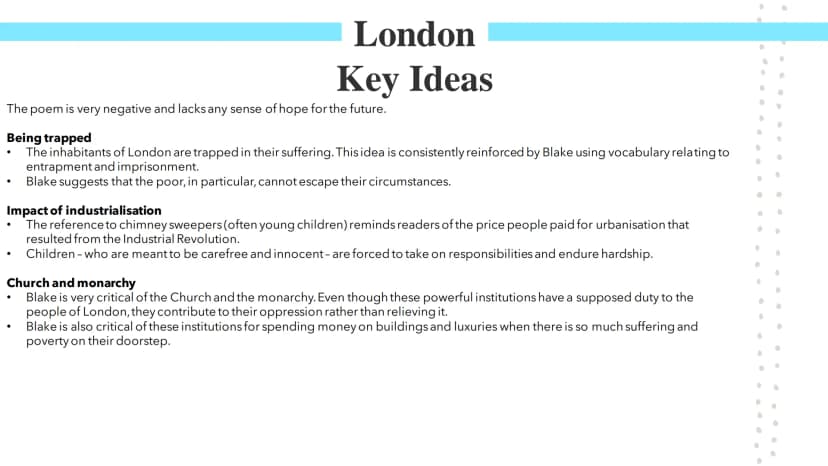
Key Ideas in London by William Blake
This section explores the central themes and ideas in Blake's "London", providing essential insights for a comprehensive London poem analysis.
Main ideas:
-
Pervasive negativity: The poem lacks any sense of hope for the future.
-
Entrapment:
- London's inhabitants are portrayed as trapped in their suffering
- Blake uses vocabulary related to imprisonment to reinforce this idea
- The poor are shown as unable to escape their circumstances
-
Impact of industrialization:
- References to chimney sweepers highlight the human cost of urban development
- Children are forced into labor, losing their innocence and carefree nature
-
Criticism of institutions:
- Blake harshly criticizes the Church and monarchy
- These powerful institutions are shown as oppressors rather than protectors
- Blake condemns their focus on luxury while ignoring widespread poverty
Quote: "And the hapless soldier's sigh / Runs in blood down palace walls" - This line criticizes the monarchy's indifference to soldiers' suffering.
Highlight: Blake's critique of societal institutions and the effects of industrialization makes "London" a powerful social commentary that remains relevant today.
This analysis of key ideas provides crucial context for understanding the London poem themes and Blake's critical perspective on 18th century English society.
3
of 9
Structure and Form of London by William Blake
This section examines the structural and formal elements of "London", offering insights into how Blake crafts his critique of society through poetic techniques.
Key structural and formal elements:
- Regular rhythm and rhyme:
- ABAB rhyme scheme
- Four stanzas of four lines each
- Written in iambic tetrameter (a rigid rhythm)
- Enjambment (sentences flowing over line endings)
Highlight: The regular rhythm and enjambment echo the never-ending cycle of suffering in London.
-
Shifting focus:
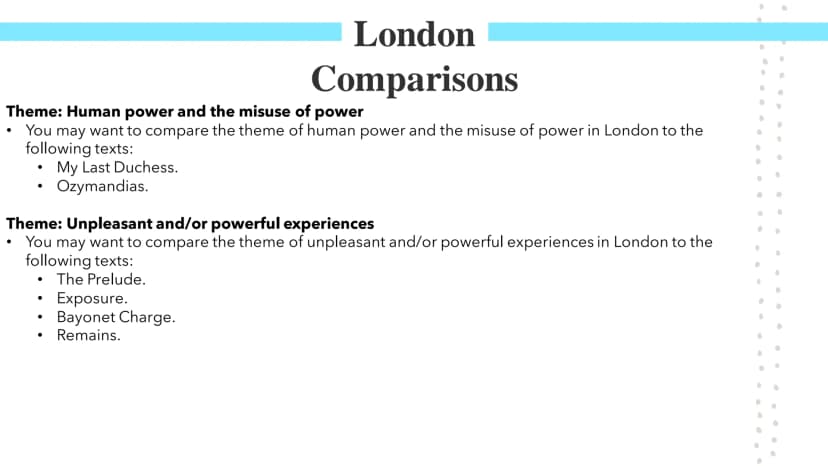
- First part describes general deprivation and misery
- Stanza 3 shifts to those responsible (the "black'ning church" and "palace")
- Final stanza emphasizes the widespread nature of suffering, affecting even newborns
-
Dramatic monologue:
- Written from the perspective of a single speaker
- Conveys the narrator's personal anger and frustration at the suffering around him
Definition: A dramatic monologue is a type of poem in which a single character speaks to a silent listener, revealing their thoughts and feelings.
Example: The line "I wander thro' each charter'd street" immediately establishes the speaker's presence and perspective.
This analysis of structure and form is crucial for a thorough London poem analysis, showing how Blake uses poetic techniques to reinforce his themes and critique of society.
4
of 9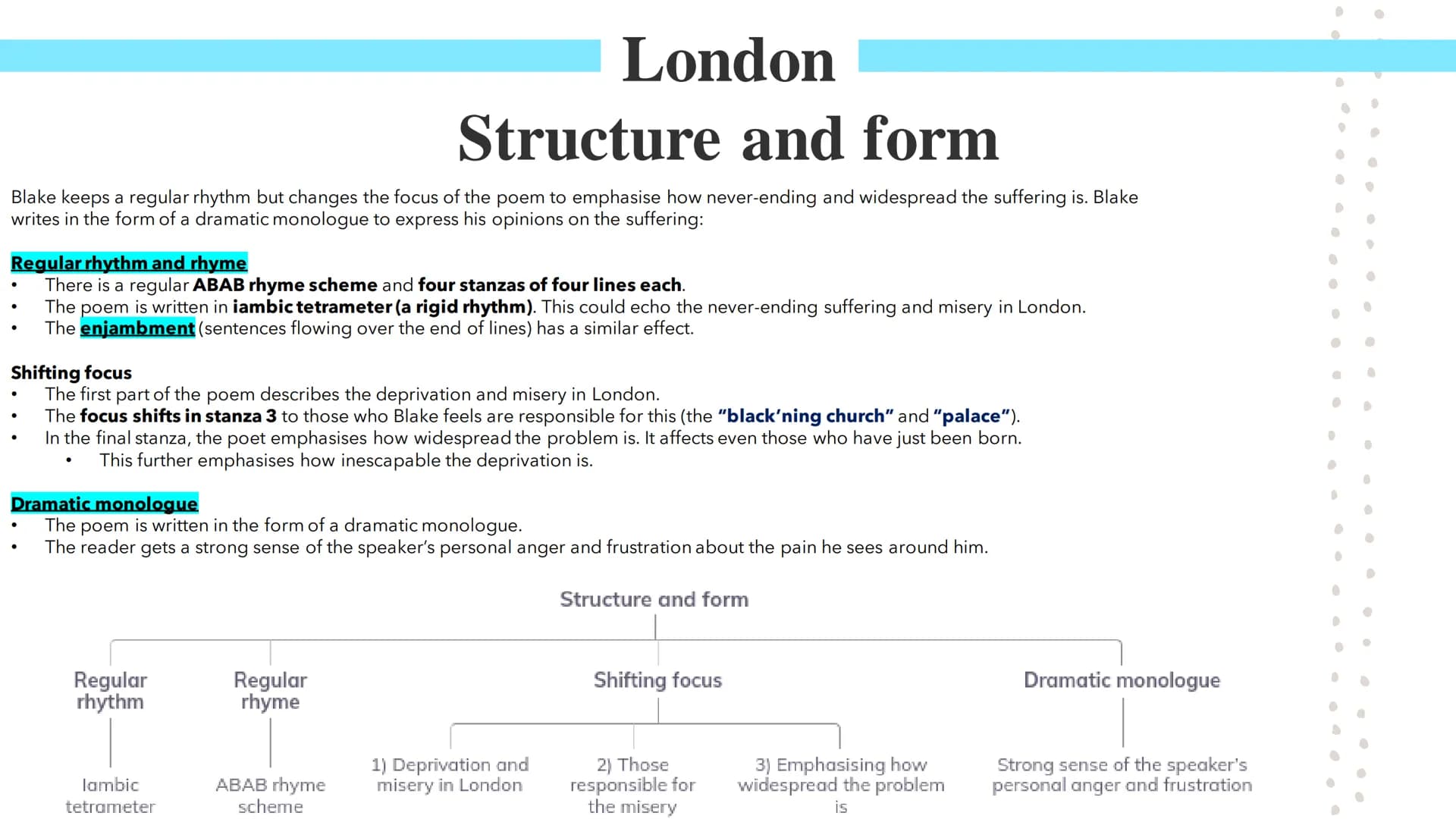
Language Analysis: Suffering and Horror in London by William Blake
This section provides a detailed London poem analysis focusing on Blake's use of language to convey the suffering and horror he observes in the city.
Key linguistic techniques:
-
Sensory language:
- Brings the horror of London alive for the reader
- Examples include vivid descriptions of sights and sounds in the city
-
Repetition of "every":
- Emphasizes the widespread nature of suffering
- Occurs throughout the poem to reinforce the universality of misery
-
Emotive language:
- Expresses the extent of suffering and Blake's anger at negligent institutions
- Examples include:
- "Marks of weakness, marks of woe"
- "In every infant's cry of fear"
- "Blasts the newborn infant's tear"
Quote: "And mark in every face I meet / Marks of weakness, marks of woe" - This line uses repetition and emotive language to emphasize pervasive suffering.
- Vivid verbs:
- Words like "curse" and "blast" intensify the horrors described
- Create a sense of violence and destruction
Vocabulary: "Blast" in this context means to damage or destroy, emphasizing the harmful impact of society on its most vulnerable members.
This language analysis is crucial for understanding how Blake crafts his powerful critique of London society, making "London" a seminal work in English literature.
5
of 9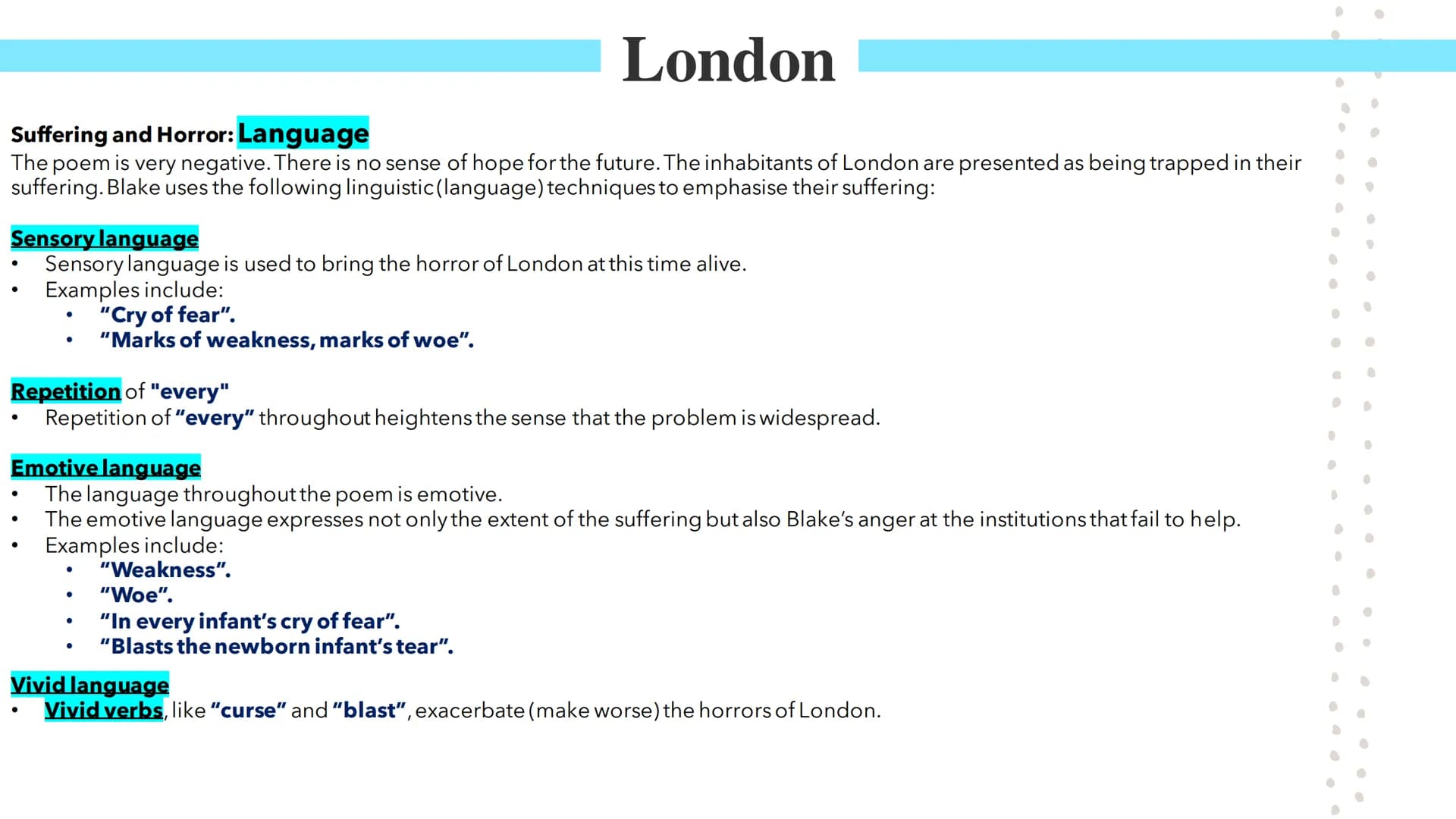
Themes in London by William Blake
This section explores the central themes in "London", providing a deeper London poem analysis and insight into Blake's critique of 18th century English society.
Key themes:
- Corrupt Institutions:
- Blake harshly criticizes the Church and monarchy
- These powerful entities are portrayed as failing in their duty to help the suffering populace
- The poem suggests they contribute to oppression rather than alleviating it
Quote: "How the chimney-sweeper's cry / Every black'ning church appalls" - This line criticizes the Church's indifference to child labor.
-
Suffering and Oppression:
- The poem vividly depicts widespread misery in London
- Characters like chimney sweepers and soldiers represent different facets of societal suffering
- Blake emphasizes how inescapable this suffering is, affecting even newborns
-
Loss of Innocence:
- The poem contrasts with Blake's earlier "Songs of Innocence"
- Children, traditionally symbols of innocence, are shown as victims of societal corruption
- The "youthful harlot's curse" represents the ultimate loss of innocence
-
Social Injustice:
- Blake critiques the stark inequality in London society
- The poem highlights how the poor are trapped in cycles of poverty and exploitation
- The powerful are implicated in perpetuating this unjust system
Highlight: Blake's themes of corruption, suffering, and social injustice make "London" a powerful critique of urban society that remains relevant today.
This thematic analysis is essential for a comprehensive understanding of the London poem themes and Blake's radical social commentary.
6
of 9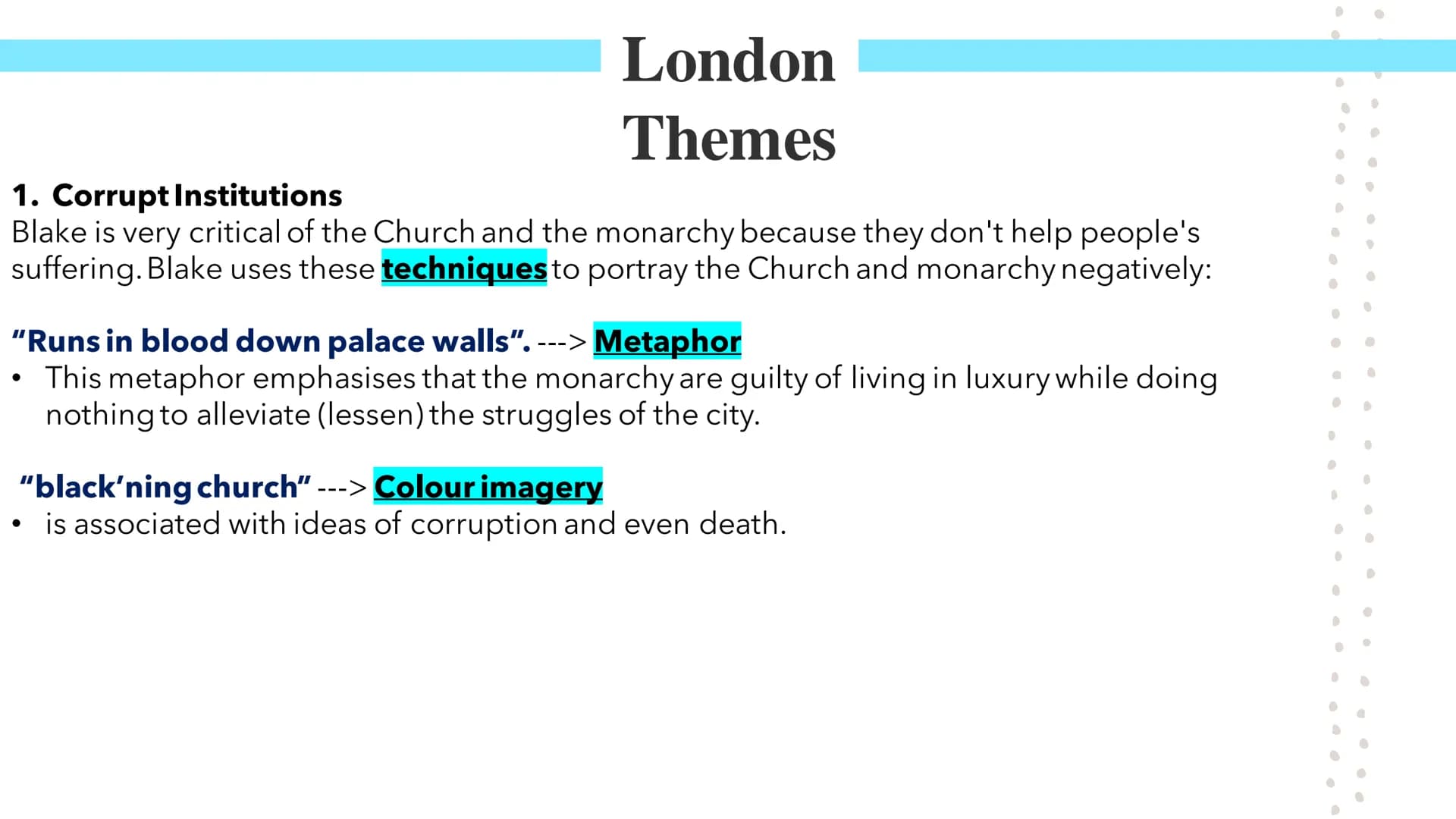
Conclusion and Significance of London by William Blake
This final section summarizes the key aspects of "London" and reflects on its enduring significance in English literature and social commentary.
Key points:
-
Powerful critique:
- "London" offers a scathing indictment of late 18th century English society
- Blake exposes widespread suffering, corruption, and social injustice
-
Innovative poetic techniques:
- Use of dramatic monologue to convey personal anger and frustration
- Vivid imagery and repetition to emphasize pervasive misery
- Regular rhythm and rhyme scheme echoing the cycle of suffering
-
Themes of universal relevance:
- Corruption of powerful institutions
- Impact of industrialization on society
- Loss of innocence in urban environments
- Persistent social inequality
Highlight: The themes and critiques in "London" remain strikingly relevant to modern urban societies, contributing to the poem's enduring impact.
-
Historical context:
- Reflects Blake's disillusionment following the French Revolution
- Captures the atmosphere of political repression in 1790s London
-
Literary significance:
- Considered one of Blake's most powerful and influential works
- Exemplifies the shift from Romantic idealism to social criticism in English poetry
Quote: "And mark in every face I meet / Marks of weakness, marks of woe" - This oft-quoted line encapsulates the poem's central theme of pervasive suffering.
This London poem analysis demonstrates why "London" remains a crucial text in English literature, offering a timeless critique of urban society and the human condition.
7
of 9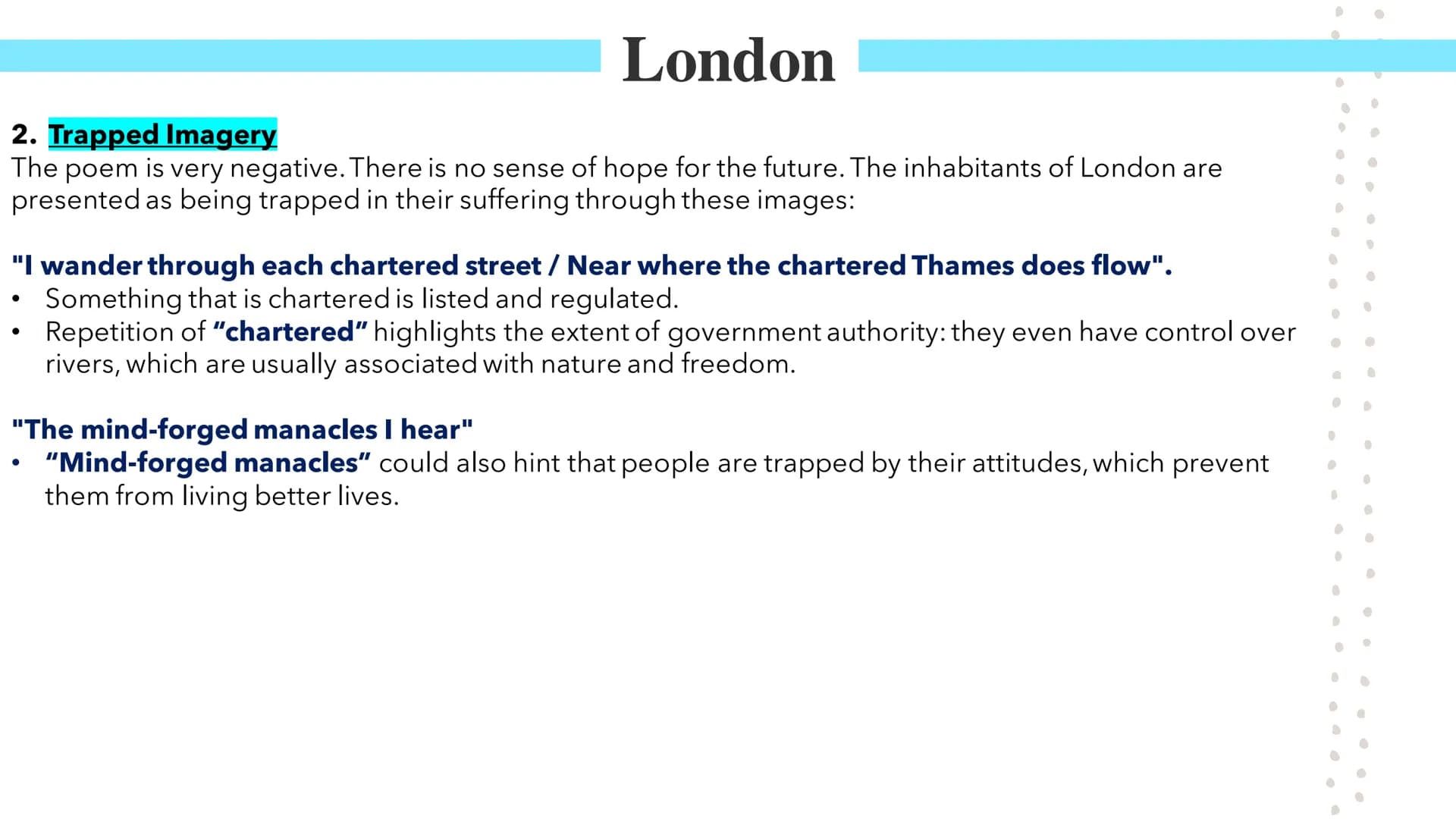
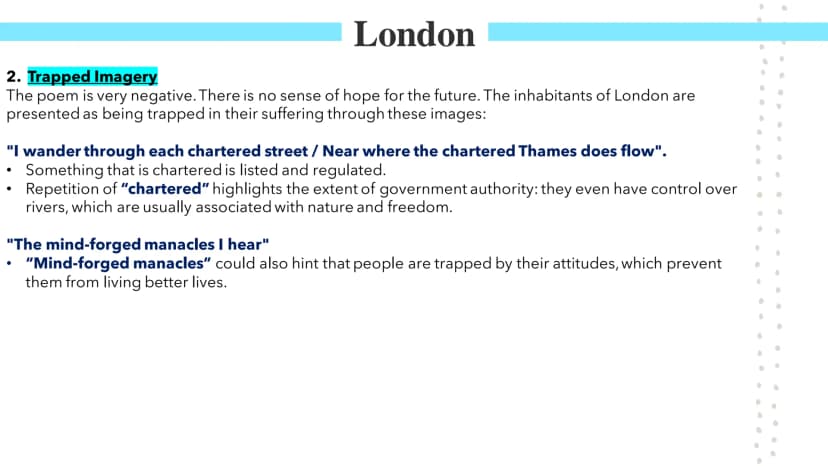
Imagery of Entrapment
This section explores how Blake uses imagery to convey confinement and control.
Quote: "I wander through each chartered street / Near where the chartered Thames does flow"
Definition: Chartered - officially authorized or regulated by authority.
8
of 9
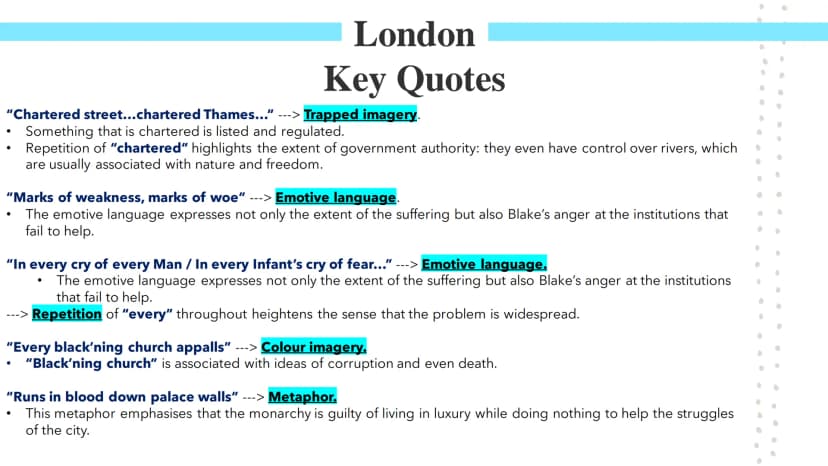
Key Quotations
The eighth page provides essential quotations and their analysis.
Highlight: The repetition of "chartered" emphasizes pervasive governmental control.
Example: "Marks of weakness, marks of woe" demonstrates the visible signs of suffering.
9
of 9
Overall Summary of London by William Blake
London by William Blake provides a searing critique of late 18th century London society, exposing the widespread suffering, oppression and social injustice of the time. This London poem analysis reveals how Blake uses vivid imagery and repetition to emphasize the pervasive misery he observes while walking through London's streets.
Key aspects of the poem:
- Published in 1794 as part of Blake's "Songs of Experience" collection
- Written as a dramatic monologue expressing Blake's radical political and social views
- Criticizes corrupt institutions like the Church and monarchy for failing to help the poor
- Highlights negative impacts of industrialization, especially on children
- Uses techniques like sensory language and repetition to bring the horrors of London to life
- Maintains a regular rhythm and ABAB rhyme scheme to echo the endless cycle of suffering
- Shifts focus from general deprivation to specific institutions responsible and then to the universality of misery
- Employs vivid, emotive language to convey the narrator's anger and frustration
This London poem context reflects Blake's disillusionment following the French Revolution and subsequent crackdown on free expression in England. The poem's themes of oppression, social injustice, and corrupt power structures remain relevant today, cementing its place as a powerful critique of urban society.
We thought you’d never ask...
What is the Knowunity AI companion?
Our AI companion is specifically built for the needs of students. Based on the millions of content pieces we have on the platform we can provide truly meaningful and relevant answers to students. But its not only about answers, the companion is even more about guiding students through their daily learning challenges, with personalised study plans, quizzes or content pieces in the chat and 100% personalisation based on the students skills and developments.
Where can I download the Knowunity app?
You can download the app in the Google Play Store and in the Apple App Store.
Is Knowunity really free of charge?
That's right! Enjoy free access to study content, connect with fellow students, and get instant help – all at your fingertips.
Similar Content
Most popular content: William Blake's London
9English LiteratureBlake's London Analysis
Explore William Blake's 'London' through a detailed analysis of its themes, including entrapment, the impact of industrialization, and critiques of the Church and monarchy. This summary highlights key quotations, structural elements, and comparisons with other works, providing essential insights for students studying this powerful poem from the 'Songs of Experience' collection.
1010,558347
English LiteratureLondon's Poetic Struggles
Explore the poignant themes of poverty, child labor, and women's oppression in London's poetry, focusing on works like 'A Wife in London' and William Blake's 'London'. This summary provides critical insights into the socio-political context and literary techniques used in these poems.
105,921345
English LiteratureOppression in Poetry: Blake & Agard
Explore a Grade 9 analytical essay comparing William Blake's 'London' and Linton Kwesi Johnson's 'Checking Out Me History'. This essay delves into themes of oppression, misuse of power, and the contrasting tones of despair and hope in both poems. Key linguistic devices, motifs, and the poets' critiques of societal structures are examined to inspire critical thinking and understanding of historical context.
1081814
English LiteratureBlake's London: Oppression & Innocence
Explore the profound themes of oppression and innocence in William Blake's poem 'London'. This analysis delves into the imagery, structure, and social commentary reflecting the Industrial Revolution's impact on society. Key concepts include the use of repetition, caesura, and juxtaposition to illustrate the struggles of the oppressed and the corruption of institutions. Ideal for GCSE English Literature students studying poetry.
111,14650
English LiteratureBlake's London: Oppression & Power
Explore William Blake's 'London' through detailed analysis of its themes, structure, and context. This study note delves into the poem's portrayal of social issues, the cycle of poverty, and the psychological impact of oppression. Ideal for GCSE English students, it includes key quotes, methods, and insights to enhance understanding and critical analysis. Perfect for exam preparation and deepening literary appreciation.
102,10656
English LiteratureBlake's London Analysis
Explore a comprehensive analysis of William Blake's poem 'London'. This study note delves into key themes such as deprivation, corruption, and the impact of the Industrial Revolution on society. Understand Blake's critique of the monarchy and church, and how he portrays the suffering of the city's inhabitants through vivid imagery and powerful language. Ideal for GCSE English Literature students seeking to deepen their understanding of this significant work.
111,36316
English LiteratureBlake's London: Power & Suffering
Explore William Blake's poignant critique of societal oppression in his poem 'London'. This analysis delves into themes of greed, inequality, and the impact of institutional power on the individual. Key concepts include the use of iambic tetrameter, the significance of repetition, and the juxtaposition of innocence and immorality. Ideal for students studying English Literature and poetry analysis.
114592
English LiteratureBlake's London: Power and Despair
Explore the themes of power, disillusionment, and societal decay in William Blake's 'London'. This analysis delves into key quotes, the emotional impact of repetition, and the symbolism of death and marriage, highlighting the poem's critique of authority and the human condition. Ideal for English literature students seeking a deeper understanding of Blake's work.
1163924
English LiteratureLondon - My Last Duchess poetry comparison
AQA GCSE English Literature power and conflict
101273
Most popular content in English Literature
9English LiteratureAn Inspector Calls: Character Insights
Explore in-depth analysis and key quotes for characters in J.B. Priestley's 'An Inspector Calls'. This resource covers Gerald Croft, Inspector Goole, Sheila Birling, Mrs. Birling, Eric Birling, and Eva Smith, focusing on themes of class, gender roles, and social responsibility. Ideal for students aiming for Grade 8 and above.
1025,429907
English LiteratureRomeo and Juliet: Key themes
Key Romeo and Juliet themes and analysed quotes
106,708198
English LiteratureMacbeth: Guilt and Ambition
Explore the complex themes of guilt and ambition in Shakespeare's 'Macbeth'. This analysis covers key characters, including Macbeth and Lady Macbeth, their moral dilemmas, and the tragic consequences of their ambition. Ideal for students studying character motivations, thematic elements, and the psychological impact of power. Includes insights on the natural order, manipulation, and the descent into madness.
919,093397
I
English LiteratureInspector Calls Quiz (YR 10 MOCKS)
for YR 10 GCSE mock on Inspector Calls
102,1451
E
English LiteratureExplore the World of English Literature
Master the key concepts and works of English literature with this comprehensive flashcard set designed for grade 10 students.
112,0941
English LiteratureExploring Macbeth's Themes
Dive into the intricate themes of Shakespeare's Macbeth, including the supernatural, ambition, guilt, and kingship. This analysis features key quotes and insights that reveal how these themes intertwine to shape the characters and the narrative. Ideal for students seeking a deeper understanding of the play's moral complexities and psychological depth.
1015,849524
E
English LiteratureExploring English Literature: A Journey through Medium
Discover the captivating world of English Literature with this comprehensive medium-level flashcard set. Dive into the works of renowned authors and explore the themes, characters, and literary techniques that make their writing truly remarkable.
111,0580
E
English LiteratureExploring 'A Christmas Carol': Themes, Characters, and Lessons
Delve into the main themes, key characters, and valuable lessons in Charles Dickens' 'A Christmas Carol'. Discover the impact of Scrooge's transformation and the significance of love, redemption, and the true meaning of Christmas.
101,2480
English LiteratureMacbeth Key Themes Essay Plans
Essay plans for key themes in macbeth - guilt, supernatural & ambition
115,186146
Most popular content
9 Sociology
Sociology of Education Overview
Explore comprehensive A-Level Sociology notes on the education system, covering key theories, policies, and sociological perspectives. This resource includes insights on marketisation, gender roles, cultural deprivation, and educational inequalities, providing a thorough understanding of how education shapes social stratification and individual achievement. Ideal for exam preparation and in-depth study.
12102,8693,040
SociologySociology of Families: Comprehensive Revision
Dive into an extensive overview of family dynamics, perspectives, and patterns in sociology. This resource covers key concepts such as family diversity, gender roles, marriage, and the impact of social policies on family structures. Perfect for A-Level Sociology students preparing for Paper 2.
1273,6612,307
CriminologyCriminology: Crime & Punishment Overview
Comprehensive mindmaps covering key concepts in the Crime and Punishment topic for WJEC Criminology Unit 4. This resource includes detailed insights into the Criminal Justice System, crime prevention strategies, sentencing models, and the roles of various agencies. Ideal for A-Level revision, ensuring you grasp essential theories and legislative processes to excel in your exams.
1254,8691,059
SociologyComprehensive Crime & Deviance Overview
Explore an extensive revision of crime and deviance topics, including theories, types of crime, and the impact of media. This resource covers key concepts such as Marxism, functionalism, gender and crime, and the influence of globalization on criminal behavior. Ideal for students seeking a thorough understanding of criminology and its various theories. Type: Full Topic Revision.
1251,6541,399
C
 Biology
Cell Biology and Cell structure
cell structures
93,2470
English LiteratureAn Inspector Calls: Character Insights
Explore in-depth analysis and key quotes for characters in J.B. Priestley's 'An Inspector Calls'. This resource covers Gerald Croft, Inspector Goole, Sheila Birling, Mrs. Birling, Eric Birling, and Eva Smith, focusing on themes of class, gender roles, and social responsibility. Ideal for students aiming for Grade 8 and above.
1025,429907
CriminologyWJEC Unit 4 Criminology
Criminology unit 4 detailed revision note
127,151125
CriminologyCriminology Theories Overview
Explore key criminology theories and their implications on crime and deviance. This comprehensive summary covers biological, psychological, and sociological perspectives, including labelling theory, right realism, and the impact of social campaigns on policy development. Ideal for A-Level criminology students seeking to understand the complexities of criminal behaviour and the factors influencing crime prevention strategies.
129,760210
English LiteratureRomeo and Juliet: Key themes
Key Romeo and Juliet themes and analysed quotes
106,708198
Can't find what you're looking for? Explore other subjects.
Students love us — and so will you.
4.6/5App Store
4.7/5Google Play
The app is very easy to use and well designed. I have found everything I was looking for so far and have been able to learn a lot from the presentations! I will definitely use the app for a class assignment! And of course it also helps a lot as an inspiration.
Stefan SiOS user
This app is really great. There are so many study notes and help [...]. My problem subject is French, for example, and the app has so many options for help. Thanks to this app, I have improved my French. I would recommend it to anyone.
Samantha KlichAndroid user
Wow, I am really amazed. I just tried the app because I've seen it advertised many times and was absolutely stunned. This app is THE HELP you want for school and above all, it offers so many things, such as workouts and fact sheets, which have been VERY helpful to me personally.
AnnaiOS user
English Literature2,704 views·Updated Jun 19, 2026·9 pagesExplore The London Poem: Fun Gcse Summary & Analysis for Kids!
Gabriela@gabriela.my.school.journey16
London by William Blake stands as a powerful critique of late 18th-century urban life, examining themes of social injustice, institutional corruption, and human suffering. This comprehensive analysis explores the poem's structure, themes, and historical context.
• The poem presents...
1
of 9
Sign up to see the content. It's free!
- Access to all documents
- Improve your grades
- Join milions of students
London by William Blake - Introduction
This page introduces William Blake's poem "London" and provides key contextual information for understanding the London poem analysis.
Key points:
- "London" was published in 1794 as part of Blake's "Songs of Experience" collection
- The poem describes a narrator walking through London, observing widespread poverty and misery
- It expresses anger at those in power for failing to alleviate suffering
Context: Blake held radical views for his time, criticizing the luxurious lives of the rich compared to the poor's suffering. He was also against organized religion, viewing the Church as corrupt.
Blake's poetic works:
- Wrote two famous collections: "Songs of Innocence" and "Songs of Experience"
- "Innocence" poems explored positive themes like childhood and nature
- "Experience" poems had a darker tone, focusing on society's corruption
Highlight: The poem's context is heavily influenced by the French Revolution of 1789, which Blake initially saw as a positive new beginning. However, the subsequent crackdown on free expression in London is reflected in the poem's references to "chartered" streets and "mind-forged manacles".
This introduction sets the stage for a deeper London poem analysis, highlighting Blake's critical perspective on late 18th century English society.
2
of 9Sign up to see the content. It's free!
- Access to all documents
- Improve your grades
- Join milions of students
Key Ideas in London by William Blake
This section explores the central themes and ideas in Blake's "London", providing essential insights for a comprehensive London poem analysis.
Main ideas:
-
Pervasive negativity: The poem lacks any sense of hope for the future.
-
Entrapment:
- London's inhabitants are portrayed as trapped in their suffering
- Blake uses vocabulary related to imprisonment to reinforce this idea
- The poor are shown as unable to escape their circumstances
-
Impact of industrialization:
- References to chimney sweepers highlight the human cost of urban development
- Children are forced into labor, losing their innocence and carefree nature
-
Criticism of institutions:
- Blake harshly criticizes the Church and monarchy
- These powerful institutions are shown as oppressors rather than protectors
- Blake condemns their focus on luxury while ignoring widespread poverty
Quote: "And the hapless soldier's sigh / Runs in blood down palace walls" - This line criticizes the monarchy's indifference to soldiers' suffering.
Highlight: Blake's critique of societal institutions and the effects of industrialization makes "London" a powerful social commentary that remains relevant today.
This analysis of key ideas provides crucial context for understanding the London poem themes and Blake's critical perspective on 18th century English society.
3
of 9Sign up to see the content. It's free!
- Access to all documents
- Improve your grades
- Join milions of students
Structure and Form of London by William Blake
This section examines the structural and formal elements of "London", offering insights into how Blake crafts his critique of society through poetic techniques.
Key structural and formal elements:
- Regular rhythm and rhyme:
- ABAB rhyme scheme
- Four stanzas of four lines each
- Written in iambic tetrameter (a rigid rhythm)
- Enjambment (sentences flowing over line endings)
Highlight: The regular rhythm and enjambment echo the never-ending cycle of suffering in London.
-
Shifting focus:
- First part describes general deprivation and misery
- Stanza 3 shifts to those responsible (the "black'ning church" and "palace")
- Final stanza emphasizes the widespread nature of suffering, affecting even newborns
-
Dramatic monologue:
- Written from the perspective of a single speaker
- Conveys the narrator's personal anger and frustration at the suffering around him
Definition: A dramatic monologue is a type of poem in which a single character speaks to a silent listener, revealing their thoughts and feelings.
Example: The line "I wander thro' each charter'd street" immediately establishes the speaker's presence and perspective.
This analysis of structure and form is crucial for a thorough London poem analysis, showing how Blake uses poetic techniques to reinforce his themes and critique of society.
4
of 9Sign up to see the content. It's free!
- Access to all documents
- Improve your grades
- Join milions of students
Language Analysis: Suffering and Horror in London by William Blake
This section provides a detailed London poem analysis focusing on Blake's use of language to convey the suffering and horror he observes in the city.
Key linguistic techniques:
-
Sensory language:
- Brings the horror of London alive for the reader
- Examples include vivid descriptions of sights and sounds in the city
-
Repetition of "every":
- Emphasizes the widespread nature of suffering
- Occurs throughout the poem to reinforce the universality of misery
-
Emotive language:
- Expresses the extent of suffering and Blake's anger at negligent institutions
- Examples include:
- "Marks of weakness, marks of woe"
- "In every infant's cry of fear"
- "Blasts the newborn infant's tear"
Quote: "And mark in every face I meet / Marks of weakness, marks of woe" - This line uses repetition and emotive language to emphasize pervasive suffering.
- Vivid verbs:
- Words like "curse" and "blast" intensify the horrors described
- Create a sense of violence and destruction
Vocabulary: "Blast" in this context means to damage or destroy, emphasizing the harmful impact of society on its most vulnerable members.
This language analysis is crucial for understanding how Blake crafts his powerful critique of London society, making "London" a seminal work in English literature.
5
of 9Sign up to see the content. It's free!
- Access to all documents
- Improve your grades
- Join milions of students
Themes in London by William Blake
This section explores the central themes in "London", providing a deeper London poem analysis and insight into Blake's critique of 18th century English society.
Key themes:
- Corrupt Institutions:
- Blake harshly criticizes the Church and monarchy
- These powerful entities are portrayed as failing in their duty to help the suffering populace
- The poem suggests they contribute to oppression rather than alleviating it
Quote: "How the chimney-sweeper's cry / Every black'ning church appalls" - This line criticizes the Church's indifference to child labor.
-
Suffering and Oppression:
- The poem vividly depicts widespread misery in London
- Characters like chimney sweepers and soldiers represent different facets of societal suffering
- Blake emphasizes how inescapable this suffering is, affecting even newborns
-
Loss of Innocence:
- The poem contrasts with Blake's earlier "Songs of Innocence"
- Children, traditionally symbols of innocence, are shown as victims of societal corruption
- The "youthful harlot's curse" represents the ultimate loss of innocence
-
Social Injustice:
- Blake critiques the stark inequality in London society
- The poem highlights how the poor are trapped in cycles of poverty and exploitation
- The powerful are implicated in perpetuating this unjust system
Highlight: Blake's themes of corruption, suffering, and social injustice make "London" a powerful critique of urban society that remains relevant today.
This thematic analysis is essential for a comprehensive understanding of the London poem themes and Blake's radical social commentary.
6
of 9Sign up to see the content. It's free!
- Access to all documents
- Improve your grades
- Join milions of students
Conclusion and Significance of London by William Blake
This final section summarizes the key aspects of "London" and reflects on its enduring significance in English literature and social commentary.
Key points:
-
Powerful critique:
- "London" offers a scathing indictment of late 18th century English society
- Blake exposes widespread suffering, corruption, and social injustice
-
Innovative poetic techniques:
- Use of dramatic monologue to convey personal anger and frustration
- Vivid imagery and repetition to emphasize pervasive misery
- Regular rhythm and rhyme scheme echoing the cycle of suffering
-
Themes of universal relevance:
- Corruption of powerful institutions
- Impact of industrialization on society
- Loss of innocence in urban environments
- Persistent social inequality
Highlight: The themes and critiques in "London" remain strikingly relevant to modern urban societies, contributing to the poem's enduring impact.
-
Historical context:
- Reflects Blake's disillusionment following the French Revolution
- Captures the atmosphere of political repression in 1790s London
-
Literary significance:
- Considered one of Blake's most powerful and influential works
- Exemplifies the shift from Romantic idealism to social criticism in English poetry
Quote: "And mark in every face I meet / Marks of weakness, marks of woe" - This oft-quoted line encapsulates the poem's central theme of pervasive suffering.
This London poem analysis demonstrates why "London" remains a crucial text in English literature, offering a timeless critique of urban society and the human condition.
7
of 9Sign up to see the content. It's free!
- Access to all documents
- Improve your grades
- Join milions of students
Imagery of Entrapment
This section explores how Blake uses imagery to convey confinement and control.
Quote: "I wander through each chartered street / Near where the chartered Thames does flow"
Definition: Chartered - officially authorized or regulated by authority.
8
of 9Sign up to see the content. It's free!
- Access to all documents
- Improve your grades
- Join milions of students
Key Quotations
The eighth page provides essential quotations and their analysis.
Highlight: The repetition of "chartered" emphasizes pervasive governmental control.
Example: "Marks of weakness, marks of woe" demonstrates the visible signs of suffering.
9
of 9Sign up to see the content. It's free!
- Access to all documents
- Improve your grades
- Join milions of students
Overall Summary of London by William Blake
London by William Blake provides a searing critique of late 18th century London society, exposing the widespread suffering, oppression and social injustice of the time. This London poem analysis reveals how Blake uses vivid imagery and repetition to emphasize the pervasive misery he observes while walking through London's streets.
Key aspects of the poem:
- Published in 1794 as part of Blake's "Songs of Experience" collection
- Written as a dramatic monologue expressing Blake's radical political and social views
- Criticizes corrupt institutions like the Church and monarchy for failing to help the poor
- Highlights negative impacts of industrialization, especially on children
- Uses techniques like sensory language and repetition to bring the horrors of London to life
- Maintains a regular rhythm and ABAB rhyme scheme to echo the endless cycle of suffering
- Shifts focus from general deprivation to specific institutions responsible and then to the universality of misery
- Employs vivid, emotive language to convey the narrator's anger and frustration
This London poem context reflects Blake's disillusionment following the French Revolution and subsequent crackdown on free expression in England. The poem's themes of oppression, social injustice, and corrupt power structures remain relevant today, cementing its place as a powerful critique of urban society.
We thought you’d never ask...
What is the Knowunity AI companion?
Our AI companion is specifically built for the needs of students. Based on the millions of content pieces we have on the platform we can provide truly meaningful and relevant answers to students. But its not only about answers, the companion is even more about guiding students through their daily learning challenges, with personalised study plans, quizzes or content pieces in the chat and 100% personalisation based on the students skills and developments.
Where can I download the Knowunity app?
You can download the app in the Google Play Store and in the Apple App Store.
Is Knowunity really free of charge?
That's right! Enjoy free access to study content, connect with fellow students, and get instant help – all at your fingertips.
Similar Content
Most popular content: William Blake's London
9English LiteratureBlake's London Analysis
Explore William Blake's 'London' through a detailed analysis of its themes, including entrapment, the impact of industrialization, and critiques of the Church and monarchy. This summary highlights key quotations, structural elements, and comparisons with other works, providing essential insights for students studying this powerful poem from the 'Songs of Experience' collection.
1010,558347
English LiteratureLondon's Poetic Struggles
Explore the poignant themes of poverty, child labor, and women's oppression in London's poetry, focusing on works like 'A Wife in London' and William Blake's 'London'. This summary provides critical insights into the socio-political context and literary techniques used in these poems.
105,921345
English LiteratureOppression in Poetry: Blake & Agard
Explore a Grade 9 analytical essay comparing William Blake's 'London' and Linton Kwesi Johnson's 'Checking Out Me History'. This essay delves into themes of oppression, misuse of power, and the contrasting tones of despair and hope in both poems. Key linguistic devices, motifs, and the poets' critiques of societal structures are examined to inspire critical thinking and understanding of historical context.
1081814
English LiteratureBlake's London: Oppression & Innocence
Explore the profound themes of oppression and innocence in William Blake's poem 'London'. This analysis delves into the imagery, structure, and social commentary reflecting the Industrial Revolution's impact on society. Key concepts include the use of repetition, caesura, and juxtaposition to illustrate the struggles of the oppressed and the corruption of institutions. Ideal for GCSE English Literature students studying poetry.
111,14650
English LiteratureBlake's London: Oppression & Power
Explore William Blake's 'London' through detailed analysis of its themes, structure, and context. This study note delves into the poem's portrayal of social issues, the cycle of poverty, and the psychological impact of oppression. Ideal for GCSE English students, it includes key quotes, methods, and insights to enhance understanding and critical analysis. Perfect for exam preparation and deepening literary appreciation.
102,10656
English LiteratureBlake's London Analysis
Explore a comprehensive analysis of William Blake's poem 'London'. This study note delves into key themes such as deprivation, corruption, and the impact of the Industrial Revolution on society. Understand Blake's critique of the monarchy and church, and how he portrays the suffering of the city's inhabitants through vivid imagery and powerful language. Ideal for GCSE English Literature students seeking to deepen their understanding of this significant work.
111,36316
English LiteratureBlake's London: Power & Suffering
Explore William Blake's poignant critique of societal oppression in his poem 'London'. This analysis delves into themes of greed, inequality, and the impact of institutional power on the individual. Key concepts include the use of iambic tetrameter, the significance of repetition, and the juxtaposition of innocence and immorality. Ideal for students studying English Literature and poetry analysis.
114592
English LiteratureBlake's London: Power and Despair
Explore the themes of power, disillusionment, and societal decay in William Blake's 'London'. This analysis delves into key quotes, the emotional impact of repetition, and the symbolism of death and marriage, highlighting the poem's critique of authority and the human condition. Ideal for English literature students seeking a deeper understanding of Blake's work.
1163924
English LiteratureLondon - My Last Duchess poetry comparison
AQA GCSE English Literature power and conflict
101273
Most popular content in English Literature
9English LiteratureAn Inspector Calls: Character Insights
Explore in-depth analysis and key quotes for characters in J.B. Priestley's 'An Inspector Calls'. This resource covers Gerald Croft, Inspector Goole, Sheila Birling, Mrs. Birling, Eric Birling, and Eva Smith, focusing on themes of class, gender roles, and social responsibility. Ideal for students aiming for Grade 8 and above.
1025,429907
English LiteratureRomeo and Juliet: Key themes
Key Romeo and Juliet themes and analysed quotes
106,708198
English LiteratureMacbeth: Guilt and Ambition
Explore the complex themes of guilt and ambition in Shakespeare's 'Macbeth'. This analysis covers key characters, including Macbeth and Lady Macbeth, their moral dilemmas, and the tragic consequences of their ambition. Ideal for students studying character motivations, thematic elements, and the psychological impact of power. Includes insights on the natural order, manipulation, and the descent into madness.
919,093397
I
English LiteratureInspector Calls Quiz (YR 10 MOCKS)
for YR 10 GCSE mock on Inspector Calls
102,1451
E
English LiteratureExplore the World of English Literature
Master the key concepts and works of English literature with this comprehensive flashcard set designed for grade 10 students.
112,0941
English LiteratureExploring Macbeth's Themes
Dive into the intricate themes of Shakespeare's Macbeth, including the supernatural, ambition, guilt, and kingship. This analysis features key quotes and insights that reveal how these themes intertwine to shape the characters and the narrative. Ideal for students seeking a deeper understanding of the play's moral complexities and psychological depth.
1015,849524
E
English LiteratureExploring English Literature: A Journey through Medium
Discover the captivating world of English Literature with this comprehensive medium-level flashcard set. Dive into the works of renowned authors and explore the themes, characters, and literary techniques that make their writing truly remarkable.
111,0580
E
English LiteratureExploring 'A Christmas Carol': Themes, Characters, and Lessons
Delve into the main themes, key characters, and valuable lessons in Charles Dickens' 'A Christmas Carol'. Discover the impact of Scrooge's transformation and the significance of love, redemption, and the true meaning of Christmas.
101,2480
English LiteratureMacbeth Key Themes Essay Plans
Essay plans for key themes in macbeth - guilt, supernatural & ambition
115,186146
Most popular content
9SociologySociology of Education Overview
Explore comprehensive A-Level Sociology notes on the education system, covering key theories, policies, and sociological perspectives. This resource includes insights on marketisation, gender roles, cultural deprivation, and educational inequalities, providing a thorough understanding of how education shapes social stratification and individual achievement. Ideal for exam preparation and in-depth study.
12102,8693,040
SociologySociology of Families: Comprehensive Revision
Dive into an extensive overview of family dynamics, perspectives, and patterns in sociology. This resource covers key concepts such as family diversity, gender roles, marriage, and the impact of social policies on family structures. Perfect for A-Level Sociology students preparing for Paper 2.
1273,6612,307
CriminologyCriminology: Crime & Punishment Overview
Comprehensive mindmaps covering key concepts in the Crime and Punishment topic for WJEC Criminology Unit 4. This resource includes detailed insights into the Criminal Justice System, crime prevention strategies, sentencing models, and the roles of various agencies. Ideal for A-Level revision, ensuring you grasp essential theories and legislative processes to excel in your exams.
1254,8691,059
SociologyComprehensive Crime & Deviance Overview
Explore an extensive revision of crime and deviance topics, including theories, types of crime, and the impact of media. This resource covers key concepts such as Marxism, functionalism, gender and crime, and the influence of globalization on criminal behavior. Ideal for students seeking a thorough understanding of criminology and its various theories. Type: Full Topic Revision.
1251,6541,399
C
BiologyCell Biology and Cell structure
cell structures
93,2470
English LiteratureAn Inspector Calls: Character Insights
Explore in-depth analysis and key quotes for characters in J.B. Priestley's 'An Inspector Calls'. This resource covers Gerald Croft, Inspector Goole, Sheila Birling, Mrs. Birling, Eric Birling, and Eva Smith, focusing on themes of class, gender roles, and social responsibility. Ideal for students aiming for Grade 8 and above.
1025,429907
CriminologyWJEC Unit 4 Criminology
Criminology unit 4 detailed revision note
127,151125
CriminologyCriminology Theories Overview
Explore key criminology theories and their implications on crime and deviance. This comprehensive summary covers biological, psychological, and sociological perspectives, including labelling theory, right realism, and the impact of social campaigns on policy development. Ideal for A-Level criminology students seeking to understand the complexities of criminal behaviour and the factors influencing crime prevention strategies.
129,760210
English LiteratureRomeo and Juliet: Key themes
Key Romeo and Juliet themes and analysed quotes
106,708198
Can't find what you're looking for? Explore other subjects.
Students love us — and so will you.
4.6/5App Store
4.7/5Google Play
The app is very easy to use and well designed. I have found everything I was looking for so far and have been able to learn a lot from the presentations! I will definitely use the app for a class assignment! And of course it also helps a lot as an inspiration.
Stefan SiOS user
This app is really great. There are so many study notes and help [...]. My problem subject is French, for example, and the app has so many options for help. Thanks to this app, I have improved my French. I would recommend it to anyone.
Samantha KlichAndroid user
Wow, I am really amazed. I just tried the app because I've seen it advertised many times and was absolutely stunned. This app is THE HELP you want for school and above all, it offers so many things, such as workouts and fact sheets, which have been VERY helpful to me personally.
AnnaiOS user