
Shakespeare's King Lear masterfully captures a world in chaos, where...
 English Literature245 views·Updated Jun 14, 2026·5 pages
A* Grade A-Level English Literature Essay: Themes of Uncertainty in King Lear
millie@millie_xmtr



1 / 5
1
of 5
Political Chaos and Succession Crisis
Ever wondered what happens when a king makes the worst decision possible? Lear's choice to divide his kingdom creates immediate uncertainty that drives the entire tragedy forward.
Shakespeare uses anastrophe (unusual word order) when Lear announces he's divided "in three our kingdom." This twisted syntax mirrors the unnatural chaos about to unfold - it literally sounds wrong because it is wrong. The emphasis on "three" and "divided" screams instability, especially to a Jacobean audience who knew the biblical warning that "a kingdom divided against itself cannot stand."
The colour symbolism in Lear's "darker purpose" hints at hidden dangers lurking beneath his plan. Whilst Lear believes he's preventing "future strife," the modal verb "may" reveals his own uncertainty - he's not actually sure this will work. This foolishness would have horrified audiences who believed in the Divine Right of Kings, where rulers must reign until death.
Key Point: Lear's decision to give the "more opulent" portion to his youngest daughter whilst the "eldest-born" Goneril gets less creates unfairness that foreshadows the political chaos to come.
2
of 5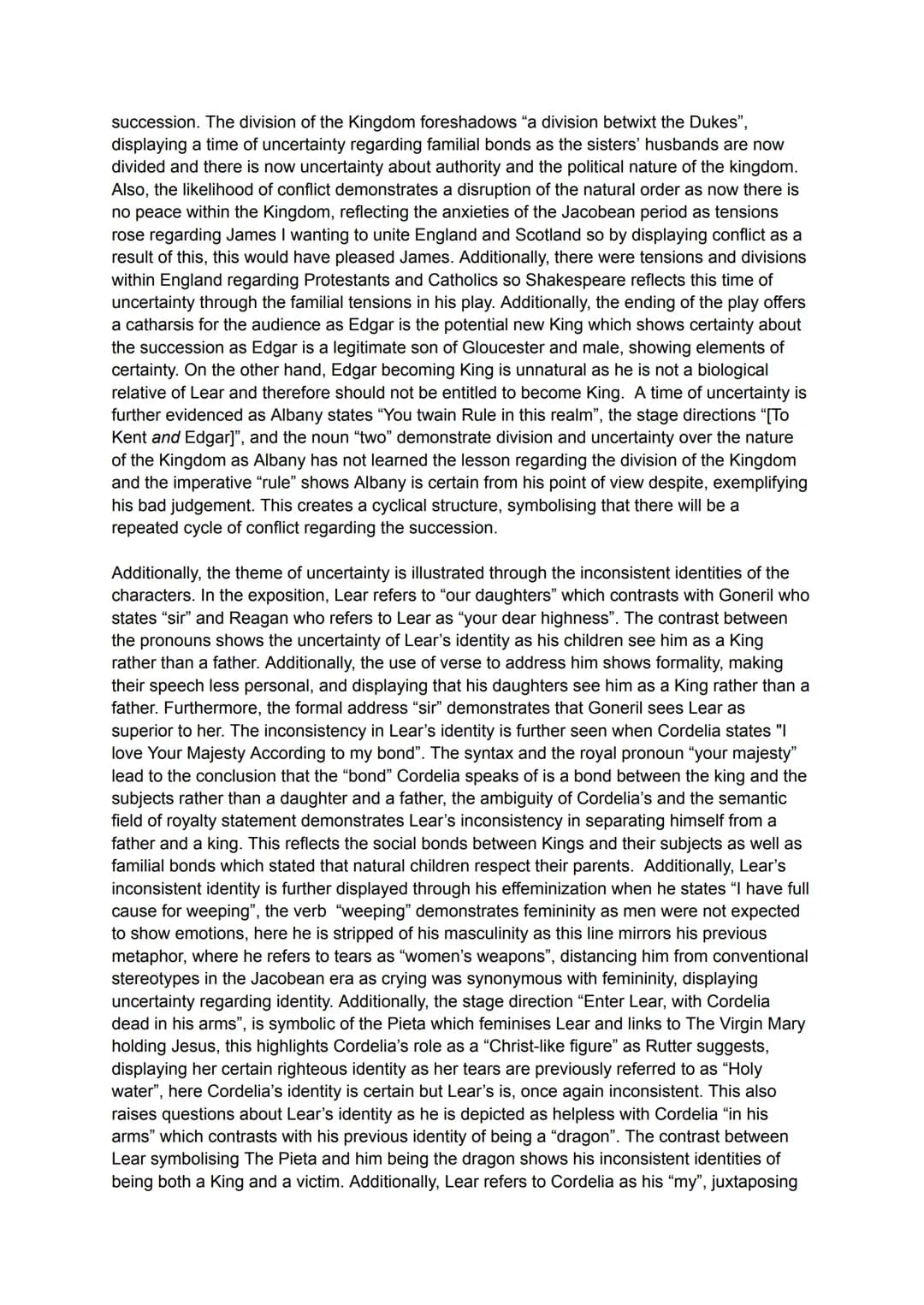
Fractured Families and Divided Authority
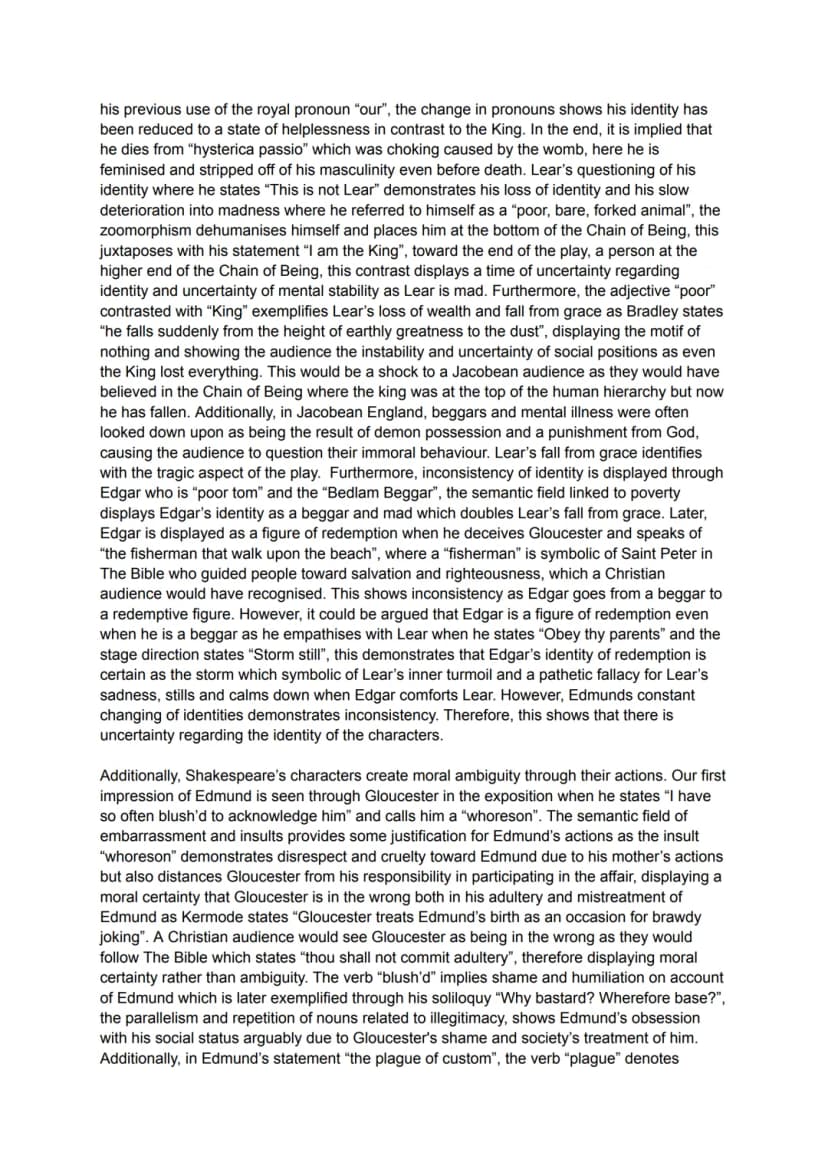
The political breakdown immediately spreads to family relationships, creating "division betwixt the Dukes" as the sisters' husbands become rivals. This reflects real Jacobean anxieties about James I's plans to unite England and Scotland, plus religious tensions between Protestants and Catholics.
Interestingly, the play's ending offers both resolution and continued uncertainty. Edgar emerges as the potential new king - he's legitimate and male, which should provide stability. However, he's not Lear's biological relative, making his succession technically unnatural. When Albany suggests "you twain rule in this realm" to both Kent and Edgar, we see the same dangerous division being repeated.
This cyclical structure suggests that lessons haven't been learned and the cycle of conflict will continue. Shakespeare deliberately leaves audiences wondering whether true political stability is even possible.
Key Point: The play's structure mirrors its theme - just as the kingdom is divided, the narrative itself splits between multiple plots and potential futures, keeping audiences constantly uncertain about what comes next.
3
of 5
Identity Crisis and Mental Breakdown
Your identity seems pretty solid, right? In King Lear, even the most powerful characters lose track of who they really are, creating psychological uncertainty that's genuinely unsettling to watch.
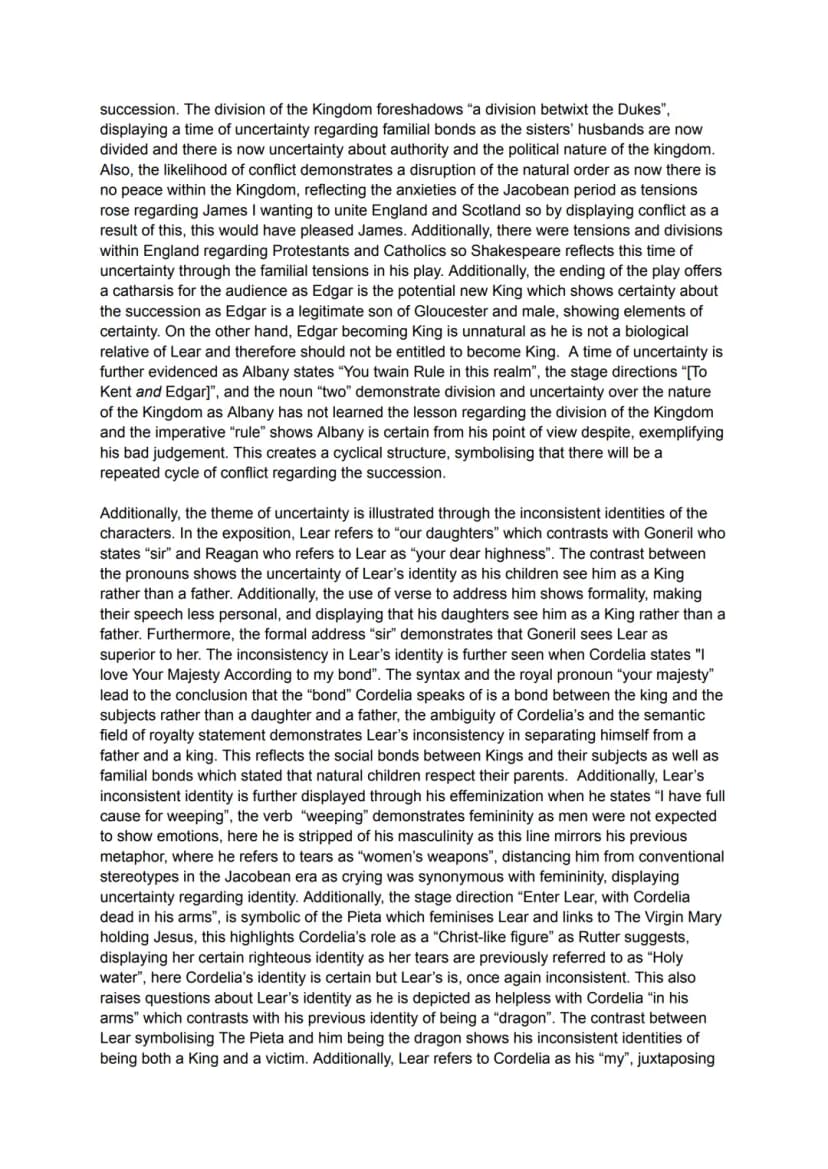
Lear's identity shifts dramatically throughout the play. His daughters address him formally as "sir" and "Your Majesty" rather than "father," showing the confusion between his royal and paternal roles. When he later weeps openly - described as "women's weapons" - he's stripped of traditional masculinity. The stage direction showing him holding dead Cordelia "in his arms" deliberately echoes the Pieta, feminising him as a suffering, helpless figure.
His confused self-questioning - "This is not Lear" versus "I am the King" - shows his mental deterioration. The zoomorphism of calling himself a "poor, bare, forked animal" places him at the bottom of the Chain of Being, a shocking fall that would have horrified Jacobean audiences who saw kings as divinely appointed.
Edgar's transformation from nobleman to "Poor Tom" the Bedlam Beggar doubles this theme of lost identity, though he later emerges as a redemptive figure. This flexibility suggests some identities might be more authentic than others.
Key Point: The storm physically "stills" when Edgar comforts Lear as Poor Tom, suggesting that sometimes our lowest moments reveal our truest selves.
4
of 5
Moral Confusion and Justified Villainy
Here's where Shakespeare gets really clever - he makes you almost sympathise with the villains whilst questioning the heroes' actions. This moral ambiguity keeps audiences constantly unsure about who's actually right or wrong.
Edmund's villainy has clear justification. Gloucester publicly calls him "whoreson" and admits he "blush'd to acknowledge him," creating the shame and resentment that fuel Edmund's revenge. His soliloquy questioning "Why bastard? Wherefore base?" shows how society's cruel treatment shaped his actions. Renaissance audiences, who valued individual ambition, might actually support his rise against inherited privilege.
Goneril's treatment of Lear creates similar moral uncertainty. When she asks him to "disquantity your train" because his knights are "disorder'd, so debosh'd," she's actually being reasonable - they're causing genuine problems. Yet this strips away Lear's remaining symbols of power, making her seem cruel even when she's justified.
The brutal eye-gouging scene with Gloucester initially seems purely evil, but Edgar later suggests it's divine punishment for his father's adultery and blindness to Edmund's true nature.
Key Point: Shakespeare deliberately makes moral judgement difficult - even Edgar, the 'good' son, coldly states that his father's suffering "cost him his eyes" as payment for his sins.
5
of 5
Divine Justice or Cruel Chaos?
The play's final question haunts audiences: is there any moral order in the universe, or is everything just random suffering? Shakespeare leaves this deliberately uncertain, reflecting the religious and philosophical anxieties of his time.
Gloucester's punishment aligns with morality play traditions where sinners face consequences that fit their crimes. His physical blindness mirrors his inability to see Edmund's true nature or Edgar's worth. Religious audiences might see divine justice at work, especially given biblical warnings about adultery and the eye-for-an-eye principle.
However, the sheer brutality of the violence, combined with innocent Cordelia's death, challenges any neat moral framework. Goneril's 'disobedience' to her father violates biblical commands to honour parents, yet her practical concerns about the disruptive knights seem entirely reasonable, especially from modern feminist perspectives.
The play functions as a morality play that refuses to provide clear moral lessons. Instead, it forces audiences to grapple with competing value systems - traditional religious authority versus Renaissance individualism, filial duty versus practical necessity, divine justice versus random cruelty.
Key Point: Rather than resolving moral uncertainty, King Lear intensifies it, reflecting the broader cultural anxieties of the Jacobean period when old certainties were being challenged by new ways of thinking.
We thought you’d never ask...
What is the Knowunity AI companion?
Our AI companion is specifically built for the needs of students. Based on the millions of content pieces we have on the platform we can provide truly meaningful and relevant answers to students. But its not only about answers, the companion is even more about guiding students through their daily learning challenges, with personalised study plans, quizzes or content pieces in the chat and 100% personalisation based on the students skills and developments.
Where can I download the Knowunity app?
You can download the app in the Google Play Store and in the Apple App Store.
Is Knowunity really free of charge?
That's right! Enjoy free access to study content, connect with fellow students, and get instant help – all at your fingertips.
Similar Content
 LLCE Ang
 Taller de lectura y redacción
Most popular content: Integration of Knowledge and Ideas
9English LiteratureGCSE English - Romeo and Juliet
R&J Essay Plans
1177012
English LiteratureA Streetcar Named Desire - Context
This should hopefully cover all of the relevant info you’ll need for Streetcar
123798
English LiteraturePower and conflict: checking out me own history
AQA checking out me own history quote analysis
112013
English LiteratureMiscellaneous AQA English Literature Essay Plans/Questions - Streetcar, Color Purple, Feminine Gospels
2 essay plans on 'A Streetcar Named Desire' by Tennessee Williams and 2 comparing 'The Colour Purple' by Alice Walker with 'Feminine Gospels' by Carol Ann Duffy. All based on AQA Paper 2 option B. As well as lists of past exam questions.
122555
English LiteraturePower and conflict: London
AQA power and conflict London quote analysis
112058
English LiteratureOthello - Context
This should cover all areas of Othello’s context
121835
English LiteraturePower and conflict: tissue
AQA power and conflict tissue quote analysis
111033
English LiteraturePower and conflict: my last duchess
AQA power and conflict my last duchess quote analysis
111624
English LiteratureGCSE English Literature Paper 1
AQA, ACC and Macbeth
112086
Most popular content in English Literature
9English LiteratureAn Inspector Calls: Character Insights
Explore in-depth analysis and key quotes for characters in J.B. Priestley's 'An Inspector Calls'. This resource covers Gerald Croft, Inspector Goole, Sheila Birling, Mrs. Birling, Eric Birling, and Eva Smith, focusing on themes of class, gender roles, and social responsibility. Ideal for students aiming for Grade 8 and above.
1025,429907
English LiteratureRomeo and Juliet: Key themes
Key Romeo and Juliet themes and analysed quotes
106,708198
English LiteratureMacbeth: Guilt and Ambition
Explore the complex themes of guilt and ambition in Shakespeare's 'Macbeth'. This analysis covers key characters, including Macbeth and Lady Macbeth, their moral dilemmas, and the tragic consequences of their ambition. Ideal for students studying character motivations, thematic elements, and the psychological impact of power. Includes insights on the natural order, manipulation, and the descent into madness.
919,093397
I
English LiteratureInspector Calls Quiz (YR 10 MOCKS)
for YR 10 GCSE mock on Inspector Calls
102,1451
E
English LiteratureExplore the World of English Literature
Master the key concepts and works of English literature with this comprehensive flashcard set designed for grade 10 students.
112,0941
English LiteratureExploring Macbeth's Themes
Dive into the intricate themes of Shakespeare's Macbeth, including the supernatural, ambition, guilt, and kingship. This analysis features key quotes and insights that reveal how these themes intertwine to shape the characters and the narrative. Ideal for students seeking a deeper understanding of the play's moral complexities and psychological depth.
1015,849524
E
English LiteratureExploring English Literature: A Journey through Medium
Discover the captivating world of English Literature with this comprehensive medium-level flashcard set. Dive into the works of renowned authors and explore the themes, characters, and literary techniques that make their writing truly remarkable.
111,0580
E
English LiteratureExploring 'A Christmas Carol': Themes, Characters, and Lessons
Delve into the main themes, key characters, and valuable lessons in Charles Dickens' 'A Christmas Carol'. Discover the impact of Scrooge's transformation and the significance of love, redemption, and the true meaning of Christmas.
101,2480
English LiteratureMacbeth Key Themes Essay Plans
Essay plans for key themes in macbeth - guilt, supernatural & ambition
115,186146
Most popular content
9 Sociology
Sociology of Education Overview
Explore comprehensive A-Level Sociology notes on the education system, covering key theories, policies, and sociological perspectives. This resource includes insights on marketisation, gender roles, cultural deprivation, and educational inequalities, providing a thorough understanding of how education shapes social stratification and individual achievement. Ideal for exam preparation and in-depth study.
12102,8693,040
SociologySociology of Families: Comprehensive Revision
Dive into an extensive overview of family dynamics, perspectives, and patterns in sociology. This resource covers key concepts such as family diversity, gender roles, marriage, and the impact of social policies on family structures. Perfect for A-Level Sociology students preparing for Paper 2.
1273,6612,307
CriminologyCriminology: Crime & Punishment Overview
Comprehensive mindmaps covering key concepts in the Crime and Punishment topic for WJEC Criminology Unit 4. This resource includes detailed insights into the Criminal Justice System, crime prevention strategies, sentencing models, and the roles of various agencies. Ideal for A-Level revision, ensuring you grasp essential theories and legislative processes to excel in your exams.
1254,8691,059
SociologyComprehensive Crime & Deviance Overview
Explore an extensive revision of crime and deviance topics, including theories, types of crime, and the impact of media. This resource covers key concepts such as Marxism, functionalism, gender and crime, and the influence of globalization on criminal behavior. Ideal for students seeking a thorough understanding of criminology and its various theories. Type: Full Topic Revision.
1251,6541,399
C
 Biology
Cell Biology and Cell structure
cell structures
93,2470
English LiteratureAn Inspector Calls: Character Insights
Explore in-depth analysis and key quotes for characters in J.B. Priestley's 'An Inspector Calls'. This resource covers Gerald Croft, Inspector Goole, Sheila Birling, Mrs. Birling, Eric Birling, and Eva Smith, focusing on themes of class, gender roles, and social responsibility. Ideal for students aiming for Grade 8 and above.
1025,429907
CriminologyWJEC Unit 4 Criminology
Criminology unit 4 detailed revision note
127,151125
CriminologyCriminology Theories Overview
Explore key criminology theories and their implications on crime and deviance. This comprehensive summary covers biological, psychological, and sociological perspectives, including labelling theory, right realism, and the impact of social campaigns on policy development. Ideal for A-Level criminology students seeking to understand the complexities of criminal behaviour and the factors influencing crime prevention strategies.
129,760210
English LiteratureRomeo and Juliet: Key themes
Key Romeo and Juliet themes and analysed quotes
106,708198
Can't find what you're looking for? Explore other subjects.
Students love us — and so will you.
4.6/5App Store
4.7/5Google Play
The app is very easy to use and well designed. I have found everything I was looking for so far and have been able to learn a lot from the presentations! I will definitely use the app for a class assignment! And of course it also helps a lot as an inspiration.
Stefan SiOS user
This app is really great. There are so many study notes and help [...]. My problem subject is French, for example, and the app has so many options for help. Thanks to this app, I have improved my French. I would recommend it to anyone.
Samantha KlichAndroid user
Wow, I am really amazed. I just tried the app because I've seen it advertised many times and was absolutely stunned. This app is THE HELP you want for school and above all, it offers so many things, such as workouts and fact sheets, which have been VERY helpful to me personally.
AnnaiOS user
English Literature245 views·Updated Jun 14, 2026·5 pagesA* Grade A-Level English Literature Essay: Themes of Uncertainty in King Lear
millie@millie_xmtr
Shakespeare's King Lear masterfully captures a world in chaos, where nothing feels certain anymore. The play explores how political upheaval, shifting identities, and moral confusion create an atmosphere of constant tension and unpredictability that would have deeply resonated with Jacobean...
1
of 5
Sign up to see the content. It's free!
- Access to all documents
- Improve your grades
- Join milions of students
Political Chaos and Succession Crisis
Ever wondered what happens when a king makes the worst decision possible? Lear's choice to divide his kingdom creates immediate uncertainty that drives the entire tragedy forward.
Shakespeare uses anastrophe (unusual word order) when Lear announces he's divided "in three our kingdom." This twisted syntax mirrors the unnatural chaos about to unfold - it literally sounds wrong because it is wrong. The emphasis on "three" and "divided" screams instability, especially to a Jacobean audience who knew the biblical warning that "a kingdom divided against itself cannot stand."
The colour symbolism in Lear's "darker purpose" hints at hidden dangers lurking beneath his plan. Whilst Lear believes he's preventing "future strife," the modal verb "may" reveals his own uncertainty - he's not actually sure this will work. This foolishness would have horrified audiences who believed in the Divine Right of Kings, where rulers must reign until death.
Key Point: Lear's decision to give the "more opulent" portion to his youngest daughter whilst the "eldest-born" Goneril gets less creates unfairness that foreshadows the political chaos to come.
2
of 5Sign up to see the content. It's free!
- Access to all documents
- Improve your grades
- Join milions of students
Fractured Families and Divided Authority
The political breakdown immediately spreads to family relationships, creating "division betwixt the Dukes" as the sisters' husbands become rivals. This reflects real Jacobean anxieties about James I's plans to unite England and Scotland, plus religious tensions between Protestants and Catholics.
Interestingly, the play's ending offers both resolution and continued uncertainty. Edgar emerges as the potential new king - he's legitimate and male, which should provide stability. However, he's not Lear's biological relative, making his succession technically unnatural. When Albany suggests "you twain rule in this realm" to both Kent and Edgar, we see the same dangerous division being repeated.
This cyclical structure suggests that lessons haven't been learned and the cycle of conflict will continue. Shakespeare deliberately leaves audiences wondering whether true political stability is even possible.
Key Point: The play's structure mirrors its theme - just as the kingdom is divided, the narrative itself splits between multiple plots and potential futures, keeping audiences constantly uncertain about what comes next.
3
of 5Sign up to see the content. It's free!
- Access to all documents
- Improve your grades
- Join milions of students
Identity Crisis and Mental Breakdown
Your identity seems pretty solid, right? In King Lear, even the most powerful characters lose track of who they really are, creating psychological uncertainty that's genuinely unsettling to watch.
Lear's identity shifts dramatically throughout the play. His daughters address him formally as "sir" and "Your Majesty" rather than "father," showing the confusion between his royal and paternal roles. When he later weeps openly - described as "women's weapons" - he's stripped of traditional masculinity. The stage direction showing him holding dead Cordelia "in his arms" deliberately echoes the Pieta, feminising him as a suffering, helpless figure.
His confused self-questioning - "This is not Lear" versus "I am the King" - shows his mental deterioration. The zoomorphism of calling himself a "poor, bare, forked animal" places him at the bottom of the Chain of Being, a shocking fall that would have horrified Jacobean audiences who saw kings as divinely appointed.
Edgar's transformation from nobleman to "Poor Tom" the Bedlam Beggar doubles this theme of lost identity, though he later emerges as a redemptive figure. This flexibility suggests some identities might be more authentic than others.
Key Point: The storm physically "stills" when Edgar comforts Lear as Poor Tom, suggesting that sometimes our lowest moments reveal our truest selves.
4
of 5Sign up to see the content. It's free!
- Access to all documents
- Improve your grades
- Join milions of students
Moral Confusion and Justified Villainy
Here's where Shakespeare gets really clever - he makes you almost sympathise with the villains whilst questioning the heroes' actions. This moral ambiguity keeps audiences constantly unsure about who's actually right or wrong.
Edmund's villainy has clear justification. Gloucester publicly calls him "whoreson" and admits he "blush'd to acknowledge him," creating the shame and resentment that fuel Edmund's revenge. His soliloquy questioning "Why bastard? Wherefore base?" shows how society's cruel treatment shaped his actions. Renaissance audiences, who valued individual ambition, might actually support his rise against inherited privilege.
Goneril's treatment of Lear creates similar moral uncertainty. When she asks him to "disquantity your train" because his knights are "disorder'd, so debosh'd," she's actually being reasonable - they're causing genuine problems. Yet this strips away Lear's remaining symbols of power, making her seem cruel even when she's justified.
The brutal eye-gouging scene with Gloucester initially seems purely evil, but Edgar later suggests it's divine punishment for his father's adultery and blindness to Edmund's true nature.
Key Point: Shakespeare deliberately makes moral judgement difficult - even Edgar, the 'good' son, coldly states that his father's suffering "cost him his eyes" as payment for his sins.
5
of 5Sign up to see the content. It's free!
- Access to all documents
- Improve your grades
- Join milions of students
Divine Justice or Cruel Chaos?
The play's final question haunts audiences: is there any moral order in the universe, or is everything just random suffering? Shakespeare leaves this deliberately uncertain, reflecting the religious and philosophical anxieties of his time.
Gloucester's punishment aligns with morality play traditions where sinners face consequences that fit their crimes. His physical blindness mirrors his inability to see Edmund's true nature or Edgar's worth. Religious audiences might see divine justice at work, especially given biblical warnings about adultery and the eye-for-an-eye principle.
However, the sheer brutality of the violence, combined with innocent Cordelia's death, challenges any neat moral framework. Goneril's 'disobedience' to her father violates biblical commands to honour parents, yet her practical concerns about the disruptive knights seem entirely reasonable, especially from modern feminist perspectives.
The play functions as a morality play that refuses to provide clear moral lessons. Instead, it forces audiences to grapple with competing value systems - traditional religious authority versus Renaissance individualism, filial duty versus practical necessity, divine justice versus random cruelty.
Key Point: Rather than resolving moral uncertainty, King Lear intensifies it, reflecting the broader cultural anxieties of the Jacobean period when old certainties were being challenged by new ways of thinking.
We thought you’d never ask...
What is the Knowunity AI companion?
Our AI companion is specifically built for the needs of students. Based on the millions of content pieces we have on the platform we can provide truly meaningful and relevant answers to students. But its not only about answers, the companion is even more about guiding students through their daily learning challenges, with personalised study plans, quizzes or content pieces in the chat and 100% personalisation based on the students skills and developments.
Where can I download the Knowunity app?
You can download the app in the Google Play Store and in the Apple App Store.
Is Knowunity really free of charge?
That's right! Enjoy free access to study content, connect with fellow students, and get instant help – all at your fingertips.
Similar Content
Most popular content: Integration of Knowledge and Ideas
9English LiteratureGCSE English - Romeo and Juliet
R&J Essay Plans
1177012
English LiteratureA Streetcar Named Desire - Context
This should hopefully cover all of the relevant info you’ll need for Streetcar
123798
English LiteraturePower and conflict: checking out me own history
AQA checking out me own history quote analysis
112013
English LiteratureMiscellaneous AQA English Literature Essay Plans/Questions - Streetcar, Color Purple, Feminine Gospels
2 essay plans on 'A Streetcar Named Desire' by Tennessee Williams and 2 comparing 'The Colour Purple' by Alice Walker with 'Feminine Gospels' by Carol Ann Duffy. All based on AQA Paper 2 option B. As well as lists of past exam questions.
122555
English LiteraturePower and conflict: London
AQA power and conflict London quote analysis
112058
English LiteratureOthello - Context
This should cover all areas of Othello’s context
121835
English LiteraturePower and conflict: tissue
AQA power and conflict tissue quote analysis
111033
English LiteraturePower and conflict: my last duchess
AQA power and conflict my last duchess quote analysis
111624
English LiteratureGCSE English Literature Paper 1
AQA, ACC and Macbeth
112086
Most popular content in English Literature
9English LiteratureAn Inspector Calls: Character Insights
Explore in-depth analysis and key quotes for characters in J.B. Priestley's 'An Inspector Calls'. This resource covers Gerald Croft, Inspector Goole, Sheila Birling, Mrs. Birling, Eric Birling, and Eva Smith, focusing on themes of class, gender roles, and social responsibility. Ideal for students aiming for Grade 8 and above.
1025,429907
English LiteratureRomeo and Juliet: Key themes
Key Romeo and Juliet themes and analysed quotes
106,708198
English LiteratureMacbeth: Guilt and Ambition
Explore the complex themes of guilt and ambition in Shakespeare's 'Macbeth'. This analysis covers key characters, including Macbeth and Lady Macbeth, their moral dilemmas, and the tragic consequences of their ambition. Ideal for students studying character motivations, thematic elements, and the psychological impact of power. Includes insights on the natural order, manipulation, and the descent into madness.
919,093397
I
English LiteratureInspector Calls Quiz (YR 10 MOCKS)
for YR 10 GCSE mock on Inspector Calls
102,1451
E
English LiteratureExplore the World of English Literature
Master the key concepts and works of English literature with this comprehensive flashcard set designed for grade 10 students.
112,0941
English LiteratureExploring Macbeth's Themes
Dive into the intricate themes of Shakespeare's Macbeth, including the supernatural, ambition, guilt, and kingship. This analysis features key quotes and insights that reveal how these themes intertwine to shape the characters and the narrative. Ideal for students seeking a deeper understanding of the play's moral complexities and psychological depth.
1015,849524
E
English LiteratureExploring English Literature: A Journey through Medium
Discover the captivating world of English Literature with this comprehensive medium-level flashcard set. Dive into the works of renowned authors and explore the themes, characters, and literary techniques that make their writing truly remarkable.
111,0580
E
English LiteratureExploring 'A Christmas Carol': Themes, Characters, and Lessons
Delve into the main themes, key characters, and valuable lessons in Charles Dickens' 'A Christmas Carol'. Discover the impact of Scrooge's transformation and the significance of love, redemption, and the true meaning of Christmas.
101,2480
English LiteratureMacbeth Key Themes Essay Plans
Essay plans for key themes in macbeth - guilt, supernatural & ambition
115,186146
Most popular content
9SociologySociology of Education Overview
Explore comprehensive A-Level Sociology notes on the education system, covering key theories, policies, and sociological perspectives. This resource includes insights on marketisation, gender roles, cultural deprivation, and educational inequalities, providing a thorough understanding of how education shapes social stratification and individual achievement. Ideal for exam preparation and in-depth study.
12102,8693,040
SociologySociology of Families: Comprehensive Revision
Dive into an extensive overview of family dynamics, perspectives, and patterns in sociology. This resource covers key concepts such as family diversity, gender roles, marriage, and the impact of social policies on family structures. Perfect for A-Level Sociology students preparing for Paper 2.
1273,6612,307
CriminologyCriminology: Crime & Punishment Overview
Comprehensive mindmaps covering key concepts in the Crime and Punishment topic for WJEC Criminology Unit 4. This resource includes detailed insights into the Criminal Justice System, crime prevention strategies, sentencing models, and the roles of various agencies. Ideal for A-Level revision, ensuring you grasp essential theories and legislative processes to excel in your exams.
1254,8691,059
SociologyComprehensive Crime & Deviance Overview
Explore an extensive revision of crime and deviance topics, including theories, types of crime, and the impact of media. This resource covers key concepts such as Marxism, functionalism, gender and crime, and the influence of globalization on criminal behavior. Ideal for students seeking a thorough understanding of criminology and its various theories. Type: Full Topic Revision.
1251,6541,399
C
BiologyCell Biology and Cell structure
cell structures
93,2470
English LiteratureAn Inspector Calls: Character Insights
Explore in-depth analysis and key quotes for characters in J.B. Priestley's 'An Inspector Calls'. This resource covers Gerald Croft, Inspector Goole, Sheila Birling, Mrs. Birling, Eric Birling, and Eva Smith, focusing on themes of class, gender roles, and social responsibility. Ideal for students aiming for Grade 8 and above.
1025,429907
CriminologyWJEC Unit 4 Criminology
Criminology unit 4 detailed revision note
127,151125
CriminologyCriminology Theories Overview
Explore key criminology theories and their implications on crime and deviance. This comprehensive summary covers biological, psychological, and sociological perspectives, including labelling theory, right realism, and the impact of social campaigns on policy development. Ideal for A-Level criminology students seeking to understand the complexities of criminal behaviour and the factors influencing crime prevention strategies.
129,760210
English LiteratureRomeo and Juliet: Key themes
Key Romeo and Juliet themes and analysed quotes
106,708198
Can't find what you're looking for? Explore other subjects.
Students love us — and so will you.
4.6/5App Store
4.7/5Google Play
The app is very easy to use and well designed. I have found everything I was looking for so far and have been able to learn a lot from the presentations! I will definitely use the app for a class assignment! And of course it also helps a lot as an inspiration.
Stefan SiOS user
This app is really great. There are so many study notes and help [...]. My problem subject is French, for example, and the app has so many options for help. Thanks to this app, I have improved my French. I would recommend it to anyone.
Samantha KlichAndroid user
Wow, I am really amazed. I just tried the app because I've seen it advertised many times and was absolutely stunned. This app is THE HELP you want for school and above all, it offers so many things, such as workouts and fact sheets, which have been VERY helpful to me personally.
AnnaiOS user