
"An Inspector Calls" explores themes of responsibility, social class, and...
 English Literature126 views·Updated Jun 22, 2026·6 pages
Analyzing Key Themes in 'An Inspector Calls'

marim .@marim._m0okvb6dxnefg


1 / 6
1
of 6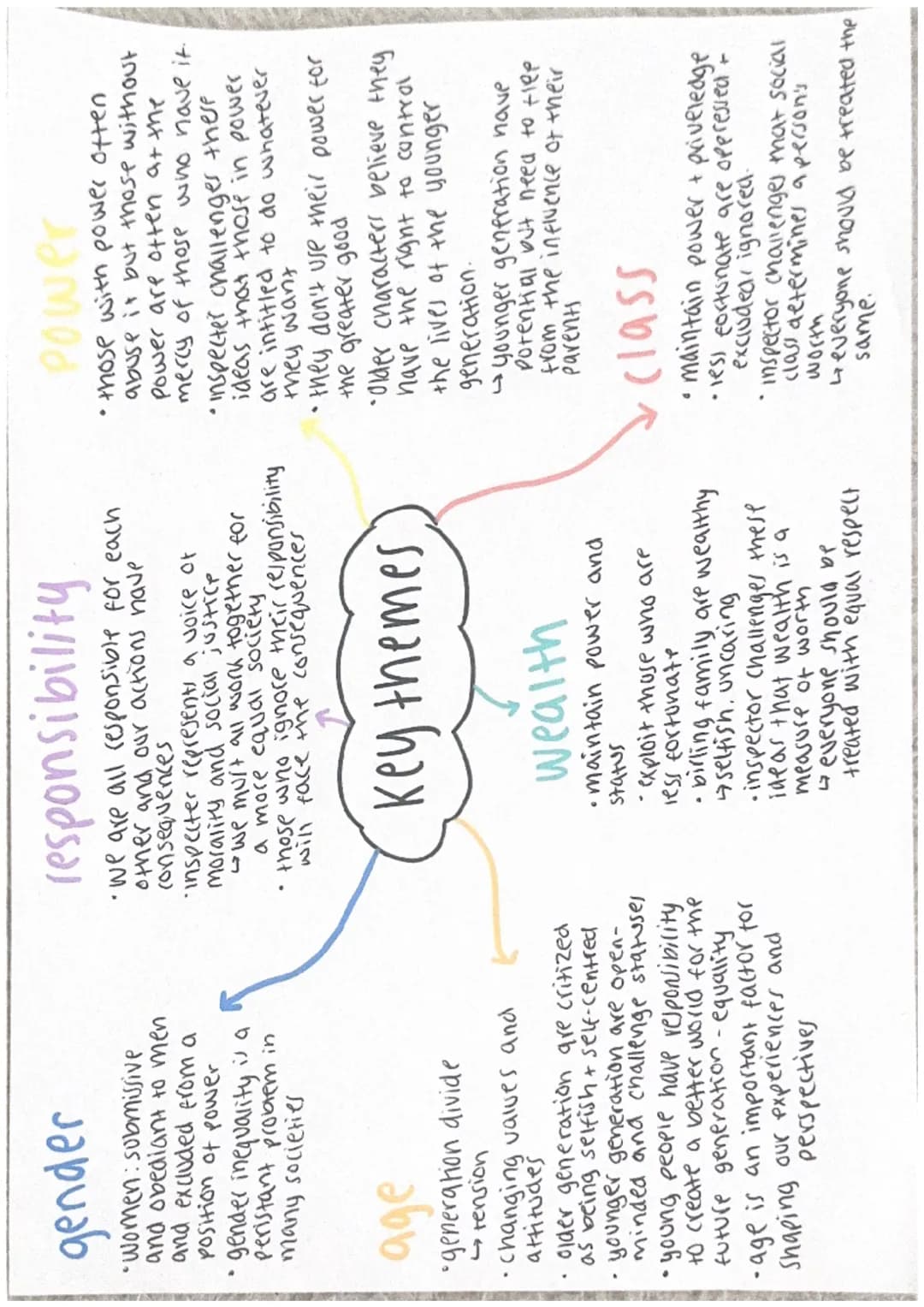
Key Themes in "An Inspector Calls"
The play tackles several interconnected themes that shape character actions and society. Gender inequality is portrayed through women's subordinate position to men, with female characters either expected to be obedient or exploited. Age creates generational tensions, with older characters criticized as selfish while younger ones are portrayed as more open-minded with potential to challenge the status quo.
Responsibility stands as a central theme - the Inspector represents the voice of morality, reminding characters that their actions have consequences. Priestley suggests we all have obligations to each other and must work together toward a more equal society.
Wealth and power shape how characters behave, with the Birling family using their privilege selfishly while exploiting those less fortunate. The Inspector challenges the notion that wealth determines a person's worth, arguing everyone deserves equal respect regardless of social standing.
Think about it: How does Priestley use the Inspector to challenge the idea that those with power are entitled to do whatever they want?
The play's examination of social class shows how the wealthy maintain privilege while the less fortunate are excluded and ignored. Younger characters potentially represent hope for change but must first escape their parents' damaging influence.
2
of 6
Blame and Responsibility
The characters display dramatically different attitudes toward accepting responsibility for their actions. Mr. Birling stubbornly refuses to accept any responsibility, dismissing the issue and blaming others instead. His wife follows this pattern, insisting the Birlings were completely innocent in Eva's tragedy.
Eric stands in contrast to his parents by acknowledging and accepting his responsibility. He confronts his mother, insisting she should also accept her part in Eva's death. Meanwhile, Sheila experiences extreme guilt, accepting responsibility and visibly maturing through the course of the play.
The Inspector serves as a catalyst for moral awakening, helping each character understand the consequences of their actions. His presence forces them to confront uncomfortable truths about themselves.
Remember: The characters' differing reactions to responsibility create the central conflict of the play and reveal their true nature.
Gerald falls somewhere in between, initially showing concern but ultimately returning to his selfish attitude, treating Eva as merely his mistress rather than a person deserving dignity.
3
of 6
Social Class and Equality
The play powerfully illustrates how social hierarchy shapes characters' behaviors and attitudes. Mr. Birling appears primarily concerned with potential scandal rather than Eva's suffering, while Sheila initially uses her social position to get what she wants, behaving like a spoilt child.
Characters from higher social classes treat those beneath them as objects. Eva Smith is repeatedly treated as disposable by various members of the Birling family, highlighting how the upper classes lack conscience. Priestley implies this inequality inevitably leads to social disruption, harm, and tragedy.
Eric's character represents the irresponsibility of privileged youth - gambling, drinking, and living off his father's money without earning his way. Meanwhile, characters like Edna the servant remain almost invisible, emphasizing the stark inequality in Edwardian society.
Key insight: Through the contrasting treatment of Eva Smith and the Birling family, Priestley shows how social class determined not just lifestyle but basic human dignity.
Mrs. Birling's position in the charity emphasizes the hypocrisy of the wealthy who maintain social barriers while pretending to help those less fortunate.
4
of 6
Patriarchal Society and Attitudes Toward Women
The play exposes a deeply patriarchal society where men dominate women socially and economically. Mr. Birling functions as head of the household, while Eva Smith is repeatedly used and dismissed by various men throughout the story.
Women's social value was tied to appearance and marriage prospects. Upper-class women like Sheila were raised to be well-educated and attend social events, essentially to showcase their family's wealth through fine dress and manners.
The gender inequality is stark - Gerald holds a higher social position than Sheila simply because of his gender and wealth. Meanwhile, women like Eva who fall from respectability find themselves isolated and ignored by society, eventually turning to prostitution out of desperation.
Consider this: Even though Mrs. Birling has a higher social class than Mr. Birling, she still lacks real power in their patriarchal household.
Most disturbingly, the play shows how men felt justified in their mistreatment of lower-class women. Eric forcing himself on Eva represents the most extreme example of how upper-class men viewed working-class women as objects for their use rather than as human beings with dignity.
5
of 6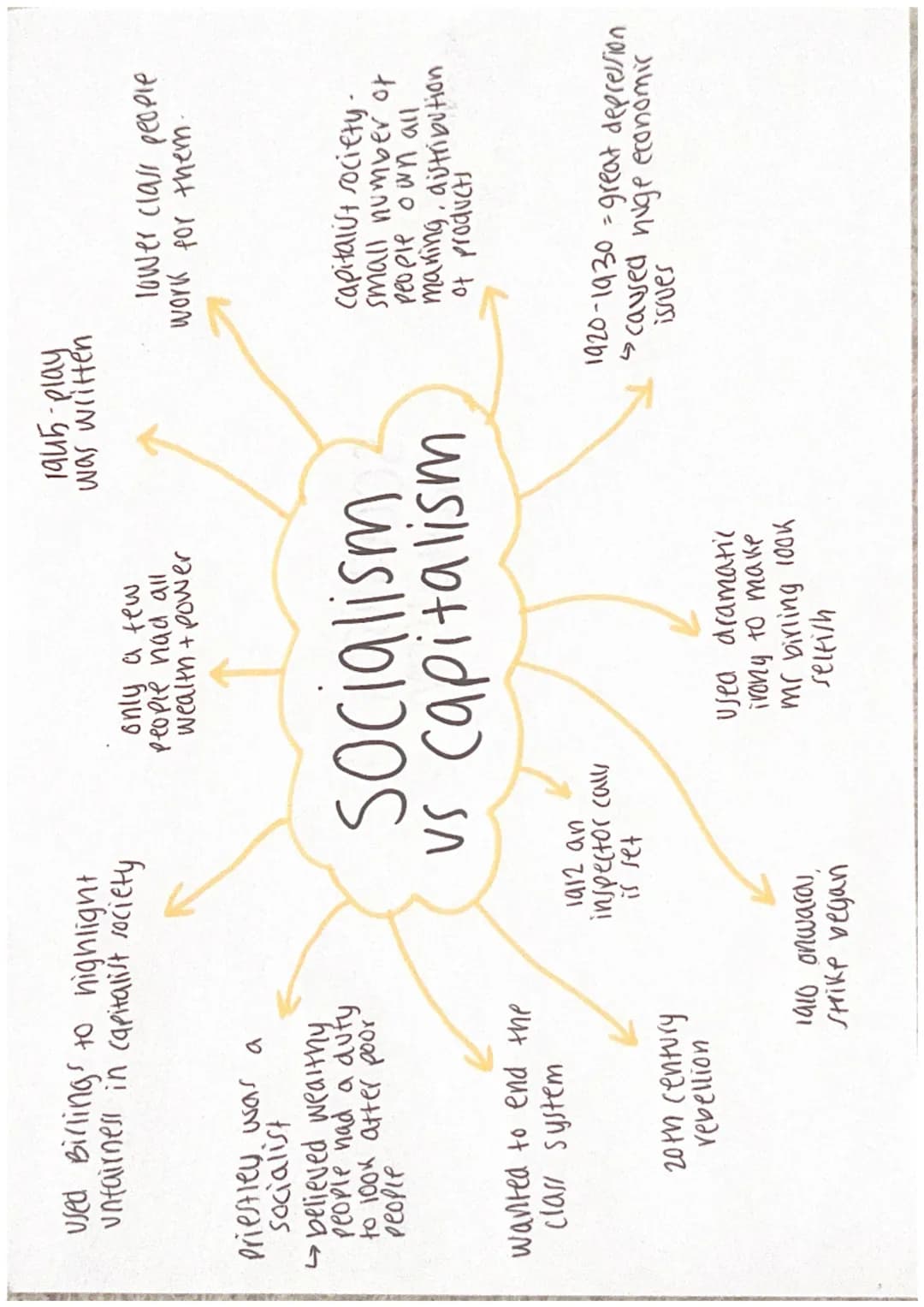
Socialism vs Capitalism
Priestley uses the Birlings to highlight the unfairness of capitalist society in early 20th century Britain. As a socialist himself, he believed wealthy people had a responsibility to look after those less fortunate and wanted to end the rigid class system that dominated British society.
The play is set in 1912 but was written in 1945, allowing Priestley to use dramatic irony to make Mr. Birling look foolish and selfish. The period between these dates saw massive social upheaval - strikes beginning around 1910, followed by the Great Depression of 1920-1930 that caused enormous economic hardship.
Priestley criticizes the capitalist structure where a small number of people own all means of production while lower-class people work for them with little reward. The Birling family represents this small, privileged group who hoard wealth and power.
Historical context: By setting his play in 1912 but writing it in 1945, Priestley could comment on how the self-interest of the wealthy contributed to decades of social problems.
The contrast between socialist and capitalist values forms the ideological backbone of the play, with Inspector Goole representing socialist principles of collective responsibility against the Birlings' capitalist self-interest.
6
of 6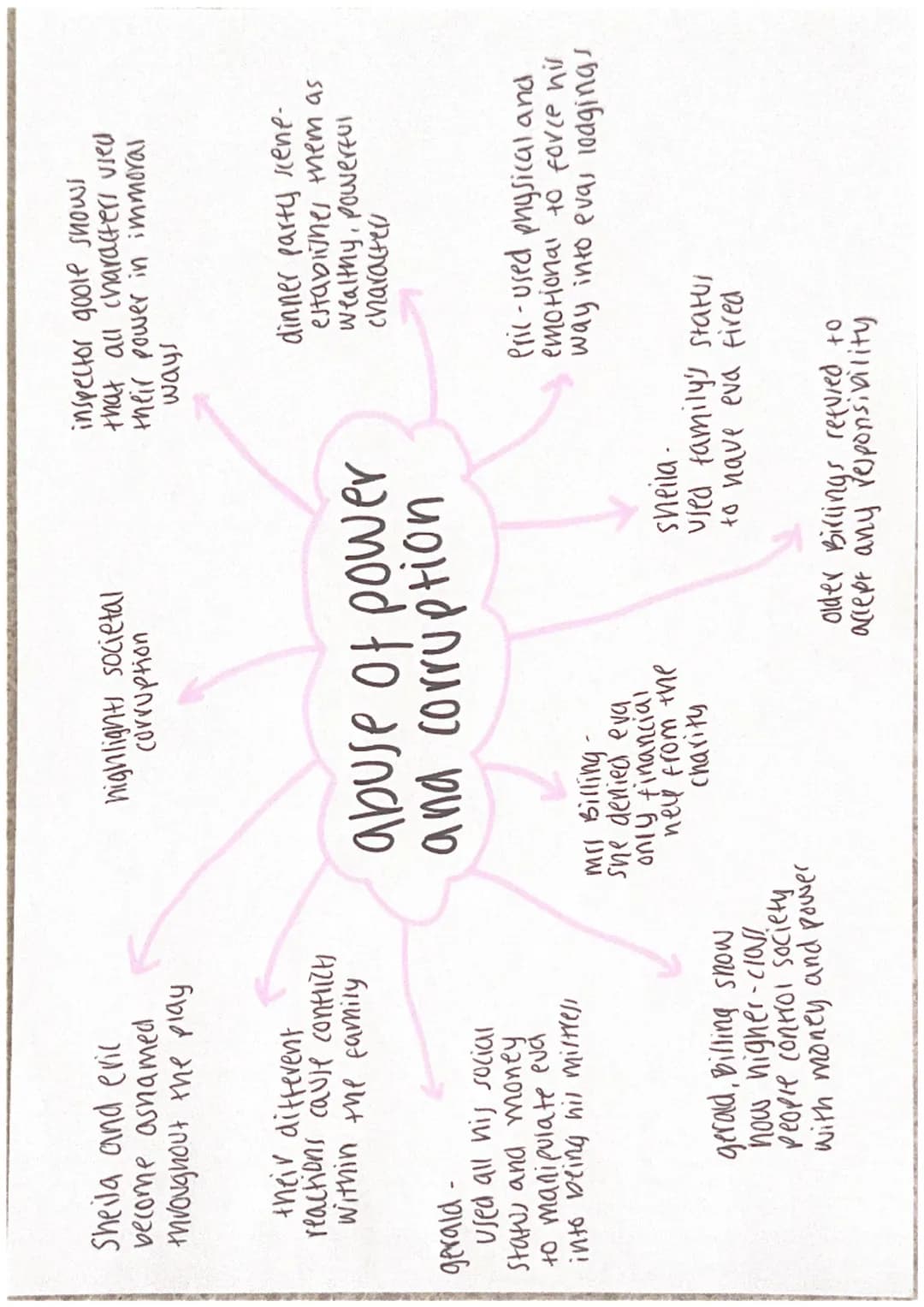
Abuse of Power and Corruption
Throughout the play, characters misuse their social status and wealth in damaging ways. The opening dinner party scene establishes the Birlings and Gerald as wealthy, powerful characters who believe their position is secure and deserved.
Each character abuses their power differently: Gerald uses his status to manipulate Eva into becoming his mistress, Sheila uses her family's influence to have Eva fired, and Eric uses physical and emotional force to impose himself on Eva. These actions collectively highlight how societal corruption works through multiple forms of power abuse.
Mrs. Birling's refusal to help Eva through her charity position represents perhaps the most callous abuse - denying help to someone in desperate need while hiding behind rules and respectability. The younger characters, Sheila and Eric, at least become ashamed as they recognize their wrongdoing.
Look deeper: The Inspector's investigation reveals how power corrupts at every level - from economic influence to social status to physical dominance.
The stark contrast between the older Birlings' refusal to accept responsibility and the younger generation's growing awareness suggests Priestley's hope that future generations might use power more ethically and build a more just society.
We thought you’d never ask...
What is the Knowunity AI companion?
Our AI companion is specifically built for the needs of students. Based on the millions of content pieces we have on the platform we can provide truly meaningful and relevant answers to students. But its not only about answers, the companion is even more about guiding students through their daily learning challenges, with personalised study plans, quizzes or content pieces in the chat and 100% personalisation based on the students skills and developments.
Where can I download the Knowunity app?
You can download the app in the Google Play Store and in the Apple App Store.
Is Knowunity really free of charge?
That's right! Enjoy free access to study content, connect with fellow students, and get instant help – all at your fingertips.
Similar Content
Most popular content: An Inspector Calls
9English LiteratureAn Inspector Calls: Character Insights
Explore in-depth analysis and key quotes for characters in J.B. Priestley's 'An Inspector Calls'. This resource covers Gerald Croft, Inspector Goole, Sheila Birling, Mrs. Birling, Eric Birling, and Eva Smith, focusing on themes of class, gender roles, and social responsibility. Ideal for students aiming for Grade 8 and above.
1025,429907
English LiteratureAn Inspector Calls: Character Insights
Explore the intricate character dynamics and themes in J.B. Priestley's 'An Inspector Calls'. This analysis covers key characters like Mrs. Birling, Sheila, Eric, and the Inspector, alongside themes of social responsibility, class, and gender inequality. Understand the historical context and Priestley's critique of capitalism. Ideal for students seeking a comprehensive understanding of the play's moral messages.
1013,200682
English LiteratureAn Inspector Calls: Character Quotes
Explore key quotes and analyses from JB Priestley's 'An Inspector Calls', focusing on characters like Inspector Goole, Eva Smith, and the Birling family. This resource provides insights into themes of social responsibility, class conflict, and gender roles, making it essential for GCSE English Literature students. Ideal for exam preparation and deepening understanding of the play's critical messages.
1017,821452
English Literaturean inspector calls character quotes
character mind maps with quotes for sheila,eric,mr birling,mrs birling,eva,inspector goole and gerald. concise notes with quotes that can be easily analysed.
111,17923
English LiteratureSheila Birling's Transformation
Explore the character development of Sheila Birling in J.B. Priestley's 'An Inspector Calls'. This analysis delves into her journey from naivety to social awareness, highlighting key themes such as patriarchy, responsibility, and the changing attitudes towards women's rights. Understand how Sheila's evolution reflects Priestley's message of hope for societal change. Type: Character Analysis.
97,101150
English LiteratureCapitalism vs. Socialism
Explore the contrasting ideologies of capitalism and socialism in J.B. Priestley's 'An Inspector Calls'. This analysis includes key character insights, thematic discussions, and critical quotations that highlight the moral responsibilities of the wealthy towards the working class. Ideal for students studying political ideologies and social responsibility in literature.
112,846129
English LiteratureSocial Context in AIC
Explore the socio-political context of J.B. Priestley's 'An Inspector Calls' through key themes of capitalism and socialism. This summary highlights the historical backdrop of 1912 and 1945, the impact of class systems, and the evolving roles of women. Ideal for understanding the play's critique of social inequality and the moral responsibilities of individuals. Type: Context Summary.
98,603278
English LiteratureCharacter Insights: An Inspector Calls
Explore detailed mind maps of key characters in J.B. Priestley's 'An Inspector Calls', including Mrs. Birling, Sheila, Eric, and Inspector Goole. This resource highlights their roles, social ideologies, and the themes of social responsibility and inequality, essential for exam preparation.
111,350179
English LiteratureCharacter Analysis in An Inspector Calls
Explore the key characters and themes in J.B. Priestley's 'An Inspector Calls' with this comprehensive analysis. Delve into the roles of women, the significance of Inspector Goole, and the impact of social responsibility as portrayed through characters like Mrs. Birling, Eric Birling, Gerald Croft, and Sheila Birling. This annotated guide provides insights into the play's critique of capitalism and its relevance to women's rights. Ideal for students and literature enthusiasts.
92,27150
Most popular content in English Literature
9English LiteratureAn Inspector Calls: Character Insights
Explore in-depth analysis and key quotes for characters in J.B. Priestley's 'An Inspector Calls'. This resource covers Gerald Croft, Inspector Goole, Sheila Birling, Mrs. Birling, Eric Birling, and Eva Smith, focusing on themes of class, gender roles, and social responsibility. Ideal for students aiming for Grade 8 and above.
1025,429907
English LiteratureRomeo and Juliet: Key themes
Key Romeo and Juliet themes and analysed quotes
106,708198
English LiteratureMacbeth: Guilt and Ambition
Explore the complex themes of guilt and ambition in Shakespeare's 'Macbeth'. This analysis covers key characters, including Macbeth and Lady Macbeth, their moral dilemmas, and the tragic consequences of their ambition. Ideal for students studying character motivations, thematic elements, and the psychological impact of power. Includes insights on the natural order, manipulation, and the descent into madness.
919,093397
I
English LiteratureInspector Calls Quiz (YR 10 MOCKS)
for YR 10 GCSE mock on Inspector Calls
102,1451
E
English LiteratureExplore the World of English Literature
Master the key concepts and works of English literature with this comprehensive flashcard set designed for grade 10 students.
112,0941
English LiteratureExploring Macbeth's Themes
Dive into the intricate themes of Shakespeare's Macbeth, including the supernatural, ambition, guilt, and kingship. This analysis features key quotes and insights that reveal how these themes intertwine to shape the characters and the narrative. Ideal for students seeking a deeper understanding of the play's moral complexities and psychological depth.
1015,849524
E
English LiteratureExploring English Literature: A Journey through Medium
Discover the captivating world of English Literature with this comprehensive medium-level flashcard set. Dive into the works of renowned authors and explore the themes, characters, and literary techniques that make their writing truly remarkable.
111,0580
E
English LiteratureExploring 'A Christmas Carol': Themes, Characters, and Lessons
Delve into the main themes, key characters, and valuable lessons in Charles Dickens' 'A Christmas Carol'. Discover the impact of Scrooge's transformation and the significance of love, redemption, and the true meaning of Christmas.
101,2480
English LiteratureMacbeth Key Themes Essay Plans
Essay plans for key themes in macbeth - guilt, supernatural & ambition
115,186146
Most popular content
9 Sociology
Sociology of Education Overview
Explore comprehensive A-Level Sociology notes on the education system, covering key theories, policies, and sociological perspectives. This resource includes insights on marketisation, gender roles, cultural deprivation, and educational inequalities, providing a thorough understanding of how education shapes social stratification and individual achievement. Ideal for exam preparation and in-depth study.
12102,8693,040
SociologySociology of Families: Comprehensive Revision
Dive into an extensive overview of family dynamics, perspectives, and patterns in sociology. This resource covers key concepts such as family diversity, gender roles, marriage, and the impact of social policies on family structures. Perfect for A-Level Sociology students preparing for Paper 2.
1273,6612,307
CriminologyCriminology: Crime & Punishment Overview
Comprehensive mindmaps covering key concepts in the Crime and Punishment topic for WJEC Criminology Unit 4. This resource includes detailed insights into the Criminal Justice System, crime prevention strategies, sentencing models, and the roles of various agencies. Ideal for A-Level revision, ensuring you grasp essential theories and legislative processes to excel in your exams.
1254,8691,059
SociologyComprehensive Crime & Deviance Overview
Explore an extensive revision of crime and deviance topics, including theories, types of crime, and the impact of media. This resource covers key concepts such as Marxism, functionalism, gender and crime, and the influence of globalization on criminal behavior. Ideal for students seeking a thorough understanding of criminology and its various theories. Type: Full Topic Revision.
1251,6541,399
C
 Biology
Cell Biology and Cell structure
cell structures
93,2470
English LiteratureAn Inspector Calls: Character Insights
Explore in-depth analysis and key quotes for characters in J.B. Priestley's 'An Inspector Calls'. This resource covers Gerald Croft, Inspector Goole, Sheila Birling, Mrs. Birling, Eric Birling, and Eva Smith, focusing on themes of class, gender roles, and social responsibility. Ideal for students aiming for Grade 8 and above.
1025,429907
CriminologyWJEC Unit 4 Criminology
Criminology unit 4 detailed revision note
127,151125
CriminologyCriminology Theories Overview
Explore key criminology theories and their implications on crime and deviance. This comprehensive summary covers biological, psychological, and sociological perspectives, including labelling theory, right realism, and the impact of social campaigns on policy development. Ideal for A-Level criminology students seeking to understand the complexities of criminal behaviour and the factors influencing crime prevention strategies.
129,760210
English LiteratureRomeo and Juliet: Key themes
Key Romeo and Juliet themes and analysed quotes
106,708198
Can't find what you're looking for? Explore other subjects.
Students love us — and so will you.
4.6/5App Store
4.7/5Google Play
The app is very easy to use and well designed. I have found everything I was looking for so far and have been able to learn a lot from the presentations! I will definitely use the app for a class assignment! And of course it also helps a lot as an inspiration.
Stefan SiOS user
This app is really great. There are so many study notes and help [...]. My problem subject is French, for example, and the app has so many options for help. Thanks to this app, I have improved my French. I would recommend it to anyone.
Samantha KlichAndroid user
Wow, I am really amazed. I just tried the app because I've seen it advertised many times and was absolutely stunned. This app is THE HELP you want for school and above all, it offers so many things, such as workouts and fact sheets, which have been VERY helpful to me personally.
AnnaiOS user
English Literature126 views·Updated Jun 22, 2026·6 pagesAnalyzing Key Themes in 'An Inspector Calls'
marim .@marim._m0okvb6dxnefg
"An Inspector Calls" explores themes of responsibility, social class, and gender in early 20th century Britain. The play examines how the wealthy Birling family's actions collectively led to a young woman's tragedy, highlighting the moral failings of those with power...
1
of 6
Sign up to see the content. It's free!
- Access to all documents
- Improve your grades
- Join milions of students
Key Themes in "An Inspector Calls"
The play tackles several interconnected themes that shape character actions and society. Gender inequality is portrayed through women's subordinate position to men, with female characters either expected to be obedient or exploited. Age creates generational tensions, with older characters criticized as selfish while younger ones are portrayed as more open-minded with potential to challenge the status quo.
Responsibility stands as a central theme - the Inspector represents the voice of morality, reminding characters that their actions have consequences. Priestley suggests we all have obligations to each other and must work together toward a more equal society.
Wealth and power shape how characters behave, with the Birling family using their privilege selfishly while exploiting those less fortunate. The Inspector challenges the notion that wealth determines a person's worth, arguing everyone deserves equal respect regardless of social standing.
Think about it: How does Priestley use the Inspector to challenge the idea that those with power are entitled to do whatever they want?
The play's examination of social class shows how the wealthy maintain privilege while the less fortunate are excluded and ignored. Younger characters potentially represent hope for change but must first escape their parents' damaging influence.
2
of 6Sign up to see the content. It's free!
- Access to all documents
- Improve your grades
- Join milions of students
Blame and Responsibility
The characters display dramatically different attitudes toward accepting responsibility for their actions. Mr. Birling stubbornly refuses to accept any responsibility, dismissing the issue and blaming others instead. His wife follows this pattern, insisting the Birlings were completely innocent in Eva's tragedy.
Eric stands in contrast to his parents by acknowledging and accepting his responsibility. He confronts his mother, insisting she should also accept her part in Eva's death. Meanwhile, Sheila experiences extreme guilt, accepting responsibility and visibly maturing through the course of the play.
The Inspector serves as a catalyst for moral awakening, helping each character understand the consequences of their actions. His presence forces them to confront uncomfortable truths about themselves.
Remember: The characters' differing reactions to responsibility create the central conflict of the play and reveal their true nature.
Gerald falls somewhere in between, initially showing concern but ultimately returning to his selfish attitude, treating Eva as merely his mistress rather than a person deserving dignity.
3
of 6Sign up to see the content. It's free!
- Access to all documents
- Improve your grades
- Join milions of students
Social Class and Equality
The play powerfully illustrates how social hierarchy shapes characters' behaviors and attitudes. Mr. Birling appears primarily concerned with potential scandal rather than Eva's suffering, while Sheila initially uses her social position to get what she wants, behaving like a spoilt child.
Characters from higher social classes treat those beneath them as objects. Eva Smith is repeatedly treated as disposable by various members of the Birling family, highlighting how the upper classes lack conscience. Priestley implies this inequality inevitably leads to social disruption, harm, and tragedy.
Eric's character represents the irresponsibility of privileged youth - gambling, drinking, and living off his father's money without earning his way. Meanwhile, characters like Edna the servant remain almost invisible, emphasizing the stark inequality in Edwardian society.
Key insight: Through the contrasting treatment of Eva Smith and the Birling family, Priestley shows how social class determined not just lifestyle but basic human dignity.
Mrs. Birling's position in the charity emphasizes the hypocrisy of the wealthy who maintain social barriers while pretending to help those less fortunate.
4
of 6Sign up to see the content. It's free!
- Access to all documents
- Improve your grades
- Join milions of students
Patriarchal Society and Attitudes Toward Women
The play exposes a deeply patriarchal society where men dominate women socially and economically. Mr. Birling functions as head of the household, while Eva Smith is repeatedly used and dismissed by various men throughout the story.
Women's social value was tied to appearance and marriage prospects. Upper-class women like Sheila were raised to be well-educated and attend social events, essentially to showcase their family's wealth through fine dress and manners.
The gender inequality is stark - Gerald holds a higher social position than Sheila simply because of his gender and wealth. Meanwhile, women like Eva who fall from respectability find themselves isolated and ignored by society, eventually turning to prostitution out of desperation.
Consider this: Even though Mrs. Birling has a higher social class than Mr. Birling, she still lacks real power in their patriarchal household.
Most disturbingly, the play shows how men felt justified in their mistreatment of lower-class women. Eric forcing himself on Eva represents the most extreme example of how upper-class men viewed working-class women as objects for their use rather than as human beings with dignity.
5
of 6Sign up to see the content. It's free!
- Access to all documents
- Improve your grades
- Join milions of students
Socialism vs Capitalism
Priestley uses the Birlings to highlight the unfairness of capitalist society in early 20th century Britain. As a socialist himself, he believed wealthy people had a responsibility to look after those less fortunate and wanted to end the rigid class system that dominated British society.
The play is set in 1912 but was written in 1945, allowing Priestley to use dramatic irony to make Mr. Birling look foolish and selfish. The period between these dates saw massive social upheaval - strikes beginning around 1910, followed by the Great Depression of 1920-1930 that caused enormous economic hardship.
Priestley criticizes the capitalist structure where a small number of people own all means of production while lower-class people work for them with little reward. The Birling family represents this small, privileged group who hoard wealth and power.
Historical context: By setting his play in 1912 but writing it in 1945, Priestley could comment on how the self-interest of the wealthy contributed to decades of social problems.
The contrast between socialist and capitalist values forms the ideological backbone of the play, with Inspector Goole representing socialist principles of collective responsibility against the Birlings' capitalist self-interest.
6
of 6Sign up to see the content. It's free!
- Access to all documents
- Improve your grades
- Join milions of students
Abuse of Power and Corruption
Throughout the play, characters misuse their social status and wealth in damaging ways. The opening dinner party scene establishes the Birlings and Gerald as wealthy, powerful characters who believe their position is secure and deserved.
Each character abuses their power differently: Gerald uses his status to manipulate Eva into becoming his mistress, Sheila uses her family's influence to have Eva fired, and Eric uses physical and emotional force to impose himself on Eva. These actions collectively highlight how societal corruption works through multiple forms of power abuse.
Mrs. Birling's refusal to help Eva through her charity position represents perhaps the most callous abuse - denying help to someone in desperate need while hiding behind rules and respectability. The younger characters, Sheila and Eric, at least become ashamed as they recognize their wrongdoing.
Look deeper: The Inspector's investigation reveals how power corrupts at every level - from economic influence to social status to physical dominance.
The stark contrast between the older Birlings' refusal to accept responsibility and the younger generation's growing awareness suggests Priestley's hope that future generations might use power more ethically and build a more just society.
We thought you’d never ask...
What is the Knowunity AI companion?
Our AI companion is specifically built for the needs of students. Based on the millions of content pieces we have on the platform we can provide truly meaningful and relevant answers to students. But its not only about answers, the companion is even more about guiding students through their daily learning challenges, with personalised study plans, quizzes or content pieces in the chat and 100% personalisation based on the students skills and developments.
Where can I download the Knowunity app?
You can download the app in the Google Play Store and in the Apple App Store.
Is Knowunity really free of charge?
That's right! Enjoy free access to study content, connect with fellow students, and get instant help – all at your fingertips.
Similar Content
Most popular content: An Inspector Calls
9English LiteratureAn Inspector Calls: Character Insights
Explore in-depth analysis and key quotes for characters in J.B. Priestley's 'An Inspector Calls'. This resource covers Gerald Croft, Inspector Goole, Sheila Birling, Mrs. Birling, Eric Birling, and Eva Smith, focusing on themes of class, gender roles, and social responsibility. Ideal for students aiming for Grade 8 and above.
1025,429907
English LiteratureAn Inspector Calls: Character Insights
Explore the intricate character dynamics and themes in J.B. Priestley's 'An Inspector Calls'. This analysis covers key characters like Mrs. Birling, Sheila, Eric, and the Inspector, alongside themes of social responsibility, class, and gender inequality. Understand the historical context and Priestley's critique of capitalism. Ideal for students seeking a comprehensive understanding of the play's moral messages.
1013,200682
English LiteratureAn Inspector Calls: Character Quotes
Explore key quotes and analyses from JB Priestley's 'An Inspector Calls', focusing on characters like Inspector Goole, Eva Smith, and the Birling family. This resource provides insights into themes of social responsibility, class conflict, and gender roles, making it essential for GCSE English Literature students. Ideal for exam preparation and deepening understanding of the play's critical messages.
1017,821452
English Literaturean inspector calls character quotes
character mind maps with quotes for sheila,eric,mr birling,mrs birling,eva,inspector goole and gerald. concise notes with quotes that can be easily analysed.
111,17923
English LiteratureSheila Birling's Transformation
Explore the character development of Sheila Birling in J.B. Priestley's 'An Inspector Calls'. This analysis delves into her journey from naivety to social awareness, highlighting key themes such as patriarchy, responsibility, and the changing attitudes towards women's rights. Understand how Sheila's evolution reflects Priestley's message of hope for societal change. Type: Character Analysis.
97,101150
English LiteratureCapitalism vs. Socialism
Explore the contrasting ideologies of capitalism and socialism in J.B. Priestley's 'An Inspector Calls'. This analysis includes key character insights, thematic discussions, and critical quotations that highlight the moral responsibilities of the wealthy towards the working class. Ideal for students studying political ideologies and social responsibility in literature.
112,846129
English LiteratureSocial Context in AIC
Explore the socio-political context of J.B. Priestley's 'An Inspector Calls' through key themes of capitalism and socialism. This summary highlights the historical backdrop of 1912 and 1945, the impact of class systems, and the evolving roles of women. Ideal for understanding the play's critique of social inequality and the moral responsibilities of individuals. Type: Context Summary.
98,603278
English LiteratureCharacter Insights: An Inspector Calls
Explore detailed mind maps of key characters in J.B. Priestley's 'An Inspector Calls', including Mrs. Birling, Sheila, Eric, and Inspector Goole. This resource highlights their roles, social ideologies, and the themes of social responsibility and inequality, essential for exam preparation.
111,350179
English LiteratureCharacter Analysis in An Inspector Calls
Explore the key characters and themes in J.B. Priestley's 'An Inspector Calls' with this comprehensive analysis. Delve into the roles of women, the significance of Inspector Goole, and the impact of social responsibility as portrayed through characters like Mrs. Birling, Eric Birling, Gerald Croft, and Sheila Birling. This annotated guide provides insights into the play's critique of capitalism and its relevance to women's rights. Ideal for students and literature enthusiasts.
92,27150
Most popular content in English Literature
9English LiteratureAn Inspector Calls: Character Insights
Explore in-depth analysis and key quotes for characters in J.B. Priestley's 'An Inspector Calls'. This resource covers Gerald Croft, Inspector Goole, Sheila Birling, Mrs. Birling, Eric Birling, and Eva Smith, focusing on themes of class, gender roles, and social responsibility. Ideal for students aiming for Grade 8 and above.
1025,429907
English LiteratureRomeo and Juliet: Key themes
Key Romeo and Juliet themes and analysed quotes
106,708198
English LiteratureMacbeth: Guilt and Ambition
Explore the complex themes of guilt and ambition in Shakespeare's 'Macbeth'. This analysis covers key characters, including Macbeth and Lady Macbeth, their moral dilemmas, and the tragic consequences of their ambition. Ideal for students studying character motivations, thematic elements, and the psychological impact of power. Includes insights on the natural order, manipulation, and the descent into madness.
919,093397
I
English LiteratureInspector Calls Quiz (YR 10 MOCKS)
for YR 10 GCSE mock on Inspector Calls
102,1451
E
English LiteratureExplore the World of English Literature
Master the key concepts and works of English literature with this comprehensive flashcard set designed for grade 10 students.
112,0941
English LiteratureExploring Macbeth's Themes
Dive into the intricate themes of Shakespeare's Macbeth, including the supernatural, ambition, guilt, and kingship. This analysis features key quotes and insights that reveal how these themes intertwine to shape the characters and the narrative. Ideal for students seeking a deeper understanding of the play's moral complexities and psychological depth.
1015,849524
E
English LiteratureExploring English Literature: A Journey through Medium
Discover the captivating world of English Literature with this comprehensive medium-level flashcard set. Dive into the works of renowned authors and explore the themes, characters, and literary techniques that make their writing truly remarkable.
111,0580
E
English LiteratureExploring 'A Christmas Carol': Themes, Characters, and Lessons
Delve into the main themes, key characters, and valuable lessons in Charles Dickens' 'A Christmas Carol'. Discover the impact of Scrooge's transformation and the significance of love, redemption, and the true meaning of Christmas.
101,2480
English LiteratureMacbeth Key Themes Essay Plans
Essay plans for key themes in macbeth - guilt, supernatural & ambition
115,186146
Most popular content
9SociologySociology of Education Overview
Explore comprehensive A-Level Sociology notes on the education system, covering key theories, policies, and sociological perspectives. This resource includes insights on marketisation, gender roles, cultural deprivation, and educational inequalities, providing a thorough understanding of how education shapes social stratification and individual achievement. Ideal for exam preparation and in-depth study.
12102,8693,040
SociologySociology of Families: Comprehensive Revision
Dive into an extensive overview of family dynamics, perspectives, and patterns in sociology. This resource covers key concepts such as family diversity, gender roles, marriage, and the impact of social policies on family structures. Perfect for A-Level Sociology students preparing for Paper 2.
1273,6612,307
CriminologyCriminology: Crime & Punishment Overview
Comprehensive mindmaps covering key concepts in the Crime and Punishment topic for WJEC Criminology Unit 4. This resource includes detailed insights into the Criminal Justice System, crime prevention strategies, sentencing models, and the roles of various agencies. Ideal for A-Level revision, ensuring you grasp essential theories and legislative processes to excel in your exams.
1254,8691,059
SociologyComprehensive Crime & Deviance Overview
Explore an extensive revision of crime and deviance topics, including theories, types of crime, and the impact of media. This resource covers key concepts such as Marxism, functionalism, gender and crime, and the influence of globalization on criminal behavior. Ideal for students seeking a thorough understanding of criminology and its various theories. Type: Full Topic Revision.
1251,6541,399
C
BiologyCell Biology and Cell structure
cell structures
93,2470
English LiteratureAn Inspector Calls: Character Insights
Explore in-depth analysis and key quotes for characters in J.B. Priestley's 'An Inspector Calls'. This resource covers Gerald Croft, Inspector Goole, Sheila Birling, Mrs. Birling, Eric Birling, and Eva Smith, focusing on themes of class, gender roles, and social responsibility. Ideal for students aiming for Grade 8 and above.
1025,429907
CriminologyWJEC Unit 4 Criminology
Criminology unit 4 detailed revision note
127,151125
CriminologyCriminology Theories Overview
Explore key criminology theories and their implications on crime and deviance. This comprehensive summary covers biological, psychological, and sociological perspectives, including labelling theory, right realism, and the impact of social campaigns on policy development. Ideal for A-Level criminology students seeking to understand the complexities of criminal behaviour and the factors influencing crime prevention strategies.
129,760210
English LiteratureRomeo and Juliet: Key themes
Key Romeo and Juliet themes and analysed quotes
106,708198
Can't find what you're looking for? Explore other subjects.
Students love us — and so will you.
4.6/5App Store
4.7/5Google Play
The app is very easy to use and well designed. I have found everything I was looking for so far and have been able to learn a lot from the presentations! I will definitely use the app for a class assignment! And of course it also helps a lot as an inspiration.
Stefan SiOS user
This app is really great. There are so many study notes and help [...]. My problem subject is French, for example, and the app has so many options for help. Thanks to this app, I have improved my French. I would recommend it to anyone.
Samantha KlichAndroid user
Wow, I am really amazed. I just tried the app because I've seen it advertised many times and was absolutely stunned. This app is THE HELP you want for school and above all, it offers so many things, such as workouts and fact sheets, which have been VERY helpful to me personally.
AnnaiOS user