
Understanding the context behind "An Inspector Calls" is absolutely crucial...
 English Literature119 views·Updated Jun 19, 2026·7 pages
Understanding the Context of An Inspector Calls

robyn🎀🤗@rqbny



1 / 7
1
of 7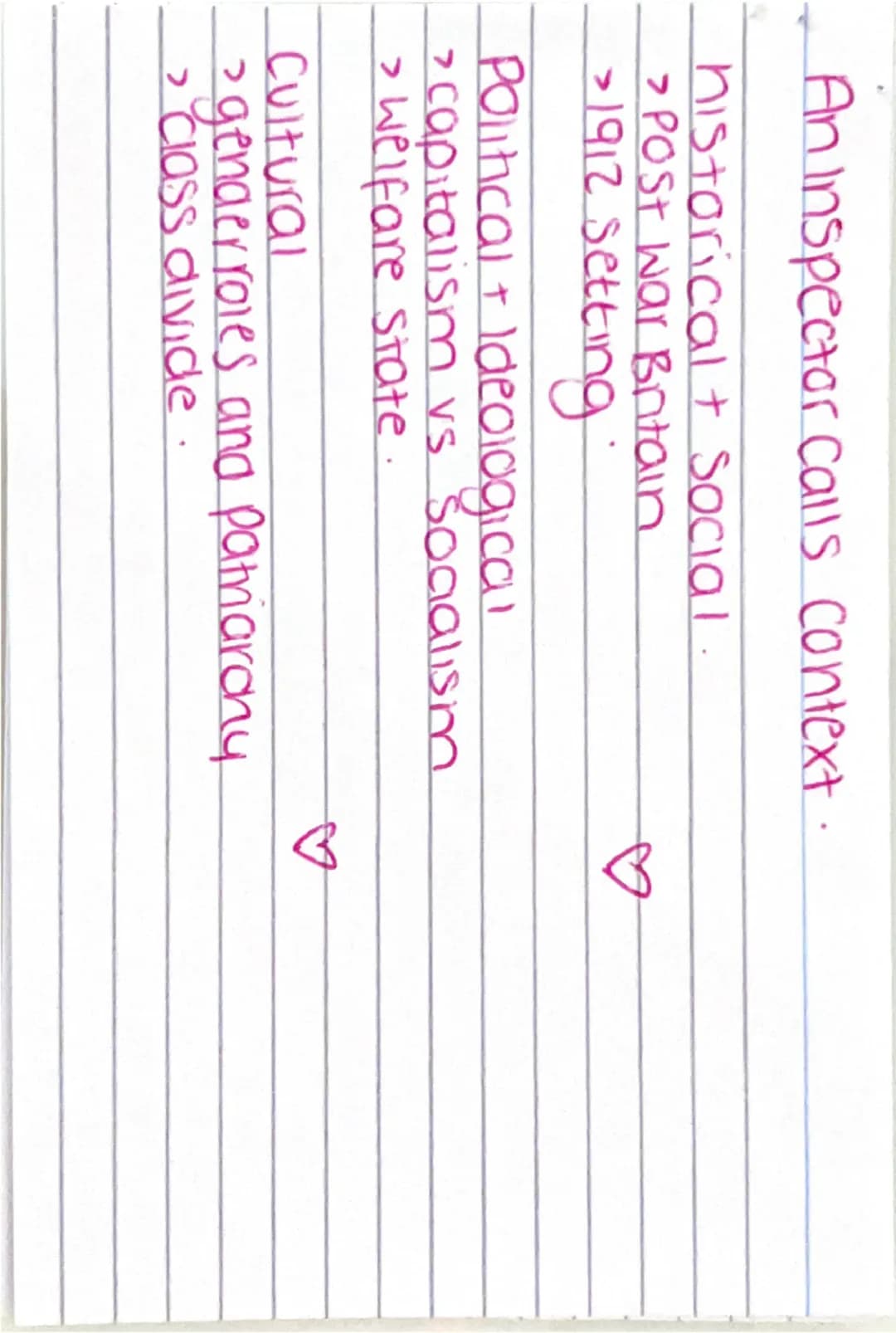
Historical and Social Context
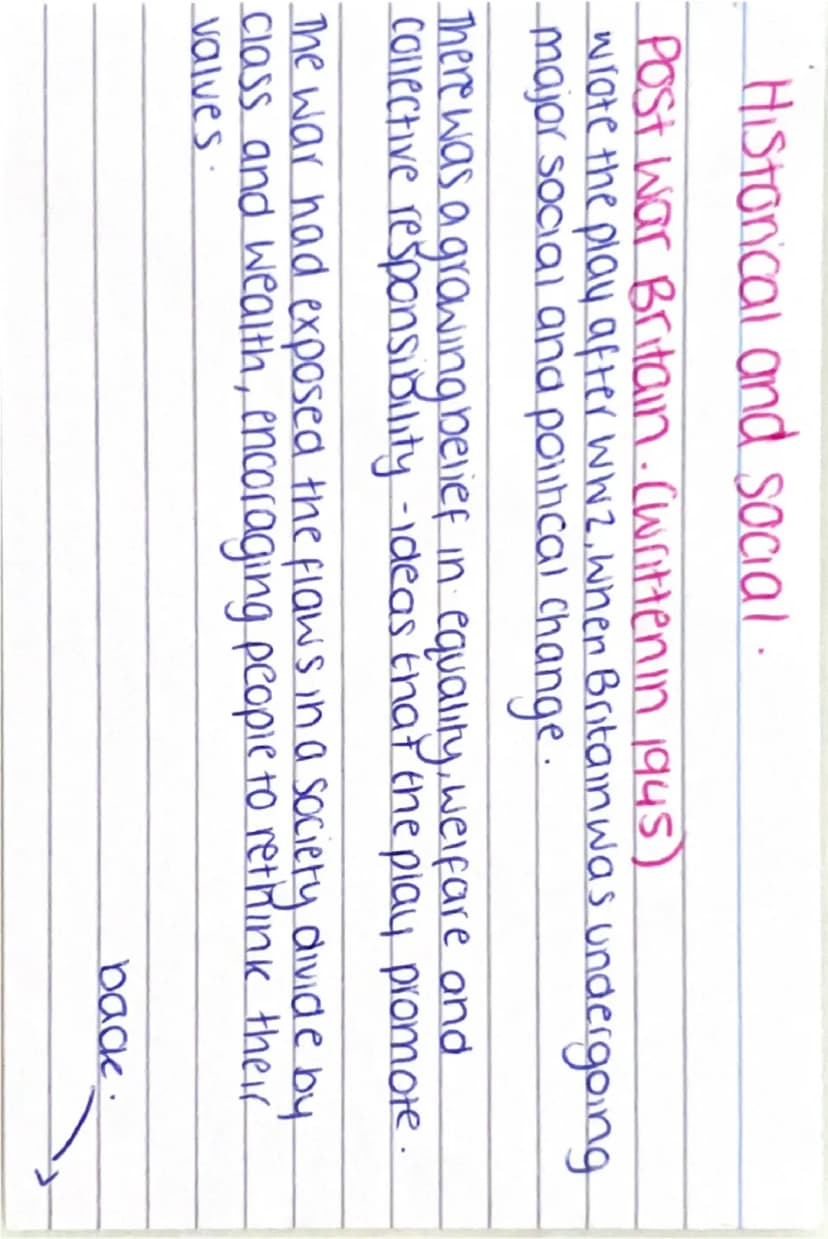
Post-war Britain in 1945 was a completely different world from the one we see in the Birling household. Priestley deliberately wrote this play after World War II, when Britain was desperately trying to rebuild itself with fresh ideas about equality and social care.
The war had shown everyone that collective responsibility actually worked - people had pulled together to survive the Blitz and defeat fascism. Suddenly, the idea that "we're all in this together" wasn't just nice rhetoric; it was proven fact.
This context explains why the Inspector's message hits so hard. Audiences in 1945 had lived through rationing, shared shelters, and genuine community spirit - making the Birlings' selfish attitudes seem even more outdated and disgusting.
Key insight: Priestley wasn't just entertaining his audience - he was trying to convince them that the old class-based society needed to stay buried in the past.
2
of 7
The 1912 Setting
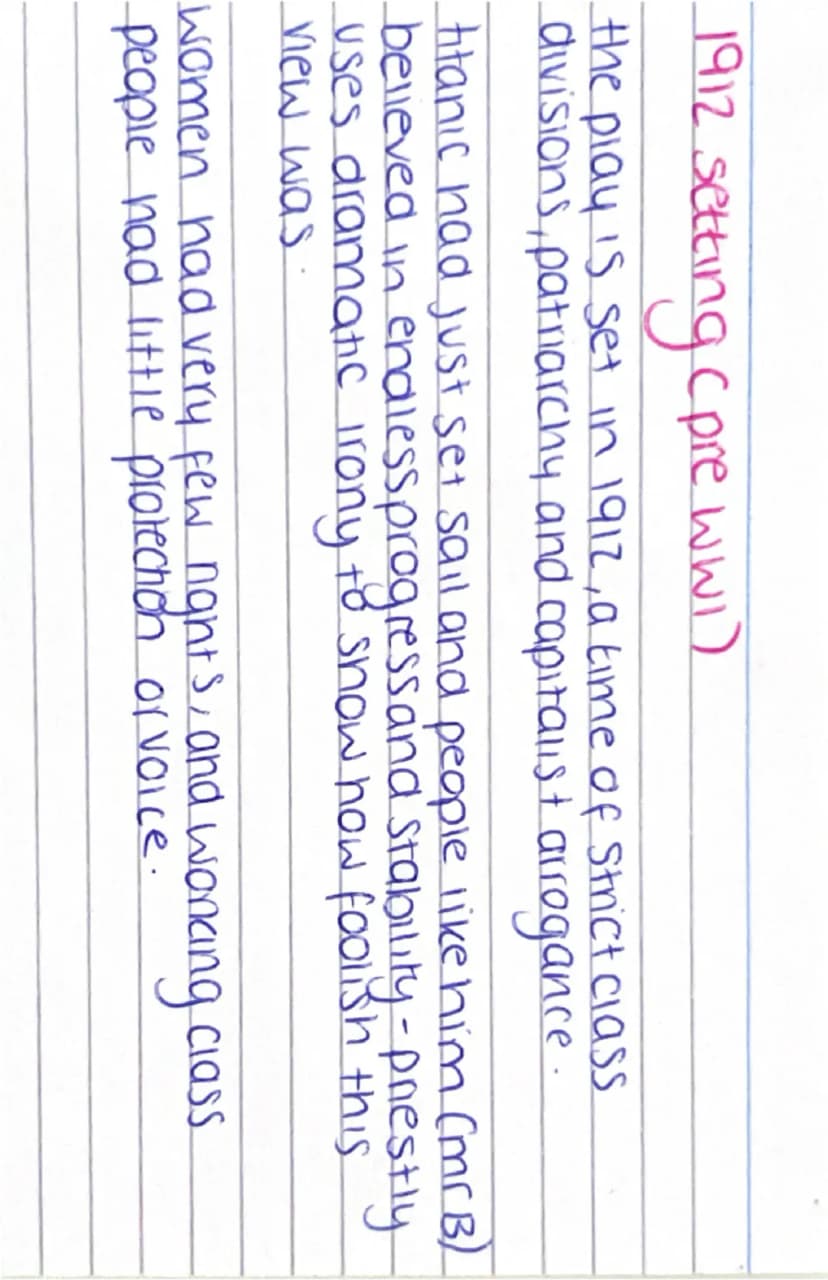
Pre-WWI Britain was the perfect setting for Priestley's criticism because it represents everything he wanted audiences to reject. This was an era of strict class divisions, where people like Mr Birling genuinely believed their privileged position was natural and permanent.
The dramatic irony here is brilliant - Mr Birling confidently predicts that the Titanic is "unsinkable" and that war is impossible. Your 1945 audience knows he's spectacularly wrong about everything, which immediately undermines his authority and credibility.
Women had virtually no rights in 1912, and working-class people like Eva Smith were completely disposable to their employers. This harsh reality makes the Inspector's call for social responsibility even more urgent and necessary.
Exam tip: Always mention how Priestley uses dramatic irony to make Mr Birling look foolish - it's a key technique that shows up in most high-level answers.
3
of 7
Political Battle: Capitalism vs Socialism
Here's where Priestley really shows his cards - he was a committed Socialist who believed society should look after everyone, not just the wealthy. The entire play is basically him arguing against the capitalist mindset that dominated 1912.
The Birlings represent everything wrong with capitalism - they're selfish, exploitative, and completely indifferent to anyone outside their social circle. Meanwhile, the Inspector voices Priestley's socialist beliefs through that famous line: "we are all members of one body."
This wasn't just abstract politics for 1945 audiences. They were literally deciding between continuing with the old Conservative ways or embracing Labour's radical new vision of social welfare and collective responsibility.
Remember: Every time a Birling character acts selfishly, Priestley is showing his audience why capitalism fails ordinary people.
4
of 7
The Welfare State Revolution
Britain's 1945 Labour government was busy creating the NHS and modern welfare system while audiences watched this play. Priestley was essentially cheerleading for these massive social changes by showing what happens when society ignores its most vulnerable members.
The play works as powerful propaganda for welfare reforms - Eva Smith's tragic story demonstrates exactly why Britain needed unemployment benefits, worker protections, and free healthcare. Without these safety nets, people literally died.
Collective responsibility wasn't just the Inspector's abstract moral message; it was the practical foundation of the welfare state that Priestley's audiences were being asked to support with their taxes and votes.
Context connection: Link Eva Smith's struggles to why the NHS was created - both show what happens when society abandons working-class people.
5
of 7
Gender Roles and Patriarchy
Women in 1912 were expected to be pretty, quiet, and completely dependent on male relatives for everything from money to major decisions. Sheila starts the play fitting this traditional feminine role perfectly - she's engaged, obsessed with clothes, and defers to her father.
But watch how Sheila's character develops throughout the evening. She becomes increasingly independent, challenges the men's authority, and ultimately sees the truth more clearly than any of the male characters. This transformation reflects Priestley's support for gender equality.
The contrast is deliberate - Priestley wants his 1945 audience (who'd just seen women work in factories, join the forces, and prove their capabilities during the war) to reject the restrictive gender roles that trapped women like Sheila.
Character analysis: Sheila's growth from obedient daughter to independent thinker mirrors how British women's roles changed between 1912 and 1945.
6
of 7
Class Divide and Social Inequality
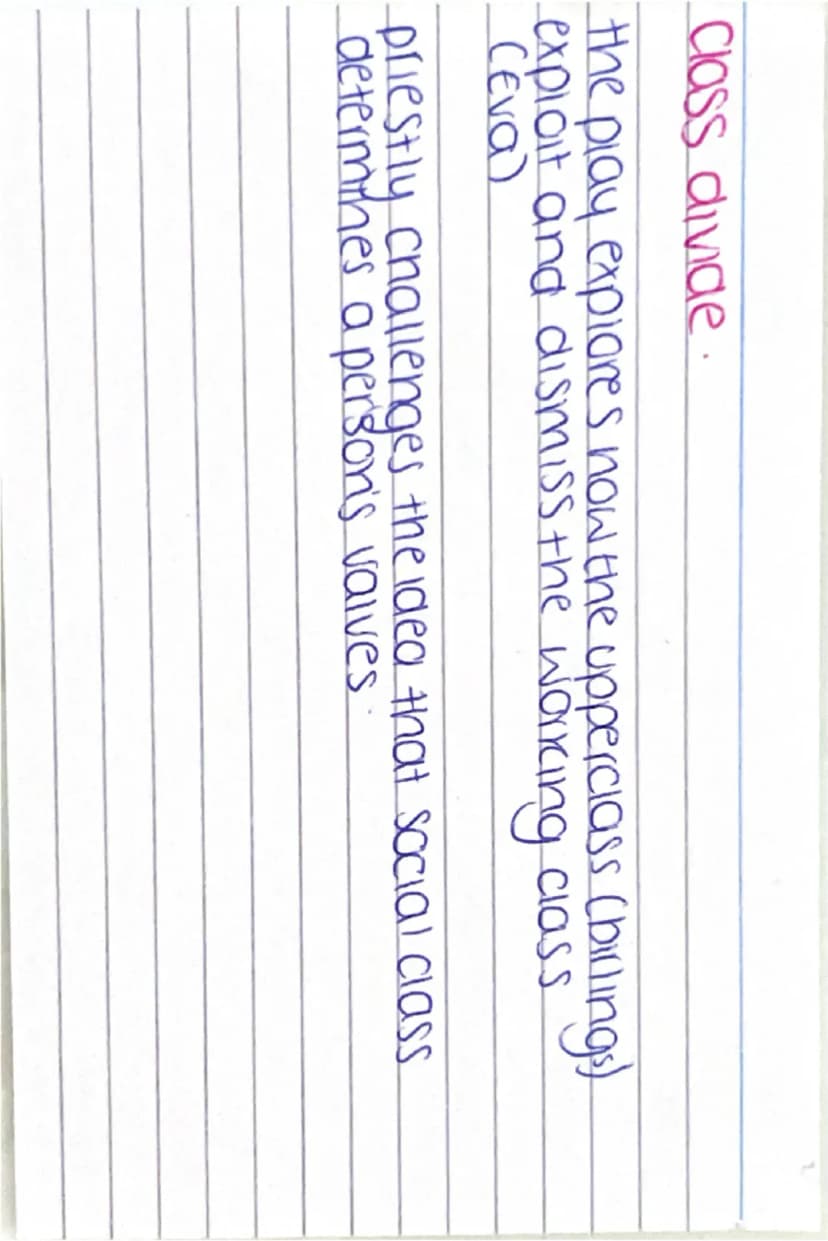
The class system in 1912 wasn't just about having more money - it was about believing that upper-class people were naturally superior to workers like Eva Smith. The Birlings genuinely think their social class makes them more important and valuable as human beings.
Priestley systematically destroys this assumption by showing how morally bankrupt the wealthy Birlings actually are, while presenting Eva Smith as dignified, principled, and deserving of respect. He's challenging the idea that social class determines a person's worth.
This message resonated powerfully with 1945 audiences who'd seen upper-class incompetence lead to military disasters while working-class people showed incredible courage and solidarity throughout the war.
Essay focus: Always explore how Priestley uses the Birlings' treatment of Eva Smith to expose the cruelty and injustice of the British class system.
7
of 7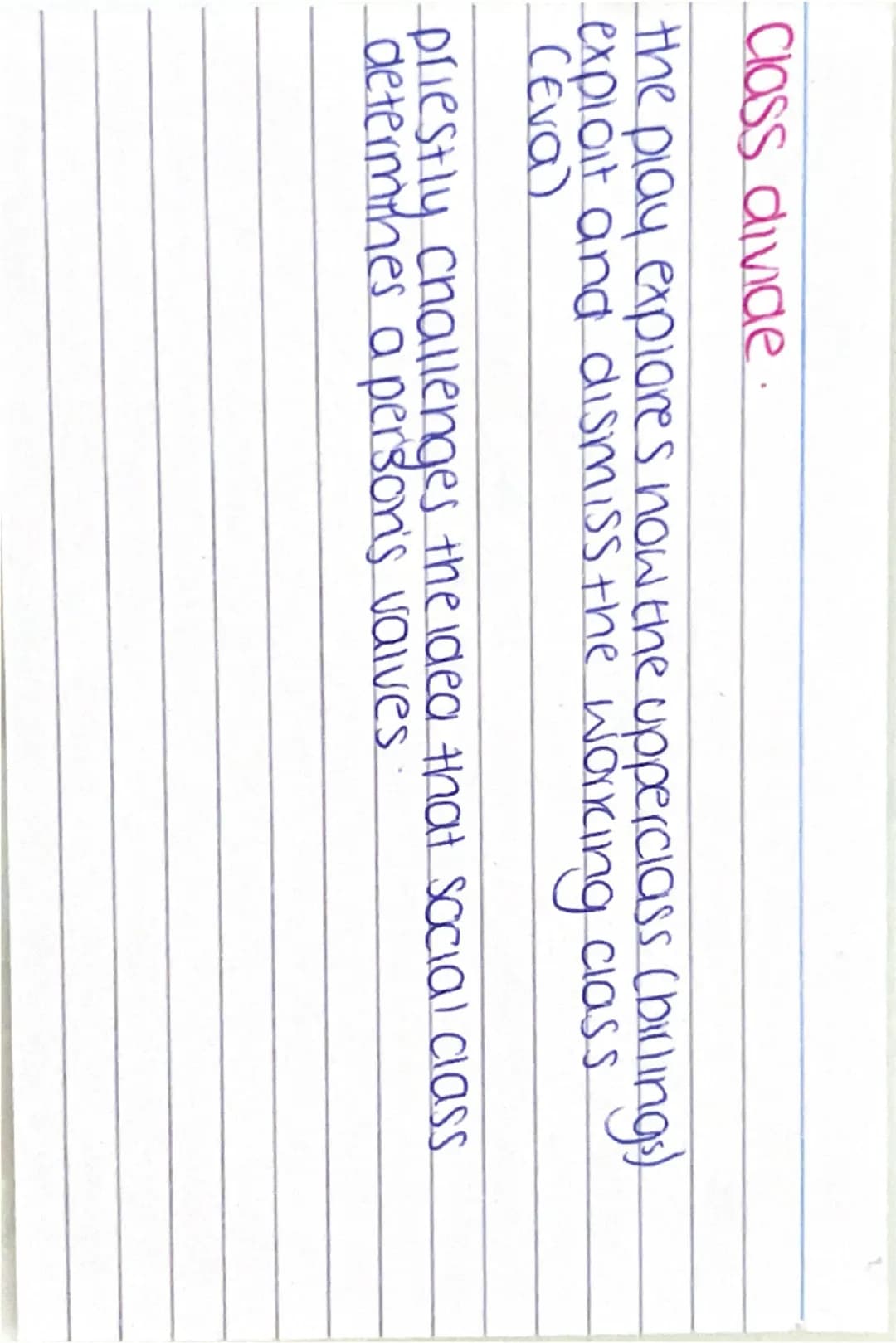
We thought you’d never ask...
What is the Knowunity AI companion?
Our AI companion is specifically built for the needs of students. Based on the millions of content pieces we have on the platform we can provide truly meaningful and relevant answers to students. But its not only about answers, the companion is even more about guiding students through their daily learning challenges, with personalised study plans, quizzes or content pieces in the chat and 100% personalisation based on the students skills and developments.
Where can I download the Knowunity app?
You can download the app in the Google Play Store and in the Apple App Store.
Is Knowunity really free of charge?
That's right! Enjoy free access to study content, connect with fellow students, and get instant help – all at your fingertips.
Similar Content
 Anglais
Most popular content: Societal Context
1Most popular content in English Literature
9English LiteratureAn Inspector Calls: Character Insights
Explore in-depth analysis and key quotes for characters in J.B. Priestley's 'An Inspector Calls'. This resource covers Gerald Croft, Inspector Goole, Sheila Birling, Mrs. Birling, Eric Birling, and Eva Smith, focusing on themes of class, gender roles, and social responsibility. Ideal for students aiming for Grade 8 and above.
1025,429907
English LiteratureRomeo and Juliet: Key themes
Key Romeo and Juliet themes and analysed quotes
106,708198
English LiteratureMacbeth: Guilt and Ambition
Explore the complex themes of guilt and ambition in Shakespeare's 'Macbeth'. This analysis covers key characters, including Macbeth and Lady Macbeth, their moral dilemmas, and the tragic consequences of their ambition. Ideal for students studying character motivations, thematic elements, and the psychological impact of power. Includes insights on the natural order, manipulation, and the descent into madness.
919,093397
I
English LiteratureInspector Calls Quiz (YR 10 MOCKS)
for YR 10 GCSE mock on Inspector Calls
102,1461
E
English LiteratureExplore the World of English Literature
Master the key concepts and works of English literature with this comprehensive flashcard set designed for grade 10 students.
112,0941
English LiteratureExploring Macbeth's Themes
Dive into the intricate themes of Shakespeare's Macbeth, including the supernatural, ambition, guilt, and kingship. This analysis features key quotes and insights that reveal how these themes intertwine to shape the characters and the narrative. Ideal for students seeking a deeper understanding of the play's moral complexities and psychological depth.
1015,849524
E
English LiteratureExploring English Literature: A Journey through Medium
Discover the captivating world of English Literature with this comprehensive medium-level flashcard set. Dive into the works of renowned authors and explore the themes, characters, and literary techniques that make their writing truly remarkable.
111,0580
E
English LiteratureExploring 'A Christmas Carol': Themes, Characters, and Lessons
Delve into the main themes, key characters, and valuable lessons in Charles Dickens' 'A Christmas Carol'. Discover the impact of Scrooge's transformation and the significance of love, redemption, and the true meaning of Christmas.
101,2480
English LiteratureMacbeth Key Themes Essay Plans
Essay plans for key themes in macbeth - guilt, supernatural & ambition
115,186146
Most popular content
9 Sociology
Sociology of Education Overview
Explore comprehensive A-Level Sociology notes on the education system, covering key theories, policies, and sociological perspectives. This resource includes insights on marketisation, gender roles, cultural deprivation, and educational inequalities, providing a thorough understanding of how education shapes social stratification and individual achievement. Ideal for exam preparation and in-depth study.
12102,8693,040
SociologySociology of Families: Comprehensive Revision
Dive into an extensive overview of family dynamics, perspectives, and patterns in sociology. This resource covers key concepts such as family diversity, gender roles, marriage, and the impact of social policies on family structures. Perfect for A-Level Sociology students preparing for Paper 2.
1273,6662,307
CriminologyCriminology: Crime & Punishment Overview
Comprehensive mindmaps covering key concepts in the Crime and Punishment topic for WJEC Criminology Unit 4. This resource includes detailed insights into the Criminal Justice System, crime prevention strategies, sentencing models, and the roles of various agencies. Ideal for A-Level revision, ensuring you grasp essential theories and legislative processes to excel in your exams.
1254,8721,059
SociologyComprehensive Crime & Deviance Overview
Explore an extensive revision of crime and deviance topics, including theories, types of crime, and the impact of media. This resource covers key concepts such as Marxism, functionalism, gender and crime, and the influence of globalization on criminal behavior. Ideal for students seeking a thorough understanding of criminology and its various theories. Type: Full Topic Revision.
1251,6541,399
C
 Biology
Cell Biology and Cell structure
cell structures
93,2490
English LiteratureAn Inspector Calls: Character Insights
Explore in-depth analysis and key quotes for characters in J.B. Priestley's 'An Inspector Calls'. This resource covers Gerald Croft, Inspector Goole, Sheila Birling, Mrs. Birling, Eric Birling, and Eva Smith, focusing on themes of class, gender roles, and social responsibility. Ideal for students aiming for Grade 8 and above.
1025,429907
CriminologyWJEC Unit 4 Criminology
Criminology unit 4 detailed revision note
127,151125
CriminologyCriminology Theories Overview
Explore key criminology theories and their implications on crime and deviance. This comprehensive summary covers biological, psychological, and sociological perspectives, including labelling theory, right realism, and the impact of social campaigns on policy development. Ideal for A-Level criminology students seeking to understand the complexities of criminal behaviour and the factors influencing crime prevention strategies.
129,760210
English LiteratureRomeo and Juliet: Key themes
Key Romeo and Juliet themes and analysed quotes
106,708198
Can't find what you're looking for? Explore other subjects.
Students love us — and so will you.
4.6/5App Store
4.7/5Google Play
The app is very easy to use and well designed. I have found everything I was looking for so far and have been able to learn a lot from the presentations! I will definitely use the app for a class assignment! And of course it also helps a lot as an inspiration.
Stefan SiOS user
This app is really great. There are so many study notes and help [...]. My problem subject is French, for example, and the app has so many options for help. Thanks to this app, I have improved my French. I would recommend it to anyone.
Samantha KlichAndroid user
Wow, I am really amazed. I just tried the app because I've seen it advertised many times and was absolutely stunned. This app is THE HELP you want for school and above all, it offers so many things, such as workouts and fact sheets, which have been VERY helpful to me personally.
AnnaiOS user
English Literature119 views·Updated Jun 19, 2026·7 pagesUnderstanding the Context of An Inspector Calls
robyn🎀🤗@rqbny
Understanding the context behind "An Inspector Calls" is absolutely crucial for your GCSE analysis. Priestley wrote this play with a clear political message, using the contrast between 1912 (when it's set) and 1945 (when it was written) to challenge audiences...
1
of 7
Sign up to see the content. It's free!
- Access to all documents
- Improve your grades
- Join milions of students
Historical and Social Context
Post-war Britain in 1945 was a completely different world from the one we see in the Birling household. Priestley deliberately wrote this play after World War II, when Britain was desperately trying to rebuild itself with fresh ideas about equality and social care.
The war had shown everyone that collective responsibility actually worked - people had pulled together to survive the Blitz and defeat fascism. Suddenly, the idea that "we're all in this together" wasn't just nice rhetoric; it was proven fact.
This context explains why the Inspector's message hits so hard. Audiences in 1945 had lived through rationing, shared shelters, and genuine community spirit - making the Birlings' selfish attitudes seem even more outdated and disgusting.
Key insight: Priestley wasn't just entertaining his audience - he was trying to convince them that the old class-based society needed to stay buried in the past.
2
of 7Sign up to see the content. It's free!
- Access to all documents
- Improve your grades
- Join milions of students
The 1912 Setting
Pre-WWI Britain was the perfect setting for Priestley's criticism because it represents everything he wanted audiences to reject. This was an era of strict class divisions, where people like Mr Birling genuinely believed their privileged position was natural and permanent.
The dramatic irony here is brilliant - Mr Birling confidently predicts that the Titanic is "unsinkable" and that war is impossible. Your 1945 audience knows he's spectacularly wrong about everything, which immediately undermines his authority and credibility.
Women had virtually no rights in 1912, and working-class people like Eva Smith were completely disposable to their employers. This harsh reality makes the Inspector's call for social responsibility even more urgent and necessary.
Exam tip: Always mention how Priestley uses dramatic irony to make Mr Birling look foolish - it's a key technique that shows up in most high-level answers.
3
of 7Sign up to see the content. It's free!
- Access to all documents
- Improve your grades
- Join milions of students
Political Battle: Capitalism vs Socialism
Here's where Priestley really shows his cards - he was a committed Socialist who believed society should look after everyone, not just the wealthy. The entire play is basically him arguing against the capitalist mindset that dominated 1912.
The Birlings represent everything wrong with capitalism - they're selfish, exploitative, and completely indifferent to anyone outside their social circle. Meanwhile, the Inspector voices Priestley's socialist beliefs through that famous line: "we are all members of one body."
This wasn't just abstract politics for 1945 audiences. They were literally deciding between continuing with the old Conservative ways or embracing Labour's radical new vision of social welfare and collective responsibility.
Remember: Every time a Birling character acts selfishly, Priestley is showing his audience why capitalism fails ordinary people.
4
of 7Sign up to see the content. It's free!
- Access to all documents
- Improve your grades
- Join milions of students
The Welfare State Revolution
Britain's 1945 Labour government was busy creating the NHS and modern welfare system while audiences watched this play. Priestley was essentially cheerleading for these massive social changes by showing what happens when society ignores its most vulnerable members.
The play works as powerful propaganda for welfare reforms - Eva Smith's tragic story demonstrates exactly why Britain needed unemployment benefits, worker protections, and free healthcare. Without these safety nets, people literally died.
Collective responsibility wasn't just the Inspector's abstract moral message; it was the practical foundation of the welfare state that Priestley's audiences were being asked to support with their taxes and votes.
Context connection: Link Eva Smith's struggles to why the NHS was created - both show what happens when society abandons working-class people.
5
of 7Sign up to see the content. It's free!
- Access to all documents
- Improve your grades
- Join milions of students
Gender Roles and Patriarchy
Women in 1912 were expected to be pretty, quiet, and completely dependent on male relatives for everything from money to major decisions. Sheila starts the play fitting this traditional feminine role perfectly - she's engaged, obsessed with clothes, and defers to her father.
But watch how Sheila's character develops throughout the evening. She becomes increasingly independent, challenges the men's authority, and ultimately sees the truth more clearly than any of the male characters. This transformation reflects Priestley's support for gender equality.
The contrast is deliberate - Priestley wants his 1945 audience (who'd just seen women work in factories, join the forces, and prove their capabilities during the war) to reject the restrictive gender roles that trapped women like Sheila.
Character analysis: Sheila's growth from obedient daughter to independent thinker mirrors how British women's roles changed between 1912 and 1945.
6
of 7Sign up to see the content. It's free!
- Access to all documents
- Improve your grades
- Join milions of students
Class Divide and Social Inequality
The class system in 1912 wasn't just about having more money - it was about believing that upper-class people were naturally superior to workers like Eva Smith. The Birlings genuinely think their social class makes them more important and valuable as human beings.
Priestley systematically destroys this assumption by showing how morally bankrupt the wealthy Birlings actually are, while presenting Eva Smith as dignified, principled, and deserving of respect. He's challenging the idea that social class determines a person's worth.
This message resonated powerfully with 1945 audiences who'd seen upper-class incompetence lead to military disasters while working-class people showed incredible courage and solidarity throughout the war.
Essay focus: Always explore how Priestley uses the Birlings' treatment of Eva Smith to expose the cruelty and injustice of the British class system.
7
of 7Sign up to see the content. It's free!
- Access to all documents
- Improve your grades
- Join milions of students
We thought you’d never ask...
What is the Knowunity AI companion?
Our AI companion is specifically built for the needs of students. Based on the millions of content pieces we have on the platform we can provide truly meaningful and relevant answers to students. But its not only about answers, the companion is even more about guiding students through their daily learning challenges, with personalised study plans, quizzes or content pieces in the chat and 100% personalisation based on the students skills and developments.
Where can I download the Knowunity app?
You can download the app in the Google Play Store and in the Apple App Store.
Is Knowunity really free of charge?
That's right! Enjoy free access to study content, connect with fellow students, and get instant help – all at your fingertips.
Similar Content
Most popular content: Societal Context
1Most popular content in English Literature
9English LiteratureAn Inspector Calls: Character Insights
Explore in-depth analysis and key quotes for characters in J.B. Priestley's 'An Inspector Calls'. This resource covers Gerald Croft, Inspector Goole, Sheila Birling, Mrs. Birling, Eric Birling, and Eva Smith, focusing on themes of class, gender roles, and social responsibility. Ideal for students aiming for Grade 8 and above.
1025,429907
English LiteratureRomeo and Juliet: Key themes
Key Romeo and Juliet themes and analysed quotes
106,708198
English LiteratureMacbeth: Guilt and Ambition
Explore the complex themes of guilt and ambition in Shakespeare's 'Macbeth'. This analysis covers key characters, including Macbeth and Lady Macbeth, their moral dilemmas, and the tragic consequences of their ambition. Ideal for students studying character motivations, thematic elements, and the psychological impact of power. Includes insights on the natural order, manipulation, and the descent into madness.
919,093397
I
English LiteratureInspector Calls Quiz (YR 10 MOCKS)
for YR 10 GCSE mock on Inspector Calls
102,1461
E
English LiteratureExplore the World of English Literature
Master the key concepts and works of English literature with this comprehensive flashcard set designed for grade 10 students.
112,0941
English LiteratureExploring Macbeth's Themes
Dive into the intricate themes of Shakespeare's Macbeth, including the supernatural, ambition, guilt, and kingship. This analysis features key quotes and insights that reveal how these themes intertwine to shape the characters and the narrative. Ideal for students seeking a deeper understanding of the play's moral complexities and psychological depth.
1015,849524
E
English LiteratureExploring English Literature: A Journey through Medium
Discover the captivating world of English Literature with this comprehensive medium-level flashcard set. Dive into the works of renowned authors and explore the themes, characters, and literary techniques that make their writing truly remarkable.
111,0580
E
English LiteratureExploring 'A Christmas Carol': Themes, Characters, and Lessons
Delve into the main themes, key characters, and valuable lessons in Charles Dickens' 'A Christmas Carol'. Discover the impact of Scrooge's transformation and the significance of love, redemption, and the true meaning of Christmas.
101,2480
English LiteratureMacbeth Key Themes Essay Plans
Essay plans for key themes in macbeth - guilt, supernatural & ambition
115,186146
Most popular content
9SociologySociology of Education Overview
Explore comprehensive A-Level Sociology notes on the education system, covering key theories, policies, and sociological perspectives. This resource includes insights on marketisation, gender roles, cultural deprivation, and educational inequalities, providing a thorough understanding of how education shapes social stratification and individual achievement. Ideal for exam preparation and in-depth study.
12102,8693,040
SociologySociology of Families: Comprehensive Revision
Dive into an extensive overview of family dynamics, perspectives, and patterns in sociology. This resource covers key concepts such as family diversity, gender roles, marriage, and the impact of social policies on family structures. Perfect for A-Level Sociology students preparing for Paper 2.
1273,6662,307
CriminologyCriminology: Crime & Punishment Overview
Comprehensive mindmaps covering key concepts in the Crime and Punishment topic for WJEC Criminology Unit 4. This resource includes detailed insights into the Criminal Justice System, crime prevention strategies, sentencing models, and the roles of various agencies. Ideal for A-Level revision, ensuring you grasp essential theories and legislative processes to excel in your exams.
1254,8721,059
SociologyComprehensive Crime & Deviance Overview
Explore an extensive revision of crime and deviance topics, including theories, types of crime, and the impact of media. This resource covers key concepts such as Marxism, functionalism, gender and crime, and the influence of globalization on criminal behavior. Ideal for students seeking a thorough understanding of criminology and its various theories. Type: Full Topic Revision.
1251,6541,399
C
BiologyCell Biology and Cell structure
cell structures
93,2490
English LiteratureAn Inspector Calls: Character Insights
Explore in-depth analysis and key quotes for characters in J.B. Priestley's 'An Inspector Calls'. This resource covers Gerald Croft, Inspector Goole, Sheila Birling, Mrs. Birling, Eric Birling, and Eva Smith, focusing on themes of class, gender roles, and social responsibility. Ideal for students aiming for Grade 8 and above.
1025,429907
CriminologyWJEC Unit 4 Criminology
Criminology unit 4 detailed revision note
127,151125
CriminologyCriminology Theories Overview
Explore key criminology theories and their implications on crime and deviance. This comprehensive summary covers biological, psychological, and sociological perspectives, including labelling theory, right realism, and the impact of social campaigns on policy development. Ideal for A-Level criminology students seeking to understand the complexities of criminal behaviour and the factors influencing crime prevention strategies.
129,760210
English LiteratureRomeo and Juliet: Key themes
Key Romeo and Juliet themes and analysed quotes
106,708198
Can't find what you're looking for? Explore other subjects.
Students love us — and so will you.
4.6/5App Store
4.7/5Google Play
The app is very easy to use and well designed. I have found everything I was looking for so far and have been able to learn a lot from the presentations! I will definitely use the app for a class assignment! And of course it also helps a lot as an inspiration.
Stefan SiOS user
This app is really great. There are so many study notes and help [...]. My problem subject is French, for example, and the app has so many options for help. Thanks to this app, I have improved my French. I would recommend it to anyone.
Samantha KlichAndroid user
Wow, I am really amazed. I just tried the app because I've seen it advertised many times and was absolutely stunned. This app is THE HELP you want for school and above all, it offers so many things, such as workouts and fact sheets, which have been VERY helpful to me personally.
AnnaiOS user