
Animal Farm portrays the dangers of propaganda through various techniques...
 English Literature1,662 views·Updated Jun 25, 2026·6 pages
Examples of Propaganda in Animal Farm - Essay Plan & Quotes

mel@mel.jane84


1 / 6
1
of 6
Squealer's Propaganda Tactics
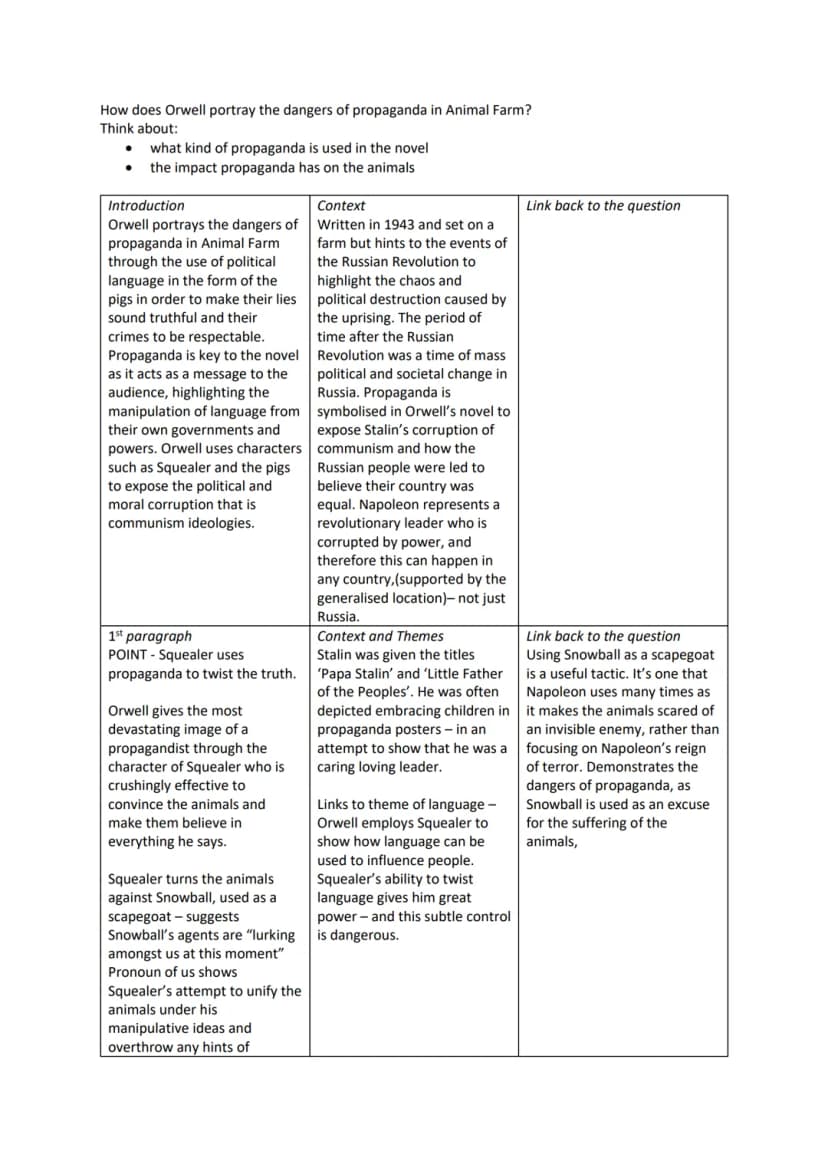
Squealer, the primary propagandist in Animal Farm, employs various techniques to manipulate the other animals' perceptions and beliefs.
Example: Squealer turns the animals against Snowball by suggesting that "Snowball's agents are lurking amongst us at this moment."
This use of fear and the creation of an invisible enemy is a classic propaganda technique. Squealer's use of the pronoun "us" is a subtle way to unify the animals under his manipulative ideas.
Highlight: Squealer fabricates evidence against Snowball, claiming he was "Jones's secret agent" and that this has been "proved by documents."
These tactics demonstrate how propaganda can be used to rewrite history and discredit opponents. The dangers of such manipulation are evident in how easily the animals are swayed by these baseless claims.
Vocabulary: Scapegoat - A person or group blamed for the wrongdoings, mistakes, or faults of others.
The use of Snowball as a scapegoat is a recurring tactic employed by Napoleon, diverting attention from his own tyrannical rule and justifying the animals' suffering.
2
of 6
The Role of Intellectuals and Bystanders
Orwell highlights the importance of informed individuals in confronting propaganda through the character of Benjamin.
Quote: "Benjamin was the only animal who did not side with either faction."
Benjamin's refusal to use his knowledge to help make decisions for the farm represents the dangers of intellectual apathy. His character may symbolize the Russian intelligentsia or, more broadly, intellectuals who choose to ignore politics.
Highlight: Benjamin's eventual action comes too late when he realizes what's happening to Boxer, shouting, "Fools! Do you not see what is written on the side of that van?"
This moment underscores Orwell's message that courageous, informed individuals must confront propaganda early to prevent its harmful consequences.
3
of 6
The Spread of Propaganda
The effectiveness of the pigs' propaganda is demonstrated by how the animals not only believe it but also spread it themselves.
Example: Boxer unwittingly spreads propaganda every time he says "Napoleon is always right."
This illustrates how trust and loyalty can be exploited to perpetuate propaganda. The pigs' effective use of language, including statistics and jargon, confuses the poorly educated animals.
Vocabulary: Intelligentsia - Intellectuals or highly educated people as a group, especially when regarded as possessing culture and political influence.
Orwell's critique extends beyond the specific context of the Russian Revolution, suggesting that the misuse of language in politics is a universal issue.
Quote: "Political writing is bad writing."
This quote from Orwell's essay highlights his belief that politicians often use vague language and clichés to sound impressive without conveying real meaning.
4
of 6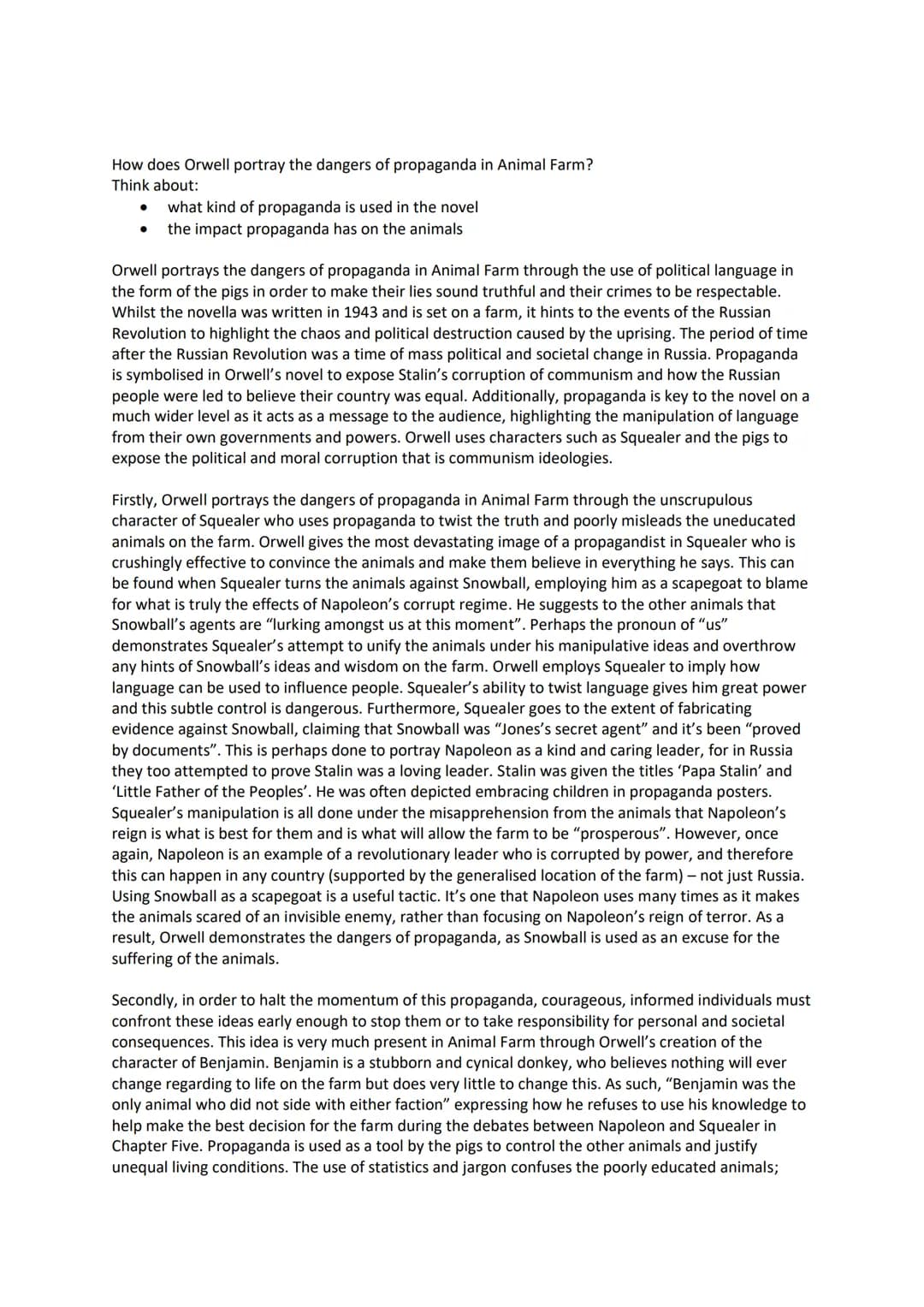
The Dangers of Unchallenged Propaganda
The novel ultimately warns of the consequences when propaganda goes unchallenged. The pigs' manipulation of language and information allows them to maintain power and exploit the other animals.
Highlight: Orwell's message: Malicious groups will continue to use propaganda to usurp power, exploit the vulnerable, and control the masses unless courageous individuals spread the truth and stand up for those who cannot fight for themselves.
The gradual changes to the Seven Commandments and the animals' acceptance of these changes demonstrate how propaganda can slowly erode principles and values.
Example: The commandment "All animals are equal" becomes "All animals are equal, but some animals are more equal than others."
This transformation encapsulates the dangers of propaganda in justifying inequality and oppression. The novel serves as a warning about the power of language and the importance of critical thinking in the face of political manipulation.
5
of 6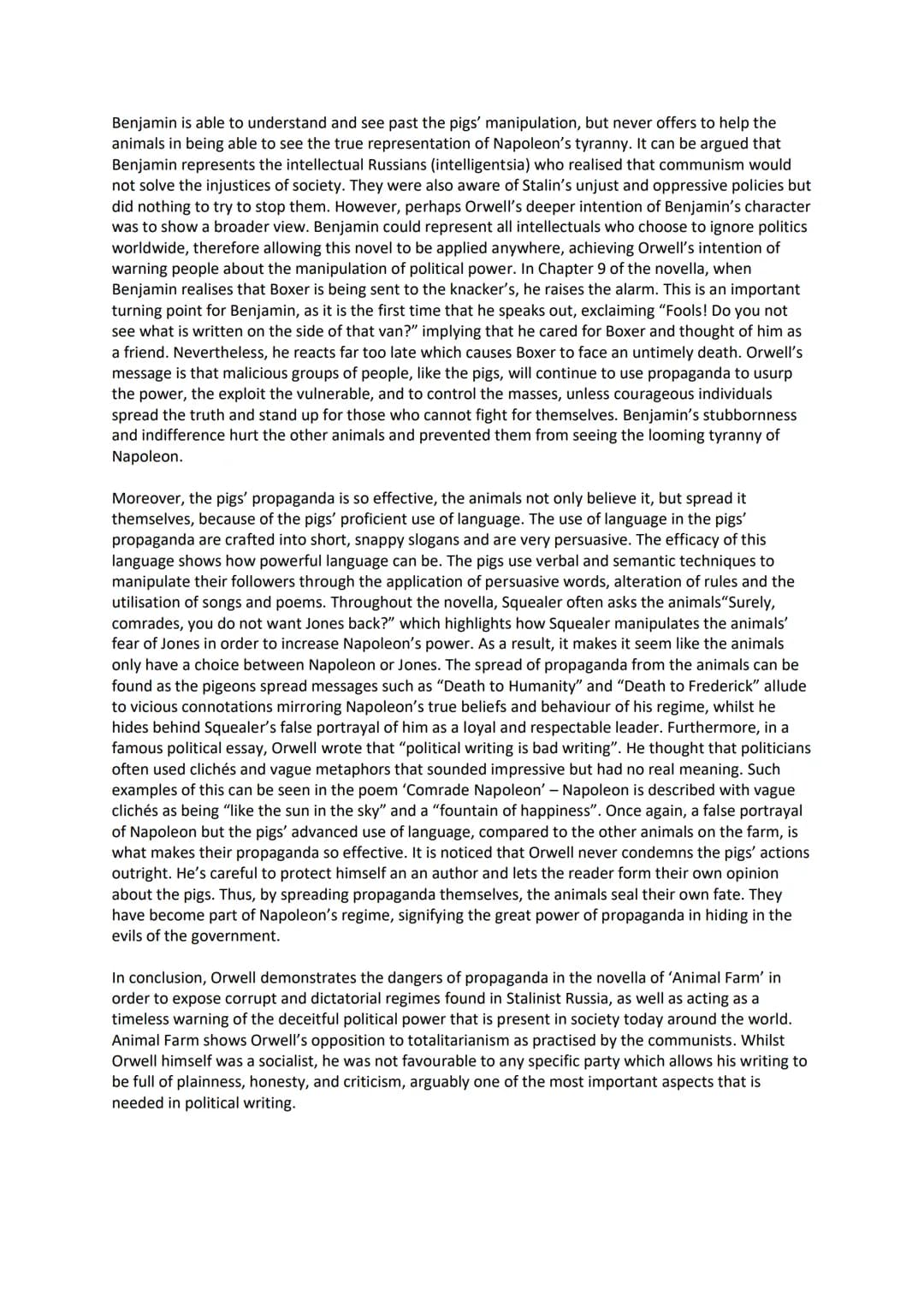
Conclusion: The Lasting Impact of Animal Farm
Animal Farm remains a powerful critique of propaganda and political manipulation. Its allegorical nature allows readers to apply its lessons to various political contexts beyond the specific events of the Russian Revolution.
Highlight: The novel demonstrates how propaganda can distort truth, create fear, justify oppression, and prevent critical thinking.
Orwell's work continues to be relevant, serving as a reminder of the importance of questioning authority, thinking critically, and standing up against injustice. The dangers of propaganda portrayed in Animal Farm serve as a timeless warning about the manipulation of language and information in politics.
Quote: "If liberty means anything at all, it means the right to tell people what they do not want to hear." - George Orwell
This quote, though not from Animal Farm, encapsulates Orwell's belief in the importance of speaking truth to power, a theme that runs throughout the novel. The enduring popularity of Animal Farm attests to its effectiveness in exposing the mechanisms of propaganda and the dangers of political apathy.
6
of 6
Propaganda Techniques in Animal Farm
George Orwell's Animal Farm vividly portrays the dangers of propaganda through various characters and techniques. The novel serves as a powerful allegory for political manipulation, particularly in the context of the Russian Revolution and Stalinist era.
Highlight: Orwell uses the pigs, especially Squealer, to demonstrate how language can be twisted to serve those in power.
The introduction emphasizes that propaganda is a key theme in the novel, used to expose the political and moral corruption inherent in communist ideologies. Orwell employs characters like Squealer and the other pigs to illustrate how propaganda can make lies sound truthful and crimes appear respectable.
Example: Squealer, as the main propagandist, is described as "crushingly effective" in convincing the animals to believe everything he says.
The novel's setting on a farm, while alluding to the Russian Revolution, serves to highlight the universal nature of political manipulation and corruption.
Quote: "Orwell uses characters such as Squealer and the pigs to expose the political and moral corruption that is communism ideologies."
We thought you’d never ask...
What is the Knowunity AI companion?
Our AI companion is specifically built for the needs of students. Based on the millions of content pieces we have on the platform we can provide truly meaningful and relevant answers to students. But its not only about answers, the companion is even more about guiding students through their daily learning challenges, with personalised study plans, quizzes or content pieces in the chat and 100% personalisation based on the students skills and developments.
Where can I download the Knowunity app?
You can download the app in the Google Play Store and in the Apple App Store.
Is Knowunity really free of charge?
That's right! Enjoy free access to study content, connect with fellow students, and get instant help – all at your fingertips.
Similar Content
Most popular content: George Orwell
9English LiteratureAnimal Farm Exam Insights
Comprehensive revision guide for *Animal Farm*, covering key themes, characters, and historical context. This resource is essential for mastering your English Literature GCSE exam, with a focus on Orwell's critique of totalitarianism and the allegorical representation of the Russian Revolution. Ideal for students preparing for Paper 1, featuring exam practice questions and detailed analysis.
114,418126
English LiteratureAnimal Farm Analysis
Explore the key themes, characters, and narrative structure of George Orwell's *Animal Farm*. This detailed summary covers the allegorical elements reflecting the Russian Revolution, the rise of authoritarianism, and the moral lessons about power and greed. Ideal for students studying literature and political allegory.
92,10851
English LanguageExploring Dystopian Themes
This study note delves into the key themes of dystopian literature as presented in 'The Handmaid's Tale' and its connections to works like 'Animal Farm' and '1984'. It covers the exploration of authoritarian regimes, the impact of patriarchy, and the moral implications of power and control. Ideal for students studying dystopian narratives and their societal critiques.
121,36328
English LiteratureSquealer's Manipulation Tactics
Explore how Squealer embodies propaganda in George Orwell's 'Animal Farm'. This analysis delves into key themes of manipulation, symbolism, and irony, highlighting Squealer's role in controlling the narrative and the animals' perception of power. Ideal for Grade 9 students, this resource includes critical insights and top band A01 statements for effective exam preparation.
111,67838
English LiteratureAnimal farm GCSE English literature
Animal farm
116629
English LiteratureAnimal Farm: Political Allegory
Explore the political allegory in George Orwell's 'Animal Farm', where characters symbolize figures from the Russian Revolution. This summary delves into themes of corruption, totalitarianism, and the manipulation of ideals, highlighting how revolutionary leaders can become oppressive. Understand the implications of Orwell's critique on power dynamics and the role of the working class in sustaining tyranny. Ideal for students studying political ideologies and literature.
106209
EnglishA Hanging: Key Insights
Explore key quotes and in-depth analysis of George Orwell's 'A Hanging'. This study note delves into the symbolism of the dog, the significance of the prisoner's actions, and the emotional impact of capital punishment. Ideal for higher English students seeking to understand the themes of humanity and morality in Orwell's work.
S52936
English LiteratureAnimal Farm Character Analysis
Explore the key characters of George Orwell's 'Animal Farm' with this detailed mind map. Featuring in-depth analysis of Napoleon, Snowball, Squealer, and Old Major, along with essential quotes, context, themes, and significant moments. Ideal for AQA and Edexcel GCSE English Literature students.
1098118
English LiteratureAnimal Farm Character Insights
Explore key quotes and character analyses from George Orwell's 'Animal Farm'. This summary covers the context, imagery, and significant themes, including the roles of Napoleon, Snowball, Boxer, and Squealer. Ideal for AQA English Literature students seeking to deepen their understanding of the text.
1194620
Most popular content in English Literature
9English LiteratureAn Inspector Calls: Character Insights
Explore in-depth analysis and key quotes for characters in J.B. Priestley's 'An Inspector Calls'. This resource covers Gerald Croft, Inspector Goole, Sheila Birling, Mrs. Birling, Eric Birling, and Eva Smith, focusing on themes of class, gender roles, and social responsibility. Ideal for students aiming for Grade 8 and above.
1025,429907
English LiteratureRomeo and Juliet: Key themes
Key Romeo and Juliet themes and analysed quotes
106,708198
English LiteratureMacbeth: Guilt and Ambition
Explore the complex themes of guilt and ambition in Shakespeare's 'Macbeth'. This analysis covers key characters, including Macbeth and Lady Macbeth, their moral dilemmas, and the tragic consequences of their ambition. Ideal for students studying character motivations, thematic elements, and the psychological impact of power. Includes insights on the natural order, manipulation, and the descent into madness.
919,093397
I
English LiteratureInspector Calls Quiz (YR 10 MOCKS)
for YR 10 GCSE mock on Inspector Calls
102,1451
E
English LiteratureExplore the World of English Literature
Master the key concepts and works of English literature with this comprehensive flashcard set designed for grade 10 students.
112,0941
English LiteratureExploring Macbeth's Themes
Dive into the intricate themes of Shakespeare's Macbeth, including the supernatural, ambition, guilt, and kingship. This analysis features key quotes and insights that reveal how these themes intertwine to shape the characters and the narrative. Ideal for students seeking a deeper understanding of the play's moral complexities and psychological depth.
1015,849524
E
English LiteratureExploring English Literature: A Journey through Medium
Discover the captivating world of English Literature with this comprehensive medium-level flashcard set. Dive into the works of renowned authors and explore the themes, characters, and literary techniques that make their writing truly remarkable.
111,0580
E
English LiteratureExploring 'A Christmas Carol': Themes, Characters, and Lessons
Delve into the main themes, key characters, and valuable lessons in Charles Dickens' 'A Christmas Carol'. Discover the impact of Scrooge's transformation and the significance of love, redemption, and the true meaning of Christmas.
101,2480
English LiteratureMacbeth Key Themes Essay Plans
Essay plans for key themes in macbeth - guilt, supernatural & ambition
115,186146
Most popular content
9 Sociology
Sociology of Education Overview
Explore comprehensive A-Level Sociology notes on the education system, covering key theories, policies, and sociological perspectives. This resource includes insights on marketisation, gender roles, cultural deprivation, and educational inequalities, providing a thorough understanding of how education shapes social stratification and individual achievement. Ideal for exam preparation and in-depth study.
12102,8693,040
SociologySociology of Families: Comprehensive Revision
Dive into an extensive overview of family dynamics, perspectives, and patterns in sociology. This resource covers key concepts such as family diversity, gender roles, marriage, and the impact of social policies on family structures. Perfect for A-Level Sociology students preparing for Paper 2.
1273,6612,307
CriminologyCriminology: Crime & Punishment Overview
Comprehensive mindmaps covering key concepts in the Crime and Punishment topic for WJEC Criminology Unit 4. This resource includes detailed insights into the Criminal Justice System, crime prevention strategies, sentencing models, and the roles of various agencies. Ideal for A-Level revision, ensuring you grasp essential theories and legislative processes to excel in your exams.
1254,8691,059
SociologyComprehensive Crime & Deviance Overview
Explore an extensive revision of crime and deviance topics, including theories, types of crime, and the impact of media. This resource covers key concepts such as Marxism, functionalism, gender and crime, and the influence of globalization on criminal behavior. Ideal for students seeking a thorough understanding of criminology and its various theories. Type: Full Topic Revision.
1251,6541,399
C
 Biology
Cell Biology and Cell structure
cell structures
93,2470
English LiteratureAn Inspector Calls: Character Insights
Explore in-depth analysis and key quotes for characters in J.B. Priestley's 'An Inspector Calls'. This resource covers Gerald Croft, Inspector Goole, Sheila Birling, Mrs. Birling, Eric Birling, and Eva Smith, focusing on themes of class, gender roles, and social responsibility. Ideal for students aiming for Grade 8 and above.
1025,429907
CriminologyWJEC Unit 4 Criminology
Criminology unit 4 detailed revision note
127,151125
CriminologyCriminology Theories Overview
Explore key criminology theories and their implications on crime and deviance. This comprehensive summary covers biological, psychological, and sociological perspectives, including labelling theory, right realism, and the impact of social campaigns on policy development. Ideal for A-Level criminology students seeking to understand the complexities of criminal behaviour and the factors influencing crime prevention strategies.
129,760210
English LiteratureRomeo and Juliet: Key themes
Key Romeo and Juliet themes and analysed quotes
106,708198
Can't find what you're looking for? Explore other subjects.
Students love us — and so will you.
4.6/5App Store
4.7/5Google Play
The app is very easy to use and well designed. I have found everything I was looking for so far and have been able to learn a lot from the presentations! I will definitely use the app for a class assignment! And of course it also helps a lot as an inspiration.
Stefan SiOS user
This app is really great. There are so many study notes and help [...]. My problem subject is French, for example, and the app has so many options for help. Thanks to this app, I have improved my French. I would recommend it to anyone.
Samantha KlichAndroid user
Wow, I am really amazed. I just tried the app because I've seen it advertised many times and was absolutely stunned. This app is THE HELP you want for school and above all, it offers so many things, such as workouts and fact sheets, which have been VERY helpful to me personally.
AnnaiOS user
English Literature1,662 views·Updated Jun 25, 2026·6 pagesExamples of Propaganda in Animal Farm - Essay Plan & Quotes
mel@mel.jane84
Animal Farm portrays the dangers of propaganda through various techniques and characters, highlighting how it can manipulate and control a population. Orwell uses the pigs, particularly Squealer, to demonstrate how language can be twisted to serve those in power. The...
1
of 6
Sign up to see the content. It's free!
- Access to all documents
- Improve your grades
- Join milions of students
Squealer's Propaganda Tactics
Squealer, the primary propagandist in Animal Farm, employs various techniques to manipulate the other animals' perceptions and beliefs.
Example: Squealer turns the animals against Snowball by suggesting that "Snowball's agents are lurking amongst us at this moment."
This use of fear and the creation of an invisible enemy is a classic propaganda technique. Squealer's use of the pronoun "us" is a subtle way to unify the animals under his manipulative ideas.
Highlight: Squealer fabricates evidence against Snowball, claiming he was "Jones's secret agent" and that this has been "proved by documents."
These tactics demonstrate how propaganda can be used to rewrite history and discredit opponents. The dangers of such manipulation are evident in how easily the animals are swayed by these baseless claims.
Vocabulary: Scapegoat - A person or group blamed for the wrongdoings, mistakes, or faults of others.
The use of Snowball as a scapegoat is a recurring tactic employed by Napoleon, diverting attention from his own tyrannical rule and justifying the animals' suffering.
2
of 6Sign up to see the content. It's free!
- Access to all documents
- Improve your grades
- Join milions of students
The Role of Intellectuals and Bystanders
Orwell highlights the importance of informed individuals in confronting propaganda through the character of Benjamin.
Quote: "Benjamin was the only animal who did not side with either faction."
Benjamin's refusal to use his knowledge to help make decisions for the farm represents the dangers of intellectual apathy. His character may symbolize the Russian intelligentsia or, more broadly, intellectuals who choose to ignore politics.
Highlight: Benjamin's eventual action comes too late when he realizes what's happening to Boxer, shouting, "Fools! Do you not see what is written on the side of that van?"
This moment underscores Orwell's message that courageous, informed individuals must confront propaganda early to prevent its harmful consequences.
3
of 6Sign up to see the content. It's free!
- Access to all documents
- Improve your grades
- Join milions of students
The Spread of Propaganda
The effectiveness of the pigs' propaganda is demonstrated by how the animals not only believe it but also spread it themselves.
Example: Boxer unwittingly spreads propaganda every time he says "Napoleon is always right."
This illustrates how trust and loyalty can be exploited to perpetuate propaganda. The pigs' effective use of language, including statistics and jargon, confuses the poorly educated animals.
Vocabulary: Intelligentsia - Intellectuals or highly educated people as a group, especially when regarded as possessing culture and political influence.
Orwell's critique extends beyond the specific context of the Russian Revolution, suggesting that the misuse of language in politics is a universal issue.
Quote: "Political writing is bad writing."
This quote from Orwell's essay highlights his belief that politicians often use vague language and clichés to sound impressive without conveying real meaning.
4
of 6Sign up to see the content. It's free!
- Access to all documents
- Improve your grades
- Join milions of students
The Dangers of Unchallenged Propaganda
The novel ultimately warns of the consequences when propaganda goes unchallenged. The pigs' manipulation of language and information allows them to maintain power and exploit the other animals.
Highlight: Orwell's message: Malicious groups will continue to use propaganda to usurp power, exploit the vulnerable, and control the masses unless courageous individuals spread the truth and stand up for those who cannot fight for themselves.
The gradual changes to the Seven Commandments and the animals' acceptance of these changes demonstrate how propaganda can slowly erode principles and values.
Example: The commandment "All animals are equal" becomes "All animals are equal, but some animals are more equal than others."
This transformation encapsulates the dangers of propaganda in justifying inequality and oppression. The novel serves as a warning about the power of language and the importance of critical thinking in the face of political manipulation.
5
of 6Sign up to see the content. It's free!
- Access to all documents
- Improve your grades
- Join milions of students
Conclusion: The Lasting Impact of Animal Farm
Animal Farm remains a powerful critique of propaganda and political manipulation. Its allegorical nature allows readers to apply its lessons to various political contexts beyond the specific events of the Russian Revolution.
Highlight: The novel demonstrates how propaganda can distort truth, create fear, justify oppression, and prevent critical thinking.
Orwell's work continues to be relevant, serving as a reminder of the importance of questioning authority, thinking critically, and standing up against injustice. The dangers of propaganda portrayed in Animal Farm serve as a timeless warning about the manipulation of language and information in politics.
Quote: "If liberty means anything at all, it means the right to tell people what they do not want to hear." - George Orwell
This quote, though not from Animal Farm, encapsulates Orwell's belief in the importance of speaking truth to power, a theme that runs throughout the novel. The enduring popularity of Animal Farm attests to its effectiveness in exposing the mechanisms of propaganda and the dangers of political apathy.
6
of 6Sign up to see the content. It's free!
- Access to all documents
- Improve your grades
- Join milions of students
Propaganda Techniques in Animal Farm
George Orwell's Animal Farm vividly portrays the dangers of propaganda through various characters and techniques. The novel serves as a powerful allegory for political manipulation, particularly in the context of the Russian Revolution and Stalinist era.
Highlight: Orwell uses the pigs, especially Squealer, to demonstrate how language can be twisted to serve those in power.
The introduction emphasizes that propaganda is a key theme in the novel, used to expose the political and moral corruption inherent in communist ideologies. Orwell employs characters like Squealer and the other pigs to illustrate how propaganda can make lies sound truthful and crimes appear respectable.
Example: Squealer, as the main propagandist, is described as "crushingly effective" in convincing the animals to believe everything he says.
The novel's setting on a farm, while alluding to the Russian Revolution, serves to highlight the universal nature of political manipulation and corruption.
Quote: "Orwell uses characters such as Squealer and the pigs to expose the political and moral corruption that is communism ideologies."
We thought you’d never ask...
What is the Knowunity AI companion?
Our AI companion is specifically built for the needs of students. Based on the millions of content pieces we have on the platform we can provide truly meaningful and relevant answers to students. But its not only about answers, the companion is even more about guiding students through their daily learning challenges, with personalised study plans, quizzes or content pieces in the chat and 100% personalisation based on the students skills and developments.
Where can I download the Knowunity app?
You can download the app in the Google Play Store and in the Apple App Store.
Is Knowunity really free of charge?
That's right! Enjoy free access to study content, connect with fellow students, and get instant help – all at your fingertips.
Similar Content
Most popular content: George Orwell
9English LiteratureAnimal Farm Exam Insights
Comprehensive revision guide for *Animal Farm*, covering key themes, characters, and historical context. This resource is essential for mastering your English Literature GCSE exam, with a focus on Orwell's critique of totalitarianism and the allegorical representation of the Russian Revolution. Ideal for students preparing for Paper 1, featuring exam practice questions and detailed analysis.
114,418126
English LiteratureAnimal Farm Analysis
Explore the key themes, characters, and narrative structure of George Orwell's *Animal Farm*. This detailed summary covers the allegorical elements reflecting the Russian Revolution, the rise of authoritarianism, and the moral lessons about power and greed. Ideal for students studying literature and political allegory.
92,10851
English LanguageExploring Dystopian Themes
This study note delves into the key themes of dystopian literature as presented in 'The Handmaid's Tale' and its connections to works like 'Animal Farm' and '1984'. It covers the exploration of authoritarian regimes, the impact of patriarchy, and the moral implications of power and control. Ideal for students studying dystopian narratives and their societal critiques.
121,36328
English LiteratureSquealer's Manipulation Tactics
Explore how Squealer embodies propaganda in George Orwell's 'Animal Farm'. This analysis delves into key themes of manipulation, symbolism, and irony, highlighting Squealer's role in controlling the narrative and the animals' perception of power. Ideal for Grade 9 students, this resource includes critical insights and top band A01 statements for effective exam preparation.
111,67838
English LiteratureAnimal farm GCSE English literature
Animal farm
116629
English LiteratureAnimal Farm: Political Allegory
Explore the political allegory in George Orwell's 'Animal Farm', where characters symbolize figures from the Russian Revolution. This summary delves into themes of corruption, totalitarianism, and the manipulation of ideals, highlighting how revolutionary leaders can become oppressive. Understand the implications of Orwell's critique on power dynamics and the role of the working class in sustaining tyranny. Ideal for students studying political ideologies and literature.
106209
EnglishA Hanging: Key Insights
Explore key quotes and in-depth analysis of George Orwell's 'A Hanging'. This study note delves into the symbolism of the dog, the significance of the prisoner's actions, and the emotional impact of capital punishment. Ideal for higher English students seeking to understand the themes of humanity and morality in Orwell's work.
S52936
English LiteratureAnimal Farm Character Analysis
Explore the key characters of George Orwell's 'Animal Farm' with this detailed mind map. Featuring in-depth analysis of Napoleon, Snowball, Squealer, and Old Major, along with essential quotes, context, themes, and significant moments. Ideal for AQA and Edexcel GCSE English Literature students.
1098118
English LiteratureAnimal Farm Character Insights
Explore key quotes and character analyses from George Orwell's 'Animal Farm'. This summary covers the context, imagery, and significant themes, including the roles of Napoleon, Snowball, Boxer, and Squealer. Ideal for AQA English Literature students seeking to deepen their understanding of the text.
1194620
Most popular content in English Literature
9English LiteratureAn Inspector Calls: Character Insights
Explore in-depth analysis and key quotes for characters in J.B. Priestley's 'An Inspector Calls'. This resource covers Gerald Croft, Inspector Goole, Sheila Birling, Mrs. Birling, Eric Birling, and Eva Smith, focusing on themes of class, gender roles, and social responsibility. Ideal for students aiming for Grade 8 and above.
1025,429907
English LiteratureRomeo and Juliet: Key themes
Key Romeo and Juliet themes and analysed quotes
106,708198
English LiteratureMacbeth: Guilt and Ambition
Explore the complex themes of guilt and ambition in Shakespeare's 'Macbeth'. This analysis covers key characters, including Macbeth and Lady Macbeth, their moral dilemmas, and the tragic consequences of their ambition. Ideal for students studying character motivations, thematic elements, and the psychological impact of power. Includes insights on the natural order, manipulation, and the descent into madness.
919,093397
I
English LiteratureInspector Calls Quiz (YR 10 MOCKS)
for YR 10 GCSE mock on Inspector Calls
102,1451
E
English LiteratureExplore the World of English Literature
Master the key concepts and works of English literature with this comprehensive flashcard set designed for grade 10 students.
112,0941
English LiteratureExploring Macbeth's Themes
Dive into the intricate themes of Shakespeare's Macbeth, including the supernatural, ambition, guilt, and kingship. This analysis features key quotes and insights that reveal how these themes intertwine to shape the characters and the narrative. Ideal for students seeking a deeper understanding of the play's moral complexities and psychological depth.
1015,849524
E
English LiteratureExploring English Literature: A Journey through Medium
Discover the captivating world of English Literature with this comprehensive medium-level flashcard set. Dive into the works of renowned authors and explore the themes, characters, and literary techniques that make their writing truly remarkable.
111,0580
E
English LiteratureExploring 'A Christmas Carol': Themes, Characters, and Lessons
Delve into the main themes, key characters, and valuable lessons in Charles Dickens' 'A Christmas Carol'. Discover the impact of Scrooge's transformation and the significance of love, redemption, and the true meaning of Christmas.
101,2480
English LiteratureMacbeth Key Themes Essay Plans
Essay plans for key themes in macbeth - guilt, supernatural & ambition
115,186146
Most popular content
9SociologySociology of Education Overview
Explore comprehensive A-Level Sociology notes on the education system, covering key theories, policies, and sociological perspectives. This resource includes insights on marketisation, gender roles, cultural deprivation, and educational inequalities, providing a thorough understanding of how education shapes social stratification and individual achievement. Ideal for exam preparation and in-depth study.
12102,8693,040
SociologySociology of Families: Comprehensive Revision
Dive into an extensive overview of family dynamics, perspectives, and patterns in sociology. This resource covers key concepts such as family diversity, gender roles, marriage, and the impact of social policies on family structures. Perfect for A-Level Sociology students preparing for Paper 2.
1273,6612,307
CriminologyCriminology: Crime & Punishment Overview
Comprehensive mindmaps covering key concepts in the Crime and Punishment topic for WJEC Criminology Unit 4. This resource includes detailed insights into the Criminal Justice System, crime prevention strategies, sentencing models, and the roles of various agencies. Ideal for A-Level revision, ensuring you grasp essential theories and legislative processes to excel in your exams.
1254,8691,059
SociologyComprehensive Crime & Deviance Overview
Explore an extensive revision of crime and deviance topics, including theories, types of crime, and the impact of media. This resource covers key concepts such as Marxism, functionalism, gender and crime, and the influence of globalization on criminal behavior. Ideal for students seeking a thorough understanding of criminology and its various theories. Type: Full Topic Revision.
1251,6541,399
C
BiologyCell Biology and Cell structure
cell structures
93,2470
English LiteratureAn Inspector Calls: Character Insights
Explore in-depth analysis and key quotes for characters in J.B. Priestley's 'An Inspector Calls'. This resource covers Gerald Croft, Inspector Goole, Sheila Birling, Mrs. Birling, Eric Birling, and Eva Smith, focusing on themes of class, gender roles, and social responsibility. Ideal for students aiming for Grade 8 and above.
1025,429907
CriminologyWJEC Unit 4 Criminology
Criminology unit 4 detailed revision note
127,151125
CriminologyCriminology Theories Overview
Explore key criminology theories and their implications on crime and deviance. This comprehensive summary covers biological, psychological, and sociological perspectives, including labelling theory, right realism, and the impact of social campaigns on policy development. Ideal for A-Level criminology students seeking to understand the complexities of criminal behaviour and the factors influencing crime prevention strategies.
129,760210
English LiteratureRomeo and Juliet: Key themes
Key Romeo and Juliet themes and analysed quotes
106,708198
Can't find what you're looking for? Explore other subjects.
Students love us — and so will you.
4.6/5App Store
4.7/5Google Play
The app is very easy to use and well designed. I have found everything I was looking for so far and have been able to learn a lot from the presentations! I will definitely use the app for a class assignment! And of course it also helps a lot as an inspiration.
Stefan SiOS user
This app is really great. There are so many study notes and help [...]. My problem subject is French, for example, and the app has so many options for help. Thanks to this app, I have improved my French. I would recommend it to anyone.
Samantha KlichAndroid user
Wow, I am really amazed. I just tried the app because I've seen it advertised many times and was absolutely stunned. This app is THE HELP you want for school and above all, it offers so many things, such as workouts and fact sheets, which have been VERY helpful to me personally.
AnnaiOS user