
Charles Dickens' masterpiece "A Christmas Carol" follows the...
 English Literature3,016 views·Updated Jun 14, 2026·9 pages
A Christmas Carol: Fun Revision Notes and Summaries PDF for GCSE

Izzy 🫨@zevux



1 / 9
1
of 9
A Christmas Carol - Comprehensive Study Guide and Analysis
Charles Dickens' masterpiece "A Christmas Carol" stands as one of literature's most enduring tales of redemption. This detailed analysis provides essential insights for GCSE revision and literary study.
Definition: A Christmas Carol is a Victorian-era novella that follows the supernatural transformation of miserly Ebenezer Scrooge through visits from four ghosts on Christmas Eve.
The narrative structure consists of five staves (chapters), each serving a distinct purpose in Scrooge's journey toward redemption. This format, unusual for its time, mirrors the musical nature of the title and enhances the story's thematic resonance.
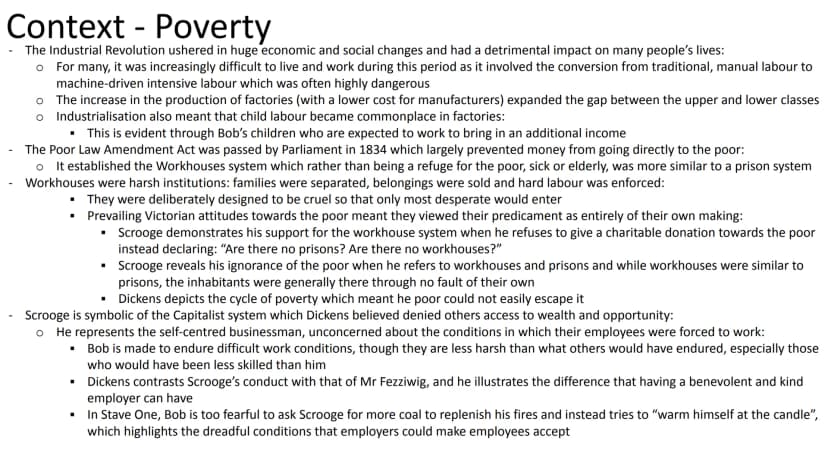
Understanding the historical context is crucial for deeper analysis. Written in 1843, during Victorian England's industrial revolution, the story addresses pressing social issues including poverty, class division, and the human cost of unchecked capitalism.
2
of 9
Stave One: Marley's Ghost - Critical Analysis
Stave 1 A Christmas Carol summary opens with the memorable declaration of Marley's death, setting the supernatural tone that pervades the narrative. Dickens masterfully establishes Scrooge's character through precise details and interactions.
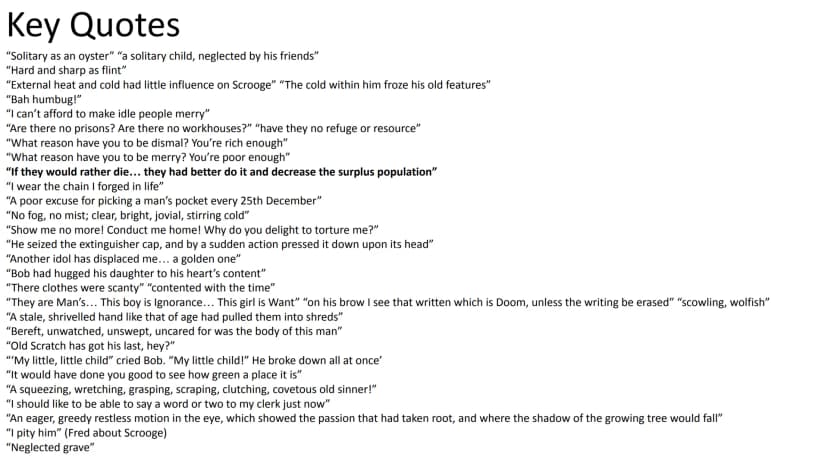
Quote: "Marley was dead: to begin with. There is no doubt whatever about that."
The introduction of key characters serves multiple narrative purposes:
- Bob Cratchit represents the working poor
- Fred embodies Christmas spirit and familial love
- The charity collectors highlight social responsibility
- Marley's ghost serves as a warning and catalyst
Highlight: Marley's chains, forged through greed and selfishness, symbolize the spiritual bondage of materialism - a central theme throughout the novel.
3
of 9
Stave Two: The First of the Three Spirits
The detailed analysis of A Christmas Carol staves continues with the Ghost of Christmas Past, whose appearance and symbolism merit careful study. This spirit's physical description - "like a child yet like an old man" - represents memory's timeless nature.
Vocabulary: The spirit's illuminated head symbolizes the enlightening power of memories and self-reflection.
Through carefully selected visions, this stave reveals Scrooge's transformation from an innocent child to a hardened businessman:
- The abandoned schoolboy reflects emotional neglect
- Fan's appearance highlights lost familial connections
- Fezziwig demonstrates positive leadership
- Belle represents sacrificed love for monetary gain
4
of 9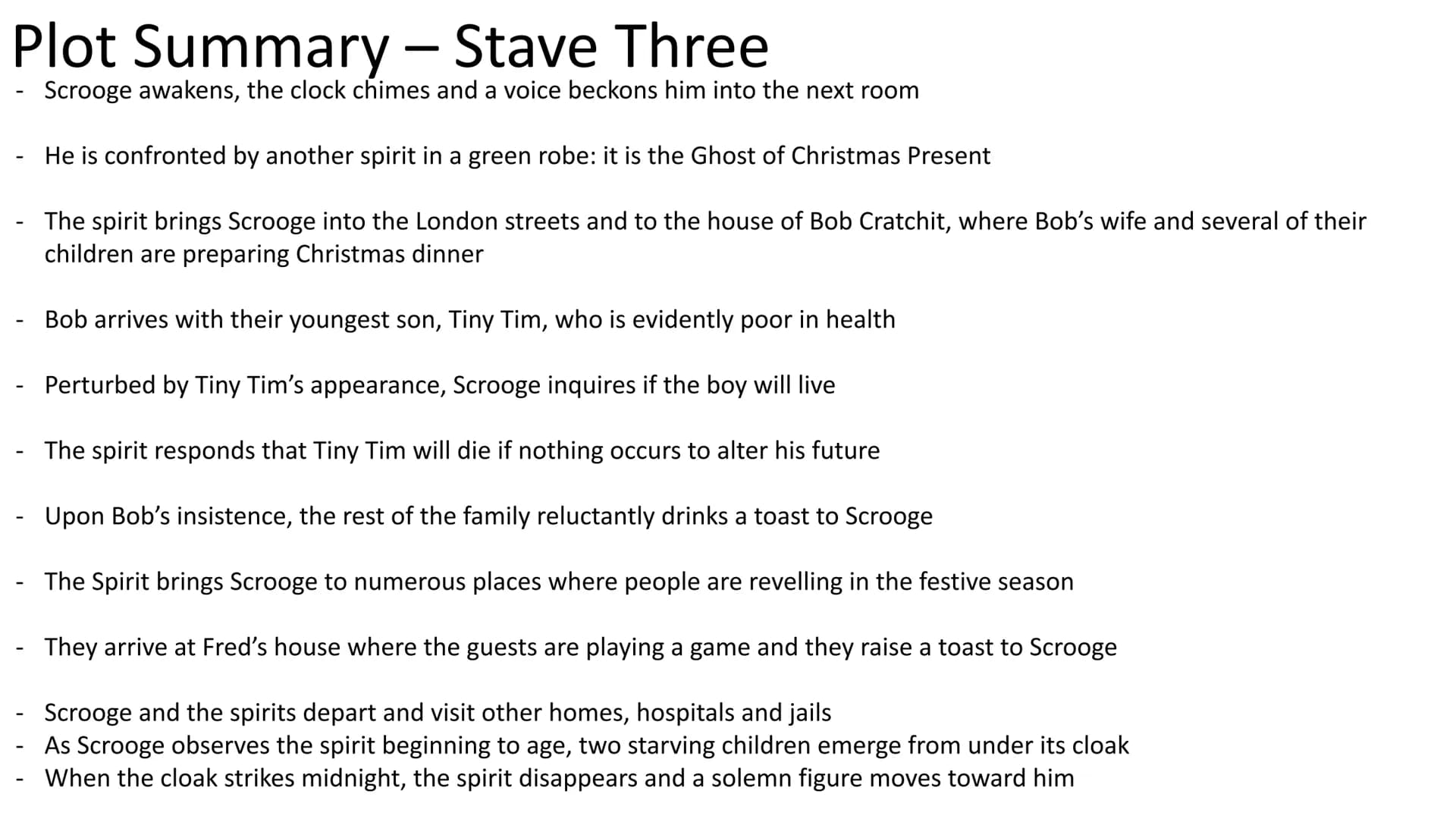
Stave Three: The Second of the Three Spirits
The Ghost of Christmas Present provides crucial social commentary through its journey with Scrooge. This section is particularly relevant for A Christmas Carol GCSE revision as it contains many of the novel's most significant themes.
Example: The Cratchit family dinner scene illustrates both poverty and dignity, showing how spiritual wealth can exist despite material poverty.
The spirit's revelations serve multiple purposes:
- Tiny Tim personifies Victorian-era child poverty
- The family's toast to Scrooge reveals complex social relationships
- Fred's party demonstrates joy without wealth
- The spirit's aging represents time's precious nature
The appearance of Want and Ignorance under the spirit's robes delivers Dickens' strongest social message, directly addressing Victorian society's failures toward its most vulnerable members.
5
of 9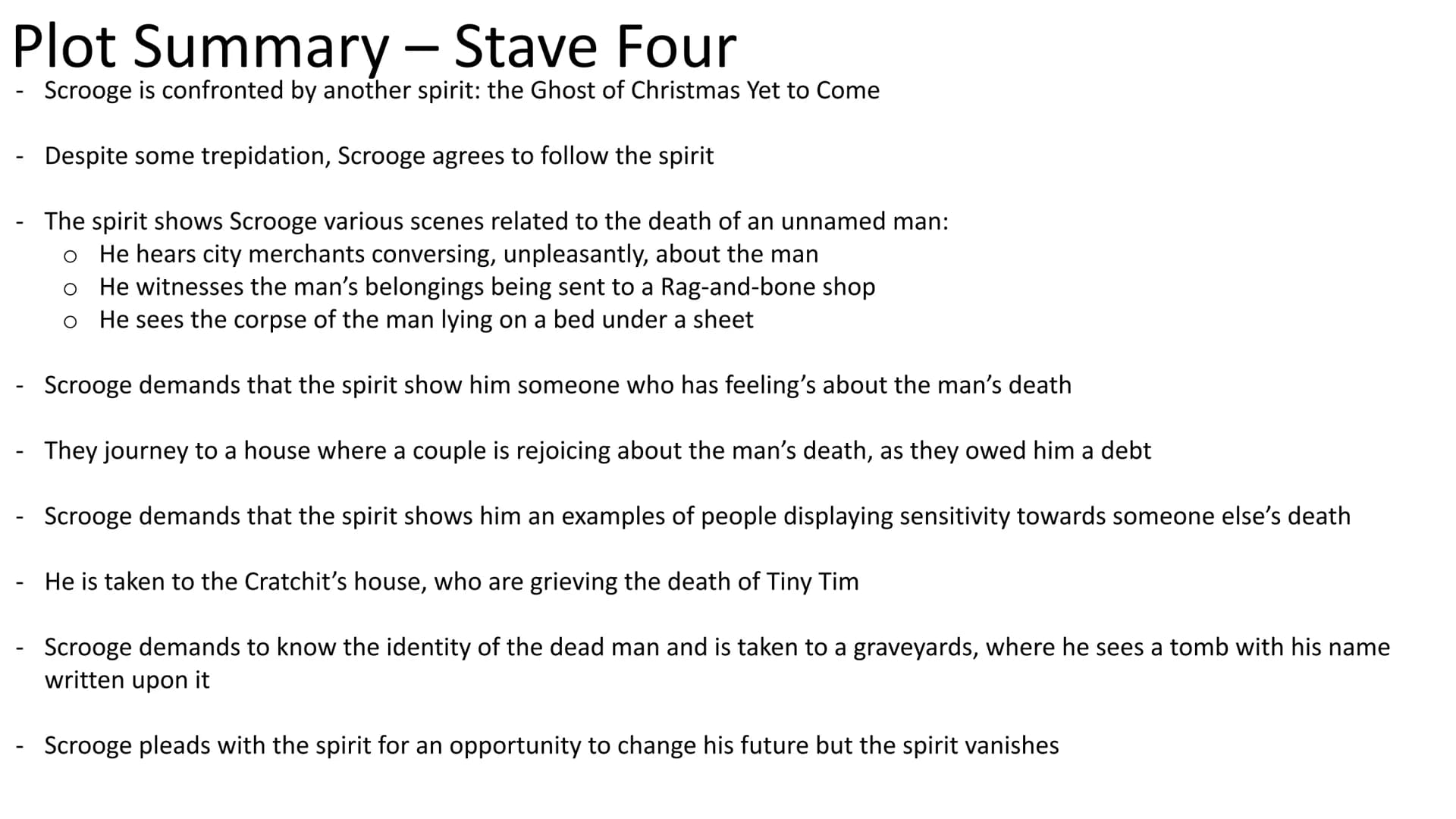
A Christmas Carol: Staves 4-5 Plot Summary and Analysis
The final chapters of Charles Dickens' masterpiece A Christmas Carol reach their dramatic climax as Scrooge confronts his potential future and experiences profound transformation. In Stave Four, the Ghost of Christmas Yet to Come appears as a dark, silent figure, leading Scrooge through haunting scenes of an unnamed man's death. The spirit reveals how this man's passing elicits only cruel remarks from merchants and opportunistic behavior from those who knew him.
Highlight: The Ghost of Christmas Yet to Come shows Scrooge the devastating consequences of continuing his miserly ways, including the death of Tiny Tim and his own lonely demise.
In a pivotal moment that shapes A Christmas Carol plot summary revision notes, Scrooge discovers the dead man is himself, finding his name etched on a neglected tombstone. This revelation forces him to confront the bitter truth about his legacy. Meanwhile, the Cratchit family's genuine grief over Tiny Tim's death provides a stark contrast to the callous reactions to Scrooge's passing, demonstrating the profound difference between being feared and being loved.
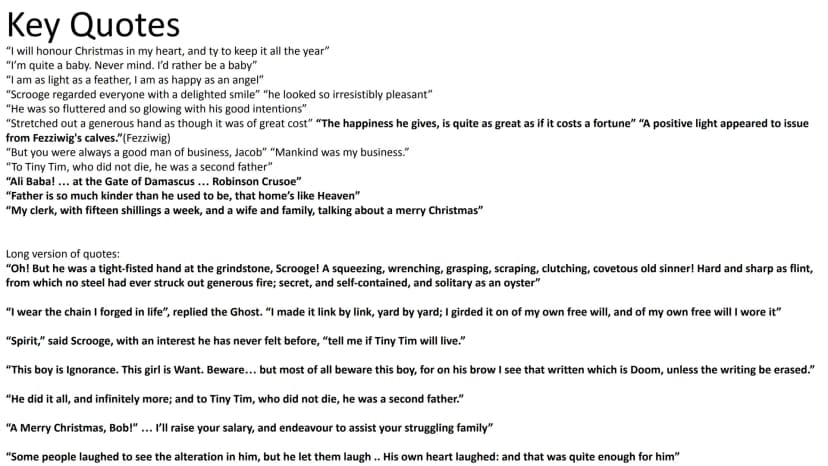
Stave Five brings redemption and joy as Scrooge awakens on Christmas morning a changed man. For students studying A Christmas Carol GCSE revision notes, this transformation represents the culmination of Dickens' themes about social responsibility and personal redemption. Scrooge's actions - sending a prize turkey to the Cratchits, giving generously to charity, and becoming "a second father to Tiny Tim" - demonstrate his complete metamorphosis from a miserly recluse to a beacon of Christmas spirit.
Definition: The Victorian context of poverty and social reform is crucial to understanding Dickens' message. The Poor Law Amendment Act of 1834 and the harsh realities of workhouses formed the backdrop against which Scrooge's transformation gains its full significance.
The novella concludes with Scrooge fulfilling his promise to honor Christmas in his heart year-round. His redemption serves as a powerful commentary on Victorian society's treatment of the poor and the transformative power of compassion. For those studying A Christmas Carol revision booklet AQA, this resolution perfectly encapsulates Dickens' message about social responsibility and the possibility of personal change.
Quote: "I will honour Christmas in my heart, and try to keep it all the year. I will live in the Past, the Present, and the Future. The Spirits of all Three shall strive within me."
6
of 9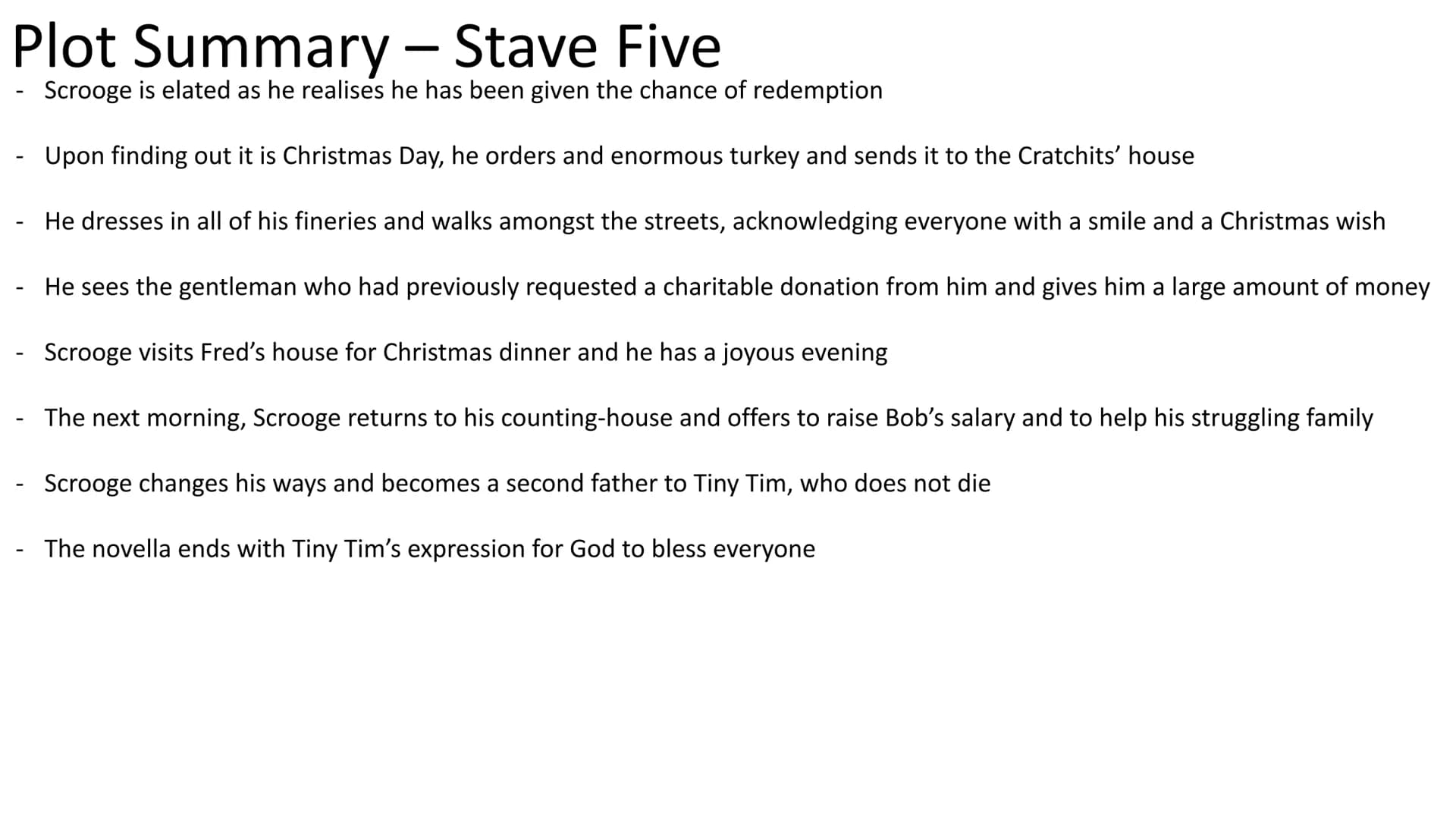
Page 7: Historical Context
The narrative is set against the backdrop of the Industrial Revolution, highlighting the social issues of the Victorian era.
Definition: The Industrial Revolution was a period of rapid industrialization that led to significant social and economic changes in Victorian Britain.
Highlight: Dickens uses the story to critique the harsh conditions faced by the poor during this period.
7
of 9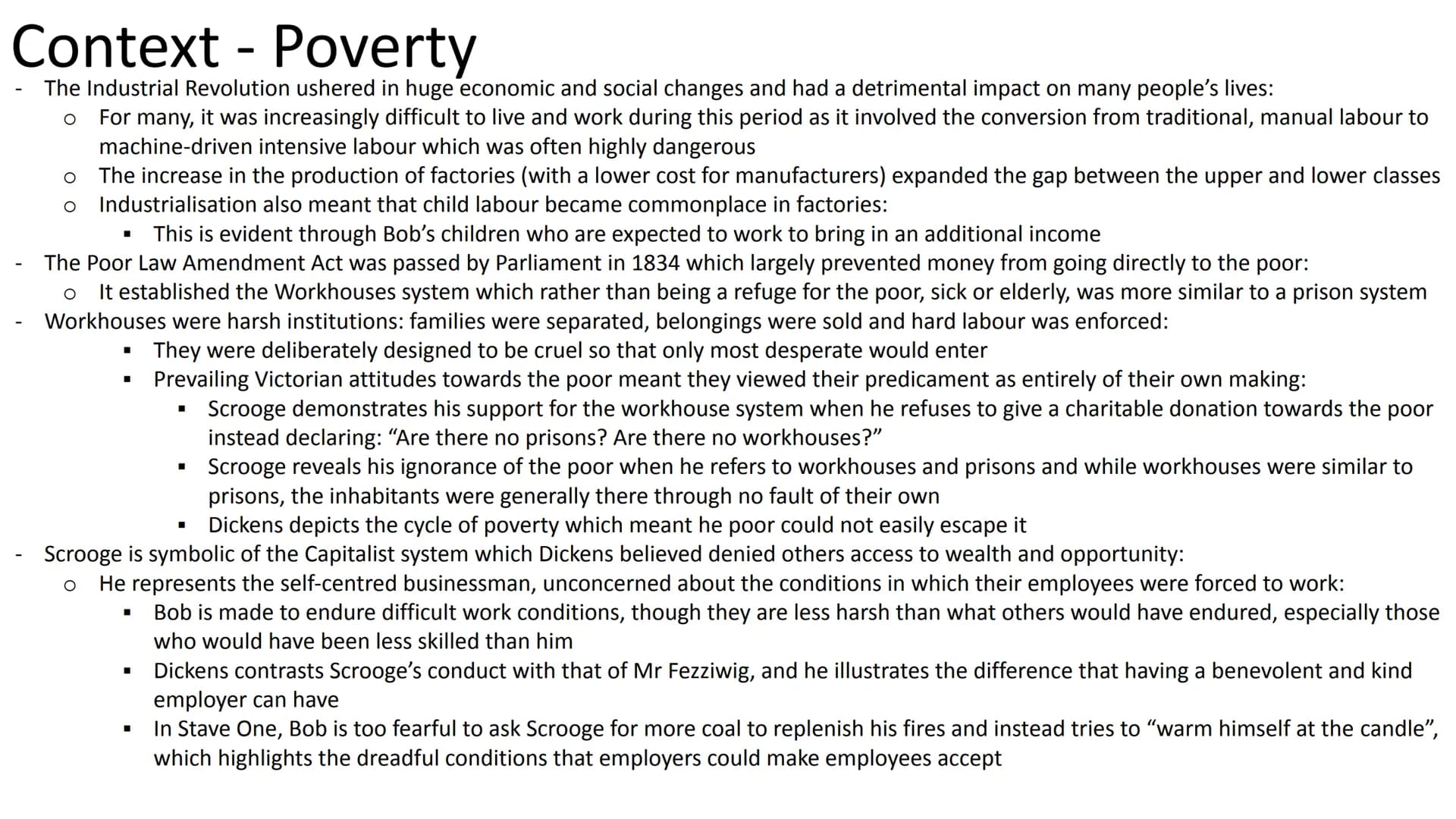
Page 8-9: [No content provided in transcript]
8
of 9
Stave One: Marley's Ghost
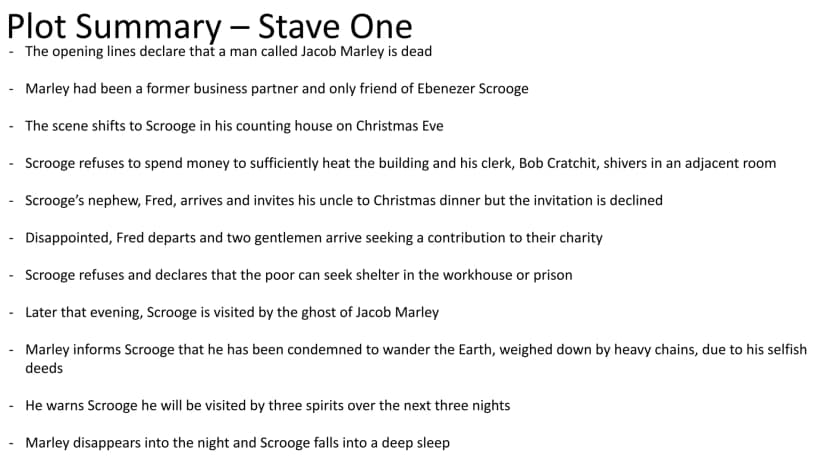
Stave One introduces the protagonist, Ebenezer Scrooge, a cold-hearted and miserly old man who hates Christmas. The story begins on Christmas Eve, seven years after the death of Scrooge's business partner, Jacob Marley.
Scrooge is shown to be a cruel and selfish man, refusing to donate to charity or even provide adequate heating for his clerk, Bob Cratchit. He rebuffs his nephew Fred's invitation to Christmas dinner and declares that the poor should seek shelter in prisons or workhouses.
Quote: "Bah! Humbug!" - Scrooge's famous exclamation, expressing his disdain for Christmas.
That night, Scrooge is visited by Marley's ghost, who warns him of the consequences of his selfish life. Marley informs Scrooge that he will be visited by three spirits over the next three nights, offering him a chance at redemption.
Highlight: The appearance of Marley's ghost sets the supernatural tone for the rest of the novella and introduces the central theme of redemption.
9
of 9
We thought you’d never ask...
What is the Knowunity AI companion?
Our AI companion is specifically built for the needs of students. Based on the millions of content pieces we have on the platform we can provide truly meaningful and relevant answers to students. But its not only about answers, the companion is even more about guiding students through their daily learning challenges, with personalised study plans, quizzes or content pieces in the chat and 100% personalisation based on the students skills and developments.
Where can I download the Knowunity app?
You can download the app in the Google Play Store and in the Apple App Store.
Is Knowunity really free of charge?
That's right! Enjoy free access to study content, connect with fellow students, and get instant help – all at your fingertips.
Similar Content
 LLCE Ang
Most popular content: Charles Dickens
9English LiteratureA Christmas Carol Insights
Explore key themes, character analyses, and the moral lessons of Charles Dickens' 'A Christmas Carol'. This comprehensive guide covers Scrooge's transformation, the significance of Jacob Marley, and the impact of poverty, making it essential for exam preparation and deeper understanding of the novella.
106,865399
English LiteratureRedemption in A Christmas Carol
Explore the theme of redemption in Charles Dickens' 'A Christmas Carol' through Scrooge's transformative journey. This summary highlights key character relationships, including Marley, Bob Cratchit, and Fred, and examines the motifs of greed, social responsibility, and the impact of Christmas spirit. Ideal for students studying character development and thematic analysis in literature.
1011,393653
English LiteratureScrooge's Transformation Insights
Explore key quotes from 'A Christmas Carol' that illustrate Scrooge's journey from isolation to redemption. This analysis covers themes of class disparity, compassion, and personal growth, highlighting the significance of Dickens' social commentary. Ideal for students studying character development and thematic elements in literature.
113,182109
English LiteratureDickens on Poverty in A Christmas Carol
Explore a comprehensive analysis of how Charles Dickens addresses the themes of poverty and social responsibility in 'A Christmas Carol'. This essay delves into the causes, consequences, and potential solutions to poverty as depicted through the character transformation of Scrooge and the allegorical representation of Ignorance and Want. Ideal for students aiming for a Grade 9 understanding of Victorian social issues.
103,824139
English LiteratureVictorian Context & Themes
Explore the Victorian context and key themes of 'A Christmas Carol' by Charles Dickens. This summary covers the impact of the Industrial Revolution, living conditions in London, societal views on poverty, and the moral lessons of redemption, family, and social justice. Ideal for students studying English literature and the historical backdrop of Dickens' work.
103,191124
English LiteraturePoverty and Redemption in A Christmas Carol
Explore the themes of poverty and redemption in Dickens' 'A Christmas Carol' through key quotes and character analysis. This study note delves into the societal critiques presented by Dickens, the significance of the Cratchit family, and Scrooge's transformative journey. Ideal for students studying literature and social commentary.
1184930
English LiteratureVictorian Poverty & Dickens
Explore the socio-economic context of 'A Christmas Carol' by Charles Dickens. This summary delves into Victorian poverty, the impact of the Industrial Revolution, and Dickens' advocacy for charity and social reform. Understand the themes of wealth disparity, child labor, and the moral responsibilities of the rich towards the poor. Ideal for students studying literature and social history.
111,74926
English LiteratureRedemption in A Christmas Carol
Explore the key themes of redemption, poverty, and family in Charles Dickens' 'A Christmas Carol'. This summary highlights Scrooge's transformation, Tiny Tim's significance, and the moral lessons woven throughout the text. Ideal for GCSE and mock exam preparation.
1255714
English LiteratureScrooge's Redemption Journey
Explore the transformative journey of Scrooge in 'A Christmas Carol' as he learns the importance of empathy and responsibility towards others, particularly through his relationship with Tiny Tim. This summary delves into key themes of redemption, personal choice, and societal responsibility, highlighting how Dickens advocates for change in Victorian society. Ideal for English Literature students preparing for exams or discussions.
115072
Most popular content in English Literature
9English LiteratureAn Inspector Calls: Character Insights
Explore in-depth analysis and key quotes for characters in J.B. Priestley's 'An Inspector Calls'. This resource covers Gerald Croft, Inspector Goole, Sheila Birling, Mrs. Birling, Eric Birling, and Eva Smith, focusing on themes of class, gender roles, and social responsibility. Ideal for students aiming for Grade 8 and above.
1025,429907
English LiteratureRomeo and Juliet: Key themes
Key Romeo and Juliet themes and analysed quotes
106,708198
English LiteratureMacbeth: Guilt and Ambition
Explore the complex themes of guilt and ambition in Shakespeare's 'Macbeth'. This analysis covers key characters, including Macbeth and Lady Macbeth, their moral dilemmas, and the tragic consequences of their ambition. Ideal for students studying character motivations, thematic elements, and the psychological impact of power. Includes insights on the natural order, manipulation, and the descent into madness.
919,093397
I
English LiteratureInspector Calls Quiz (YR 10 MOCKS)
for YR 10 GCSE mock on Inspector Calls
102,1451
E
English LiteratureExplore the World of English Literature
Master the key concepts and works of English literature with this comprehensive flashcard set designed for grade 10 students.
112,0941
English LiteratureExploring Macbeth's Themes
Dive into the intricate themes of Shakespeare's Macbeth, including the supernatural, ambition, guilt, and kingship. This analysis features key quotes and insights that reveal how these themes intertwine to shape the characters and the narrative. Ideal for students seeking a deeper understanding of the play's moral complexities and psychological depth.
1015,849524
E
English LiteratureExploring English Literature: A Journey through Medium
Discover the captivating world of English Literature with this comprehensive medium-level flashcard set. Dive into the works of renowned authors and explore the themes, characters, and literary techniques that make their writing truly remarkable.
111,0580
E
English LiteratureExploring 'A Christmas Carol': Themes, Characters, and Lessons
Delve into the main themes, key characters, and valuable lessons in Charles Dickens' 'A Christmas Carol'. Discover the impact of Scrooge's transformation and the significance of love, redemption, and the true meaning of Christmas.
101,2480
English LiteratureMacbeth Key Themes Essay Plans
Essay plans for key themes in macbeth - guilt, supernatural & ambition
115,186146
Most popular content
9 Sociology
Sociology of Education Overview
Explore comprehensive A-Level Sociology notes on the education system, covering key theories, policies, and sociological perspectives. This resource includes insights on marketisation, gender roles, cultural deprivation, and educational inequalities, providing a thorough understanding of how education shapes social stratification and individual achievement. Ideal for exam preparation and in-depth study.
12102,8693,040
SociologySociology of Families: Comprehensive Revision
Dive into an extensive overview of family dynamics, perspectives, and patterns in sociology. This resource covers key concepts such as family diversity, gender roles, marriage, and the impact of social policies on family structures. Perfect for A-Level Sociology students preparing for Paper 2.
1273,6612,307
CriminologyCriminology: Crime & Punishment Overview
Comprehensive mindmaps covering key concepts in the Crime and Punishment topic for WJEC Criminology Unit 4. This resource includes detailed insights into the Criminal Justice System, crime prevention strategies, sentencing models, and the roles of various agencies. Ideal for A-Level revision, ensuring you grasp essential theories and legislative processes to excel in your exams.
1254,8691,059
SociologyComprehensive Crime & Deviance Overview
Explore an extensive revision of crime and deviance topics, including theories, types of crime, and the impact of media. This resource covers key concepts such as Marxism, functionalism, gender and crime, and the influence of globalization on criminal behavior. Ideal for students seeking a thorough understanding of criminology and its various theories. Type: Full Topic Revision.
1251,6541,399
C
 Biology
Cell Biology and Cell structure
cell structures
93,2470
English LiteratureAn Inspector Calls: Character Insights
Explore in-depth analysis and key quotes for characters in J.B. Priestley's 'An Inspector Calls'. This resource covers Gerald Croft, Inspector Goole, Sheila Birling, Mrs. Birling, Eric Birling, and Eva Smith, focusing on themes of class, gender roles, and social responsibility. Ideal for students aiming for Grade 8 and above.
1025,429907
CriminologyWJEC Unit 4 Criminology
Criminology unit 4 detailed revision note
127,151125
CriminologyCriminology Theories Overview
Explore key criminology theories and their implications on crime and deviance. This comprehensive summary covers biological, psychological, and sociological perspectives, including labelling theory, right realism, and the impact of social campaigns on policy development. Ideal for A-Level criminology students seeking to understand the complexities of criminal behaviour and the factors influencing crime prevention strategies.
129,760210
English LiteratureRomeo and Juliet: Key themes
Key Romeo and Juliet themes and analysed quotes
106,708198
Can't find what you're looking for? Explore other subjects.
Students love us — and so will you.
4.6/5App Store
4.7/5Google Play
The app is very easy to use and well designed. I have found everything I was looking for so far and have been able to learn a lot from the presentations! I will definitely use the app for a class assignment! And of course it also helps a lot as an inspiration.
Stefan SiOS user
This app is really great. There are so many study notes and help [...]. My problem subject is French, for example, and the app has so many options for help. Thanks to this app, I have improved my French. I would recommend it to anyone.
Samantha KlichAndroid user
Wow, I am really amazed. I just tried the app because I've seen it advertised many times and was absolutely stunned. This app is THE HELP you want for school and above all, it offers so many things, such as workouts and fact sheets, which have been VERY helpful to me personally.
AnnaiOS user
English Literature3,016 views·Updated Jun 14, 2026·9 pagesA Christmas Carol: Fun Revision Notes and Summaries PDF for GCSE
Izzy 🫨@zevux
Charles Dickens' masterpiece "A Christmas Carol" follows the transformation of Ebenezer Scrooge from a miserly businessman to a compassionate human being through supernatural intervention on Christmas Eve.
The story begins in Stave 1with Scrooge working in his...
1
of 9
Sign up to see the content. It's free!
- Access to all documents
- Improve your grades
- Join milions of students
A Christmas Carol - Comprehensive Study Guide and Analysis
Charles Dickens' masterpiece "A Christmas Carol" stands as one of literature's most enduring tales of redemption. This detailed analysis provides essential insights for GCSE revision and literary study.
Definition: A Christmas Carol is a Victorian-era novella that follows the supernatural transformation of miserly Ebenezer Scrooge through visits from four ghosts on Christmas Eve.
The narrative structure consists of five staves (chapters), each serving a distinct purpose in Scrooge's journey toward redemption. This format, unusual for its time, mirrors the musical nature of the title and enhances the story's thematic resonance.
Understanding the historical context is crucial for deeper analysis. Written in 1843, during Victorian England's industrial revolution, the story addresses pressing social issues including poverty, class division, and the human cost of unchecked capitalism.
2
of 9Sign up to see the content. It's free!
- Access to all documents
- Improve your grades
- Join milions of students
Stave One: Marley's Ghost - Critical Analysis
Stave 1 A Christmas Carol summary opens with the memorable declaration of Marley's death, setting the supernatural tone that pervades the narrative. Dickens masterfully establishes Scrooge's character through precise details and interactions.
Quote: "Marley was dead: to begin with. There is no doubt whatever about that."
The introduction of key characters serves multiple narrative purposes:
- Bob Cratchit represents the working poor
- Fred embodies Christmas spirit and familial love
- The charity collectors highlight social responsibility
- Marley's ghost serves as a warning and catalyst
Highlight: Marley's chains, forged through greed and selfishness, symbolize the spiritual bondage of materialism - a central theme throughout the novel.
3
of 9Sign up to see the content. It's free!
- Access to all documents
- Improve your grades
- Join milions of students
Stave Two: The First of the Three Spirits
The detailed analysis of A Christmas Carol staves continues with the Ghost of Christmas Past, whose appearance and symbolism merit careful study. This spirit's physical description - "like a child yet like an old man" - represents memory's timeless nature.
Vocabulary: The spirit's illuminated head symbolizes the enlightening power of memories and self-reflection.
Through carefully selected visions, this stave reveals Scrooge's transformation from an innocent child to a hardened businessman:
- The abandoned schoolboy reflects emotional neglect
- Fan's appearance highlights lost familial connections
- Fezziwig demonstrates positive leadership
- Belle represents sacrificed love for monetary gain
4
of 9Sign up to see the content. It's free!
- Access to all documents
- Improve your grades
- Join milions of students
Stave Three: The Second of the Three Spirits
The Ghost of Christmas Present provides crucial social commentary through its journey with Scrooge. This section is particularly relevant for A Christmas Carol GCSE revision as it contains many of the novel's most significant themes.
Example: The Cratchit family dinner scene illustrates both poverty and dignity, showing how spiritual wealth can exist despite material poverty.
The spirit's revelations serve multiple purposes:
- Tiny Tim personifies Victorian-era child poverty
- The family's toast to Scrooge reveals complex social relationships
- Fred's party demonstrates joy without wealth
- The spirit's aging represents time's precious nature
The appearance of Want and Ignorance under the spirit's robes delivers Dickens' strongest social message, directly addressing Victorian society's failures toward its most vulnerable members.
5
of 9Sign up to see the content. It's free!
- Access to all documents
- Improve your grades
- Join milions of students
A Christmas Carol: Staves 4-5 Plot Summary and Analysis
The final chapters of Charles Dickens' masterpiece A Christmas Carol reach their dramatic climax as Scrooge confronts his potential future and experiences profound transformation. In Stave Four, the Ghost of Christmas Yet to Come appears as a dark, silent figure, leading Scrooge through haunting scenes of an unnamed man's death. The spirit reveals how this man's passing elicits only cruel remarks from merchants and opportunistic behavior from those who knew him.
Highlight: The Ghost of Christmas Yet to Come shows Scrooge the devastating consequences of continuing his miserly ways, including the death of Tiny Tim and his own lonely demise.
In a pivotal moment that shapes A Christmas Carol plot summary revision notes, Scrooge discovers the dead man is himself, finding his name etched on a neglected tombstone. This revelation forces him to confront the bitter truth about his legacy. Meanwhile, the Cratchit family's genuine grief over Tiny Tim's death provides a stark contrast to the callous reactions to Scrooge's passing, demonstrating the profound difference between being feared and being loved.
Stave Five brings redemption and joy as Scrooge awakens on Christmas morning a changed man. For students studying A Christmas Carol GCSE revision notes, this transformation represents the culmination of Dickens' themes about social responsibility and personal redemption. Scrooge's actions - sending a prize turkey to the Cratchits, giving generously to charity, and becoming "a second father to Tiny Tim" - demonstrate his complete metamorphosis from a miserly recluse to a beacon of Christmas spirit.
Definition: The Victorian context of poverty and social reform is crucial to understanding Dickens' message. The Poor Law Amendment Act of 1834 and the harsh realities of workhouses formed the backdrop against which Scrooge's transformation gains its full significance.
The novella concludes with Scrooge fulfilling his promise to honor Christmas in his heart year-round. His redemption serves as a powerful commentary on Victorian society's treatment of the poor and the transformative power of compassion. For those studying A Christmas Carol revision booklet AQA, this resolution perfectly encapsulates Dickens' message about social responsibility and the possibility of personal change.
Quote: "I will honour Christmas in my heart, and try to keep it all the year. I will live in the Past, the Present, and the Future. The Spirits of all Three shall strive within me."
6
of 9Sign up to see the content. It's free!
- Access to all documents
- Improve your grades
- Join milions of students
Page 7: Historical Context
The narrative is set against the backdrop of the Industrial Revolution, highlighting the social issues of the Victorian era.
Definition: The Industrial Revolution was a period of rapid industrialization that led to significant social and economic changes in Victorian Britain.
Highlight: Dickens uses the story to critique the harsh conditions faced by the poor during this period.
7
of 9Sign up to see the content. It's free!
- Access to all documents
- Improve your grades
- Join milions of students
Page 8-9: [No content provided in transcript]
8
of 9Sign up to see the content. It's free!
- Access to all documents
- Improve your grades
- Join milions of students
Stave One: Marley's Ghost
Stave One introduces the protagonist, Ebenezer Scrooge, a cold-hearted and miserly old man who hates Christmas. The story begins on Christmas Eve, seven years after the death of Scrooge's business partner, Jacob Marley.
Scrooge is shown to be a cruel and selfish man, refusing to donate to charity or even provide adequate heating for his clerk, Bob Cratchit. He rebuffs his nephew Fred's invitation to Christmas dinner and declares that the poor should seek shelter in prisons or workhouses.
Quote: "Bah! Humbug!" - Scrooge's famous exclamation, expressing his disdain for Christmas.
That night, Scrooge is visited by Marley's ghost, who warns him of the consequences of his selfish life. Marley informs Scrooge that he will be visited by three spirits over the next three nights, offering him a chance at redemption.
Highlight: The appearance of Marley's ghost sets the supernatural tone for the rest of the novella and introduces the central theme of redemption.
9
of 9Sign up to see the content. It's free!
- Access to all documents
- Improve your grades
- Join milions of students
We thought you’d never ask...
What is the Knowunity AI companion?
Our AI companion is specifically built for the needs of students. Based on the millions of content pieces we have on the platform we can provide truly meaningful and relevant answers to students. But its not only about answers, the companion is even more about guiding students through their daily learning challenges, with personalised study plans, quizzes or content pieces in the chat and 100% personalisation based on the students skills and developments.
Where can I download the Knowunity app?
You can download the app in the Google Play Store and in the Apple App Store.
Is Knowunity really free of charge?
That's right! Enjoy free access to study content, connect with fellow students, and get instant help – all at your fingertips.
Similar Content
Most popular content: Charles Dickens
9English LiteratureA Christmas Carol Insights
Explore key themes, character analyses, and the moral lessons of Charles Dickens' 'A Christmas Carol'. This comprehensive guide covers Scrooge's transformation, the significance of Jacob Marley, and the impact of poverty, making it essential for exam preparation and deeper understanding of the novella.
106,865399
English LiteratureRedemption in A Christmas Carol
Explore the theme of redemption in Charles Dickens' 'A Christmas Carol' through Scrooge's transformative journey. This summary highlights key character relationships, including Marley, Bob Cratchit, and Fred, and examines the motifs of greed, social responsibility, and the impact of Christmas spirit. Ideal for students studying character development and thematic analysis in literature.
1011,393653
English LiteratureScrooge's Transformation Insights
Explore key quotes from 'A Christmas Carol' that illustrate Scrooge's journey from isolation to redemption. This analysis covers themes of class disparity, compassion, and personal growth, highlighting the significance of Dickens' social commentary. Ideal for students studying character development and thematic elements in literature.
113,182109
English LiteratureDickens on Poverty in A Christmas Carol
Explore a comprehensive analysis of how Charles Dickens addresses the themes of poverty and social responsibility in 'A Christmas Carol'. This essay delves into the causes, consequences, and potential solutions to poverty as depicted through the character transformation of Scrooge and the allegorical representation of Ignorance and Want. Ideal for students aiming for a Grade 9 understanding of Victorian social issues.
103,824139
English LiteratureVictorian Context & Themes
Explore the Victorian context and key themes of 'A Christmas Carol' by Charles Dickens. This summary covers the impact of the Industrial Revolution, living conditions in London, societal views on poverty, and the moral lessons of redemption, family, and social justice. Ideal for students studying English literature and the historical backdrop of Dickens' work.
103,191124
English LiteraturePoverty and Redemption in A Christmas Carol
Explore the themes of poverty and redemption in Dickens' 'A Christmas Carol' through key quotes and character analysis. This study note delves into the societal critiques presented by Dickens, the significance of the Cratchit family, and Scrooge's transformative journey. Ideal for students studying literature and social commentary.
1184930
English LiteratureVictorian Poverty & Dickens
Explore the socio-economic context of 'A Christmas Carol' by Charles Dickens. This summary delves into Victorian poverty, the impact of the Industrial Revolution, and Dickens' advocacy for charity and social reform. Understand the themes of wealth disparity, child labor, and the moral responsibilities of the rich towards the poor. Ideal for students studying literature and social history.
111,74926
English LiteratureRedemption in A Christmas Carol
Explore the key themes of redemption, poverty, and family in Charles Dickens' 'A Christmas Carol'. This summary highlights Scrooge's transformation, Tiny Tim's significance, and the moral lessons woven throughout the text. Ideal for GCSE and mock exam preparation.
1255714
English LiteratureScrooge's Redemption Journey
Explore the transformative journey of Scrooge in 'A Christmas Carol' as he learns the importance of empathy and responsibility towards others, particularly through his relationship with Tiny Tim. This summary delves into key themes of redemption, personal choice, and societal responsibility, highlighting how Dickens advocates for change in Victorian society. Ideal for English Literature students preparing for exams or discussions.
115072
Most popular content in English Literature
9English LiteratureAn Inspector Calls: Character Insights
Explore in-depth analysis and key quotes for characters in J.B. Priestley's 'An Inspector Calls'. This resource covers Gerald Croft, Inspector Goole, Sheila Birling, Mrs. Birling, Eric Birling, and Eva Smith, focusing on themes of class, gender roles, and social responsibility. Ideal for students aiming for Grade 8 and above.
1025,429907
English LiteratureRomeo and Juliet: Key themes
Key Romeo and Juliet themes and analysed quotes
106,708198
English LiteratureMacbeth: Guilt and Ambition
Explore the complex themes of guilt and ambition in Shakespeare's 'Macbeth'. This analysis covers key characters, including Macbeth and Lady Macbeth, their moral dilemmas, and the tragic consequences of their ambition. Ideal for students studying character motivations, thematic elements, and the psychological impact of power. Includes insights on the natural order, manipulation, and the descent into madness.
919,093397
I
English LiteratureInspector Calls Quiz (YR 10 MOCKS)
for YR 10 GCSE mock on Inspector Calls
102,1451
E
English LiteratureExplore the World of English Literature
Master the key concepts and works of English literature with this comprehensive flashcard set designed for grade 10 students.
112,0941
English LiteratureExploring Macbeth's Themes
Dive into the intricate themes of Shakespeare's Macbeth, including the supernatural, ambition, guilt, and kingship. This analysis features key quotes and insights that reveal how these themes intertwine to shape the characters and the narrative. Ideal for students seeking a deeper understanding of the play's moral complexities and psychological depth.
1015,849524
E
English LiteratureExploring English Literature: A Journey through Medium
Discover the captivating world of English Literature with this comprehensive medium-level flashcard set. Dive into the works of renowned authors and explore the themes, characters, and literary techniques that make their writing truly remarkable.
111,0580
E
English LiteratureExploring 'A Christmas Carol': Themes, Characters, and Lessons
Delve into the main themes, key characters, and valuable lessons in Charles Dickens' 'A Christmas Carol'. Discover the impact of Scrooge's transformation and the significance of love, redemption, and the true meaning of Christmas.
101,2480
English LiteratureMacbeth Key Themes Essay Plans
Essay plans for key themes in macbeth - guilt, supernatural & ambition
115,186146
Most popular content
9SociologySociology of Education Overview
Explore comprehensive A-Level Sociology notes on the education system, covering key theories, policies, and sociological perspectives. This resource includes insights on marketisation, gender roles, cultural deprivation, and educational inequalities, providing a thorough understanding of how education shapes social stratification and individual achievement. Ideal for exam preparation and in-depth study.
12102,8693,040
SociologySociology of Families: Comprehensive Revision
Dive into an extensive overview of family dynamics, perspectives, and patterns in sociology. This resource covers key concepts such as family diversity, gender roles, marriage, and the impact of social policies on family structures. Perfect for A-Level Sociology students preparing for Paper 2.
1273,6612,307
CriminologyCriminology: Crime & Punishment Overview
Comprehensive mindmaps covering key concepts in the Crime and Punishment topic for WJEC Criminology Unit 4. This resource includes detailed insights into the Criminal Justice System, crime prevention strategies, sentencing models, and the roles of various agencies. Ideal for A-Level revision, ensuring you grasp essential theories and legislative processes to excel in your exams.
1254,8691,059
SociologyComprehensive Crime & Deviance Overview
Explore an extensive revision of crime and deviance topics, including theories, types of crime, and the impact of media. This resource covers key concepts such as Marxism, functionalism, gender and crime, and the influence of globalization on criminal behavior. Ideal for students seeking a thorough understanding of criminology and its various theories. Type: Full Topic Revision.
1251,6541,399
C
BiologyCell Biology and Cell structure
cell structures
93,2470
English LiteratureAn Inspector Calls: Character Insights
Explore in-depth analysis and key quotes for characters in J.B. Priestley's 'An Inspector Calls'. This resource covers Gerald Croft, Inspector Goole, Sheila Birling, Mrs. Birling, Eric Birling, and Eva Smith, focusing on themes of class, gender roles, and social responsibility. Ideal for students aiming for Grade 8 and above.
1025,429907
CriminologyWJEC Unit 4 Criminology
Criminology unit 4 detailed revision note
127,151125
CriminologyCriminology Theories Overview
Explore key criminology theories and their implications on crime and deviance. This comprehensive summary covers biological, psychological, and sociological perspectives, including labelling theory, right realism, and the impact of social campaigns on policy development. Ideal for A-Level criminology students seeking to understand the complexities of criminal behaviour and the factors influencing crime prevention strategies.
129,760210
English LiteratureRomeo and Juliet: Key themes
Key Romeo and Juliet themes and analysed quotes
106,708198
Can't find what you're looking for? Explore other subjects.
Students love us — and so will you.
4.6/5App Store
4.7/5Google Play
The app is very easy to use and well designed. I have found everything I was looking for so far and have been able to learn a lot from the presentations! I will definitely use the app for a class assignment! And of course it also helps a lot as an inspiration.
Stefan SiOS user
This app is really great. There are so many study notes and help [...]. My problem subject is French, for example, and the app has so many options for help. Thanks to this app, I have improved my French. I would recommend it to anyone.
Samantha KlichAndroid user
Wow, I am really amazed. I just tried the app because I've seen it advertised many times and was absolutely stunned. This app is THE HELP you want for school and above all, it offers so many things, such as workouts and fact sheets, which have been VERY helpful to me personally.
AnnaiOS user