
Understanding how children develop literacy skills is crucial for A-Level...
 English Language115 views·Updated Jun 17, 2026·10 pages
Understanding Child Language Acquisition Theorists

Tom Robinson@tomrobinson_kylw




1 / 10
1
of 10
Introduction to CLA Literacy
This topic focuses on Child Language Acquisition and how children develop their reading and writing abilities. You'll need to understand various theoretical approaches and developmental stages for your A-Level English Language exam.
The study of literacy development combines practical observation with academic theory. It's essential to grasp both the processes children go through and the theorists who've mapped these journeys.
2
of 10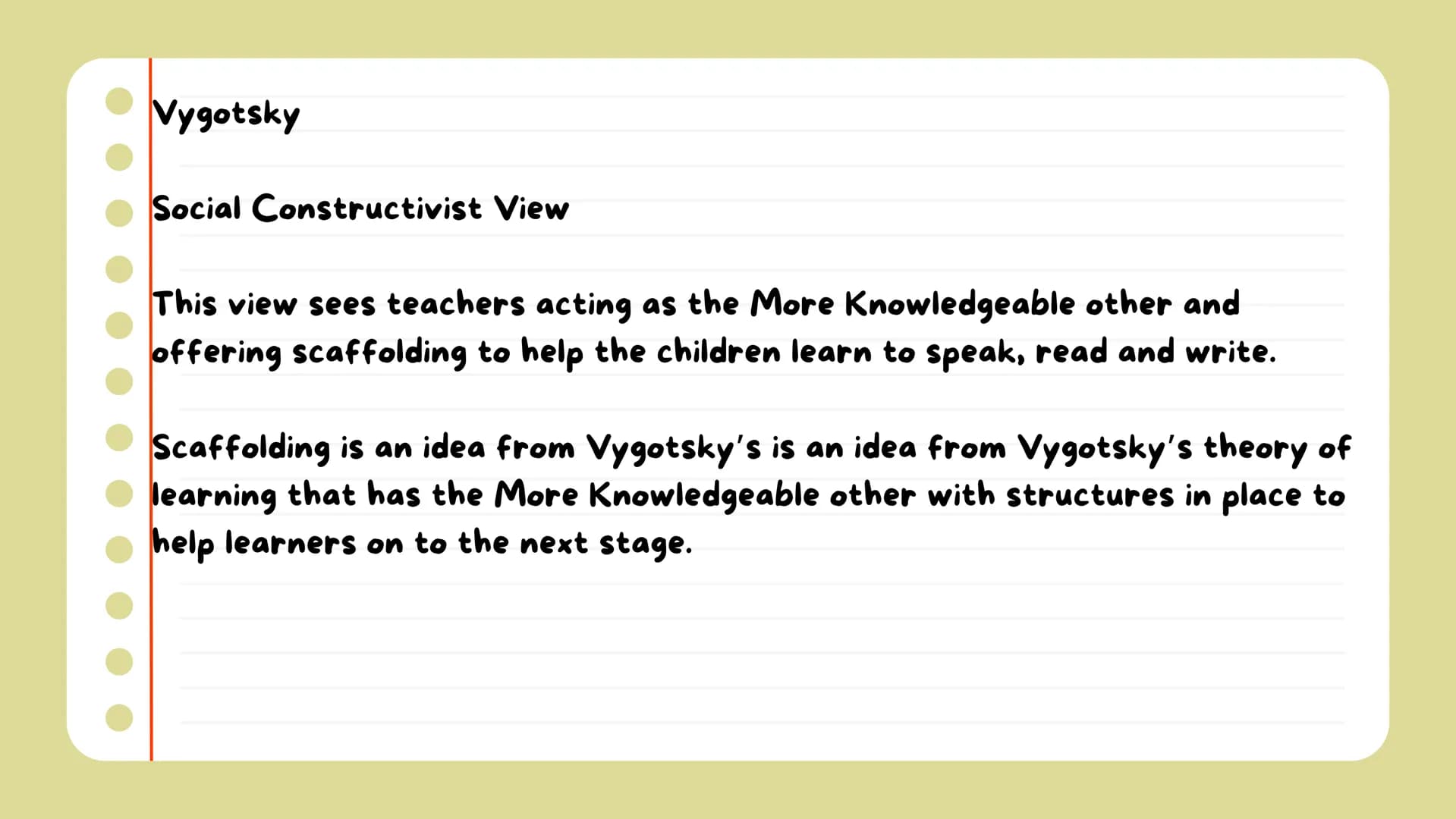
Vygotsky's Social Constructivist Approach
Vygotsky believed that learning happens through social interaction, which is brilliant news for understanding how children pick up literacy skills. His theory centres on the More Knowledgeable Other - basically any person (teacher, parent, older sibling) who knows more than the child.
Scaffolding is Vygotsky's key concept here. Think of it like building supports around a construction project - the adult provides temporary help structures that gradually get removed as the child becomes more confident. This might be guiding a child's hand whilst writing or helping them sound out words.
Remember: Scaffolding isn't permanent - it's designed to be removed once the child can manage independently.
3
of 10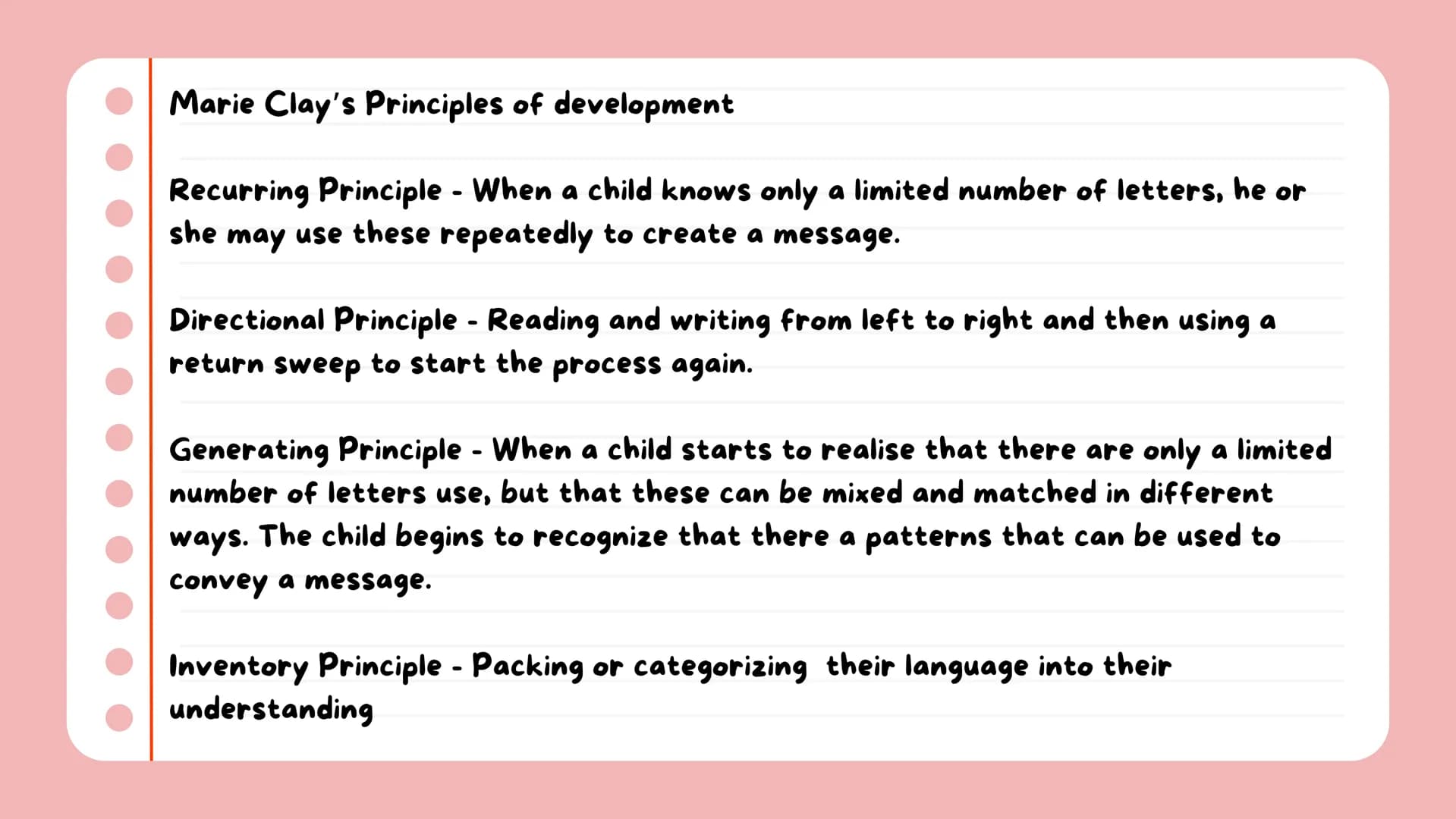
Marie Clay's Developmental Principles
Clay identified four key principles that show how children naturally approach literacy learning. The Recurring Principle explains why your little cousin might write their name using only the letters they know really well - it's completely normal developmental behaviour.
The Directional Principle covers the left-to-right movement and return sweep that seems obvious to us but needs to be learned. Meanwhile, the Generating Principle is when children have that lightbulb moment - realising they can mix and match letters to create different meanings.
The Inventory Principle shows children categorising and organising their growing language knowledge. They're essentially building their own internal filing system for letters, sounds, and words.
Exam Tip: These principles often appear in analysis questions, so make sure you can spot them in children's writing samples.
4
of 10
Yetta Goodman's Three Key Principles
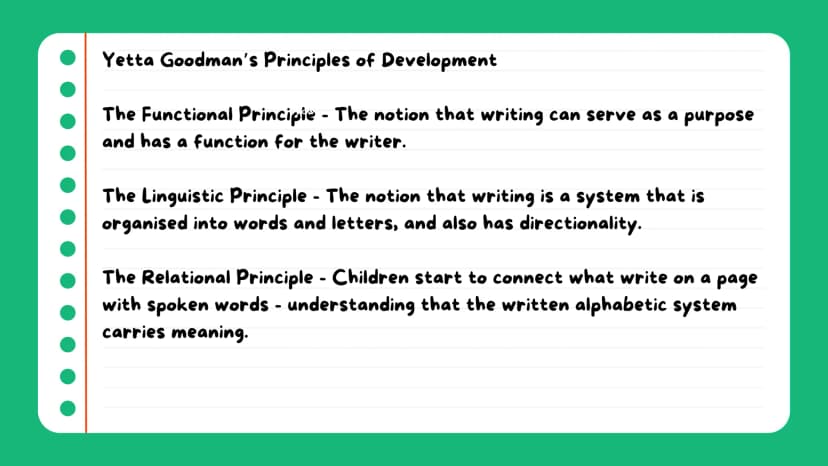
Goodman's research focuses on three crucial realisations children make about writing. The Functional Principle is when children understand that writing actually does something - it's not just pretty marks on paper but serves real purposes like shopping lists or birthday cards.
The Linguistic Principle involves recognising that writing follows systematic rules. Children start noticing patterns in how letters work together and understand directional conventions.
The Relational Principle represents a massive breakthrough - connecting written symbols to spoken language and meaning. This is when children truly grasp that those squiggles on paper carry the same meaning as spoken words.
Key Point: All three principles work together - children don't master them in isolation but develop understanding simultaneously.
5
of 10
Kroll's Four Stages of Writing Development
Kroll's model tracks children's journey from basic motor skills to sophisticated personal expression. Stage 1 (Preparatory) focuses on physical abilities - holding pencils, forming letters, and grasping spelling basics.
Stage 2 (Consolidation) sees children writing exactly as they speak, using simple sentences connected with basic conjunctions like 'and' or 'but'. Don't expect complex grammar here - they're still figuring things out.
Stage 3 (Differentiation) marks a crucial turning point where children recognise that writing differs from speech. They begin adapting their style for different purposes and audiences, showing growing sophistication.
Stage 4 (Integration) represents mastery - children develop their own voice whilst making appropriate linguistic choices consistently. This is where creativity really flourishes within conventional frameworks.
Exam Focus: Be ready to identify these stages in writing samples and explain what each demonstrates about a child's development.
6
of 10
Barclay's Seven-Stage Model
Barclay provides a detailed roadmap of writing development that's incredibly useful for analysis. Stage 1 (Scribbling) through Stage 3 (Mock letters) show children experimenting with mark-making before understanding letter-sound relationships.
Stage 4 (Conventional Letters) marks real progress - children start connecting sounds with symbols, though spacing remains chaotic. Stage 5 (Invented Spelling) demonstrates phonetic logic, even when results look unusual to adult eyes.
Stages 6 and 7 show increasing mastery of standard spelling patterns and conventional presentation. By Stage 7, most words are correctly spelled and handwriting becomes joined and legible.
This model brilliantly shows how children's 'mistakes' actually represent logical thinking and developmental progress rather than failures.
Remember: Each stage builds on the previous ones - children don't skip steps but progress systematically through each phase.
7
of 10
Additional Key Theorists and Concepts
Frances Christie's genre theory identifies seven text types that children learn to master: narratives, recounts, procedures, reports, explanations, expositions, and discussions. Understanding these genres helps children write more effectively for different purposes.
Richard Gentry catalogued common misspelling patterns including insertion, omission, substitution, and phonetic spelling. These aren't random errors but show systematic thinking processes.
Katherine Perera distinguished between chronological texts and non-chronological texts requiring logical connectives. This progression from simple time-based organisation to complex logical relationships shows cognitive development.
Analysis Tip: Look for these patterns in children's writing to demonstrate your understanding of developmental stages.
8
of 10
Social and Cultural Influences on Literacy
Shirley Brice Heath's ethnographic study revealed how different communities approach literacy development. Middle-class families often use books formally to develop literacy skills, whilst other communities rely more on oral creativity and storytelling traditions.
Goouch and Lambirth highlighted the importance of maintaining children's confidence - focusing too heavily on correctness can damage self-esteem and hinder progress. Heckman noted the tension between adult expectations of accuracy and children's natural creative development.
This research emphasises that there's no single 'correct' path to literacy - cultural background significantly influences how children approach reading and writing.
Critical Thinking: Consider how different teaching approaches might suit different learners based on their cultural backgrounds.
9
of 10
The Role of Creative Writing
Alan Maley championed creative writing as a powerful tool for language development. He argued that playful engagement with language helps children explore possibilities in a supportive environment, boosting lexical, grammatical, and phonological development.
Creative writing allows children to experiment without the pressure of perfect accuracy. This freedom encourages risk-taking and linguistic exploration that formal exercises might inhibit.
The approach recognises that creativity and technical skill develop together rather than in opposition. Children need opportunities to play with language alongside learning conventional rules.
Key Insight: Creative writing isn't just 'fun' - it's a legitimate developmental tool that supports all aspects of language learning.
10
of 10
Benefits and Applications of Creative Writing
Dörnyei identified multiple benefits of creative writing: relieving classroom monotony, enabling student success, increasing motivation, making tasks enjoyable, and promoting autonomy. These factors create optimal conditions for language development.
Karmiloff-Smith emphasised that social aspects of writing often develop before technical skills - children understand writing's communicative purpose before mastering spelling and grammar.
Torrance found that appropriate teacher feedback enhances creativity whilst improving accuracy. The key is balancing encouragement with constructive guidance, helping children develop both confidence and competence.
This research shows that creativity and accuracy aren't opposing forces but complementary aspects of effective literacy development.
Practical Application: Effective literacy teaching combines creative freedom with structured support, allowing children to develop both skills and confidence simultaneously.
We thought you’d never ask...
What is the Knowunity AI companion?
Our AI companion is specifically built for the needs of students. Based on the millions of content pieces we have on the platform we can provide truly meaningful and relevant answers to students. But its not only about answers, the companion is even more about guiding students through their daily learning challenges, with personalised study plans, quizzes or content pieces in the chat and 100% personalisation based on the students skills and developments.
Where can I download the Knowunity app?
You can download the app in the Google Play Store and in the Apple App Store.
Is Knowunity really free of charge?
That's right! Enjoy free access to study content, connect with fellow students, and get instant help – all at your fingertips.
Similar Content
 Język angielski
Most popular content: English Phonetics
1Most popular content in English Language
9English LanguageLanguage Paper 1 Strategies
Master the AQA English Language Paper 1 with this comprehensive guide. Explore key strategies for language and structural analysis, critical evaluation, and creative writing. Learn how to effectively analyze texts, utilize literary techniques, and enhance your writing skills to excel in your exams.
928,524895
English LanguageAnalyzing Conflict in The Pearl
Explore the intricate language and structure used by John Steinbeck in 'The Pearl' to depict the intense conflict between Kino and the scorpion. This study note provides a detailed analysis of key language features, character responses, and narrative techniques, essential for mastering AQA GCSE English Language Paper 1. Ideal for students preparing for their exams, this resource emphasizes critical reading and writing skills.
97,905331
English LanguageEnglish Language Exam Strategies
This comprehensive revision booklet for AQA English Language Paper 1 covers essential topics such as narrative structure, character analysis, and language techniques. It includes model answers, practice questions, and key concepts from various texts like 'The Woman in Black', 'The Hunger Games', and 'To Kill a Mockingbird'. Perfect for students preparing for their exams, this resource enhances understanding of literary devices and effective writing strategies.
1015,9221,310
English LanguageEnglish Language Exam Strategies
Master the English Language Paper 2 with this comprehensive guide. Discover effective strategies for each question, including skimming techniques, writing structures, and language analysis methods. Perfect for exam preparation, this resource covers question formats, time management tips, and essential writing techniques to enhance your performance. Ideal for students aiming to excel in their English Language assessments.
1019,524339
E
English LanguageEnglish quiz about writing techniques.
It's just a short english quiz.
75451
M
English LanguageMastering English Language: Intermediate Level
Boost your English language skills with this comprehensive flashcard set designed for intermediate learners. Perfect for grade 11 students!
113311
E
English LanguageEnglish language devices
Master the fundamental principles of biology with this comprehensive flashcard set designed specifically for grade 9 students. Explore key concepts, terms, and processes to excel in your biology studies.
93435
M
English LanguageMastering English Language: Advanced Vocabulary Flashcards
Expand your English vocabulary with this comprehensive set of advanced flashcards. Perfect for grade 11 students looking to excel in English Language exams.
114042
M
English LanguageMastering English Language: Advanced Flashcards
Boost your English language skills with these challenging flashcards designed for advanced learners. Perfect for grade 11 students!
113390
Most popular content
9 Sociology
Sociology of Education Overview
Explore comprehensive A-Level Sociology notes on the education system, covering key theories, policies, and sociological perspectives. This resource includes insights on marketisation, gender roles, cultural deprivation, and educational inequalities, providing a thorough understanding of how education shapes social stratification and individual achievement. Ideal for exam preparation and in-depth study.
12102,8523,040
SociologySociology of Families: Comprehensive Revision
Dive into an extensive overview of family dynamics, perspectives, and patterns in sociology. This resource covers key concepts such as family diversity, gender roles, marriage, and the impact of social policies on family structures. Perfect for A-Level Sociology students preparing for Paper 2.
1273,6612,307
CriminologyCriminology: Crime & Punishment Overview
Comprehensive mindmaps covering key concepts in the Crime and Punishment topic for WJEC Criminology Unit 4. This resource includes detailed insights into the Criminal Justice System, crime prevention strategies, sentencing models, and the roles of various agencies. Ideal for A-Level revision, ensuring you grasp essential theories and legislative processes to excel in your exams.
1254,8691,059
SociologyComprehensive Crime & Deviance Overview
Explore an extensive revision of crime and deviance topics, including theories, types of crime, and the impact of media. This resource covers key concepts such as Marxism, functionalism, gender and crime, and the influence of globalization on criminal behavior. Ideal for students seeking a thorough understanding of criminology and its various theories. Type: Full Topic Revision.
1251,6541,399
C
 Biology
Cell Biology and Cell structure
cell structures
93,2470
English LiteratureAn Inspector Calls: Character Insights
Explore in-depth analysis and key quotes for characters in J.B. Priestley's 'An Inspector Calls'. This resource covers Gerald Croft, Inspector Goole, Sheila Birling, Mrs. Birling, Eric Birling, and Eva Smith, focusing on themes of class, gender roles, and social responsibility. Ideal for students aiming for Grade 8 and above.
1025,429907
CriminologyWJEC Unit 4 Criminology
Criminology unit 4 detailed revision note
127,151125
CriminologyCriminology Theories Overview
Explore key criminology theories and their implications on crime and deviance. This comprehensive summary covers biological, psychological, and sociological perspectives, including labelling theory, right realism, and the impact of social campaigns on policy development. Ideal for A-Level criminology students seeking to understand the complexities of criminal behaviour and the factors influencing crime prevention strategies.
129,760210
English LiteratureRomeo and Juliet: Key themes
Key Romeo and Juliet themes and analysed quotes
106,708198
Can't find what you're looking for? Explore other subjects.
Students love us — and so will you.
4.6/5App Store
4.7/5Google Play
The app is very easy to use and well designed. I have found everything I was looking for so far and have been able to learn a lot from the presentations! I will definitely use the app for a class assignment! And of course it also helps a lot as an inspiration.
Stefan SiOS user
This app is really great. There are so many study notes and help [...]. My problem subject is French, for example, and the app has so many options for help. Thanks to this app, I have improved my French. I would recommend it to anyone.
Samantha KlichAndroid user
Wow, I am really amazed. I just tried the app because I've seen it advertised many times and was absolutely stunned. This app is THE HELP you want for school and above all, it offers so many things, such as workouts and fact sheets, which have been VERY helpful to me personally.
AnnaiOS user
English Language115 views·Updated Jun 17, 2026·10 pagesUnderstanding Child Language Acquisition Theorists
Tom Robinson@tomrobinson_kylw
Understanding how children develop literacy skills is crucial for A-Level English Language students studying Child Language Acquisition (CLA). This guide explores the key theories and stages that explain how young learners master reading and writing, from their first scribbles to...
1
of 10
Sign up to see the content. It's free!
- Access to all documents
- Improve your grades
- Join milions of students
Introduction to CLA Literacy
This topic focuses on Child Language Acquisition and how children develop their reading and writing abilities. You'll need to understand various theoretical approaches and developmental stages for your A-Level English Language exam.
The study of literacy development combines practical observation with academic theory. It's essential to grasp both the processes children go through and the theorists who've mapped these journeys.
2
of 10Sign up to see the content. It's free!
- Access to all documents
- Improve your grades
- Join milions of students
Vygotsky's Social Constructivist Approach
Vygotsky believed that learning happens through social interaction, which is brilliant news for understanding how children pick up literacy skills. His theory centres on the More Knowledgeable Other - basically any person (teacher, parent, older sibling) who knows more than the child.
Scaffolding is Vygotsky's key concept here. Think of it like building supports around a construction project - the adult provides temporary help structures that gradually get removed as the child becomes more confident. This might be guiding a child's hand whilst writing or helping them sound out words.
Remember: Scaffolding isn't permanent - it's designed to be removed once the child can manage independently.
3
of 10Sign up to see the content. It's free!
- Access to all documents
- Improve your grades
- Join milions of students
Marie Clay's Developmental Principles
Clay identified four key principles that show how children naturally approach literacy learning. The Recurring Principle explains why your little cousin might write their name using only the letters they know really well - it's completely normal developmental behaviour.
The Directional Principle covers the left-to-right movement and return sweep that seems obvious to us but needs to be learned. Meanwhile, the Generating Principle is when children have that lightbulb moment - realising they can mix and match letters to create different meanings.
The Inventory Principle shows children categorising and organising their growing language knowledge. They're essentially building their own internal filing system for letters, sounds, and words.
Exam Tip: These principles often appear in analysis questions, so make sure you can spot them in children's writing samples.
4
of 10Sign up to see the content. It's free!
- Access to all documents
- Improve your grades
- Join milions of students
Yetta Goodman's Three Key Principles
Goodman's research focuses on three crucial realisations children make about writing. The Functional Principle is when children understand that writing actually does something - it's not just pretty marks on paper but serves real purposes like shopping lists or birthday cards.
The Linguistic Principle involves recognising that writing follows systematic rules. Children start noticing patterns in how letters work together and understand directional conventions.
The Relational Principle represents a massive breakthrough - connecting written symbols to spoken language and meaning. This is when children truly grasp that those squiggles on paper carry the same meaning as spoken words.
Key Point: All three principles work together - children don't master them in isolation but develop understanding simultaneously.
5
of 10Sign up to see the content. It's free!
- Access to all documents
- Improve your grades
- Join milions of students
Kroll's Four Stages of Writing Development
Kroll's model tracks children's journey from basic motor skills to sophisticated personal expression. Stage 1 (Preparatory) focuses on physical abilities - holding pencils, forming letters, and grasping spelling basics.
Stage 2 (Consolidation) sees children writing exactly as they speak, using simple sentences connected with basic conjunctions like 'and' or 'but'. Don't expect complex grammar here - they're still figuring things out.
Stage 3 (Differentiation) marks a crucial turning point where children recognise that writing differs from speech. They begin adapting their style for different purposes and audiences, showing growing sophistication.
Stage 4 (Integration) represents mastery - children develop their own voice whilst making appropriate linguistic choices consistently. This is where creativity really flourishes within conventional frameworks.
Exam Focus: Be ready to identify these stages in writing samples and explain what each demonstrates about a child's development.
6
of 10Sign up to see the content. It's free!
- Access to all documents
- Improve your grades
- Join milions of students
Barclay's Seven-Stage Model
Barclay provides a detailed roadmap of writing development that's incredibly useful for analysis. Stage 1 (Scribbling) through Stage 3 (Mock letters) show children experimenting with mark-making before understanding letter-sound relationships.
Stage 4 (Conventional Letters) marks real progress - children start connecting sounds with symbols, though spacing remains chaotic. Stage 5 (Invented Spelling) demonstrates phonetic logic, even when results look unusual to adult eyes.
Stages 6 and 7 show increasing mastery of standard spelling patterns and conventional presentation. By Stage 7, most words are correctly spelled and handwriting becomes joined and legible.
This model brilliantly shows how children's 'mistakes' actually represent logical thinking and developmental progress rather than failures.
Remember: Each stage builds on the previous ones - children don't skip steps but progress systematically through each phase.
7
of 10Sign up to see the content. It's free!
- Access to all documents
- Improve your grades
- Join milions of students
Additional Key Theorists and Concepts
Frances Christie's genre theory identifies seven text types that children learn to master: narratives, recounts, procedures, reports, explanations, expositions, and discussions. Understanding these genres helps children write more effectively for different purposes.
Richard Gentry catalogued common misspelling patterns including insertion, omission, substitution, and phonetic spelling. These aren't random errors but show systematic thinking processes.
Katherine Perera distinguished between chronological texts and non-chronological texts requiring logical connectives. This progression from simple time-based organisation to complex logical relationships shows cognitive development.
Analysis Tip: Look for these patterns in children's writing to demonstrate your understanding of developmental stages.
8
of 10Sign up to see the content. It's free!
- Access to all documents
- Improve your grades
- Join milions of students
Social and Cultural Influences on Literacy
Shirley Brice Heath's ethnographic study revealed how different communities approach literacy development. Middle-class families often use books formally to develop literacy skills, whilst other communities rely more on oral creativity and storytelling traditions.
Goouch and Lambirth highlighted the importance of maintaining children's confidence - focusing too heavily on correctness can damage self-esteem and hinder progress. Heckman noted the tension between adult expectations of accuracy and children's natural creative development.
This research emphasises that there's no single 'correct' path to literacy - cultural background significantly influences how children approach reading and writing.
Critical Thinking: Consider how different teaching approaches might suit different learners based on their cultural backgrounds.
9
of 10Sign up to see the content. It's free!
- Access to all documents
- Improve your grades
- Join milions of students
The Role of Creative Writing
Alan Maley championed creative writing as a powerful tool for language development. He argued that playful engagement with language helps children explore possibilities in a supportive environment, boosting lexical, grammatical, and phonological development.
Creative writing allows children to experiment without the pressure of perfect accuracy. This freedom encourages risk-taking and linguistic exploration that formal exercises might inhibit.
The approach recognises that creativity and technical skill develop together rather than in opposition. Children need opportunities to play with language alongside learning conventional rules.
Key Insight: Creative writing isn't just 'fun' - it's a legitimate developmental tool that supports all aspects of language learning.
10
of 10Sign up to see the content. It's free!
- Access to all documents
- Improve your grades
- Join milions of students
Benefits and Applications of Creative Writing
Dörnyei identified multiple benefits of creative writing: relieving classroom monotony, enabling student success, increasing motivation, making tasks enjoyable, and promoting autonomy. These factors create optimal conditions for language development.
Karmiloff-Smith emphasised that social aspects of writing often develop before technical skills - children understand writing's communicative purpose before mastering spelling and grammar.
Torrance found that appropriate teacher feedback enhances creativity whilst improving accuracy. The key is balancing encouragement with constructive guidance, helping children develop both confidence and competence.
This research shows that creativity and accuracy aren't opposing forces but complementary aspects of effective literacy development.
Practical Application: Effective literacy teaching combines creative freedom with structured support, allowing children to develop both skills and confidence simultaneously.
We thought you’d never ask...
What is the Knowunity AI companion?
Our AI companion is specifically built for the needs of students. Based on the millions of content pieces we have on the platform we can provide truly meaningful and relevant answers to students. But its not only about answers, the companion is even more about guiding students through their daily learning challenges, with personalised study plans, quizzes or content pieces in the chat and 100% personalisation based on the students skills and developments.
Where can I download the Knowunity app?
You can download the app in the Google Play Store and in the Apple App Store.
Is Knowunity really free of charge?
That's right! Enjoy free access to study content, connect with fellow students, and get instant help – all at your fingertips.
Similar Content
Most popular content: English Phonetics
1Most popular content in English Language
9English LanguageLanguage Paper 1 Strategies
Master the AQA English Language Paper 1 with this comprehensive guide. Explore key strategies for language and structural analysis, critical evaluation, and creative writing. Learn how to effectively analyze texts, utilize literary techniques, and enhance your writing skills to excel in your exams.
928,524895
English LanguageAnalyzing Conflict in The Pearl
Explore the intricate language and structure used by John Steinbeck in 'The Pearl' to depict the intense conflict between Kino and the scorpion. This study note provides a detailed analysis of key language features, character responses, and narrative techniques, essential for mastering AQA GCSE English Language Paper 1. Ideal for students preparing for their exams, this resource emphasizes critical reading and writing skills.
97,905331
English LanguageEnglish Language Exam Strategies
This comprehensive revision booklet for AQA English Language Paper 1 covers essential topics such as narrative structure, character analysis, and language techniques. It includes model answers, practice questions, and key concepts from various texts like 'The Woman in Black', 'The Hunger Games', and 'To Kill a Mockingbird'. Perfect for students preparing for their exams, this resource enhances understanding of literary devices and effective writing strategies.
1015,9221,310
English LanguageEnglish Language Exam Strategies
Master the English Language Paper 2 with this comprehensive guide. Discover effective strategies for each question, including skimming techniques, writing structures, and language analysis methods. Perfect for exam preparation, this resource covers question formats, time management tips, and essential writing techniques to enhance your performance. Ideal for students aiming to excel in their English Language assessments.
1019,524339
E
English LanguageEnglish quiz about writing techniques.
It's just a short english quiz.
75451
M
English LanguageMastering English Language: Intermediate Level
Boost your English language skills with this comprehensive flashcard set designed for intermediate learners. Perfect for grade 11 students!
113311
E
English LanguageEnglish language devices
Master the fundamental principles of biology with this comprehensive flashcard set designed specifically for grade 9 students. Explore key concepts, terms, and processes to excel in your biology studies.
93435
M
English LanguageMastering English Language: Advanced Vocabulary Flashcards
Expand your English vocabulary with this comprehensive set of advanced flashcards. Perfect for grade 11 students looking to excel in English Language exams.
114042
M
English LanguageMastering English Language: Advanced Flashcards
Boost your English language skills with these challenging flashcards designed for advanced learners. Perfect for grade 11 students!
113390
Most popular content
9SociologySociology of Education Overview
Explore comprehensive A-Level Sociology notes on the education system, covering key theories, policies, and sociological perspectives. This resource includes insights on marketisation, gender roles, cultural deprivation, and educational inequalities, providing a thorough understanding of how education shapes social stratification and individual achievement. Ideal for exam preparation and in-depth study.
12102,8523,040
SociologySociology of Families: Comprehensive Revision
Dive into an extensive overview of family dynamics, perspectives, and patterns in sociology. This resource covers key concepts such as family diversity, gender roles, marriage, and the impact of social policies on family structures. Perfect for A-Level Sociology students preparing for Paper 2.
1273,6612,307
CriminologyCriminology: Crime & Punishment Overview
Comprehensive mindmaps covering key concepts in the Crime and Punishment topic for WJEC Criminology Unit 4. This resource includes detailed insights into the Criminal Justice System, crime prevention strategies, sentencing models, and the roles of various agencies. Ideal for A-Level revision, ensuring you grasp essential theories and legislative processes to excel in your exams.
1254,8691,059
SociologyComprehensive Crime & Deviance Overview
Explore an extensive revision of crime and deviance topics, including theories, types of crime, and the impact of media. This resource covers key concepts such as Marxism, functionalism, gender and crime, and the influence of globalization on criminal behavior. Ideal for students seeking a thorough understanding of criminology and its various theories. Type: Full Topic Revision.
1251,6541,399
C
BiologyCell Biology and Cell structure
cell structures
93,2470
English LiteratureAn Inspector Calls: Character Insights
Explore in-depth analysis and key quotes for characters in J.B. Priestley's 'An Inspector Calls'. This resource covers Gerald Croft, Inspector Goole, Sheila Birling, Mrs. Birling, Eric Birling, and Eva Smith, focusing on themes of class, gender roles, and social responsibility. Ideal for students aiming for Grade 8 and above.
1025,429907
CriminologyWJEC Unit 4 Criminology
Criminology unit 4 detailed revision note
127,151125
CriminologyCriminology Theories Overview
Explore key criminology theories and their implications on crime and deviance. This comprehensive summary covers biological, psychological, and sociological perspectives, including labelling theory, right realism, and the impact of social campaigns on policy development. Ideal for A-Level criminology students seeking to understand the complexities of criminal behaviour and the factors influencing crime prevention strategies.
129,760210
English LiteratureRomeo and Juliet: Key themes
Key Romeo and Juliet themes and analysed quotes
106,708198
Can't find what you're looking for? Explore other subjects.
Students love us — and so will you.
4.6/5App Store
4.7/5Google Play
The app is very easy to use and well designed. I have found everything I was looking for so far and have been able to learn a lot from the presentations! I will definitely use the app for a class assignment! And of course it also helps a lot as an inspiration.
Stefan SiOS user
This app is really great. There are so many study notes and help [...]. My problem subject is French, for example, and the app has so many options for help. Thanks to this app, I have improved my French. I would recommend it to anyone.
Samantha KlichAndroid user
Wow, I am really amazed. I just tried the app because I've seen it advertised many times and was absolutely stunned. This app is THE HELP you want for school and above all, it offers so many things, such as workouts and fact sheets, which have been VERY helpful to me personally.
AnnaiOS user