
These English 8 notes cover essential reading and writing skills...
 English1,622 views·Updated Jun 27, 2026·49 pages
Comprehensive English Grade 8 Notes 📖💡

Jona Mariz De Venecia@jonadv




1 / 10
1
of 10
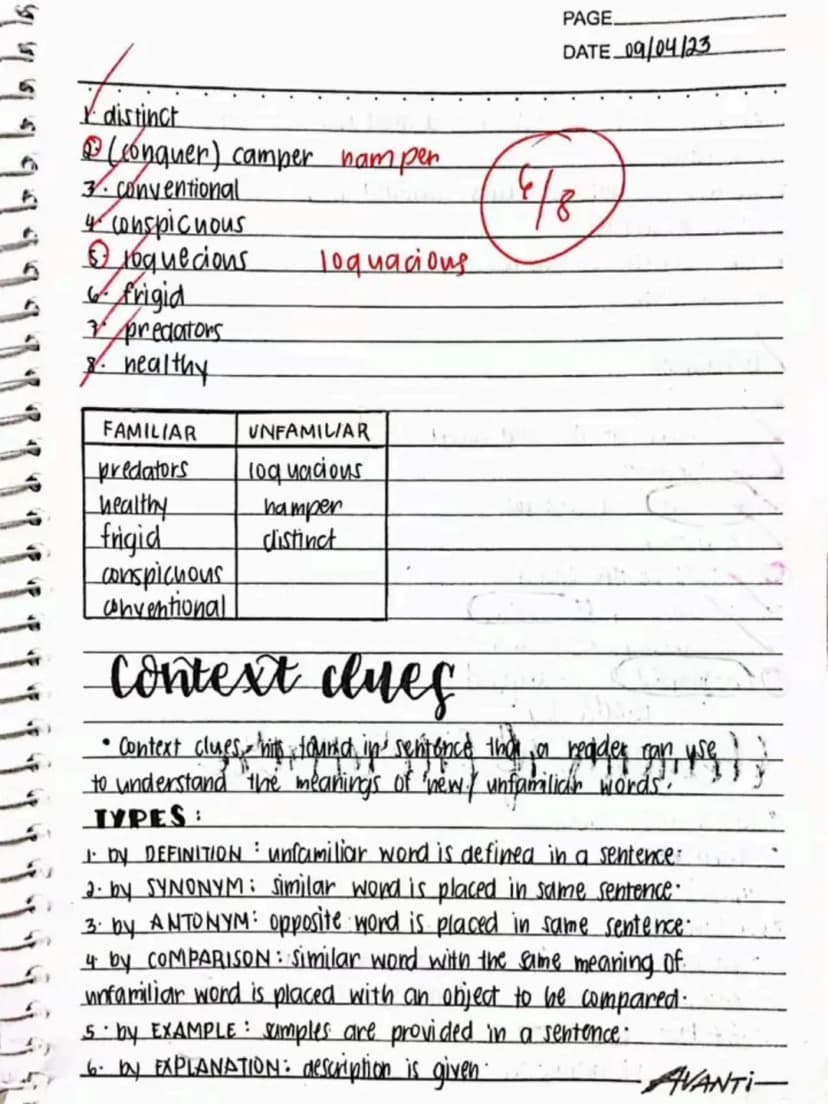
Context Clues - Your Secret to Understanding Any Text
Ever get stuck on a difficult word while reading? Context clues are hints hidden in sentences that help you figure out what unfamiliar words mean without running to the dictionary every time.
There are 8 main types of context clues to look for. Definition clues directly explain the word in the same sentence. Synonym clues give you a similar word nearby, while antonym clues show you the opposite meaning.
Comparison clues help by showing similar meanings, and example clues provide specific samples. Sometimes you'll find explanation clues that describe the word, cause-effect clues that show what happens, or you might need to use inference to make an educated guess based on the description.
Pro Tip: When you see an unfamiliar word, always read the whole sentence and the sentences around it - the answer is usually hiding there!
2
of 10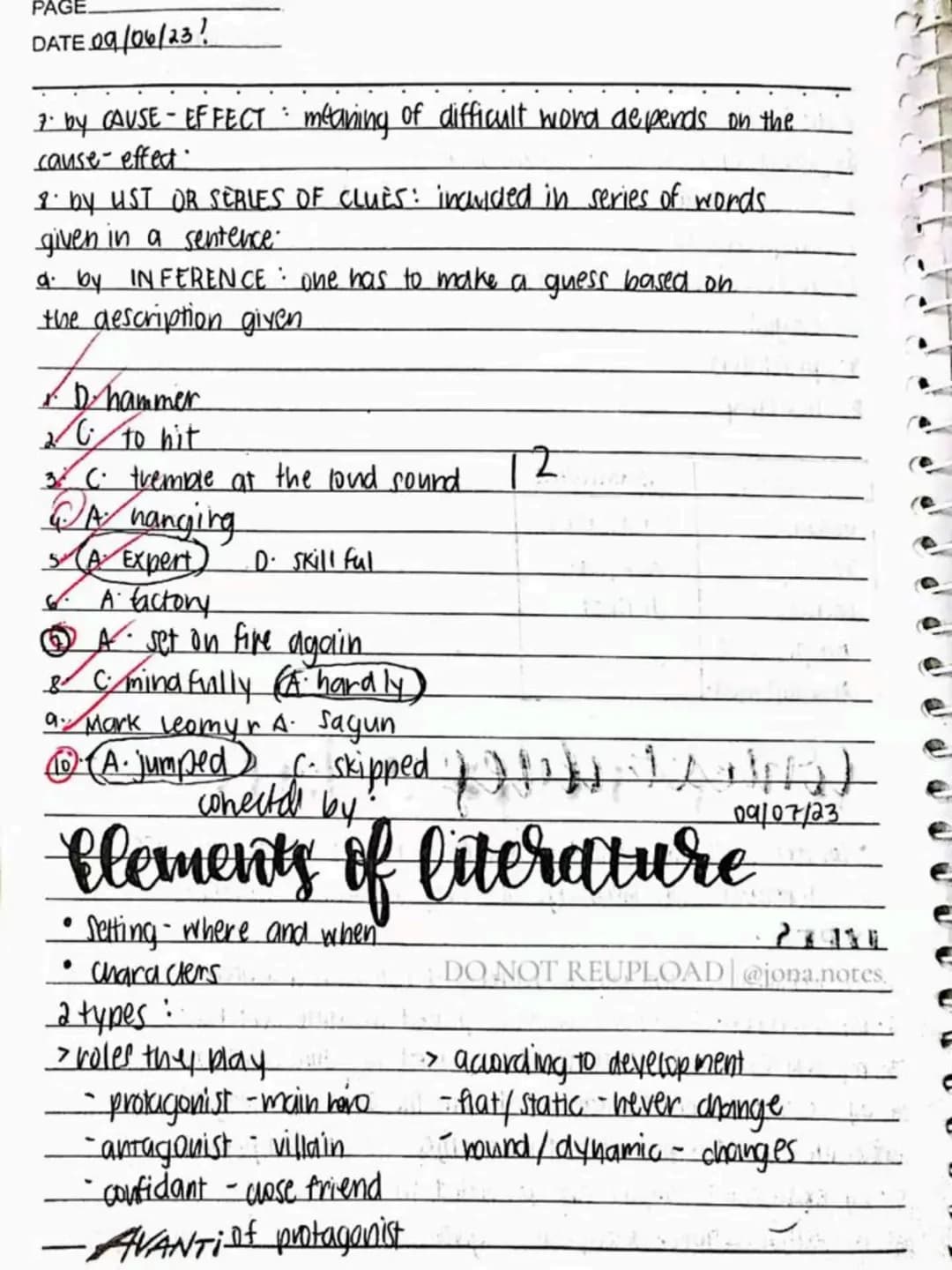
Story Elements - The Building Blocks of Every Tale
Understanding story elements makes reading so much easier and helps you analyze any text for exams. Every story has a setting (where and when it happens) and different types of characters with specific roles.
Characters come in different types based on their roles. The protagonist is your main hero, while the antagonist serves as the villain. Don't forget the confidant - that close friend character who listens to everyone's problems.
Characters also develop differently throughout stories. Flat or static characters never change from beginning to end. Round or dynamic characters grow and change as the story progresses - these are usually the most interesting ones to follow.
Remember: The protagonist isn't always the "good guy" - they're just the main character whose story you're following!
3
of 10
Plot Structure and Conflict - How Stories Unfold
Every good story follows a similar plot structure that builds tension and keeps you interested. It starts with exposition (background info), moves through rising action (building tension), hits the climax (the big moment), then falling action, and finally the resolution (ending).
Conflict drives every story forward - it's the main problem characters face. This opposing force creates all the drama and keeps readers hooked until the very end.
The theme tells you what the story is really about - the deeper message or lesson. Mood refers to the feeling the story creates, whether it's sad, happy, mysterious, or exciting.
Test Tip: Teachers love asking about plot structure, so memorize that sequence: exposition → rising action → climax → falling action → resolution!
4
of 10
"Soul of the Great Bell" - A Classic Chinese Tale
This Chinese folktale teaches us about sacrifice and family love through the story of Ko-Ngai and her father Konan-Yu. When the bell-maker faces execution for failing to create a perfect bell, his daughter discovers the terrible secret ingredient needed.
The protagonist Ko-Ngai represents ultimate sacrifice, while the antagonist Son of Heaven creates the conflict with his impossible demands. The story's theme focuses on a daughter's sacrifice to save her father's life.
Understanding Chinese civilization helps you appreciate this story better. China has over 20,000 characters in its language, and red symbolizes good luck in their culture.
Cultural Note: This story shows how folktales from different cultures often share similar themes about family loyalty and sacrifice.
5
of 10
Bibliography - Giving Credit Where It's Due
A bibliography lists all the books and sources you used in your research projects. It comes from Greek words meaning "book" and "to write" - basically, it's writing about books you've read.
Every book has specific parts you need to know: title page, copyright page, contents, body, glossary, references, and index. When creating bibliography entries, you'll need the author's name, title, publisher, and publication date.
There are different bibliography styles depending on your subject. APA style works for social sciences, MLA style for literature papers, and Chicago style for humanities subjects.
Assignment Saver: Always keep track of your sources while researching - it's much harder to find them again later!
6
of 10
Modal Verbs and Adverbs - Expressing Possibility and Certainty
Modal verbs like may, will, can, should, and must help you express different levels of certainty, possibility, and obligation. They're essential for clear communication in both speaking and writing.
Modal adverbs work similarly but as describing words. Words like "possibly," "certainly," and "necessarily" show how sure you are about something. "Possibly" suggests something might happen, while "certainly" shows you're confident about it.
These words help you express permission (can, may), ability (can), obligation (should, must), and future certainty (will). Understanding these makes your writing more precise and mature.
Writing Tip: Using modal verbs correctly makes you sound more sophisticated and shows you understand different levels of certainty.
7
of 10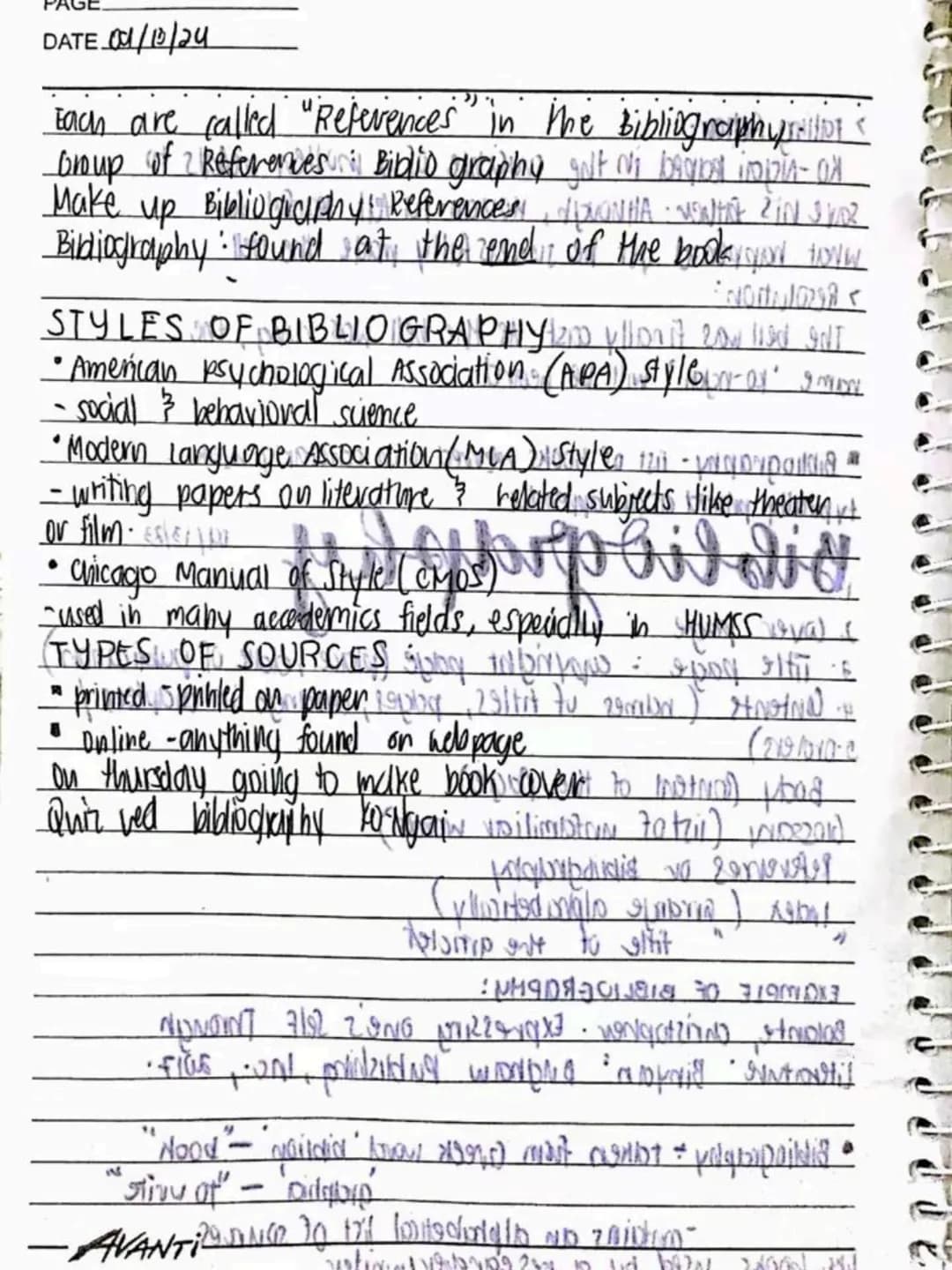
"Makato and the Cowrie Shells" - Character Analysis
This Thai folktale demonstrates both direct and indirect characterization techniques that authors use to reveal character traits. Understanding these methods helps you analyze any story more effectively.
Direct characterization happens when authors directly tell you about characters - like describing Makato as "tall and handsome" or "an orphan." Indirect characterization requires you to figure out traits from character actions and what others say about them.
Makato shows positive traits through his actions: he's hardworking, sensible, and good-tempered. Other characters like Pra Ruang demonstrate kindness, while the old woman shows helpfulness by giving Makato water.
Analysis Skill: Look for both what the author tells you directly and what you can infer from character behavior - this deeper reading impresses teachers!
8
of 10
9
of 10
10
of 10
We thought you’d never ask...
What is the Knowunity AI companion?
Our AI companion is specifically built for the needs of students. Based on the millions of content pieces we have on the platform we can provide truly meaningful and relevant answers to students. But its not only about answers, the companion is even more about guiding students through their daily learning challenges, with personalised study plans, quizzes or content pieces in the chat and 100% personalisation based on the students skills and developments.
Where can I download the Knowunity app?
You can download the app in the Google Play Store and in the Apple App Store.
Is Knowunity really free of charge?
That's right! Enjoy free access to study content, connect with fellow students, and get instant help – all at your fingertips.
Similar Content
 Lenguaje y Comunicación
 Frans
Frans Otros
Otros Duits
DuitsMost popular content: Language
9 MIL
MILMEDIA AND INFORMATION LITERACY
MIL REVIEWER
G116,243132
EnglishFigure Of Speech
English - Figure of Speech
G83,87364
EnglishEnglish G10 2ND QUARTER Reviewer
English G10 2ND QUARTER Reviewer
G105,819155
 Other
OtherENGLISH GRADE 7 1ST-4TH QUARTER
JHS GRADE 7 ENGLISH LESSONS
G72,59731
Iba paPag-unlad ng Sarili at Pakikipagkapwa: Mabisang Komunikasyon
Pagkatuto ng mga estratehiya sa mabisang komunikasyon at pakikipagkapwa
G108357
 Malikhaing Pagsulat
Malikhaing Pagsulat (Creative Writing) Lesson 1
Notes for HUMSS students
G114734
 KomPan
Komunikasyon at Pananaliksik sa Wika at Kulturang Filipino
It teaches how to use Filipino correctly in speaking and writing, especially in formal settings.
G116,374272
Iba paFilipino 2nd quarter notes
Grade 9 notes
G92,43842
FilipinoWika at Estruktura ng Filipino: Balarila - Pangungusap at Kayarian
Pag-aaral ng mga uri ng pangungusap at kayarian nito sa wikang Filipino upang mapahusay ang kakayahan sa paggamit ng tamang estruktura ng wika.
G74505
Most popular content in English
9EnglishEnglish G10 1ST QUARTER Reviewer
English G10 1ST QUARTER Reviewer all about Sources
G107,990249
EnglishENG - GRADE 10 - 1ST QUARTER
This provides Grade 10 Students complete notes on the mentioned subject for a specific quarter.
G101,45531
EnglishFigure Of Speech
English - Figure of Speech
G83,87364
EnglishGrade 7 English Reviewer – Narrative Texts, Literary Devices, and Reading Skills (Quarter 3)
This reviewer for Grade 7 English Quarter 3 focuses on narrative elements, types of conflict, common figures of speech, imagery, and reading comprehension strategies. It supports learners in understanding and analyzing literary texts effectively.
G72,69840
EnglishEnglish Grade 9 Notes 💙📒
1st Quarter Notes in Grade 9!! 📚📝
G92,40836
EnglishENGLISHGrade 9 Quarter 3 Reviewer
All about the lessons in Grade 9 Quarter 3 ENGLISH, all complete, highlighted, printable, and has extra informations.
G93,83642
EnglishEnglish G10 2ND QUARTER Reviewer
English G10 2ND QUARTER Reviewer
G105,819155
EnglishEnglish 10 3rd Quarter Reviewer
Topics: Argumentative Essay; Informative, Persuasive, and Argumentative Writing Techniques; Literary Criticism
G102,27739
EnglishDifferentiate Biases from Prejudices
English 9 Quarter 3 - Module 1
G92,34231
Most popular content
9 Math
MathMathematics Grade 10 Quarter 1
Grade 10 Math topics
G1010,218250
Iba paEl Filibusterismo (FILIPINO 10)
Kilalanin ang mga karakter at alamin ang mga pangyayari mula Kabanata 1 hanggang 39.
G1011,183240
 Science
Science 9 Quarter 1 Lesson 1
Topics: The Respiratory System and The Circulatory System
G911,069383
 Gen Physics
General Physics 1, First Sem
Units of Measurement, Vectors, and Kinematics. All with formulas
G116,247168
FilipinoFilipino 8 Reviewer
Filipino Reviewer for 4th Quarter for Grade 8 students
G88,088127
ScienceSCIENCE Grade 9 Quarter 3 Reviewer
All about the lessons in Grade 9 Quarter 3 SCIENCE, all complete, highlighted, printable, and has extra informations.
G914,629303
 Pre-Cal
UPCAT Reviewer: Mathematics
general coverage of the mathematics section for UPCAT
G127,072397
OtherIntroduction to Philosophy - 1st Semester, Grade 12
A summarized notes for Grade 12 students. Easier learning for the 1st semester’s Philosophy subject.
G123,93956
ScienceThe Human Digestive System
Science Grade 8 1st Quarter Lesson
G84,78386
Can't find what you're looking for? Explore other subjects.
Students love us — and so will you.
4.6/5App Store
4.7/5Google Play
The app is very easy to use and well designed. I have found everything I was looking for so far and have been able to learn a lot from the presentations! I will definitely use the app for a class assignment! And of course it also helps a lot as an inspiration.
Stefan SiOS user
This app is really great. There are so many study notes and help [...]. My problem subject is French, for example, and the app has so many options for help. Thanks to this app, I have improved my French. I would recommend it to anyone.
Samantha KlichAndroid user
Wow, I am really amazed. I just tried the app because I've seen it advertised many times and was absolutely stunned. This app is THE HELP you want for school and above all, it offers so many things, such as workouts and fact sheets, which have been VERY helpful to me personally.
AnnaiOS user
English1,622 views·Updated Jun 27, 2026·49 pagesComprehensive English Grade 8 Notes 📖💡
Jona Mariz De Venecia@jonadv
These English 8 notes cover essential reading and writing skills you'll use throughout high school. You'll learn how to figure out word meanings using context clues, understand story elements, and create proper bibliographies for your research projects.
1
of 10
Sign up to see the content. It's free!
- Access to all documents
- Improve your grades
- Join milions of students
Context Clues - Your Secret to Understanding Any Text
Ever get stuck on a difficult word while reading? Context clues are hints hidden in sentences that help you figure out what unfamiliar words mean without running to the dictionary every time.
There are 8 main types of context clues to look for. Definition clues directly explain the word in the same sentence. Synonym clues give you a similar word nearby, while antonym clues show you the opposite meaning.
Comparison clues help by showing similar meanings, and example clues provide specific samples. Sometimes you'll find explanation clues that describe the word, cause-effect clues that show what happens, or you might need to use inference to make an educated guess based on the description.
Pro Tip: When you see an unfamiliar word, always read the whole sentence and the sentences around it - the answer is usually hiding there!
2
of 10Sign up to see the content. It's free!
- Access to all documents
- Improve your grades
- Join milions of students
Story Elements - The Building Blocks of Every Tale
Understanding story elements makes reading so much easier and helps you analyze any text for exams. Every story has a setting (where and when it happens) and different types of characters with specific roles.
Characters come in different types based on their roles. The protagonist is your main hero, while the antagonist serves as the villain. Don't forget the confidant - that close friend character who listens to everyone's problems.
Characters also develop differently throughout stories. Flat or static characters never change from beginning to end. Round or dynamic characters grow and change as the story progresses - these are usually the most interesting ones to follow.
Remember: The protagonist isn't always the "good guy" - they're just the main character whose story you're following!
3
of 10Sign up to see the content. It's free!
- Access to all documents
- Improve your grades
- Join milions of students
Plot Structure and Conflict - How Stories Unfold
Every good story follows a similar plot structure that builds tension and keeps you interested. It starts with exposition (background info), moves through rising action (building tension), hits the climax (the big moment), then falling action, and finally the resolution (ending).
Conflict drives every story forward - it's the main problem characters face. This opposing force creates all the drama and keeps readers hooked until the very end.
The theme tells you what the story is really about - the deeper message or lesson. Mood refers to the feeling the story creates, whether it's sad, happy, mysterious, or exciting.
Test Tip: Teachers love asking about plot structure, so memorize that sequence: exposition → rising action → climax → falling action → resolution!
4
of 10Sign up to see the content. It's free!
- Access to all documents
- Improve your grades
- Join milions of students
"Soul of the Great Bell" - A Classic Chinese Tale
This Chinese folktale teaches us about sacrifice and family love through the story of Ko-Ngai and her father Konan-Yu. When the bell-maker faces execution for failing to create a perfect bell, his daughter discovers the terrible secret ingredient needed.
The protagonist Ko-Ngai represents ultimate sacrifice, while the antagonist Son of Heaven creates the conflict with his impossible demands. The story's theme focuses on a daughter's sacrifice to save her father's life.
Understanding Chinese civilization helps you appreciate this story better. China has over 20,000 characters in its language, and red symbolizes good luck in their culture.
Cultural Note: This story shows how folktales from different cultures often share similar themes about family loyalty and sacrifice.
5
of 10Sign up to see the content. It's free!
- Access to all documents
- Improve your grades
- Join milions of students
Bibliography - Giving Credit Where It's Due
A bibliography lists all the books and sources you used in your research projects. It comes from Greek words meaning "book" and "to write" - basically, it's writing about books you've read.
Every book has specific parts you need to know: title page, copyright page, contents, body, glossary, references, and index. When creating bibliography entries, you'll need the author's name, title, publisher, and publication date.
There are different bibliography styles depending on your subject. APA style works for social sciences, MLA style for literature papers, and Chicago style for humanities subjects.
Assignment Saver: Always keep track of your sources while researching - it's much harder to find them again later!
6
of 10Sign up to see the content. It's free!
- Access to all documents
- Improve your grades
- Join milions of students
Modal Verbs and Adverbs - Expressing Possibility and Certainty
Modal verbs like may, will, can, should, and must help you express different levels of certainty, possibility, and obligation. They're essential for clear communication in both speaking and writing.
Modal adverbs work similarly but as describing words. Words like "possibly," "certainly," and "necessarily" show how sure you are about something. "Possibly" suggests something might happen, while "certainly" shows you're confident about it.
These words help you express permission (can, may), ability (can), obligation (should, must), and future certainty (will). Understanding these makes your writing more precise and mature.
Writing Tip: Using modal verbs correctly makes you sound more sophisticated and shows you understand different levels of certainty.
7
of 10Sign up to see the content. It's free!
- Access to all documents
- Improve your grades
- Join milions of students
"Makato and the Cowrie Shells" - Character Analysis
This Thai folktale demonstrates both direct and indirect characterization techniques that authors use to reveal character traits. Understanding these methods helps you analyze any story more effectively.
Direct characterization happens when authors directly tell you about characters - like describing Makato as "tall and handsome" or "an orphan." Indirect characterization requires you to figure out traits from character actions and what others say about them.
Makato shows positive traits through his actions: he's hardworking, sensible, and good-tempered. Other characters like Pra Ruang demonstrate kindness, while the old woman shows helpfulness by giving Makato water.
Analysis Skill: Look for both what the author tells you directly and what you can infer from character behavior - this deeper reading impresses teachers!
8
of 10Sign up to see the content. It's free!
- Access to all documents
- Improve your grades
- Join milions of students
9
of 10Sign up to see the content. It's free!
- Access to all documents
- Improve your grades
- Join milions of students
10
of 10Sign up to see the content. It's free!
- Access to all documents
- Improve your grades
- Join milions of students
We thought you’d never ask...
What is the Knowunity AI companion?
Our AI companion is specifically built for the needs of students. Based on the millions of content pieces we have on the platform we can provide truly meaningful and relevant answers to students. But its not only about answers, the companion is even more about guiding students through their daily learning challenges, with personalised study plans, quizzes or content pieces in the chat and 100% personalisation based on the students skills and developments.
Where can I download the Knowunity app?
You can download the app in the Google Play Store and in the Apple App Store.
Is Knowunity really free of charge?
That's right! Enjoy free access to study content, connect with fellow students, and get instant help – all at your fingertips.
Similar Content
Most popular content: Language
9MILMEDIA AND INFORMATION LITERACY
MIL REVIEWER
G116,243132
EnglishFigure Of Speech
English - Figure of Speech
G83,87364
EnglishEnglish G10 2ND QUARTER Reviewer
English G10 2ND QUARTER Reviewer
G105,819155
OtherENGLISH GRADE 7 1ST-4TH QUARTER
JHS GRADE 7 ENGLISH LESSONS
G72,59731
Iba paPag-unlad ng Sarili at Pakikipagkapwa: Mabisang Komunikasyon
Pagkatuto ng mga estratehiya sa mabisang komunikasyon at pakikipagkapwa
G108357
Malikhaing PagsulatMalikhaing Pagsulat (Creative Writing) Lesson 1
Notes for HUMSS students
G114734
KomPanKomunikasyon at Pananaliksik sa Wika at Kulturang Filipino
It teaches how to use Filipino correctly in speaking and writing, especially in formal settings.
G116,374272
Iba paFilipino 2nd quarter notes
Grade 9 notes
G92,43842
FilipinoWika at Estruktura ng Filipino: Balarila - Pangungusap at Kayarian
Pag-aaral ng mga uri ng pangungusap at kayarian nito sa wikang Filipino upang mapahusay ang kakayahan sa paggamit ng tamang estruktura ng wika.
G74505
Most popular content in English
9EnglishEnglish G10 1ST QUARTER Reviewer
English G10 1ST QUARTER Reviewer all about Sources
G107,990249
EnglishENG - GRADE 10 - 1ST QUARTER
This provides Grade 10 Students complete notes on the mentioned subject for a specific quarter.
G101,45531
EnglishFigure Of Speech
English - Figure of Speech
G83,87364
EnglishGrade 7 English Reviewer – Narrative Texts, Literary Devices, and Reading Skills (Quarter 3)
This reviewer for Grade 7 English Quarter 3 focuses on narrative elements, types of conflict, common figures of speech, imagery, and reading comprehension strategies. It supports learners in understanding and analyzing literary texts effectively.
G72,69840
EnglishEnglish Grade 9 Notes 💙📒
1st Quarter Notes in Grade 9!! 📚📝
G92,40836
EnglishENGLISHGrade 9 Quarter 3 Reviewer
All about the lessons in Grade 9 Quarter 3 ENGLISH, all complete, highlighted, printable, and has extra informations.
G93,83642
EnglishEnglish G10 2ND QUARTER Reviewer
English G10 2ND QUARTER Reviewer
G105,819155
EnglishEnglish 10 3rd Quarter Reviewer
Topics: Argumentative Essay; Informative, Persuasive, and Argumentative Writing Techniques; Literary Criticism
G102,27739
EnglishDifferentiate Biases from Prejudices
English 9 Quarter 3 - Module 1
G92,34231
Most popular content
9MathMathematics Grade 10 Quarter 1
Grade 10 Math topics
G1010,218250
Iba paEl Filibusterismo (FILIPINO 10)
Kilalanin ang mga karakter at alamin ang mga pangyayari mula Kabanata 1 hanggang 39.
G1011,183240
ScienceScience 9 Quarter 1 Lesson 1
Topics: The Respiratory System and The Circulatory System
G911,069383
Gen PhysicsGeneral Physics 1, First Sem
Units of Measurement, Vectors, and Kinematics. All with formulas
G116,247168
FilipinoFilipino 8 Reviewer
Filipino Reviewer for 4th Quarter for Grade 8 students
G88,088127
ScienceSCIENCE Grade 9 Quarter 3 Reviewer
All about the lessons in Grade 9 Quarter 3 SCIENCE, all complete, highlighted, printable, and has extra informations.
G914,629303
Pre-CalUPCAT Reviewer: Mathematics
general coverage of the mathematics section for UPCAT
G127,072397
OtherIntroduction to Philosophy - 1st Semester, Grade 12
A summarized notes for Grade 12 students. Easier learning for the 1st semester’s Philosophy subject.
G123,93956
ScienceThe Human Digestive System
Science Grade 8 1st Quarter Lesson
G84,78386
Can't find what you're looking for? Explore other subjects.
Students love us — and so will you.
4.6/5App Store
4.7/5Google Play
The app is very easy to use and well designed. I have found everything I was looking for so far and have been able to learn a lot from the presentations! I will definitely use the app for a class assignment! And of course it also helps a lot as an inspiration.
Stefan SiOS user
This app is really great. There are so many study notes and help [...]. My problem subject is French, for example, and the app has so many options for help. Thanks to this app, I have improved my French. I would recommend it to anyone.
Samantha KlichAndroid user
Wow, I am really amazed. I just tried the app because I've seen it advertised many times and was absolutely stunned. This app is THE HELP you want for school and above all, it offers so many things, such as workouts and fact sheets, which have been VERY helpful to me personally.
AnnaiOS user