
Ready to master English class this quarter? We're covering everything...
 English7,990 views·Updated Jun 17, 2026·9 pages
Grade 10 English 1st Quarter Review Guide
K
kish andres@kishandres


1 / 9
1
of 9
Information Sources and Their Characteristics
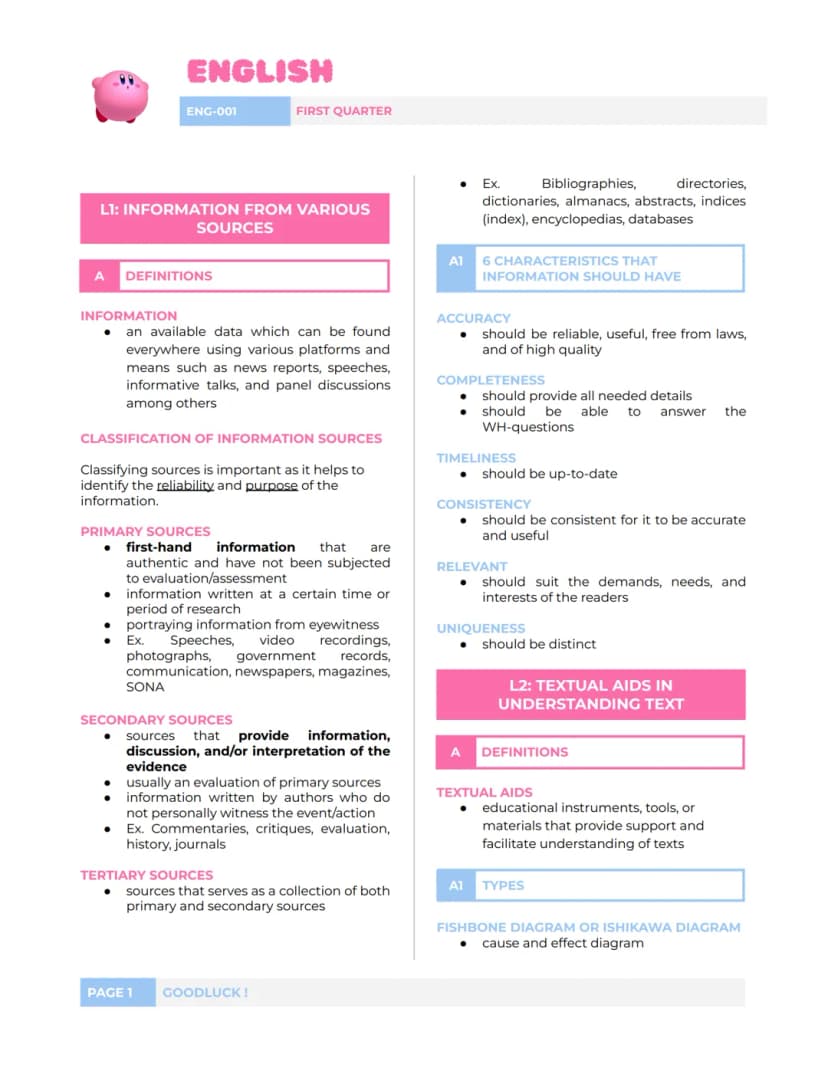
Ever wonder how to tell if that random article you found online is actually trustworthy? Information is basically any data you can find anywhere - news reports, speeches, social media posts, you name it. The trick is knowing what makes information good.
Good information has six key qualities you need to remember. It should be accurate , complete (answers all the who, what, when, where, why questions), timely , consistent, relevant to your needs, and unique. Think of it like choosing a friend to give you advice - you want someone reliable, informed, and honest.
Primary sources are the real deal - firsthand information like speeches, photos, government records, or newspapers from when something actually happened. Secondary sources are someone else's take on primary sources, like commentaries or critiques. Tertiary sources are collections of both, like encyclopedias or databases.
Pro tip: When researching for projects, always start with primary sources when possible - they're the most authentic and will make your work stand out!
2
of 9
Textual Aids and Visual Learning Tools
Visual learners, this section is your best friend! Textual aids are tools that make understanding complex information way easier. Think of them as your study buddies that never get tired of helping you organize thoughts.
Graphic organizers are visual displays that structure information perfectly. The Venn diagram is your go-to for comparing two things - super useful for essays comparing characters or themes. Flow charts show sequences and processes step-by-step, while fishbone diagrams help you trace causes and effects.
Understanding the difference between linear and non-linear text is crucial. Linear text (like novels) must be read from start to finish. Non-linear text (like infographics) can be read in any order. Learning to convert between these formats is a skill you'll use constantly.
Study hack: When reading dense textbooks, create your own graphic organizers to break down complex concepts - it makes review sessions so much more effective!
3
of 9
Evaluating Information Sources Effectively
Not all sources are created equal, and knowing the difference can save your grades! Different types of sources serve different purposes, and understanding accessibility and effectiveness helps you choose the right ones for your projects.
Academic sources like research papers and textbooks are your heavy hitters - they're peer-reviewed and detailed but can be technical. Government sources provide official data and statistics that are usually reliable. Popular sources like magazines are easier to read but may lack depth.
Reference materials like encyclopedias, dictionaries, and atlases give you quick facts and background information. They're perfect starting points but shouldn't be your only sources for major projects.
Why does source evaluation matter? It shows you're thinking critically, prevents plagiarism, demonstrates wide reading, and helps readers follow up on topics that interest them. Plus, it proves you're not just sharing personal opinions but backing up your ideas with solid evidence.
Research reality check: Your teachers can spot unreliable sources from a mile away - taking time to evaluate sources properly will definitely boost your credibility and grades!
4
of 9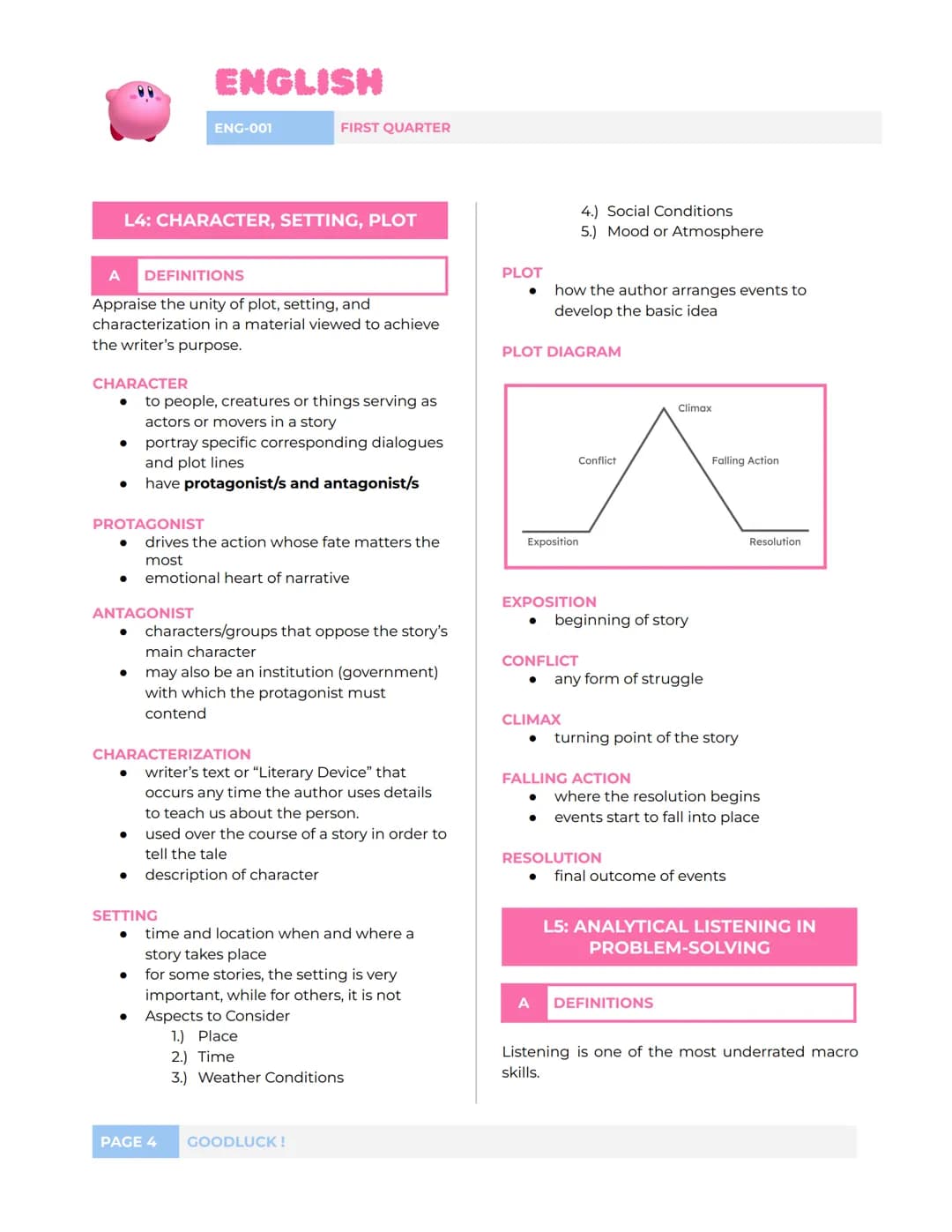
Character, Setting, and Plot Analysis
Time to dive into what makes stories tick! Understanding character, setting, and plot helps you analyze any story like a pro. These elements work together to create the writer's intended message.
Characters are the people (or creatures) who drive your story. The protagonist is your main character whose journey we follow, while the antagonist creates conflict - and it doesn't always have to be a person! Characterization is how writers reveal personality through actions, dialogue, and descriptions.
Setting includes place, time, weather, social conditions, and mood. Sometimes it's just background, but other times it's crucial to the story's meaning. Plot follows a classic structure: exposition (setup), conflict (the problem), climax (turning point), falling action (resolution begins), and resolution (final outcome).
Analysis tip: When studying stories, ask yourself how each element supports the theme - this deeper thinking will impress your teachers and improve your essay scores!
5
of 9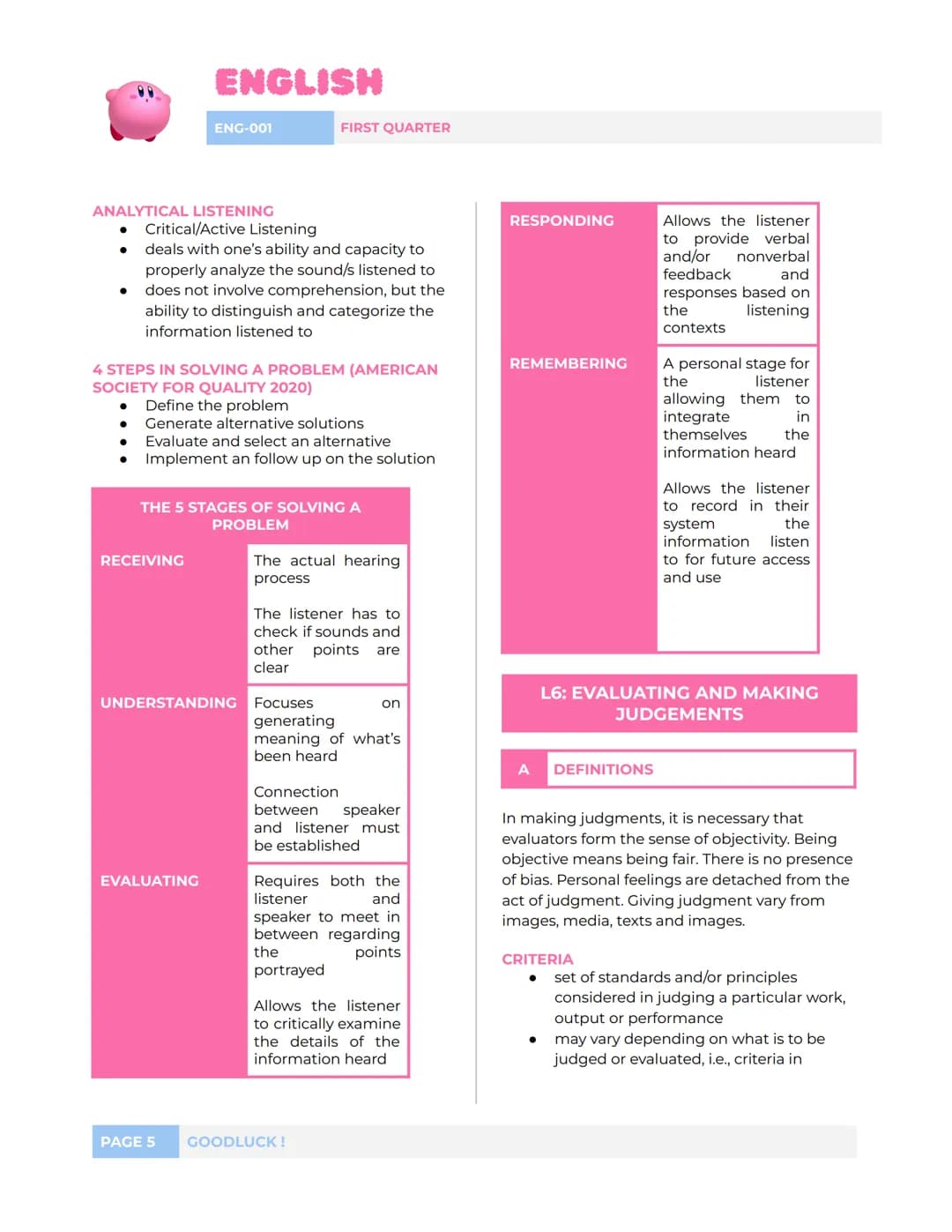
Analytical Listening and Problem-Solving
Listening might seem easy, but analytical listening is actually a superpower that most people never develop properly. It's about actively processing and categorizing what you hear, not just understanding it.
The five stages of effective listening create a complete cycle: receiving (actually hearing clearly), understanding (making meaning), evaluating (critically examining details), responding (giving feedback), and remembering (storing information for future use). Each stage requires focus and practice.
Problem-solving through listening follows four key steps: define the problem clearly, generate alternative solutions, evaluate and select the best option, then implement and follow up. This process works for everything from group projects to personal conflicts.
Life skill alert: Mastering analytical listening will make you stand out in group discussions, improve your relationships, and help you succeed in future jobs where communication is key!
6
of 9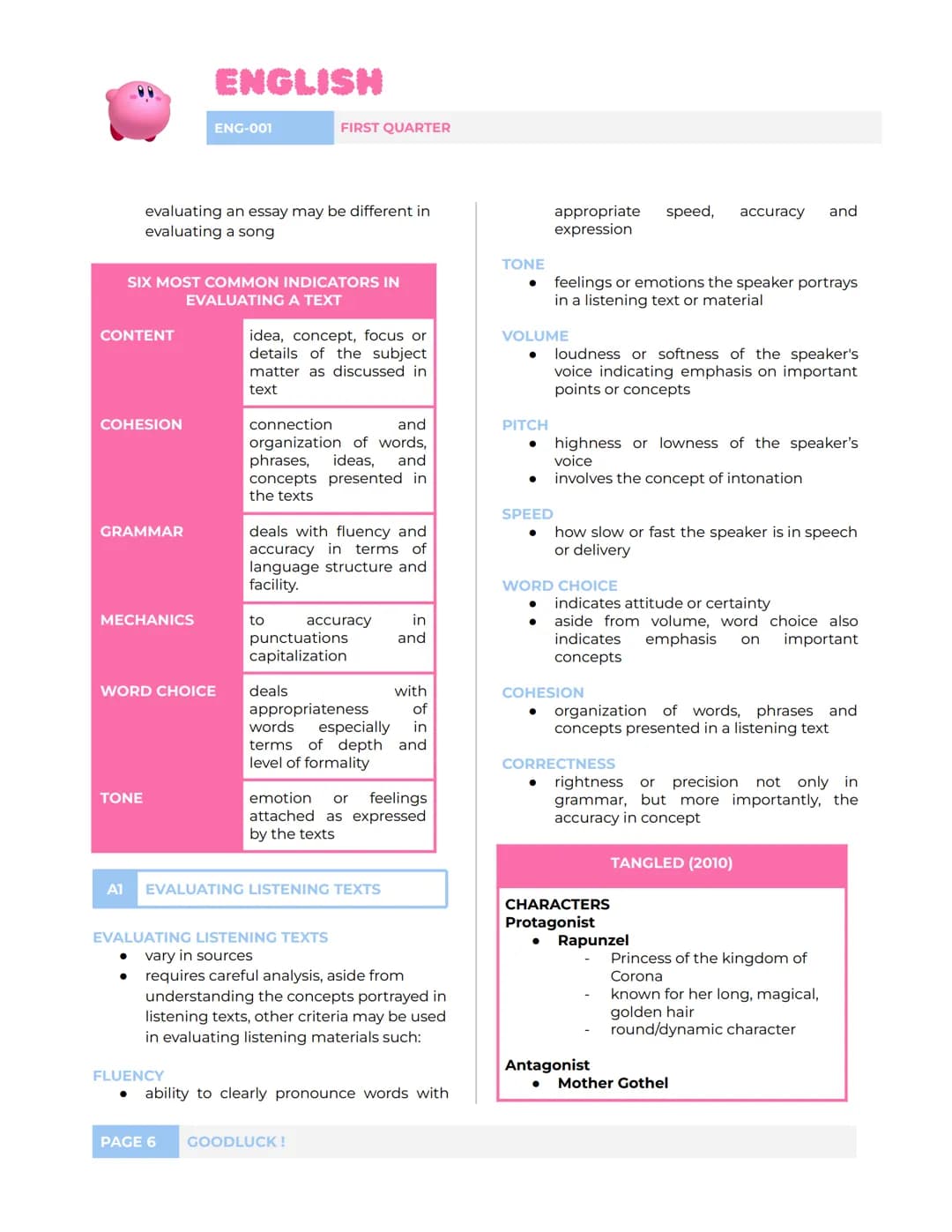
Making Fair Judgments and Evaluations
Being objective means being fair - no personal bias, just honest evaluation based on clear criteria. Whether you're evaluating texts, presentations, or media, having standards helps you judge fairly and consistently.
For listening texts, focus on six key indicators: tone (emotions conveyed), volume (emphasis through loudness), pitch (intonation patterns), speed (delivery pace), word choice (attitude and precision), and cohesion (how well ideas connect).
For written texts, evaluate content (ideas and focus), cohesion (organization), grammar (language structure), mechanics (punctuation and capitalization), word choice (appropriateness), and tone (emotional expression). Fluency and correctness tie everything together.
Evaluation wisdom: Good critics aren't just negative - they recognize strengths and weaknesses fairly, which makes their feedback actually helpful and respected!
7
of 9
Analyzing Tangled - Characters and Setting
Let's put theory into practice with Disney's Tangled! Rapunzel serves as our protagonist - she's a round, dynamic character who grows throughout the story. Mother Gothel is our antagonist, a flat, static character who represents control and manipulation.
The setting creates the story's foundation. Set in 1790 in the fictional Kingdom of Corona, most action happens in Rapunzel's tower (representing isolation) and various locations showing freedom and adventure. The warm, sunny weather reflects the optimistic tone.
The social conditions explore themes of freedom versus control. Mother Gothel's manipulation represents how people can disguise abuse as protection. The mood shifts from whimsical wonder in early scenes to adventure and romance as Rapunzel discovers the world.
Character insight: Notice how Rapunzel and Eugene are both dynamic characters who change, while Mother Gothel remains static - this contrast reinforces the story's themes about growth versus stagnation!
8
of 9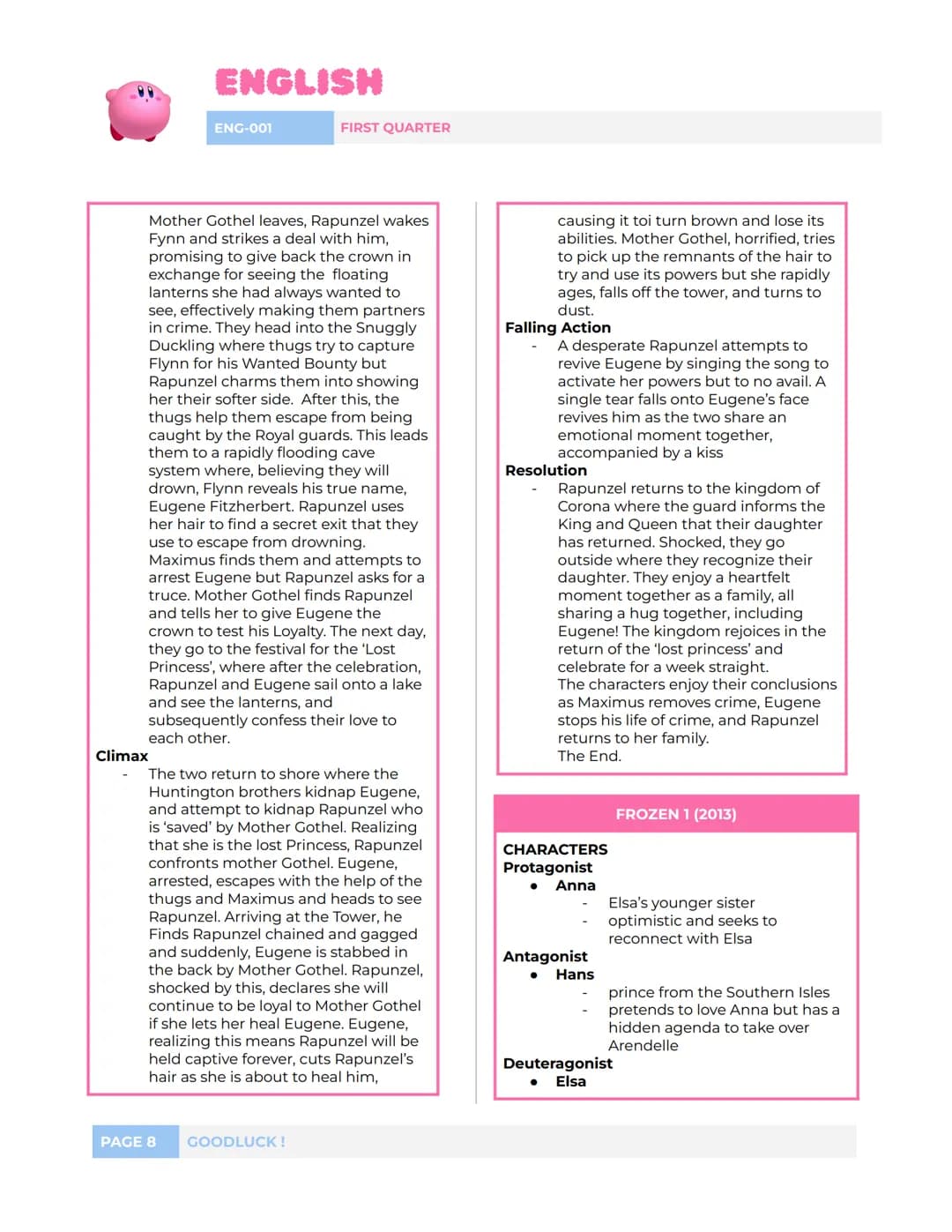
Tangled's Plot Structure and Frozen's Conflicts
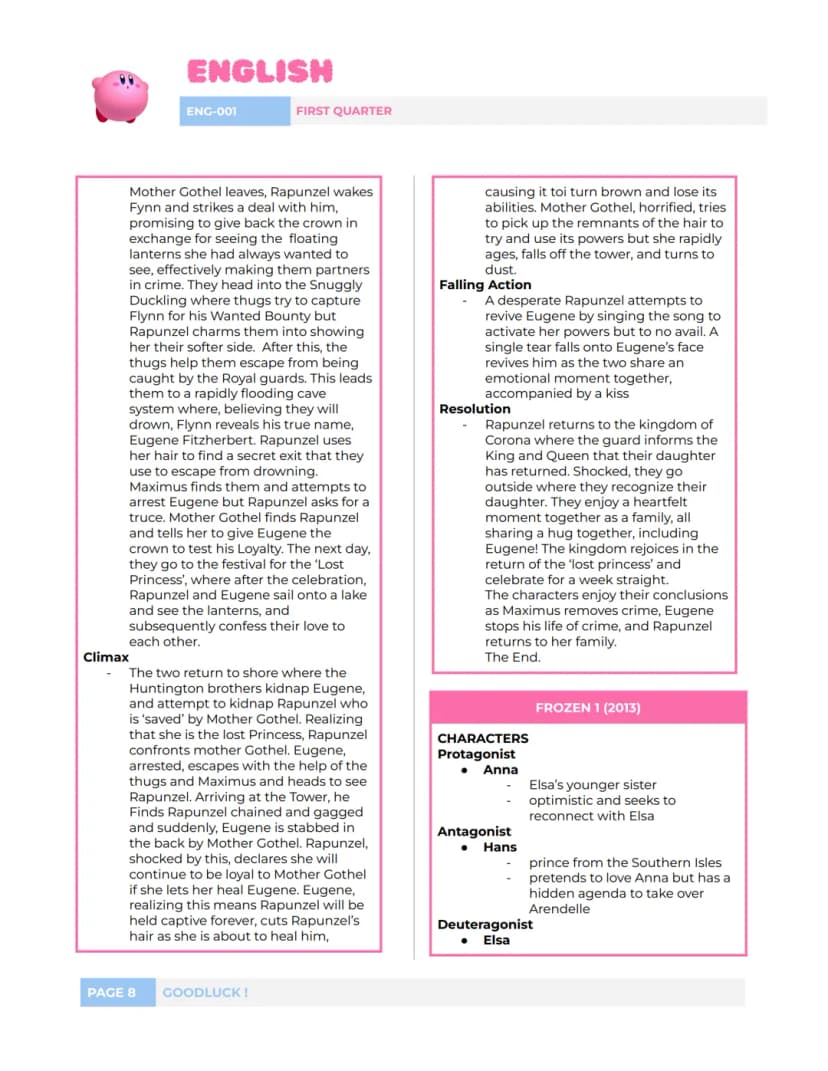
Tangled's plot follows the classic structure perfectly. The exposition establishes the magical flower, Rapunzel's kidnapping, and Flynn's theft. The rising action builds through Flynn's discovery of the tower, their partnership, and growing romance.
The climax hits when Rapunzel realizes she's the lost princess and Eugene cuts her hair to save her from eternal captivity. Falling action shows Rapunzel's tear reviving Eugene, leading to the resolution where she reunites with her real parents and finds true love.
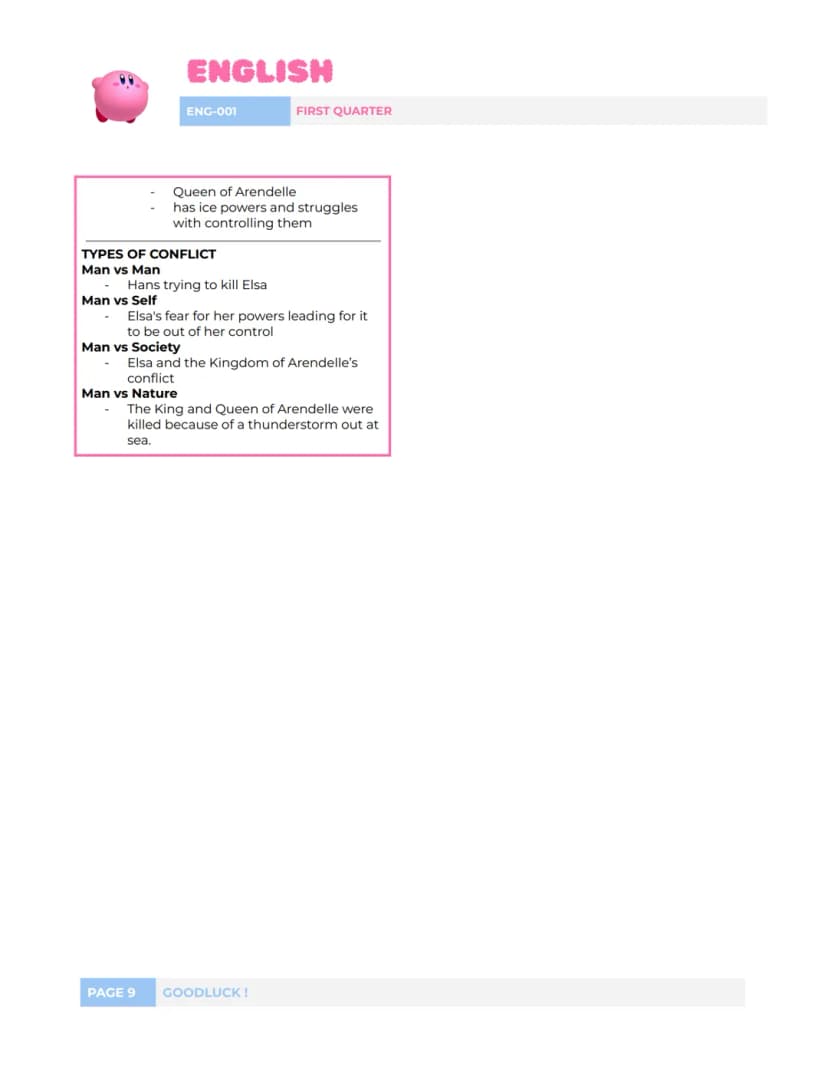
Frozen demonstrates different types of conflict brilliantly. Man vs. Man appears in Hans trying to kill Elsa. Man vs. Self drives Elsa's struggle with her powers. Man vs. Society shows in Elsa's conflict with Arendelle's expectations. Man vs. Nature tragically kills Anna and Elsa's parents.
Plot mastery: Understanding these conflict types helps you analyze any story more deeply and write more compelling essays about character motivations and story themes!
9
of 9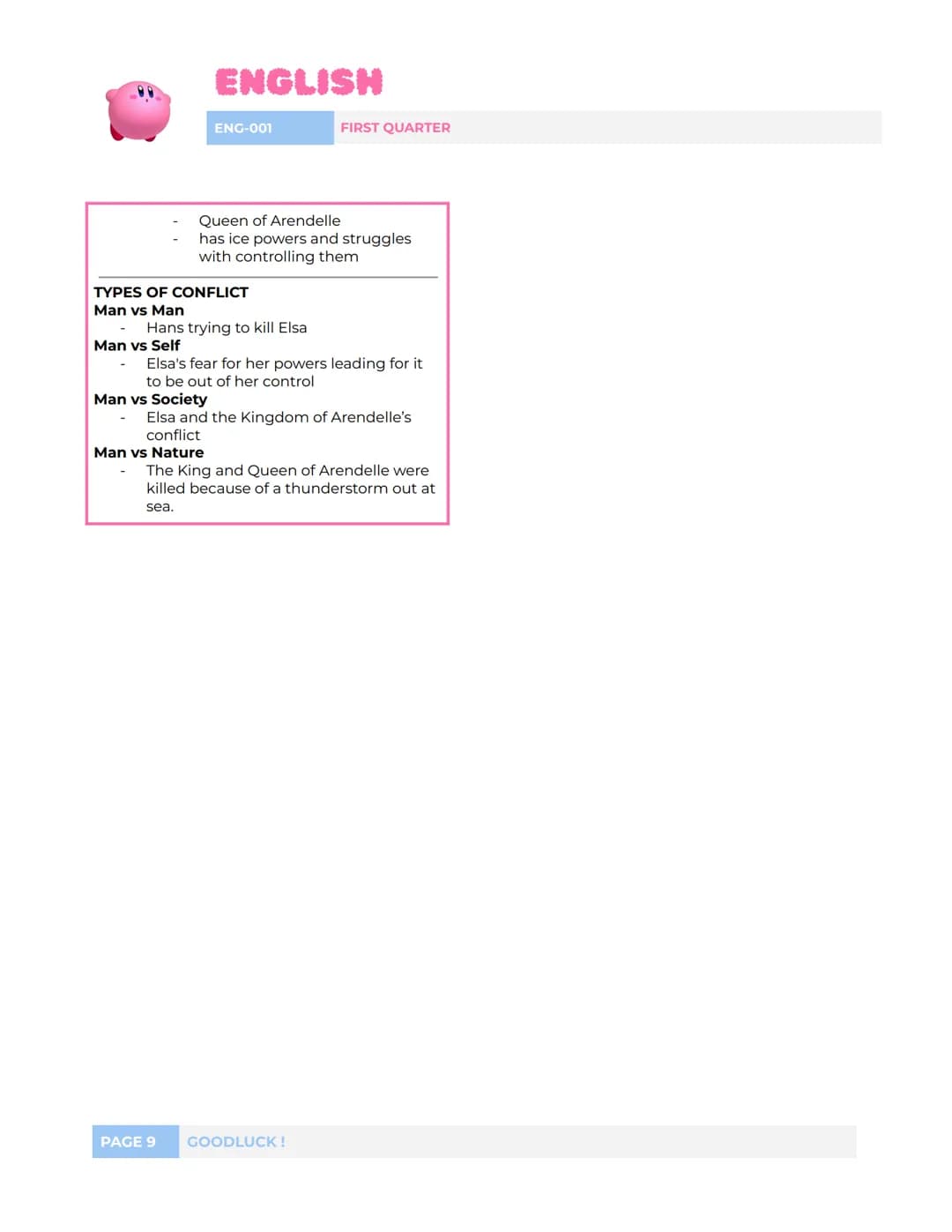
Understanding Conflict Types Through Film
Recognizing different types of conflict makes you a stronger story analyst. Man vs. Man is the most obvious - direct confrontation between characters like Hans trying to harm Elsa. This external conflict drives much of the action and tension.
Man vs. Self creates the most compelling character development. Elsa's fear of her own powers shows internal struggle that many viewers relate to. This type of conflict often drives character growth and makes protagonists more sympathetic.
Man vs. Society and Man vs. Nature add layers of complexity. Elsa facing societal expectations about royal behavior creates realistic tension, while the storm that killed their parents shows how natural forces can shape destiny.
Analysis breakthrough: Great stories usually combine multiple conflict types - identifying all of them in your essays shows sophisticated thinking that teachers absolutely love to see!
We thought you’d never ask...
What is the Knowunity AI companion?
Our AI companion is specifically built for the needs of students. Based on the millions of content pieces we have on the platform we can provide truly meaningful and relevant answers to students. But its not only about answers, the companion is even more about guiding students through their daily learning challenges, with personalised study plans, quizzes or content pieces in the chat and 100% personalisation based on the students skills and developments.
Where can I download the Knowunity app?
You can download the app in the Google Play Store and in the Apple App Store.
Is Knowunity really free of charge?
That's right! Enjoy free access to study content, connect with fellow students, and get instant help – all at your fingertips.
Similar Content
 Méthodo
 Aardrijkskunde
 Fun Stuff
Most popular content: Source
3 MIL
MILMedia and Information Literacy
Notes
G122,07032
 Iba pa
PAGBASA AT PAGSUSURI NG IBA’T IBANG TEKSTO TUNGO SA PANANALIKSIK
This document provides an overview about TEKSTO from the PAGBASA AT PAGSUSURI NG IBA’T IBANG TEKSTO TUNGO SA PANANALIKSIK course
G111,96722
Oral ComORAL COMMUNICATION
Notes for oral com first sem
G111,37714
Most popular content in English
9EnglishENG - GRADE 10 - 1ST QUARTER
This provides Grade 10 Students complete notes on the mentioned subject for a specific quarter.
G101,45531
EnglishFigure Of Speech
English - Figure of Speech
G83,87364
EnglishGrade 7 English Reviewer – Narrative Texts, Literary Devices, and Reading Skills (Quarter 3)
This reviewer for Grade 7 English Quarter 3 focuses on narrative elements, types of conflict, common figures of speech, imagery, and reading comprehension strategies. It supports learners in understanding and analyzing literary texts effectively.
G72,69840
EnglishEnglish Grade 9 Notes 💙📒
1st Quarter Notes in Grade 9!! 📚📝
G92,40836
EnglishENGLISHGrade 9 Quarter 3 Reviewer
All about the lessons in Grade 9 Quarter 3 ENGLISH, all complete, highlighted, printable, and has extra informations.
G93,83642
EnglishEnglish G10 2ND QUARTER Reviewer
English G10 2ND QUARTER Reviewer
G105,819155
EnglishEnglish 10 3rd Quarter Reviewer
Topics: Argumentative Essay; Informative, Persuasive, and Argumentative Writing Techniques; Literary Criticism
G102,27739
EnglishDifferentiate Biases from Prejudices
English 9 Quarter 3 - Module 1
G92,34231
EnglishGrade 10 English Reviewer – Informational Texts, Claims, and Source Evaluation (Quarter 2)
This reviewer for Grade 10 English Quarter 2 helps students read, evaluate, and analyze informational texts. It covers types of claims, valid evidence, critical reading, and how to judge the credibility and logic of what they read.
G101,1779
Most popular content
9 Math
MathMathematics Grade 10 Quarter 1
Grade 10 Math topics
G1010,218250
Iba paEl Filibusterismo (FILIPINO 10)
Kilalanin ang mga karakter at alamin ang mga pangyayari mula Kabanata 1 hanggang 39.
G1011,183240
 Science
Science 9 Quarter 1 Lesson 1
Topics: The Respiratory System and The Circulatory System
G911,069383
 Gen Physics
General Physics 1, First Sem
Units of Measurement, Vectors, and Kinematics. All with formulas
G116,247168
 Filipino
Filipino 8 Reviewer
Filipino Reviewer for 4th Quarter for Grade 8 students
G88,088127
ScienceSCIENCE Grade 9 Quarter 3 Reviewer
All about the lessons in Grade 9 Quarter 3 SCIENCE, all complete, highlighted, printable, and has extra informations.
G914,627303
 Pre-Cal
UPCAT Reviewer: Mathematics
general coverage of the mathematics section for UPCAT
G127,072397
OtherIntroduction to Philosophy - 1st Semester, Grade 12
A summarized notes for Grade 12 students. Easier learning for the 1st semester’s Philosophy subject.
G123,93956
ScienceThe Human Digestive System
Science Grade 8 1st Quarter Lesson
G84,78386
Can't find what you're looking for? Explore other subjects.
Students love us — and so will you.
4.6/5App Store
4.7/5Google Play
The app is very easy to use and well designed. I have found everything I was looking for so far and have been able to learn a lot from the presentations! I will definitely use the app for a class assignment! And of course it also helps a lot as an inspiration.
Stefan SiOS user
This app is really great. There are so many study notes and help [...]. My problem subject is French, for example, and the app has so many options for help. Thanks to this app, I have improved my French. I would recommend it to anyone.
Samantha KlichAndroid user
Wow, I am really amazed. I just tried the app because I've seen it advertised many times and was absolutely stunned. This app is THE HELP you want for school and above all, it offers so many things, such as workouts and fact sheets, which have been VERY helpful to me personally.
AnnaiOS user
English7,990 views·Updated Jun 17, 2026·9 pagesGrade 10 English 1st Quarter Review Guide
K
kish andres@kishandres
Ready to master English class this quarter? We're covering everything from finding reliable sources to analyzing your favorite movies like Tangled and Frozen. These skills will help you ace your assignments and become a smarter consumer of information in our...
1
of 9
Sign up to see the content. It's free!
- Access to all documents
- Improve your grades
- Join milions of students
Information Sources and Their Characteristics
Ever wonder how to tell if that random article you found online is actually trustworthy? Information is basically any data you can find anywhere - news reports, speeches, social media posts, you name it. The trick is knowing what makes information good.
Good information has six key qualities you need to remember. It should be accurate , complete (answers all the who, what, when, where, why questions), timely , consistent, relevant to your needs, and unique. Think of it like choosing a friend to give you advice - you want someone reliable, informed, and honest.
Primary sources are the real deal - firsthand information like speeches, photos, government records, or newspapers from when something actually happened. Secondary sources are someone else's take on primary sources, like commentaries or critiques. Tertiary sources are collections of both, like encyclopedias or databases.
Pro tip: When researching for projects, always start with primary sources when possible - they're the most authentic and will make your work stand out!
2
of 9Sign up to see the content. It's free!
- Access to all documents
- Improve your grades
- Join milions of students
Textual Aids and Visual Learning Tools
Visual learners, this section is your best friend! Textual aids are tools that make understanding complex information way easier. Think of them as your study buddies that never get tired of helping you organize thoughts.
Graphic organizers are visual displays that structure information perfectly. The Venn diagram is your go-to for comparing two things - super useful for essays comparing characters or themes. Flow charts show sequences and processes step-by-step, while fishbone diagrams help you trace causes and effects.
Understanding the difference between linear and non-linear text is crucial. Linear text (like novels) must be read from start to finish. Non-linear text (like infographics) can be read in any order. Learning to convert between these formats is a skill you'll use constantly.
Study hack: When reading dense textbooks, create your own graphic organizers to break down complex concepts - it makes review sessions so much more effective!
3
of 9Sign up to see the content. It's free!
- Access to all documents
- Improve your grades
- Join milions of students
Evaluating Information Sources Effectively
Not all sources are created equal, and knowing the difference can save your grades! Different types of sources serve different purposes, and understanding accessibility and effectiveness helps you choose the right ones for your projects.
Academic sources like research papers and textbooks are your heavy hitters - they're peer-reviewed and detailed but can be technical. Government sources provide official data and statistics that are usually reliable. Popular sources like magazines are easier to read but may lack depth.
Reference materials like encyclopedias, dictionaries, and atlases give you quick facts and background information. They're perfect starting points but shouldn't be your only sources for major projects.
Why does source evaluation matter? It shows you're thinking critically, prevents plagiarism, demonstrates wide reading, and helps readers follow up on topics that interest them. Plus, it proves you're not just sharing personal opinions but backing up your ideas with solid evidence.
Research reality check: Your teachers can spot unreliable sources from a mile away - taking time to evaluate sources properly will definitely boost your credibility and grades!
4
of 9Sign up to see the content. It's free!
- Access to all documents
- Improve your grades
- Join milions of students
Character, Setting, and Plot Analysis
Time to dive into what makes stories tick! Understanding character, setting, and plot helps you analyze any story like a pro. These elements work together to create the writer's intended message.
Characters are the people (or creatures) who drive your story. The protagonist is your main character whose journey we follow, while the antagonist creates conflict - and it doesn't always have to be a person! Characterization is how writers reveal personality through actions, dialogue, and descriptions.
Setting includes place, time, weather, social conditions, and mood. Sometimes it's just background, but other times it's crucial to the story's meaning. Plot follows a classic structure: exposition (setup), conflict (the problem), climax (turning point), falling action (resolution begins), and resolution (final outcome).
Analysis tip: When studying stories, ask yourself how each element supports the theme - this deeper thinking will impress your teachers and improve your essay scores!
5
of 9Sign up to see the content. It's free!
- Access to all documents
- Improve your grades
- Join milions of students
Analytical Listening and Problem-Solving
Listening might seem easy, but analytical listening is actually a superpower that most people never develop properly. It's about actively processing and categorizing what you hear, not just understanding it.
The five stages of effective listening create a complete cycle: receiving (actually hearing clearly), understanding (making meaning), evaluating (critically examining details), responding (giving feedback), and remembering (storing information for future use). Each stage requires focus and practice.
Problem-solving through listening follows four key steps: define the problem clearly, generate alternative solutions, evaluate and select the best option, then implement and follow up. This process works for everything from group projects to personal conflicts.
Life skill alert: Mastering analytical listening will make you stand out in group discussions, improve your relationships, and help you succeed in future jobs where communication is key!
6
of 9Sign up to see the content. It's free!
- Access to all documents
- Improve your grades
- Join milions of students
Making Fair Judgments and Evaluations
Being objective means being fair - no personal bias, just honest evaluation based on clear criteria. Whether you're evaluating texts, presentations, or media, having standards helps you judge fairly and consistently.
For listening texts, focus on six key indicators: tone (emotions conveyed), volume (emphasis through loudness), pitch (intonation patterns), speed (delivery pace), word choice (attitude and precision), and cohesion (how well ideas connect).
For written texts, evaluate content (ideas and focus), cohesion (organization), grammar (language structure), mechanics (punctuation and capitalization), word choice (appropriateness), and tone (emotional expression). Fluency and correctness tie everything together.
Evaluation wisdom: Good critics aren't just negative - they recognize strengths and weaknesses fairly, which makes their feedback actually helpful and respected!
7
of 9Sign up to see the content. It's free!
- Access to all documents
- Improve your grades
- Join milions of students
Analyzing Tangled - Characters and Setting
Let's put theory into practice with Disney's Tangled! Rapunzel serves as our protagonist - she's a round, dynamic character who grows throughout the story. Mother Gothel is our antagonist, a flat, static character who represents control and manipulation.
The setting creates the story's foundation. Set in 1790 in the fictional Kingdom of Corona, most action happens in Rapunzel's tower (representing isolation) and various locations showing freedom and adventure. The warm, sunny weather reflects the optimistic tone.
The social conditions explore themes of freedom versus control. Mother Gothel's manipulation represents how people can disguise abuse as protection. The mood shifts from whimsical wonder in early scenes to adventure and romance as Rapunzel discovers the world.
Character insight: Notice how Rapunzel and Eugene are both dynamic characters who change, while Mother Gothel remains static - this contrast reinforces the story's themes about growth versus stagnation!
8
of 9Sign up to see the content. It's free!
- Access to all documents
- Improve your grades
- Join milions of students
Tangled's Plot Structure and Frozen's Conflicts
Tangled's plot follows the classic structure perfectly. The exposition establishes the magical flower, Rapunzel's kidnapping, and Flynn's theft. The rising action builds through Flynn's discovery of the tower, their partnership, and growing romance.
The climax hits when Rapunzel realizes she's the lost princess and Eugene cuts her hair to save her from eternal captivity. Falling action shows Rapunzel's tear reviving Eugene, leading to the resolution where she reunites with her real parents and finds true love.
Frozen demonstrates different types of conflict brilliantly. Man vs. Man appears in Hans trying to kill Elsa. Man vs. Self drives Elsa's struggle with her powers. Man vs. Society shows in Elsa's conflict with Arendelle's expectations. Man vs. Nature tragically kills Anna and Elsa's parents.
Plot mastery: Understanding these conflict types helps you analyze any story more deeply and write more compelling essays about character motivations and story themes!
9
of 9Sign up to see the content. It's free!
- Access to all documents
- Improve your grades
- Join milions of students
Understanding Conflict Types Through Film
Recognizing different types of conflict makes you a stronger story analyst. Man vs. Man is the most obvious - direct confrontation between characters like Hans trying to harm Elsa. This external conflict drives much of the action and tension.
Man vs. Self creates the most compelling character development. Elsa's fear of her own powers shows internal struggle that many viewers relate to. This type of conflict often drives character growth and makes protagonists more sympathetic.
Man vs. Society and Man vs. Nature add layers of complexity. Elsa facing societal expectations about royal behavior creates realistic tension, while the storm that killed their parents shows how natural forces can shape destiny.
Analysis breakthrough: Great stories usually combine multiple conflict types - identifying all of them in your essays shows sophisticated thinking that teachers absolutely love to see!
We thought you’d never ask...
What is the Knowunity AI companion?
Our AI companion is specifically built for the needs of students. Based on the millions of content pieces we have on the platform we can provide truly meaningful and relevant answers to students. But its not only about answers, the companion is even more about guiding students through their daily learning challenges, with personalised study plans, quizzes or content pieces in the chat and 100% personalisation based on the students skills and developments.
Where can I download the Knowunity app?
You can download the app in the Google Play Store and in the Apple App Store.
Is Knowunity really free of charge?
That's right! Enjoy free access to study content, connect with fellow students, and get instant help – all at your fingertips.
Similar Content
Most popular content: Source
3MILMedia and Information Literacy
Notes
G122,07032
Iba paPAGBASA AT PAGSUSURI NG IBA’T IBANG TEKSTO TUNGO SA PANANALIKSIK
This document provides an overview about TEKSTO from the PAGBASA AT PAGSUSURI NG IBA’T IBANG TEKSTO TUNGO SA PANANALIKSIK course
G111,96722
Oral ComORAL COMMUNICATION
Notes for oral com first sem
G111,37714
Most popular content in English
9EnglishENG - GRADE 10 - 1ST QUARTER
This provides Grade 10 Students complete notes on the mentioned subject for a specific quarter.
G101,45531
EnglishFigure Of Speech
English - Figure of Speech
G83,87364
EnglishGrade 7 English Reviewer – Narrative Texts, Literary Devices, and Reading Skills (Quarter 3)
This reviewer for Grade 7 English Quarter 3 focuses on narrative elements, types of conflict, common figures of speech, imagery, and reading comprehension strategies. It supports learners in understanding and analyzing literary texts effectively.
G72,69840
EnglishEnglish Grade 9 Notes 💙📒
1st Quarter Notes in Grade 9!! 📚📝
G92,40836
EnglishENGLISHGrade 9 Quarter 3 Reviewer
All about the lessons in Grade 9 Quarter 3 ENGLISH, all complete, highlighted, printable, and has extra informations.
G93,83642
EnglishEnglish G10 2ND QUARTER Reviewer
English G10 2ND QUARTER Reviewer
G105,819155
EnglishEnglish 10 3rd Quarter Reviewer
Topics: Argumentative Essay; Informative, Persuasive, and Argumentative Writing Techniques; Literary Criticism
G102,27739
EnglishDifferentiate Biases from Prejudices
English 9 Quarter 3 - Module 1
G92,34231
EnglishGrade 10 English Reviewer – Informational Texts, Claims, and Source Evaluation (Quarter 2)
This reviewer for Grade 10 English Quarter 2 helps students read, evaluate, and analyze informational texts. It covers types of claims, valid evidence, critical reading, and how to judge the credibility and logic of what they read.
G101,1779
Most popular content
9MathMathematics Grade 10 Quarter 1
Grade 10 Math topics
G1010,218250
Iba paEl Filibusterismo (FILIPINO 10)
Kilalanin ang mga karakter at alamin ang mga pangyayari mula Kabanata 1 hanggang 39.
G1011,183240
ScienceScience 9 Quarter 1 Lesson 1
Topics: The Respiratory System and The Circulatory System
G911,069383
Gen PhysicsGeneral Physics 1, First Sem
Units of Measurement, Vectors, and Kinematics. All with formulas
G116,247168
FilipinoFilipino 8 Reviewer
Filipino Reviewer for 4th Quarter for Grade 8 students
G88,088127
ScienceSCIENCE Grade 9 Quarter 3 Reviewer
All about the lessons in Grade 9 Quarter 3 SCIENCE, all complete, highlighted, printable, and has extra informations.
G914,627303
Pre-CalUPCAT Reviewer: Mathematics
general coverage of the mathematics section for UPCAT
G127,072397
OtherIntroduction to Philosophy - 1st Semester, Grade 12
A summarized notes for Grade 12 students. Easier learning for the 1st semester’s Philosophy subject.
G123,93956
ScienceThe Human Digestive System
Science Grade 8 1st Quarter Lesson
G84,78386
Can't find what you're looking for? Explore other subjects.
Students love us — and so will you.
4.6/5App Store
4.7/5Google Play
The app is very easy to use and well designed. I have found everything I was looking for so far and have been able to learn a lot from the presentations! I will definitely use the app for a class assignment! And of course it also helps a lot as an inspiration.
Stefan SiOS user
This app is really great. There are so many study notes and help [...]. My problem subject is French, for example, and the app has so many options for help. Thanks to this app, I have improved my French. I would recommend it to anyone.
Samantha KlichAndroid user
Wow, I am really amazed. I just tried the app because I've seen it advertised many times and was absolutely stunned. This app is THE HELP you want for school and above all, it offers so many things, such as workouts and fact sheets, which have been VERY helpful to me personally.
AnnaiOS user