
Literary devices and character analysis are essential tools that help...
 English125 views·Updated Jun 11, 2026·2 pages
Understanding Hero Types and Points of View in English 1

Annika@amoreiousme
1
of 2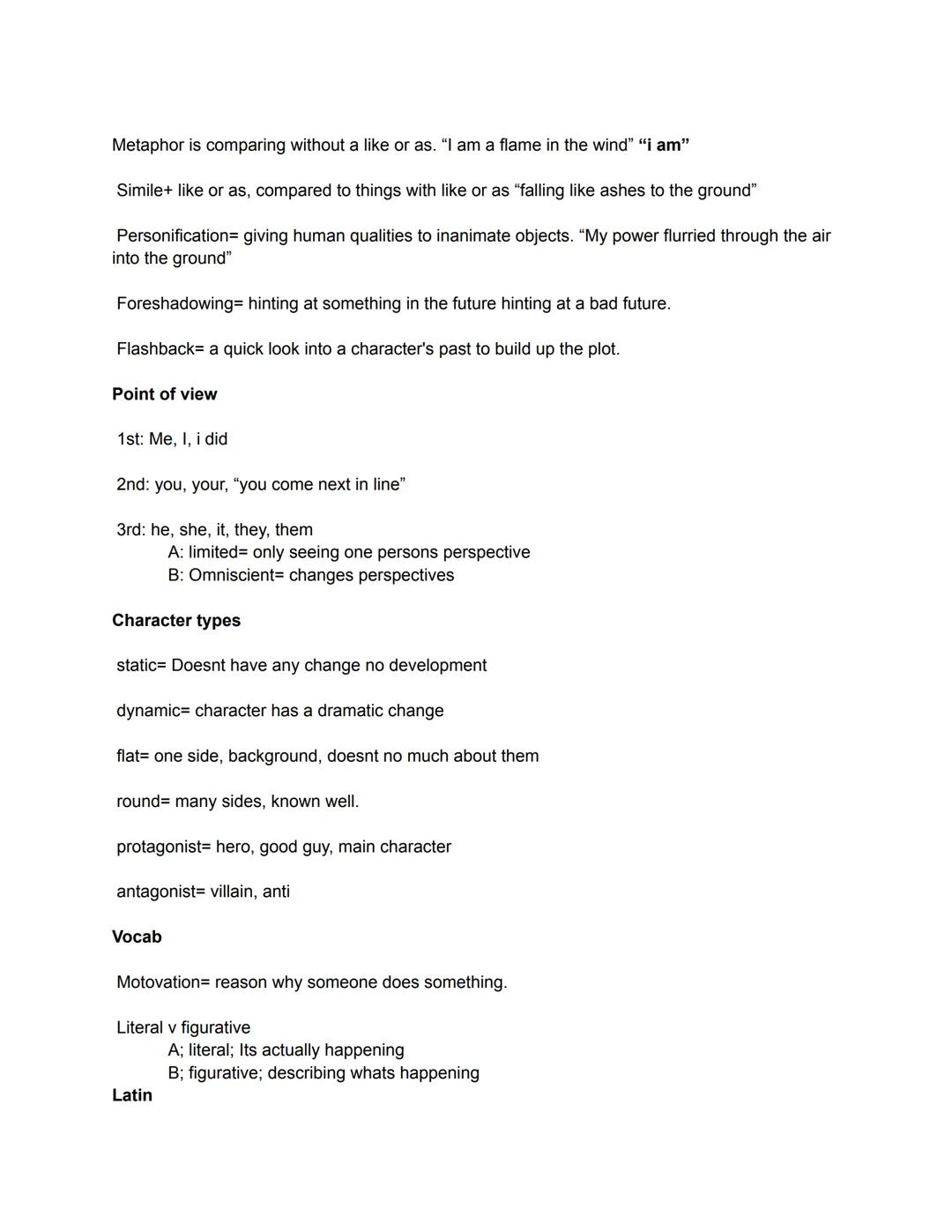
Literary Devices and Character Types
Ever wonder how authors make their stories come alive? They use literary devices like metaphors, which compare things without using "like" or "as" ("I am a flame in the wind"), while similes make comparisons using those words ("falling like ashes to the ground"). Personification brings objects to life by giving them human qualities, such as "My power flurried through the air into the ground."
Stories can be told from different points of view. First-person uses "I" and "me," second-person uses "you," and third-person uses "he," "she," or "they." Third-person limited shows only one character's perspective, while third-person omniscient jumps between different characters' thoughts.
Characters in stories can be categorized in several ways. Static characters don't change, while dynamic characters undergo significant development. Flat characters have limited dimensions and often stay in the background, whereas round characters are complex with multiple facets. The protagonist is typically the main character or hero, while the antagonist opposes them.
Remember this! When analyzing literature, look for foreshadowing (hints about future events) and flashbacks (glimpses into a character's past) to better understand how the author builds tension and develops the plot.
2
of 2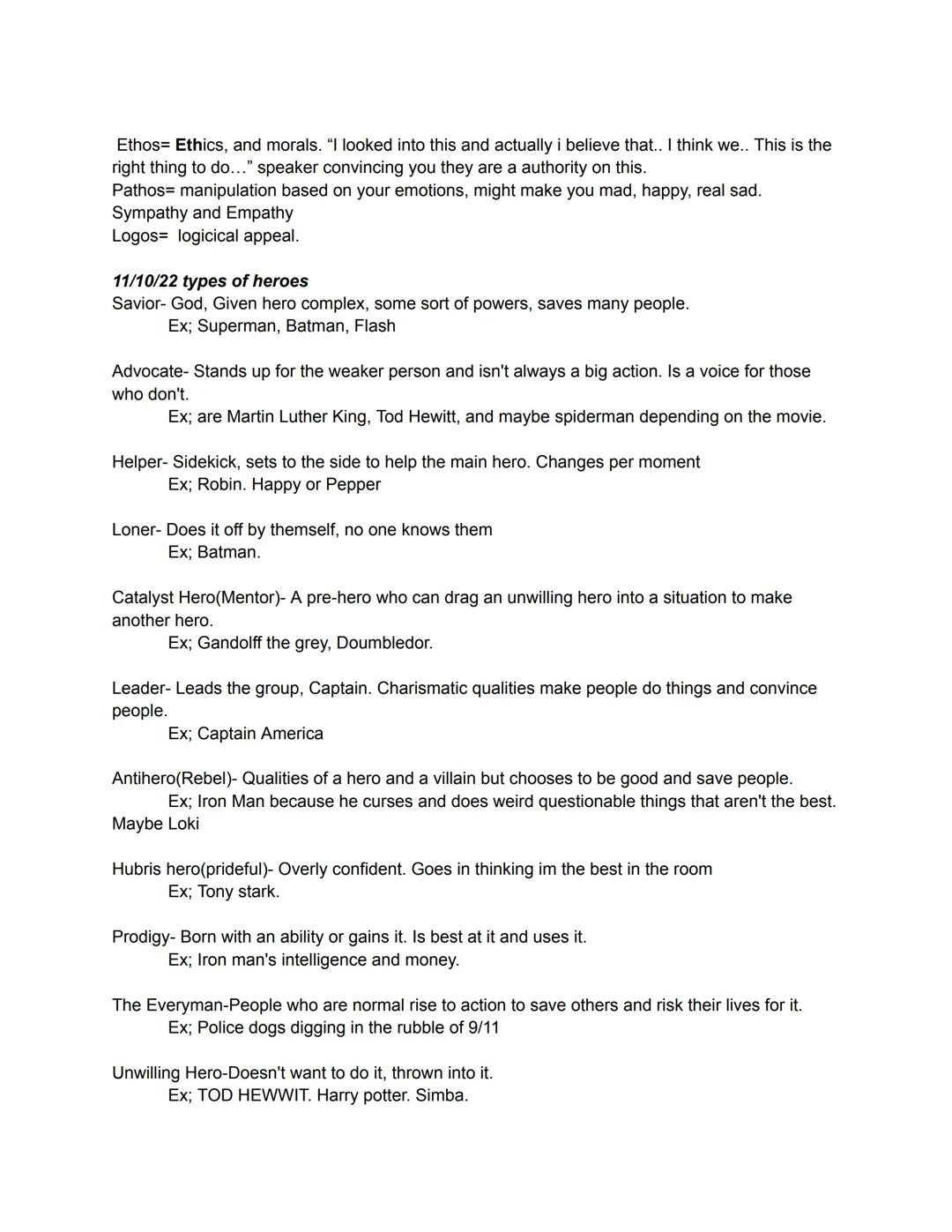
Rhetorical Appeals and Hero Types
When someone tries to persuade you, they might use three main appeals. Ethos appeals to ethics and establishes the speaker's credibility ("I've researched this thoroughly..."). Pathos targets your emotions, making you feel angry, happy, or sad. Logos uses logic and facts to convince you.
Literature features many types of heroes, each with distinct characteristics. A Savior hero has extraordinary powers and saves many people, like Superman. An Advocate hero stands up for the weak, like Martin Luther King Jr. The Helper assists the main hero, while the Loner works independently.
Some heroes don't fit the traditional mold. The Antihero has qualities of both heroes and villains but chooses to do good, like Iron Man. The Unwilling Hero doesn't want the responsibility but rises to the occasion anyway, like Harry Potter. The Everyman hero is an ordinary person who takes extraordinary action when needed.
Pro tip: When writing your own stories, mix different hero types to create complex, relatable characters. For example, an Unwilling Hero who's also a Prodigy (born with special abilities) creates interesting internal conflicts that readers love.
We thought you’d never ask...
What is the Knowunity AI companion?
Our AI companion is specifically built for the needs of students. Based on the millions of content pieces we have on the platform we can provide truly meaningful and relevant answers to students. But its not only about answers, the companion is even more about guiding students through their daily learning challenges, with personalised study plans, quizzes or content pieces in the chat and 100% personalisation based on the students skills and developments.
Where can I download the Knowunity app?
You can download the app in the Google Play Store and in the Apple App Store.
Is Knowunity really free of charge?
That's right! Enjoy free access to study content, connect with fellow students, and get instant help – all at your fingertips.
Similar Content
Most popular content: Hero's Journey
1Most popular content in English
9G
Englishgrade 6 english
learning the basics
6th7870
M
EnglishMastering English Grammar: Challenging Concepts for Grade 9
Boost your English skills with this comprehensive flashcard set covering advanced grammar topics for grade 9 students. Dive into challenging concepts and ace your exams!
10th3771
E
EnglishEnglish 10 grammar quiz
verbs
10th3090
EnglishIntroduction to linguistics
Introduction to linguistics exam revision notes. Structure of language, typologies of language, parts of speech, language families, Chomsky, Hockett, semantic triangle, Prague Linguistic Circle, writing systems, acquisition and learning
1,21250
M
Englishmatter
8th grade science
8th1731
AP English LanguageAP Lang Unit 1.1 Notes (The Rhetorical Situation)
Notes on AP lang unit 1.1, the rhetorical situation
10th28013
G
Englishgrade 10 English vocabulary
this content is about vocabulary
10th4866
EnglishThe great Gatsbey notes. please note that these are things I found interesting/ important. if you have any questions please feel free to ask
grammar and the great gatsby notes.
11th94469
EnglishComplete Hamlet Breakdown
What you need to know in Hamlet
10th30817
Most popular content
9O
 AP US History
Origins and Dynamics of the Columbian Exchange
Analyze the ecological and economic motivations behind the initial transfer of goods, people, and diseases between the Old and New Worlds.
9th3,1280
I
AP US HistoryIntroduction to Early Cultural Interactions
Analyze the initial social and religious encounters between Europeans, Africans, and Indigenous peoples in the colonial Americas.
9th2,7730
O
 AP World History
Origins of Ancient River Civilizations
Analyze the environmental factors and technological innovations that led to the rise of early states in Mesopotamia, Egypt, and the Indus Valley.
9th3,1870
M
AP US HistoryMotivations for European Exploration
Analyze the economic, religious, and political factors that drove European powers to the Americas during the 15th and 16th centuries.
9th1,7780
F
 AP Psychology
Foundations of Ethical Guidelines in Research
Practice the core principles of the APA ethical code including informed consent, debriefing, and the role of Institutional Review Boards.
9th1,3360
I
AP US HistoryIntroduction to Native American Societies
Examine the diverse social, political, and economic structures of North American indigenous groups prior to European contact.
9th1,1100
I
 AP Biology
Introduction to Biological Elements of Life
Practice identifying the essential elements including carbon, nitrogen, phosphorus, and sulfur that compose biological macromolecules.
9th1,7390
I
AP US HistoryIntroduction to the Spanish Encomienda System
Explore the fundamental economic and social structures of the Spanish colonial system, focusing on the encomienda and the casta social hierarchy.
9th8890
O
AP World HistoryOrigins and Continuity of the Byzantine Empire
Analyze the political and cultural transitions from the Roman Empire to the Byzantine Empire, focusing on the reign of Justinian I and his code.
9th1,6320
Can't find what you're looking for? Explore other subjects.
Students love us — and so will you.
4.6/5App Store
4.7/5Google Play
The app is very easy to use and well designed. I have found everything I was looking for so far and have been able to learn a lot from the presentations! I will definitely use the app for a class assignment! And of course it also helps a lot as an inspiration.
Stefan SiOS user
This app is really great. There are so many study notes and help [...]. My problem subject is French, for example, and the app has so many options for help. Thanks to this app, I have improved my French. I would recommend it to anyone.
Samantha KlichAndroid user
Wow, I am really amazed. I just tried the app because I've seen it advertised many times and was absolutely stunned. This app is THE HELP you want for school and above all, it offers so many things, such as workouts and fact sheets, which have been VERY helpful to me personally.
AnnaiOS user
English125 views·Updated Jun 11, 2026·2 pagesUnderstanding Hero Types and Points of View in English 1
Annika@amoreiousme
Literary devices and character analysis are essential tools that help us understand and interpret literature. These techniques give stories depth, making characters memorable and plots engaging. Understanding these concepts will improve your reading comprehension and writing skills.
1
of 2
Sign up to see the content. It's free!
- Access to all documents
- Improve your grades
- Join milions of students
Literary Devices and Character Types
Ever wonder how authors make their stories come alive? They use literary devices like metaphors, which compare things without using "like" or "as" ("I am a flame in the wind"), while similes make comparisons using those words ("falling like ashes to the ground"). Personification brings objects to life by giving them human qualities, such as "My power flurried through the air into the ground."
Stories can be told from different points of view. First-person uses "I" and "me," second-person uses "you," and third-person uses "he," "she," or "they." Third-person limited shows only one character's perspective, while third-person omniscient jumps between different characters' thoughts.
Characters in stories can be categorized in several ways. Static characters don't change, while dynamic characters undergo significant development. Flat characters have limited dimensions and often stay in the background, whereas round characters are complex with multiple facets. The protagonist is typically the main character or hero, while the antagonist opposes them.
Remember this! When analyzing literature, look for foreshadowing (hints about future events) and flashbacks (glimpses into a character's past) to better understand how the author builds tension and develops the plot.
2
of 2Sign up to see the content. It's free!
- Access to all documents
- Improve your grades
- Join milions of students
Rhetorical Appeals and Hero Types
When someone tries to persuade you, they might use three main appeals. Ethos appeals to ethics and establishes the speaker's credibility ("I've researched this thoroughly..."). Pathos targets your emotions, making you feel angry, happy, or sad. Logos uses logic and facts to convince you.
Literature features many types of heroes, each with distinct characteristics. A Savior hero has extraordinary powers and saves many people, like Superman. An Advocate hero stands up for the weak, like Martin Luther King Jr. The Helper assists the main hero, while the Loner works independently.
Some heroes don't fit the traditional mold. The Antihero has qualities of both heroes and villains but chooses to do good, like Iron Man. The Unwilling Hero doesn't want the responsibility but rises to the occasion anyway, like Harry Potter. The Everyman hero is an ordinary person who takes extraordinary action when needed.
Pro tip: When writing your own stories, mix different hero types to create complex, relatable characters. For example, an Unwilling Hero who's also a Prodigy (born with special abilities) creates interesting internal conflicts that readers love.
We thought you’d never ask...
What is the Knowunity AI companion?
Our AI companion is specifically built for the needs of students. Based on the millions of content pieces we have on the platform we can provide truly meaningful and relevant answers to students. But its not only about answers, the companion is even more about guiding students through their daily learning challenges, with personalised study plans, quizzes or content pieces in the chat and 100% personalisation based on the students skills and developments.
Where can I download the Knowunity app?
You can download the app in the Google Play Store and in the Apple App Store.
Is Knowunity really free of charge?
That's right! Enjoy free access to study content, connect with fellow students, and get instant help – all at your fingertips.
Similar Content
Most popular content: Hero's Journey
1Most popular content in English
9G
Englishgrade 6 english
learning the basics
6th7870
M
EnglishMastering English Grammar: Challenging Concepts for Grade 9
Boost your English skills with this comprehensive flashcard set covering advanced grammar topics for grade 9 students. Dive into challenging concepts and ace your exams!
10th3771
E
EnglishEnglish 10 grammar quiz
verbs
10th3090
EnglishIntroduction to linguistics
Introduction to linguistics exam revision notes. Structure of language, typologies of language, parts of speech, language families, Chomsky, Hockett, semantic triangle, Prague Linguistic Circle, writing systems, acquisition and learning
1,21250
M
Englishmatter
8th grade science
8th1731
AP English LanguageAP Lang Unit 1.1 Notes (The Rhetorical Situation)
Notes on AP lang unit 1.1, the rhetorical situation
10th28013
G
Englishgrade 10 English vocabulary
this content is about vocabulary
10th4866
EnglishThe great Gatsbey notes. please note that these are things I found interesting/ important. if you have any questions please feel free to ask
grammar and the great gatsby notes.
11th94469
EnglishComplete Hamlet Breakdown
What you need to know in Hamlet
10th30817
Most popular content
9O
AP US HistoryOrigins and Dynamics of the Columbian Exchange
Analyze the ecological and economic motivations behind the initial transfer of goods, people, and diseases between the Old and New Worlds.
9th3,1280
I
AP US HistoryIntroduction to Early Cultural Interactions
Analyze the initial social and religious encounters between Europeans, Africans, and Indigenous peoples in the colonial Americas.
9th2,7730
O
AP World HistoryOrigins of Ancient River Civilizations
Analyze the environmental factors and technological innovations that led to the rise of early states in Mesopotamia, Egypt, and the Indus Valley.
9th3,1870
M
AP US HistoryMotivations for European Exploration
Analyze the economic, religious, and political factors that drove European powers to the Americas during the 15th and 16th centuries.
9th1,7780
F
AP PsychologyFoundations of Ethical Guidelines in Research
Practice the core principles of the APA ethical code including informed consent, debriefing, and the role of Institutional Review Boards.
9th1,3360
I
AP US HistoryIntroduction to Native American Societies
Examine the diverse social, political, and economic structures of North American indigenous groups prior to European contact.
9th1,1100
I
AP BiologyIntroduction to Biological Elements of Life
Practice identifying the essential elements including carbon, nitrogen, phosphorus, and sulfur that compose biological macromolecules.
9th1,7390
I
AP US HistoryIntroduction to the Spanish Encomienda System
Explore the fundamental economic and social structures of the Spanish colonial system, focusing on the encomienda and the casta social hierarchy.
9th8890
O
AP World HistoryOrigins and Continuity of the Byzantine Empire
Analyze the political and cultural transitions from the Roman Empire to the Byzantine Empire, focusing on the reign of Justinian I and his code.
9th1,6320
Can't find what you're looking for? Explore other subjects.
Students love us — and so will you.
4.6/5App Store
4.7/5Google Play
The app is very easy to use and well designed. I have found everything I was looking for so far and have been able to learn a lot from the presentations! I will definitely use the app for a class assignment! And of course it also helps a lot as an inspiration.
Stefan SiOS user
This app is really great. There are so many study notes and help [...]. My problem subject is French, for example, and the app has so many options for help. Thanks to this app, I have improved my French. I would recommend it to anyone.
Samantha KlichAndroid user
Wow, I am really amazed. I just tried the app because I've seen it advertised many times and was absolutely stunned. This app is THE HELP you want for school and above all, it offers so many things, such as workouts and fact sheets, which have been VERY helpful to me personally.
AnnaiOS user