
"The Yellow Wallpaper" is a psychological study of a woman's...
 English68 views·Updated Jun 12, 2026·3 pages
Insightful Analysis of 'The Yellow Wallpaper' by Charlotte Perkins Gilman

Catalina Collazos@catalinacollazos9
1 / 3
1
of 3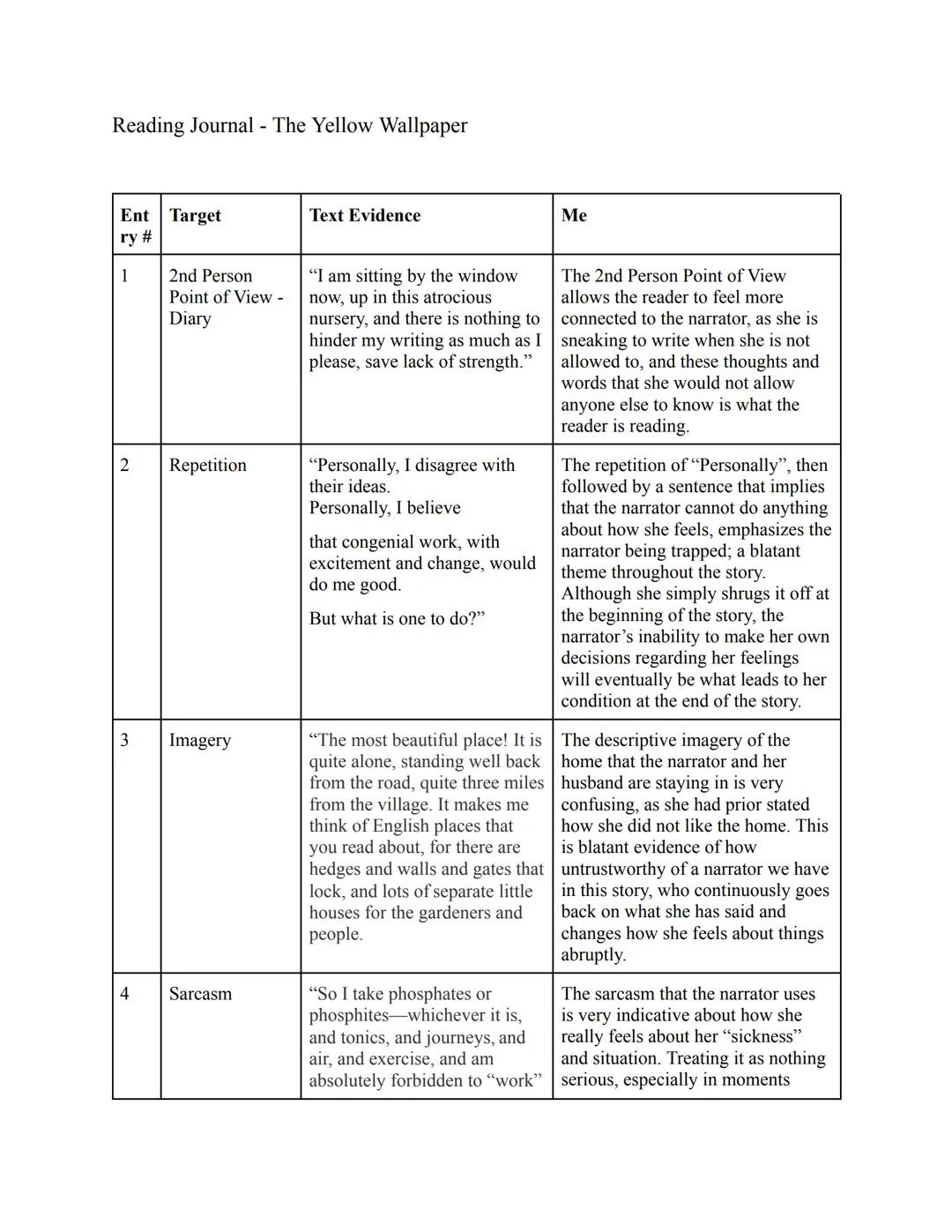
Literary Techniques: Point of View and Repetition
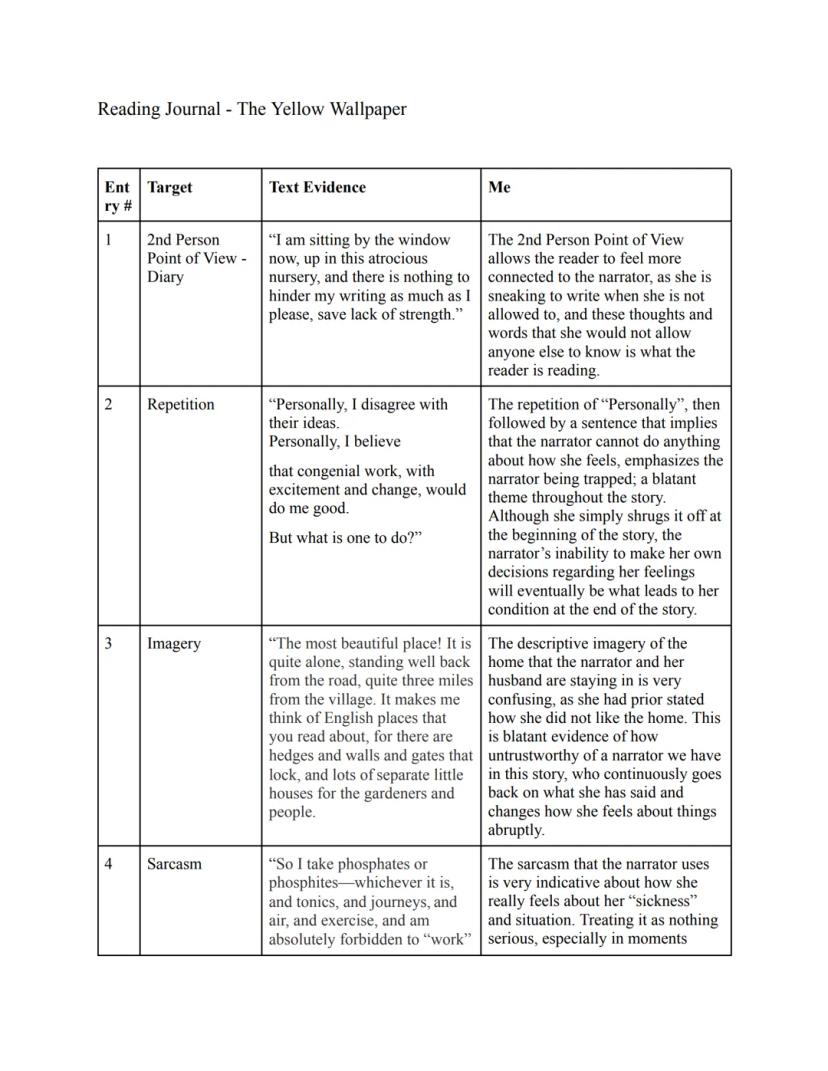
The story uses second-person diary format to create an intimate connection between reader and narrator. When she writes, "I am sitting by the window now, up in this atrocious nursery," we're drawn into her secret thoughts—ones she wouldn't share with her husband or doctor. This personal perspective makes her deterioration more immediate and disturbing.
The author employs repetition as a powerful tool to emphasize the narrator's trapped condition. When she writes "Personally, I disagree" and "Personally, I believe" before concluding "But what is one to do?", we see her frustration at being unable to make decisions about her own treatment. This repetition highlights her powerlessness, a theme that intensifies throughout the story.
The narrator's descriptive imagery of the home reveals her unreliability early on. She contradicts herself, describing the place as "beautiful" after previously expressing dislike for it. Her sarcastic tone when discussing her prescribed treatment ("I take phosphates or phosphites—whichever it is") hints at her true feelings about her situation.
Notice This! The narrator's contradictions aren't just confusing—they're deliberate clues about her mental state. When she describes the same things differently at different times, it signals her increasing detachment from reality.
2
of 3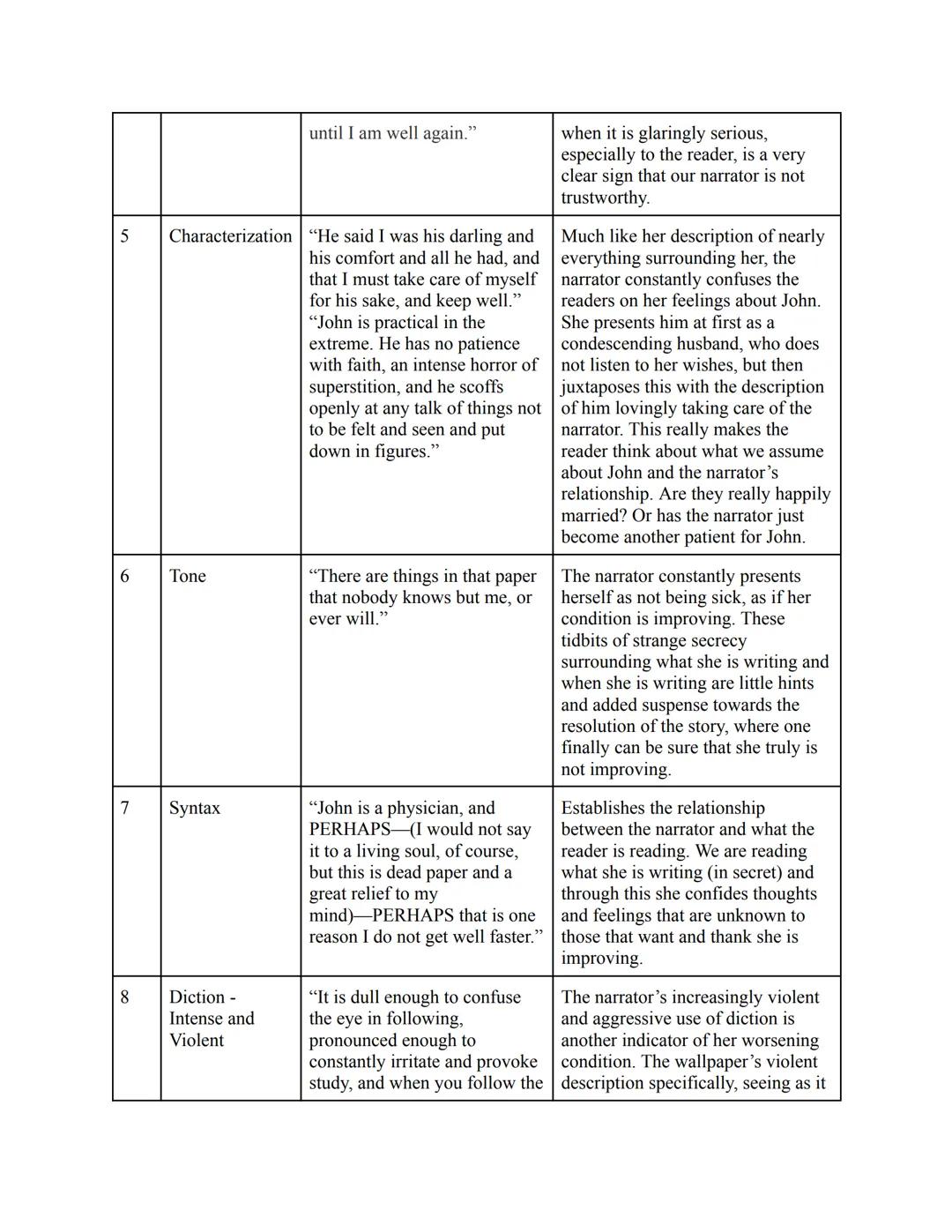
Character Development and Narrative Clues
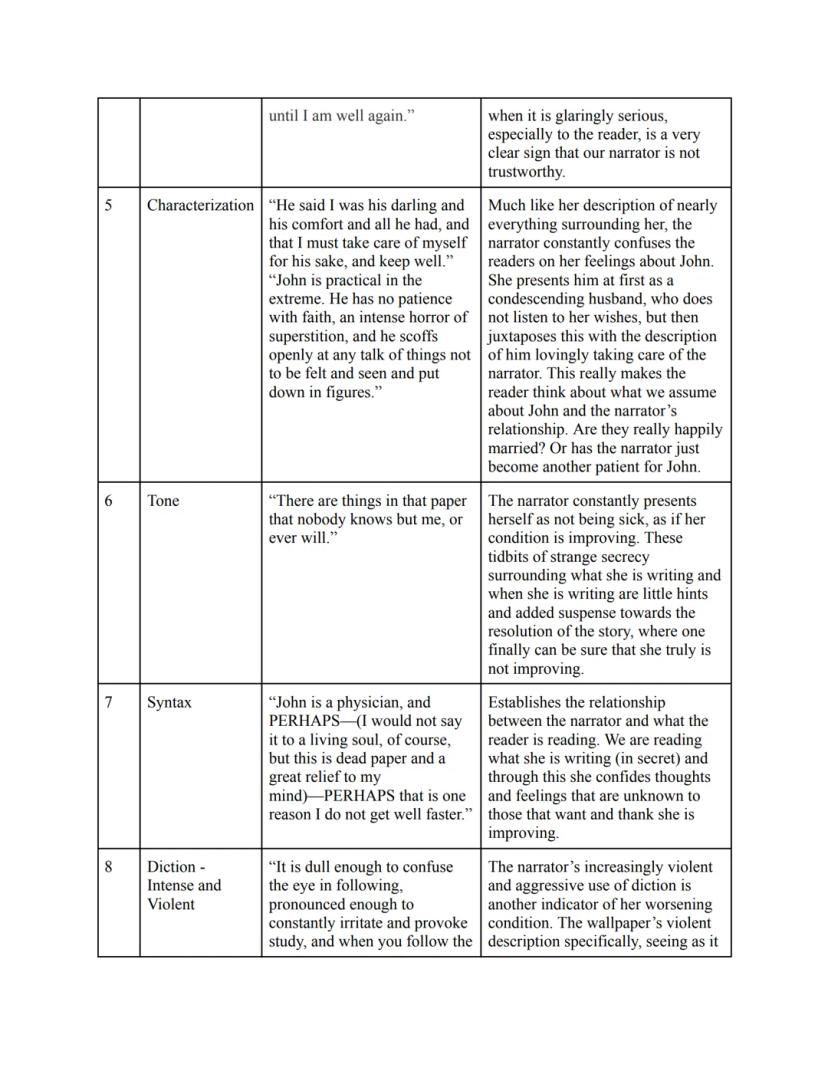
The narrator's characterization of her husband John creates a complex picture. She alternates between depicting him as lovingly concerned ("he said I was his darling") and dismissively practical ("no patience with faith"). This inconsistency raises questions about their relationship—is he truly caring, or is she just another patient to him?
The story's tone shifts subtly as the narrator becomes more secretive. Her statement that "There are things in that paper that nobody knows but me" introduces a sense of paranoia and mystery. You can feel her increasing distance from reality when she refers to her journal as "dead paper"—a safe place unlike the living people she can't trust.
Syntax changes signal her deteriorating condition. The capitalized "PERHAPS" shows her increasing agitation and the emotional weight of her thoughts. Her writing becomes a confession space where she admits doubts she can't voice aloud.
The narrator's intense diction becomes increasingly violent when describing the wallpaper—using words like "suicide," "plunge," and "destroy" to describe its pattern. This language mirrors her own mental state as she loses grip on reality.
Reading Insight: Pay attention to how the narrator's writing style changes throughout the story. The increasingly frantic syntax and violent word choices aren't random—they're carefully crafted signals of her psychological breakdown.
3
of 3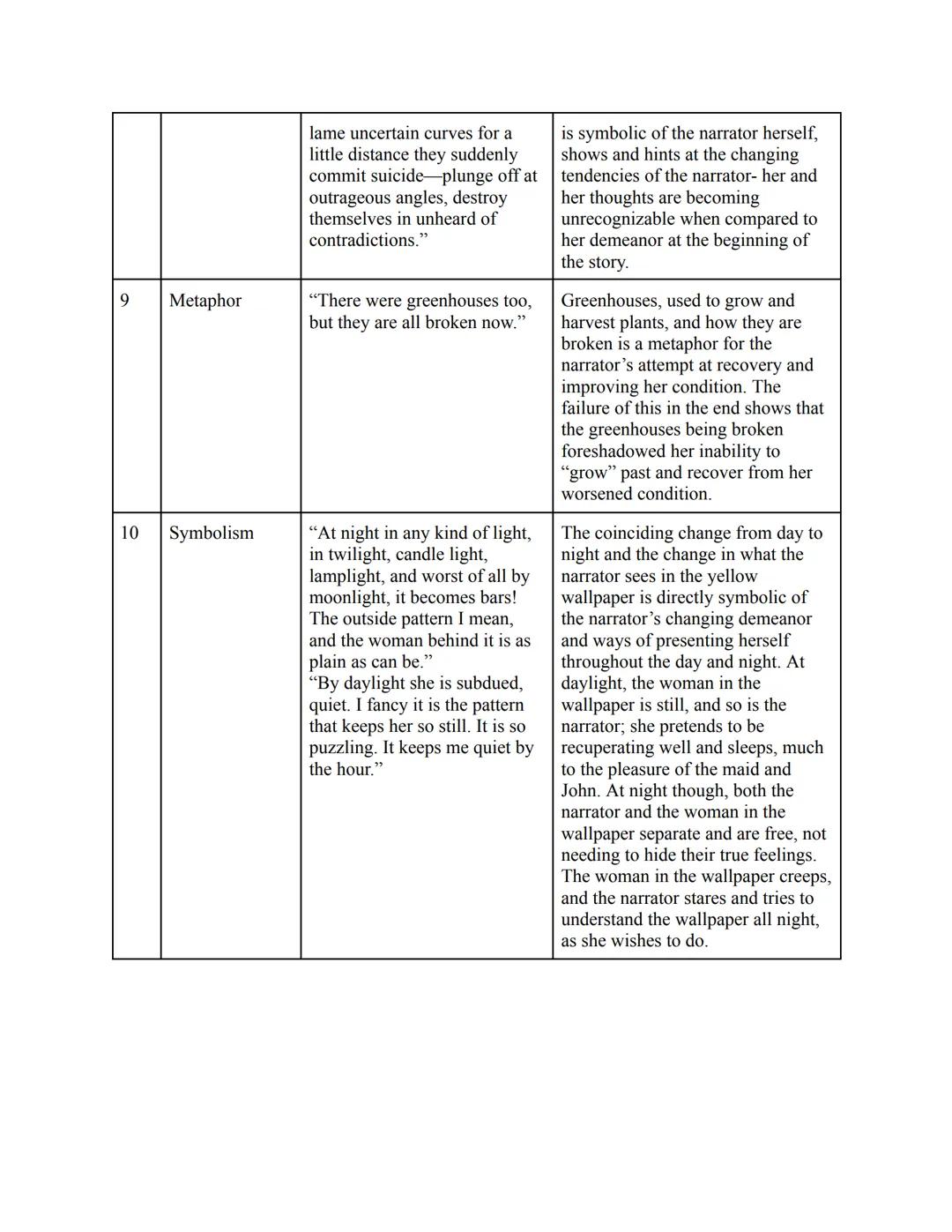
Symbolism and Metaphor
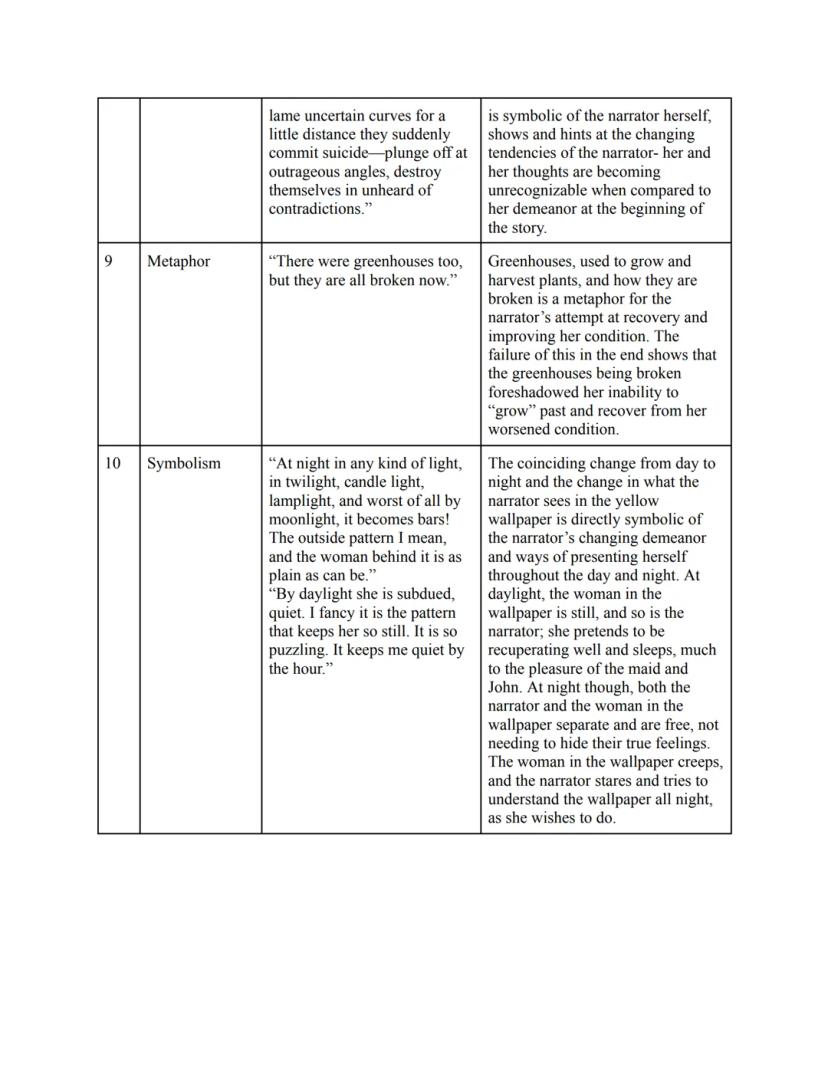
The broken greenhouses represent a powerful metaphor for the narrator's failed recovery. Just as greenhouses should nurture growth but cannot when damaged, the narrator's "rest cure" treatment fails to help her mental condition. Instead of healing, she experiences progressive deterioration.
The most striking symbolism appears in the wallpaper itself, which transforms depending on the light. By day, the woman behind the pattern is "subdued, quiet," mirroring how the narrator presents herself to John and others. By night, the pattern becomes "bars" with a woman trapped behind them—a reflection of the narrator's true, confined self.
This day/night contrast symbolizes the narrator's dual existence: her public performance of docile recovery versus her private obsession and deterioration. As the story progresses, these two selves begin to merge in disturbing ways. The woman she sees "creeping" in the wallpaper at night becomes an extension of herself—her repressed desires for freedom physically manifested.
Critical Connection: The yellow wallpaper isn't just an object the narrator fixates on—it's a symbolic mirror of her psychological state. The woman she sees trapped behind the pattern represents her own feelings of confinement within her marriage, treatment, and society's expectations.
We thought you’d never ask...
What is the Knowunity AI companion?
Our AI companion is specifically built for the needs of students. Based on the millions of content pieces we have on the platform we can provide truly meaningful and relevant answers to students. But its not only about answers, the companion is even more about guiding students through their daily learning challenges, with personalised study plans, quizzes or content pieces in the chat and 100% personalisation based on the students skills and developments.
Where can I download the Knowunity app?
You can download the app in the Google Play Store and in the Apple App Store.
Is Knowunity really free of charge?
That's right! Enjoy free access to study content, connect with fellow students, and get instant help – all at your fingertips.
Similar Content
Most popular content: The Yellow Wallpaper
1Most popular content in English
9G
Englishgrade 6 english
learning the basics
6th7870
M
EnglishMastering English Grammar: Challenging Concepts for Grade 9
Boost your English skills with this comprehensive flashcard set covering advanced grammar topics for grade 9 students. Dive into challenging concepts and ace your exams!
10th3771
E
EnglishEnglish 10 grammar quiz
verbs
10th3090
EnglishIntroduction to linguistics
Introduction to linguistics exam revision notes. Structure of language, typologies of language, parts of speech, language families, Chomsky, Hockett, semantic triangle, Prague Linguistic Circle, writing systems, acquisition and learning
1,21250
M
Englishmatter
8th grade science
8th1731
AP English LanguageAP Lang Unit 1.1 Notes (The Rhetorical Situation)
Notes on AP lang unit 1.1, the rhetorical situation
10th28013
G
Englishgrade 10 English vocabulary
this content is about vocabulary
10th4866
EnglishThe great Gatsbey notes. please note that these are things I found interesting/ important. if you have any questions please feel free to ask
grammar and the great gatsby notes.
11th94469
EnglishComplete Hamlet Breakdown
What you need to know in Hamlet
10th30817
Most popular content
9O
 AP US History
Origins and Dynamics of the Columbian Exchange
Analyze the ecological and economic motivations behind the initial transfer of goods, people, and diseases between the Old and New Worlds.
9th3,1280
I
AP US HistoryIntroduction to Early Cultural Interactions
Analyze the initial social and religious encounters between Europeans, Africans, and Indigenous peoples in the colonial Americas.
9th2,7730
O
 AP World History
Origins of Ancient River Civilizations
Analyze the environmental factors and technological innovations that led to the rise of early states in Mesopotamia, Egypt, and the Indus Valley.
9th3,1870
M
AP US HistoryMotivations for European Exploration
Analyze the economic, religious, and political factors that drove European powers to the Americas during the 15th and 16th centuries.
9th1,7780
F
 AP Psychology
Foundations of Ethical Guidelines in Research
Practice the core principles of the APA ethical code including informed consent, debriefing, and the role of Institutional Review Boards.
9th1,3360
I
AP US HistoryIntroduction to Native American Societies
Examine the diverse social, political, and economic structures of North American indigenous groups prior to European contact.
9th1,1100
I
 AP Biology
Introduction to Biological Elements of Life
Practice identifying the essential elements including carbon, nitrogen, phosphorus, and sulfur that compose biological macromolecules.
9th1,7390
I
AP US HistoryIntroduction to the Spanish Encomienda System
Explore the fundamental economic and social structures of the Spanish colonial system, focusing on the encomienda and the casta social hierarchy.
9th8890
O
AP World HistoryOrigins and Continuity of the Byzantine Empire
Analyze the political and cultural transitions from the Roman Empire to the Byzantine Empire, focusing on the reign of Justinian I and his code.
9th1,6320
Can't find what you're looking for? Explore other subjects.
Students love us — and so will you.
4.6/5App Store
4.7/5Google Play
The app is very easy to use and well designed. I have found everything I was looking for so far and have been able to learn a lot from the presentations! I will definitely use the app for a class assignment! And of course it also helps a lot as an inspiration.
Stefan SiOS user
This app is really great. There are so many study notes and help [...]. My problem subject is French, for example, and the app has so many options for help. Thanks to this app, I have improved my French. I would recommend it to anyone.
Samantha KlichAndroid user
Wow, I am really amazed. I just tried the app because I've seen it advertised many times and was absolutely stunned. This app is THE HELP you want for school and above all, it offers so many things, such as workouts and fact sheets, which have been VERY helpful to me personally.
AnnaiOS user
English68 views·Updated Jun 12, 2026·3 pagesInsightful Analysis of 'The Yellow Wallpaper' by Charlotte Perkins Gilman
Catalina Collazos@catalinacollazos9
"The Yellow Wallpaper" is a psychological study of a woman's descent into madness. Through journal entries, we witness her deteriorating mental state as she becomes obsessed with the wallpaper in her room. This analysis explores key literary techniques that reveal...
1
of 3
Sign up to see the content. It's free!
- Access to all documents
- Improve your grades
- Join milions of students
Literary Techniques: Point of View and Repetition
The story uses second-person diary format to create an intimate connection between reader and narrator. When she writes, "I am sitting by the window now, up in this atrocious nursery," we're drawn into her secret thoughts—ones she wouldn't share with her husband or doctor. This personal perspective makes her deterioration more immediate and disturbing.
The author employs repetition as a powerful tool to emphasize the narrator's trapped condition. When she writes "Personally, I disagree" and "Personally, I believe" before concluding "But what is one to do?", we see her frustration at being unable to make decisions about her own treatment. This repetition highlights her powerlessness, a theme that intensifies throughout the story.
The narrator's descriptive imagery of the home reveals her unreliability early on. She contradicts herself, describing the place as "beautiful" after previously expressing dislike for it. Her sarcastic tone when discussing her prescribed treatment ("I take phosphates or phosphites—whichever it is") hints at her true feelings about her situation.
Notice This! The narrator's contradictions aren't just confusing—they're deliberate clues about her mental state. When she describes the same things differently at different times, it signals her increasing detachment from reality.
2
of 3Sign up to see the content. It's free!
- Access to all documents
- Improve your grades
- Join milions of students
Character Development and Narrative Clues
The narrator's characterization of her husband John creates a complex picture. She alternates between depicting him as lovingly concerned ("he said I was his darling") and dismissively practical ("no patience with faith"). This inconsistency raises questions about their relationship—is he truly caring, or is she just another patient to him?
The story's tone shifts subtly as the narrator becomes more secretive. Her statement that "There are things in that paper that nobody knows but me" introduces a sense of paranoia and mystery. You can feel her increasing distance from reality when she refers to her journal as "dead paper"—a safe place unlike the living people she can't trust.
Syntax changes signal her deteriorating condition. The capitalized "PERHAPS" shows her increasing agitation and the emotional weight of her thoughts. Her writing becomes a confession space where she admits doubts she can't voice aloud.
The narrator's intense diction becomes increasingly violent when describing the wallpaper—using words like "suicide," "plunge," and "destroy" to describe its pattern. This language mirrors her own mental state as she loses grip on reality.
Reading Insight: Pay attention to how the narrator's writing style changes throughout the story. The increasingly frantic syntax and violent word choices aren't random—they're carefully crafted signals of her psychological breakdown.
3
of 3Sign up to see the content. It's free!
- Access to all documents
- Improve your grades
- Join milions of students
Symbolism and Metaphor
The broken greenhouses represent a powerful metaphor for the narrator's failed recovery. Just as greenhouses should nurture growth but cannot when damaged, the narrator's "rest cure" treatment fails to help her mental condition. Instead of healing, she experiences progressive deterioration.
The most striking symbolism appears in the wallpaper itself, which transforms depending on the light. By day, the woman behind the pattern is "subdued, quiet," mirroring how the narrator presents herself to John and others. By night, the pattern becomes "bars" with a woman trapped behind them—a reflection of the narrator's true, confined self.
This day/night contrast symbolizes the narrator's dual existence: her public performance of docile recovery versus her private obsession and deterioration. As the story progresses, these two selves begin to merge in disturbing ways. The woman she sees "creeping" in the wallpaper at night becomes an extension of herself—her repressed desires for freedom physically manifested.
Critical Connection: The yellow wallpaper isn't just an object the narrator fixates on—it's a symbolic mirror of her psychological state. The woman she sees trapped behind the pattern represents her own feelings of confinement within her marriage, treatment, and society's expectations.
We thought you’d never ask...
What is the Knowunity AI companion?
Our AI companion is specifically built for the needs of students. Based on the millions of content pieces we have on the platform we can provide truly meaningful and relevant answers to students. But its not only about answers, the companion is even more about guiding students through their daily learning challenges, with personalised study plans, quizzes or content pieces in the chat and 100% personalisation based on the students skills and developments.
Where can I download the Knowunity app?
You can download the app in the Google Play Store and in the Apple App Store.
Is Knowunity really free of charge?
That's right! Enjoy free access to study content, connect with fellow students, and get instant help – all at your fingertips.
Similar Content
Most popular content: The Yellow Wallpaper
1Most popular content in English
9G
Englishgrade 6 english
learning the basics
6th7870
M
EnglishMastering English Grammar: Challenging Concepts for Grade 9
Boost your English skills with this comprehensive flashcard set covering advanced grammar topics for grade 9 students. Dive into challenging concepts and ace your exams!
10th3771
E
EnglishEnglish 10 grammar quiz
verbs
10th3090
EnglishIntroduction to linguistics
Introduction to linguistics exam revision notes. Structure of language, typologies of language, parts of speech, language families, Chomsky, Hockett, semantic triangle, Prague Linguistic Circle, writing systems, acquisition and learning
1,21250
M
Englishmatter
8th grade science
8th1731
AP English LanguageAP Lang Unit 1.1 Notes (The Rhetorical Situation)
Notes on AP lang unit 1.1, the rhetorical situation
10th28013
G
Englishgrade 10 English vocabulary
this content is about vocabulary
10th4866
EnglishThe great Gatsbey notes. please note that these are things I found interesting/ important. if you have any questions please feel free to ask
grammar and the great gatsby notes.
11th94469
EnglishComplete Hamlet Breakdown
What you need to know in Hamlet
10th30817
Most popular content
9O
AP US HistoryOrigins and Dynamics of the Columbian Exchange
Analyze the ecological and economic motivations behind the initial transfer of goods, people, and diseases between the Old and New Worlds.
9th3,1280
I
AP US HistoryIntroduction to Early Cultural Interactions
Analyze the initial social and religious encounters between Europeans, Africans, and Indigenous peoples in the colonial Americas.
9th2,7730
O
AP World HistoryOrigins of Ancient River Civilizations
Analyze the environmental factors and technological innovations that led to the rise of early states in Mesopotamia, Egypt, and the Indus Valley.
9th3,1870
M
AP US HistoryMotivations for European Exploration
Analyze the economic, religious, and political factors that drove European powers to the Americas during the 15th and 16th centuries.
9th1,7780
F
AP PsychologyFoundations of Ethical Guidelines in Research
Practice the core principles of the APA ethical code including informed consent, debriefing, and the role of Institutional Review Boards.
9th1,3360
I
AP US HistoryIntroduction to Native American Societies
Examine the diverse social, political, and economic structures of North American indigenous groups prior to European contact.
9th1,1100
I
AP BiologyIntroduction to Biological Elements of Life
Practice identifying the essential elements including carbon, nitrogen, phosphorus, and sulfur that compose biological macromolecules.
9th1,7390
I
AP US HistoryIntroduction to the Spanish Encomienda System
Explore the fundamental economic and social structures of the Spanish colonial system, focusing on the encomienda and the casta social hierarchy.
9th8890
O
AP World HistoryOrigins and Continuity of the Byzantine Empire
Analyze the political and cultural transitions from the Roman Empire to the Byzantine Empire, focusing on the reign of Justinian I and his code.
9th1,6320
Can't find what you're looking for? Explore other subjects.
Students love us — and so will you.
4.6/5App Store
4.7/5Google Play
The app is very easy to use and well designed. I have found everything I was looking for so far and have been able to learn a lot from the presentations! I will definitely use the app for a class assignment! And of course it also helps a lot as an inspiration.
Stefan SiOS user
This app is really great. There are so many study notes and help [...]. My problem subject is French, for example, and the app has so many options for help. Thanks to this app, I have improved my French. I would recommend it to anyone.
Samantha KlichAndroid user
Wow, I am really amazed. I just tried the app because I've seen it advertised many times and was absolutely stunned. This app is THE HELP you want for school and above all, it offers so many things, such as workouts and fact sheets, which have been VERY helpful to me personally.
AnnaiOS user