
George Orwell's Animal Farmis a powerful story about farm...
 English Literature2,108 views·Updated Jun 16, 2026·11 pages
Your Easy Guide to Animal Farm: Chapter Summaries, Themes, and Characters

🌿 𝐒𝐭𝐮𝐝𝐲_𝐋𝐢𝐟𝐞 🕊️@study_life01
1 / 10
1
of 10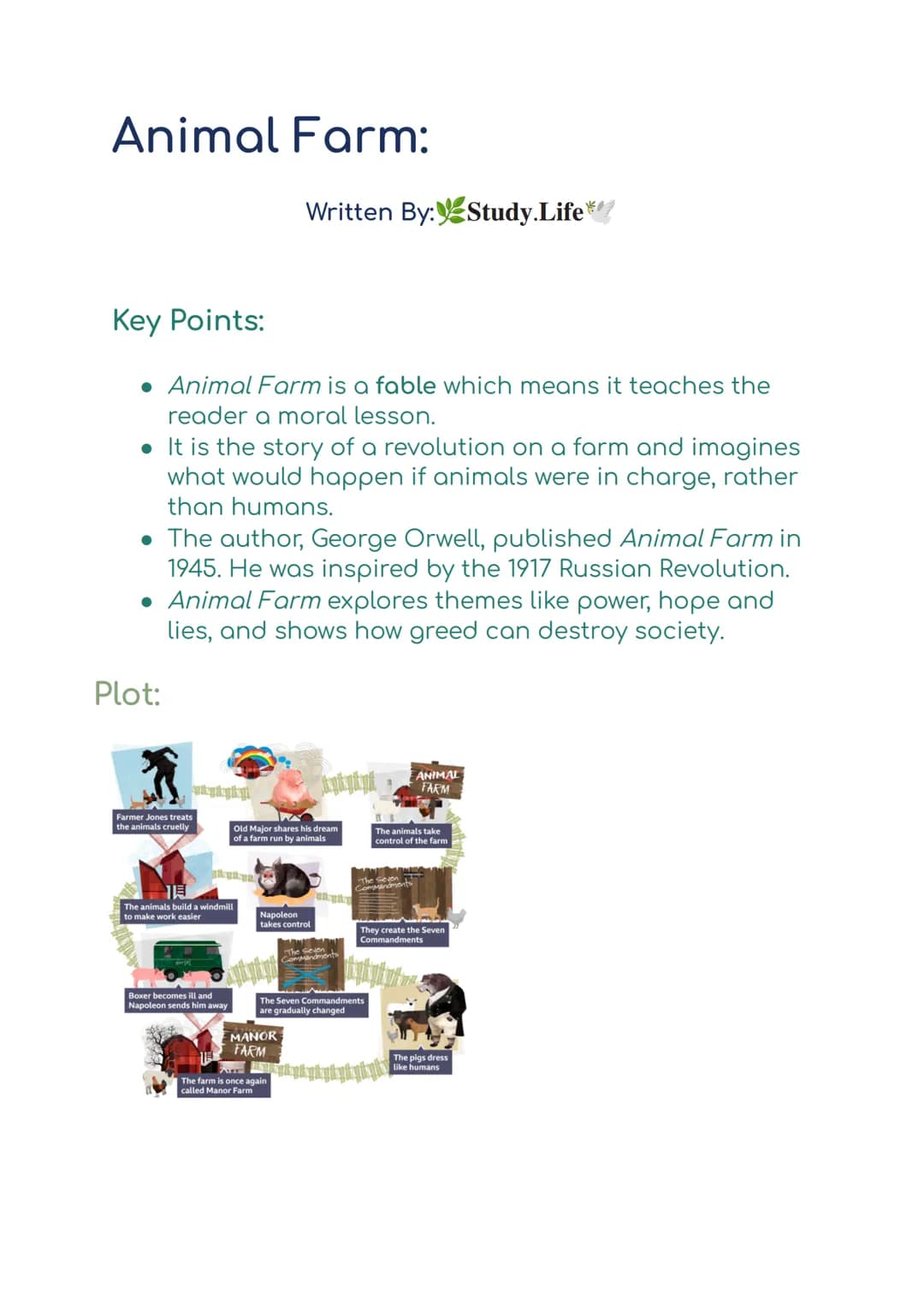
Animal Farm Full Story and Analysis
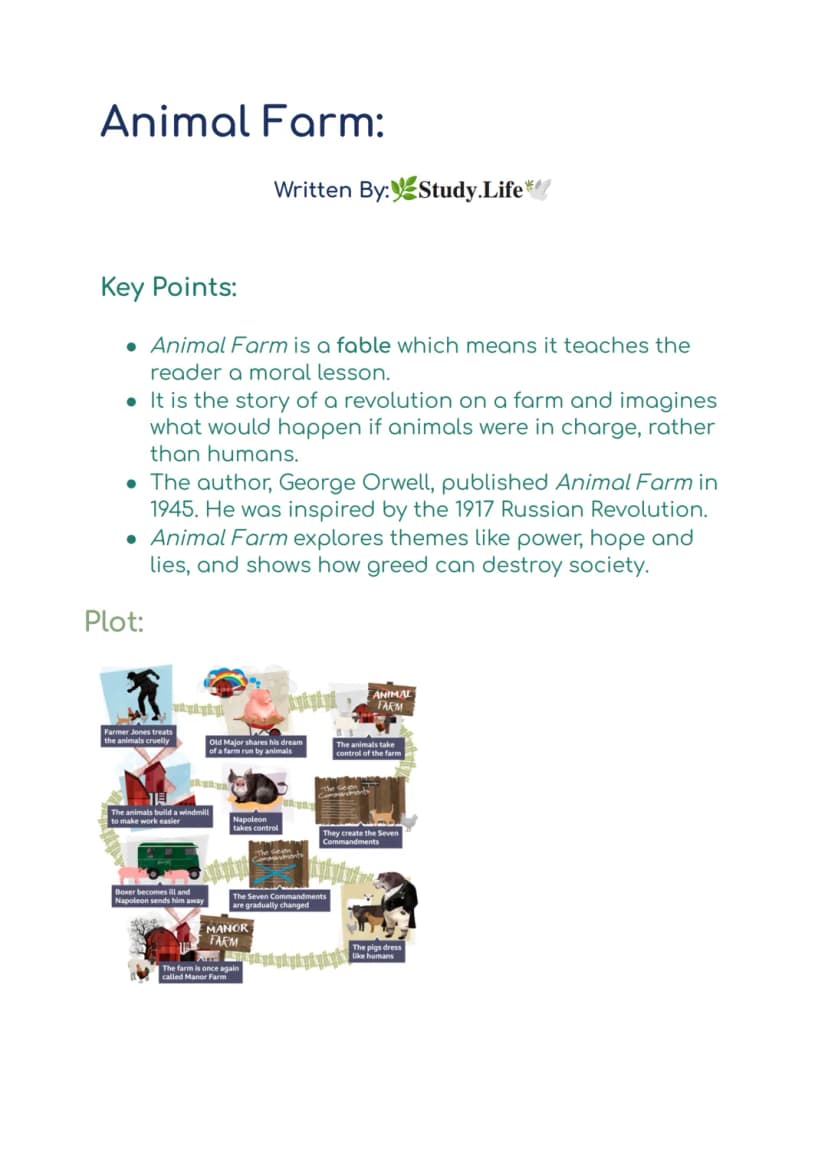
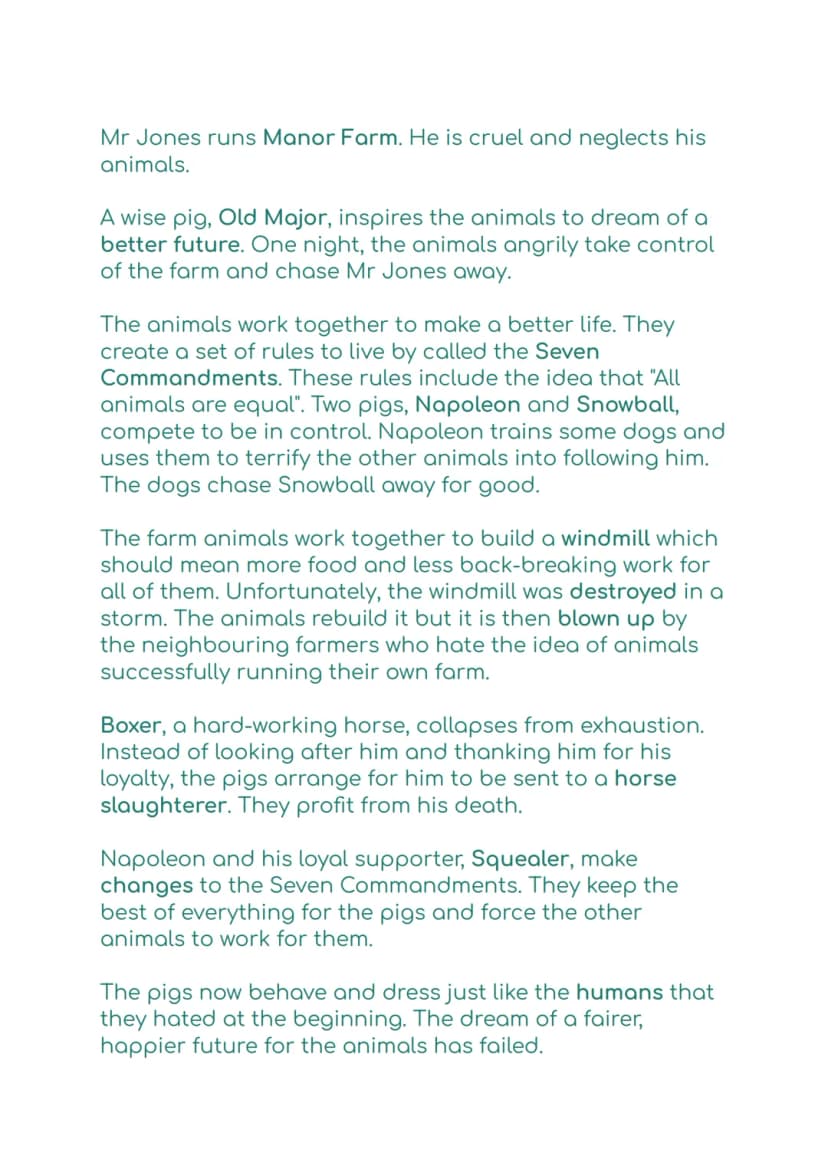
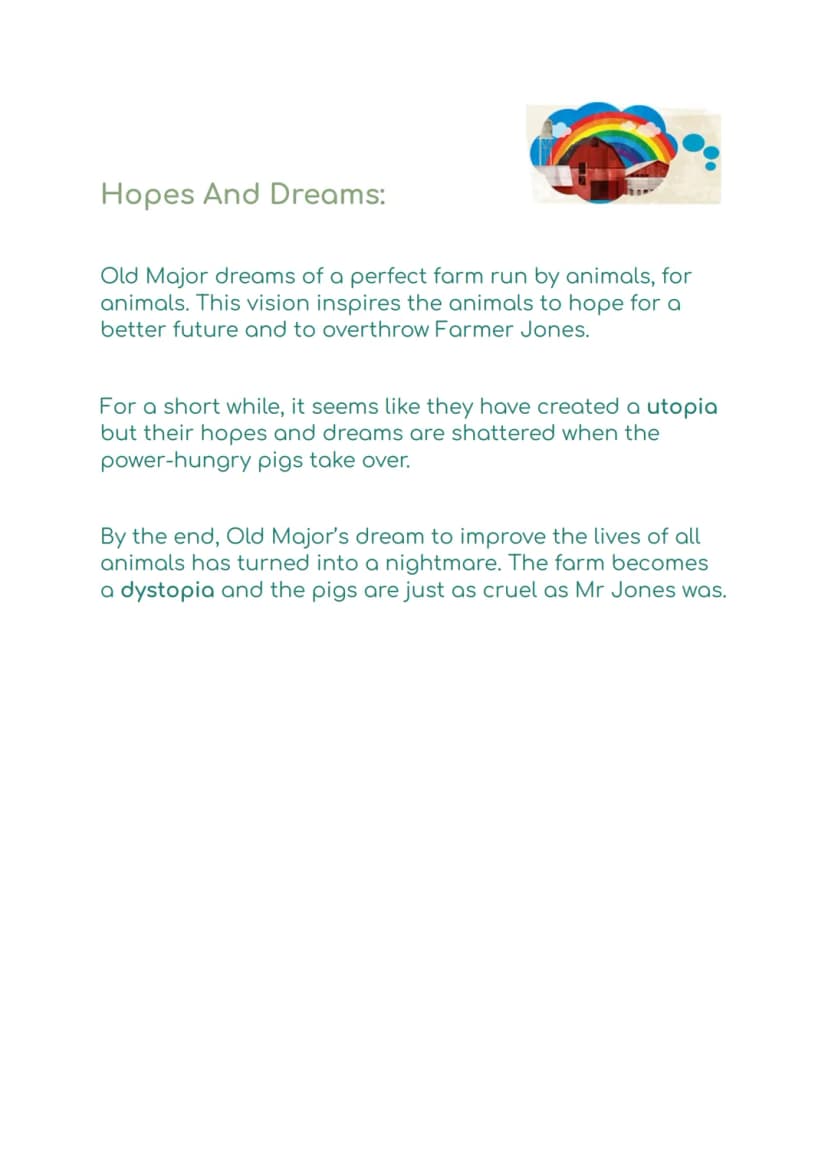
The Animal Farm full story begins at Manor Farm, where the animals live under the cruel treatment of their human owner, Mr. Jones. The tale unfolds when Old Major, a respected pig, shares his revolutionary vision of a farm governed by animals. This pivotal moment sets the stage for a powerful narrative about society, power, and corruption.
Definition: Animal Farm is an allegorical novella that uses farm animals to represent historical figures and political ideologies from the Russian Revolution.
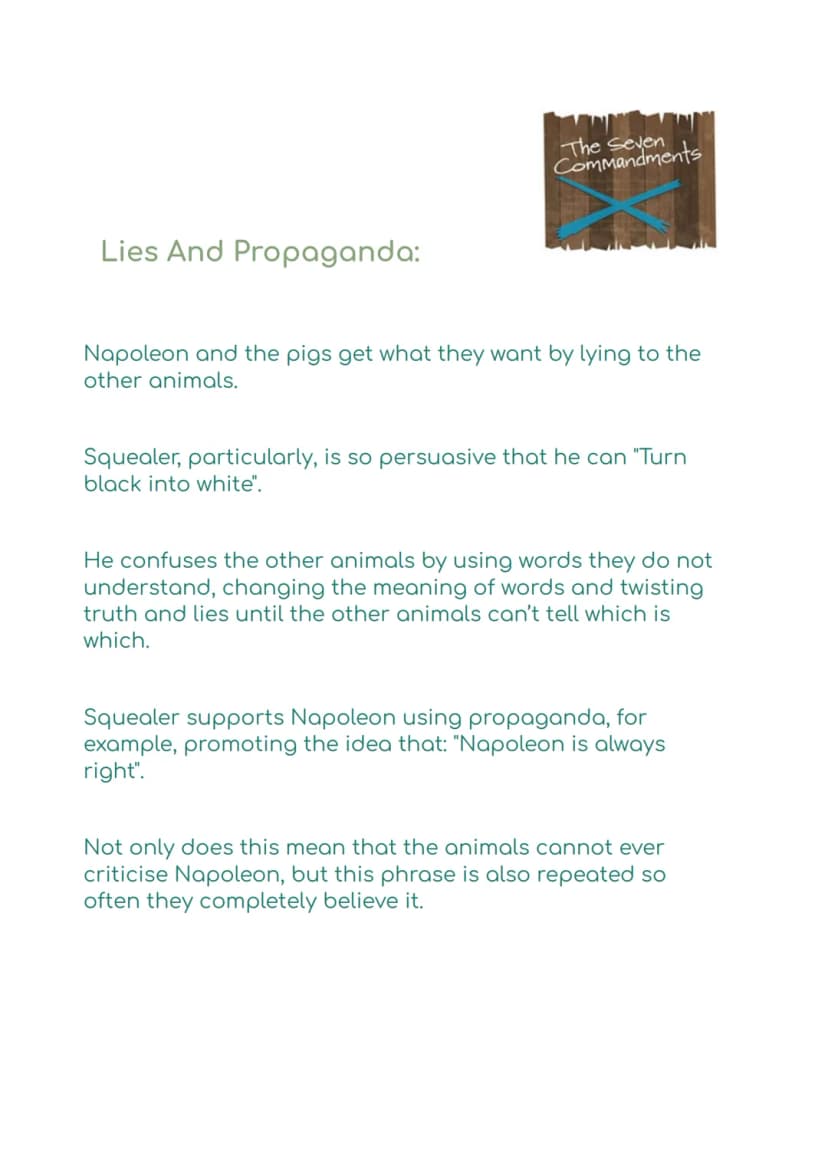
The Animal Farm themes center around power corruption, social inequality, and the manipulation of language and history. After the animals successfully overthrow Mr. Jones, they establish Seven Commandments based on the principle that "All animals are equal." However, the pigs, particularly Napoleon and Snowball, emerge as leaders and gradually begin to abuse their power.
The construction of the windmill becomes a central plot point that demonstrates the exploitation of the working class. While the animals labor tirelessly, the pigs manipulate the situation for their benefit. The story reaches its tragic climax when Boxer, the loyal horse, is sent to his death, highlighting the ultimate betrayal of the revolution's ideals.
2
of 10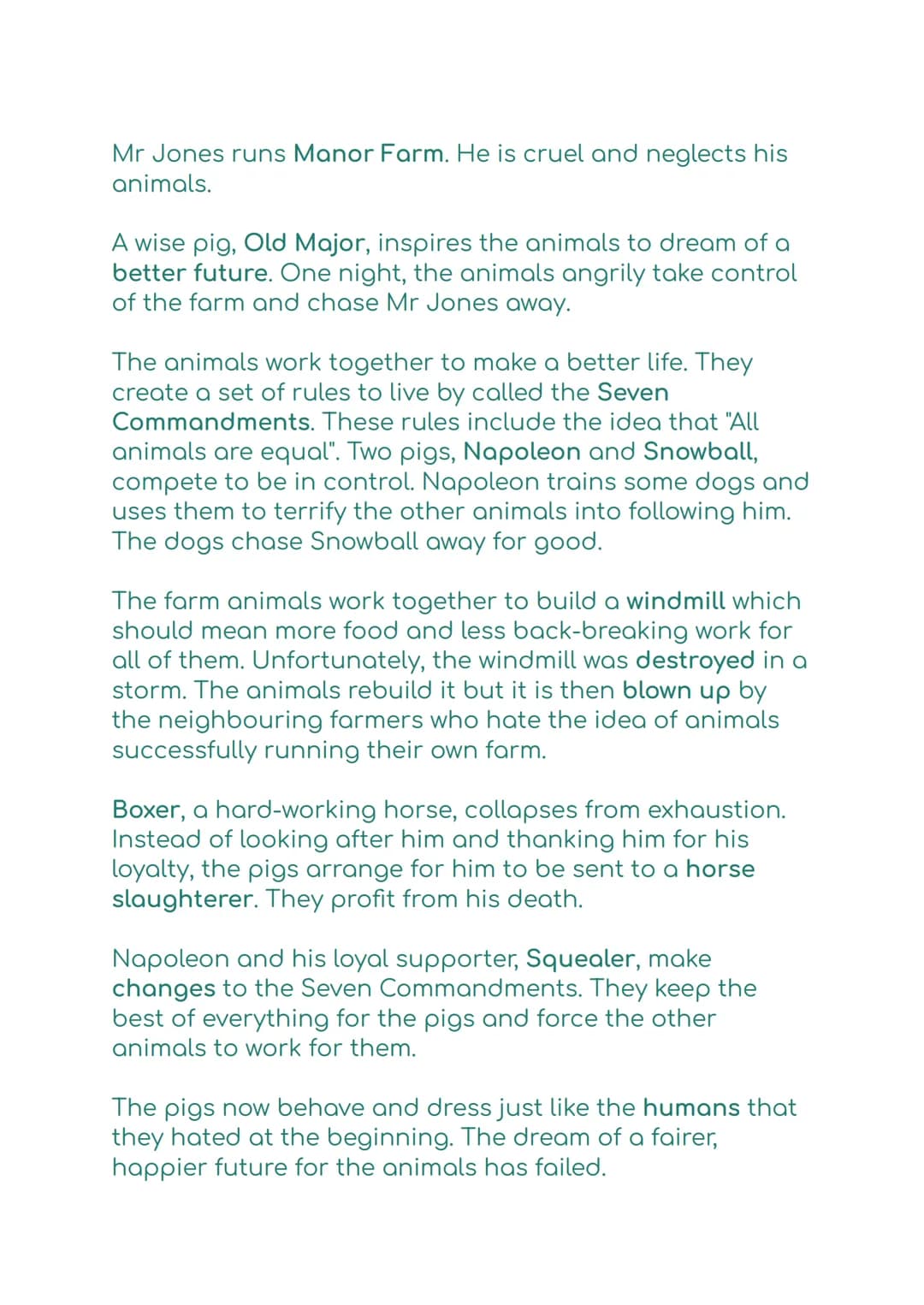
Understanding Animal Farm Characters and Their Significance
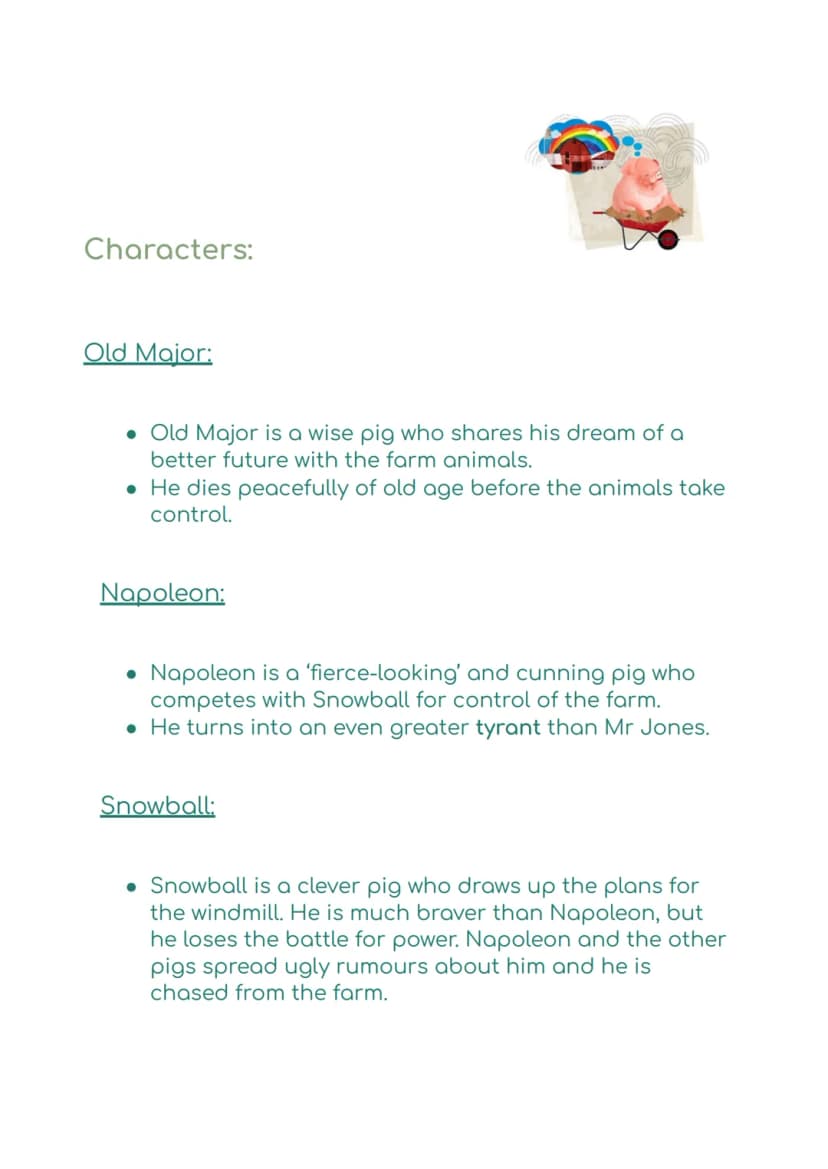
The Animal Farm characters represent various social and political figures. Old Major symbolizes both Karl Marx and Vladimir Lenin, providing the ideological foundation for the revolution. His dream of equality and prosperity serves as the catalyst for change.
Highlight: Napoleon, the main antagonist, represents Joseph Stalin, demonstrating how power can corrupt and transform leaders into tyrants.
Snowball, portrayed as an intelligent and innovative leader, represents Leon Trotsky. His plans for the windmill and eventual exile mirror historical events. The dynamic between Napoleon and Snowball illustrates the power struggles that often occur in revolutionary movements.
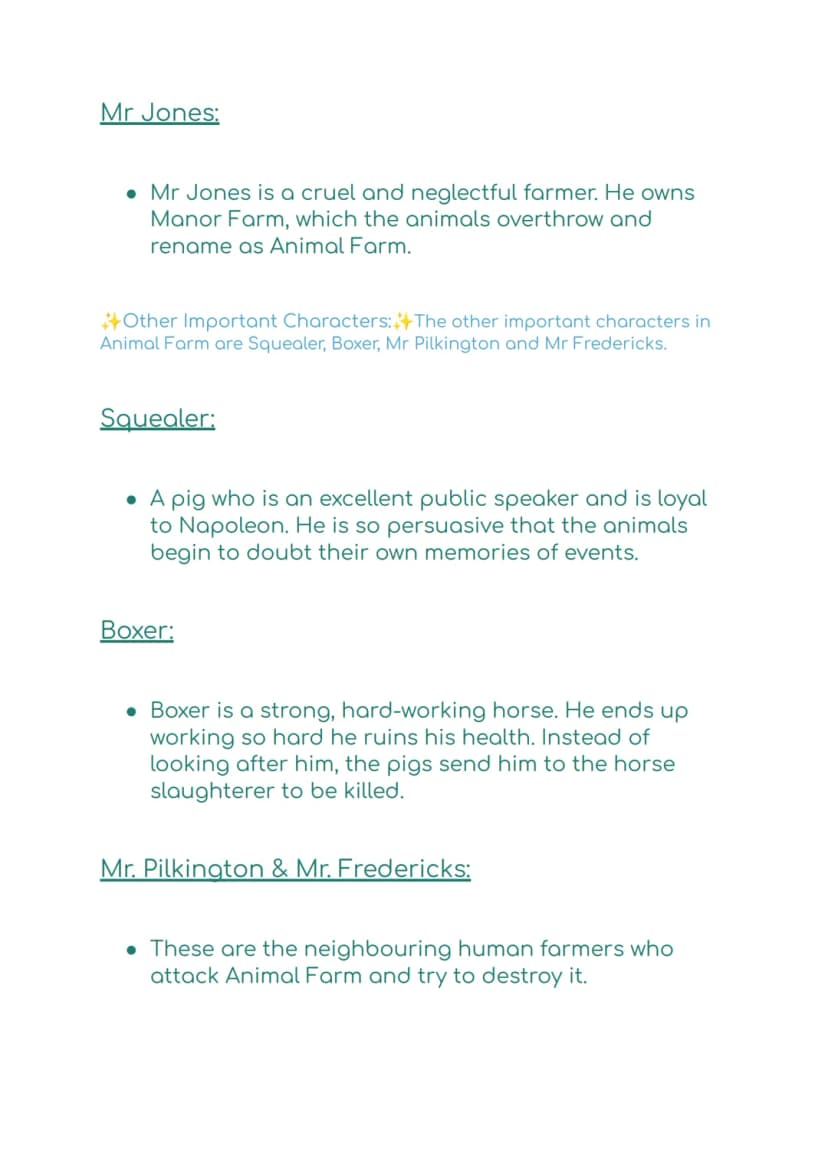
The supporting characters each serve specific symbolic purposes. Boxer represents the loyal working class, while Squealer embodies propaganda and manipulation of truth. The human characters, Mr. Jones, Mr. Pilkington, and Mr. Frederick, represent different aspects of capitalist society and foreign powers.
3
of 10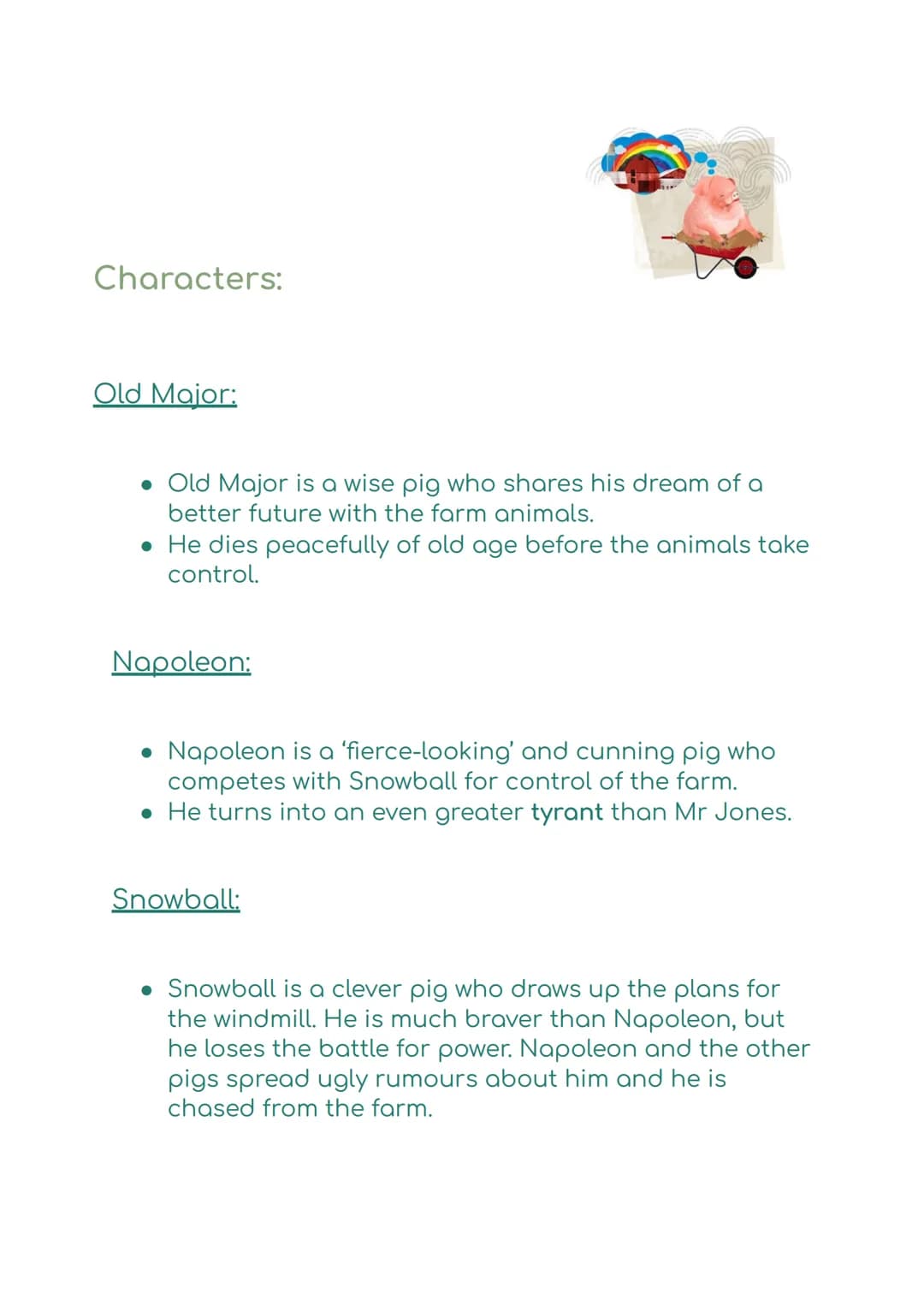
Exploring Animal Farm Themes and Symbolism
The five main themes in Animal Farm include power corruption, the manipulation of language, class structure, education and intelligence, and the power of propaganda. These themes interweave throughout the narrative, creating a complex critique of political systems and human nature.
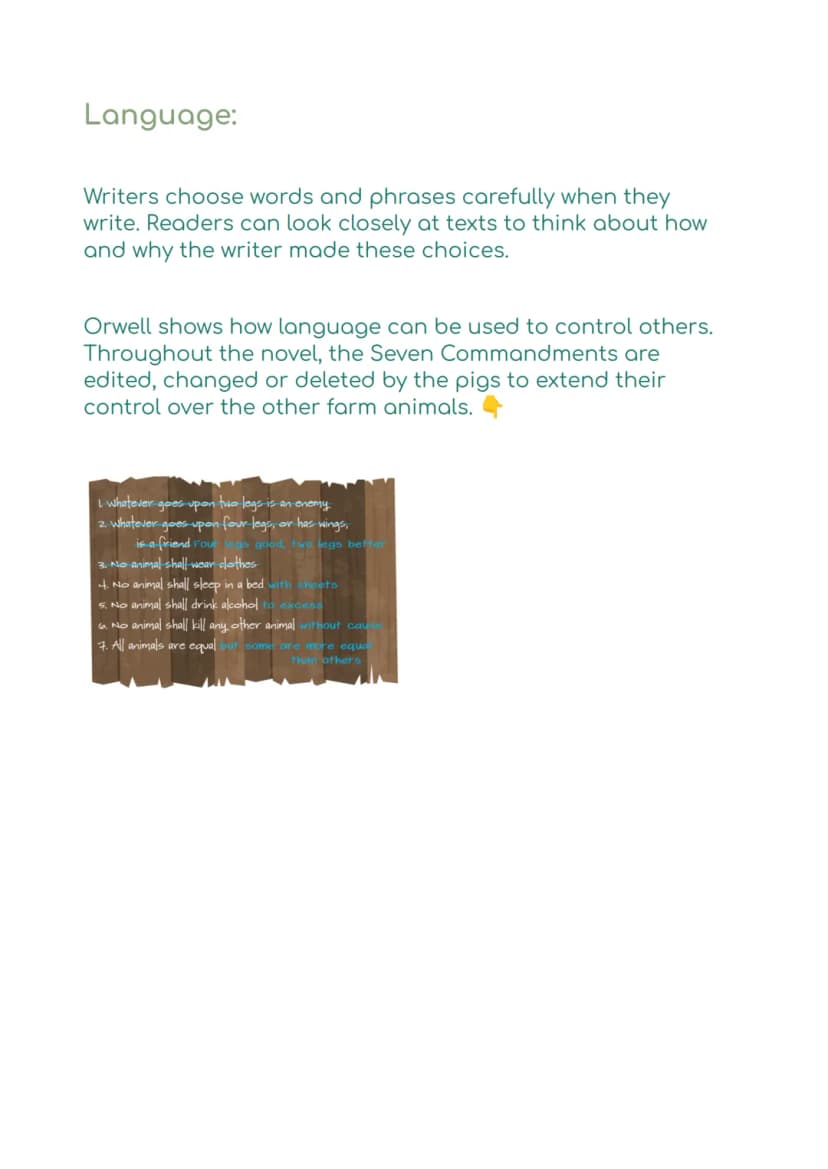
Example: The gradual changes to the Seven Commandments demonstrate how language can be manipulated to maintain power. The phrase "All animals are equal" becomes "All animals are equal, but some animals are more equal than others."
The windmill symbolizes industrialization and the false promises of progress. Its repeated destruction represents the challenges faced by societies during rapid technological and social change. The farm itself becomes a microcosm of larger society, showing how idealistic revolutions can deteriorate into oppressive regimes.
4
of 10
Animal Farm Summary and Historical Context
George Orwell wrote Animal Farm as a response to the events of the Russian Revolution and the rise of Stalinism. Published in 1945, the book serves as both a political satire and a warning about totalitarian regimes.
Quote: "The creatures outside looked from pig to man, and from man to pig, and from pig to man again; but already it was impossible to say which was which."
The Animal Farm chapter summary shows a clear progression from hope to disillusionment. The initial victory over human oppression leads to the establishment of new rules and systems. However, the pigs' gradual adoption of human behaviors and privileges demonstrates how power structures can be replicated even after revolutionary change.
The story concludes with the pigs becoming indistinguishable from the humans they once opposed, completing the cycle of corruption and betrayal of revolutionary ideals.
5
of 10
Historical Context of Animal Farm
Understanding the historical context is crucial for a comprehensive Animal Farm summary and analysis. George Orwell wrote Animal Farm as an allegory for the Russian Revolution and the subsequent rise of Stalinism.
Russian Revolution
The novel mirrors the events of the 1917 Russian Revolution, which overthrew the Tsarist autocracy and led to the creation of the Soviet Union.
Highlight: Just as the animals rebel against Mr. Jones, the Russian people revolted against Tsar Nicholas II.
Rise of Stalin
The power struggle between Napoleon and Snowball represents the real-life conflict between Joseph Stalin and Leon Trotsky for control of the Soviet Union after Lenin's death.
Example: Napoleon's exile of Snowball mirrors Stalin's expulsion of Trotsky from the Communist Party and his subsequent exile from the Soviet Union.
Stalinist Era
The bulk of the novel represents the Stalinist era in the Soviet Union, characterized by:
- Collectivization of agriculture
- Rapid industrialization
- Political purges
- Cult of personality
Quote: "Comrades!" he cried. "You do not imagine, I hope, that we pigs are doing this in a spirit of selfishness and privilege?" This quote reflects Stalin's justification for the privileges of the ruling class.
World War II
The novel was written during World War II, and some events in the book reflect this global conflict.
Vocabulary: Allegory - A story, poem, or picture that can be interpreted to reveal a hidden meaning, typically a moral or political one.
Critique of Totalitarianism
Orwell's experiences in the Spanish Civil War had disillusioned him with communism, and Animal Farm serves as a critique of totalitarian regimes in general.
Highlight: The gradual erosion of the Seven Commandments in the novel reflects how totalitarian regimes often betray their original ideals.
Understanding this historical context enriches our reading of Animal Farm and helps us appreciate its relevance beyond its specific historical moment. This context is essential for any Animal Farm summary essay or in-depth analysis of the novel's themes and characters.
6
of 10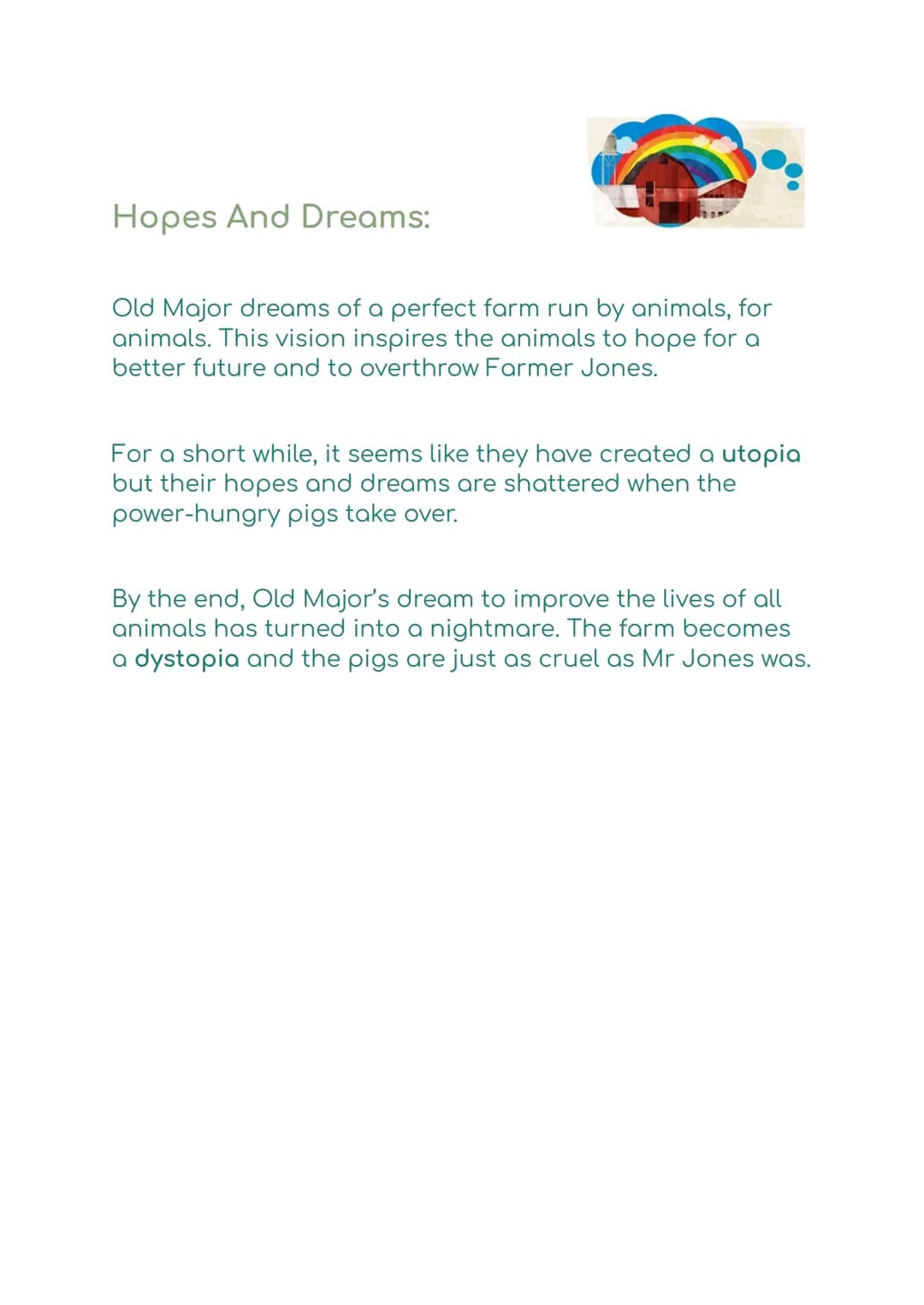
Symbolism in Animal Farm
George Orwell's Animal Farm is rich in symbolism, which is crucial to understanding the deeper meanings of the novel. This aspect is essential for any Animal Farm summary and analysis essay. Here are some key symbols used in the novel:
The Farm
Manor Farm, later renamed Animal Farm, symbolizes Russia before and after the revolution.
Highlight: The change in name from Manor Farm to Animal Farm represents the transition from Tsarist Russia to the Soviet Union.
The Animals
Different animals represent various segments of Russian society:
- Pigs: The intellectual elite and political class
- Horses and donkeys: The working class
- Sheep: The easily manipulated masses
- Dogs: The military and police force
Example: Boxer, the loyal and hardworking horse, represents the ideal Soviet worker, while the sheep symbolize the easily swayed public.
The Windmill
The windmill represents the Soviet Union's attempts at rapid industrialization, particularly Stalin's Five-Year Plans.
Quote: "If this windmill is built, comrades," said Snowball, "we can have electric light in our stalls. We could run a dynamo and supply ourselves with electric light, heat, and power for circular saws."
The Seven Commandments
These represent the original ideals of the revolution, which are gradually corrupted over time.
Vocabulary: Corruption - Dishonest or fraudulent conduct by those in power, typically involving bribery.
The Barn
The barn, where the Seven Commandments are written, symbolizes the collective memory of the revolution.
Highlight: The pigs' alterations to the commandments on the barn wall represent the manipulation of history and collective memory.
Alcohol
Alcohol symbolizes the corrupting influence of power and luxury.
Example: The pigs' gradual adoption of drinking alcohol mirrors their increasing similarity to the humans they once overthrew.
The Farmhouse
The farmhouse represents the Kremlin and the luxuries enjoyed by the ruling class.
Understanding these symbols is crucial for a comprehensive Animal Farm summary PDF or analysis. They provide insight into Orwell's critique of totalitarian regimes and the corruption of revolutionary ideals.
7
of 10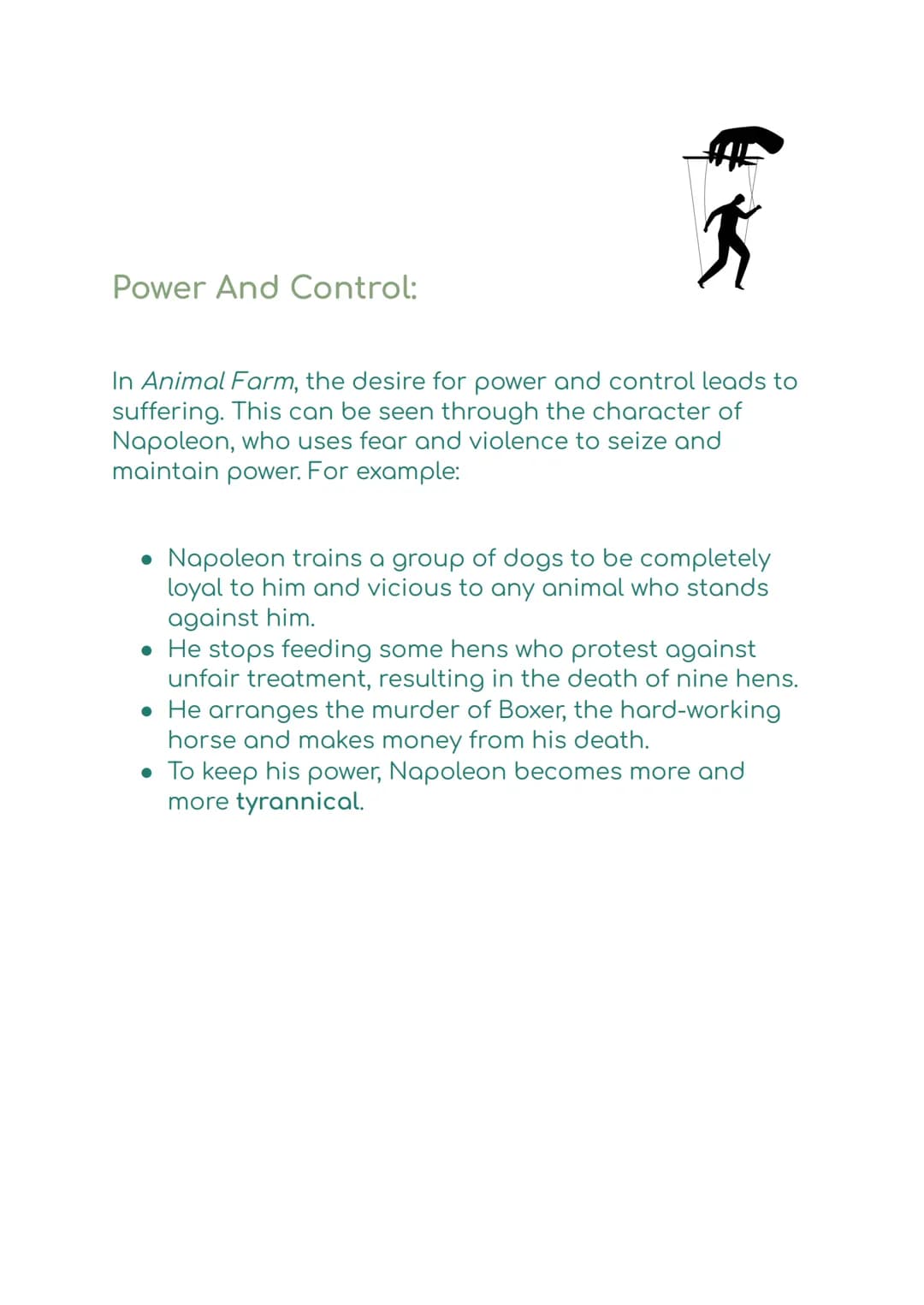
Character Development in Animal Farm
Character development is a crucial aspect of George Orwell's Animal Farm, contributing significantly to the novel's themes and allegory. Understanding how characters evolve throughout the story is essential for any Animal Farm summary and analysis essay.
Napoleon
Napoleon, the main antagonist, undergoes the most dramatic transformation:
- Initially, he appears as one of the leaders of the revolution.
- Gradually, he becomes more power-hungry and ruthless.
- By the end, he has become a tyrant, indistinguishable from the human oppressors the animals once overthrew.
Quote: "Napoleon is always right" - This phrase, repeated by the animals, shows how Napoleon's authority becomes unquestionable over time.
Snowball
Snowball's character serves as a foil to Napoleon:
- He starts as an idealistic and intelligent leader.
- His plans for the windmill represent progress and innovation.
- His expulsion from the farm marks a turning point in the story.
Highlight: Snowball's fate mirrors that of Leon Trotsky in the Soviet Union, showing how revolutionary ideals can be betrayed.
Boxer
Boxer's character arc is particularly tragic:
- He begins as a loyal and hardworking supporter of the revolution.
- His strength and dedication are exploited by the pigs.
- His fate at the end of the novel symbolizes the betrayal of the working class.
Example: Boxer's motto "I will work harder" evolves into "Napoleon is always right," showing his blind loyalty to the corrupt leadership.
Squealer
Squealer's development illustrates the power of propaganda:
- He starts as Napoleon's mouthpiece.
- Over time, he becomes more skilled at manipulating language and facts.
- By the end, he's an expert at rewriting history to suit the pigs' narrative.
Vocabulary: Propaganda - Information, especially of a biased or misleading nature, used to promote a political cause or point of view.
Benjamin
Benjamin, the donkey, remains cynical and unchanged throughout the story:
- He's skeptical of the revolution from the start.
- His pessimism proves prophetic as the farm's situation deteriorates.
- His character represents those who see the truth but feel powerless to change it.
Understanding these character arcs is crucial for a comprehensive Animal Farm summary PDF or analysis. They illustrate how power corrupts and how revolutionary ideals can be betrayed, which are central themes in the novel.
8
of 10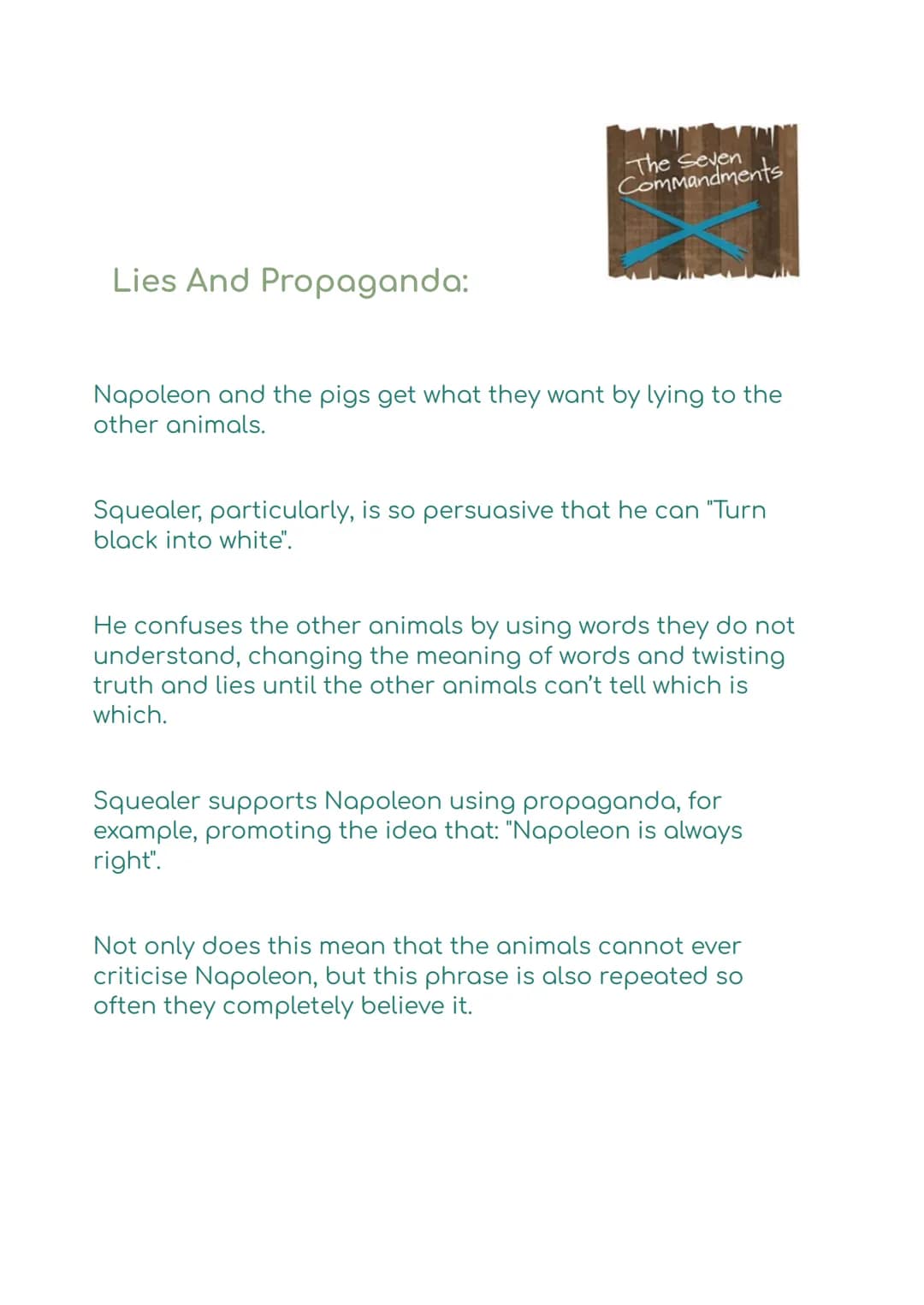
Narrative Techniques in Animal Farm
George Orwell employs various narrative techniques in Animal Farm to convey his message effectively. Understanding these techniques is crucial for a comprehensive Animal Farm summary and analysis essay.
Allegory
The entire novel is an extended allegory for the Russian Revolution and the rise of Stalinism.
Definition: An allegory is a story, poem, or picture that can be interpreted to reveal a hidden meaning, typically a moral or political one.
Third-Person Omniscient Narration
Orwell uses a third-person omniscient narrator, allowing readers to see events from multiple perspectives while maintaining a sense of objectivity.
Example: The narrator describes both the animals' thoughts and the humans' reactions, providing a comprehensive view of events.
Irony
Irony is used throughout the novel to highlight the discrepancy between the animals' expectations and reality.
Quote: "All animals are equal, but some animals are more equal than others." This famous line exemplifies Orwell's use of irony to expose the hypocrisy of the pigs' regime.
Foreshadowing
Orwell uses foreshadowing to hint at future events and the eventual outcome of the animal revolution.
Highlight: Old Major's warning about humans and the potential for animals to become like them foreshadows the pigs' eventual transformation.
Symbolism
Various elements in the story serve as symbols for real-world concepts and events.
Example: The windmill symbolizes the Soviet Union's five-year plans for rapid industrialization.
Repetition
Certain phrases and ideas are repeated throughout the novel to emphasize key themes.
Vocabulary: Motif - A recurring element in a story that has symbolic significance.
Simplicity of Language
Orwell uses simple, clear language to make the story accessible and to mirror the supposed simplicity of the animals' worldview.
Highlight: This simplicity in style contrasts sharply with the complex political ideas being explored, making the corruption of ideals even more stark.
Understanding these narrative techniques enhances our appreciation of Animal Farm and helps us grasp the deeper meanings behind the seemingly simple story. This analysis is crucial for any Animal Farm summary PDF or in-depth study of the novel.
9
of 10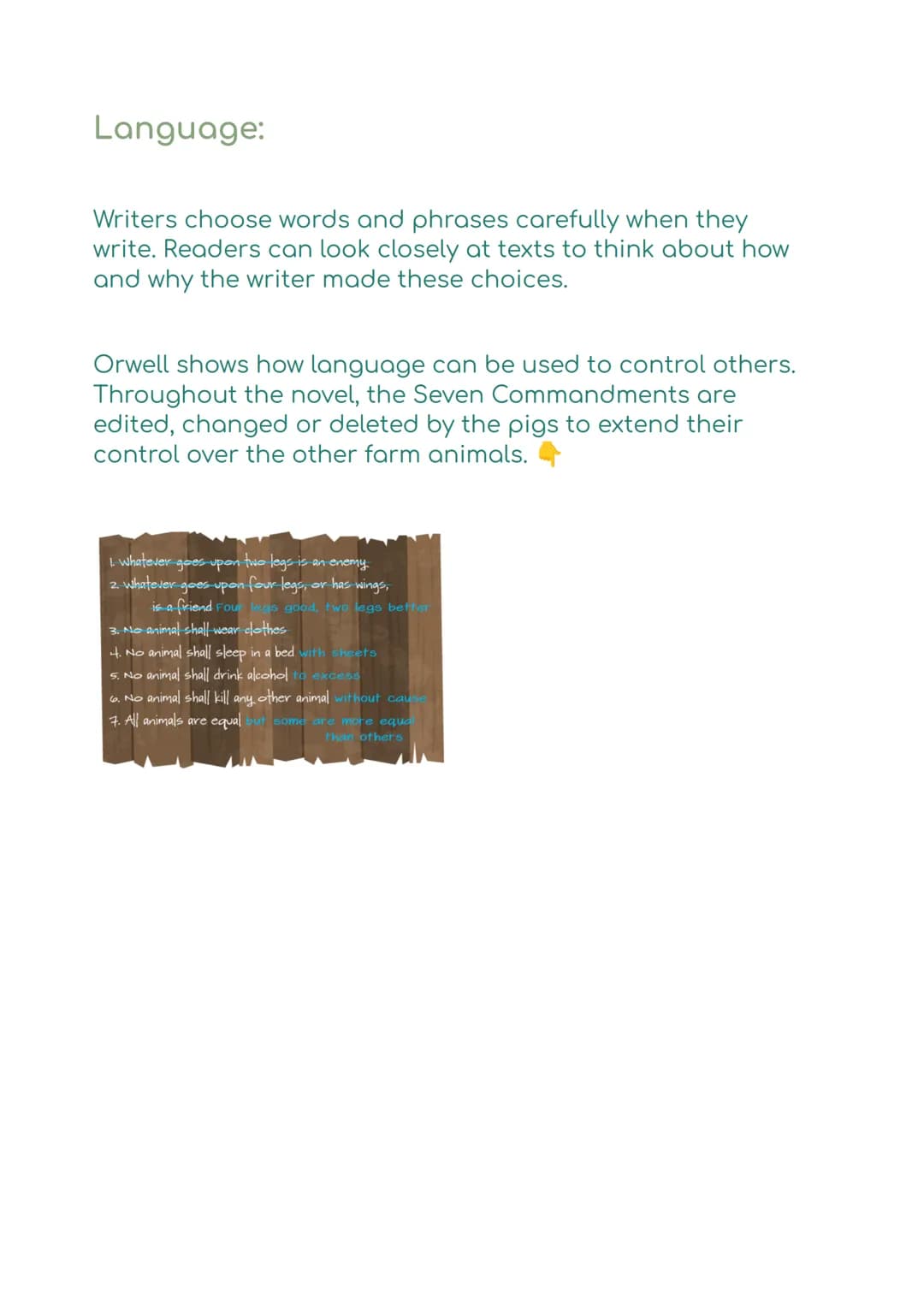
Understanding the Literary Structure of Animal Farm
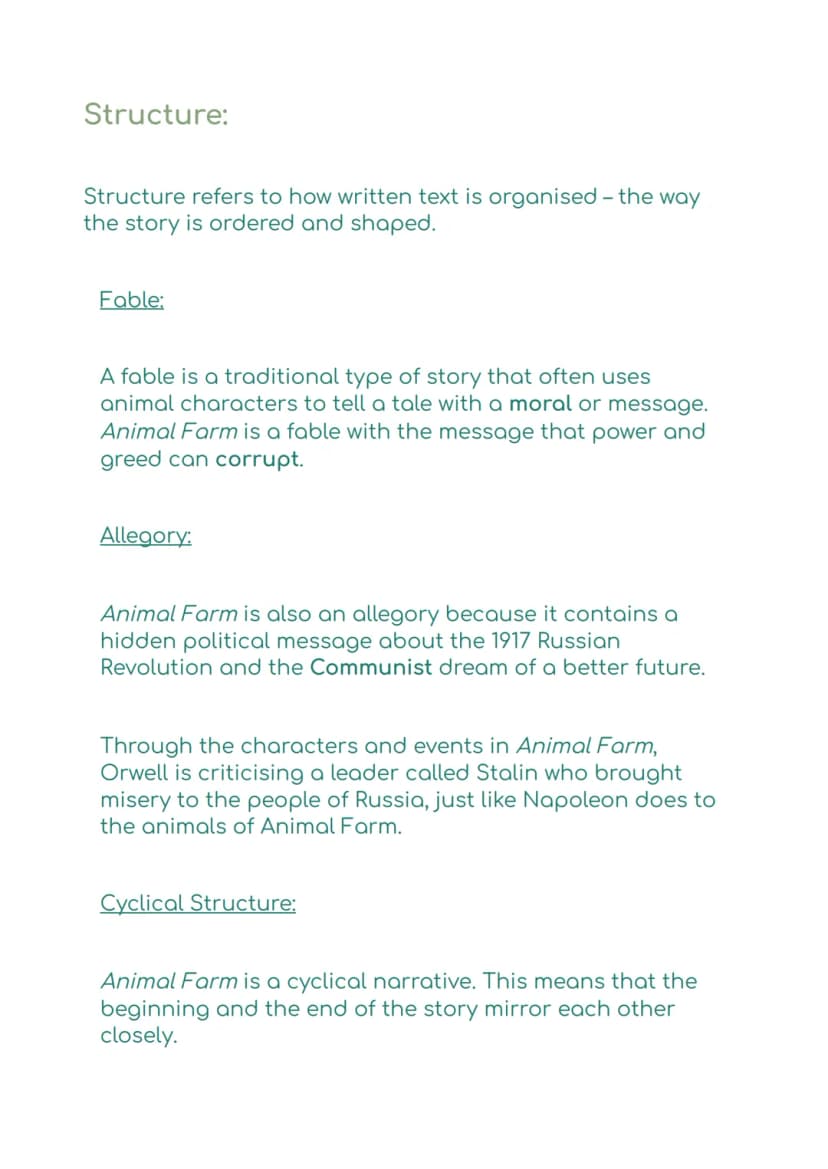
The masterful construction of Animal Farm employs several sophisticated literary techniques that enhance its powerful message. At its core, the novel functions as a fable - a traditional storytelling format that uses animal characters to convey deep moral lessons. Through the interactions of the farm animals, Orwell crafts a compelling narrative about how power corrupts and absolute power corrupts absolutely.
Definition: A fable is a short story that features animals as main characters and teaches a clear moral lesson or life truth. In Animal Farm, the animals represent different social classes and political figures.
The novel's structure is deliberately cyclical, meaning the ending mirrors the beginning in significant ways. This circular pattern reinforces one of the story's central themes - that revolutions often end up replacing one form of tyranny with another. When the story opens, the animals suffer under human oppression. By the end, they find themselves in remarkably similar circumstances under pig leadership, demonstrating how power structures can repeat themselves.
Most importantly, Animal Farm functions as an allegory - a story where characters and events symbolize larger ideas or historical figures. Each animal and incident corresponds to real people and events from the Russian Revolution and its aftermath. For example, Napoleon the pig represents Joseph Stalin, while Snowball represents Leon Trotsky. This allegorical structure allows Orwell to critique totalitarianism and the corruption of socialist ideals in a way that remains relevant beyond its specific historical context.
Highlight: The genius of Animal Farm lies in how it works on multiple levels - as an engaging fable for younger readers, a political satire for adults, and a warning about power and corruption for all.
10
of 10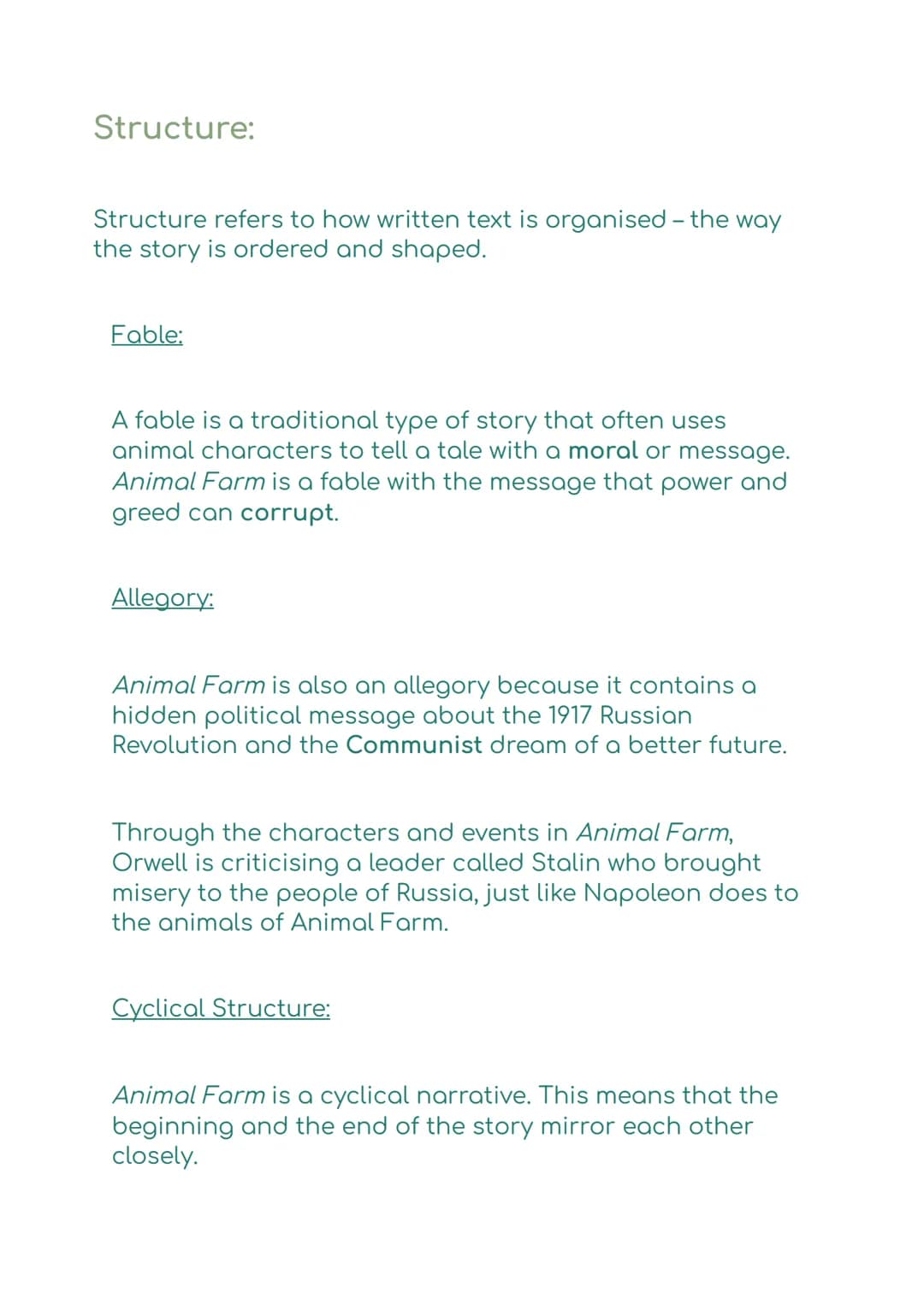
Analyzing the Themes and Characters in Animal Farm
The major themes in Animal Farm revolve around power, corruption, and the manipulation of language and truth. Through the evolution of the Seven Commandments and the pigs' gradual adoption of human behaviors, Orwell illustrates how those in power can gradually erode principles and ideals to serve their own interests.
Example: The commandment "All animals are equal" becomes "All animals are equal, but some animals are more equal than others" - showing how language can be twisted to justify inequality.
The characters in Animal Farm each represent different aspects of society and historical figures. Boxer, the loyal horse, symbolizes the hardworking but naive working class, while the sheep represent the easily manipulated masses. The pigs, particularly Napoleon and Snowball, demonstrate how revolutionary leaders can either betray or stay true to their original ideals. Benjamin, the cynical donkey, represents those who see the truth but feel powerless to change it.
Understanding these character representations helps readers grasp the deeper meanings in the Animal Farm full story. The transformation of Manor Farm into Animal Farm, and then essentially back to Manor Farm under pig rule, serves as a powerful commentary on how revolutions can fail their original purposes when leaders become corrupted by power.
Quote: "The creatures outside looked from pig to man, and from man to pig, and from pig to man again; but already it was impossible to say which was which." This final line perfectly captures the story's central message about power and corruption.
We thought you’d never ask...
What is the Knowunity AI companion?
Our AI companion is specifically built for the needs of students. Based on the millions of content pieces we have on the platform we can provide truly meaningful and relevant answers to students. But its not only about answers, the companion is even more about guiding students through their daily learning challenges, with personalised study plans, quizzes or content pieces in the chat and 100% personalisation based on the students skills and developments.
Where can I download the Knowunity app?
You can download the app in the Google Play Store and in the Apple App Store.
Is Knowunity really free of charge?
That's right! Enjoy free access to study content, connect with fellow students, and get instant help – all at your fingertips.
Similar Content
Most popular content: George Orwell
9English LiteratureAnimal Farm Exam Insights
Comprehensive revision guide for *Animal Farm*, covering key themes, characters, and historical context. This resource is essential for mastering your English Literature GCSE exam, with a focus on Orwell's critique of totalitarianism and the allegorical representation of the Russian Revolution. Ideal for students preparing for Paper 1, featuring exam practice questions and detailed analysis.
114,418126
English LanguageExploring Dystopian Themes
This study note delves into the key themes of dystopian literature as presented in 'The Handmaid's Tale' and its connections to works like 'Animal Farm' and '1984'. It covers the exploration of authoritarian regimes, the impact of patriarchy, and the moral implications of power and control. Ideal for students studying dystopian narratives and their societal critiques.
121,36328
English LiteratureSquealer's Manipulation Tactics
Explore how Squealer embodies propaganda in George Orwell's 'Animal Farm'. This analysis delves into key themes of manipulation, symbolism, and irony, highlighting Squealer's role in controlling the narrative and the animals' perception of power. Ideal for Grade 9 students, this resource includes critical insights and top band A01 statements for effective exam preparation.
111,67838
English LiteratureAnimal farm GCSE English literature
Animal farm
116629
English LiteratureAnimal Farm: Political Allegory
Explore the political allegory in George Orwell's 'Animal Farm', where characters symbolize figures from the Russian Revolution. This summary delves into themes of corruption, totalitarianism, and the manipulation of ideals, highlighting how revolutionary leaders can become oppressive. Understand the implications of Orwell's critique on power dynamics and the role of the working class in sustaining tyranny. Ideal for students studying political ideologies and literature.
106209
EnglishA Hanging: Key Insights
Explore key quotes and in-depth analysis of George Orwell's 'A Hanging'. This study note delves into the symbolism of the dog, the significance of the prisoner's actions, and the emotional impact of capital punishment. Ideal for higher English students seeking to understand the themes of humanity and morality in Orwell's work.
S52936
English LiteraturePropaganda in Animal Farm
Explore the dangers of propaganda in George Orwell's 'Animal Farm' through a detailed essay plan. This resource includes key quotes, contextual analysis, and thematic discussions, focusing on the manipulation of language by the pigs and its impact on the other animals. Ideal for GCSE English Literature students studying AQA and Edexcel syllabuses.
111,66230
English LiteratureAnimal Farm Character Analysis
Explore the key characters of George Orwell's 'Animal Farm' with this detailed mind map. Featuring in-depth analysis of Napoleon, Snowball, Squealer, and Old Major, along with essential quotes, context, themes, and significant moments. Ideal for AQA and Edexcel GCSE English Literature students.
1098118
English LiteratureAnimal Farm Character Insights
Explore key quotes and character analyses from George Orwell's 'Animal Farm'. This summary covers the context, imagery, and significant themes, including the roles of Napoleon, Snowball, Boxer, and Squealer. Ideal for AQA English Literature students seeking to deepen their understanding of the text.
1194620
Most popular content in English Literature
9English LiteratureAn Inspector Calls: Character Insights
Explore in-depth analysis and key quotes for characters in J.B. Priestley's 'An Inspector Calls'. This resource covers Gerald Croft, Inspector Goole, Sheila Birling, Mrs. Birling, Eric Birling, and Eva Smith, focusing on themes of class, gender roles, and social responsibility. Ideal for students aiming for Grade 8 and above.
1025,429907
English LiteratureRomeo and Juliet: Key themes
Key Romeo and Juliet themes and analysed quotes
106,708198
English LiteratureMacbeth: Guilt and Ambition
Explore the complex themes of guilt and ambition in Shakespeare's 'Macbeth'. This analysis covers key characters, including Macbeth and Lady Macbeth, their moral dilemmas, and the tragic consequences of their ambition. Ideal for students studying character motivations, thematic elements, and the psychological impact of power. Includes insights on the natural order, manipulation, and the descent into madness.
919,093397
I
English LiteratureInspector Calls Quiz (YR 10 MOCKS)
for YR 10 GCSE mock on Inspector Calls
102,1451
E
English LiteratureExplore the World of English Literature
Master the key concepts and works of English literature with this comprehensive flashcard set designed for grade 10 students.
112,0941
English LiteratureExploring Macbeth's Themes
Dive into the intricate themes of Shakespeare's Macbeth, including the supernatural, ambition, guilt, and kingship. This analysis features key quotes and insights that reveal how these themes intertwine to shape the characters and the narrative. Ideal for students seeking a deeper understanding of the play's moral complexities and psychological depth.
1015,849524
E
English LiteratureExploring English Literature: A Journey through Medium
Discover the captivating world of English Literature with this comprehensive medium-level flashcard set. Dive into the works of renowned authors and explore the themes, characters, and literary techniques that make their writing truly remarkable.
111,0580
E
English LiteratureExploring 'A Christmas Carol': Themes, Characters, and Lessons
Delve into the main themes, key characters, and valuable lessons in Charles Dickens' 'A Christmas Carol'. Discover the impact of Scrooge's transformation and the significance of love, redemption, and the true meaning of Christmas.
101,2480
English LiteratureMacbeth Key Themes Essay Plans
Essay plans for key themes in macbeth - guilt, supernatural & ambition
115,186146
Most popular content
9 Sociology
Sociology of Education Overview
Explore comprehensive A-Level Sociology notes on the education system, covering key theories, policies, and sociological perspectives. This resource includes insights on marketisation, gender roles, cultural deprivation, and educational inequalities, providing a thorough understanding of how education shapes social stratification and individual achievement. Ideal for exam preparation and in-depth study.
12102,8693,040
SociologySociology of Families: Comprehensive Revision
Dive into an extensive overview of family dynamics, perspectives, and patterns in sociology. This resource covers key concepts such as family diversity, gender roles, marriage, and the impact of social policies on family structures. Perfect for A-Level Sociology students preparing for Paper 2.
1273,6612,307
CriminologyCriminology: Crime & Punishment Overview
Comprehensive mindmaps covering key concepts in the Crime and Punishment topic for WJEC Criminology Unit 4. This resource includes detailed insights into the Criminal Justice System, crime prevention strategies, sentencing models, and the roles of various agencies. Ideal for A-Level revision, ensuring you grasp essential theories and legislative processes to excel in your exams.
1254,8691,059
SociologyComprehensive Crime & Deviance Overview
Explore an extensive revision of crime and deviance topics, including theories, types of crime, and the impact of media. This resource covers key concepts such as Marxism, functionalism, gender and crime, and the influence of globalization on criminal behavior. Ideal for students seeking a thorough understanding of criminology and its various theories. Type: Full Topic Revision.
1251,6541,399
C
 Biology
Cell Biology and Cell structure
cell structures
93,2470
English LiteratureAn Inspector Calls: Character Insights
Explore in-depth analysis and key quotes for characters in J.B. Priestley's 'An Inspector Calls'. This resource covers Gerald Croft, Inspector Goole, Sheila Birling, Mrs. Birling, Eric Birling, and Eva Smith, focusing on themes of class, gender roles, and social responsibility. Ideal for students aiming for Grade 8 and above.
1025,429907
CriminologyWJEC Unit 4 Criminology
Criminology unit 4 detailed revision note
127,151125
CriminologyCriminology Theories Overview
Explore key criminology theories and their implications on crime and deviance. This comprehensive summary covers biological, psychological, and sociological perspectives, including labelling theory, right realism, and the impact of social campaigns on policy development. Ideal for A-Level criminology students seeking to understand the complexities of criminal behaviour and the factors influencing crime prevention strategies.
129,760210
English LiteratureRomeo and Juliet: Key themes
Key Romeo and Juliet themes and analysed quotes
106,708198
Can't find what you're looking for? Explore other subjects.
Students love us — and so will you.
4.6/5App Store
4.7/5Google Play
The app is very easy to use and well designed. I have found everything I was looking for so far and have been able to learn a lot from the presentations! I will definitely use the app for a class assignment! And of course it also helps a lot as an inspiration.
Stefan SiOS user
This app is really great. There are so many study notes and help [...]. My problem subject is French, for example, and the app has so many options for help. Thanks to this app, I have improved my French. I would recommend it to anyone.
Samantha KlichAndroid user
Wow, I am really amazed. I just tried the app because I've seen it advertised many times and was absolutely stunned. This app is THE HELP you want for school and above all, it offers so many things, such as workouts and fact sheets, which have been VERY helpful to me personally.
AnnaiOS user
English Literature2,108 views·Updated Jun 16, 2026·11 pagesYour Easy Guide to Animal Farm: Chapter Summaries, Themes, and Characters
🌿 𝐒𝐭𝐮𝐝𝐲_𝐋𝐢𝐟𝐞 🕊️@study_life01
George Orwell's Animal Farm is a powerful story about farm animals who rebel against their human farmer to create their own society, serving as an allegory for political revolution and corruption.
The Animal Farm full storyfollows the animals of...
1
of 10
Sign up to see the content. It's free!
- Access to all documents
- Improve your grades
- Join milions of students
Animal Farm Full Story and Analysis
The Animal Farm full story begins at Manor Farm, where the animals live under the cruel treatment of their human owner, Mr. Jones. The tale unfolds when Old Major, a respected pig, shares his revolutionary vision of a farm governed by animals. This pivotal moment sets the stage for a powerful narrative about society, power, and corruption.
Definition: Animal Farm is an allegorical novella that uses farm animals to represent historical figures and political ideologies from the Russian Revolution.
The Animal Farm themes center around power corruption, social inequality, and the manipulation of language and history. After the animals successfully overthrow Mr. Jones, they establish Seven Commandments based on the principle that "All animals are equal." However, the pigs, particularly Napoleon and Snowball, emerge as leaders and gradually begin to abuse their power.
The construction of the windmill becomes a central plot point that demonstrates the exploitation of the working class. While the animals labor tirelessly, the pigs manipulate the situation for their benefit. The story reaches its tragic climax when Boxer, the loyal horse, is sent to his death, highlighting the ultimate betrayal of the revolution's ideals.
2
of 10Sign up to see the content. It's free!
- Access to all documents
- Improve your grades
- Join milions of students
Understanding Animal Farm Characters and Their Significance
The Animal Farm characters represent various social and political figures. Old Major symbolizes both Karl Marx and Vladimir Lenin, providing the ideological foundation for the revolution. His dream of equality and prosperity serves as the catalyst for change.
Highlight: Napoleon, the main antagonist, represents Joseph Stalin, demonstrating how power can corrupt and transform leaders into tyrants.
Snowball, portrayed as an intelligent and innovative leader, represents Leon Trotsky. His plans for the windmill and eventual exile mirror historical events. The dynamic between Napoleon and Snowball illustrates the power struggles that often occur in revolutionary movements.
The supporting characters each serve specific symbolic purposes. Boxer represents the loyal working class, while Squealer embodies propaganda and manipulation of truth. The human characters, Mr. Jones, Mr. Pilkington, and Mr. Frederick, represent different aspects of capitalist society and foreign powers.
3
of 10Sign up to see the content. It's free!
- Access to all documents
- Improve your grades
- Join milions of students
Exploring Animal Farm Themes and Symbolism
The five main themes in Animal Farm include power corruption, the manipulation of language, class structure, education and intelligence, and the power of propaganda. These themes interweave throughout the narrative, creating a complex critique of political systems and human nature.
Example: The gradual changes to the Seven Commandments demonstrate how language can be manipulated to maintain power. The phrase "All animals are equal" becomes "All animals are equal, but some animals are more equal than others."
The windmill symbolizes industrialization and the false promises of progress. Its repeated destruction represents the challenges faced by societies during rapid technological and social change. The farm itself becomes a microcosm of larger society, showing how idealistic revolutions can deteriorate into oppressive regimes.
4
of 10Sign up to see the content. It's free!
- Access to all documents
- Improve your grades
- Join milions of students
Animal Farm Summary and Historical Context
George Orwell wrote Animal Farm as a response to the events of the Russian Revolution and the rise of Stalinism. Published in 1945, the book serves as both a political satire and a warning about totalitarian regimes.
Quote: "The creatures outside looked from pig to man, and from man to pig, and from pig to man again; but already it was impossible to say which was which."
The Animal Farm chapter summary shows a clear progression from hope to disillusionment. The initial victory over human oppression leads to the establishment of new rules and systems. However, the pigs' gradual adoption of human behaviors and privileges demonstrates how power structures can be replicated even after revolutionary change.
The story concludes with the pigs becoming indistinguishable from the humans they once opposed, completing the cycle of corruption and betrayal of revolutionary ideals.
5
of 10Sign up to see the content. It's free!
- Access to all documents
- Improve your grades
- Join milions of students
Historical Context of Animal Farm
Understanding the historical context is crucial for a comprehensive Animal Farm summary and analysis. George Orwell wrote Animal Farm as an allegory for the Russian Revolution and the subsequent rise of Stalinism.
Russian Revolution
The novel mirrors the events of the 1917 Russian Revolution, which overthrew the Tsarist autocracy and led to the creation of the Soviet Union.
Highlight: Just as the animals rebel against Mr. Jones, the Russian people revolted against Tsar Nicholas II.
Rise of Stalin
The power struggle between Napoleon and Snowball represents the real-life conflict between Joseph Stalin and Leon Trotsky for control of the Soviet Union after Lenin's death.
Example: Napoleon's exile of Snowball mirrors Stalin's expulsion of Trotsky from the Communist Party and his subsequent exile from the Soviet Union.
Stalinist Era
The bulk of the novel represents the Stalinist era in the Soviet Union, characterized by:
- Collectivization of agriculture
- Rapid industrialization
- Political purges
- Cult of personality
Quote: "Comrades!" he cried. "You do not imagine, I hope, that we pigs are doing this in a spirit of selfishness and privilege?" This quote reflects Stalin's justification for the privileges of the ruling class.
World War II
The novel was written during World War II, and some events in the book reflect this global conflict.
Vocabulary: Allegory - A story, poem, or picture that can be interpreted to reveal a hidden meaning, typically a moral or political one.
Critique of Totalitarianism
Orwell's experiences in the Spanish Civil War had disillusioned him with communism, and Animal Farm serves as a critique of totalitarian regimes in general.
Highlight: The gradual erosion of the Seven Commandments in the novel reflects how totalitarian regimes often betray their original ideals.
Understanding this historical context enriches our reading of Animal Farm and helps us appreciate its relevance beyond its specific historical moment. This context is essential for any Animal Farm summary essay or in-depth analysis of the novel's themes and characters.
6
of 10Sign up to see the content. It's free!
- Access to all documents
- Improve your grades
- Join milions of students
Symbolism in Animal Farm
George Orwell's Animal Farm is rich in symbolism, which is crucial to understanding the deeper meanings of the novel. This aspect is essential for any Animal Farm summary and analysis essay. Here are some key symbols used in the novel:
The Farm
Manor Farm, later renamed Animal Farm, symbolizes Russia before and after the revolution.
Highlight: The change in name from Manor Farm to Animal Farm represents the transition from Tsarist Russia to the Soviet Union.
The Animals
Different animals represent various segments of Russian society:
- Pigs: The intellectual elite and political class
- Horses and donkeys: The working class
- Sheep: The easily manipulated masses
- Dogs: The military and police force
Example: Boxer, the loyal and hardworking horse, represents the ideal Soviet worker, while the sheep symbolize the easily swayed public.
The Windmill
The windmill represents the Soviet Union's attempts at rapid industrialization, particularly Stalin's Five-Year Plans.
Quote: "If this windmill is built, comrades," said Snowball, "we can have electric light in our stalls. We could run a dynamo and supply ourselves with electric light, heat, and power for circular saws."
The Seven Commandments
These represent the original ideals of the revolution, which are gradually corrupted over time.
Vocabulary: Corruption - Dishonest or fraudulent conduct by those in power, typically involving bribery.
The Barn
The barn, where the Seven Commandments are written, symbolizes the collective memory of the revolution.
Highlight: The pigs' alterations to the commandments on the barn wall represent the manipulation of history and collective memory.
Alcohol
Alcohol symbolizes the corrupting influence of power and luxury.
Example: The pigs' gradual adoption of drinking alcohol mirrors their increasing similarity to the humans they once overthrew.
The Farmhouse
The farmhouse represents the Kremlin and the luxuries enjoyed by the ruling class.
Understanding these symbols is crucial for a comprehensive Animal Farm summary PDF or analysis. They provide insight into Orwell's critique of totalitarian regimes and the corruption of revolutionary ideals.
7
of 10Sign up to see the content. It's free!
- Access to all documents
- Improve your grades
- Join milions of students
Character Development in Animal Farm
Character development is a crucial aspect of George Orwell's Animal Farm, contributing significantly to the novel's themes and allegory. Understanding how characters evolve throughout the story is essential for any Animal Farm summary and analysis essay.
Napoleon
Napoleon, the main antagonist, undergoes the most dramatic transformation:
- Initially, he appears as one of the leaders of the revolution.
- Gradually, he becomes more power-hungry and ruthless.
- By the end, he has become a tyrant, indistinguishable from the human oppressors the animals once overthrew.
Quote: "Napoleon is always right" - This phrase, repeated by the animals, shows how Napoleon's authority becomes unquestionable over time.
Snowball
Snowball's character serves as a foil to Napoleon:
- He starts as an idealistic and intelligent leader.
- His plans for the windmill represent progress and innovation.
- His expulsion from the farm marks a turning point in the story.
Highlight: Snowball's fate mirrors that of Leon Trotsky in the Soviet Union, showing how revolutionary ideals can be betrayed.
Boxer
Boxer's character arc is particularly tragic:
- He begins as a loyal and hardworking supporter of the revolution.
- His strength and dedication are exploited by the pigs.
- His fate at the end of the novel symbolizes the betrayal of the working class.
Example: Boxer's motto "I will work harder" evolves into "Napoleon is always right," showing his blind loyalty to the corrupt leadership.
Squealer
Squealer's development illustrates the power of propaganda:
- He starts as Napoleon's mouthpiece.
- Over time, he becomes more skilled at manipulating language and facts.
- By the end, he's an expert at rewriting history to suit the pigs' narrative.
Vocabulary: Propaganda - Information, especially of a biased or misleading nature, used to promote a political cause or point of view.
Benjamin
Benjamin, the donkey, remains cynical and unchanged throughout the story:
- He's skeptical of the revolution from the start.
- His pessimism proves prophetic as the farm's situation deteriorates.
- His character represents those who see the truth but feel powerless to change it.
Understanding these character arcs is crucial for a comprehensive Animal Farm summary PDF or analysis. They illustrate how power corrupts and how revolutionary ideals can be betrayed, which are central themes in the novel.
8
of 10Sign up to see the content. It's free!
- Access to all documents
- Improve your grades
- Join milions of students
Narrative Techniques in Animal Farm
George Orwell employs various narrative techniques in Animal Farm to convey his message effectively. Understanding these techniques is crucial for a comprehensive Animal Farm summary and analysis essay.
Allegory
The entire novel is an extended allegory for the Russian Revolution and the rise of Stalinism.
Definition: An allegory is a story, poem, or picture that can be interpreted to reveal a hidden meaning, typically a moral or political one.
Third-Person Omniscient Narration
Orwell uses a third-person omniscient narrator, allowing readers to see events from multiple perspectives while maintaining a sense of objectivity.
Example: The narrator describes both the animals' thoughts and the humans' reactions, providing a comprehensive view of events.
Irony
Irony is used throughout the novel to highlight the discrepancy between the animals' expectations and reality.
Quote: "All animals are equal, but some animals are more equal than others." This famous line exemplifies Orwell's use of irony to expose the hypocrisy of the pigs' regime.
Foreshadowing
Orwell uses foreshadowing to hint at future events and the eventual outcome of the animal revolution.
Highlight: Old Major's warning about humans and the potential for animals to become like them foreshadows the pigs' eventual transformation.
Symbolism
Various elements in the story serve as symbols for real-world concepts and events.
Example: The windmill symbolizes the Soviet Union's five-year plans for rapid industrialization.
Repetition
Certain phrases and ideas are repeated throughout the novel to emphasize key themes.
Vocabulary: Motif - A recurring element in a story that has symbolic significance.
Simplicity of Language
Orwell uses simple, clear language to make the story accessible and to mirror the supposed simplicity of the animals' worldview.
Highlight: This simplicity in style contrasts sharply with the complex political ideas being explored, making the corruption of ideals even more stark.
Understanding these narrative techniques enhances our appreciation of Animal Farm and helps us grasp the deeper meanings behind the seemingly simple story. This analysis is crucial for any Animal Farm summary PDF or in-depth study of the novel.
9
of 10Sign up to see the content. It's free!
- Access to all documents
- Improve your grades
- Join milions of students
Understanding the Literary Structure of Animal Farm
The masterful construction of Animal Farm employs several sophisticated literary techniques that enhance its powerful message. At its core, the novel functions as a fable - a traditional storytelling format that uses animal characters to convey deep moral lessons. Through the interactions of the farm animals, Orwell crafts a compelling narrative about how power corrupts and absolute power corrupts absolutely.
Definition: A fable is a short story that features animals as main characters and teaches a clear moral lesson or life truth. In Animal Farm, the animals represent different social classes and political figures.
The novel's structure is deliberately cyclical, meaning the ending mirrors the beginning in significant ways. This circular pattern reinforces one of the story's central themes - that revolutions often end up replacing one form of tyranny with another. When the story opens, the animals suffer under human oppression. By the end, they find themselves in remarkably similar circumstances under pig leadership, demonstrating how power structures can repeat themselves.
Most importantly, Animal Farm functions as an allegory - a story where characters and events symbolize larger ideas or historical figures. Each animal and incident corresponds to real people and events from the Russian Revolution and its aftermath. For example, Napoleon the pig represents Joseph Stalin, while Snowball represents Leon Trotsky. This allegorical structure allows Orwell to critique totalitarianism and the corruption of socialist ideals in a way that remains relevant beyond its specific historical context.
Highlight: The genius of Animal Farm lies in how it works on multiple levels - as an engaging fable for younger readers, a political satire for adults, and a warning about power and corruption for all.
10
of 10Sign up to see the content. It's free!
- Access to all documents
- Improve your grades
- Join milions of students
Analyzing the Themes and Characters in Animal Farm
The major themes in Animal Farm revolve around power, corruption, and the manipulation of language and truth. Through the evolution of the Seven Commandments and the pigs' gradual adoption of human behaviors, Orwell illustrates how those in power can gradually erode principles and ideals to serve their own interests.
Example: The commandment "All animals are equal" becomes "All animals are equal, but some animals are more equal than others" - showing how language can be twisted to justify inequality.
The characters in Animal Farm each represent different aspects of society and historical figures. Boxer, the loyal horse, symbolizes the hardworking but naive working class, while the sheep represent the easily manipulated masses. The pigs, particularly Napoleon and Snowball, demonstrate how revolutionary leaders can either betray or stay true to their original ideals. Benjamin, the cynical donkey, represents those who see the truth but feel powerless to change it.
Understanding these character representations helps readers grasp the deeper meanings in the Animal Farm full story. The transformation of Manor Farm into Animal Farm, and then essentially back to Manor Farm under pig rule, serves as a powerful commentary on how revolutions can fail their original purposes when leaders become corrupted by power.
Quote: "The creatures outside looked from pig to man, and from man to pig, and from pig to man again; but already it was impossible to say which was which." This final line perfectly captures the story's central message about power and corruption.
We thought you’d never ask...
What is the Knowunity AI companion?
Our AI companion is specifically built for the needs of students. Based on the millions of content pieces we have on the platform we can provide truly meaningful and relevant answers to students. But its not only about answers, the companion is even more about guiding students through their daily learning challenges, with personalised study plans, quizzes or content pieces in the chat and 100% personalisation based on the students skills and developments.
Where can I download the Knowunity app?
You can download the app in the Google Play Store and in the Apple App Store.
Is Knowunity really free of charge?
That's right! Enjoy free access to study content, connect with fellow students, and get instant help – all at your fingertips.
Similar Content
Most popular content: George Orwell
9English LiteratureAnimal Farm Exam Insights
Comprehensive revision guide for *Animal Farm*, covering key themes, characters, and historical context. This resource is essential for mastering your English Literature GCSE exam, with a focus on Orwell's critique of totalitarianism and the allegorical representation of the Russian Revolution. Ideal for students preparing for Paper 1, featuring exam practice questions and detailed analysis.
114,418126
English LanguageExploring Dystopian Themes
This study note delves into the key themes of dystopian literature as presented in 'The Handmaid's Tale' and its connections to works like 'Animal Farm' and '1984'. It covers the exploration of authoritarian regimes, the impact of patriarchy, and the moral implications of power and control. Ideal for students studying dystopian narratives and their societal critiques.
121,36328
English LiteratureSquealer's Manipulation Tactics
Explore how Squealer embodies propaganda in George Orwell's 'Animal Farm'. This analysis delves into key themes of manipulation, symbolism, and irony, highlighting Squealer's role in controlling the narrative and the animals' perception of power. Ideal for Grade 9 students, this resource includes critical insights and top band A01 statements for effective exam preparation.
111,67838
English LiteratureAnimal farm GCSE English literature
Animal farm
116629
English LiteratureAnimal Farm: Political Allegory
Explore the political allegory in George Orwell's 'Animal Farm', where characters symbolize figures from the Russian Revolution. This summary delves into themes of corruption, totalitarianism, and the manipulation of ideals, highlighting how revolutionary leaders can become oppressive. Understand the implications of Orwell's critique on power dynamics and the role of the working class in sustaining tyranny. Ideal for students studying political ideologies and literature.
106209
EnglishA Hanging: Key Insights
Explore key quotes and in-depth analysis of George Orwell's 'A Hanging'. This study note delves into the symbolism of the dog, the significance of the prisoner's actions, and the emotional impact of capital punishment. Ideal for higher English students seeking to understand the themes of humanity and morality in Orwell's work.
S52936
English LiteraturePropaganda in Animal Farm
Explore the dangers of propaganda in George Orwell's 'Animal Farm' through a detailed essay plan. This resource includes key quotes, contextual analysis, and thematic discussions, focusing on the manipulation of language by the pigs and its impact on the other animals. Ideal for GCSE English Literature students studying AQA and Edexcel syllabuses.
111,66230
English LiteratureAnimal Farm Character Analysis
Explore the key characters of George Orwell's 'Animal Farm' with this detailed mind map. Featuring in-depth analysis of Napoleon, Snowball, Squealer, and Old Major, along with essential quotes, context, themes, and significant moments. Ideal for AQA and Edexcel GCSE English Literature students.
1098118
English LiteratureAnimal Farm Character Insights
Explore key quotes and character analyses from George Orwell's 'Animal Farm'. This summary covers the context, imagery, and significant themes, including the roles of Napoleon, Snowball, Boxer, and Squealer. Ideal for AQA English Literature students seeking to deepen their understanding of the text.
1194620
Most popular content in English Literature
9English LiteratureAn Inspector Calls: Character Insights
Explore in-depth analysis and key quotes for characters in J.B. Priestley's 'An Inspector Calls'. This resource covers Gerald Croft, Inspector Goole, Sheila Birling, Mrs. Birling, Eric Birling, and Eva Smith, focusing on themes of class, gender roles, and social responsibility. Ideal for students aiming for Grade 8 and above.
1025,429907
English LiteratureRomeo and Juliet: Key themes
Key Romeo and Juliet themes and analysed quotes
106,708198
English LiteratureMacbeth: Guilt and Ambition
Explore the complex themes of guilt and ambition in Shakespeare's 'Macbeth'. This analysis covers key characters, including Macbeth and Lady Macbeth, their moral dilemmas, and the tragic consequences of their ambition. Ideal for students studying character motivations, thematic elements, and the psychological impact of power. Includes insights on the natural order, manipulation, and the descent into madness.
919,093397
I
English LiteratureInspector Calls Quiz (YR 10 MOCKS)
for YR 10 GCSE mock on Inspector Calls
102,1451
E
English LiteratureExplore the World of English Literature
Master the key concepts and works of English literature with this comprehensive flashcard set designed for grade 10 students.
112,0941
English LiteratureExploring Macbeth's Themes
Dive into the intricate themes of Shakespeare's Macbeth, including the supernatural, ambition, guilt, and kingship. This analysis features key quotes and insights that reveal how these themes intertwine to shape the characters and the narrative. Ideal for students seeking a deeper understanding of the play's moral complexities and psychological depth.
1015,849524
E
English LiteratureExploring English Literature: A Journey through Medium
Discover the captivating world of English Literature with this comprehensive medium-level flashcard set. Dive into the works of renowned authors and explore the themes, characters, and literary techniques that make their writing truly remarkable.
111,0580
E
English LiteratureExploring 'A Christmas Carol': Themes, Characters, and Lessons
Delve into the main themes, key characters, and valuable lessons in Charles Dickens' 'A Christmas Carol'. Discover the impact of Scrooge's transformation and the significance of love, redemption, and the true meaning of Christmas.
101,2480
English LiteratureMacbeth Key Themes Essay Plans
Essay plans for key themes in macbeth - guilt, supernatural & ambition
115,186146
Most popular content
9SociologySociology of Education Overview
Explore comprehensive A-Level Sociology notes on the education system, covering key theories, policies, and sociological perspectives. This resource includes insights on marketisation, gender roles, cultural deprivation, and educational inequalities, providing a thorough understanding of how education shapes social stratification and individual achievement. Ideal for exam preparation and in-depth study.
12102,8693,040
SociologySociology of Families: Comprehensive Revision
Dive into an extensive overview of family dynamics, perspectives, and patterns in sociology. This resource covers key concepts such as family diversity, gender roles, marriage, and the impact of social policies on family structures. Perfect for A-Level Sociology students preparing for Paper 2.
1273,6612,307
CriminologyCriminology: Crime & Punishment Overview
Comprehensive mindmaps covering key concepts in the Crime and Punishment topic for WJEC Criminology Unit 4. This resource includes detailed insights into the Criminal Justice System, crime prevention strategies, sentencing models, and the roles of various agencies. Ideal for A-Level revision, ensuring you grasp essential theories and legislative processes to excel in your exams.
1254,8691,059
SociologyComprehensive Crime & Deviance Overview
Explore an extensive revision of crime and deviance topics, including theories, types of crime, and the impact of media. This resource covers key concepts such as Marxism, functionalism, gender and crime, and the influence of globalization on criminal behavior. Ideal for students seeking a thorough understanding of criminology and its various theories. Type: Full Topic Revision.
1251,6541,399
C
BiologyCell Biology and Cell structure
cell structures
93,2470
English LiteratureAn Inspector Calls: Character Insights
Explore in-depth analysis and key quotes for characters in J.B. Priestley's 'An Inspector Calls'. This resource covers Gerald Croft, Inspector Goole, Sheila Birling, Mrs. Birling, Eric Birling, and Eva Smith, focusing on themes of class, gender roles, and social responsibility. Ideal for students aiming for Grade 8 and above.
1025,429907
CriminologyWJEC Unit 4 Criminology
Criminology unit 4 detailed revision note
127,151125
CriminologyCriminology Theories Overview
Explore key criminology theories and their implications on crime and deviance. This comprehensive summary covers biological, psychological, and sociological perspectives, including labelling theory, right realism, and the impact of social campaigns on policy development. Ideal for A-Level criminology students seeking to understand the complexities of criminal behaviour and the factors influencing crime prevention strategies.
129,760210
English LiteratureRomeo and Juliet: Key themes
Key Romeo and Juliet themes and analysed quotes
106,708198
Can't find what you're looking for? Explore other subjects.
Students love us — and so will you.
4.6/5App Store
4.7/5Google Play
The app is very easy to use and well designed. I have found everything I was looking for so far and have been able to learn a lot from the presentations! I will definitely use the app for a class assignment! And of course it also helps a lot as an inspiration.
Stefan SiOS user
This app is really great. There are so many study notes and help [...]. My problem subject is French, for example, and the app has so many options for help. Thanks to this app, I have improved my French. I would recommend it to anyone.
Samantha KlichAndroid user
Wow, I am really amazed. I just tried the app because I've seen it advertised many times and was absolutely stunned. This app is THE HELP you want for school and above all, it offers so many things, such as workouts and fact sheets, which have been VERY helpful to me personally.
AnnaiOS user