
The Malcolm X and Martin Luther King comparisonreveals two...
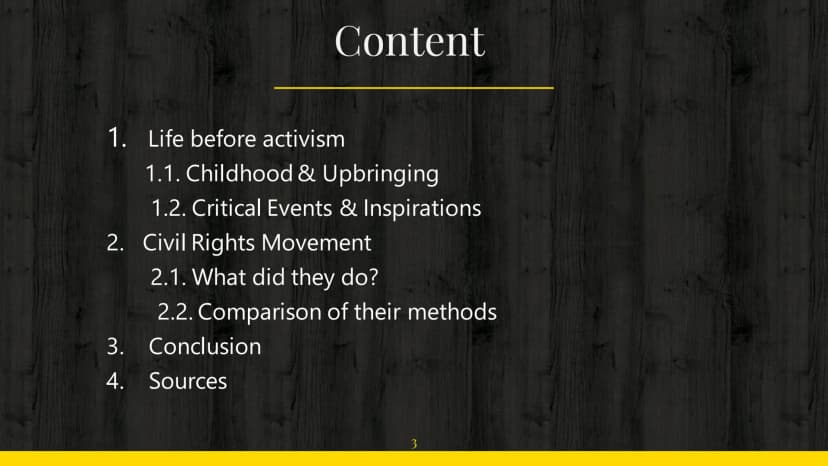
 Englisch2,434 views·Updated Jun 25, 2026·29 pages
Comparing Malcolm X and Martin Luther King: Their Childhoods and Civil Rights Contributions

Jasmin@cayennedyen_arg







1 / 10
1
of 10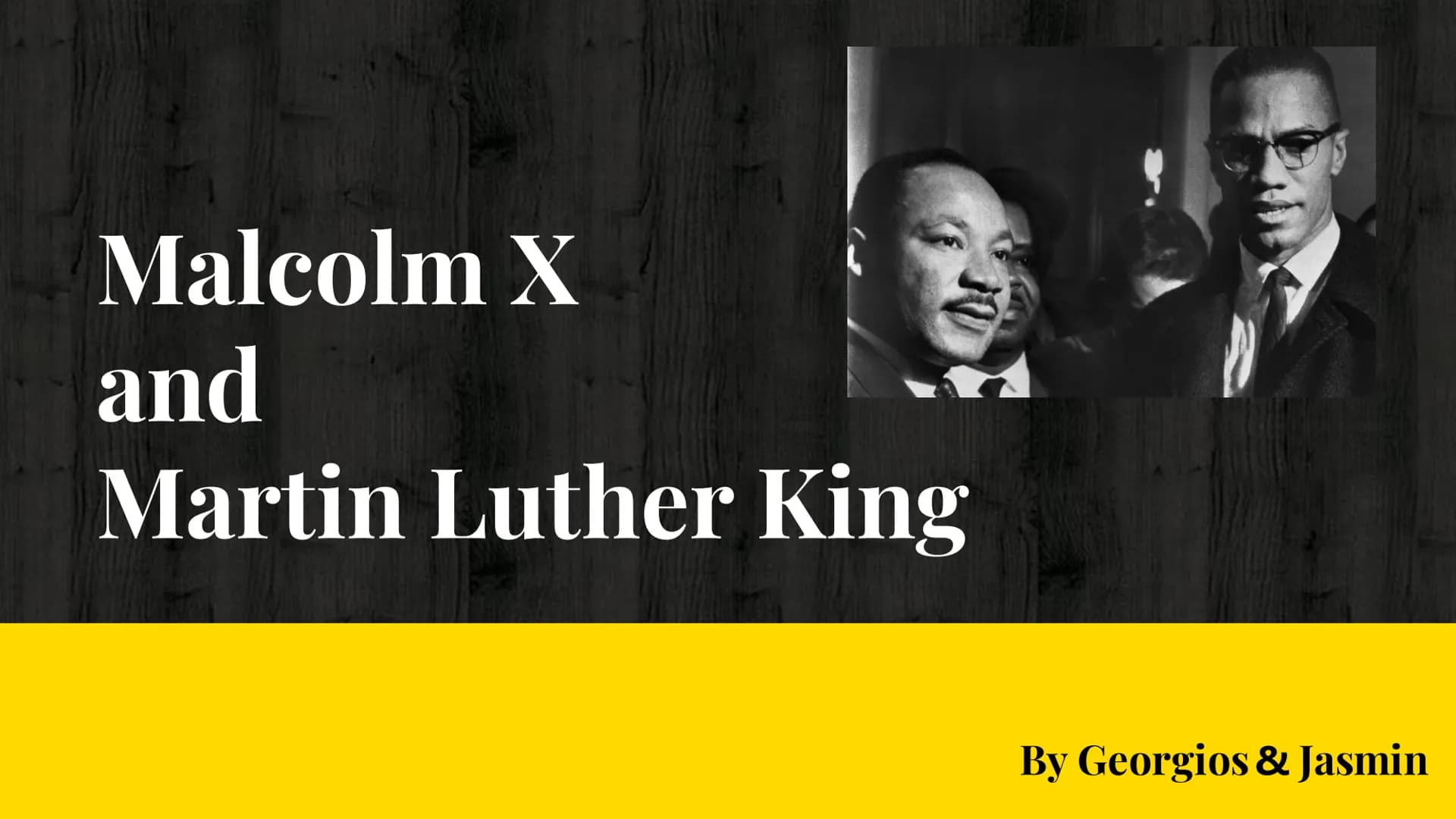
The Legacy of Malcolm X and Martin Luther King: A Historical Analysis
The profound impact of Malcolm X and Martin Luther King on American civil rights remains unmatched in modern history. Their different approaches to achieving racial equality stemmed from their distinct upbringings and life experiences, shaping two of the most influential leaders in the fight for civil rights.
Definition: The Civil Rights Movement was a decades-long struggle by African Americans to achieve social justice and equal rights under the law, reaching its peak in the 1950s and 1960s.
Their journeys, while different in many aspects, shared the common goal of advancing African American rights and dignity. Both leaders emerged during a pivotal time in American history when racial segregation and discrimination were deeply entrenched in society. Understanding their backgrounds provides crucial insight into their later philosophical differences and approaches to activism.
These two figures, often portrayed as opposites, actually complemented each other's work in many ways. Their combined influence created a powerful force for change in American society, though they employed different strategies and held contrasting views on how to achieve racial equality.
2
of 10
Early Life Influences and Philosophical Foundations
The childhood influences on Malcolm X and Martin Luther King activism were markedly different. King grew up in a middle-class family in Atlanta, surrounded by educated civil rights activists and religious leaders. His father was a prominent Baptist minister who instilled in him strong Christian values and a belief in nonviolent resistance.
Highlight: Malcolm X's early life was marked by tragedy and hardship, while King's upbringing was relatively privileged and stable. These contrasting experiences significantly shaped their later approaches to civil rights activism.
Malcolm X, born Malcolm Little, experienced severe racial violence and poverty in his youth. His father was murdered by white supremacists, and his mother was institutionalized, leading to his placement in foster homes. These early traumatic experiences shaped his more militant approach to racial justice and his initial rejection of integration with white society.
Their educational paths also diverged significantly. King received formal education at Morehouse College and Boston University, earning a Ph.D. in systematic theology. Malcolm X largely educated himself during his imprisonment, where he underwent a transformative experience and converted to the Nation of Islam.
3
of 10
Contrasting Approaches to Civil Rights
The Civil Rights Movement contributions by Malcolm X and Martin Luther King reflected their different philosophies and backgrounds. King advocated for nonviolent civil disobedience, inspired by Mahatma Gandhi's successful resistance against British colonial rule in India. His approach emphasized integration, peaceful protest, and working within the existing political system.
Quote: "Darkness cannot drive out darkness; only light can do that. Hate cannot drive out hate; only love can do that." - Martin Luther King Jr.
Malcolm X initially promoted black nationalism and self-reliance, rejecting the notion of integration. He believed in self-defense "by any means necessary" and criticized the nonviolent approach as ineffective. However, after his split from the Nation of Islam and his pilgrimage to Mecca, his views evolved to become more inclusive.
Their different strategies created a dynamic tension within the Civil Rights Movement. While King's approach appealed to moderate whites and emphasized moral persuasion, Malcolm X's message resonated with urban blacks and those who had lost faith in the possibility of peaceful change. Together, they provided complementary forces that pushed American society toward meaningful reform.
4
of 10
Impact and Historical Significance
The Malcolm X and Martin Luther King comparison reveals how different approaches to fighting injustice can contribute to social change. While their methods differed, both leaders made crucial contributions to the advancement of civil rights in America.
Example: King's March on Washington and Malcolm X's "The Ballot or the Bullet" speech represent their contrasting yet equally powerful approaches to achieving racial equality.
Their legacies continue to influence modern social justice movements. King's emphasis on nonviolent resistance and coalition-building has become a model for peaceful protest worldwide. Malcolm X's focus on black pride, self-determination, and human rights has inspired generations of activists fighting for racial justice.
Both leaders evolved in their thinking over time, with Malcolm X becoming more open to interracial cooperation after his pilgrimage to Mecca, and King becoming more radical in his critique of economic inequality and the Vietnam War before his assassination. Their transformations demonstrate the complexity of the struggle for civil rights and the importance of being willing to grow and adapt in the pursuit of justice.
5
of 10
Early Life and Influences: Martin Luther King Jr. and Malcolm X
Childhood influences on Malcolm X and Martin Luther King activism shaped these two influential Civil Rights leaders in dramatically different ways. Their contrasting upbringings helped form their distinct approaches to fighting racial injustice in America.
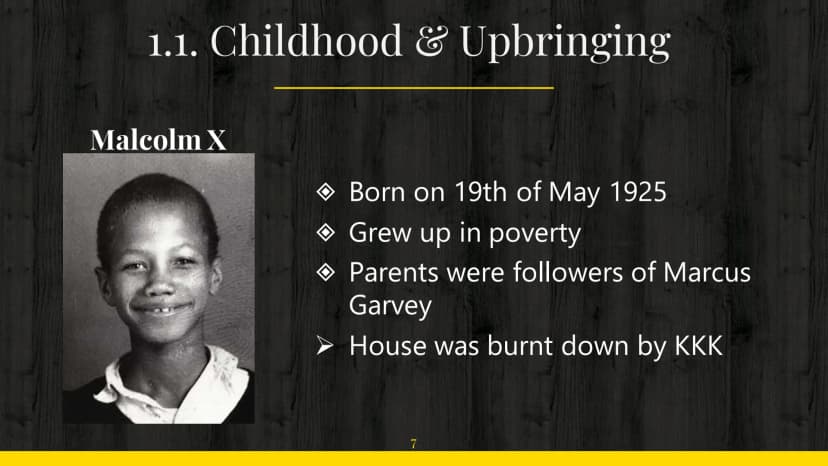
Martin Luther King Jr. was born into a stable, middle-class family in Atlanta on January 15, 1929. His father served as a prominent Baptist pastor while his mother worked as a teacher, providing him with strong educational and spiritual foundations. This nurturing environment, coupled with his parents' emphasis on dignity and non-violent resistance, profoundly influenced his later philosophy of peaceful protest.
Definition: Non-violent resistance - A strategy for social change that rejects the use of violence, instead relying on peaceful protest methods like boycotts, civil disobedience, and peaceful demonstrations.
Malcolm X's early life presented a stark contrast. Born Malcolm Little on May 19, 1925, he experienced severe trauma and hardship from an early age. His parents were active followers of Marcus Garvey's black nationalist movement, which made them targets of white supremacist groups. The Ku Klux Klan burned down their home, foreshadowing the violence that would continue to impact his family.
Highlight: The dramatic differences in their childhoods - King's stable, supportive environment versus Malcolm X's experience of poverty and violence - heavily influenced their later approaches to civil rights activism.
The tragic death of Malcolm's father, likely at the hands of white supremacists, followed by his mother's institutionalization, left him navigating the foster care system. His academic aspirations were crushed when a teacher told him becoming a lawyer was "unrealistic for a black boy," leading him to drop out of school. These early experiences of systemic racism and personal tragedy shaped his more militant approach to racial justice.
6
of 10
The Path to Leadership: Divergent Roads to Activism
The Malcolm X and Martin Luther King comparison becomes particularly striking when examining their educational and early adult experiences. King pursued formal education, earning a sociology degree before continuing to graduate studies in theology. His academic background reinforced his belief in using intellectual discourse and moral persuasion to achieve social change.
Quote: "Intelligence plus character - that is the goal of true education." - Martin Luther King Jr.
Malcolm X's path to leadership emerged through different channels. After dropping out of school, he became involved in criminal activities in Boston and New York. However, his time in prison became transformative, leading him to the Nation of Islam and intensive self-education. This period of self-study and spiritual conversion shaped his understanding of racial justice and black empowerment.
Their divergent paths to leadership reflect the complexity of the Civil Rights Movement itself, demonstrating how different experiences could lead to varying approaches in fighting for racial equality. While King's approach was rooted in his Christian upbringing and formal education, Malcolm X's perspective was forged through personal hardship and self-directed learning.
Example: King's response to injustice was shaped by his father's teachings about Christian love and non-violence, while Malcolm X's approach was influenced by his direct experiences with white supremacy and systemic oppression.
7
of 10
Impact and Legacy: Two Approaches to Civil Rights
The Civil Rights Movement contributions by Malcolm X and Martin Luther King demonstrate how different philosophical approaches could work toward the same ultimate goal of racial justice. King's non-violent resistance strategy, developed through his religious training and academic study, proved effective in mobilizing both black and white Americans.
Malcolm X's more radical approach, emphasizing black pride, self-reliance, and the right to self-defense, resonated deeply with urban African Americans who had experienced similar hardships to his own. His message of black nationalism and economic independence offered an alternative path to empowerment.
Vocabulary: Black Nationalism - A political and social movement advocating for separate black institutions and economic self-reliance within the African American community.
These contrasting approaches ultimately complemented each other in the larger struggle for civil rights. King's peaceful protests and Malcolm X's militant stance represented different but necessary responses to racial oppression, demonstrating that social movements often require diverse strategies to achieve their goals.
8
of 10
Historical Context and Modern Relevance
The childhood experiences of both leaders must be understood within the broader context of racial segregation and discrimination in early 20th century America. Their different responses to systemic racism - King's integration-focused approach and Malcolm X's emphasis on black separation and self-determination - reflected the complex reality of African American life during this period.
Their early experiences continue to resonate in contemporary discussions about racial justice and social change. King's middle-class background and formal education provided him with tools to navigate white society, while Malcolm X's experiences of poverty and discrimination led him to advocate for more radical solutions.
Highlight: Both leaders' approaches to civil rights activism were directly shaped by their childhood experiences: King's stable, educated background led to his strategy of peaceful integration, while Malcolm X's traumatic youth influenced his more militant stance on black empowerment.
The lasting impact of their different philosophies demonstrates how personal experience shapes political consciousness and social movement leadership. Their contrasting paths remind us that the struggle for justice can take many forms, all valuable in their own way.
9
of 10
Malcolm X's Journey Through Prison and Transformation
During his early years, Malcolm X became entangled in a life of crime that would ultimately lead to a profound transformation. Before becoming a prominent civil rights leader, he engaged in various illegal activities including burglary, drug dealing, and robbery in Boston and New York City. These actions reflected the harsh realities and limited opportunities available to young African Americans in the 1940s.
Definition: The term "Detroit Red" was Malcolm X's street name during his criminal years, referring to his reddish hair color and time spent in Detroit.
In 1946, at the age of 20, Malcolm X received a 10-year prison sentence for burglary and larceny. This imprisonment, though initially devastating, became the catalyst for his remarkable transformation. While incarcerated at Norfolk Prison Colony in Massachusetts, he underwent a profound intellectual and spiritual awakening that would reshape his entire worldview and future direction.
The prison environment, despite its restrictions, provided Malcolm X with unprecedented access to the prison's extensive library. He devoted countless hours to reading, self-education, and developing his understanding of history, philosophy, and religion. It was during this period that he was introduced to the Nation of Islam through his siblings' letters, leading to his conversion and eventual emergence as one of the organization's most influential leaders.
Highlight: Malcolm X's prison transformation exemplifies how education and spiritual awakening can radically change a person's life direction and purpose.
10
of 10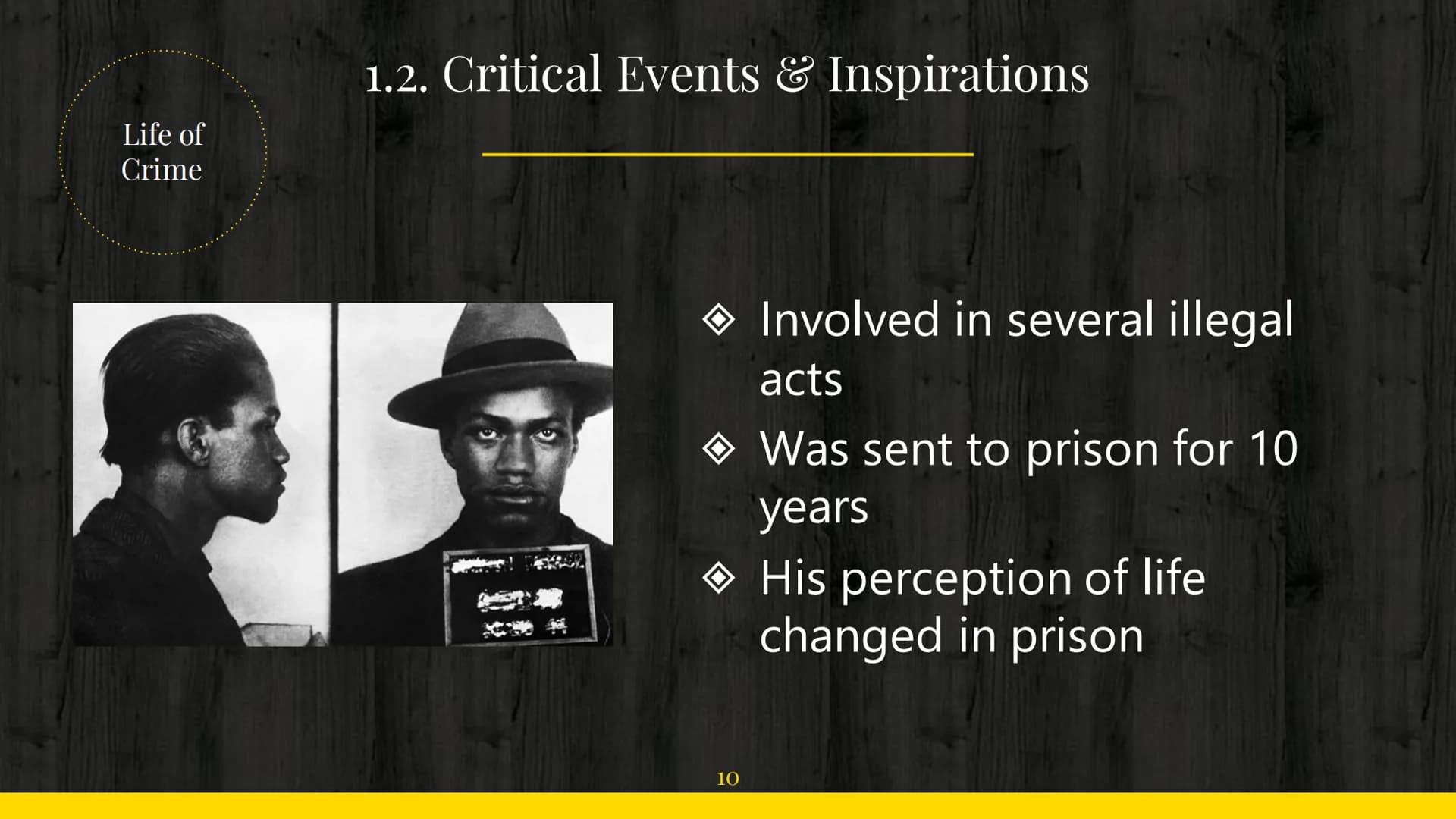
The Impact of Imprisonment on Malcolm X's Activism
The decade Malcolm X spent in prison proved to be the foundational period that shaped his future role in the Civil Rights Movement. His intensive study and reflection during imprisonment developed his critical thinking skills and deepened his understanding of systemic racism and social injustice in America.
During his incarceration, Malcolm X developed a rigorous daily routine of reading and studying, often reading until the lights went out at night. He famously copied the entire dictionary by hand to improve his vocabulary and writing skills. This dedication to self-improvement and education became a cornerstone of his later teachings about black empowerment and self-reliance.
Quote: "In my whole life, I had never been able to speak in front of audiences. But now I had to stand up and teach what I had learned about the religion of Islam. I was both teaching and learning at the same time." - Malcolm X
The prison experience transformed Malcolm X from a street criminal into an articulate and powerful advocate for African American rights. This metamorphosis would later influence his approach to civil rights, distinguishing him from other leaders like Martin Luther King Jr., and contributing to the Malcolm X and Martin Luther King comparison that scholars still study today. His emphasis on self-defense and black nationalism, shaped by his prison experience, offered an alternative perspective to King's nonviolent resistance strategy.
We thought you’d never ask...
What is the Knowunity AI companion?
Our AI companion is specifically built for the needs of students. Based on the millions of content pieces we have on the platform we can provide truly meaningful and relevant answers to students. But its not only about answers, the companion is even more about guiding students through their daily learning challenges, with personalised study plans, quizzes or content pieces in the chat and 100% personalisation based on the students skills and developments.
Where can I download the Knowunity app?
You can download the app in the Google Play Store and in the Apple App Store.
Is Knowunity really free of charge?
That's right! Enjoy free access to study content, connect with fellow students, and get instant help – all at your fingertips.
Similar Content
 Sosyal Bilgiler
Most popular content: Comparison
9EnglischVergleich schreiben leicht gemacht
Diese Anleitung bietet eine strukturierte Methode zum Schreiben von Vergleichen, einschließlich der PEE-Methode und nützlicher Linking-Wörter. Ideal für Schüler, die ihre Schreibfähigkeiten verbessern möchten. Enthält Tipps zur Einleitung, Hauptteil und Schlussfolgerung.
114,706108
EnglischVergleichsaufsatz schreiben
Erfahren Sie, wie Sie einen Vergleichsaufsatz effektiv verfassen. Diese Anleitung behandelt die Struktur, wichtige Phrasen und Tipps zur Analyse von Ähnlichkeiten und Unterschieden zwischen zwei Themen. Ideal für Schüler, die ihre Schreibfähigkeiten verbessern möchten.
96,24599
EnglischOperatoren und Erwartungen
Entdecken Sie die wichtigsten Operatoren und deren Erwartungen für die englische Sprachprüfung. Diese Zusammenfassung bietet klare Anleitungen zu den Operatoren wie 'diskutieren', 'erklären', 'vergleichen' und 'zusammenfassen', einschließlich der Anforderungen an Einleitungssätze, Argumentationsstrukturen und Textbelege. Ideal für Schüler, die sich auf Prüfungen vorbereiten.
112,61724
EnglischText-Visual Material Vergleich
Erfahren Sie, wie Sie schriftliche Texte und visuelle Materialien effektiv vergleichen und analysieren können. Diese Anleitung bietet eine klare Struktur für die Einführung, den Hauptteil und die Schlussfolgerung, um die wichtigsten Ähnlichkeiten und Unterschiede zu identifizieren. Ideal für die Vorbereitung auf Prüfungen oder das Schreiben kritischer Essays.
101,33613
EnglischEffektive Outline & Vergleich
Diese Anleitung bietet eine klare Struktur und wichtige Tipps zum Verfassen von Outlines und Vergleichen in Englisch (Q1 GK). Erfahren Sie, wie Sie relevante Informationen sammeln, eigene Worte verwenden und überzeugende Argumente formulieren. Ideal für die Vorbereitung auf Prüfungen.
1111,009144
EnglischEinfluss der Einwanderung auf die USA
Diese Zusammenfassung behandelt den Einfluss der Einwanderung auf die amerikanische Gesellschaft, einschließlich der Analyse von Charles Hirschmans Artikel und Joseph Kepplers Karikatur. Sie umfasst eine prägnante Zusammenfassung, einen Vergleich zwischen Text und Bild sowie eine kritische Betrachtung eines Zitats über die Assimilation von Einwanderern. Ideal für Schüler, die sich auf ihre Englischklausur vorbereiten.
115,09395
EnglischBill und Georgie: Trauerbewältigung
Diese Analyse untersucht die Beziehung zwischen Bill Denbrough und seinem verstorbenen Bruder Georgie aus Stephen Kings *Es*. Der Fokus liegt auf Bills emotionalem Kampf und den unterschiedlichen Bewältigungsmechanismen im Vergleich zu Gordie und seinem Bruder Dennis. Die Aufgaben umfassen eine Zusammenfassung des Textes, einen Vergleich der Brüderbeziehungen und eine Kommentierung der Trauerbewältigung. Ideal für Englisch E2 Schüler, die sich mit literarischen Themen und Charakteranalysen auseinandersetzen.
112,97244
EnglischTextarten effektiv verfassen
Erfahren Sie, wie Sie verschiedene Textarten wie Kommentare, Zusammenfassungen und Vergleiche in Englisch schreiben. Diese Anleitung bietet nützliche Phrasen, Strukturhinweise und Tipps zur Verwendung formeller Sprache. Ideal für Studierende, die ihre Schreibfähigkeiten verbessern möchten.
102,63968
EnglischEveline: Lebensentscheidungen
Analysiere die Lebenssituation von Eveline in James Joyces Kurzgeschichte. Untersuche ihre Gründe für das Verlassen ihres Zuhauses und vergleiche sie mit der Figur Grace aus der Geschichte 'Red'. Diese Analyse umfasst die Beschreibung von Evelines Herausforderungen, ihre inneren Konflikte und die Bedeutung ihrer Versprechen. Ideal für die Vorbereitung auf Prüfungen und das Verständnis literarischer Themen.
112,23627
Most popular content in Englisch
9EnglischEnglisch LK Abitur 2025
Komplette Englisch LK Abi Zusammenfassung 2025
1315,040394
EnglischGlobale Themen und Analysen
Entdecken Sie umfassende Analysen zu Globalisierung, dem amerikanischen Traum, britischer Kolonialgeschichte, Shakespeare und mehr. Diese Zusammenstellung bietet Einblicke in narrative Techniken, rhetorische Strategien und gesellschaftliche Kontexte. Ideal für Schüler, die sich auf das Abitur vorbereiten und ein tiefes Verständnis für verschiedene Themen entwickeln möchten.
1310,305192
EnglischEnglisch Abitur 2023: Lernmaterialien
Entdecken Sie umfassende Lernmaterialien für das Englisch Abitur 2023 in NRW. Diese Sammlung umfasst wichtige Themen wie die nigerianische Ölindustrie, Rhetorikanalyse, Immigration, Brexit, britische Regierungssysteme und vieles mehr. Ideal für die Vorbereitung auf Prüfungen und das Verständnis zentraler Konzepte. Nutzen Sie diese Ressourcen, um Ihre Kenntnisse zu vertiefen und erfolgreich zu lernen.
1252,1121,471
1
Englisch10 unregelmäßige Verben im past participle
unregelmäßige Verben aus Englisch - past participle
64,2593
EnglischBehold the Dreamers Zusammenfassung
Zusammenfassung für jedes Kapitel „Behold the Dreamers“ von Imbolo Mbue
1112,360164
EnglischBehold the Dreamers: Kapitelanalyse
Detaillierte Kapitelanalyse von 'Behold the Dreamers' von Imbolo Mbue. Diese Zusammenfassung behandelt zentrale Themen wie den nigerianischen Traum, gesellschaftliche Kontexte und die Herausforderungen der Einwanderung. Ideal für Studierende, die sich mit den komplexen Themen des Romans auseinandersetzen möchten.
1137,585398
EnglischEnglisch LK Abi Lernzettel 2025
Englisch LK Hessen lernzettel für 2025
135,38497
EnglischEnglisch Abitur SH 2025
Text types, Globalization, Climate Change
124,10697
EnglischAbi Hessen 2025 Englisch Lektüren LK
Gran Torino, Othello, The Circle, Embassy of Cambodia, Shooting an Elephant, My Son the Fanatic
134,54787
Most popular content
9 Deutsch
Der zerbrochene Krug
Szenenzusammenfassunfen, Figurenkonstellationen, Aufbau des Stücks, Sprache und Stilbesonderheiten, Aussageabsicht, Thematik, Interpretation
1148,034728
DeutschDer zerbrochene Krug von Heinrich von Kleist
Hier steht so ziemlich alles drinnen von Zusammenfassungen der einzelnen Auftritte bis hin zu den einzelnen Perosn und noch einiges mehr
1254,769921
DeutschDer zerbrochne Krug
Ausführliche Lernzettel zu: Basisdaten, Handlung, ausführliche Zusammenfassungen der Auftritte, zentrale Themen, Symbolische Bedeutung, Merkmale der Komödie
1214,327253
DeutschHeimsuchung_JennyErpenbeck_Abitur
Zusammenfassungen für jedes Kapitel, Analysen und Zitate
1314,076277
 Mathe
MatheZP10 Mathe Zusammenfassung NRW
Lernzettel für die ZP10 Mathe in NRW mit allen Themen außer Sinusfunktionen.
1061,9114,842
DeutschDer zerbrochene Krug: Analyse
Diese umfassende Analyse von 'Der zerbrochene Krug' von Heinrich von Kleist bietet eine detaillierte Kapitelzusammenfassung, Charakterisierungen, historische Kontexte, sowie den Aufbau und die sprachlichen Merkmale des Dramas. Ideal für Studierende, die sich auf Prüfungen vorbereiten oder tiefere Einblicke in Kleists Werk gewinnen möchten.
1199,8351,255
EnglischEnglisch LK Abitur 2025
Komplette Englisch LK Abi Zusammenfassung 2025
1315,040394
DeutschSchreibkompetenzen Deutsch LK
Diese umfassende Zusammenstellung bereitet auf das Abitur 2024 vor und deckt alle relevanten Schreibkompetenzen ab: von der Analyse pragmatischer Texte über die Erörterung literarischer Werke bis hin zur Interpretation von Epik, Lyrik und Dramatik. Zudem werden Techniken des materialgestützten Schreibens, der Redeanalyse sowie journalistische Textsorten und rhetorische Mittel behandelt. Ideal für eine gezielte und effektive Prüfungsvorbereitung.
138,207165
DeutschJenny Erpenbeck "Heimsuchung"
Übersicht und Struktur des Romans
117,998168
Can't find what you're looking for? Explore other subjects.
Students love us — and so will you.
4.6/5App Store
4.7/5Google Play
The app is very easy to use and well designed. I have found everything I was looking for so far and have been able to learn a lot from the presentations! I will definitely use the app for a class assignment! And of course it also helps a lot as an inspiration.
Stefan SiOS user
This app is really great. There are so many study notes and help [...]. My problem subject is French, for example, and the app has so many options for help. Thanks to this app, I have improved my French. I would recommend it to anyone.
Samantha KlichAndroid user
Wow, I am really amazed. I just tried the app because I've seen it advertised many times and was absolutely stunned. This app is THE HELP you want for school and above all, it offers so many things, such as workouts and fact sheets, which have been VERY helpful to me personally.
AnnaiOS user
Englisch2,434 views·Updated Jun 25, 2026·29 pagesComparing Malcolm X and Martin Luther King: Their Childhoods and Civil Rights Contributions
Jasmin@cayennedyen_arg
The Malcolm X and Martin Luther King comparison reveals two influential leaders who shaped the Civil Rights Movement through different approaches and philosophies. While both fought against racial injustice, their methods and beliefs were shaped by their unique experiences.
Their ...
1
of 10
Sign up to see the content. It's free!
- Access to all documents
- Improve your grades
- Join milions of students
The Legacy of Malcolm X and Martin Luther King: A Historical Analysis
The profound impact of Malcolm X and Martin Luther King on American civil rights remains unmatched in modern history. Their different approaches to achieving racial equality stemmed from their distinct upbringings and life experiences, shaping two of the most influential leaders in the fight for civil rights.
Definition: The Civil Rights Movement was a decades-long struggle by African Americans to achieve social justice and equal rights under the law, reaching its peak in the 1950s and 1960s.
Their journeys, while different in many aspects, shared the common goal of advancing African American rights and dignity. Both leaders emerged during a pivotal time in American history when racial segregation and discrimination were deeply entrenched in society. Understanding their backgrounds provides crucial insight into their later philosophical differences and approaches to activism.
These two figures, often portrayed as opposites, actually complemented each other's work in many ways. Their combined influence created a powerful force for change in American society, though they employed different strategies and held contrasting views on how to achieve racial equality.
2
of 10Sign up to see the content. It's free!
- Access to all documents
- Improve your grades
- Join milions of students
Early Life Influences and Philosophical Foundations
The childhood influences on Malcolm X and Martin Luther King activism were markedly different. King grew up in a middle-class family in Atlanta, surrounded by educated civil rights activists and religious leaders. His father was a prominent Baptist minister who instilled in him strong Christian values and a belief in nonviolent resistance.
Highlight: Malcolm X's early life was marked by tragedy and hardship, while King's upbringing was relatively privileged and stable. These contrasting experiences significantly shaped their later approaches to civil rights activism.
Malcolm X, born Malcolm Little, experienced severe racial violence and poverty in his youth. His father was murdered by white supremacists, and his mother was institutionalized, leading to his placement in foster homes. These early traumatic experiences shaped his more militant approach to racial justice and his initial rejection of integration with white society.
Their educational paths also diverged significantly. King received formal education at Morehouse College and Boston University, earning a Ph.D. in systematic theology. Malcolm X largely educated himself during his imprisonment, where he underwent a transformative experience and converted to the Nation of Islam.
3
of 10Sign up to see the content. It's free!
- Access to all documents
- Improve your grades
- Join milions of students
Contrasting Approaches to Civil Rights
The Civil Rights Movement contributions by Malcolm X and Martin Luther King reflected their different philosophies and backgrounds. King advocated for nonviolent civil disobedience, inspired by Mahatma Gandhi's successful resistance against British colonial rule in India. His approach emphasized integration, peaceful protest, and working within the existing political system.
Quote: "Darkness cannot drive out darkness; only light can do that. Hate cannot drive out hate; only love can do that." - Martin Luther King Jr.
Malcolm X initially promoted black nationalism and self-reliance, rejecting the notion of integration. He believed in self-defense "by any means necessary" and criticized the nonviolent approach as ineffective. However, after his split from the Nation of Islam and his pilgrimage to Mecca, his views evolved to become more inclusive.
Their different strategies created a dynamic tension within the Civil Rights Movement. While King's approach appealed to moderate whites and emphasized moral persuasion, Malcolm X's message resonated with urban blacks and those who had lost faith in the possibility of peaceful change. Together, they provided complementary forces that pushed American society toward meaningful reform.
4
of 10Sign up to see the content. It's free!
- Access to all documents
- Improve your grades
- Join milions of students
Impact and Historical Significance
The Malcolm X and Martin Luther King comparison reveals how different approaches to fighting injustice can contribute to social change. While their methods differed, both leaders made crucial contributions to the advancement of civil rights in America.
Example: King's March on Washington and Malcolm X's "The Ballot or the Bullet" speech represent their contrasting yet equally powerful approaches to achieving racial equality.
Their legacies continue to influence modern social justice movements. King's emphasis on nonviolent resistance and coalition-building has become a model for peaceful protest worldwide. Malcolm X's focus on black pride, self-determination, and human rights has inspired generations of activists fighting for racial justice.
Both leaders evolved in their thinking over time, with Malcolm X becoming more open to interracial cooperation after his pilgrimage to Mecca, and King becoming more radical in his critique of economic inequality and the Vietnam War before his assassination. Their transformations demonstrate the complexity of the struggle for civil rights and the importance of being willing to grow and adapt in the pursuit of justice.
5
of 10Sign up to see the content. It's free!
- Access to all documents
- Improve your grades
- Join milions of students
Early Life and Influences: Martin Luther King Jr. and Malcolm X
Childhood influences on Malcolm X and Martin Luther King activism shaped these two influential Civil Rights leaders in dramatically different ways. Their contrasting upbringings helped form their distinct approaches to fighting racial injustice in America.
Martin Luther King Jr. was born into a stable, middle-class family in Atlanta on January 15, 1929. His father served as a prominent Baptist pastor while his mother worked as a teacher, providing him with strong educational and spiritual foundations. This nurturing environment, coupled with his parents' emphasis on dignity and non-violent resistance, profoundly influenced his later philosophy of peaceful protest.
Definition: Non-violent resistance - A strategy for social change that rejects the use of violence, instead relying on peaceful protest methods like boycotts, civil disobedience, and peaceful demonstrations.
Malcolm X's early life presented a stark contrast. Born Malcolm Little on May 19, 1925, he experienced severe trauma and hardship from an early age. His parents were active followers of Marcus Garvey's black nationalist movement, which made them targets of white supremacist groups. The Ku Klux Klan burned down their home, foreshadowing the violence that would continue to impact his family.
Highlight: The dramatic differences in their childhoods - King's stable, supportive environment versus Malcolm X's experience of poverty and violence - heavily influenced their later approaches to civil rights activism.
The tragic death of Malcolm's father, likely at the hands of white supremacists, followed by his mother's institutionalization, left him navigating the foster care system. His academic aspirations were crushed when a teacher told him becoming a lawyer was "unrealistic for a black boy," leading him to drop out of school. These early experiences of systemic racism and personal tragedy shaped his more militant approach to racial justice.
6
of 10Sign up to see the content. It's free!
- Access to all documents
- Improve your grades
- Join milions of students
The Path to Leadership: Divergent Roads to Activism
The Malcolm X and Martin Luther King comparison becomes particularly striking when examining their educational and early adult experiences. King pursued formal education, earning a sociology degree before continuing to graduate studies in theology. His academic background reinforced his belief in using intellectual discourse and moral persuasion to achieve social change.
Quote: "Intelligence plus character - that is the goal of true education." - Martin Luther King Jr.
Malcolm X's path to leadership emerged through different channels. After dropping out of school, he became involved in criminal activities in Boston and New York. However, his time in prison became transformative, leading him to the Nation of Islam and intensive self-education. This period of self-study and spiritual conversion shaped his understanding of racial justice and black empowerment.
Their divergent paths to leadership reflect the complexity of the Civil Rights Movement itself, demonstrating how different experiences could lead to varying approaches in fighting for racial equality. While King's approach was rooted in his Christian upbringing and formal education, Malcolm X's perspective was forged through personal hardship and self-directed learning.
Example: King's response to injustice was shaped by his father's teachings about Christian love and non-violence, while Malcolm X's approach was influenced by his direct experiences with white supremacy and systemic oppression.
7
of 10Sign up to see the content. It's free!
- Access to all documents
- Improve your grades
- Join milions of students
Impact and Legacy: Two Approaches to Civil Rights
The Civil Rights Movement contributions by Malcolm X and Martin Luther King demonstrate how different philosophical approaches could work toward the same ultimate goal of racial justice. King's non-violent resistance strategy, developed through his religious training and academic study, proved effective in mobilizing both black and white Americans.
Malcolm X's more radical approach, emphasizing black pride, self-reliance, and the right to self-defense, resonated deeply with urban African Americans who had experienced similar hardships to his own. His message of black nationalism and economic independence offered an alternative path to empowerment.
Vocabulary: Black Nationalism - A political and social movement advocating for separate black institutions and economic self-reliance within the African American community.
These contrasting approaches ultimately complemented each other in the larger struggle for civil rights. King's peaceful protests and Malcolm X's militant stance represented different but necessary responses to racial oppression, demonstrating that social movements often require diverse strategies to achieve their goals.
8
of 10Sign up to see the content. It's free!
- Access to all documents
- Improve your grades
- Join milions of students
Historical Context and Modern Relevance
The childhood experiences of both leaders must be understood within the broader context of racial segregation and discrimination in early 20th century America. Their different responses to systemic racism - King's integration-focused approach and Malcolm X's emphasis on black separation and self-determination - reflected the complex reality of African American life during this period.
Their early experiences continue to resonate in contemporary discussions about racial justice and social change. King's middle-class background and formal education provided him with tools to navigate white society, while Malcolm X's experiences of poverty and discrimination led him to advocate for more radical solutions.
Highlight: Both leaders' approaches to civil rights activism were directly shaped by their childhood experiences: King's stable, educated background led to his strategy of peaceful integration, while Malcolm X's traumatic youth influenced his more militant stance on black empowerment.
The lasting impact of their different philosophies demonstrates how personal experience shapes political consciousness and social movement leadership. Their contrasting paths remind us that the struggle for justice can take many forms, all valuable in their own way.
9
of 10Sign up to see the content. It's free!
- Access to all documents
- Improve your grades
- Join milions of students
Malcolm X's Journey Through Prison and Transformation
During his early years, Malcolm X became entangled in a life of crime that would ultimately lead to a profound transformation. Before becoming a prominent civil rights leader, he engaged in various illegal activities including burglary, drug dealing, and robbery in Boston and New York City. These actions reflected the harsh realities and limited opportunities available to young African Americans in the 1940s.
Definition: The term "Detroit Red" was Malcolm X's street name during his criminal years, referring to his reddish hair color and time spent in Detroit.
In 1946, at the age of 20, Malcolm X received a 10-year prison sentence for burglary and larceny. This imprisonment, though initially devastating, became the catalyst for his remarkable transformation. While incarcerated at Norfolk Prison Colony in Massachusetts, he underwent a profound intellectual and spiritual awakening that would reshape his entire worldview and future direction.
The prison environment, despite its restrictions, provided Malcolm X with unprecedented access to the prison's extensive library. He devoted countless hours to reading, self-education, and developing his understanding of history, philosophy, and religion. It was during this period that he was introduced to the Nation of Islam through his siblings' letters, leading to his conversion and eventual emergence as one of the organization's most influential leaders.
Highlight: Malcolm X's prison transformation exemplifies how education and spiritual awakening can radically change a person's life direction and purpose.
10
of 10Sign up to see the content. It's free!
- Access to all documents
- Improve your grades
- Join milions of students
The Impact of Imprisonment on Malcolm X's Activism
The decade Malcolm X spent in prison proved to be the foundational period that shaped his future role in the Civil Rights Movement. His intensive study and reflection during imprisonment developed his critical thinking skills and deepened his understanding of systemic racism and social injustice in America.
During his incarceration, Malcolm X developed a rigorous daily routine of reading and studying, often reading until the lights went out at night. He famously copied the entire dictionary by hand to improve his vocabulary and writing skills. This dedication to self-improvement and education became a cornerstone of his later teachings about black empowerment and self-reliance.
Quote: "In my whole life, I had never been able to speak in front of audiences. But now I had to stand up and teach what I had learned about the religion of Islam. I was both teaching and learning at the same time." - Malcolm X
The prison experience transformed Malcolm X from a street criminal into an articulate and powerful advocate for African American rights. This metamorphosis would later influence his approach to civil rights, distinguishing him from other leaders like Martin Luther King Jr., and contributing to the Malcolm X and Martin Luther King comparison that scholars still study today. His emphasis on self-defense and black nationalism, shaped by his prison experience, offered an alternative perspective to King's nonviolent resistance strategy.
We thought you’d never ask...
What is the Knowunity AI companion?
Our AI companion is specifically built for the needs of students. Based on the millions of content pieces we have on the platform we can provide truly meaningful and relevant answers to students. But its not only about answers, the companion is even more about guiding students through their daily learning challenges, with personalised study plans, quizzes or content pieces in the chat and 100% personalisation based on the students skills and developments.
Where can I download the Knowunity app?
You can download the app in the Google Play Store and in the Apple App Store.
Is Knowunity really free of charge?
That's right! Enjoy free access to study content, connect with fellow students, and get instant help – all at your fingertips.
Similar Content
Most popular content: Comparison
9EnglischVergleich schreiben leicht gemacht
Diese Anleitung bietet eine strukturierte Methode zum Schreiben von Vergleichen, einschließlich der PEE-Methode und nützlicher Linking-Wörter. Ideal für Schüler, die ihre Schreibfähigkeiten verbessern möchten. Enthält Tipps zur Einleitung, Hauptteil und Schlussfolgerung.
114,706108
EnglischVergleichsaufsatz schreiben
Erfahren Sie, wie Sie einen Vergleichsaufsatz effektiv verfassen. Diese Anleitung behandelt die Struktur, wichtige Phrasen und Tipps zur Analyse von Ähnlichkeiten und Unterschieden zwischen zwei Themen. Ideal für Schüler, die ihre Schreibfähigkeiten verbessern möchten.
96,24599
EnglischOperatoren und Erwartungen
Entdecken Sie die wichtigsten Operatoren und deren Erwartungen für die englische Sprachprüfung. Diese Zusammenfassung bietet klare Anleitungen zu den Operatoren wie 'diskutieren', 'erklären', 'vergleichen' und 'zusammenfassen', einschließlich der Anforderungen an Einleitungssätze, Argumentationsstrukturen und Textbelege. Ideal für Schüler, die sich auf Prüfungen vorbereiten.
112,61724
EnglischText-Visual Material Vergleich
Erfahren Sie, wie Sie schriftliche Texte und visuelle Materialien effektiv vergleichen und analysieren können. Diese Anleitung bietet eine klare Struktur für die Einführung, den Hauptteil und die Schlussfolgerung, um die wichtigsten Ähnlichkeiten und Unterschiede zu identifizieren. Ideal für die Vorbereitung auf Prüfungen oder das Schreiben kritischer Essays.
101,33613
EnglischEffektive Outline & Vergleich
Diese Anleitung bietet eine klare Struktur und wichtige Tipps zum Verfassen von Outlines und Vergleichen in Englisch (Q1 GK). Erfahren Sie, wie Sie relevante Informationen sammeln, eigene Worte verwenden und überzeugende Argumente formulieren. Ideal für die Vorbereitung auf Prüfungen.
1111,009144
EnglischEinfluss der Einwanderung auf die USA
Diese Zusammenfassung behandelt den Einfluss der Einwanderung auf die amerikanische Gesellschaft, einschließlich der Analyse von Charles Hirschmans Artikel und Joseph Kepplers Karikatur. Sie umfasst eine prägnante Zusammenfassung, einen Vergleich zwischen Text und Bild sowie eine kritische Betrachtung eines Zitats über die Assimilation von Einwanderern. Ideal für Schüler, die sich auf ihre Englischklausur vorbereiten.
115,09395
EnglischBill und Georgie: Trauerbewältigung
Diese Analyse untersucht die Beziehung zwischen Bill Denbrough und seinem verstorbenen Bruder Georgie aus Stephen Kings *Es*. Der Fokus liegt auf Bills emotionalem Kampf und den unterschiedlichen Bewältigungsmechanismen im Vergleich zu Gordie und seinem Bruder Dennis. Die Aufgaben umfassen eine Zusammenfassung des Textes, einen Vergleich der Brüderbeziehungen und eine Kommentierung der Trauerbewältigung. Ideal für Englisch E2 Schüler, die sich mit literarischen Themen und Charakteranalysen auseinandersetzen.
112,97244
EnglischTextarten effektiv verfassen
Erfahren Sie, wie Sie verschiedene Textarten wie Kommentare, Zusammenfassungen und Vergleiche in Englisch schreiben. Diese Anleitung bietet nützliche Phrasen, Strukturhinweise und Tipps zur Verwendung formeller Sprache. Ideal für Studierende, die ihre Schreibfähigkeiten verbessern möchten.
102,63968
EnglischEveline: Lebensentscheidungen
Analysiere die Lebenssituation von Eveline in James Joyces Kurzgeschichte. Untersuche ihre Gründe für das Verlassen ihres Zuhauses und vergleiche sie mit der Figur Grace aus der Geschichte 'Red'. Diese Analyse umfasst die Beschreibung von Evelines Herausforderungen, ihre inneren Konflikte und die Bedeutung ihrer Versprechen. Ideal für die Vorbereitung auf Prüfungen und das Verständnis literarischer Themen.
112,23627
Most popular content in Englisch
9EnglischEnglisch LK Abitur 2025
Komplette Englisch LK Abi Zusammenfassung 2025
1315,040394
EnglischGlobale Themen und Analysen
Entdecken Sie umfassende Analysen zu Globalisierung, dem amerikanischen Traum, britischer Kolonialgeschichte, Shakespeare und mehr. Diese Zusammenstellung bietet Einblicke in narrative Techniken, rhetorische Strategien und gesellschaftliche Kontexte. Ideal für Schüler, die sich auf das Abitur vorbereiten und ein tiefes Verständnis für verschiedene Themen entwickeln möchten.
1310,305192
EnglischEnglisch Abitur 2023: Lernmaterialien
Entdecken Sie umfassende Lernmaterialien für das Englisch Abitur 2023 in NRW. Diese Sammlung umfasst wichtige Themen wie die nigerianische Ölindustrie, Rhetorikanalyse, Immigration, Brexit, britische Regierungssysteme und vieles mehr. Ideal für die Vorbereitung auf Prüfungen und das Verständnis zentraler Konzepte. Nutzen Sie diese Ressourcen, um Ihre Kenntnisse zu vertiefen und erfolgreich zu lernen.
1252,1121,471
1
Englisch10 unregelmäßige Verben im past participle
unregelmäßige Verben aus Englisch - past participle
64,2593
EnglischBehold the Dreamers Zusammenfassung
Zusammenfassung für jedes Kapitel „Behold the Dreamers“ von Imbolo Mbue
1112,360164
EnglischBehold the Dreamers: Kapitelanalyse
Detaillierte Kapitelanalyse von 'Behold the Dreamers' von Imbolo Mbue. Diese Zusammenfassung behandelt zentrale Themen wie den nigerianischen Traum, gesellschaftliche Kontexte und die Herausforderungen der Einwanderung. Ideal für Studierende, die sich mit den komplexen Themen des Romans auseinandersetzen möchten.
1137,585398
EnglischEnglisch LK Abi Lernzettel 2025
Englisch LK Hessen lernzettel für 2025
135,38497
EnglischEnglisch Abitur SH 2025
Text types, Globalization, Climate Change
124,10697
EnglischAbi Hessen 2025 Englisch Lektüren LK
Gran Torino, Othello, The Circle, Embassy of Cambodia, Shooting an Elephant, My Son the Fanatic
134,54787
Most popular content
9DeutschDer zerbrochene Krug
Szenenzusammenfassunfen, Figurenkonstellationen, Aufbau des Stücks, Sprache und Stilbesonderheiten, Aussageabsicht, Thematik, Interpretation
1148,034728
DeutschDer zerbrochene Krug von Heinrich von Kleist
Hier steht so ziemlich alles drinnen von Zusammenfassungen der einzelnen Auftritte bis hin zu den einzelnen Perosn und noch einiges mehr
1254,769921
DeutschDer zerbrochne Krug
Ausführliche Lernzettel zu: Basisdaten, Handlung, ausführliche Zusammenfassungen der Auftritte, zentrale Themen, Symbolische Bedeutung, Merkmale der Komödie
1214,327253
DeutschHeimsuchung_JennyErpenbeck_Abitur
Zusammenfassungen für jedes Kapitel, Analysen und Zitate
1314,076277
MatheZP10 Mathe Zusammenfassung NRW
Lernzettel für die ZP10 Mathe in NRW mit allen Themen außer Sinusfunktionen.
1061,9114,842
DeutschDer zerbrochene Krug: Analyse
Diese umfassende Analyse von 'Der zerbrochene Krug' von Heinrich von Kleist bietet eine detaillierte Kapitelzusammenfassung, Charakterisierungen, historische Kontexte, sowie den Aufbau und die sprachlichen Merkmale des Dramas. Ideal für Studierende, die sich auf Prüfungen vorbereiten oder tiefere Einblicke in Kleists Werk gewinnen möchten.
1199,8351,255
EnglischEnglisch LK Abitur 2025
Komplette Englisch LK Abi Zusammenfassung 2025
1315,040394
DeutschSchreibkompetenzen Deutsch LK
Diese umfassende Zusammenstellung bereitet auf das Abitur 2024 vor und deckt alle relevanten Schreibkompetenzen ab: von der Analyse pragmatischer Texte über die Erörterung literarischer Werke bis hin zur Interpretation von Epik, Lyrik und Dramatik. Zudem werden Techniken des materialgestützten Schreibens, der Redeanalyse sowie journalistische Textsorten und rhetorische Mittel behandelt. Ideal für eine gezielte und effektive Prüfungsvorbereitung.
138,207165
DeutschJenny Erpenbeck "Heimsuchung"
Übersicht und Struktur des Romans
117,998168
Can't find what you're looking for? Explore other subjects.
Students love us — and so will you.
4.6/5App Store
4.7/5Google Play
The app is very easy to use and well designed. I have found everything I was looking for so far and have been able to learn a lot from the presentations! I will definitely use the app for a class assignment! And of course it also helps a lot as an inspiration.
Stefan SiOS user
This app is really great. There are so many study notes and help [...]. My problem subject is French, for example, and the app has so many options for help. Thanks to this app, I have improved my French. I would recommend it to anyone.
Samantha KlichAndroid user
Wow, I am really amazed. I just tried the app because I've seen it advertised many times and was absolutely stunned. This app is THE HELP you want for school and above all, it offers so many things, such as workouts and fact sheets, which have been VERY helpful to me personally.
AnnaiOS user