
Prezentul simplu și prezentul continuu sunt două timpuri de bază...
 Engleză235 views·Updated Jun 25, 2026·10 pages
Timpuri Verbale și Exemple Uzuale
A
Andreea Preda@andreeapreda
1 / 10
1
of 10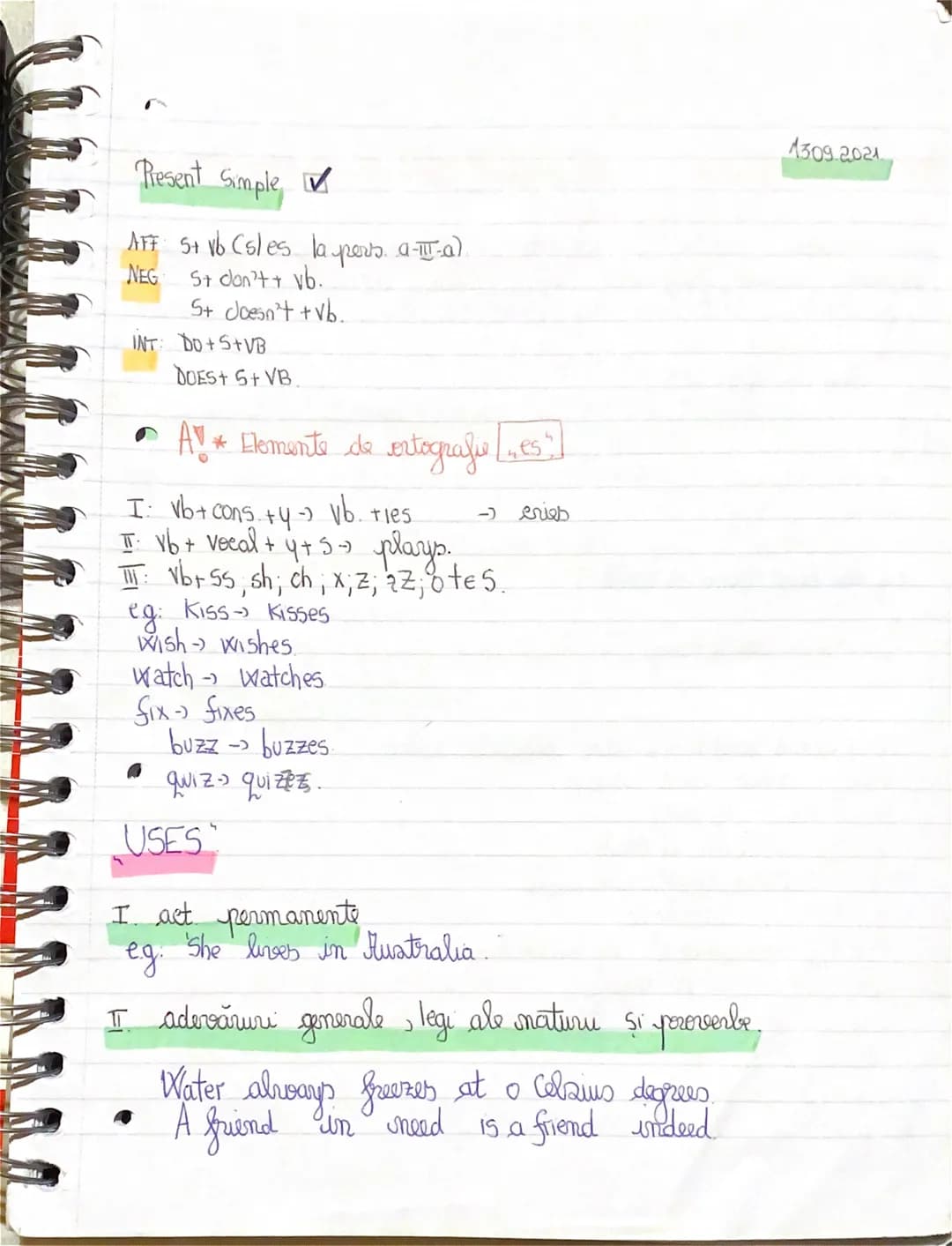
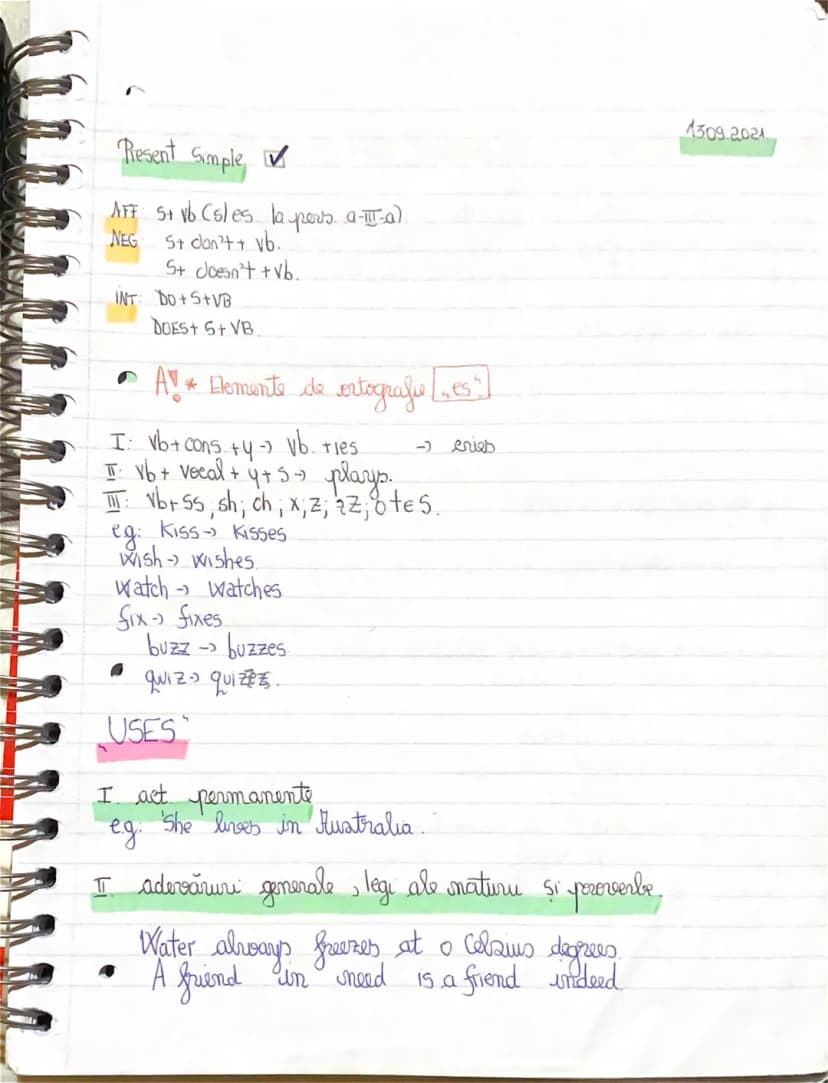
Prezentul Simplu
Prezentul simplu este un timp pe care îl folosim pentru lucruri care se întâmplă mereu sau regulat.
Formarea lui este simplă: subiect + verb (care primește -s sau -es la persoana a III-a singular). La negativ, folosim don't sau doesn't + verb, iar la întrebări începem cu Do sau Does.
💡 La persoana a III-a singular, verbele se schimbă după reguli speciale. Verbele care se termină în -s, -sh, -ch, -x, -z primesc terminația -es (kiss → kisses, watch → watches).
Prezentul simplu se folosește pentru:
- Acțiuni permanente ("She lives in Australia")
- Adevăruri generale și legi ale naturii ("Water freezes at 0 Celsius degrees")
- Proverbe ("A friend in need is a friend indeed")
2
of 10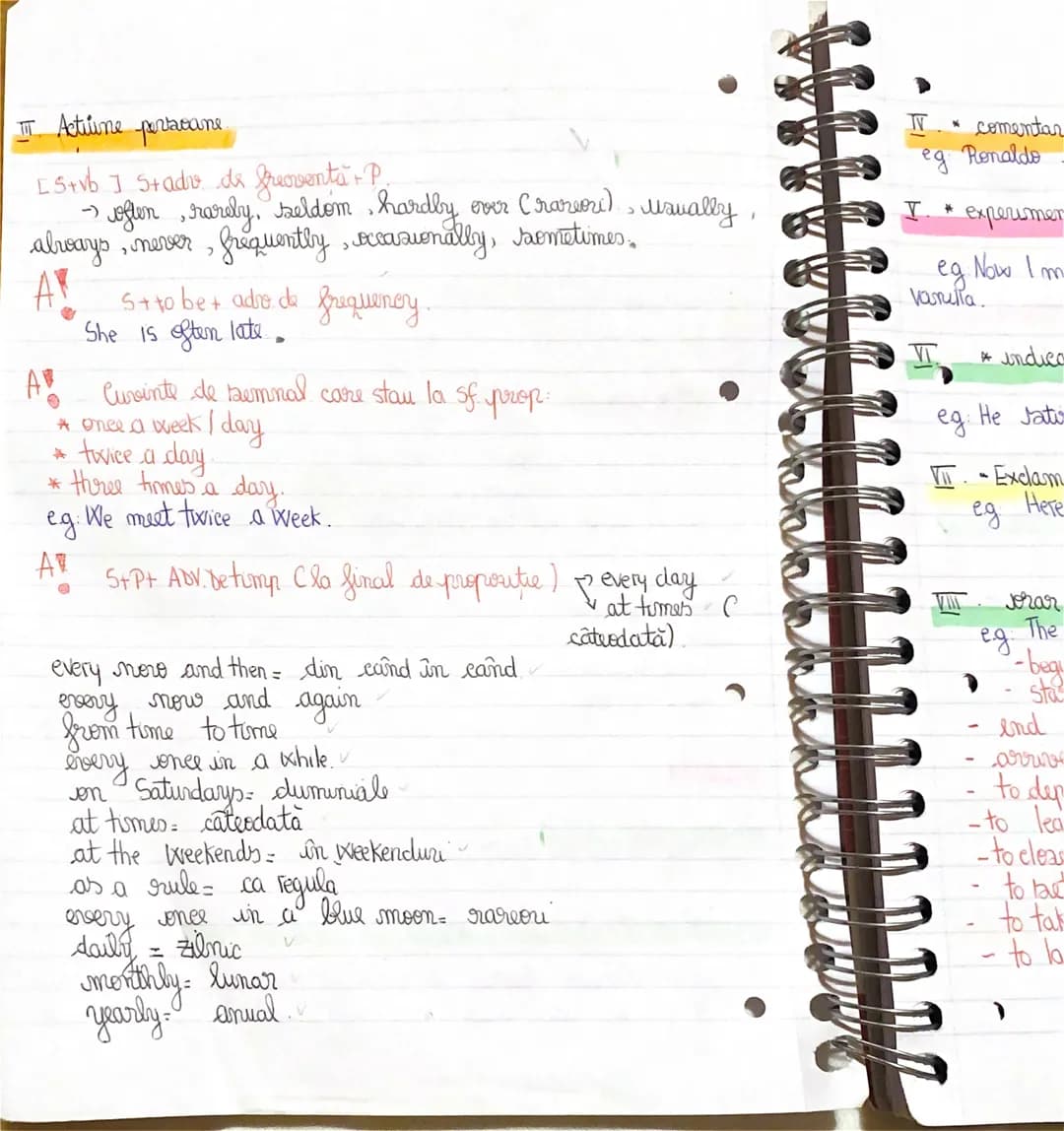
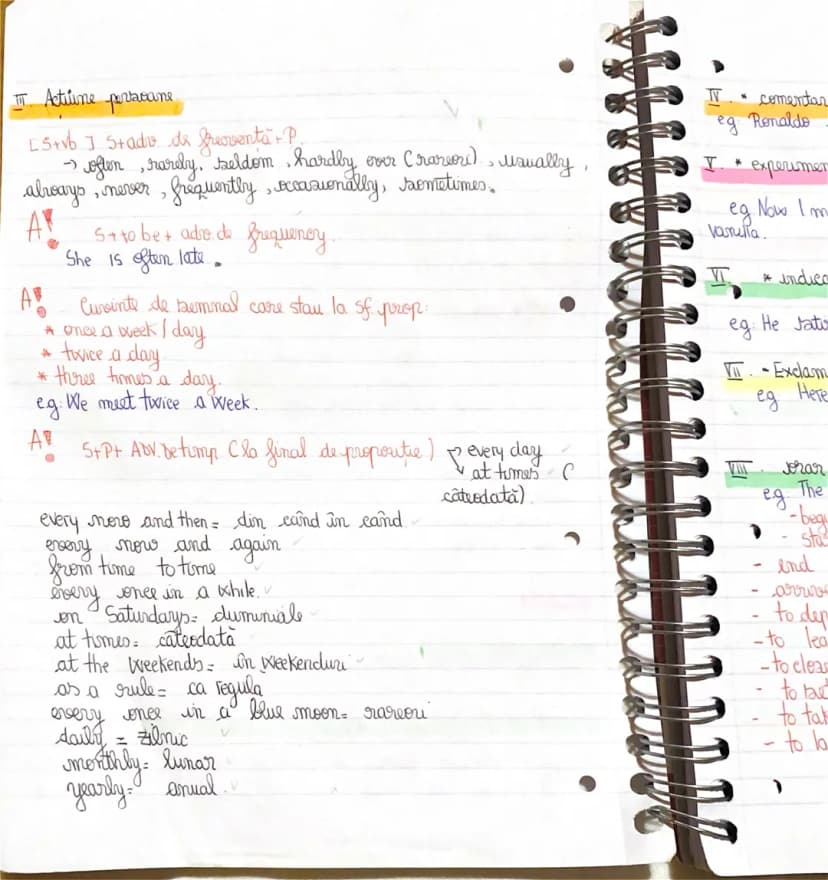
Frecvența în Prezentul Simplu
Când vorbim despre cât de des facem ceva, folosim cuvinte de frecvență:
- Often, rarely, seldom (rareori), usually, always, never
- Ele se pun de obicei între subiect și verb: "She often comes late"
- Cu verbul "to be" se pun după verb: "She is often late"
Alte expresii de timp folosite cu prezentul simplu stau la sfârșitul propoziției:
- Once/twice a week
- Every day/morning
- On Saturdays (sâmbătele)
- At weekends (în weekenduri)
💡 Expresiile "every once in a blue moon" sau "from time to time" înseamnă că ceva se întâmplă foarte rar sau ocazional.
3
of 10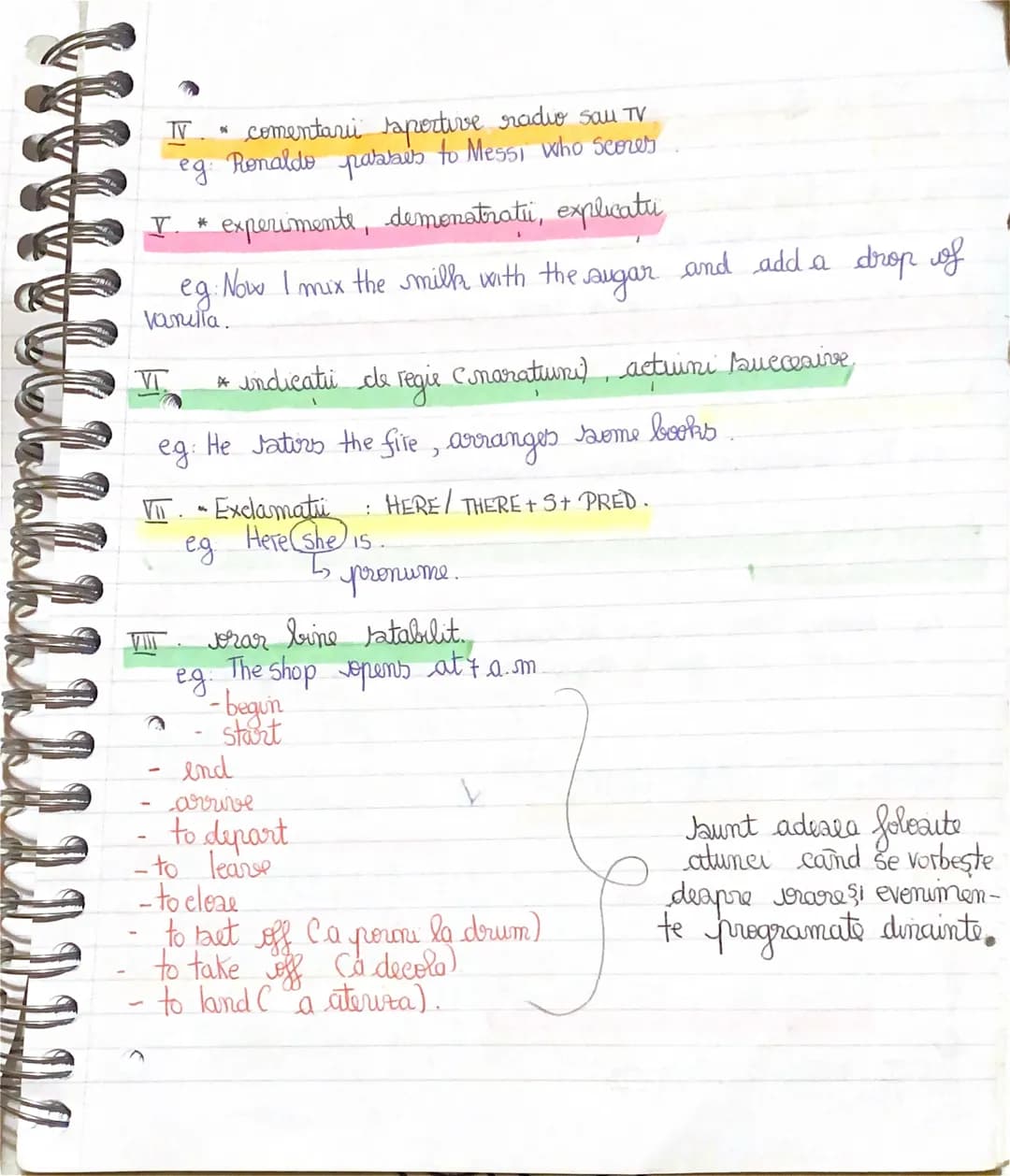
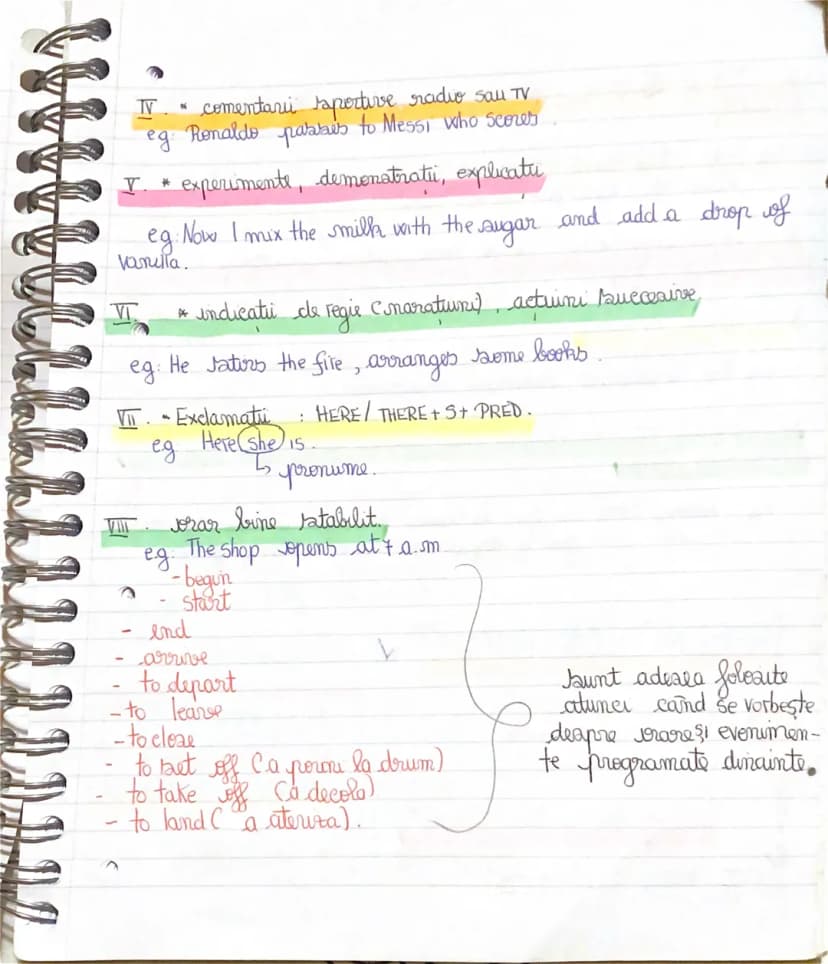
Alte Utilizări ale Prezentului Simplu
Prezentul simplu mai are și alte utilizări interesante:
- În comentarii sportive: "Ronaldo passes to Messi who scores"
- În experimente sau demonstrații: "Now I mix the milk with sugar and add vanilla"
- În indicații sau acțiuni succesive: "He enters the room, arranges some books"
- În exclamații: "Here she is!"
Este folosit și pentru orare și evenimente programate:
- "The shop opens at 7 a.m."
- Verbele de mișcare (begin, start, arrive, depart, leave) sunt folosite cu prezentul simplu când vorbim despre evenimente programate.
💡 Când povestești un film sau o carte, poți folosi prezentul simplu chiar dacă acțiunea s-a întâmplat în trecut: "Harry Potter goes to Hogwarts School. He has two friends."
4
of 10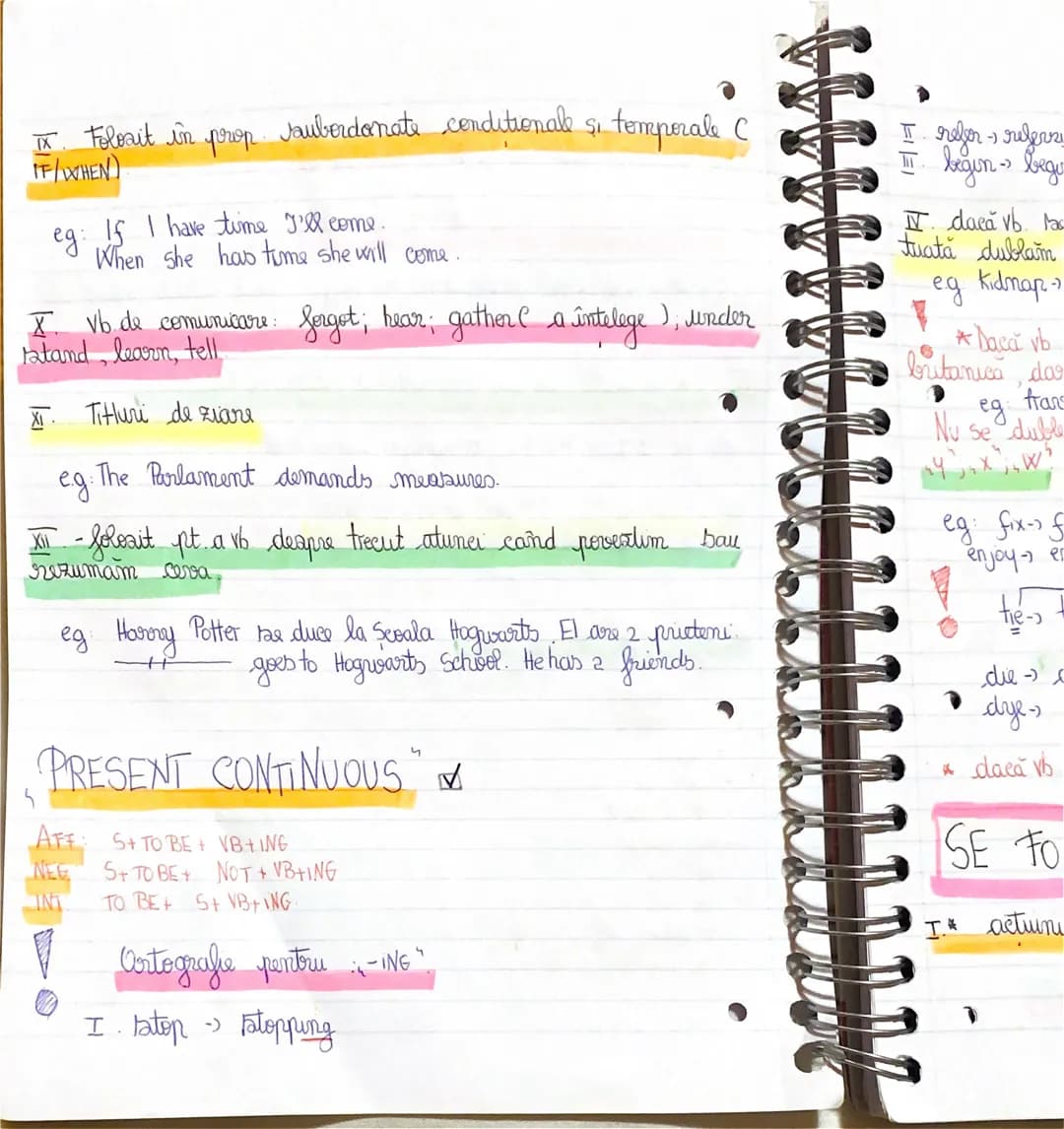
Alte Utilizări și Prezentul Continuu
Prezentul simplu se mai folosește:
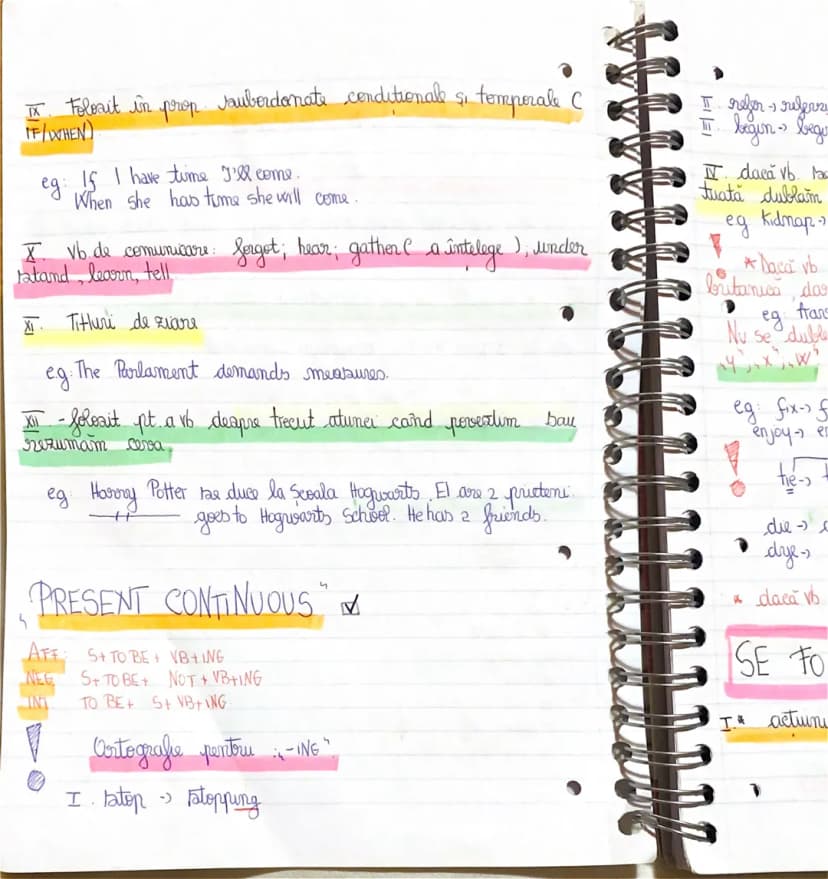
- În propoziții condiționale cu "if/when": "If I have time, I'll come"
- Cu verbe de comunicare: say, hear, understand, learn, tell
- În titluri de ziare: "The Parliament demands measures"
Prezentul continuu are structura: subiect + to be + verb + -ing
Când adăugăm -ing la verbe, avem câteva reguli de ortografie:
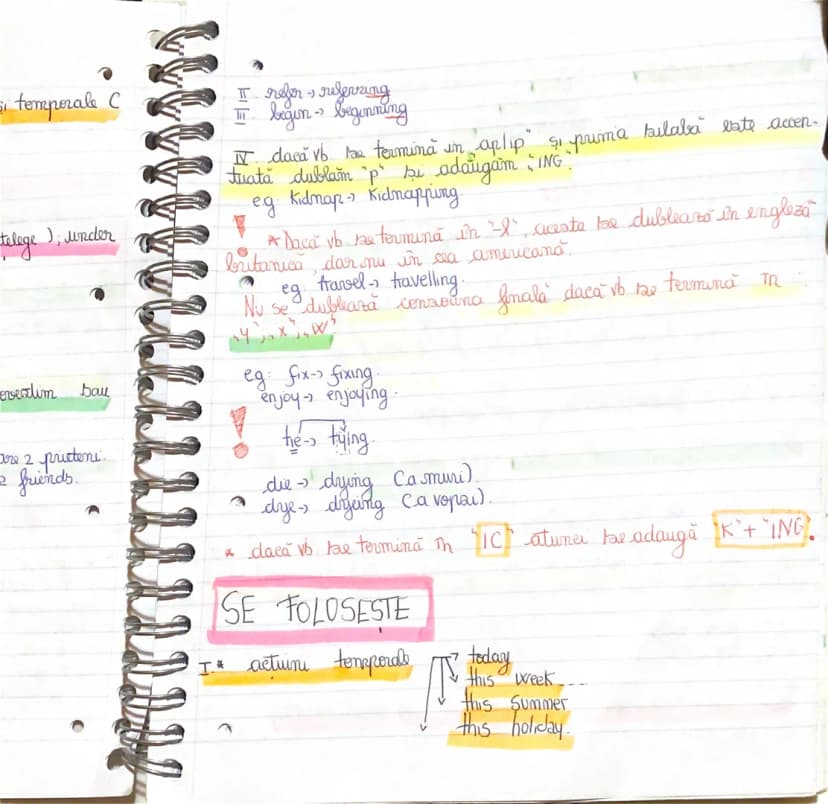
- La verbele care se termină într-o consoană precedată de o vocală scurtă, dublăm consoana: stop → stopping
- La verbele care se termină în -e, eliminăm e-ul: write → writing
- La verbele care se termină în -l, dublăm l-ul în engleza britanică: travel → travelling
💡 Nu trebuie să dublezi consoana finală dacă accentul nu cade pe ultima silabă sau dacă verbul se termină în două consoane: visit → visiting, help → helping.
5
of 10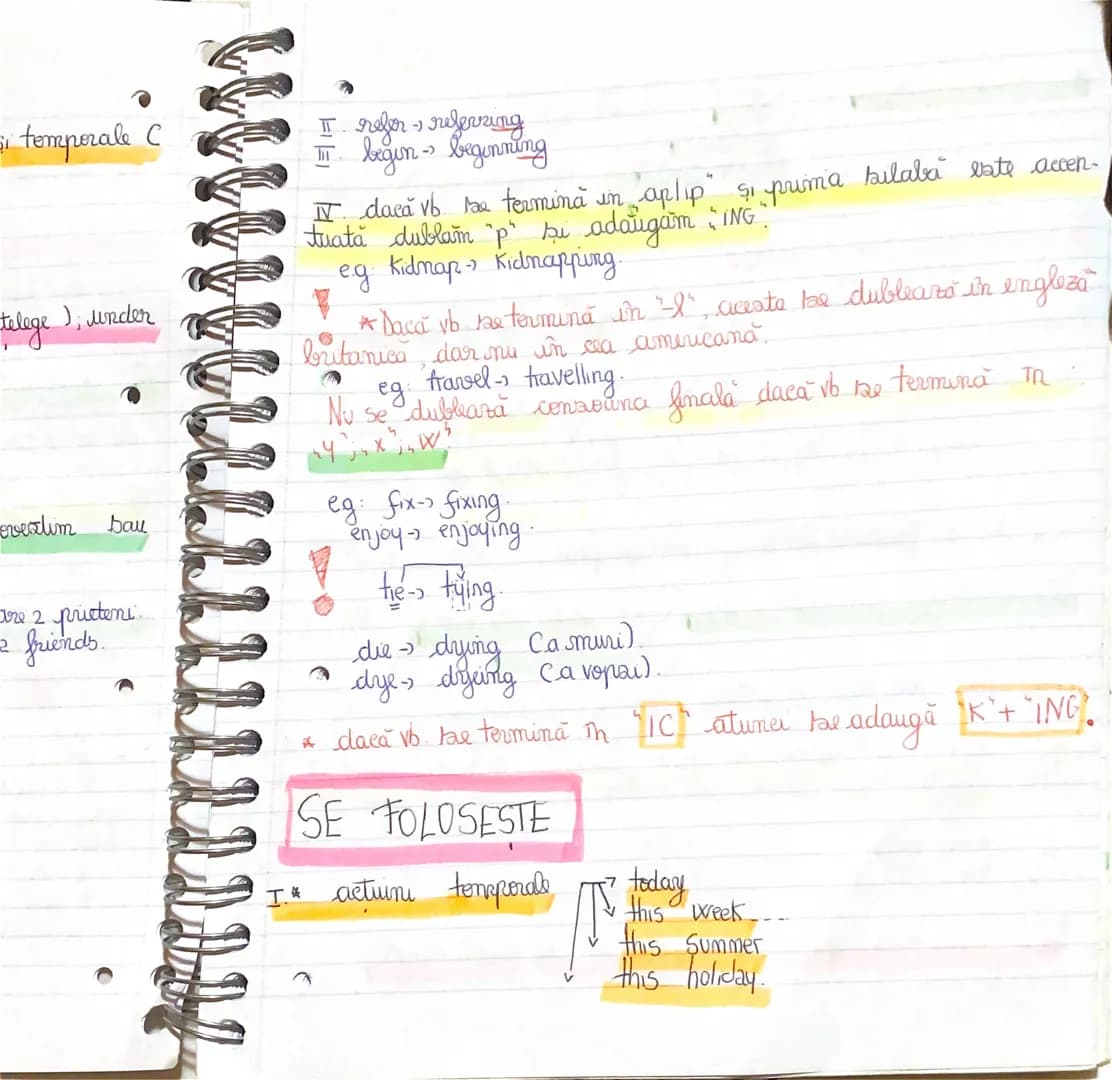
Reguli de Ortografie pentru -ING și Utilizări
Alte reguli pentru adăugarea terminației -ing:
- La verbele care se termină în -ie, schimbăm în -y: lie → lying, die → dying
- Dacă verbul se termină în -ic, adăugăm -k: panic → panicking
Prezentul continuu se folosește pentru:
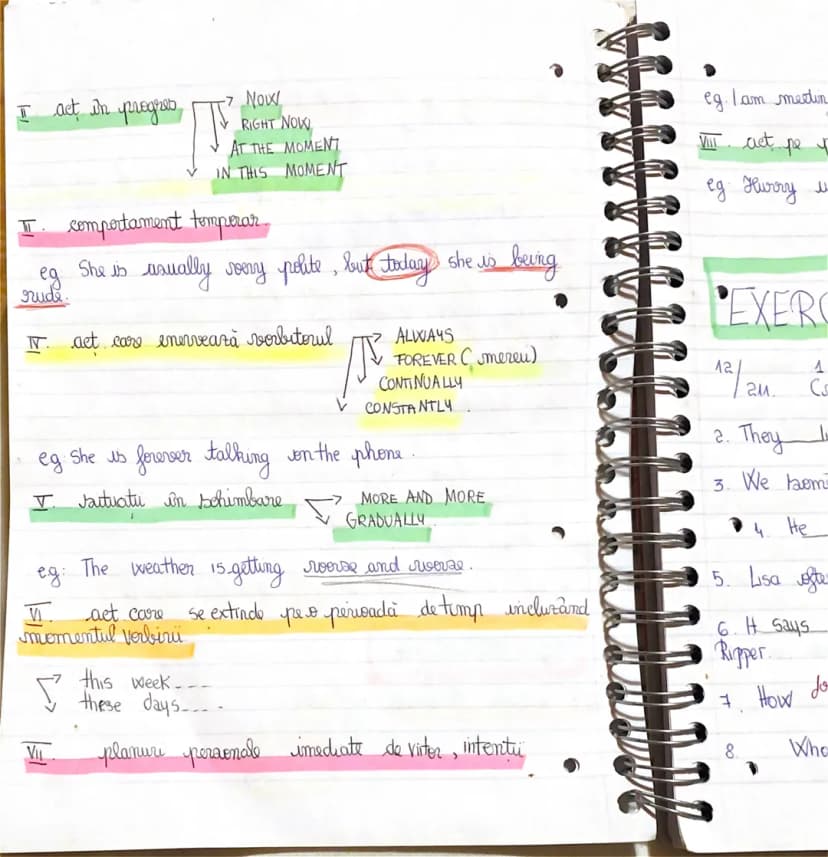
- Acțiuni temporare care se întâmplă într-o perioadă mai largă: "this week", "this summer", "today"
- Acțiuni în progres chiar acum: "now", "at the moment", "right now"
💡 Verbele care exprimă stări (like, love, hate, know, believe, understand) de obicei nu se folosesc la aspectul continuu.
Când vrei să spui că faci ceva în prezent dar nu neapărat chiar în acest moment, folosești prezentul continuu: "I am studying English this year."
6
of 10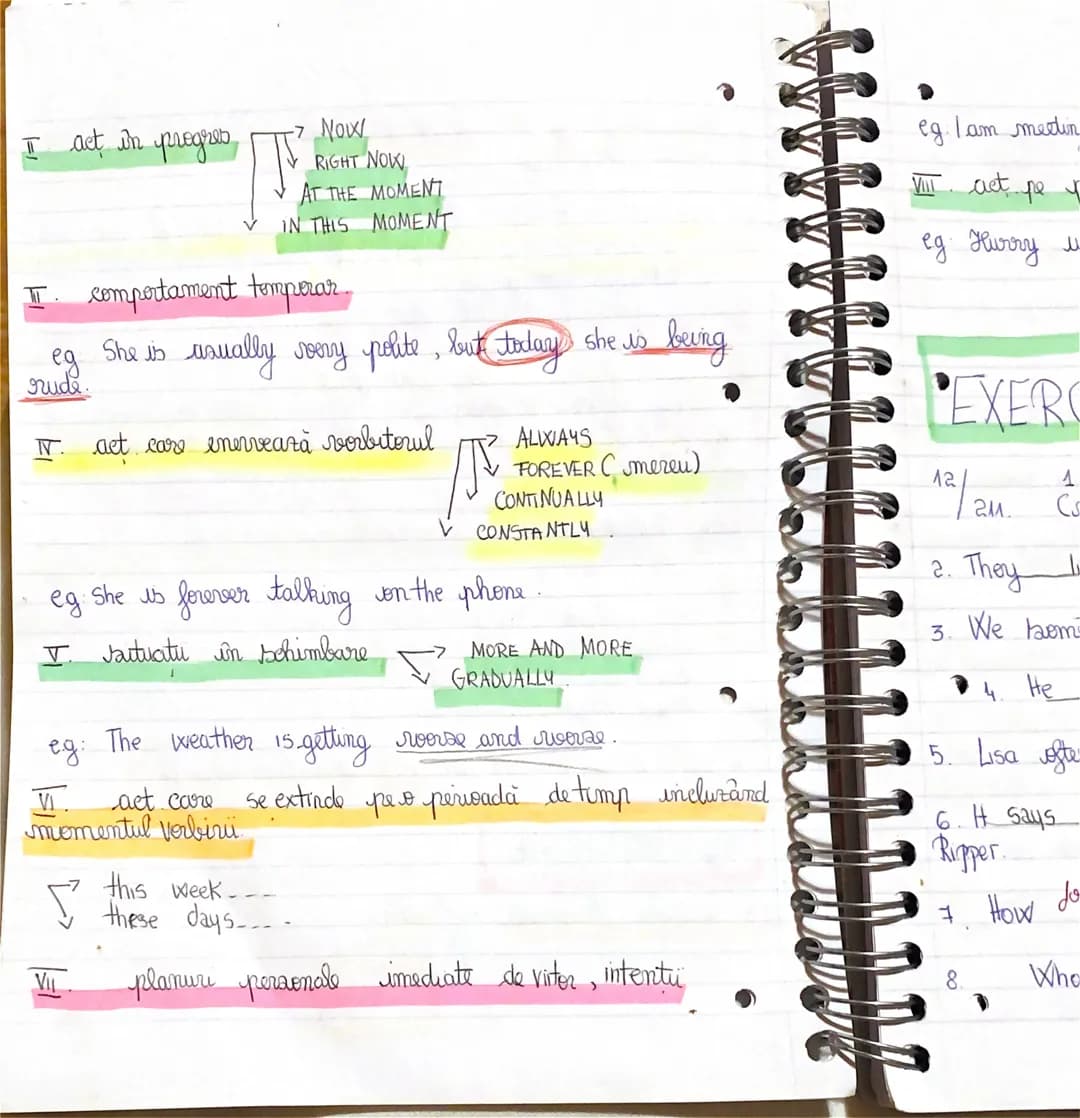
Alte Utilizări ale Prezentului Continuu
Prezentul continuu mai are și alte utilizări importante:
- Comportament temporar: "She is usually very polite, but today she is being rude"
- Acțiuni care enervează vorbitorul, folosit cu adverbe ca "always", "forever", "continually": "She is forever talking on the phone"
- Situații în schimbare cu "more and more", "gradually": "The weather is getting worse and worse"
- Acțiuni care se extind pe o perioadă inclusiv momentul vorbirii: "I am learning English these days"
- Planuri personale imediate de viitor: "I am meeting her tomorrow"
💡 Când folosești "always" cu prezentul continuu, de obicei exprimi o emoție negativă sau enervare: "He is always coming late!" (Este enervant că întârzie mereu!)
Pentru a alege între prezentul simplu și prezentul continuu, gândește-te dacă acțiunea este obișnuită și repetată (prezent simplu) sau temporară și în desfășurare (prezent continuu).
7
of 10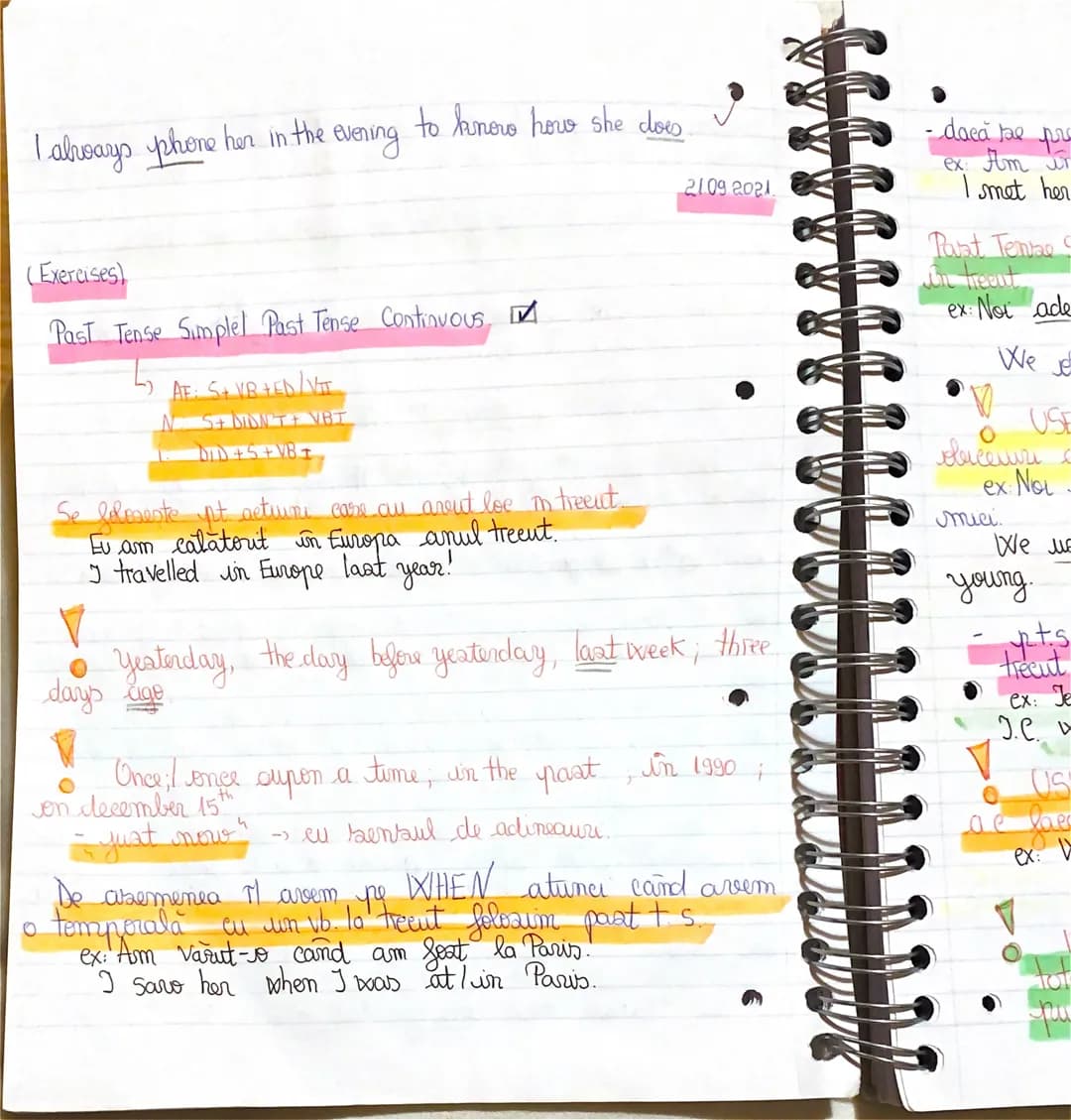
Trecutul Simplu
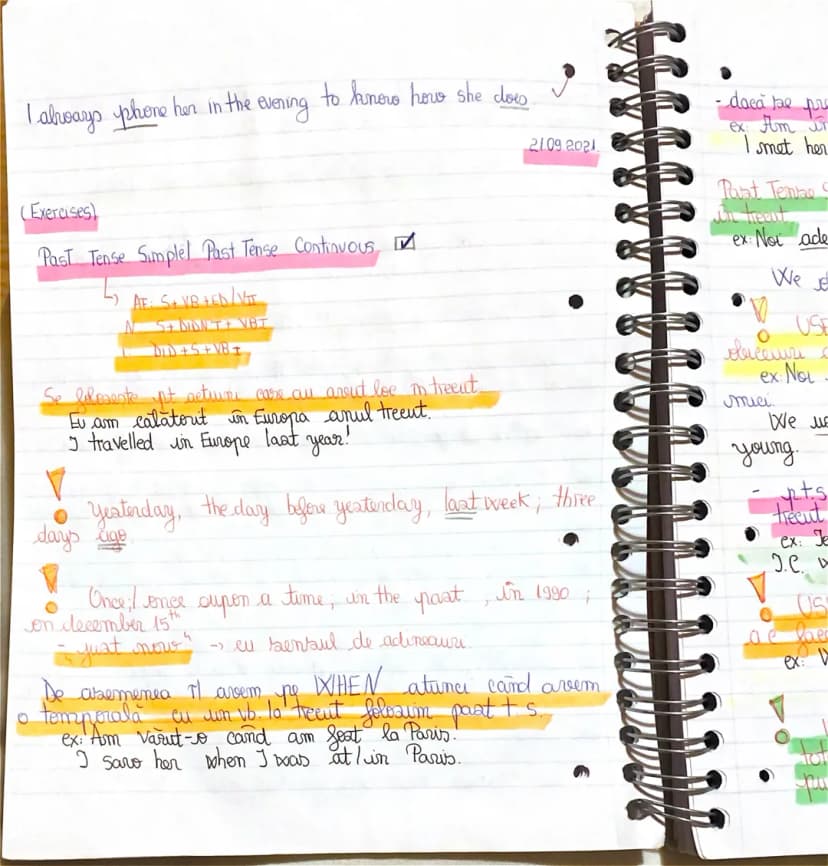
Trecutul simplu (Past Simple) se formează:
- Afirmativ: subiect + verb + -ed sau forma a II-a
- Negativ: subiect + didn't + verb
- Întrebări: Did + subiect + verb
Folosim trecutul simplu pentru acțiuni care s-au încheiat în trecut:
- "I travelled in Europe last year"
Expresii de timp folosite cu trecutul simplu:
- Yesterday, last week, three days ago
- Once/some time ago (odată, cândva)
- In the past (în trecut)
- Just now (adineauri)
💡 După "when" într-o propoziție temporală, folosim tot trecutul simplu: "I saw her when I was in Paris."
Trecutul simplu se folosește și atunci când specificăm locul unde s-a întâmplat acțiunea: "I met her in Paris."
8
of 10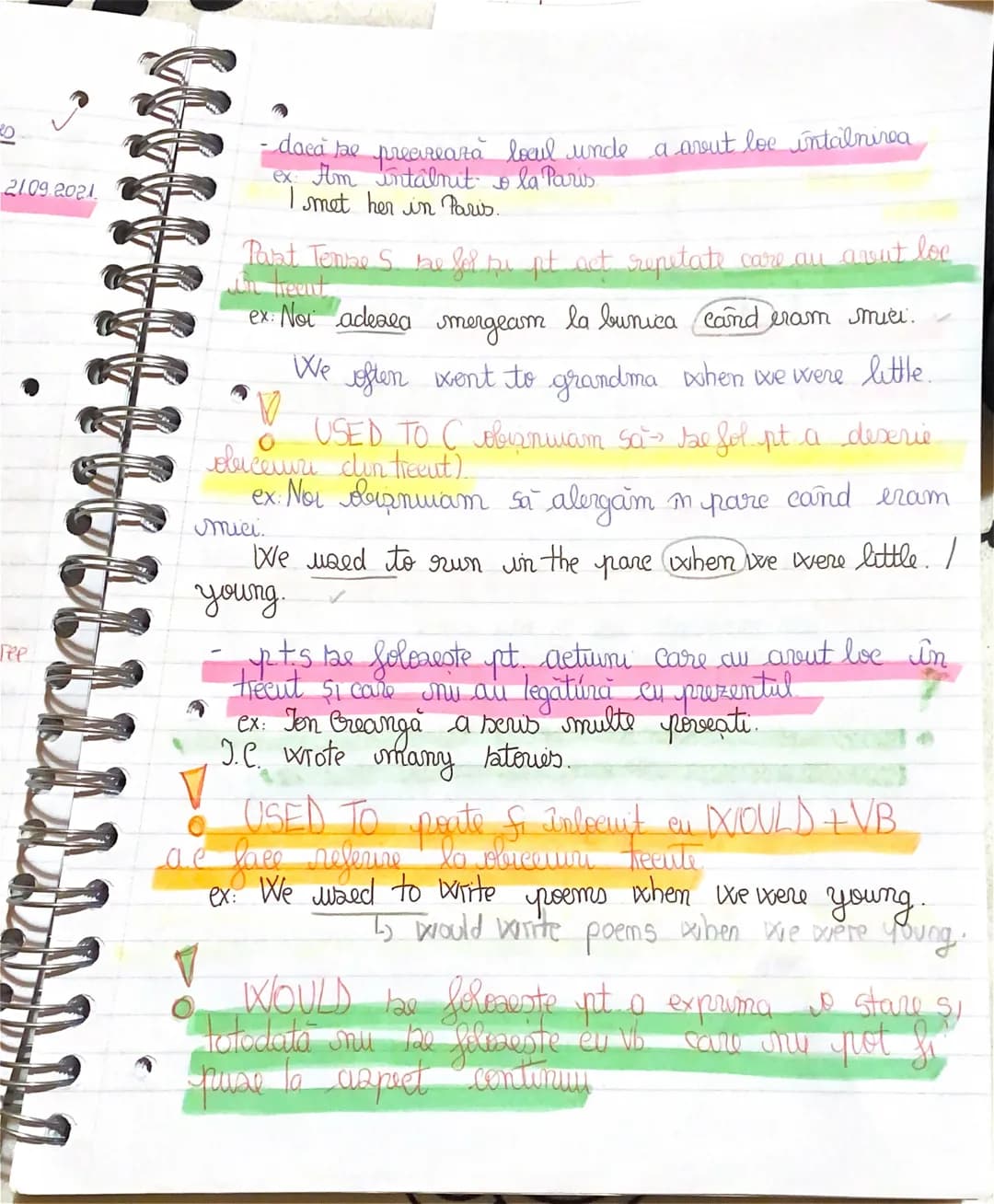
Utilizări ale Trecutului Simplu
Trecutul simplu are mai multe utilizări:
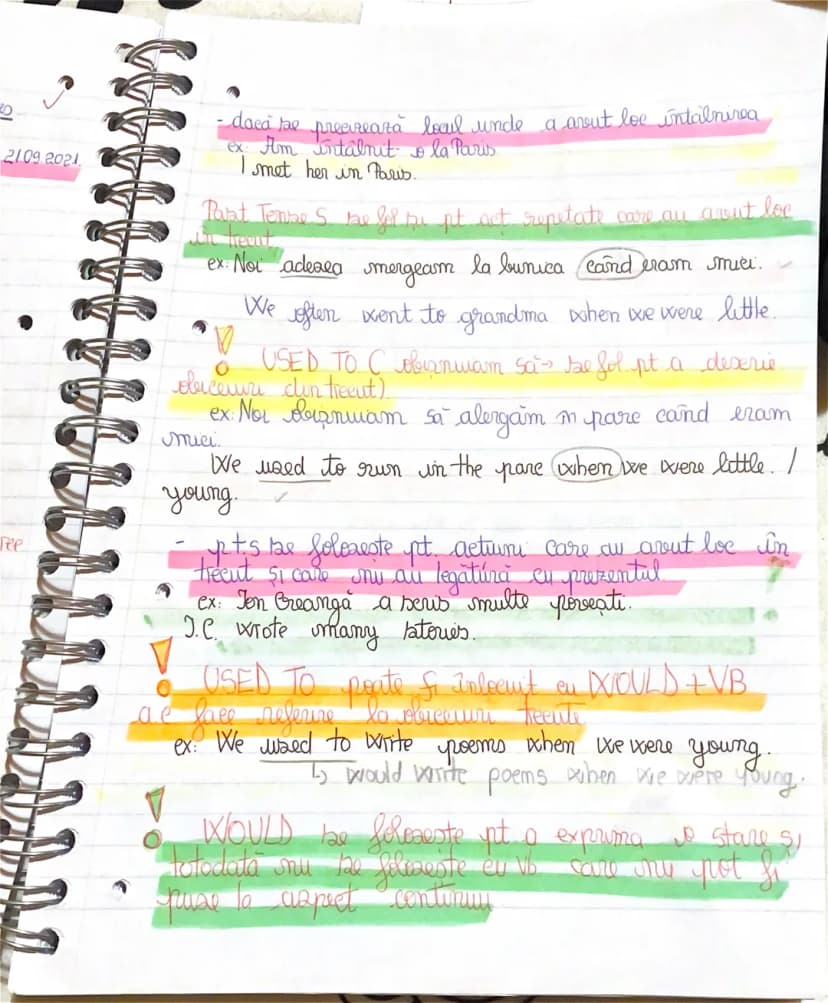
- Pentru acțiuni repetate în trecut: "We often went to grandma when we were little"
- Cu used to pentru a descrie obiceiuri din trecut: "We used to run in the park when we were young"
- Pentru acțiuni din trecut care nu au legătură cu prezentul: "Ion Creangă wrote many stories"
Used to poate fi înlocuit cu would + verb când vorbim despre obiceiuri trecute:
- "We used to write poems" = "We would write poems when we were young"
💡 Atenție! "Would" nu se folosește pentru a exprima o stare și nici cu verbe care nu pot fi puse la aspectul continuu (verbe de stare).
Când formezi trecutul simplu, adaugă -ed la verbe regulate, dar învață formele verbelor neregulate, cum ar fi "went" (de la "go"), "saw" (de la "see"), etc.
9
of 10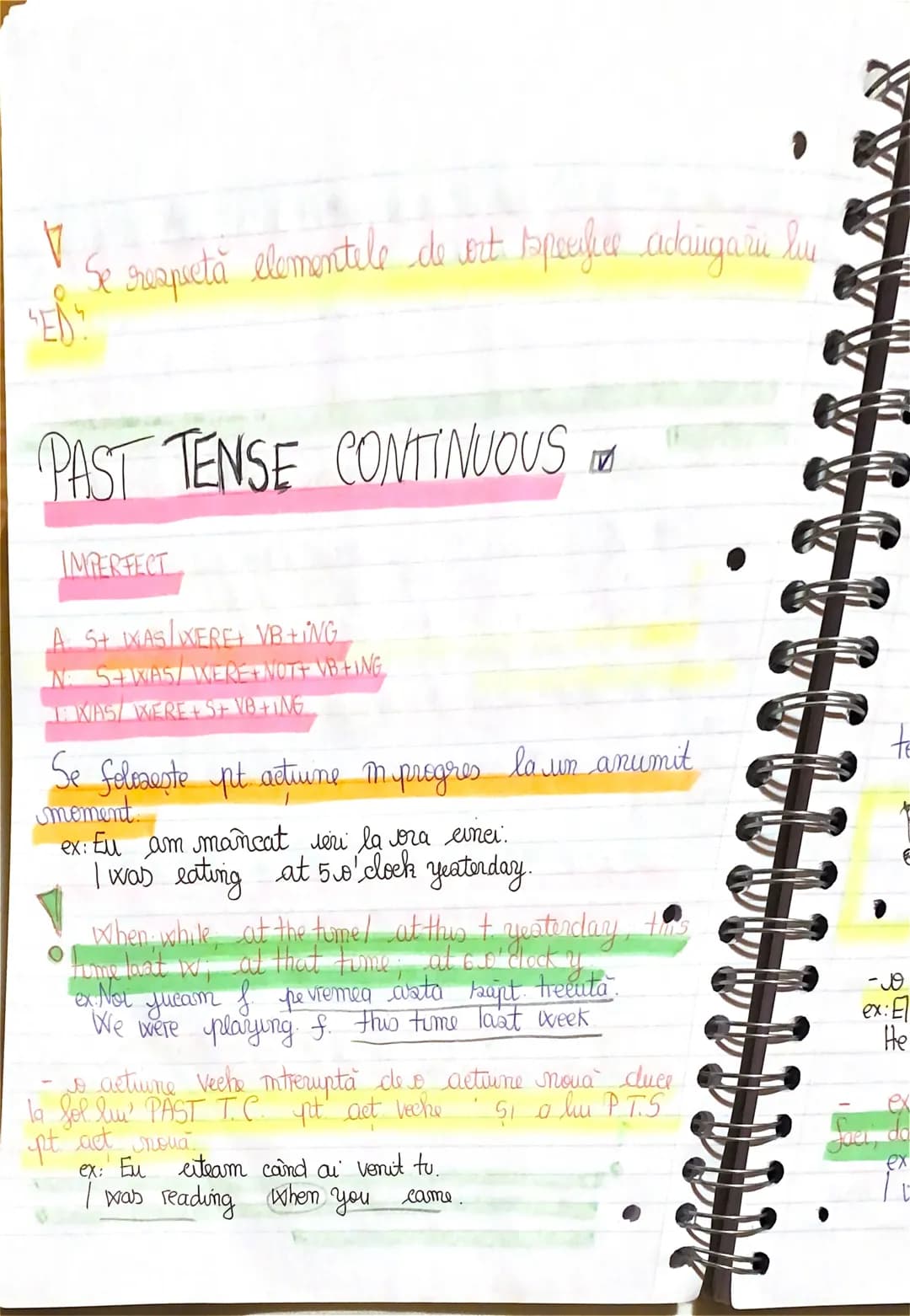
Trecutul Continuu (Imperfect)
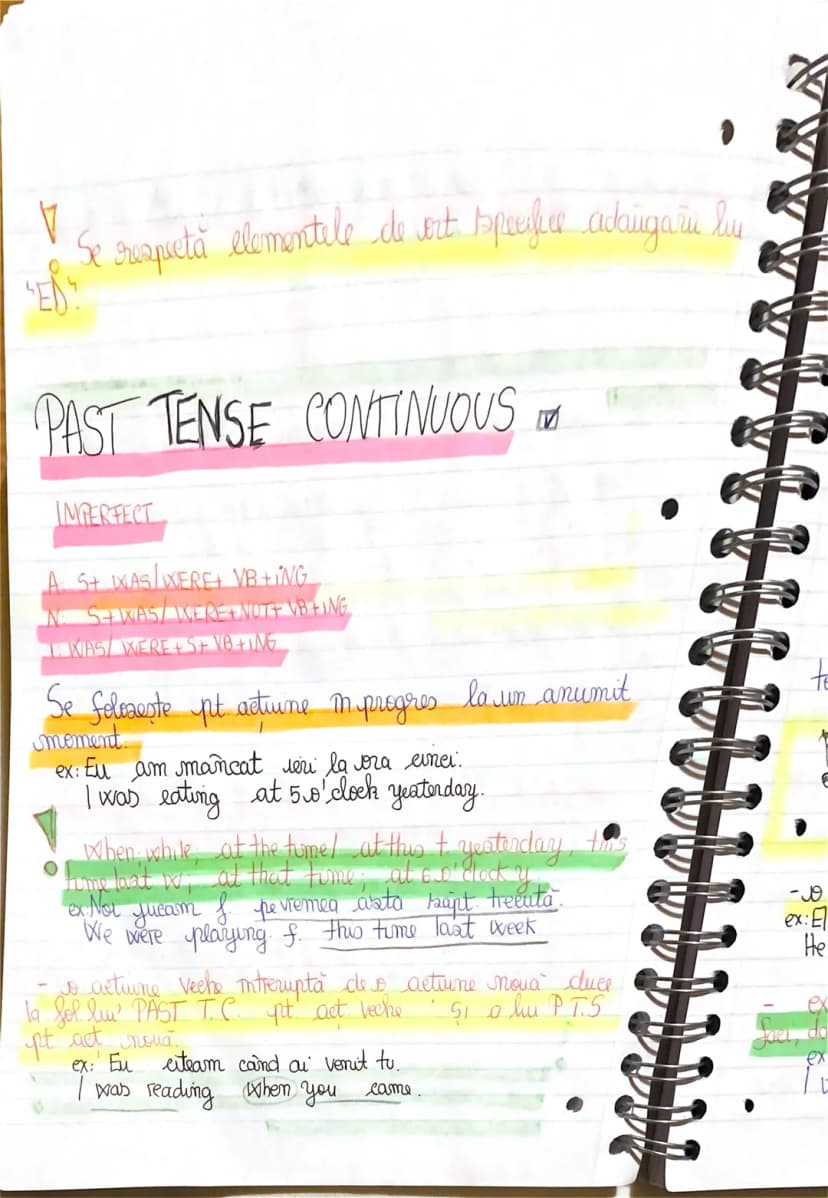
Trecutul continuu se formează:
- Afirmativ: subiect + was/were + verb + -ing
- Negativ: subiect + was/were not + verb + -ing
- Întrebări: Was/Were + subiect + verb + -ing
Folosim trecutul continuu pentru:
- Acțiuni în progres la un anumit moment din trecut: "I was eating at 5 o'clock yesterday"
- Cu expresii ca: when, while, at this time yesterday, at that time
💡 Când o acțiune veche este întreruptă de o acțiune nouă, folosim trecutul continuu pentru acțiunea veche și trecutul simplu pentru cea nouă: "I was reading when you came."
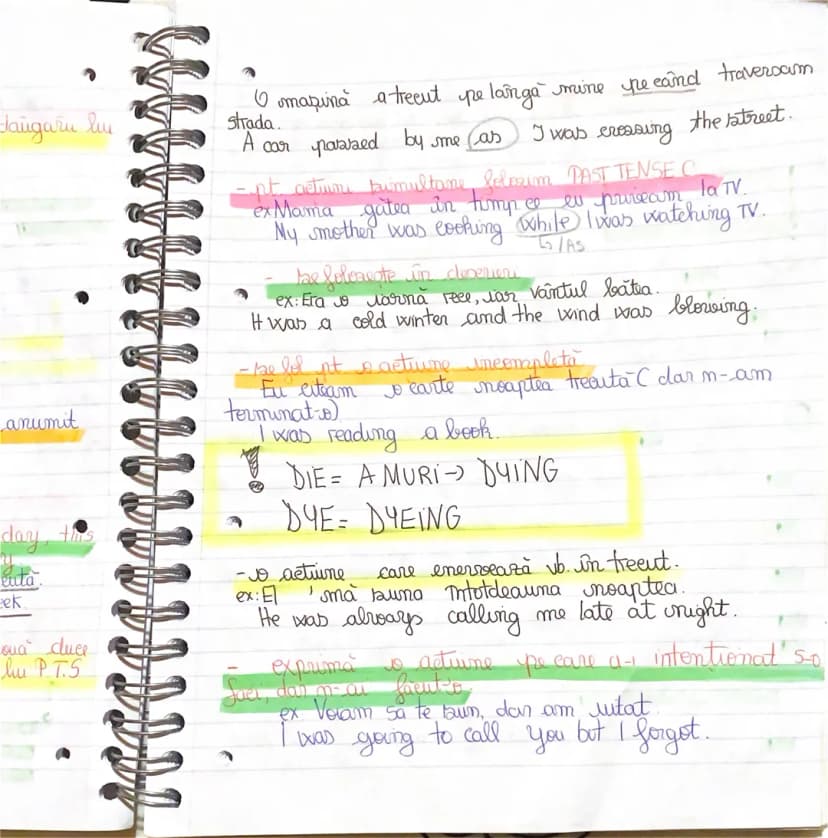
Un alt exemplu: "A car passed by me as I was crossing the street." (O mașină a trecut pe lângă mine în timp ce traversam strada.)
10
of 10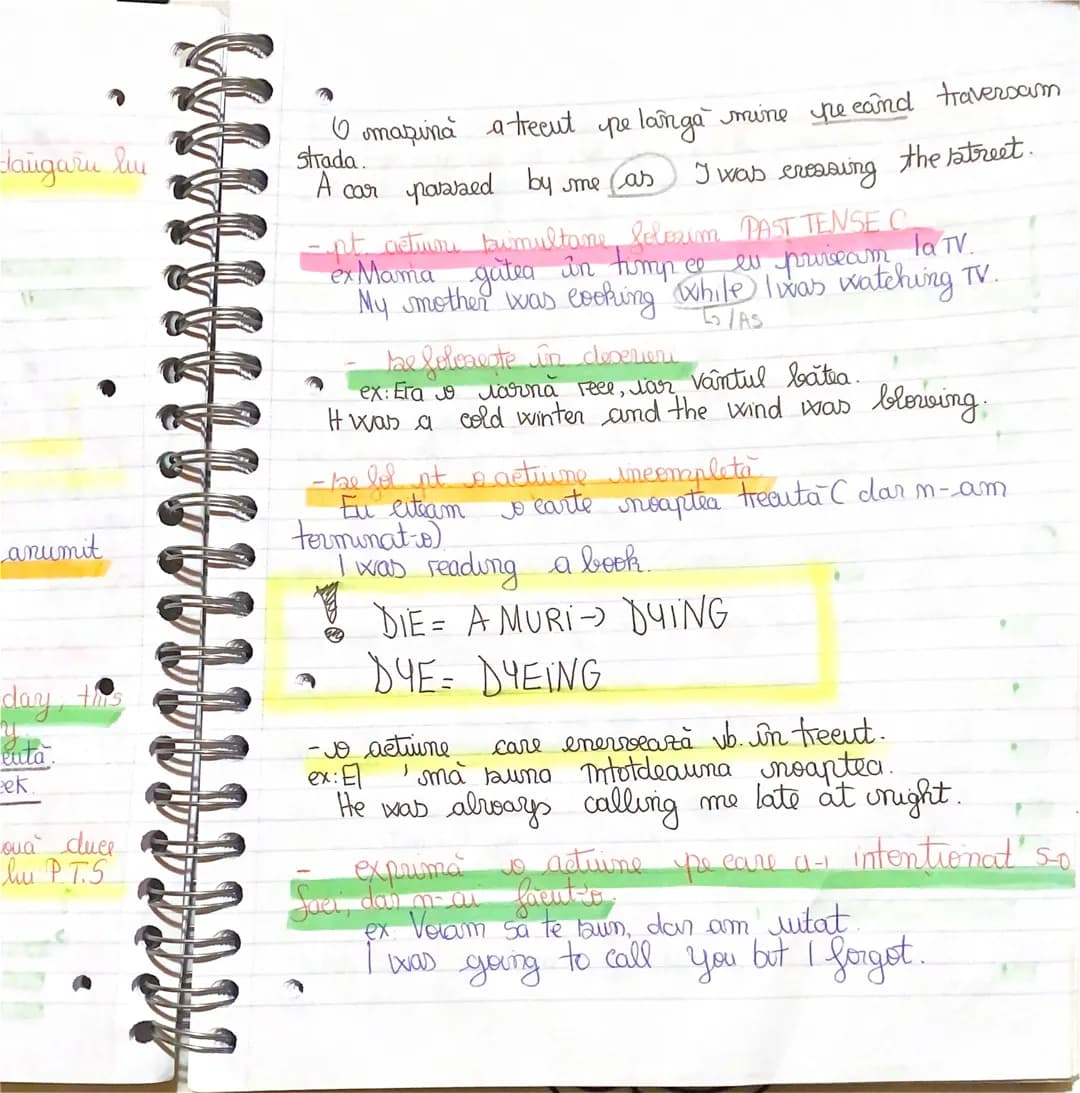
Alte Utilizări ale Trecutului Continuu
Trecutul continuu mai are următoarele utilizări:
- Pentru acțiuni simultane folosim trecutul continuu pentru ambele acțiuni: "My mother was cooking while I was watching TV"
- În descrieri: "It was a cold winter and the wind was blowing"
- Pentru acțiuni incomplete: "I was reading a book last night"
- Pentru acțiuni care enervau în trecut: "He was always calling me late at night"
- Pentru intenții nerealizate: "I was going to call you but I forgot"
💡 Reține diferența: "dying" (murind) și "dyeing" (vopsind) se scriu diferit, deși se pronunță la fel!
Alegerea între trecutul simplu și continuu depinde de cum vezi acțiunea: ca un eveniment complet (trecutul simplu) sau ca o acțiune în desfășurare în trecut (trecutul continuu).
We thought you’d never ask...
What is the Knowunity AI companion?
Our AI companion is specifically built for the needs of students. Based on the millions of content pieces we have on the platform we can provide truly meaningful and relevant answers to students. But its not only about answers, the companion is even more about guiding students through their daily learning challenges, with personalised study plans, quizzes or content pieces in the chat and 100% personalisation based on the students skills and developments.
Where can I download the Knowunity app?
You can download the app in the Google Play Store and in the Apple App Store.
Is Knowunity really free of charge?
That's right! Enjoy free access to study content, connect with fellow students, and get instant help – all at your fingertips.
Most popular content in Engleză
9EnglezăGramatica Engleza
Present simple / grammar review / signal words /exemple
55684
EnglezăTimpuri verbale - engleză
Timpurile verbale ale limbii engleze structurate simplu alături de exemple .
780313
EnglezăGramatică pentru bilingv la engleză
Include timpurile verbelor esențiale, verbele modale, condițional, vocea pasivă și conectoare logice importante
848210
EnglezăThe Conditionals/‘’If’’ Clauses
All Conditional forms
82003
Englezătimpurile verbale la engleza
english tenses
52766
 Limba și literatura română
Timpul verbal Prezent Simplu
Fișă de recapitulare Prezentul Simplu
73593
Limba și literatura românăTimpul verbal Prezent Continuu
Fișă de recapitulare Prezentul Continuu
72595
Englezămost used english irregular verbs
fisa cu verbe neregulate si regulile de la past perfect simple
647415
EnglezăConditional Clauses
Toate cele 4 tipuri de propoziții condiționale
82631
Most popular content
9Limba și literatura românăEseuri Limba si literatura română
Eseurile sunt structurate dupa barem. Aceste eseuri sunt pentru profilul real, bune si pentru uman dar lipsesc relatiile dintre personaje si caracrerizarile.
127,551149
Limba și literatura românăToate eseurile pentru bac
Contin eseul propriu zis si schematizarea acestuia
125,136104
 Biologie
Notițe-Bio 11-12
Biologie. Anatomie, fiziologie și genetică
114,47579
Limba și literatura românăEseu”Luceafărul” de Mihai Eminescu complet
eseu
116,42996
Limba și literatura românăPortofoliu Limba Romana Teorie Gimnaziu
Toata teoria limba română
66,239107
Limba și literatura românăRezumat ultima noapte de dragoste, întâia de război
Rezumat pe capitole
122,89834
Limba și literatura românăEseu- Leoaica tanara, iubirea
Eseu pt bac
113,37446
Limba și literatura românăEseu-Moara cu noroc ,Ioan Slavici
eseul complet moara cu noroc
116,355119
BiologieExercitii biologie
Bac biologie
126,179148
Can't find what you're looking for? Explore other subjects.
Students love us — and so will you.
4.6/5App Store
4.7/5Google Play
The app is very easy to use and well designed. I have found everything I was looking for so far and have been able to learn a lot from the presentations! I will definitely use the app for a class assignment! And of course it also helps a lot as an inspiration.
Stefan SiOS user
This app is really great. There are so many study notes and help [...]. My problem subject is French, for example, and the app has so many options for help. Thanks to this app, I have improved my French. I would recommend it to anyone.
Samantha KlichAndroid user
Wow, I am really amazed. I just tried the app because I've seen it advertised many times and was absolutely stunned. This app is THE HELP you want for school and above all, it offers so many things, such as workouts and fact sheets, which have been VERY helpful to me personally.
AnnaiOS user
Engleză235 views·Updated Jun 25, 2026·10 pagesTimpuri Verbale și Exemple Uzuale
A
Andreea Preda@andreeapreda
Prezentul simplu și prezentul continuu sunt două timpuri de bază ale limbii engleze pe care le folosim în mod diferit, în funcție de situație. Haideți să vedem cum funcționează și când trebuie să le folosim corect!
1
of 10
Sign up to see the content. It's free!
- Access to all documents
- Improve your grades
- Join milions of students
Prezentul Simplu
Prezentul simplu este un timp pe care îl folosim pentru lucruri care se întâmplă mereu sau regulat.
Formarea lui este simplă: subiect + verb (care primește -s sau -es la persoana a III-a singular). La negativ, folosim don't sau doesn't + verb, iar la întrebări începem cu Do sau Does.
💡 La persoana a III-a singular, verbele se schimbă după reguli speciale. Verbele care se termină în -s, -sh, -ch, -x, -z primesc terminația -es (kiss → kisses, watch → watches).
Prezentul simplu se folosește pentru:
- Acțiuni permanente ("She lives in Australia")
- Adevăruri generale și legi ale naturii ("Water freezes at 0 Celsius degrees")
- Proverbe ("A friend in need is a friend indeed")
2
of 10Sign up to see the content. It's free!
- Access to all documents
- Improve your grades
- Join milions of students
Frecvența în Prezentul Simplu
Când vorbim despre cât de des facem ceva, folosim cuvinte de frecvență:
- Often, rarely, seldom (rareori), usually, always, never
- Ele se pun de obicei între subiect și verb: "She often comes late"
- Cu verbul "to be" se pun după verb: "She is often late"
Alte expresii de timp folosite cu prezentul simplu stau la sfârșitul propoziției:
- Once/twice a week
- Every day/morning
- On Saturdays (sâmbătele)
- At weekends (în weekenduri)
💡 Expresiile "every once in a blue moon" sau "from time to time" înseamnă că ceva se întâmplă foarte rar sau ocazional.
3
of 10Sign up to see the content. It's free!
- Access to all documents
- Improve your grades
- Join milions of students
Alte Utilizări ale Prezentului Simplu
Prezentul simplu mai are și alte utilizări interesante:
- În comentarii sportive: "Ronaldo passes to Messi who scores"
- În experimente sau demonstrații: "Now I mix the milk with sugar and add vanilla"
- În indicații sau acțiuni succesive: "He enters the room, arranges some books"
- În exclamații: "Here she is!"
Este folosit și pentru orare și evenimente programate:
- "The shop opens at 7 a.m."
- Verbele de mișcare (begin, start, arrive, depart, leave) sunt folosite cu prezentul simplu când vorbim despre evenimente programate.
💡 Când povestești un film sau o carte, poți folosi prezentul simplu chiar dacă acțiunea s-a întâmplat în trecut: "Harry Potter goes to Hogwarts School. He has two friends."
4
of 10Sign up to see the content. It's free!
- Access to all documents
- Improve your grades
- Join milions of students
Alte Utilizări și Prezentul Continuu
Prezentul simplu se mai folosește:
- În propoziții condiționale cu "if/when": "If I have time, I'll come"
- Cu verbe de comunicare: say, hear, understand, learn, tell
- În titluri de ziare: "The Parliament demands measures"
Prezentul continuu are structura: subiect + to be + verb + -ing
Când adăugăm -ing la verbe, avem câteva reguli de ortografie:
- La verbele care se termină într-o consoană precedată de o vocală scurtă, dublăm consoana: stop → stopping
- La verbele care se termină în -e, eliminăm e-ul: write → writing
- La verbele care se termină în -l, dublăm l-ul în engleza britanică: travel → travelling
💡 Nu trebuie să dublezi consoana finală dacă accentul nu cade pe ultima silabă sau dacă verbul se termină în două consoane: visit → visiting, help → helping.
5
of 10Sign up to see the content. It's free!
- Access to all documents
- Improve your grades
- Join milions of students
Reguli de Ortografie pentru -ING și Utilizări
Alte reguli pentru adăugarea terminației -ing:
- La verbele care se termină în -ie, schimbăm în -y: lie → lying, die → dying
- Dacă verbul se termină în -ic, adăugăm -k: panic → panicking
Prezentul continuu se folosește pentru:
- Acțiuni temporare care se întâmplă într-o perioadă mai largă: "this week", "this summer", "today"
- Acțiuni în progres chiar acum: "now", "at the moment", "right now"
💡 Verbele care exprimă stări (like, love, hate, know, believe, understand) de obicei nu se folosesc la aspectul continuu.
Când vrei să spui că faci ceva în prezent dar nu neapărat chiar în acest moment, folosești prezentul continuu: "I am studying English this year."
6
of 10Sign up to see the content. It's free!
- Access to all documents
- Improve your grades
- Join milions of students
Alte Utilizări ale Prezentului Continuu
Prezentul continuu mai are și alte utilizări importante:
- Comportament temporar: "She is usually very polite, but today she is being rude"
- Acțiuni care enervează vorbitorul, folosit cu adverbe ca "always", "forever", "continually": "She is forever talking on the phone"
- Situații în schimbare cu "more and more", "gradually": "The weather is getting worse and worse"
- Acțiuni care se extind pe o perioadă inclusiv momentul vorbirii: "I am learning English these days"
- Planuri personale imediate de viitor: "I am meeting her tomorrow"
💡 Când folosești "always" cu prezentul continuu, de obicei exprimi o emoție negativă sau enervare: "He is always coming late!" (Este enervant că întârzie mereu!)
Pentru a alege între prezentul simplu și prezentul continuu, gândește-te dacă acțiunea este obișnuită și repetată (prezent simplu) sau temporară și în desfășurare (prezent continuu).
7
of 10Sign up to see the content. It's free!
- Access to all documents
- Improve your grades
- Join milions of students
Trecutul Simplu
Trecutul simplu (Past Simple) se formează:
- Afirmativ: subiect + verb + -ed sau forma a II-a
- Negativ: subiect + didn't + verb
- Întrebări: Did + subiect + verb
Folosim trecutul simplu pentru acțiuni care s-au încheiat în trecut:
- "I travelled in Europe last year"
Expresii de timp folosite cu trecutul simplu:
- Yesterday, last week, three days ago
- Once/some time ago (odată, cândva)
- In the past (în trecut)
- Just now (adineauri)
💡 După "when" într-o propoziție temporală, folosim tot trecutul simplu: "I saw her when I was in Paris."
Trecutul simplu se folosește și atunci când specificăm locul unde s-a întâmplat acțiunea: "I met her in Paris."
8
of 10Sign up to see the content. It's free!
- Access to all documents
- Improve your grades
- Join milions of students
Utilizări ale Trecutului Simplu
Trecutul simplu are mai multe utilizări:
- Pentru acțiuni repetate în trecut: "We often went to grandma when we were little"
- Cu used to pentru a descrie obiceiuri din trecut: "We used to run in the park when we were young"
- Pentru acțiuni din trecut care nu au legătură cu prezentul: "Ion Creangă wrote many stories"
Used to poate fi înlocuit cu would + verb când vorbim despre obiceiuri trecute:
- "We used to write poems" = "We would write poems when we were young"
💡 Atenție! "Would" nu se folosește pentru a exprima o stare și nici cu verbe care nu pot fi puse la aspectul continuu (verbe de stare).
Când formezi trecutul simplu, adaugă -ed la verbe regulate, dar învață formele verbelor neregulate, cum ar fi "went" (de la "go"), "saw" (de la "see"), etc.
9
of 10Sign up to see the content. It's free!
- Access to all documents
- Improve your grades
- Join milions of students
Trecutul Continuu (Imperfect)
Trecutul continuu se formează:
- Afirmativ: subiect + was/were + verb + -ing
- Negativ: subiect + was/were not + verb + -ing
- Întrebări: Was/Were + subiect + verb + -ing
Folosim trecutul continuu pentru:
- Acțiuni în progres la un anumit moment din trecut: "I was eating at 5 o'clock yesterday"
- Cu expresii ca: when, while, at this time yesterday, at that time
💡 Când o acțiune veche este întreruptă de o acțiune nouă, folosim trecutul continuu pentru acțiunea veche și trecutul simplu pentru cea nouă: "I was reading when you came."
Un alt exemplu: "A car passed by me as I was crossing the street." (O mașină a trecut pe lângă mine în timp ce traversam strada.)
10
of 10Sign up to see the content. It's free!
- Access to all documents
- Improve your grades
- Join milions of students
Alte Utilizări ale Trecutului Continuu
Trecutul continuu mai are următoarele utilizări:
- Pentru acțiuni simultane folosim trecutul continuu pentru ambele acțiuni: "My mother was cooking while I was watching TV"
- În descrieri: "It was a cold winter and the wind was blowing"
- Pentru acțiuni incomplete: "I was reading a book last night"
- Pentru acțiuni care enervau în trecut: "He was always calling me late at night"
- Pentru intenții nerealizate: "I was going to call you but I forgot"
💡 Reține diferența: "dying" (murind) și "dyeing" (vopsind) se scriu diferit, deși se pronunță la fel!
Alegerea între trecutul simplu și continuu depinde de cum vezi acțiunea: ca un eveniment complet (trecutul simplu) sau ca o acțiune în desfășurare în trecut (trecutul continuu).
We thought you’d never ask...
What is the Knowunity AI companion?
Our AI companion is specifically built for the needs of students. Based on the millions of content pieces we have on the platform we can provide truly meaningful and relevant answers to students. But its not only about answers, the companion is even more about guiding students through their daily learning challenges, with personalised study plans, quizzes or content pieces in the chat and 100% personalisation based on the students skills and developments.
Where can I download the Knowunity app?
You can download the app in the Google Play Store and in the Apple App Store.
Is Knowunity really free of charge?
That's right! Enjoy free access to study content, connect with fellow students, and get instant help – all at your fingertips.
Most popular content in Engleză
9EnglezăGramatica Engleza
Present simple / grammar review / signal words /exemple
55684
EnglezăTimpuri verbale - engleză
Timpurile verbale ale limbii engleze structurate simplu alături de exemple .
780313
EnglezăGramatică pentru bilingv la engleză
Include timpurile verbelor esențiale, verbele modale, condițional, vocea pasivă și conectoare logice importante
848210
EnglezăThe Conditionals/‘’If’’ Clauses
All Conditional forms
82003
Englezătimpurile verbale la engleza
english tenses
52766
Limba și literatura românăTimpul verbal Prezent Simplu
Fișă de recapitulare Prezentul Simplu
73593
Limba și literatura românăTimpul verbal Prezent Continuu
Fișă de recapitulare Prezentul Continuu
72595
Englezămost used english irregular verbs
fisa cu verbe neregulate si regulile de la past perfect simple
647415
EnglezăConditional Clauses
Toate cele 4 tipuri de propoziții condiționale
82631
Most popular content
9Limba și literatura românăEseuri Limba si literatura română
Eseurile sunt structurate dupa barem. Aceste eseuri sunt pentru profilul real, bune si pentru uman dar lipsesc relatiile dintre personaje si caracrerizarile.
127,551149
Limba și literatura românăToate eseurile pentru bac
Contin eseul propriu zis si schematizarea acestuia
125,136104
BiologieNotițe-Bio 11-12
Biologie. Anatomie, fiziologie și genetică
114,47579
Limba și literatura românăEseu”Luceafărul” de Mihai Eminescu complet
eseu
116,42996
Limba și literatura românăPortofoliu Limba Romana Teorie Gimnaziu
Toata teoria limba română
66,239107
Limba și literatura românăRezumat ultima noapte de dragoste, întâia de război
Rezumat pe capitole
122,89834
Limba și literatura românăEseu- Leoaica tanara, iubirea
Eseu pt bac
113,37446
Limba și literatura românăEseu-Moara cu noroc ,Ioan Slavici
eseul complet moara cu noroc
116,355119
BiologieExercitii biologie
Bac biologie
126,179148
Can't find what you're looking for? Explore other subjects.
Students love us — and so will you.
4.6/5App Store
4.7/5Google Play
The app is very easy to use and well designed. I have found everything I was looking for so far and have been able to learn a lot from the presentations! I will definitely use the app for a class assignment! And of course it also helps a lot as an inspiration.
Stefan SiOS user
This app is really great. There are so many study notes and help [...]. My problem subject is French, for example, and the app has so many options for help. Thanks to this app, I have improved my French. I would recommend it to anyone.
Samantha KlichAndroid user
Wow, I am really amazed. I just tried the app because I've seen it advertised many times and was absolutely stunned. This app is THE HELP you want for school and above all, it offers so many things, such as workouts and fact sheets, which have been VERY helpful to me personally.
AnnaiOS user