
Prezentul Continuu (Present Continuous) e timpul verbal care arată acțiuni...
 Limba și literatura română259 views·Updated Jun 24, 2026·2 pages
Explicarea Verbală a Timpului Prezent Continuu
E
Elisa Flocea@elisaflocea
1
of 2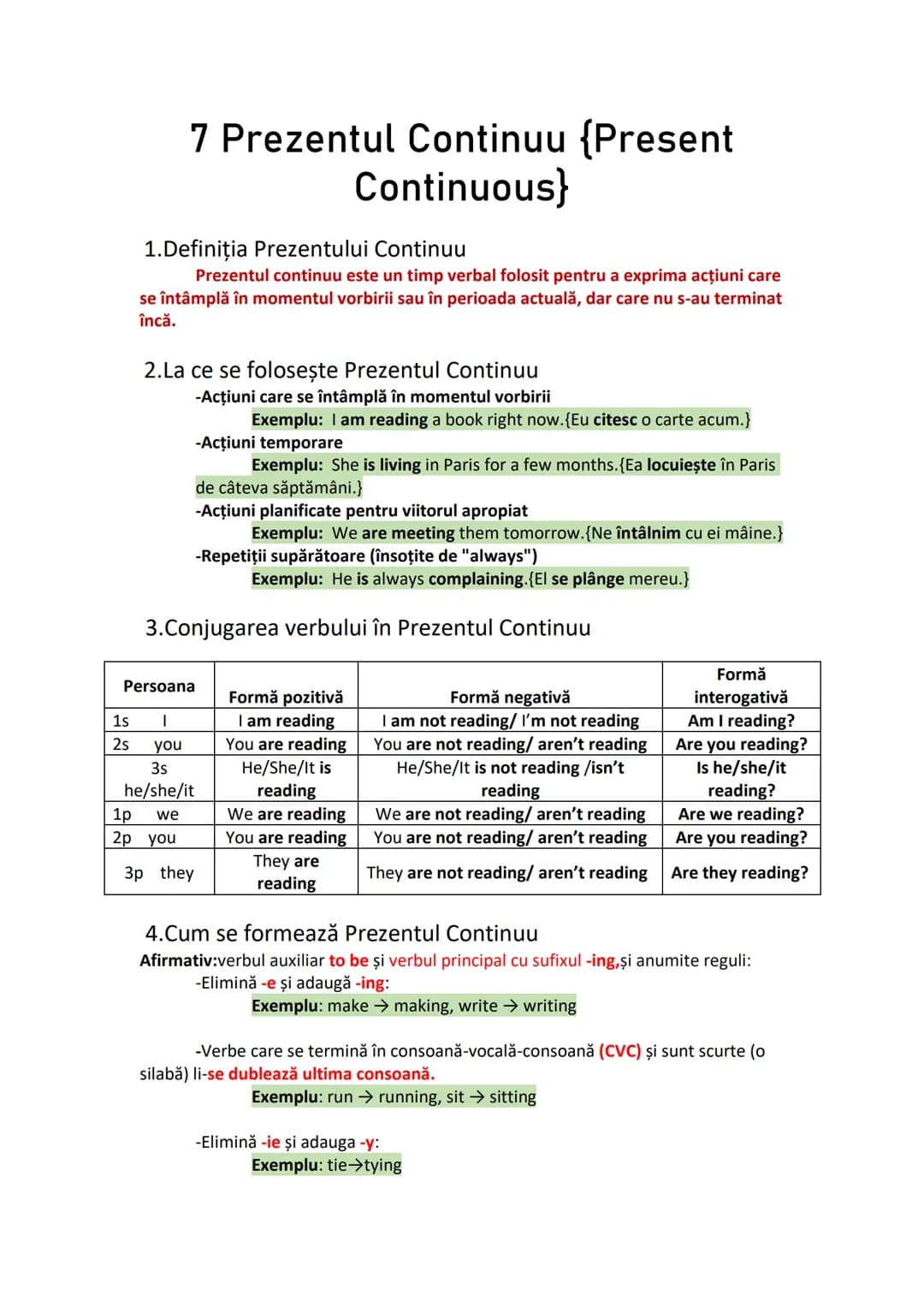
Ce este Prezentul Continuu și cum îl folosim
Prezentul Continuu ne ajută să vorbim despre acțiuni care se întâmplă chiar acum, în timp ce vorbim. Îl folosim când vrem să spunem ce facem în prezent, dar acțiunea nu s-a terminat încă.
Putem folosi acest timp verbal în patru situații principale:
- Pentru acțiuni care se întâmplă chiar acum: "I am reading a book right now." (Citesc o carte acum.)
- Pentru situații temporare: "She is living in Paris for a few months." (Ea locuiește în Paris pentru câteva luni.)
- Pentru planuri în viitorul apropiat: "We are meeting them tomorrow." (Ne întâlnim cu ei mâine.)
- Pentru a exprima repetiții care ne deranjează, folosind "always": "He is always complaining." (El se plânge mereu.)
Formarea Prezentului Continuu e destul de simplă: folosim verbul auxiliar to be (am, are, is) și adăugăm -ing la verbul principal. Avem însă câteva reguli importante:
- Eliminăm -e de la sfârșitul verbului și adăugăm -ing (write → writing)
- Dublăm ultima consoană la verbele scurte care se termină în consoană-vocală-consoană (run → running)
- Schimbăm -ie în -y și adăugăm -ing (tie → tying)
Descoperă! Încearcă să observi cum folosim Prezentul Continuu în conversațiile zilnice. De câte ori ai spus azi "Acum fac..." sau "Săptămâna asta lucrez la..."?
2
of 2
Formele negative, interogative și excepțiile
Ca să formăm negația în Prezentul Continuu, folosim formula: to be + not + verb + -ing. De exemplu: "She is not watching TV" sau forma scurtă "She isn't watching TV" (Ea nu se uită la TV).
Pentru interogație, inversăm ordinea: to be + subiect + verb + -ing? De exemplu: "Are they coming?" (Ei vin?). E super simplu să pui o întrebare în Prezentul Continuu!
Când folosim Prezentul Continuu, ne ajută cuvintele cheie precum: now, right now, at the moment, today, this week, currently. Acestea sunt indicii clare că trebuie să folosim acest timp verbal.
Nu toate verbele pot fi folosite în Prezentul Continuu. Există verbe care exprimă stări, emoții, gânduri sau percepții care nu se folosesc de obicei cu -ing:
- Verbe de percepție: see, hear
- Verbe de emoție: love, hate, like
- Verbe de gândire: believe, know, understand
- Verbe de dorință: want, need, prefer
Atenție! Când vrei să spui "Îmi place ciocolata", nu folosim Prezentul Continuu. Corect este "I like chocolate", nu "I am liking chocolate".
We thought you’d never ask...
What is the Knowunity AI companion?
Our AI companion is specifically built for the needs of students. Based on the millions of content pieces we have on the platform we can provide truly meaningful and relevant answers to students. But its not only about answers, the companion is even more about guiding students through their daily learning challenges, with personalised study plans, quizzes or content pieces in the chat and 100% personalisation based on the students skills and developments.
Where can I download the Knowunity app?
You can download the app in the Google Play Store and in the Apple App Store.
Is Knowunity really free of charge?
That's right! Enjoy free access to study content, connect with fellow students, and get instant help – all at your fingertips.
Most popular content in Limba și literatura română
9Limba și literatura românăEseuri Limba si literatura română
Eseurile sunt structurate dupa barem. Aceste eseuri sunt pentru profilul real, bune si pentru uman dar lipsesc relatiile dintre personaje si caracrerizarile.
127,551149
Limba și literatura românăToate eseurile pentru bac
Contin eseul propriu zis si schematizarea acestuia
125,136104
Limba și literatura românăEseu”Luceafărul” de Mihai Eminescu complet
eseu
116,42996
Limba și literatura românăPortofoliu Limba Romana Teorie Gimnaziu
Toata teoria limba română
66,236107
Limba și literatura românăRezumat ultima noapte de dragoste, întâia de război
Rezumat pe capitole
122,89834
Limba și literatura românăEseu-Moara cu noroc ,Ioan Slavici
eseul complet moara cu noroc
116,355119
Limba și literatura românăEseu- Leoaica tanara, iubirea
Eseu pt bac
113,37446
Limba și literatura românăEnigma Otiliei
Eseu bac
123,85357
Limba și literatura românăEnigma Otiliei- Rezumat.
George Călinescu, Enigma Otiliei
92,01532
Most popular content
9Limba și literatura românăEseuri Limba si literatura română
Eseurile sunt structurate dupa barem. Aceste eseuri sunt pentru profilul real, bune si pentru uman dar lipsesc relatiile dintre personaje si caracrerizarile.
127,551149
Limba și literatura românăToate eseurile pentru bac
Contin eseul propriu zis si schematizarea acestuia
125,136104
 Biologie
Notițe-Bio 11-12
Biologie. Anatomie, fiziologie și genetică
114,47579
Limba și literatura românăEseu”Luceafărul” de Mihai Eminescu complet
eseu
116,42996
Limba și literatura românăPortofoliu Limba Romana Teorie Gimnaziu
Toata teoria limba română
66,236107
Limba și literatura românăRezumat ultima noapte de dragoste, întâia de război
Rezumat pe capitole
122,89834
Limba și literatura românăEseu- Leoaica tanara, iubirea
Eseu pt bac
113,37446
Limba și literatura românăEseu-Moara cu noroc ,Ioan Slavici
eseul complet moara cu noroc
116,355119
BiologieExercitii biologie
Bac biologie
126,179148
Can't find what you're looking for? Explore other subjects.
Students love us — and so will you.
4.6/5App Store
4.7/5Google Play
The app is very easy to use and well designed. I have found everything I was looking for so far and have been able to learn a lot from the presentations! I will definitely use the app for a class assignment! And of course it also helps a lot as an inspiration.
Stefan SiOS user
This app is really great. There are so many study notes and help [...]. My problem subject is French, for example, and the app has so many options for help. Thanks to this app, I have improved my French. I would recommend it to anyone.
Samantha KlichAndroid user
Wow, I am really amazed. I just tried the app because I've seen it advertised many times and was absolutely stunned. This app is THE HELP you want for school and above all, it offers so many things, such as workouts and fact sheets, which have been VERY helpful to me personally.
AnnaiOS user
Limba și literatura română259 views·Updated Jun 24, 2026·2 pagesExplicarea Verbală a Timpului Prezent Continuu
E
Elisa Flocea@elisaflocea
Prezentul Continuu (Present Continuous) e timpul verbal care arată acțiuni în desfășurare chiar acum sau care continuă în perioada actuală. E foarte util pentru a exprima ce se întâmplă în momentul în care vorbim sau planuri pentru viitorul apropiat.
1
of 2
Sign up to see the content. It's free!
- Access to all documents
- Improve your grades
- Join milions of students
Ce este Prezentul Continuu și cum îl folosim
Prezentul Continuu ne ajută să vorbim despre acțiuni care se întâmplă chiar acum, în timp ce vorbim. Îl folosim când vrem să spunem ce facem în prezent, dar acțiunea nu s-a terminat încă.
Putem folosi acest timp verbal în patru situații principale:
- Pentru acțiuni care se întâmplă chiar acum: "I am reading a book right now." (Citesc o carte acum.)
- Pentru situații temporare: "She is living in Paris for a few months." (Ea locuiește în Paris pentru câteva luni.)
- Pentru planuri în viitorul apropiat: "We are meeting them tomorrow." (Ne întâlnim cu ei mâine.)
- Pentru a exprima repetiții care ne deranjează, folosind "always": "He is always complaining." (El se plânge mereu.)
Formarea Prezentului Continuu e destul de simplă: folosim verbul auxiliar to be (am, are, is) și adăugăm -ing la verbul principal. Avem însă câteva reguli importante:
- Eliminăm -e de la sfârșitul verbului și adăugăm -ing (write → writing)
- Dublăm ultima consoană la verbele scurte care se termină în consoană-vocală-consoană (run → running)
- Schimbăm -ie în -y și adăugăm -ing (tie → tying)
Descoperă! Încearcă să observi cum folosim Prezentul Continuu în conversațiile zilnice. De câte ori ai spus azi "Acum fac..." sau "Săptămâna asta lucrez la..."?
2
of 2Sign up to see the content. It's free!
- Access to all documents
- Improve your grades
- Join milions of students
Formele negative, interogative și excepțiile
Ca să formăm negația în Prezentul Continuu, folosim formula: to be + not + verb + -ing. De exemplu: "She is not watching TV" sau forma scurtă "She isn't watching TV" (Ea nu se uită la TV).
Pentru interogație, inversăm ordinea: to be + subiect + verb + -ing? De exemplu: "Are they coming?" (Ei vin?). E super simplu să pui o întrebare în Prezentul Continuu!
Când folosim Prezentul Continuu, ne ajută cuvintele cheie precum: now, right now, at the moment, today, this week, currently. Acestea sunt indicii clare că trebuie să folosim acest timp verbal.
Nu toate verbele pot fi folosite în Prezentul Continuu. Există verbe care exprimă stări, emoții, gânduri sau percepții care nu se folosesc de obicei cu -ing:
- Verbe de percepție: see, hear
- Verbe de emoție: love, hate, like
- Verbe de gândire: believe, know, understand
- Verbe de dorință: want, need, prefer
Atenție! Când vrei să spui "Îmi place ciocolata", nu folosim Prezentul Continuu. Corect este "I like chocolate", nu "I am liking chocolate".
We thought you’d never ask...
What is the Knowunity AI companion?
Our AI companion is specifically built for the needs of students. Based on the millions of content pieces we have on the platform we can provide truly meaningful and relevant answers to students. But its not only about answers, the companion is even more about guiding students through their daily learning challenges, with personalised study plans, quizzes or content pieces in the chat and 100% personalisation based on the students skills and developments.
Where can I download the Knowunity app?
You can download the app in the Google Play Store and in the Apple App Store.
Is Knowunity really free of charge?
That's right! Enjoy free access to study content, connect with fellow students, and get instant help – all at your fingertips.
Most popular content in Limba și literatura română
9Limba și literatura românăEseuri Limba si literatura română
Eseurile sunt structurate dupa barem. Aceste eseuri sunt pentru profilul real, bune si pentru uman dar lipsesc relatiile dintre personaje si caracrerizarile.
127,551149
Limba și literatura românăToate eseurile pentru bac
Contin eseul propriu zis si schematizarea acestuia
125,136104
Limba și literatura românăEseu”Luceafărul” de Mihai Eminescu complet
eseu
116,42996
Limba și literatura românăPortofoliu Limba Romana Teorie Gimnaziu
Toata teoria limba română
66,236107
Limba și literatura românăRezumat ultima noapte de dragoste, întâia de război
Rezumat pe capitole
122,89834
Limba și literatura românăEseu-Moara cu noroc ,Ioan Slavici
eseul complet moara cu noroc
116,355119
Limba și literatura românăEseu- Leoaica tanara, iubirea
Eseu pt bac
113,37446
Limba și literatura românăEnigma Otiliei
Eseu bac
123,85357
Limba și literatura românăEnigma Otiliei- Rezumat.
George Călinescu, Enigma Otiliei
92,01532
Most popular content
9Limba și literatura românăEseuri Limba si literatura română
Eseurile sunt structurate dupa barem. Aceste eseuri sunt pentru profilul real, bune si pentru uman dar lipsesc relatiile dintre personaje si caracrerizarile.
127,551149
Limba și literatura românăToate eseurile pentru bac
Contin eseul propriu zis si schematizarea acestuia
125,136104
BiologieNotițe-Bio 11-12
Biologie. Anatomie, fiziologie și genetică
114,47579
Limba și literatura românăEseu”Luceafărul” de Mihai Eminescu complet
eseu
116,42996
Limba și literatura românăPortofoliu Limba Romana Teorie Gimnaziu
Toata teoria limba română
66,236107
Limba și literatura românăRezumat ultima noapte de dragoste, întâia de război
Rezumat pe capitole
122,89834
Limba și literatura românăEseu- Leoaica tanara, iubirea
Eseu pt bac
113,37446
Limba și literatura românăEseu-Moara cu noroc ,Ioan Slavici
eseul complet moara cu noroc
116,355119
BiologieExercitii biologie
Bac biologie
126,179148
Can't find what you're looking for? Explore other subjects.
Students love us — and so will you.
4.6/5App Store
4.7/5Google Play
The app is very easy to use and well designed. I have found everything I was looking for so far and have been able to learn a lot from the presentations! I will definitely use the app for a class assignment! And of course it also helps a lot as an inspiration.
Stefan SiOS user
This app is really great. There are so many study notes and help [...]. My problem subject is French, for example, and the app has so many options for help. Thanks to this app, I have improved my French. I would recommend it to anyone.
Samantha KlichAndroid user
Wow, I am really amazed. I just tried the app because I've seen it advertised many times and was absolutely stunned. This app is THE HELP you want for school and above all, it offers so many things, such as workouts and fact sheets, which have been VERY helpful to me personally.
AnnaiOS user