
Understanding Earth and space science is crucial for making sense...
 Earth Science3,568 views·Updated Jun 20, 2026·15 pages
Mastering Earth Science for Your College Entrance Exam
K
Kreatives@kreatives



1 / 10
1
of 10
Earth's Major Spheres and Structure
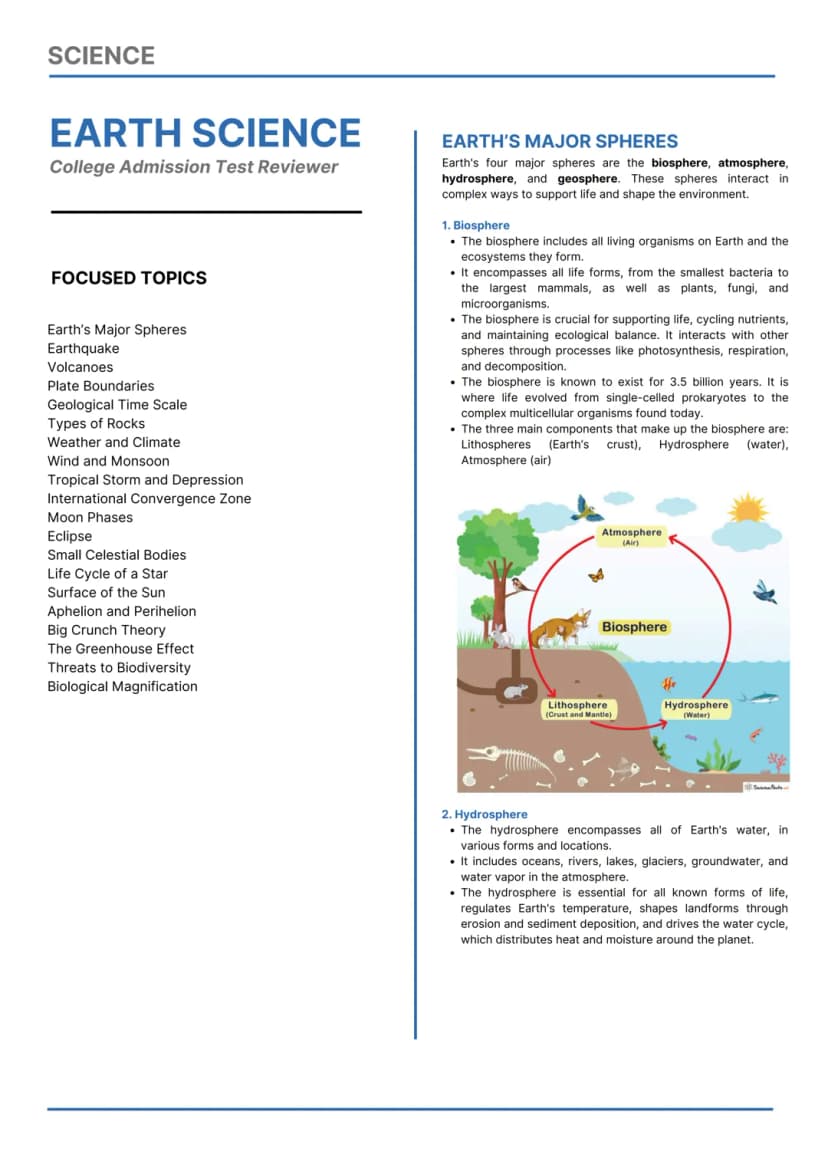
Ever wonder how all the different parts of Earth work together to support life? Earth's four major spheres - biosphere, atmosphere, hydrosphere, and geosphere - constantly interact to create the dynamic planet we live on.
The biosphere includes all living things and has existed for about 3.5 billion years. It's where life evolved from simple bacteria to complex organisms like us! This sphere depends on the other three spheres to survive - it needs air from the atmosphere, water from the hydrosphere, and land from the geosphere.
The hydrosphere contains all of Earth's water in oceans, rivers, lakes, and even water vapor. This sphere is essential because it regulates Earth's temperature and drives the water cycle, which distributes heat and moisture around our planet. Without it, life as we know it couldn't exist.
Quick Tip: Remember that the biosphere is made up of three components: lithosphere (crust), hydrosphere (water), and atmosphere (air).
2
of 10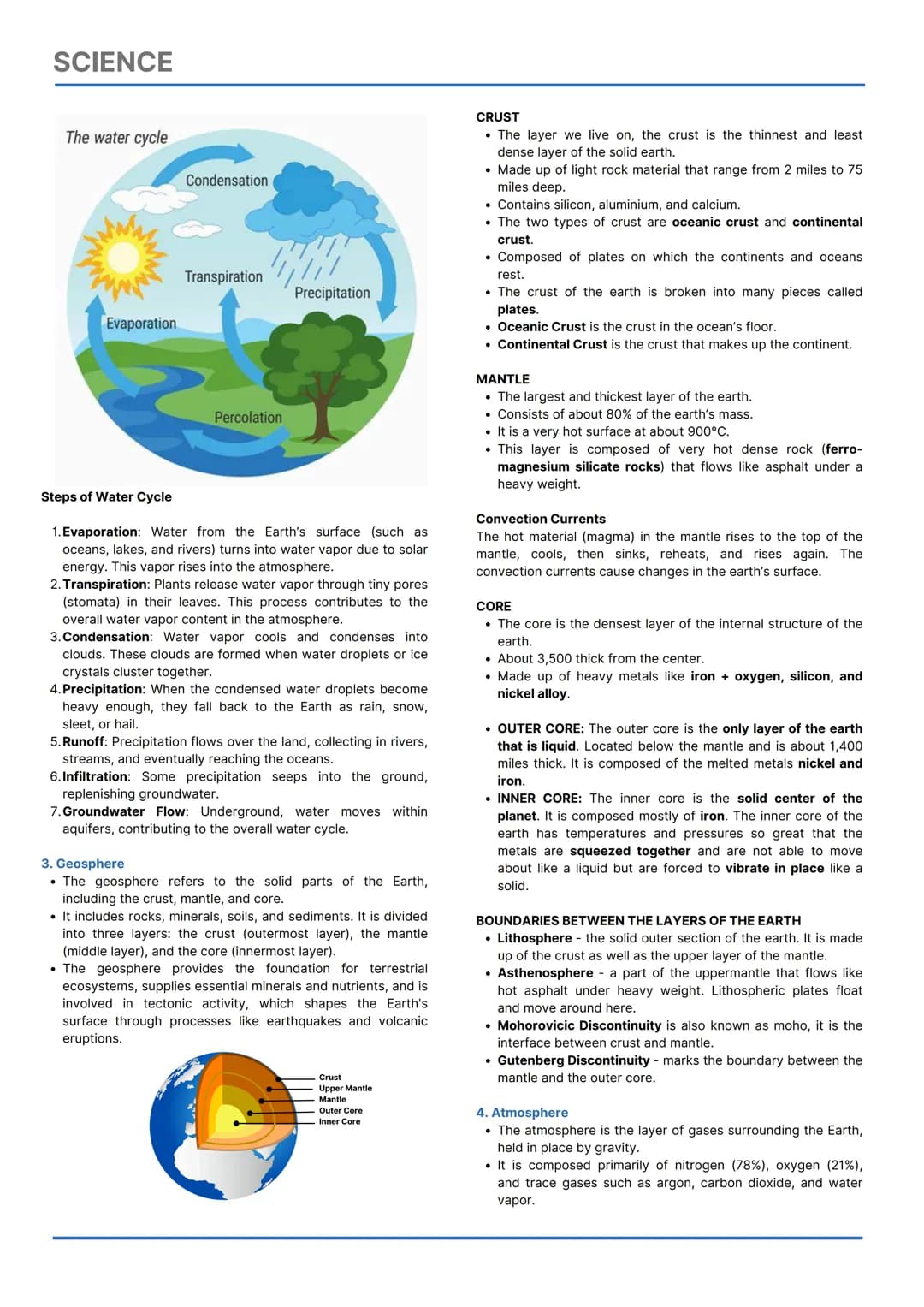
Water Cycle and Earth's Internal Structure
The water cycle is like Earth's circulatory system, constantly moving water around the planet. It starts with evaporation from oceans and lakes, then transpiration from plants adds more water vapor to the air. This vapor cools and forms clouds through condensation, eventually falling back as precipitation.
Earth's internal structure has three main layers that get hotter as you go deeper. The crust is the thin outer layer we live on - it's only 2-75 miles thick and contains silicon, aluminum, and calcium. The oceanic crust forms ocean floors, while continental crust makes up the continents.
The mantle is the largest layer, making up 80% of Earth's mass. At about 900°C, it's hot enough that rock flows like thick liquid! Convection currents in the mantle cause hot magma to rise, cool, and sink back down, which drives changes on Earth's surface.
Remember: The core has two parts - a liquid outer core made of melted iron and nickel, and a solid inner core where extreme pressure keeps metals squeezed together despite the intense heat.
3
of 10
Atmospheric Layers
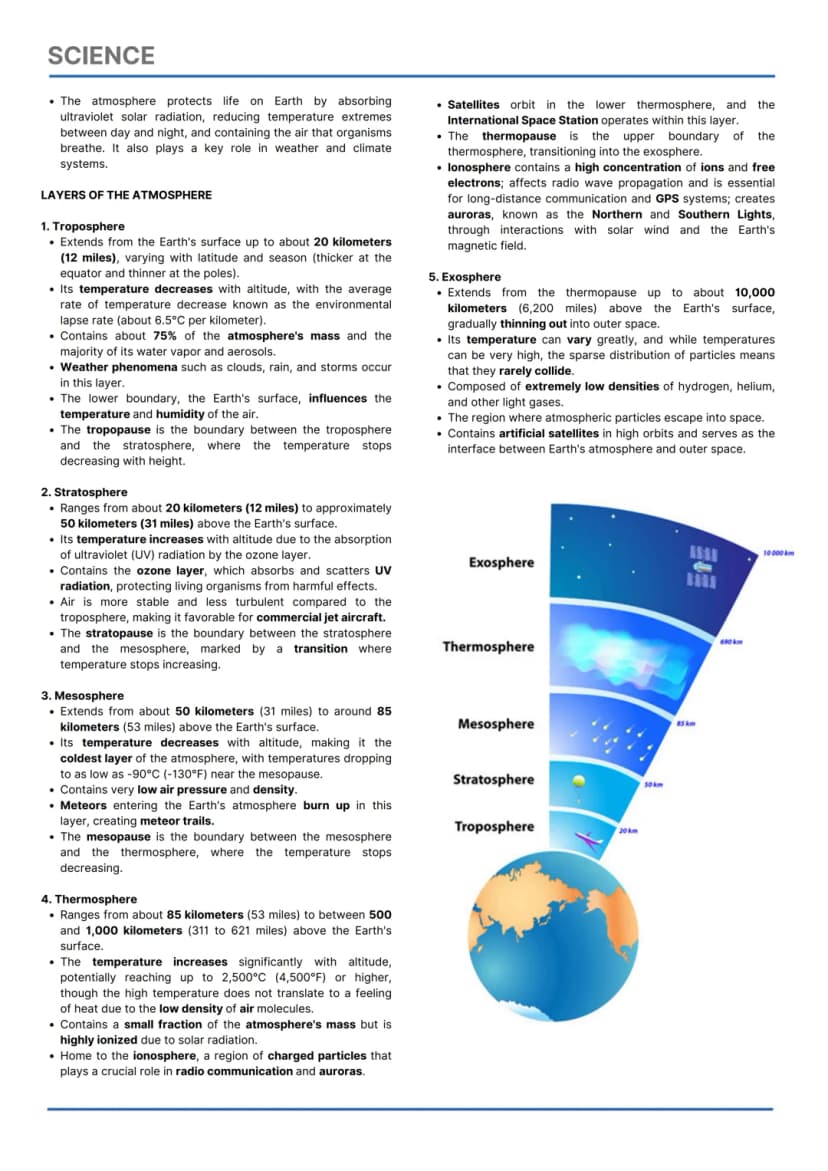
Think of Earth's atmosphere as a protective blanket with five distinct layers, each with its own personality. This 78% nitrogen, 21% oxygen mixture doesn't just give us air to breathe - it shields us from harmful radiation and regulates our planet's temperature.
The troposphere is where all weather happens and contains 75% of the atmosphere's mass. As you go higher, it gets colder at about 6.5°C per kilometer. Above that, the stratosphere actually gets warmer with altitude thanks to the ozone layer absorbing UV radiation - that's why jets love flying here for smooth rides.
The mesosphere is the coldest layer at -90°C, where meteors burn up creating those cool shooting star trails. The thermosphere can reach 2,500°C, but you wouldn't feel hot because the air is so thin! This is where the International Space Station orbits and where auroras light up the sky.
Key Point: The ionosphere within the thermosphere contains charged particles that make radio communication and GPS possible - pretty amazing how this invisible layer connects our modern world!
4
of 10
Earthquakes and Seismic Activity
Earthquakes might seem random and terrifying, but they're actually predictable events that happen when rock suddenly shifts along fault lines. The energy released creates seismic waves that travel through Earth, and understanding these waves helps scientists locate and measure earthquakes.
The focus (or hypocenter) is where the earthquake actually starts underground, while the epicenter is the point directly above it on Earth's surface. Primary waves arrive first because they're the fastest and can travel through both solids and liquids. Secondary waves come next but only move through solids.
Surface waves cause the most damage even though they're the slowest. Love waves shake side-to-side and can topple buildings, while Rayleigh waves create a rolling motion that's even more destructive. Scientists measure earthquake strength using magnitude (energy released) and intensity (effects at specific locations).
Safety Note: The Pacific Ring of Fire around the Pacific Ocean experiences the most earthquake and volcanic activity due to active tectonic plates - this affects countries like Japan, Indonesia, and the Philippines significantly.
5
of 10
Earthquake Measurement and Volcanoes
The PHIVOLCS Earthquake Intensity Scale ranges from I (scarcely perceptible) to X (completely devastating), helping people understand what to expect during different earthquake strengths. This practical scale focuses on actual effects rather than just scientific measurements.
Volcanoes form when magma (molten rock underground) reaches the surface and becomes lava. They're basically Earth's pressure relief valves! The main parts include the vent (opening where lava flows), crater , and summit (the volcano's peak).
What makes some volcanoes explosive while others are gentle depends on several factors. More water vapor and trapped gas create bigger explosions, while basaltic magma (thin) produces quiet eruptions and granitic magma (thick) leads to violent ones. Hawaiian eruptions are the calmest, while Pelean eruptions are among the most dangerous to populated areas.
Interesting Fact: Phreatic eruptions happen when cold groundwater meets hot rock - it's like nature's pressure cooker suddenly releasing steam!
6
of 10
Types of Volcanoes and Plate Boundaries
Different volcano types create distinct landscapes based on their eruption styles. Shield volcanoes like Hawaii's Mauna Loa have gentle slopes from fluid lava flows, while stratovolcanoes like Mount Fuji have steep, cone-shaped profiles from alternating explosive and quiet eruptions.
Plate boundaries are where the real geological action happens! At convergent boundaries, plates crash together - when an oceanic plate meets a continental plate, the denser oceanic plate gets subducted (pulled down), creating volcanic mountain chains like the Andes. When two continental plates collide, you get massive mountain ranges like the Himalayas.
Subduction zones are particularly important because they're where most of the world's explosive volcanoes and powerful earthquakes occur. The Ring of Fire around the Pacific is basically a series of these active subduction zones. Seafloor spreading at mid-ocean ridges creates new oceanic crust as plates move apart.
Visual Tip: Think of oceanic-oceanic convergence as creating island chains (like Japan), oceanic-continental as creating coastal mountain ranges, and continental-continental as creating inland mountain ranges.
7
of 10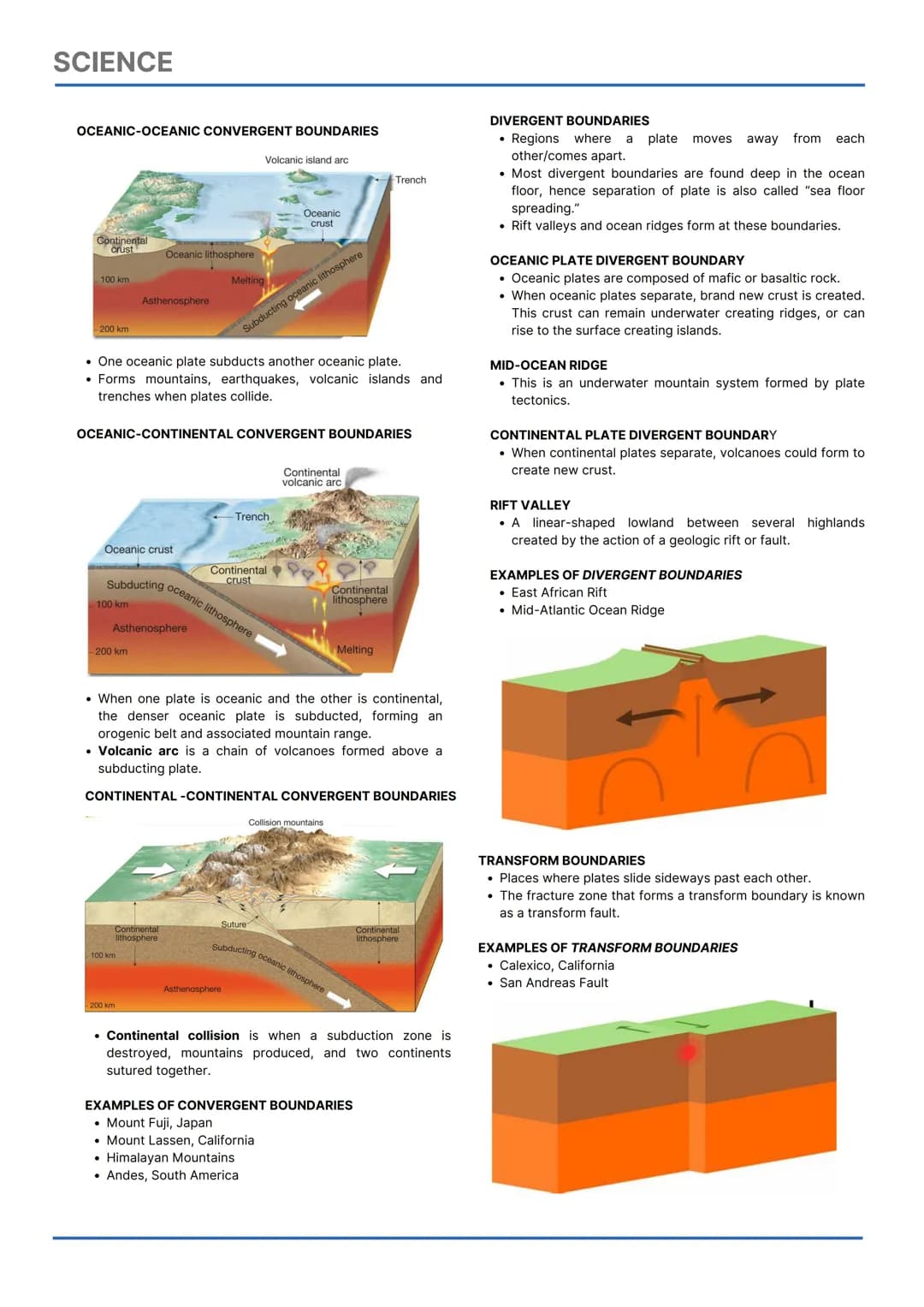
Plate Boundary Types and Geological Time
Divergent boundaries are where plates pull apart, creating new crust through seafloor spreading. The Mid-Atlantic Ridge is slowly making the Atlantic Ocean wider each year! On land, divergent boundaries create rift valleys like the East African Rift, which might eventually split Africa into two continents.
Transform boundaries are where plates slide past each other sideways. The famous San Andreas Fault in California is a perfect example - it's responsible for many of California's earthquakes as the Pacific and North American plates grind against each other.
The Geological Time Scale organizes Earth's 4.6-billion-year history into manageable chunks. We're currently in the Phanerozoic Eon (meaning "visible life"), which started 541 million years ago with the Cambrian Explosion - when complex life forms rapidly appeared in the fossil record.
Mind-Blowing Fact: The supercontinent Pangaea existed about 335-175 million years ago, and its breakup created the Atlantic Ocean and positioned continents where they are today!
8
of 10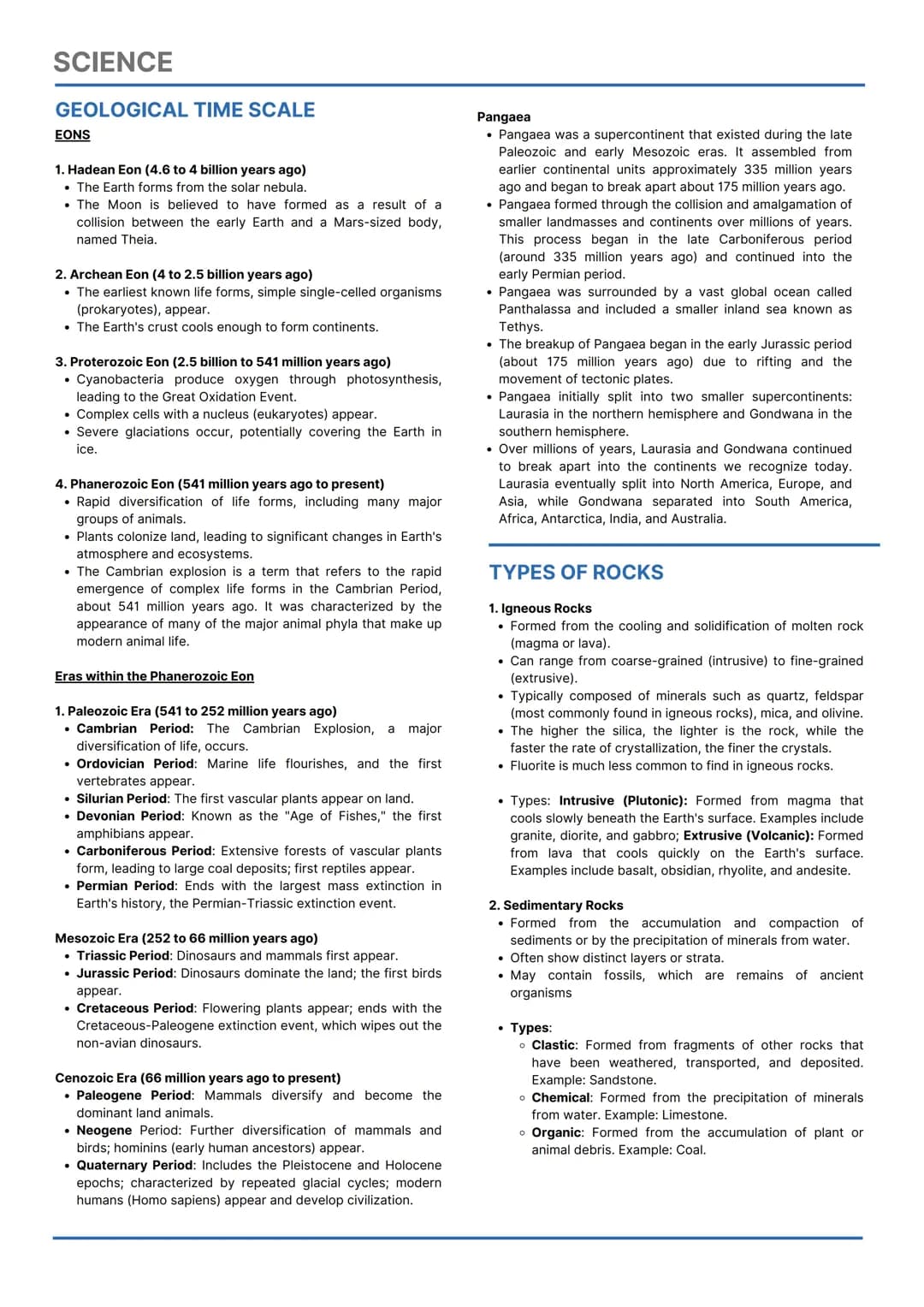
Geological Eras and Rock Types
Earth's history is divided into major eras that tell the story of life's evolution. The Paleozoic Era saw life move from oceans to land, the Mesozoic Era was dominated by dinosaurs, and our current Cenozoic Era is the age of mammals and eventually humans.
Rock types form through three main processes that create Earth's geological story. Igneous rocks crystallize from molten magma or lava - granite forms slowly underground (intrusive) while basalt cools quickly on the surface (extrusive). The faster the cooling, the smaller the crystals!
Sedimentary rocks form from accumulated particles or chemical precipitation, often preserving fossils that help us understand Earth's history. Limestone forms from ocean creatures' shells, while sandstone comes from compressed sand particles. Coal forms from ancient plant material - that's fossil fuel from actual fossils!
Study Tip: Metamorphic rocks form when existing rocks get "cooked" by heat and pressure - marble comes from limestone, and schist shows the layered structure typical of foliated metamorphic rocks.
9
of 10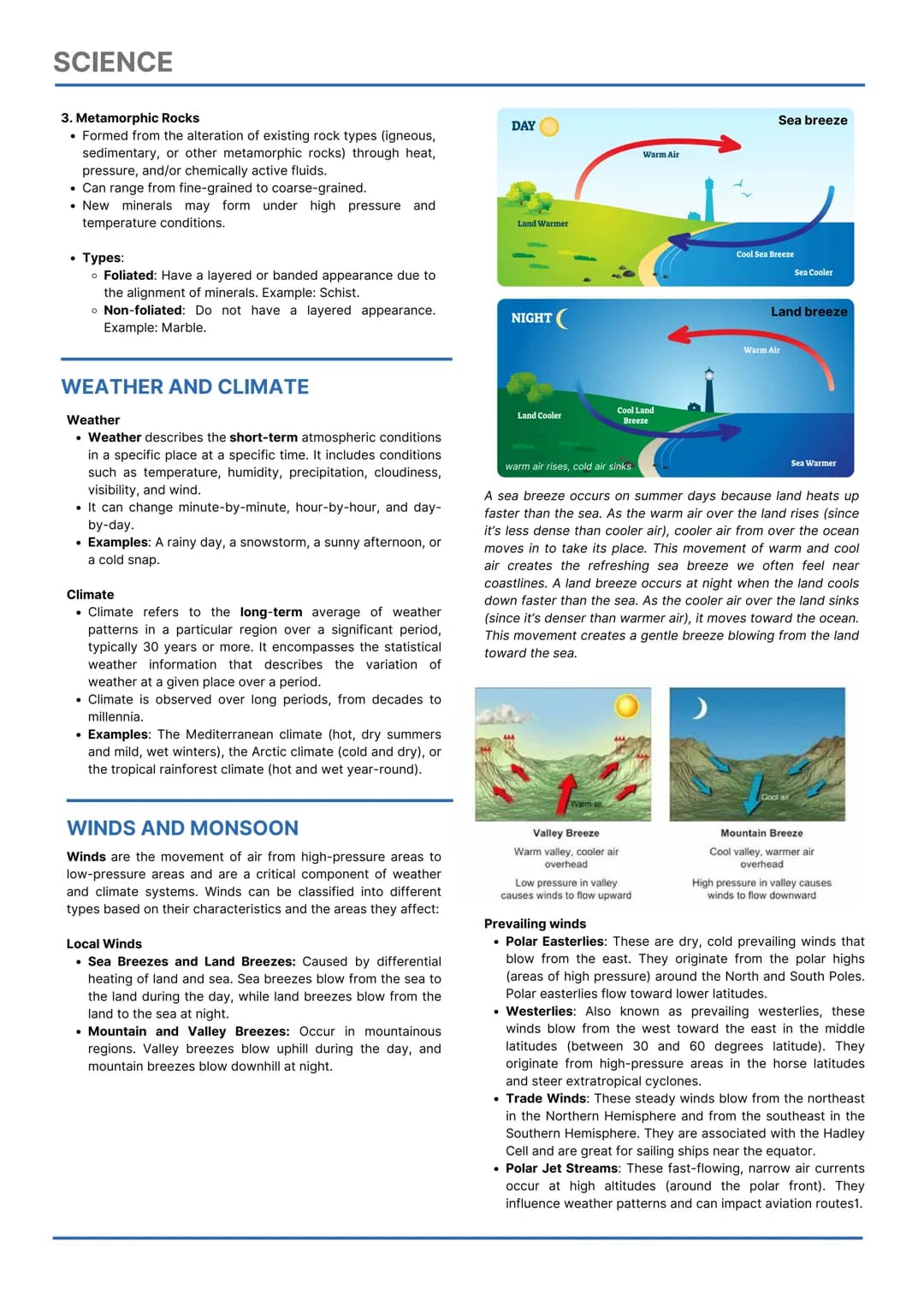
Weather, Climate, and Wind Patterns
Weather is what's happening right now - today's temperature, rainfall, and wind. Climate is the long-term average pattern over 30+ years. Think of weather as your daily mood and climate as your personality!
Sea breezes and land breezes show how temperature differences create local winds. During the day, land heats faster than water, so cool sea air moves inland. At night, land cools faster, reversing the pattern. This same principle works on a global scale with monsoons.
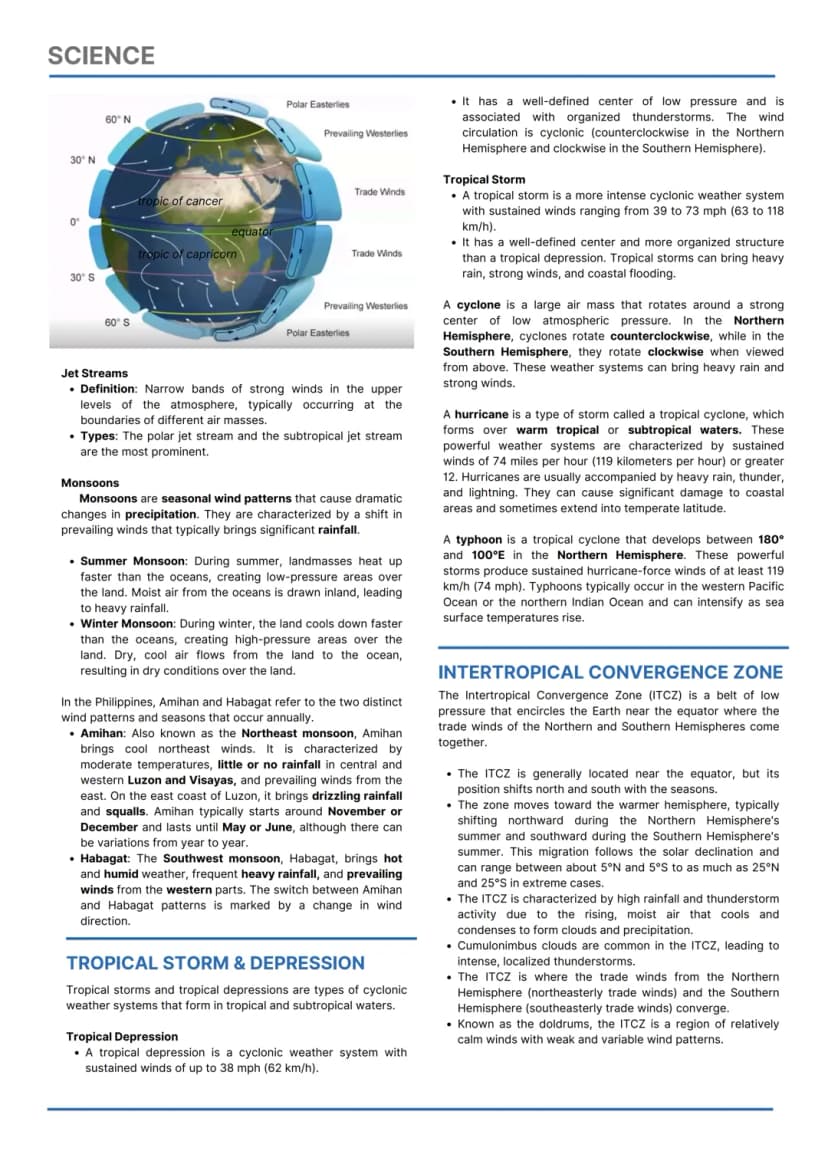
Trade winds, westerlies, and polar easterlies are Earth's major wind belts created by global heating patterns and the Coriolis effect. Jet streams are like fast-moving rivers of air that influence weather patterns and help (or hinder) airplane flights.
Local Connection: In the Philippines, Amihan (northeast monsoon) brings cool, dry weather from November to May, while Habagat (southwest monsoon) brings hot, humid conditions with heavy rainfall.
10
of 10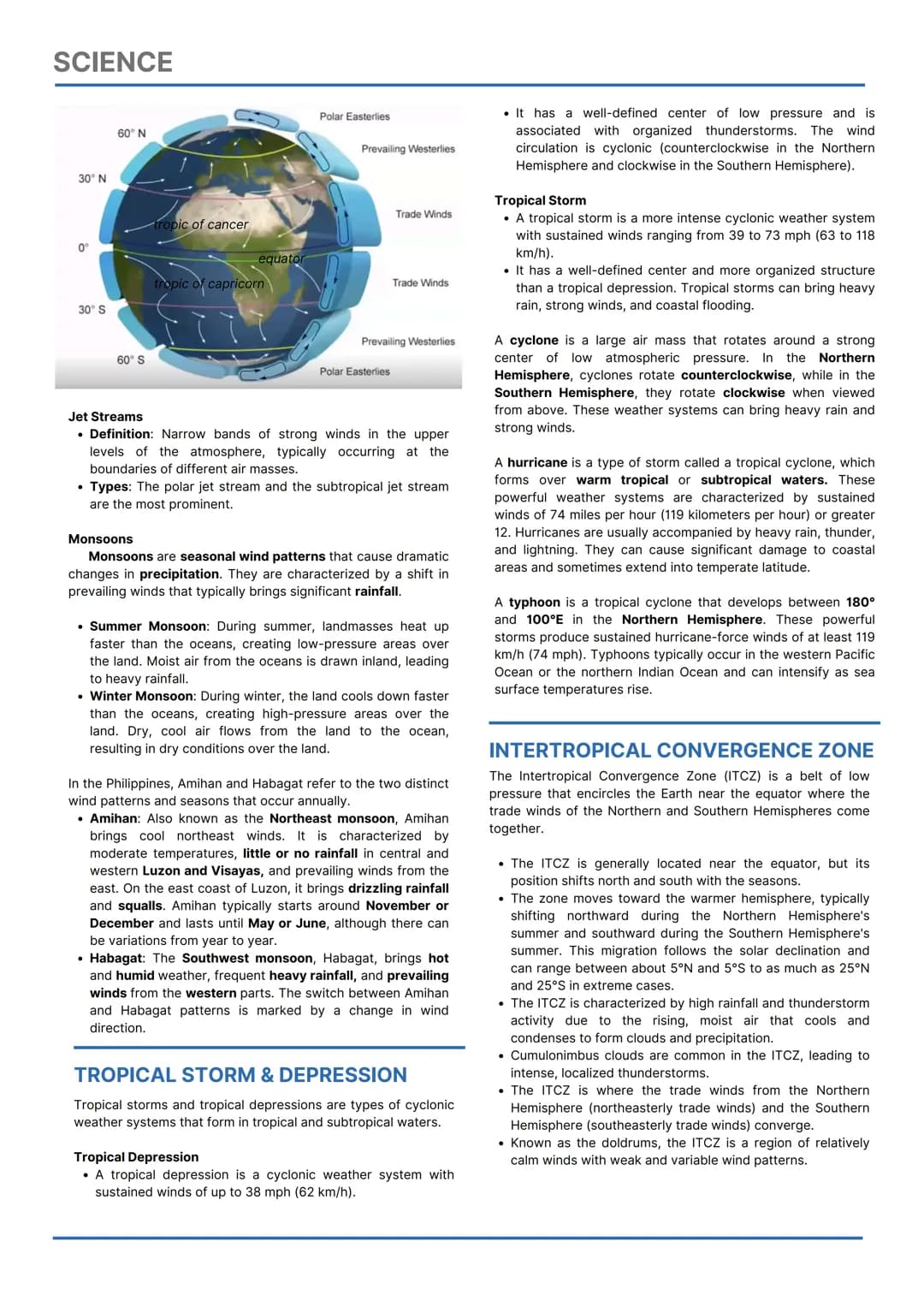
Tropical Weather Systems and Celestial Interactions
Tropical depressions have winds up to 38 mph, tropical storms have winds from 39-73 mph, and hurricanes/typhoons pack winds over 74 mph. These systems form over warm ocean waters and can cause devastating damage when they reach land.
The Intertropical Convergence Zone (ITCZ) is where trade winds from both hemispheres meet near the equator. This zone shifts with the seasons, following the sun's position, and creates a belt of heavy rainfall and thunderstorms. Sailors historically called this area the "doldrums" because of its calm, unpredictable winds.
Understanding these weather patterns helps predict seasonal changes and extreme weather events. The ITCZ's movement affects monsoon patterns across tropical regions, influencing agriculture, water resources, and daily life for billions of people.
Weather Fact: Cumulonimbus clouds in the ITCZ can tower over 60,000 feet high, creating some of the most intense thunderstorms on Earth with lightning, heavy rain, and sometimes tornadoes.
We thought you’d never ask...
What is the Knowunity AI companion?
Our AI companion is specifically built for the needs of students. Based on the millions of content pieces we have on the platform we can provide truly meaningful and relevant answers to students. But its not only about answers, the companion is even more about guiding students through their daily learning challenges, with personalised study plans, quizzes or content pieces in the chat and 100% personalisation based on the students skills and developments.
Where can I download the Knowunity app?
You can download the app in the Google Play Store and in the Apple App Store.
Is Knowunity really free of charge?
That's right! Enjoy free access to study content, connect with fellow students, and get instant help – all at your fingertips.
Similar Content
 Otros
Otros Otros
Otros Scheikunde
 Autres
Most popular content: Scientific Method
6 Econ
EconApplied economics
Second semester
G121,91648
 Other
OtherIntroduction to Psychology
for first year Psychology student who wants to advance study the subject.
G122,73796
ScienceScience G10 2ND QUARTER Reviewer
Science G10 2ND QUARTER Reviewer
G106,914190
OtherPhysical Science notes
notes for advance studying
G1286221
OtherScience 2nd Quarter notes
Grade 10 science notes
G101,26626
OtherScience 9 - Q2
Reviewer
G966719
Most popular content in Earth Science
9Earth ScienceProkaryotic and Eukaryotic Cells
Science - Biology
G83,39747
Earth ScienceParts of a compound microscope
Science - biology
G83,02233
Earth ScienceEARTH AND LIFE SCIENCE
EARTH AND LIFE SCIENCE
G113,78074
 GenMath
College Entrance Exam Reviewers Sample
Sharing some notes from an official entrance exam reviewer and as someone who passed multiple college entrance exams. Hope this helps.
G111,7589
Earth ScienceEarth
About earth science
G112,20576
Earth ScienceCell Division - Difference of Mitosis and Meiosis
General Biology
G111,96843
Earth ScienceNotes for Physical Science
This tackles on the summary of physical sciences.
G1181317
Earth Sciencereviewer for entrance exam
good memorization, study hard
G1278512
Earth ScienceEarth Science Lesson 1
Notes for STEM students
G1149610
Most popular content
9MathMathematics Grade 10 Quarter 1
Grade 10 Math topics
G1010,223250
Iba paEl Filibusterismo (FILIPINO 10)
Kilalanin ang mga karakter at alamin ang mga pangyayari mula Kabanata 1 hanggang 39.
G1011,183240
ScienceScience 9 Quarter 1 Lesson 1
Topics: The Respiratory System and The Circulatory System
G911,075383
 Gen Physics
General Physics 1, First Sem
Units of Measurement, Vectors, and Kinematics. All with formulas
G116,255168
 Filipino
Filipino 8 Reviewer
Filipino Reviewer for 4th Quarter for Grade 8 students
G88,088127
ScienceSCIENCE Grade 9 Quarter 3 Reviewer
All about the lessons in Grade 9 Quarter 3 SCIENCE, all complete, highlighted, printable, and has extra informations.
G914,629303
 Pre-Cal
UPCAT Reviewer: Mathematics
general coverage of the mathematics section for UPCAT
G127,085397
OtherIntroduction to Philosophy - 1st Semester, Grade 12
A summarized notes for Grade 12 students. Easier learning for the 1st semester’s Philosophy subject.
G123,96856
ScienceThe Human Digestive System
Science Grade 8 1st Quarter Lesson
G84,78386
Can't find what you're looking for? Explore other subjects.
Students love us — and so will you.
4.6/5App Store
4.7/5Google Play
The app is very easy to use and well designed. I have found everything I was looking for so far and have been able to learn a lot from the presentations! I will definitely use the app for a class assignment! And of course it also helps a lot as an inspiration.
Stefan SiOS user
This app is really great. There are so many study notes and help [...]. My problem subject is French, for example, and the app has so many options for help. Thanks to this app, I have improved my French. I would recommend it to anyone.
Samantha KlichAndroid user
Wow, I am really amazed. I just tried the app because I've seen it advertised many times and was absolutely stunned. This app is THE HELP you want for school and above all, it offers so many things, such as workouts and fact sheets, which have been VERY helpful to me personally.
AnnaiOS user
Earth Science3,568 views·Updated Jun 20, 2026·15 pagesMastering Earth Science for Your College Entrance Exam
K
Kreatives@kreatives
Understanding Earth and space science is crucial for making sense of the world around us - from predicting earthquakes and volcanic eruptions to explaining why we have seasons and weather patterns. This comprehensive guide covers the essential concepts you'll need...
1
of 10
Sign up to see the content. It's free!
- Access to all documents
- Improve your grades
- Join milions of students
Earth's Major Spheres and Structure
Ever wonder how all the different parts of Earth work together to support life? Earth's four major spheres - biosphere, atmosphere, hydrosphere, and geosphere - constantly interact to create the dynamic planet we live on.
The biosphere includes all living things and has existed for about 3.5 billion years. It's where life evolved from simple bacteria to complex organisms like us! This sphere depends on the other three spheres to survive - it needs air from the atmosphere, water from the hydrosphere, and land from the geosphere.
The hydrosphere contains all of Earth's water in oceans, rivers, lakes, and even water vapor. This sphere is essential because it regulates Earth's temperature and drives the water cycle, which distributes heat and moisture around our planet. Without it, life as we know it couldn't exist.
Quick Tip: Remember that the biosphere is made up of three components: lithosphere (crust), hydrosphere (water), and atmosphere (air).
2
of 10Sign up to see the content. It's free!
- Access to all documents
- Improve your grades
- Join milions of students
Water Cycle and Earth's Internal Structure
The water cycle is like Earth's circulatory system, constantly moving water around the planet. It starts with evaporation from oceans and lakes, then transpiration from plants adds more water vapor to the air. This vapor cools and forms clouds through condensation, eventually falling back as precipitation.
Earth's internal structure has three main layers that get hotter as you go deeper. The crust is the thin outer layer we live on - it's only 2-75 miles thick and contains silicon, aluminum, and calcium. The oceanic crust forms ocean floors, while continental crust makes up the continents.
The mantle is the largest layer, making up 80% of Earth's mass. At about 900°C, it's hot enough that rock flows like thick liquid! Convection currents in the mantle cause hot magma to rise, cool, and sink back down, which drives changes on Earth's surface.
Remember: The core has two parts - a liquid outer core made of melted iron and nickel, and a solid inner core where extreme pressure keeps metals squeezed together despite the intense heat.
3
of 10Sign up to see the content. It's free!
- Access to all documents
- Improve your grades
- Join milions of students
Atmospheric Layers
Think of Earth's atmosphere as a protective blanket with five distinct layers, each with its own personality. This 78% nitrogen, 21% oxygen mixture doesn't just give us air to breathe - it shields us from harmful radiation and regulates our planet's temperature.
The troposphere is where all weather happens and contains 75% of the atmosphere's mass. As you go higher, it gets colder at about 6.5°C per kilometer. Above that, the stratosphere actually gets warmer with altitude thanks to the ozone layer absorbing UV radiation - that's why jets love flying here for smooth rides.
The mesosphere is the coldest layer at -90°C, where meteors burn up creating those cool shooting star trails. The thermosphere can reach 2,500°C, but you wouldn't feel hot because the air is so thin! This is where the International Space Station orbits and where auroras light up the sky.
Key Point: The ionosphere within the thermosphere contains charged particles that make radio communication and GPS possible - pretty amazing how this invisible layer connects our modern world!
4
of 10Sign up to see the content. It's free!
- Access to all documents
- Improve your grades
- Join milions of students
Earthquakes and Seismic Activity
Earthquakes might seem random and terrifying, but they're actually predictable events that happen when rock suddenly shifts along fault lines. The energy released creates seismic waves that travel through Earth, and understanding these waves helps scientists locate and measure earthquakes.
The focus (or hypocenter) is where the earthquake actually starts underground, while the epicenter is the point directly above it on Earth's surface. Primary waves arrive first because they're the fastest and can travel through both solids and liquids. Secondary waves come next but only move through solids.
Surface waves cause the most damage even though they're the slowest. Love waves shake side-to-side and can topple buildings, while Rayleigh waves create a rolling motion that's even more destructive. Scientists measure earthquake strength using magnitude (energy released) and intensity (effects at specific locations).
Safety Note: The Pacific Ring of Fire around the Pacific Ocean experiences the most earthquake and volcanic activity due to active tectonic plates - this affects countries like Japan, Indonesia, and the Philippines significantly.
5
of 10Sign up to see the content. It's free!
- Access to all documents
- Improve your grades
- Join milions of students
Earthquake Measurement and Volcanoes
The PHIVOLCS Earthquake Intensity Scale ranges from I (scarcely perceptible) to X (completely devastating), helping people understand what to expect during different earthquake strengths. This practical scale focuses on actual effects rather than just scientific measurements.
Volcanoes form when magma (molten rock underground) reaches the surface and becomes lava. They're basically Earth's pressure relief valves! The main parts include the vent (opening where lava flows), crater , and summit (the volcano's peak).
What makes some volcanoes explosive while others are gentle depends on several factors. More water vapor and trapped gas create bigger explosions, while basaltic magma (thin) produces quiet eruptions and granitic magma (thick) leads to violent ones. Hawaiian eruptions are the calmest, while Pelean eruptions are among the most dangerous to populated areas.
Interesting Fact: Phreatic eruptions happen when cold groundwater meets hot rock - it's like nature's pressure cooker suddenly releasing steam!
6
of 10Sign up to see the content. It's free!
- Access to all documents
- Improve your grades
- Join milions of students
Types of Volcanoes and Plate Boundaries
Different volcano types create distinct landscapes based on their eruption styles. Shield volcanoes like Hawaii's Mauna Loa have gentle slopes from fluid lava flows, while stratovolcanoes like Mount Fuji have steep, cone-shaped profiles from alternating explosive and quiet eruptions.
Plate boundaries are where the real geological action happens! At convergent boundaries, plates crash together - when an oceanic plate meets a continental plate, the denser oceanic plate gets subducted (pulled down), creating volcanic mountain chains like the Andes. When two continental plates collide, you get massive mountain ranges like the Himalayas.
Subduction zones are particularly important because they're where most of the world's explosive volcanoes and powerful earthquakes occur. The Ring of Fire around the Pacific is basically a series of these active subduction zones. Seafloor spreading at mid-ocean ridges creates new oceanic crust as plates move apart.
Visual Tip: Think of oceanic-oceanic convergence as creating island chains (like Japan), oceanic-continental as creating coastal mountain ranges, and continental-continental as creating inland mountain ranges.
7
of 10Sign up to see the content. It's free!
- Access to all documents
- Improve your grades
- Join milions of students
Plate Boundary Types and Geological Time
Divergent boundaries are where plates pull apart, creating new crust through seafloor spreading. The Mid-Atlantic Ridge is slowly making the Atlantic Ocean wider each year! On land, divergent boundaries create rift valleys like the East African Rift, which might eventually split Africa into two continents.
Transform boundaries are where plates slide past each other sideways. The famous San Andreas Fault in California is a perfect example - it's responsible for many of California's earthquakes as the Pacific and North American plates grind against each other.
The Geological Time Scale organizes Earth's 4.6-billion-year history into manageable chunks. We're currently in the Phanerozoic Eon (meaning "visible life"), which started 541 million years ago with the Cambrian Explosion - when complex life forms rapidly appeared in the fossil record.
Mind-Blowing Fact: The supercontinent Pangaea existed about 335-175 million years ago, and its breakup created the Atlantic Ocean and positioned continents where they are today!
8
of 10Sign up to see the content. It's free!
- Access to all documents
- Improve your grades
- Join milions of students
Geological Eras and Rock Types
Earth's history is divided into major eras that tell the story of life's evolution. The Paleozoic Era saw life move from oceans to land, the Mesozoic Era was dominated by dinosaurs, and our current Cenozoic Era is the age of mammals and eventually humans.
Rock types form through three main processes that create Earth's geological story. Igneous rocks crystallize from molten magma or lava - granite forms slowly underground (intrusive) while basalt cools quickly on the surface (extrusive). The faster the cooling, the smaller the crystals!
Sedimentary rocks form from accumulated particles or chemical precipitation, often preserving fossils that help us understand Earth's history. Limestone forms from ocean creatures' shells, while sandstone comes from compressed sand particles. Coal forms from ancient plant material - that's fossil fuel from actual fossils!
Study Tip: Metamorphic rocks form when existing rocks get "cooked" by heat and pressure - marble comes from limestone, and schist shows the layered structure typical of foliated metamorphic rocks.
9
of 10Sign up to see the content. It's free!
- Access to all documents
- Improve your grades
- Join milions of students
Weather, Climate, and Wind Patterns
Weather is what's happening right now - today's temperature, rainfall, and wind. Climate is the long-term average pattern over 30+ years. Think of weather as your daily mood and climate as your personality!
Sea breezes and land breezes show how temperature differences create local winds. During the day, land heats faster than water, so cool sea air moves inland. At night, land cools faster, reversing the pattern. This same principle works on a global scale with monsoons.
Trade winds, westerlies, and polar easterlies are Earth's major wind belts created by global heating patterns and the Coriolis effect. Jet streams are like fast-moving rivers of air that influence weather patterns and help (or hinder) airplane flights.
Local Connection: In the Philippines, Amihan (northeast monsoon) brings cool, dry weather from November to May, while Habagat (southwest monsoon) brings hot, humid conditions with heavy rainfall.
10
of 10Sign up to see the content. It's free!
- Access to all documents
- Improve your grades
- Join milions of students
Tropical Weather Systems and Celestial Interactions
Tropical depressions have winds up to 38 mph, tropical storms have winds from 39-73 mph, and hurricanes/typhoons pack winds over 74 mph. These systems form over warm ocean waters and can cause devastating damage when they reach land.
The Intertropical Convergence Zone (ITCZ) is where trade winds from both hemispheres meet near the equator. This zone shifts with the seasons, following the sun's position, and creates a belt of heavy rainfall and thunderstorms. Sailors historically called this area the "doldrums" because of its calm, unpredictable winds.
Understanding these weather patterns helps predict seasonal changes and extreme weather events. The ITCZ's movement affects monsoon patterns across tropical regions, influencing agriculture, water resources, and daily life for billions of people.
Weather Fact: Cumulonimbus clouds in the ITCZ can tower over 60,000 feet high, creating some of the most intense thunderstorms on Earth with lightning, heavy rain, and sometimes tornadoes.
We thought you’d never ask...
What is the Knowunity AI companion?
Our AI companion is specifically built for the needs of students. Based on the millions of content pieces we have on the platform we can provide truly meaningful and relevant answers to students. But its not only about answers, the companion is even more about guiding students through their daily learning challenges, with personalised study plans, quizzes or content pieces in the chat and 100% personalisation based on the students skills and developments.
Where can I download the Knowunity app?
You can download the app in the Google Play Store and in the Apple App Store.
Is Knowunity really free of charge?
That's right! Enjoy free access to study content, connect with fellow students, and get instant help – all at your fingertips.
Similar Content
Most popular content: Scientific Method
6EconApplied economics
Second semester
G121,91648
OtherIntroduction to Psychology
for first year Psychology student who wants to advance study the subject.
G122,73796
ScienceScience G10 2ND QUARTER Reviewer
Science G10 2ND QUARTER Reviewer
G106,914190
OtherPhysical Science notes
notes for advance studying
G1286221
OtherScience 2nd Quarter notes
Grade 10 science notes
G101,26626
OtherScience 9 - Q2
Reviewer
G966719
Most popular content in Earth Science
9Earth ScienceProkaryotic and Eukaryotic Cells
Science - Biology
G83,39747
Earth ScienceParts of a compound microscope
Science - biology
G83,02233
Earth ScienceEARTH AND LIFE SCIENCE
EARTH AND LIFE SCIENCE
G113,78074
GenMathCollege Entrance Exam Reviewers Sample
Sharing some notes from an official entrance exam reviewer and as someone who passed multiple college entrance exams. Hope this helps.
G111,7589
Earth ScienceEarth
About earth science
G112,20576
Earth ScienceCell Division - Difference of Mitosis and Meiosis
General Biology
G111,96843
Earth ScienceNotes for Physical Science
This tackles on the summary of physical sciences.
G1181317
Earth Sciencereviewer for entrance exam
good memorization, study hard
G1278512
Earth ScienceEarth Science Lesson 1
Notes for STEM students
G1149610
Most popular content
9MathMathematics Grade 10 Quarter 1
Grade 10 Math topics
G1010,223250
Iba paEl Filibusterismo (FILIPINO 10)
Kilalanin ang mga karakter at alamin ang mga pangyayari mula Kabanata 1 hanggang 39.
G1011,183240
ScienceScience 9 Quarter 1 Lesson 1
Topics: The Respiratory System and The Circulatory System
G911,075383
Gen PhysicsGeneral Physics 1, First Sem
Units of Measurement, Vectors, and Kinematics. All with formulas
G116,255168
FilipinoFilipino 8 Reviewer
Filipino Reviewer for 4th Quarter for Grade 8 students
G88,088127
ScienceSCIENCE Grade 9 Quarter 3 Reviewer
All about the lessons in Grade 9 Quarter 3 SCIENCE, all complete, highlighted, printable, and has extra informations.
G914,629303
Pre-CalUPCAT Reviewer: Mathematics
general coverage of the mathematics section for UPCAT
G127,085397
OtherIntroduction to Philosophy - 1st Semester, Grade 12
A summarized notes for Grade 12 students. Easier learning for the 1st semester’s Philosophy subject.
G123,96856
ScienceThe Human Digestive System
Science Grade 8 1st Quarter Lesson
G84,78386
Can't find what you're looking for? Explore other subjects.
Students love us — and so will you.
4.6/5App Store
4.7/5Google Play
The app is very easy to use and well designed. I have found everything I was looking for so far and have been able to learn a lot from the presentations! I will definitely use the app for a class assignment! And of course it also helps a lot as an inspiration.
Stefan SiOS user
This app is really great. There are so many study notes and help [...]. My problem subject is French, for example, and the app has so many options for help. Thanks to this app, I have improved my French. I would recommend it to anyone.
Samantha KlichAndroid user
Wow, I am really amazed. I just tried the app because I've seen it advertised many times and was absolutely stunned. This app is THE HELP you want for school and above all, it offers so many things, such as workouts and fact sheets, which have been VERY helpful to me personally.
AnnaiOS user