
Think space is just about pretty stars? Think again! Understanding...
 Earth Science496 views·Updated Jun 26, 2026·6 pages
Introduction to Earth Science for STEM Students

Reigh<3@reigh0fsunshine



1 / 6
1
of 6
The Universe and How We Study It
The universe is basically everything that exists - all the galaxies, stars, and planets you can imagine, plus way more. Your home? It's on Earth, in our solar system, inside the Milky Way galaxy, which is just one tiny speck among an estimated 100 to 200 billion galaxies out there.
Here's what's crazy: astronomers have only discovered about 51 galaxies so far, but they know there are billions more waiting to be found. They figured this out by counting galaxies in small sections of space and then doing the math for the entire universe.
Optical telescopes have been our main tools for exploring space since Galileo's time, though today's versions are way more advanced. These instruments help scientists gather evidence for the major theories about how everything began: the Big Bang Theory, Steady State, Pulsating Universe, and The Big Crunch.
Quick Tip: When studying universe theories, focus on their main differences - some say the universe had a beginning, others say it's eternal, and some suggest it goes through cycles.
2
of 6
Major Theories About the Universe's Origin
The Big Bang Theory is probably the one you've heard of - it suggests our universe started from a tiny point called a singularity and has been expanding for about 13.8 billion years. Think of it like a massive explosion that scattered energy and matter everywhere.
The Steady State theory takes a completely different approach, claiming the universe has always existed with no beginning or end. According to this idea, new matter keeps getting created to maintain constant density as space expands.
The Pulsating Universe theory is like a cosmic heartbeat - it combines the Big Bang and Big Crunch in endless cycles of expansion and collapse. Meanwhile, The Big Crunch theory suggests the universe will eventually stop expanding and collapse into itself, creating the ultimate black hole.
Remember: Each theory tries to answer the same big questions but offers totally different explanations for what you observe in space.
3
of 6
What Makes Up the Universe and Different Cultural Views
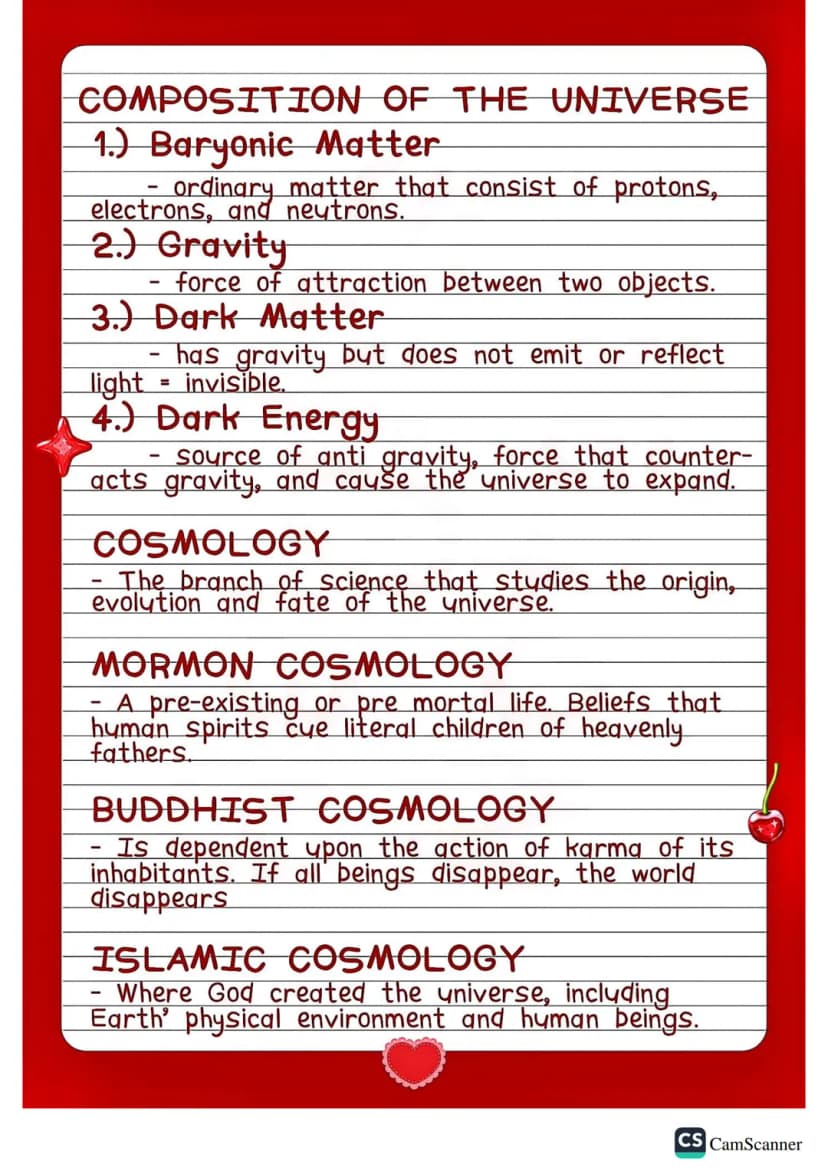
The universe consists of four main components that you should know. Baryonic matter is the ordinary stuff made of protons, electrons, and neutrons - basically everything you can touch. Gravity pulls objects together, while mysterious dark matter has gravity but stays completely invisible. Dark energy works like anti-gravity, pushing the universe apart.
Cosmology is the scientific study of how the universe began, evolved, and might end. But different cultures have their own explanations too.
Mormon cosmology focuses on pre-existing spirits and heavenly families. Buddhist cosmology connects the universe's fate to karma and actions of its inhabitants. Islamic cosmology emphasizes God's creation of everything, including Earth and humans. Hindu cosmology sees creation as timeless cycles with no real beginning.
Study Smart: For tests, focus on the four components of the universe first, then remember that different belief systems offer alternative explanations to scientific theories.
4
of 6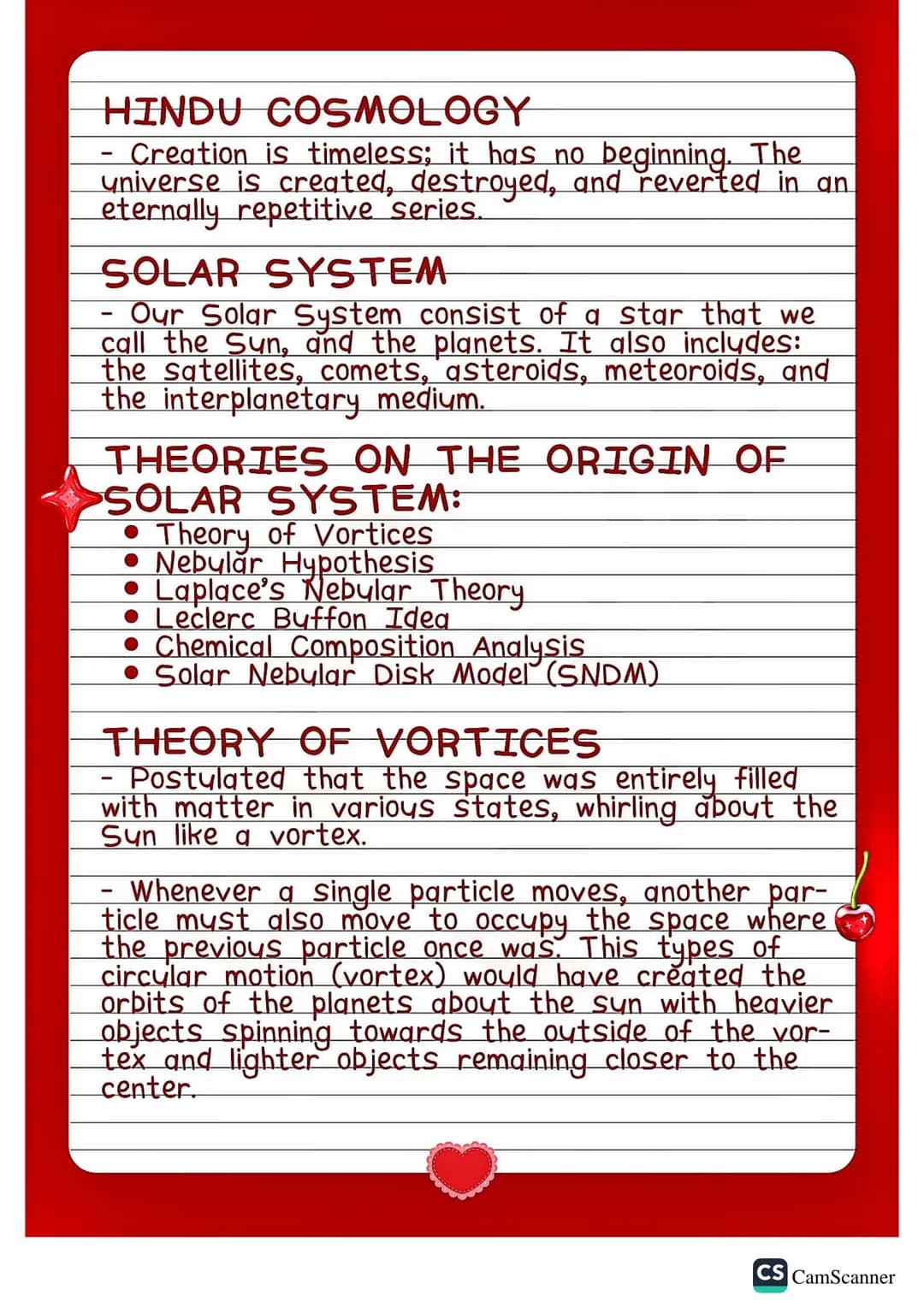
Our Solar System and Early Formation Theories
Your solar system includes way more than just the Sun and eight planets. It's packed with satellites (moons), comets, asteroids, meteoroids, and something called the interplanetary medium - basically the space between everything.
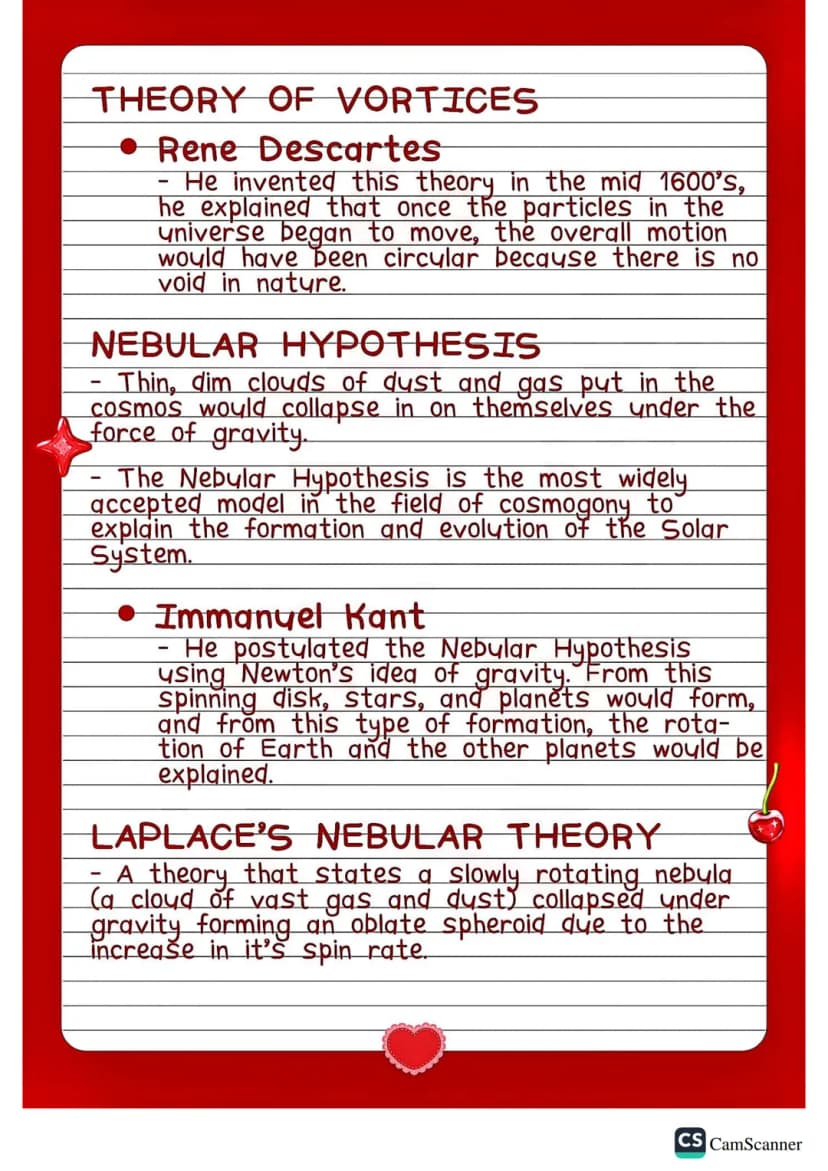
Scientists have developed several theories to explain how this cosmic neighborhood formed. The Theory of Vortices imagines space filled with swirling matter around the Sun, with heavier objects spinning outward and lighter ones staying close to the center.
René Descartes invented the vortices theory in the mid-1600s, explaining that particles naturally move in circles because there's no empty space in nature. The Nebular Hypothesis suggests that clouds of dust and gas collapsed under gravity to form our solar system - and it's currently the most accepted explanation among scientists.
Key Point: Understanding these formation theories helps explain why planets orbit the Sun in specific patterns and why some are rocky while others are gas giants.
5
of 6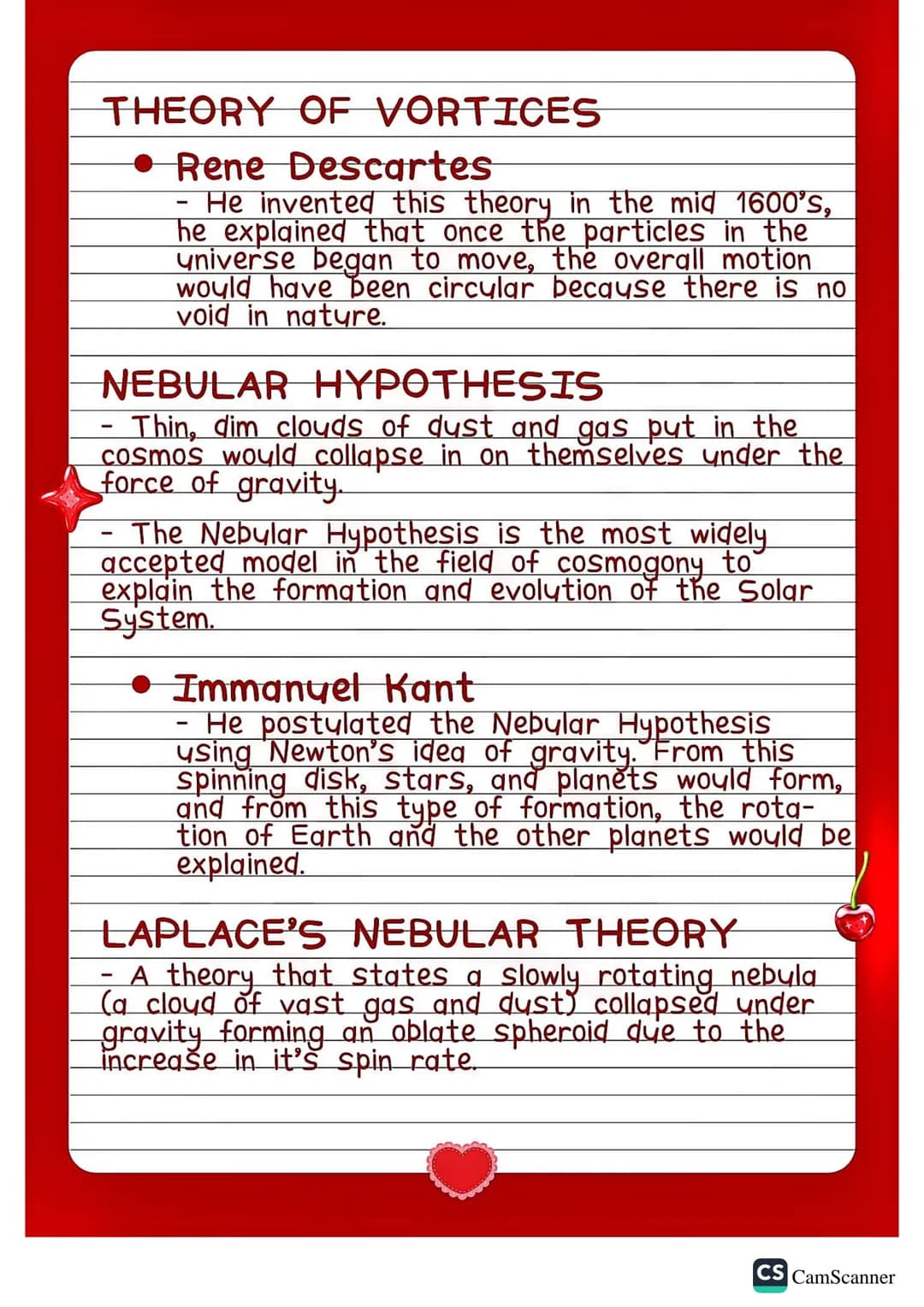
More Solar System Formation Theories
Immanuel Kant developed the Nebular Hypothesis using Newton's gravity ideas, explaining how spinning disks of matter could form stars and planets. This theory also explains why Earth and other planets rotate the way they do.
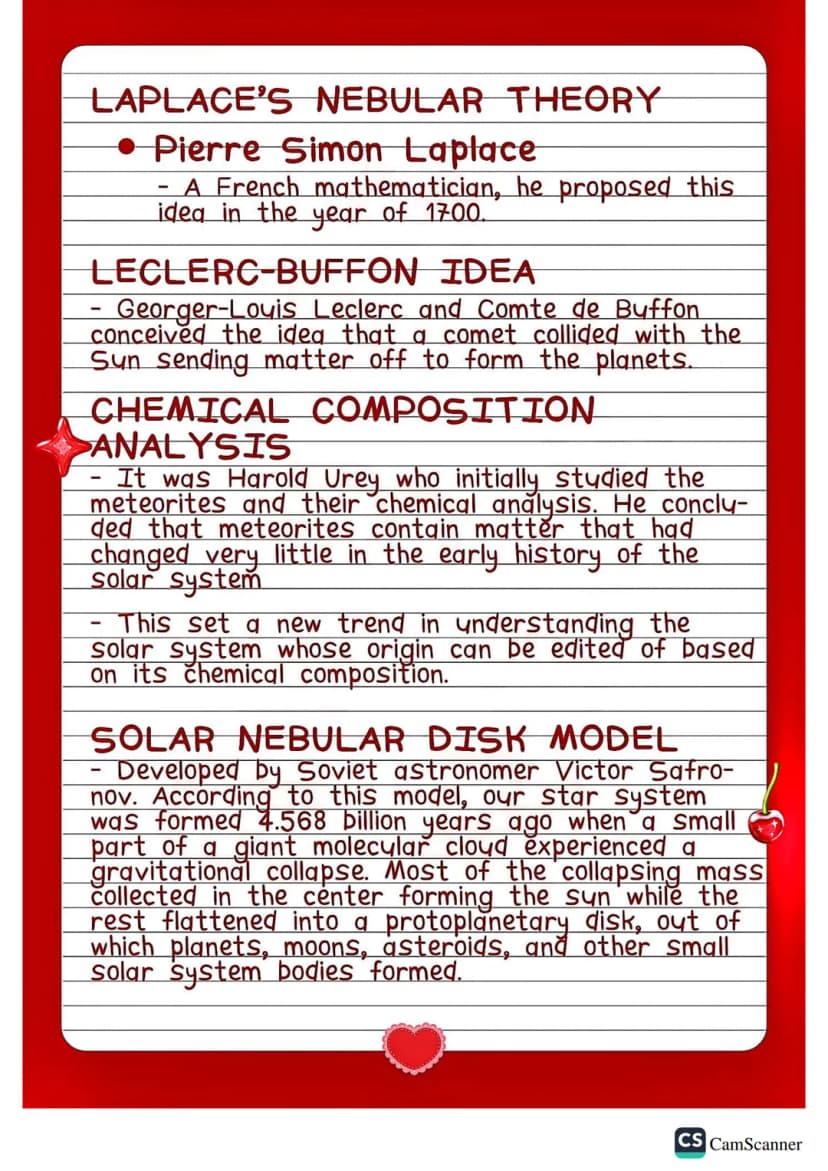
Pierre Simon Laplace, a French mathematician from the 1700s, proposed Laplace's Nebular Theory. He suggested a slowly rotating cloud of gas and dust collapsed under gravity, spinning faster and flattening into a disk shape as it shrank.
The Leclerc-Buffon Idea takes a more dramatic approach - these scientists thought a comet smashed into the Sun, sending chunks of matter flying off to become planets. While this sounds exciting, it's not widely accepted today.
Chemical Composition Analysis became important when Harold Urey studied meteorites and found they contained matter virtually unchanged since the early solar system, giving scientists new clues about our cosmic origins.
Test Tip: Remember the scientists' names with their theories - Kant with Nebular Hypothesis, Laplace with his version of nebular theory, and Urey with chemical analysis.
6
of 6
The Most Modern Theory
The Solar Nebular Disk Model represents our current best understanding of how the solar system formed. Developed by Soviet astronomer Victor Safronov, this model explains what happened about 4.568 billion years ago.
According to this theory, a small section of a giant molecular cloud collapsed under its own gravity. Most of the material clumped together in the center to form our Sun, while the leftover matter flattened into a spinning disk around it.
From this protoplanetary disk, planets, moons, asteroids, and other solar system objects gradually formed through collisions and gravitational attraction. This model successfully explains many features we observe today, like why planets orbit in the same plane and direction.
This theory combines evidence from meteorite studies, computer simulations, and observations of other star systems currently forming. It shows how scientific understanding evolves as new technology and evidence become available.
Connect the Dots: This model explains not just how our solar system formed, but also helps scientists understand planetary systems around other stars throughout the universe.
We thought you’d never ask...
What is the Knowunity AI companion?
Our AI companion is specifically built for the needs of students. Based on the millions of content pieces we have on the platform we can provide truly meaningful and relevant answers to students. But its not only about answers, the companion is even more about guiding students through their daily learning challenges, with personalised study plans, quizzes or content pieces in the chat and 100% personalisation based on the students skills and developments.
Where can I download the Knowunity app?
You can download the app in the Google Play Store and in the Apple App Store.
Is Knowunity really free of charge?
That's right! Enjoy free access to study content, connect with fellow students, and get instant help – all at your fingertips.
Similar Content
 Scienze
 Geografia
Most popular content in Earth Science
9Earth ScienceProkaryotic and Eukaryotic Cells
Science - Biology
G83,39747
Earth ScienceEarth science - your help entrance college exam
Earth science
G123,56888
Earth ScienceParts of a compound microscope
Science - biology
G83,02233
Earth ScienceEARTH AND LIFE SCIENCE
EARTH AND LIFE SCIENCE
G113,78074
 GenMath
College Entrance Exam Reviewers Sample
Sharing some notes from an official entrance exam reviewer and as someone who passed multiple college entrance exams. Hope this helps.
G111,7589
Earth ScienceEarth
About earth science
G112,20576
Earth ScienceCell Division - Difference of Mitosis and Meiosis
General Biology
G111,96843
Earth ScienceNotes for Physical Science
This tackles on the summary of physical sciences.
G1181317
Earth Sciencereviewer for entrance exam
good memorization, study hard
G1278512
Most popular content
9MathMathematics Grade 10 Quarter 1
Grade 10 Math topics
G1010,223250
 Iba pa
El Filibusterismo (FILIPINO 10)
Kilalanin ang mga karakter at alamin ang mga pangyayari mula Kabanata 1 hanggang 39.
G1011,183240
ScienceScience 9 Quarter 1 Lesson 1
Topics: The Respiratory System and The Circulatory System
G911,075383
 Gen Physics
General Physics 1, First Sem
Units of Measurement, Vectors, and Kinematics. All with formulas
G116,255168
 Filipino
Filipino 8 Reviewer
Filipino Reviewer for 4th Quarter for Grade 8 students
G88,088127
ScienceSCIENCE Grade 9 Quarter 3 Reviewer
All about the lessons in Grade 9 Quarter 3 SCIENCE, all complete, highlighted, printable, and has extra informations.
G914,629303
 Pre-Cal
UPCAT Reviewer: Mathematics
general coverage of the mathematics section for UPCAT
G127,085397
OtherIntroduction to Philosophy - 1st Semester, Grade 12
A summarized notes for Grade 12 students. Easier learning for the 1st semester’s Philosophy subject.
G123,96856
ScienceThe Human Digestive System
Science Grade 8 1st Quarter Lesson
G84,78386
Can't find what you're looking for? Explore other subjects.
Students love us — and so will you.
4.6/5App Store
4.7/5Google Play
The app is very easy to use and well designed. I have found everything I was looking for so far and have been able to learn a lot from the presentations! I will definitely use the app for a class assignment! And of course it also helps a lot as an inspiration.
Stefan SiOS user
This app is really great. There are so many study notes and help [...]. My problem subject is French, for example, and the app has so many options for help. Thanks to this app, I have improved my French. I would recommend it to anyone.
Samantha KlichAndroid user
Wow, I am really amazed. I just tried the app because I've seen it advertised many times and was absolutely stunned. This app is THE HELP you want for school and above all, it offers so many things, such as workouts and fact sheets, which have been VERY helpful to me personally.
AnnaiOS user
Earth Science496 views·Updated Jun 26, 2026·6 pagesIntroduction to Earth Science for STEM Students
Reigh<3@reigh0fsunshine
Think space is just about pretty stars? Think again! Understanding the universe and our solar system is like having the ultimate backstory to everything around us. From mind-blowing theories about cosmic explosions to how our own backyard of planets formed,...
1
of 6
Sign up to see the content. It's free!
- Access to all documents
- Improve your grades
- Join milions of students
The Universe and How We Study It
The universe is basically everything that exists - all the galaxies, stars, and planets you can imagine, plus way more. Your home? It's on Earth, in our solar system, inside the Milky Way galaxy, which is just one tiny speck among an estimated 100 to 200 billion galaxies out there.
Here's what's crazy: astronomers have only discovered about 51 galaxies so far, but they know there are billions more waiting to be found. They figured this out by counting galaxies in small sections of space and then doing the math for the entire universe.
Optical telescopes have been our main tools for exploring space since Galileo's time, though today's versions are way more advanced. These instruments help scientists gather evidence for the major theories about how everything began: the Big Bang Theory, Steady State, Pulsating Universe, and The Big Crunch.
Quick Tip: When studying universe theories, focus on their main differences - some say the universe had a beginning, others say it's eternal, and some suggest it goes through cycles.
2
of 6Sign up to see the content. It's free!
- Access to all documents
- Improve your grades
- Join milions of students
Major Theories About the Universe's Origin
The Big Bang Theory is probably the one you've heard of - it suggests our universe started from a tiny point called a singularity and has been expanding for about 13.8 billion years. Think of it like a massive explosion that scattered energy and matter everywhere.
The Steady State theory takes a completely different approach, claiming the universe has always existed with no beginning or end. According to this idea, new matter keeps getting created to maintain constant density as space expands.
The Pulsating Universe theory is like a cosmic heartbeat - it combines the Big Bang and Big Crunch in endless cycles of expansion and collapse. Meanwhile, The Big Crunch theory suggests the universe will eventually stop expanding and collapse into itself, creating the ultimate black hole.
Remember: Each theory tries to answer the same big questions but offers totally different explanations for what you observe in space.
3
of 6Sign up to see the content. It's free!
- Access to all documents
- Improve your grades
- Join milions of students
What Makes Up the Universe and Different Cultural Views
The universe consists of four main components that you should know. Baryonic matter is the ordinary stuff made of protons, electrons, and neutrons - basically everything you can touch. Gravity pulls objects together, while mysterious dark matter has gravity but stays completely invisible. Dark energy works like anti-gravity, pushing the universe apart.
Cosmology is the scientific study of how the universe began, evolved, and might end. But different cultures have their own explanations too.
Mormon cosmology focuses on pre-existing spirits and heavenly families. Buddhist cosmology connects the universe's fate to karma and actions of its inhabitants. Islamic cosmology emphasizes God's creation of everything, including Earth and humans. Hindu cosmology sees creation as timeless cycles with no real beginning.
Study Smart: For tests, focus on the four components of the universe first, then remember that different belief systems offer alternative explanations to scientific theories.
4
of 6Sign up to see the content. It's free!
- Access to all documents
- Improve your grades
- Join milions of students
Our Solar System and Early Formation Theories
Your solar system includes way more than just the Sun and eight planets. It's packed with satellites (moons), comets, asteroids, meteoroids, and something called the interplanetary medium - basically the space between everything.
Scientists have developed several theories to explain how this cosmic neighborhood formed. The Theory of Vortices imagines space filled with swirling matter around the Sun, with heavier objects spinning outward and lighter ones staying close to the center.
René Descartes invented the vortices theory in the mid-1600s, explaining that particles naturally move in circles because there's no empty space in nature. The Nebular Hypothesis suggests that clouds of dust and gas collapsed under gravity to form our solar system - and it's currently the most accepted explanation among scientists.
Key Point: Understanding these formation theories helps explain why planets orbit the Sun in specific patterns and why some are rocky while others are gas giants.
5
of 6Sign up to see the content. It's free!
- Access to all documents
- Improve your grades
- Join milions of students
More Solar System Formation Theories
Immanuel Kant developed the Nebular Hypothesis using Newton's gravity ideas, explaining how spinning disks of matter could form stars and planets. This theory also explains why Earth and other planets rotate the way they do.
Pierre Simon Laplace, a French mathematician from the 1700s, proposed Laplace's Nebular Theory. He suggested a slowly rotating cloud of gas and dust collapsed under gravity, spinning faster and flattening into a disk shape as it shrank.
The Leclerc-Buffon Idea takes a more dramatic approach - these scientists thought a comet smashed into the Sun, sending chunks of matter flying off to become planets. While this sounds exciting, it's not widely accepted today.
Chemical Composition Analysis became important when Harold Urey studied meteorites and found they contained matter virtually unchanged since the early solar system, giving scientists new clues about our cosmic origins.
Test Tip: Remember the scientists' names with their theories - Kant with Nebular Hypothesis, Laplace with his version of nebular theory, and Urey with chemical analysis.
6
of 6Sign up to see the content. It's free!
- Access to all documents
- Improve your grades
- Join milions of students
The Most Modern Theory
The Solar Nebular Disk Model represents our current best understanding of how the solar system formed. Developed by Soviet astronomer Victor Safronov, this model explains what happened about 4.568 billion years ago.
According to this theory, a small section of a giant molecular cloud collapsed under its own gravity. Most of the material clumped together in the center to form our Sun, while the leftover matter flattened into a spinning disk around it.
From this protoplanetary disk, planets, moons, asteroids, and other solar system objects gradually formed through collisions and gravitational attraction. This model successfully explains many features we observe today, like why planets orbit in the same plane and direction.
This theory combines evidence from meteorite studies, computer simulations, and observations of other star systems currently forming. It shows how scientific understanding evolves as new technology and evidence become available.
Connect the Dots: This model explains not just how our solar system formed, but also helps scientists understand planetary systems around other stars throughout the universe.
We thought you’d never ask...
What is the Knowunity AI companion?
Our AI companion is specifically built for the needs of students. Based on the millions of content pieces we have on the platform we can provide truly meaningful and relevant answers to students. But its not only about answers, the companion is even more about guiding students through their daily learning challenges, with personalised study plans, quizzes or content pieces in the chat and 100% personalisation based on the students skills and developments.
Where can I download the Knowunity app?
You can download the app in the Google Play Store and in the Apple App Store.
Is Knowunity really free of charge?
That's right! Enjoy free access to study content, connect with fellow students, and get instant help – all at your fingertips.
Similar Content
Most popular content in Earth Science
9Earth ScienceProkaryotic and Eukaryotic Cells
Science - Biology
G83,39747
Earth ScienceEarth science - your help entrance college exam
Earth science
G123,56888
Earth ScienceParts of a compound microscope
Science - biology
G83,02233
Earth ScienceEARTH AND LIFE SCIENCE
EARTH AND LIFE SCIENCE
G113,78074
GenMathCollege Entrance Exam Reviewers Sample
Sharing some notes from an official entrance exam reviewer and as someone who passed multiple college entrance exams. Hope this helps.
G111,7589
Earth ScienceEarth
About earth science
G112,20576
Earth ScienceCell Division - Difference of Mitosis and Meiosis
General Biology
G111,96843
Earth ScienceNotes for Physical Science
This tackles on the summary of physical sciences.
G1181317
Earth Sciencereviewer for entrance exam
good memorization, study hard
G1278512
Most popular content
9MathMathematics Grade 10 Quarter 1
Grade 10 Math topics
G1010,223250
Iba paEl Filibusterismo (FILIPINO 10)
Kilalanin ang mga karakter at alamin ang mga pangyayari mula Kabanata 1 hanggang 39.
G1011,183240
ScienceScience 9 Quarter 1 Lesson 1
Topics: The Respiratory System and The Circulatory System
G911,075383
Gen PhysicsGeneral Physics 1, First Sem
Units of Measurement, Vectors, and Kinematics. All with formulas
G116,255168
FilipinoFilipino 8 Reviewer
Filipino Reviewer for 4th Quarter for Grade 8 students
G88,088127
ScienceSCIENCE Grade 9 Quarter 3 Reviewer
All about the lessons in Grade 9 Quarter 3 SCIENCE, all complete, highlighted, printable, and has extra informations.
G914,629303
Pre-CalUPCAT Reviewer: Mathematics
general coverage of the mathematics section for UPCAT
G127,085397
OtherIntroduction to Philosophy - 1st Semester, Grade 12
A summarized notes for Grade 12 students. Easier learning for the 1st semester’s Philosophy subject.
G123,96856
ScienceThe Human Digestive System
Science Grade 8 1st Quarter Lesson
G84,78386
Can't find what you're looking for? Explore other subjects.
Students love us — and so will you.
4.6/5App Store
4.7/5Google Play
The app is very easy to use and well designed. I have found everything I was looking for so far and have been able to learn a lot from the presentations! I will definitely use the app for a class assignment! And of course it also helps a lot as an inspiration.
Stefan SiOS user
This app is really great. There are so many study notes and help [...]. My problem subject is French, for example, and the app has so many options for help. Thanks to this app, I have improved my French. I would recommend it to anyone.
Samantha KlichAndroid user
Wow, I am really amazed. I just tried the app because I've seen it advertised many times and was absolutely stunned. This app is THE HELP you want for school and above all, it offers so many things, such as workouts and fact sheets, which have been VERY helpful to me personally.
AnnaiOS user