
The Solar System is a collection of eight planets and...
 Earth and Space Science54 views·Updated Jun 8, 2026·2 pages
Discover Our Solar System: Planets and Wonders

Sri@study._.tofu
1
of 2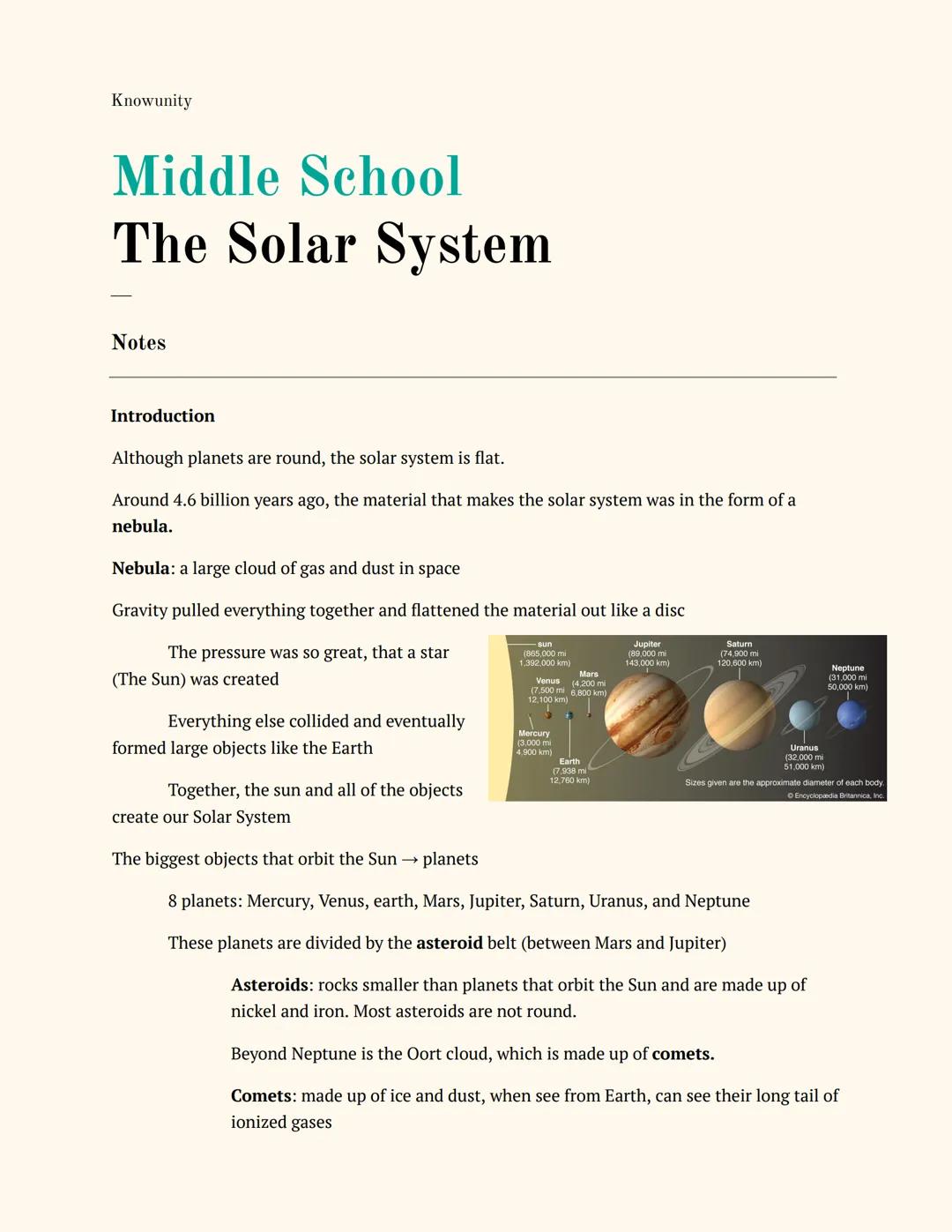
Formation and Structure of the Solar System
Ever wondered why the Solar System is flat even though planets are round? About 4.6 billion years ago, gravity pulled together a giant cloud of gas and dust called a nebula. As this material collapsed, it flattened into a spinning disc, much like a pizza dough being tossed and spun.
In the center of this disc, tremendous pressure created our Sun. The remaining materials collided and stuck together, eventually forming the planets and other objects. This whole collection of the Sun and orbiting objects makes up our Solar System.
The eight planets in our Solar System are divided by the asteroid belt, which sits between Mars and Jupiter. The inner planets (Mercury, Venus, Earth, and Mars) are smaller and rocky. The outer planets (Jupiter, Saturn, Uranus, and Neptune) are much larger gas giants.
Fun Fact: Beyond Neptune lies the Oort cloud, which is filled with comets - icy objects that develop beautiful tails of gas when they approach the Sun!
2
of 2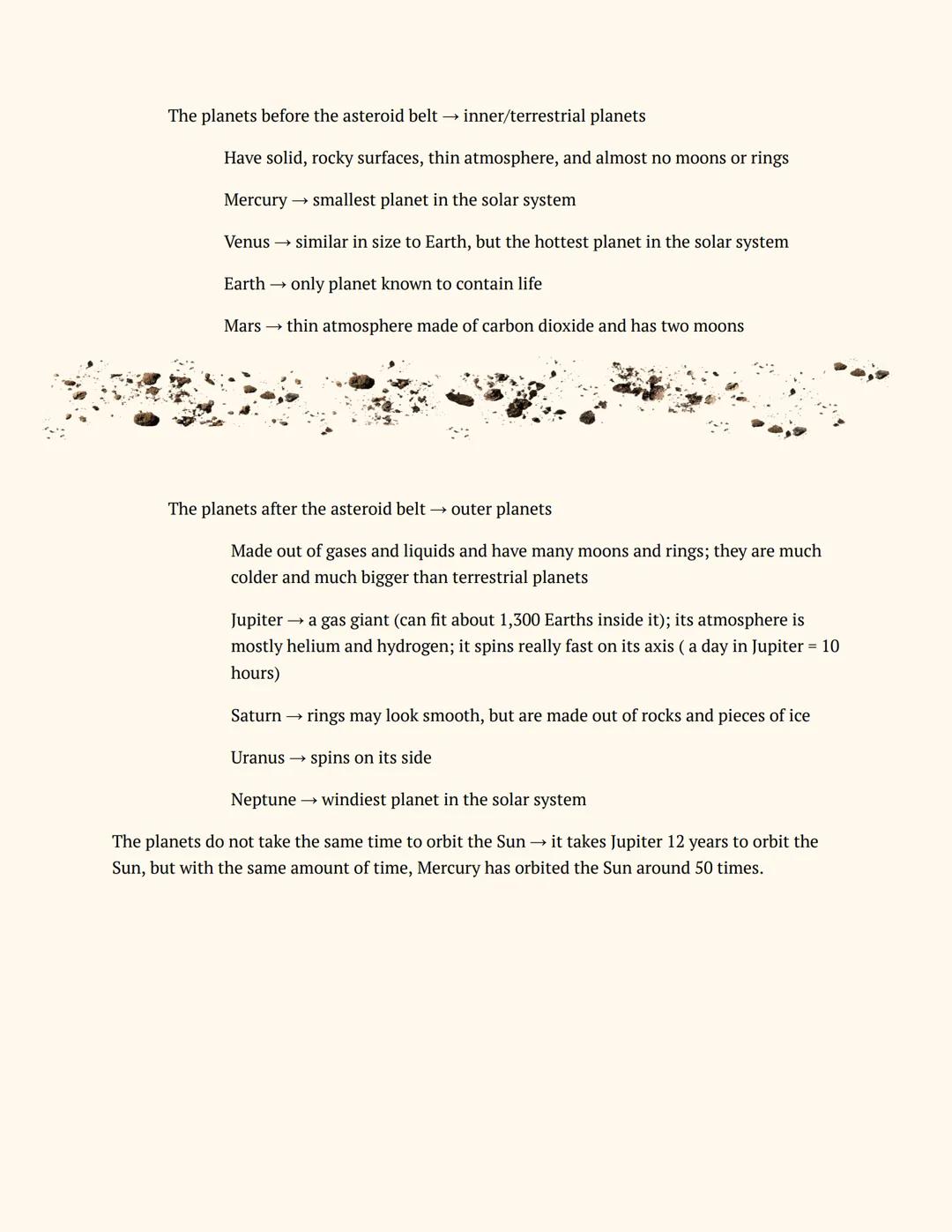
The Planets of Our Solar System
The four inner planets (also called terrestrial planets) all have solid, rocky surfaces with thin atmospheres. Mercury is our smallest planet, while Venus is the hottest despite being similar in size to Earth. Earth is special as the only known planet with life, and Mars has a carbon dioxide atmosphere with two small moons.
The four outer planets are completely different from their rocky neighbors! These massive balls of gas and liquid have many moons and rings. Jupiter is so huge you could fit about 1,300 Earths inside it, and a Jupiter day only lasts 10 hours! Saturn is famous for its beautiful rings made of ice and rock fragments. Uranus uniquely spins on its side, while Neptune experiences the strongest winds in the Solar System.
Each planet takes a different amount of time to orbit the Sun. While Mercury races around the Sun about 50 times in the same period it takes Jupiter to complete just one orbit (12 Earth years), you can see how differently time works across our Solar System!
Amazing Space Fact: The size differences between planets are incredible - Jupiter's diameter is about 11 times Earth's diameter and nearly 30 times larger than tiny Mercury!
We thought you’d never ask...
What is the Knowunity AI companion?
Our AI companion is specifically built for the needs of students. Based on the millions of content pieces we have on the platform we can provide truly meaningful and relevant answers to students. But its not only about answers, the companion is even more about guiding students through their daily learning challenges, with personalised study plans, quizzes or content pieces in the chat and 100% personalisation based on the students skills and developments.
Where can I download the Knowunity app?
You can download the app in the Google Play Store and in the Apple App Store.
Is Knowunity really free of charge?
That's right! Enjoy free access to study content, connect with fellow students, and get instant help – all at your fingertips.
Similar Content
Most popular content in Earth and Space Science
9P
Earth and Space Scienceplate tectonics
This quiz can help you study for simple plate tectonics tests.
6th2180
O
Earth and Space ScienceOur Solar System, and Beyond
Just a quiz on space science to get to know a little more
6th1600
E
Earth and Space ScienceEarth systems
How much do you know about you earth systems?
6th2210
S
Earth and Space ScienceScience
Use this to jog your memory
6th2230
W
Earth and Space ScienceWorld Oceans - Sixth Grade
Can you guess all the oceans? This will test your knowledge on the location of each ocean, describing bordering countries, seas, lands, and other oceans.
6th1390
Earth and Space ScienceEvidences of Plate Tectonics
This tackles the continental drift theory and the Evidences for continental drift theory.
99821
Earth and Space ScienceAtmospheric Layers and Their Characteristics
Learn about the distinct features and characteristics of the four main atmospheric layers: troposphere, stratosphere, mesosphere, and thermosphere.
6th642
Earth and Space ScienceEarth layer
Earth layer
953
Earth and Space SciencePhilsca EarthScience
For entrance exam review
12th912
Most popular content
9O
 AP US History
Origins and Dynamics of the Columbian Exchange
Analyze the ecological and economic motivations behind the initial transfer of goods, people, and diseases between the Old and New Worlds.
9th3,1280
I
AP US HistoryIntroduction to Early Cultural Interactions
Analyze the initial social and religious encounters between Europeans, Africans, and Indigenous peoples in the colonial Americas.
9th2,7730
O
AP World HistoryOrigins of Ancient River Civilizations
Analyze the environmental factors and technological innovations that led to the rise of early states in Mesopotamia, Egypt, and the Indus Valley.
9th3,1870
M
AP US HistoryMotivations for European Exploration
Analyze the economic, religious, and political factors that drove European powers to the Americas during the 15th and 16th centuries.
9th1,7780
F
 AP Psychology
Foundations of Ethical Guidelines in Research
Practice the core principles of the APA ethical code including informed consent, debriefing, and the role of Institutional Review Boards.
9th1,3360
I
AP US HistoryIntroduction to Native American Societies
Examine the diverse social, political, and economic structures of North American indigenous groups prior to European contact.
9th1,1100
I
 AP Biology
Introduction to Biological Elements of Life
Practice identifying the essential elements including carbon, nitrogen, phosphorus, and sulfur that compose biological macromolecules.
9th1,7390
I
AP US HistoryIntroduction to the Spanish Encomienda System
Explore the fundamental economic and social structures of the Spanish colonial system, focusing on the encomienda and the casta social hierarchy.
9th8890
O
AP World HistoryOrigins and Continuity of the Byzantine Empire
Analyze the political and cultural transitions from the Roman Empire to the Byzantine Empire, focusing on the reign of Justinian I and his code.
9th1,6320
Can't find what you're looking for? Explore other subjects.
Students love us — and so will you.
4.6/5App Store
4.7/5Google Play
The app is very easy to use and well designed. I have found everything I was looking for so far and have been able to learn a lot from the presentations! I will definitely use the app for a class assignment! And of course it also helps a lot as an inspiration.
Stefan SiOS user
This app is really great. There are so many study notes and help [...]. My problem subject is French, for example, and the app has so many options for help. Thanks to this app, I have improved my French. I would recommend it to anyone.
Samantha KlichAndroid user
Wow, I am really amazed. I just tried the app because I've seen it advertised many times and was absolutely stunned. This app is THE HELP you want for school and above all, it offers so many things, such as workouts and fact sheets, which have been VERY helpful to me personally.
AnnaiOS user
Earth and Space Science54 views·Updated Jun 8, 2026·2 pagesDiscover Our Solar System: Planets and Wonders
Sri@study._.tofu
The Solar System is a collection of eight planets and other objects that orbit the Sun. It formed about 4.6 billion years ago from a nebula - a massive cloud of gas and dust in space. Gravity pulled this material...
1
of 2
Sign up to see the content. It's free!
- Access to all documents
- Improve your grades
- Join milions of students
Formation and Structure of the Solar System
Ever wondered why the Solar System is flat even though planets are round? About 4.6 billion years ago, gravity pulled together a giant cloud of gas and dust called a nebula. As this material collapsed, it flattened into a spinning disc, much like a pizza dough being tossed and spun.
In the center of this disc, tremendous pressure created our Sun. The remaining materials collided and stuck together, eventually forming the planets and other objects. This whole collection of the Sun and orbiting objects makes up our Solar System.
The eight planets in our Solar System are divided by the asteroid belt, which sits between Mars and Jupiter. The inner planets (Mercury, Venus, Earth, and Mars) are smaller and rocky. The outer planets (Jupiter, Saturn, Uranus, and Neptune) are much larger gas giants.
Fun Fact: Beyond Neptune lies the Oort cloud, which is filled with comets - icy objects that develop beautiful tails of gas when they approach the Sun!
2
of 2Sign up to see the content. It's free!
- Access to all documents
- Improve your grades
- Join milions of students
The Planets of Our Solar System
The four inner planets (also called terrestrial planets) all have solid, rocky surfaces with thin atmospheres. Mercury is our smallest planet, while Venus is the hottest despite being similar in size to Earth. Earth is special as the only known planet with life, and Mars has a carbon dioxide atmosphere with two small moons.
The four outer planets are completely different from their rocky neighbors! These massive balls of gas and liquid have many moons and rings. Jupiter is so huge you could fit about 1,300 Earths inside it, and a Jupiter day only lasts 10 hours! Saturn is famous for its beautiful rings made of ice and rock fragments. Uranus uniquely spins on its side, while Neptune experiences the strongest winds in the Solar System.
Each planet takes a different amount of time to orbit the Sun. While Mercury races around the Sun about 50 times in the same period it takes Jupiter to complete just one orbit (12 Earth years), you can see how differently time works across our Solar System!
Amazing Space Fact: The size differences between planets are incredible - Jupiter's diameter is about 11 times Earth's diameter and nearly 30 times larger than tiny Mercury!
We thought you’d never ask...
What is the Knowunity AI companion?
Our AI companion is specifically built for the needs of students. Based on the millions of content pieces we have on the platform we can provide truly meaningful and relevant answers to students. But its not only about answers, the companion is even more about guiding students through their daily learning challenges, with personalised study plans, quizzes or content pieces in the chat and 100% personalisation based on the students skills and developments.
Where can I download the Knowunity app?
You can download the app in the Google Play Store and in the Apple App Store.
Is Knowunity really free of charge?
That's right! Enjoy free access to study content, connect with fellow students, and get instant help – all at your fingertips.
Similar Content
Most popular content in Earth and Space Science
9P
Earth and Space Scienceplate tectonics
This quiz can help you study for simple plate tectonics tests.
6th2180
O
Earth and Space ScienceOur Solar System, and Beyond
Just a quiz on space science to get to know a little more
6th1600
E
Earth and Space ScienceEarth systems
How much do you know about you earth systems?
6th2210
S
Earth and Space ScienceScience
Use this to jog your memory
6th2230
W
Earth and Space ScienceWorld Oceans - Sixth Grade
Can you guess all the oceans? This will test your knowledge on the location of each ocean, describing bordering countries, seas, lands, and other oceans.
6th1390
Earth and Space ScienceEvidences of Plate Tectonics
This tackles the continental drift theory and the Evidences for continental drift theory.
99821
Earth and Space ScienceAtmospheric Layers and Their Characteristics
Learn about the distinct features and characteristics of the four main atmospheric layers: troposphere, stratosphere, mesosphere, and thermosphere.
6th642
Earth and Space ScienceEarth layer
Earth layer
953
Earth and Space SciencePhilsca EarthScience
For entrance exam review
12th912
Most popular content
9O
AP US HistoryOrigins and Dynamics of the Columbian Exchange
Analyze the ecological and economic motivations behind the initial transfer of goods, people, and diseases between the Old and New Worlds.
9th3,1280
I
AP US HistoryIntroduction to Early Cultural Interactions
Analyze the initial social and religious encounters between Europeans, Africans, and Indigenous peoples in the colonial Americas.
9th2,7730
O
AP World HistoryOrigins of Ancient River Civilizations
Analyze the environmental factors and technological innovations that led to the rise of early states in Mesopotamia, Egypt, and the Indus Valley.
9th3,1870
M
AP US HistoryMotivations for European Exploration
Analyze the economic, religious, and political factors that drove European powers to the Americas during the 15th and 16th centuries.
9th1,7780
F
AP PsychologyFoundations of Ethical Guidelines in Research
Practice the core principles of the APA ethical code including informed consent, debriefing, and the role of Institutional Review Boards.
9th1,3360
I
AP US HistoryIntroduction to Native American Societies
Examine the diverse social, political, and economic structures of North American indigenous groups prior to European contact.
9th1,1100
I
AP BiologyIntroduction to Biological Elements of Life
Practice identifying the essential elements including carbon, nitrogen, phosphorus, and sulfur that compose biological macromolecules.
9th1,7390
I
AP US HistoryIntroduction to the Spanish Encomienda System
Explore the fundamental economic and social structures of the Spanish colonial system, focusing on the encomienda and the casta social hierarchy.
9th8890
O
AP World HistoryOrigins and Continuity of the Byzantine Empire
Analyze the political and cultural transitions from the Roman Empire to the Byzantine Empire, focusing on the reign of Justinian I and his code.
9th1,6320
Can't find what you're looking for? Explore other subjects.
Students love us — and so will you.
4.6/5App Store
4.7/5Google Play
The app is very easy to use and well designed. I have found everything I was looking for so far and have been able to learn a lot from the presentations! I will definitely use the app for a class assignment! And of course it also helps a lot as an inspiration.
Stefan SiOS user
This app is really great. There are so many study notes and help [...]. My problem subject is French, for example, and the app has so many options for help. Thanks to this app, I have improved my French. I would recommend it to anyone.
Samantha KlichAndroid user
Wow, I am really amazed. I just tried the app because I've seen it advertised many times and was absolutely stunned. This app is THE HELP you want for school and above all, it offers so many things, such as workouts and fact sheets, which have been VERY helpful to me personally.
AnnaiOS user