
Rock layers hold the key to Earth's history, much like...
 Earth and Space Science73 views·Updated Jun 7, 2026·2 pages
Understanding Rock Layers: Geology Explained
P
prince edgar@princeedgar_jdto
1
of 2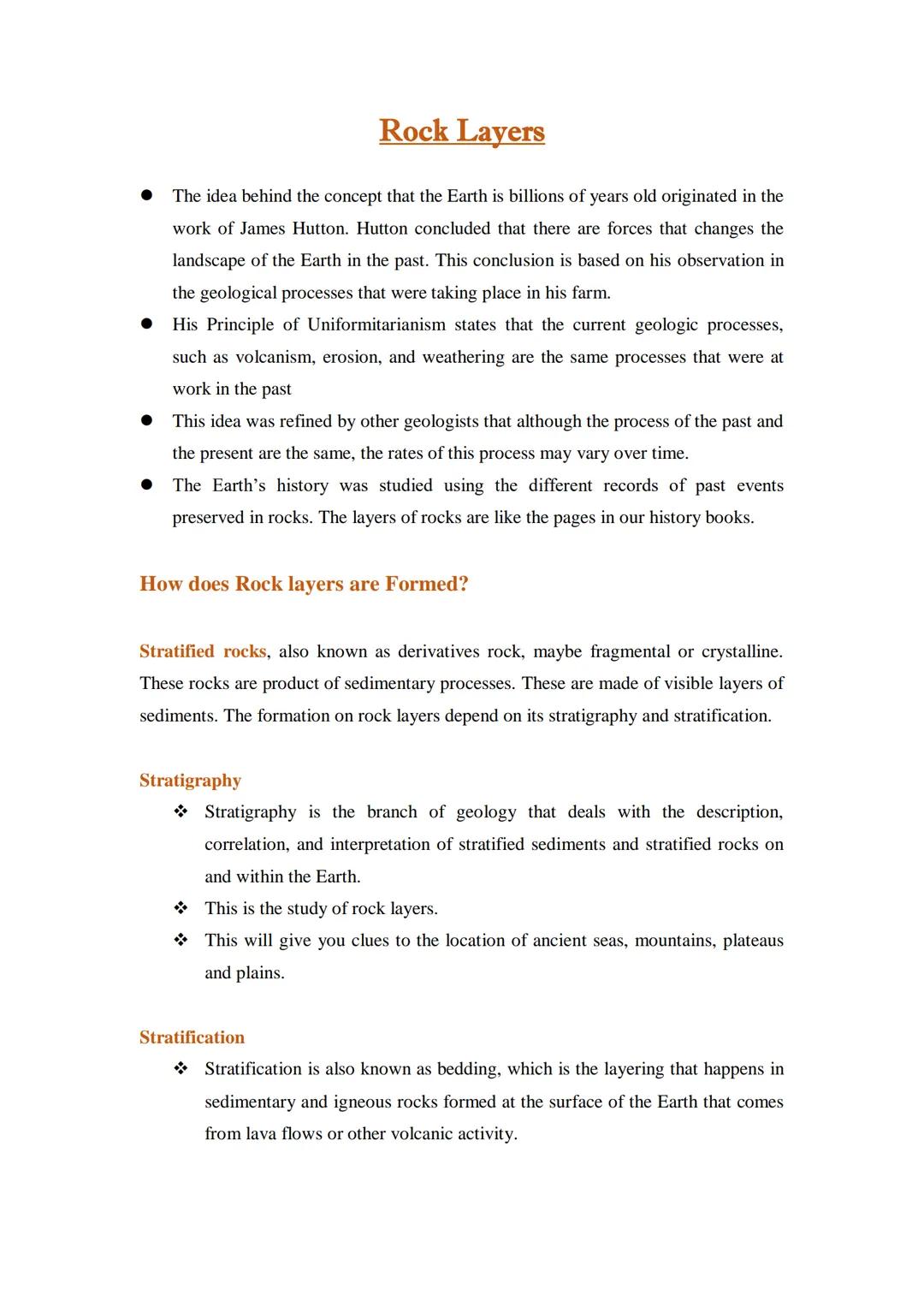
Rock Layers and Their Formation
Ever wondered how scientists know the Earth is billions of years old? It all started with James Hutton, who observed geological processes on his farm and realized these same forces shaped our planet throughout history. His Principle of Uniformitarianism suggests that the geological processes we see today (like erosion and volcanism) are the same ones that occurred in the past, though their rates may have varied.
Rock layers form through a process called stratification, also known as bedding. These stratified rocks contain visible layers of sediments that stack up over time. You can think of them as nature's record-keeping system—each layer preserving a snapshot of Earth's history.
Stratigraphy is the scientific study of these rock layers. It helps geologists interpret, describe, and connect stratified sediments and rocks found on Earth. By examining these layers, scientists can reconstruct ancient landscapes, determining where seas, mountains, plains, and plateaus once existed.
Did you know? When you look at a cliff face with distinct rock layers, you're actually looking at a timeline of Earth's history! The different colors and textures represent different time periods and environmental conditions.
2
of 2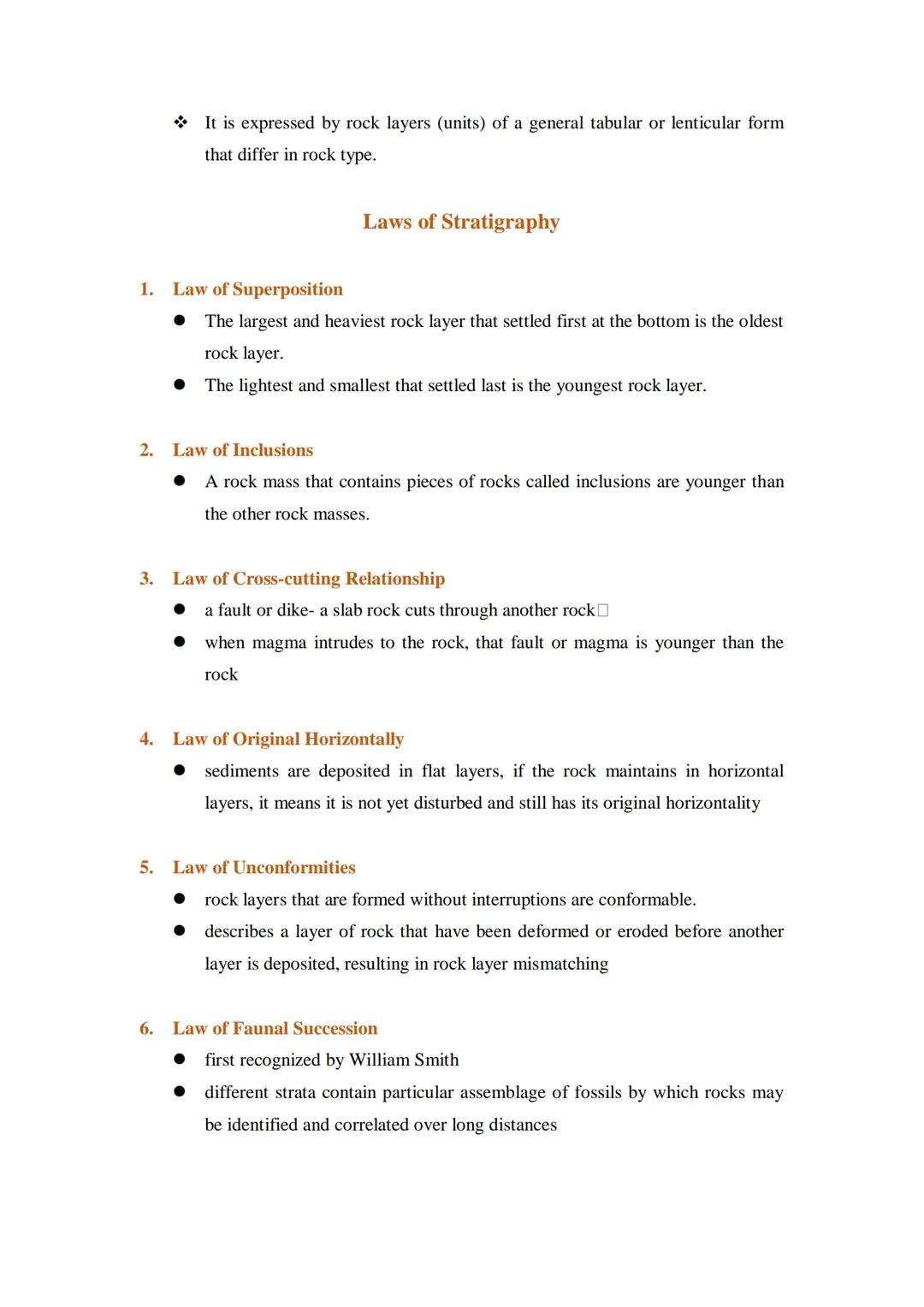
Laws of Stratigraphy
The Law of Superposition is the foundation of understanding rock layers. It's pretty logical: heavier rocks settle first at the bottom (making them the oldest), while lighter materials settle on top (making them younger). Think of it like stacking books—the first book you place is at the bottom of the pile.
When examining rock formations, scientists also look for clues in unusual patterns. The Law of Inclusions tells us that if a rock contains fragments of another rock (inclusions), the rock with inclusions must be younger. Similarly, the Law of Cross-cutting Relationships shows that when a fault or magma intrusion cuts through existing rock, the intrusion must have happened after the original rock formed.
Other important principles include the Law of Original Horizontality (sediments initially deposit in flat layers) and the Law of Unconformities (which identifies gaps in the rock record). The Law of Faunal Succession, first recognized by William Smith, uses fossil assemblages to identify and match rock layers across different locations.
Try this! Next time you see layered rocks on a hike or roadside cutting, try to identify which layers are oldest and youngest based on the Law of Superposition. You're reading Earth's history just like a geologist!
We thought you’d never ask...
What is the Knowunity AI companion?
Our AI companion is specifically built for the needs of students. Based on the millions of content pieces we have on the platform we can provide truly meaningful and relevant answers to students. But its not only about answers, the companion is even more about guiding students through their daily learning challenges, with personalised study plans, quizzes or content pieces in the chat and 100% personalisation based on the students skills and developments.
Where can I download the Knowunity app?
You can download the app in the Google Play Store and in the Apple App Store.
Is Knowunity really free of charge?
That's right! Enjoy free access to study content, connect with fellow students, and get instant help – all at your fingertips.
Similar Content
Most popular content in Earth and Space Science
9P
Earth and Space Scienceplate tectonics
This quiz can help you study for simple plate tectonics tests.
6th2180
O
Earth and Space ScienceOur Solar System, and Beyond
Just a quiz on space science to get to know a little more
6th1600
E
Earth and Space ScienceEarth systems
How much do you know about you earth systems?
6th2210
S
Earth and Space ScienceScience
Use this to jog your memory
6th2230
Earth and Space ScienceEvidences of Plate Tectonics
This tackles the continental drift theory and the Evidences for continental drift theory.
99821
 AP Biology
Biochemistry
Biomolecules
2523
Earth and Space ScienceEarth layer
Earth layer
953
Earth and Space ScienceAtmospheric Layers and Their Characteristics
Learn about the distinct features and characteristics of the four main atmospheric layers: troposphere, stratosphere, mesosphere, and thermosphere.
6th642
Earth and Space ScienceAngle Relationships
Geometry
1434
Most popular content
9O
 AP US History
Origins and Dynamics of the Columbian Exchange
Analyze the ecological and economic motivations behind the initial transfer of goods, people, and diseases between the Old and New Worlds.
9th3,1280
I
AP US HistoryIntroduction to Early Cultural Interactions
Analyze the initial social and religious encounters between Europeans, Africans, and Indigenous peoples in the colonial Americas.
9th2,7730
O
AP World HistoryOrigins of Ancient River Civilizations
Analyze the environmental factors and technological innovations that led to the rise of early states in Mesopotamia, Egypt, and the Indus Valley.
9th3,1870
M
AP US HistoryMotivations for European Exploration
Analyze the economic, religious, and political factors that drove European powers to the Americas during the 15th and 16th centuries.
9th1,7780
F
 AP Psychology
Foundations of Ethical Guidelines in Research
Practice the core principles of the APA ethical code including informed consent, debriefing, and the role of Institutional Review Boards.
9th1,3360
I
AP US HistoryIntroduction to Native American Societies
Examine the diverse social, political, and economic structures of North American indigenous groups prior to European contact.
9th1,1100
I
AP BiologyIntroduction to Biological Elements of Life
Practice identifying the essential elements including carbon, nitrogen, phosphorus, and sulfur that compose biological macromolecules.
9th1,7390
I
AP US HistoryIntroduction to the Spanish Encomienda System
Explore the fundamental economic and social structures of the Spanish colonial system, focusing on the encomienda and the casta social hierarchy.
9th8890
O
AP World HistoryOrigins and Continuity of the Byzantine Empire
Analyze the political and cultural transitions from the Roman Empire to the Byzantine Empire, focusing on the reign of Justinian I and his code.
9th1,6320
Can't find what you're looking for? Explore other subjects.
Students love us — and so will you.
4.6/5App Store
4.7/5Google Play
The app is very easy to use and well designed. I have found everything I was looking for so far and have been able to learn a lot from the presentations! I will definitely use the app for a class assignment! And of course it also helps a lot as an inspiration.
Stefan SiOS user
This app is really great. There are so many study notes and help [...]. My problem subject is French, for example, and the app has so many options for help. Thanks to this app, I have improved my French. I would recommend it to anyone.
Samantha KlichAndroid user
Wow, I am really amazed. I just tried the app because I've seen it advertised many times and was absolutely stunned. This app is THE HELP you want for school and above all, it offers so many things, such as workouts and fact sheets, which have been VERY helpful to me personally.
AnnaiOS user
Earth and Space Science73 views·Updated Jun 7, 2026·2 pagesUnderstanding Rock Layers: Geology Explained
P
prince edgar@princeedgar_jdto
Rock layers hold the key to Earth's history, much like pages in a history book. These layers, formed over billions of years, help scientists understand how our planet has changed and evolved through time. By studying these rock formations, we...
1
of 2
Sign up to see the content. It's free!
- Access to all documents
- Improve your grades
- Join milions of students
Rock Layers and Their Formation
Ever wondered how scientists know the Earth is billions of years old? It all started with James Hutton, who observed geological processes on his farm and realized these same forces shaped our planet throughout history. His Principle of Uniformitarianism suggests that the geological processes we see today (like erosion and volcanism) are the same ones that occurred in the past, though their rates may have varied.
Rock layers form through a process called stratification, also known as bedding. These stratified rocks contain visible layers of sediments that stack up over time. You can think of them as nature's record-keeping system—each layer preserving a snapshot of Earth's history.
Stratigraphy is the scientific study of these rock layers. It helps geologists interpret, describe, and connect stratified sediments and rocks found on Earth. By examining these layers, scientists can reconstruct ancient landscapes, determining where seas, mountains, plains, and plateaus once existed.
Did you know? When you look at a cliff face with distinct rock layers, you're actually looking at a timeline of Earth's history! The different colors and textures represent different time periods and environmental conditions.
2
of 2Sign up to see the content. It's free!
- Access to all documents
- Improve your grades
- Join milions of students
Laws of Stratigraphy
The Law of Superposition is the foundation of understanding rock layers. It's pretty logical: heavier rocks settle first at the bottom (making them the oldest), while lighter materials settle on top (making them younger). Think of it like stacking books—the first book you place is at the bottom of the pile.
When examining rock formations, scientists also look for clues in unusual patterns. The Law of Inclusions tells us that if a rock contains fragments of another rock (inclusions), the rock with inclusions must be younger. Similarly, the Law of Cross-cutting Relationships shows that when a fault or magma intrusion cuts through existing rock, the intrusion must have happened after the original rock formed.
Other important principles include the Law of Original Horizontality (sediments initially deposit in flat layers) and the Law of Unconformities (which identifies gaps in the rock record). The Law of Faunal Succession, first recognized by William Smith, uses fossil assemblages to identify and match rock layers across different locations.
Try this! Next time you see layered rocks on a hike or roadside cutting, try to identify which layers are oldest and youngest based on the Law of Superposition. You're reading Earth's history just like a geologist!
We thought you’d never ask...
What is the Knowunity AI companion?
Our AI companion is specifically built for the needs of students. Based on the millions of content pieces we have on the platform we can provide truly meaningful and relevant answers to students. But its not only about answers, the companion is even more about guiding students through their daily learning challenges, with personalised study plans, quizzes or content pieces in the chat and 100% personalisation based on the students skills and developments.
Where can I download the Knowunity app?
You can download the app in the Google Play Store and in the Apple App Store.
Is Knowunity really free of charge?
That's right! Enjoy free access to study content, connect with fellow students, and get instant help – all at your fingertips.
Similar Content
Most popular content in Earth and Space Science
9P
Earth and Space Scienceplate tectonics
This quiz can help you study for simple plate tectonics tests.
6th2180
O
Earth and Space ScienceOur Solar System, and Beyond
Just a quiz on space science to get to know a little more
6th1600
E
Earth and Space ScienceEarth systems
How much do you know about you earth systems?
6th2210
S
Earth and Space ScienceScience
Use this to jog your memory
6th2230
Earth and Space ScienceEvidences of Plate Tectonics
This tackles the continental drift theory and the Evidences for continental drift theory.
99821
AP BiologyBiochemistry
Biomolecules
2523
Earth and Space ScienceEarth layer
Earth layer
953
Earth and Space ScienceAtmospheric Layers and Their Characteristics
Learn about the distinct features and characteristics of the four main atmospheric layers: troposphere, stratosphere, mesosphere, and thermosphere.
6th642
Earth and Space ScienceAngle Relationships
Geometry
1434
Most popular content
9O
AP US HistoryOrigins and Dynamics of the Columbian Exchange
Analyze the ecological and economic motivations behind the initial transfer of goods, people, and diseases between the Old and New Worlds.
9th3,1280
I
AP US HistoryIntroduction to Early Cultural Interactions
Analyze the initial social and religious encounters between Europeans, Africans, and Indigenous peoples in the colonial Americas.
9th2,7730
O
AP World HistoryOrigins of Ancient River Civilizations
Analyze the environmental factors and technological innovations that led to the rise of early states in Mesopotamia, Egypt, and the Indus Valley.
9th3,1870
M
AP US HistoryMotivations for European Exploration
Analyze the economic, religious, and political factors that drove European powers to the Americas during the 15th and 16th centuries.
9th1,7780
F
AP PsychologyFoundations of Ethical Guidelines in Research
Practice the core principles of the APA ethical code including informed consent, debriefing, and the role of Institutional Review Boards.
9th1,3360
I
AP US HistoryIntroduction to Native American Societies
Examine the diverse social, political, and economic structures of North American indigenous groups prior to European contact.
9th1,1100
I
AP BiologyIntroduction to Biological Elements of Life
Practice identifying the essential elements including carbon, nitrogen, phosphorus, and sulfur that compose biological macromolecules.
9th1,7390
I
AP US HistoryIntroduction to the Spanish Encomienda System
Explore the fundamental economic and social structures of the Spanish colonial system, focusing on the encomienda and the casta social hierarchy.
9th8890
O
AP World HistoryOrigins and Continuity of the Byzantine Empire
Analyze the political and cultural transitions from the Roman Empire to the Byzantine Empire, focusing on the reign of Justinian I and his code.
9th1,6320
Can't find what you're looking for? Explore other subjects.
Students love us — and so will you.
4.6/5App Store
4.7/5Google Play
The app is very easy to use and well designed. I have found everything I was looking for so far and have been able to learn a lot from the presentations! I will definitely use the app for a class assignment! And of course it also helps a lot as an inspiration.
Stefan SiOS user
This app is really great. There are so many study notes and help [...]. My problem subject is French, for example, and the app has so many options for help. Thanks to this app, I have improved my French. I would recommend it to anyone.
Samantha KlichAndroid user
Wow, I am really amazed. I just tried the app because I've seen it advertised many times and was absolutely stunned. This app is THE HELP you want for school and above all, it offers so many things, such as workouts and fact sheets, which have been VERY helpful to me personally.
AnnaiOS user