
Geologists use two main techniques to determine the age of...
 Earth and Space Science140 views·Updated Jun 12, 2026·2 pages
Understanding Relative and Absolute Dating

Prince Evangelio@princeevangelio_klky
1
of 2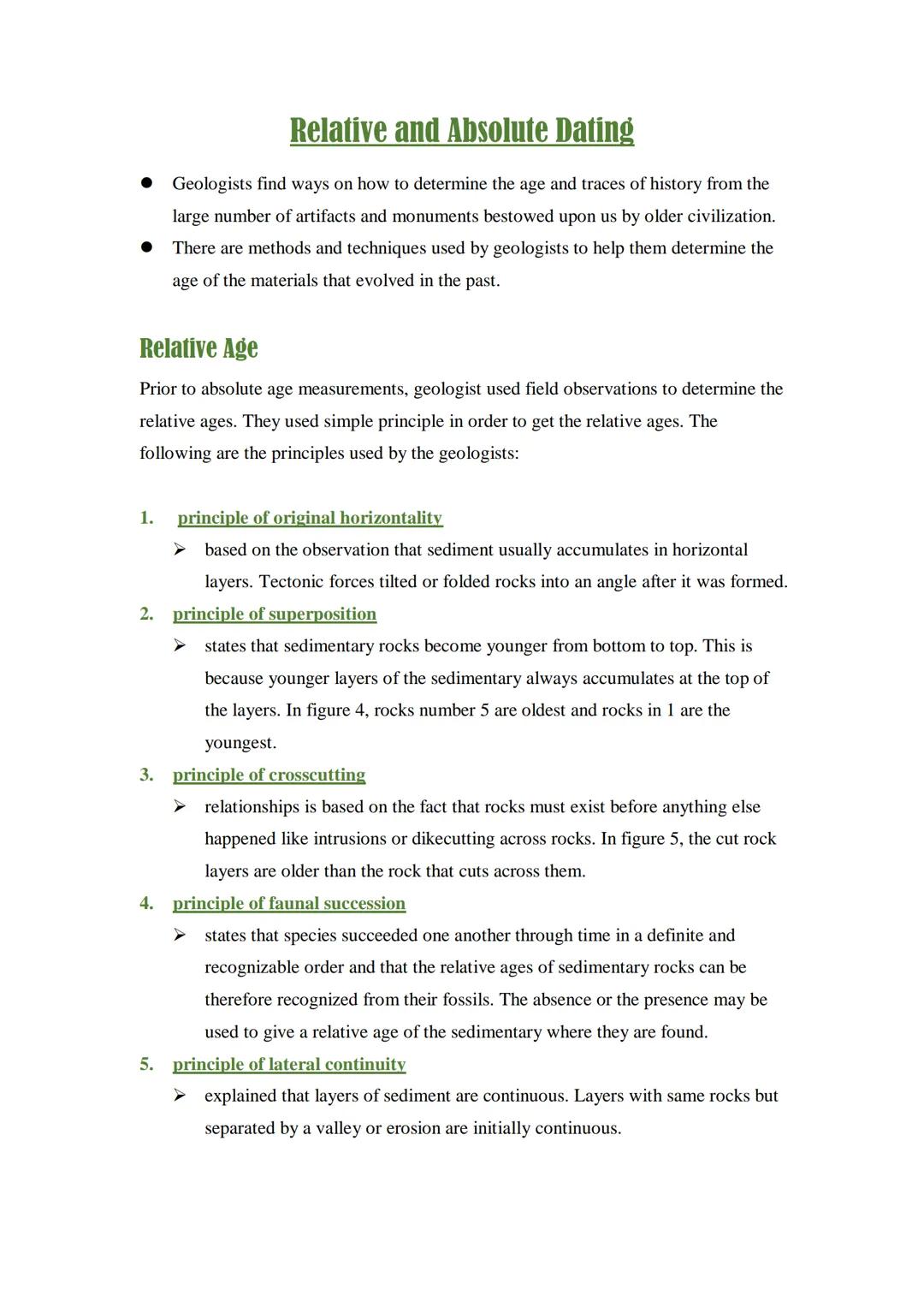
Relative Dating Methods
Ever wondered how scientists figure out which rocks formed first without knowing their exact age? Relative dating is like putting together a timeline based on clues in the rocks themselves.
Geologists use several key principles to determine which rocks came first. The principle of original horizontality tells us that sediments were originally deposited in horizontal layers, so tilted layers must have been moved after formation. The principle of superposition shows that in undisturbed rock layers, the oldest rocks are at the bottom while younger layers stack on top.
When rocks are cut by other features, the principle of crosscutting relationships helps determine sequence - whatever is being cut must be older than what's cutting through it. The principle of lateral continuity explains that rock layers extend outward in all directions until they thin out or meet a barrier, so matching layers across valleys were once connected.
Remember this! The principle of faunal succession is particularly useful because certain fossil species only existed during specific time periods, creating a biological timeline that helps date sedimentary rocks even when they're found in different locations.
2
of 2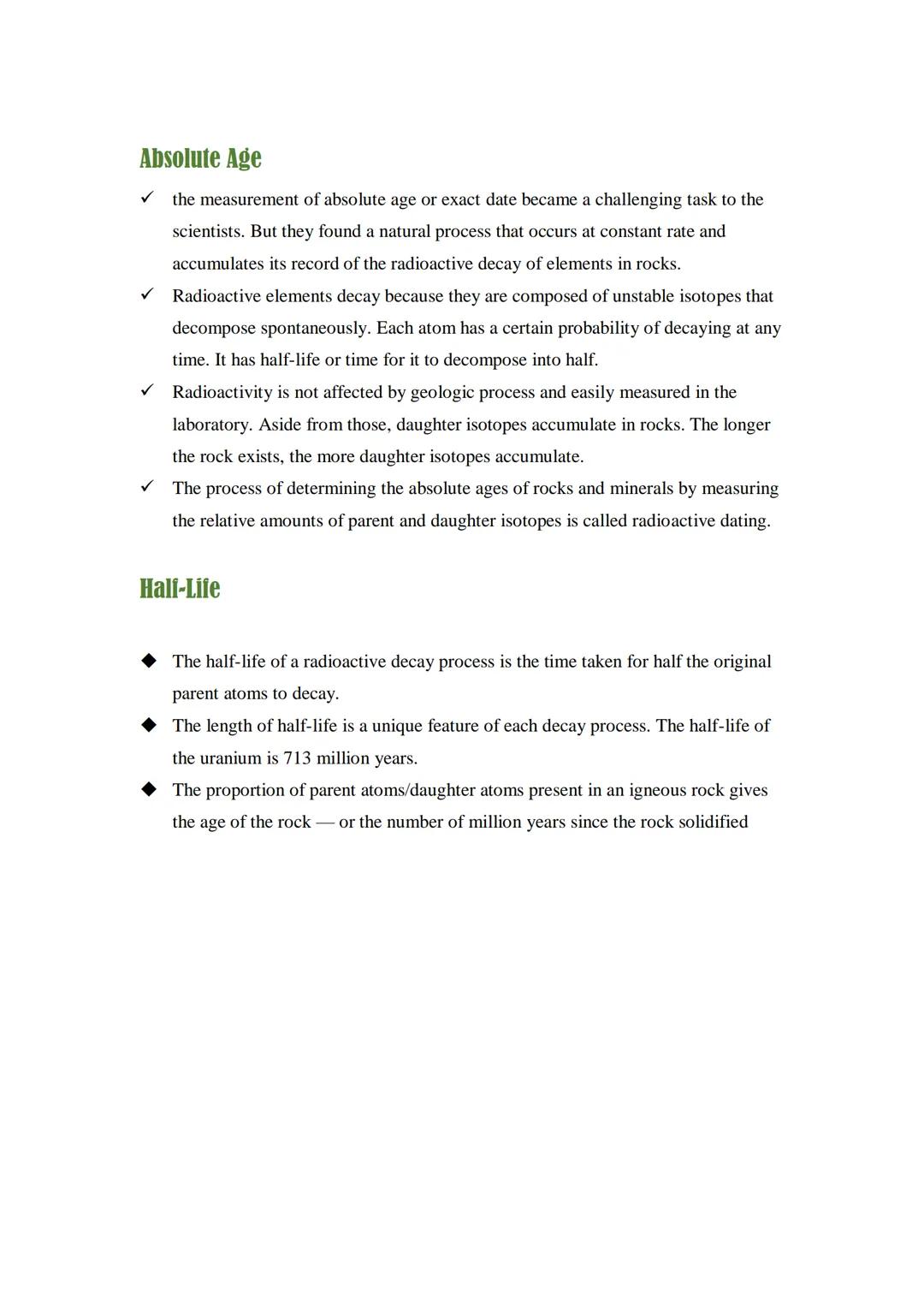
Absolute Dating and Half-Life
While relative dating tells us which rocks came before others, absolute dating gives us actual numbers - like determining a rock is 250 million years old. Pretty amazing, right?
Scientists discovered they could use radioactive dating by measuring the decay of unstable isotopes in rocks. Radioactive elements decay at constant rates regardless of temperature, pressure, or other geological processes, making them reliable natural clocks. The longer a rock exists, the more parent isotopes transform into daughter isotopes.
The key concept here is half-life - the time it takes for half of the parent atoms to decay into daughter atoms. Each radioactive element has its own unique half-life. For example, uranium has a half-life of 713 million years. By measuring the proportion of parent atoms to daughter atoms in an igneous rock, scientists can calculate exactly how many years have passed since the rock solidified.
Cool fact! Radioactive dating works because the decay process is unaffected by geological events like eruptions or earthquakes. This means that no matter what happened to the rock after it formed, its radioactive clock keeps ticking at exactly the same rate.
We thought you’d never ask...
What is the Knowunity AI companion?
Our AI companion is specifically built for the needs of students. Based on the millions of content pieces we have on the platform we can provide truly meaningful and relevant answers to students. But its not only about answers, the companion is even more about guiding students through their daily learning challenges, with personalised study plans, quizzes or content pieces in the chat and 100% personalisation based on the students skills and developments.
Where can I download the Knowunity app?
You can download the app in the Google Play Store and in the Apple App Store.
Is Knowunity really free of charge?
That's right! Enjoy free access to study content, connect with fellow students, and get instant help – all at your fingertips.
Similar Content
Most popular content in Earth and Space Science
9P
Earth and Space Scienceplate tectonics
This quiz can help you study for simple plate tectonics tests.
6th2180
O
Earth and Space ScienceOur Solar System, and Beyond
Just a quiz on space science to get to know a little more
6th1600
E
Earth and Space ScienceEarth systems
How much do you know about you earth systems?
6th2210
S
Earth and Space ScienceScience
Use this to jog your memory
6th2230
W
Earth and Space ScienceWorld Oceans - Sixth Grade
Can you guess all the oceans? This will test your knowledge on the location of each ocean, describing bordering countries, seas, lands, and other oceans.
6th1390
Earth and Space ScienceEvidences of Plate Tectonics
This tackles the continental drift theory and the Evidences for continental drift theory.
99821
Earth and Space ScienceAtmospheric Layers and Their Characteristics
Learn about the distinct features and characteristics of the four main atmospheric layers: troposphere, stratosphere, mesosphere, and thermosphere.
6th642
Earth and Space ScienceEarth layer
Earth layer
953
Earth and Space SciencePhilsca EarthScience
For entrance exam review
12th912
Most popular content
9O
 AP US History
Origins and Dynamics of the Columbian Exchange
Analyze the ecological and economic motivations behind the initial transfer of goods, people, and diseases between the Old and New Worlds.
9th3,1280
I
AP US HistoryIntroduction to Early Cultural Interactions
Analyze the initial social and religious encounters between Europeans, Africans, and Indigenous peoples in the colonial Americas.
9th2,7730
O
AP World HistoryOrigins of Ancient River Civilizations
Analyze the environmental factors and technological innovations that led to the rise of early states in Mesopotamia, Egypt, and the Indus Valley.
9th3,1870
M
AP US HistoryMotivations for European Exploration
Analyze the economic, religious, and political factors that drove European powers to the Americas during the 15th and 16th centuries.
9th1,7780
F
 AP Psychology
Foundations of Ethical Guidelines in Research
Practice the core principles of the APA ethical code including informed consent, debriefing, and the role of Institutional Review Boards.
9th1,3360
I
AP US HistoryIntroduction to Native American Societies
Examine the diverse social, political, and economic structures of North American indigenous groups prior to European contact.
9th1,1100
I
 AP Biology
Introduction to Biological Elements of Life
Practice identifying the essential elements including carbon, nitrogen, phosphorus, and sulfur that compose biological macromolecules.
9th1,7390
I
AP US HistoryIntroduction to the Spanish Encomienda System
Explore the fundamental economic and social structures of the Spanish colonial system, focusing on the encomienda and the casta social hierarchy.
9th8890
O
AP World HistoryOrigins and Continuity of the Byzantine Empire
Analyze the political and cultural transitions from the Roman Empire to the Byzantine Empire, focusing on the reign of Justinian I and his code.
9th1,6320
Can't find what you're looking for? Explore other subjects.
Students love us — and so will you.
4.6/5App Store
4.7/5Google Play
The app is very easy to use and well designed. I have found everything I was looking for so far and have been able to learn a lot from the presentations! I will definitely use the app for a class assignment! And of course it also helps a lot as an inspiration.
Stefan SiOS user
This app is really great. There are so many study notes and help [...]. My problem subject is French, for example, and the app has so many options for help. Thanks to this app, I have improved my French. I would recommend it to anyone.
Samantha KlichAndroid user
Wow, I am really amazed. I just tried the app because I've seen it advertised many times and was absolutely stunned. This app is THE HELP you want for school and above all, it offers so many things, such as workouts and fact sheets, which have been VERY helpful to me personally.
AnnaiOS user
Earth and Space Science140 views·Updated Jun 12, 2026·2 pagesUnderstanding Relative and Absolute Dating
Prince Evangelio@princeevangelio_klky
Geologists use two main techniques to determine the age of rocks and artifacts: relative and absolute dating. These methods help unravel Earth's history by analyzing rock layers, fossils, and radioactive elements, allowing us to understand how our planet has changed...
1
of 2
Sign up to see the content. It's free!
- Access to all documents
- Improve your grades
- Join milions of students
Relative Dating Methods
Ever wondered how scientists figure out which rocks formed first without knowing their exact age? Relative dating is like putting together a timeline based on clues in the rocks themselves.
Geologists use several key principles to determine which rocks came first. The principle of original horizontality tells us that sediments were originally deposited in horizontal layers, so tilted layers must have been moved after formation. The principle of superposition shows that in undisturbed rock layers, the oldest rocks are at the bottom while younger layers stack on top.
When rocks are cut by other features, the principle of crosscutting relationships helps determine sequence - whatever is being cut must be older than what's cutting through it. The principle of lateral continuity explains that rock layers extend outward in all directions until they thin out or meet a barrier, so matching layers across valleys were once connected.
Remember this! The principle of faunal succession is particularly useful because certain fossil species only existed during specific time periods, creating a biological timeline that helps date sedimentary rocks even when they're found in different locations.
2
of 2Sign up to see the content. It's free!
- Access to all documents
- Improve your grades
- Join milions of students
Absolute Dating and Half-Life
While relative dating tells us which rocks came before others, absolute dating gives us actual numbers - like determining a rock is 250 million years old. Pretty amazing, right?
Scientists discovered they could use radioactive dating by measuring the decay of unstable isotopes in rocks. Radioactive elements decay at constant rates regardless of temperature, pressure, or other geological processes, making them reliable natural clocks. The longer a rock exists, the more parent isotopes transform into daughter isotopes.
The key concept here is half-life - the time it takes for half of the parent atoms to decay into daughter atoms. Each radioactive element has its own unique half-life. For example, uranium has a half-life of 713 million years. By measuring the proportion of parent atoms to daughter atoms in an igneous rock, scientists can calculate exactly how many years have passed since the rock solidified.
Cool fact! Radioactive dating works because the decay process is unaffected by geological events like eruptions or earthquakes. This means that no matter what happened to the rock after it formed, its radioactive clock keeps ticking at exactly the same rate.
We thought you’d never ask...
What is the Knowunity AI companion?
Our AI companion is specifically built for the needs of students. Based on the millions of content pieces we have on the platform we can provide truly meaningful and relevant answers to students. But its not only about answers, the companion is even more about guiding students through their daily learning challenges, with personalised study plans, quizzes or content pieces in the chat and 100% personalisation based on the students skills and developments.
Where can I download the Knowunity app?
You can download the app in the Google Play Store and in the Apple App Store.
Is Knowunity really free of charge?
That's right! Enjoy free access to study content, connect with fellow students, and get instant help – all at your fingertips.
Similar Content
Most popular content in Earth and Space Science
9P
Earth and Space Scienceplate tectonics
This quiz can help you study for simple plate tectonics tests.
6th2180
O
Earth and Space ScienceOur Solar System, and Beyond
Just a quiz on space science to get to know a little more
6th1600
E
Earth and Space ScienceEarth systems
How much do you know about you earth systems?
6th2210
S
Earth and Space ScienceScience
Use this to jog your memory
6th2230
W
Earth and Space ScienceWorld Oceans - Sixth Grade
Can you guess all the oceans? This will test your knowledge on the location of each ocean, describing bordering countries, seas, lands, and other oceans.
6th1390
Earth and Space ScienceEvidences of Plate Tectonics
This tackles the continental drift theory and the Evidences for continental drift theory.
99821
Earth and Space ScienceAtmospheric Layers and Their Characteristics
Learn about the distinct features and characteristics of the four main atmospheric layers: troposphere, stratosphere, mesosphere, and thermosphere.
6th642
Earth and Space ScienceEarth layer
Earth layer
953
Earth and Space SciencePhilsca EarthScience
For entrance exam review
12th912
Most popular content
9O
AP US HistoryOrigins and Dynamics of the Columbian Exchange
Analyze the ecological and economic motivations behind the initial transfer of goods, people, and diseases between the Old and New Worlds.
9th3,1280
I
AP US HistoryIntroduction to Early Cultural Interactions
Analyze the initial social and religious encounters between Europeans, Africans, and Indigenous peoples in the colonial Americas.
9th2,7730
O
AP World HistoryOrigins of Ancient River Civilizations
Analyze the environmental factors and technological innovations that led to the rise of early states in Mesopotamia, Egypt, and the Indus Valley.
9th3,1870
M
AP US HistoryMotivations for European Exploration
Analyze the economic, religious, and political factors that drove European powers to the Americas during the 15th and 16th centuries.
9th1,7780
F
AP PsychologyFoundations of Ethical Guidelines in Research
Practice the core principles of the APA ethical code including informed consent, debriefing, and the role of Institutional Review Boards.
9th1,3360
I
AP US HistoryIntroduction to Native American Societies
Examine the diverse social, political, and economic structures of North American indigenous groups prior to European contact.
9th1,1100
I
AP BiologyIntroduction to Biological Elements of Life
Practice identifying the essential elements including carbon, nitrogen, phosphorus, and sulfur that compose biological macromolecules.
9th1,7390
I
AP US HistoryIntroduction to the Spanish Encomienda System
Explore the fundamental economic and social structures of the Spanish colonial system, focusing on the encomienda and the casta social hierarchy.
9th8890
O
AP World HistoryOrigins and Continuity of the Byzantine Empire
Analyze the political and cultural transitions from the Roman Empire to the Byzantine Empire, focusing on the reign of Justinian I and his code.
9th1,6320
Can't find what you're looking for? Explore other subjects.
Students love us — and so will you.
4.6/5App Store
4.7/5Google Play
The app is very easy to use and well designed. I have found everything I was looking for so far and have been able to learn a lot from the presentations! I will definitely use the app for a class assignment! And of course it also helps a lot as an inspiration.
Stefan SiOS user
This app is really great. There are so many study notes and help [...]. My problem subject is French, for example, and the app has so many options for help. Thanks to this app, I have improved my French. I would recommend it to anyone.
Samantha KlichAndroid user
Wow, I am really amazed. I just tried the app because I've seen it advertised many times and was absolutely stunned. This app is THE HELP you want for school and above all, it offers so many things, such as workouts and fact sheets, which have been VERY helpful to me personally.
AnnaiOS user