
Elizabeth Proctor is a central character in The Crucible,...
 Drama522 views·Updated Jun 28, 2026·3 pages
The Crucible: Easy Act 1-4 Summary for Kids with Elizabeth Proctor Fun Facts

carson mochan@carsonmochan
1 / 3
1
of 3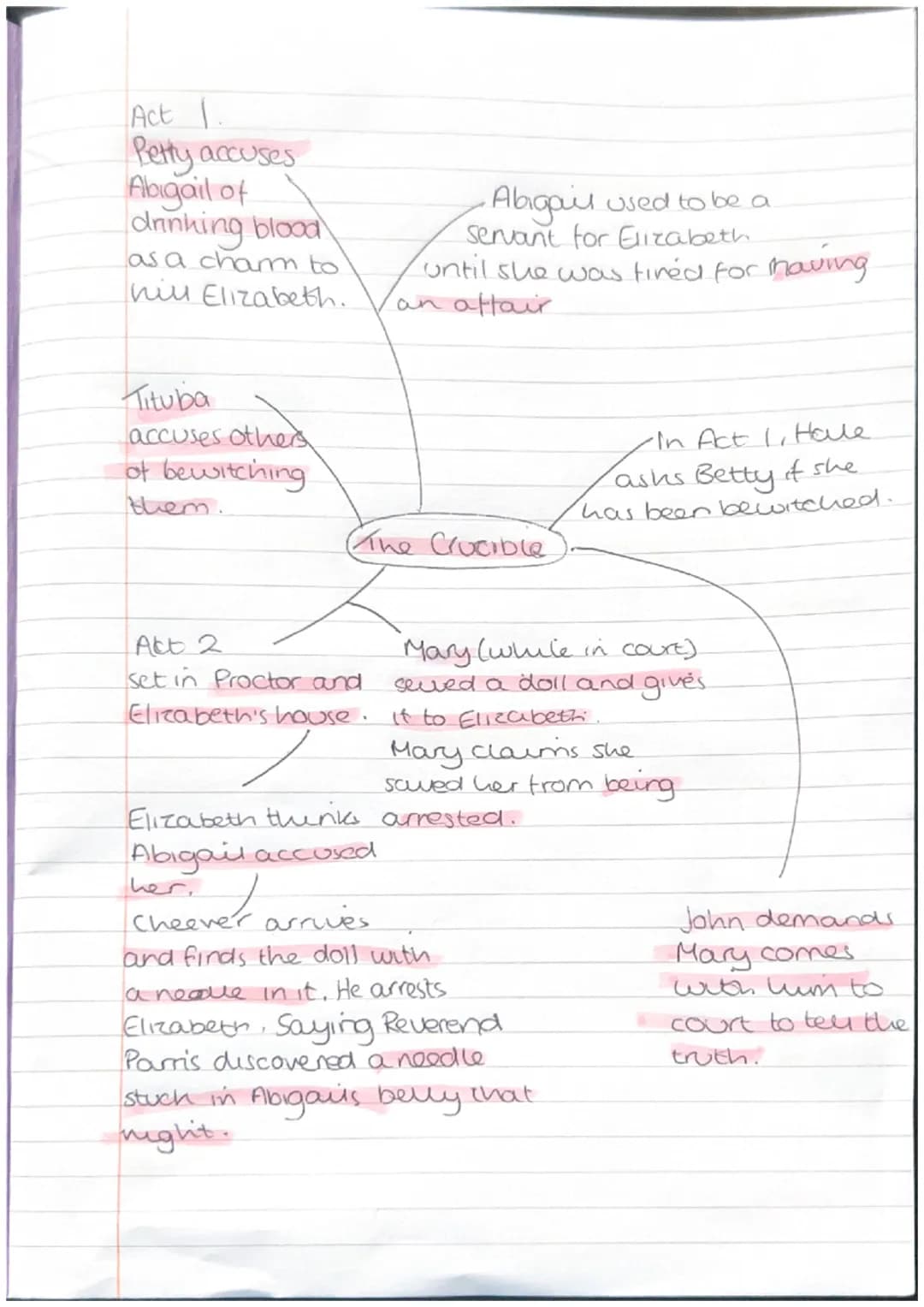
Act 2: The Proctor Household and Elizabeth's Arrest
Act 2 takes place in John and Elizabeth Proctor's home, providing insight into their strained relationship following John's affair with Abigail. The tension between them is palpable as they discuss the ongoing witch trials.
Mary Warren, their current servant, returns from court and gives Elizabeth a poppet (doll) she made while there. This seemingly innocent gift will later become crucial evidence against Elizabeth.
Vocabulary: Poppet - A small figure of a human being used in sorcery and witchcraft; a doll or puppet.
Cheever arrives at the Proctor home to arrest Elizabeth, having found a needle in the poppet. This is linked to an incident where Abigail claimed to have been stuck with a needle, cleverly framing Elizabeth for witchcraft.
Example: The poppet with the needle serves as an example of how seemingly innocent objects were used as "evidence" of witchcraft during the Salem trials.
John Proctor, realizing the gravity of the situation, demands that Mary Warren accompany him to court to reveal the truth about the false accusations. This sets the stage for the dramatic confrontations in Act 3.
Highlight: Elizabeth Proctor's arrest marks a turning point in the play, as the witch hunt directly impacts the main characters.
2
of 3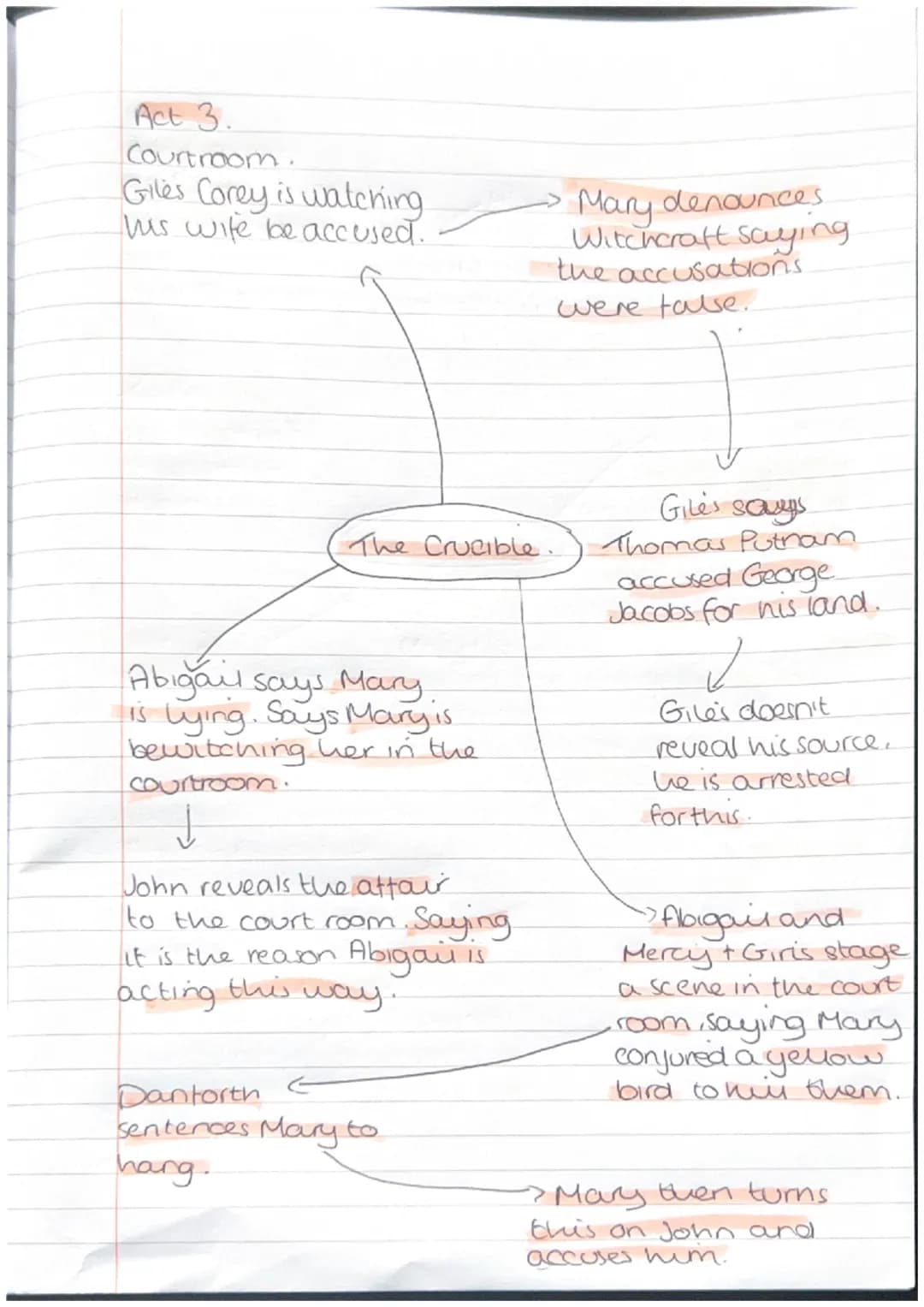
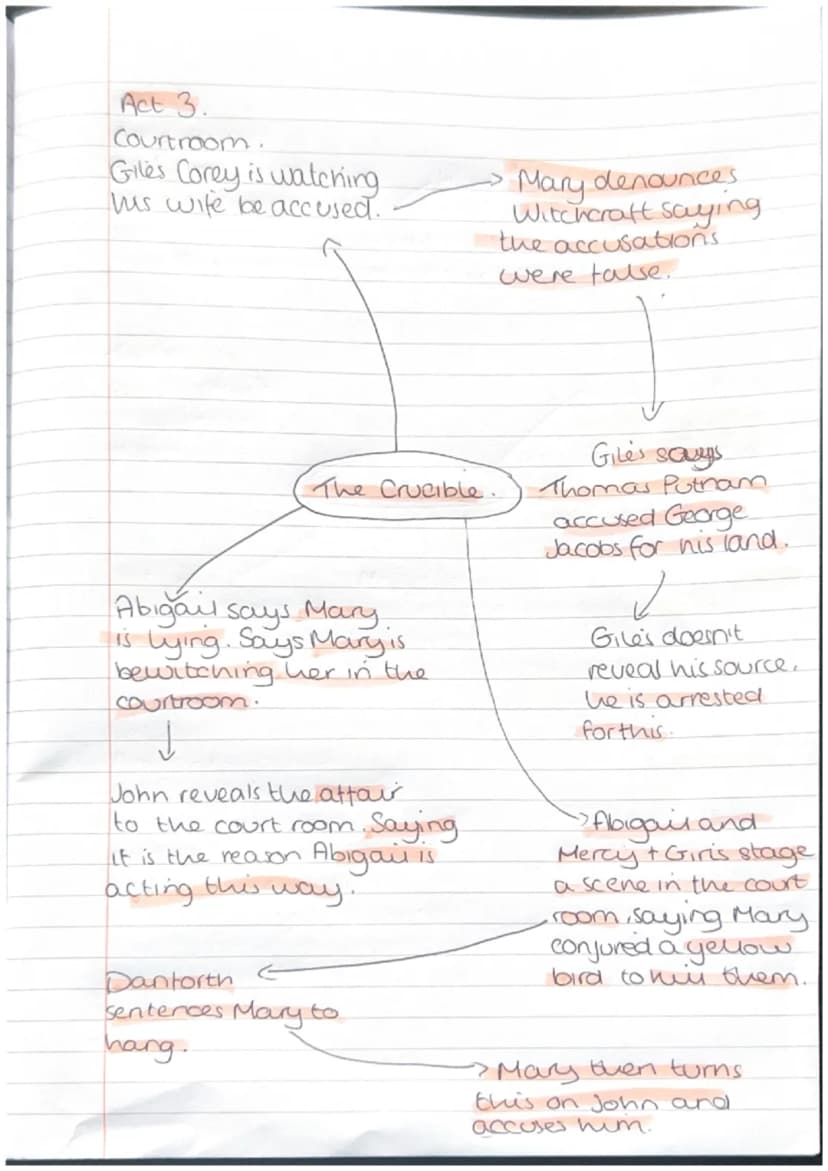
Act 3: Courtroom Drama and Revelations
Act 3 takes place in the Salem courtroom, where the witch trials are in full swing. Giles Corey watches as his wife faces accusations, highlighting the widespread nature of the hysteria. The tension escalates as various characters attempt to prove or disprove the allegations of witchcraft.
Mary Warren attempts to recant her previous accusations, stating that the claims of witchcraft were false. However, Abigail and the other girls stage a dramatic scene in the courtroom, claiming that Mary is now bewitching them. This clever manipulation further complicates the proceedings.
Definition: Recant - To withdraw or disavow a previous statement or belief, especially formally or publicly.
In a desperate attempt to discredit Abigail, John Proctor reveals his affair with her to the court. He explains that Abigail's accusations against Elizabeth are motivated by jealousy and a desire for revenge.
Quote: "I have known her, sir. I have known her."
This powerful admission by John Proctor exposes his own sin in an attempt to save his wife and reveal the truth about Abigail's motivations.
The act concludes with Mary Warren, under immense pressure, turning against John Proctor and accusing him of witchcraft. This shocking turn of events demonstrates the power of mass hysteria and the difficulty of standing against it.
Highlight: The courtroom scene in Act 3 showcases the dangerous combination of fear, manipulation, and rigid authority that fueled the Salem witch trials.
3
of 3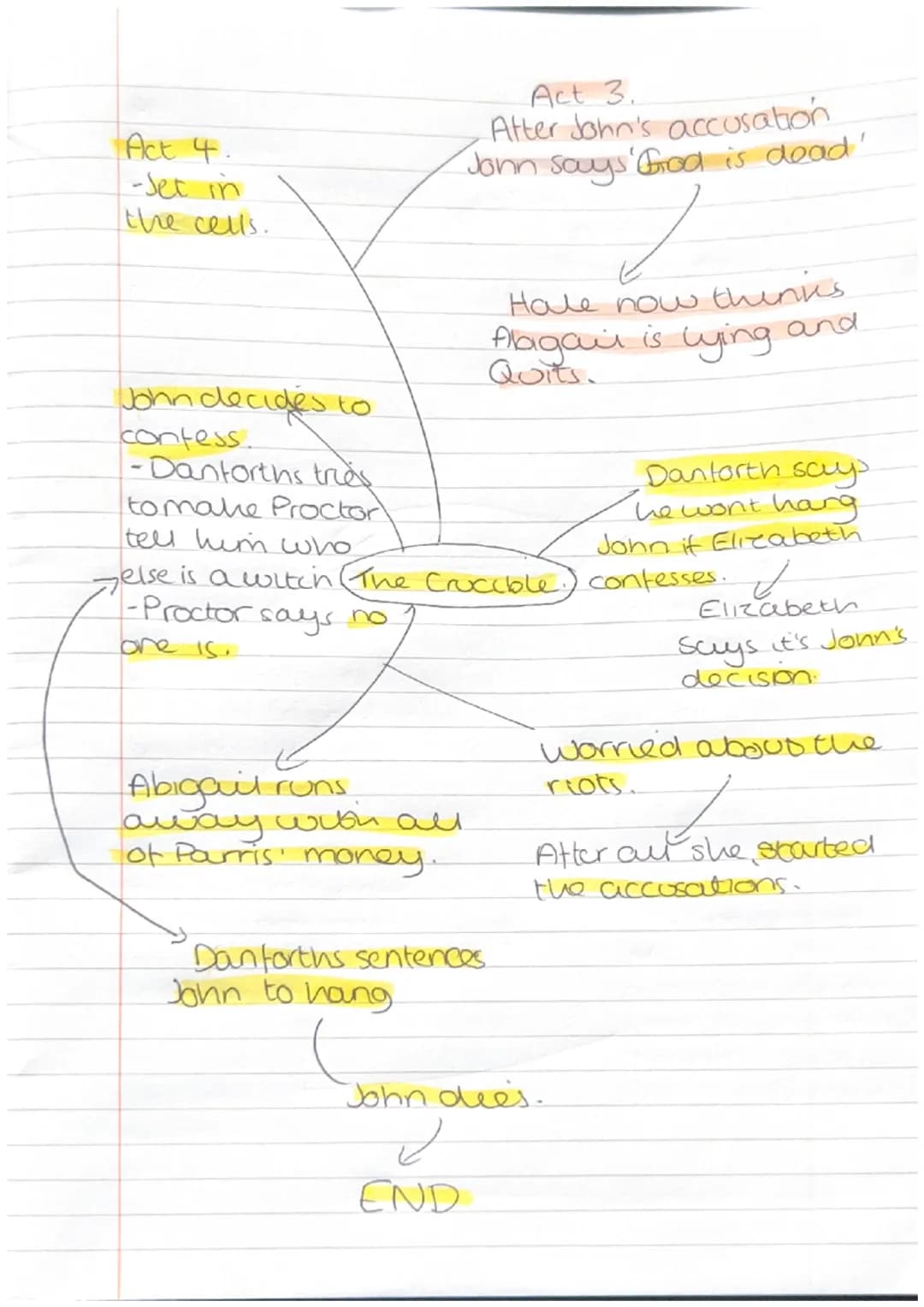
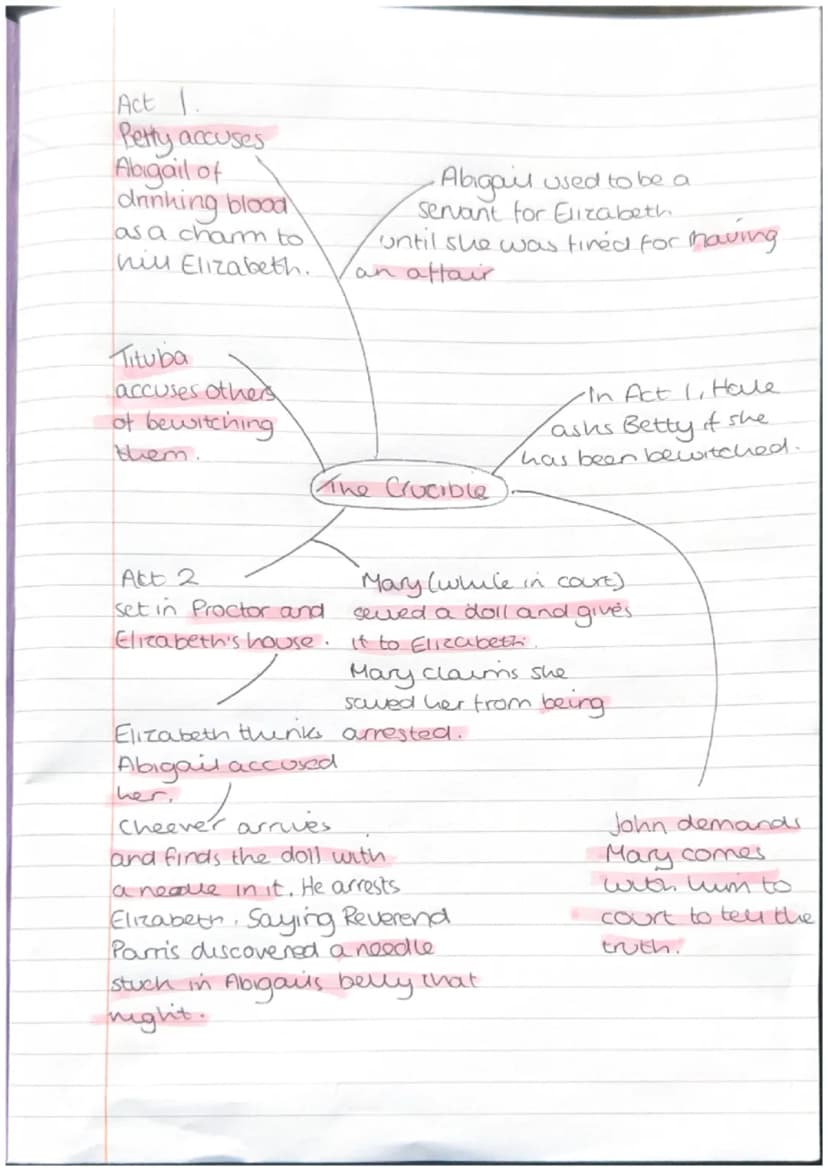
Act 1: The Accusations Begin
In Act 1 of The Crucible, the seeds of hysteria are sown in Salem. Reverend Hale arrives to investigate claims of witchcraft, questioning Betty about possible bewitchment. Meanwhile, Abigail Williams, a former servant in the Proctor household, is accused by Betty of drinking blood as a charm to kill Elizabeth Proctor. This accusation sets the stage for the conflict between Abigail and Elizabeth that will drive much of the play's action.
Highlight: The accusation of Abigail drinking blood to harm Elizabeth foreshadows the personal vendetta that will unfold.
Tituba, Reverend Parris's slave, is pressured into accusing others of witchcraft, further fueling the growing hysteria in Salem. This act establishes the atmosphere of fear and suspicion that will pervade the rest of the play.
Quote: "Betty, you never say that again! You will never-"
This line, likely spoken by Abigail to Betty, demonstrates Abigail's attempts to control the narrative and protect herself from accusations.
We thought you’d never ask...
What is the Knowunity AI companion?
Our AI companion is specifically built for the needs of students. Based on the millions of content pieces we have on the platform we can provide truly meaningful and relevant answers to students. But its not only about answers, the companion is even more about guiding students through their daily learning challenges, with personalised study plans, quizzes or content pieces in the chat and 100% personalisation based on the students skills and developments.
Where can I download the Knowunity app?
You can download the app in the Google Play Store and in the Apple App Store.
Is Knowunity really free of charge?
That's right! Enjoy free access to study content, connect with fellow students, and get instant help – all at your fingertips.
Similar Content
 Música
 MAPEH
MAPEHMost popular content: Arthur Miller
3DramaThe Crucible Costume Breakdown
Explore a detailed costume breakdown for characters in Arthur Miller's 'The Crucible'. This guide covers essential elements of each character's attire, reflecting their social status and personality traits, perfect for GCSE Drama students. Key characters include John Proctor, Abigail Williams, and Reverend Parris, with insights into fabric choices, colors, and accessories that enhance the storytelling.
114109
DramaReverend Hale: Character Analysis
Explore the complex character of Reverend Hale in Arthur Miller's 'The Crucible'. This analysis delves into his transformation from a confident witchcraft expert to a regretful figure, highlighting key quotes and themes of authority, faith, and guilt throughout the play. Ideal for students studying character development and thematic elements in literature.
111229
DramaThe Crucible Overview
Explore key themes and characters in Arthur Miller's 'The Crucible', a pivotal play set during the Salem Witch Trials. This summary covers essential elements such as symbolism, character motivations, and historical context, making it ideal for GCSE Drama students preparing for Component 3 exams.
111,50648
Most popular content in Drama
9DramaYear 11 Drama Essentials
Explore key concepts in Year 11 Drama with this comprehensive guide covering acting skills, design elements, and performance analysis. Learn how to effectively structure your answers using the PEEL method, and understand the importance of context in theatrical productions. Ideal for students preparing for Component 1 assessments in Understanding Drama.
111,36828
DramaThe Crucible Costume Breakdown
Explore a detailed costume breakdown for characters in Arthur Miller's 'The Crucible'. This guide covers essential elements of each character's attire, reflecting their social status and personality traits, perfect for GCSE Drama students. Key characters include John Proctor, Abigail Williams, and Reverend Parris, with insights into fabric choices, colors, and accessories that enhance the storytelling.
114109
DramaBlood Brothers Character Costumes
Explore detailed costume analyses for key characters in 'Blood Brothers'. This summary highlights the significance of each character's attire, reflecting their social status, personality, and development throughout the play. Ideal for GCSE Drama students seeking to understand the visual storytelling elements in performance.
111,89131
A
DramaAn Inspector Calls
Key quotes, themes, and literary analysis of J.B. Priestley's 'An Inspector Calls', focusing on social class and capitalism.
112890
B
DramaBlood brothers flash cards
a quick fire set of flash cards in Blood brothers- GCSE Drama
115994
A
DramaAQA GCSE Drama Blood Brothers
Quiz for exam questions on Blood Brothers for AQA GCSE Drama.
118799
DramaFamily Dynamics in Drama
Explore the intricate family relationships in 'Things I Know to Be True' through detailed character analysis of Bob and Ben. This summary highlights key themes such as responsibility, generational conflict, and emotional struggles, providing insights into the characters' motivations and interactions. Ideal for students studying drama and character development.
95518
DramaKing Lear Act 1, Scene 1
King Lear Act 1 Scene 1. Quotes and analysis of language/structure
121992
DramaGCSE Drama Exam Techniques
Master your GCSE Drama exam with this comprehensive guide covering essential skills, character analysis, and performance techniques. Learn about costume description, vocal terminology, proxemics, and effective communication strategies. This resource includes exam structure, timing, and tips for answering various question types to enhance your performance and understanding of dramatic elements.
112143
Most popular content
9 Sociology
Sociology of Education Overview
Explore comprehensive A-Level Sociology notes on the education system, covering key theories, policies, and sociological perspectives. This resource includes insights on marketisation, gender roles, cultural deprivation, and educational inequalities, providing a thorough understanding of how education shapes social stratification and individual achievement. Ideal for exam preparation and in-depth study.
12102,8693,040
SociologySociology of Families: Comprehensive Revision
Dive into an extensive overview of family dynamics, perspectives, and patterns in sociology. This resource covers key concepts such as family diversity, gender roles, marriage, and the impact of social policies on family structures. Perfect for A-Level Sociology students preparing for Paper 2.
1273,6662,307
CriminologyCriminology: Crime & Punishment Overview
Comprehensive mindmaps covering key concepts in the Crime and Punishment topic for WJEC Criminology Unit 4. This resource includes detailed insights into the Criminal Justice System, crime prevention strategies, sentencing models, and the roles of various agencies. Ideal for A-Level revision, ensuring you grasp essential theories and legislative processes to excel in your exams.
1254,8721,059
SociologyComprehensive Crime & Deviance Overview
Explore an extensive revision of crime and deviance topics, including theories, types of crime, and the impact of media. This resource covers key concepts such as Marxism, functionalism, gender and crime, and the influence of globalization on criminal behavior. Ideal for students seeking a thorough understanding of criminology and its various theories. Type: Full Topic Revision.
1251,6541,399
C
 Biology
Cell Biology and Cell structure
cell structures
93,2490
 English Literature
An Inspector Calls: Character Insights
Explore in-depth analysis and key quotes for characters in J.B. Priestley's 'An Inspector Calls'. This resource covers Gerald Croft, Inspector Goole, Sheila Birling, Mrs. Birling, Eric Birling, and Eva Smith, focusing on themes of class, gender roles, and social responsibility. Ideal for students aiming for Grade 8 and above.
1025,429907
CriminologyWJEC Unit 4 Criminology
Criminology unit 4 detailed revision note
127,151125
CriminologyCriminology Theories Overview
Explore key criminology theories and their implications on crime and deviance. This comprehensive summary covers biological, psychological, and sociological perspectives, including labelling theory, right realism, and the impact of social campaigns on policy development. Ideal for A-Level criminology students seeking to understand the complexities of criminal behaviour and the factors influencing crime prevention strategies.
129,760210
English LiteratureRomeo and Juliet: Key themes
Key Romeo and Juliet themes and analysed quotes
106,708198
Can't find what you're looking for? Explore other subjects.
Students love us — and so will you.
4.6/5App Store
4.7/5Google Play
The app is very easy to use and well designed. I have found everything I was looking for so far and have been able to learn a lot from the presentations! I will definitely use the app for a class assignment! And of course it also helps a lot as an inspiration.
Stefan SiOS user
This app is really great. There are so many study notes and help [...]. My problem subject is French, for example, and the app has so many options for help. Thanks to this app, I have improved my French. I would recommend it to anyone.
Samantha KlichAndroid user
Wow, I am really amazed. I just tried the app because I've seen it advertised many times and was absolutely stunned. This app is THE HELP you want for school and above all, it offers so many things, such as workouts and fact sheets, which have been VERY helpful to me personally.
AnnaiOS user
Drama522 views·Updated Jun 28, 2026·3 pagesThe Crucible: Easy Act 1-4 Summary for Kids with Elizabeth Proctor Fun Facts
carson mochan@carsonmochan
Elizabeth Proctor is a central character in The Crucible, Arthur Miller's play about the Salem witch trials. This The Crucible gcse drama act 1 4 summary explores her role and significance throughout the story.
• Elizabeth Proctor, wife of...
1
of 3
Sign up to see the content. It's free!
- Access to all documents
- Improve your grades
- Join milions of students
Act 2: The Proctor Household and Elizabeth's Arrest
Act 2 takes place in John and Elizabeth Proctor's home, providing insight into their strained relationship following John's affair with Abigail. The tension between them is palpable as they discuss the ongoing witch trials.
Mary Warren, their current servant, returns from court and gives Elizabeth a poppet (doll) she made while there. This seemingly innocent gift will later become crucial evidence against Elizabeth.
Vocabulary: Poppet - A small figure of a human being used in sorcery and witchcraft; a doll or puppet.
Cheever arrives at the Proctor home to arrest Elizabeth, having found a needle in the poppet. This is linked to an incident where Abigail claimed to have been stuck with a needle, cleverly framing Elizabeth for witchcraft.
Example: The poppet with the needle serves as an example of how seemingly innocent objects were used as "evidence" of witchcraft during the Salem trials.
John Proctor, realizing the gravity of the situation, demands that Mary Warren accompany him to court to reveal the truth about the false accusations. This sets the stage for the dramatic confrontations in Act 3.
Highlight: Elizabeth Proctor's arrest marks a turning point in the play, as the witch hunt directly impacts the main characters.
2
of 3Sign up to see the content. It's free!
- Access to all documents
- Improve your grades
- Join milions of students
Act 3: Courtroom Drama and Revelations
Act 3 takes place in the Salem courtroom, where the witch trials are in full swing. Giles Corey watches as his wife faces accusations, highlighting the widespread nature of the hysteria. The tension escalates as various characters attempt to prove or disprove the allegations of witchcraft.
Mary Warren attempts to recant her previous accusations, stating that the claims of witchcraft were false. However, Abigail and the other girls stage a dramatic scene in the courtroom, claiming that Mary is now bewitching them. This clever manipulation further complicates the proceedings.
Definition: Recant - To withdraw or disavow a previous statement or belief, especially formally or publicly.
In a desperate attempt to discredit Abigail, John Proctor reveals his affair with her to the court. He explains that Abigail's accusations against Elizabeth are motivated by jealousy and a desire for revenge.
Quote: "I have known her, sir. I have known her."
This powerful admission by John Proctor exposes his own sin in an attempt to save his wife and reveal the truth about Abigail's motivations.
The act concludes with Mary Warren, under immense pressure, turning against John Proctor and accusing him of witchcraft. This shocking turn of events demonstrates the power of mass hysteria and the difficulty of standing against it.
Highlight: The courtroom scene in Act 3 showcases the dangerous combination of fear, manipulation, and rigid authority that fueled the Salem witch trials.
3
of 3Sign up to see the content. It's free!
- Access to all documents
- Improve your grades
- Join milions of students
Act 1: The Accusations Begin
In Act 1 of The Crucible, the seeds of hysteria are sown in Salem. Reverend Hale arrives to investigate claims of witchcraft, questioning Betty about possible bewitchment. Meanwhile, Abigail Williams, a former servant in the Proctor household, is accused by Betty of drinking blood as a charm to kill Elizabeth Proctor. This accusation sets the stage for the conflict between Abigail and Elizabeth that will drive much of the play's action.
Highlight: The accusation of Abigail drinking blood to harm Elizabeth foreshadows the personal vendetta that will unfold.
Tituba, Reverend Parris's slave, is pressured into accusing others of witchcraft, further fueling the growing hysteria in Salem. This act establishes the atmosphere of fear and suspicion that will pervade the rest of the play.
Quote: "Betty, you never say that again! You will never-"
This line, likely spoken by Abigail to Betty, demonstrates Abigail's attempts to control the narrative and protect herself from accusations.
We thought you’d never ask...
What is the Knowunity AI companion?
Our AI companion is specifically built for the needs of students. Based on the millions of content pieces we have on the platform we can provide truly meaningful and relevant answers to students. But its not only about answers, the companion is even more about guiding students through their daily learning challenges, with personalised study plans, quizzes or content pieces in the chat and 100% personalisation based on the students skills and developments.
Where can I download the Knowunity app?
You can download the app in the Google Play Store and in the Apple App Store.
Is Knowunity really free of charge?
That's right! Enjoy free access to study content, connect with fellow students, and get instant help – all at your fingertips.
Similar Content
Most popular content: Arthur Miller
3DramaThe Crucible Costume Breakdown
Explore a detailed costume breakdown for characters in Arthur Miller's 'The Crucible'. This guide covers essential elements of each character's attire, reflecting their social status and personality traits, perfect for GCSE Drama students. Key characters include John Proctor, Abigail Williams, and Reverend Parris, with insights into fabric choices, colors, and accessories that enhance the storytelling.
114109
DramaReverend Hale: Character Analysis
Explore the complex character of Reverend Hale in Arthur Miller's 'The Crucible'. This analysis delves into his transformation from a confident witchcraft expert to a regretful figure, highlighting key quotes and themes of authority, faith, and guilt throughout the play. Ideal for students studying character development and thematic elements in literature.
111229
DramaThe Crucible Overview
Explore key themes and characters in Arthur Miller's 'The Crucible', a pivotal play set during the Salem Witch Trials. This summary covers essential elements such as symbolism, character motivations, and historical context, making it ideal for GCSE Drama students preparing for Component 3 exams.
111,50648
Most popular content in Drama
9DramaYear 11 Drama Essentials
Explore key concepts in Year 11 Drama with this comprehensive guide covering acting skills, design elements, and performance analysis. Learn how to effectively structure your answers using the PEEL method, and understand the importance of context in theatrical productions. Ideal for students preparing for Component 1 assessments in Understanding Drama.
111,36828
DramaThe Crucible Costume Breakdown
Explore a detailed costume breakdown for characters in Arthur Miller's 'The Crucible'. This guide covers essential elements of each character's attire, reflecting their social status and personality traits, perfect for GCSE Drama students. Key characters include John Proctor, Abigail Williams, and Reverend Parris, with insights into fabric choices, colors, and accessories that enhance the storytelling.
114109
DramaBlood Brothers Character Costumes
Explore detailed costume analyses for key characters in 'Blood Brothers'. This summary highlights the significance of each character's attire, reflecting their social status, personality, and development throughout the play. Ideal for GCSE Drama students seeking to understand the visual storytelling elements in performance.
111,89131
A
DramaAn Inspector Calls
Key quotes, themes, and literary analysis of J.B. Priestley's 'An Inspector Calls', focusing on social class and capitalism.
112890
B
DramaBlood brothers flash cards
a quick fire set of flash cards in Blood brothers- GCSE Drama
115994
A
DramaAQA GCSE Drama Blood Brothers
Quiz for exam questions on Blood Brothers for AQA GCSE Drama.
118799
DramaFamily Dynamics in Drama
Explore the intricate family relationships in 'Things I Know to Be True' through detailed character analysis of Bob and Ben. This summary highlights key themes such as responsibility, generational conflict, and emotional struggles, providing insights into the characters' motivations and interactions. Ideal for students studying drama and character development.
95518
DramaKing Lear Act 1, Scene 1
King Lear Act 1 Scene 1. Quotes and analysis of language/structure
121992
DramaGCSE Drama Exam Techniques
Master your GCSE Drama exam with this comprehensive guide covering essential skills, character analysis, and performance techniques. Learn about costume description, vocal terminology, proxemics, and effective communication strategies. This resource includes exam structure, timing, and tips for answering various question types to enhance your performance and understanding of dramatic elements.
112143
Most popular content
9SociologySociology of Education Overview
Explore comprehensive A-Level Sociology notes on the education system, covering key theories, policies, and sociological perspectives. This resource includes insights on marketisation, gender roles, cultural deprivation, and educational inequalities, providing a thorough understanding of how education shapes social stratification and individual achievement. Ideal for exam preparation and in-depth study.
12102,8693,040
SociologySociology of Families: Comprehensive Revision
Dive into an extensive overview of family dynamics, perspectives, and patterns in sociology. This resource covers key concepts such as family diversity, gender roles, marriage, and the impact of social policies on family structures. Perfect for A-Level Sociology students preparing for Paper 2.
1273,6662,307
CriminologyCriminology: Crime & Punishment Overview
Comprehensive mindmaps covering key concepts in the Crime and Punishment topic for WJEC Criminology Unit 4. This resource includes detailed insights into the Criminal Justice System, crime prevention strategies, sentencing models, and the roles of various agencies. Ideal for A-Level revision, ensuring you grasp essential theories and legislative processes to excel in your exams.
1254,8721,059
SociologyComprehensive Crime & Deviance Overview
Explore an extensive revision of crime and deviance topics, including theories, types of crime, and the impact of media. This resource covers key concepts such as Marxism, functionalism, gender and crime, and the influence of globalization on criminal behavior. Ideal for students seeking a thorough understanding of criminology and its various theories. Type: Full Topic Revision.
1251,6541,399
C
BiologyCell Biology and Cell structure
cell structures
93,2490
English LiteratureAn Inspector Calls: Character Insights
Explore in-depth analysis and key quotes for characters in J.B. Priestley's 'An Inspector Calls'. This resource covers Gerald Croft, Inspector Goole, Sheila Birling, Mrs. Birling, Eric Birling, and Eva Smith, focusing on themes of class, gender roles, and social responsibility. Ideal for students aiming for Grade 8 and above.
1025,429907
CriminologyWJEC Unit 4 Criminology
Criminology unit 4 detailed revision note
127,151125
CriminologyCriminology Theories Overview
Explore key criminology theories and their implications on crime and deviance. This comprehensive summary covers biological, psychological, and sociological perspectives, including labelling theory, right realism, and the impact of social campaigns on policy development. Ideal for A-Level criminology students seeking to understand the complexities of criminal behaviour and the factors influencing crime prevention strategies.
129,760210
English LiteratureRomeo and Juliet: Key themes
Key Romeo and Juliet themes and analysed quotes
106,708198
Can't find what you're looking for? Explore other subjects.
Students love us — and so will you.
4.6/5App Store
4.7/5Google Play
The app is very easy to use and well designed. I have found everything I was looking for so far and have been able to learn a lot from the presentations! I will definitely use the app for a class assignment! And of course it also helps a lot as an inspiration.
Stefan SiOS user
This app is really great. There are so many study notes and help [...]. My problem subject is French, for example, and the app has so many options for help. Thanks to this app, I have improved my French. I would recommend it to anyone.
Samantha KlichAndroid user
Wow, I am really amazed. I just tried the app because I've seen it advertised many times and was absolutely stunned. This app is THE HELP you want for school and above all, it offers so many things, such as workouts and fact sheets, which have been VERY helpful to me personally.
AnnaiOS user