

New and Emerging Technologies in Design and Technology GCSEis...
 Design & Technology1,767 views·Updated Jun 20, 2026·5 pages
New and Emerging Technologies GCSE DT - Fun Guide for Kids

1 / 5
1
of 5
Impact of Culture and Society on Product Design
This page delves deeper into the influence of culture and society on Design and Technology GCSE topics, particularly focusing on how cultural factors shape product development and acceptance.
The case study of the £5 note controversy in the UK is explored in detail. In 2016, it was revealed that the new polymer Bank of England £5 note contained tallow, an animal fat-based substance. This discovery upset various communities, including Hindus, Sikhs, vegans, and vegetarians, who avoid using animal products in their daily lives.
Quote: "The revelation in 2016 that the new polymer Bank of England £5 note contained tallow, an animal fat-based substance, upset a number of communities."
The controversy led to a significant public response:
- An official petition gathered over 100,000 signatures in just two days.
- Some establishments refused to accept the notes as payment.
- A café owner expressed repulsion at the idea of the note containing tallow, believing her customers supported this view.
Highlight: This case study demonstrates how overlooking cultural and religious considerations in product design can lead to widespread controversy and rejection of even essential items like currency.
The page also discusses the concept of fashion and trends in product design. Designers must ensure their products align with the current fashion and trends of the target market area. This consideration is crucial in Product Design GCSE studies.
Product Evolution is introduced as a key concept, explaining how products change over time due to:
- Market Pull
- Technology Push
- Fashion and Trends
Definition: Product Evolution refers to the changes and improvements made to products over time, driven by market demands, technological advancements, and changing fashion trends.
The page provides visual examples of product evolution, including:
- The evolution of gaming controllers from the Sega Saturn to the Xbox 360
- The development of the Spitfire aircraft
- The progression from the original Mini Cooper to newer models
Example: The evolution of gaming controllers showcases how ergonomics, functionality, and aesthetics have changed over time to meet user needs and technological capabilities.
Lastly, the concept of Iconic Designs is introduced. These are products considered timeless due to their innovative nature, industry-changing impact, and frequent imitation.
Vocabulary: Iconic Designs are products that have stood the test of time due to their innovative features, industry influence, and enduring popularity.
Examples of iconic designs mentioned include the iPod, iPhone, Angle-Poise Lamp, Swiss Army Knife, Converse Shoes, Levi's Jeans, and the Classic Mini Cooper.
2
of 5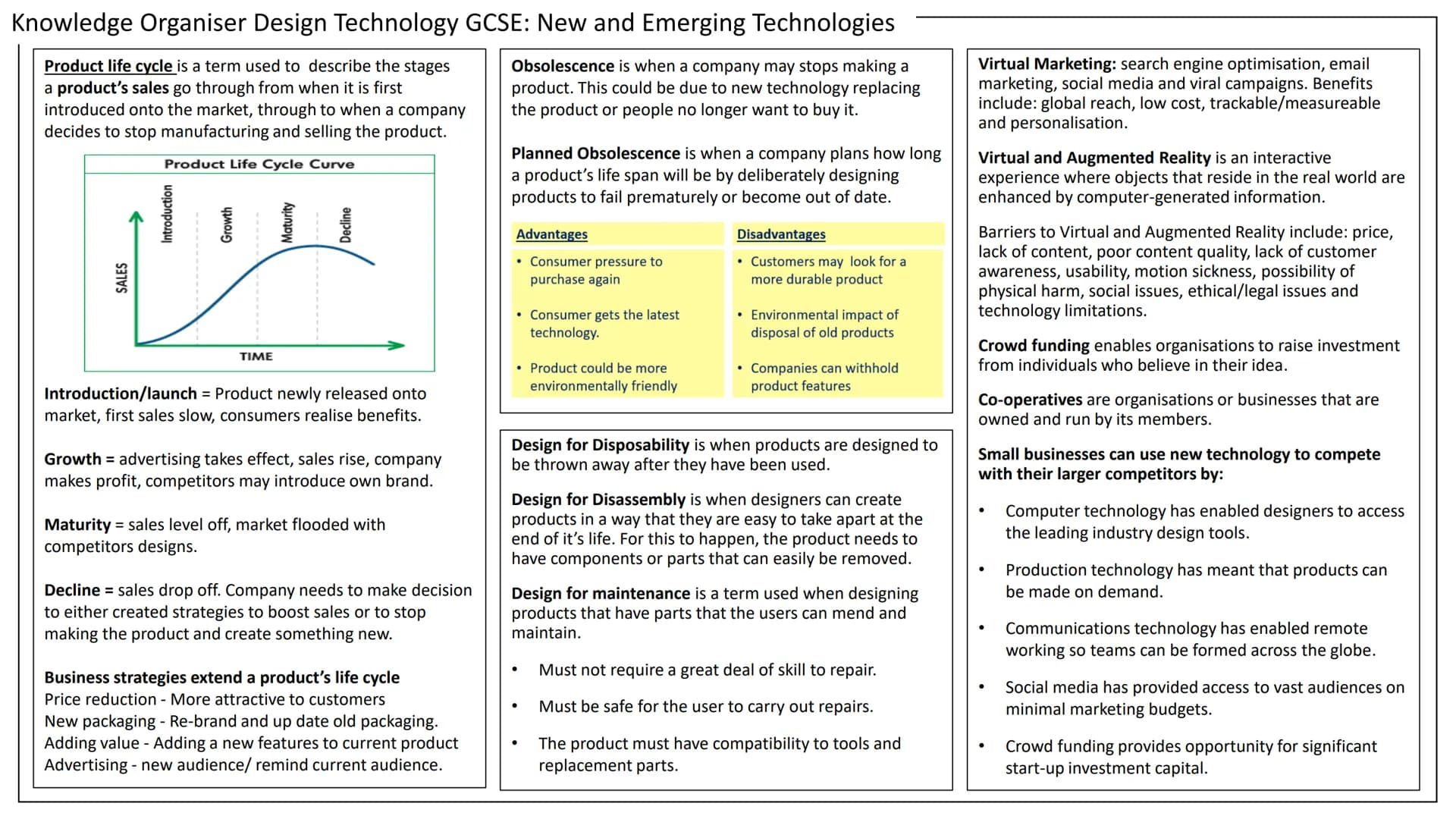
Product Life Cycle and Obsolescence
This page focuses on the Product Life Cycle and Obsolescence, crucial concepts in Design and Technology GCSE topics and Product Design GCSE studies.
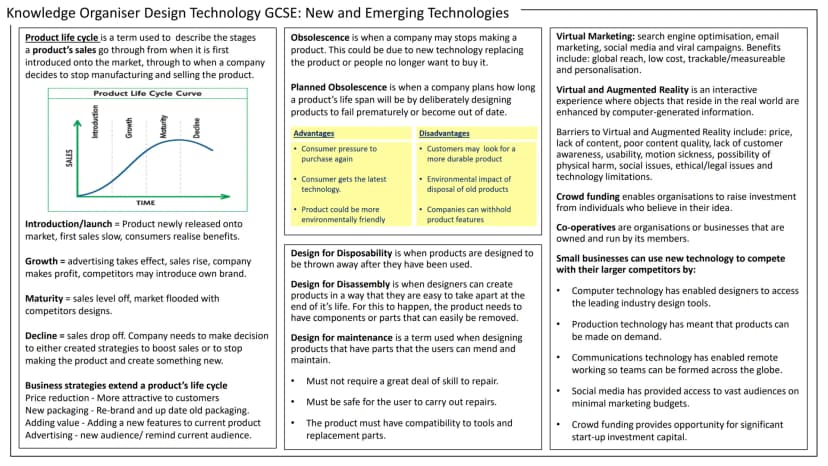
The Product Life Cycle is defined as the stages a product's sales go through from its introduction to the market until the company decides to stop manufacturing and selling it. This concept is essential for understanding market dynamics in Design and Technology GCSE topics.
Definition: The Product Life Cycle describes the journey of a product from its market introduction through growth, maturity, and eventual decline or obsolescence.
The Product Life Cycle is typically represented by a curve with four main stages:
-
Introduction/Launch:
- The product is newly released onto the market
- Initial sales are slow
- Consumers begin to realize the product's benefits
-
Growth:
- Advertising takes effect
- Sales rise
- The company starts making a profit
- Competitors may introduce their own versions
-
Maturity:
- Sales level off
- The market becomes flooded with competitors' designs
-
Decline:
- Sales drop off
- The company needs to make decisions about the product's future
Highlight: Understanding the Product Life Cycle is crucial for businesses to make informed decisions about product development, marketing strategies, and when to introduce new products or discontinue existing ones.
The concept of Obsolescence is also introduced on this page. Obsolescence occurs when a company stops making a product, which can happen due to various factors:
- New technology replacing the product
- Declining consumer demand
Vocabulary: Obsolescence refers to the state of being which occurs when an object, service, or practice is no longer wanted or used, often because it has been replaced by something newer or more efficient.
Understanding obsolescence is crucial in New and emerging technologies DT as it drives innovation and the need for continuous product development.
Example: The rapid obsolescence of older mobile phone models due to the introduction of smartphones illustrates how technological advancements can quickly make existing products outdated.
This page provides valuable insights into the dynamic nature of product markets and the importance of anticipating and adapting to changes in technology and consumer preferences. These concepts are fundamental to success in product design and development, making them essential components of Design and Technology GCSE topics and Product Design GCSE curricula.
3
of 5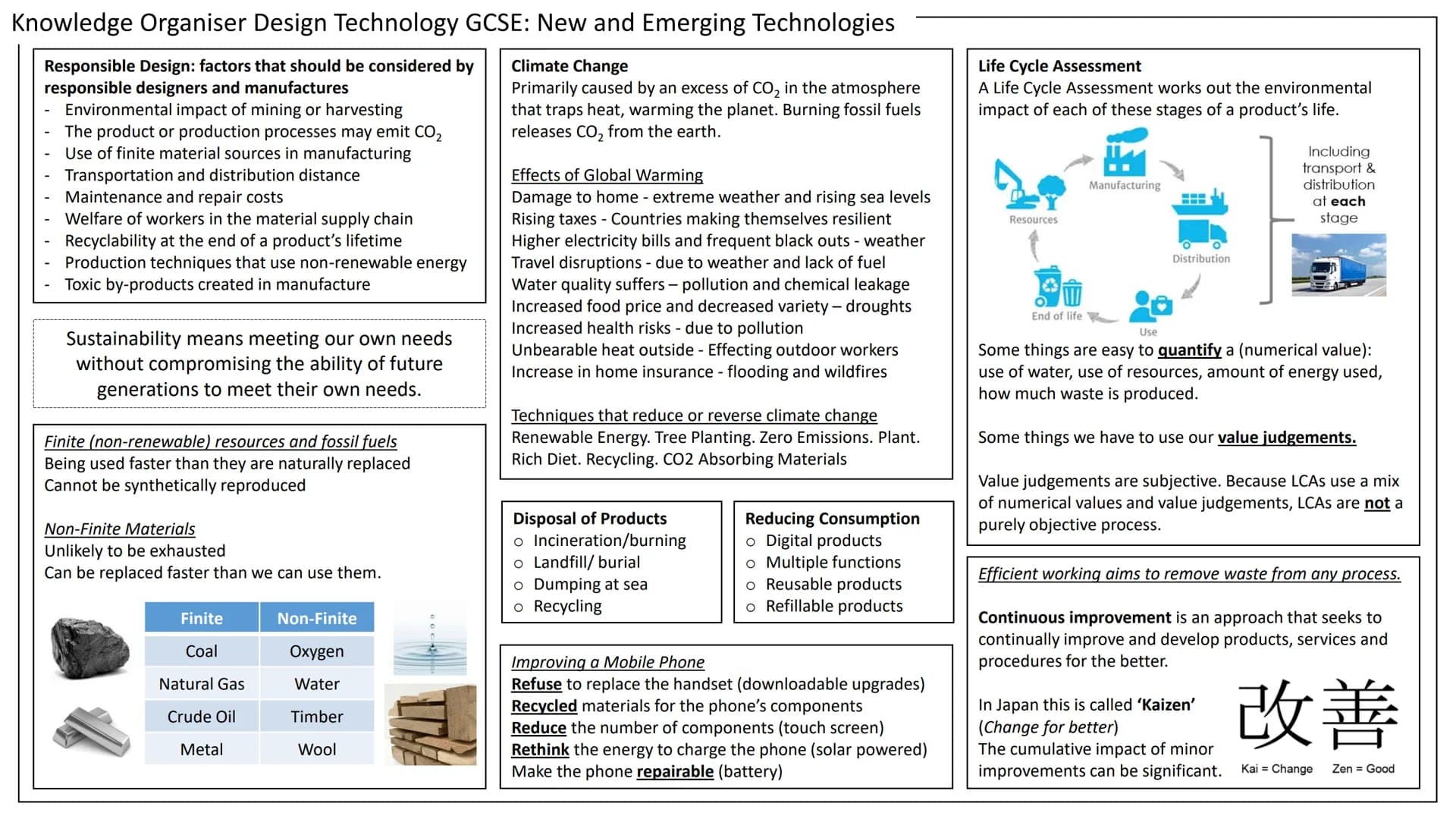
New and Emerging Technologies in Design and Technology
This page delves deeper into New and emerging technologies gcse dt, exploring various aspects of modern manufacturing and their impact on product design and production.
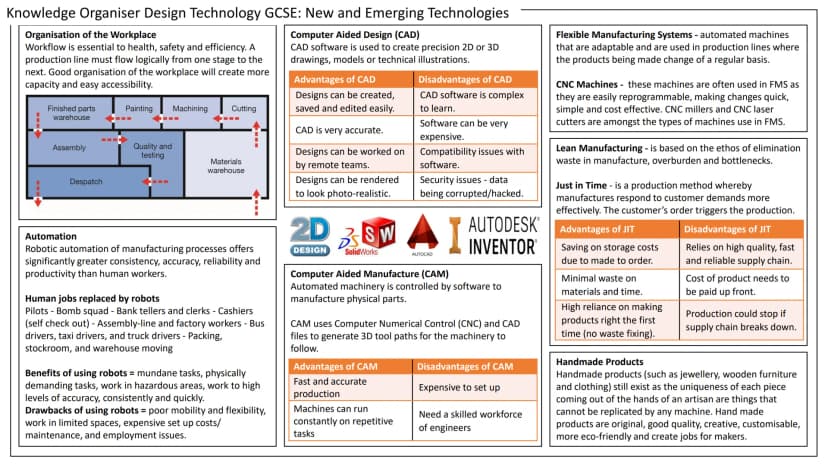
Computer Aided Design (CAD) is introduced as a crucial tool in modern design processes. CAD software allows designers to create precise 2D and 3D models of products before they are manufactured.
Definition: Computer Aided Design (CAD) refers to the use of computer systems to aid in the creation, modification, analysis, or optimization of a design.
Benefits of CAD in product design include:
- Increased accuracy in design
- Ability to easily modify designs
- Improved visualization of the final product
- Easier collaboration among design team members
Computer Aided Manufacturing (CAM) is presented as the natural progression from CAD in the production process. CAM involves using computer-controlled machines to manufacture products based on CAD designs.
Vocabulary: Computer Aided Manufacturing (CAM) is the use of software to control machine tools and related machinery in the manufacturing of workpieces.
The advantages of CAM in manufacturing include:
- Increased precision and consistency in production
- Ability to produce complex shapes that would be difficult or impossible to create manually
- Reduced production time and labor costs
- Easier replication of designs for mass production
The page also introduces Flexible Manufacturing Systems (FMS), which combine CAD/CAM technologies with robotics and computer-controlled systems to create highly adaptable production lines.
Highlight: Flexible Manufacturing Systems represent a significant advancement in New and emerging technologies DT, allowing for rapid changes in production without the need for extensive retooling.
Just-In-Time (JIT) Manufacturing is discussed as a strategy to reduce waste and increase efficiency in production processes. This approach involves producing goods to meet demand exactly in time, neither too early nor too late.
Example: Toyota's production system is a famous example of Just-In-Time manufacturing, where parts are delivered to the production line just as they are needed, reducing storage costs and improving efficiency.
The concept of Lean Manufacturing is introduced, which focuses on minimizing waste in manufacturing processes while maximizing productivity.
Definition: Lean Manufacturing is a systematic method for waste minimization within a manufacturing system without sacrificing productivity.
These concepts are crucial in understanding modern manufacturing processes and are essential components of Design and Technology GCSE topics. They demonstrate how New and emerging technologies gcse dt are shaping the future of product design and production, making manufacturing more efficient, flexible, and responsive to market demands.
4
of 5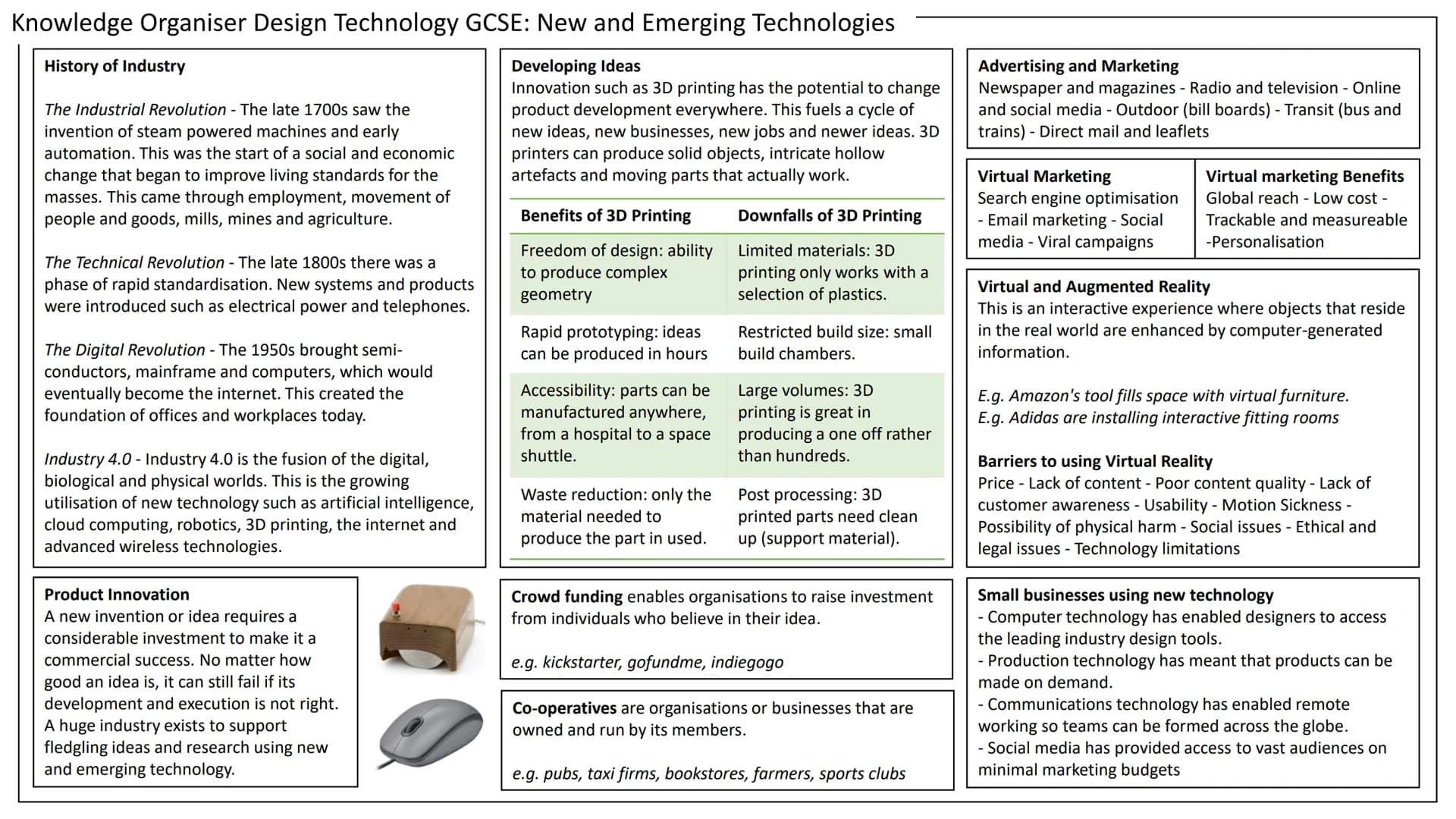
Sustainability and Environmental Considerations in Design and Technology
This page focuses on the crucial aspects of sustainability and environmental impact in Design and Technology GCSE topics, particularly in relation to New and emerging technologies gcse dt.
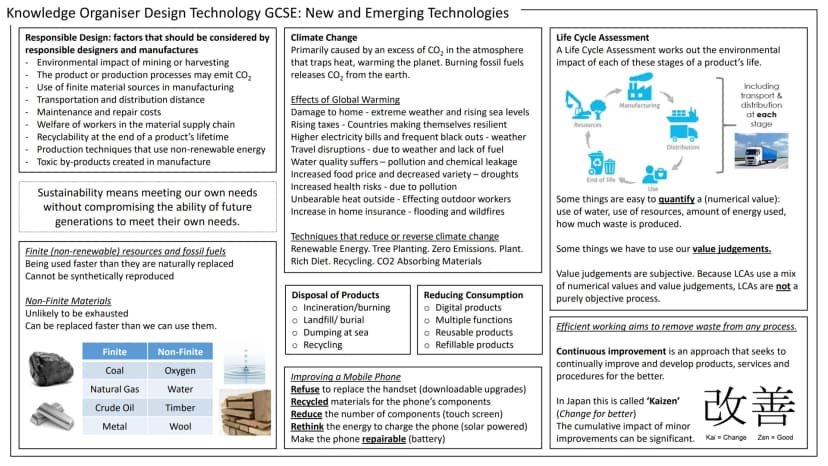
Sustainability is introduced as a key concept in modern design and manufacturing. It refers to the practice of creating and using products in ways that minimize negative environmental impacts and promote long-term ecological balance.
Definition: Sustainability in design and technology involves creating products and systems that meet current needs without compromising the ability of future generations to meet their own needs.
The page discusses several strategies for promoting sustainability in product design and manufacturing:
-
Use of Sustainable Materials:
- Choosing materials that are renewable, recyclable, or have a lower environmental impact
- Examples include bamboo, recycled plastics, and biodegradable materials
-
Energy Efficiency:
- Designing products that consume less energy during use
- Implementing energy-saving features in manufacturing processes
-
Waste Reduction:
- Minimizing waste in the manufacturing process
- Designing products for easy disassembly and recycling at the end of their life cycle
-
Longevity and Repairability:
- Creating products that last longer and can be easily repaired, reducing the need for frequent replacements
Highlight: The concept of the Circular Economy is introduced as an alternative to the traditional linear economy (make, use, dispose). In a circular economy, resources are kept in use for as long as possible, extracting the maximum value from them while in use, then recovering and regenerating products and materials at the end of each service life.
The page also discusses the importance of Life Cycle Assessment (LCA) in evaluating the environmental impact of products:
Vocabulary: Life Cycle Assessment (LCA) is a technique to assess environmental impacts associated with all the stages of a product's life, from raw material extraction through materials processing, manufacture, distribution, use, repair and maintenance, and disposal or recycling.
The benefits of conducting LCAs include:
- Identifying areas of high environmental impact in a product's life cycle
- Informing design decisions to reduce overall environmental impact
- Providing data for environmental product declarations and eco-labeling
Example: An LCA of a smartphone might reveal that the majority of its environmental impact comes from the manufacturing stage, particularly in the production of electronic components. This information could guide designers to focus on using more sustainable materials or improving manufacturing processes.
The page concludes by emphasizing the growing importance of sustainability in Design and Technology GCSE topics and how New and emerging technologies DT are playing a crucial role in creating more sustainable products and manufacturing processes.
Quote: "Sustainability is no longer just an option in design and technology; it's a necessity. As designers and technologists, we have a responsibility to create products and systems that meet current needs while preserving resources for future generations."
This focus on sustainability and environmental considerations demonstrates how Design and Technology GCSE topics are evolving to address global challenges, preparing students to become responsible designers and consumers in an increasingly environmentally conscious world.
5
of 5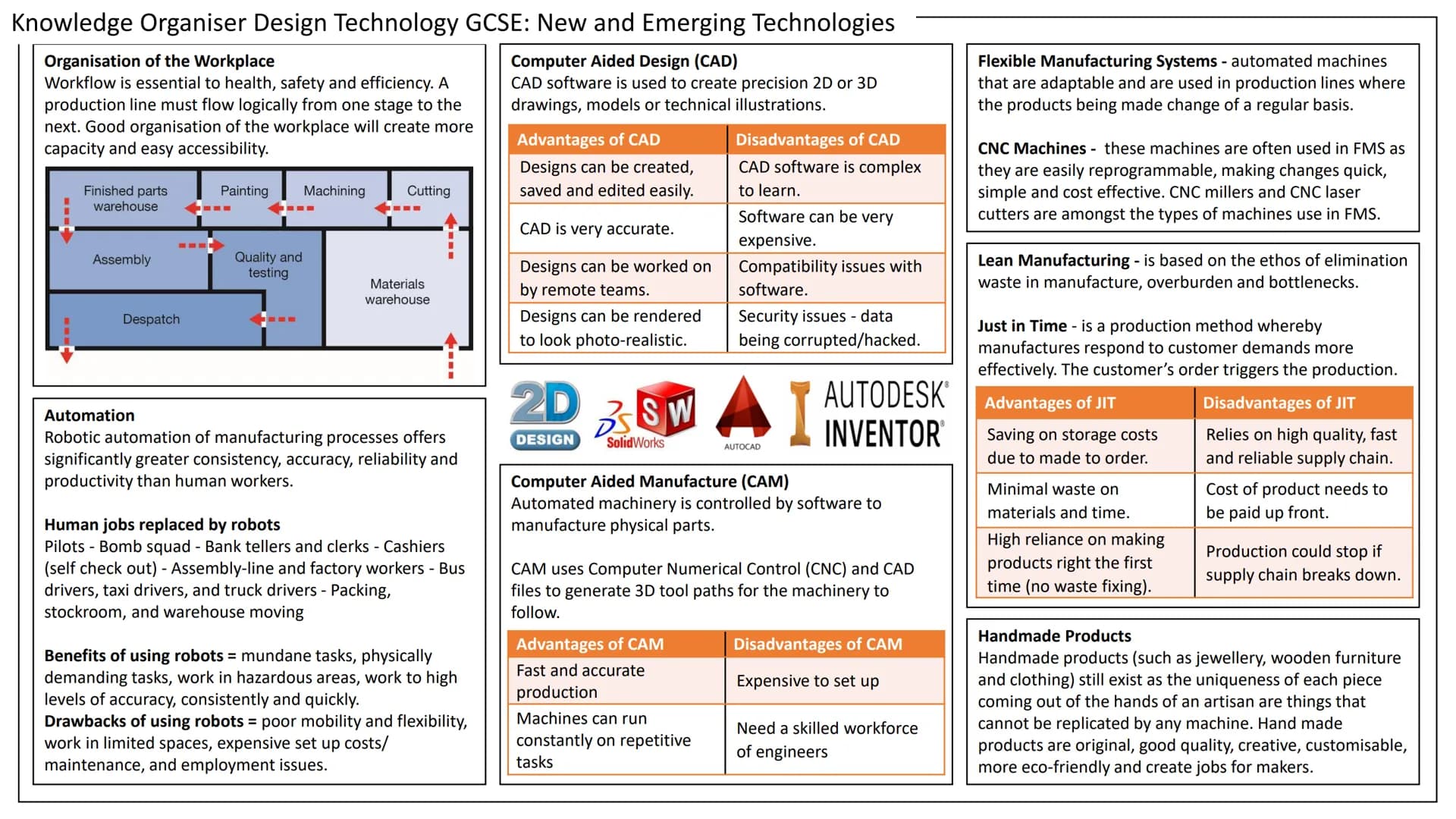
New and Emerging Technologies in Design and Technology
This page introduces fundamental concepts in Design and Technology GCSE topics, focusing on the forces that drive product development and innovation.
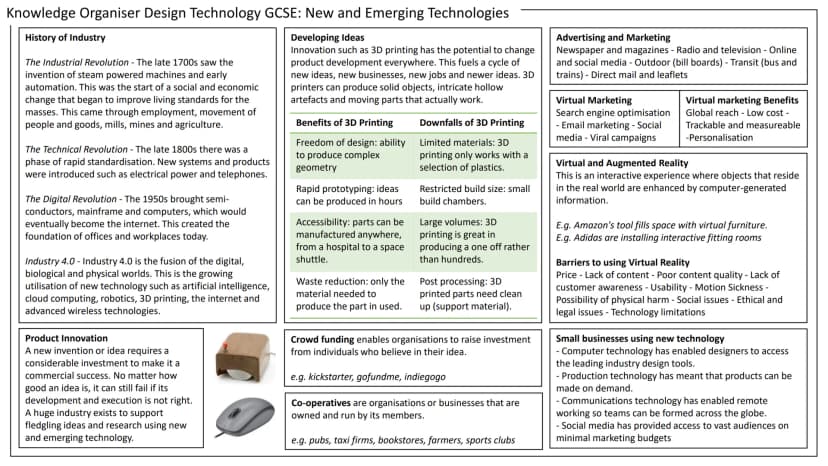
Technology Push refers to the development of new technologies, materials, and manufacturing methods that lead to new or improved products. Examples include smartphones, electricity, and mass production techniques.
Market Pull, on the other hand, is driven by consumer demand for new or improved products to meet their needs. This is often identified through reviews, polls, and surveys. Examples include aesthetic improvements and enhanced usability features.
Inclusive Design aims to create products that are usable by all people, regardless of their abilities or disabilities. This approach is evident in the design of cars, doorframes, and adjustable products.
Exclusive Design targets specific groups with particular needs, such as car seats for babies, wheelchairs, and stair lifts.
Definition: Inclusive design is an approach that ensures products are accessible and usable by people of all abilities, while exclusive design focuses on meeting the specific needs of particular groups.
The page outlines four main strategies for designers to cater to the majority of the population:
- One size fits all (e.g., door frames and baths)
- A range of sizes to cover all (e.g., shoes and clothes)
- Adjustability to allow use by all (e.g., car seats and shower head height)
- Adaptability to suit location or user (e.g., children's booster seats and car roof bars)
Highlight: Despite designers' best efforts, there is often a small group of potential users who may be left out, highlighting the challenges in creating truly universal designs.
The influence of culture and society on design is also discussed, with examples showing how products are adapted for different markets based on cultural norms and religious beliefs.
Example: In India, McDonald's doesn't sell beef burgers due to the large Hindu population that considers cows sacred. In contrast, the UK sees peak sales of fish and chips on Fridays, reflecting Christian traditions.
Vocabulary: Culture is defined as the values, beliefs, customs, and behaviors used by groups in society, while society refers to a collective of people living together in a community.
The page concludes with a case study on the £5 note controversy, illustrating how cultural and religious considerations can impact even seemingly universal products like currency.
We thought you’d never ask...
What is the Knowunity AI companion?
Our AI companion is specifically built for the needs of students. Based on the millions of content pieces we have on the platform we can provide truly meaningful and relevant answers to students. But its not only about answers, the companion is even more about guiding students through their daily learning challenges, with personalised study plans, quizzes or content pieces in the chat and 100% personalisation based on the students skills and developments.
Where can I download the Knowunity app?
You can download the app in the Google Play Store and in the Apple App Store.
Is Knowunity really free of charge?
That's right! Enjoy free access to study content, connect with fellow students, and get instant help – all at your fingertips.
Similar Content
 Otros
OtrosMost popular content: Work, Exchange, and Technology
4Design & TechnologyJust In Time Production Insights
Explore the fundamentals of Just In Time (JIT) production, including its advantages and disadvantages, the role of automation, and the impact of robotics in manufacturing. This summary covers essential concepts like technology push, market pull, and sustainable practices, making it ideal for AQA Design Technology students seeking to excel.
101,69931
Design & TechnologySustainable Design Strategies
Explore key concepts in sustainable design, including user-centered design, iterative processes, and environmental impacts. This study note covers ecological issues, the 6 R's, and influential designers like Coco Chanel and Alexander McQueen. Ideal for AQA GCSE Design and Technology students seeking to understand the intersection of design and environmental responsibility.
119509
 Product Design
Materials and Manufacturing Insights
Explore key concepts in materials science and manufacturing processes, including the origins of paper, properties of metals and polymers, and modern production techniques. This summary covers essential topics such as material properties, manufacturing systems, and sustainable practices, making it a valuable resource for design technology students. Type: Summary.
91284
 Media Studies
BBC Radio 1 Insights
Explore the dynamics of BBC Radio 1's Breakfast Show, focusing on audience engagement, technological convergence, and marketing strategies. This summary covers key concepts in media studies, including media representation and the impact of social media on contemporary broadcasting. Ideal for students studying media industries and theories.
122416
Most popular content in Design & Technology
9D
Design & Technologydesign and manufacture
Test yourself
S42924
Design & TechnologyGCSE Computer Science Essentials
Comprehensive overview of key concepts in GCSE Computer Science, covering data types, programming techniques, network protocols, and ethical considerations. Ideal for exam preparation and understanding core principles. Includes topics like algorithms, SQL, cybersecurity, and system software.
117,468348
Design & Technologygcse design technology knowledge organiser
sunmarised information for the theory paper
1168924
Design & TechnologyDesign Technology Essentials
Explore key concepts in Design Technology for GCSE, including sustainable design, material properties, energy types, and production techniques. This knowledge organiser covers essential topics such as renewable energy, mechanical properties, and user-centered design, providing a comprehensive overview for effective study and exam preparation.
109,312465
Design & TechnologyGraphic Communications Essentials
Comprehensive overview of key concepts in Graphic Communications for National 5 and Higher exams, covering design principles, color theory, typography, and digital graphics. Ideal for exam preparation and understanding essential graphic design software and techniques.
S41,84796
Design & TechnologyJust In Time Production Insights
Explore the fundamentals of Just In Time (JIT) production, including its advantages and disadvantages, the role of automation, and the impact of robotics in manufacturing. This summary covers essential concepts like technology push, market pull, and sustainable practices, making it ideal for AQA Design Technology students seeking to excel.
101,69931
Design & TechnologyDesign technology
mock revision sheets
101461
Design & TechnologySustainable Design Strategies
Explore key concepts in sustainable design, including user-centered design, iterative processes, and environmental impacts. This study note covers ecological issues, the 6 R's, and influential designers like Coco Chanel and Alexander McQueen. Ideal for AQA GCSE Design and Technology students seeking to understand the intersection of design and environmental responsibility.
119509
Design & TechnologyTimber Materials Overview GCSE
Explore essential concepts in timber-based materials for GCSE Design and Technology. This comprehensive guide covers wood joints, fixings, turning, routing, surface treatments, and the properties of hardwoods, softwoods, and manufactured boards. Ideal for students preparing for exams, this resource also addresses forestry management and sustainable practices. Enhance your understanding of timber applications in furniture and construction.
112,10974
Most popular content
9 Sociology
Sociology of Education Overview
Explore comprehensive A-Level Sociology notes on the education system, covering key theories, policies, and sociological perspectives. This resource includes insights on marketisation, gender roles, cultural deprivation, and educational inequalities, providing a thorough understanding of how education shapes social stratification and individual achievement. Ideal for exam preparation and in-depth study.
12102,8693,040
SociologySociology of Families: Comprehensive Revision
Dive into an extensive overview of family dynamics, perspectives, and patterns in sociology. This resource covers key concepts such as family diversity, gender roles, marriage, and the impact of social policies on family structures. Perfect for A-Level Sociology students preparing for Paper 2.
1273,6662,307
CriminologyCriminology: Crime & Punishment Overview
Comprehensive mindmaps covering key concepts in the Crime and Punishment topic for WJEC Criminology Unit 4. This resource includes detailed insights into the Criminal Justice System, crime prevention strategies, sentencing models, and the roles of various agencies. Ideal for A-Level revision, ensuring you grasp essential theories and legislative processes to excel in your exams.
1254,8721,059
SociologyComprehensive Crime & Deviance Overview
Explore an extensive revision of crime and deviance topics, including theories, types of crime, and the impact of media. This resource covers key concepts such as Marxism, functionalism, gender and crime, and the influence of globalization on criminal behavior. Ideal for students seeking a thorough understanding of criminology and its various theories. Type: Full Topic Revision.
1251,6541,399
C
 Biology
Cell Biology and Cell structure
cell structures
93,2490
 English Literature
An Inspector Calls: Character Insights
Explore in-depth analysis and key quotes for characters in J.B. Priestley's 'An Inspector Calls'. This resource covers Gerald Croft, Inspector Goole, Sheila Birling, Mrs. Birling, Eric Birling, and Eva Smith, focusing on themes of class, gender roles, and social responsibility. Ideal for students aiming for Grade 8 and above.
1025,429907
CriminologyWJEC Unit 4 Criminology
Criminology unit 4 detailed revision note
127,151125
CriminologyCriminology Theories Overview
Explore key criminology theories and their implications on crime and deviance. This comprehensive summary covers biological, psychological, and sociological perspectives, including labelling theory, right realism, and the impact of social campaigns on policy development. Ideal for A-Level criminology students seeking to understand the complexities of criminal behaviour and the factors influencing crime prevention strategies.
129,760210
English LiteratureRomeo and Juliet: Key themes
Key Romeo and Juliet themes and analysed quotes
106,708198
Can't find what you're looking for? Explore other subjects.
Students love us — and so will you.
4.6/5App Store
4.7/5Google Play
The app is very easy to use and well designed. I have found everything I was looking for so far and have been able to learn a lot from the presentations! I will definitely use the app for a class assignment! And of course it also helps a lot as an inspiration.
Stefan SiOS user
This app is really great. There are so many study notes and help [...]. My problem subject is French, for example, and the app has so many options for help. Thanks to this app, I have improved my French. I would recommend it to anyone.
Samantha KlichAndroid user
Wow, I am really amazed. I just tried the app because I've seen it advertised many times and was absolutely stunned. This app is THE HELP you want for school and above all, it offers so many things, such as workouts and fact sheets, which have been VERY helpful to me personally.
AnnaiOS user
Design & Technology1,767 views·Updated Jun 20, 2026·5 pagesNew and Emerging Technologies GCSE DT - Fun Guide for Kids
New and Emerging Technologies in Design and Technology GCSEis a crucial topic that explores how technological advancements and societal factors influence product design and development. This summary covers key concepts like technology push, market pull, inclusive design, and the...
1
of 5
Sign up to see the content. It's free!
- Access to all documents
- Improve your grades
- Join milions of students
Impact of Culture and Society on Product Design
This page delves deeper into the influence of culture and society on Design and Technology GCSE topics, particularly focusing on how cultural factors shape product development and acceptance.
The case study of the £5 note controversy in the UK is explored in detail. In 2016, it was revealed that the new polymer Bank of England £5 note contained tallow, an animal fat-based substance. This discovery upset various communities, including Hindus, Sikhs, vegans, and vegetarians, who avoid using animal products in their daily lives.
Quote: "The revelation in 2016 that the new polymer Bank of England £5 note contained tallow, an animal fat-based substance, upset a number of communities."
The controversy led to a significant public response:
- An official petition gathered over 100,000 signatures in just two days.
- Some establishments refused to accept the notes as payment.
- A café owner expressed repulsion at the idea of the note containing tallow, believing her customers supported this view.
Highlight: This case study demonstrates how overlooking cultural and religious considerations in product design can lead to widespread controversy and rejection of even essential items like currency.
The page also discusses the concept of fashion and trends in product design. Designers must ensure their products align with the current fashion and trends of the target market area. This consideration is crucial in Product Design GCSE studies.
Product Evolution is introduced as a key concept, explaining how products change over time due to:
- Market Pull
- Technology Push
- Fashion and Trends
Definition: Product Evolution refers to the changes and improvements made to products over time, driven by market demands, technological advancements, and changing fashion trends.
The page provides visual examples of product evolution, including:
- The evolution of gaming controllers from the Sega Saturn to the Xbox 360
- The development of the Spitfire aircraft
- The progression from the original Mini Cooper to newer models
Example: The evolution of gaming controllers showcases how ergonomics, functionality, and aesthetics have changed over time to meet user needs and technological capabilities.
Lastly, the concept of Iconic Designs is introduced. These are products considered timeless due to their innovative nature, industry-changing impact, and frequent imitation.
Vocabulary: Iconic Designs are products that have stood the test of time due to their innovative features, industry influence, and enduring popularity.
Examples of iconic designs mentioned include the iPod, iPhone, Angle-Poise Lamp, Swiss Army Knife, Converse Shoes, Levi's Jeans, and the Classic Mini Cooper.
2
of 5Sign up to see the content. It's free!
- Access to all documents
- Improve your grades
- Join milions of students
Product Life Cycle and Obsolescence
This page focuses on the Product Life Cycle and Obsolescence, crucial concepts in Design and Technology GCSE topics and Product Design GCSE studies.
The Product Life Cycle is defined as the stages a product's sales go through from its introduction to the market until the company decides to stop manufacturing and selling it. This concept is essential for understanding market dynamics in Design and Technology GCSE topics.
Definition: The Product Life Cycle describes the journey of a product from its market introduction through growth, maturity, and eventual decline or obsolescence.
The Product Life Cycle is typically represented by a curve with four main stages:
-
Introduction/Launch:
- The product is newly released onto the market
- Initial sales are slow
- Consumers begin to realize the product's benefits
-
Growth:
- Advertising takes effect
- Sales rise
- The company starts making a profit
- Competitors may introduce their own versions
-
Maturity:
- Sales level off
- The market becomes flooded with competitors' designs
-
Decline:
- Sales drop off
- The company needs to make decisions about the product's future
Highlight: Understanding the Product Life Cycle is crucial for businesses to make informed decisions about product development, marketing strategies, and when to introduce new products or discontinue existing ones.
The concept of Obsolescence is also introduced on this page. Obsolescence occurs when a company stops making a product, which can happen due to various factors:
- New technology replacing the product
- Declining consumer demand
Vocabulary: Obsolescence refers to the state of being which occurs when an object, service, or practice is no longer wanted or used, often because it has been replaced by something newer or more efficient.
Understanding obsolescence is crucial in New and emerging technologies DT as it drives innovation and the need for continuous product development.
Example: The rapid obsolescence of older mobile phone models due to the introduction of smartphones illustrates how technological advancements can quickly make existing products outdated.
This page provides valuable insights into the dynamic nature of product markets and the importance of anticipating and adapting to changes in technology and consumer preferences. These concepts are fundamental to success in product design and development, making them essential components of Design and Technology GCSE topics and Product Design GCSE curricula.
3
of 5Sign up to see the content. It's free!
- Access to all documents
- Improve your grades
- Join milions of students
New and Emerging Technologies in Design and Technology
This page delves deeper into New and emerging technologies gcse dt, exploring various aspects of modern manufacturing and their impact on product design and production.
Computer Aided Design (CAD) is introduced as a crucial tool in modern design processes. CAD software allows designers to create precise 2D and 3D models of products before they are manufactured.
Definition: Computer Aided Design (CAD) refers to the use of computer systems to aid in the creation, modification, analysis, or optimization of a design.
Benefits of CAD in product design include:
- Increased accuracy in design
- Ability to easily modify designs
- Improved visualization of the final product
- Easier collaboration among design team members
Computer Aided Manufacturing (CAM) is presented as the natural progression from CAD in the production process. CAM involves using computer-controlled machines to manufacture products based on CAD designs.
Vocabulary: Computer Aided Manufacturing (CAM) is the use of software to control machine tools and related machinery in the manufacturing of workpieces.
The advantages of CAM in manufacturing include:
- Increased precision and consistency in production
- Ability to produce complex shapes that would be difficult or impossible to create manually
- Reduced production time and labor costs
- Easier replication of designs for mass production
The page also introduces Flexible Manufacturing Systems (FMS), which combine CAD/CAM technologies with robotics and computer-controlled systems to create highly adaptable production lines.
Highlight: Flexible Manufacturing Systems represent a significant advancement in New and emerging technologies DT, allowing for rapid changes in production without the need for extensive retooling.
Just-In-Time (JIT) Manufacturing is discussed as a strategy to reduce waste and increase efficiency in production processes. This approach involves producing goods to meet demand exactly in time, neither too early nor too late.
Example: Toyota's production system is a famous example of Just-In-Time manufacturing, where parts are delivered to the production line just as they are needed, reducing storage costs and improving efficiency.
The concept of Lean Manufacturing is introduced, which focuses on minimizing waste in manufacturing processes while maximizing productivity.
Definition: Lean Manufacturing is a systematic method for waste minimization within a manufacturing system without sacrificing productivity.
These concepts are crucial in understanding modern manufacturing processes and are essential components of Design and Technology GCSE topics. They demonstrate how New and emerging technologies gcse dt are shaping the future of product design and production, making manufacturing more efficient, flexible, and responsive to market demands.
4
of 5Sign up to see the content. It's free!
- Access to all documents
- Improve your grades
- Join milions of students
Sustainability and Environmental Considerations in Design and Technology
This page focuses on the crucial aspects of sustainability and environmental impact in Design and Technology GCSE topics, particularly in relation to New and emerging technologies gcse dt.
Sustainability is introduced as a key concept in modern design and manufacturing. It refers to the practice of creating and using products in ways that minimize negative environmental impacts and promote long-term ecological balance.
Definition: Sustainability in design and technology involves creating products and systems that meet current needs without compromising the ability of future generations to meet their own needs.
The page discusses several strategies for promoting sustainability in product design and manufacturing:
-
Use of Sustainable Materials:
- Choosing materials that are renewable, recyclable, or have a lower environmental impact
- Examples include bamboo, recycled plastics, and biodegradable materials
-
Energy Efficiency:
- Designing products that consume less energy during use
- Implementing energy-saving features in manufacturing processes
-
Waste Reduction:
- Minimizing waste in the manufacturing process
- Designing products for easy disassembly and recycling at the end of their life cycle
-
Longevity and Repairability:
- Creating products that last longer and can be easily repaired, reducing the need for frequent replacements
Highlight: The concept of the Circular Economy is introduced as an alternative to the traditional linear economy (make, use, dispose). In a circular economy, resources are kept in use for as long as possible, extracting the maximum value from them while in use, then recovering and regenerating products and materials at the end of each service life.
The page also discusses the importance of Life Cycle Assessment (LCA) in evaluating the environmental impact of products:
Vocabulary: Life Cycle Assessment (LCA) is a technique to assess environmental impacts associated with all the stages of a product's life, from raw material extraction through materials processing, manufacture, distribution, use, repair and maintenance, and disposal or recycling.
The benefits of conducting LCAs include:
- Identifying areas of high environmental impact in a product's life cycle
- Informing design decisions to reduce overall environmental impact
- Providing data for environmental product declarations and eco-labeling
Example: An LCA of a smartphone might reveal that the majority of its environmental impact comes from the manufacturing stage, particularly in the production of electronic components. This information could guide designers to focus on using more sustainable materials or improving manufacturing processes.
The page concludes by emphasizing the growing importance of sustainability in Design and Technology GCSE topics and how New and emerging technologies DT are playing a crucial role in creating more sustainable products and manufacturing processes.
Quote: "Sustainability is no longer just an option in design and technology; it's a necessity. As designers and technologists, we have a responsibility to create products and systems that meet current needs while preserving resources for future generations."
This focus on sustainability and environmental considerations demonstrates how Design and Technology GCSE topics are evolving to address global challenges, preparing students to become responsible designers and consumers in an increasingly environmentally conscious world.
5
of 5Sign up to see the content. It's free!
- Access to all documents
- Improve your grades
- Join milions of students
New and Emerging Technologies in Design and Technology
This page introduces fundamental concepts in Design and Technology GCSE topics, focusing on the forces that drive product development and innovation.
Technology Push refers to the development of new technologies, materials, and manufacturing methods that lead to new or improved products. Examples include smartphones, electricity, and mass production techniques.
Market Pull, on the other hand, is driven by consumer demand for new or improved products to meet their needs. This is often identified through reviews, polls, and surveys. Examples include aesthetic improvements and enhanced usability features.
Inclusive Design aims to create products that are usable by all people, regardless of their abilities or disabilities. This approach is evident in the design of cars, doorframes, and adjustable products.
Exclusive Design targets specific groups with particular needs, such as car seats for babies, wheelchairs, and stair lifts.
Definition: Inclusive design is an approach that ensures products are accessible and usable by people of all abilities, while exclusive design focuses on meeting the specific needs of particular groups.
The page outlines four main strategies for designers to cater to the majority of the population:
- One size fits all (e.g., door frames and baths)
- A range of sizes to cover all (e.g., shoes and clothes)
- Adjustability to allow use by all (e.g., car seats and shower head height)
- Adaptability to suit location or user (e.g., children's booster seats and car roof bars)
Highlight: Despite designers' best efforts, there is often a small group of potential users who may be left out, highlighting the challenges in creating truly universal designs.
The influence of culture and society on design is also discussed, with examples showing how products are adapted for different markets based on cultural norms and religious beliefs.
Example: In India, McDonald's doesn't sell beef burgers due to the large Hindu population that considers cows sacred. In contrast, the UK sees peak sales of fish and chips on Fridays, reflecting Christian traditions.
Vocabulary: Culture is defined as the values, beliefs, customs, and behaviors used by groups in society, while society refers to a collective of people living together in a community.
The page concludes with a case study on the £5 note controversy, illustrating how cultural and religious considerations can impact even seemingly universal products like currency.
We thought you’d never ask...
What is the Knowunity AI companion?
Our AI companion is specifically built for the needs of students. Based on the millions of content pieces we have on the platform we can provide truly meaningful and relevant answers to students. But its not only about answers, the companion is even more about guiding students through their daily learning challenges, with personalised study plans, quizzes or content pieces in the chat and 100% personalisation based on the students skills and developments.
Where can I download the Knowunity app?
You can download the app in the Google Play Store and in the Apple App Store.
Is Knowunity really free of charge?
That's right! Enjoy free access to study content, connect with fellow students, and get instant help – all at your fingertips.
Similar Content
Most popular content: Work, Exchange, and Technology
4Design & TechnologyJust In Time Production Insights
Explore the fundamentals of Just In Time (JIT) production, including its advantages and disadvantages, the role of automation, and the impact of robotics in manufacturing. This summary covers essential concepts like technology push, market pull, and sustainable practices, making it ideal for AQA Design Technology students seeking to excel.
101,69931
Design & TechnologySustainable Design Strategies
Explore key concepts in sustainable design, including user-centered design, iterative processes, and environmental impacts. This study note covers ecological issues, the 6 R's, and influential designers like Coco Chanel and Alexander McQueen. Ideal for AQA GCSE Design and Technology students seeking to understand the intersection of design and environmental responsibility.
119509
Product DesignMaterials and Manufacturing Insights
Explore key concepts in materials science and manufacturing processes, including the origins of paper, properties of metals and polymers, and modern production techniques. This summary covers essential topics such as material properties, manufacturing systems, and sustainable practices, making it a valuable resource for design technology students. Type: Summary.
91284
Media StudiesBBC Radio 1 Insights
Explore the dynamics of BBC Radio 1's Breakfast Show, focusing on audience engagement, technological convergence, and marketing strategies. This summary covers key concepts in media studies, including media representation and the impact of social media on contemporary broadcasting. Ideal for students studying media industries and theories.
122416
Most popular content in Design & Technology
9D
Design & Technologydesign and manufacture
Test yourself
S42924
Design & TechnologyGCSE Computer Science Essentials
Comprehensive overview of key concepts in GCSE Computer Science, covering data types, programming techniques, network protocols, and ethical considerations. Ideal for exam preparation and understanding core principles. Includes topics like algorithms, SQL, cybersecurity, and system software.
117,468348
Design & Technologygcse design technology knowledge organiser
sunmarised information for the theory paper
1168924
Design & TechnologyDesign Technology Essentials
Explore key concepts in Design Technology for GCSE, including sustainable design, material properties, energy types, and production techniques. This knowledge organiser covers essential topics such as renewable energy, mechanical properties, and user-centered design, providing a comprehensive overview for effective study and exam preparation.
109,312465
Design & TechnologyGraphic Communications Essentials
Comprehensive overview of key concepts in Graphic Communications for National 5 and Higher exams, covering design principles, color theory, typography, and digital graphics. Ideal for exam preparation and understanding essential graphic design software and techniques.
S41,84796
Design & TechnologyJust In Time Production Insights
Explore the fundamentals of Just In Time (JIT) production, including its advantages and disadvantages, the role of automation, and the impact of robotics in manufacturing. This summary covers essential concepts like technology push, market pull, and sustainable practices, making it ideal for AQA Design Technology students seeking to excel.
101,69931
Design & TechnologyDesign technology
mock revision sheets
101461
Design & TechnologySustainable Design Strategies
Explore key concepts in sustainable design, including user-centered design, iterative processes, and environmental impacts. This study note covers ecological issues, the 6 R's, and influential designers like Coco Chanel and Alexander McQueen. Ideal for AQA GCSE Design and Technology students seeking to understand the intersection of design and environmental responsibility.
119509
Design & TechnologyTimber Materials Overview GCSE
Explore essential concepts in timber-based materials for GCSE Design and Technology. This comprehensive guide covers wood joints, fixings, turning, routing, surface treatments, and the properties of hardwoods, softwoods, and manufactured boards. Ideal for students preparing for exams, this resource also addresses forestry management and sustainable practices. Enhance your understanding of timber applications in furniture and construction.
112,10974
Most popular content
9SociologySociology of Education Overview
Explore comprehensive A-Level Sociology notes on the education system, covering key theories, policies, and sociological perspectives. This resource includes insights on marketisation, gender roles, cultural deprivation, and educational inequalities, providing a thorough understanding of how education shapes social stratification and individual achievement. Ideal for exam preparation and in-depth study.
12102,8693,040
SociologySociology of Families: Comprehensive Revision
Dive into an extensive overview of family dynamics, perspectives, and patterns in sociology. This resource covers key concepts such as family diversity, gender roles, marriage, and the impact of social policies on family structures. Perfect for A-Level Sociology students preparing for Paper 2.
1273,6662,307
CriminologyCriminology: Crime & Punishment Overview
Comprehensive mindmaps covering key concepts in the Crime and Punishment topic for WJEC Criminology Unit 4. This resource includes detailed insights into the Criminal Justice System, crime prevention strategies, sentencing models, and the roles of various agencies. Ideal for A-Level revision, ensuring you grasp essential theories and legislative processes to excel in your exams.
1254,8721,059
SociologyComprehensive Crime & Deviance Overview
Explore an extensive revision of crime and deviance topics, including theories, types of crime, and the impact of media. This resource covers key concepts such as Marxism, functionalism, gender and crime, and the influence of globalization on criminal behavior. Ideal for students seeking a thorough understanding of criminology and its various theories. Type: Full Topic Revision.
1251,6541,399
C
BiologyCell Biology and Cell structure
cell structures
93,2490
English LiteratureAn Inspector Calls: Character Insights
Explore in-depth analysis and key quotes for characters in J.B. Priestley's 'An Inspector Calls'. This resource covers Gerald Croft, Inspector Goole, Sheila Birling, Mrs. Birling, Eric Birling, and Eva Smith, focusing on themes of class, gender roles, and social responsibility. Ideal for students aiming for Grade 8 and above.
1025,429907
CriminologyWJEC Unit 4 Criminology
Criminology unit 4 detailed revision note
127,151125
CriminologyCriminology Theories Overview
Explore key criminology theories and their implications on crime and deviance. This comprehensive summary covers biological, psychological, and sociological perspectives, including labelling theory, right realism, and the impact of social campaigns on policy development. Ideal for A-Level criminology students seeking to understand the complexities of criminal behaviour and the factors influencing crime prevention strategies.
129,760210
English LiteratureRomeo and Juliet: Key themes
Key Romeo and Juliet themes and analysed quotes
106,708198
Can't find what you're looking for? Explore other subjects.
Students love us — and so will you.
4.6/5App Store
4.7/5Google Play
The app is very easy to use and well designed. I have found everything I was looking for so far and have been able to learn a lot from the presentations! I will definitely use the app for a class assignment! And of course it also helps a lot as an inspiration.
Stefan SiOS user
This app is really great. There are so many study notes and help [...]. My problem subject is French, for example, and the app has so many options for help. Thanks to this app, I have improved my French. I would recommend it to anyone.
Samantha KlichAndroid user
Wow, I am really amazed. I just tried the app because I've seen it advertised many times and was absolutely stunned. This app is THE HELP you want for school and above all, it offers so many things, such as workouts and fact sheets, which have been VERY helpful to me personally.
AnnaiOS user