
Ever wondered how criminal cases really get decided? It's not...
 Criminology1,954 views·Updated Jun 20, 2026·3 pages
Understanding the Main Factors That Impact Criminal Court Decisions

K🩷@kstudies


1 / 3
1
of 3
Evidence, Media, and Witness Testimony in Criminal Cases
Physical evidence like DNA and blood samples pack the biggest punch in court because they're scientifically proven and hard to argue against. However, contamination during investigation can completely mess up a case and potentially lead to wrongful convictions.
The burden of proof sits squarely on the prosecution's shoulders - they must prove guilt whilst the defence can only challenge their claims. This gives prosecutors a major advantage since they control most of the evidence presented to the jury.
Media coverage can absolutely destroy the "innocent until proven guilty" principle. Take the 2011 London riots after Mark Duggan's death - media reports about his alleged criminal background sparked moral panic and influenced both public opinion and harsher sentencing for riot-related crimes.
Key Point: The media's portrayal of suspects often creates public pressure that can influence trial outcomes, even when initial reports prove inaccurate.
Eyewitness testimony might seem reliable, but it's surprisingly flaky. Memory fades over time, stress affects recall, and even seeing similar photos can alter someone's recollection. The Ronald Cotton case shows how confidently wrong witnesses can be - Jennifer Thompson was "certain" of his identity, yet DNA evidence later proved his innocence after 10 years in prison.
2
of 3
Expert Witnesses and Political Influence
Expert witnesses carry serious weight because juries trust their specialist knowledge and credentials. They help explain complex evidence that ordinary people might not understand, making their testimony incredibly influential in reaching verdicts.
The Sally Clark case perfectly demonstrates how expert testimony can go horribly wrong. Professor Roy Meadow claimed the odds of both her children dying from SIDS were 1 in 73 million - completely flawed statistics that helped convict an innocent mother. She served three years before the conviction was overturned, but the damage was done.
Political pressure shapes criminal justice through Parliament's law-making power and influence over sentencing guidelines. Politicians can effectively pressure judges to impose harsher sentences, especially during public outcry over particular types of crimes.
Key Point: The Arms to Iraq scandal shows how political considerations can influence prosecution decisions - sometimes cases don't proceed because they'd embarrass the government.
The Dangerous Dogs Act 1991 emerged from media-driven moral panic about certain dog breeds. This demonstrates how political responses to public fear can create sweeping legislation that affects thousands of people based on isolated incidents rather than solid evidence.
3
of 3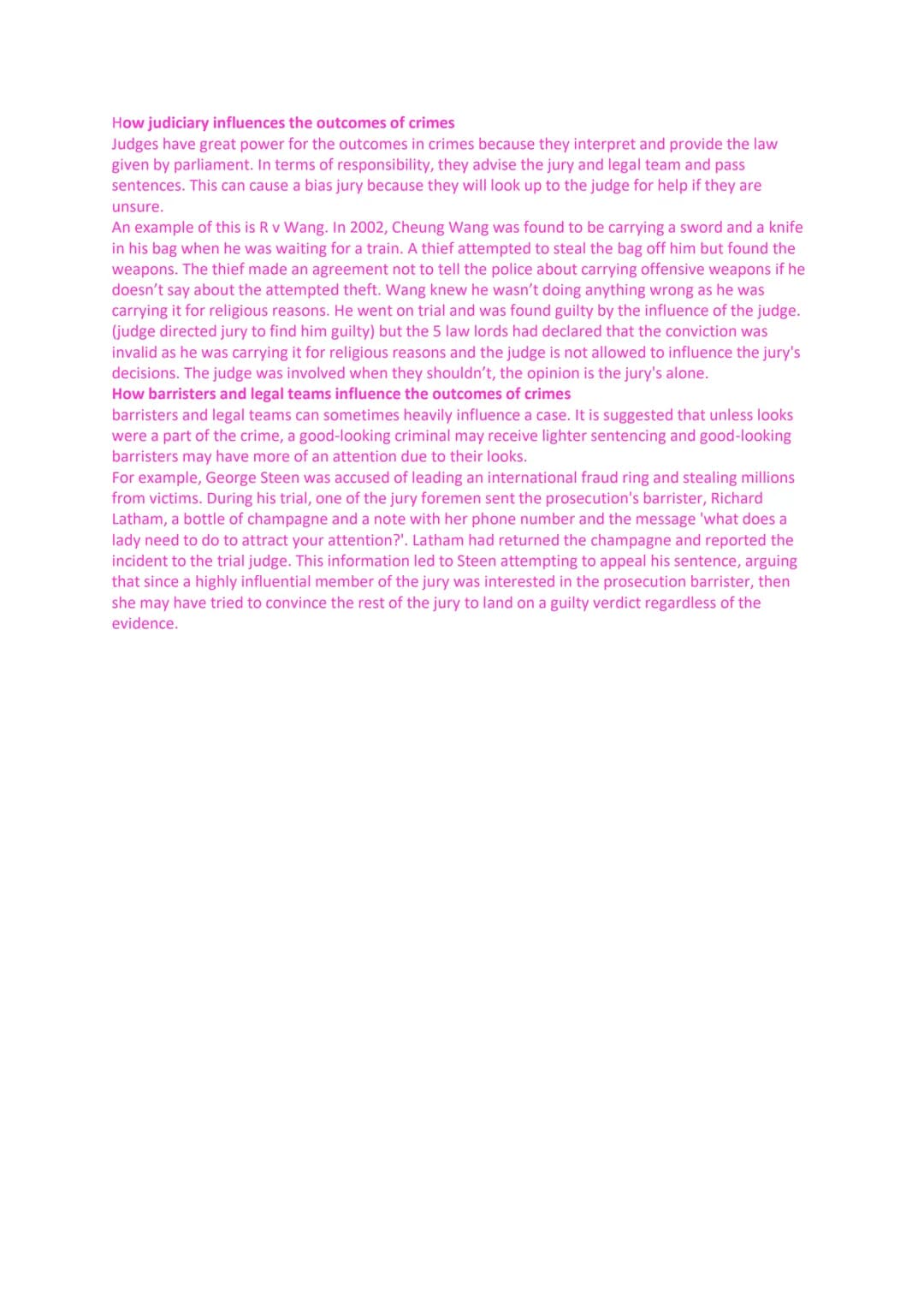
Judicial and Legal Team Influences
Judges wield enormous power in criminal trials through their ability to interpret law, advise juries, and determine sentences. However, they're supposed to remain neutral - when they cross this line, it can invalidate entire convictions.
The R v Wang case from 2002 shows what happens when judges overstep their boundaries. Wang carried religious weapons and was found guilty after the judge directed the jury's verdict. The conviction was later declared invalid because judges cannot influence jury decisions - that's the jury's job alone.
Barristers and legal teams can influence outcomes in unexpected ways, including through their physical appearance and charisma. Research suggests attractive defendants and lawyers may receive more favourable treatment, though this shouldn't affect justice.
Key Point: The George Steen fraud case shows how jury members can become inappropriately interested in attractive barristers, potentially affecting their verdict decisions.
The champagne incident in Steen's trial - where a jury member sent the prosecution barrister her phone number - demonstrates how personal attraction can compromise the entire judicial process. Steen used this incident to appeal his sentence, arguing the jury foreman's interest in the prosecutor may have influenced the guilty verdict.
We thought you’d never ask...
What is the Knowunity AI companion?
Our AI companion is specifically built for the needs of students. Based on the millions of content pieces we have on the platform we can provide truly meaningful and relevant answers to students. But its not only about answers, the companion is even more about guiding students through their daily learning challenges, with personalised study plans, quizzes or content pieces in the chat and 100% personalisation based on the students skills and developments.
Where can I download the Knowunity app?
You can download the app in the Google Play Store and in the Apple App Store.
Is Knowunity really free of charge?
That's right! Enjoy free access to study content, connect with fellow students, and get instant help – all at your fingertips.
Similar Content
 Pädagogik
 Religión
Most popular content: Social Influence
9 Psychology
Social Influence Overview
Explore key concepts in social influence, including conformity, obedience, and minority influence. This comprehensive summary covers essential studies such as Milgram's experiment, Asch's conformity tests, and the Stanford prison experiment, providing insights into the psychological mechanisms behind social behavior. Ideal for A-Level revision.
127,472320
PsychologyKey Concepts in Social Influence
Explore essential theories and experiments in social influence, including conformity, obedience, and minority influence. This summary covers key studies like Milgram's experiment, Asch's conformity tests, and the Stanford prison experiment, providing a comprehensive overview for AQA A Level psychology students.
128,537305
PsychologyUnderstanding Social Influence
Explore key concepts of social influence in AQA A-Level Psychology with this comprehensive mindmap. Delve into compliance, conformity, obedience, and minority influence, supported by landmark studies like Asch's and Milgram's experiments. Perfect for revision and enhancing your understanding of how social dynamics shape behavior.
123,636109
PsychologyUnderstanding Social Influence
Explore the key concepts of social influence, including obedience, conformity, and minority influence. This comprehensive summary covers essential studies like Milgram's experiment and the Stanford prison experiment, along with evaluations and theoretical frameworks. Ideal for psychology students seeking to grasp the dynamics of social behavior and influence.
123,401170
PsychologyUnderstanding Minority Influence
Explore the dynamics of minority influence in social psychology through Moscovici's study. This summary highlights key concepts such as consistency, commitment, and flexibility in shaping opinions. Learn how minority groups can effectively persuade the majority and the implications for social change. Ideal for psychology students preparing for exams or seeking to deepen their understanding of social influence mechanisms.
136338
PsychologyUnderstanding Social Influence
Explore key concepts in social influence, including conformity, obedience, and minority influence. This comprehensive revision note covers essential studies such as Asch's conformity experiments, Milgram's obedience research, and the Stanford prison experiment, providing insights into factors like social norms, peer influence, and the role of authority. Ideal for A Level Psychology students preparing for exams.
121,07219
PsychologyUnderstanding Social Influence
Explore key concepts in AQA A Level Psychology related to Social Influence, including Asch's conformity experiments, normative social influence, obedience, compliance, and minority influence. This summary provides a comprehensive overview of the factors affecting social behavior and the dynamics of group influence, supported by relevant research findings.
127507
PsychologyUnderstanding Minority Influence
Explore the dynamics of minority influence in social psychology. This summary covers key concepts such as consistency, commitment, and the processes of change that enable minorities to sway majority opinions. Ideal for A-Level students, this resource includes research findings from Moscovici and others, highlighting the importance of synchronic and diachronic consistency, the augmentation principle, and the snowball effect in social change.
121525
PsychologyUnderstanding Social Influence
Explore key theories and experiments in social influence, including obedience, conformity, and minority influence. This summary covers pivotal studies such as Milgram's obedience experiment, Asch's conformity research, and Zimbardo's Stanford prison experiment, providing insights into how social dynamics shape behavior. Ideal for psychology students seeking a comprehensive overview of social influence concepts.
121,15837
Most popular content in Criminology
9CriminologyCriminology: Crime & Punishment Overview
Comprehensive mindmaps covering key concepts in the Crime and Punishment topic for WJEC Criminology Unit 4. This resource includes detailed insights into the Criminal Justice System, crime prevention strategies, sentencing models, and the roles of various agencies. Ideal for A-Level revision, ensuring you grasp essential theories and legislative processes to excel in your exams.
1254,8691,059
CriminologyWJEC Unit 4 Criminology
Criminology unit 4 detailed revision note
127,151125
CriminologyCriminology Theories Overview
Explore key criminology theories and their implications on crime and deviance. This comprehensive summary covers biological, psychological, and sociological perspectives, including labelling theory, right realism, and the impact of social campaigns on policy development. Ideal for A-Level criminology students seeking to understand the complexities of criminal behaviour and the factors influencing crime prevention strategies.
129,760210
CriminologyCriminology WJEC unit 2
Unit 2 notes for criminology certificate WJEC
121,41328
CriminologyCriminology Theories Overview
Explore key concepts in criminology with this comprehensive summary covering Marxism, deviant behavior, biological theories, and more. Ideal for Year 12 students studying Unit 2, this resource provides textbook-accurate insights into the criminal justice system, individual rights, and various criminological theories. Enhance your understanding of crime and deviance with annotated notes designed for effective learning.
126,838159
CriminologyCriminology Unit 2 Overview
Explore a comprehensive summary of key concepts in criminology for WJEC Level 3 Unit 2. This document covers essential theories of crime, including biological, sociological, and psychological perspectives, as well as the impact of media, labelling theory, and crime types. Ideal for students preparing for exams or seeking a concise reference on crime and deviance.
122,56639
CriminologyCriminological Theories Overview
Explore key criminological theories including Marxism, Strain Theory, Labelling Theory, and Realism. This summary covers the impact of social structures on crime, the role of individual behavior, and the implications for crime policy and prevention. Ideal for WJEC Level 3 students studying criminology, this resource provides concise insights into the complexities of crime and deviance.
1219,976534
CriminologyCriminology Unit 4 Revision Cards
These were the revision cards I used for my Criminology Unit 4 exam. Feel free to print these out and use them as an exam resource, they have been colour coded for each AC. Good luck!
125,55090
CriminologyCriminology Unit 2
Part 2/2
1296434
Most popular content
9SociologySociology of Education Overview
Explore comprehensive A-Level Sociology notes on the education system, covering key theories, policies, and sociological perspectives. This resource includes insights on marketisation, gender roles, cultural deprivation, and educational inequalities, providing a thorough understanding of how education shapes social stratification and individual achievement. Ideal for exam preparation and in-depth study.
12102,8693,040
SociologySociology of Families: Comprehensive Revision
Dive into an extensive overview of family dynamics, perspectives, and patterns in sociology. This resource covers key concepts such as family diversity, gender roles, marriage, and the impact of social policies on family structures. Perfect for A-Level Sociology students preparing for Paper 2.
1273,6612,307
CriminologyCriminology: Crime & Punishment Overview
Comprehensive mindmaps covering key concepts in the Crime and Punishment topic for WJEC Criminology Unit 4. This resource includes detailed insights into the Criminal Justice System, crime prevention strategies, sentencing models, and the roles of various agencies. Ideal for A-Level revision, ensuring you grasp essential theories and legislative processes to excel in your exams.
1254,8691,059
SociologyComprehensive Crime & Deviance Overview
Explore an extensive revision of crime and deviance topics, including theories, types of crime, and the impact of media. This resource covers key concepts such as Marxism, functionalism, gender and crime, and the influence of globalization on criminal behavior. Ideal for students seeking a thorough understanding of criminology and its various theories. Type: Full Topic Revision.
1251,6541,399
C
 Biology
Cell Biology and Cell structure
cell structures
93,2470
 English Literature
An Inspector Calls: Character Insights
Explore in-depth analysis and key quotes for characters in J.B. Priestley's 'An Inspector Calls'. This resource covers Gerald Croft, Inspector Goole, Sheila Birling, Mrs. Birling, Eric Birling, and Eva Smith, focusing on themes of class, gender roles, and social responsibility. Ideal for students aiming for Grade 8 and above.
1025,429907
CriminologyWJEC Unit 4 Criminology
Criminology unit 4 detailed revision note
127,151125
CriminologyCriminology Theories Overview
Explore key criminology theories and their implications on crime and deviance. This comprehensive summary covers biological, psychological, and sociological perspectives, including labelling theory, right realism, and the impact of social campaigns on policy development. Ideal for A-Level criminology students seeking to understand the complexities of criminal behaviour and the factors influencing crime prevention strategies.
129,760210
English LiteratureRomeo and Juliet: Key themes
Key Romeo and Juliet themes and analysed quotes
106,708198
Can't find what you're looking for? Explore other subjects.
Students love us — and so will you.
4.6/5App Store
4.7/5Google Play
The app is very easy to use and well designed. I have found everything I was looking for so far and have been able to learn a lot from the presentations! I will definitely use the app for a class assignment! And of course it also helps a lot as an inspiration.
Stefan SiOS user
This app is really great. There are so many study notes and help [...]. My problem subject is French, for example, and the app has so many options for help. Thanks to this app, I have improved my French. I would recommend it to anyone.
Samantha KlichAndroid user
Wow, I am really amazed. I just tried the app because I've seen it advertised many times and was absolutely stunned. This app is THE HELP you want for school and above all, it offers so many things, such as workouts and fact sheets, which have been VERY helpful to me personally.
AnnaiOS user
Criminology1,954 views·Updated Jun 20, 2026·3 pagesUnderstanding the Main Factors That Impact Criminal Court Decisions
K🩷@kstudies
Ever wondered how criminal cases really get decided? It's not just about the evidence - loads of different factors can tip the scales of justice. From DNA samples to media headlines, witness memories to political pressure, understanding these influences helps...
1
of 3
Sign up to see the content. It's free!
- Access to all documents
- Improve your grades
- Join milions of students
Evidence, Media, and Witness Testimony in Criminal Cases
Physical evidence like DNA and blood samples pack the biggest punch in court because they're scientifically proven and hard to argue against. However, contamination during investigation can completely mess up a case and potentially lead to wrongful convictions.
The burden of proof sits squarely on the prosecution's shoulders - they must prove guilt whilst the defence can only challenge their claims. This gives prosecutors a major advantage since they control most of the evidence presented to the jury.
Media coverage can absolutely destroy the "innocent until proven guilty" principle. Take the 2011 London riots after Mark Duggan's death - media reports about his alleged criminal background sparked moral panic and influenced both public opinion and harsher sentencing for riot-related crimes.
Key Point: The media's portrayal of suspects often creates public pressure that can influence trial outcomes, even when initial reports prove inaccurate.
Eyewitness testimony might seem reliable, but it's surprisingly flaky. Memory fades over time, stress affects recall, and even seeing similar photos can alter someone's recollection. The Ronald Cotton case shows how confidently wrong witnesses can be - Jennifer Thompson was "certain" of his identity, yet DNA evidence later proved his innocence after 10 years in prison.
2
of 3Sign up to see the content. It's free!
- Access to all documents
- Improve your grades
- Join milions of students
Expert Witnesses and Political Influence
Expert witnesses carry serious weight because juries trust their specialist knowledge and credentials. They help explain complex evidence that ordinary people might not understand, making their testimony incredibly influential in reaching verdicts.
The Sally Clark case perfectly demonstrates how expert testimony can go horribly wrong. Professor Roy Meadow claimed the odds of both her children dying from SIDS were 1 in 73 million - completely flawed statistics that helped convict an innocent mother. She served three years before the conviction was overturned, but the damage was done.
Political pressure shapes criminal justice through Parliament's law-making power and influence over sentencing guidelines. Politicians can effectively pressure judges to impose harsher sentences, especially during public outcry over particular types of crimes.
Key Point: The Arms to Iraq scandal shows how political considerations can influence prosecution decisions - sometimes cases don't proceed because they'd embarrass the government.
The Dangerous Dogs Act 1991 emerged from media-driven moral panic about certain dog breeds. This demonstrates how political responses to public fear can create sweeping legislation that affects thousands of people based on isolated incidents rather than solid evidence.
3
of 3Sign up to see the content. It's free!
- Access to all documents
- Improve your grades
- Join milions of students
Judicial and Legal Team Influences
Judges wield enormous power in criminal trials through their ability to interpret law, advise juries, and determine sentences. However, they're supposed to remain neutral - when they cross this line, it can invalidate entire convictions.
The R v Wang case from 2002 shows what happens when judges overstep their boundaries. Wang carried religious weapons and was found guilty after the judge directed the jury's verdict. The conviction was later declared invalid because judges cannot influence jury decisions - that's the jury's job alone.
Barristers and legal teams can influence outcomes in unexpected ways, including through their physical appearance and charisma. Research suggests attractive defendants and lawyers may receive more favourable treatment, though this shouldn't affect justice.
Key Point: The George Steen fraud case shows how jury members can become inappropriately interested in attractive barristers, potentially affecting their verdict decisions.
The champagne incident in Steen's trial - where a jury member sent the prosecution barrister her phone number - demonstrates how personal attraction can compromise the entire judicial process. Steen used this incident to appeal his sentence, arguing the jury foreman's interest in the prosecutor may have influenced the guilty verdict.
We thought you’d never ask...
What is the Knowunity AI companion?
Our AI companion is specifically built for the needs of students. Based on the millions of content pieces we have on the platform we can provide truly meaningful and relevant answers to students. But its not only about answers, the companion is even more about guiding students through their daily learning challenges, with personalised study plans, quizzes or content pieces in the chat and 100% personalisation based on the students skills and developments.
Where can I download the Knowunity app?
You can download the app in the Google Play Store and in the Apple App Store.
Is Knowunity really free of charge?
That's right! Enjoy free access to study content, connect with fellow students, and get instant help – all at your fingertips.
Similar Content
Most popular content: Social Influence
9PsychologySocial Influence Overview
Explore key concepts in social influence, including conformity, obedience, and minority influence. This comprehensive summary covers essential studies such as Milgram's experiment, Asch's conformity tests, and the Stanford prison experiment, providing insights into the psychological mechanisms behind social behavior. Ideal for A-Level revision.
127,472320
PsychologyKey Concepts in Social Influence
Explore essential theories and experiments in social influence, including conformity, obedience, and minority influence. This summary covers key studies like Milgram's experiment, Asch's conformity tests, and the Stanford prison experiment, providing a comprehensive overview for AQA A Level psychology students.
128,537305
PsychologyUnderstanding Social Influence
Explore key concepts of social influence in AQA A-Level Psychology with this comprehensive mindmap. Delve into compliance, conformity, obedience, and minority influence, supported by landmark studies like Asch's and Milgram's experiments. Perfect for revision and enhancing your understanding of how social dynamics shape behavior.
123,636109
PsychologyUnderstanding Social Influence
Explore the key concepts of social influence, including obedience, conformity, and minority influence. This comprehensive summary covers essential studies like Milgram's experiment and the Stanford prison experiment, along with evaluations and theoretical frameworks. Ideal for psychology students seeking to grasp the dynamics of social behavior and influence.
123,401170
PsychologyUnderstanding Minority Influence
Explore the dynamics of minority influence in social psychology through Moscovici's study. This summary highlights key concepts such as consistency, commitment, and flexibility in shaping opinions. Learn how minority groups can effectively persuade the majority and the implications for social change. Ideal for psychology students preparing for exams or seeking to deepen their understanding of social influence mechanisms.
136338
PsychologyUnderstanding Social Influence
Explore key concepts in social influence, including conformity, obedience, and minority influence. This comprehensive revision note covers essential studies such as Asch's conformity experiments, Milgram's obedience research, and the Stanford prison experiment, providing insights into factors like social norms, peer influence, and the role of authority. Ideal for A Level Psychology students preparing for exams.
121,07219
PsychologyUnderstanding Social Influence
Explore key concepts in AQA A Level Psychology related to Social Influence, including Asch's conformity experiments, normative social influence, obedience, compliance, and minority influence. This summary provides a comprehensive overview of the factors affecting social behavior and the dynamics of group influence, supported by relevant research findings.
127507
PsychologyUnderstanding Minority Influence
Explore the dynamics of minority influence in social psychology. This summary covers key concepts such as consistency, commitment, and the processes of change that enable minorities to sway majority opinions. Ideal for A-Level students, this resource includes research findings from Moscovici and others, highlighting the importance of synchronic and diachronic consistency, the augmentation principle, and the snowball effect in social change.
121525
PsychologyUnderstanding Social Influence
Explore key theories and experiments in social influence, including obedience, conformity, and minority influence. This summary covers pivotal studies such as Milgram's obedience experiment, Asch's conformity research, and Zimbardo's Stanford prison experiment, providing insights into how social dynamics shape behavior. Ideal for psychology students seeking a comprehensive overview of social influence concepts.
121,15837
Most popular content in Criminology
9CriminologyCriminology: Crime & Punishment Overview
Comprehensive mindmaps covering key concepts in the Crime and Punishment topic for WJEC Criminology Unit 4. This resource includes detailed insights into the Criminal Justice System, crime prevention strategies, sentencing models, and the roles of various agencies. Ideal for A-Level revision, ensuring you grasp essential theories and legislative processes to excel in your exams.
1254,8691,059
CriminologyWJEC Unit 4 Criminology
Criminology unit 4 detailed revision note
127,151125
CriminologyCriminology Theories Overview
Explore key criminology theories and their implications on crime and deviance. This comprehensive summary covers biological, psychological, and sociological perspectives, including labelling theory, right realism, and the impact of social campaigns on policy development. Ideal for A-Level criminology students seeking to understand the complexities of criminal behaviour and the factors influencing crime prevention strategies.
129,760210
CriminologyCriminology WJEC unit 2
Unit 2 notes for criminology certificate WJEC
121,41328
CriminologyCriminology Theories Overview
Explore key concepts in criminology with this comprehensive summary covering Marxism, deviant behavior, biological theories, and more. Ideal for Year 12 students studying Unit 2, this resource provides textbook-accurate insights into the criminal justice system, individual rights, and various criminological theories. Enhance your understanding of crime and deviance with annotated notes designed for effective learning.
126,838159
CriminologyCriminology Unit 2 Overview
Explore a comprehensive summary of key concepts in criminology for WJEC Level 3 Unit 2. This document covers essential theories of crime, including biological, sociological, and psychological perspectives, as well as the impact of media, labelling theory, and crime types. Ideal for students preparing for exams or seeking a concise reference on crime and deviance.
122,56639
CriminologyCriminological Theories Overview
Explore key criminological theories including Marxism, Strain Theory, Labelling Theory, and Realism. This summary covers the impact of social structures on crime, the role of individual behavior, and the implications for crime policy and prevention. Ideal for WJEC Level 3 students studying criminology, this resource provides concise insights into the complexities of crime and deviance.
1219,976534
CriminologyCriminology Unit 4 Revision Cards
These were the revision cards I used for my Criminology Unit 4 exam. Feel free to print these out and use them as an exam resource, they have been colour coded for each AC. Good luck!
125,55090
CriminologyCriminology Unit 2
Part 2/2
1296434
Most popular content
9SociologySociology of Education Overview
Explore comprehensive A-Level Sociology notes on the education system, covering key theories, policies, and sociological perspectives. This resource includes insights on marketisation, gender roles, cultural deprivation, and educational inequalities, providing a thorough understanding of how education shapes social stratification and individual achievement. Ideal for exam preparation and in-depth study.
12102,8693,040
SociologySociology of Families: Comprehensive Revision
Dive into an extensive overview of family dynamics, perspectives, and patterns in sociology. This resource covers key concepts such as family diversity, gender roles, marriage, and the impact of social policies on family structures. Perfect for A-Level Sociology students preparing for Paper 2.
1273,6612,307
CriminologyCriminology: Crime & Punishment Overview
Comprehensive mindmaps covering key concepts in the Crime and Punishment topic for WJEC Criminology Unit 4. This resource includes detailed insights into the Criminal Justice System, crime prevention strategies, sentencing models, and the roles of various agencies. Ideal for A-Level revision, ensuring you grasp essential theories and legislative processes to excel in your exams.
1254,8691,059
SociologyComprehensive Crime & Deviance Overview
Explore an extensive revision of crime and deviance topics, including theories, types of crime, and the impact of media. This resource covers key concepts such as Marxism, functionalism, gender and crime, and the influence of globalization on criminal behavior. Ideal for students seeking a thorough understanding of criminology and its various theories. Type: Full Topic Revision.
1251,6541,399
C
BiologyCell Biology and Cell structure
cell structures
93,2470
English LiteratureAn Inspector Calls: Character Insights
Explore in-depth analysis and key quotes for characters in J.B. Priestley's 'An Inspector Calls'. This resource covers Gerald Croft, Inspector Goole, Sheila Birling, Mrs. Birling, Eric Birling, and Eva Smith, focusing on themes of class, gender roles, and social responsibility. Ideal for students aiming for Grade 8 and above.
1025,429907
CriminologyWJEC Unit 4 Criminology
Criminology unit 4 detailed revision note
127,151125
CriminologyCriminology Theories Overview
Explore key criminology theories and their implications on crime and deviance. This comprehensive summary covers biological, psychological, and sociological perspectives, including labelling theory, right realism, and the impact of social campaigns on policy development. Ideal for A-Level criminology students seeking to understand the complexities of criminal behaviour and the factors influencing crime prevention strategies.
129,760210
English LiteratureRomeo and Juliet: Key themes
Key Romeo and Juliet themes and analysed quotes
106,708198
Can't find what you're looking for? Explore other subjects.
Students love us — and so will you.
4.6/5App Store
4.7/5Google Play
The app is very easy to use and well designed. I have found everything I was looking for so far and have been able to learn a lot from the presentations! I will definitely use the app for a class assignment! And of course it also helps a lot as an inspiration.
Stefan SiOS user
This app is really great. There are so many study notes and help [...]. My problem subject is French, for example, and the app has so many options for help. Thanks to this app, I have improved my French. I would recommend it to anyone.
Samantha KlichAndroid user
Wow, I am really amazed. I just tried the app because I've seen it advertised many times and was absolutely stunned. This app is THE HELP you want for school and above all, it offers so many things, such as workouts and fact sheets, which have been VERY helpful to me personally.
AnnaiOS user